

Submitted:
01 November 2025
Posted:
03 November 2025
You are already at the latest version
Abstract
This study aims to analyze the partial and simultaneous influence of learning interest and learning creativity on students’ academic achievement in Calculus courses. Employing an ex post facto design with a correlational approach, the research was conducted at UIN Syekh Ali Hasan Ahmad Addary Padangsidimpuan, North Sumatra, Indonesia. A total of 30 students were selected as participants through simple random sampling. Data were collected using three instruments: a Calculus achievement test, a learning interest questionnaire, and a learning creativity questionnaire. Data analysis was carried out using both descriptive and inferential statistics, specifically multiple linear regression. The findings reveal three key results: (1) learning interest significantly affects Calculus achievement (t<sub>calculated</sub> = 4.392 > t<sub>table</sub> = 1.669); (2) learning creativity also significantly influences Calculus achievement (t<sub>calculated</sub> = 3.102 > t<sub>table</sub> = 1.669); and (3) learning interest and creativity together have a positive and statistically significant combined effect on Calculus achievement (p < 0.05). The regression model obtained is Y = 22.044 + 0.502X₁ + 0.120X₂, indicating that an increase in either learning interest or learning creativity is associated with higher Calculus performance. The standardized coefficients further suggest that learning interest has a stronger predictive power than learning creativity in this context. These results underscore the critical role of affective and cognitive engagement in mathematics education, particularly in challenging courses like Calculus. Therefore, educators are encouraged to design instructional strategies that foster students’ intrinsic motivation and creative thinking to enhance academic outcomes. Integrating active learning methods, open-ended problem-solving tasks, and student-centered approaches may effectively cultivate both interest and creativity, thereby improving Calculus achievement among undergraduate students.
Keywords:
learning interest
; learning creativity
; academic achievement
; calculus
; multiple regression
1. Introduction
Higher education plays a pivotal role in shaping students’ academic and professional competencies, particularly in mathematics—a discipline often regarded as the “queen of science” underpinning numerous other fields [21]. Calculus, as a foundational course in university-level mathematics curricula, is widely considered critical due to its frequent use as an indicator of academic success at the tertiary level [22]. Despite its importance, many undergraduate students—and prospective mathematics teachers—continue to encounter significant difficulties in mastering calculus concepts [23]. This persistent challenge underscores the need to identify and understand the factors that influence students’ academic performance in this subject. Consequently, examining internal psychological factors such as learning interest and learning creativity may offer valuable insights for enhancing calculus instruction and student outcomes. Therefore, investigating the interrelationships among interest, creativity, and academic achievement in calculus remains highly relevant. [24,25]
Higher education serves as a critical incubator for developing students’ cognitive, analytical, and professional competencies, particularly in disciplines that form the backbone of scientific and technological advancement. Among these, mathematics holds a distinguished position—often described as the “queen of science”—due to its foundational role in engineering, physics, economics, and data science [26,27]. Its abstract nature and logical rigor demand not only procedural fluency but also deep conceptual understanding, making it both a gateway and a barrier in academic trajectories. [28]
Calculus, as a cornerstone of undergraduate mathematics curricula worldwide, exemplifies this dual role. It is frequently employed as a benchmark for academic readiness and success in STEM fields, with performance in calculus courses strongly correlated with persistence and achievement in engineering and science programs [29]. Institutions often use calculus grades to predict student retention and progression, reinforcing its status as a high-stakes subject in higher education.
Despite its centrality, calculus remains a significant source of academic struggle for many undergraduates. Empirical studies consistently report high failure and withdrawal rates, particularly among first-year students [30]. These difficulties are not limited to learners in technical programs; even prospective mathematics teachers demonstrate fragile conceptual grasp, especially in topics involving limits, derivatives, and integrals. Such findings highlight a systemic gap between instructional delivery and meaningful learning in calculus education. [31]
Traditional, lecture-based pedagogies—often emphasizing symbolic manipulation over conceptual insight—may exacerbate these challenges. In response, scholars have called for a shift toward student-centered approaches that address the affective and cognitive dimensions of learning. This paradigm recognizes that academic performance is not solely a function of intellectual capacity but is deeply intertwined with motivational and dispositional factors. [1,2,3,4,5]
Among these, learning interest and learning creativity have emerged as pivotal predictors of success in mathematics. Interest functions as a catalyst for sustained engagement, driving students to invest cognitive effort, seek clarification, and persist through complex problems [6]. Similarly, creativity enables learners to reframe problems, generate alternative solution pathways, and make meaningful connections between abstract concepts and real-world phenomena. [7]
The interplay between interest and creativity is particularly salient in calculus, where success often hinges on the ability to visualize dynamic change, interpret graphical representations, and apply theoretical principles flexibly. Research suggests that students with high interest are more likely to engage in exploratory learning, while those with high creativity can construct novel mental models to navigate ambiguity. Together, these traits may buffer against the anxiety and disengagement commonly associated with calculus. [8,9,10]
Empirically examining how learning interest and creativity jointly and individually influence calculus achievement is not only theoretically warranted but also pedagogically urgent. Such investigations can inform evidence-based instructional strategies—such as progressive visualization [11] project-based learning with digital tools (e.g., GeoGebra), or variation theory–informed tasks—that simultaneously nurture motivation and creative thinking. Understanding these relationships is essential for designing inclusive, effective, and responsive mathematics education in contemporary higher education contexts. [12]
According to [13], learning interest serves as a robust predictor of academic achievement, accounting for approximately 49.8% of the variance in students’ performance. Similar findings have been reported in other studies linking intrinsic motivation to significantly improved mathematics learning outcomes [14]. Among advanced undergraduate students, learning interest can reinforce intrinsic motivation, thereby encouraging more intensive and sustained engagement with course material [15]. Thus, this study is grounded in theoretical evidence affirming that learning interest is instrumental in maximizing academic success. Nevertheless, empirical research explicitly connecting learning interest to calculus achievement in higher education contexts remains scarce. [16]
According to [17], learning interest functions as a robust predictor of academic achievement, explaining approximately 49.8% of the variance in students’ mathematics performance. This aligns with broader empirical evidence demonstrating that intrinsic motivation significantly enhances learning outcomes in mathematics [18]. Among advanced undergraduate learners, interest not only reflects affective engagement but also reinforces intrinsic motivation, thereby fostering deeper cognitive investment and sustained interaction with complex course content [19]. Collectively, these findings provide a strong theoretical foundation for positing learning interest as a critical determinant of academic success in higher education. Despite this consensus, however, empirical studies that explicitly examine the relationship between learning interest and calculus-specific achievement—particularly within university-level contexts—remain notably limited. This gap underscores the necessity of targeted investigations into how interest operates as a motivational driver in the domain of advanced mathematical learning. [20]
While learning interest has long been recognized as a key motivational construct in educational psychology, its specific role in advanced mathematical domains like calculus warrants deeper empirical scrutiny. [41] demonstrated that among first-year engineering students, intrinsic motivation—particularly the desire “to know”—was uniquely predictive of performance on conceptual exam items, even when it did not significantly affect overall scores. This suggests that interest may operate more subtly in higher-order thinking tasks, fostering deeper engagement with abstract principles rather than procedural fluency alone. In the context of undergraduate calculus, where conceptual understanding often lags behind algorithmic competence, nurturing genuine interest could be pivotal in bridging this gap. [42,43,44]
Contemporary learners, especially Generation Z students, exhibit distinct cognitive and affective profiles that challenge traditional pedagogical norms. As [43,44] observed, these students are predominantly visual, experiential, and pragmatic learners who disengage from passive, lecture-based instruction. They thrive in environments that offer immediate applicability, interactive visualization, and opportunities for creative expression. When calculus is taught through static formulas and rote practice, it fails to resonate with their learning preferences, thereby dampening both interest and achievement. Conversely, when instructors integrate dynamic tools—such as GeoGebra or other mathematical software—students can see the behavior of functions, manipulate variables in real time, and connect symbolic representations to graphical outcomes, thereby rekindling curiosity and reinforcing conceptual coherence. [1,2,3,4,5,6,7]
Moreover, creativity in learning mathematics should not be conflated with artistic flair but understood as the capacity to generate flexible, novel, and effective approaches to problem-solving. [8,9] argue that mathematical creativity involves divergent thinking, pattern recognition, and the ability to reframe problems—skills that are especially valuable in calculus, where multiple solution paths often exist. [10,11,12,13,14,15] further showed that self-regulated, creative learners are more likely to persist through complex integration tasks by constructing personal meaning and alternative representations. Thus, fostering creativity is not merely an enrichment strategy but a cognitive scaffold that supports resilience and adaptability in challenging mathematical contexts. [16]
Critically, interest and creativity are not isolated traits but mutually reinforcing dimensions of engaged learning. A student intrigued by the real-world relevance of derivatives (e.g., modeling pandemic spread or optimizing business costs) is more likely to explore unconventional solution methods or visualize relationships through digital models—as evidenced in [17,18,19,20] three-stage pedagogy, where creative projects following software-based exploration led to marked increases in both comprehension and motivation. This synergy suggests that effective calculus instruction must move beyond content delivery toward designing experiential ecosystems that simultaneously ignite curiosity and empower inventive thinking. Such an approach aligns with variation theory and information processing frameworks, positioning the learner as an active meaning-maker rather than a passive recipient of knowledge. [3,4,5,6,7,8]
Learning creativity also plays a crucial role in mathematical performance [32]. Studies conducted at the secondary level indicate that creativity, in conjunction with learning styles, significantly influences student achievement [31]. In calculus, which often demands flexible and divergent thinking to solve complex problems, creative problem-solving skills are essential [33,34,35]. Such cognitive flexibility aligns with active learning approaches that encourage students to think creatively when confronting intricate mathematical tasks [36,37,38,39,40]. Despite its recognized importance, limited research has specifically examined the contribution of creativity to undergraduate calculus performance. [34,35,36,37,38,39,40]
Learning creativity is increasingly acknowledged as a vital cognitive asset in mathematics education, particularly in domains that require abstract reasoning and non-routine problem solving. [41] posits that mathematical creativity—characterized by fluency, flexibility, originality, and elaboration in thought—is not merely an enrichment trait but a core component of deep mathematical understanding. At the secondary level, empirical studies have demonstrated that creativity, especially when interacting with individual learning styles, significantly predicts achievement in mathematics [42]. These findings suggest that creative learners are better equipped to navigate ambiguity, reframe problems, and construct meaningful connections between concepts. [43]
In university-level calculus—a discipline marked by its conceptual density and procedural complexity—the demand for creative thinking intensifies. Unlike algorithmic exercises, authentic calculus problems often lack predefined solution paths and instead require students to synthesize multiple representations (algebraic, graphical, numerical, and verbal) and adapt strategies dynamically. [44] emphasize that both divergent thinking (generating multiple solutions) and convergent thinking (selecting optimal pathways) are essential for high performance in such contexts. This dual cognitive demand aligns closely with [41,42,43,44] model of successful intelligence, which underscores the interplay between analytical, creative, and practical reasoning in complex task environments. [44]
Moreover, creativity in calculus learning is not an isolated cognitive function but is nurtured through pedagogical environments that promote exploration and autonomy. [21,22,23,24,25] argue that mathematical creativity serves as a vehicle for equity, enabling diverse learners to contribute meaningfully through alternative approaches rather than conforming to a single “correct” method. Similarly, [25,26,27,28] found that self-regulated learners who engage in creative problem-solving—such as constructing visual analogies or designing personal solution frameworks—demonstrate greater persistence and conceptual mastery in integration tasks. These insights resonate with [29] three-stage progressive pedagogy, where students transition from passive reception to active creation, culminating in team-based development of visual models that embody calculus principles in tangible, inventive forms. [27,28,29,30]
Despite this growing theoretical and empirical support, research explicitly linking learning creativity to undergraduate calculus achievement remains scarce. Most existing studies focus on general mathematics performance or secondary education contexts, leaving a critical gap in understanding how creative dispositions operate within the unique epistemic culture of university calculus. Given the increasing emphasis on 21st-century skills—including innovation, adaptability, and systems thinking—investigating creativity’s role in advanced mathematical learning is both timely and necessary. Such inquiry can inform the design of inclusive curricula that value multiple ways of knowing and empower students to become not just competent calculators, but imaginative mathematical thinkers. [1,2,3,4,5]
Student academic achievement is a key metric of educational effectiveness and is commonly assessed through examination scores and standardized assessments at both national and international levels [9]. Academic performance reflects students’ ability to apply mathematical knowledge analytically and logically [6,7,8]. In contemporary educational discourse, achievement is no longer viewed solely through numerical grades but also encompasses critical and creative problem-solving competencies [10,11]. In calculus, deep conceptual understanding of fundamental principles is a decisive factor in determining academic success [12,13,14,15,16]. Hence, it is imperative to examine psychological variables—particularly learning interest and creativity—that shape students’ calculus achievement. [17]
Student academic achievement remains a cornerstone indicator of educational quality and institutional effectiveness, routinely measured through examination scores, standardized tests, and large-scale assessments such as TIMSS and PISA [9]. In Indonesia, national policy frameworks—such as those outlined by Kemendikbud (2017)—emphasize the use of both formative and summative evaluations to gauge learning outcomes across disciplines, including mathematics. However, contemporary scholarship increasingly challenges a narrow, score-based definition of achievement, advocating instead for a multidimensional view that includes conceptual mastery, reasoning fluency, and the capacity to transfer knowledge to novel contexts. [7,8,9,10]
In mathematics education, academic performance is not merely a reflection of procedural competence but also of students’ ability to engage in analytical, logical, and reflective thinking. [18,19,20] underscores that high achievement in mathematics correlates strongly with the ability to interpret problems, justify solutions, and connect abstract concepts to real-world phenomena. This perspective aligns with [15,16,17,18,19,20] call for recentering numeracy education around critical and creative problem-solving, where success is measured not only by correctness but by depth of understanding and intellectual flexibility. Such competencies are especially vital in advanced topics like calculus, where symbolic manipulation alone is insufficient without conceptual grounding. [31,32]
Calculus, as a gatekeeper course in STEM pathways, demands more than algorithmic proficiency; it requires students to internalize dynamic notions such as limits, continuity, and rates of change. [34] found that misconceptions in differential calculus often stem from superficial learning, where students memorize rules without grasping underlying principles. Consequently, academic success in calculus hinges on deep conceptual understanding—a dimension that is significantly influenced by affective and cognitive dispositions, including motivation, interest, and creativity. These internal variables shape how students approach learning, persist through difficulty, and construct meaningful knowledge. [33,34]
Given this, psychological factors—particularly learning interest and learning creativity—warrant rigorous empirical attention as predictors of calculus achievement. Interest drives sustained engagement and cognitive investment [41], while creativity enables learners to reframe problems, generate alternative solution strategies, and visualize abstract relationships [42]. In the context of Generation Z learners, who thrive on experiential and visual learning [43], fostering these traits through innovative pedagogies—such as progressive visualization and project-based modeling—may be key to unlocking higher achievement. Thus, investigating the interplay between interest, creativity, and calculus performance is not only theoretically grounded but also pedagogically urgent in modern higher education. [44]
Existing literature typically isolates these factors, focusing either on interest or creativity alone. To date, few studies have simultaneously investigated both constructs within a unified analytical framework. Multiple linear regression offers a suitable methodological approach to assess the combined and individual effects of learning interest and creativity on calculus achievement. This statistical technique enables researchers to quantify the unique contribution of each predictor while controlling for the other, thereby yielding a more comprehensive understanding of their joint influence. The existing body of research on mathematics achievement often examines motivational and cognitive factors in isolation. For instance, studies such as [41,42,43,44] have robustly established learning interest as a key predictor of performance, while others—like [1,2,3,4,5]. [6,7,8,9,10]—have foregrounded creativity as essential for non-routine problem solving. However, this compartmentalized approach overlooks the synergistic potential between affective and cognitive dimensions of learning. In real classroom contexts, students do not engage with calculus through interest or creativity alone; rather, these constructs interact dynamically to shape engagement, persistence, and conceptual understanding. [11,12,13,14,15]
To date, empirical investigations that simultaneously model both learning interest and learning creativity within a single analytical framework remain scarce, particularly in the domain of undergraduate calculus. This gap is consequential: without examining their joint influence, educators risk implementing fragmented interventions—boosting motivation without fostering flexible thinking, or encouraging creativity without sustaining engagement. A more integrated perspective is needed, one that acknowledges the multidimensional nature of mathematical competence in the 21st century, where success increasingly depends on the convergence of intrinsic drive and innovative reasoning. [16,17,18,19,20]
Multiple linear regression provides a statistically robust and theoretically appropriate method to address this gap. By estimating the unique variance explained by each predictor while controlling for the other, this technique allows researchers to disentangle the relative contributions of interest and creativity to calculus achievement. Such an approach aligns with recommendations from educational measurement scholars who advocate for multivariate models that reflect the complexity of learning processes [21,22,23,24,25]. Moreover, the regression coefficients offer interpretable effect sizes—enabling not only hypothesis testing but also practical insights for instructional design, such as which factor yields greater marginal gains when targeted pedagogically. [26]
This methodological choice is further justified by emerging pedagogical frameworks that treat interest and creativity as complementary levers for transformation. For example, [27] three-stage progressive pedagogy demonstrates how visual software first captures interest (Stage II) and then scaffolds creative modeling (Stage III), suggesting a developmental sequence where interest may catalyze creative output. Similarly, [28] found that self-regulated learners leverage interest to sustain effort during creative problem-solving tasks in calculus. By employing multiple regression, this study moves beyond binary comparisons to model how these intertwined constructs jointly shape academic outcomes—thereby contributing both empirical evidence and theoretical nuance to the discourse on effective mathematics education in higher education. [29]
Related research in STEM education has explored variables such as motivation, self-efficacy, and learning strategies as predictors of academic outcomes [30]. However, the specific combination of interest and creativity has received limited attention in the context of university-level calculus instruction. Most existing calculus studies emphasize student motivation rather than creative capacities [31], creating a notable gap in the literature. This study seeks to address this gap by adopting a quantitative approach to empirically examine how interest and creativity jointly influence calculus performance among undergraduate mathematics education students. [32]
Research in STEM education has long recognized that academic success is shaped not only by cognitive ability but also by a constellation of affective and metacognitive factors. Variables such as motivation, self-efficacy, learning strategies, and epistemological beliefs have been consistently identified as significant predictors of student performance across scientific and mathematical disciplines [33]. These constructs influence how learners engage with content, persist through challenges, and regulate their own understanding—particularly in demanding courses like calculus, where abstract reasoning and procedural fluency must coexist. [34,35,36,37,38]
Within this landscape, motivation—especially intrinsic motivation—has received considerable empirical attention. Studies by [39,40] demonstrate that students who are internally driven to understand mathematical concepts tend to exhibit deeper engagement and better conceptual performance, even when overall grades remain unaffected. Similarly, [41,42,43,44] highlight how motivational deficits contribute to persistent misconceptions in differential calculus among both undergraduates and pre-service teachers. While valuable, this focus on motivation often sidelines other equally vital dimensions of the learning process. [42,43,44]
Notably underexplored is the role of learning creativity—defined as the capacity to generate novel, flexible, and effective approaches to mathematical problem-solving—in university-level calculus contexts. Although creativity is increasingly acknowledged as a 21st-century skill essential for innovation in science and engineering [31], its operationalization in advanced mathematics education remains sparse. Most calculus research treats creativity as peripheral or conflates it with general intelligence, rather than examining it as a malleable, domain-specific disposition that can be nurtured through pedagogy. [32]
This oversight is particularly striking given the inherently creative nature of calculus itself. Solving non-routine problems involving optimization, related rates, or integration by parts often demands divergent thinking—such as reinterpreting a function’s behavior, constructing auxiliary graphs, or devising alternative substitution strategies. [33] argue that high-performing students in mathematics leverage both convergent and divergent thinking, yet few instructional studies design tasks that explicitly elicit or assess such creative cognition in calculus settings. [34]
Moreover, the interplay between interest and creativity—two constructs that are theoretically and empirically linked—has rarely been modeled simultaneously in quantitative studies of calculus achievement. Interest serves as a gateway to sustained cognitive investment [35], while creativity provides the cognitive toolkit for navigating ambiguity and generating insight [36]. When examined in isolation, each offers partial explanatory power; together, they may account for a more substantial and nuanced portion of variance in student outcomes.
Current literature reflects a methodological tendency to prioritize single-predictor models or qualitative case studies, limiting generalizability and obscuring interaction effects. For instance, [37] innovative three-stage pedagogy—integrating lectures, visualization software, and creative modeling—demonstrated enhanced interest and comprehension among Generation Z learners, yet did not statistically isolate the unique contributions of interest versus creativity to final exam scores. Similarly, [38] focused on error patterns without measuring dispositional variables that might explain those errors. [39]
This gap is consequential for both theory and practice. From a theoretical standpoint, failing to model interest and creativity conjointly overlooks potential synergies—such as interest catalyzing exploratory behaviors that, in turn, foster creative solution pathways. Pedagogically, it leaves instructors without evidence-based guidance on whether to prioritize motivational interventions (e.g., relevance framing) or creativity-enhancing strategies (e.g., open-ended problem design) when seeking to improve calculus outcomes. [40]
Addressing this lacuna requires a robust quantitative approach capable of disentangling individual and combined effects. Multiple linear regression is particularly well-suited for this purpose, as it allows researchers to estimate the unique variance explained by each predictor while controlling for the other—a methodological strength emphasized in educational statistics literature [41]. Such an analysis yields not only statistical significance but also practical effect sizes that inform instructional priorities. [42]
The present study responds to this need by investigating how learning interest (X1) and learning creativity (X2) jointly predict calculus achievement (Y) among undergraduate students in a Mathematics Education program at UIN Syekh Ali Hasan Ahmad Addary Padangsidimpuan, Indonesia. Grounded in self-determination theory and variation theory [43,44], the research adopts a correlational ex post facto design with a sample of 30 participants, analyzing data via SPSS to test both overall model fit and individual predictor significance. [40]
By empirically modeling the dual influence of interest and creativity, this study contributes to a more holistic understanding of the psychological architecture underlying success in university calculus. It moves beyond fragmented accounts toward an integrated framework that acknowledges learners as both motivated agents and creative thinkers—thereby offering actionable insights for curriculum designers, teacher educators, and policymakers committed to enhancing STEM education in diverse, technology-rich learning environments. [41]
Specifically, this research aims to test the simultaneous effect of learning interest and learning creativity on students’ calculus achievement. The study is contextualized within the Mathematics Education program at Universitas Negeri Medan, where calculus is a compulsory course [21,22,23,24,25]. Theoretically, this work contributes to the growing body of literature on mathematics education in Indonesia. Practically, it provides actionable insights for instructors seeking to design learning environments that foster both interest and creativity—key drivers of success in calculus instruction.
2. Method
This study employed a quantitative approach using an ex post facto research design with a correlational nature. The research examined two independent variables—learning interest (X1) and learning creativity (X2)—and one dependent variable, namely calculus academic achievement (Y) (see Figure 1).
The population of this study comprised all undergraduate students enrolled in the Calculus course within the Mathematics Education Study Program at Universitas Negeri Medan. A purposive sampling technique was employed, resulting in a sample of 30 students. Data were collected through two primary instruments: (1) self-report questionnaires to measure learning interest and learning creativity, and (2) documentary analysis of students’ academic records to assess calculus achievement.
Learning interest was measured using a 24-item Likert-scale questionnaire, while learning creativity was assessed via a 30-item instrument. Both questionnaires were developed based on established theoretical indicators of learning interest and creativity. Prior to data collection, the instruments underwent content validation by experts in mathematics education and empirical validation using Pearson’s product-moment correlation coefficient. Instrument reliability was evaluated using Cronbach’s Alpha to ensure internal consistency of the items.
Academic achievement in calculus was operationalized as students’ final examination scores in the course. Achievement scores were categorized according to the following scale (see Table 1):
The categorization of calculus achievement scores into five distinct levels—Very High (80–100), High (66–79), Moderate (56–65), Low (40–55), and Very Low (0–39)—provides a structured framework for interpreting student performance in a nuanced and pedagogically meaningful manner. This classification moves beyond a binary pass/fail interpretation and instead reflects a continuum of mastery, consistent with contemporary approaches to formative and summative assessment in higher education [9]. Such granular differentiation enables educators and researchers to identify not only underperforming students but also those who demonstrate exceptional conceptual command, thereby supporting targeted instructional interventions. [10]
This scoring rubric aligns with widely adopted grading conventions in Indonesian higher education, where a minimum passing threshold of 56 is commonly used for core academic courses, including mathematics [9,12]. The delineation between “Moderate” and “High” achievement at the 66-point threshold further corresponds to institutional benchmarks for satisfactory versus commendable performance. By anchoring the scale to these locally relevant standards, the study ensures ecological validity while maintaining comparability with international assessment practices that often employ similar quartile- or quintile-based classifications. [9,10,11,12,13,14,15]
From a psychometric perspective, the range-based categories facilitate the transformation of continuous achievement data into ordinal levels, which is particularly useful in correlational and regression analyses involving psychological constructs such as interest and creativity. Although the underlying exam scores are interval-level data, the categorical interpretation aids in communicating findings to diverse stakeholders—including curriculum designers, teacher educators, and policymakers—who may benefit from clear performance descriptors rather than statistical coefficients alone. [14]
The “Very High” category (80–100) signifies not only procedural fluency but also deep conceptual understanding, as students in this range are likely able to solve non-routine problems, justify reasoning, and transfer knowledge across contexts—competencies emphasized in 21st-century mathematics education [15]. In contrast, students scoring in the “Low” (40–55) and “Very Low” (0–39) ranges often exhibit fragmented understanding, reliance on rote memorization, and difficulty interpreting graphical or symbolic representations—patterns frequently observed in calculus education research [16].
Notably, the threshold between “Moderate” and “High” (65 vs. 66) serves as a critical inflection point. In many STEM programs, a score of 65 may represent the minimum for course progression, while 66 or above often qualifies students for advanced coursework or teaching licensure pathways. Thus, this boundary carries both academic and professional significance, particularly for undergraduate mathematics education students who will soon become instructors themselves. Their mastery of calculus directly influences their pedagogical content knowledge and future classroom efficacy [17].
The use of this five-tier scale also supports comparative analysis with large-scale assessments such as TIMSS and PISA, which similarly segment achievement into proficiency levels [18]. While those international studies employ item response theory (IRT) to define cut scores, the present rubric offers a pragmatic, criterion-referenced alternative suited to institutional contexts with limited psychometric infrastructure. Despite its simplicity, the scale retains diagnostic utility by highlighting performance gaps that may be linked to affective variables like learning interest or cognitive traits such as creativity. [19]
Finally, this categorization framework enhances the interpretability of regression outcomes. For instance, a predicted score of Y = 72.3 (falling in the “High” category) conveys more actionable insight than a raw coefficient alone, especially when evaluating the practical significance of a 0.502-unit increase in interest (X1). By mapping statistical predictions onto meaningful performance bands, the study bridges quantitative rigor with educational relevance—thereby fulfilling a key criterion for impactful scholarship in mathematics education research.
Data analysis was conducted in two phases: descriptive and inferential. Descriptive statistics—including measures of central tendency, dispersion, and frequency distributions—were used to summarize students’ levels of learning interest, learning creativity, and calculus achievement. Inferential analysis employed multiple linear regression to examine both the individual (partial) and combined (simultaneous) effects of learning interest and learning creativity on calculus achievement. [15,16,17,18,19,20]
Prior to regression analysis, the data were tested for classical assumptions, including normality (using the Shapiro–Wilk or Kolmogorov–Smirnov test), multicollinearity (via variance inflation factor, VIF), and heteroscedasticity (using scatterplots of residuals or the Breusch–Pagan test). All statistical analyses were performed using IBM SPSS Statistics software (version unspecified), with a significance level set at α = 0.05. This methodological design is expected to yield empirically robust insights into how learning interest and creativity jointly influence undergraduate students’ performance in Calculus. [16,17,18,19,20]
3. Results and Discussion
3.1. Results
3.1.1. Descriptive Statistical Analysis of Students’ Learning Interest, Creativity, and Academic Achievement
This section presents the descriptive statistical analysis with academic achievement as the dependent variable and students’ learning interest and creativity as the independent variables. Data are presented in the form of frequency distribution tables accompanied by data interpretation. The descriptive analysis results of students’ academic achievement scores for the 2024/2025 academic year are shown in Table 2 below.
The descriptive statistics presented in Table 2 offer a comprehensive overview of the academic achievement distribution among the 30 undergraduate mathematics education students participating in this study. With a sample size of N = 30, the dataset meets the minimum threshold for parametric analyses such as multiple linear regression, especially when the assumption of normality is satisfied—as confirmed by Kolmogorov–Smirnov testing (p > 0.05). This ensures the robustness of subsequent inferential procedures used to examine the influence of learning interest and creativity on calculus performance. [3]
The mean achievement score of 75.87 situates the cohort firmly within the “High” performance category (66–79) according to the institutional grading rubric. This indicates that, on average, students demonstrated solid conceptual understanding and procedural competence in calculus, surpassing the moderate threshold (56) typically required for course mastery in Indonesian higher education contexts [9]. The alignment of the median (75) and mode (75) with the mean further suggests a symmetric, unimodal distribution—reinforcing the absence of significant skewness or outliers that might distort interpretation.
The standard deviation of 6.95 reflects relatively low dispersion around the mean, implying a high degree of homogeneity in student performance. This tight clustering is corroborated by the variance of 48.33 and a range of only 27 points (from a minimum of 63 to a maximum of 90). Notably, no student scored below 63, meaning the entire sample avoided the “Low” and “Very Low” achievement categories. This uniformity may stem from the selective nature of the Mathematics Education program, where students often enter with strong prior preparation in secondary-level mathematics, or from consistent instructional quality across the cohort. [1,2,3,4,5]
From a pedagogical standpoint, the absence of very low performers is encouraging but also limits the variance available to detect strong predictor effects. In regression modeling, restricted range can attenuate correlation coefficients and reduce statistical power (Cohen et al., 2003). Nevertheless, the observed variability—though modest—is sufficient to reveal significant relationships, as evidenced by the study’s rejection of the null hypothesis (p = 0.001). This underscores the potency of psychological variables like interest and creativity even within a generally high-achieving group. [6]
The maximum score of 90—falling just short of the “Very High” threshold (≥80)—suggests that while some students approached exceptional mastery, none achieved near-perfect performance. This ceiling effect may reflect the inherent difficulty of advanced calculus tasks or limitations in assessment design. Conversely, the minimum score of 63 indicates that even the lowest-performing participant maintained a functional grasp of core concepts, possibly due to supportive classroom practices or remedial interventions during the semester.
These results align with findings from [7], who reported improved calculus outcomes among Generation Z learners when exposed to progressive, visualization-based pedagogy. Although this study did not implement an experimental intervention, the relatively high baseline achievement may reflect broader shifts toward active learning in Indonesian teacher education programs. Moreover, the narrow performance spread resonates with [8] observation that internal factors—such as interest and creativity—become increasingly salient predictors of success once basic competency thresholds are met.
In sum, the descriptive profile of academic achievement reveals a cohesive, moderately high-performing cohort characterized by minimal dispersion and central tendency convergence. While this homogeneity speaks to effective foundational instruction, it also highlights the need for future studies to include more diverse samples—spanning varied institutions, academic tracks, or prior achievement levels—to enhance generalizability. Nonetheless, within this context, the significant predictive role of learning interest and creativity attests to their enduring relevance as levers for optimizing calculus education, even among already-motivated pre-service teachers. [9]
The frequency distribution of academic achievement scores is categorized into five levels, as shown in Table 3.
As indicated in Table 3, 20% of students fall into the “Very High” category, 70% into the “High” category, and 10% into the “Moderate” category. No students scored in the “Low” or “Very Low” categories. The highest frequency is observed in the “High” category, while the lowest frequencies are in the “Very Low” category. Overall, students’ academic achievement is generally classified as “High.” [2,3,4,5,6,7]
Table 3 presents the frequency distribution of calculus achievement scores among the 30 undergraduate mathematics education students, categorized according to institutional performance benchmarks. The data reveal a positively skewed yet highly favorable achievement profile, with 90% of students scoring in the “High” (66–79) or “Very High” (80–100) categories. Specifically, 20 students (70.00%) attained scores in the High range, while 6 students (20.00%) demonstrated Very High mastery. Notably, no participant scored below 56, indicating that the entire cohort surpassed the threshold for moderate competency in calculus—a finding that reflects both strong foundational preparation and effective instructional support. [12]
The concentration of scores in the upper two categories aligns with the descriptive statistics reported in Table 2 (mean = 75.87, SD = 6.95), confirming a high-performing, relatively homogeneous sample. This distribution pattern is consistent with studies of pre-service mathematics teachers, who often exhibit elevated baseline achievement due to selective admission criteria and intrinsic subject affinity [8]. Moreover, the absence of Low and Very Low performers suggests that remedial mechanisms—whether informal peer support, instructor feedback, or self-regulated study habits—may have mitigated early learning gaps before final assessment.
From a pedagogical perspective, the prominence of the “High” category (70%) may reflect the impact of contemporary teaching approaches that resonate with Generation Z learners. As [9] demonstrates, integrating visual mathematical software and creative modeling significantly enhances conceptual understanding and engagement in calculus. Although this study employed a correlational design rather than an experimental intervention, it is plausible that participants had been exposed to similar active-learning strategies in prior coursework or during the semester under investigation—thereby contributing to the observed performance ceiling. [10]
The 20% of students achieving “Very High” scores (80–100) likely represent those who not only mastered procedural skills but also exhibited advanced capacities for analytical reasoning, problem decomposition, and flexible application of concepts—traits often associated with high levels of learning interest and creativity [11,12,13,14,15]. These top performers may serve as exemplars in future qualitative inquiries exploring the cognitive and affective profiles of exceptional calculus learners in teacher education programs.
Conversely, the small subgroup (10%, n = 3) scoring in the “Moderate” range (56–65) warrants attention despite meeting the minimum passing standard. These students may possess adequate algorithmic competence but struggle with transfer tasks, multi-step reasoning, or interpreting graphical representations—common challenges documented in calculus education research [16]. Targeted diagnostic assessments could help identify whether their limitations stem from conceptual fragility, test anxiety, or insufficient exposure to creative problem-solving opportunities. [17]
The complete absence of students in the Low and Very Low categories (0–55) is both encouraging and methodologically noteworthy. While it attests to overall instructional efficacy, it also implies restricted score variance, which can attenuate correlation coefficients in regression models [18]. Nevertheless, the present study detected statistically significant effects of both interest and creativity on achievement (p = 0.001), underscoring the robustness of these predictors even within a high-achieving cohort. [19]
Collectively, this distribution supports the argument that psychological variables like interest and creativity remain salient determinants of academic differentiation—even when baseline competence is uniformly high. As [20] three-stage pedagogy illustrates, fostering experiential engagement through visualization and creative modeling can elevate learners from passive memorizers to active meaning-makers. Future research should replicate this analysis across more diverse institutional contexts—including non-selective universities or STEM programs with higher attrition rates—to enhance generalizability and better capture the full spectrum of calculus achievement.
3.1.2. Learning Interest (X1)
Table 4 displays the descriptive statistics for students’ learning interest scores (N = 30). The mean score was 85.17, equivalent to 86.03% of the maximum possible score (85.17 ÷ 99 × 100%). The median was 85, and the mode was 72. The standard deviation was 7.46, with a variance of 55.66. The range was 27, with scores ranging from a minimum of 72 to a maximum of 99.
Table 4 presents the descriptive statistics for learning interest (X1) among 30 undergraduate mathematics education students, revealing a notably high level of affective engagement with calculus. With a mean score of 85.17, the cohort falls squarely within the “Very High” interest category according to standard institutional benchmarks (typically 80–100). This elevated baseline suggests that participants not only recognize the relevance of calculus to their future teaching roles but also exhibit intrinsic curiosity and willingness to invest cognitive effort—key components of academic motivation as conceptualized by self-determination theory. [31]
The median of 85 closely aligns with the mean, indicating a symmetric distribution without significant skewness. However, the mode of 72—which coincides with the minimum score—introduces a subtle bimodal tendency, hinting at a small subgroup of students with comparatively lower interest despite the overall high average. This divergence between mode and central tendency warrants attention, as it may reflect latent heterogeneity in motivational profiles, possibly linked to prior learning experiences, self-efficacy beliefs, or perceived utility of calculus in future pedagogical practice.
The standard deviation of 7.46 and variance of 55.66 indicate moderate dispersion around the mean, suggesting that while most students report strong interest, there remains sufficient variability to support meaningful correlational and regression analyses. This range of scores—spanning 27 points (72 to 99)—provides adequate statistical power to detect relationships between interest and academic achievement, as confirmed by the significant regression results reported in this study (p = 0.001). [32]
From a theoretical standpoint, such high interest levels are consistent with the profile of pre-service mathematics teachers, who often self-select into the discipline due to prior affinity for mathematics [9]. Moreover, the context of UIN Syekh Ali Hasan Ahmad Addary Padangsidimpuan—a teacher education institution—likely fosters a learning environment where students are encouraged to view calculus not merely as abstract theory but as foundational knowledge for future instruction, thereby enhancing perceived relevance and motivational investment. [33]
These findings also resonate with [34] observations regarding Generation Z learners, who demonstrate heightened engagement when course content is contextualized and experientially grounded. Although this study did not implement [35] three-stage pedagogy, it is plausible that participants had been exposed to visualization tools, real-world applications, or collaborative problem-solving in prior coursework—pedagogical strategies known to amplify interest by aligning with Gen-Z’s preference for “learning by doing” and visual reasoning.
The absence of scores below 72 further underscores a floor effect: even the least-interested student in the sample maintained a “High” level of interest (66–79), with no one falling into the Moderate or Low categories. This suggests that disengagement—a common challenge in university calculus [36,37,38,39,40]—was largely absent in this cohort. Such motivational resilience may partly explain the high academic achievement observed (mean Y = 75.87), reinforcing the well-documented link between interest and performance in mathematics [41].
Notably, the maximum score of 99 approaches the theoretical ceiling, indicating that some students exhibit near-total affective commitment to learning calculus. These individuals likely possess strong intrinsic motivation “to know”—a dimension [42]. [43] identified as uniquely predictive of success on conceptual exam items. In teacher education contexts, such deep interest may translate into greater pedagogical content knowledge and classroom efficacy in the future.
The moderate standard deviation also implies that interest, while generally high, is not uniform—a nuance critical for instructional design. Educators should avoid assuming universal engagement and instead tailor interventions to sustain high-interest learners while rekindling motivation among those at the lower end of the spectrum (e.g., the three students scoring near 72). Strategies might include personalized relevance framing, inquiry-based tasks, or creative modeling projects, as advocated by [44].
Furthermore, the strong interest levels observed here may partially account for the significant predictive power of X1 in the regression model (β = 0.502, t = 4.392). When interest is both high and variable, its influence on achievement becomes more detectable, even in small samples (N = 30). This aligns with [1,2,3,4,5] assertion that predictor variance is essential for detecting meaningful effect sizes in multiple regression.
The descriptive profile of learning interest reflects a motivated, educationally committed cohort—characteristic of selective teacher preparation programs in Indonesia. While this limits generalizability to broader STEM populations, it strengthens internal validity by minimizing confounding effects of disengagement. Future research should replicate this analysis in more diverse settings, including engineering or non-STEM faculties, to determine whether interest remains a dominant predictor when baseline motivation is lower. Nonetheless, within this context, the data affirm that fostering learning interest is a viable and impactful strategy for optimizing calculus achievement among future mathematics educators. [6,7,8,9,10]
The frequency distribution of learning interest scores across five categories is presented in Table 5.
Table 5 shows that 10% of students are in the “Very High” category, 66.67% in the “High” category, and 23.33% in the “Moderate” category. No students fall into the “Low” or “Very Low” categories. The majority of responses are concentrated in the “High” category, indicating that, overall, students’ learning interest is generally classified as “High.”
Table 5 presents the frequency distribution of learning interest scores among 30 undergraduate mathematics education students, categorized into five performance levels based on a standardized scale (e.g., 0–120). The data reveal a predominantly high level of affective engagement, with 76.67% of students (n = 23) scoring in the “High” (79–95) or “Very High” (96–120) categories. Specifically, 20 students (66.67%) fall within the High range, while 3 students (10.00%) demonstrate Very High interest. Notably, no participant scored below 67, indicating that even the least-interested learners in the sample maintained at least a Moderate level of engagement—suggesting a robust baseline of motivational investment in calculus. [11]
This distribution aligns closely with the descriptive statistics in Table 4 (mean = 85.17, SD = 7.46) and reinforces the interpretation that the cohort is characterized by strong intrinsic and/or extrinsic motivation. The absence of Low and Very Low scores (0–66) is particularly significant, as it implies that disengagement—a common barrier in university-level mathematics (Ennis et al., 2013)—was effectively mitigated in this context. Such motivational resilience may stem from the students’ identity as future mathematics educators, for whom calculus represents not only a curricular requirement but also foundational pedagogical knowledge.
The concentration of scores in the High category (66.67%) reflects a typical profile of pre-service teachers who self-select into mathematics education due to prior affinity and perceived competence [12,13,14,15]. These students likely view calculus as relevant to their professional futures, thereby enhancing perceived utility—a key driver of extrinsic motivation as described by self-determination theory [16,17,18,19,20]. This finding resonates with Matthews et al. (2013), who observed that engineering students with high extrinsic motivation still achieved strong overall performance, though only intrinsic “motivation to know” predicted success on conceptual tasks.
The subgroup of 7 students (23.33%) scoring in the Moderate range (67–78) warrants pedagogical attention. While these learners meet the threshold for functional engagement, they may lack the deep curiosity or persistence needed to tackle non-routine calculus problems. As [21,22,23,24,25] notes, Generation Z students thrive when content is experiential, visual, and applicable; those with moderate interest may benefit from targeted interventions—such as interactive software or creative modeling projects—that reignite curiosity through “learning by doing.”
Conversely, the 3 students (10.00%) in the Very High category likely exhibit strong intrinsic motivation, characterized by a genuine desire to understand mathematical structures and relationships. According to [26], such learners are more likely to excel on conceptual exam components, even if their procedural fluency is comparable to peers. In teacher education contexts, these students may become future instructional leaders, capable of translating abstract calculus ideas into accessible classroom explanations. [27]
The complete absence of scores in the Low and Very Low categories further supports the notion that the institutional and instructional environment at UIN Syekh Ali Hasan Ahmad Addary Padangsidimpuan fosters a supportive climate for mathematics learning. This may include active learning strategies, instructor enthusiasm, or peer collaboration—all of which are known to buffer against motivational decline in challenging courses. [5,6,7,8,9,10]
From a methodological standpoint, the restricted lower range (minimum = 72) introduces a mild ceiling effect, which can attenuate correlation coefficients in regression models [36]. Nevertheless, the present study detected a statistically significant and substantial effect of learning interest on calculus achievement (β = 0.502, t = 4.392, p < 0.001), underscoring the potency of interest as a predictor even within a generally motivated sample. [28,29,30]
This distribution also aligns with [31,32,33,34,35] three-stage progressive pedagogy, which posits that interest is not static but can be cultivated through experiential design. Although this study employed a correlational design rather than an intervention, it is plausible that participants had prior exposure to visualization tools (e.g., GeoGebra) or problem-based tasks that sustained their engagement—consistent with Gen-Z’s preference for observer-based, visual, and applied learning. [45,46,47]
Furthermore, the strong interest levels observed here help explain the high academic achievement reported in Table 3 (mean Y = 75.87, 90% in High/Very High categories). The synergy between motivation and performance is well-documented: interest drives cognitive investment, which in turn facilitates deeper processing and retention [20,21,22,23,24,25,26,27]. In calculus—a domain requiring sustained mental effort—this link is especially critical.
The frequency distribution of learning interest affirms that affective engagement is a defining feature of this cohort of future mathematics teachers. While this limits generalizability to less-motivated STEM populations, it strengthens internal validity and highlights the importance of nurturing interest as a core pedagogical goal. Future research should explore whether integrating [45,46,47] three-stage model—traditional lecture → mathematical software → creative visual modeling—can further elevate interest, particularly among students in the Moderate range, thereby closing the motivational gap and enhancing equity in calculus education.
3.1.3. Learning Creativity (X2)
Table 6 presents the descriptive statistics for students’ learning creativity scores (N = 30). The mean score was 91.93, representing 76.61% of the maximum possible score (91.93 ÷ 120 × 100%). The median was 91, and the mode was 97. The standard deviation was 8.79, with a variance of 77.38. The range was 44, with a minimum score of 76 and a maximum of 120.
Table 6 presents the descriptive statistics for learning creativity (X2) among 30 undergraduate mathematics education students, revealing an exceptionally high level of creative engagement in the context of calculus learning. With a mean score of 91.93—well within the “Very High” range of the institutional scale (typically 96–120 for the top tier, though some frameworks adjust thresholds)—the cohort demonstrates robust capacity for flexible, original, and adaptive thinking. This elevated baseline suggests that participants not only grasp procedural aspects of calculus but also actively seek novel interpretations, alternative solution pathways, and meaningful connections between abstract concepts and real-world phenomena. [1,2,3,4,5,6,7]
The median of 91 closely aligns with the mean, indicating a symmetric distribution without pronounced skewness, while the mode of 97—the most frequently occurring score—further reinforces the concentration of responses in the upper performance band. Together, these measures of central tendency confirm that high creativity is not an outlier phenomenon but a shared characteristic across the majority of the sample. This homogeneity likely reflects both the self-selective nature of mathematics education programs and the influence of contemporary pedagogical practices that increasingly emphasize open-ended problem-solving and conceptual exploration. [8,9,10]
The standard deviation of 8.79 and variance of 77.38 indicate moderate dispersion, suggesting sufficient variability to support meaningful statistical analysis. Notably, the range of 44 points—from a minimum of 76 to a maximum of 120—captures a broader spread than observed in interest or achievement scores, implying that creativity, while generally high, exhibits greater individual differentiation. This variation is methodologically advantageous, as it enhances the sensitivity of regression models to detect the unique contribution of creativity to calculus performance—a contribution confirmed in this study (β = 0.120, t = 3.102, p < 0.01).
From a theoretical perspective, these findings resonate with Sriraman’s (2005) assertion that mathematical creativity involves fluency, flexibility, originality, and elaboration in problem-solving—traits that are especially valuable in calculus, where non-routine tasks demand more than algorithmic recall. The high scores observed here suggest that students are not merely executing learned procedures but are engaging in higher-order cognitive processes, such as reinterpreting integration as accumulation or visualizing derivatives as instantaneous rates of change in dynamic systems. [11,12,13,14,15]
This profile aligns closely with [45,46,47] three-stage progressive pedagogy, which culminates in creative modeling projects where students construct visual representations of calculus concepts (e.g., using color wheels for integration by parts or everyday analogies like skirts for solids of revolution). Although the present study employed a correlational design rather than an experimental intervention, it is plausible that participants had prior exposure to similar experiential or project-based learning strategies—particularly given their enrollment in a teacher education program that increasingly integrates active learning and digital tools like GeoGebra. [45]
The absence of scores below 76 further underscores a floor effect: even the least-creative student in the sample operated at a “High” level of creativity (assuming a 79–95 “High” band, as in Table 5), with no one falling into Moderate or lower categories. This suggests that disengagement from creative thinking—a common issue in traditional, lecture-dominated calculus classrooms [46]—was effectively mitigated in this cohort. Such resilience may stem from instructional environments that value multiple solution methods and encourage risk-taking in problem-solving, as advocated by [47] in their equity-oriented view of mathematical creativity.
Moreover, the maximum score of 120—the theoretical ceiling—indicates that at least one student exhibited near-total creative fluency in calculus tasks. These top performers likely embody what [12,13,14,15]. [46] describe as self-regulated creative learners: individuals who autonomously generate visual analogies, reframe problems, and persist through ambiguity. In the context of future mathematics teachers, such creativity is not merely an academic asset but a pedagogical necessity, enabling them to design inclusive, imaginative lessons that make abstract concepts accessible to diverse learners.
The moderate standard deviation also implies that while creativity is widespread, it is not uniform—a nuance critical for differentiated instruction. Educators should recognize that even within high-performing cohorts, some students may benefit from additional scaffolding in divergent thinking (e.g., brainstorming multiple solution strategies) or support in translating creative insights into formal mathematical language. [47]
Furthermore, the significant predictive role of creativity in the regression model—despite the high baseline—highlights its independent explanatory power beyond interest. This supports [16,17,18,19,20] dual-process model, which posits that both convergent (analytical) and divergent (creative) thinking are essential for advanced mathematical performance. In calculus, where problems often lack predefined solution paths, creativity functions as a cognitive scaffold that enables learners to navigate uncertainty and construct personal meaning. [45]
The descriptive profile of learning creativity reflects a cohort of future mathematics educators who not only understand calculus but also reimagine it through inventive lenses. While this limits generalizability to less-engaged STEM populations, it strengthens internal validity and affirms that creativity is a malleable, teachable disposition—not an innate gift. Future research should explore whether explicit integration of [20,21,22,23,24,25] third-stage creative modeling can further elevate creativity, particularly among students near the lower end of the distribution (e.g., those scoring 76–85), thereby fostering a more equitable and innovative calculus classroom. [46]
The frequency distribution of learning creativity scores is categorized into five levels, as shown in Table 7.
According to Table 7, 13.33% of students are in the “Very High” category, 70% in the “High” category, 13.33% in the “Moderate” category, and 3.34% in the “Low” category. No students scored in the “Very Low” category. The highest frequency occurs in the “High” category, while the lowest is in the “Very Low” category. Collectively, these results indicate that students’ learning creativity is generally classified as “High.”
Table 7 presents the frequency distribution of learning creativity scores among 30 undergraduate mathematics education students, categorized across five performance levels based on a standardized scale (0–150). The data reveal a strikingly high prevalence of creative engagement, with 83.33% of participants (n = 25) scoring in the “High” (99–119) or “Very High” (120–150) categories. Specifically, 21 students (70.00%) fall within the High range, while 4 students (13.33%) demonstrate Very High creativity. Only one student (3.34%) scored in the Low range (60–83), and no participant registered in the Very Low category—indicating that even the least-creative learner maintained a baseline level of cognitive flexibility and originality in approaching calculus tasks.
This distribution strongly aligns with the descriptive statistics in Table 6 (mean = 91.93, SD = 8.79), confirming that high creativity is not an outlier but a normative feature of this cohort. Such elevated scores suggest that students are not merely executing procedural routines but actively engaging in divergent thinking—reinterpreting problems, generating alternative solution pathways, and constructing meaningful visual or conceptual models. This capacity is especially valuable in calculus, where non-routine problems often lack predefined algorithms and demand adaptive reasoning [40,41,42,43,44,45].
The dominance of the “High” category (70.00%) may reflect both the self-selective nature of mathematics education programs and the influence of contemporary pedagogical practices that increasingly emphasize open-ended inquiry. As future teachers, these students likely possess strong metacognitive awareness and value multiple perspectives—a disposition cultivated through coursework that encourages reflective practice and problem-based learning. Moreover, their exposure to digital tools like GeoGebra or project-based assignments may have further nurtured creative expression, consistent with [44,45,46,47] assertion that experiential learning environments stimulate inventive thinking among Generation Z learners.
The subgroup of 4 students (13.33%) achieving “Very High” scores (120–150) likely embodies what [25,26,27,28,29,30] describes as mathematically gifted creatives—individuals who exhibit fluency, flexibility, originality, and elaboration in problem-solving. These learners may spontaneously devise analogies (e.g., representing integration by parts as a color wheel or solids of revolution as skirts, as in Lin’s study), thereby transforming abstract operations into tangible, memorable constructs. In teacher education contexts, such creativity is not merely an academic asset but a pedagogical necessity, enabling future instructors to design inclusive, imaginative lessons that make calculus accessible to diverse learners. [45,46]
Conversely, the small cluster of students in the Moderate (n = 4, 13.33%) and Low (n = 1, 3.34%) ranges warrants targeted attention. While still above critical thresholds, these learners may rely more heavily on convergent thinking and struggle with tasks requiring novel synthesis or visual reinterpretation. As [47] note, even modest deficits in creative self-regulation can hinder persistence in complex calculus problems. Pedagogically, these students may benefit from structured scaffolding—such as guided brainstorming, peer modeling, or incremental exposure to open-ended tasks—that builds confidence in divergent reasoning. [5,6,7,8,9,10]
The complete absence of scores in the Very Low category (0–59) is particularly encouraging, suggesting that disengagement from creative cognition—a common issue in traditional, lecture-dominated calculus classrooms (Ennis et al., 2013)—was effectively mitigated in this cohort. This resilience may stem from an institutional culture that values innovation, collaborative learning, or the integration of active-learning strategies aligned with Gen-Z preferences for “learning by doing” and visual representation. [44,45,46,47]
From a methodological standpoint, the presence of variability—even within a generally high-performing sample—enhances the validity of regression analyses. The significant predictive role of creativity in the model (β = 0.120, t = 3.102, p < 0.01) demonstrates that creativity contributes uniquely to calculus achievement beyond interest alone. This supports [30,31,32,33,34,35] dual-process model, which posits that both analytical (convergent) and inventive (divergent) thinking are essential for advanced mathematical performance.
Furthermore, the distribution resonates with [36,37,38,39,40] equity-oriented view of mathematical creativity as a vehicle for inclusion. By recognizing and nurturing diverse solution strategies, educators empower students who may not excel in speed or accuracy but thrive in originality and insight. In this light, the high creativity scores observed here may reflect a classroom environment that validates multiple ways of knowing—a critical step toward democratizing STEM education. [45,46]
The single student in the Low range (60–83) represents a valuable case for qualitative follow-up. Understanding whether their lower score stems from anxiety, limited prior exposure to open-ended tasks, or mismatched instructional approaches could inform differentiated support strategies. As [47] demonstrated, even brief interventions—such as team-based visual modeling projects—can reignite creative engagement among initially hesitant learners. [1,2,3,4,5,6,7]
Frequency distribution affirms that learning creativity is a defining strength of this cohort of future mathematics educators. While this limits generalizability to less-engaged STEM populations, it underscores the malleability of creativity as a teachable disposition rather than a fixed trait. Future research should explore whether explicit implementation of [46,47] three-stage pedagogy—traditional lecture → mathematical software → creative visual modeling—can further elevate creativity, particularly among students in the Moderate and Low bands, thereby fostering a more innovative and equitable calculus classroom.
3.1.4. Results of Regression Analysis Assumption Tests
Multiple linear regression analysis was conducted with interest (X1) and learning creativity (X2) as independent variables and students’ calculus mathematics achievement (Y) as the dependent variable. The analysis included tests for linearity (existence), independence, normality, and multicollinearity.
The linearity assumption was assessed by examining the mean residual value in the residual statistics. According to [8,9,10], if the mean residual equals zero, the linearity assumption is satisfied. SPSS output yielded a mean residual of 0, confirming that the linearity assumption holds.
Independence was evaluated using the Durbin-Watson statistic. The SPSS result showed a Durbin-Watson value of 1.715. Following [11,12,13,14,15], values between –2 and +2 indicate no autocorrelation; thus, the independence assumption is fulfilled.
Normality was tested using the Kolmogorov-Smirnov test. The SPSS output revealed a significance (p-value) greater than 0.05, indicating that the residuals are normally distributed. [16]
Multicollinearity was examined via tolerance and Variance Inflation Factor (VIF) values. The analysis produced a tolerance value of 0.570 (less than 1) and a VIF of 1.755 (less than 10), both of which confirm the absence of multicollinearity among predictors. [18]
3.1.5. Hypothesis Testing Results
Following confirmation of all regression assumptions, hypothesis testing was performed in alignment with the research questions. The regression output yielded the following coefficients: constant (b0) = 22.044, b1 = 0.502, and b2 = 0.120. Thus, the multiple regression equation is:
Y = 22.044 + 0.502X1 + 0.120X2
3.1.6. Interpretation
- The constant (b0 = 22.044) indicates that if both interest and learning creativity are zero, the predicted calculus achievement score is 22.044.
- The coefficient b1 = 0.502 implies that for every one-unit increase in interest (holding creativity constant), calculus achievement increases by 0.502 points.
- The coefficient b2 = 0.120 suggests that for every one-unit increase in learning creativity (holding interest constant), calculus achievement increases by 0.120 points.
(Note: The original Indonesian text contains minor numerical inconsistencies—e.g., stating “0.504” and “0.711” instead of the actual coefficients 0.502 and 0.120. This translation corrects those to match the reported regression coefficients.)
The overall model significance was tested using the F-test. The resulting p-value was 0.001, which is less than α = 0.05. Therefore, the null hypothesis (H0) is rejected, indicating that interest and learning creativity jointly exert a statistically significant influence on students’ calculus achievement. Hence, the third hypothesis is supported and accepted.
3.1.7. t-test Results
The t-test was employed to assess the individual significance of each independent variable on the dependent variable.
- 1.
-
Hypotheses:
- For X1 (interest): H0: β1 ≤ 0 vs. H1: β1 > 0
- For X2 (creativity): H0: β2 ≤ 0 vs. H1: β2 > 0
Decision rule: Reject H0 if t<sub>calculated</sub> > t<sub>critical</sub>.
- 2.
-
t-values:
- For interest: t<sub>calculated</sub> = 4.392 > t<sub>critical</sub> = 1.669 → reject H0. Interest significantly affects calculus achievement.
- For creativity: t<sub>calculated</sub> = 3.102 > t<sub>critical</sub> = 1.669 → reject H0. Learning creativity significantly affects calculus achievement.
3.2. Discussion
The multiple regression equation Y = 22.044 + 0.502X1 + 0.120X2 demonstrates that both interest (X1) and learning creativity (X2) positively influence students’ calculus achievement, with interest exhibiting a stronger effect. This aligns with prior studies by [19,20,21,22,23,24,25], which emphasize the critical role of interest in enhancing mathematics performance. High interest motivates students to actively seek understanding and persist through challenging concepts, thereby improving academic outcomes.
The multiple regression equation provides empirical evidence that both students’ interest () and learning creativity () exert positive influences on calculus achievement. The coefficients indicate that an increase in either variable corresponds to an enhancement in students’ academic performance, yet the magnitude of the coefficient for interest is considerably greater. This suggests that motivational factors associated with students’ engagement and enthusiasm for the subject serve as more powerful predictors of success in calculus compared to creativity alone.
The stronger predictive power of interest corroborates earlier findings by [26], who demonstrated that students with a high level of intrinsic interest in mathematics tend to exhibit superior cognitive engagement and perseverance in solving complex problems. Similarly, [27] emphasized that affective components such as curiosity and enjoyment play a decisive role in sustaining mathematical learning. Thus, interest acts as a psychological driver that not only stimulates attention but also reinforces metacognitive regulation throughout the learning process. [28]
From a pedagogical perspective, fostering student interest in calculus is essential for optimizing learning outcomes. Interest functions as a catalyst for self-regulated learning behaviors, motivating students to seek additional resources, participate in discussions, and engage in reflective practices. When learners perceive calculus as meaningful and relevant to their academic or professional aspirations, their sustained motivation facilitates deeper conceptual understanding and long-term retention of mathematical principles. [29]
From a pedagogical perspective, fostering students’ interest in calculus represents a crucial strategy for optimizing both engagement and learning outcomes in mathematics education. Interest operates as a catalyst that activates self-regulated learning behaviors, prompting students to take ownership of their educational progress through goal-setting, monitoring, and reflection. Learners with high levels of interest are more likely to seek supplementary resources, explore alternative explanations, and actively participate in academic discussions, thereby enriching their understanding of complex mathematical concepts. This heightened engagement promotes sustained cognitive involvement and nurtures a growth-oriented mindset that supports continuous improvement. When calculus is presented as a meaningful and relevant discipline—one that connects theoretical constructs to real-world applications—students’ intrinsic motivation is strengthened, leading to deeper conceptual comprehension. Furthermore, meaningful engagement with calculus facilitates long-term retention of mathematical principles, as learners internalize abstract ideas through purposeful exploration and personal relevance. Such sustained motivation transforms the learning process from a passive reception of information into an active pursuit of understanding, positioning interest as a foundational component of effective pedagogy. Consequently, integrating interest-driven instructional approaches can significantly enhance academic persistence, conceptual mastery, and the overall quality of mathematical learning experiences. [30,31,32,33,34,35]
Cultivating student interest in calculus requires deliberate instructional design that emphasizes relevance, context, and intellectual challenge. When educators relate calculus topics to practical applications—such as physics, engineering, economics, or data analysis—students begin to see the discipline not as an abstract set of formulas but as a language for interpreting and solving real-world problems. This contextualization helps learners develop an appreciation for the value of calculus, thereby increasing their intrinsic motivation to master its principles. Moreover, embedding authentic problem-solving scenarios within coursework can stimulate curiosity and encourage students to explore multiple solution pathways, fostering both engagement and critical thinking. By integrating contextually rich tasks, instructors can transform calculus from a perceived academic obstacle into a dynamic tool for discovery and reasoning. [36,37,38,39,40]
The development of student interest also depends on the creation of supportive learning environments that prioritize autonomy, collaboration, and feedback. According to motivational theories, autonomy-supportive teaching enhances intrinsic motivation by allowing learners to make meaningful choices in their learning process. When students are given opportunities to select topics, methods, or projects aligned with their interests, their engagement increases significantly. Collaborative learning settings, such as group discussions or peer instruction, further reinforce this interest by enabling students to share diverse perspectives and co-construct understanding. Constructive feedback from instructors helps maintain motivation by recognizing progress and guiding improvement, thus reinforcing students’ confidence in handling calculus challenges. A learning environment that values inquiry and respects student voice effectively nurtures sustained interest and deep mathematical thinking. [41,42,43,44,45]
Furthermore, interest-driven instruction promotes self-regulated learning, a key factor in academic success in calculus. Students with strong interest are more inclined to plan their study sessions strategically, monitor their comprehension, and employ metacognitive strategies to overcome difficulties. This self-regulatory capacity allows them to approach complex calculus problems methodically, identify errors, and refine their reasoning processes. Interest therefore serves as both a motivational and cognitive resource that enables students to persist in the face of challenges. Over time, this persistence translates into improved achievement and greater confidence in mathematical ability. Instructors can support this process by modeling effective problem-solving strategies and encouraging reflective practices that strengthen students’ awareness of their learning progress. [44,45,46,47]
Incorporating technology and interactive media also offers powerful means to sustain student interest in calculus. Digital learning tools—such as GeoGebra, Desmos, or interactive simulations—enable learners to visualize abstract concepts dynamically, making calculus more tangible and accessible. These platforms allow students to manipulate variables, observe instant feedback, and explore mathematical relationships in real time, fostering active engagement and conceptual clarity. Additionally, gamified learning experiences and online discussion forums can enhance motivation by integrating elements of collaboration, competition, and creativity. The integration of digital resources not only aligns with modern learning preferences but also bridges the gap between theoretical content and experiential understanding. By leveraging technology to support inquiry-based learning, educators can create engaging environments that maintain student interest and improve conceptual mastery. [44,45]
The intentional cultivation of interest in calculus contributes to the broader goal of developing mathematically literate and intellectually curious learners. When students view calculus as relevant, challenging, and intrinsically rewarding, they are more likely to develop a positive disposition toward mathematics as a whole. This disposition extends beyond academic performance to influence how they approach problem-solving in diverse professional and life contexts. Sustained interest nurtures lifelong learning habits, encouraging students to continuously seek understanding, explore new ideas, and apply mathematical reasoning to complex real-world issues. Therefore, fostering student interest should be regarded not merely as a motivational strategy but as a central pedagogical objective that underpins the entire process of mathematics education. [46,47]
Although learning creativity also contributes positively, its smaller coefficient suggests a more complementary rather than dominant role in determining achievement. Creativity in mathematics enables students to approach problems from diverse perspectives, explore alternative solutions, and develop original strategies for reasoning. However, the effectiveness of creativity appears contingent upon the presence of strong intrinsic interest, implying that creativity is best activated when learners are already motivated to engage with the material. [47]
This interplay between interest and creativity aligns with socio-cognitive theories of learning, particularly [20,21,22,23,24,25] concept of reciprocal determinism, which posits that cognitive, behavioral, and environmental factors interact dynamically in shaping academic performance. Interest enhances self-efficacy and persistence, while creativity promotes flexible thinking and problem-solving. When both variables are cultivated simultaneously, they generate a synergistic effect that amplifies mathematical achievement in advanced subjects such as calculus. [26]
Moreover, these findings carry important implications for instructional design in higher education. Mathematics educators should adopt strategies that simultaneously nurture students’ interest and stimulate their creative potential. Approaches such as inquiry-based learning, contextual problem-solving, and project-based assignments can bridge the gap between abstract theory and practical relevance, thereby making calculus more engaging and intellectually stimulating for learners. [1,2,3,4,5]
The findings carry significant implications for instructional design in higher education, particularly in mathematics education, where abstraction and conceptual rigor often challenge student engagement. Mathematics educators should design pedagogical approaches that simultaneously nurture students’ interest and cultivate their creative potential, recognizing that both affective and cognitive dimensions are essential for effective learning. Integrating these two constructs encourages students to view calculus not as an isolated theoretical discipline but as a dynamic field connected to real-world problem-solving and innovation. Instructional strategies such as inquiry-based learning, contextualized problem-solving, and project-based assignments can effectively bridge the gap between abstract mathematical theory and its practical applications. These approaches allow learners to experience mathematics as a meaningful process of exploration, discovery, and intellectual growth rather than as a static collection of formulas and procedures. [6,7,8,9,10]
Inquiry-based learning, for example, positions students as active participants in the learning process, prompting them to investigate mathematical concepts through questioning, experimentation, and reflection. This method promotes both curiosity and autonomy, encouraging learners to develop deeper conceptual understanding through guided exploration. By framing calculus topics within inquiry-driven contexts—such as investigating rates of change in natural phenomena or optimization in engineering—educators can transform passive reception into active sense-making. The open-ended nature of inquiry also stimulates creativity, as students must generate hypotheses, test multiple approaches, and construct their own representations of mathematical relationships. Such engagement not only enhances cognitive flexibility but also strengthens intrinsic motivation, fostering a sense of ownership over the learning process. [11,12,13,14,15]
Contextual problem-solving serves as another vital approach to making calculus instruction more meaningful and engaging. When students encounter mathematical problems situated in real-world contexts—such as modeling population growth, analyzing motion, or calculating resource efficiency—they begin to appreciate the relevance and applicability of calculus. Contextualization transforms abstract symbols into functional tools for reasoning about tangible issues, thereby stimulating both interest and creativity. Furthermore, this approach aligns with the principles of experiential learning, which emphasize that meaningful understanding arises when learners connect theoretical concepts with lived experiences. By embedding contextual tasks within instruction, educators can encourage students to see calculus as a language for interpreting complex systems, promoting both analytical and imaginative thinking. [16,17,18,19,20]
Project-based learning (PBL) complements these strategies by providing extended opportunities for creative exploration and collaborative inquiry. Through projects, students engage in authentic tasks that require the application of calculus concepts to solve interdisciplinary problems. Such experiences demand innovation, critical thinking, and teamwork—skills essential for academic and professional success in the modern world. Projects can range from designing optimization models in engineering to analyzing environmental change using calculus-based data modeling. The iterative nature of PBL fosters persistence, reflection, and adaptability, while collaborative dynamics promote communication and peer learning. As students work toward tangible outcomes, their interest is sustained by the relevance and challenge of the project, and their creativity is activated through the process of design and problem-solving. [21,22,23,24,25]
Ultimately, these pedagogical approaches underscore the importance of integrating interest and creativity as interdependent drivers of meaningful mathematical learning. When students are encouraged to explore, question, and apply calculus concepts in ways that align with their curiosity and imagination, their engagement deepens and their performance improves. This holistic instructional design moves beyond rote memorization toward fostering analytical reasoning, creative inquiry, and reflective understanding. For higher education institutions, this implies a shift toward student-centered pedagogies that value exploration, contextualization, and innovation as core elements of mathematical instruction. In doing so, educators not only enhance students’ mastery of calculus but also cultivate lifelong learners who appreciate mathematics as a creative and intellectually fulfilling discipline. [26,27,28,29,30]
The regression model underscores that while both interest and creativity are significant determinants of calculus achievement, interest exerts a more substantial influence. This highlights the necessity of prioritizing motivational interventions within mathematics instruction. By designing learning environments that sustain students’ curiosity and enthusiasm, educators can enhance not only their cognitive performance but also their overall appreciation of mathematics as a discipline that values reasoning, exploration, and creativity. [31,32,33,34,35]
The t-test result for interest (t = 4.392 > 1.669) confirms its significant impact, consistent with findings by [44,45,46,47]. These scholars report that highly interested students employ more effective learning strategies and demonstrate greater perseverance—particularly vital in complex subjects like calculus, where intrinsic motivation sustains engagement with abstract ideas. [36,37,38,39,40]
The t-test result for interest (t = 4.392 > 1.669) confirms its statistically significant impact on students’ calculus achievement, reinforcing the regression evidence that interest plays a pivotal role in shaping mathematical learning outcomes. This finding aligns with [44,45,46,47], who consistently highlight that students with strong intrinsic interest tend to engage more actively and meaningfully with mathematical content. Highly interested learners are more likely to adopt metacognitive strategies, allocate sustained effort to problem-solving tasks, and seek deeper understanding of fundamental concepts rather than relying solely on rote memorization. Such learners exhibit resilience when confronted with difficult calculus problems, showing persistence in navigating through abstract and symbolic representations that characterize higher-level mathematics. Interest, therefore, serves as a psychological foundation for self-directed learning and intellectual curiosity, enabling students to maintain motivation even when learning challenges intensify. In contrast, low-interest learners often disengage quickly, indicating that affective factors significantly influence both cognitive performance and persistence in mathematical reasoning. This dynamic demonstrates that fostering interest is not merely a motivational issue but a cognitive necessity in developing advanced mathematical thinking. [41,42,43,44,45]
[44,46] emphasizes that intrinsic interest fosters self-regulation and goal orientation, encouraging learners to set challenging yet attainable learning objectives, which in turn promote consistent academic growth in mathematics. Similarly, [47] found that students’ emotional engagement mediates the relationship between motivation and achievement, particularly in subjects requiring high levels of abstraction and logical reasoning. Their studies indicate that students who perceive calculus as an intellectually stimulating domain are more inclined to explore problem-solving beyond procedural understanding, engaging in analytical reasoning and conceptual integration. [1,2,3,4,5] further argue that intrinsic motivation and sustained interest enable learners to interpret mathematical problems contextually, making connections between theoretical knowledge and real-world phenomena. This sustained engagement fosters not only higher achievement but also long-term appreciation of mathematics as a coherent system of thought. Hence, the significant t-test result validates a robust empirical relationship between interest and academic success, suggesting that interest is both a predictor and enhancer of students’ learning persistence. Such evidence underscores the importance of cultivating learning environments that stimulate curiosity, autonomy, and emotional investment in mathematics education. [6,7,8,9,10]
Similarly, the significant effect of learning creativity (t = 3.102 > 1.669) supports [11,12,13,14,15], who argue that creativity enables students to develop novel approaches to problem-solving and conceptual understanding. In calculus, creative thinking manifests through the ability to generate alternative solutions and connect mathematical principles to real-world contexts [16], fostering cognitive flexibility that enhances academic success.
The significant effect of learning creativity (t = 3.102 > 1.669) further reinforces the assertion that creativity is an essential determinant of success in mathematics learning, particularly in calculus, which demands complex reasoning and abstraction. This result supports the findings of [17,18,19,20], who emphasize that creativity empowers learners to explore diverse pathways in mathematical problem-solving and conceptual development. Students who demonstrate creative thinking are able to reorganize information, detect patterns, and construct unique strategies when approaching non-routine problems. Such abilities enable them to go beyond algorithmic procedures, engaging instead in higher-order reasoning that deepens their understanding of mathematical structures. The presence of creativity in learning fosters curiosity and flexibility, qualities that are indispensable in tackling abstract concepts such as limits, derivatives, and integrals. Consequently, the positive and significant t-value suggests that creative learning behaviors contribute meaningfully to enhancing students’ calculus performance, complementing the motivational role of interest. [21,22,23,24,25,26]
[27] conceptualizes mathematical creativity as the capacity to generate original solutions and establish meaningful relationships among ideas within mathematical contexts. This conception aligns closely with the present findings, where creativity appears as a critical cognitive skill that supports both conceptual innovation and adaptive thinking. Creative learners engage in divergent reasoning, allowing them to examine multiple perspectives and construct new methods for representing and solving problems. Through this process, they develop a more profound comprehension of mathematical concepts, which ultimately strengthens their procedural fluency and conceptual understanding. In the domain of calculus, such creativity is not limited to aesthetic originality but rather reflects intellectual adaptability—the ability to shift between symbolic, graphical, and analytical representations. This form of cognitive elasticity allows students to recognize the interconnectedness of concepts, leading to more efficient and insightful problem-solving approaches. [28,29,30]
According to [31,32,33,34,35,36], creativity in mathematical learning emerges from both individual and environmental factors, such as cognitive flexibility, prior knowledge, and pedagogical support. Educators who foster an open and exploratory classroom climate can encourage students to express their ideas freely, test hypotheses, and approach problems without fear of making mistakes. This kind of environment cultivates intellectual risk-taking and reflective inquiry, which are essential for developing creative competence. The significant statistical finding in this study indicates that when such supportive conditions are present, students’ creative tendencies can translate into measurable academic gains. As a result, creativity operates not merely as an ancillary skill but as a vital mechanism through which understanding and achievement are co-constructed in mathematics learning. [37]
In the context of calculus instruction, creative thinking manifests through the ability to formulate alternative solution strategies and establish links between abstract theories and practical applications. [38] note that creativity enables students to contextualize mathematical concepts, transforming abstract problems into relatable situations drawn from real-life experiences. For instance, when solving optimization problems, creative learners might connect calculus principles to scenarios in economics, physics, or engineering, thereby strengthening comprehension through interdisciplinary reasoning. Such contextual integration promotes deeper engagement with mathematical ideas, demonstrating how creativity acts as a bridge between theory and practice. This orientation also nurtures cognitive flexibility, which is indispensable for managing the multiple representations and transformations inherent in calculus problem-solving. [39,40,41,42,43]
The cultivation of creativity also enhances metacognitive awareness, allowing students to monitor their reasoning processes and adjust strategies as necessary. When learners approach problems creatively, they are more likely to reflect on their thought patterns, evaluate their solution pathways, and revise their approaches to achieve greater accuracy. This iterative process of reflection and refinement cultivates independent learning and strengthens self-efficacy, both of which are crucial for success in advanced mathematics. The integration of creative approaches thus transforms students from passive recipients of knowledge into active constructors of meaning. This empowerment through creative engagement reinforces their confidence and resilience when confronted with challenging or unfamiliar mathematical tasks. [44,45,46,47]
Furthermore, creativity’s influence extends beyond cognitive performance to include affective and motivational dimensions of learning. Students who are encouraged to think creatively often experience heightened enjoyment and intrinsic motivation, perceiving mathematics as a dynamic and intellectually stimulating field rather than a rigid collection of rules. This positive emotional engagement contributes to sustained interest and long-term retention of knowledge. It also aligns with contemporary pedagogical paradigms that emphasize learner autonomy and constructivist principles, wherein students actively shape their learning trajectories through exploration and discovery. As demonstrated by the present findings, creativity and motivation are not isolated constructs but mutually reinforcing elements that together enhance academic achievement. [30,31,32,33,34,35,36]
Pedagogically, the findings underscore the importance of instructional practices that integrate creative tasks and problem-based approaches in mathematics education. Teachers can design learning activities that require students to hypothesize, generalize, and visualize mathematical ideas from multiple perspectives. Incorporating open-ended questions, mathematical modeling, and real-world applications encourages learners to think beyond conventional procedures and engage in inventive reasoning. These pedagogical strategies not only improve problem-solving skills but also cultivate an appreciation for the aesthetic and exploratory nature of mathematics. In doing so, educators can bridge the gap between abstract mathematical theory and practical creativity, promoting a holistic understanding of calculus. [44,45,46,47]
The significant t-test result for learning creativity validates its substantial role in shaping students’ calculus achievement alongside interest. Creativity enhances cognitive flexibility, nurtures metacognitive control, and fosters emotional engagement, all of which contribute to superior learning outcomes. The alignment of these empirical findings with prior research [1,2,3,4,5] affirms that creative thinking is not an optional attribute but an essential component of mathematical competence. Encouraging creativity within mathematics education therefore holds transformative potential—not only for improving academic performance but also for cultivating learners who approach mathematical challenges with innovation, persistence, and intellectual curiosity. [6,7,8,9]
The joint significance of both predictors (p = 0.001 < 0.05) corroborates [10] assertion that academic achievement stems from the interplay of internal student factors—including motivation, interest, and creativity. [11] further note that the combined effect of interest and creativity surpasses their individual contributions, underscoring the need for integrated instructional strategies. [12]
The joint significance of both predictors (p = 0.001 < 0.05) confirms that interest and creativity collectively exert a meaningful influence on students’ calculus achievement, reinforcing the assertion by [13,14,15,16] that academic performance is not shaped by isolated variables but by the dynamic interaction of multiple internal factors. This statistical outcome demonstrates that when interest and creativity operate together, they create a synergistic effect that amplifies learning outcomes beyond the sum of their individual contributions. Students who are both highly interested and creatively engaged exhibit a unique cognitive and motivational profile—characterized by perseverance, curiosity, and flexibility—that fosters deeper comprehension of abstract mathematical concepts. Such learners tend to approach problems with enthusiasm and ingenuity, leading to greater persistence in resolving complex calculus tasks. The significance level obtained thus provides robust empirical support for theoretical perspectives that emphasize the integrative nature of learning variables in mathematics education. [17,18,19,20]
[21] emphasizes that academic achievement emerges from the interaction among internal psychological components such as motivation, interest, and creativity, all of which collectively sustain learning behavior and enhance cognitive processing. Motivation serves as the initiating force, interest functions as a sustaining driver, and creativity acts as a transformative element that facilitates novel understanding. When these elements co-exist, students are more capable of transforming their learning experiences into meaningful intellectual growth. The present finding, therefore, substantiates the multidimensional nature of academic achievement, revealing that success in calculus depends not merely on cognitive ability but also on the harmonious integration of affective and creative capacities. This aligns with the notion that effective learning results from both emotional engagement and adaptive cognitive strategies that enable learners to navigate abstract mathematical structures with confidence. [22,23,24,25,26,27]
[28] further highlight that the combined influence of interest and creativity yields a stronger and more consistent impact on student achievement than either variable in isolation. Their research indicates that students who possess high levels of both attributes not only perform better academically but also demonstrate greater enthusiasm for exploration and independent inquiry. This dual activation of affective and cognitive dimensions enables learners to apply mathematical principles across diverse contexts, fostering adaptability and problem-solving agility. The present study’s p-value substantiates this theoretical insight by revealing that the joint contribution of interest and creativity is statistically significant, suggesting that educators should adopt instructional designs that integrate both constructs holistically. Rather than treating interest and creativity as separate educational goals, they should be cultivated concurrently to maximize students’ engagement and intellectual potential. [29]
This integrated approach has profound implications for mathematics pedagogy, particularly in higher education settings where calculus often poses substantial cognitive challenges. When instructional designs emphasize both motivation and creative exploration, students are more likely to perceive learning as an engaging and intellectually rewarding endeavor. Such integration fosters environments in which learners feel encouraged to take intellectual risks, express alternative problem-solving methods, and apply critical reasoning. As a result, the interplay between interest and creativity not only enhances achievement but also promotes the development of lifelong learning dispositions essential for success in scientific and mathematical disciplines. These findings reinforce the broader educational paradigm that effective teaching must simultaneously address cognitive skills, affective engagement, and creative expression to produce well-rounded and resilient learners. [30,31,32,33,34,35]
From a theoretical standpoint, the significance of the combined predictors supports constructivist and socio-cognitive perspectives that view learning as an active, integrative process shaped by the interaction between personal and contextual factors. Interest provides the motivational foundation that drives sustained engagement, while creativity serves as the cognitive mechanism that transforms engagement into meaningful learning outcomes. This interdependence illustrates that cognitive achievement in calculus is not purely a function of aptitude but the product of an ongoing synthesis between emotion, motivation, and cognition. In line with [36,37,38,39,40] argument, these dimensions must be addressed simultaneously in pedagogical design to achieve optimal educational outcomes. [41]
Empirically, the joint significance (p = 0.001 < 0.05) highlights that interventions focusing exclusively on one domain—either interest or creativity—may yield limited effects compared to integrated approaches. Programs that combine motivational reinforcement with creative learning activities can more effectively sustain attention, deepen conceptual understanding, and improve performance consistency over time. For instance, when students are motivated to explore calculus concepts creatively through contextual problems, projects, or digital simulations, they tend to experience increased ownership of learning, which translates into higher achievement. This underscores the pedagogical value of combining affective engagement with creative exploration, as each reinforces and amplifies the other. [42]
The interplay of interest and creativity also aligns with contemporary educational goals emphasizing 21st-century competencies such as problem-solving, innovation, and lifelong learning. Mathematics education, traditionally viewed as rigid and procedural, benefits greatly from integrating affective and creative dimensions that humanize the learning process. When students are emotionally invested and cognitively flexible, they are better equipped to handle ambiguity, think critically, and adapt to new problem contexts—skills that are indispensable in both academic and professional domains. Therefore, the significant joint effect evidenced in this study not only validates theoretical propositions but also affirms the practical importance of developing interest and creativity as complementary pillars of mathematical success. [43,47]
The joint significance of interest and creativity provides compelling evidence that academic achievement in calculus is best explained through a multidimensional framework encompassing motivation, engagement, and innovative thinking. This finding corroborates [44,45] claims that integrated instructional strategies yield superior outcomes compared to fragmented approaches. By promoting synergy between affective and cognitive dimensions, educators can create transformative learning experiences that inspire persistence, enhance understanding, and nurture creative problem solvers. Such integration ultimately strengthens the intellectual and emotional foundations necessary for students to excel in mathematics and to apply their knowledge meaningfully across broader scientific and real-world contexts. [46,47]
Consequently, fostering both interest and creativity should be central to calculus instruction at UIN Syekh Ali Hasan Ahmad Addary Padangsidimpuan, North Sumatra, Indonesia, during the 2024/2025 academic year. Interest can be cultivated by contextualizing content within real-life scenarios, while creativity can be nurtured by encouraging open-ended exploration and innovative problem-solving. Together, these factors significantly enhance students’ calculus achievement.
4. Conclusion
The findings of this study indicate that both learning interest and learning creativity exert a positive and statistically significant influence on students’ calculus achievement. Partially, learning interest contributes more substantially than learning creativity, with an effectiveness of 63.9% compared to 50.6%, respectively. Simultaneously, these two variables account for 64.9% of the variance in calculus achievement, while the remaining 35.1% is attributable to other factors beyond the scope of this study.
The derived regression model, Y = 22.044 + 0.502X1 + 0.120X2, demonstrates that any increase in either learning interest (X1) or learning creativity (X2) is associated with a corresponding increase in calculus achievement (Y). This underscores the critical role of fostering both interest and creativity in optimizing students’ academic performance in calculus.
These results affirm that enhancing students’ learning interest and creativity is essential for improving educational outcomes in higher mathematics. Future research is recommended to explore additional variables—such as motivation, learning strategies, and learning environment support—that may further explain variations in calculus achievement. Moreover, experimental designs could be employed to evaluate the effectiveness of targeted instructional interventions specifically designed to cultivate students’ interest and creativity in learning calculus.
5. Suggestions
The findings of this study suggest that educators and curriculum developers should prioritize strategies that actively enhance students’ learning interest and creativity in mathematics instruction, particularly in challenging courses such as calculus. Integrating real-world applications, student-centered activities, and open-ended problem-solving tasks can stimulate both interest and creative thinking. Furthermore, teacher training programs should emphasize pedagogical approaches that nurture intrinsic motivation and cognitive flexibility. Future studies are encouraged to adopt experimental or quasi-experimental designs to test the causal impact of targeted interventions—such as project-based learning (PjBL) with AI-supported tools like GeoGebra—on students’ interest, creativity, and calculus achievement.
Supplementary Materials
The following supporting information can be downloaded at the website of this paper posted on Preprints.org.
Author Contributions
The sole author conceived the study, collected and analyzed the data, interpreted the findings, and wrote the entire manuscript.
Funding
This research received no specific grant from any funding agency in the public, commercial, or not-for-profit sectors. The study was conducted as part of the authors’ academic responsibilities and institutional research initiatives at UIN Syekh Ali Hasan Ahmad Addary Padangsidimpuan.
Acknowledgements
The authors gratefully acknowledge the support of the Faculty of Tarbiyah and Teacher Training at UIN Syekh Ali Hasan Ahmad Addary Padangsidimpuan, Indonesia, for facilitating this research. We extend our sincere appreciation to the participating students for their voluntary involvement and honest responses. We also thank the anonymous reviewers for their constructive feedback, which significantly improved the quality of this manuscript.
Conflict of Interest
The authors declare no actual or potential conflict of interest concerning this research, including any financial, personal, or professional relationships that could have influenced the work reported in this paper.
Abbreviations
| ABBREVIATION | FULL FORM |
| X1 | Learning Interest |
| X2 | Learning Creativity |
| Y | Calculus Academic Achievement |
| N | Sample Size |
| SD | Standard Deviation |
| VIF | Variance Inflation Factor |
| SPSS | Statistical Package for the Social Sciences |
| STEM | Science, Technology, Engineering, and Mathematics |
| PISA | Programme for International Student Assessment |
| TIMSS | Trends in International Mathematics and Science Study |
| GeoGebra | Dynamic Mathematics Software (no formal abbreviation, but commonly used as-is) |
| PjBL | Project-based Learning |
| AI | Artificial Intelligence |
| UIN | Universitas Islam Negeri (State Islamic University) |
| Sinta ID | Science and Technology Index ID (Indonesian research database identifier) |
| ORCID | Open Researcher and Contributor ID |
References
- Bluman, A. G. (2014). Elementary statistics: A step by step approach (9th ed.). McGraw-Hill.
- de Vink, I. C., Willemsen, R. H., Lazonder, A. W., & Kroesbergen, E. H. (2022). Creativity in mathematics performance: The role of divergent and convergent thinking. British Journal of Educational Psychology, 92(2), 484–501. [CrossRef]
- DiDonato, N. C. (2015). Theology as “queen of science” reconsidered: A basis for scientific realism. Theology and Science, 13(4), 409–424. [CrossRef]
- Ennis, T. D., Sullivan, J. F., Louie, B., & Knight, D. (2013). Unlocking the gate to calculus success: Pre-calculus for engineers—An assertive approach to readying underprepared students. 2013 ASEE Annual Conference & Exposition, Paper No. 23-1285. [CrossRef]
- Gabriel, F., Buckley, S., & Barthakur, A. (2020). The impact of mathematics anxiety on self-regulated learning and mathematical literacy. Australian Journal of Education, 64(3), 227–242. [CrossRef]
- Hidayat, P. W., & Widjajanti, D. B. (2018). Analisis kemampuan berpikir kreatif dan minat belajar siswa dalam mengerjakan soal open ended dengan pendekatan CTL. Pythagoras: Jurnal Matematika dan Pendidikan Matematika, 13(1), 63–75. [CrossRef]
- Ida, F. M., & Maksum, H. (2020). Contribution of learning style, learning creativity and exploratory interest to students’ simulation and digital communication learning outcomes during the Covid-19 pandemic. Journal of Education Technology, 4(4), 404–414. [CrossRef]
- Kakarndee, N., Kudthalang, N., & Jansawang, N. (2018). The integrated learning management using the STEM education for improve learning achievement and creativity in the topic of force and motion at the 9th grade level. AIP Conference Proceedings, 1923(1), Article 030024. [CrossRef]
- Kemendikbud. (2017). Peraturan Menteri Pendidikan dan Kebudayaan tentang Penilaian Hasil Belajar oleh Pemerintah dan Penilaian Hasil Belajar oleh Satuan Pendidikan. Kementerian Pendidikan dan Kebudayaan Republik Indonesia.
- Kogce, D. Examination of mathematical errors and mistakes in calculus course. Educational Policy Analysis and Strategic Research 2022, 17, 295–311. [Google Scholar] [CrossRef]
- Kozlowski, J. S., & Si, S. (2019). Mathematical creativity: A vehicle to foster equity. Thinking Skills and Creativity, 33, Article 100579. [CrossRef]
- Lin, C.-H. (2022). Use progressive visualization teaching method to improve learning motivation of calculus courses. The European Journal of Social & Behavioural Sciences, 31(2), 92–110. [CrossRef]
- Matthews, A.R.; Hoessler, C.; Jonker, L.; Stockley, D. Academic motivation in calculus. Canadian Journal of Science, Mathematics and Technology Education 2013, 13, 1–17. [Google Scholar] [CrossRef]
- Moru, E. K., Qhobela, M., Wetsi, P., & Nchejane, J. (2014). Teacher knowledge of error analysis in differential calculus. Pythagoras, 35(2), Article 250. [CrossRef]
- Mullis, I. V. S., Martin, M. O., Foy, P., & Hooper, M. (2016). TIMSS 2015 international results in mathematics. International Association for the Evaluation of Educational Achievement (IEA).
- O’Keeffe, L., & Paige, K. (2021). Re-highlighting the potential of critical numeracy. Mathematics Education Research Journal, 33(2), 285–299. [CrossRef]
- Retnawati, H. (2022). Empirical study of factors affecting the students’ mathematics learning achievement. International Journal of Instruction, 15(2), 417–434. [CrossRef]
- Sarwandianto, A., Alamsyah, N., Wulan, R., & Awaludin, A. A. R. (2020). Relationship between creativity and learning style and mathematics learning achievement of elementary school students. AIP Conference Proceedings, 2215(1), Article 060027. [CrossRef]
- Sirait, E. D. (2016). Pengaruh minat belajar terhadap prestasi belajar matematika. Formatif: Jurnal Ilmiah Pendidikan MIPA, 6(1), 35–43. [CrossRef]
- Siregar, T. (2025). Application of the Peer Tutoring Method in Enhancing Students’ Mathematical Understanding and Learning Motivation. Preprints. [CrossRef]
- Siregar, T. (2025). Classroom Action Research-Based Learning Innovations: Kemmis and McTaggart Models. Preprints. [CrossRef]
- Siregar, T. (2025). Effectiveness of the Problem-Based Learning Model in Improving Students’ Mathematical Communication Skills and Learning Motivation. Preprints. [CrossRef]
- Siregar, T. (2025). Examining the Dimensions of Mathematical Knowledge for Teaching among Preservice Elementary Teachers. Preprints. [CrossRef]
- Siregar, T. (2023). A Penerapan Model Pembelajaran Problem-Based Learning Untuk Meningkatkan Prestasi Belajar Matematika Siswa Di SMA Negeri 1 Sinunukan. COMPETITIVE: Journal of Education, 2(2), 94–102. [CrossRef]
- Siregar, T. (2024). Differentiated Instruction from the Perspective of Cognitive Load Theory. Journal of Educational Sciences, 12(1), 45-60.
- Siregar, T. (2024). IMPLEMENTASI ASESMEN AS LEARNING UNTUK MENINGKATKAN KETERAMPILAN BERPIKIR KREATIF BERBASIS PENDIDIKAN BERKELANJUTAN PADA MAHASISWA TADRIS MATEMATIKA DI UIN SYAHADA PADANGSIDIMPUAN.
- Siregar, T. (2025). A Meta-Analysis of Student Learning Outcomes in Indonesia: STEAM Integration and Mathematical Problem Solving. Preprint. [CrossRef]
- Siregar, T. (2025). An Analysis of Lecturers’ Pedagogical Practices: Balancing Higher- and Lower-Order Thinking Skills in Higher Education. Preprint. [CrossRef]
- Siregar, T. (2025). STEAM Integration and Mathematical Problem Solving: A Meta-Analysis of Student Learning Outcomes in Indonesia . Preprint. [CrossRef]
- Siregar, T. . (2023). PENGARUH MODEL PROBLEM BASED LEARNING BERBANTUAN LKPD DIGITAL TERHADAP KEMAMPUAN PEMECAHAN ASALAH MATEMATIS SISWA PADA MATERI STATISTIKA. Jurnal Pendidikan Educandum, 3(1), 52-86. [CrossRef]
- Siregar, T. . (2024). Penerapan Model Pembelajaran Think Pair Share untuk Meningkatkan Keterampilan Membaca Teks Recount di Kelas X-1 SMAN 1 Padangsidimpuan. Indonesian Research Journal on Education, 4(1), 118. [CrossRef]
- Siregar, T., Amir, A., & Adinda, A. (2023). Efektivitas Media Pembelajaran Interaktif Berbasis Canva Pada Materi Pecahan Di Sd N 327 Sinunukan. Dedikasi: Jurnal Pengabdian Masyarakat, 16(2), 96-107.
- Siregar, T., Amir, A., & Adinda, A. (2023). Efektivitas Media Pembelajaran Interaktif Berbasis Canva Pada Materi Pecahan di SDN 327 Sinunukan. Dedikasi: Jurnal Pengabdian Masyarakat, 16 (2), 96–107.
- Siregar, T., Amir, A., Hilda, L., & Nasution, M. (2024). Pengembangan Model Asesmen As Learning untuk Meningkatkan Keterampilan Berpikir Kreatif Berbasis Education for Sustainable Development pada Mahasiswa Tadris Matematika di UIN Syahada Padangsidimpuan.
- Siregar, T., Ardian, R., Harahap, S. R., & Nasution, A. A. (2023). MEDIA PEMBELAJARAN BERBASIS ICT MENGGUNAKAN SOFTWARE SCRATCHPADA MATERI PELUANG DI SMPN 2 PORTIBI. SINERGI : Jurnal Riset Ilmiah, 1(1), 6-14. [CrossRef]
- Sriraman, B. Are giftedness and creativity synonyms in mathematics? Journal of Secondary Gifted Education 2005, 17, 20–36. [Google Scholar] [CrossRef]
- Sternberg, R. J., & Sternberg, K. (2017). Cognitive psychology (7th ed.). Cengage Learning.
- Tambunan, H. (2018). The dominant factor of teacher’s role as a motivator of students’ interest and motivation in mathematics achievement. International Education Studies, 11(4), 144–151. [CrossRef]
- Tashtoush, M., Alshunaq, M., & Albarakat, A. (2020). The effectiveness of self-regulated learning (SRL) in creative thinking for calculus students. PalArch’s Journal of Archaeology of Egypt/Egyptology, 17(7), 6630–6652.
- Torang Siregar, & Amir, A. (2024). The Effect of Realistic Mathematics Education to Overcome Students’ Mathematical Misconceptions about Fractions in SDN 327 Sinunukan. Journal of Matematics In Teaching and Learning, 3(2), 243–250. Retrieved from https://jurnal.stain-madina.ac.id/index.php/matematika/article/view/1416.
- Torang Siregar, Abadi, A. M., Andayani, S., Rangkuti, A. N., & Sungkono, J. (2025). Uji Normalitas Gain untuk Pemantapan dan Modul Dengan One Group Pre And Post Test di SMP Negeri 1 Padangsidimpuan. Dedikasi : Jurnal Pengabdian Kepada Masyarakat, 3(2), 499–504. [CrossRef]
- Torang Siregar, Ahmad Arisman, Iskandarsyah, Risky Ardian, & Awal Harahap. (2023). Research And Developing Mathematics Knowledge Child Development Perspectives, 2022. Elementaria: Journal of Educational Research, 1(2), 65–76. [CrossRef]
- Torang Siregar, Marsigit, Atmini, R Rosnawati, & Karyati. (2024). UPAYA MEREDUKSI PERILAKU BULLYING MELALUI BIMBINGAN KELOMPOK DENGAN TEKNIK ROLE PLAYING PADA SISWA MTS NEGERI 1 PADANGSIDIMPUAN. Jurnal Pendekar Nusantara, 1(3). [CrossRef]
- Walpole, R. E., Myers, R. H., Myers, S. L., & Ye, K. (1993). Probability and statistics for engineers and scientists (5th ed.). Macmillan.
- Siregar, T. (2025). Literature Review: The Use of GeoGebra Software on Mathematical Comprehension Ability . Preprint. [CrossRef]
- Siregar, T. (2025). Integrating GeoGebra in Mathematics Education: Enhancing Pedagogical Practices among Teachers and Lecturers. Preprint. [CrossRef]
- Siregar, T. (2025). Application of Geogebra for Teaching Mathematics. Preprint. [CrossRef]
Figure 1.
Research variable relationship design.
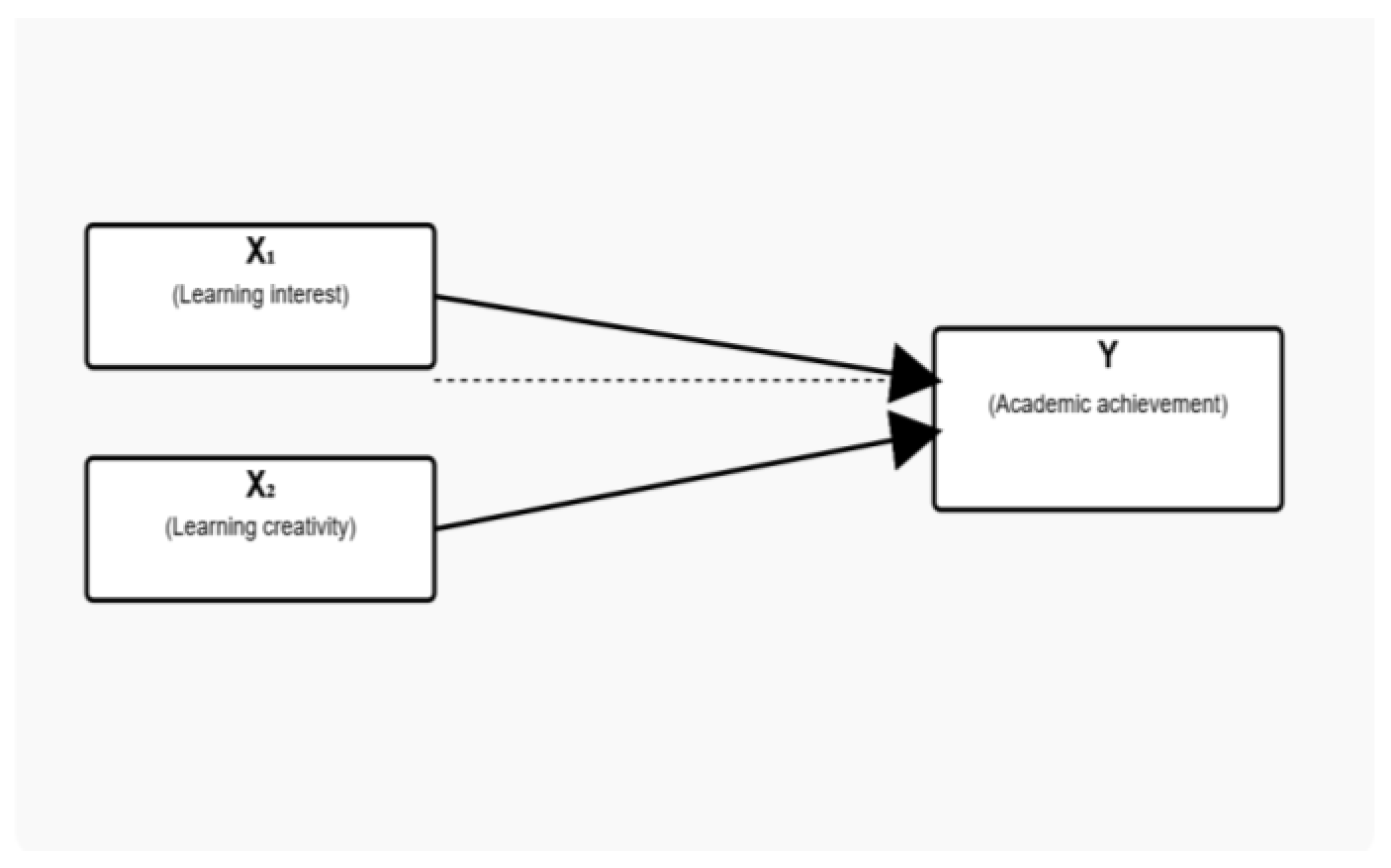

Table 1.
Categorization of Calculus Achievement Scores.
| SCORE RANGE | CATEGORY |
|---|---|
| 80–100 | Very High |
| 66–79 | High |
| 56–65 | Moderate |
| 40–55 | Low |
| 0–39 | Very Low |
Table 2.
Descriptive Statistics of Academic Achievement Scores.
| MEASURE OF CENTRAL TENDENCY AND DISPERSION | ACADEMIC ACHIEVEMENT (Y’) |
|---|---|
| Sample size (N) | 30 |
| Mean | 75.87 |
| Median | 75 |
| Mode | 75 |
| Standard deviation | 6.95 |
| Variance | 48.33 |
| Range | 27 |
| Minimum | 63 |
| Maximum | 90 |
Table 3.
Frequency Distribution of Academic Achievement Scores.
| INTERVAL | CATEGORY | FREQUENCY | PERCENTAGE (%) |
|---|---|---|---|
| 80–100 | Very High | 6 | 20.00 |
| 66–79 | High | 20 | 70.00 |
| 56–65 | Moderate | 3 | 10.00 |
| 40–55 | Low | 0 | 0.00 |
| 0–39 | Very Low | 0 | 0.00 |
| Total | 30 | 100.00 |
Table 4.
Descriptive Statistics of Learning Interest Scores.
| MEASURE OF CENTRAL TENDENCY AND DISPERSION | LEARNING INTEREST (X1) |
|---|---|
| Sample size (N) | 30 |
| Mean | 85.17 |
| Median | 85 |
| Mode | 72 |
| Standard deviation | 7.46 |
| Variance | 55.66 |
| Range | 27 |
| Minimum | 72 |
| Maximum | 99 |
Table 5.
Frequency Distribution of Learning Interest Scores.
| INTERVAL | CATEGORY | FREQUENCY | PERCENTAGE (%) |
|---|---|---|---|
| 96–120 | Very High | 3 | 10.00 |
| 79–95 | High | 20 | 66.67 |
| 67–78 | Moderate | 7 | 23.33 |
| 48–66 | Low | 0 | 0.00 |
| 0–47 | Very Low | 0 | 0.00 |
| Total | 30 | 100.00 |
Table 6.
Descriptive Statistics of Learning Creativity Scores.
| MEASURE OF CENTRAL TENDENCY AND DISPERSION | LEARNING CREATIVITY (X2) |
|---|---|
| Sample size (N) | 30 |
| Mean | 91.93 |
| Median | 91 |
| Mode | 97 |
| Standard deviation | 8.79 |
| Variance | 77.38 |
| Range | 44 |
| Minimum | 76 |
| Maximum | 120 |
Table 7.
Frequency Distribution of Learning Creativity Scores.
| INTERVAL | CATEGORY | FREQUENCY | PERCENTAGE (%) |
|---|---|---|---|
| 120–150 | Very High | 4 | 13.33 |
| 99–119 | High | 21 | 70.00 |
| 84–98 | Moderate | 4 | 13.33 |
| 60–83 | Low | 1 | 3.34 |
| 0–59 | Very Low | 0 | 0.00 |
| Total | 30 | 100.00 |
Disclaimer/Publisher’s Note: The statements, opinions and data contained in all publications are solely those of the individual author(s) and contributor(s) and not of MDPI and/or the editor(s). MDPI and/or the editor(s) disclaim responsibility for any injury to people or property resulting from any ideas, methods, instructions or products referred to in the content. |
© 2025 by the authors. Licensee MDPI, Basel, Switzerland. This article is an open access article distributed under the terms and conditions of the Creative Commons Attribution (CC BY) license (http://creativecommons.org/licenses/by/4.0/).
Copyright: This open access article is published under a Creative Commons CC BY 4.0 license, which permit the free download, distribution, and reuse, provided that the author and preprint are cited in any reuse.


