

Submitted:
02 March 2025
Posted:
03 March 2025
You are already at the latest version
Abstract
The study aims to analyze the level of digital technology development in Latin American countries and evaluate the prospects of this sphere in the region. The problems of digital technology development in the Latin American region are identified; the factors influencing their development and dissemination in groups are highlighted; their prospects are assessed. While assessing the level of digital technology development in Latin American countries, the more developed countries in this area were identified—Uruguay, Chile, and Argentina—and the less developed countries—Venezuela, Paraguay, Guatemala, Bolivia, and Honduras. As a result of the identified features of digitalization in Latin America, three possible scenarios for developing digital technologies for the coming years were proposed: positive, negative, and neutral. Based on the analysis of the factors influencing the development of digital technologies in this region, it was concluded that a neutral scenario is more likely for Latin American countries in the next five years. This scenario is characterized by relatively stable rates of digital technology development in the advanced countries of the region and faster than current digitalization processes in lagging countries. The study employed analysis, synthesis, classification, grouping, statistical, index, and rating methods.

Keywords:
Digital economy
; Digitalization
; Information and communication technologies
; Latin America
; Digital technologies
Abstract. The study aims to analyze the level of digital technology development in Latin American countries and evaluate the prospects of this sphere in the region. The problems of digital technology development in the Latin American region are identified; the factors influencing their development and dissemination in groups are highlighted; their prospects are assessed. While assessing the level of digital technology development in Latin American countries, the more developed countries in this area were identified—Uruguay, Chile, and Argentina—and the less developed countries—Venezuela, Paraguay, Guatemala, Bolivia, and Honduras. As a result of the identified features of digitalization in Latin America, three possible scenarios for developing digital technologies for the coming years were proposed: positive, negative, and neutral. Based on the analysis of the factors influencing the development of digital technologies in this region, it was concluded that a neutral scenario is more likely for Latin American countries in the next five years. This scenario is characterized by relatively stable rates of digital technology development in the advanced countries of the region and faster than current digitalization processes in lagging countries. The study employed analysis, synthesis, classification, grouping, statistical, index, and rating methods.
1. Introduction
In the context of a changing external environment and the rapid introduction of digital technologies into all spheres of society, the processes of digitalization of the economy are becoming an important task for every modern state. The digital economy and economic growth are closely linked today due to the increasingly large-scale access of companies to global markets, reduced transaction costs, and increased labor productivity, which allows them to become more effective participants in international economic relations. However, digitalization processes are currently occurring differently in all regions of the world. Thus, more active dynamics are observed in developed Western countries, as well as in the newly industrialized countries of East and Southeast Asia. In Latin America, although positive trends have emerged in this area, the countries of the region are significantly lagging behind the advanced countries of the world in terms of digitalization.
Digital technologies are rapidly advancing globally, impacting various areas, including production, e-commerce, e-government, education, telemedicine, the use of big data and artificial intelligence, climate tech, etc. The processes of digital transformation and digitalization in Latin America are uneven, both in individual technologies and in individual states of the region. This has led to the fact that by now the region is experiencing the phenomenon of the so-called “digital inequality.” Some countries are far ahead of their neighbors, who previously neglected digital development. This situation further exacerbates economic inequality in the region, the problem of which is quite acute in Latin America.
In this sense, it is important for Latin American countries to not only study the experience of developed countries in terms of digitalization (USA, Singapore, Germany, Great Britain, Sweden, Switzerland, etc.) but also of specific countries in the region that have successful digital implementation and transformation in different areas, resulting in good management of their economies.
Currently, there are not many scientific works that carry out a comprehensive analysis of the development of the digital economy in Latin American countries, and studies by specialists from around the world, for example, in Russian-language literature, are few. Among the publications that somehow consider the key aspects of digitalization in the countries of the Latin American region, we can note the studies of such Russian authors as Abramov V.I., Malanicheva N.V. (Abramov et al., 2023), Simonova L.N. (Simonova, 2017, 2022, 2023), Davydov V.M. (Davydov, 2016), Pichkov O.B. (Pichkov et al., 2021), Ermakova A.R. (Ermakova, 2022), Katz R., Kallorda F. (Katz et al., 2018), Cretsu O.V., Zakharova A.S. (Cretsu et al., 2020), Koval A.G. (Koval, et al., 2020), Lavut A.A. (Lavut, 2020), Pashentsev E.N. (Pashentsev, 2019), Smal S.V. (Smal, 2021), Stadnik I.T., Tsvetkova N.L. (Stadnik, et al., 2021), Yakovlev P.P. (Yakovlev, 2020, 2022). In the scientific literature in foreign languages, this topic was covered by Cordella A., Paletti A. (Cordella, et al., 2019), Dempsey C. (Dempsey, 2020), Garcia I. (Garcia, 2017), Katz R. (Katz, 2015), Kosevich E. (Kosevich, 2020), Pena I. (Pena, 2021), Razumovsky D.V., and Moseykin Yu.N. (Razumovsky, et al., 2022), and Verma R. (Verma, 2017). However, these works lack a comprehensive analysis of the level of development of the digital economy at the national level and do not present possible options and scenarios for its development.
2. Methodology and Data
This research employed an index-based methodology using several international indices reflecting regional digital processes: the Digital Competitiveness Index (IMD World Digital Competitiveness Ranking), Networked Readiness Index, Inclusive Internet Index, and Global E-Government Development Index. The method of summing up the places was used to classify the countries according to the level of the factors studied. The authors’ methodology was used as a source of information for the analysis of the countries, in addition to the following databases: UN, Economic Forum, Statista Portal, World Bank, GSM Association Intelligence, United Nations Economic Commission for Latin America and the Caribbean, United Nations Development Programme, UNCTAD, and others.
3. Results and Discussion
Several international indices reflect digital technology development, most notably the Digital Competitiveness Index, the Network Readiness Index, the Inclusive Internet Index, and the e-Government Development Index. These indices are based on various analytical factors. Table 1 compares the rankings of 17 Latin American countries using these indices. It should be noted that the data for some countries is unavailable because of their small size or insufficient data collection. The Digital Competitiveness Index and the Network Readiness Index use a point system with a maximum score of 100. The Inclusive Internet Index and e-Government Development Index use a country’s ranking out of 100 and 193 countries, respectively.
Next, the sum of places method was applied, and the average rating score was calculated, according to the results of which all countries of the region were distributed (Table 2). As a result of the study using the index method, it was concluded that Uruguay, Chile, Brazil, and Argentina occupy higher positions in the ratings.
It is relevant to observe that international indices employ diverse analytical factors that are dependent upon the study’s specific focus. Therefore, an objective and thorough assessment of digital technology development requires the consideration of the most complete range of factors. Based on the analysis of these indices, six key factor groups influencing the level of digitalization in Latin American countries were identified: “digital infrastructure,” “human capital,” “Internet usage by citizens,” “Using digital technologies in business,” “Digital government services,” and “economy.” These factor groups were further disaggregated into individual assessment factors (Table 3).
Source: developed by the authors.
For analytical purposes, Table 4, Table 5, Table 6, Table 7, Table 8 and Table 9 indicate each country’s rank within the studied group for each factor in parentheses. For example, Brazil’s number of Internet users (in millions) is 187.9 (1), meaning it ranks 1st among the 19 countries. The final column presents the total scores for each country. Consequently, lower scores indicate a higher ranking in Table 4, Table 5, Table 6, Table 7, Table 8 and Table 9.
This study identified factors influencing digital infrastructure development, including the number of Internet users, the number of fixed broadband subscribers, the average speed of fixed broadband Internet, the price per 1 GB of traffic, and others (Table 4).
Digital economy development requires an educated workforce with strong digital skills. The growth of higher education has a positive impact on overall well-being, and the development of the digital economy enhances this effect, especially at the provincial and city levels, suggesting that people with higher education can significantly benefit from the development of the digital economy (Zhang & Wang, 2024). Accordingly, this study considered factors related to human capital: the level of higher education, the literacy rate, the number of cybersecurity personnel, and others (Table 5). It is also important to note that individuals with higher education are more likely to contribute to digital economy development, while those without it often use the internet primarily for communication (social media).
Next, a group of this study also considered factors related to citizen internet use: internet adoption rates, the use of health and education apps, and the proportion of online shoppers. These factors directly influence the development of information technologies in e-commerce, education, healthcare, and e-government by increasing service demand in these sectors (Table 6).
The speed and scale of digital technology adoption also depend on their use in business, which drives demand for IT services. This analysis included factors such as e-commerce revenue, the density of fintech platforms, online banking penetration, social media advertising costs, and others (Table 7).
Factors related to digital government services as the duration of online service provision, the use of digital channels for document processing, and cybersecurity, are particularly important for accelerating digital government development (Table 8)
This study also considered factors related to the economy: ICT exports and imports, high- and medium-tech production, and others (Table 9). These factors can serve as predictive indicators for future digital technology development in the region.
Next, an analysis of influential factors was conducted. It revealed that the leading Latin American countries (Chile, Uruguay, Argentina, Costa Rica, and Colombia) generally exhibit advanced public administration, education, healthcare, and a well-developed business environment. These countries of the first group have long-standing digital development plans, actively support the development of digital technology, and adopt international best practices in ICT. The second group, with average digital technology development, includes states that have made some progress in developing their ICT infrastructure, though it remains insufficient. However, these countries have a significantly higher rate of internet access than the Latin American average, indicating good potential for future development. Finally, the third group, with low digital technology development, includes countries where these technologies are growing slowly; if current trends continue, the gap between the leaders and the Dominican Republic, Paraguay, Bolivia, Guatemala, Honduras, and Venezuela will widen further.
The heterogeneity in the level of development of digital technologies in the countries of the Latin American region, recorded as a result of the author’s research, has several explanations. Firstly, it is worth highlighting the degree of influence on the different states of the region of the economic and political crises, which have been especially acute in the last decade. Another key factor was the lack of interest in digital technologies among the leaders of several Latin American countries in the 2000s when more active processes of development of digital technologies began in the world. For example, the “maturity levels” of digital government in the countries of the region are significant today (Neverov, 2021).
The geographical features of the region, such as the inaccessibility and remoteness of mountainous areas in some Latin American countries (Peru, Ecuador), hinder the widespread dissemination of ICT. Based on the factors identified, key problems in digital technology development include poor internet service quality, with limited 4G and 5G access and high costs in many Latin American countries; low levels of e-commerce development; insufficient digital skills among the population; weak e-government development; and a lack of institutions for technology innovation.
Given the current situation related to the heterogeneity of digital technology development in Latin America, as well as external and internal factors, we can consider the prospects for the development of such technologies from the point of view of several scenarios. Thus, we have proposed three possible scenarios for this area, namely: positive, negative, and neutral (Table 10).
Thus, under the positive scenario, leading countries in the region (primarily Chile, Uruguay, and Argentina) will experience accelerated digital technology development, alongside a significant breakthrough in digitalization in lagging countries (Dominican Republic, Paraguay, Bolivia, Guatemala, Honduras, and Venezuela). The negative scenario predicts a slowdown in the rate of digital technology development in leading countries and sluggish digital progress in lagging countries today. Even though both positive and negative development scenarios today remain probable for Latin America, due to the conditions of instability of the external environment and serious transformations of the world economy, we think the neutral scenario is more likely. This scenario entails steady but moderate and stable growth of digital technology development in leading countries and faster progress than currently seen in lagging countries. In this case, overall, this suggests a relatively stable pace of digital technology development in Latin America, rather than a sharp increase.
4. Conclusions
Digitalization has affected all Latin American countries, but uneven development is now clearly evident across the region. To assess digital technology development, this study analyzed six factor groups reflecting the current situation “digital infrastructure,” “human capital,” “Internet usage by citizens,” “Using digital technologies in business,” “Digital government services,” and “economy.” Less developed Latin American countries lag behind leading countries by a factor of 5-10 based on certain digital technology assessment criteria. This analysis classified countries with low digital technology development as: the Dominican Republic, Paraguay, Bolivia, Guatemala, Honduras, and Venezuela; countries with average development as: Peru, Brazil, Mexico, Panama, El Salvador, and Ecuador; and leading countries as: Chile, Uruguay, Argentina, Costa Rica, and Colombia. The leading countries are characterized by governments that have adopted large-scale digital technology development programs, promoted internet access expansion, supported IT companies, allocated significant public funding for digitalization projects, and stimulated private investment in this sector. Despite the relatively stable pace of digitalization across Latin America, the region’s prospects remain unclear. This is due to several factors, including uncertainties about global economic stabilization and geopolitical trends. Therefore, this article proposes three possible scenarios for digital technology development in Latin America: positive, negative, and neutral, with the neutral scenario appearing most likely over the next five years.
The theoretical insights and practical conclusions of this study can enhance the understanding of digitalization in Latin American countries and be valuable for both researchers studying economic development in the region and business professionals planning digital technology projects there.
Funding
The study was supported by Russian Science Foundation Grant No. 24-78-00165, https://rscf.ru/project/24-78-00165/.
References
- Abramov, V.I., Malanicheva, N.V., Strelnikova, I.A., 2023. Analysis of digital economy programs of foreign countries on the example of Argentina, Brazil, India and Mexico. Management, 11(2), 45-55. [CrossRef]
- Cordella, A., Paletti, A., 2019. Government as a platform, orchestration, and public value creation: The Italian case. Government Information Quarterly. 36(4), 1-15. Volume 36. [CrossRef]
- Cretsu, O.V., Zakhartsova, A.S., 2020. Latin America: TNK with State Participation. World Economy and International Relations. 64(3), 88-97.
- Davydov, V.M. (2016). Determining the Development of Latin America and the Caribbean. Conjugation of Global and Regional Issues. Moscow: ILA RAS.
- Dempsey, C., 2020. How Digital Technology Could Lead The ’New Business Normal’ In Latin America. Forbes.
- DomainTools Internet Statistics - IP Addresses. – Available from: https://research.domaintools.com/statistics/ip-addresses/[Last accessed on 2024 Dec 28].
- Ermakova, A., 2022. Medium-Term Forecast of the Impact of Digital Transformation on the Economy: Latin American Countries. International Aspect, 3(1-2), 53-75.
- El estado de la digitalización de América Latina frente a la pandemia del COVID-19. Observatorio CAF del Ecosistema Digital Abril de 2020 / CAF – Available from: https://scioteca.caf.com/bitstream/handle/123456789/1540/El_estado_de_la_digitalizacion_de_America_Latina_frente_a_la_pandemia_del_COVID-19.pdf [Last accessed on 2024 Dec 28].
- El fin del tramite eterno: ciudodanos, burocratia y gobierno digital – Available from: https://publications.iadb.org/es/el-fin-del-tramite-eterno-ciudadanos-burocracia-y-gobierno-digital [Last accessed on 2024 Dec 28].
- E-Government Development Index 2024 – Available from: https://publicadministration.un.org/egovkb/en-us/Data-Center [Last accessed on 2024 Dec 28].
- Garcia, I., 2017. Economia digital en America Latina y el Caribe Situacion actual y recomendaciones. BID. 131 p. – Available from: https://publications.iadb.org/es/economia-digital-en-america-latina-y-el-caribe-situacion-actual-y-recomendaciones [Last accessed on 2024 Dec 28].
- Inclusive Internet Index 2022– Available from: https://impact.economist.com/projects/inclusive-internet-index/2022 [Last accessed on 2024 Dec 28].
- Katz, R., Callorda, F., 2018. Accelerating the Development of the Latin American Digital Ecosystem and Implications for Broadband Policy. Telecommunication Policy, (9). [CrossRef]
- Katz, R., 2015. El ecosistema y la economía digital en América Latina. Santiago. CEPAL. 425 р.
- Kosévich, E., 2020. Estrategias de seguridad cibernética en los países de América Latina. Iberoamerica. (1), 137-159.
- Koval, A.G., Andrianova, E.K., 2020. Prospects for the Development of the Digital Economy in Mercosur. Latin America. (3), 18-32.
- Lavut, A.A., 2020. The Search for a Latin American Development Strategy in the Context of Global Economic Instability. Latin America. (1), 33-46. [CrossRef]
- Network Readiness Index 2023. – Available from: https://networkreadinessindex.org/countries/ [Last accessed on 2024 Dec 28].
- Pashentsev, E.N., 2019. The Current Stage of Information and Psychological Warfare in Latin America. Mark Neimark. Dashkov & Co., p. 468-497.
- Pichkov, O.B., Ermakova, A.R., 2021. The Impact of Digital Transformation on Participation in Global Value Chains: The Case of Latin American Countries. Modern Economic Processes, (3), 28-57.
- Pena, I., 2021. Tecnolatinas 2021: The LAC startup ecosystem comes of age. Washington: Inter-American Development Bank. 80 p.
- Razumovskiy, D., Moseykin, Yu., 2022. Digitalización en América Latina y oportunidades para empresas rusas. Iberoamerica. (1), 5-37.
- Simonova, L.N., 2017. Possibilities and Limits of Innovative Development of Latin America. Moscow: ILA RAS. 552 p.
- Simonova, L.N., 2023. Digital Sovereignty, Challenges and Risks of Digitalization in Latin America. Latin America. (11), 6-22. [CrossRef]
- Simonova, L.N., 2022. Digital Transformation of the Latin American Economy. Latin America. (5), 8-27. [CrossRef]
- Smal, S.V., 2021. State Digitalization Policy in Latin American Countries. Experience of Applying Multidimensional Integral Indices Using the Example of Brazil. Latin America. (4), 40-55.
- Stadnik, I.T., Tsvetkova, N.L., 2021. The Place and Role of Latin American Countries in the System of International and Regional Cybersecurity. Latin America. (4), 69-84. [CrossRef]
- Statista. Average monthly net salary in selected countries in Latin America and the Caribbean as of 2024 – Available from: https://www.statista.com/statistics/950903/average-salary-latin-america-by-country/[Last accessed on 2024 Dec 28].
- Statista. Share of students in schools with teachers having the necessary technical and pedagogical skills to integrate digital devices in instruction in selected countries in Latin America in 2018 – Available from: https://www.statista.com/statistics/1184037/share-schools-teachers-skills-digital-devices-latin-america-country/[Last accessed on 2024 Dec 28].
- Statista. E-commerce sales revenue in selected countries in Latin America and the Caribbean in 2023 and 2024 – Available from: https://www.statista.com/forecasts/1029755/ecommerce-sales-revenue-latin-america-country [Last accessed on 2024 Dec 28].
- Statista. Penetration rate of online banking worldwide in 2023, by country – Available from: https://www.statista.com/forecasts/1169529/online-banking-penetration-by-country [Last accessed on 2024 Dec 28].
- Statista. Number of agricultural technology enterprises in Latin America and the Caribbean in 2019, by country – Available from: https://www.statista.com/statistics/1169573/smart-agriculture-business-latin-america-country/[Last accessed on 2024 Dec 28].
- Statista. Number of internet users in selected Latin American countries as of January 2024 – Available from: https://www.statista.com/statistics/186919/number-of-internet-users-in-latin-american-countries/[Last accessed on 2024 Dec 28].
- Statista. Number of fixed broadband subscriptions per 100 inhabitants in Latin America in 2023, by country – Available from: https://www.statista.com/statistics/729179/fixed-broadband-subscriptions-per-100-inhabitants-latin-america-country/[Last accessed on 2024 Dec 28].
- Statista. https://www.statista.com/statistics/236718/price-gigabyte-latin-america/.
- UN Comtrade Database – Available from: https://comtradeplus.un.org/ [Last accessed on 2024 Dec 28].
- Verma, R., 2017. Government portals, social media platforms and citizen engagement in India: some insights. Procedia Computer Science. (122), 842-849. [CrossRef]
- World Digital Competitiveness Ranking 2023. – Available from: https://www.imd.org/centers/wcc/world-competitiveness-center/rankings/world-digital-competitiveness-ranking/ [Last accessed on 2024 Dec 28].
- Yakovlev, P.P., 2022. The Economy of Latin America at the Start of Digital Modernization. World Economy and International Relations. 66(3), 110-118.
- Yakovlev, P.P., 2020. Latin America Needs an Economic Boost. Latin America. (2), 6-18. [CrossRef]
- World Bank Group. Mobile cellular subscriptions (per 100 people) – Available from: https://data.worldbank.org/indicator/IT.CEL.SETS.P2 [Last accessed on 2024 Dec 28].
- World Bank Group. Data bank Jobs. – Available from: https://data.worldbank.org/indicator/SL.TLF.ADVN.ZS [Last accessed on 2024 Dec 28].
- Yupeng, Zhang., Qian, Wang. (2024). Higher Education, Digital Economy, and Common Prosperity. ECNU review of education. [CrossRef]

Table 1.
– Positions of Latin American countries in international index ratings.
| Country | Digital Competitiveness Ranking 2023 | Network Readiness Index 2023 | Inclusive Internet Index 2022 | E-Government Development Index 2024 | |||||
| max 100 | place out of 17 Ctry. |
max 100 | place out of 17 Ctry. |
из 100 стран | place out of 17 Ctry. |
из 193 стран | place out of 17 Ctry. |
||
| 1 | Chile | 64,84 | 1 | 53,18 | 3 | 17 | 1 | 31 | 2 |
| 2 | Mexico | 51,26 | 2 | 49,59 | 6 | 36 | 3 | 65 | 7 |
| 3 | Argentina | 46,33 | 5 | 49,78 | 5 | 37 | 4 | 42 | 3 |
| 4 | Brazil | 49,7 | 4 | 54,67 | 1 | 23 | 2 | 50 | 4 |
| 5 | Uruguay | - | - | 54,5 | 2 | - | - | 25 | 1 |
| 6 | Costa Rica | - | - | 50,99 | 4 | - | - | 61 | 6 |
| 7 | Colombia | 45,09 | 6 | 48,28 | 6 | 48 | 6 | 68 | 9 |
| 8 | Peru | 50,17 | 3 | 45,89 | 7 | 42 | 5 | 58 | 5 |
| 9 | Panama | - | - | 43,03 | 10 | 54 | 7 | 79 | 10 |
| 10 | Dominican Republic | - | - | 43,49 | 8 | 55 | 8 | 85 | 12 |
| 11 | Ecuador | - | - | 43,05 | 9 | - | - | 67 | 8 |
| 12 | Paraguay | - | - | 41,91 | 11 | 56 | 9 | 80 | 11 |
| 13 | El Salvador | - | - | 38,07 | 14 | 72 | 12 | 115 | 14 |
| 14 | Bolivia | - | - | 39,35 | 13 | - | - | 99 | 13 |
| 15 | Honduras | - | - | 35,7 | 16 | 77 | 13 | 142 | 17 |
| 16 | Guatemala | - | - | 35,84 | 15 | 68 | 10 | 122 | 15 |
| 17 | Venezuela | 22,55 | 7 | 39,98 | 12 | 70 | 11 | 131 | 16 |
Source: compiled from: (World Digital Competitiveness Ranking 2023), (Network Readiness Index 2023), (Inclusive Internet Index 2022), (E-Government Development Index 2024).
Table 2.
– Average Point Totals Across International Index Rankings and position in the region.
| Country | max 17 | place out of 17 countries |
| Uruguay | 1,5 | 1 |
| Chile | 1,8 | 2 |
| Brazil | 2,8 | 3 |
| Argentina | 4,3 | 4 |
| Mexico | 4,5 | 5 |
| Peru | 5,0 | 6 |
| Costa Rica | 5,0 | 7 |
| Colombia | 6,8 | 8 |
| Ecuador | 8,5 | 9 |
| Panama | 9,0 | 10 |
| Dominican Republic | 9,3 | 11 |
| Paraguay | 10,3 | 12 |
| Venezuela | 11,5 | 13 |
| Bolivia | 13,0 | 14 |
| Guatemala | 13,3 | 15 |
| El Salvador | 13,3 | 16 |
| Honduras | 15,3 | 17 |
Source: compiled by the authors.
Table 3.
Factor Groups Used to Assess Digital Economy Development in Latin Americas.
| № | Group | Factors |
| 1 | Digital infrastructure | Number of Internet users |
| Number of fixed broadband subscribers | ||
| Mobile cellular subscribers | ||
| Average fixed broadband Internet speed | ||
| Price per 1 GB of Internet traffic | ||
| Households with a PC (laptop, desktop, or tablet) | ||
| Number of assigned IP addresses per country | ||
| 2 | Human capital | Labor force with higher education |
| Adult literacy rate, population aged 15+, both sexes | ||
| Average monthly net wage | ||
| Concentration of AI talent | ||
| Cybersecurity workforce | ||
| Cybersecurity workforce demand professionals | ||
| Proportion of students in schools where teachers have technical and pedagogical skills to integrate digital devices into the learning process | ||
| 3 | Internet usage by citizens | Social media adoption rate |
| Internet use for health apps | ||
| Internet use for education apps | ||
| Percentage of online shoppers | ||
| 4 | Using digital technologies in business | E-commerce sales revenue |
| Density of fintech platforms | ||
| Online banking penetration rate | ||
| Social media advertising costs | ||
| Number of agricultural machinery companies | ||
| 5 | Digital government services | Average processing time for online government services |
| Percentage of people using digital channels for document processing | ||
| Cybersecurity | ||
| 6 | Economy | Exports of information and telecommunication technologies (ICT) goods and services |
| Import of ICT goods and services | ||
| High-tech and medium-tech production |
Table 4.
Factors associated with digital infrastructure.
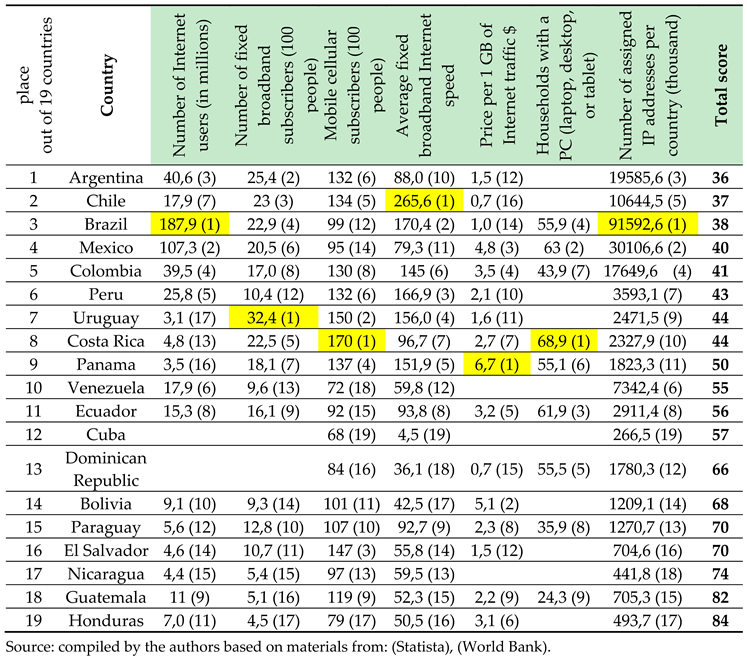
Table 5.
Factors related to human capital.
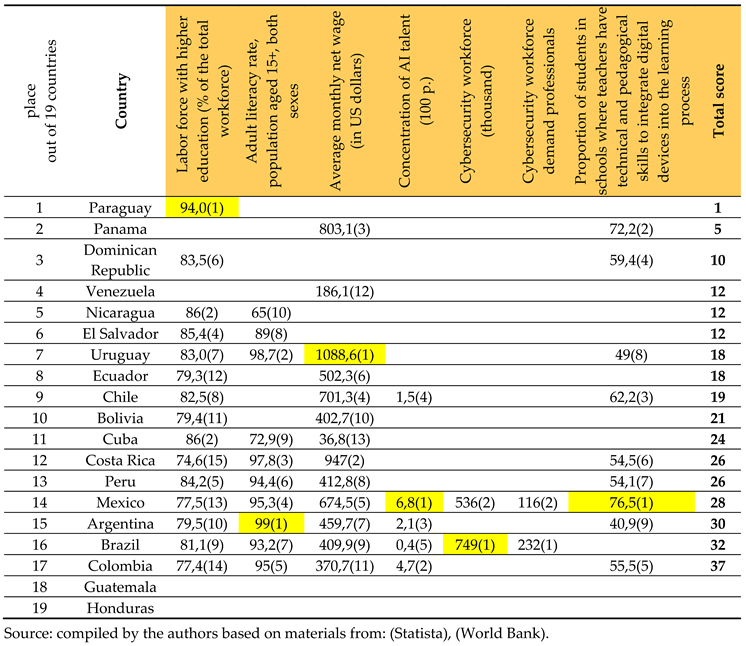
Table 6.
Factors Related to Citizen Internet Use.
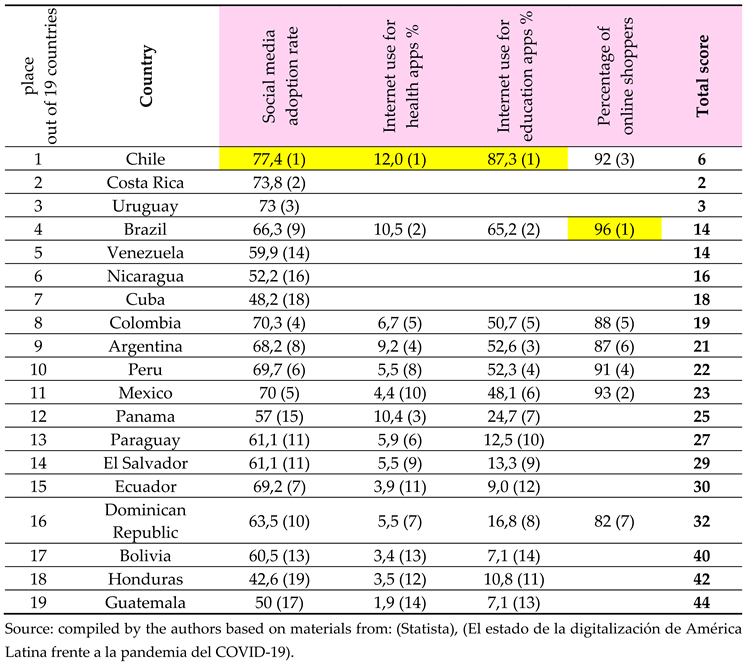
Table 7.
Factors of using digital technologies in business.
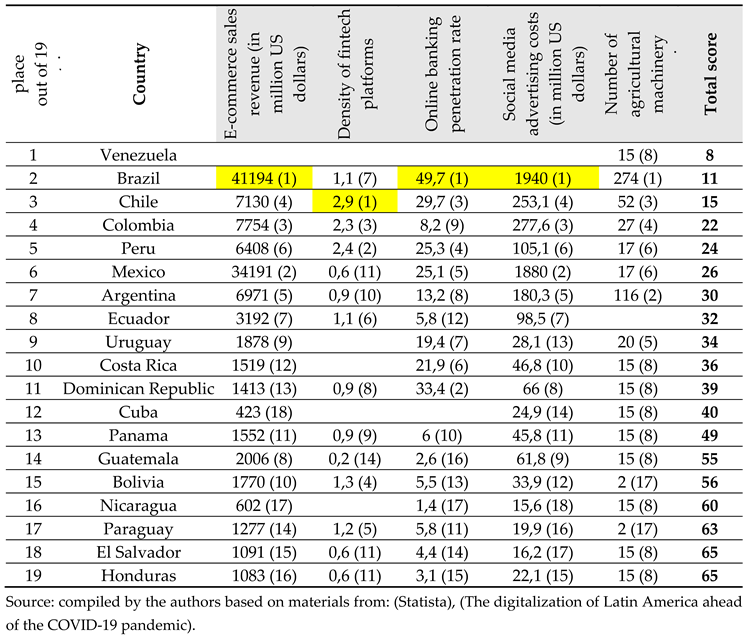
Table 8.
Factors Related to Digital Government Services.
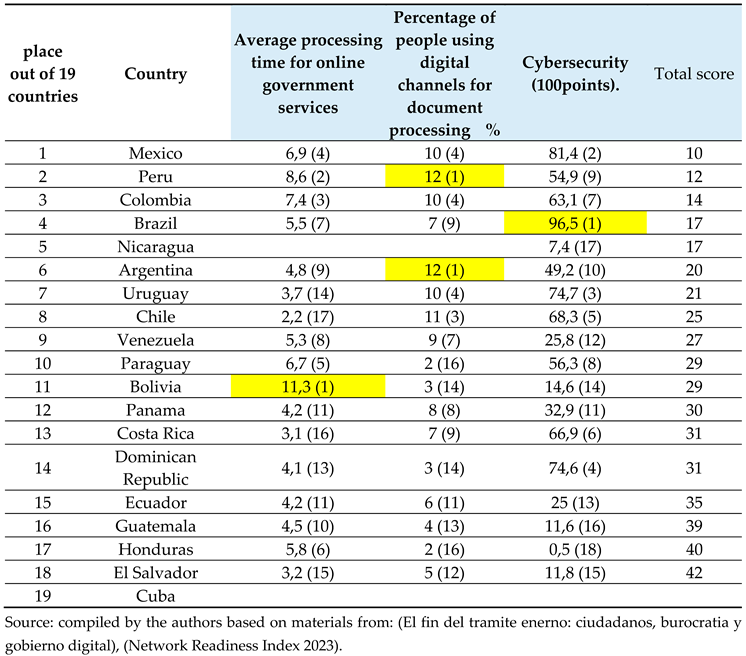
Table 9.
Factors related to the economy.
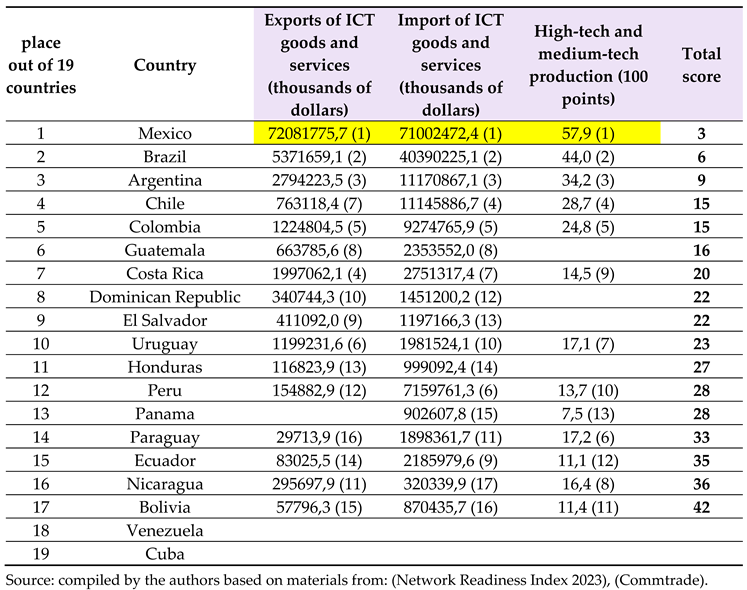
Table 10.
Main Scenarios for Digital Technology Market Development in Latin America.
| Factors | Scenarios | ||
| Positive | Negative | Neutral | |
| Active development of the digital technology market in the leading countries of the region, as well as an active breakthrough in the development of digital technologies in the countries that are lagging behind today. | A slowdown in the development of digital technologies in the leading countries of the region and slow processes of development of digital technologies in the countries that are lagging behind today. | Stable rates of development of digital technologies in the advanced countries of the region are faster than current processes of development of digital technologies in lagging countries. | |
| Digital infrastructure | Increasing the volume of funding for the development of digital infrastructure, stimulating IT companies, and adopting state programs for digitalization. | Reduction in funding for the development of digital infrastructure. |
Maintaining current levels of funding for the development of digital infrastructure. |
| Human capital | Expansion of digital literacy training programs for the population. | The training of IT specialists remains at the same level. |
The training of IT specialists remains at the same level. |
| Internet usage by citizens | Increasing the population’s income and expanding Internet access in remote areas. | Reduction in population income. |
Maintaining the population’s income at previous levels. |
| Using digital technologies in business | Stimulation of IT companies. |
Legislative restrictions. |
At the same level. |
| Digital government services | Stimulating demand for digital services among citizens and expanding the range of digital services. | Digital government services are not developing. | Digital government services remain at the same level. |
| Economy | Positive changes in the economy. |
Negative changes in the economy, economic crises. | Lack of major changes in the economy. |
Source: developed by the authors.
Disclaimer/Publisher’s Note: The statements, opinions and data contained in all publications are solely those of the individual author(s) and contributor(s) and not of MDPI and/or the editor(s). MDPI and/or the editor(s) disclaim responsibility for any injury to people or property resulting from any ideas, methods, instructions or products referred to in the content. |
© 2025 by the authors. Licensee MDPI, Basel, Switzerland. This article is an open access article distributed under the terms and conditions of the Creative Commons Attribution (CC BY) license (http://creativecommons.org/licenses/by/4.0/).
Copyright: This open access article is published under a Creative Commons CC BY 4.0 license, which permit the free download, distribution, and reuse, provided that the author and preprint are cited in any reuse.


