

Submitted:
10 December 2025
Posted:
14 December 2025
You are already at the latest version
Abstract
This study investigates the interplay between insecure attachment styles, materialism, and phubbing behaviors. Phubbing, the act of ignoring a partner in favor of smartphone use, is influenced by individual differences and societal norms. We hypothesized that attachment anxiety and avoidance would be positively associated with both enacted and perceived phubbing, and that materialism would mediate these relationships. Data were collected from 213 participants using validated scales for attachment, materialism, and phubbing. Results confirmed that attachment anxiety is positively associated with both enacted and perceived phubbing, while attachment avoidance is positively associated with perceived phubbing but not enacted phubbing. Materialism was found to mediate the relationship between attachment insecurity and phubbing behaviors. Specifically, materialism significantly mediated the positive relationships between attachment anxiety and both enacted and perceived phubbing, as well as between attachment avoidance and perceived phubbing. These findings suggest that materialistic values amplify the effects of insecure attachment on phubbing, highlighting the role of materialism as a compensatory mechanism for attachment-related insecurities. Future research should explore interventions targeting materialism and attachment anxiety to mitigate phubbing behaviors and improve relationship quality.
Keywords:
attachment
; attachment anxiety
; attachment avoidance
; phubbing
; materialism
1. Introduction
Smartphones have become an indispensable part of daily life. They are constantly carried, serving a wide range of purposes, from navigating traffic, tracking health, staying connected through social media, messaging, and video calls, etc. Smartphones are used in almost every situation, whether on the train, behind the wheel, at the dinner table, during social gatherings, at work, or while relaxing at home. In Germany, 85% of individuals aged 14 and older used mobile internet in 2023 (D21 Digital Index 2023/24: Annual Situation Report on the Digital Society, 2024), and 88.1% of private households owned at least one smartphone in 2022 (Destatis, 2022a). Despite their ubiquitous presence, the appropriate use of smartphones remains ambiguously defined in society, leading to contrasting perceptions of when smartphone use is acceptable or inappropriate. This ambiguity has given rise to behaviors such as “phubbing”—the act of ignoring a partner in favor of smartphone use—posing new challenges in social relationships.
Phubbing is shaped by both personality traits and social norms. That is, individual differences and societal expectations influence how smartphone use is perceived—either as acceptable or inappropriate (Al-Saggaf, & O’Donnell, 2019; Chotpitayasunondh & Douglas, 2016). Depending on the person and context, smartphone use may be seen as either socially acceptable or disrespectful. Phubbing is typically classified into two forms: enacted phubbing and perceived phubbing.
Enacted phubbing refers to the active behavior of using a smartphone during face-to-face interaction, where the individual is the subject performing the behavior. In contrast, perceived phubbing describes the experience of being phubbed—the individual is the object of the behavior. Importantly, these two perspectives do not always align: a person may engage in phubbing without intending to be rude, and the other may not perceive it negatively. Conversely, a person may not consider their own phone use inappropriate, yet the other party may still feel ignored or disrespected (Chotpitayasunondh & Douglas, 2016, 2018).
Since the term “phubbing” was first introduced in the Macquarie Dictionary in 2012, research in social psychology has explored its dynamics. Key drivers of enacted phubbing include reciprocity, where individuals phub in response to being phubbed (Al-Saggaf & O’Donnell, 2019; Thomas et al., 2022), and fear of missing out (FoMO), which compels individuals to check their phones frequently to stay connected to news and social updates (Al-Saggaf & O’Donnell, 2019; Schneider & Hitzfeld, 2021). FoMO, along with internet addiction and low self-control, has been shown to predict smartphone addiction, which in turn can lead to enacted phubbing (Chotpitayasunondh & Douglas, 2016; Karadag et al., 2015).
Enacted phubbing has been associated with several negative outcomes, including reduced conversational intimacy (Roberts & David, 2016; Vanden Abeele et al., 2016) and higher levels of depression (Al-Saggaf & O’Donnell, 2019; Ergün et al., 2020; Ivanova et al., 2020; Wang et al., 2017). Experimental studies suggest that phubbing disrupts the quality of interactions, mediated by unmet belonging needs (Chotpitayasunondh & Douglas, 2018). Additionally, enacted phubbing has been linked to increased anxiety, negative self-image, hostility, and loneliness (Ergün et al., 2020).
Beyond enacted phubbing, perceived phubbing also has significant psychological consequences. It often leads to feelings of social exclusion (Chotpitayasunondh & Douglas, 2018; David & Roberts, 2017), triggering a heightened need for attention and increasing social media use (David & Roberts, 2017). This cycle—feeling ignored, seeking attention, and intensifying social media engagement—can reduce overall well-being (David & Roberts, 2017).
Phubbing has been shown to be influenced by personality traits, particularly those tied to close relationship dynamics. For example, attachment theory, which describes individuals’ patterns of relating to others, offers a valuable lens for understanding phubbing. Individuals with insecure attachment styles are believed to be more prone to phubbing either as a form of emotional regulation or because they are more sensitive to perceived neglect ( Bröning & Wartberg, 2022; Shams, et al., 2019; Sun, & Miller, 2023). However, understanding the role of attachment anxiety and avoidance provides deeper insights into both enacted and perceived phubbing behaviors.
1.1. Attachment and Phubbing
Attachment theory offers a foundational framework for understanding individual differences in relationship behaviors and perceptions (Ainsworth et al., 1978; Bowlby, 1969/1982; Mikulincer & Shaver, 2007). Two key dimensions of attachment—attachment anxiety and attachment avoidance—influence how individuals seek, interpret, and respond to interpersonal closeness and relational threats. These dimensions may help explain patterns in both enacted phubbing (one’s own behavior) and perceived phubbing (perception of others’ behavior).
Attachment anxiety is characterized by an hyperactivation of the attachment system, driven by the fear of abandonment and the desire for closeness to a partner. Anxiously attached individuals frequently feel insufficiently loved and tend toward clingy behaviors (Neumann et al., 2007). Attachment avoidance, conversely, is marked by a deactivation of attachment behaviors to avoid emotional closeness and frustration. Avoidant individuals fear intimacy and trust, often prioritizing independence over emotional connection (Neumann et al., 2007).
While attachment styles are generally stable, changes can occur over time, influenced by shifts in relationship dynamics or the availability of attachment figures (Fraley & Dugan, 2021; Ross & Spinner, 2001). Attachment styles function as “working models,” adaptable to changes in relationship environments (Fraley & Dugan, 2021). Attachment security tends to improve in long-term relationships, and the attachment styles of partners interact, influencing each other in dyadic contexts (Bröning & Wartberg, 2022).
Meta-analytic findings reveal the negative effects of attachment anxiety and attachment avoidance on relationship quality. Attachment anxiety is linked to lower relationship satisfaction, greater emotional distress, and more destructive interactions (Li & Chan, 2012). In contrast, attachment avoidance is associated with dissatisfaction, emotional distance, and conflict avoidance (Li & Chan, 2012). These dimensions also interact with relationship quality, with attachment anxiety having a stronger impact on relationship conflict and attachment avoidance affecting relatedness and support (Li & Chan, 2012).
Attachment anxiety leads individuals to hypervigilantly monitor for signs of rejection or neglect (Bartholomew & Horowitz, 1991). Research supports that individuals with high attachment anxiety experience greater distress in response to partner unavailability and may ruminate about perceived neglect (Mikulincer et al., 2002). It is thus unsurprising that anxiously attached individuals are especially vulnerable to interpreting phubbing as rejection, given their heightened sensitivity to interpersonal threats (Gillath et al., 2005; Roberts & David, 2022). As such, research has shown that attachment anxiety is positively associated with perceived phubbing (Broning & Wartberg, 2022; Carnelley et al., 2023). Again, mixed results have been found on the limited research examining attachment anxiety and enacted phubbing, with Carnelley et al., (2023) finding no association, and Sun and Miller (2023) finding a positive association. These studies used different methods of data collection – a daily diary study versus a cross-sectional study which may account for these differences. The relationship with enacted phubbing may depend on situational factors. Anxious individuals may avoid phubbing to remain engaged with their partner, yet use their phone to seek validation when insecure, leading to complex, context-dependent relationships with enacted phubbing.
On the other hand, individuals with high attachment avoidance often value emotional distance and independence (Fraley & Shaver, 2000). For these individuals, enacted phubbing may serve as a disengagement strategy, using smartphones to avoid intimacy or emotional expression during interactions (Carnelley et al., 2023; Sun & Miller, 2023). This behavior aligns with findings that avoidant individuals tend to prefer low self-disclosure and are less responsive to their partner’s bids for attention (Collins & Feeney, 2000; Wei et al., 2005). Findings on attachment avoidance and enacted phubbing however have been mixed, with one study showing no association (Carnelley et al., 2023) and another showing a positive association (Sun & Miller, 2023). Perceived phubbing may not have the same negative impact on avoidant individuals, as their discomfort with closeness may reduce their sensitivity to feeling ignored or rejected (Mikulincer & Shaver, 2003). Research on avoidance and perceived partner phubbing has also yielded mixed results, with some studies reporting no significant association (Carnelley et al., 2023; McDaniel et al., 2018), while another found a gender-based difference—showing a positive link for men but a negative one for women (Broning & Wartberg, 2022).
Understanding these dynamics contributes to the growing body of research on how digital communication technologies intersect with relational behaviors and attachment processes (Roberts & David, 2016; Vanden Abeele et al., 2019).
Based on the above, we tested the following hypotheses. Two layers of analysis were distinguished: (1) hypotheses on the dependencies between attachment variables and phubbing variables and (2) hypotheses on the mediation model which assumes that materialism mediates the influence of attachment variables on phubbing.
The first layer includes H1 to H4. The second layer includes H7 to H12. In addition, two hypotheses (H5 and H6) were derived on the connections between materialism and phubbing.
The following hypothesed are located on the first layer: H1: Attachment anxiety will be positively associated with perceived phubbing.
Individuals high in attachment anxiety tend to be hypervigilant to signs of rejection or neglect in interpersonal interactions. As a result, they may be more likely to interpret others’ smartphone use during face-to-face encounters as exclusionary or dismissive, even when it is not intended that way.
H2:
Attachment anxiety will be positively associated with enacted phubbing.
Anxiously attached individuals may use smartphones during social interactions as a way to seek reassurance, validation, or connection through social media or messaging. This compensatory behavior may increase their likelihood of engaging in phubbing.
H3:
Attachment avoidance will be positively associated with enacted phubbing.
Avoidantly attached individuals tend to distance themselves emotionally from others and devalue interpersonal closeness. They may be more prone to disengaging from in-person interaction by turning to their smartphones, thus enacting phubbing.
H4:
Attachment avoidance will be negatively or not significantly associated with perceived phubbing.
The following hypotheses include materialism. Because in examining the links between attachment and phubbing, a relevant mediator that may underscore the relationship is materialism. Materialism, defined as the importance placed on possessions and their acquisition as a source of happiness or success (Richins & Dawson, 1992), is also linked to insecure attachment styles. This relationship may offer an explanatory mechanism for phubbing behaviors, which may serve as a compensatory strategy for individuals seeking external validation or security.
1.2. Materialism
Materialism is a concept with deep roots in psychological and sociological research. Broadly, materialism refers to the emphasis placed on possessions and the accumulation of material goods. It is often linked to the idea that material possessions fulfil deeper psychological needs. For instance, Maslow’s hierarchy of needs (1943) identifies basic needs such as water, food, and sleep, as well as security needs like physical safety and a stable home, as foundational for human well-being. Accumulating possessions is thought to provide greater security, ensuring survival and mitigating the risks of unforeseen events, such as job loss or natural disasters. A paid-off home, for example, may provide more security than renting in times of financial uncertainty.
Materialism is not just about satisfying physical needs, but about constructing and maintaining the self-image. According to Shrum et al. (2013), materialism involves the extent to which individuals seek to define themselves through the acquisition of possessions, experiences, and relationships that hold symbolic value. In this sense, “I am what I own,” or “I am what I experience” (Shrum et al., 2013), reflects the deeper connection between possessions and personal identity. This concept can extend to immaterial materialism, where intangible assets—such as social media presence, experiences, or relationships—serve as symbols of self-worth, much like physical possessions.
In today’s digital world, where individuals often present curated versions of themselves, immaterial items—such as the number of followers, edited photos, or status updates—serve as important symbols of status. These digital representations are akin to traditional material possessions, signaling social position and self-worth. Social comparisons are intrinsic to materialism, as individuals often measure their success against their peers, not just in terms of what they have, but how they compare to others in their social circle (Chan, & Prendergast, 2007).
The pursuit of more possessions, experiences, or relationships is often insatiable. This endless pursuit of status, success, and material wealth can appear superficial and unsustainable, especially when it detracts from personal fulfilment (Richins & Fournier, 1991). Materialism has been linked to negative outcomes, such as reduced environmental concern (Segev et al., 2015), diminished prosocial behavior, and lower social well-being (Moldes & Ku, 2020).
Empirical evidence highlights the negative consequences of materialism: it is associated with lower well-being (Dittmar et al., 2014; Dittmar & Isham, 2022; Moldes & Ku, 2020) and life satisfaction (Ozimek et al., 2024). While materialism directly decreases consumer satisfaction, its indirect effect—mediated by self-improvement and competitiveness—can be positive (Thyroff & Kilbourne, 2018). Longmire et al. (2021) found that materialism can offer symbolic security during periods of anxiety, though this security is fleeting and does not alleviate objective fear. In uncertain times, materialism may be a coping mechanism to enhance self-esteem (Belk, 2015), particularly when opportunities for social advancement exist (Cho et al., 2016; Ger & Belk, 1996; Wang et al., 2022).
The relationship between materialism and self-image insecurity has also been well-documented. At a young age, individuals may develop materialistic tendencies as a way to cope with self-uncertainty. As individuals age and their self-image solidifies, materialism tends to diminish (Martin et al., 2019). Self-uncertainty, mediated by materialism, is associated with lower subjective well-being (Chang et al., 2023). This underscores the role of materialism as a response to both social insecurity and internal uncertainty (Chang & Arkin, 2002).
Wang et al. (2020) found that smartphone addiction is positively correlated with materialism in adolescents, with materialists using social media for social comparison and objectifying their friends as digital possessions (Ozimek et al., 2017). This tendency to objectify others could contribute to phubbing behavior, as individuals with high materialistic values may focus more on the validation they get from their devices than the emotional connection with those present in the room.
Despite the wealth of research on materialism, there is limited exploration of its relationship with enacted phubbing. However, constructs related to phubbing—such as social media use—have been explored. Ozimek et al. (2024) found that materialism is positively associated with social comparison orientation, leading to passive social media use and even social media addiction. Social media use encourages upward social comparisons (Schmuck et al., 2019), where individuals measure their status against others, often by showcasing possessions or experiences.
Despite the limited research in this area, we hypothesise the following:
H5:
Materialistic values will be positively associated with enacted phubbing.
Individuals with high levels of materialism tend to be more phone-dependent, using their devices for various activities like online shopping, image management (e.g., curating social media profiles), or status signaling (e.g., showcasing luxury brand technology). This heavy reliance on smartphones for materialistic goals can lead to increased enacted phubbing, as digital engagement often takes precedence over face-to-face interactions. Smartphones, in this sense, become tools for maintaining materialistic goals, such as tracking purchases or projecting curated online identities, further diminishing in-person connection.
H6:
Materialistic values will be positively associated with perceived phubbing.
For materialistic individuals, perceived phubbing may become more pronounced. They may interpret others’ phone use during social interactions as a sign of disinterest or as a reflection of a shifting value system—where the other person is more focused on social media, status, or consumption. This interpretation of smartphone use as a threat to social connection can amplify the perception of being phubbed.
Given the links between materialism and social comparison, it is plausible that individuals high in attachment anxiety may engage in materialistic behaviors to compensate for feelings of insecurity. Such individuals may define their self-worth through status and social comparison, making materialism a key strategy to affirm their value. Consequently, enacted phubbing could be an expression of their need to seek status, as they turn to their smartphones during in-person interactions to validate themselves through digital engagement. We examine the novel relationships between attachment, materialism and phubbing below.
1.3. Attachment, Materialism, and Phubbing
Anxiously attached individuals often experience chronic insecurity and a low sense of self-worth, which can lead them to seek external validation. In this context, material possessions can serve as compensatory mechanisms to counteract feelings of rejection and insecurity (Mikulincer & Shaver, 2007). These individuals may view possessions to boost self-esteem or secure social approval. As a result, materialistic values may be adopted as a strategy for identity formation and self-worth enhancement. In contrast, avoidantly attached individuals tend to devalue emotional closeness and often prioritize autonomy and control. This can lead them to seek comfort in non-relational sources, such as material possessions or status symbols (Kasser, 2002).
Materialism in this case functions to fulfil emotional needs and creates a sense of self-worth without relying on others. Possessions provide a tangible source of validation, allowing these individuals to maintain their sense of independence while also enhancing their social status.
Based on materialism as a mediator we hypothesised on the second layer of dependencies the following propositions:
H7:
Attachment anxiety will be positively associated with materialistic values.
H8:
Attachment avoidance will be positively associated with materialistic values.
As far as we know we are the first to explore the role of materialism as a mediator in explaining how attachment influences phubbing. We hypothesised the following:
H9:
The relationship between attachment avoidance and enacted phubbing will be mediated by materialism.
Individuals high in attachment avoidance tend to prioritize independence and self-sufficiency. However, a materialistic orientation may push them to rely more heavily on digital engagement, as material possessions and status are often showcased through smartphones. This increased reliance on devices for status signalling may lead to greater enacted phubbing in social settings, as materialistic goals take precedence over interpersonal goals.
H10:
The relationship between attachment anxiety and enacted phubbing will be mediated by materialism.
For anxiously attached individuals, material possessions and digital technology (especially smartphones) often become tools for self-validation and social affirmation. This materialistic orientation can lead to increased phone use during social interactions, as individuals attempt to boost their self-worth through external validation. Consequently, this behavioral tendency is likely to result in higher levels of enacted phubbing, where the digital world eclipses the present moment with others.
H11:
The relationship between attachment anxiety and perceived phubbing will be mediated by materialism.
Anxiously attached individuals may place heightened importance on appearance, which is related to cues and material possessions, to feel secure and accepted. As a result, they are more likely to interpret others’ smartphone use as a threat to their social value. This heightened sensitivity can lead to increased perceptions of being phubbed, particularly in situations where individuals feel their self-worth is being undermined by others’ digital preoccupation.
H12:
The relationship between attachment avoidance and perceived phubbing will be mediated by materialism.
Although avoidantly attached individuals often suppress their interpersonal needs, they may still be attuned to status-related cues, including the subtle messages conveyed through smartphones. A materialistic orientation may heighten their awareness of these cues, increasing their likelihood of perceiving phubbing (especially in contexts where social comparison is salient, such as during interactions that involve visible displays of status or possessions).
2. Materials and Methods
2.1. Participants
We recruited 213 participants using a snowball sampling technique. Of these, 72.3 % were female, 27.2 % were male, and 0.5 % preferred not to disclose their gender. The participants had an average age of 34.53 years (median = 27), with ages ranging from 18-71 years. The highest level of education stated was secondary school certificate 6.1%, vocational baccalaureate 10.3%, high school diploma 54.5%, and academic degree 28.6%. A majority (73.2%) of participants were students, and 47.9% were studying psychology. Additionally, 75.1% of participants were employed. The average duration of participants’ romantic relationship was 11.5 years (median = 4.75 years), with a minimum relationship duration of 3 months and a maximum of 55.75 years. A total of 67.4% of participants lived with their partner, and. 39.1% were married. Furthermore, 60.1% of participants reported seeing their partner very often (several times a day). On average, participants spent 2.36 hours per day on social media (SD = 1.59).
2.2. Design
The data were collected online via a questionnaire. The average completion time was approximately one hour. The prerequisites for participation were being 18 years of age or older, having been in a romantic relationship for at least three months, and regularly using at least one social media platform (at least once a month). At the beginning of the survey, participants were informed about the purpose of the study and provided their consent to take part in the study. There was no deception, nor were any variables manipulated. The study was approved by the local ethics committee at the University XXX (protocol code XXX). The survey took part in a larger study with respect to phubbing behavior in collaboration between the universities xxx. There were no incentives. In the following the used measures are described. They were presented in randomized order.
2.3. Measures
2.3.1. Attachment
Attachment was assessed using the Experience in Close Relationships Scale, German 10-item version (Neumann et al., 2023). This scale, validated by Neumann et al. (2023), is a short-form adaption (10-items) of the original 36-item scale (Brennan et al., 1998; Neumann et al., 2007). The questionnaire measures attachment anxiety and attachment avoidance, each with five items, using a 7-point rating scale from 1 (strongly disagree) to 7 (strongly agree). Sample items include: “I talk to my partner about almost everything” (indicating low avoidance) and “I need confirmation that my partner loves me” (indicating high anxiety). In the current study, the internal consistency was adequate, with attachment avoidance α = .82 and attachment anxiety α = .75.
2.3.2. Materialism
Materialism was assessed using the German version of the Material Values Scale (G-MVS; Müller et al., 2013), developed by Richins (2004). The original scale consists of 15 items that load on three factors: Centrality, Success, and Happiness. The German version (Müller et al., 2013) was validated using a representative sample (N = 2,295) and showed high internal reliability; α = 0.89 for the overall 15-item scale. Regarding construct validity, 52 patients with shopping addiction and 347 students completed the G-MVS, the Compulsive Buying Scale (Faber & O’Guinn, 1992), and the depression scale of the Patient Health Questionnaire (Kroenke et al., 2009). Supporting the construct validity of the scale, findings confirmed that the G-MVS correlated positively with compulsive buying, but not with depression. This pattern of results was also observed in the original English version of the scale (Richins, 2004).
Participants indicated their level of agreement with the scale items using a 5-point rating scale, from 1 (strongly disagree) to 5 (strongly agree). Example items include: “My life would be better if I owned certain things that I do not yet have” and ‘I admire people who have expensive houses, cars and clothes’. In the current study, the scale demonstrated excellent reliability (α = .90).
2.3.3. Enacted Phubbing
Enacted phubbing was assessed using a German translation of the Phubbing Scale by Karadag et al. (2015). The scale was translated into German by our team and independently back-translated. Differences between the original and translated versions were reviewed, and the team reached a consensus on the best German phrasing.
The original scale, developed using data from focus groups, consists of ten items and has a reported reliability between α = .87. The German translation consists of ten items, measured on a 5-point rating scale, from 1 (never) to 5 (always). Participants were instructed to indicate how often certain behaviors applied to them. Example items are: “My eyes start wandering on my phone when I’m together with others” and” I feel incomplete without my mobile phone.” For an overview, see Table A1 in the Appendix. In the German version, the scale demonstrated adequate reliability (α = .75).
Figure 1.
Mediation model 1: Attachment anxiety (UV), materialism (M), phubbing bevavior (AV). Note. Bootstrapped confidence intervals in brackets. *p < 0.05, **p < 0.01, ***p < 0.001.
Figure 1.
Mediation model 1: Attachment anxiety (UV), materialism (M), phubbing bevavior (AV). Note. Bootstrapped confidence intervals in brackets. *p < 0.05, **p < 0.01, ***p < 0.001.
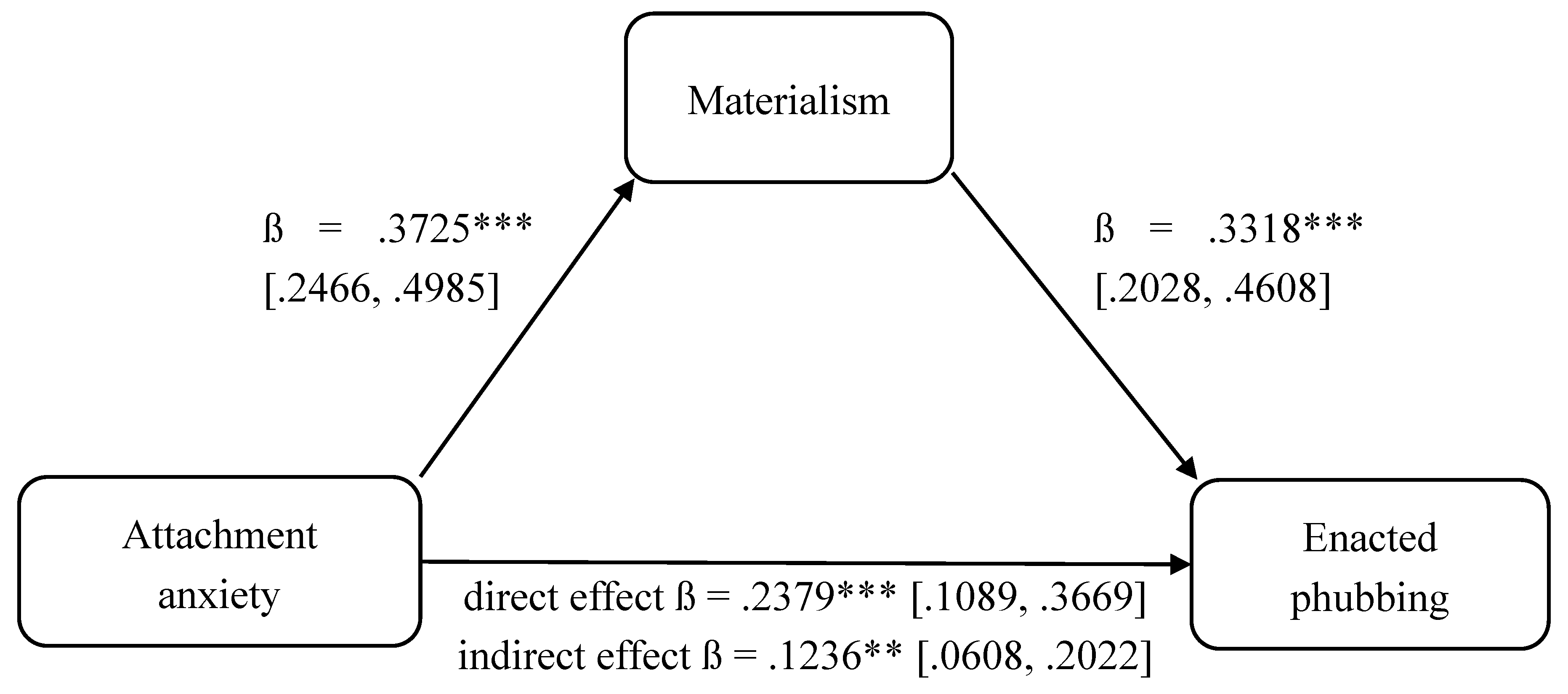
Figure 2.
Mediation model 2: Attachment avoidance (UV), materialism (M), enacted phubbing (AV). Note. Bootstrapped confidence intervals in brackets. *p < 0.05, **p < 0.01, ***p < 0.001.
Figure 2.
Mediation model 2: Attachment avoidance (UV), materialism (M), enacted phubbing (AV). Note. Bootstrapped confidence intervals in brackets. *p < 0.05, **p < 0.01, ***p < 0.001.
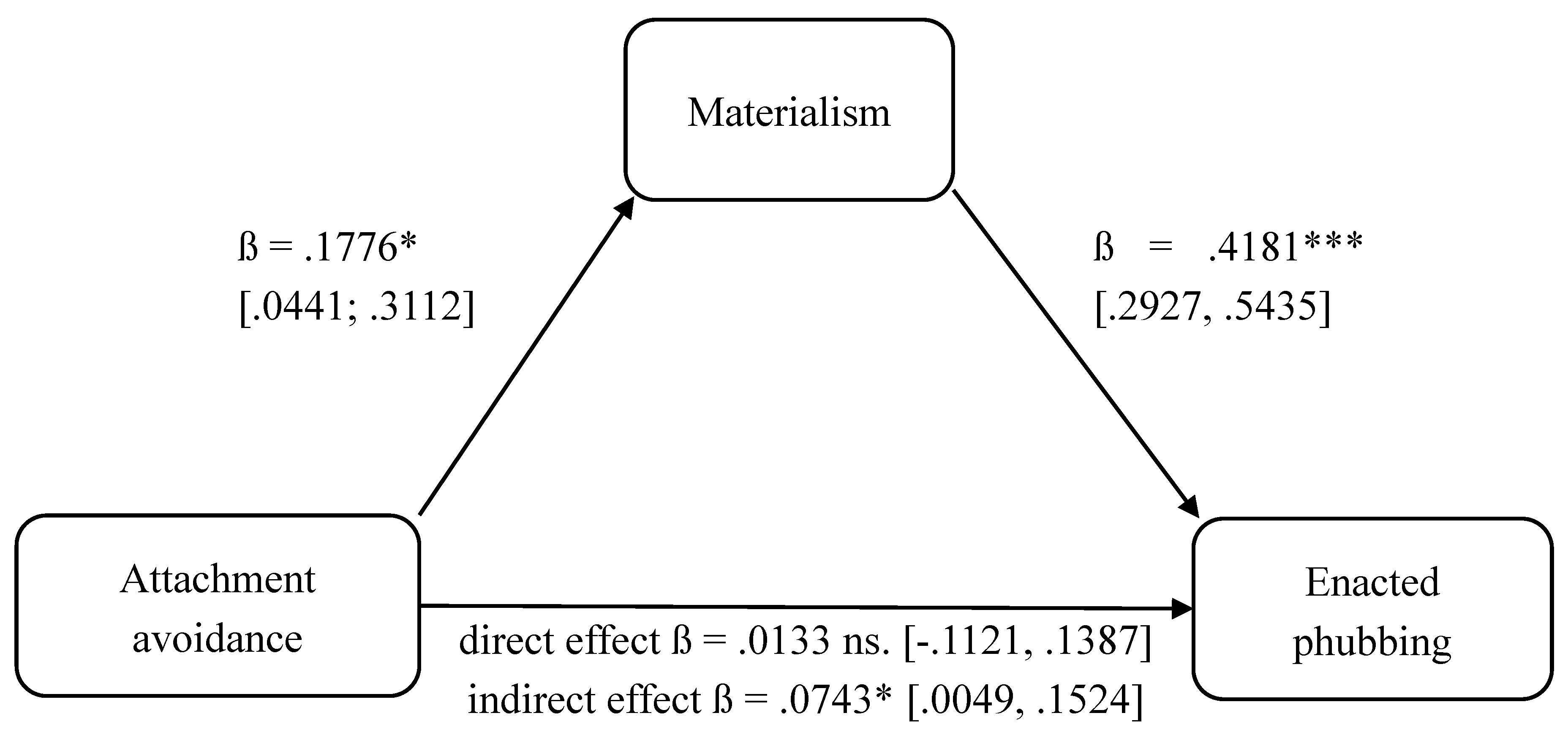
Figure 3.
Mediation model 3: Attachment anxiety (UV), materialism (M), perceived phubbing (AV). Note. Bootstrapped confidence intervals in brackets. *p < 0.05, **p < 0.01, ***p < 0.001.
Figure 3.
Mediation model 3: Attachment anxiety (UV), materialism (M), perceived phubbing (AV). Note. Bootstrapped confidence intervals in brackets. *p < 0.05, **p < 0.01, ***p < 0.001.
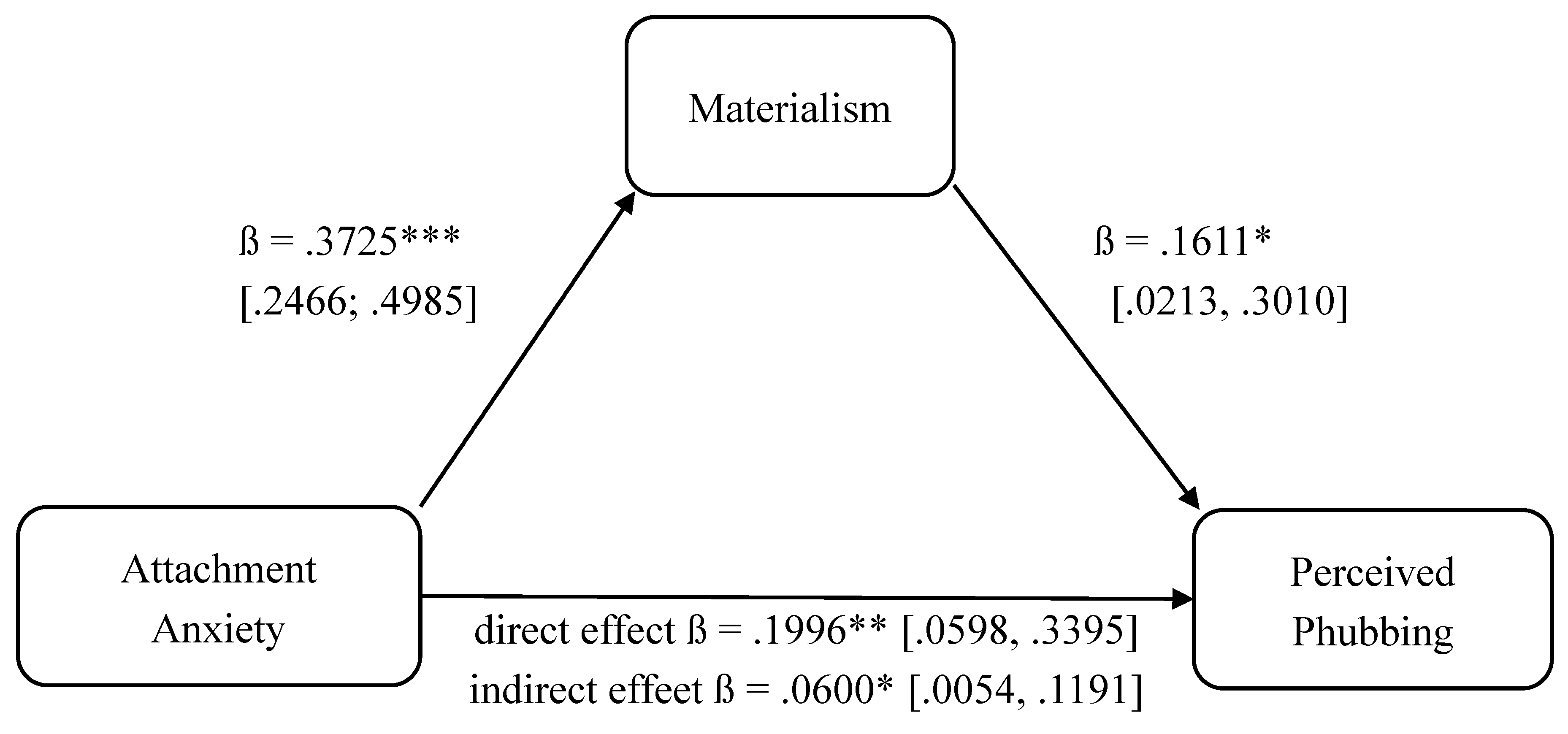
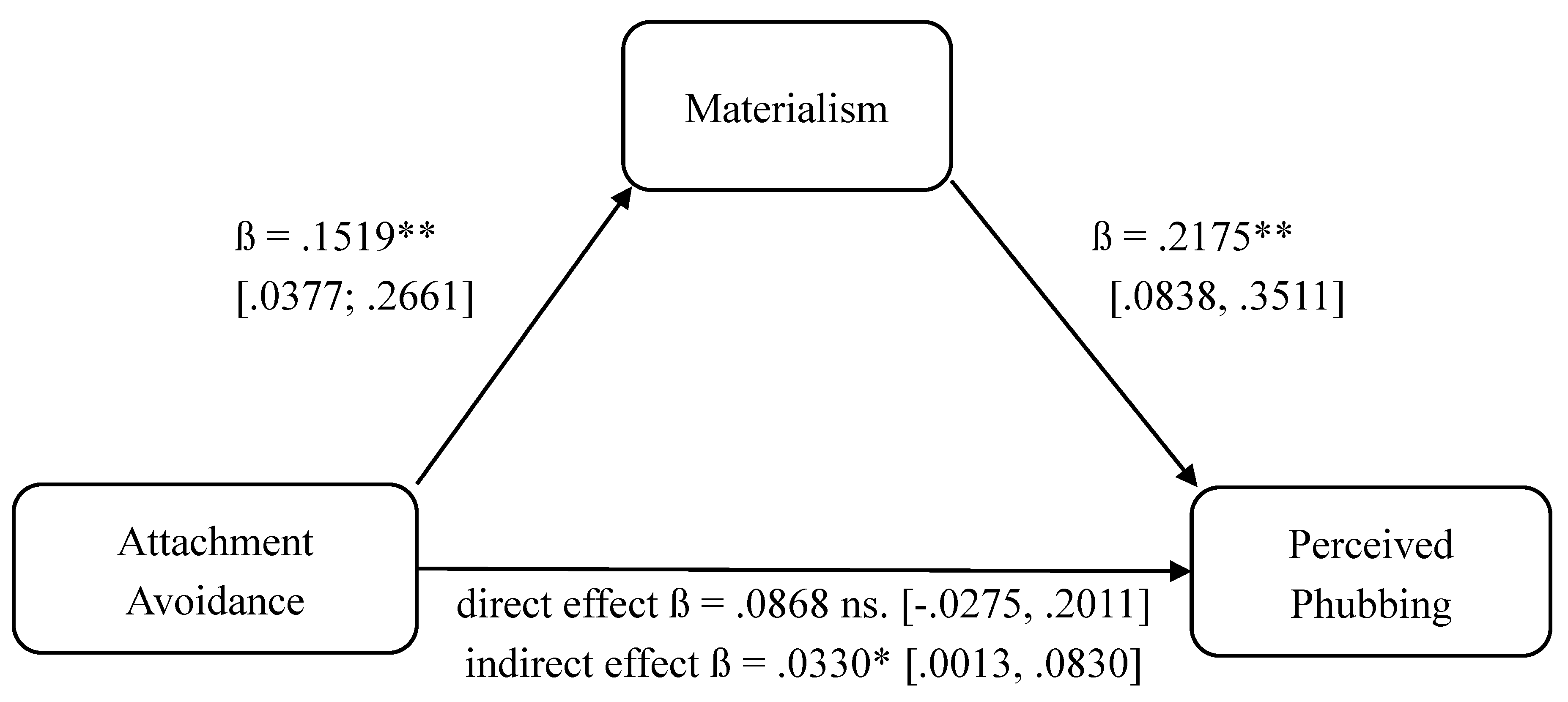
Figure 4.
Mediation model 4: Attachment avoidance (UV), materialism (M), perceived phubbing (AV). Note. Bootstrapped confidence intervals in brackets.*p < 0.05, **p < 0.01, ***p < 0.001.
Figure 4.
Mediation model 4: Attachment avoidance (UV), materialism (M), perceived phubbing (AV). Note. Bootstrapped confidence intervals in brackets.*p < 0.05, **p < 0.01, ***p < 0.001.
2.3.4. Perceived Phubbing
To measure phubbing perceptions in partnerships, we used the Partner Phubbing Scale by David and Roberts (2020). This scale, originally designed to assess general social interactions, was translated into German by our team and then independently backtranslated. The questionnaire consists of nine items measuring phubbing perception (e.g., “My partner places his or her cell phone where they can see it when we are together.”). Items were rated on a 5-point rating scale from 1 (never) to 5 (always). . For this study, the wording of the items was adapted from general social interactions (as in theoriginal version) to specifically refer to romantic partnerships. For an overview, see Table A2 in Appendix. The Partner Phubbing Scale demonstrated good reliability in the present study (α = .85).
2.4. Statistical Analyses
The statistical analysis was conducted using SPSS 29. To ensure comparability of effects, mean values of the scales and subscales were calculated. PROCESS 4 Beta (Hayes, 2022) was used for the mediation analyses. The prerequisites for mediation analysis include linearity, normal distribution of residuals, homoscedasticity, independence, and temporal precedence (Hayes, 2022). Since PROCESS 4 beta employs bootstrapping, it is robust regarding the distribution of the residuals and homoscedasticity. Independence of residuals was ensured by the research design. However, temporal precedence was not established by the research design, as cross-sectional data were used. A summary of all model assumption checks can be found at LINK XXX.
3. Results
3.1. Descriptive Results
Participants exhibited moderate levels of attachment anxiety (M = 3.62, SD = 1.69) and relatively low levels of attachment avoidance (M = 2.28, SD = 1.17, range = 1-7). Regarding materialistic values, participants scored moderately on average (M = 2.36, SD = 0.79; range = 1-5). For both enacted phubbing and perceived phubbing, participants exhibited moderate scores (enacted phubbing: M = 2.46, SD = 0.59; perceived phubbing: M = 2.60, SD = 0.73; range = 1-5).
3.2. Correlations
Hypotheses 1 to 8 were tested using product-moment correlations (see Table 1). Apart from H3, which was refuted due to a non-significant correlation (attachment avoidance was not positively correlated with enacted phubbing), all hypotheses were supported. Specifically, attachment anxiety was positively associated with perceived phubbing (H1), attachment anxiety was positively associated with enacted phubbing (H2), attachment avoidance was positively associated with perceived phubbing (H4), materialistic values and enacted phubbing were positively correlated (H5), and materialistic values and perceived phubbing were positively correlated (H6). In addition, attachment anxiety was positively associated with materialistic values (H7) and attachment avoidance was positively associated with materialistic values (H8),
3.3. Mediation Analyses
Four separate mediation analyses were conducted to test Hypotheses 9-12. These models tested whether the relationship between attachment insecurity (anxiety, avoidance) and phubbing (enacted, perceived) is mediated by materialism. These results are illustrated in Figure 1, Figure 2, Figure 3 and Figure 4.
The statistical analyses using both OLS regression and the determination of bootstrapping confidence intervals confirmed the assumed indirect mediation paths. The positive relationship between attachment anxiety and enacted phubbing (cf., H10 and mediation 1, respectively) as well as the positive relationship between attachment avoidance and enacted phubbing (cf., H9 and mediation 2, respectively) were significantly mediated indirectly via materialism. Furthermore, the positive relationship between attachment anxiety and perceived phubbing (cf., H11 and mediation 3, respectively) as well as the positive relationship between attachment avoidance and perceived phubbing (cf., H12 and mediation 4, respectively) were significantly indirectly mediated by materialism confirming hypotheses H11 and H12.
3.4. Replicabilty and Post-Hoc Power
We checked our results using the p-checker app (https://shinyapps.org/apps/p-checker/) and calculated a median observed post-hoc power of 0.9911. Above, we found a replicability index of R = 0.9821, showing that our results are replicable in around 98%. At least a test of insufficient variance (TIVA) shows that no biases occurred, Chi square = 33.283, p >.05.
4. Discussion
This research enters new ground by relating phubbing, a recently emerging social-media research topic, to personality (i.e., materialism) and attachment, i.e., attachment anxiety and attachment avoidance. In addition, the results reveal the mediation of the consequences of attachment insecurity on phubbing via materialism. d. The research idea is that materialism not only follows from attachment insecurity but that it passes along effects of attachment insecurity on phubbing.
The confirmation of H1 (attachment anxiety is positively associated with enacted phubbing and H3 (Attachment anxiety is positively associated with perceived phubbing) support the general assumption that anxious attachment was a concomitant of enacted and perceived phubbing, respectively. Anxious attachment seems to pave the way of phubbing.
In contrast, H2 (Attachment avoidance is positively associated with enacted phubbing) was refuted by the nonsignificant correlation of r = .088 between attachment avoidance and enacted phubbing although the correlation was in the expected direction This refutation could be caused by measurement problems, or it could be the result of attachment avoidance which is independent of enacted phubbing. The refutation of H2 is preliminary because the non-significant positive correlation obtained permits no conclusion although it points in the expected direction. Instead, the collection of further data seems to be desirable to clarify whether H2 should be refuted.
In addition, H4 (Attachment avoidance is positively associated with perceived phubbing) was confirmed by the data indicating that attachment avoidance might be an elicitor of perceived phubbing.
The next four hypotheses focus on materialism. Hypotheses H5, H6, H7, and H8 assumed that insecure attachment (both avoidance and anxiety) correlates positively with materialism whereas materialism correlates positively with enacted and perceived phubbing. These hypotheses were analyzed again based on correlations. Both attachment anxiety and attachment avoidance were significantly positively associated with materialistic values confirming both H5 and H6. As predicted in H7, materialism was positively associated with enacted phubbing. In addition, materialism and perceived phubbing were positively correlated underlining the overlap between materialistic values and phubbing confirming H8.
From a conceptual viewpoint it was proposed that materialism mediates the connections between attachment insecurity and both enacted and perceived phubbing. Specifically, hypothesis H9 which stated that the positive relationship between attachment anxiety and enacted phubbing is mediated by materialism was partially confirmed indicating that materialism represents a key mediator. This conclusion is also suggested by the confirmation of H10, H11, and H12.
H10 that he positive relationship between attachment avoidance and enacted phubbing is mediated by materialism was also confirmed. Furthermore, H11 that the positive relationship between attachment anxiety and perceived phubbing is mediated by materialism was partially confirmed. Finally, H12 that the positive relationship between attachment avoidance and perceived phubbing is mediated by materialism was also supported by the results.
In each mediation analysis materialism turned out to be the significant mediator between attachment insecurity and enacted and perceived phubbing, respectively. Attachment insecurity seems to be related to an emphasis on materialism which in turn fosters an inclination towards phubbing both in terms of enacted phubbing and in terms of perceived phubbing.
These consistent results suggest that materialism might enhance Fear of Missing Out (cf., Brailovskaia et al., 2023). It is not too far-fetched to assume that fear of missing out might instigate enacted phubbing especially if a materialistic value orientation prevails. In correspondence with this reasoning empirical evidence indicates that materialism and Fear of Missing Out are positively correlated (Jie Long et al., 2021). Further research is needed to clarify the role of Fear of Missing Out as a hidden motivation of phubbing.
5. Limitations
In general, women (72.3%) and students (73.2%) were overrepresented in the sample. Therefore, recruiting more male participants and including more non-student participants would be desirable in future studies because due to these sample limitations the representativeness of the results is limited.
Secondly, the study is based on questionnaires. Therefore, response sets like the tendency to agree, and social desirability might contribute to the distortion of responses. For example, materialism, attachment anxiety, and attachment avoidance might be downplayed by respondents who tend to respond in a socially desirable way. This problem might be tackled directly by including behavioral measures. As a first step, we employed a behavioral report to obtain data on phubbing. Behavioral reports are proxies to behavior and therefore are likely to exhibit high validity as behavioral approximations.
Furthermore, the G-MVS as a measure of materialism exhibited both convergent and discriminant validity because it positively correlated with the Compulsive Buying Scale and did not correlate with depression. This pattern of results supports the validity of the scale because materialism should render the individual vulnerable for compulsive buying but not for depressive tendencies.
Thirdly, our selection of personality variables was restricted by focusing on materialism. This focus seems to be obvious because the content of materialism resembles the content of phubbing in certain respects. Both variables refer to psychological addictions with the possession of possibly valuable things on the one hand and the can’t-let-go tendency towards possibly valuable information on the other hand. Our data indicate in correspondence with this reasoning (cf., H7) that a substantial correlation between materialism and enacted phubbing occurred.
Furthermore, the focus on attachment is justified because attachment variables are key determinants of social bonding. Specifically, attachment anxiety and attachment avoidance represent the basic dimensions of the subjective experience in social relationships which include a variety of important social concerns (e.g., to relate to others instead of being lonely, and to be open in social contacts instead of being defensive). Nevertheless, additional personality variables might be considered with profit in future studies. For example, the Big Five classification (extraversion, neuroticism, conscientiousness, agreeableness and, and openness to experience) might be included as a comprehensive personality taxonomy in the research design.
The confirmation of H1, H2, H4 and H9 to H12 corresponds with the proposition that attachment variables influence phubbing both directly and indirectly. The direct links which were outlined in H1, H2, and H4. reveal a basic network of relationships between social bonding and phubbing. Especially attachment anxiety and enacted and perceived phubbing, respectively, were systematically correlated positively: Higher attachment anxiety triggered more phubbing.
In addition, materialism constituted a positive correlate of attachment. Note that the common variance between attachment anxiety and materialism was 13.9%. Higher anxiety stood for more materialism and was positively related with phubbing with a special emphasis on enacted phubbing. The common variance of 17.6% between materialism and enacted phubbing was substantial. The threesome of anxiety, materialism and enacted phubbing were closely interconnected with common variances between 17.6% and 13.1%.
This study throws new light on the theoretical framework of phubbing in the context of the use of social media because the mediation analyses were very revealing with respect to the importance of materialism which turned out to be the turntable with respect to the network of variables including attachment and phubbing. The mediation analysis expanded the network of important variables which were identified by the analysis of direct influences of attachment variables on phubbing (cf., H1, H2, and H4). As mentioned before, attachment variables also might influence phubbing indirectly by statistical mediation via materialism.
Therefore, the proposition was derived that attachment variables influence phubbing both directly and indirectly. The direct links which were outlined in H1, H2, and H4. reveal a basic network of relationships between social bonding and phubbing. The pattern of results of the analysis of mediation confirmed the research idea of this study that materialism passes along the effects of attachment on phubbing both related to avoidance and anxiety. For example, as expected the relationship between attachment avoidance and enacted phubbing was mediated by materialism (cf., H9) and, in addition, the relationship between attachment anxiety and enacted phubbing was also mediated by materialism (cf., H10). Therefore, materialism constituted a central link between attachment variables and phubbing.
The same reasoning applies to H11 and H12 because the relationship between attachment anxiety and perceived phubbing was mediated by materialism. In the same vein the relationship between attachment avoidance and perceived phubbing was mediated by materialism.
In summary, the results confirm the proposition that attachment variables influence phubbing both directly and indirectly. The direct links which were outlined in H1, H2, and H4 reveal a basic framework of relationships between social bonding and phubbing. The indirect links which were outlined in H9 to H12 point to an expanded network of dependencies between social bonding and phubbing which centers on materialism as an important mediator. Note that both anxiety and avoidance are involved on the one hand and enacted and perceived phubbing on the other hand. Future research is desirable to confirm these results by replication.
From a conceptual point of view two layers of influence were distinguished with respect to connections between attachment and phubbing. One layer refers to direct influences (cf., H1, H2, and H4) whereas the second layer includes indirect influences beyond the direct connections (cf., H9 to H12). The results are not only of theoretical interest. They also point to possible applications. For example, materialism turns out to be a powerful mediator between attachment and phubbing and therefore should be considered in all predictions of enacted and perceived phubbing.
In addition, the high correlations between attachment anxiety, materialism, and enacted phubbing facilitate predictions on enacted phubbing which is both related closely to attachment anxiety and materialism. If a high level of enacted phubbing is the problem the prediction is justified that it might be reduced via lower materialism and lower attachment anxiety. Therefore, interventions which focus on the reduction of materialism and/or attachment anxiety are likely to limit the extent of enacted phubbing. This prediction should also be examined in future studies.
Data availability
The dataset generated and analyzed during the current study will be made available in the OSF repository. The link will be shared – because of the double-blind peer review process – after acceptance of the paper.
Ackowledgments
We declare that our study was approved by the local ethical committee of XXX. We declare that there are no potential conflicts of interests, and that informed consent was given by all participants.
Declaration of Interest Statement
none.
Appendix A: Translation of the Phubbing Scale & the pPhubbing Scale

Table A1.
The German Version of the Phubbing Scale.
| Original Items | German Version | |
| 1. | My eyes start wandering on my phone when I’m together with others. | Wenn ich mit anderen zusammen bin, beginnt mein Blick zu meinem Handy zu wandern. |
| 2. | I am always busy with my mobile phone when I’m with my friends. | Ich bin immer mit meinem Handy beschäftigt, wenn ich mit meinen Freund/innen zusammen bin. |
| 3. | People complain about me dealing with my mobile phone. |
Andere beschweren sich darüber, dass ich mich mit meinem Handy befasse. |
| 4. | I’m busy with my mobile phone when I’m with friends. |
Ich bin mit meinem Handy beschäftigt, wenn ich mit Freund/innen zusammen bin. |
| 5. | I don’t think that I annoy my partner when I’m busy with my mobile phone. |
Ich denke nicht, dass ich meine/n Partner/in damit nerve, wenn ich mit meinem Handy beschäftigt bin. |
| 6. | My phone is always within my reach. |
Mein Handy ist immer in Reichweite. |
| 7. | When I wake up in the morning, I first check the messages on my phone. | Wenn ich morgens aufwache, checke ich zuerst die Nachrichten auf meinem Handy. |
| 8. | I feel incomplete without my mobile phone. | Ohne mein Handy fühle ich mich unvollständig. |
| 9. | My mobile phone use increases day by day. | Meine Handy-Nutzung wird von Tag zu Tag mehr. |
| 10. | The time allocated to social, personal or professional activities decreases because of my mobile phone. | Die Zeit, die ich sozialen, persönlichen oder beruflichen Aktivitäten widme, nimmt aufgrund meiner Handy-Nutzung ab. |
Note. Items are answered on a Likert scale from 1 (never) to 5 (always).
Table A2.
The German Version of the pPhubbing Scale.
| Original Items | German Version | |
| 1. | During a typical mealtime that my partner and I spend together, my partner pulls out and checks his/her cell phone (slight modification). |
Während einer typischen Mahlzeit, die mein/e Partner/in und ich gemeinsam verbringen, holt mein/e Partner/in sein/ihr Handy raus und überprüft es. |
| 2. | My partner places his or her cell phone where they can see it when we are together. | Wenn wir zusammen sind, platziert mein/e Partner/in sein/ihr Handy so, dass er/sie es sehen kann. |
| 3. | My partner keeps his or her cell phone in their hand when he or she is with me. | Mein/e Partner/in behält sein/ihr Handy in der Hand, wenn er/sie mit mir zusammen ist. |
| 4. | When my partner’s cell phone rings or beeps, he/she pulls it out even if we are in the middle of a conversation (slight modification). | Wenn das Handy meines Partners/meiner Partnerin klingelt oder piept, holt er/sie es heraus, auch wenn wir mitten im Gespräch sind. |
| 5. | My partner glances at his/her cell phone when talking to me. |
Mein/e Partner/in schaut auf sein/ihr Handy, während er/sie mit mir spricht. |
| 6. | During leisure time that my partner and I are able to spend together, my partner uses his/her cell phone (slight modification). | In der Freizeit, die mein/e Partner/in und ich zusammen verbringen können, nutzt mein/e Partner/in sein/ihr Handy. |
| 7. | My partner does not use his or her phone when we are talking. | Mein/e Partner/in nutzt sein/ihr Handy nicht, wenn wir uns unterhalten. |
| 8. | My partner uses his or her cell phone when we are out together. | Mein/e Partner/in nutzt sein/ihr Handy, wenn wir gemeinsam unterwegs sind. |
| 9. | If there is a lull in our conversation, my partner will check his or her cell phone. |
Gibt es eine Pause in unserem Gespräch, checkt mein/e Partner/in sein/ihr Handy. |
Note. Items are answered on a Likert scale from 1 (“Never”) to 5 (“All the time”).
References
- Ainsworth, M. D. S., Blehar, M. C., Waters, E., & Wall, S. N. (1978). Patterns of attachment: a psychological study of the strange situation. Erlbaum, Lawrence.
- Al-Saggaf, Y., & MacCulloch, R. (2018). Phubbing: how frequent? Who is phubbed? In which situation? And using which apps? 39th International Conference on Information Systems (ICIS 2018): Bridging the internet of people, data, and things, San Francisco, USA.
- Al-Saggaf, Y., MacCulloch, R., & Wiener, K. (2019). Trait Boredom Is a Predictor of Phubbing Frequency. Journal of Technology in Behavioral Science, 4(3), 245-252. [CrossRef]
- Al-Saggaf, Y., & O’Donnell, S. B. (2019). Phubbing: Perceptions, reasons behind, predictors, and impacts. Human Behavior and Emerging Technologies, 1(2), 132-140. [CrossRef]
- Alicke, M., Zell, E., & Guenther, C. L. (2013). Chapter Four - Social Self-Analysis: Constructing, Protecting, and Enhancing the Self. In J. M. Olson & M. P. Zanna (Eds.), Advances in Experimental Social Psychology (Vol. 48, pp. 173-234). Academic Press. [CrossRef]
- Arriaga, X. B., & Kumashiro, M. (2019). Walking a security tightrope: relationship-induced changes in attachment security. Current Opinion in Psychology, 25, 121-126. [CrossRef]
- Arriaga, X. B., Kumashiro, M., Finkel, E. J., VanderDrift, L. E., & Luchies, L. B. (2014). Filling the Void: Bolstering Attachment Security in Committed Relationships. Social Psychological and Personality Science, 5(4), 398-406. [CrossRef]
- Arriaga, X. B., Kumashiro, M., Simpson, J. A., & Overall, N. C. (2018). Revising Working Models Across Time: Relationship Situations That Enhance Attachment Security. Personality and Social Psychology Review, 22(1), 71-96. [CrossRef]
- Bartholomew, K. J., & Horowitz, L. M. (1991). Attachment styles among young adults: a test of a four-category model. Journal of personality and social psychology, 61(2), 226-244. [CrossRef]
- Belk, R. W. (2015). Culture and materialism. In S. Ng & A. Y. Lee (Eds.), Handbook of culture and consumer behavior (pp. 299-323). Oxford University Press. [CrossRef]
- Bierhoff, H.-W., & Rohmann, E. (2020). Bindung, Partnerzufriedenheit und Kultur. In T. Ringeisen, P. Genkova, & F. T. L. Leong (Eds.), Handbuch Stress und Kultur: Interkulturelle und kulturvergleichende Perspektiven (pp. 1-20). Springer Fachmedien Wiesbaden. [CrossRef]
- Błachnio, A., & Przepiorka, A. (2019). Be Aware! If You Start Using Facebook Problematically You Will Feel Lonely: Phubbing, Loneliness, Self-esteem, and Facebook Intrusion. A Cross-Sectional Study. Social Science Computer Review, 37(2), 270-278. [CrossRef]
- Bound Alberti, F. (2018). This “Modern Epidemic”: Loneliness as an Emotion Cluster and a Neglected Subject in the History of Emotions. Emotion Review, 10(3), 242-254. [CrossRef]
- Bowlby, J. (1969). Attachment and Loss Volume I Attachment. Basic Books.
- Bowlby, J. (1980). Attachment and Loss Volume II Separation. Basic Books.
- Brailovskaia, J., Ozimek, P., Rohmann, E. & Bierhoff, H.W. (2023). Vulnerable narcissism, fear of missing out (FoMo) and addictive social media use: A gender comparison from Germany. Computers in Human Behavior, 144, 107725.
- Brennan, K. A., Clark, C. L., & Shaver, P. R. (1998). Self-report measurement of adult attachment: An integrative overview. In J. A. Simpson & W. S. Rholes (Eds.), Attachment theory and close relationships (pp. 46-76). Guilford Press.
- Bröning, S., & Wartberg, L. (2022). Attached to your smartphone? A dyadic perspective on perceived partner phubbing and attachment in long-term couple relationships. Computers in Human Behavior, 126, 10. [CrossRef]
- Büttner, C. M., Gloster, A. T., & Greifeneder, R. (2022). Your phone ruins our lunch: Attitudes, norms, and valuing the interaction predict phone use and phubbing in dyadic social interactions. Mobile Media & Communication, 10(3), 387-405. [CrossRef]
- Campbell, L., Simpson, J. A., Boldry, J., & Kashy, D. A. (2005). Perceptions of Conflict and Support in Romantic Relationships: The Role of Attachment Anxiety. Journal of personality and social psychology, 88(3), 510–531. [CrossRef]
- Canevello, A., & Crocker, J. (2010). Creating Good Relationships: Responsiveness, Relationship Quality, and Interpersonal Goals. Journal of personality and social psychology, 99(1), 78-106. [CrossRef]
- Carnelley, K. B., Vowels, L. M., Stanton, S. C. E., Millings, A., & Hart, C. M. (2023). Perceived partner phubbing predicts lower relationship quality but partners’ enacted phubbing does not. Computers in Human Behavior, 147, 107860. [CrossRef]
- Çelik, E., & Büyükşakar, S. (2024). Attachment Styles and Loneliness as Predictors of Phubbing amongst University Students [Sosyotelİzm’İn yordayicilari olarak baĞlanma stİllerİ ve yalnizlik]. Sakarya University Journal of Education, 14(1), 18-32. [CrossRef]
- Chang, B., Zhang, J., & Fang, J. (2023). Low self-concept clarity reduces subjective well-being: the mediating effect of materialism. Current Psychology, 43, 14751-14759. [CrossRef]
- Chang, L., & Arkin, R. M. (2002). Materialism as an attempt to cope with uncertainty. Psychology & Marketing, 19(5), 389-406. [CrossRef]
- Cho, H. J., Jin, B., & Watchravesringkan, K. T. (2016). A cross-cultural comparison of materialism in emerging and newly developed Asian markets. International Journal of Business, Humanities and Technology, 6(1), 1-10.
- Chotpitayasunondh, V., & Douglas, K. M. (2016). How “phubbing” becomes the norm: The antecedents and consequences of snubbing via smartphone. Computers in Human Behavior, 63, 9-18. [CrossRef]
- Chotpitayasunondh, V., & Douglas, K. M. (2018). The effects of “phubbing” on social interaction. Journal of Applied Social Psychology, 48(6), 304-316. [CrossRef]
- Christopher, A. N., Drummond, K., Jones, J. R., Marek, P., & Therriault, K. M. (2006). Beliefs about one’s own death, personal insecurity, and materialism. Personality and individual differences, 40(3), 441-451. [CrossRef]
- Clark, M. S., Greenberg, A., Hill, E., Lemay, E. P., Clark-Polner, E., & Roosth, D. (2011). Heightened interpersonal security diminishes the monetary value of possessions. Journal of Experimental Social Psychology, 47(2), 359-364. [CrossRef]
- D21-Digital-Index 2023/24: Jährliches Lagebild zur Digitalen Gesellschaft. (2024). https://initiatived21.de/publikationen/d21-digital-index.
- D’Arienzo, M. C., Boursier, V., & Griffiths, M. D. (2019). Addiction to Social Media and Attachment Styles: A Systematic Literature Review. International Journal of Mental Health and Addiction, 17(4), 1094-1118. [CrossRef]
- David, M. E., & Roberts, J. A. (2017). Phubbed and Alone: Phone Snubbing, Social Exclusion, and Attachment to Social Media. Journal of the Association for Consumer Research, 2(2), 155-163. [CrossRef]
- Deci, E. L., & Ryan, R. M. (2000). The “What” and “Why” of Goal Pursuits: Human Needs and the Self-Determination of Behavior. Psychological Inquiry, 11(4), 227-268. [CrossRef]
- Deci, E. L., & Ryan, R. M. (2014). Autonomy and Need Satisfaction in Close Relationships: Relationships Motivation Theory. In N. Weinstein (Ed.), Human Motivation and Interpersonal Relationships: Theory, Research, and Applications (pp. 53-73). Springer Netherlands. [CrossRef]
- Destatis. (2022a). Daten aus den Laufenden Wirtschaftsrechnungen (LWR) zur Ausstattung privater Haushalte mit Informationstechnik https://www.destatis.de/DE/Themen/Gesellschaft-Umwelt/Einkommen-Konsum-Lebensbedingungen/Ausstattung-Gebrauchsgueter/Tabellen/a-infotechnik-d-lwr.html.
- Destatis. (2022b, 28.04.2022). Record low of marriages and record high of births in 2021 https://www.destatis.de/EN/Press/2022/04/PE22_181_126.html.
- Dittmar, H., Bond, R., Hurst, M., & Kasser, T. (2014). The Relationship Between Materialism and Personal Well-Being: A Meta-Analysis. Journal of personality and social psychology, 107(5), 879-924. [CrossRef]
- Dittmar, H., & Isham, A. (2022). Materialistic value orientation and wellbeing. Current Opinion in Psychology, 46, 6, Article 101337. [CrossRef]
- duden online. (2024). Cornelsen Verlag GmbH. Retrieved 3.7.2024 from https://www.duden.de/node/94602/revision/1228187.
- Ergün, N., Göksu, İ., & Sakız, H. (2020). Effects of Phubbing: Relationships With Psychodemographic Variables. Psychological Reports, 123(5), 1578-1613. [CrossRef]
- Faber, R., & O’Guinn, T. (1992). A Clinical Screener for Compulsive Buying. Journal of Consumer Research, 19(3), 459-469. [CrossRef]
- Fang, J., Wang, X., Wen, Z., & Zhou, J. (2020). Fear of missing out and problematic social media use as mediators between emotional support from social media and enacted phubbing. Addictive Behaviors, 107, 106430. [CrossRef]
- Feeney, B. (2004). A Secure Base: Responsive Support of Goal Strivings and Exploration in Adult Intimate Relationships. Journal of personality and social psychology, 87(5), 631-648. [CrossRef]
- Frackowiak, M., Hilpert, P., & Russell, P. S. (2022). Partner’s perception of phubbing is more relevant than the behavior itself: A daily diary study. Computers in Human Behavior, 134, 107323. [CrossRef]
- Frackowiak, M., Hilpert, P., & Russell, P. S. (2024). Impact of partner phubbing on negative emotions: a daily diary study of mitigating factors. Current Psychology, 43, 1835-1854. [CrossRef]
- Fraley, R. C., & Dugan, K. A. (2021). The consistency of attachment security across time and relationships. In R. A. Thompson, J. A. Simpson, & L. J. Berlin (Eds.), Attachment: The Fundamental Questions (pp. 147-153). Guilford Press.
- Gasiorowska, A., Folwarczny, M., & Otterbring, T. (2022). Anxious and status signaling: Examining the link between attachment style and status consumption and the mediating role of materialistic values. Personality and individual differences, 190, 111503. [CrossRef]
- Ger, G., & Belk, R. W. (1996). Cross-cultural differences in materialism. Journal of Economic Psychology, 17(1), 55-77. [CrossRef]
- Griffin, M., Babin, B. J., & Christensen, F. (2004). A cross-cultural investigation of the materialism construct: Assessing the Richins and Dawson’s materialism scale in Denmark, France and Russia. Journal of Business Research, 57(8), 893-900. [CrossRef]
- Harlow, H. F., & Zimmermann, R. R. (1959). Affectional Response in the Infant Monkey. Science, 130(3373), 421-432. [CrossRef]
- Hayes, A. F. (2018). Introduction to mediation, moderation, and conditional process analysis a regression-based approach (Second edition ed.). The Guilford Press.
- Hazan, C., & Shaver, P. R. (1987). Romantic love conceptualized as an attachment process. Journal of personality and social psychology, 52(3), 511-524. [CrossRef]
- Helm, P. J., Jimenez, T., Bultmann, M., Lifshin, U., Greenberg, J., & Arndt, J. (2020). Existential isolation, loneliness, and attachment in young adults. Personality and individual differences, 159, 109890. [CrossRef]
- Hui, C.-m., & Tsang, O. s. (2017). The role of materialism in self-disclosure within close relationships. Personality and individual differences, 111, 174-177. [CrossRef]
- Ivanova, A., Gorbaniuk, O., Błachnio, A., Przepiórka, A., Mraka, N., Polishchuk, V., & Gorbaniuk, J. (2020). Mobile Phone Addiction, Phubbing, and Depression Among Men and Women: A Moderated Mediation Analysis. Psychiatric Quarterly, 91(3), 655-668. [CrossRef]
- Jang, K., Park, N., & Song, H. (2016). Social comparison on Facebook: Its antecedents and psychological outcomes. Computers in Human Behavior, 62, 147-154. [CrossRef]
- Jeste, D. V., Lee, E. E., & Cacioppo, S. (2020). Battling the Modern Behavioral Epidemic of Loneliness: Suggestions for Research and Interventions. JAMA Psychiatry, 77(6), 553-554. [CrossRef]
- Jie Long & Pengcheng Wang & Shuoyu Liu & Li Lei (2021). Materialism and adolescent problematic smartphone use: The mediating role of fear of missing out and the moderating role of narcissism. Current Psychology, 40:5842–5850.
- Kadylak, T., Makki, T. W., Francis, J., Cotten, S. R., Rikard, R. V., & Sah, Y. J. (2018). Disrupted copresence: Older adults’ views on mobile phone use during face-to-face interactions. Mobile Media & Communication, 6(3), 331-349. [CrossRef]
- Karadag, E., Betül Tosuntaş, Ş., Erzen, E., Duru, P., Bostan, N., Mizrak Şahín, B., Çulha, Í., & Babadag, B. (2015). Determinants of Phubbing, which is the Sum of Many Virtual Addictions: A Structural Equation Model. Journal of behavioral addictions, 4(2), 60-74. [CrossRef]
- Kasser, T. (2016). Materialistic Values and Goals. Annual review of psychology, 67(1), 489-514. [CrossRef]
- Kasser, T., & Ryan, R. M. (1996). Further Examining the American Dream: Differential Correlates of Intrinsic and Extrinsic Goals. Personality and Social Psychology Bulletin, 22(3), 280-287. [CrossRef]
- Kemper, C. J., Beierlein, C., Bensch, D., Kovaleva, A., & Rammstedt, B. (2012). Eine Kurzskala zur Erfassung des Gamma-Faktors sozial erwünschten Antwortverhaltens: Die Kurzskala Soziale Erwünschtheit-Gamma (KSE-G). GESIS Working Papers 2012|25.
- Kroenke, K., Strine, T. W., Spitzer, R. L., Williams, J. B. W., Berry, J. T., & Mokdad, A. H. (2009). The PHQ-8 as a measure of current depression in the general population. Journal of Affective Disorders, 114(1), 163-173. [CrossRef]
- Lee, D. Y. (2013). The role of attachment style in building social capital from a social networking site: The interplay of anxiety and avoidance. Computers in Human Behavior, 29(4), 1499-1509. [CrossRef]
- Li, T., & Chan, D. K.-S. (2012). How anxious and avoidant attachment affect romantic relationship quality differently: A meta-analytic review. European Journal of Social Psychology, 42(4), 406-419. [CrossRef]
- Longmire, S. J., Chan, E. Y., & Lawry, C. A. (2021). Find me strength in things: Fear can explain materialism. Psychology & Marketing, 38(12), 2247-2258. [CrossRef]
- Maftei, A., & Măirean, C. (2023). Put your phone down! Perceived phubbing, life satisfaction, and psychological distress: the mediating role of loneliness. BMC Psychology, 11(1), 332. [CrossRef]
- Main, M., Kaplan, N., & Cassidy, J. (1985). Security in Infancy, Childhood, and Adulthood: A Move to the Level of Representation. Monographs of the Society for Research in Child Development, 50(1/2), 66-104. [CrossRef]
- Martin, C., Czellar, S., & Pandelaere, M. (2019). Age-related changes in materialism in adults – A self-uncertainty perspective. Journal of Research in Personality, 78, 16-24. [CrossRef]
- Maslow, A. H. (1943). A theory of human motivation. Psychological Review, 50(4), 370–396. [CrossRef]
- Mikulincer, M., & Shaver, P. (2003). The Attachment Behavioral System In Adulthood: Activation, Psychodynamics, And Interpersonal Processes. Advances in Experimental Social Psychology, 35, 53-152. [CrossRef]
- Mikulincer, M., & Shaver, P. (2007). Boosting Attachment Security to Promote Mental Health, Prosocial Values, and Inter-Group Tolerance. Psychological Inquiry, 18(3), 139-156. [CrossRef]
- Mikulincer, M., Shaver, P. R., & Gal, I. (2021). An Attachment Perspective on Solitude and Loneliness. In R. J. Coplan, J. C. Bowker, & L. J. Nelson (Eds.), The Handbook of Solitude (Second ed., pp. 31-41). Wiley-Blackwell. [CrossRef]
- Miller-Ott, A., & Kelly, L. (2015). The Presence of Cell Phones in Romantic Partner Face-to-Face Interactions: An Expectancy Violation Theory Approach. Southern Communication Journal, 80(4), 253-270. [CrossRef]
- Miller-Ott, A. E., & Kelly, L. (2017). A Politeness Theory Analysis of Cell-Phone Usage in the Presence of Friends. Communication Studies, 68(2), 190-207. [CrossRef]
- Moldes, O., & Ku, L. (2020). Materialistic cues make us miserable: A meta-analysis of the experimental evidence for the effects of materialism on individual and societal well-being. Psychology & Marketing, 37(10), 1396-1419. [CrossRef]
- Morris, A. R., Turner, A., Gilbertson, C. H., Corner, G., Mendez, A. J., & Saxbe, D. E. (2021). Physical touch during father-infant interactions is associated with paternal oxytocin levels. Infant Behavior and Development, 64, 101613. [CrossRef]
- Müller, A., Smits, D. J., Claes, L., Gefeller, O., Hinz, A., & de Zwaan, M. (2013). The German version of the Material Values Scale. GMS Psycho-Social-Medicine, 10, 1-9. [CrossRef]
- Neumann, E., Rohmann, E., & Bierhoff, H.-W. (2007). Entwicklung und Validierung von Skalen zur Erfassung von Vermeidung und Angst in Partnerschaften. Diagnostica, 53(1), 33-47. [CrossRef]
- Neumann, E., Rohmann, E., & Sattel, H. (2023). The 10-Item Short Form of the German Experiences in Close Relationships Scale (ECR-G-10)—Model Fit, Reliability, and Validity. Behavioral Sciences, 13(11), 935. https://www.mdpi.com/2076-328X/13/11/935.
- Noftle, E. E., & Shaver, P. R. (2006). Attachment dimensions and the big five personality traits: Associations and comparative ability to predict relationship quality. Journal of Research in Personality, 40(2), 179-208. [CrossRef]
- Noguti, V., & Bokeyar, A. L. (2014). Who am I? The relationship between self-concept uncertainty and materialism. International Journal of Psychology, 49(5), 323-333. [CrossRef]
- Norris, J. I., Lambert, N. M., Nathan DeWall, C., & Fincham, F. D. (2012). Can’t buy me love?: Anxious attachment and materialistic values. Personality and individual differences, 53(5), 666-669. [CrossRef]
- Ozimek, P., Baer, F., & Förster, J. (2017). Materialists on facebook : the self-regulatory role of social comparisons and the objectification of Facebook friends. Heliyon, 3(11), e00449. [CrossRef]
- Ozimek, P., Brailovskaia, J., Bierhoff, H.-W., & Rohmann, E. (2024). Materialism in social media–More social media addiction and stress symptoms, less satisfaction with life. Telematics and Informatics Reports, 13, 100117. [CrossRef]
- Ozimek, P., & Förster, J. (2021). The Social Online-Self-Regulation-Theory: A Review of Self-Regulation in Social Media. Journal of media psychology, 33(4), 181-190. [CrossRef]
- Reeves, R. A., Baker, G. A., & Truluck, C. S. (2012). Celebrity Worship, Materialism, Compulsive Buying, and the Empty Self. Psychology & Marketing, 29(9), 674-679. [CrossRef]
- Richins, M., & Fournier, S. (1991). Some theoretical and popular notions concerning materialism. Journal of social behavior and personality, 6(6), 403-414.
- Richins, M. L. (2004). The Material Values Scale: Measurement Properties and Development of a Short Form. Journal of Consumer Research, 31(1), 209-219. [CrossRef]
- Richins, M. L., & Dawson, S. (1992). A Consumer Values Orientation for Materialism and Its Measurement: Scale Development and Validation. Journal of Consumer Research, 19(3), 303-316. [CrossRef]
- Roberts, J. A., & David, M. E. (2016). My life has become a major distraction from my cell phone: Partner phubbing and relationship satisfaction among romantic partners. Computers in Human Behavior, 54, 134-141. [CrossRef]
- Rohmann, E., Küpper, B., & Schmohr, M. (2006). Wie stabil sind Bindungsangst und Bindungsvermeidung? Der Einfluss von Persönlichkeit und Beziehungsveränderungen auf die partnerbezogenen Bindungsdimensionen. Journal of family research, 18(1), 4-26. [CrossRef]
- Rom, E., & Alfasi, Y. (2014). The Role of Adult Attachment Style in Online Social Network Affect, Cognition, and Behavior. Journal of Psychology and Psychotherapy Research, 1(1), 24-34. [CrossRef]
- Ross, L. R., & Spinner, B. (2001). General and Specific Attachment Representations in Adulthood: Is there a Relationship? Journal of Social and Personal Relationships, 18(6), 747-766. [CrossRef]
- Schmuck, D., Karsay, K., Matthes, J., & Stevic, A. (2019). “Looking Up and Feeling Down”. The influence of mobile social networking site use on upward social comparison, self-esteem, and well-being of adult smartphone users. Telematics and Informatics, 42, 101240. [CrossRef]
- Schneider, F. M., & Hitzfeld, S. (2021). I Ought to Put Down That Phone but I Phub Nevertheless: Examining the Predictors of Enacted phubbing. Social Science Computer Review, 39(6), 1075-1088. [CrossRef]
- Schokkenbroek, J. M., Hardyns, W., & Ponnet, K. (2022). Phubbed and curious: The relation between partner phubbing and electronic partner surveillance. Computers in Human Behavior, 137, 107425. [CrossRef]
- Segev, S., Shoham, A., & Gavish, Y. (2015). A closer look into the materialism construct: the antecedents and consequences of materialism and its three facets. Journal of Consumer Marketing, 32(2), 85-98. [CrossRef]
- Shrum, L. J., Chaplin, L. N., & Lowrey, T. M. (2022). Psychological causes, correlates, and consequences of materialism. Consumer Psychology Review, 5(1), 69-86. [CrossRef]
- Shrum, L. J., Wong, N., Arif, F., Chugani, S. K., Gunz, A., Lowrey, T. M., Nairn, A., Pandelaere, M., Ross, S. M., Ruvio, A., Scott, K., & Sundie, J. (2013). Reconceptualizing materialism as identity goal pursuits: Functions, processes, and consequences. Journal of Business Research, 66(8), 1179-1185. [CrossRef]
- Sirgy, M. J., Yu, G. B., Lee, D.-J., Joshanloo, M., Bosnjak, M., Jiao, J., Ekici, A., Atay, E. G., & Grzeskowiak, S. (2021). The Dual Model of Materialism: Success Versus Happiness Materialism on Present and Future Life Satisfaction. Applied Research in Quality of Life, 16(1), 201-220. [CrossRef]
- Sun, J., & Miller, C. H. (2023a). Insecure Attachment Styles and Phubbing: The Mediating Role of Problematic Smartphone Use. Human Behavior and Emerging Technologies, 2023, 4331787. [CrossRef]
- Sun, J., & Miller, C. H. (2023b). Smartphone Attachment and Self-Regulation Mediate the Influence of Avoidant Attachment Style on Phubbing. Human Behavior and Emerging Technologies, 2023, 1-10. [CrossRef]
- Sun, Y., Wang, L., Jiang, J., & Wang, R. (2020). Your love makes me feel more secure: Boosting attachment security decreases materialistic values. International Journal of Psychology, 55(1), 33-41. [CrossRef]
- Thomas, T. T., Carnelley, K. B., & Hart, C. M. (2022). Phubbing in romantic relationships and retaliation: A daily diary study. Computers in Human Behavior, 137, 107398. [CrossRef]
- Thyroff, A., & Kilbourne, W. E. (2018). Self-enhancement and individual competitiveness as mediators in the materialism/consumer satisfaction relationship. Journal of Business Research, 92, 189-196. [CrossRef]
- Trivers, R. L. (1971). The Evolution of Reciprocal Altruism. The Quarterly review of biology, 46(1), 35-57. [CrossRef]
- Ullah, M. A., Hassan, M., Siddique, H. M. A., & Mehar, R. (2020). A Quantitative Research: Exploring Factors Influencing Purchase Intention for Expensive Smart Phones. International Journal of Accounting Research, 5(1), 27-36.
- Vanden Abeele, M. M. P., Antheunis, M. L., & Schouten, A. P. (2016). The effect of mobile messaging during a conversation on impression formation and interaction quality. Computers in Human Behavior, 62, 562-569. [CrossRef]
- Wagner, M. (2020). On Increasing Divorce Risks. In D. Mortelmans (Ed.), Divorce in Europe: New insights in trends, causes and consequences of relation break-ups (Vol. 21, pp. 37-61). Springer International Publishing. [CrossRef]
- Wang, P., Nie, J., Wang, X., Wang, Y., Zhao, F., Xie, X., Lei, L., & Ouyang, M. (2020). How are smartphones associated with adolescent materialism? Journal of Health Psychology, 25(13-14), 2406-2417. [CrossRef]
- Wang, X., Chen, W.-F., Hong, Y.-Y., & Chen, Z. (2022). Perceiving high social mobility breeds materialism: The mediating role of socioeconomic status uncertainty. Journal of Business Research, 139, 629-638. [CrossRef]
- Wang, X., Xie, X., Wang, Y., Wang, P., & Lei, L. (2017). Partner phubbing and depression among married Chinese adults: The roles of relationship satisfaction and relationship length. Personality and individual differences, 110, 12-17. [CrossRef]
- Young, L., Kolubinski, D. C., & Frings, D. (2020). Attachment style moderates the relationship between social media use and user mental health and wellbeing. Heliyon, 6(6), e04056. [CrossRef]
Table 1.
Intercorrelations of the Variables.
| 1 | 2 | 3 | 4 | 5 | |
| 1 Attachment anxiety | - | -.164* | .373*** | .362*** | .260*** |
| 2 Attachment avoidance | - | .178** | .088 | .140* | |
| 3 Materialism | - | .420*** | .236*** | ||
| 4 Enacted phubbing | - | .222*** | |||
| 5 Perceived phubbing | - |
Note. df = 213; *p < .05; ** p < .01; ***p < .001.
Disclaimer/Publisher’s Note: The statements, opinions and data contained in all publications are solely those of the individual author(s) and contributor(s) and not of MDPI and/or the editor(s). MDPI and/or the editor(s) disclaim responsibility for any injury to people or property resulting from any ideas, methods, instructions or products referred to in the content. |
© 2025 by the authors. Licensee MDPI, Basel, Switzerland. This article is an open access article distributed under the terms and conditions of the Creative Commons Attribution (CC BY) license (http://creativecommons.org/licenses/by/4.0/).
Copyright: This open access article is published under a Creative Commons CC BY 4.0 license, which permit the free download, distribution, and reuse, provided that the author and preprint are cited in any reuse.


