2. Introduction: The Crisis of Capacity and the Architecture of Resilience
In the landscape of contemporary psychology and neuroscience, we face a paradox of existential proportions. On one hand, the search for meaning has never been more urgent. As Viktor Frankl (2006/1946) famously observed in the crucible of the 20th century, the "will to meaning" (Logos) is not a secondary intellectual luxury but a primary motivational force, capable of sustaining human life even under the most adverse conditions. Empirical research continues to validate this fundamental insight: a robust sense of purpose is strongly correlated with reduced allostatic load, lower inflammatory markers, and increased longevity (Ryff et al., 2004; Kim et al., 2013). Meaning acts as a powerful buffer against stress, transforming traumatic events from meaningless entropy into challenges to be overcome.
On the other hand, we are witnessing a global crisis of capacity. The modern cognitive environment is characterized by an unprecedented density of information, interruption, and volatility, leading to a state of chronic depletion in the "attention economy" (Williams, 2018). In this high-entropy environment, the very act of "making sense"—of cognitively constructing coherent narratives to buffer against uncertainty—can become a metabolically exhausting endeavor. If the "will to meaning" is enacted solely as a rigid, top-down cognitive control mechanism—a "fight" for significance against the chaos—it risks becoming a source of stress itself, contributing to the very depletion it seeks to remedy. The brain, forced to constantly update its predictive models against a relentless stream of prediction errors, can enter a state of "allostatic overload" (McEwen & Akil, 2020), where the metabolic cost of maintaining coherence exceeds the organism’s energetic budget.
This paper posits that the current mental health crisis is not merely a crisis of content (a lack of values), but a crisis of computation (a failure of energy regulation). We argue that traditional models of resilience, which rely heavily on semantic reframing, overlook the thermodynamic price of cognitive control. To resolve this, we must look beyond the narrative level of the self to the structural architecture of the brain’s predictive systems.
3. Beyond Narrative: The Missing "Glue" in Self-Theories
Current theoretical frameworks in existential psychology often treat resilience as a function of "better stories"—more robust beliefs, clearer goals, or stronger values. While essential, these elements operate primarily at the level of the Narrative Self (Gallagher, 2013). This is the domain of autobiographical memory and semantic identity, where the self is constructed through a diachronic story of "who I am" and "where I am going."
Here, we specifically address the limitations of Shaun Gallagher’s influential Pattern Theory of Self (PTS). While PTS provides an excellent taxonomy of self-aspects—ranging from minimal embodied processes to complex social narratives—critics like Kyselo (2014) and Beni (2019) argue that it offers a "list of ingredients without a recipe." It describes the components of the self but fails to explain the dynamic control parameters that bind these disparate aspects into a coherent whole, especially under conditions of extreme stress.
Neurobiologically, relying solely on the Narrative Self for resilience is risky due to its high metabolic cost. Maintaining a high-level narrative (e.g., "I am safe and purposeful") against contradictory sensory evidence (e.g., trauma, pain, failure) requires the sustained firing of deep-layer pyramidal neurons in the prefrontal cortex to actively inhibit ascending prediction errors from the amygdala and insula (Bastos et al., 2012). This top-down inhibition is energetically expensive. If the error signal becomes too strong—or if the brain’s energy reserves are depleted—the narrative prior collapses. This leads to the phenomenon of "Model Shattering," clinically observed as a sudden descent into depression or panic when a core belief is falsified by reality.
We propose that true resilience requires a second, deeper tier of regulation: a Structural Master Prior. Unlike a narrative prior, which predicts what will happen (e.g., "I will succeed"), a structural prior predicts how the system will process information. It does not provide a specific vector of hope, but rather establishes a topological "space" of capacity—a meta-cognitive setting we define, following Michael von Brück (2019), as "consciousness becoming aware of itself."
This structural dimension (Spirit) acts as the "operating system" that stabilizes the high-energy "applications" (Logos). It provides the missing "glue"—or Bayesian Binding—that prevents the self-pattern from shattering under the weight of entropy. By shifting identification from the content of the story to the space of awareness, the system reduces the necessity for expensive top-down inhibition, allowing for a more efficient processing of error signals.
3.1. The Goal: Introducing the Neuro-Existential Architecture System (NEAS)
To operationalize this distinction, we propose the Neuro-Existential Architecture System (NEAS). This framework represents a synthesis of three cutting-edge theoretical pillars:
Hierarchical Predictive Processing (Friston, 2010): Providing the computational grammar of how the brain minimizes free energy (entropy).
Spatiotemporal Neuroscience (Northoff, 2016): Explaining how the brain’s intrinsic timescales construct the feeling of continuity.
The Resonance-Inference Model (RIM): A recently proposed framework that integrates affective dynamics with active inference (Leidig, 2025).
Our approach represents a departure from representationalist views of the mind. We do not view the brain as a passive information processor building an internal map of an external world. Instead, following the Enactive Approach (Ramstead et al., 2020), we view the brain-body-environment system as actively enacting a lived world. In this view, "meaning" is not a static belief stored in neural weights, but a dynamic trajectory of self-organization. It is the process by which the organism negotiates its viability within its Markov Blanket—the statistical boundary separating self from non-self.
This article aims to demonstrate that the "Spiritual Self-Pattern" is not a metaphysical add-on, but a biophysical necessity for maintaining this boundary integrity. It is the mechanism by which the brain shifts from a high-friction state of coping (fighting entropy via Logos) to a low-friction state of Resonance (absorbing entropy via Spirit). This shift maintains the organism in a state of Affective Criticality (Tucker & Luu, 2012)—the optimal zone of adaptability where the self is stable enough to endure (Order), yet flexible enough to transform (Chaos). The NEAS thus offers a mechanistic explanation for how spiritual practices function as "technologies of enactment," training the brain to navigate the edge of chaos without falling.
3.2. Theoretical Foundation: The Physics of Existence
To ground our Neuro-Existential Architecture System (NEAS) in rigorous science rather than metaphor, we must first establish the biophysical constraints under which the brain operates. We begin by adopting a specific interpretation of the Free Energy Principle (FEP), moving away from the view of the brain as a passive mirror of reality toward the view of the brain as an active engine of viability. This shift is not merely semantic; it is the ontological prerequisite for understanding how an abstract construct like "meaning" can exert causal force on biological matter.
3.3. The Free Energy Principle: From Representation to Enactment
The Free Energy Principle (FEP), formulated by Karl Friston (2010), posits that any self-organizing system—from a single cell to a complex society—must minimize variational free energy to maintain its structural integrity over time. In information-theoretic terms, free energy is an upper bound on "surprisal" (entropy)—the improbability of sensory states given a model of the world.
Simply put: To exist is to resist the natural tendency toward disorder. A biological organism is like a thermostat that must keep its internal temperature within a viable range despite external fluctuations. This imperative is deeply rooted in the theory of Autopoiesis (Varela & Maturana, 1980): living systems are self-producing networks that constantly regenerate their own boundaries. The FEP provides the mathematical formalism for this biological struggle.
Traditionally, the FEP has been interpreted through a representationalist lens (Hohwy, 2013). In this view, the brain is a "scientist in the skull," constantly testing hypotheses to construct an increasingly accurate internal map of an external reality. The goal is veridicality: a perfect match between the inner model and the outer world. While useful for modeling perception, this view is insufficient for explaining existential resilience. It leads to a "spectator theory" of consciousness, where the self is separate from the world it observes.
We adopt here a radical enactive interpretation (Ramstead et al., 2020; Bruineberg et al., 2018). Drawing on the autopoietic theory, we argue that the brain does not have a model; it is the model. Its structure and function are the embodied history of its interactions. The goal of the system is not truth, but viability—the maintenance of the organism within its specific physiological and existential bounds (the "Markov Blanket"). In this enactive view, the minimization of free energy is not just a computational task; it is an existential imperative. The organism does not passively update a map; it actively enacts a lived world through sensorimotor loops. "Meaning," therefore, is not found in the world like a hidden object; it is enacted through the continuous negotiation between the organism’s needs and the environment’s affordances. This shift allows us to view spiritual practices not as "delusions" (false maps), but as sophisticated "technologies of enactment" that optimize the organism’s viability.
The Flexible Self: An Instrumentalist Reading of the Markov Blanket Crucially, recent scholarship (Kirchhoff et al., 2018) challenges the idea that the Markov Blanket—the statistical boundary separating internal and external states—is a fixed, physical barrier. Instead, under an instrumentalist reading, the Markov Blanket is a heuristic tool used by the observer to partition the system. This implies that the boundaries of the self are flexible. In states of deep absorption or spiritual practice, the statistical boundaries of the "self-model" can expand to include environmental variables. This provides a formal mechanism for the phenomenological experience of "oneness": it is the mathematical expansion of the Markov Blanket to encompass a wider causal field. By temporarily dissolving the rigid distinction between "self" and "world," the system effectively reduces the prediction error associated with that boundary.
3.3. The Semantic Master Prior: Frankl’s Logos
Within this biophysical framework, Viktor Frankl’s concept of Logos (the will to meaning) can be rigorously operationalized. We define Logos as a high-precision Semantic Master Prior. In the hierarchy of predictive processing, priors exist at different levels of abstraction. At the apex of this hierarchy sits the Master Prior—a generative model that predicts the overarching coherence and teleology of the self-trajectory.
The Energetics of Meaning: Integrating Affect Logic
Crucially, a semantic prior cannot function on "cold cognition" alone. As Luc Ciompi (2016) argues in his theory of Fractal Affect Logic, affects act as the "energetic glue" that binds cognitive structures. A belief ("My life has meaning") only becomes a causal force if it is affectively charged. Frankl’s "Will to Meaning" is thus not just an intellectual proposition; it is an affect-logic operator. It mobilizes the emotional energy required to sustain the high-precision prior against the entropy of suffering. Without this affective charge, the "meaning" remains an empty thought, incapable of suppressing the error signals from the limbic system.
The Mechanism of "Explaining Away"
When an individual confronts extreme adversity—such as trauma or loss—the system faces a massive spike in free energy. The sensory data (pain, loss) violently contradicts the fundamental priors of safety and continuity. This is the state of the "existential vacuum"—a high-entropy state where the model fails to predict the environment.
Logos functions as a potent top-down prediction mechanism. By asserting, for example, that "This suffering is a sacrifice for a higher cause," the brain projects a new, high-level explanation onto the chaotic sensory data. In Bayesian terms, this is called "explaining away" the prediction error. The error signal is not suppressed; it is contextualized. The raw data of suffering remains, but its informational value changes from a signal of systemic disintegration (entropy) to a signal of meaningful struggle (work).
Bayesian Model Selection in Crisis
In moments of crisis, the brain engages in implicit Bayesian Model Selection. Multiple models compete to explain the incoming high-entropy data:
Model A (Nihilism): "This suffering is random and meaningless." High immediate likelihood (matches the chaos), but low prior probability (violates the drive for coherence). Result: Passivity and Entropy.
Model B (Logos): "This suffering is a test/task." Lower immediate likelihood (requires interpretation), but extremely high prior value (preserves agency). Result: Action and Negentropy. The "Will to Meaning" is the neuro-computational bias that forces the selection of Model B. By choosing the model that preserves agency, the organism minimizes long-term expected free energy (Risk), even if short-term surprise remains high.
3.4. The Metabolic Bottleneck: The Cost of Semantic Control
However, this semantic solution has a thermodynamic price limit. While the Logos prior provides a crucial vector for survival, maintaining it requires significant metabolic investment.
The brain is the body’s most energy-expensive organ, consuming ~20% of glucose and oxygen while comprising only ~2% of body mass. The most expensive neural operation is not signal transmission, but synaptic gain control and top-down inhibition—the very mechanisms required to maintain a high-level narrative against contradictory evidence (Attwell & Laughlin, 2001).
The Neurophysiology of "The Fight"
Maintaining a positive semantic prior ("I am safe/purposeful") against a hostile reality ("You are in danger/pain") relies on the sustained firing of deep-layer pyramidal neurons in the prefrontal cortex. These neurons send inhibitory projections to the amygdala and other error-generating structures.
Furthermore, as Georg Northoff (2016) points out, this maintenance also involves Temporal Integration. The narrative self must constantly bind past memories and future projections into a coherent timeline. This "Temporal Binding" is computationally expensive, as it requires the synchronization of disparate neural networks across vast temporal scales.
This state is defined as High Allostatic Load (McEwen & Akil, 2020). The system is in a "wartime economy": it burns glucose and oxygen at a heightened rate to maintain the structural integrity of its model.
The Conflict: The system burns energy to maintain the model while the world screams the opposite.
The Consequence: If this conflict persists, the "metabolic bottleneck" is reached. The system depletes its glycogen reserves (astrocyte-neuron lactate shuttle). The result is either Rigidity (the system locks the prior, becoming dogmatic to block out reality) or Collapse (the prior shatters, leading to depression or nihilism).
This Metabolic Bottleneck is the central flaw of purely cognitive or narrative-based resilience strategies. They are effective for acute crises but unsustainable for chronic existence in a high-entropy world. To transcend this bottleneck, the brain needs a mechanism that reduces free energy without the high cost of constant semantic reframing. This necessitates the shift to the structural dimension—the domain of the Spirit.
4. The Neuro-Existential Architecture System (NEAS): From Narrative Content to Structural Capacity
Having established the thermodynamic imperatives of the Free Energy Principle and the metabolic limitations of purely semantic resilience, we now turn to the core contribution of this article: the delineation of the Neuro-Existential Architecture System (NEAS). This framework posits that the cognitive architecture governing human existence is not a flat plane of competing beliefs, but a deeply stratified hierarchy of regulation. Central to this architecture is the distinction between two fundamental classes of priors that regulate the organism-environment coupling: the content-based priors of the Narrative Self (Level 1) and the process-based priors of the Spiritual Self-Pattern (Level 2).
This distinction is crucial for resolving the paradox of resilience. It moves beyond the traditional psychological view of resilience as merely "bouncing back" through cognitive reframing or positive thinking. Instead, NEAS delineates a tiered system where specific semantic interpretations of events (Logos) are nested within—and sustained by—a broader, structural capacity to experience them without systemic disintegration (Spirit).
4.1. Level 1: The Narrative Self – Explicit Sense-Making
The first level of regulation operates within the domain of what Shaun Gallagher (2013) terms the Narrative Self. In the context of Frankl’s Logotherapy, this level represents the Psychological Dimension: the cognitive machinery that translates the intuitive call of meaning (Logos) into a coherent, communicable story.
We define the primary function of this level as Explicit Sense-Making. It is the active, constructive process by which the brain interprets raw existential data through autobiographical goals and teleological concepts.
Functionally, this level generates a Semantic Vector. It provides a directional force by answering the existential "Why?" with a specific, projected future state—such as the determination to survive a hardship to protect one’s family or complete a life’s work. In the language of predictive processing, this vector organizes action policies through active inference, motivating behavior towards specific, high-value outcomes. It acts as a powerful attractor that pulls the organism through the chaos of the present moment by anchoring it to a meaningful future.
However, a crucial distinction must be made. While the source of meaning (Frankl’s Noetic Dimension) may be unconditional, the narrative construction of meaning (Level 1) is conditional and fragile. The mechanism by which this level operates is Belief Updating. When faced with adversity, the narrative system attempts to minimize free energy by cognitively reframing the discordant reality (e.g., re-tagging "pain" as "sacrifice"). While effective for acute stabilization, this reliance on specific semantic content renders the Narrative Self vulnerable. Because the constructed story relies on specific outcomes ("I will survive to do X"), it remains falsifiable. If the specific project fails, the narrative prior collapses, resulting in a catastrophic spike in prediction error ("Model Shattering").
Thus, while Explicit Sense-Making provides the necessary direction (Vector) for action, it incurs a high metabolic cost. Maintaining a specific semantic shield against a continuously hostile reality imposes the high allostatic load described in Section 2.3. To become truly antifragile, the system must access the deeper, structural source of meaning from which the narrative was derived.
4.2. Level 2: The Spiritual Self-Pattern – Implicit Sense-Sensing
It is here that we introduce the concept of the Spiritual Self-Pattern (SSP) as a distinct and superordinate control parameter. In the context of Frankl’s Logotherapy, this level corresponds to the Noetic Dimension (or Geist): the dimension of freedom and responsibility that transcends the deterministic psyche.
We define the primary function of this level as Implicit Sense-Sensing. Unlike the Explicit Sense-Making of Level 1 (which constructs meaning conceptually), this level involves the immediate, pre-conceptual apprehension of meaning through resonance.
We adopt Michael von Brück’s definition: "Spirituality begins when consciousness becomes aware of itself" (von Brück, 2019). This represents a shift from "object-consciousness" (being aware of a thought/story) to "state-consciousness" (being aware of the awareness itself). Biologically, this level corresponds to the Minimal Phenomenal Selfhood (MPS) (Blanke & Metzinger, 2009). When this minimal self becomes the primary locus of identification, the system undergoes a phase transition we term Decentering. In this state, mental events are no longer experienced as "me" (identification) but as "events in the field of awareness" (observation).
The mechanism here is Precision Control and Bayesian Binding. Instead of attempting to "explain away" suffering via narrative updating (Level 1), the Spiritual Self-Pattern regulates the precision weighting of the signal itself. It creates a "Witnessing Space"—a topological capacity that can hold high-entropy signals (pain, grief) without collapsing. This is the neuro-computational equivalent of what Frankl called the "Defiant Power of the Human Spirit" (Trotzmacht des Geistes). By integrating disparate sensory and emotional data into a single, unified field of awareness, the system "binds" the suffering into a larger whole.
Crucially, this creates a thermodynamic paradox: The system becomes more sensitive to sensory data (increased awareness) but less reactive to it (decreased arousal). The error signal is "felt" fully but not "fought" cognitively. This decoupling of sensation from reaction saves immense amounts of metabolic energy. This structural regulation confers the property of Antifragility (Taleb, 2012). As a "prior of openness," the Spiritual Self-Pattern is structurally immune to falsification because it predicts nothing specific about the state of the world; rather, it affirms the capacity of the self to witness the world. This allows the system to "absorb" entropy, shifting the organism from a high-friction state of resistance to a low-friction state of Resonance.
Operationalizing the Hierarchy: A Comparative Overview
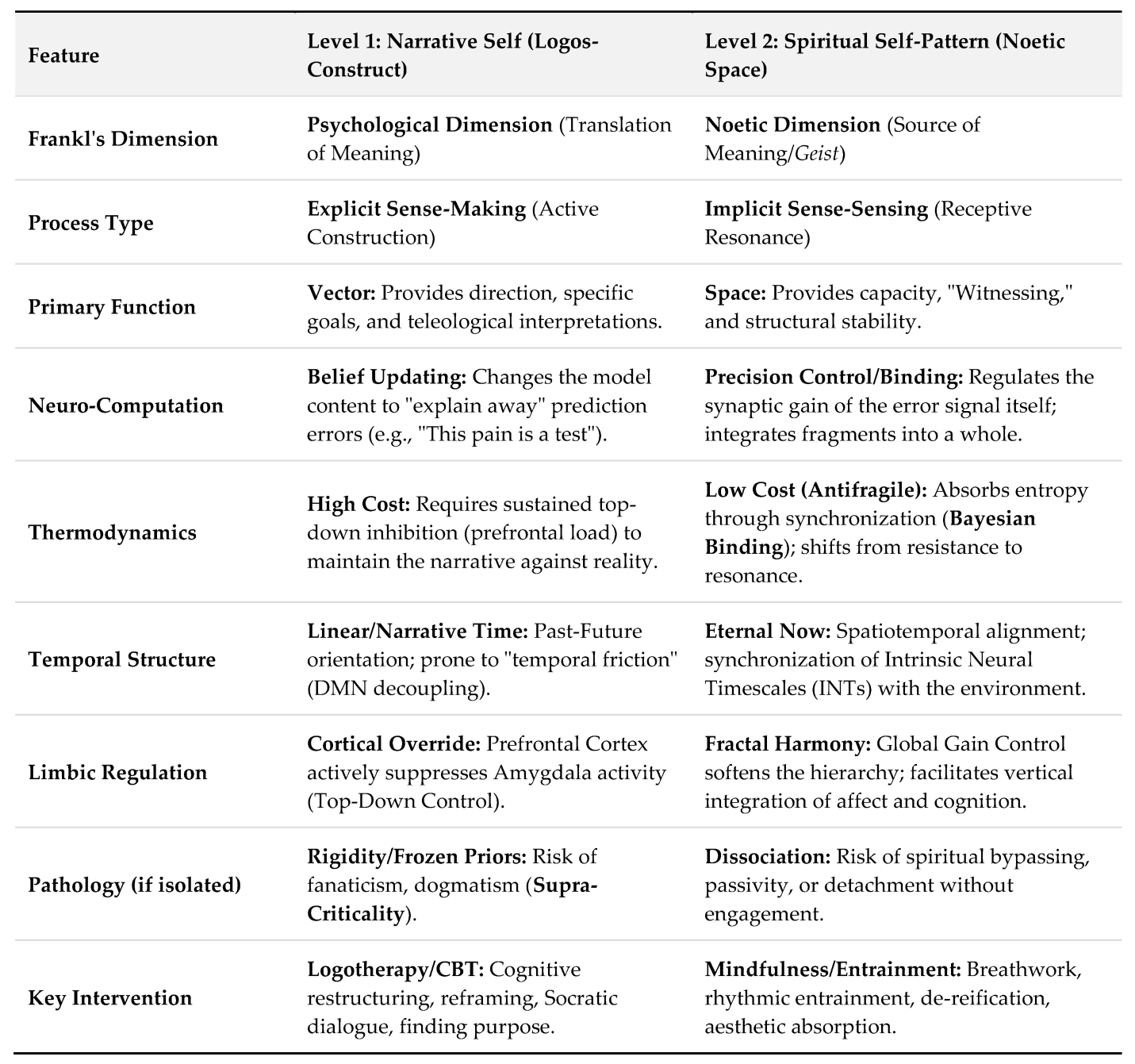
To clarify the distinction between these two modes of regulation,
Table 1 provides a systematic comparison across five dimensions: from Frankl’s philosophical categories to thermodynamic costs.
Crucially, the table highlights that Level 1 and Level 2 are not opposing forces, but complementary operators.
Level 1 (Logos-Construct) is optimized for Action: it burns energy to impose order on the world (High Cost/High Precision).
Level 2 (Noetic Space) is optimized for Reception: it saves energy by aligning with the world (Low Cost/Antifragile).
The transition from pathology to health is defined as the successful nesting of the expensive Action-mode within the efficient Reception-mode.
4.3. Hierarchical Integration: Embedding Vector Within Space
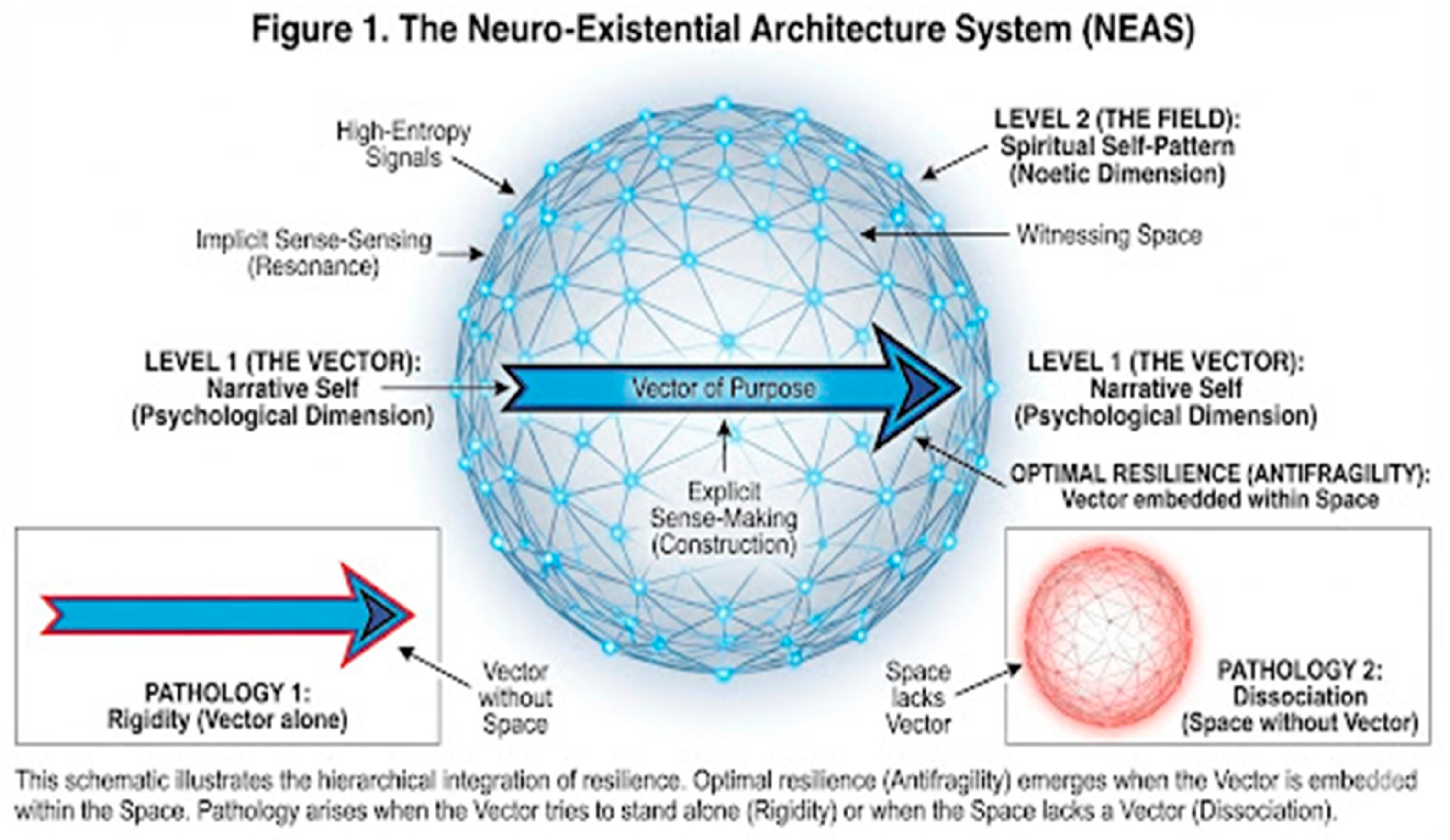
The Neuro-Existential Architecture System posits that true resilience—and ultimately, human flourishing—is not achieved by choosing one level over the other, but by their Hierarchical Integration. Optimal functioning emerges when the Vector of Logos (Goal) is embedded within the Space of the Spiritual Self-Pattern (Capacity).
We argue that pathological states often result from a failure of this integration.
Dissociated Spirituality: If the system cultivates the Spiritual Self-Pattern (Space) without Logos (Vector), it risks drifting into passive detachment or "Spiritual Bypassing." The organism has capacity but no direction; it is calm but ineffective in the world.
Rigid Fanaticism (Frozen Priors): Conversely, if the system relies solely on Logos (Vector) without the buffering capacity of Spirit, it becomes rigid. In the language of Active Inference, this corresponds to a "Frozen Prior"—a model with pathologically high precision that refuses to update despite contradictory evidence. The organism has direction but no capacity to absorb the shocks of reality; it breaks under pressure.
The Integrated State (NEAS) represents a unique neuro-existential configuration where the Spiritual Master Prior provides a low-noise, high-capacity topology—the "quiet background"—against which the Semantic Master Prior can project its vector—the "focused foreground." This integration allows the organism to pursue meaningful goals with high intensity while maintaining a low baseline of allostatic stress. This is the definition of "Flow" or "Grace" in action: high functionality with low metabolic friction. The "Spiritual Self-Pattern" is thus revealed not as a metaphysical luxury, but as the essential architectural component that allows the "Will to Meaning" to function sustainably in a high-entropy world.
Figure 1.
The Neuro-Existential Architecture System (NEAS).
Figure 1.
The Neuro-Existential Architecture System (NEAS).
This schematic illustrates the hierarchical integration of resilience.
Level 2 (The Field): The outer, spherical mesh represents the Spiritual Self-Pattern (Noetic Dimension). It functions as a high-capacity "Witnessing Space" that absorbs high-entropy signals via Implicit Sense-Sensing (Resonance).
Level 1 (The Vector): The inner, directed arrow represents the Narrative Self (Psychological Dimension). It functions as a semantic "Vector of Purpose" that organizes action via Explicit Sense-Making (Construction).
Integration: Optimal resilience (Antifragility) emerges when the Vector is embedded within the Space. Pathology arises when the Vector tries to stand alone (Rigidity) or when the Space lacks a Vector (Dissociation).
4.4. Neurodynamic Mechanisms: Enacting the Deep Self
Having delineated the hierarchical architecture of the NEAS, we must now descend into the biophysical substrates that instantiate the Spiritual Self-Pattern. How does an abstract shift in existential stance—from the narrative struggle of Logos to the witnessing capacity of Spirit—translate into tangible changes in neuronal firing and metabolic regulation? To answer this, we integrate four cutting-edge frameworks into a unified causal chain: Dean Buonomano’s Population Clocks, Georg Northoff’s Spatiotemporal Neuroscience, Luc Ciompi’s Fractal Affect Logic, and the Resonance-Inference Model (RIM) based on the recent work of Tucker, Luu, and Friston (2025). Together, these theories provide the "hard science" evidence that the Deep Self is not a metaphysical abstraction, but a distinct, high-efficiency dynamic regime of the brain.
4.5. Chrono-Architecture: From Neural Trajectories to the Eternal Now
To understand the structural regulation of the self, we must first understand the construction of time. Contrary to the intuitive notion of a centralized internal clock, Population Clock Theory posits that the brain encodes time implicitly through the changing patterns of activity within neural networks (Buonomano, 2017). In this view, time is a trajectory through a high-dimensional state space. Just as ripples on a pond encode the time elapsed since a stone was thrown, the evolving state of a neural population encodes the temporal interval of an experience. Every thought, every percept, is a unique path through this neural manifold (Buonomano & Maass, 2009).
In the standard mode of the Narrative Self (Level 1), these trajectories are often chaotic or rigidly looped. The stress of maintaining a complex autobiographical story against a hostile environment forces the neural population into "high-energy orbits"—complex, repetitive patterns of rumination that require constant metabolic input to sustain. The subjective experience of "time pressure" or "racing thoughts" is the phenomenological correlate of these erratic, high-velocity trajectories.
Here, Spatiotemporal Neuroscience provides the crucial link. Northoff (2018) argues that the brain’s Intrinsic Neural Timescales (INTs)—the temporal windows over which neurons integrate information—are hierarchically nested. In a dysregulated brain, a phenomenon termed "temporal friction" occurs: the ultra-slow timescales of the Default Mode Network (DMN), which underpin the self-concept, become decoupled from the faster timescales of sensory processing. The internal "clock" desynchronizes from the external world, trapping the subject in a solitary, ruminative time loop.
The activation of the Spiritual Self-Pattern induces a profound re-organization of this chrono-architecture, a state Northoff terms Spatiotemporal Alignment. Through practices of meta-awareness, the neural trajectories are smoothed and stabilized. The hierarchy of timescales "flattens," allowing the ultra-slow waves of the deep self to entrain with the statistical rhythm of the environment. Neurophysiologically, this is mediated by the synchronization of Slow Cortical Potentials (SCPs) with environmental rhythms.
Crucially, this synchronization effectively slows down the subjective passage of time. As the neural trajectory enters a stable, low-energy manifold—a "limit cycle" rather than a chaotic orbit—the brain creates the phenomenological experience of the "Eternal Now." This is not the absence of time, but the optimal alignment of internal population clocks with external dynamics. In this state of resonance, the brain ceases to expend energy predicting the future because it is perfectly synchronized with the present (Friston, 2010).
4.6. Fractal Affect Logic: The Bioenergetics of Trust
If Population Clocks describe the geometry of the Deep Self, Fractal Affect Logic describes its energy. Affects, in this framework, are not merely subjective feelings but "energetic operators" that organize cognitive complexity across all biological scales (Ciompi, 2016). Ciompi posits a principle of Self-Similarity: the same dynamic rules that govern the micro-level of synaptic gating also govern the macro-level of social behavior.
In states of existential threat, the dominant operator is Fear. Fear acts as a "contraction operator," raising the signal-to-noise threshold and forcing the system into a high-gain, rigid state (Ciompi, 1997). Synaptically, this manifests as a tightening of inhibitory control; cognitively, it manifests as tunnel vision. While useful for acute survival, as a chronic setting it creates a high-entropy internal environment.
The Spiritual Self-Pattern installs a fractal operator of Basic Trust (or Radical Acceptance). This operator functions as a "Global Gain Control" mechanism that fundamentally alters the system’s sensitivity.
In the language of Active Inference, this corresponds to lowering the Precision Weighting on ascending prediction errors. When the system operates under the operator of Trust, nociceptive signals (pain) or interoceptive errors (anxiety) are assigned lower precision. They are registered but not amplified (Feldman & Friston, 2010). This relaxation of inhibitory control propagates fractally upwards: neural networks become more fluid, the cognitive aperture widens, and the social self-shifts from defense to connection. This operator is "fractal" because it installs the logic of "openness" at every level simultaneously. It signals to the entire organism that the process of being is safe, effectively raising the threshold for what constitutes an "existential threat." This allows the organism to process high-intensity signals—whether grief or awe—without the metabolic cost of defensive shutdown.
4.7. Affective Criticality: The Dual-Limbic Geometry of Consciousness
Finally, we ground these temporal and energetic mechanisms in a unified dynamic theory by adopting the Criticality of Consciousness framework recently proposed by Tucker, Luu, and Friston (2025). This model provides the precise neuroanatomical hardware for our NEAS architecture by identifying two opposing limbic memory systems that must be rigorously balanced to maintain the self at the edge of chaos.
The Architecture of Duality: Papez vs. Yakovlev
Tucker et al. demonstrate that the mammalian forebrain is regulated by two distinct circuitries, each serving a specific computational and existential function.
The first is the Excitatory (E) System, anatomically grounded in the Dorsal Limbic (Papez) circuit, which links the hippocampus to the anterior thalamus and cingulate cortex. Functionally, this system is predictive: it projects high-level priors forward in time to anticipate environmental affordances. Neurochemically associated with cholinergic drive and consolidated primarily during REM sleep, it generates the phenomenological affect of Elation—the felt sense of agency, confidence, and expansion. In the NEAS framework, this is the biological substrate of the Logos-Vector (Level 1): the drive to impose meaning and direction upon the world.
The second is the Inhibitory (I) System, grounded in the Ventral Limbic (Yakovlev) circuit, connecting the amygdala to the orbitofrontal cortex and mediodorsal thalamus. Functionally, this system is corrective: it processes sensory prediction errors to update the internal model against the friction of reality. Associated with the consolidation of explicit memory during NREM sleep, it generates the affect of Anxiety—not necessarily as fear, but as vigilance, caution, and constraint. This is the substrate of Realism—the necessary check that prevents meaning from drifting into delusion.
Pathology as the Collapse of Criticality
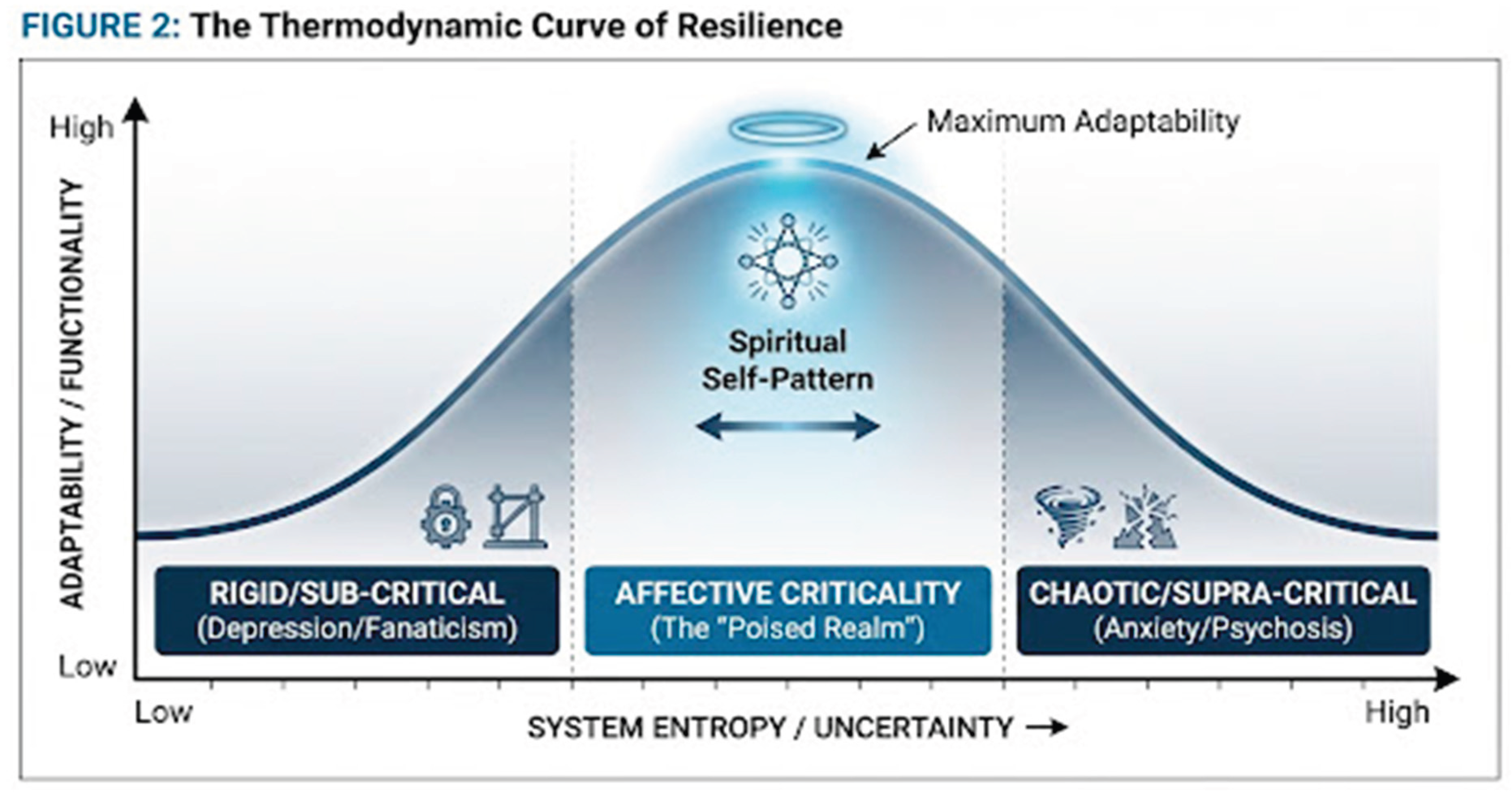
According to this model, functional consciousness is not a static state but a dynamic poise—a Criticality—where these two systems are simultaneously active and mutually counterbalancing. Pathology, in the NEAS view, is re-interpreted as the decoupling or imbalance of these circuits.
A state of Sub-Criticality (e.g., Depression) arises when the Inhibitory (Ventral) system dominates. The brain becomes locked in a "correction-only" mode, where the past (NREM-consolidated failures) constantly overwrites the future, freezing the system in a rigid, low-energy attractor of rumination.
Conversely, a state of Supra-Criticality (e.g., Fanaticism or Mania) arises when the Excitatory (Dorsal) system uncouples from reality. The brain generates rigid, high-precision predictions that ignore sensory error signals. Here, the future (REM-consolidated fantasies) overrides the present, leading to a brittle, high-energy stability that eventually shatters against reality.
The Spiritual Self-Pattern as the Criticality Regulator
This dual-limbic framework reveals the ultimate function of the Spiritual Self-Pattern (Level 2). It acts as the meta-regulatory Gain Control mechanism that maintains the E-I Balance. By shifting identification from the content of the prediction (Logos) to the space of awareness (Spirit), the system prevents the dominance of either circuit.
The "Deep Self" creates a global workspace where the Elation of Logos (Purpose) can coexist with the Vigilance of Reality (Truth), without collapsing into either mania or depression. Biologically, this state of Affective Criticality maximizes the brain’s Information Integration (Phi) and thermodynamic efficiency. It allows the organism to navigate the world with a "Soft Vector"—a direction that is strong enough to guide action but flexible enough to bend without breaking. Thus, spirituality is revealed not as a retreat from the world, but as the intricate neuro-computational art of keeping the brain’s two hemispheres of hope and fear in a perfect, resonant hum.
Figure 2.
Affective Criticality and the Poised Realm. The Spiritual Self-Pattern maintains the neural system at the phase transition between order (rigidity) and chaos (entropy), optimizing information processing and minimizing allostatic load.
Figure 2.
Affective Criticality and the Poised Realm. The Spiritual Self-Pattern maintains the neural system at the phase transition between order (rigidity) and chaos (entropy), optimizing information processing and minimizing allostatic load.
5. Clinical Implications: Technologies of Enactment
If the "Deep Self" is defined by the capacity to maintain a structural Master Prior of openness and criticality, then the crucial question becomes: How is this capacity acquired, strengthened, and applied in clinical settings? Within the framework of the Neuro-Existential Architecture System (NEAS), we posit that practices such as meditation, aesthetic engagement, and embodied rituals should be re-conceptualized not merely as "coping mechanisms" or relaxation techniques, but as Technologies of Enactment. They function as precision-engineering tools for the cognitive architecture, designed to train the system’s ability to regulate synaptic gain, align intrinsic timescales, and maintain affective criticality. This shifts the clinical focus from the passive reception of "grace" or insight to the active training of "Resonance."
5.1. From Coping to Transformation: The Physics of Change
Traditional therapeutic models, particularly standard Cognitive Behavioral Therapy (CBT), often operate primarily at Level 1 (Logos). They focus on "Cognitive Restructuring"—the logical refutation of irrational beliefs and their replacement with more adaptive narratives (Beck, 1976). While undeniably effective for reducing acute symptom severity, this approach often leaves the underlying structural vulnerability intact. The patient learns a "better story" to tell themselves about their suffering, but the high-energy cost of maintaining this story against deep-seated autonomic dysregulation remains. The "fight" for meaning continues, merely with better weapons.
NEAS proposes a paradigm shift from Coping—defined as managing symptoms via semantic control—to Transformation, defined as altering the system’s dynamic regime. Following Hermann Haken’s principles of Synergetics (Haken, 1991), we view therapeutic change not as a linear, incremental learning process, but as a non-linear Phase Transition. In complex systems, a shift from one order parameter (e.g., a depressive attractor) to another (e.g., a resilient attractor) requires a temporary destabilization of the system. The therapist does not just "teach" new skills; they act as a "perturbator" or control parameter that deliberately destabilizes the patient’s rigid behavioral patterns (Schiepek et al., 2016). This helps explain the clinical phenomenon of the "healing crisis" or the "dark night of the soul." The active introduction of "Spiritual Technologies" (like intensive breathwork, radical acceptance, or confronting existential truths) often initially increases the system’s free energy (anxiety/uncertainty) as the old, rigid "Ego-Attractor" begins to dissolve. This phase of instability is not a sign of failure, but a necessary precursor to self-organization. It is the moment where the system is "liquid" enough to be recast. The goal of NEAS therapy is to guide the patient through this instability into a new, higher-order configuration of Affective Criticality—a state where the self is stable enough to endure but flexible enough to grow.
5.2. De-Reification: Bayesian Binding in Action
The first technology of enactment targets the rigidity of the Narrative Self. In depressive and anxious states, thoughts are Reified: experienced as solid, immutable facts about the world (Northoff, 2016). Neurobiologically, this corresponds to hyper-precise priors in the Default Mode Network (DMN) that suppress sensory evidence. For the depressed individual, the thought "I am worthless" is not a hypothesis, but a prior with infinite precision.
Mindfulness practice is operationalized in NEAS as the systematic training of De-Reification. By sustaining non-judgmental attention on the immediate sensory flux, the patient learns to lower the Precision Weighting of top-down narrative predictions (Lutz et al., 2008). However, NEAS advances beyond standard mindfulness models by introducing the concept of Bayesian Binding as the core mechanism of integration (Laukkonen et al., 2025). The goal is not just to "observe" thoughts (which can lead to dissociation), but to bind them into a larger context. Clinical Vignette: Consider a patient with trauma. In a standard "Coping" approach, they might try to "reframe" the trauma ("It made me stronger"). In NEAS, the patient is guided to locate the somatic sensation of the trauma (the error signal) and simultaneously activate the "Spiritual Self-Pattern" (the capacity of wide, open awareness).
When the high-entropy error signal (trauma) is held within the high-capacity model (awareness), the brain performs a "Global Binding Operation." It integrates the fragment into the whole. This collapses the free energy of the system, not by erasing the trauma, but by stripping it of its existential threat (Friston, 2010). The trauma remains as a fact of history (Narrative), but it loses its power to shatter the self (Structural). The result is Predictive Flexibility: the ability to hold conflicting truths simultaneously—"I was hurt" AND "I am whole"—without systemic collapse.
5.3. Thalamocortical Entrainment: The Rhythm of Stability
While De-Reification works "Top-Down" to loosen rigid narratives, the second technology works "Bottom-Up" via Thalamocortical Entrainment.
The most accessible population clock available to the human organism is the breath. Research demonstrates that slow, rhythmic nasal breathing (approximately 0.1 Hz) mechanically entrains oscillations in the olfactory bulb, which then propagate to key limbic structures, including the amygdala and hippocampus (Heck et al., 2017).
In the context of NEAS, we view this as "Neural Pacemaking." By consciously regulating the breath, the patient imposes a slow, stable external rhythm onto the chaotic internal neural trajectories associated with anxiety. The thalamus, entrained by this respiratory rhythm, begins to gate sensory information more rhythmically, reducing the "noise" of random error signals (Vlemincx et al., 2013).
Crucially, this entrainment is not limited to the individual. Limbic Resonance describes the capacity of mammals to entrain each other’s physiological states (Lewis, Amini & Lannon, 2000). Group rituals, chanting, or communal prayer function as "Social Entrainment Technologies." They create a shared, external temporal scaffold ("The Ritual") that outsources the metabolic cost of regulation. The individual brain no longer has to generate its own stability; it "rides" the stability of the group rhythm. The experience of the "sublime" in aesthetic absorption acts similarly: the perfect structure of a Bach fugue or a cathedral acts as a "Super-Prior" of order, forcing the observer’s intrinsic timescales to align with it (Koelsch, 2014). This allows the system to rest in a state of resonance, saving immense amounts of metabolic energy usually spent on predictive control.
5.4. Distinction from ACT: Integration vs. Dissociation
Finally, it is crucial to distinguish NEAS from Acceptance and Commitment Therapy (ACT), with which it shares superficial similarities. Both promote "Psychological Flexibility" and a "Self-as-Context" (Hayes et al., 2006).
However, ACT often treats the "Observing Self" as a cognitive stance or a linguistic construct ("I am the sky, not the weather"). This metaphor, while helpful, carries the risk of Spiritual Bypassing—using the stance of the observer to dissociate from the raw pain of experience (Welwood, 2000). The patient can become a "cool observer," intellectually detached from their own life to avoid the heat of emotion.
NEAS, grounded in Ciompi’s Fractal Affect Logic (Ciompi, 1997), emphasizes "Hot Integration" over "Cold Distancing." We argue that transformation requires affective engagement. The Spiritual Self-Pattern does not stand apart from the pain; it permeates it.
In NEAS, the goal is not to "defuse" from the emotion (making it distant), but to Resonate with it (making it flow). We utilize the concept of Affective Criticality: we want the system to be "hot" enough (high energy/arousal) to be malleable, but "structured" enough (via the Master Prior) not to explode.
Furthermore, NEAS explicitly guards against Bypassing by insisting on the Hierarchical Integration of Logos and Spirit. Spirit (Space) without Logos (Vector) leads to a "Blissed-out" passivity. Logos (Vector) without Spirit (Space) leads to burnout. The NEAS-Integrated State uses the "Space" of Spirit to fuel the "Vector" of Logos. We do not just "commit" to values; we "resonate" with the deep structure of life to enact those values biophysically. Thus, NEAS offers a thermodynamically grounded explanation for why ACT works, while pointing towards deeper, somatic-energetic interventions that traditional protocols may overlook.
6. Conclusion from Survival to Flourishing–The Integrated Architecture
This article began with a paradox: the undeniable necessity of meaning for human survival, contrasted with the immense metabolic cost of maintaining it in a high-entropy world. We set out to resolve this tension by bridging the existential phenomenology of Viktor Frankl with the computational rigor of the Free Energy Principle. The result is the Neuro-Existential Architecture System (NEAS), a framework that redefines resilience not as a struggle for control, but as a hierarchical integration of content and structure.
6.1. The Synthesis: Logos as Vector, Spirit as Space
Our analysis confirms Viktor Frankl’s seminal insight: the "Will to Meaning" (Logos) is indeed a primary motivational force. In neuro-computational terms, it functions as a high-precision Semantic Master Prior—a teleological vector that minimizes long-term expected free energy. Without this vector, the system lacks direction; it falls prey to the entropy of the moment.
However, the NEAS framework reveals that Logos alone is insufficient. As a content-based prior, it remains fragile and metabolically expensive. To move from mere survival to genuine flourishing, the vector of Logos must be embedded within the broader topology of the Spiritual Self-Pattern (Spirit).
This spiritual dimension is not a contradiction of Frankl’s work, but its bio-energetic completion. It provides the Structural Master Prior—the "Witnessing Space"—that regulates the precision of error signals.
Logos asks: "What is the meaning of this suffering?" (Interpretation)
Spirit asks: "How can I hold this suffering without breaking?" (Capacity)
By integrating these two, NEAS offers a model where the direction of meaning is sustained by the energy of resonance. Following Tucker, Luu, and Friston (2025), we identify this integrated state as Affective Criticality: the delicate poise where the Excitatory "Thrust" of Logos (Papez Circuit) is perfectly balanced by the Inhibitory "Friction" of Reality (Yakovlev Circuit).
6.2. Limitations and Future Directions
We acknowledge that this framework is currently theoretical. Future research must empirically validate the NEAS hierarchy.
Specifically, neuroimaging studies should investigate:
Metabolic Efficiency: Does the activation of the "Spiritual Self-Pattern" (via aesthetic induction) lower glucose uptake in the dlPFC during cognitive reappraisal tasks?
Criticality Signatures: Does the "Deep Self" state correlate with neural avalanche distributions following a power law (1/f scaling), as predicted by the criticality hypothesis?
E-I Balance: Can we observe a simultaneous activation of REM-like (excitatory) and NREM-like (inhibitory) neural signatures during states of spiritual absorption, confirming the "Dual-Limbic" model of consciousness?
6.3. A New Grammar for Psychotherapy
In conclusion, this article argues that meaning is not a metaphysical luxury, but a thermodynamic necessity for viability. In an era of cognitive overload, the "fight for meaning" is a losing battle if fought solely on the battlefield of narrative. True resilience requires us to access the deeper architecture of the self—to train not just our beliefs, but our neurodynamic state.
The "Deep Self" is the evolutionary solution to the problem of entropy. It is the mechanism by which the brain ceases to be a fortress defending against the world and becomes a vessel resonating with it. By enacting this shift—from the rigid defense of the ego to the critical poise of the spirit—we do not just survive; we flourish, transforming the entropy of existence into the structure of the soul.
6.4. AI Use Declaration
The author acknowledges the use of artificial intelligence (Gemini Advanced) to assist in translating the original German manuscript into English, as well as in drafting the abstract and public significance statement. The AI output was used solely for linguistic refinement and formatting. The author has carefully reviewed, revised, and approved all content generated by the AI and assumes full responsibility for the accuracy and integrity of the final manuscript.