

Submitted:
05 December 2025
Posted:
09 December 2025
You are already at the latest version
Abstract
This study was conducted in order to show the transformative potential of extracting into the same solution and using the substances of the component composition of pomegranate peel and their seeds. First, the peel from hand-peeled pomegranates and seeds from juicing their grains in a laboratory press were crushed using a Reitz mill, then mixed taking into account the natural ratio between these parts in three different pomegranate samples [1-1.58/1, 2-1.03/1 and 3-3.77/1 (weight/weight)]. Maceration of these three mixtures was tested with a 1:2 hydromodule (g/ml) for 4.5 hours at 63 °C (mixtures 1 and 2) and for 2.5 hours at 50-55 °C with the addition of 0.15% of the enzyme Fructozym MA-LG by weight of the extraction mixture (mixture 3). Under these conditions, 44.48±0.97 % came out of mixture 1 into solution, 58.04±1.03 % from mixture 2, and 61.16±1.55% of dry substances from their total weight in the initial crude mixture from mixture 3. At the same time, more protein and fiber came out of mixtures 1 and 2 into solutions, but less fat than from mixture 3. Condensed extracts with a dry matter content of 57.0±0.5 g/100 ml were obtained from the primary extracts, including 3.24±0.03 - 4.93±0.04 g/100 ml of polyphenols and 2.80±0.02-4.00±0.04 g/100 ml of fatty oil. The insoluble residues were converted into two dietary powders with a high protein content (from 6.25±0.06 to 8.37±0.09 g/100 g dry weight) and fiber (from 58.98±0.58 to 62.6±0.65g/100 g dry weight).
Keywords:
a mixture of pomegranate peel and seeds
; thermal maceration
; release of component substances into solution
; phenol - oil extract
; protein - carbohydrate flour
; dietary fiber
1. Introduction
The growing interest in healthy eating and environmental issues encourages a more attentive attitude to the efficient use of food waste [1,2], including the peel and seeds left after receiving juice from pomegranate fruits.
By-products of pomegranate juice production are the peel from machine peeling of fruits (a complex consisting of leathery pericarp, internal partitions, placenta and seed nests) and the seeds themselves from juice extraction from pomegranate seeds. Due to the colored film-like shell that previously surrounded the juice-filled grains and the short-term contact with the juice during the pressing of the grains, the seeds themselves are more red than their natural whitish color.
Pomegranate juice producers should take special care of these by-products. This is due to the fact that they are formed in large quantities, and transportation to a specially equipped landfill for burial, although it is one of the simplest and cheapest methods of their disposal, is considered an outdated and environmentally harmful method, as it leads to contamination of the soil, groundwater and atmosphere. The legislation requires that this process be legal, with the conclusion of a contract with a specialized organization that has a license for the removal and disposal of waste.
Therefore, there is an increasing need to establish effective recycling of this type of waste so that it would be possible to avoid attributing all the costs of their occurrence and disposal to the juice.
An analysis of the current situation in the field of pomegranate peel processing shows that its most frequent element today is its extraction in the "solid/liquid" system [3]. The main reason for this choice lies not so much in the high content of extractive substances in the feedstock, but rather in the multifaceted properties of pomegranate extracts, which can be incorporated into various beverages, functional foods, and nutraceuticals [4]. In addition, they have demonstrated the potential to increase shelf life and preserve food quality [5].
Previously, the extraction of peel substances into a solution was aimed only at maximizing the yield of the target extract, and this was often carried out using toxic and expensive solvents, but today manufacturers of plant extracts prefer alternative "green" technologies [6,7] designed to use pure and safe solvents approved by GRAS [8,9].
Extraction with the help of such solvents contributed to the disclosure of the multifaceted properties of liquid extracts of pomegranate peel [10,11]. The use of enzymes in this process can ensure the maximum degree of polyphenol extraction [12,13].
Numerous studies have been conducted that have shown that water, ethanol and their combinations are the most suitable solvents for the commercial extraction of phenols from pomegranate peel and the production of products intended for human consumption [14,15,16].
The content of total polyphenols in the aqueous extract from the peel was 8460 mg (GAE)/100 g of the dry matter of the peel, which was higher than in the methanol extract and ethanol {5,990 and 4,530 mg of gallic acid equivalents/100 g of the dry matter of the peel, respectively}[17]. The maximum content of total phenols in the aqueous extracts of pomegranate peel of the Ganesh variety was 438.3 ± 14.15 mg of tannic acid equivalents/g of extract [18].
In one study, water extraction of oil from pomegranate seeds was tested under conditions in which the technological parameters varied as follows: the ratio between solvent and dried and crushed seeds from 1-3:1 (ml/g); pH 3-11; temperature 10-70 °C; time 30-390 minutes, and mixing was carried out with at a constant speed of 100 rpm. The resulting extracts were processed in a centrifuge at 5000×g for 10 minutes to separate the oil. The maximum amount of oil (19.3% of the total weight of dried seeds) was obtained with a hydromodule of 2.2:1 (ml/g), pH 5.0, temperature 63 °C and process duration of 375 minutes. This yield was lower compared to the oil yield during hexane seed extraction (26.8%), but higher than the oil yield during cold (7.0%) and hot pressing (8.6%) [19]. This means that water extraction can be used to extract into a solution not only the polyphenols of pomegranate peel, but also, surprisingly, their seed oil.
Studies have also shown that the quality of oil obtained with water can be improved by pre-enzymatic treatment of seeds [20,21].
The global production of pomegranate fruits is about 3 million tons per year, of which the peel and seeds account for about 54% or 1.62 million tons. Involving at least part of such a large volume of peel and seeds in processing requires its diversification - strategies that allow the production of new products with a higher degree of processing from the same raw materials in order to reduce risks and increase business sustainability, create additional sources of income, reduce risks and increase overall production efficiency [22,23,24].
Although to date, scientists have developed and proposed many solutions to processing companies for processing peels and seeds in the places of their direct formation, due to the incomplete compliance of these developments with the requirements of food manufacturers, their processing was not developed and remained so.
In the world, this is occasionally done by several companies that are closer to the production of liquid and dry polyphenolic extracts and oils as herbal medicine and skin care products. To do this, they patented several related technologies and created production sites for them from prefabricated equipment [25,26,27,28]. At the same time, to obtain half-pure or completely pure polyphenols, it requires the use of adsorption chromatography, which means that technical and economic problems associated with its provision and implementation, and an increase in the cost of the target product.
Since the pomegranate ingredients of these companies continue to be sold online and in green pharmacies, despite the high prices of some medicines, this means that this practice meets the goals and objectives of the business in a particular market situation.
However, in relation to the conditions and tasks of modern food production, this may not always be economically justified.
Moreover, this practice is based on technologies with strict selectivity towards target substances, which leads to the formation of new waste in the form of extracted peel and low-fat seeds. That is, the implementation of such a practice directly at the places where pomegranates are processed into juice would have virtually no effect on solving the waste problem.
In addition, separate processing of pomegranate peel and seeds at two different sites is associated with an increase in the total cost of organizing the processing of these solid residues as a whole. Despite this, few people think about the advantages of their joint processing within a single technology.
This study was conducted precisely to test the joint extraction of peel and seeds, to study the yield and composition of the obtained solutions and insoluble residues, and also to show how they can be converted into promising products with added value.
2. Materials and methods
2.1. Objects of research
In this study, the objects were the peel and seeds of ripe pomegranates from the 2024 harvest of pomegranates, as well as the aqueous extracts and insoluble solid residues obtained from them.
The peel was obtained by manually peeling the fruits, and the seeds were extracted by pressing juicy grains separated from the peel in a laboratory press, and both of these fruit parts were crushed separately using a Reitz mill.
As shown in Figure 1, the peel and seed grinding products were combined into one common experimental processing object, taking into account the pre-calculated natural average ratio between these parts in 10 randomly selected fruits of three different pomegranate samples: 1-1.58/1, 2-1.03/1 and 3-3.77/1 (weight/weight).
2.2. Extraction
Maceration with heating is a method of "hot" maceration; vegetable raw materials are aged in a liquid solvent at temperatures up to 65 °C; grinding, heating and mixing accelerates the extraction of biologically active substances, aromas and flavors.
This method has shown its high efficiency when working with plant materials with a high content of water-soluble components [16,29].
All experiments were carried out in 750 ml Labdevices glass measuring cups (St. Petersburg, Russia) with a 1/2 (g/ml) hydromodule, in which there was enough solvent to cover the entire volume of crushed material.
Before mixing, the water was heated to a certain temperature, which was then maintained for the entire time allotted for maceration. The process was carried out with the addition of the liquid enzyme Fructozym MA-LG (Erbslöh Geisenheim GmbH, Germany) in an amount of 0.15% by weight of the extraction mixture or without the participation of the enzyme.
The duration of enzymatic maceration was 2.5 hours at a temperature of 55 °C. 4.5 hours were allocated for enzyme-free maceration, and it was carried out at 63 °C. The extraction mixture was continuously mixed during the entire process with an MT-1512 mixer (China) at low speed (60 rpm).
The main part of the resulting solution was separated using tools capable of creating thrust in the “extraction mixture container/extract receiver” system and forcing the liquid phase to pass through the filter layer. The remaining extract (1/3 of the volume or more) It was isolated from the solid residue using a squeezing device.
The total yield of the dry substance into solution was calculated using the following formula:
% yield = [(mass of dried insoluble residue)/(mass of dried starting mixture)] x 100.
The yield of simple sugars, titrated acids, polyphenols, protein, and fat into the solution was calculated taking into account their content in the resulting solutions and the initial mixture.
% yield = [(mass of substance in the resulting solution)/(mass of substance in the initial mixture)] x 100.
2.3. Transformation of formed solutions and insoluble residues
The extracts were condensed in an evaporator to a dry matter content of 57° Brix directly or after clarification for 1 hour at a temperature of 50-55 °C with the addition of the enzyme Fructozym P (Erbslöh Geisenheim GmbH, Germany). Spray drying of condensed extracts was also tested.
The insoluble residues were placed on mesh metal baking trays and dried in a convection dryer at 105 °C for 5 ± 0.25 hours until air-dry, then crushed in small portions (20 g each, for 15-20 seconds) in an RAF R.7124 coffee grinder (China). The size of the powder particles was determined using a Coulter counter (the principle of this method is based on determining the change in electrical resistance when particles pass through a small hole).
2.4. Chemical analyses
- Dry substances - according to GOST (The State Standard of Russia) 24027.2-80, by drying the prepared sample of the test material to a constant mass.
- Simple sugars - according to GOST 8756.13-8, the method is based on the ability of sugars with an aldehyde group to interact with Fehling's reagent and reduce copper oxide (CuO) to Cu2O, which precipitates as a reddish precipitate.
- Total acidity is determined by the titrimetric method according to GOST ISO 750-2013, based on titration in the presence of an indicator before discoloration of the analyzed solution (0.0064 is the conversion coefficient of 0.1 N NaOH solution to citric acid).
- Crude protein – by the Keldal method (6.25 is the conversion factor used to calculate the protein content).
- Crude fat – gravimetric method according to GOST 8756.21, the method includes extraction of fat with gasoline, and then determination of the fat mass in a certain part of the resulting extract after solvent removal.
- Minerals (ash) – according to GOST 24027.2-80, by weight of the residue from burning a dry sample of the starting material in a muffle furnace.
- Fiber is an enzymatic gravimetric method according to GOST 34844-2002, this standard applies to special-purpose food products, biologically active and dietary supplements.
- Total polyphenols – according to GOST 24027.2-80, based on titration of the unreacted indigocarmine residue with 0.1 N KMnO4 solution (potassium permanganate) after oxidation of phenolic substances. Other compounds react with permanganate, therefore, all substances oxidized by this reagent are titrated first, and then the residue in the extract is titrated after treatment with activated carbon, which is capable of adsorbing only polyphenols. The amount of phenols is determined based on the difference between the amount of permanganate spent on the first and second oxidation. A coefficient of 0.004157 is used to convert milliliters of 0.1 N KMnO4 solution into grams of phenols. This principle also underlies Article 1.5.3.0008.18 of the Russian Pharmacopoeia (XIV edition), which relates to the methodology for determining tannins in medicinal raw materials.
2.5. Primary data processing
The data was analyzed using basic descriptive statistics tools such as the mean and standard deviation for a set of repeated measurements.
The significance level of 5% (p <0.05) was taken into account for all tests. The data was analyzed using Statistical Software for Social Sciences (SPSS) (IBM Inc., Armonk, New York, USA, version 26).
3. Results
3.1. Thermal maceration without enzyme involvement
3.1.1. The component composition of primary extracts from seed maceration and a mixture of peel and seeds of pomegranate sample number 1
It was found that in a sample of 10 randomly selected fruits of sample number 1, 71.1±1.5 g (or 29.7±0.63% of its total weight) accounted for the peel in one average fruit, juicy seeds (grains) - 168.5±3.5 g (or 70.3±1.5%), the seeds themselves - 45.0±0.9 g (or 18.8±0.38%). Considering that the ratio between the peel and the actual seeds was 1.58/1 (weight/weight), about 515 kg of juice can be obtained from 1 ton of pomegranates of this sample, after which 297 kg of peel and 188 kg of seeds will remain.
Table 1 shows the component composition of the peel and seeds of the pomegranate sample number 1 and a mixture of peel and seeds themselves, made up in the same ratio of 1.58/1 (weight/weight), in which they were presented in this sample of pomegranates.
Her data suggest that the P and BS of this sample of pomegranates differ greatly in the quantitative composition of some substances of their component composition with the potential for industrial use: P is much richer in monosaccharides, titrated acids and polyphenols (10.08±0.13; 4.39±0.06 and 3.60±0.04 g/100 g, respectively) than BS (9.05±0.15; 1.35±0.18 and 0.25±0.01 g/100 g, respectively). And BS contains much higher concentrations of protein and fat (5.13±0.05 and 7.30±0.10 g/100 g, respectively) than in P (2.50±0.04 and 2.80±0.03 g/100 g, respectively).
In the Table 2 shows the component composition of solutions from 4.5-hour maceration of individual BS and a mixture of P+BS 1.58/1 (weight/weight) of a sample of garnets number 1 at a hydromodule of 1:2 (g/ml) and a temperature of 63 °C. It also shows the percentage ratio between the P and BS components of the total mass of that part of each substance that came out into solution from 258 grams of the P+BS mixture (158 g peel + 100 g seeds).
From the data presented in it, it becomes clear that the concentration of solids in the solution from maceration of 100 g of BS was 8.27±0.20 g/100 ml, and in the solution from maceration of 258 g of the mixture of P+BS - 9.30±0.10 g/100 ml. If we take into account the volumes of these solutions - 200 ml from maceration of 100 g BS and 500 ml from maceration of 258 g P+BS, the total yield of solids was 16.6 g/100 g BS and 46.5 g/258 g P+BS (or 18.0 g/100 g 40.51±0.52).
This difference in the yield of solids in favor of P+BS cannot be attributed to the concentration of total solids in the feedstock - in BS it was not only not lower, but even higher (41.32±0.58 g/100 g of crude weight) than in P+BS (40.51±0.52 g/100 g of crude masses).
This is due to the fact that P+BS was initially richer in the easily soluble fraction of solids (which consists of monosaccharides, acids, polyphenols, and fibers), which passes into solution faster and more completely than the rest of them.
From the data in this table concerning the role of the P and BS components of the initial mixture in mass transfer, it can be seen that in the total mass of that part of the total solids that passed from 258 g of the initial P+BS into the solution, their P component accounted for 64.43%, the BS component - 35.57%.
This ratio follows from the fact that in 258 g of P+BS there were 100 g of BS, of which 8.27 g/100 ml x 2 (200 ml of extract) = 16.57 g could be added to the solution of dry substances; 16.57 g is equal to 35.57% of the total weight of that part of the total dry substances that passed from add the mixture to the solution as a whole [9.30 g/100 ml x 5 (500 ml extract) = 46.5 g].
In the total mass of that part of the monosaccharides that passed into solution, the ratio between its P and BS components was 55.98/44.02 (%/%), titrated acids - 83.36/16.64 (%/%), common polyphenols - 67.18/32.82 (%/%).
At the same time, in the total mass of those parts of protein and fat that passed from the same mixture into the solution, the ratio between their P and BS components was not in favor of P (37.00/63.00 (%/%) and 36.99/63.01, respectively).
This is due to the fact that protein and fat were initially much higher in BS than in P.
In practical terms, a more important indicator is the yield of individual substances of the BS component composition and the P+BS mixture into the solution as a percentage of their total weight of the bulk of the starting material.
From the Table 3 shows that under these conditions, the yield of dry substances into solution was 40.03±0.99% and 44.48±0.97% of their total weight in 100 g BS and 258 g P+BS, respectively.
The yield of monosaccharides was 85.75±2.12% and 70.68±1.75%, titrated acids - 77.04±1.91% and 75.48±1.55%, total polyphenols - 72.00±1.78% and 67.18±1.38% by the total weight of each of these substances in 100 g BS and 258 g P+BS, respectively.
3.1.2. The component composition of primary extracts from thermal maceration of a mixture of P+BS pomegranates number 2
Technical analysis showed that in the sample (n=10) of the pomegranate sample number 2, one fruit with an average weight of 239.0 ±7.0 g, 55.2±1.6 g (23.1%) is the peel, 183.8±5.4 g (76.9%) is juicy seeds (grains), 53.8±1.6 g (22.5%) - seeds themselves, 130.0± 3.8 g (54.4%) - juice. The ratio between the peel and the actual seeds is 1.03/1 (weight/weight).
After 4.5-hour maceration of the mixture of 106.6 g P+BS 1.03/1 (wt/wt) with a 1:2 (g/ml) hydromodule and a temperature of 63 °C, the yield of substances of its component composition into the solution was the same as in Table 4.
It shows that the yield of monosaccharides into the solution was 78.41±1.76%, titrated acids - 75.34±1.69%; total polyphenols - 65.20±1.47%; fibers (mostly soluble pectin) - 6.57±0.15% by the total weight of each of these substances in 106.6 g in P+BS 1.03/1 (weight/weight).
58.04± 1.03% protein and 30.12 ±0.67% crude fat, were also released into the solution, which further complicated its separation.
When comparing the data in Table 3 and Table 4, it turned out that more dry substances came out of the P+BS 1.03/1 mixture from this experimental version into the solution (50.56±1.14% of their total weight in the initial sample) than from the P+BS 1.58/1 mixture (weight/weight) from the previous experimental variants (44.48±0.97 %). This can be explained by the fact that the mixture P+BS 1.03/1 (weight/weight) of this pomegranate sample initially contained more solids (42.92±0.50 100 g of crude weight) than the mixture P+BS 1.58/1 (weight/weight) of the pomegranate sample number 1 (40.51±0.52 100 g of raw mass).
3.2. Thermal maceration of the P+BS mixture of pomegranate sample number 3 with the participation of the enzyme Fructozym MA-LG
In the sample of pomegranates number 3, the weight of one fruit was 241 ±9.0 g, in it the peel accounted for 37.6±1.41%; the mass ratio between the P and BS was the same as in Table 5.
After 2.5-hour maceration of 114.5 g of the P+BS 3.77/1 mixture (weight/weight) of garnets of this sample at a 1:2 hydromodule (g/ml) and a temperature of 50-55 °C with the addition of 0.1% Fructozym MA-LG enzyme to the extraction mixture, the yield of substances of its component composition into the solution was as follows, as in Table 6.
As can be seen from the data placed in it, in this variant, the yield of monosaccharides into the solution was 77.80±1.97%, titrated acids - 72.24±1.83%; total polyphenols - 72.28±1.83%; fibers - 3.36±0.08%, protein - 36.57±1.11%, fat - 40.81±0.58% by total weight each of these substances is in a sample of the starting material.
When comparing the effectiveness of non-enzymatic (previous variants) and enzymatic (this variant) maceration, it turned out that, despite the fact that enzymatic maceration was carried out at a more gentle temperature and in a shorter time, the use of a enzyme in this process led to a significant increase in the yield of dry substances and fat in the solution.
If in the two previous variants the yield of solids was 44.48±0.97% and 50.56±1.14% and fat was 32.15 ±0.66% and 30.12±0.67%, then in the variant of enzymatic maceration 61.16±1.55% of solids and 40.81±0.58% of fat were dissolved.
At the same time, less protein (36.57±1.11%) and fibers (3.36±0.08%) were released into the solution during enzymatic maceration than during non-enzymatic maceration (protein -45.45±0.93 and 58.04± 1.03%; fibers - 10.97±0.23 and 6.57±0.15%).
That is, the use of the enzyme contributed to some, but far from complete clarification of the solutions.
Since quite a lot of oil has been released into the solutions, it can be isolated from them as an individual product using a centrifuge.
3.3. Concentration of the primary extract
The separation and transformation of the formed solutions into intermediate and final products is depicted in Fig. 2.
Since the solution was viscous and difficult to separate from the boiled pieces of raw material, it was forcibly separated using a pump capable of creating thrust in the “extraction mixture container/extract receiver” system and forcing the liquid phase to pass through the filter layer (Fig. 2, a). The remainder of the solution was separated using a squeezing device, then both parts were mixed to obtain the entire volume of the solution (Fig. 2, b).
The combined solution is sent to the evaporation point.
Or, before evaporation, it is first sent to an apparatus with heating and mixing systems, where it is kept with a stirrer running at 60 rpm for 1 hour at a temperature of 50-55 °C with the addition of 0.015% of the enzyme Fructozym P (Figure 2, c) to remove turbidity created by soluble with pectin.
The initial or clarified extract is sent to a vacuum apparatus, where it is evaporated at a temperature of 50-60 °C and a dilution of 600-650 mm Hg to a dry matter content of 57% (Fig. 2, d).
The dry matter content is monitored using a refractometer.
Table 7 shows the results of chemical evaluation of laboratory samples of concentrated extracts from maceration of BS pomegranate sample 1 and P+BS pomegranate samples 1-3.
As it can be seen from it, the extracts obtained by this method contain all the substances of the initial mixture, and most importantly, the polyphenols of the peel and seed oil with biological activity.
These are thick, slow-flowing liquids that can be poured into glass vials as a ready-made non-sterile herbal medicine.
When comparing BS(a) and P+BS (b, c, d) concentrates based on their component composition, it turns out that these two types of concentrates differ greatly in the quantitative content of substances that can give them a special nutritional value.
The concentrated BS (a) extract contains several times fewer polyphenols (1.27±0.01 g/100 ml) than the extracts of P+BS (b, c, d) - from 3.24 ±0.03 g/100 ml to 4.93±0.04 g/100 ml.
On the other hand, the concentration of fatty oil in BS (a) extract is much higher (7.56±0.06 g/100 ml) than its concentration in P+BS (b, c, d) extracts - from 2.80±0.02 g/100 ml to 4.00±0.04 g/100 ml.
BS (a) concentrate also contains much more protein (8.08±0.07 g/100 ml) than concentrated extracts of P+BS (b, c, d) - from 1.70±0.02 g/100 ml to 4.40±0.03 g/100 ml.
BS (a) concentrate, based on its color and consistency (which are formed under the influence of high percentages of protein and fat, Figure 3) it would be more correct to call it pomegranate milk.
Under the conditions of this study, 44.48±0.97% of solids, 44.05±0.93% of protein, 32.15±0.66% of fat and 10.97±0.23% of fiber were dissolved from mixtures 1-3; 2 - 58.04±1.03 %, 30.12±0.67 %, 30.12±0.67 % and 6.57±0.15 % correspondingly; from a mixture 3 - 61.16±1.55 %, 36.57±1.11%; 40.81±0.58 %, 3.36±0.08 % accordingly.
The content of monosaccharides (from 29.21±0.26 g/100 ml to 34.97±0.31 g/100 ml) and titrated acids (from 5.84±0.05 g/100 ml to 7.83±0.06 g/100 ml) is as high as in concentrated extracts of P+BS (b, c, d). an indicator of their high nutritional value. At the same time, this reduces the purity of extracts in terms of bioactive components, which in this case are polyphenols and a fatty component.
The conversion of concentrated extracts was tested in a spray dryer at an inlet temperature of 150-200 ° C and an outlet temperature of 60-90 ° C, into which they were fed using a pump operating at a pressure of 50 to 200 bar.
It turned out that it is difficult to transfer them to a state of dry powder with particles from 20 microns to 800 microns, which is hindered by the sticky oil in their composition and their high viscosity. A more acceptable condition for their transformation is a thick liquid with the texture of liquid medicines thickened for safe swallowing.
If necessary (if it suits the business objectives) they can be processed in a centrifuge to separate the oil in its pure form.
Figure 4 shows the intermediate and final products of maceration residue conversion.
First, the crude insoluble residue (Figure 4, a) is converted to an air-dry state (Figure 4, b) in a heated air stream (convective dryers of vertical and other types with ventilation systems can be used for this purpose). The dried residue is crushed into 0.3-0.8 mm particles (Figure 4, c) and divided into two fractions on a sieve with 0.5 mm holes according to the size of the particles included in it (Figure 4, d).
The choice of such a simple method for further processing the powder from drying and grinding the residue, which consisted in passing it through a sieve with 0.5 mm holes, has a simple explanation, consisting of the following. Since the residue in the powder is far from uniform in size of the particles included in it, it remained to find out which of its components were crushed better and which were not. The expectation was that some components of the dried residue, for example, the nutella of seeds, where almost all the protein is concentrated, should be crushed better than its coarser inclusions with a high percentage of fibers. To test this, the initial powders from drying and grinding the dry post-extraction residues of BS and the P+BS mixture in a coffee grinder RAF R.7124 (in the mode of 20 g/in 20 seconds) were passed through a sieve with 0.5 mm holes.
The analyses showed that as a result of this separation, almost all of its protein from the initial powder was converted into a fine fraction.
In the table. 8 and 9 present the results of studying the component composition of the dry residues BS and P+BS of the garnet sample number 1 and two fractions from their separation on a sieve with 0.5 mm holes. They show that after 4.5 hours of maceration with a 1:2 hydromodule and a temperature of 63 °C, the protein in the insoluble BS residue was 6.51±0.05 g/100 g of dry weight, and in the insoluble residue of the P+BS mixture it was 3.57±0.03 g of dry weight. In the insoluble BS residue and the P+BS mixture, the fiber content remained high - 60.23±0.50 g/100 g of dry weight and 53.00±0.54 g/100 g of dry weight, respectively.
Although protein and fiber can be consumed together, in some cases, a higher purity of the product in protein or fiber may be required. And this makes it necessary to restructure - redistribute these substances – transfer protein to one part of the powder, and fiber to another.
Data from the table. 8 and 9 indicate that this can be achieved by separating the initial powder into two fractions, with a particle size of <0.5 mm and with a particle size of >0.5 mm.
As can be seen from Table 8, the protein content in two fractions of the dried residue from the BS maceration of the pomegranate sample number 1 was: fine fraction 11.11±0.10 g/100 g of dry weight; coarse - 1.13 g/100 g of dry weight. That is, there is approximately 9 times more protein in the fine fraction than in the coarse fraction.
As can be seen from Table 9, the protein content in two fractions of the dried residue from maceration of the P+BS of the pomegranate sample number 1 was: fine fraction 6.25±0.06 g/100 g of dry weight; coarse fraction - 0.63±0.01 g/100 g of dry weight. That is, there is 9.9 times more protein in the fine fraction than in the coarse fraction.
To find out the differences in the specific values of these and other indicators of the component composition of the two powders from the separation of dry insoluble residues from the maceration of P+BS of the pomegranate sample number 2 and 3, it is necessary to refer to the data in Table 10 and Table 11.
And they say that these two parts of powders from the remains of mixtures of P+BS images of pomegranates numbered 2 and 3 contain:
- fine-grained part - protein 7.06±0.07 - 8.37±0.09 g/100 g of dry weight; fibers 37.95±0.40 - 38.39±0.37 g/100 g of dry weight;
- coarse-grained part - protein 1.05±0.01 - 1.13±0.01 g/100 g dry weight; fiber 58.98±0.58 - 62.63±0.65 g/100 g dry weight.
Hence, separation in these cases also led to a significant increase in the protein content and a decrease in the fiber content in the finely dispersed part of the powder and, conversely, a decrease in the protein content and an increase in the fiber content in the coarse part.
It can be seen from the above tables that in addition to protein, most of the monosaccharides, acids and fatty oil have also been converted into a fine fraction.
Thus, the main result of the restructuring of the powders of the dry residues of P+BS mixtures of pomegranate samples numbered 1, 2 and 3 was that most of the protein, titrated acids and monosaccharides originally contained in them passed into the fine fraction, and the coarse fraction became significantly cleaner in fibers.
4. Discussion
When obtaining juice from the fruits of the Punica granatum L. plant. first, they are subjected to a treatment aimed at separating the juicy seeds from the P, then the juice is squeezed out of the juicy seeds, after which the BS remain. A crucial role in the economics of this process is played by the balance between juice and hard fruit parts, which can vary greatly depending on the variety of pomegranate [30]. In the fruits of the 24 varieties and forms of Azerbaijani pomegranates studied earlier, the mass fraction of grains varied from 46.73-75.88%, juice - 36.5-61.3%, BS - 5.49-30.36%, P - 24.12- 53.27% (on average, P accounted for 39.52% of the total weight of the fruit) [31].
This study was conducted with samples of pomegranates with conditional numbers 1, 2 and 3. It was found that, in the order of the given order, the percentage of P in them was 29.7 and 23.1 and 37.6, and the ratio between the P and the BS themselves was 1.58/1; 1.03/1 and 3.77/1 (weight/weight).
Maceration of the obtained mixtures was tested with a 1:2 (g/ml) hydromodule: mixtures 1 and 2 for 4.5 hours at 63 °C; mixtures 3 for 2.5 hours at 50-55 °C with the addition of 0.015% Fructozym MA-LG enzyme to the extraction mixture.
At the end of maceration, the problem had to be solved due to the fact that during this process the pieces of the mixture quickly boil and stick together, which makes it difficult to separate the liquid phase from them. This is due to the fact that there is little cellulose in the mixture of these parts of pomegranate, especially the part of it represented by P [32]. The study of the component composition of the peel of fruits of different species showed that the air-dry peel of pomegranate fruits contained much less cellulose (0.50 g/100 g) than the peel of persimmon (11.0 g/100 g), mandarin (4.60 g/100 g) and pear (6.80 g/100 g). The same humidity [33]. If there were more cellulose in the pomegranate peel pieces, they would retain their original shape better.
From the mixtures of P+BS samples of garnets 1, 2 and 3, 44.48±0.97%, 50.56±1.14% and 61.16±1.55% of dry substances to their total weight in the bulk of the starting material were released into the solution, respectively.
Such a percentage of the extraction of dried peel substances into the solution is not unusual, even when performing this procedure using the simplest extraction methods, for example, the maceration method performed at atmospheric pressure. Wang and colleagues [34], using water and this method in the processing of dried peel, obtained a total extract yield of 43% of its total weight.
The yield of dry substances from the pomegranate sample number 3 (61.16±1.55%) is comparable to their yield in the published study [35], in which water with a total volume of 180 ml was used for two-stage maceration of 6.03 g +/-0.03 grams of dry peel. Under these conditions, 60.3% of dry matter or 603 mg/1 g of dry peel was released into the solution.
In another study, for a similar starting material and similar conditions, the total extract yield was 614 mg/1 g of completely dried starting peel [36].
One of the features of the condensed extracts that were obtained in this study is that, along with the polyphenols of the pomegranate peel, they also contain the oil of their seeds, so it is no coincidence that they were called phenol-oil concentrates.
In general, this opens up new possibilities for understanding their dual function, given that the prospects of using polyphenols of the peel and pomegranate seed oil as a bioactive ingredient for modern topical therapies are confirmed by recent studies [37,38].
One of the problems associated with the unsaturated fatty acids of pomegranate seed oil, which is part of the concentrated extract obtained by us, is that they tend to oxidize and as a result may acquire an unpleasant taste and/or smell. This trend also includes a negative effect when this oil is stored, that is, its shelf life or storage stability is short due to problems associated with the tendency of unsaturated fatty acids to undergo oxidation.
Pomegranate seed oil is usually treated in a special way and/or contains substances that stabilize unsaturated fatty acids from oxidation. For example, they try to minimize the oxidation of oil by adding tocopherols or other antioxidants in the amount of 50 to 1000 ppm to the solvent. However, no specific observations have been made regarding an increase in the stability period of the oil obtained in this way [39]. In the present study, this problem is solved due to the fact that the concentrated extract contains polyphenols, which are powerful natural antioxidants [40,41]. It also contains reducing sugars, which also help to increase the stability of the oil with respect to oxidative decomposition and reduce the moisture activity of the concentrate containing edible oil. It is known that some simple carbohydrates are potential acceptors of hydroxyl radicals [42,43].
Due to the high content of rare oil (2.80±0.02-4.00±0.04 g/100 g of extract with a dry matter content of 57 g) and especially polyphenols (3.24±0.03-4.93±0.04 g/100 g of extract with a dry matter content of 57 g), it may well serve as an analogue of the polyphenolic extract POM x from POM Wonderful (USA), in which the concentration of isomers of punicalagines α and β in 26 is equal to 21.80 and 4.79 mg/ml, which is 26 times higher than in pomegranate juice (0.15 and 0.02 mg/ml, respectively); This also applies to ellagic acid glycosides (19.65 mg/ml in extract versus 0.33 mg/ml in juice) and total polyphenols [44].
From the data of studying the chemical composition of concentrated extracts of P+BS mixtures of pomegranate samples 1, 2 and 3, it follows that they contain not only peel polyphenols and seed oil, but also literally all other substances of the component composition of the initial mixtures, including fibers. In this regard, a published study [45] is of interest, which indicates a higher antioxidant effect of pomegranate internal septum extract compared to whole pomegranate fruit extract, and this was attributed to the fact that the former contained more fibrous components (glucans, xylans, and pectin). Since garnet concentrates also contain intensely colored active compounds, ways are being sought to increase the color stability of garnet concentrates during their storage [46].
Due to the significant difference in the content of the most in-demand substances (polyphenols in the peel, fatty oil in the seeds) [47], P and BS are usually processed separately, and both of these processes, given their selective nature for target substances, result in the formation of a significant amount of new waste in the form of extracted peel and low-fat seeds. At the same time, there is a lot of protein in the BS solid residue, along with fibers, from which special benefits can be derived, and the P protein in the solid residue is several times less than in the BS residue, which makes the residue of low value as a protein source.
In this study, joint maceration of the peel and seeds was carried out, which partially resolved this issue; this was confirmed by analysis of powders from drying and grinding of post-extraction residues.
A simple solution was also found, which consisted in screening the powder from the maceration of P+BS mixtures on a sieve with 0.5 mm holes. As a result, the main part of its protein passed into the fine fraction that passed through the holes of the sieve, and the main part of the fibers remained in another part with particle sizes of more than 0.5 mm, which was a great find.
Scientists believe [48] that pomegranate powders are of particular value as ingredients in dietary flour products.
5. Conclusions
Thus, the results of carrying out the entire amount of work on the joint maceration of pomegranate peels and their seeds in accordance with the tasks set out in the introductory part of this article can be summarized as follows.
Combining the extraction of both fractions of pomegranate bio-waste in one procedure allowed not only to avoid double work, eliminate unnecessary steps and reduce the time and cost of their implementation, but also to obtain a multifunctional extract with a high content of not only polyphenols, but also fatty oil as an active component.
Another practically significant result of combining these two different procedures (taking into account the experience of their industrial application) into one was also a significant increase in protein concentration in the dried and crushed post-extraction residue, especially in its fine fraction.
This study also showed that ideas for new research in this area should be based on the identified disadvantages of thermal maceration.
The first is the difficulty of separating the formed solutions due to softening and clumping of small particles of the mixture.
The second disadvantage is related to the fact that in the dry matter of extracts condensed to a dry matter content of 57%, the main share is not in the active ingredients (polyphenols, oil), but in monosaccharides (up to 45.77–61.35% of the dry matter of the extract), which may prevent their use as liquid phytotherapeutic agents.
References
- Cano-Lamadrid, M.; Martínez-Zamora, L.; Castillejo, N.; Artés-Hernández, F. From pomegranate byproducts waste to worth: A review of extraction techniques and potential applications for their revalorization. Foods 2022, 11(17), 2596. [Google Scholar] [CrossRef] [PubMed]
- Capanoglu, E.; Nemli, E.; Tomas-Barberan, F. Novel approaches in the valorization of agricultural wastes and their applications. Journal of Agricultural and Food Chemistry 2022, 70, 6787–6804. [Google Scholar] [CrossRef] [PubMed]
- Hafizov, S.G.; Qurbanov, I.S.; Hafizov, G.K. Improving the biotechnology of pomegranate botanical extracts, taking into account the need to deepen the processing of raw materials. J Biological Sci. 2020, 20, 103–111. [Google Scholar] [CrossRef]
- Giri, N.A.; Gaikwad, N.N.; Raigond, P.; Damale, R.; Marathe, R.A. Exploring the potential of pomegranate peel extract as a natural food additive: A review. Curr Nutr Rep. 2023. [Google Scholar] [CrossRef]
- Xiang, Q.; Li, M.; Wen, J.; Ren, F.; Yang, Z.; Jiang, X.; Chen, Y. The bioactivity and applications of pomegranate peel extract: A review. J of Food Biochemistry 2022. [Google Scholar] [CrossRef]
- Cannavacciuolo, C.; Pagliari, S.; Celano, R.; Campone, L.; Rastrelli, L. Critical analysis of green extraction techniques used for botanicals: Trends, priorities, and optimization strategies-A review. Trends in Analytical Chemistry 2024, 173117627. [Google Scholar] [CrossRef]
- Usman, M.; Nakagawa, M.; Cheng, S. Emerging Trends in Green Extraction Techniques for Bioactive Natural Products. Processes 2023, 11(12), 3444. [Google Scholar] [CrossRef]
- Zhu, Y.; Luan, Y.; Zhao, Y.; Liu, J.; Duan, Z.; Ruan, R. Current technologies and uses for fruit and vegetable wastes in a sustainable system: A review. Foods 2023, 12(10), 1949. [Google Scholar] [CrossRef]
- Lopez-Salas, L.; Exposito-Almellon, X.; Borras-Linares, I.; Lozano-Sanchez, J.; Segura-Carretero, A. Design of experiments for green and GRAS solvent extraction of phenolic compounds from food industry by-products-A systematic review. TrAC Trends in Analytical Chemistry 2024, 117536. [Google Scholar] [CrossRef]
- Ain, H.B.U.; Tufail, T.; Bashir, S.; Ijaz, N.; Hussain, M.; Ikram, A.; et al. Nutritional importance and industrial uses of pomegranate peel: A critical review. Food Science and Nutrition 2023. [Google Scholar] [CrossRef]
- Kaderides, K.; Kyriakoudi, A.; Mourtzinos, I.; Goula, A.M. Potential of pomegranate peel extract as a natural additive in foods. Trends in Food Science & Technology 2021. [Google Scholar] [CrossRef]
- Buenrostro-Figueroa, J.J.; Nevárez-Moorillón, G.V.; Chávez-González, M.L.; Sepúlveda, L.; Ascacio-Valdés, J.A.; Aguilar, C.N.; et al. Improved extraction of high value-added polyphenols from pomegranate peel by solid-state fermentation. Fermentation 2023, 9(6), 530. [Google Scholar] [CrossRef]
- Aydin, M.; Tontul, I.; Turker, S. Enhanced recovery of phenolic compounds in pomegranate by-products using green technologies. Journal of Food Process Engineering 2025, 48(11), e70273. [Google Scholar] [CrossRef]
- Huang, Z.; Foo Su, C.; Chou, W.S. A review on the extraction of polyphenols from pomegranate peel for punicalagin purification: techniques, applications, and future prospects. Sustainable Food Technology 2025, 3(2), 396–413. [Google Scholar] [CrossRef]
- Domínguez-Rodríguez, G.; Montero, L.; Viganó, J.; Cifuentes, A.; Rostagno, M.A.; Ibáñez, E. Advanced extraction techniques combined with natural deep eutectic solvents for extracting phenolic compounds from pomegranate (Punica granatum L.) peels. Int. J. Mol. Sci. 2024, 25, 9992. [Google Scholar] [CrossRef] [PubMed]
- Hafizov, S.G.; Musina, O.N.; Hafizov, G.K. Extracting hydrophilic components from pomegranate peel and pulp. Food Processing: Techniques and Technology (In Russian). 2023, 53(1), 168–182. [Google Scholar] [CrossRef]
- Castiel, I.; Gueniche, A. Non-therapeutic cosmetic use of at least one pomegranate extract, as agent for firming skin of a subject, who has weight modification prior to and/or after an aesthetic surgery and to prevent and/or treat sagging skin, in espcenet. Patent FR 2967063A1, 2012. [Google Scholar]
- Malviya, S.; Jha, A.; Hettiarachchy, N. Antioxidant and antibacterial potential of pomegranate peel extracts. J. Food Sci. Technol. 2014, 51, 4132–4137. [Google Scholar] [CrossRef]
- Ghorbanzadeh, R.; Rezaei, K. Optimization of an aqueous extraction process for pomegranate seed oil. J of the American Oil Chemists Society 2017, 94(12), 1491–1501. [Google Scholar] [CrossRef]
- Kaseke, T.; Opara, U.L.; Fawole, O.A. Effects of Enzymatic Pretreatment of Seeds on the Physicochemical Properties, Bioactive Compounds, and Antioxidant Activity of Pomegranate Seed Oil. Molecules 2021, 26(15), 4575. [Google Scholar] [CrossRef]
- Solomakou, N.; Kalfa, E.; Kyriakoudi, A.; Kaderides, K.; Mourtzinos, İ.; Goula, A.M. An approach for the valorization of pomegranate by-products using ultrasound and enzymatic methods. Sustainable Chemistry for the Environment 2024, 5, 100060. [Google Scholar] [CrossRef]
- Ko, K.; Dadmohammadi, Y.; Abbaspourrad, A. Nutritional and bioactive components of pomegranate waste used in food and cosmetic applications: A review. Foods 2021. [Google Scholar] [CrossRef] [PubMed]
- Hafizov, S. G. Pomegranate seed juice: chemical composition in freshly squeezed form and technological behavior during cold storage without freezing. In Proceedings of the 5th International scientific conference «foundations and trends in research», Amsterdam, 2024; pp. 117–122. Available online: https://ojs.publisher.agency/index.php/ERM/article/view/2981.
- Hafizov, S.G. The quality of pomegranate juices obtained from pomegranate grain or whole pomegranates with preserved peel at different pressure values. In Proceedings of the 4th International scientific conference “Foundations and trends in research”, Amsterdam, 2023; pp. 22–28. Available online: https://ojs.publisher.agency/index.php/ERM/article/view/2391.
- Gullón, P.; Astray, G.; Gullón, B.; Tomasevic, I; Lorenzo, J.M. Pomegranate peel as suitable source of high-added value bioactives: Tailored functionalized meat products. Molecules 2020. [Google Scholar] [CrossRef] [PubMed]
- Wang, J; Sun, M; Yu, J; Wang, J; Cui, Q. Pomegranate seeds: a comprehensive review of traditional uses, chemical composition, and pharmacological properties. Front Pharmacol. 2024, 11; 15, 1401826. [Google Scholar] [CrossRef]
- Lampakis, D.; Skenderidis, P.; Leontopoulos, S. Technologies and extraction methods of polyphenolic compounds derived from pomegranate (Punica granatum) Peels. A mini review. Processes 2021, 9, 236. [Google Scholar] [CrossRef]
- Hafizov, S.G.; Hafizov, G.K. Industrially applied methods for the production of pomegranate polyphenols. Science and innovations 2021: Development directions and priorities 2021, 2, 198–207. [Google Scholar] [CrossRef]
- Andrade, T.A.; Fetzer, D.E.L.; Motta dos Passos, N.H.; Ambye-Jensen, M. Maceration and fractionation technologies in a demonstration-scale green biorefinery: Proteins, sugars, and lipids extraction and energy efficiency. Industrial crops and products 2025, 223, 120142. [Google Scholar] [CrossRef]
- El Moujahed, S.; Dinica, R.M.; Cudalbeanu, M.; Avramescu, S.M.; Msegued Ayam, I.; Ouazzani Chahdi, F.; et al. Characterizations of six pomegranate (Punica granatum L.) varieties of global commercial interest in morocco: pomological, organoleptic, chemical and biochemical studies. Molecules 2022, 27(12), 3847. [Google Scholar] [CrossRef]
- Hafizov, S.G.; Hafizov, G.K. Scientific substantiation and development of principles for the selection of pomegranate varieties with high juice yield (In Russian). Fruit growing and viticulture in the South of Russia 2024, 87(3), 207–223. [Google Scholar] [CrossRef]
- Skrt, M.; Albreht, A.; Vovk, I.; Constantin, O.E.; Râpeanu, G.; Sežun, M.; et al. Extraction of polyphenols and valorization of fibers from istrian-grown pomegranate (Punica granatum L.). Food 2022, 11, 2740. [Google Scholar] [CrossRef]
- Hafizov, S.G. Comparative study of the chemical composition of bio-waste of pomegranate, persimmon, mandarin and pear. Proceedings of the 6th International Scientific Conference «Modern Scientific Method» (April 18-19, 2024). Vienna, Austria; 2024, pp. 31–35. Available online: https://ojs.scipub.de/index.php/MSM/article/view/3392.
- Wang, Z.; Pan, Z.; Ma, H.; Atungulu, G.G. Extract of phenolics from pomegranate peels. The Open Food Science J. 2011, 5, 1725. [Google Scholar] [CrossRef]
- Harscoat-Schiavo, Ch.; Khoualdia, B.; Savoire, R.; Hobloss, S.; Buré, C. Extraction of phenolics from pomegranate residues: Selectivity induced by the methods. J of Supercritical Fluids 2021, 176, 105300. [Google Scholar] [CrossRef]
- Saffarzadeh-Matin, S.; Khosrowshahi, F.M. Phenolic compounds extraction from Iranian pomegranate (Punica granatum) industrial waste applicable to pilot plant scale. Industrial Crops and Products 2017, 108, 583 597. [Google Scholar] [CrossRef]
- Kenary, R.E.; Zahed, N.; Shabani, G. Evaluation of physicochemical, antimicrobial, and antioxidant properties of the set yogurt containing anthocyanin extract of pomegranate peel during storage. Food research journal. 2025, 35(3), 73–87. [Google Scholar] [CrossRef]
- Costa, E.M.; Machado, M.; Pintado, M.; Silva, S. Evaluating pomegranate seed oil for potential topical applications: safety, anti-inflammatory activity and wound healing in skin cell models. Inflammopharmacol 2025, 11. [Google Scholar] [CrossRef]
- Anderson, Steve; Dreher, Mark; Green, Rick. Method and composition for producing a stable and deodorized form of pomegranate seed oil. Patent US 9506011B2, 2016. [Google Scholar]
- Zhang, H.; Wang, M.; Yu, G.; Pu, J.; Tian, K.; Tang, X.; et al. Comparative analysis of the phenolic contents and antioxidant activities of different parts of two pomegranate (Punica granatum L.) Cultivars: ‘Tunisia’ and ‘Qingpi. Front. Plant Sci. 2-23; 14, 1265018. [CrossRef]
- Benchagra, L.; Berrougui, H.; Islam, M.O.; Ramchoun, M.; Boulbaroud, S.; Hajjaji, A.; et al. Antioxidant effect of moroccan pomegranate (Punica granatum L. Sefri Variety) extracts rich in punicalagin against the oxidative stress process. Foods 2021, 10, 2219. [Google Scholar] [CrossRef]
- Khaleri, M.; Li, Q. Stereoselective conversions of carbohydrate anomeric hydroxyl group in basic and neutral conditions. Molecules 2025, 30(1), 120. [Google Scholar] [CrossRef]
- Jiang, Y.; Wei, Y.; Zhou, Q.Y.; et al. Direct radical functionalization of native sugars. Nature 2024, 631, 319–327. [Google Scholar] [CrossRef]
- Byron, Bates; Fritz Erich, A.; Liker; Harley, R. Processes for extracting phytochemicals from pomegranate solids and compositions and methods of use thereof. 2015. Available online: https://patents.google.com/patent/US8658220B2/en.
- Maiuolo, J.; Liuzzi, F.; Oppedisano, F.; Spagnoletta, A.; Caminiti, R.; Mazza, V.; et al. Polyphenols and Fibre: Key Players with Antioxidant Activity in Two Extracts from Pomegranate (Punica granatum). International J of Molecular Sciences 2025, 26(19), 9807. [Google Scholar] [CrossRef]
- Türkyılmaza, M.; Hamzaoglu, F.; Ozkan, M. Enzimatically induced copigmentation in pomegranate juice concentrate during storage. Applied Food Research 2025, 5(2), 101449. [Google Scholar] [CrossRef]
- Ferraz, L.P.; Silva, E.K. Multi-stage ethanol–water biorefining of pomegranate pomace by-product enables time-resolved fractionation of fatty acids, phenolics and protein-rich residual biomass. Bioresource Technology 2025, 133734. [Google Scholar] [CrossRef]
- Merlini, F.B.; Kotsuka da Silva, L.; Alves, G.; Bastos, J.C.S.; Kotsuka da Silva, M.; Rocha, S.A. Nutritional properties of pomegranate (Punica granatum) agroindustrial subproducts and their application in fresh pasta. Research, society and development 2025, 14, 10. [Google Scholar] [CrossRef]
Figure 1.
Peel and seed extraction and pretreatment before maceration: a-pomegranate; b- hand-peeled peel; c – crushed peel; d- juicy grains; e –seeds; f- crushed seeds; g- a mixture of peel and seed products.
Figure 1.
Peel and seed extraction and pretreatment before maceration: a-pomegranate; b- hand-peeled peel; c – crushed peel; d- juicy grains; e –seeds; f- crushed seeds; g- a mixture of peel and seed products.
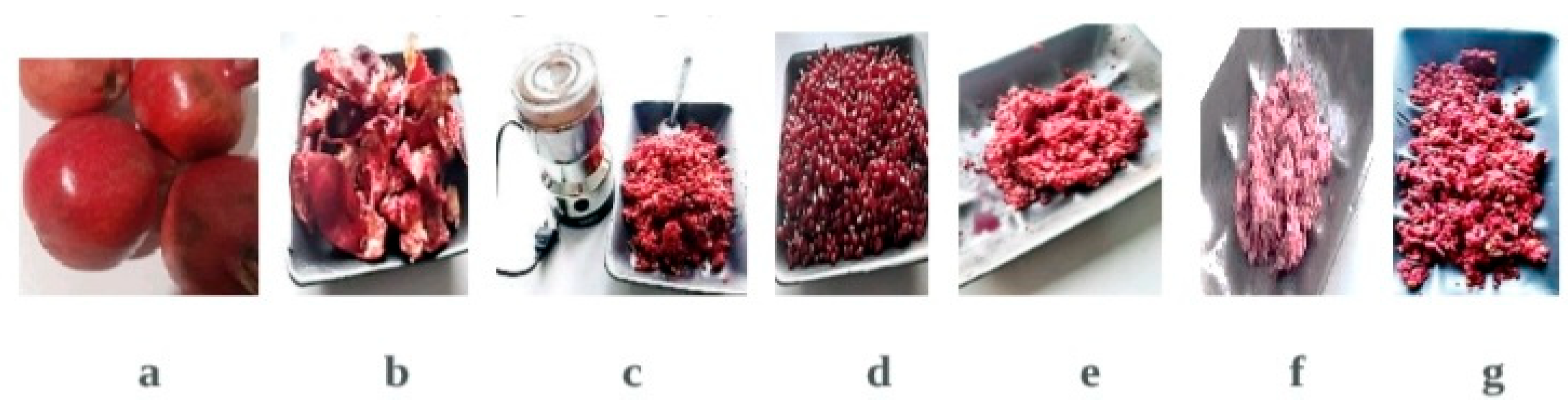
Figure 2.
Separation and transformation of the primary extract: a- extraction mixture and man-made system for separating the formed solution; b- separated solution; c- solution (b) after enzyme treatment; d- solution (c) after concentration in an evaporator to a dry matter content of 57 g/100 g.
Figure 2.
Separation and transformation of the primary extract: a- extraction mixture and man-made system for separating the formed solution; b- separated solution; c- solution (b) after enzyme treatment; d- solution (c) after concentration in an evaporator to a dry matter content of 57 g/100 g.

Figure 3.
Concentrated extract from maceration of BS sample of pomegranates 1.
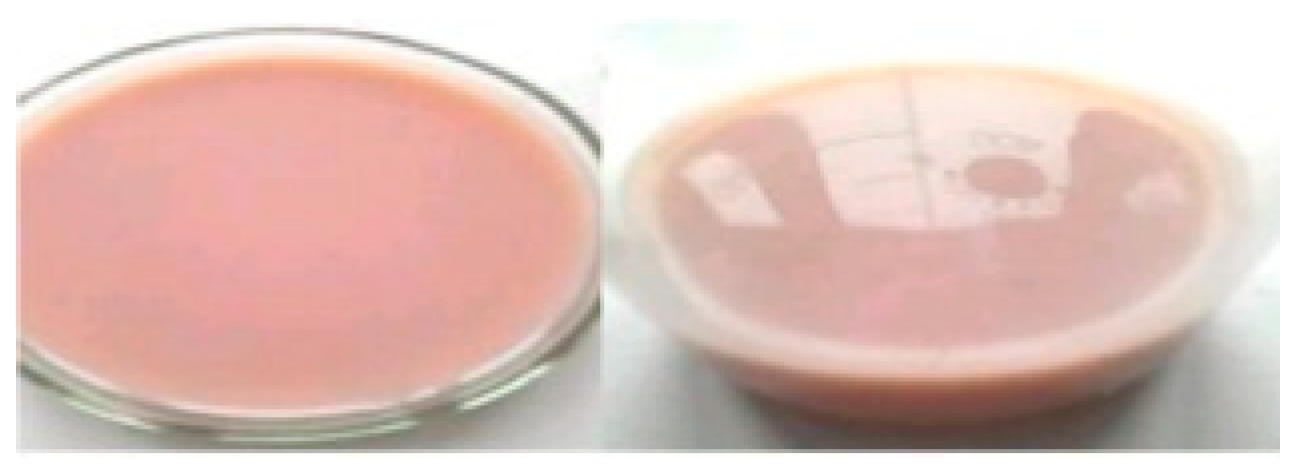
Figure 4.
Crude insoluble residue and intermediate and final products of its transformation: a-crude residue; b -dried residue, c- dried residue after grinding; d- two fractions from the separation of the crushed residue on a sieve with 0.5 mm holes.
Figure 4.
Crude insoluble residue and intermediate and final products of its transformation: a-crude residue; b -dried residue, c- dried residue after grinding; d- two fractions from the separation of the crushed residue on a sieve with 0.5 mm holes.
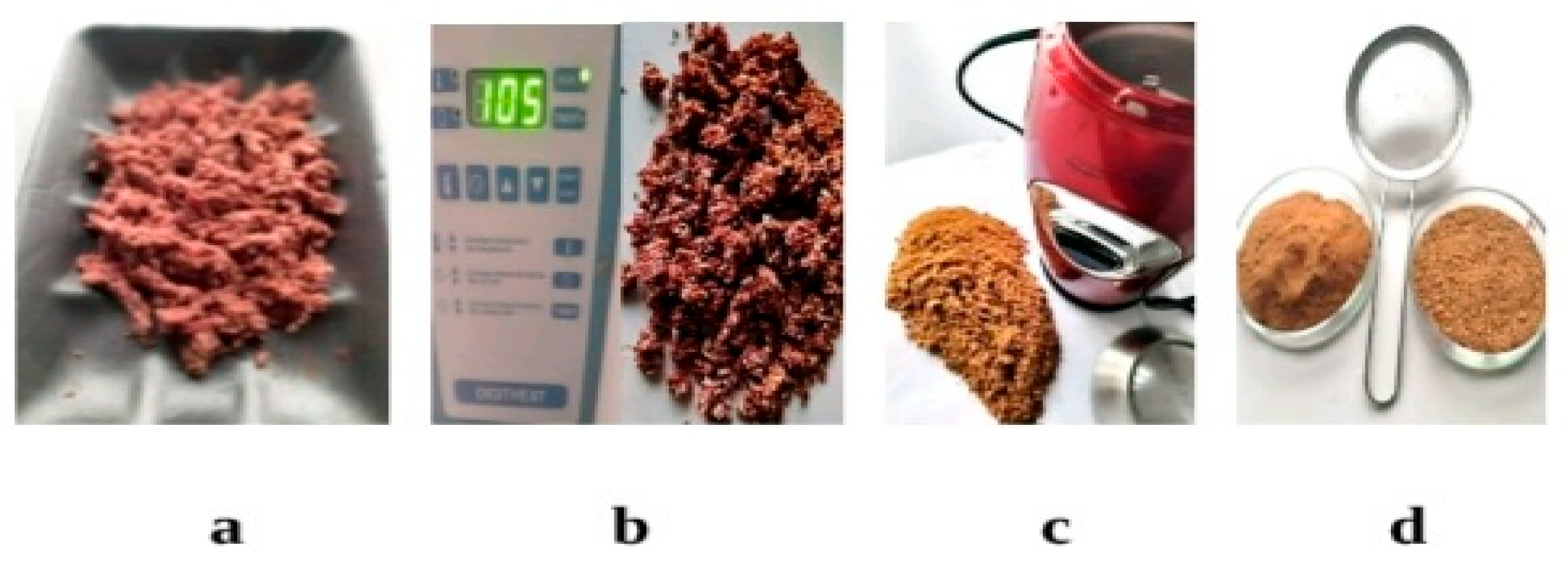

Table 1.
Component composition of P, BS and P+BS 1.58/1 (weight/weight) of pomegranate sample number 1, G/100 g of crude weight. Symbols: P – peel, BS – seeds themselves, P+BS- a mixture of peel and seeds.
Table 1.
Component composition of P, BS and P+BS 1.58/1 (weight/weight) of pomegranate sample number 1, G/100 g of crude weight. Symbols: P – peel, BS – seeds themselves, P+BS- a mixture of peel and seeds.
| Components | P | BS | P+BS |
|---|---|---|---|
| Dry substances | 40.00±0.55 | 41.32±0.58 | 40.51±0.52 |
| Sucrose | 0.66 ±0.01 | 0.00 | 0.40±0.01 |
| Monosaccharides | 10.08±0.13 | 9.05±0.15 | 9.68±0.14 |
| Titrated acids (in terms of citric acid) | 4.39± 0.06 | 1.35±0.02 | 3.21±0.04 |
| Crude protein (N x 6.25) | 2.50±0.04 | 5.13±0.05 | 3.52±0.05 |
| Crude fat | 2.80±0.03 | 7.30±0.10 | 4.54±0.05 |
| Fibers | 13.32±0.19 | 17.04±0.22 | 14.76±0.20 |
| Mineral substances | 0.75±0.01 | 0.80±0.01 | 0.77±0.01 |
|
Substances capable of reacting with KMnO4: Total Polyphenols |
5.50±0.09 3.60±0.04 |
0.65±0.01 0.25±0.01 |
3.62±0.05 2.28±0.03 |
| p-value | 0.05 | 0.05 | 0.05 |
Table 2.
Component composition of solutions from 4.5-hour maceration of BS and P+BS [1.58/1 (weight/weight)] of the pomegranate sample number 1 at a 1:2 hydromodule and a temperature of 63 °C.
Table 2.
Component composition of solutions from 4.5-hour maceration of BS and P+BS [1.58/1 (weight/weight)] of the pomegranate sample number 1 at a 1:2 hydromodule and a temperature of 63 °C.
| Components | Maceration solutions: | ||
|---|---|---|---|
| BS (100 g) | P+BS (258 g) | ||
| G/100 ml | G/100 ml | The ratio between the P and BS components of the total mass of the part of the substance that came out of the mixture into solution,%/% | |
| Dry substances | 8.27±0.20 | 9.30±0.10 | 64.43/35.57 |
| Monosaccharides | 3.88±0.09 | 3.53±0.07 | 55.98/44.02 |
| Titrated acids (in terms of citric acid) | 0.52±0.01 | 1.25±0.04 | 83.36/16.64 |
| Crude protein (N x 6.25) | 1.26±0.03 | 0.80±0.02 | 37.00/63.00 |
| Crude fat | 1.15±0.02 | 0.73±0.02 | 36.99/63.01 |
| Fibers | 1.05±0.02 | 0.32±0.01 | 72.33/27.67 |
| Mineral substances | 0.15±0.01 | 0.17±0.01 | 64.71/35.29 |
|
Substances capable of reacting with KMnO4: Total Polyphenols |
0.26±0.01 0.09±0.01 |
2.50±0.04 0.79±0.02 |
95.84/4.16 67.18/32.82 |
| p-value | 0.05 | 0.05 | 0.05 |
Note.Extract yield: 200 ml/100 g of BS; 500 ml/258 g of P+BS mixture.
Table 3.
The yield of substances of the component composition of individual BS and a mixture of P+BS is 1.58/1 (weight/weight) of the pomegranate sample number 1 into solution after their 4.5-hour maceration at a 1:2 (g/ml) hydromodule and a temperature of 63 °C.
Table 3.
The yield of substances of the component composition of individual BS and a mixture of P+BS is 1.58/1 (weight/weight) of the pomegranate sample number 1 into solution after their 4.5-hour maceration at a 1:2 (g/ml) hydromodule and a temperature of 63 °C.
| Components |
The yield: | |
|---|---|---|
| % of the total mass of the substance in 100 g BS | % of the total mass of the substance in 258 g P+BS 1.58/1 (weight/weight) | |
| Dry substances | 40.03±0.99 | 44.48±0.97 |
| Monosaccharides | 85.75 ±2.12 | 70.68±1.75 |
| Titrated acids (in terms of citric acid) | 77.04±1.91 | 75.48±1.55 |
| Crude protein (N x 6.25) | 49.12± 1.21 | 44.05±0.93 |
| Crude fat | 31.50±0.78 | 32.15±0.66 |
| Fibers | 12.32±0.30 | 10.97±0.23 |
| Mineral substances | 37.50±0.92 | 42.71±0.88 |
|
Substances capable of reacting with KMnO4: Total Polyphenols |
80.00±1.97 72.00±1.78 |
80.30±1.65 67.18±1.38 |
| p-value | 0.05 | 0.05 |
Table 4.
Component composition of the mixture P+BS 1.03/1 (weight/weight) of the pomegranate sample number 2 and the solution from its 4.5-hour maceration at a hydromodule of 1:2 (g/ml) and a temperature of 63 °C.
Table 4.
Component composition of the mixture P+BS 1.03/1 (weight/weight) of the pomegranate sample number 2 and the solution from its 4.5-hour maceration at a hydromodule of 1:2 (g/ml) and a temperature of 63 °C.
|
Components |
P+BS mixture, G/100 g of raw mass | Solution, G/100 ml |
Yield of the substance in solution, % of the total mass of the substance in 106.6 g of the crude mixture |
|---|---|---|---|
| Dry substances | 42.92±0.50 | 9.46±0.12 | 50.56±1.14 |
| Sucrose | 0.52±0.01 | 0.10 ±0.01 | 45.45 ±1.02 |
| Monosaccharides | 14.59±0.17 | 4.85±0.06 | 78.41±1.76 |
| Titrated acids (in terms of citric acid) | 4.17 ±0.04 | 1.33 ±0.02 | 75.34±1.69 |
| Crude protein (N x 6.25) | 3.08±0.04 | 0.78±0.02 | 58.04± 1.03 |
| Crude fat | 4.70±0.05 | 0.60±0.01 | 30.12 ±0.67 |
| Fibers | 10.04±1.26 | 0.28±0.01 | 6.57±0.15 |
| Mineral substances | 0.84 ±0.01 | 0.15±0.01 | 42.69±0.96 |
|
Substances capable of reacting with KMnO4: Total Polyphenols |
4.98±0.06 2.79±0.03 |
1.37±0.02 0.77±0.01 |
64.96±1.46 65.20±1.47 |
| p-value | 0.05 | 0.05 | 0.05 |
Note.Extract yield: 250 ml/106.6 g of crude mixture.
Table 5.
Indicators of the technical composition of the sample of pomegranates number 3 using the example of one average fruit.
Table 5.
Indicators of the technical composition of the sample of pomegranates number 3 using the example of one average fruit.
| Part of the fetus | Gram | % of the total weight of the fetus | Ratio between P and BS (weight/weight) |
|---|---|---|---|
| P | 90.5±3.4 | 37.6±1.41 |
3.77/1 |
| Grains with juice | 150.5±5.6 | 62.4±2.32 | |
| Juice | 126.5±4.7 | 52.4±1.95 | |
| BS | 24.0±0.9 | 10.0±0.37 |
Table 6.
Component composition of the initial mixture P+BS 3.77/1 (weight/weight) of the pomegranate sample number 3 and the primary extract from its maceration for 2.5 hours at a 1:2 (g/ml) hydromodule and a temperature of 50-55 °C with the addition of 0.015% of the enzyme Fructozym MA-LG to the extraction mixture.
Table 6.
Component composition of the initial mixture P+BS 3.77/1 (weight/weight) of the pomegranate sample number 3 and the primary extract from its maceration for 2.5 hours at a 1:2 (g/ml) hydromodule and a temperature of 50-55 °C with the addition of 0.015% of the enzyme Fructozym MA-LG to the extraction mixture.
| Components | Initial crude mixture, G/100 G of crude mass | Solution, G/100 ml |
Yield of the substance in solution, % of the total mass of the substance in 114.5 G P+BS |
|---|---|---|---|
| Dry substances | 42.21 ±0.40 | 12.91±0.20 | 61.16±1.55 |
| Sucrose | 0.85± 0.01 | 0.31±0.01 | 63.92±1.62 |
| Monosaccharides | 18.93±0.18 | 8.43±0.12 | 77.80±1.97 |
| Titrated acids (in terms of citric acid) | 3.16±0.03 | 1.47±0.02 | 72.24±1.83 |
| Crude protein (N x 6.25) | 2.16 ±0.03 | 0.40±0.01 | 36.57±1.11 |
| Crude fat | 3.92±0.04 | 0.80±0.02 | 40.81±0.58 |
| Fibers | 7.79±0.07 | 0.15 ±0.01 | 3.36±0.08 |
| Mineral substances | 0.64±0.01 | 0.13±0.01 | 17.80±0.45 |
|
Substances capable of reacting with KMnO4: Total Polyphenols |
4.76 ±0.04 3.21±0.02 |
1.92 ±0.03 1.33±0.02 |
70.46±1.79 72.28±1.83 |
| p-value | 0.05 | 0.05 |
Note.Extract yield: 200 ml/114.5 g of crude mixture.
Table 7.
Component composition of concentrated extracts from maceration of BS pomegranate sample 1 and P+BS pomegranate samples 1-3 1:2 hydromodule (g/ml), G/100 ml. Symbols: a- concentrate from 4.5-hour maceration BS of the pomegranate sample number 1 at a temperature of 63 °C; b - concentrate from 4.5-hour maceration of the mixture P+BS 1.58/1 (weight/weight) of the pomegranate sample number 1 at a temperature of 63 °C; c - concentrate from 4.5-hour maceration of the P+BS 1.03/1 (weight/weight) of the pomegranate sample number 2 at a temperature of 63 °C (the primary extract was treated with the Fructozym P enzyme for 1 hour at 50-55 ° C before its concentration); d - concentrate from 2.5 hours maceration of the P+BS 3.77/1 (weight/weight) of the pomegranate sample number 3 at a a temperature of 50-55 °C with the addition of 0.015% Fructozym MA-LG enzyme to the extraction mixture.
Table 7.
Component composition of concentrated extracts from maceration of BS pomegranate sample 1 and P+BS pomegranate samples 1-3 1:2 hydromodule (g/ml), G/100 ml. Symbols: a- concentrate from 4.5-hour maceration BS of the pomegranate sample number 1 at a temperature of 63 °C; b - concentrate from 4.5-hour maceration of the mixture P+BS 1.58/1 (weight/weight) of the pomegranate sample number 1 at a temperature of 63 °C; c - concentrate from 4.5-hour maceration of the P+BS 1.03/1 (weight/weight) of the pomegranate sample number 2 at a temperature of 63 °C (the primary extract was treated with the Fructozym P enzyme for 1 hour at 50-55 ° C before its concentration); d - concentrate from 2.5 hours maceration of the P+BS 3.77/1 (weight/weight) of the pomegranate sample number 3 at a a temperature of 50-55 °C with the addition of 0.015% Fructozym MA-LG enzyme to the extraction mixture.
| Components | a | b | c | d |
|---|---|---|---|---|
| Dry substances | 57.00±0.50 | 57.00±0.20 | 57.00±0.20 | 57.00±0.20 |
| Monosaccharides | 26.09±0.22 | 32.09±0.28 | 29.21±0.26 | 34.97±0.31 |
| Sucrose | 0.00 | 1.14±0.01 | 0.50±0.01 | 1.23±0.01 |
| Titrated acids (in terms of citric acid) | 3.50±0.04 | 6.81±0.07 | 7.83±0.06 | 5.84±0.05 |
|
Substances capable of reacting with KMnO4: Total Polyphenols |
1.67±0.02 1.27±0.01 |
5.92±0.05 3.24 ±0.03 |
8.00±0.07 4.35±0.04 |
7.04±0.06 4.93±0.04 |
| Fat | 7.56±0.06 | 4.00±0.04 | 3.62±0.03 | 2.80±0.02 |
| Protein(Nx6.25) | 8.08±0.07 | 4.40±0.03 | 4.20±0.04 | 1.70±0.02 |
| p-value | 0.05 | 0.05 | 0.05 | 0.05 |
Table 8.
Component composition of the dry solid residue from 4.5-hour of crude BS maceration of the pomegranate sample number 1 at a 1:2 hydromodule and a temperature of 63 °C. Symbols: a – insoluble residue before separation on a sieve with 0.5 mm holes; b- fine fraction with a particle size of <0.5 mm; c- coarse fraction with a particle size of >0.5 mm.
Table 8.
Component composition of the dry solid residue from 4.5-hour of crude BS maceration of the pomegranate sample number 1 at a 1:2 hydromodule and a temperature of 63 °C. Symbols: a – insoluble residue before separation on a sieve with 0.5 mm holes; b- fine fraction with a particle size of <0.5 mm; c- coarse fraction with a particle size of >0.5 mm.
| Components | G/100 g of dry weight | ||
|---|---|---|---|
| a | b | c | |
| Sucrose | 0.00 | 0.00 | 0.00 |
| Monosaccharides | 5.19±0.04 | 5.89±0.05 | 4.39±0.04 |
| Titrated acids (in terms of citric acid) | 1.27±0.01 | 1.56±0.01 | 0.94±0.01 |
| Protein (N x 6.25) | 6.51±0.05 | 11.11±0.10 | 1.32±0.01 |
| Fat | 24.22±0.23 | 25.68 ±0.23 | 22.56±0.20 |
| Fibers | 60.23±0.50 | 53.39±0.52 | 68.04±0.65 |
| Mineral substances | 2.06±0.02 | 1.72±0.02 | 2.44±0.02 |
|
Substances capable of reacting with KMnO4: Total Polyphenols |
0.54±0.01 0.28±0.01 |
0.74±0.01 0.28±0.01 |
0.31±0.01 0.28±0.01 |
| p-value | 0.05 | 0.05 | 0.05 |
Note.The yield of the crude residue is 68.8 g/100 g of rawBS, and the dry residue is 24.8 g/100 g of rawBS[fine fraction/coarse fraction 1.14/1 (weight/weight)].
Table 9.
Component composition of the dehydrated solid residue from 4-hour maceration of crude P+BS 1.58/1 (weight/weight) of the pomegranate sample number 1 at a 1:2 hydromodule and a temperature of 63 °C Symbols: a – insoluble residue before separation on a sieve with 0.5 mm holes; b- fine fraction with a particle size of <0.5 mm; c- coarse fraction with a particle size of >0.5 mm.
Table 9.
Component composition of the dehydrated solid residue from 4-hour maceration of crude P+BS 1.58/1 (weight/weight) of the pomegranate sample number 1 at a 1:2 hydromodule and a temperature of 63 °C Symbols: a – insoluble residue before separation on a sieve with 0.5 mm holes; b- fine fraction with a particle size of <0.5 mm; c- coarse fraction with a particle size of >0.5 mm.
| Components | G/100 g of dry weight | ||
|---|---|---|---|
| a | b | c | |
| Sucrose | 1.40±0.01 | 2.45±0.02 | 0.25±0.01 |
| Monosaccharides | 13.13±0.12 | 15.80±0.17 | 10.20±0.09 |
| Titrated acids (in terms of citric acid) | 3.66±0.03 | 4.20±0.04 | 2.75±0.02 |
| Protein (N x 6.25) | 3.57±0.03 | 6.25±0.06 | 0.63±0.01 |
| Fat | 17.75±0.18 | 19.46±0.20 | 15.87±0.17 |
| Fibers | 53.00±0.54 | 44.81±0.45 | 62.11±0.64 |
| Mineral substances | 2.03±0.02 | 1.60±0.01 | 2.51±0.02 |
|
Substances capable of reacting with KMnO4: Total Polyphenols |
5.53±0.045 3.44± 0.03 |
5.43±0.04 3.20±0.02 |
5.68±0.06 3.71±0.04 |
| p-value | 0.05 | 0.05 | 0.05 |
Note.The yield of the crude residue is 193.8 g/258 g of rawP+BS, and the dry residue is 55.6 g/258 g of rawP+BS[fine fraction/coarse fraction 1.1/1 (weight/weight)].
Table 10.
Component composition of the dehydrated solid residue from 4-hour maceration of crude P+BS 1.03/1 (weight/weight) of the pomegranate sample number 2 at a 1:2 hydromodule and a temperature of 63 °C. Symbols: a – insoluble residue before separation on a sieve with 0.5 mm holes; b- fine fraction with a particle size of <0.5 mm; c- coarse fraction with a particle size of >0.5 mm.
Table 10.
Component composition of the dehydrated solid residue from 4-hour maceration of crude P+BS 1.03/1 (weight/weight) of the pomegranate sample number 2 at a 1:2 hydromodule and a temperature of 63 °C. Symbols: a – insoluble residue before separation on a sieve with 0.5 mm holes; b- fine fraction with a particle size of <0.5 mm; c- coarse fraction with a particle size of >0.5 mm.
| Components | G/100 g of dry weight | ||
|---|---|---|---|
| a | b | c | |
| Sucrose | 1.41±0.01 | 1.80±0.01 | 0.48±0.01 |
| Monosaccharides | 15.54±0.17 | 17.85±0.19 | 10.00±0.09 |
| Titrated acids (in terms of citric acid) | 5.05±0.05 | 5.95±0.06 | 2.90±0.04 |
| Protein (N x 6.25) | 5.31±0.03 | 7.06 ±0.07 | 1.13±0.01 |
| Fat | 16.18±0.15 | 17.40±0.16 | 13.27±0.12 |
| Fibers | 45.00±0.45 | 37.95±0.40 | 62.63 ±0.65 |
| Mineral substances | 2.38±0.02 | 1.85±0.01 | 3.65±0.04 |
|
Substances capable of reacting with KMnO4: Total Polyphenols |
9.07±0.09 4.81 ±0.05 |
9.14±0.10 5.68±0.07 |
4.94±0.05 2.72±0.03 |
| p-value | 0.05 | 0.05 | 0.05 |
Note.The yield of the crude residue is 97.9 g/109 g of rawP+BS, and the dry residue is 21.5 g/109 g of rawP+BS[fine fraction/coarse fraction 2.4/1 (weight/weight)].
Table 11.
Component composition of the dehydrated solid residue from 2.5-hour maceration of crude P+BS 3.96/1 (weight/weight) of pomegranate sample number 3 at a 1:2 (g/ml) hydromodule and a temperature of 55 °C with the addition of 0.015% Fructozym MA-LG enzyme to the extraction mixture. Symbols: a – insoluble residue before separation on a sieve with 0.5 mm holes; b- fine fraction with a particle size of <0.5 mm; c- coarse fraction with a particle size of >0.5 mm.
Table 11.
Component composition of the dehydrated solid residue from 2.5-hour maceration of crude P+BS 3.96/1 (weight/weight) of pomegranate sample number 3 at a 1:2 (g/ml) hydromodule and a temperature of 55 °C with the addition of 0.015% Fructozym MA-LG enzyme to the extraction mixture. Symbols: a – insoluble residue before separation on a sieve with 0.5 mm holes; b- fine fraction with a particle size of <0.5 mm; c- coarse fraction with a particle size of >0.5 mm.
| Components | G/100 g of dry weight | ||
|---|---|---|---|
| a | b | c | |
| Sucrose | 1.59±0.01 | 2.00±0.01 | 0.00 |
| Monosaccharides | 22.56±0.24 | 24.00±0.26 | 18.60±0.20 |
| Titrated acids (in terms of citric acid) | 5.29 ±0.04 | 6.25±0.07 | 2.65±0.03 |
| Protein (N x 6.25) | 6.43±0.05 | 8.37±0.09 | 1.05±0.01 |
| Fat | 10.89 ±0.13 | 11.07±0.13 | 10.38±0.15 |
| Fibers | 43.75 ±0.42 | 38.39±0.37 | 58.98±0.58 |
| Mineral substances | 2.19±0.02 | 1.77±0.02 | 3.40±0.03 |
|
Substances capable of reacting with KMnO4: Total Polyphenols |
7.30±0.08 4.81 ±0.05 |
8.15±0.07 5.60±0.06 |
4.94±0.05 2.64±0.03 |
| p-value | 0.05 | 0.05 | 0.05 |
Note.The yield of the crude residue is 60.0 g/114.5 g of rawP+BS, and the dry residue is 21.3 g/114.5 g of rawP+BS[fine fraction/coarse fraction 2.78/1 (weight/weight)].
Disclaimer/Publisher’s Note: The statements, opinions and data contained in all publications are solely those of the individual author(s) and contributor(s) and not of MDPI and/or the editor(s). MDPI and/or the editor(s) disclaim responsibility for any injury to people or property resulting from any ideas, methods, instructions or products referred to in the content. |
© 2025 by the authors. Licensee MDPI, Basel, Switzerland. This article is an open access article distributed under the terms and conditions of the Creative Commons Attribution (CC BY) license (http://creativecommons.org/licenses/by/4.0/).
Copyright: This open access article is published under a Creative Commons CC BY 4.0 license, which permit the free download, distribution, and reuse, provided that the author and preprint are cited in any reuse.


