

Submitted:
27 October 2025
Posted:
28 October 2025
You are already at the latest version
Abstract
Herein, ionic exchange resins (IExRs) were synthesized by the copolymerization of ethyl acrylate, acrylonitrile, and 8% divinylbenzene cross-linker, and functionalized with ethylenediamine and triethylenetetramine to produce weak cationic resins with amino groups. Hydrazine hydrate (HA) was employed to synthesize hydrazide-functionalized weak anionic resins. In addition, zwitterionic resins (Zw) were generated by reacting with sodium chloroacetate. The structures and morphology of the synthesized resins were undertaken by infrared spectroscopy and scanning electron microscopy. Sorption performance was studied by batch tests using simulated mono-HMI and multi-HMI aqueous samples, as well as polluted water samples collected from the Tarnita area. The HMIs residual concentrations after the solutions interaction with IExR in batch were quantified via atomic absorption spectroscopy. Additionally, sorption isotherms, kinetics, and thermodynamic parameters studies were conducted. Wheat germination was included to test the efficiency of the batch sorption using IExRs, as compared to the stream collected in Tarnita mine area, emphasizing the water cleaning process which leads to healthy plants growth. The results demonstrate that after IExR sorption the tested HMIs content is below the permissible maximum level for surface water, enabling to resolve the pollution of the steam close to Tarnita closed mine area, removing of the major contaminants found in it.

Keywords:
ionic exchange resins
; cross-linking
; heavy metal ions sorption
; polluted river water
; wheat germination
1. Introduction
Over the last years, heavy metal ions (HMIs) have been deposited into the environment over a range of industrial development and expansion processes, including mining, metallurgy, and chemicals [1,2]. Unlike organic pollutants, HMIs cannot biodegrade, and can remain in an ecosystem for decades, causing irreversible impacts on human and environmental health [3,4,5]. Once they are in the environment, HMIs accumulate in soils and water, are taken up by living organisms, biomagnify in the food web, and ultimately pose substantial risks to environmental and human health [6,7]. This problem can be compounded at abandoned mines sites, where poorly constructed impoundments are continuing to release harmful materials into the adjacent ecosystems [8,9,10]. As a previously mined barite area, the Tarnița closed mine has become a serious environmental concern for the area [11]. After the barite mine closed, the area around is still contaminated because pollution does not stop with the cessation of the mining processes [12]. The ongoing release of HMIs into nearby soil and surface water creates ongoing unsafe conditions, affecting the community, fauna, and flora in adjacent ecosystems caused by a lack of control and clean-up measures [13,14,15]. Recent onsite investigatory samples have shown disturbing population increases in pollutants, indicating a need for comprehensive remediation strategy to manage the contaminant footprint of the mining operations and the relationship it/they have with HMIs sediment in the ecosystem [13,14]. For sampling surface water sources in proximity to the Tarnița mining area, HMIs in aquatic ecosystems were lensing the metal-ion content utilizing atomic absorption spectrometry (AAS), as it is both an easy and sensitive method to measure contaminant levels. The analytical data reported hazardous HMIs concentrations of several contextually important HMIs, including: manganese (Mn2+) 1.95 mg/L, copper (Cu2+) 19.91 mg/L; and iron (Fe2+) at 154.59 mg/L [16]. These concentrations are above recommended limits for surface water established by international environmental agencies [17,18]. The significantly high concentrations of manganese and copper suggested mining contaminants of residual ores and mining related waste left uncontrolled or treatment equipment unsupervised. The combination of elevated manganese and copper levels suggests that uncontained mine waste rock or industrial wastes were left in the environment, while the elevated levels of Fe2+ suggest that iron-bearing minerals may have leached from the environment as a consequence of acid mine drainage. The combined impacts of these contaminants and the fact that pollutants are leaching in Tarnița surface water makes it a valuable case study on finding effective filtration solutions for water. There are in-depth discussions and summaries of traditional methods for removal of HMIs where potential options for effective removal of HMIs in aquatic systems are described in electrochemical treatments, coagulation-flocculation, membrane filtration, and precipitation [4,19,20]. While all of the methods described above have benefits to be used in certain situations, some limitations are already known, among them high-priced/high operational costs, poor selectivity, high energy costs, large amounts of unwanted residual hazardous sludge that also needs to be processed and disposed of [21]. Certainly, among the less costly and sustainable methods of pollutant removal the adsorption and ion exchange processes gain prominence as the way forward [22].
Ion exchange resins (IExRs) may present high selectivity, flexibility of use, ability to be reused or recycled; and this makes them a very attractive material to retain HMIs from impaired sources of water [23,24]. These synthetic polymers can remove the contaminants by a relatively simple method of exchanging counterions in their structure with certain metal ions in a solution. The chelating IExRs have the greatest advantage to form stable coordination complexes with metal ions [25,26]. Their performance can be easily tuned by the chemical structure, degree of crosslinking, and types of functional groups [27,28]. Among the various types of synthetic resins for environmental applications those based on crosslinked acrylic polymers are currently the most promising. By chemical modification, the materials can be enriched with proper physical and chemical characteristics including hydrophilicity, functionalization with specific chelating groups, and adjustable porosity [29]. Among the functional groups, the amino/imino (–NH2/–NH–), carboxyl (–COOH), and amide (–NH–CO) have shown great promise in this regard, for donor-acceptor interactions that selectively bond divalent and trivalent metal cations [30,31]. These functional groups function as Lewis bases or electron pair donors and could create stable metal-ligand complexes by coordinating to the electron-deficient metal ions (Lewis’s acids) [32] which are trapped within the matrix of the resin [33,34]. Even if both the chemical structure and the sorption behavior of IExRs have been already described in scientific literature, there is still a lack of synergistically evaluations of IExR synthesis, structure optimization and practical development - especially relevant in Tarnița closed mine where HMIs contaminated the nearby water. Previous research is largely based upon controlled laboratory batch experiments, usually utilizing synthetic metal ion solutions that did not reasonably reflect the complexity of the polluted water. Even in the limited field application studies that have utilized some IExRs, laser focus evaluation of how crosslink density affects mechanical stability and resin sorption performance is not thoroughly evaluated.
This study has systematically investigated the synthesis, physicochemical properties and functional applications of new IExRs based on 8% crosslinking density acrylic copolymers. The IExRs were designed to specifically target HMIs found usually in polluted waters in the mining areas (mainly Fe(II), Cu(II), and Mn(II)), by functionalizing with ethylenediamine and triethylenetetramine, to yield weak cationic resins bearing amino groups, or with hydrazine hydrate, to yield weak anionic resins. Also, the formation of zwitterionic resins via reaction of the weak cationic/cationic resins with sodium chloroacetate was followed. The sorption equilibrium and kinetic tests demonstrated the functional stability of the new IExRs as well as the effectiveness of the resin’s functional groups. In this study, mono-HMI and multi-HMIs synthetic waters as well as water samples collected from Tarnița area were tested by evaluating the IExRs sorption capability and selectivity in order to provide contextual knowledge toward the materials feasibility and operational performance for extensive clean-up projects. This research endeavored to enable the development of technically practical, economically reasonable, and ecologically preferred designs for HMI removal from contaminated water sources. By correlating advanced polymeric chemistry with specific applications to the environment, this study aims to present a scalable solution to water purification in post-mining landscapes and other implicated and vulnerable open systems
2. Materials and Methods
2.1. Materials
A copolymer of divinylbenzene, ethyl acrylate, and acrylonitrile with an 8% cross-linking degree was first obtained and then its functionalization was done in accordance with our previously described methodology [35]. In brief, was used ethylenediamine (EDA) or triethylenetetramine (TETA) and hydrazine hydrate (HA) to produce weak cationic IExR (with pendant amino groups, EDA and TETA) or weak anionic IExR (with HA). The process of obtaining zwitterionic IExR (Zw) involved reacting weak cationic/anionic IExR with sodium chloroacetate. HMIs salts of CuSO4⋅5H2O, FeSO4⋅7H2O, and MnSO4⋅H2O were acquired from Sigma-Aldrich (Sigma-Aldrich, Chemical Co.; St. Louis, MO, USA) and used as purchased. IExR regeneration and reutilization tests were carried out using NaOH and HCl as 1N aqueous solutions (Sigma-Aldrich, Chemical Co.; St. Louis, MO, USA). For all studies ultrapure water (0.552 µS·cm-1) was used, including solution preparation and washing using an Evoqua Ultra Clear TPTWF.
2.2. HMIs Sorption Experiments
To test for HMI sorption, swelled beads in a volume of 1 mL were placed in a backer and then added 20 mL of polluted water (simulated mono-HMI and multi-HMI aqueous samples using Cu(II), Fe(II) and Mn(II) ions, as well as polluted water samples collected from the Tarnita area) and kept under shaking at 250 rpm with the Orbital Shaker-Incubator ES-20 for 24h if not specified or for different periods of time, and at a temperature of 25ºC. The appropriate salts were dissolved in ultrapure water to create the fresh stock solutions for each HMI. The starting concentration of the mono-HMI and multi-HMI aqueous solutions was 1 mM Me(II), their pH being corrected to about 5 using 1 N HCl or NaOH. The effectiveness of the IExR as a sorbent was assessed by regenerating the HMIs loaded resins for two-hour utilizing a 1 N HCl aqueous solution. Subsequently, the activation with 1 N NaOH was done and then IExR was extensively rinsed with ultrapure water to equilibrate the pH and reused in a new HMI sorption cycle.
2.3. Characterization Methods
FTIR-ATR spectroscopy confirmed the synthesis of cationic/anionic/zwitterionic IExR. The samples FTIR-ATR spectra were obtained using an IR Tracer-100 FT-IR spectrometer (Shimadzu Corporation, Japan) using the GladeATR module (PIKE Technologies, USA).
The Verios G4 UC Scanning Electron Microscope was used, operating at an accelerating voltage of 5 kV in high vacuum, equipped with a detector type concentric backscattered (CBS). To enhance electrical conductivity, the samples were covered with a layer of 10 nm platinum, utilizing a Leica EM ACE200 Sputter coater. Before characterization, IExR were lyophilized at -57 °C for 48 hours using the ALPHA 1–2 LD plus freeze dryer.
The volume weight (Wv), given in g·mL-1, was obtained by weighting during drying a known initial volume of completely water-saturated resin until a constant load value was achieved.
The volume and weight exchange capacities (Ev, mEq·mL-1, and EW, mEq·g-1, respectively), specifically refer to the exchange capabilities of weak bases and weak acids [35,36]. In summary, 10 mL IExR were treated with 1 N HCl to evaluate its exchange capacity. After removing the excess HCl using a mixture of 1:2 (v/v) water:methanol, the eluent’s HCl content was determined by titrating it with a standardized 1 N NaOH solution. Each test was run three times, and the average results—with less than 5% variation—were reported. The two ionic forms of zwitterionic resins that were also evaluated. The volume and weight exchange capacities were determined using the equations presented in Table S1, Supplementary Material.
The diameters of the IExR beads were evaluated by a Morphologi G3SE device (Malvern Instruments, Malvern, UK). For this, the IExRs were distributed on a glass plate, and the well-formed, non-aggregated resins beads with diameters between 0.3 and 1.5 mm were measured.
The HMIs concentration remaining in the supernatant after IExR sorption was evaluated using a ContrAA 800 Spectrometer (Analytik Jena, Germany) outfitted with continuous radiation source as a Xenon short-arc lamp . To avoid interference of possible formed metal complex, before analysis the solutions dilution with 0.5 wt.% HNO3 was done. The Cu(II), Fe(II), and Mn(II) corresponding peaks absorbance occurred at 324 nm, 248 nm, and 279 nm, respectively. The measurements were conducted in an air/acetylene flame of 4 to 8 mm height and a consistent flow rate of 50 L·h-1. The equations used to calculate the IExRs sorption capacity (SC) and retention efficiency (RE) are presented in Table S1.
2.4. Wheat Germination Experiments
The wheat germination experiments were done to assess the toxicity of the contaminated water collected from the Tarnita mine areas compared to the water resulted after IExR sorption, employing a previously established methodology [11,37]. Summarily, 5 mL of Tarnita collected water or the supernatants resulted after sorption experiments and 50 wheat seedlings were placed in Petri plates at 25°C for seven days. For all experiments, three replicates were done and compared with seedlings of a control sample when using distilled water. After seven days, the dead seeds, germinated ones, and the grown seedlings were counted and then the wheat young plantlets were collected and the total height (H, cm) and the total mass (M, g) were quantified.
3. Results
3.1. IExR Structural and Morphological Characterization
The FTIR-ATR spectra provide solid evidence of chemical structure of the bead both for the cationic/anionic IExR and the subsequent zwitterionic functionalization (Figure 1).
The FTIR-ATR spectra for the amine-modified ion exchange resins (IEx-EDA, IEx-TETA, and IEx-HA) are displayed in Figure 1a. All the samples revealed characteristic absorption bands establishing their successful functionalization of the polymer backbone with primary and secondary amine containing groups, both of which are important for the future preparation of zwitterionic resins. The bands located near 2900 cm−1 from all the spectra represented C-H stretching from the aliphatic groups located within the resin matrix. The IEx-EDA resin exhibited a band in the range of 1350–1450 cm−1 characteristic to a C–N stretching. A moderate band located approximately 1560 cm−1 was assigned N-H bending which encompasses both primary and secondary amine bonds. The absence of a carbonyl related signal provides further relevant evidence that functionalization has occurred predominantly by way of amine grafting to the resin surface with ethylenediamine moieties introduced. The IEx-TETA resin (Figure 1a) demonstrates similar, but more intense (and broad), absorptions in the N-H stretching range indicating an increased amount of amine groups due to triethylenetetramine incorporation. The increase in intensity between both N-H deformation (~1550–1600 cm−1) and C–N stretching (~1350–1450 cm−1) is suggestive of the presence of multiple amine environments (primary and secondary amines). The increases in amine concentrations would be expected to enhance the reactivity of the resin in further functionalization to zwitterionic structures. In contrast to the previous two IEx, the IEx-HA resin (Figure 1a) had a moderated absorption band near 1650 cm−1, indicative of the C=O stretching vibrations associated with hydrazide or amide groups (–CONHNH2). The detection of additional N–H deformation and C–N stretching bands indicates the effective substitution of these hydrazide groups. These functional groups provide nucleophilic (–NH–) and electrophilic C=O sites making IEx-HA a unique multifunctional intermediate to develop zwitterionic-type resins where charge is evenly distributed. The incremental change in intensities and positions among the three spectra suggests that more amine substitution and molecular complexity are present. Chemical change such as this can influence the density and functionality of reactive sites available for subsequent sulfonation or carboxylation reactions that are essential for producing zwitterionic type resins which display an increase in hydrophilicity and charge neutrality and can potentially be obtained under ion exchange conditions.
The characteristic peaks of Zw confirm the presence of key functional groups associated with improved hydrophilicity, charge neutrality, and antifouling potential, as would be expected from amphoteric surface engineering. Thus, the characteristic bands of IEx-EDA-Zw derived from EDA (Figure 1b) are as follows: the bands characteristic for COO- group at 1625 cm-1 (C=O stretching) and at 1545 cm–1 (C–O vibrations) as well as that for the amino groups at 1395 cm–1 and 1249 cm–1 (symmetric and asymmetric C–N stretching), confirming thus the formation of Zw. The weak band at 3242 cm–1, assigned to N–H and O–H stretching, and that at 677 cm-1, characteristic for the N–H out of plane bending, along with the broadness and multiplicity in the region 3600-3200 cm-1 can suggest hydrogen bonding, likely due to hydroxyl groups (from Zw) and amine group (from EDA). Moreover, broad and overlapping bands in the 3000–3600 cm−1 region indicates hydrophilicity and hydrogen bonding, consistent with what’s expected for zwitterionic surfaces.
For the IEx-TETA-Zw, which is obtained from TETA (Figure 1b), the presence of broad N–H/O–H bands (3237 cm-1, 1444 cm-1 and 677 cm-1), C=O stretching vibrations (1726 cm-1) and C–O/C–N peaks (1546 cm-1 and 1246 cm-1) confirm the IExR chemical structure by evidencing the functional groups of both TETA and Zw. Similarly, the IEx-HA-Zw spectrum exhibits all the expected features of both hydrazine hydrate and COOH-containing polymer (IEx-HA-Zw) (Figure 1b). The absorption bands at 3515 cm−1 and 3230 cm-1 from HA-Zw spectrum are attributed to the vibration of NH2 and O–H groups. Also, the characteristic band of carboxylic group are present in spectrum at 1533 cm–1 and 1726 cm-1 indicate ester/carboxyl functionalities characteristic of IEx-HA-Zw. The presence of primary amines in Zw is demonstrated by the bands at 2141 cm−1 (N–H stretching vibration), 1444 cm−1 (N–H bending and C–N stretching vibration), 1095 cm-1 (NH2 deformation vibration) and at 674 cm-1 band characteristics to N–H out of plane bending vibrations. The bands at 1622 cm-1 (C=N stretching vibrations) and 1251 cm-1 (C–N stretching vibrations) are assigned to CN group.
The morphology of IExR, before and after functionalization with sodium chloroacetate, was followed by SEM (Figure 2).
Initially, the weak cationic/anionic IExR have either a rough and granular (EDA) or a smooth with microcracks surface (TETA and HA). After functionalization, the surface of IEx-EDA-Zw became more roughness, the zwitterionic layers appear to form a loosely packed, possibly hydrated or porous structure, also the fibrous/rod-like feature visible may suggest polymer aggregates. In the case of IEx-TETA-Zw the surface shows a heterogeneous structure with polymer clustering, some areas look smoother, while others show distinct domains (indicative of partial or uneven polymer coverage). The surface of IEx-HA-Zw is very porous and highly textured morphology, that fact suggests substantial surface modification a potentially high polymer loading. The sponge-like architecture may enhance hydrophilicity and antifouling properties. Also, in all IEx cases the inset images confirm the spherical geometry is retained after all modification. Moreover, the surface morphology changes significantly upon zwitterion grafting, indicating successful surface functionalization. The trend from smooth to increasingly porous surfaces from top to bottom reflects the effect of zwitterionic polymer type and interaction with the weak cationic/anionic IExR base material.
Table 1 provides comparative data on weak cationic/anionic IExR and the corresponding Zw resins, specifically focusing on their exchange capacities (acidic and basic), volume weight, and mean particle diameter. IEx-TETA-Zw has the highest basic exchange capacity (6.806 mEq·g−1) and moderate acid exchange capacity (2.803 mEq·g−1), indicating its strong potential in base exchange processes, making them ideal for capturing anions or working in basic environments.
Moreover, the IEx-TETA-Zw has the largest particles (0.611 mm), which may influence column performance (e.g., flow rate, back pressure) in future dynamic sorption experiments, but can be ideal for basic ion exchange processes with high capacity and larger particle size for sorption in batch condition or in fluidized bed column (dynamics condition). The least basic exchange is seen in IEx-EDA (2.859 mEq·g−1), suggesting less functionality for ion exchange. IEx-EDA-Zw and IEx-HA-Zw show similarly high exchange capacities (4.859 mEq·g−1 and 4.828 mEq·g−1 for acid exchange capacity, respectively 3.311 mEq·g−1 and 3.212 mEq·g−1 for basic exchange capacity), probably due to the rigidity of structure (chain length) comparative with IEx-TETA-Zw which are more flexible (longer chain length). However, the weak cationic/anionic IExR conducted to smaller beads sizes as compared to that of the corresponding zwitterionic IExR (0.318 vs 0.509 for IEx-EDA-Zw, 0.422 vs 0.611 for IEx-TETA-Zw and 0.235 vs 0.325 for IEx-HA-Zw). The zwitterionic modifications of cationic/anionic IExR tend to enhance both exchange capacities and particle size, possibly due to increased functional group density or swelling behavior. The anionic resin HA has the lowest volume weight (0.054 g·mL−1) and the smallest particle size (0.235 mm), indicating it is very light and porous, which aligns with its high exchange capacity per gram (14.281 mEq·g−1), often beneficial for high surface area but may result in higher pressure drops in packed columns. TETA has the highest volume weight (0.390 g·mL−1), suggesting a denser resin, sustain also by SEM measurements (Figure 2). In general, volume weight appears to inversely correlate with exchange capacity (mEq·g−1) in several cases.
3.2. Application of Zwitterionic IExR
The IExR were evaluated in batch studies as sorbents for several harmful HMIs, utilizing both mono-HMI and multi-HMIs solutions, and also a real water sampled on Tarnita tailing pond, with the findings illustrated in Figure 3. Consequently, in mono-HMI and multi-HMIs solutions, the functionalized IExR beads with EDA, TETA, and HA exhibit values of SC between 2 and 27 mg HMIs/g resin, regardless of the tested simulated polluted water (Figure 3a). The AAS results (Figure 3a and 3b) indicate that both EDA and TETA based zwitterionic resins demonstrated the greatest sorption performance across all tested HMIs, irrespective of mono-HMI and multi-HMIs tested solutions, while IEx-HA-Zw presented a lower SC compared to the starting resin based on HA, but with a higher RE (more than 99%).
Additionally, as compared to the EDA based resins, the TETA functionalized resin and the corresponding zwitterionic one exhibits greater SC regardless of the tested synthetic contaminated solutions (mono- or multi- HMIs), probably due to the TETA longer sidechains and increased flexibility. Nevertheless, the competitive conditions modified the RE of the cationic (EDA and TETA) and anionic (HA) resin, while the zwitterionic resin didn’t bring any notable changes in the SC and RE, comparable with monocomponent solution. The examined resins were efficient in the sorption of all tested HMIs in both mono- and multi-HMIs systems, with Cu(II) > Fe(II) > Mn(II) as the order, with a small exception in the case of HA-Zw which had a slightly higher affinity for Fe than Cu in monocomponent solution. When the tests were done on the Tarnita sampled water, the EDA and TETA based zwitterionic resins and the HA series retain about 93.8% Mn(II), 94.7% Fe(II) and more than 95.5% Cu(II) from real water (Table 2), even if Tarnita water has a significant excess of the Fe(II) ion (154.49 mg·L-1) as compared to the Cu(II) and Mn(II) (19.91 and 1.95 mg·L-1, respectively) content (Figure 3c, Table S2).
In this study, the HMIs content of waters synthetic contaminated as well as that collected from the Tarnita region are evaluated and contrasted to the HMIs permissible values as maximum limits for surface waters as determined by the world and European specialized organisms (Table S2) [17,18]. In this respect, the IEx-EDA-Zw, IEx-TETA-Zw, IEx-HA and IEx-HA-Zw resins successfully cleaned contaminated water up to under the admissible limit (Table 2). This shows the possible use of these IExR, with high crosslinking degree, in surface water treatment.
In order to gain information on the optimum conditions for the sorption of tested HMIs from real wastewaters by the IEx resins prepared in this work, batch sorption experiments were performed to investigate the isotherms, kinetics and thermodynamics of the sorption process using simulated aqueous solutions of mixtures of the four HMIs. The isotherm and kinetic experimental sorption data were fitted with several well-known models (Table S1).
The experimental equilibrium data showed that the Zw have a high affinity for the tested HMIs, as demonstrated by the “Class L” isotherms shape [38] obtained for all systems (Figure 4).
Once again, it is observed that the IEx-TETA-Zw and IEx-EDA-Zw resins had the highest and the lowest, respectively, sorption capacities for all HMIs. In this study, the experimental equilibrium results have been fitted with three well-known equations, namely the isotherms Langmuir, Freundlich and Sips (Table S1). The parameters obtained by modelling the experimental data with the three isotherm models are presented in Table 3. The suitability of a certain isotherm model to fit the experimental results was evaluated by R2 correlation coefficient, i.e., the higher the R2 value, the better the model described the equilibrium data. As it is seen, the Sips equation could not be fitted for the Mn(II) sorption on IEx-EDA-Zw resin, probably because this metal ion is more prone to transformation into metal oxides. Nevertheless, the Sips isotherm was the most appropriate at describing the experimental data, as demonstrated by the highest R2 values, with the exception of Mn(II) sorption on the IEx-TETA-Zw and IEx-HA-Zw resins, for which the Freundlich and Langmuir model, respectively, were mode suitable. The favorable adsorption of HMIs on the investigated resins is also supported by the values of 1/n parameter in the Sips model, which were between 0.01 and 0.67.
The effect of contact time on the sorption of Cu(II), Fe(II) and Mn(II) by the IEx-EDA-Zw, IEx-TETA-Zw and IEx-HA-Zw resins is shown in Figure 5. As can be seen, the maximum sorption capacity is reached in less than three hours for all resins.
To gain information about the sorption mechanism of HMIs on the resins, the experimental data has been fitted with the pseudo-first-order (PFO) and pseudo-second-order (PSO) kinetic models. The kinetic parameters presented in Table 4 show that the sorption of HMIs on the IEx-EDA-Zw resin was better fitted by the PFO model (i.e., physical sorption), while for the IEx-HA-Zw resin PSO was more suitable (i.e., chemical sorption), as reflected by the higher R2 and lower χ2 correlation coefficients. On the other hand, for the IEx-TETA-Zw resin, the R2 and χ2 correlation coefficients indicate physical adsorption in the case of Cu(II) and chemical sorption for Fe(II) and Mn(II).
The investigations on the influence of temperature on the sorption processes are important to gain information on the spontaneity and feasibility of sorption. This can be achieved by assessing parameters such as the standard enthalpy (ΔHo), the standard entropy (ΔSo) and the Gibbs free energy (ΔGo), the plots of sorbed amount of HMIs (q) versus temperature being presented in Figure 6. As it can be seen, an insignificant variation of q was determined by increasing the temperature from 20 to 25 oC. Nevertheless, by further increasing the temperature up to 40 oC, the sorption capacities of the resins decreased for all the tested HMIs.
The linear regressions of ln Kd vs. 1/T for the investigated systems (Figure S1) allowed the determination of standard enthalpy (ΔHo) and standard entropy (ΔSo) using equation 13, Table S1. The Gibbs free energy (ΔGo) was also calculated using equation 14, Table S1. The obtained thermodynamic parameters are presented in Table 5.
The negative values of ΔHº and ΔGº indicate that the sorption process is exotherm (taking place most probably by the chelation mechanisms) and spontaneous. Also, the ΔSº negative values are ascribed to the randomness decreasing during sorption at the interface between IEx resin and the HMIs solutions, the overall systems turning in a more organized one. At pH = 5 which we used herein, the small number of released protons from amine/carboxylic functional groups were not able to compensate the Me(II) ions which are coordinated or retained by physico-chemical interactions on the sorbent surface. However, the increasing values of ΔGo as a function of temperature suggests the decrease of spontaneity of HMIs sorption process onto the zwitterionic ion exchange resins ascribed to the numerous functional groups repulsive interactions, which decreased the sorption bonds).
For economic viability, sorbents must quantitatively desorb stored solutes and facilitate the full active sites regeneration. This study evaluated the reutilization of zwitterionic ion exchange resins for the sorption of Cu(II), Fe(II) and Mn(II) during six sorption/desorption cycles (Figure 7). The regeneration efficiency of zwitterionic resins in a multi-HMIs solution after six cycles of sorption/desorption was higher than 90%, as shown in Figure 7 and Figure S2. This information indicates that the sorbent and its functional groups have not been damaged during any desorption/regeneration cycles. According to this finding, IEx resins show promise as a material for removing HMIs from synthetic and real polluted water. These results also show that ion exchange resins can be recycled for a minimum of six sorption/desorption cycles and that the sorption process is reversible.
3.3. Wheat Germination Tests
To demonstrate the IExR efficiency in the removing the HMIs from polluted waters, a series of wheat grains germination tests serve as clear, reliable, and cheap techniques acting as a toxicity control test. As it can be seen from Figure 8 the water sampled from Tarnita (WT) fully blocks viable seedling development whereas the control one (distilled water) conducted to a total planetule’s height of 313.5 cm). The supernatant obtained after IExR HMIs sorption don’t stop seeds from germinating or seedlings from growing. Furthermore, after germination of seven days of the tested supernatants had a harmless impact on wheat seedlings, with the total mass values closely resembling those of the control (1.92 g for IEx-EDA-Zw, 1.45 g for IEx-TETA-Zw, 1.97 g for IEx-HA-Zw and 1.59 g for control). It is worth to mention that the supernatants obtained after IEx-EDA-Zw and IEx-TETA-Zw HMIs sorption even conduct to an increase of the H values at 356.7 cm and 345.7. Given that the Tarnita tainted water had a hazardous impact on germination whereas the resultant water after the sorption test were harmless, it can be assumed that the zwitterionic IExR constitutes materials effective for water cleaning.
4. Conclusion
The paper presents a detailed look about IExR synthesis made from acrylic copolymers with 8% crosslinking and characterization, along with their application in HMIs removing from synthetic (mono- and multicomponent) and real polluted water (Tarnita water). The structural strength and surface properties of the resin are key for its HMI removal abilities, properties confirmed by using FTIR-ATR and SEM techniques. SEM imaging revealed the resin’s surface features and texture, giving insights into its shape and the FTIR-ATR analysis detected amphoteric functional groups, showing the Zw synthesis was successful. The IEx-EDA-Zw, IEx-TETA-Zw, and IEx-HA-Zw functionalized amphoteric resins showed effective HMI removal in both simulated and real Tarnita-polluted waters. IEx-TETA-Zw’s structural flexibility likely contributed to its highest removal capacity among all the ions studied. Even in competitive conditions all Zw showed high removal rates with small variation compared to monocomponent system. The resins managed to remove over 93.8% of Mn(II), Fe(II), and Cu(II) from polluted Tarnita water, proving their potential for cleaning water. Additionally, the results indicate that Zw remains stable and effective after more than six sorption/desorption cycles, and this makes them suitable for long-term use, which not only reduces operational costs but also encourages eco-friendly water treatment approaches. The ability of Zw to efficient remove HMIs from real and synthetic (mono- and multicomponent) polluted water and also the reusability corelate with the practical applicability make from them a compatible material with existing treatment systems, indicating that the Zw may be easily integrated into the infrastructure. The findings on wheat germination show that Zw effectively removes harmful HMIs from Tarnita-polluted water, this is evident from the improved germination and growth of wheat seeds. Unlike the untreated Tarnita water, which completely inhibited seedling development, the supernatants obtained after HMIs sorption were non-toxic and supported normal plant growth. Notably, the zwitterionic resins maintained their performance under competitive conditions and showed no phytotoxic effects after treatment, confirming their potential for safe and efficient application in environmental water decontamination.
Supplementary Materials
The following supporting information can be downloaded at the website of this paper posted on Preprints.org. Table S1: Mathematical equations used in this study; Table S2: Characteristics of initial mono-HMI (MoHMI) and multi-HMIs (MuHMI) synthetic aqueous solutions, and of water sampled from Tarnita (WT); Figure S1: Plot ln Kd as a function of 1/T for the sorption of Cu(II), Fe(II) and Mn(II) ions sorption on IEx-EDA-Zw, IEx-TETA-Zw and IEx-HA-Zw resins; Figure S2. Successive HMIs sorption/desorption cycles (multicomponent HMIs).
Author Contributions
Conceptualization, M.M.; methodology, M.-M.Z., R.C., F.B., A.P.M., and M.M.; investigation, M.-M.Z., A.P.M. and R.C.; data curation, M.-M.Z., F.B. and M.M.; writing–original draft preparation, M.-M.Z., A.P.M. and R.C.; writing–review and editing, F.B. and M.M.; supervision, M.M. and M.-M.Z.; project administration, M.M.; funding acquisition, M.M. All authors have read and agreed to the published version of the manuscript.
Funding
This work was financially supported by a grant of the Ministry of Research, Innovation and Digitization, CNCS-UEFISCDI, project number PN-IV-P1-PCE-2023-0738, within PNCDI IV.
Institutional Review Board Statement
Not applicable
Data Availability Statement
Data presented in this study are available on reasonable request from the corresponding authors.
Conflicts of Interest
The authors declare no conflicts of interest
References
- S Sharafi, S.; Salehi, F. Comprehensive assessment of heavy metal (HMs) contamination and associated health risks in agricultural soils and groundwater proximal to industrial sites. Sci Rep 2025, 15, 7518. [Google Scholar] [CrossRef]
- Jagaba, A.H.; Lawal, I.M.; Birniwa, A.H.; Affam, A.C.; Usman, A.K.; Soja, U.B.; Saleh, D.; Hussaini, A.; Noor, A.; Yaro, N.S.A. Sources of water contamination by heavy metals. In Membrane technologies for heavy metal removal from water, 1st Edition, Boca Raton, CRC Press, 2024; pp. 3–27. [CrossRef]
- Thakur, S.; Chandra, A.; Kumar, V.; Bharti, S. Environmental pollutants: endocrine disruptors/pesticides/reactive dyes and inorganic toxic compounds metals, radionuclides, and metalloids and their impact on the ecosystem. In Biotechnology for environmental sustainability, Singapore: Springer Nature Singapore, 2025; pp. 55–100. [CrossRef]
- Raghavendra, N. Drinking water contamination and its solving approaches: a comprehensive review of current knowledge and future directions. Water, Air, & Soil Pollut. 2024, 235, 639. [Google Scholar] [CrossRef]
- Peng, J.; Chen, Y.; Xia, Q.; Rong, G.; Zhang, J. Ecological risk and early warning of soil compound pollutants (HMs, PAHs, PCBs and OCPs) in an industrial city, Changchun, China. Environ. Pollut. 2021, 272, 116038. [Google Scholar] [CrossRef]
- Kumar, A.; Thakur, A.; Somya, A.; Zarrouk, A.; Dagdag, O.; Berdimurodov, E. Sorbents Developed from Spent Ion Exchangers for Heavy Metal Removal. In Ion Exchange Processes for Water and Environment Management, Singapore: Springer Nature Singapore, 2025; pp. 169–206. [CrossRef]
- Angon, P.B.; Islam, M.S.; Das, A.; Anjum, N.; Poudel, A.; Suchi, S.A. Sources, effects and present perspectives of heavy metals contamination: Soil, plants and human food chain. Heliyon 2024, 10, e28357. [Google Scholar] [CrossRef] [PubMed]
- Shukla, A.K.; Pradhan, M.; Tiwari, O.N. Heavy metal contamination of surface sediments-soil adjoining the largest copper mine waste dump in central India using multivariate pattern recognition techniques and geo-statistical mapping. Nat. Environ. Pollut. Technol. 2024, 23, 1363–1374. [Google Scholar] [CrossRef]
- Domingo, J.P.T.; Jenkin, G.R.; Quick, L.; Williams, R.D.; Hudson-Edwards, K.A.; Tortajada, C.; Byrne, P.; Coulthard, T.J.; Padrones, J.T.; Crane, R.; Gibaga, C.R.L. Sustainable mining in tropical, biodiverse landscapes: environmental challenges and opportunities in the archipelagic Philippines. J. Clean. Prod. 2024, 468, 143114. [Google Scholar] [CrossRef]
- Sengupta, M. Environmental impacts of mining: monitoring, restoration, and control. 2nd Edition, Boca Raton, CRC Press, 2021. [CrossRef]
- Necula, R.; Zaharia, M.; Butnariu, A.; Zamfirache, M.M.; Surleva, A.; Ciobanu, C.I.; Pintilie, O.; Iacoban, C.; Drochioiu, G. Heavy metals and arsenic in an abandoned barite mining area: ecological risk assessment using biomarkers. Environ. Forensics, 2023; 24, 164–175. [Google Scholar] [CrossRef]
- Mittelstädt, P.; Pollmann, N.; Karimzadeh, L.; Kories, H.; Klinger, C. Wastes in Underground Coal Mines and Their Behavior during Mine Water Level Rebound—A Review. Minerals 2023, 13, 1496. [Google Scholar] [CrossRef]
- Cuciurean, C.I.; Sidor, C.G.; Camarero, J.J.; Buculei, A.; Badea, O. Detecting changes in industrial pollution by analyzing heavy metal concentrations in tree-ring wood from Romanian conifer forests. Environ. Res. 2024, 252, 118884. [Google Scholar] [CrossRef]
- Radu, V.M.; Vîjdea, A.M.; Ivanov, A.A.; Alexe, V.E.; Dincă, G.; Cetean, V.M.; Filiuță, A.E. Research on the closure and remediation processes of mining areas in Romania and approaches to the strategy for heavy metal pollution remediation. Sustainability 2023, 15, 15293. [Google Scholar] [CrossRef]
- Sidor, C.G.; Vlad, R.; Popa, I.; Semeniuc, A.; Apostol, E.; Badea, O. Impact of industrial pollution on radial growth of conifers in a former mining area in the eastern Carpathians (northern Romania). Forests 2021, 12, 640. [Google Scholar] [CrossRef]
- Zaharia, M.M.; Bucatariu, F.; Vasiliu, A.L.; Mihai, M. Stable and reusable acrylic ion-exchangers. From HMIs highly polluted tailing pond to safe and clean water. Chemosphere 2022, 304, 135383. [Google Scholar] [CrossRef]
- World Health Organization, Guidelines for drinking-water quality, fourth edition incorporating the first and second addenda, World Health Organization. 2022. Available online: https://iris.who.int/bitstream/handle/10665/352532/9789240045064-eng.pdf?sequence=1ISBN 978-92-4-004506-4.
- Guidance Document No. 38 Technical Guidance for implementing Environmental Quality Standards (EQS) for metals, Consideration of metal bioavailability and natural background concentrations in assessing compliance, Common Implementation Strategy for the Water Framework Directive (2000/60/EC, European Commission. 2019. Available online: https://circabc.europa.eu/sd/a/a705289f-7001-4c7d-ac7c-1cf8140e2117/Guidance%20No%2038%20-%20Technical%20guidance%20for%20EQS%20for%20metals.pdf.
- Yu, Z.; Yu, Q.J.; Wu, Y.; Ding, K. Uptake of aqueous heavy metal ions (HMIs) by various biomasses and non-biological materials: a mini review of adsorption capacities, mechanisms and processes. Int. J. Environ. Anal. Chem. 2023, 103, 8416–8427. [Google Scholar] [CrossRef]
- Alkhadra, M.A.; Su, X.; Suss, M.E.; Tian, H.; Guyes, E.N.; Shocron, A.N.; Conforti, K.M.; De Souza, J.P.; Kim, N.; Tedesco, M.; Khoiruddin, K. Electrochemical methods for water purification, ion separations, and energy conversion. Chem. Rev. 2022, 122, 13547–13635. [Google Scholar] [CrossRef]
- Oladimeji, T.E.; Oyedemi, M.; Emetere, M.E.; Agboola, O.; Adeoye, J.B.; Odunlami, O.A. Review on the impact of heavy metals from industrial wastewater effluent and removal technologies. Heliyon 2024, 10, e40370. [Google Scholar] [CrossRef] [PubMed]
- Akhtar, M.S.; Ali, S.; Zaman, W. Innovative adsorbents for pollutant removal: exploring the latest research and applications. Molecules 2024, 29, 4317. [Google Scholar] [CrossRef]
- Vijayan, P.P.; Chithra, P.G.; Krishna, S.V.A.; Ansar, E.B.; Parameswaranpillai, J. Development and current trends on ion exchange materials. Sep. Purif. Rev. 2024, 53, 40–60. [Google Scholar] [CrossRef]
- Ali, A.; Sadia, M.; Azeem, M.; Ahmad, M.Z.; Umar, M.; Abbas, Z.U. Ion exchange resins and their applications in water treatment and pollutants removal from environment: A review: Ion exchange resins and their applications. Futuristic Biotechnology 2023, 3, 12–19. [Google Scholar] [CrossRef]
- Xu, M.; Zhang, L.; Yuan, L.; Ji, C.; Zhang, Y.; Kong, D.; Zhang, Y.; Lv, L.; Hua, M.; Zhang, W. Machine learning-assisted adsorption capacity prediction of ion exchange or chelate resin for heavy metals in aqueous solutions: External validation via multi-factor experiments. Sep. Purif. Technol. 2025, 368, 133019. [Google Scholar] [CrossRef]
- Mohebbi, A.; Abolghasemi Mahani, A.; Izadi, A. Ion exchange resin technology in recovery of precious and noble metals. In Applications of Ion Exchange Materials in Chemical and Food Industries, Cham: Springer International Publishing. 2019; pp. 193–258. [CrossRef]
- Marin, N.M.; Nita Lazar, M.; Popa, M.; Galaon, T.; Pascu, L.F. Current trends in development and use of polymeric ion-exchange resins in wastewater treatment. Materials 2024, 17, 5994. [Google Scholar] [CrossRef] [PubMed]
- Clemens, A.L.; Jayathilake, B.S.; Karnes, J.J.; Schwartz, J.J.; Baker, S.E.; Duoss, E.B.; Oakdale, J.S. Tuning alkaline anion exchange membranes through crosslinking: a review of synthetic strategies and property relationships. Polymers 2023, 15, 1534. [Google Scholar] [CrossRef]
- Chu, S.; Feng, X.; Liu, C.; Wu, H.; Liu, X. Advances in chelating resins for adsorption of heavy metal ions. Ind. Eng. Chem. Res. 2022, 61, 11309–11328. [Google Scholar] [CrossRef]
- Hermassi, M.; Granados, M.; Valderrama, C.; Skoglund, N.; Ayora, C.; Cortina, J.L. Impact of functional group types in ion exchange resins on rare earth element recovery from treated acid mine waters. J. Clean. Prod. 2022, 379, 134742. [Google Scholar] [CrossRef]
- Wang, X.; Song, J.; Chen, Y.; Xiao, H.; Shi, X.; Liu, Y.; Zhu, L.; He, Y.L.; Chen, X. CO2 absorption over ion exchange resins: the effect of amine functional groups and microporous structures. Ind. Eng. Chem. Res. 2020, 59, 16507–16515. [Google Scholar] [CrossRef]
- Akitsu, T. Electrophile and Lewis Acid. BoD–Books on Demand. IntechOpen, eBook (PDF) ISBN978-1-83769-572-0, 2023. [CrossRef]
- Pramanik, A.K.; Tamang, N.; Chatterjee, A.; Bhattarai, A.; Saha, B. Ion exchange resins for selective separation of toxic metals. Mater. Res. Found. 2023, 137, 55–74. [Google Scholar] [CrossRef]
- King, A.P.; Gellineau, H.A.; MacMillan, S.N.; Wilson, J.J. Physical properties, ligand substitution reactions, and biological activity of Co (III)-Schiff base complexes. Dalton Trans. 2019, 48, 987–6002. [Google Scholar] [CrossRef] [PubMed]
- Zaharia, M.M.; Vasiliu, A.L.; Trofin, M.A.; Pamfil, D.; Bucatariu, F.; Racovita, S.; Mihai, M. Design of multifunctional composite materials based on acrylic ion exchangers and CaCO3 as sorbents for small organic molecules. React. Func. Polym. 2021, 166, 104997. [Google Scholar] [CrossRef]
- Jordan, M.L.; Valentino, L.; Nazyrynbekova, N.; Palakkal, V.M.; Kole, S.; Bhattacharya, D.; Lin, Y.J.; Arges, C.G. Promoting water-splitting in Janus bipolar ion-exchange resin wafers for electrode ionization. Mol. Syst. Des. Eng. 2020, 5, 922–935. [Google Scholar] [CrossRef]
- Zaharia, M.M.; Bucatariu, F.; Vasiliu, A.L.; Mihai, M. Versatile Zwitterionic Beads for Heavy Metal Ion Removal from Aqueous Media and Soils by Sorption and Catalysis Processes. ACS Appl. Polym. Mater. 2023, 5, 8183–8193. [Google Scholar] [CrossRef]
- Piccin, J.S.; Cadaval Jr, T.R.S.A.; De Pinto, L.A.A.; Dotto, G.L. Adsorption isotherms in liquid phase: experimental, modeling, and interpretations. In Adsorption processes for water treatment and purification, Cham: Springer International Publishing, 2017; pp. 19–51. [CrossRef]
Figure 1.
FTIR-ATR spectra of cationic/anionic IExR (a) and the subsequent zwitterionic functionalization (b).
Figure 1.
FTIR-ATR spectra of cationic/anionic IExR (a) and the subsequent zwitterionic functionalization (b).
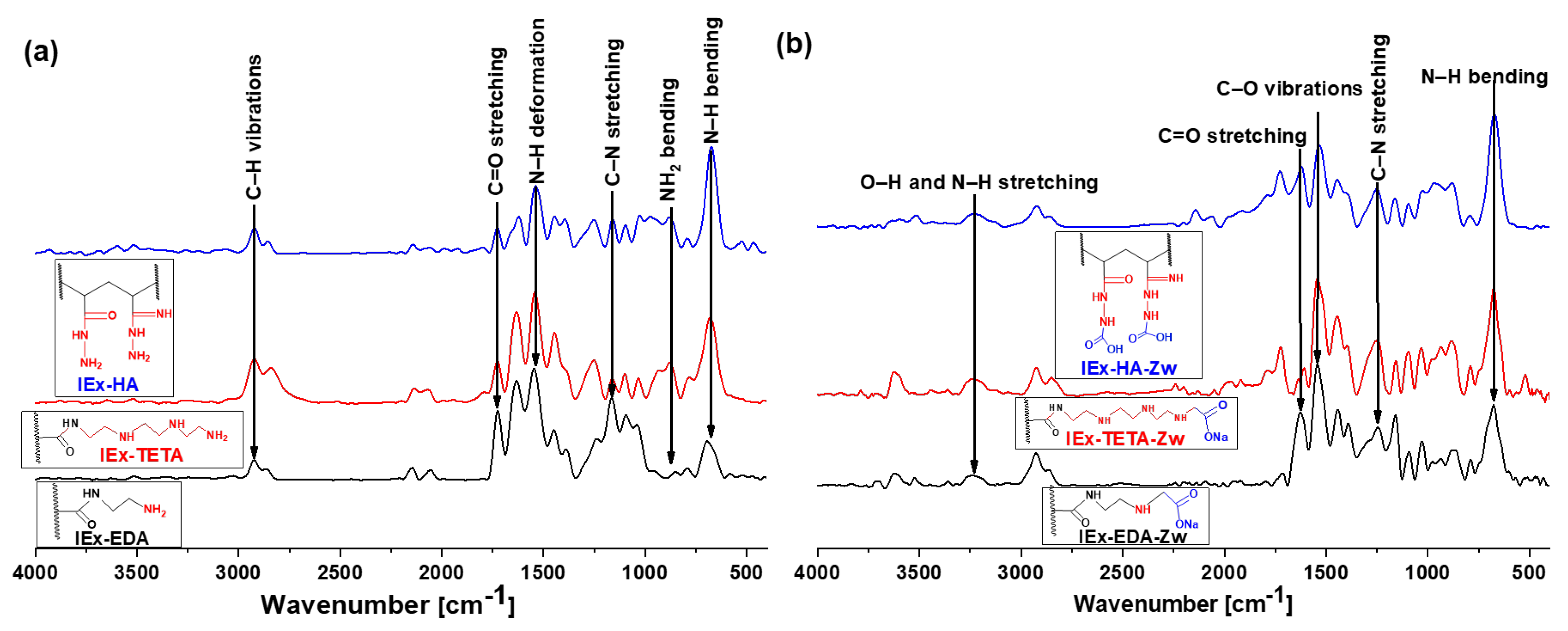
Figure 2.
SEM images on the surface of IExR with weak cationic/anionic groups (upper line) and the corresponding zwitterionic resins (second line) (300 μm scale bar). Insets SEM images of the corresponding IExR with lower magnification (5 μm scale bar).
Figure 2.
SEM images on the surface of IExR with weak cationic/anionic groups (upper line) and the corresponding zwitterionic resins (second line) (300 μm scale bar). Insets SEM images of the corresponding IExR with lower magnification (5 μm scale bar).
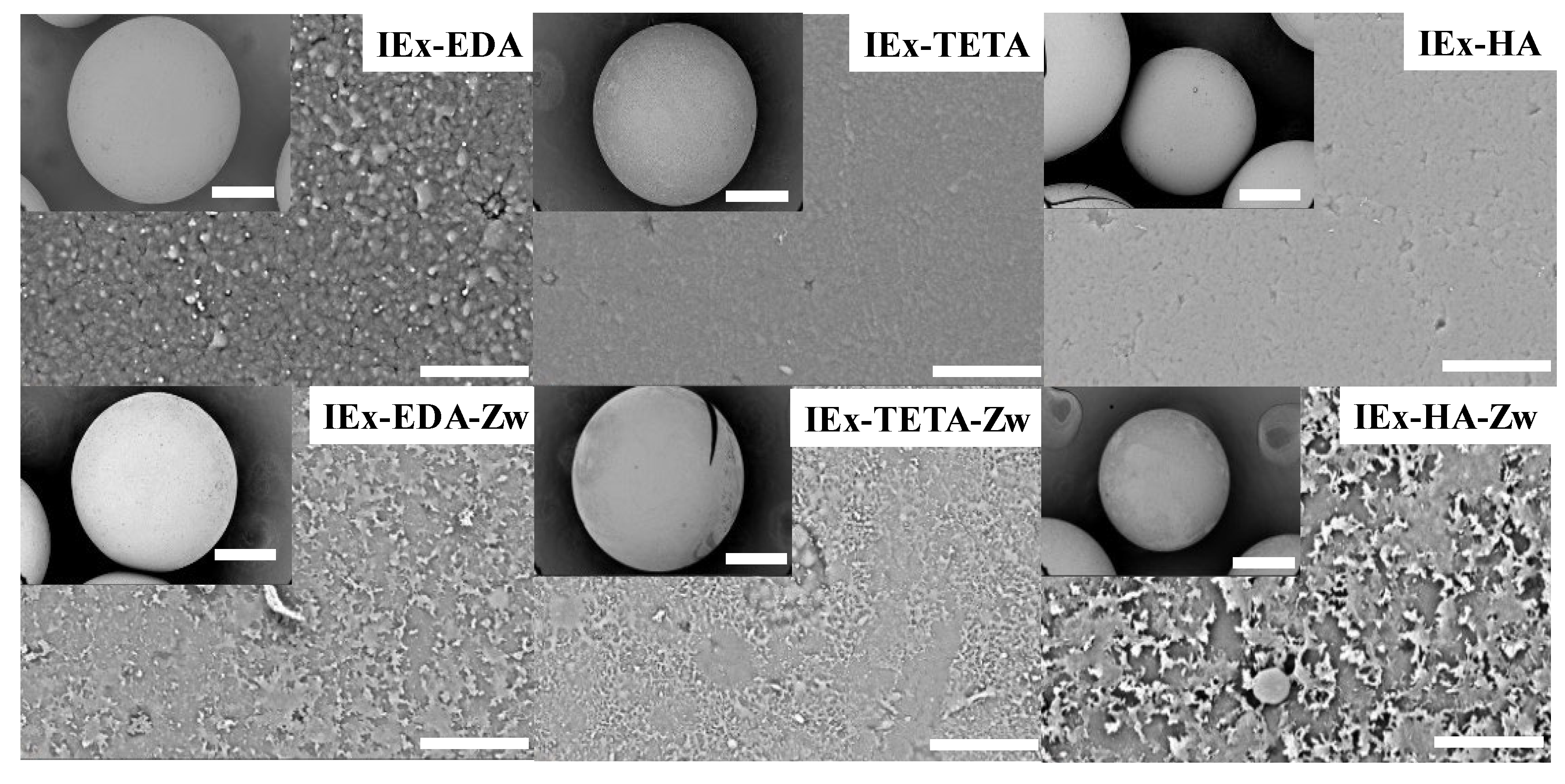
Figure 3.
The sorption capacity of tested IExR, in (a) mono-HMI, (b) multi-HMI aqueous solutions, and (c) Tarnita sampled water for all. Insets of each system retention efficiency (RE, %).
Figure 3.
The sorption capacity of tested IExR, in (a) mono-HMI, (b) multi-HMI aqueous solutions, and (c) Tarnita sampled water for all. Insets of each system retention efficiency (RE, %).
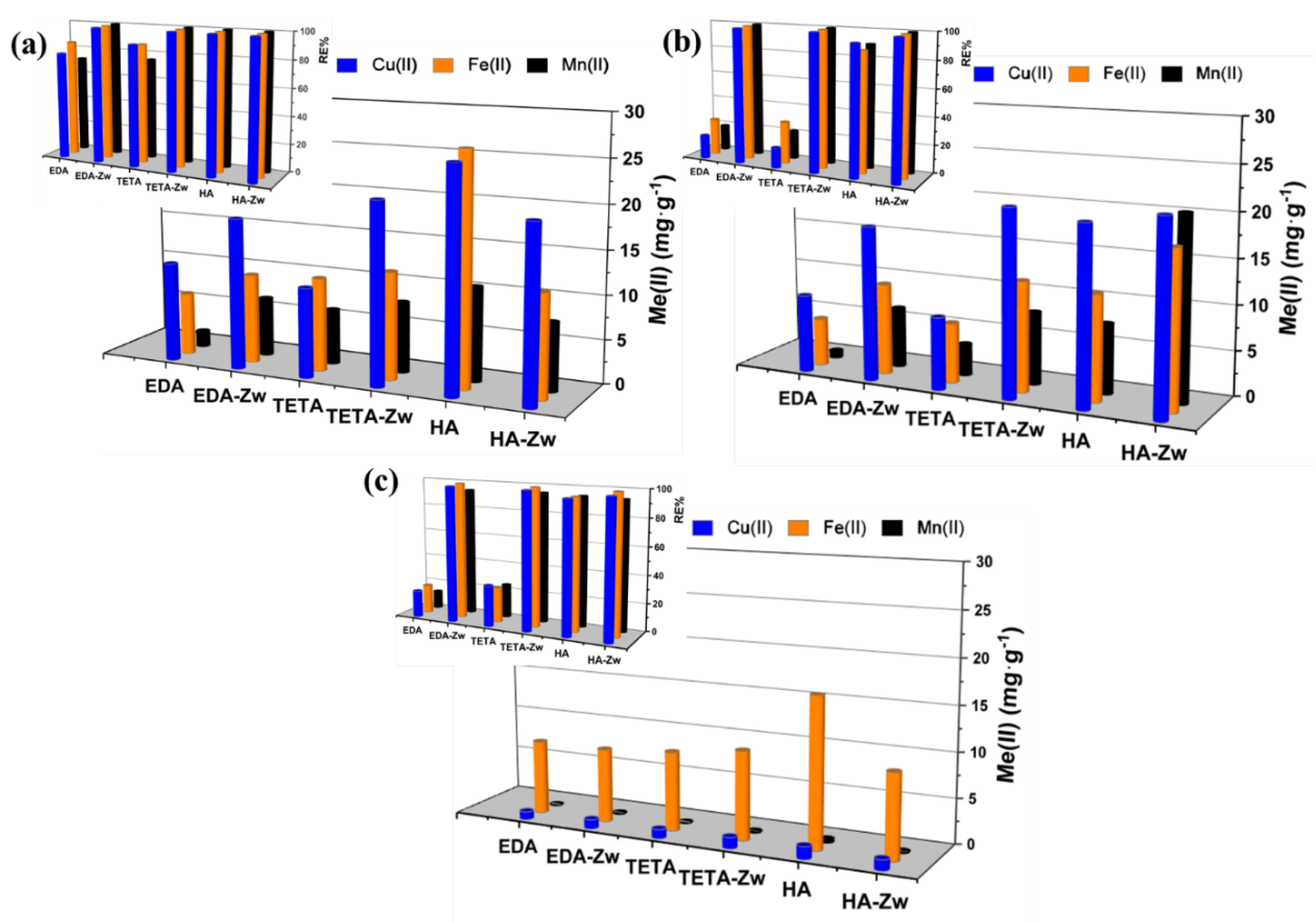
Figure 4.
Equilibrium data for the sorption from multicomponent solution of HMIs by IEx-EDA-Zw, IEx-TETA-Zw and IEx-HA-Zw resins.
Figure 4.
Equilibrium data for the sorption from multicomponent solution of HMIs by IEx-EDA-Zw, IEx-TETA-Zw and IEx-HA-Zw resins.
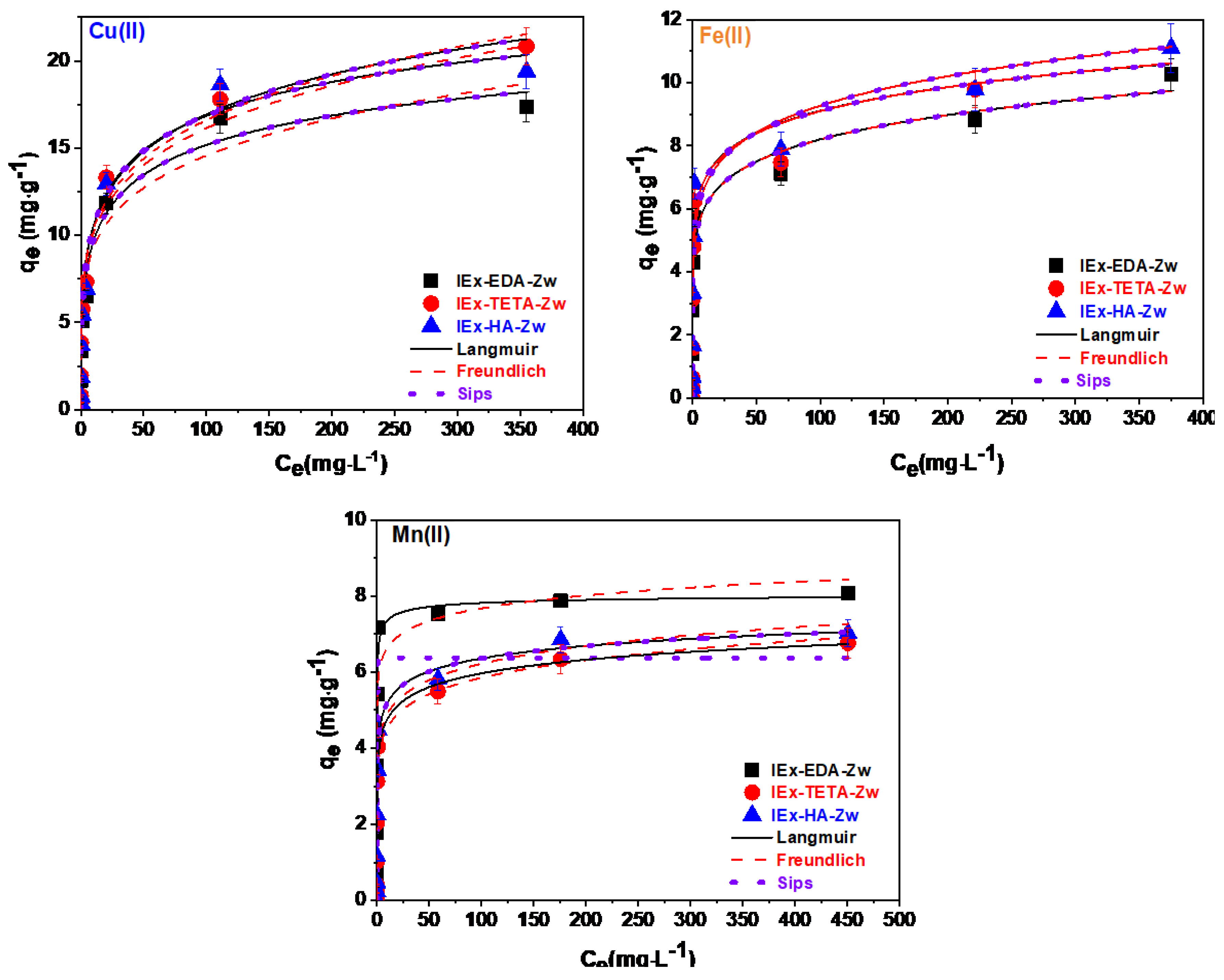
Figure 5.
Sorption data of HMIs (multicomponent solution) on zwitterionic resins fitted by PFO and PSO kinetic models.
Figure 5.
Sorption data of HMIs (multicomponent solution) on zwitterionic resins fitted by PFO and PSO kinetic models.
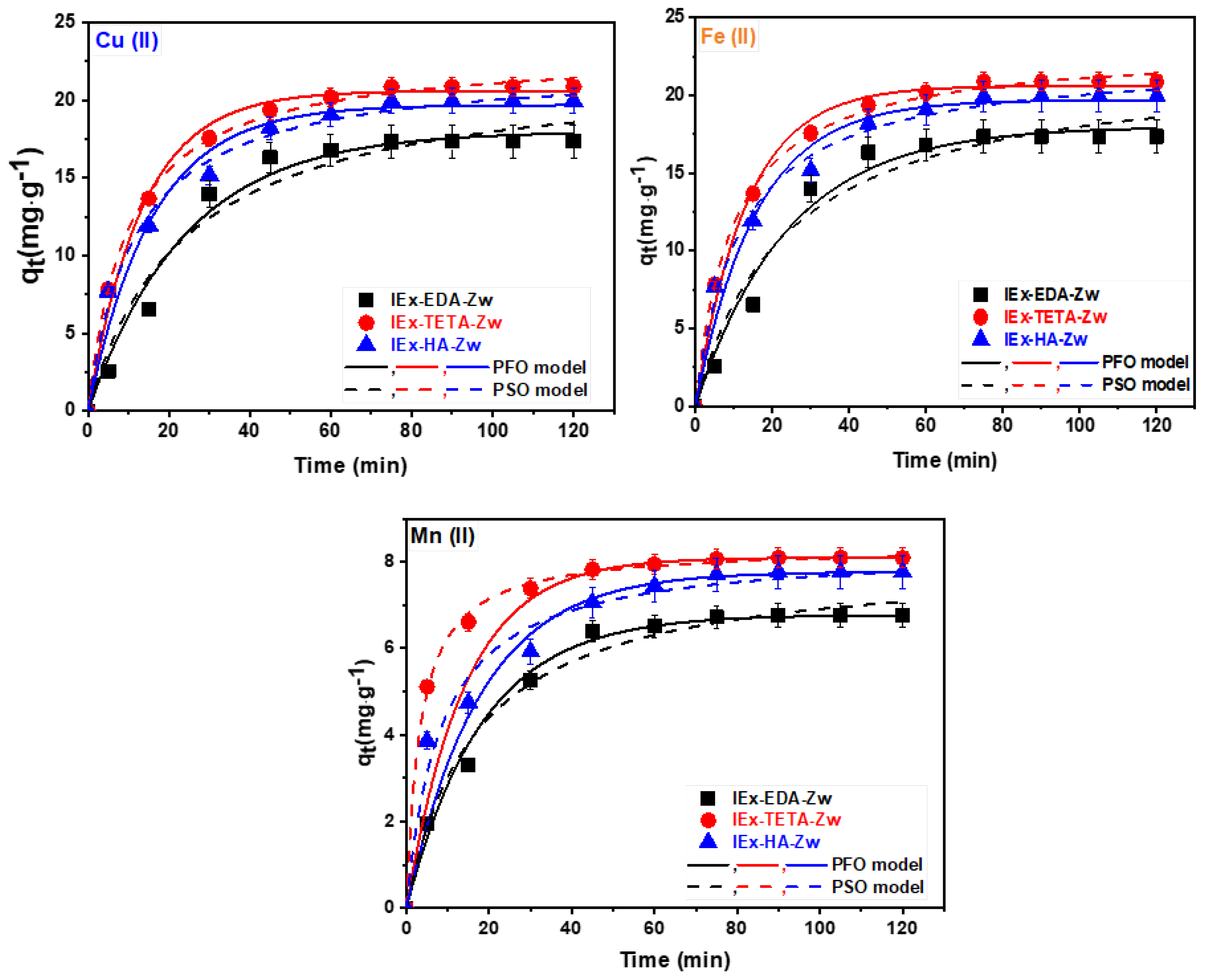
Figure 6.
Effect of temperature on maximum sorption capacity of multicomponent Cu(II), Fe(II) and Mn(II) solutions by zwitterionic resins.
Figure 6.
Effect of temperature on maximum sorption capacity of multicomponent Cu(II), Fe(II) and Mn(II) solutions by zwitterionic resins.

Figure 7.
The zwitterionic IExR retention efficiency (RE, %) tested for multi-HMIs solutions, over six cycles of sorption/desorption.
Figure 7.
The zwitterionic IExR retention efficiency (RE, %) tested for multi-HMIs solutions, over six cycles of sorption/desorption.
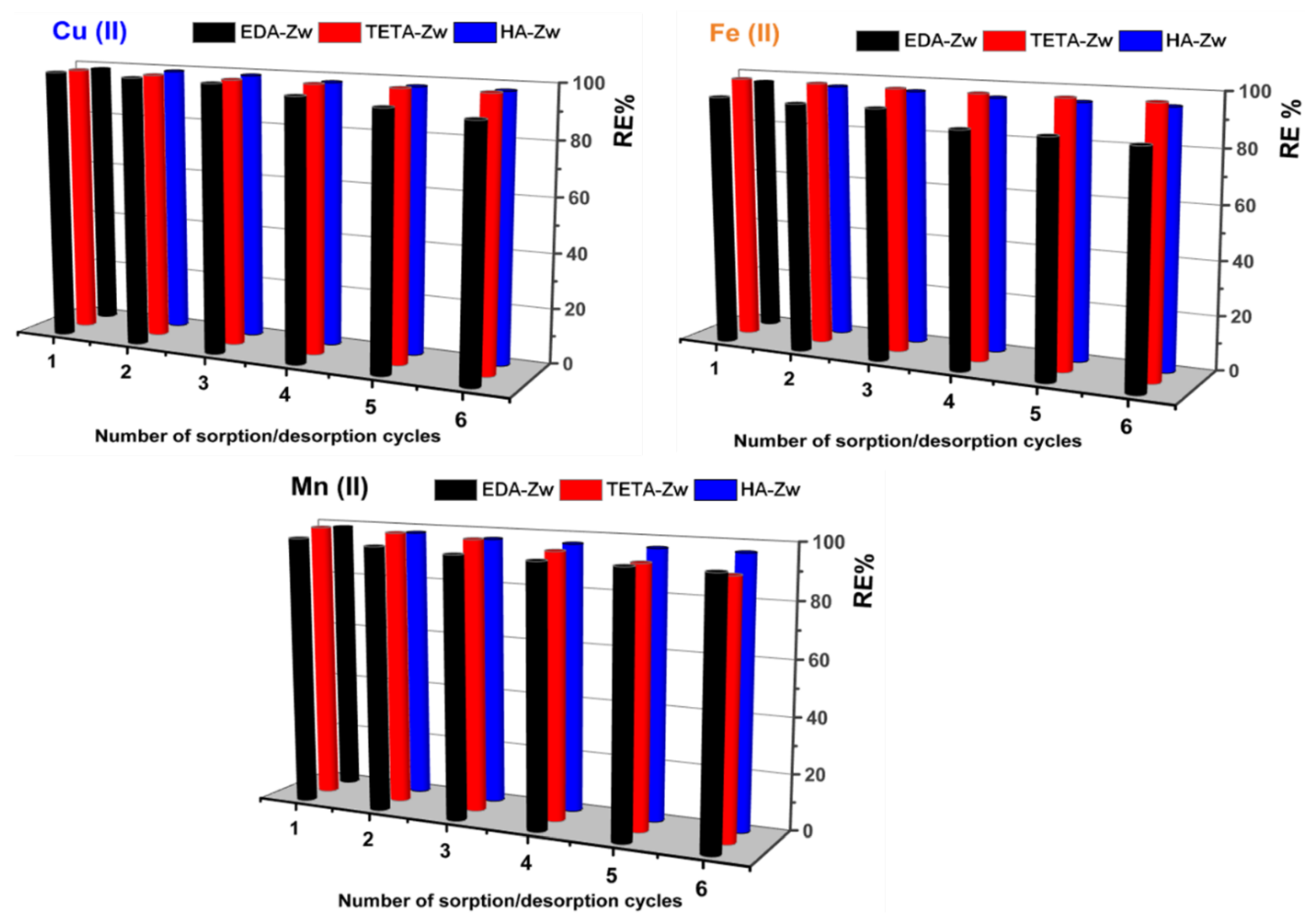
Figure 8.
Zwitterionic IExR sorption’s impact on the toxicity elimination of the water sampled from Tarnita (WT) on wheat germination seeds.
Figure 8.
Zwitterionic IExR sorption’s impact on the toxicity elimination of the water sampled from Tarnita (WT) on wheat germination seeds.
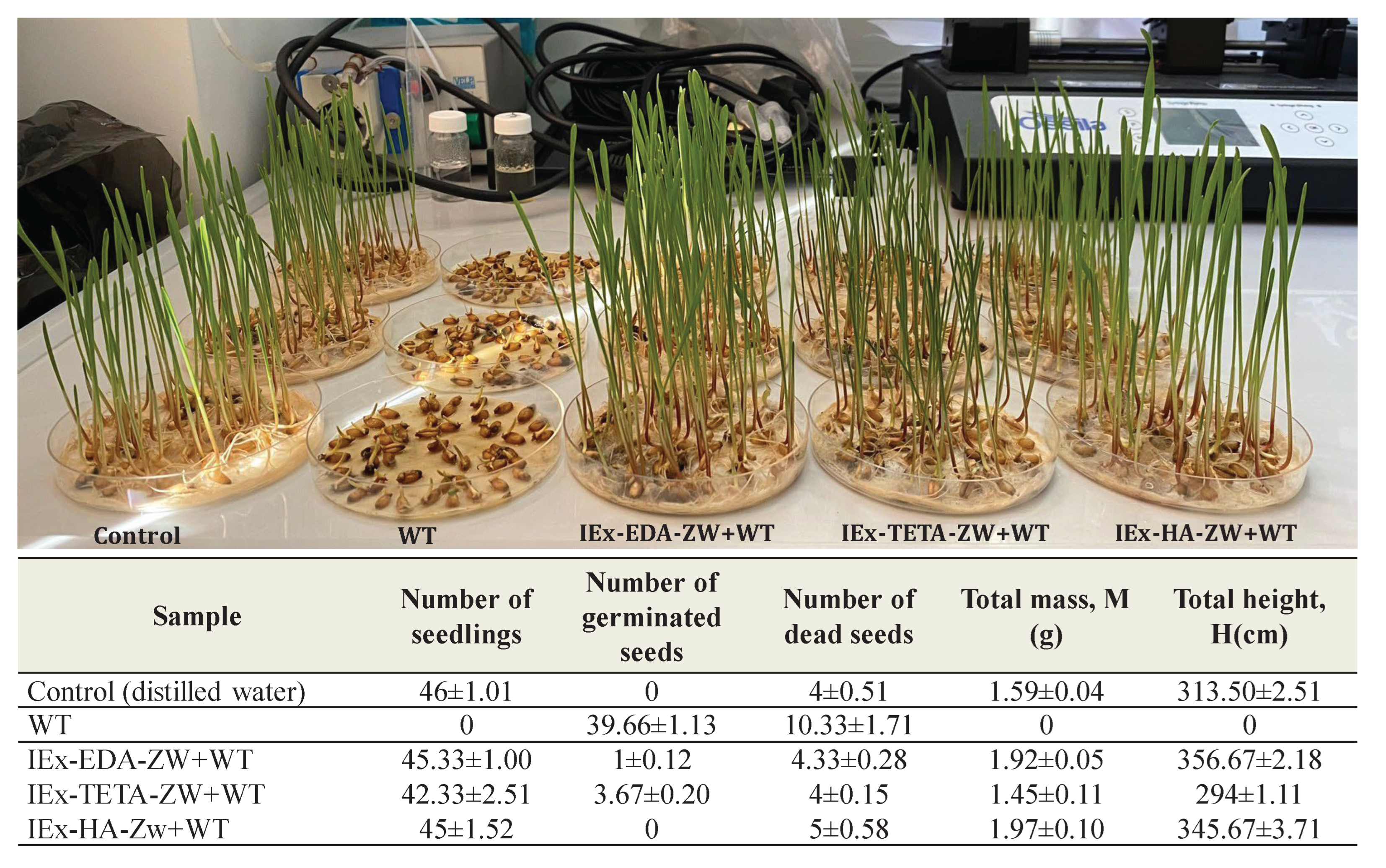

Table 1.
The characteristics of the weak cationic/anionic IExR and their functionalized Zw.
| IEx resins | E(acid) | E(basic) | Wv | Mean diameter | ||
|---|---|---|---|---|---|---|
| mEq·mL-1 | mEq·g-1 | mEq·mL-1 | mEq·g-1 | g·mL-1 | mm | |
| IEx-EDA | 1.154 | 2.859 | 0.295 | 0.318 | ||
| IEx-EDA-Zw | 4.669 | 4.859 | 0.959 | 3.311 | 0.188 | 0.509 |
| IEx-TETA | 2.067 | 5.650 | 0.390 | 0.422 | ||
| IEx-TETA-Zw | 1.646 | 2.803 | 1.334 | 6.806 | 0.157 | 0.611 |
| IEx-HA | 0.259 | 14.281 | 0.054 | 0.235 | ||
| IEx-HA-Zw | 1.392 | 4.828 | 2.153 | 3.212 | 0.164 | 0.325 |
Table 2.
Concentration of HMIs after resin sorption from mono-HMI (MoHMI) and multi-HMIs (MuHMI) synthetic aqueous solutions, and from water sampled from Tarnita (WT).
Table 2.
Concentration of HMIs after resin sorption from mono-HMI (MoHMI) and multi-HMIs (MuHMI) synthetic aqueous solutions, and from water sampled from Tarnita (WT).
| Sample | Cu(II) (mg·L-1) | Fe(II) (mg·L-1) | Mn(II) (mg·L-1) | ||||||
|---|---|---|---|---|---|---|---|---|---|
| MoHMI | MuHMI | WT | MoHMI | MuHMI | WT | MoHMI | MuHMI | WT | |
| IEx-EDA | 2.36 | 4.58 | 14.92 | 7.37 | 10.62 | 110.53 | 3.44 | 15.16 | 1.71 |
| IEx-EDA-Zw | 0.23 | 0.85 | 0.12 | 0.13 | 0.16 | 0.18 | 0.12 | 0.28 | 0.13 |
| IEx-TETA | 6.78 | 9.58 | 12.89 | 3.56 | 12.09 | 116.85 | 3.91 | 16.65 | 35.2 |
| IEx-TETA-Zw | 0.15 | 0.5 | 0.11 | 0.10 | 0.12 | 0.16 | 0.1 | 0.24 | 0.1 |
| IEx-HA | 0.36 | 1.12 | 1.09 | 0.11 | 0.21 | 0.19 | 0.17 | 0.29 | 0.23 |
| IEx-HA-Zw | 0.37 | 0.84 | 0.29 | 0.12 | 0.19 | 0.15 | 0.22 | 0.27 | 0.18 |
Table 3.
Langmuir, Freundlich and Sips isotherm models parameters for the sorption of tested zwitterionic resins for Cu(II), Fe(II) and Mn(II).
Table 3.
Langmuir, Freundlich and Sips isotherm models parameters for the sorption of tested zwitterionic resins for Cu(II), Fe(II) and Mn(II).
| IEx resins | HMIs | ISOTHERM MODEL | |||||||||
|---|---|---|---|---|---|---|---|---|---|---|---|
| Langmuir | Freundlich | Sips | |||||||||
| qm, (mg·g-1) | KL, (L·mg-1) | R2 |
KF, (L ·g−1) |
1·n-1 | R2 | qm, (mg·g-1) | aS | 1·n-1 | R2 | ||
| IEx-EDA-Zw | Cu(II) | 28.54 | 0.23 | 0.9343 | 5.88 | 0.20 | 0.9357 | 28.48 | 0.35 | 0.23 | 0.96601 |
| Fe(II) | 523.74 | 0.01 | 0.9169 | 4.51 | 0.13 | 0.9377 | 498.97 | 0.13 | 0.01 | 0.9556 | |
| Mn(II) | 8.16 | 3.64 | 0.9166 | 5.75 | 0.06 | 0.7750 | - | - | - | - | |
| IEx-TETA-Zw | Cu(II) | 56.99 | 0.12 | 0.9612 | 6.44 | 0.21 | 0.9679 | 56.77 | 0.27 | 0.12 | 0.9748 |
| Fe(II) | 2297.14 | 0.02 | 0.8603 | 4.89 | 0.14 | 0.8954 | 2083.85 | 0.14 | 0.01 | 0.9398 | |
| Mn(II) | 10.89 | 0.50 | 0.9841 | 3.53 | 0.11 | 0.9796 | 10.89 | 0.19 | 0.50 | 0.9703 | |
| IEx-HA-Zw | Cu(II) | 31.80 | 0.22 | 0.9300 | 6.35 | 0.21 | 0.9330 | 31.72 | 0.36 | 0.22 | 0.9638 |
| Fe(II) | 204.13 | 0.03 | 0.8858 | 5.33 | 0.12 | 0.9144 | 197.83 | 0.12 | 0.03 | 0.9470 | |
| Mn(II) | 9.99 | 0.66 | 0.9714 | 3.86 | 0.10 | 0.9644 | 9.99 | 0.21 | 0.67 | 0.9637 | |
Table 4.
Kinetic parameters for the sorption of Cu(II), Fe(II) and Mn(II) by zwitterionic resins.
| Parameter | IEx-EDA-Zw | IEx-TETA-Zw | IEx-HA-Zw | |||||||
|---|---|---|---|---|---|---|---|---|---|---|
| Cu(II) | Fe(II) | Mn(II) | Cu(II) | Fe(II) | Mn(II) | Cu(II) | Fe(II) | Mn(II) | ||
| Exp. | qe,exp, (mg·g-1) | 17.40 | 10.27 | 6.78 | 20.84 | 12.30 | 8.12 | 19.94 | 11.77 | 7.76 |
| PFO | qe,cal, (mg·g-1) k1, (min-1) R2 χ2 |
17.98 4.16·10-2 0.9831 0.89 |
10.71 4.23·10-2 0.9661 0.65 |
6.78 5.45·10-2 0.9918 0.06 |
20.59 7.51·10-2 0.9925 0.42 |
12 10.73·10-2 0.9824 0.29 |
8.10 7.09·10-2 0.8456 1.13 |
19.68 6.33·10-2 0.9792 1.07 |
11.30 16.38·10-2 0.9565 0.67 |
7.77 5.61·10-2 0.9284 0. 52 |
| PSO | qe,cal, (mg·g-1) k2, (min-1) R2 χ2 |
13.95 1.48·10-3 0.4175 30.51 |
13.24 3.22·10-3 0.9438 1.08 |
8.06 7.48·10-3 0.9860 0.09 |
18.01 1.88·10-3 0.6430 20.26 |
13.14 1.15·10-3 0.9985 0.03 |
8.35 2.07·10-3 0.9985 0.01 |
22.31 3.88·10-3 0.9915 0.40 |
12.09 3.35·10-3 0.9885 0.18 |
8.32 3.08·10-3 0.9765 0.17 |
Table 5.
Thermodynamic parameters for the sorption of HMIs by zwitterionic resins.
| IEx resins | HMIs | ΔHo, (kJ·mol-1) |
ΔSo, (kJ·mol-1·K-1) |
ΔGo, (kJ·mol-1) | |||
|---|---|---|---|---|---|---|---|
| 293.15 K | 298.15 K | 303.15 K | 313.15 K | ||||
| IEx-EDA-Zw | Cu(II) | -217.981 | -0.709 | -9.505 | -5.963 | -2.420 | -0.664 |
| Fe(II) | -300.271 | -0.100 | -5.816 | -3.793 | -2.229 | -1.274 | |
| Mn(II) | -237.301 | -0.791 | -5.350 | -4.394 | -3.562 | -1.474 | |
| IEx-TETA-Zw | Cu(II) | -364.445 | -1.189 | -15.837 | -9.891 | -3.945 | -0.947 |
| Fe(II) | -334.404 | -1.099 | -12.307 | -6.813 | -1.319 | -0.468 | |
| Mn(II) | -238.406 | -0.795 | -5.395 | -1.420 | -0.754 | -0.350 | |
| IEx-HA-Zw | Cu(II) | -377.505 | -1.231 | -16.662 | -10.507 | -4.353 | -2.956 |
| Fe(II) | -232.049 | -0.775 | -4.811 | -2.936 | -1.940 | -0.692 | |
| Mn(II) | -215.410 | -0.706 | -8.388 | -4.857 | -1.326 | -0.737 | |
Disclaimer/Publisher’s Note: The statements, opinions and data contained in all publications are solely those of the individual author(s) and contributor(s) and not of MDPI and/or the editor(s). MDPI and/or the editor(s) disclaim responsibility for any injury to people or property resulting from any ideas, methods, instructions or products referred to in the content. |
© 2025 by the authors. Licensee MDPI, Basel, Switzerland. This article is an open access article distributed under the terms and conditions of the Creative Commons Attribution (CC BY) license (http://creativecommons.org/licenses/by/4.0/).
Copyright: This open access article is published under a Creative Commons CC BY 4.0 license, which permit the free download, distribution, and reuse, provided that the author and preprint are cited in any reuse.


