

Submitted:
24 October 2025
Posted:
29 October 2025
You are already at the latest version
Abstract
The present study investigates the effects of particle size, milk fat, and sucrose content on the rheological and textural properties of pistachio spread formulations. Three pistachio pastes were prepared using a mill with different particle sizes: LP (large), MP (medium), and SP (small). Pistachio spreads were formulated with sugar, milk fat, and a combination of sugar and milk fat. The samples were analyzed for their physicochemical properties, including texture, color, rheological characterization, and oil separation. Sensory analysis of pistachio spreads was also performed to reinforce the correlation between textural and rheological parameters and sensory aspects. The rheological properties of pistachio pastes and spreads were evaluated using a rheometer between 20 °C and 45 °C, and all samples exhibited non-Newtonian properties with a yield stress. Textural analysis indicated that increasing milk fat content reduced firmness and work of shear values, thereby improving spreadability. In contrast, a higher sucrose content increased these parameters, making the paste more viscous. This comprehensive study highlights the interplay between ingredient composition and physical properties, providing valuable insights for developing pistachio-based spreads.

Keywords:
Pistacia vera L
; pistachio
; rheology
; anhydrous milk fat
; particle size
; texture
; oil separation
; color
1. Introduction
Pistachios (Pistacia vera L.) are a globally appreciated nut, renowned for their distinct flavor, nutritional benefits, and diverse culinary applications [1,2,3]. According to the most recent report by the International Nut and Dried Fruit Council (INC, 2024), global pistachio production reached approximately 1.168 million metric tons (in-shell), marking a 9.1% increase from the previous year. Turkey was among the leading producers, contributing around 383,000 metric tons, which accounts for nearly one-third of the global pistachio supply. Approximately 80% of this production originates from the Southeastern Anatolia region [5].
Among the many cultivars, the “Boz Antep pistachio” holds a distinctive status due to its superior sensory and technological qualities. Boz Antep pistachio is the name given to pistachios harvested before they are fully ripe, approximately one month before the standard harvest time. The term “boz” originates from the grayish-green outer shell appearance, indicating that the fruit has not yet fully browned. Thus, this particular variety is highly prized for its vibrant dark green color, indicating its maturity and chlorophyll content, contributing to its appealing appearance and premium status in confectionery applications [1,6,7].Additionally, pistachio paste was awarded a Protected Geographical Indication (PGI) designation by the European Commission on June 25, 2025, which mandates that it be produced solely in Gaziantep using early-harvested Boz pistachios, which formally acknowledges it as a legally protected quality characteristic [8]. However, there remains a lack of scientific information on how the distinct compositional characteristics of Boz pistachios impact the physicochemical and textural properties of pistachio-based spreads, despite their cultural and regulatory significance.
Rheology, the science of deformation and flow behavior of materials, is essential for assessing the physicochemical and textural aspects of foods [9]. Recent studies on the rheology of pistachio paste highlight its complex rheological behavior and the importance of understanding its texture for food product applications. The rheology of pistachio paste has been modeled using approaches like the Herschel-Bulkley model, which captures its yield stress and flow characteristics effectively [10,11]. This is especially relevant for the paste’s stability, spreadability, and sensory qualities, such as mouthfeel and texture, which are highly valued in the food industry.
Texture is the sensory and functional expression of the structural, mechanical, and surface characteristics of food seen through the senses of vision, hearing, touch, and kinesthetics. This concept suggests that texture is a multifaceted quality whose assessment includes multiple senses simultaneously [12,13]. Sensory evaluation and instrumental texture analysis are typically employed to quantify the physical characteristics of pistachio paste. These analyses can reveal parameters like firmness, adhesiveness, and spreadability which impact how the product is applied or consumed [14].
Particle size distribution, fat–solid interactions, and formulation composition are the main factors influencing the rheological and textural behavior of nut-based pastes, which include pistachio pastes and spreads, peanut, pecan, hazelnut, sesame, walnut, macadamia and cocoa butters [15,16,17,18,19,20,21]. These pastes are typically characterized as semi-solid, oil-continuous colloidal systems). Numerous studies have been conducted on stabilization techniques based on emulsifiers and oleogelators, such as monoglycerides, lecithin, beeswax, and rice bran wax, which greatly improve oil retention and storage stability in response to industrial issues including oil separation and phase instability [15,22,23]. Additionally, it has been demonstrated that adjusting the fat content, moisture content, or particle size affects yield stress, hardness, spreadability, and visual lubricity in a variety of nut-based matrices [19].
Previous studies on pistachio butter and spreads have mainly focused on individual formulation factors or processing variables, whereas limited information is available on how the combined effects of particle size, milk fat, and sucrose determine the rheological and textural behavior of pistachio spreads. Therefore, it was hypothesized that finer particle size and higher milk fat levels would reduce yield stress and consistency, enhancing spreadability, while higher sucrose concentration would increase structural strength and decrease flowability. Subsequently, the objective of this study was to systematically evaluate the effects of particle size, milk fat, and sucrose on the rheological and textural characteristics of pistachio spreads across different temperatures.
The present study utilizes Boz pistachio to prepare pistachio spreads with varying formulations, focusing on how its inherent qualities influence the rheological and textural properties of the resulting formulations without the addition of other additives. In other words, during the preparation of the pistachio spread formulations in this study, no additives, emulsifiers, or stabilizers were incorporated into the formulations. The spreads were created solely using varying concentrations of Boz pistachio paste, anhydrous cow’s milk fat, and sucrose, providing a more natural product without the influence of synthetic or commercial additives. This aspect of the study is particularly relevant for applications in clean-label products, where consumers increasingly prefer formulations free from artificial ingredients.
2. Materials and Methods
2.1. Materials
Boz pistachio, icing sugar and anhydrous cow’s milk fat were supplied by a local producer in Gaziantep, Turkey.
A laboratory-scale colloid mill (Demirbaş Makina, 2018, Afyonkarahisar, Turkey) was used to produce pistachio paste. Firstly, pistachio nuts were dried in an oven (Heratherm OGH60, Thermo Scientific, Germany) at 100 °C to achieve a moisture content of less than 3%, thereby preventing clumping during the grinding process. Colloid mills typically use shearing force and high-frequency vibrations to reduce the size of food material before forcing the particles to pass through the space between stationary and rotating wheels [24]. The particle size of the material being processed is controlled by varying the distance between the rotor and the stator.
Three pistachio pastes were prepared using a mill with different particle sizes: LP (large), MP (medium), and SP (small). Anhydrous cow’s milk fat, icing sugar were added to the pistachio paste (SP) according to the formulations as shown in Table 1. The mixture of pistachio spreads was blended in a colloid mill. All pistachio-based samples were prepared and filled into a glass container and stored in a refrigerator (4.0±1.0 °C) prior to analysis.
2.2. Proximate Analysis of Pistachio
The proximate composition of the samples was determined according to the Official Methods of AOAC International (AOAC, 2023). Moisture content of the pistachio was calculated by the difference in weight of an approximately 10 g sample before and after drying at 105.0 ±1.0 °C for 3 hours (Heratherm OGH60, Thermo Scientific, Germany). Oil in the kernel was extracted with hexane by distillation for 6 h in an automatic extractor (SER 148/6, Velp Scientifica, Italy). The solvent was removed in a rotor evaporator at 50 °C for approximately 30 min, and the samples were further dried at 105 °C for 10 min (Heratherm OGH60, Thermo Scientific, Germany, cooled in a desiccator, and weighed. Crude protein content was analyzed using the Kjeldahl method (AOAC Official Method 991.02) with a nitrogen-to-protein conversion factor of 5.30 and also carbohydrate, and ash contents were carried out according to the standard method [25].
2.3. Analysis of Particle Size Distribution
The particle size distribution of the pistachio paste samples was determined using a laser diffraction particle size analyzer (Malvern Mastersizer 2000E; Malvern Instruments Ltd., UK). Before measurement, each sample was thoroughly diluted in distilled water (at room temperature) at a 1:10 (w/v) ratio. Following 1 minute of manual shaking, the suspensions were homogenized using a vortex mixer (Heldolph D-91126; Schwabach, Germany) to disperse aggregates and facilitate the effective removal of free oil droplets. The thoroughness of the process was evident in the fact that all analyses were performed in triplicate, and the mean values were reported. Particle size values were expressed as D10 (μm), D50 (μm), and D90 (μm), representing the diameters at which 10%, 50%, and 90% of the total volume of particles were smaller, respectively [10].
2.4. Color Analysis
Color measurements of the pistachio pastes and spreads were performed utilizing a ColorFlex colorimeter (Model A60-1010-615; Hunter Associates Laboratory Inc., Reston, VA, USA). The color parameters L*, a*, and b* were documented according to the CIE (Commission Internationale de l’Éclairage) color space standard [26]. In this system, the L* value signifies lightness (ranging from 0 = black to 100 = white), a* represents the red-green axis (positive values denote redness; negative values denote greenness), and b* represents the yellow-blue axis (positive values denote yellowness; negative values denote blueness). Before analysis, the equipment was calibrated using standard black and white calibration tiles. Upon inserting the sample into the measuring chamber, measurements were obtained relative to the white standard. Each sample was assessed at no fewer than ten distinct locations to allow for any variability, and the average color values were computed. All measurements were conducted in triplicate.
2.5. Oil Separation Rate
A slightly modified protocol of Shakerardekani et al. (2014) was followed for the oil separation measurements [10]. Separate centrifuge tubes were filled with roughly 15 g of each sample and were heated to 80 °C in a water bath for 30 min, and then the tubes were allowed to cool under running water for 15 min. The tubes were centrifuged with a Merlin Supra centrifuge (Spectra Scientific, UK) for 15 minutes at 3000 rpm. A Pasteur pipette was used to take out the separated oil. The oil separation rate (OSR) measures the degree of oil phase separation in pistachio pastes and spreads, which is essential for determining their colloidal stability. Additionally, after the samples were centrifuged and the oil phase was separated, they were stored at refrigeration (4.0 ±1.0 °C) and room temperature (25.0 ±1.0 °C) conditions for 9 months, simulating shelf storage in a store or household. The amount of oil phase separated at periodic intervals (every weak) was measured to investigate the effect of temperature, particle size, and composition on oil stability.
The following formula was used to determine the centrifugal oil–solids OSR:
OSR (g/100 g) = (m1/mi) × 100 (1)
Where m1 is the mass of the separated oil in grams, and mi is the mass of the initial sample in grams.
2.6. Rheological Analysis
The rheological characteristics of pistachio pastes and spreads samples were evaluated with a rotational viscometer (Brookfield RVDV-III Digital Viscometer; Brookfield Engineering Laboratories, Middleboro, MA, USA) equipped with a temperature-controlled chamber and operated through Rheocal T 1.0.9 software (Brookfield Engineering Laboratories, Middleboro, MA, USA) for data acquisition and analysis. Measurements were carried out at six distinct temperatures: 20 °C, 25 °C, 30 °C, 35 °C, 40 °C, and 45 °C using spindle No. 27 and a standard sample cup. Shear stress and apparent viscosity were measured for each sample throughout a shear rate range of 1–50 s-1 for a duration of 250 seconds. The flow characteristics of the samples were expressed using the Herschel–Bulkley equation [11].
The Herschel–Bulkley model equation is as follows:
τ = τ0 + Kγ n (2)
Where
τ = shear stress (Pa),
τ0 = value of the stress in the yield stress (Pa), the stress required to initiate flow,
K= consistency index (Pa.s), indicating the fluid’s viscosity,
n = flow behavior index (dimensionless),
γ = shear rate (s-1).
Furthermore, the relationship between temperature and consistency coefficient (K) is well interpreted by an Arrhenius-type equation [21]. The model parameters were determined by carefully following the consistency coefficient, K, as a function of temperature using (3) and (4) in accordance with experimental findings:
K = ko exp (Ea/RT), (3)
ln K = ln ko + (Ea/RT), (4)
where:
K = consistency coefficient (Pa.sn),
ko = Arrhenius constant (Pa.sn),
Ea = Activation energy (J/mol), which is used to represent the stability of the system,
R = Universal gas constant (8.314 J/mol),
T = Absolute temperature (°K)
2.7. Sensory Analysis
The freshly prepared pistachio spreads (PS1, PS2, and PS3) were evaluated through sensory analysis using the quantitative descriptive analysis (QDA) method [14,18]. A trained panel consisting of 20 individuals (10 males and 10 females), aged between 20 and 45 years, participated in the evaluation. Each sensory attribute was rated on a linear intensity scale ranging from 1 (extremely poor) to 9 (excellent) (Table 2). The evaluations were conducted in a sensory laboratory maintained at 25 ± 1.0 °C. Samples were served in 50 mL portions within coded cups labeled with three-digit random numbers to ensure blinding [17]. Following data collection and statistical processing, the median intensity values for each attribute were visualized in a QDA spider chart.
2.8. Instrumental Textural Analysis
The textural properties of pistachio pastes and spreads were evaluated using a texture analyzer (TA.XT Plus, Stable Micro Systems, Surrey, UK) equipped with a 45 mm diameter spreadability 45° conical probe (P/45C) and 30 kg load cell. Calibration of both force and distance was carried out before each measurement. The test rig comprised a male probe and a female cone fixture. Prior to analysis, the female cone was conditioned at 5 °C for 24 hours. After the conditioning period, approximately 8 g of each sample was placed into the female cone, and the male probe was allowed to penetrate the sample at a constant speed of 5 mm/s from a height of 25.0 mm above the surface. Data acquisition and analysis were performed using Exponent software (version 6.1.1.10, Stable Micro Systems, Surrey, UK). Firmness (peak force of the first compression cycle), adhesiveness (negative area of the force–time curve), and spreadability were determined from the texture profile curves. Spreadability was expressed as the work of shear, calculated from the area under the force–time curve during compression, as described in previous studies [20,27,28]. All measurements were conducted in triplicate, and the mean values were reported. Each sample was tested once.
2.9. Statistical Analysis
All experiments were conducted in triplicate, and the results are presented as mean values. Statistical analyses were performed using one-way analysis of variance (ANOVA) with Statgraphics Plus (version 5.1; Statistical Graphics Corp., Herndon, VA, USA). Duncan’s multiple range test was applied to determine significant differences among the samples, and differences were considered statistically significant at p < 0.05.
3. Results and Discussion
3.1. Composition of Pistachio
Pistachio sample has total oil 46.08±1.52%; protein, 21.57±0.42%; moisture, 3.74±0.03%, carbohydrate 27.69±1.05 and ash, 1.38±0.02%. These values agree with those reported by other authors [29,30,31]. Tsantili et al. (2010) have conducted studies on the composition of different pistachio varieties. Fat ratios varied from 49.79% to 57.62%, while protein ratios ranged from 19% to 21.8% in a dry basis. This study’s results show that pistachios can be potentially applicable to industrial applications because of their high chemical composition similarity.
Pistachio spreads are products that contain a minimum of 40% nut ingredients, which may be incorporated in various forms, including whole nuts, nut pieces, paste, or slurry [14]. Pistachio paste is better for culinary applications as it blends more effectively than pistachio butter. The production technology involves a two-step size reduction process. The initial phase consists of grinding with conventional grinding apparatus such as colloid mills, attrition mills, disintegrators, and hammer mills, followed by a second homogenization phase [32]. It was shown that the specific conditions of either drying or storing the product had an effect on the changes in the pistachio composition [30].
3.2. Particle Size Distribution of Pistachio Pastes
Table 3 shows the particle sizes in the pistachio paste samples according to the milling cycle. There was a statistically significant difference between pistachio pastes (P < 0.05).) Considering a cumulative volume of 10% (D10), the particle size was reduced by 67% when the milling cycle was increased.
*All values are mean ± standard deviation of three replicates. Different superscript letters within the same column indicate statistical differences in the sample (P < 0.05).
The particle size distribution of the pistachio paste samples varied significantly depending on the grinding intensity used. LP had the coarsest structure, with a D90 of 434.80 µm. On the other hand, SP had the finest distribution, with a D90 of 149.78 µm, which shows that the system was more homogeneous and smoother. The median particle size (D50) ranged from 16.71 μm in LP to 7.18 μm in SP, confirming a progressive reduction in particle coarseness as the particle size class shifted from LP to SP. The D10 fraction showed a similar pattern, with SP reaching values close to 1.88 μm, which is suitable for making the product easier to spread and less gritty. It is anticipated that the reduction in particle size will enhance mouthfeel and increase the interaction of the surface area with the fat matrix, potentially affecting rheological behavior, oil binding capacity, and sensory perception. The substantial statistical differences (P < 0.05) observed among all three samples at D10, D50, and D90 validate that the implemented size reduction treatment effect As expected, particul size decreased with grinding time. Shakerardekani et al. (2014) produced pistachio paste using different colloid mill gap sizes and reported that reducing the mill gap allowed more kernels to enter the space between the discs, resulting in a more uniform paste being formed more rapidly, although with a larger particle size. However, it was also clearly observed that decreasing the particle size (from 80 to 20 μm) significantly improved the colloidal stability of the paste [10,33].
With their fine grindability, Boz pistachios add a unique flavor and an eye-catching appearance to pastries and desserts. They are the key ingredient that gives baklava its characteristic golden green color and distinctive aroma. Therefore, it was decided to useSP, which has the smallest particle size, in formulations containing pistachio paste prepared with milk fat and sugar in this study.
3.3. Color Values of Pistachio Pastes and Spreads
Table 4 shows the color parameters of pistachio pastes and spreads. Significant differences were found between the LP and SP in terms of L*, a*, and b*. Pistachio paste becomes darker as the particle size increases, as evidenced by LP, which has the lowest L* value at 44.34±0.02. Samples with small particles have a large specific surface area and a small diameter, which causes them to scatter more light and appear lighter and more saturated than samples with large particles [34]. The highest b* value at 45.86±0.05, which indicates yellowness of the samples, was observed in sample LP. a* values of pstachio pastes ranged from -3.82±0.05 (LP) to -3.64±0.04 (SP). Shakerardekani et al. (2014) reported that there was no significant difference (p < 0.05) in the L, a, and b values of pistachio pastes produced with varied milling gaps.
The types and amounts of pistachio paste, sugar, and milk fat in the spread formulations typically have an effect on the color parameters. As the amount of milk fat in the product increased, the L* and b* (yellowness) values also increased, which is thought to be due to the inherent color of milk fat. Different ratios of milk fats affected a* values of pistachio spreads significantly (p < 0.05). In the formulations with added sugar S1, S2, andS3, the color became lighter, while the yellowness value also increased from 44.19 ± 0.12 to 44.72 ± 0.08. The most important parameter of Boz pistachio is a* value, which indicates the greenness of the sample [35,36]. FS1, FS2 and FS3 were all acceptable; there are no statistical differences between them in terms of greenness (P < 0.05).
*All values are mean ± standard deviation of three replicates. Different superscript letters within the same column indicate statistical differences in the sample (P < 0.05).
3.4. Oil Separation Rate of Pistachio Spreads and Pastes
The results of the separated oil values (%) for samples stored at 4 °C and 25 °C are presented in Figure 1, Figure 2 and Figure 3. Pistachio pastes and spreads are typically shelf-stable; however, oil separation during storage can adversely impact customer acceptability. In samples with different types and ratios of ingredients, less oil separation was observed at 4 °C compared to the samples stored at 25 °C on the same days.
The pistachio paste exhibited reduced stability with increasing particle size. This occurred because the paste causes a decrease in the dispersion of the solid phase within the oil phase as the quantity of larger particles increases, resulting in decreased stability. The paste became less stable due to the formation of a narrower dispersion of the solid phase in the oil phase as the quantity of bigger particles rose.
The oil separation rate and colloidal stability of pistachio paste, when mixed with milk fat and sugar without emulsifiers or stabilizers, can be investigated by the chemical and physical properties of these constituents. Pistachio paste, which contains approximately 45-60% oil, proteins, and carbohydrates, is recognized for its high oil content. The oil phase typically segregates due to gravitational forces, which are influenced by the viscosity of the paste and the interactions among its constituents in the mixture [37].
Research has demonstrated that naturally sourced sugars, when incorporated into emulsions, can alter molecular interactions, resulting in enhanced stability of oil droplets [38]. This discovery is especially pertinent for researchers, food scientists, and product developers focused on food formulation, particularly those engaged with mixtures that incorporate milk fat, sugar, and pistachio paste. Sugar not only imparts sweetness but may also improve emulsion quality by stabilizing protein interactions [39,40]. The incorporation of sugar affects water activity in the mixture, altering its physical dynamics. Sugar acts as a humectant, which may help stabilize the system temporarily by retaining moisture, but does not inherently prevent oil separation [37]. When sugar is combined with fat, the overall viscosity of the paste may increase; however, it might still facilitate oil migration if sugar concentration is not optimally balanced. Studies on nut pastes indicate that oil migration can worsen over time, leading to visible separation on the surface of the paste [41].
Milk fat enhances the creaminess and flavor of the mixture but, similarly to sugar, does not inherently stabilize it without emulsifiers. The density differences between milk fat and pistachio oil can lead to phase separation, where the denser components float to the top over time, particularly under suboptimal storage conditions [35]. Research shows that oil separation in pastes, including those with native plant oils, typically exhibits initial rapid separation that slows down as the mixture equilibrates [37].
Moreover, environmental factors such as temperature significantly affect both oil separation and the overall stability of the mixture. Higher temperatures can increase oil fluidity, exacerbating the separation process. Conversely, lower temperatures may help stabilize the mixture but could negatively affect textural properties if the fats solidify [42]. Gamlı and Hayoğlu (2007) reported that the pistachio nuts paste stored at 4 °C was more acceptable due to low deteriorative reactions as compared to those stored at 20 °C [43].
In summary, the oil separation rate and colloidal stability of a blend of pistachio paste, milk fat, and sugar without added emulsifiers or stabilizers are influenced by the inherent properties of the ingredients, environmental conditions, and balance between the fat and aqueous phases. The mixture is susceptible to oil separation over time due to the interactions among components, their concentrations, and storage conditions.
3.5.1. Effect of Milk Fat
The rheological behavior of pistachio mixtures F1, F2, and F3, prepared with increasing milk fat contents (4, 7, and 10%; w/w), was analyzed. Table 6 summarizes the yield stress, consistency coefficient, and rheological behavior index for each mixture. Similar to the pistachio pastes, all mixtures exhibited non-Newtonian shear-thinning behavior with an apparent yield stress.
*All values are mean ± standard deviation of three replicates. Different superscript letters within the same column indicate statistical differences depending on temperature for each sample (P < 0.05).
The addition of milk fat to the pistachio pastes significantly altered their rheological properties. As observed in the results, the pastes with higher milk fat concentrations exhibited lower viscosity and yield stress values, which is consistent with the behavior of other fat-based pastes. The addition of fat molecules disrupts the continuous network structure formed by proteins and polysaccharides, resulting in a reduction in overall viscosity. Fat serves as a plasticizer in food pastes, reducing the resistance to deformation and making the product softer and more spreadable [52]. This behavior is well-documented in various studies on fat-based emulsions and nut pastes [11,27].
In this study, the impact of milk fat on the rheological and textural properties of pistachio spreads was investigated at various temperatures. Particularly, significant differences were observed at lower temperatures (20 °C and 25 °C), where milk fat remains in a solid state, affecting both the rheological behavior and texture of the spreads. The solidification of milk fat at low temperature leads to a more structured matrix in the spread, which restricts its flow behavior. As the temperature increases, the milk fat fully melts, and the spread becomes more fluid, as evidenced by the reduction in yield stress values. This transition is crucial for applications in food products that require both spreadability and texture consistency, as fat melting plays a key role in determining these properties [43]. As milk fat content increased, yield stress values generally decreased. This can be attributed to the lubricating effect of milk fat, which reduces internal friction within the matrix and facilitates flow [53]. F3, with 10% milk fat, exhibited the lowest yield stress (6.05±0.02 Pa at 45 °C), consistent with findings in fat-rich food matrices where higher fat content softens the overall structure [45]. However, at temperatures below 35 °C, the partial crystallization of milk fat introduced structural rigidity, slightly counteracting this softening effect. Milk fat plays a significant role in the rheological properties of the pistachio creams. The solid fat content increases structural rigidity, leading to higher yield stress and consistency coefficients at 20 °C and 25 °C. This effect diminishes at high temperatures (above 35 °C) as milk fat melting increases, which improves rheological behavior and reduces resistance to deformation. [49]. Similar behavior has been reported in studies on fat-containing emulsions, where solid fat content directly impacts texture and viscoelastic properties [45]. For instance, at 20 °C, the yield stress of F3 (10.51±0.16 Pa) was relatively higher compared to its value at 35 °C (6.11±0.07 Pa) or above, suggesting the dual influence of fat crystallization and concentration.
The consistency coefficient followed a similar trend, decreasing with increasing milk fat content. Higher fat content enhanced rheological behavior by disrupting the rigid network of pistachio particles and sucrose. This behavior was most evident at higher temperatures (above 35 °C) where milk fat was fully melted, creating a more homogenous and fluid system [54].
The rheological behavior index values showed an increasing trend with milk fat content and were well below 1.0, confirming the shear-thinning nature of the formulations. This indicates that higher milk fat content contributed to a more fluid-like behavior, reducing the non-linearity of the shear-thinning response. The trend suggests that milk fat’s role as a plasticizer becomes more prominent as its concentration increases [35].
Statistical analysis exhibited significant differences (p < 0.05) in yield stress and consistency coefficient values between different milk fat concentrations. Spreads with higher milk fat exhibited significantly lower viscosity and yield stress compared to those with lower milk fat, highlighting the importance of fat as a rheological modifier [44].
3.5. Rheological Analysis
The particle size of the pistachio creams was systematically reduced across formulations, with LP having the largest and SP the smallest particle size. The rheological behavior of pistachio pastes LP, MP and SP was analyzed, and the results are presented in Table 5.
The rheological measurements indicated that all the pistachio paste formulations exhibited non-Newtonian rheological behavior, which is consistent with the properties typically observed in nut-based spreads and pastes [44]. All formulations exhibited non-Newtonian shear-thinning behavior with a yield stress, which aligns with the behavior of high-viscosity food products such as nut pastes, spreads, many colloidal suspensions, and emulsions [11,45,46,47,48].
*All values are mean ± standard deviation of three replicates. Different superscript letters within the same column indicate statistical differences depending on temperature for each sample (P < 0.05).
Figure 4 shows the shear-thinning behavior observed, where viscosity decreases as shear rate increases. This behavior suggests that the pistachio pastes possess a structured network that becomes disrupted at higher shear rates, allowing for easier flow.
The rheological behavior of pistachio pastes aligns with previous studies on nut-based systems, where particle size is found to play a critical role in determining texture and flow properties. For example, a study on hazelnut pastes found that reducing particle size enhanced flow property and decreased apparent viscosity [35]. The presence of yield stress in all formulations indicates that the pistachio pastes require a certain threshold of applied stress before they begin to flow, a property commonly seen in food pastes and gels [49].
The particle size of pistachio pastes significantly influenced the rheological and textural properties of the final pistachio paste. As the particle size decreased from LP (largest) to SP (smallest), the consistency and yield stress values increased. Smaller particle sizes typically lead to more compact and cohesive pastes, which exhibit higher viscosity and yield stress, as seen in the transition from LP to SP. This trend is consistent with the findings of Shakerardekani et al. (2014), who reported that finer particle dispersions improve the structural stability and viscosity of fat-based pastes [10]. The interaction between fine particles and the fat matrix likely creates more rigid networks, enhancing the yield stress and consistency coefficient values in the paste. Also, Shakerardekani et al. (2014) examined the impact of milling and evaluated various rheological models, ultimately determining that the Herschel–Bulkley model was the most appropriate for characterizing the rheological properties of pistachio paste.
Yield stress is a key factor in the spreadability of nut-based products, as it directly affects the ease with which the product can be spread on a surface. The yield stress values decreased as the particle size decreased, suggesting that finer particles enhance a smoother structure with reduced resistance to flow [50]. The consistency coefficient exhibited a similar trend, with SP demonstrating the lowest consistency coefficient value at 3.53±0.01. This suggests that reduced particle size enhances flowability due to minimized internal friction and particle aggregation [10].
The flow behavior index values were well below 1.0, which confirms the shear-thinning nature of the formulations. The increased rheological behavior index values for smaller particle sizes (SP) suggest improved homogeneity and reduced structural rigidity, a pattern that has also been observed in peanut butter formulations [51]. The statistical analysis confirm significant differences (p < 0.05) in yield stress and consistency coefficient values between the different particle sizes, supporting the hypothesis that smaller particles increase paste viscosity and yield stress.
3.5.2. Effect of Sugar
Table 7 presents the rheological parameters of pistachio mixtures, S1, S2 and S3, prepared with increasing sucrose concentrations (24, 27, and 30%; w/w, respectively). It should be noted that below 30–35 °C, especially in formulations with higher sugar content, sucrose crystallizes at lower temperatures, making it impossible to obtain accurate flow data. This situation has led to partial solidification and the loss of observable flow behavior, making it impossible to accurately characterize the rheological properties in this temperature range.
The sucrose content directly influenced the yield stress, consistency coefficient, and rheological behavior index values, demonstrating the critical role of solid content in the rheological properties of these systems. This is supported by Faruk Gamlı and Hayoğlu (2007), who observed that sugar increases the rigidity of nut-based pastes by forming a structured matrix within the fat phase [43]. Higher sucrose content also led to reduced spreadability and sucrose’s ability to bind moisture and increase paste thickness also contributed to this effect [55].
*All values are mean ± standard deviation of three replicates. Different superscript letters within the same column indicate statistical differences depending on temperature for each sample (P < 0.05). nd: not determined.
The consistency coefficient also showed an increasing trend with sucrose content, as expected. S3 demonstrated the highest values at 25.16±0.62, reflecting its more viscous nature. Sucrose acts as a filler within the matrix, increasing the apparent viscosity and energy required for deformation. These interactive effects align with Rao (2013), who suggested that fat serves to soften pastes, while sugar increases their consistency. At higher temperatures, values decreased significantly due to the melting of milk fat, which offset some of the viscosity contributed by sucrose [49]. The results are similar to those found in studies of other food systems, such as peanut butter, where the combination of fat and sugar results in pastes with varying textural properties [52].
The rheological behavior index values decrease with increasing sucrose content. This indicates a more pronounced shear-thinning behavior for formulations with higher sucrose concentrations. The lower values in S3 (0.581±0.010 and 0.572±0.010 ) and reflect the strong interactions between solid sucrose particles and the pistachio cream matrix, which resist flow under low shear conditions.
The results are consistent with previous studies on sugar-rich food systems. Emadzadeh et al. (2011) reported that higher sucrose content significantly increases yield stress and viscosity due to its role in forming a dense and rigid matrix [44]. Similarly, studies on confectionery products have highlighted the interplay between sugar content and fat crystallization in determining rheological behavior [51].
The statistical analysis revealed significant differences (p < 0.05) in the viscosity and yield stress of pastes with varying sucrose concentrations. Pastes with higher sucrose content exhibited higher yield stress and viscosity, confirming the impact of sucrose on the textural properties of the pastes.
3.5.3. Combined Effect of Milk Fat and Sugar
The rheological behavior of pistachio spreads FS1, FS2 and FS3 prepared with varying formulations of pistachio pastes (SP), milk fat, and sucrose was analyzed, and the results are presented in Table 8. The combined effect of milk fat and sucrose in the pistachio paste formulations resulted in complex changes in the rheological properties. Spreads such as FS1 (4% milk fat and 30% sucrose), exhibited higher consistency, higher yield stress, and lower rheological behavior index values compared to FS2 (7% milk fat and 27% sucrose), and FS3 (10% milk fat and 24% sucrose). The increase in fat content tended to soften the paste by reducing yield stress at higher temperatures, but sucrose counterbalanced this effect by enhancing viscosity at lower temperatures. The combined interactions of fat and sugar have been shown to produce desirable texture properties, such as increased firmness and reduced spreadability at lower temperatures [48]. These interactions result in a balanced formulation where both spreadability and firmness are optimized for consumer preferences.
Yield stress showed an increasing trend with higher sucrose concentrations. FS1, containing 30% sucrose, exhibited the highest yield stress across all temperatures. This is due to the increased volume fraction of solid particles and formation of a gel-like structure within the paste, which enhances network rigidity and requires higher stress to initiate flow [56]. The trend aligns with findings in similar systems where sugar crystals contribute significantly to the mechanical strength of the structure [14]. At temperatures below 35 °C, this effect was compounded by the partial crystallization of milk fat, further enhancing rigidity and yield stress, particularly in FS3.
Measurements were conducted at temperatures ranging from 20 °C to 45 °C. Across all formulations, yield stress and consistency coefficient decreased with increasing temperature, as expected due to the softening of lipid components and increased molecular mobility. The yield stress values exhibited a strong dependence on the formulations. FS1 (66% PP3, 4% milk fat, 30% sucrose) exhibited the highest yield stress across all temperatures due to the high sucrose concentration and low milk fat content. Conversely, FS3 (66% SP, 10% milk fat, 24% sucrose) had the lowest yield stress, reflecting the softening effect of increased milk fat and the reduced rigidity from lower sucrose content [47].
The consistency coefficient followed a similar pattern to yield stress. FS1 demonstrated the highest consistency coefficient values at 19.01±0.21, suggesting a more viscous and rigid structure, while FS3 had the lowest consistency coefficient values at 2.03±0.04 due to its relatively softer and more fluid composition. These results highlight the balance between sucrose’s solidifying effect and milk fat’s plasticizing effect [44].
Significant differences (p < 0.05) were observed between the different fat-sucrose formulations. Spreads with higher fat and lower sucrose concentrations exhibited significantly lower viscosity, whereas pastes with higher sucrose and lower fat concentrations exhibited higher viscosity and yield stress [45].
As the temperature increased, a general decrease in both consistency coefficient and yield stress was observed, as shown in Table 8. This trend aligns with the findings of several studies suggesting that temperature has a significant effect on the rheological properties of food products, particularly in emulsions and fat-based systems [49]. As temperature increases, the molecular motion within the paste becomes more pronounced, leading to a reduction in viscosity. Additionally, the melting of milk fat further reduced the product’s resistance to flow.
*All values are mean ± standard deviation of three replicates. Different superscript letters within the same column indicate statistical differences depending on temperature for each sample (P < 0.05).
Sucrose, on the other hand, had a contrasting effect. As sucrose concentration increased, both consistency coefficient and yield stress values increased, (S1, S2 and S3). This suggests that sucrose contributes to the formation of a more rigid network structure, increasing the resistance to flow. Similar effects have been observed in other food systems where sugar acts as a structure-building agent in emulsions and gels, thereby increasing viscosity and firmness [44]. The high yield stress observed in the pistachio-sucrose formulations suggests that the presence of sucrose increases the structural integrity of the paste, making it firmer and more difficult to spread. Sucrose also played a role in modulating the rheological properties of the pistachio pastes. The effect of sucrose was observed through the increase in consistency and yield stress at higher sucrose concentrations, especially at lower temperatures. For example, pistachio spread containing 30% sucrose (FS3) were thicker and more resistant to flow at 20 °C and 25 °C, likely due to the increased interaction between sucrose and the fat phase. At these temperatures, the pastes exhibited high viscosity and higher yield stress values, which could be attributed to both the solidified fat and the thickening effect of sucrose in the system.
As temperature increased, the viscosity decreased, and the pastes became more fluid, consistent with the melting of milk fat and the dissolution of sucrose, leading to a more uniform and less resistant paste. The effect of sucrose concentration on viscosity is well-documented in other food systems, where higher sugar concentrations lead to thicker pastes and increased yield stress [47]. However, at higher temperatures, the decrease in viscosity was more pronounced, reflecting the dominant effect of milk fat melting on the overall rheology. Therefore, at 20 °C and 25 °C, the fat remains in a semi-solid or crystalline form, resulting in a marked increase in viscosity and a decrease in the flowability of the pastes, as shown in Table 8. This behavior was most noticeable in formulations with higher milk fat content, especially those containing 10% milk fat (FS3). At these temperatures, the presence of solidified milk fat contributes to the overall stiffness of the paste, which limits its ability to flow and results in increased resistance to shear stress. This was evident in the rheological measurements, where the pastes exhibited higher yield stress values, particularly at 20 °C (16.78±0.41 Pa) and 25 °C (13.40±0.14 Pa), indicating that the milk fat had not fully melted.
The Arrhenius parameters, including activation energy (Ea), were determined for all formulations based on the temperature dependence of yield stress. These parameters provide insights into the energy required to overcome resistance to flow as the temperature changes. The results are summarized in Table 9.
The pistachio pastes’ activation energy (Ea) values slightly decreased as the particle size decreased. The largest particle size, LP, also had the highest Ea (32.1 kJ/mol), suggesting that its coarser and more rigid microstructure requires more energy to start flow. However, the Ea values for MP and SP, which had progressively smaller particle sizes, were slightly lower (31.8 kJ/mol), indicating that finer particles make molecular mobility and flow easier in a thermal environment. Moreover, SP had the lowest pre- exponential factor (k₀) values (2.1×10⁻⁵), followed by MP (2.4×10⁻⁵) and LP (2.8×10⁻⁵), indicating that better flowability is a result of smaller particle size. Strong temperature- dependent variation across particle size treatments was indicated by the excellent Arrhenius fit (r2 ≥ 0.986) of pistachio pastes.
The activation energy (Ea) values increased with sucrose concentration, rising from 15.3 kJ/mol at 24% sugar to 18.4 kJ/mol at 27% and 18.9 kJ/mol at 30% sucrose. This trend clearly indicates that formulations with higher sucrose content exhibit greater temperature sensitivity of viscosity, confirming that sucrose strengthens the temperature dependence of flow behavior. Pastes with higher fat content exhibited lower activation energies, consistent with findings by Emadzadeh et al. (2015), which indicate that fat reduces temperature sensitivity in emulsions [48]. The reduced temperature dependence in fat-rich pastes suggests that fat stabilizes the emulsion, maintaining a consistent texture across a broader temperature range.
Activation energies determined for pistachio pastes in this study are in line with those reported for similar food systems. For example, in chocolate spreads, activation energies typically range from 20 to 40 kJ/mol, depending on the fat and sugar content [49]. Similarly, the observed relationship between sucrose content, milk fat crystallization, and activation energy is consistent with findings from studies on nut-based and fat-rich spreads [10].
Temperature had a big effect on how pistachio pastes flowed. As anticipated, both yield stress and consistency coefficients diminished with rising temperature, aligning with the conventional behavior of non-Newtonian food systems, wherein thermal input diminishes internal structural resistance and facilitates flow. These results agree with the findings of Cruz et al. (2011), which indicated that increased temperature diminishes the internal resistance of pastes, thereby improving flowability and spreadability [57]. The temperature-dependent decline in the flow behavior index (n) indicated the enhanced shear-thinning characteristics at reduced temperatures and a progressive transition towards more Newtonian flow at elevated temperatures.
Additionally, a statistical analysis of the K values obtained from rheological analyses of the samples at various temperatures has been conducted. For example, a significant statistical difference was found at all temperatures studied for samples FS1, FS2 and FS3. Similarly, a significant difference was also found between the K values of products with different particle sizes (LP, MP and SP) depending on temperature (Table A1).
The determined activation energy (Ea) values indicate that the rheological behavior of the pistachio pastes is highly sensitive to temperature changes. The higher activation energy in LP reflects a more temperature-dependent rheological behavior, likely due to the increased influence of sucrose and the partial crystallization of milk fat at lower temperatures. As temperature increased, milk fat fully melted, reducing the resistance to flow and lowering yield stress and viscosity [50]. On the other hand, the pistachio pastes with sugar-based formulations (S1, S2, and S3) with sucrose contents increasing from 24% in S1 to 30% in S3 exhibited progressively higher Ea values, indicating that higher sucrose levels promote the formation of a more rigid and structured network that requires greater energy to initiate flow. This behavior is in agreement with previous findings on sugar-rich nut-based systems, where sucrose-driven solid–liquid interactions and microcrystalline network formation increased the temperature sensitivity of viscosity and delayed the onset of flow under thermal excitation. Emadzadeh et al. (2012), which indicated that the addition of sucrose in high concentrations increases the viscosity and stiffness of food pastes, leading to higher activation energy values [47].
These activation energy (Ea) values are also consistent with those reported in the literature for similar fat-based food systems. Rabadán et al. (2018) found that fat-based pastes exhibit a strong temperature dependency, with higher activation energies corresponding to pastes with higher fat content [53]. This is due to the increased energy required to overcome the intermolecular forces in the solid phase of the fat, leading to changes in the paste’s rheological behavior as the fat melts.
3.6. Textural Analysis
The spreadability of the formulations was evaluated using a standard test to assess their ability to spread under a fixed force, and the results are shown in Table 10. The textural analysis provided valuable information about the firmness, adhesiveness, and spreadability of the pistachio pastes. Firmness, assessed as the peak value in the spreadability analysis, indicated that pistachio pastes with higher sucrose concentrations (S1, S2, and S3) were significantly firmer. This finding aligns with previous research by Dubost et al. (2003), who discovered that sucrose enhances the firmness of pastes by contributing to a more structured network [51]. The increased firmness can be attributed to the ability of sucrose to form hydrogen bonds with other components in the paste, creating a more rigid structure
*All values are the mean ± standard deviation of three replicates. Different superscript letters within the same column indicate statistical differences for samples (P < 0.05).
As shown in Table 10, spreadability was significantly affected by both milk fat and sucrose content. Higher fat content led to better spreadability, as it decreased yield stress and enhanced fluidity [43]. The lubricating effect of milk fat was most pronounced in the (SP) sample, where the paste was smooth and easily spreadable. In contrast, higher sucrose content reduced spreadability, as the paste became thicker and more resistant to shear, supporting findings by Emadzadeh et al. (2013). The crystallization of milk fat also influenced spreadability. At lower temperatures (below 35 °C), the crystallization of milk fat increased yield stress, reducing spreadability, which is in line with previous studies [53]. This effect was particularly notable in the pastes stored at 20 °C and 25 °C, where pastes became firmer as the fat crystallized.
The spreadability of the pistachio pastes was significantly influenced by both milk fat content and sucrose concentration. FS3, which had the highest milk fat (10%) and the lowest sucrose content (24%), exhibited the greatest spreadability. This can be attributed to the lubricating and plasticizing effect of milk fat, which softened the paste and reduced resistance to spreading [58]. In contrast, FS1, with the lowest milk fat (4%) and highest sucrose content (30%), exhibited the least spreadability due to its firmer, more rigid texture. As expected, FS2 (7% milk fat, 27% sucrose) exhibited intermediate spreadability, confirming the influence of both components on the overall spreadability. The results demonstrate a clear trend where higher milk fat content facilitates easier spreading, while higher sucrose concentration contributes to greater resistance to deformation, making the paste more difficult to spread.
The work of shear, representing the energy required to spread the paste, was also significantly higher for the pistachio-sucrose formulations. This result highlights the inverse relationship between firmness and work of shear, as firmer pastes typically require more energy to spread. Conversely, pastes with higher milk fat concentrations (F1, F2 and F3) exhibited lower firmness and work of shear values, making them easier to spread. These findings are consistent with the work of Emadzadeh et al. (2013), who exhibited that increasing fat content results in softer, more spreadable pastes with reduced resistance to shear [52]. The spreadability of nut-based pastes is often governed by the balance between fat and sugar content, as seen in other studies on nut butters and spreads. For example, a study on hazelnut spreads found that increasing fat content improved spreadability, while higher sugar content decreased it [59]. Similarly, in chocolate pastes, fat content was identified as a key factor in determining firmness and spreading, depending on the nature and amount of the lipids used for their preparation [60]. The statistical analysis exhibited significant differences (p < 0.05) in spreadability values based on fat and sucrose concentrations. Higher fat concentrations resulted in significantly better spreadability, while higher sucrose concentrations led to reduced spreadability.
The adhesiveness values make it evident how the formulation parameters affected the spreads’ stickiness and ability to form residues. Adhesiveness gradually decreased from -0.667 to -0.538 Ns in the particle size series (LP–MP–SP), suggesting that smaller particles were less sticky, most likely due to reduced inter particle friction and clearer oral perception. The lubricating/plasticizing functions of fat were confirmed by a similar reduction trend observed as the milk fat content increased (F1–F3), where adhesiveness values dropped from –0.401 to –0.224 Ns. This implies a less sticky and smoother mouth feel, which is often associated with improved sensory acceptance. On the other hand, with adhesiveness values ranging from –1.272 to –1.300 Ns, the sucrose series (S1–S3) showed the highest stickiness and residue formation. Since higher sugar levels are known to enhance capillary forces and structural cohesion, resulting in greater adhesive resistance, this behavior aligns with the existing literature. The behavior of the combined sugar-fat formulations (FS1–FS3) was balanced and intermediate. Because of the predominant effect of fat, FS1 showed comparatively high adhesiveness (–0.796 Ns), while FS3 showed noticeably lower stickiness (–0.352 Ns). These findings unequivocally show that while enough milk fat can counteract the tendency of sucrose to increase adhesiveness, it can also have the opposite effect.
3.7. Sensory Analysis
The value distribution QDA parameters are displayed in the spider chart of Figure 5 allowing for a sensory comparison of pistachio spreads. The sensory spider plot provides a clear visual representation of FS2’s superiority over FS1 and FS3 in almost all of the traits that were examined. FS2’s top rankings in flavor, taste, color, spreadability, and overall acceptability indicate a strong consumer preference. Its optimal stickiness contributes to its excellent spreadability and mouth feel, further enhancing its appeal. While FS3 exhibited slightly better flowability and less stiffness, FS2 emerged as the most balanced in terms of texture, taste, and handling attributes. This balance makes FS2 the formulation most preferred in sensory evaluation. FS1, with lower scores across most qualities, may not be as appealing to consumers.
Figure 5 demonstrates that FS2 (66% pistachio paste (SP), 7% milk fat, and 27% sugar) received the highest mean scores for sensory attributes (taste, flavor, color, spreadability, and overall acceptability). Therefore, it was considered the most acceptable spread, being rated from very good to excellent. As supported by both instrumental and sensory evaluations, FS2 demonstrated the most desirable overall quality. The instrumental texture results showed that FS3 was the least hard and sticky, but the sensory panel liked FS2 better because it had a more balanced texture—neither too firm like FS1 nor too soft and flowable like FS3. FS2 had the best mix of moderate firmness, acceptable adhesiveness, and decent spreadability. This led to the top marks in taste, flavor, spreadability, and overall acceptance during sensory evaluation. These results show that consumers prefer a moderate texture profile over one that is very soft or very firm.
The findings from this study have significant implications for the development of pistachio-based spreads. The ability to control the spreadability, firmness, and texture of the paste through the manipulation of milk fat and sucrose content allows for the creation of customized pistachio spreads with desired sensory characteristics. For example, a lower sucrose content and higher milk fat would result in a smoother, more spreadable paste, suitable for applications requiring easy spreadability (e.g., on bread). On the other hand, higher sucrose content and lower milk fat would result in a firmer paste, ideal for confectionery uses or as a topping [27,59]. Furthermore, the rheological and textural properties of pistachio pastes could be optimized for specific consumer preferences by adjusting the formulation to meet varying needs for sweetness, consistency, and spreadability. The findings of this study can also inform processing techniques, such as the control of temperature during production, to achieve the desired product characteristics.
The combined manipulation of the sucrose and milk fat levels had a significant impact on the structural and sensory quality of the pistachio spreads, as the instrumental texture results of the FS series clearly showed (P < 0.05). Firmness and work of shear values steadily declined as milk fat increased from FS1 to FS3, suggesting a matrix that was becoming more lubricated and plasticized. The sensory evaluation showed that FS3 was the most fluid and easily deformable formulation, with a flowability score that increased significantly from 6.94 in FS1 to 8.06 in FS3. This supports known rheology–sensory relationships, as previously documented for spreads made with pistachios and other nuts, where a higher fat content improves spreadability and oral melting behavior while lowering particle–particle friction [10,19,20]. Nevertheless, despite having the highest flowability, FS3’s overall acceptability (7.25) was lower than that of FS2 (8.06), suggesting that excessive fluidity and a lack of structural definition could undermine consumers’ perceptions of premium texture, particularly in conventional pistachio-based applications.
There was a considerable correlation between FS1, which had the lowest fat content, and lower spreadability scores (6.82–6.94 range) and sensory mouth adhesiveness. Instrumentally, it also demonstrated more negative adhesiveness and stiffness. Perceived stickiness was considerably higher for sensory qualities such as mouth adhesiveness (6.94) and adhesiveness to the spoon (7.29), as compared to FS2. Similar to this tendency, insufficient lubrication leads to structural resistance and the formation of oral residue in high-solid nut butters [15,23]. Although scores above seven imply a “good” perception, FS1 lacked the harmony, richness, smoothness, and softness required for increased hedonic appeal.
FS2 consistently stood out as the best formulation, with the highest overall acceptability (8.06), a delicious flavor (7.88), acceptable spreadability (7.53), and a perfect balance of mouthfeel. It also exhibits intermediate stiffness and moderate adhesiveness, as indicated by instrumental data. This suggests that FS2 achieved the critical “sensory–rheological equilibrium zone,” wherein sufficient plasticization by milk fat reduces structural resistance without compromising body, and sugar provides body and taste perception without creating excessive hardness or stickiness. The significantly higher flavor and taste scores in FS2 suggest that the fat-sugar ratio may have optimized flavor release kinetics, enhancing both sweetness perception and lipid-aroma solubilization.
These results confirm that instrumental texture assessments exhibit a robust correlation with sensory perception, particularly in terms of spreadability, adhesiveness, and flowability characteristics. FS3 indicates that the highest instrumental fluidity does not always correspond to the highest consumer liking. Instead, sensory acceptance was maximized when structural integrity, lubricity, and flavor perception were simultaneously balanced a condition achieved most effectively by FS2. All formulations, made without any emulsifiers, stabilizers, or commercial additives, achieved high sensory scores (≥6.5), indicating that it is possible to create clean-label pistachio spreads that are appealing to consumers by using only natural macronutrient modulation.
4. Conclusions
The present study highlights the intricate relationship between particle size, milk fat, and sucrose in influencing the rheological properties and spreadability of pistachio spreads. Finer particle sizes increase viscosity and yield stress, while milk fat reduces these properties, particularly at higher temperatures. In contrast, sucrose increased viscosity and decreased spreadability by reinforcing the structural network and enhancing solid–solid interaction. Furthermore, the findings emphasize the importance of controlling thermal conditions, fat phase transitions, and sugar interactions to produce high-quality pistachio spreads with enhanced sensory attributes. The results provide useful guidance for balancing milk fat and sucrose levels to achieve desirable spreadability and stability. Future research could investigate the potential of alternative natural sweeteners and plant-based fat substitutes to create clean-label or vegan-friendly formulations that do not compromise texture or spreadability. Additionally, comprehensive studies that utilize microstructural imaging and shelf-life evaluations would enhance our understanding of how these factors influence consumer acceptance and product stability over time. Furthermore, investigating the impact of fluctuating storage temperatures and real-life distribution environments would further strengthen the industrial relevance of this research.
Author Contributions
Conceptualization, G.S. and A.K.; methodology, G.S..; A.K..; validation, G.S.., N.F.K. and A.K..; formal analysis, G.S. and N.F.K..; investigation, G.S. and N.F.K.; resources, G:S. and A.K..; data curation, G.S..; writing—original draft preparation, G.S. and A.K..; writing—review and editing, G.S.., N.F.K. and A.K.; visualization, G.S..; supervision, A.K..; project administration, G.S: and A.K.. All authors have read and agreed to the published version of the manuscript.
Funding
“This research received no external funding”
Institutional Review Board Statement
The sensory evaluation was conducted according to the guidelines of the Gaziantep University, and approved by the Ethics Committee of [Gaziantep University, Approval No. 015, 09.12.2024].
Informed Consent Statement
Informed consent was obtained from all participants involved in the sensory evaluation.
Data Availability Statement
The original contributions presented in the study are included in the article, further inquiries can be directed to the corresponding authors.
Acknowledgments
The authors would like to express their sincere gratitude to Şölen Chocolate Food Industry and Trade Inc. (Gaziantep, Turkey) for their valuable support and collaboration during this research. This article is part of the master’s thesis research conducted by Nazlı Feray Kılıç under the supervision of Prof. Dr. Ahmet Kaya and Asst. Prof. Dr. Gülten Şekeroğlu at Gaziantep University. The thesis has not yet been published.
Conflicts of Interest
“The authors declare no conflicts of interest.”
Appendix A

Table A1.
Comparison of K values of samples at the same temperatures.
| Sample | 20 °C | 25 °C | 30 °C | 35 °C | 40 °C | 45 °C |
| LP MP SP F1 F2 F3 S1 S2 S3 FS1 FS2 FS3 |
15.70±0.70f 11.47±0.20e 9.76±0.64d 6.05±0.01b 4.76±0.05a 6.88±0.22c nd nd nd 19.01±0.21g 9.12±0.46d 15.22±0.19f |
11.28±0.66h 8.91±0.29g 7.94±0.25f 4.46±0.07c 3.19±0.01b 2.73±0.11a nd nd nd 12.96±0.20i 7.06±0.05e 6.16±0.05d |
9.28±0.10h 6.95±0.10g 6.18±0.13f 3.65±0.06d 2.46±0.03b 1.94±0.01a 17.28±0.73j 20.01±0.50k nd 10.18±0.21i 5.06±0.10e 2.97±0.04c |
7.42±0.10g 5.65±0.10f 5.10±0.14e 2.98±0.06c 2.00±0.06a 1.69±0.02a 15.43±0.04i 17.54±0.21j 25.16±0.62k 8.37±0.17h 4.02±0.05d 2.48±0.02b |
6.50±0.27g 4.80±0.10f 4.20±0.10e 2.45±0.02c 1.86±0.01b 1.47±0.01a 13.90±0.25i 15.88±0.29j 22.58±0.35k 7.61±0.07h 3.39±0.06d 2.19±0.01c |
5.38±0.21f 4.14±0.15e 3.53±0.01d 2.22±0.02c 1.59±0.09ab 1.33±0.02a 13.03±0.27h 14.62±0.52i 19.96±0.76j 7.20±032g 3.16±0.04d 2.03±0.04bc |
* Different superscript letters within the same column indicate statistical differences for samples (P < 0.05). nd: Not determined.
References
- Mateos, R.; Salvador, M.D.; Fregapane, G.; Goya, L. Why Should Pistachio Be a Regular Food in Our Diet? Nutrients 2022, 14, 3207. [Google Scholar] [CrossRef]
- Kola, O.; Hayoğlu, İ.; Türkoğlu, H.; Parıldı, E.; Ak, B.E.; Akkaya, M.R. Physical and Chemical Properties of Some Pistachio Varieties (Pistacia vera L.) and Oils Grown under Irrigated and Non-Irrigated Conditions in Turkey. Quality Assurance and Safety of Crops & Foods 2018, 10, 383–388. [Google Scholar] [CrossRef]
- Bulló, M.; Juanola-Falgarona, M.; Hernández-Alonso, P.; Salas-Salvadó, J. Nutrition Attributes and Health Effects of Pistachio Nuts. Br J Nutr 2015, 113, S79–S93. [Google Scholar] [CrossRef]
- International Nut and Dried Fruit Council (INC). (2024).Global statistical yearbook 2024: World tree nut and dried fruit production and consumption trends. International Nut and Dried Fruit Council. https://www.nutfruit.org. (25.09.2025).
- Turkish Statistical Institute (TÜİK). (2024). Plant production statistics 2024: Pistachio (Antep fıstığı) production by region. Turkish Statistical Institute. https://data.tuik.gov.tr (25.09.2025).
- Mandalari, G.; Barreca, D.; Gervasi, T.; Roussell, M.A.; Klein, B.; Feeney, M.J.; Carughi, A. Pistachio Nuts (Pistacia vera L.): Production, Nutrients, Bioactives and Novel Health Effects. Plants 2022, 11, 18. [Google Scholar] [CrossRef]
- Bellomo, M.G.; Fallico, B. Anthocyanins, Chlorophylls and Xanthophylls in Pistachio Nuts (Pistacia Vera) of Different Geographic Origin. Journal of Food Composition and Analysis 2007, 20, 352–359. [Google Scholar] [CrossRef]
- European Commission. (2025). Commission Implementing Regulation (EU) 2025/1245 of 25 June 2025 entering “Antep Fıstığı Ezmesi” into the register of protected geographical indications (PGI). Official Journal of the European Union. https://eur-lex.europa.eu. (28.08.2025).
- Steffe, J.F. Rheological Methods in Food Process Engineering; Freeman Press: East Lansing, MI, USA, 1996. [Google Scholar]
- Shakerardekani, A. Effect of Milling Process on Colloidal Stability, Color and Rheological Properties of Pistachio Paste. Journal of Nuts 2014, 05. [Google Scholar] [CrossRef]
- Taghizadeh, M.; Razavi, S.M.A. Modeling Time-Independent Rheological Behavior of Pistachio Butter. International Journal of Food Properties, 2009, 12, 331–340. [Google Scholar] [CrossRef]
- Szczesniak, A. S. Texture is a sensory property. Food Quality and Preference, 2002, 13, 215–225. [Google Scholar] [CrossRef]
- Ditschun, T.L.; Riddell, E.; Qin, W.; Graves, K.; Jegede, O.; Sharafbafi, N.; Pendergast, T.; Chidichimo, D.; Wilson, S.F. Overview of Mouthfeel from the Perspective of Sensory Scientists in Industry. Comp Rev Food Sci Food Safe 2025, 24, e70126. [Google Scholar] [CrossRef] [PubMed]
- Shakerardekani, A. Consumer Acceptance and Quantitative Descriptive Analysis of Pistachio Spread. Journal of Agricultural Science and Technology 2017, 19: 85–95.
- https://jast.modares.ac.ir/article-23-1009-en.
- Shuai, X. , Li, Y. , Zhang, Y., Wei, C., Zhang, M., & Du, L. Gelation of whole macadamia butter by different oleogelators affects the physicochemical properties and applications. LWT, 2024, 198, 115961. [Google Scholar] [CrossRef]
- Shahidi-Noghabi, M. , Naji-Tabasi, S. , & Sarraf, M. Effect of emulsifier on rheological, textural and microstructure properties of walnut butter. Journal of Food Measurement and Characterization, 2018, 13, 785–792. [Google Scholar] [CrossRef]
- Li, L. , Huan, Y. , & Shi, C. Effect of Sorbitol on Rheological, Textural and Microstructural Characteristics of Peanut Butter. Food Science and Technology Research, 2014, 20, 739–747. [Google Scholar] [CrossRef]
- Wagener, E. A. , & Kerr, W. L. Effects of oil content on the sensory, textural, and physical properties of pecan butter (Carya illinoinensis). Journal of Texture Studies, 2017, 49, 286–292. [Google Scholar] [CrossRef]
- Principato, L. , Carullo, D., Gruppi, A., Lambri, M., Bassani, A., & Spigno, G. Correlation of rheology and oral tribology with sensory perception of commercial hazelnut and cocoa-based spreads. Journal of Texture Studies, 2024, 55. [CrossRef]
- Zhang, W.; Xu, T.; Yang, R. Effect of Roasting and Grinding on the Processing Characteristics and Organoleptic Properties of Sesame Butter. Euro J Lipid Sci Tech 2019, 121, 1800401. [Google Scholar] [CrossRef]
- Pekmez, H.; Özkanlı, O.; Şekeroğlu, G.; Kaya, A. Influence of Particle Size on the Color, Rheological, and Textural Properties of Sesame Paste. Qual. Assur. Saf. Crops Foods 2025, 17, 146–160. [Google Scholar] [CrossRef]
- Hitlamani, V. , Huded, P. , Kumar, G. S., & Chetana, R. Development of high-fiber and high-protein virgin coconut oil-based spread and its physico-chemical and sensory qualities. Journal of Food Science and Technology, 2024, 61, 2196–2204. [Google Scholar] [CrossRef]
- Leahu, A. , Ghinea, C. , & Ropciuc, S. Rheological, Textural, and Sensorial Characterization of Walnut Butter. Applied Sciences, 2022, 12, 10976. [Google Scholar] [CrossRef]
- Wang, B.; Hou, L.; Yang, M.; Jin, L.; Liu, H.; Wang, X. An Evaluation of the Physicochemical Properties of Sesame Paste Produced by Ball Milling Compared against Conventional Colloid Milling. J. Oleo Sci. 2024, 73, 645–655. [Google Scholar] [CrossRef]
- Official Methods of Analysis of AOAC International; Latimer, G.W. Ed.; 22nd ed.; Oxford University Press: New York, 2023; ISBN 978-0-19-761013-8.
- Commission Internationale de l’Éclairage (CIE). Colorimetry. 4th ed.; CIE Publication No. V: 15:2018; CIE Central Bureau, 2018.
- Shakerardekani, A.; Karim, R.; Ghazali, H.M.; Chin, N.L. Development of Pistachio (Pistacia Vera L.) Spread. Journal of Food Science 2013, 78, doi:10.1111/1750-3841.12045. 2013, 78.
- Brighenti, M.; Govindasamy-Lucey, S.; Lim, K.; Nelson, K.; Lucey, J.A. Characterization of the Rheological, Textural, and Sensory Properties of Samples of Commercial US Cream Cheese with Different Fat Contents. Journal of Dairy Science 2008, 91, 4501–4517. [Google Scholar] [CrossRef]
- Arena, E.; Campisi, S.; Fallico, B.; Maccarone, E. Distribution of Fatty Acids and Phytosterols as a Criterion to Discriminate Geographic Origin of Pistachio Seeds. Food Chemistry 2007, 104, 403–408. [Google Scholar] [CrossRef]
- Tsantili, E.; Takidelli, C.; Christopoulos, M.V.; Lambrinea, E.; Rouskas, D.; Roussos, P.A. Physical, Compositional and Sensory Differences in Nuts among Pistachio (Pistachia Vera L.) Varieties. Scientia Horticulturae 2010, 125, 562–568. [Google Scholar] [CrossRef]
- Martínez, M.L.; Fabani, M.P.; Baroni, M.V.; Huaman, R.N.M.; Ighani, M.; Maestri, D.M.; Wunderlin, D.; Tapia, A.; Feresin, G.E. Argentinian Pistachio Oil and Flour: A Potential Novel Approach of Pistachio Nut Utilization. J Food Sci Technol 2016, 53, 2260–2269. [Google Scholar] [CrossRef]
- De Jonge, N.; Kaszab, T.; Badak-Kerti, K. Physical Properties of Different Nut Butters. Progress 2023, 19, 77–86. [Google Scholar] [CrossRef]
- Shakerardekani, A., & Karim, R. (2018). Optimization of Processing Variables for Pistachio Paste Production. Pistachio and Health Journal, 1. [CrossRef]
- Glicerina, V. , Balestra, F., Rosa, M. D., Bergenhstål, B., Tornberg, E., & Romani, S. (2014). The influence of different processing stages on particle size, microstructure, and appearance of dark chocolate. Journal of Food Science, 79, 1359–1365. [CrossRef]
- Shakerardekani, A.; Karim, R.; Ghazali, H.; Chin, N. Textural, Rheological and Sensory Properties and Oxidative Stability of Nut Spreads—A Review. IJMS 2013, 14, 4223–4241. [Google Scholar] [CrossRef]
- Hayoglu, I.; Faruk Gamli, O. Water Sorption Isotherms of Pistachio Nut Paste. Int J of Food Sci Tech 2007, 42, 224–227. [Google Scholar] [CrossRef]
- Yuzer, M.O.; Genccelep, H. Effect of Sesame Protein/ PVA Nanofibers on Oil Separation and Rheological Properties in Sesame Paste. J Food Process Engineering 2024, 47, e14534. [Google Scholar] [CrossRef]
- Huo, Y.; Hou, X.; Yu, Y.; Wen, X.; Ding, Y.; Li, Y.; Wang, Z. Improving the Thermal and Oxidative Stability of Food-Grade Phycocyanin from Arthrospira Platensis by Addition of Saccharides and Sugar Alcohols. Foods 2022, 11, 1752. [Google Scholar] [CrossRef]
- Cornacchia, L.; Roos, Y.H. Solid–Liquid Transitions and Stability of HPKO-in-Water Systems Emulsified by Dairy Proteins. Food Biophysics 2011, 6, 288–294. [Google Scholar] [CrossRef]
- Zhu, Q.; Pan, Y.; Jia, X.; Li, J.; Zhang, M.; Yin, L. Review on the Stability Mechanism and Application of Water-in-Oil Emulsions Encapsulating Various Additives. Comp Rev Food Sci Food Safe 2019, 18, 1660–1675. [Google Scholar] [CrossRef]
- Chen, P.; Bao, H.; Jiang, M.; Zhu, W.; Zhao, Y.; Zhang, R.; Zhu, K. Effect of Hot-air Drying on Drying Characteristics and Quality of Tiger Nut. J Sci Food Agric 2025, 105, 255–265. [Google Scholar] [CrossRef]
- Walton, D.; Randall, B.; Poienou, M.; Nevenimo, T.; Moxon, J.; Wallace, H. Shelf Life of Tropical Canarium Nut Stored under Ambient Conditions. Horticulturae 2017, 3, 24. [Google Scholar] [CrossRef]
- Faruk Gamlı, Ö.; Hayoğlu, İ. The Effect of the Different Packaging and Storage Conditions on the Quality of Pistachio Nut Paste. Journal of Food Engineering 2007, 78, 443–448. [Google Scholar] [CrossRef]
- Emadzadeh, B.; Razavi, S. M. A.; Hashemi, M.; Mahallati, M. N.; Farhoosh, R. Optimization of Fat Replacers and Sweetener Levels to Formulate Reduced-Calorie Pistachio Butter: A Response Surface Methodology. International Journal of Nuts and Related Sciences 2011, 2, 37–54. [Google Scholar]
- Shakerardekani, A.; Karim, R.; Ghazali, H.M.; Chin, N.L. The Effect of Monoglyceride Addition on the Rheological Properties of Pistachio Spread. J Americ Oil Chem Soc 2013, 90, 1517–1521. [Google Scholar] [CrossRef]
- Fidaleo, M.; Miele, N.A.; Mainardi, S.; Armini, V.; Nardi, R.; Cavella, S. Effect of Refining Degree on Particle Size, Sensory and Rheological Characteristics of Anhydrous Paste for Ice Creams Produced in Industrial Stirred Ball Mill. LWT - Food Science and Technology 2017, 79, 242–250. [Google Scholar] [CrossRef]
- Emadzadeh, B.; Razavi, S.M.A.; Mahallati, M.N. Effects of Fat Replacers and Sweeteners on the Time-Dependent Rheological Characteristics and Emulsion Stability of Low-Calorie Pistachio Butter: A Response Surface Methodology. Food Bioprocess Technol 2012, 5, 1581–1591. [Google Scholar] [CrossRef]
- Emadzadeh, B.; Razavi, S.M.A.; Rezvani, E.; Schleining, G. Steady Shear Rheological Behavior and Thixotropy of Low-Calorie Pistachio Butter. International Journal of Food Properties 2015, 18, 137–148. [Google Scholar] [CrossRef]
- Rao, M.A. Rheology of Fluid, Semisolid, and Solid Foods: Principles and Applications; Food Engineering Series; Springer US: Boston, MA, 2014; ISBN 978-1-4614-9229-0. [Google Scholar]
- Razavi, S.M.A.; Taghizadeh, M.; Shaker Ardekani, A. Modeling the Time-Dependent Rheological Properties of Pistachio Butter. Journal of Nuts 2010, 01. [Google Scholar] [CrossRef]
- Dubost, N.J.; Shewfelt, R.L.; Eitenmiller, R.R. Consumer Acceptabılıty, Sensory and Instrumental Analysıs Of Peanut Soy Spreads. Journal of Food Quality 2003, 26, 27–42. [Google Scholar] [CrossRef]
- Emadzadeh, B.; Razavi, S.M.A.; Schleining, G. Dynamic Rheological and Textural Characteristics of Low-Calorie Pistachio Butter. International Journal of Food Properties 2013, 16, 512–526. [Google Scholar] [CrossRef]
- Rabadán, A.; Gallardo-Guerrero, L.; Gandul-Rojas, B.; Álvarez-Ortí, M.; Pardo, J.E. Effect of Roasting Conditions on Pigment Composition and Some Quality Parameters of Pistachio Oil. Food Chemistry 2018, 264, 49–57. [Google Scholar] [CrossRef]
- Shakerardekani, A.; Karim, R.; Ghazali, H.M.; Chin, N.L. Oxidative Stability of Pistachio (Pistacia Vera L.) Paste and Spreads. J. Am. Oil Chem. Soc. 2015, 92, 1015–1021. [Google Scholar] [CrossRef]
- Mousazadeh, M.; Mousavi, M.; Emam-Djomeh, Z.; Ali Ahmed, S.; Hadinezhad, M.; Hassanzadeh, H. Sensorial, Textural, and Rheological Analysis of Novel Pistachio-based Chocolate Formulations by Quantitative Descriptive Analysis. Food Science & Nutrition 2023, 11, 7120–7129. [Google Scholar] [CrossRef]
- Guinard, J.-X.; Mazzucchelli, R. The Sensory Perception of Texture and Mouthfeel. Trends in Food Science & Technology 1996, 7, 213–219. [Google Scholar] [CrossRef]
- Cruz, M.; Freitas, F.; Torres, C.A.V.; Reis, M.A.M.; Alves, V.D. Influence of Temperature on the Rheological Behavior of a New Fucose-Containing Bacterial Exopolysaccharide. International Journal of Biological Macromolecules 2011, 48, 695–699. [Google Scholar] [CrossRef] [PubMed]
- Rasouli Pirouzian, H.; Alakas, E.; Cayir, M.; Yakisik, E.; Toker, O.S.; Kaya, Ş.; Tanyeri, O. Buttermilk as Milk Powder and Whey Substitute in Compound Milk Chocolate: Comparative Study and Optimisation. Int J of Dairy Tech 2021, 74, 246–257. [Google Scholar] [CrossRef]
- Marra, F.; Lavorgna, A.; Incarnato, L.; Malvano, F.; Albanese, D. Optimization of Hazelnut Spread Based on Total or Partial Substitution of Palm Oil. Foods 2023, 12, 3122. [Google Scholar] [CrossRef] [PubMed]
- Manzocco, L.; Calligaris, S.; Camerin, M.; Pizzale, L.; Nicoli, M.C. Prediction of Firmness and Physical Stability of Low-Fat Chocolate Spreads. Journal of Food Engineering 2014, 126, 120–125. [Google Scholar] [CrossRef]
Figure 1.
Oil separation rates of pistachio pastes at 4 °C (blue lines) and 25 °C (red lines) (the length of the error bars is the standard error of the mean). .
Figure 1.
Oil separation rates of pistachio pastes at 4 °C (blue lines) and 25 °C (red lines) (the length of the error bars is the standard error of the mean). .
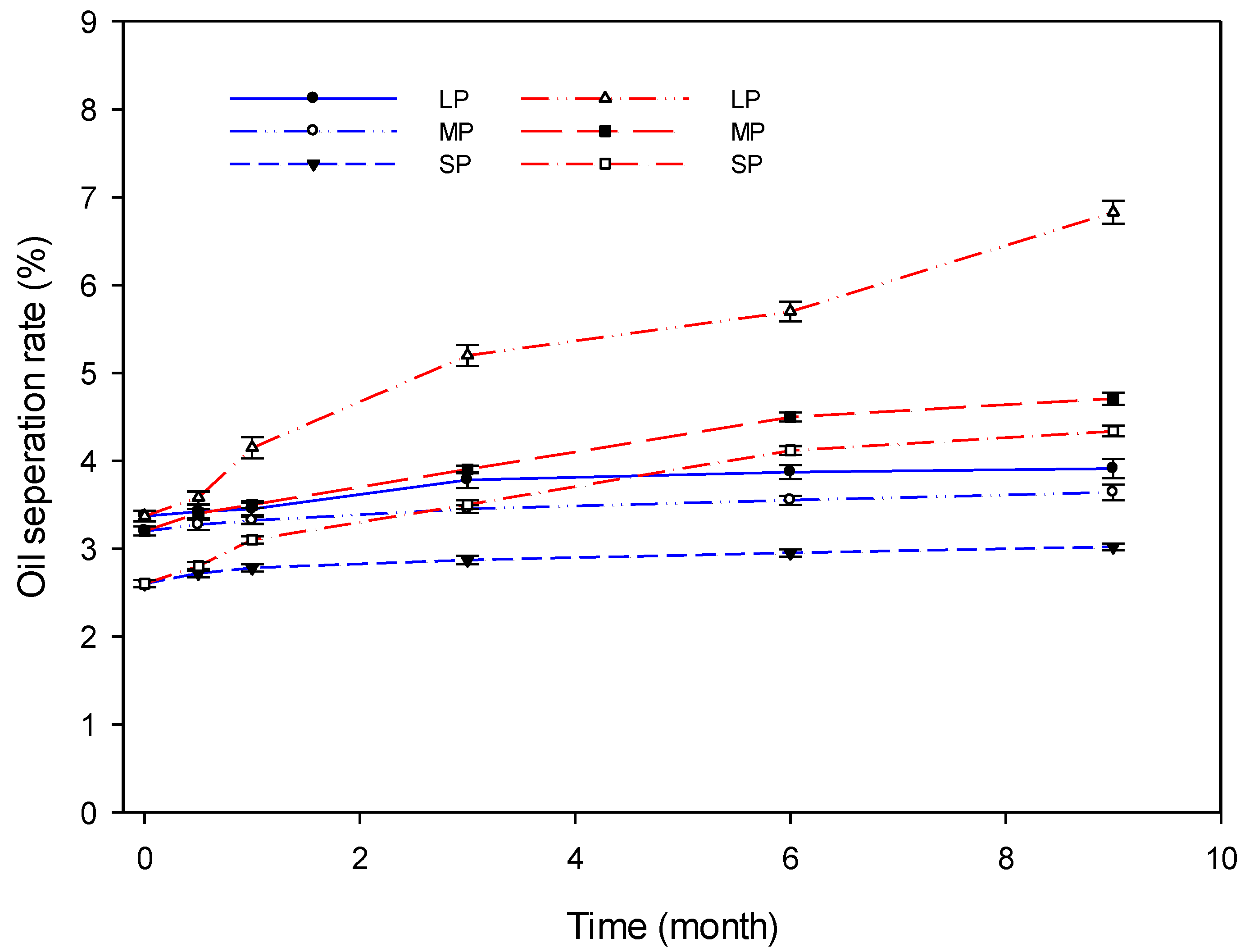
Figure 2.
Oil separation rates of pistachio spreads (milk fat based and sugar based) at 4 °C (blue lines) and 25 °C (red lines) (the length of the error bars is the standard error of the mean). .
Figure 2.
Oil separation rates of pistachio spreads (milk fat based and sugar based) at 4 °C (blue lines) and 25 °C (red lines) (the length of the error bars is the standard error of the mean). .
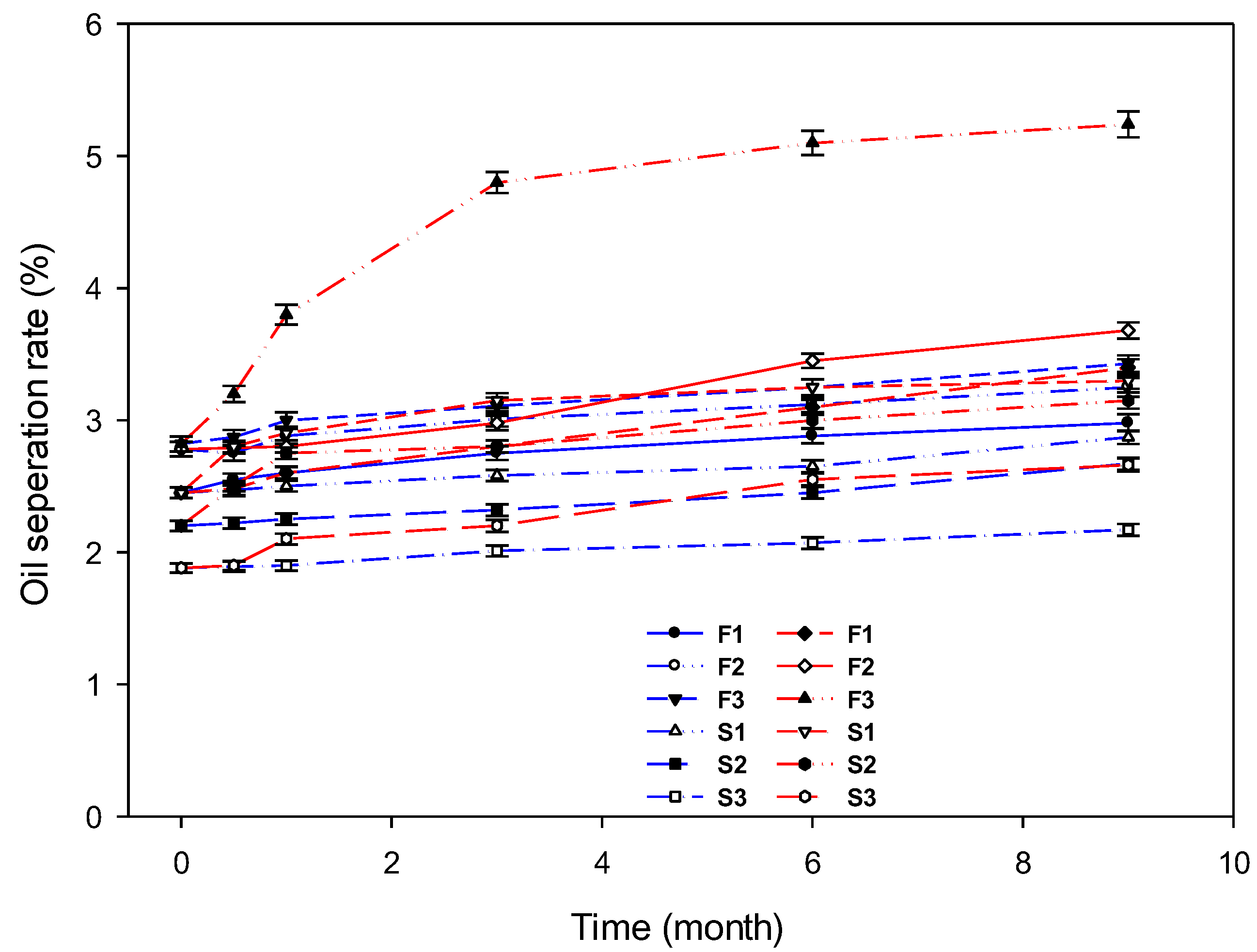
Figure 3.
Oil separation rates of pistachio spreads (sugar and milk fat based) at at 4 °C (blue lines) and 25 °C (red lines) (the length of the error bars is the standard error of the mean). .
Figure 3.
Oil separation rates of pistachio spreads (sugar and milk fat based) at at 4 °C (blue lines) and 25 °C (red lines) (the length of the error bars is the standard error of the mean). .
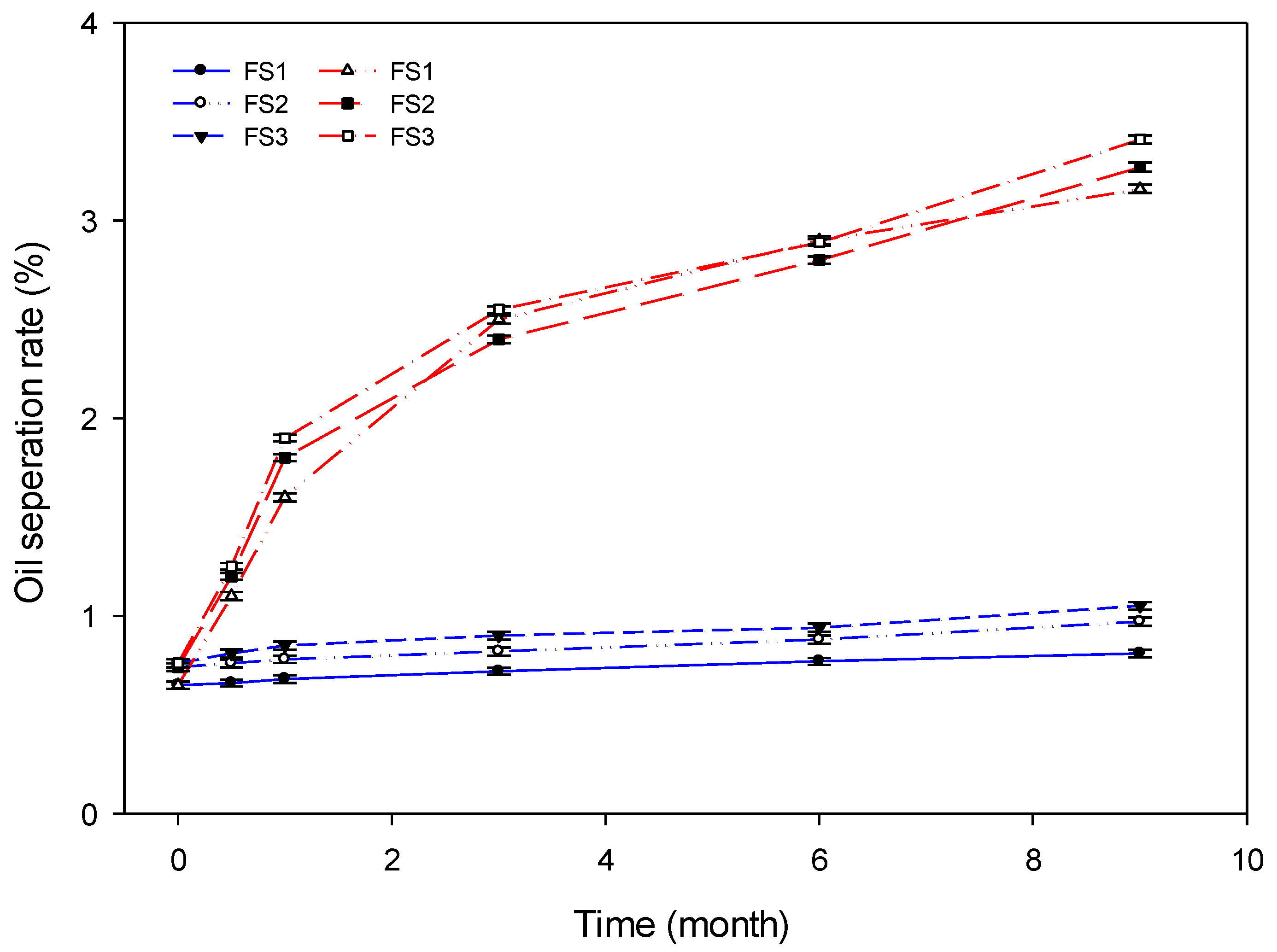
Figure 4.
Change in viscosity and shear stress with shear rate at 45 °C.
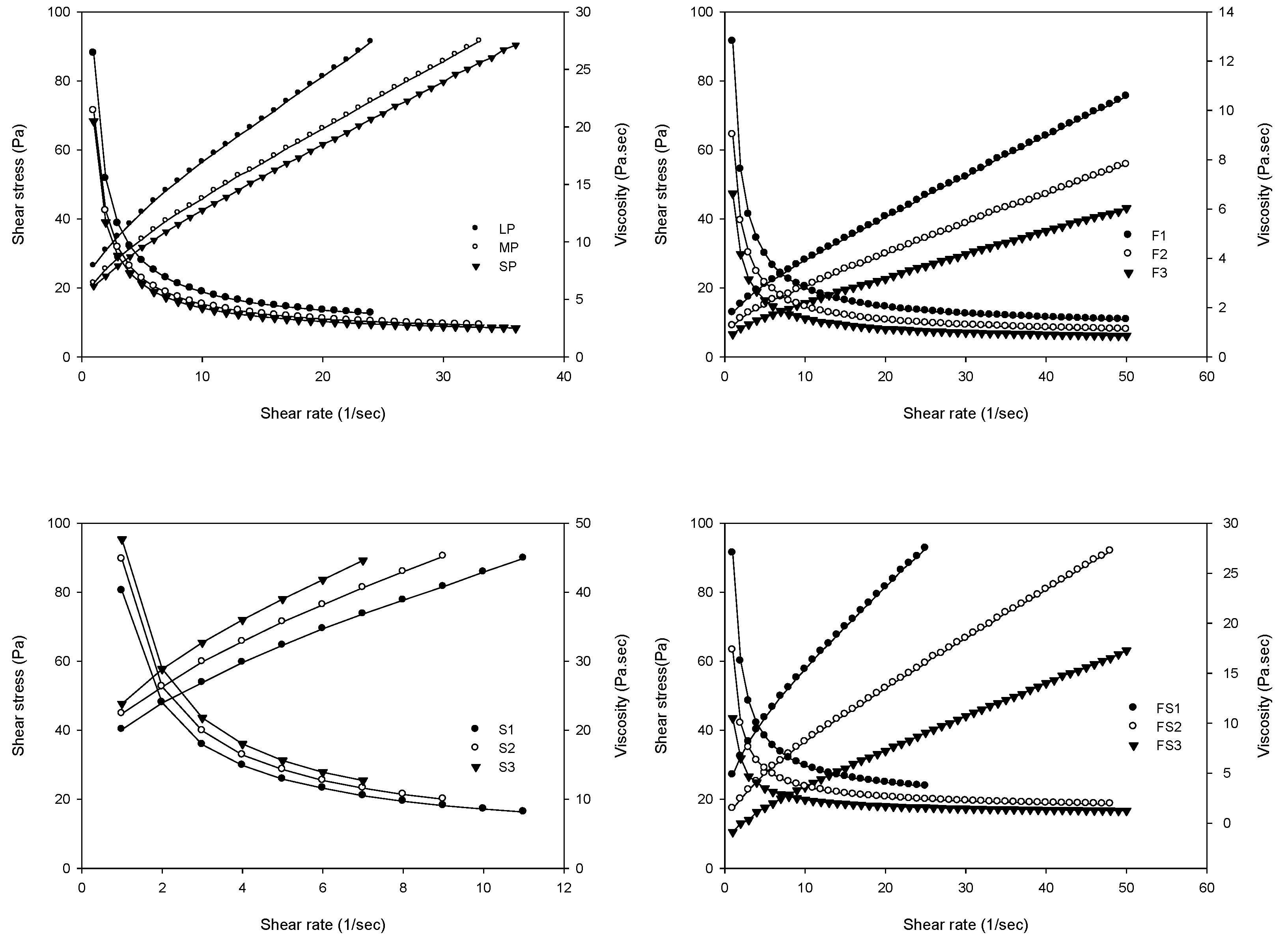
Figure 5.
Sensory results from analysis of pistachio spreads. Standard errors of means for each attribute are as follows: Color (0.17), flavor (0.12), adhesiveness to the spoon (0.19), spreadability (0.19), flowability (0.17), firmness (0.18), adhesiveness to the mouth (0.23), oily (0.12) and taste (0.16).
Figure 5.
Sensory results from analysis of pistachio spreads. Standard errors of means for each attribute are as follows: Color (0.17), flavor (0.12), adhesiveness to the spoon (0.19), spreadability (0.19), flowability (0.17), firmness (0.18), adhesiveness to the mouth (0.23), oily (0.12) and taste (0.16).
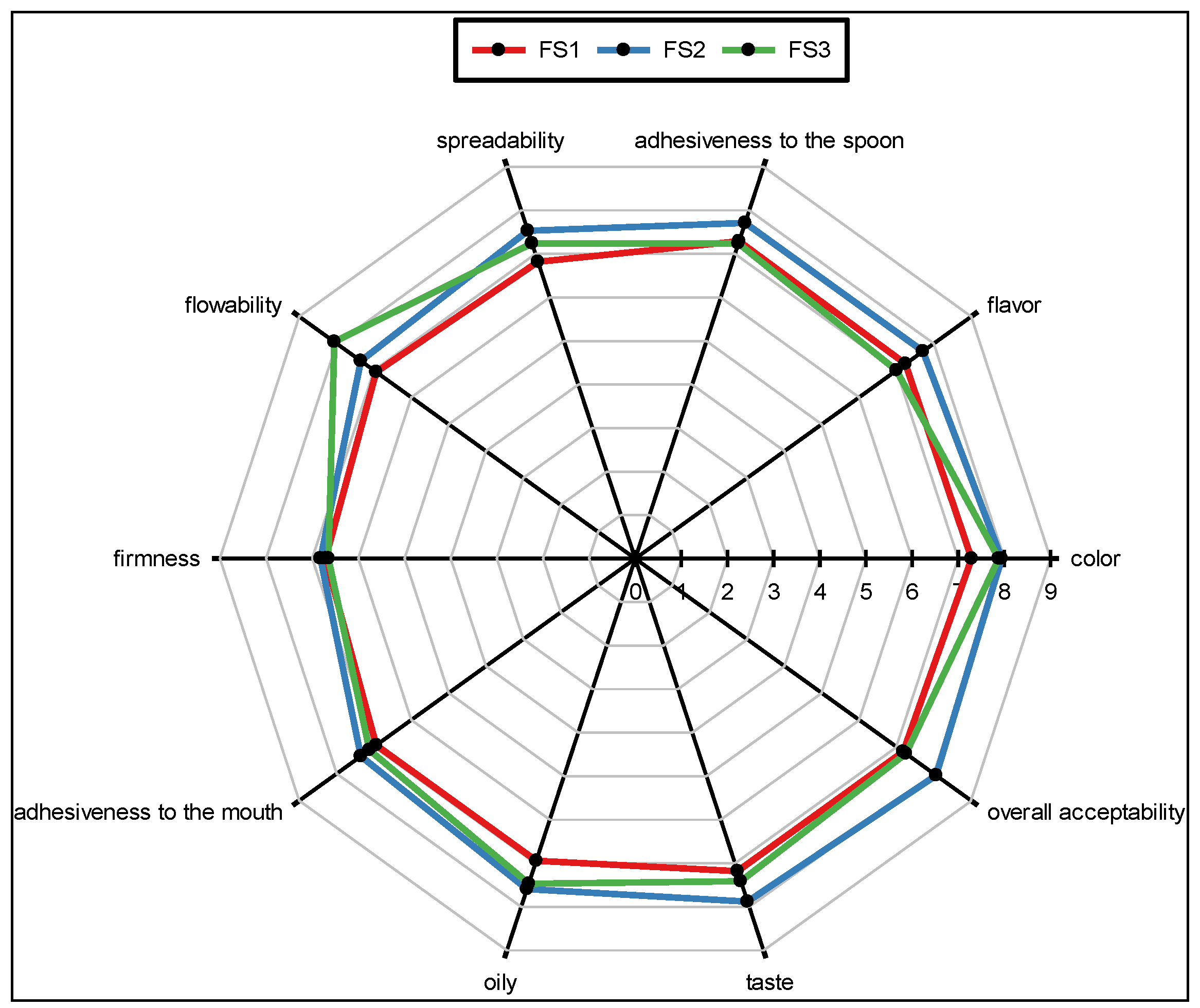
Table 1.
Formulations of pistachio spreads.
| Ingredients (%, w/w) | |||
| Formulation | Pistachio paste (SP) | Milk fat | Icing sugar |
| F1 | 96 | 4 | - |
| F2 | 93 | 7 | - |
| F3 | 90 | 10 | - |
| S1 | 76 | - | 24 |
| S2 | 73 | - | 27 |
| S3 | 70 | - | 30 |
| FS1 | 66 | 4 | 30 |
| FS2 | 66 | 7 | 27 |
| FS3 | 66 | 10 | 24 |
Table 2.
Sensory evaluation form. Please evaluate the given samples according to the characteristics described below and score them on a 9-point scale. (Scoring Scale: 9 = Excellent, 8 = Very good, 7 = Good, 6 = Fairly good, 5 = Moderate, 4 = Fairly poor, 3 = Poor, 2 = Very poor, 1 = Extremely poor).
Table 2.
Sensory evaluation form. Please evaluate the given samples according to the characteristics described below and score them on a 9-point scale. (Scoring Scale: 9 = Excellent, 8 = Very good, 7 = Good, 6 = Fairly good, 5 = Moderate, 4 = Fairly poor, 3 = Poor, 2 = Very poor, 1 = Extremely poor).
| Attribute | Definition of the Attribute | Evaluation of the attribute |
| Color | Evaluate the color of the product. | Look at the sample and evaluate the color of the sample |
| Flavor | Evaluate freshness, intensity, and the overall intensity of flavor perceived | Smell and taste the sample to assess the aroma strength, freshness, and characteristic pistachio flavor. |
| Adhesiveness to the spoon |
The property of the sample to stick to a surface | Insert a spoon into the sample and lift it slowly to measure stickiness. |
| Spreadability | Property of the sample to be spread over a surface | Using a spoon, spread the sample onto bread and evaluate its spreadability. |
| Flowability | Ability of the sample to flow or deform under its own weight | Place the spoon in the container and swirl several times to assess fluidity. |
| Firmness | Resistance of the sample to deformation under applied pressure | Place the sample in the mouth and evaluate the maximum force required to compress it. |
| Adhesiveness to the mouth |
The degree to which the sample sticks to oral surfaces, such as the palate or tongue | Press the sample against the palate with the tongue and evaluate the adhesiveness. |
| Oily | Perception of oil content and greasy mouth feel. | Place the sample in the mouth, swallow, and evaluate the perceived oiliness |
| Taste | Overall gustatory perception, including sweetness, balance, and aftertaste | Eat the sample and evaluate taste, balance, and aftertaste. |
| Overall Acceptability | Overall acceptability is a collective score indicating judges’ preferences based on sensory attributes | Evaluate the sample as a whole, taking into account all its attributes. |
Table 3.
Particle size of pistachio paste as a function of cumulative particle volume. (10%, 50%, and 90%)*.
Table 3.
Particle size of pistachio paste as a function of cumulative particle volume. (10%, 50%, and 90%)*.
| Sample | D10 (µm) | D50(µm) | D90 (µm) |
| LP | 5.72±0.06c | 16.71±0.12c | 434.80±9.30c |
| MP | 2.02±0.04b | 11.89±0.08b | 395.40±7.90b |
| SP | 1.88±0.03a | 7.18±0.07a | 149.78±4.60a |
Table 4.
Color values of pistachio pastes and spreads *.
| Sample | L* | a* | b* |
| LP | 44.34±0.02a | -3.82±0.05a | 45.86±0.05g |
| MP | 44.41±0.02b | -3.77±0.03ab | 44.91±0.06e |
| SP | 44.42±0.03b | -3.64±0.04cde | 44.55±0.05c |
| F1 | 44.76±0.02c | -3.53±0.07f | 44.21±0.06a |
| F2 | 44.91±0.04d | -3.56±0.08ef | 44.37±0.11b |
| F3 | 45.25±0.03e | -3.72±0.06bc | 44.77±0.09d |
| S1 | 46.79±0.02f | -3.57±0.03ef | 44.19±0.12a |
| S2 | 47.23±0.03g | -3.66±0.06cd | 44.28±0.09ab |
| S3 | 47.40±0.03h | 3.42±0.04g | 44.72±0.08d |
| FS1 | 48.11±0.03j | -3.61±0.02def | 44.73±0.03d |
| FS2 | 48.28±0.03k | -3.56±0.03ef | 44.64±0.05cd |
| FS3 | 48.02±0.04i | -3.59±0.02def | 45.10±0.06f |
Table 6.
Flow behavior parameters for pistachio spread (milk fat-based) according to the Herschel–Bulkley model*.
Table 6.
Flow behavior parameters for pistachio spread (milk fat-based) according to the Herschel–Bulkley model*.
| Sample | Temperature (ᵒC) |
τₒ (Pa) |
K |
n |
| F1 | 20 25 30 35 40 45 |
12.71±0.69b 12.57±0.20b 11.45±0.26a 11.25±0.21a 11.47±0.10a 11.52±0.20a |
6.05±0.01f 4.46±0.07e 3.65±0.06d 2.98±0.06c 2.45±0.02b 2.22±0.02a |
0.868±0.001b 0.884±0.004d 0.880±0.004cd 0.879±0.003c 0.878±0.002c 0.858±0.001a |
| F2 | 20 25 30 35 40 45 |
9.73±0.05c 9.06±0.20b 8.75±0.07b 8.92±0.40b 8.19±0.03a 8.24±0.05a |
4.76±0.05f 3.19±0.01e 2.46±0.03d 2.00±0.06c 1.86±0.01b 1.59±0.09a |
0.871±0.003b 0.893±0.001c 0.901±0.002d 0.900±0.006d 0.872±0.001b 0.852±0.005a |
| F3 | 20 25 30 35 40 45 |
10.51±0.16d 8.10±0.14c 6.41±0.02b 6.11±0.07a 6.11±0.02a 6.05±0.02a |
6.88±0.22e 2.73±0.11d 1.94±0.01c 1.69±0.02b 1.47±0.01a 1.33±0.02a |
0.801±0.007a 0.897±0.008e 0.896±0.002e 0.880±0.002d 0.867±0.002c 0.849±0.002b |
Table 5.
The regressed values of the Herschel–Bulkley model (Eq. 2) used to describe the flow curves of pistachio paste*.
Table 5.
The regressed values of the Herschel–Bulkley model (Eq. 2) used to describe the flow curves of pistachio paste*.
| Sample | Temperature (ᵒC) |
τₒ (Pa) |
K |
n |
| LP | 20 25 30 35 40 45 |
19.80±0.93a 20.64±0.56a 20.28±0.26a 20.40±0.11a 20.52±0.65a 21.03±0.57a |
15.70±0.70e 11.28±0.66d 9.28±0.10c 7.42±0.10b 6.50±0.27a 5.38±0.21a |
0.770±0.02a 0.809±0.06a 0.803±0.01a 0.812±0.01a 0.797±0.01a 0.783±0.01a |
| MP | 20 25 30 35 40 45 |
19.64±0.56c 18.07±0.83ab 17.35±0.40a 17.26±0.41a 17.39±0.10a 18.37±0.29b |
11.47±0.20f 8.91±0.29e 6.95±0.10d 5.65±0.10c 4.80±0.10b 4.14±0.15a |
0.823±0.01ab 0.825±0.01ab 0.835±0.01b 0.835±0.01b 0.828±0.01ab 0.820±0.01a |
| SP | 20 25 30 35 40 45 |
19.62±0.71b 17.13±0.82a 16.56±0.85a 16.25±0.68a 16.48±0.23a 17.48±0.12a |
9.76±0.64f 7.94±0.25e 6.18±0.13d 5.10±0.14c 4.20±0.10b 3.53±0.01a |
0.848±0.04a 0.837±0.01a 0.847±0.01a 0.844±0.01a 0.846±0.01a 0.844±0.01a |
Table 7.
Flow behavior parameters for pistachio spread (sugar-based), according to the Herschel–Bulkley model*.
Table 7.
Flow behavior parameters for pistachio spread (sugar-based), according to the Herschel–Bulkley model*.
| Sample | Temperature (ᵒC) |
τₒ (Pa) |
K |
n |
| S1 | 20 25 30 35 40 45 |
nd nd 26.94±0.86bc 25.22±0.05a 26.04±0.33ab 27.46±0.52c |
nd nd 17.28±0.73d 15.43±0.04c 13.90±0.25b 13.03±0.27a |
nd nd 0.710±0.015d 0.693±0.001c 0.674±0.003b 0.642±0.010a |
| S2 | 20 25 30 35 40 45 |
nd nd 28.48±0.20a 27.60±0.39a 27.70±0.30a 29.80±0.84b |
nd nd 20.01±0.50d 17.54±0.21c 15.88±0.29b 14.62±0.52a |
nd nd 0.689±0.014c 0.675±0.010bc 0.662±0.010ab 0.648±0.011a |
| S3 | 20 25 30 35 40 45 |
nd nd nd 24.20±0.33a 24.96±0.37a 27.82±0.82b |
nd nd nd 25.16±0.62c 22.58±0.35b 19.96±0.76a |
nd nd nd 0.581±0.010a 0.572±0.010a 0.581±0.019a |
Table 8.
Flow behavior parameters for pistachio spread (sugar and milk fat based) according to the Herschel-Bulkley model*.
Table 8.
Flow behavior parameters for pistachio spread (sugar and milk fat based) according to the Herschel-Bulkley model*.
| Sample | Temperature (ᵒC) |
τₒ (Pa) |
K |
n |
| FS1 | 20 25 30 35 40 45 |
16.48±0.03a 18.98±0.02b 19.17±0.38bc 19.68±0.16cd 19.82±0.11d 20.47±0.54e |
19.01±0.21f 12.96±0.20e 10.18±0.21d 8.37±0.17c 7.61±0.07b 7.20±0.32a |
0.692±0.004a 0.751±0.005cd 0.759±0.007d 0.763±0.006d 0.740±0.002c 0.715±0.011b |
| FS2 | 20 25 30 35 40 45 |
14.45±0.39b 14.20±0.10ab 13.91±0.13a 14.60±0.26bc 14.90±0.23cd 15.07±0.20d |
9.12±0.46e 7.06±0.05e 5.06±0.10d 4.02±0.05c 3.39±0.06b 3.16±0.04a |
0.811±0.012a 0.823±0.002a 0.838±0.009b 0.848±0.003b 0.845±0.004b 0.823±0.003a |
| FS3 | 20 25 30 35 40 45 |
16.78±0.41b 13.40±0.14b 9.52±0.20a 9.39±0.02a 9.30±0.02a 9.38±0.02a |
15.22±0.19f 6.16±0.05e 2.97±0.04d 2.48±0.02c 2.19±0.01b 2.03±0.04a |
0.716±0.007a 0.814±0.002b 0.879±0.020e 0.872±0.002e 0.858±0.002d 0.836±0.005c |
Table 9.
Arrhenius parameters of pistachio paste and spreads.
| Sample | Ea | ko | r2 | ||
| LP | 32.1 | 2.8*10-5 | 0.9866 | ||
| MP | 31.8 | 2.4*10-5 | 0.9926 | ||
| SP | 31.8 | 2.1*10-5 | 0.9986 | ||
| F1 | 27.5 | 6.4*10-5 | 0.9860 | ||
| F2 | 22.2 | 3.6*10-4 | 0.9714 | ||
| F3 | 20.4 | 5.9*10-4 | 0.9963 | ||
| S1 | 15.3 | 4.0*10-2 | 0.9891 | ||
| S2 | 18.4 | 2.6*10-2 | 0.9916 | ||
| S3 | 18.9 | 1.6*10-2 | 0.9978 | ||
| FS1 | 18.2 | 7.0*10-3 | 0.9336 | ||
| FS2 | 25.4 | 2.0*10-4 | 0.9569 | ||
| FS3 | 20.3 | 9.0*10-4 | 0.9720 | ||
Table 10.
Textural properties of pistachio paste and spread*.
| Samples | Firmness (N) | Spreadability (N s) | Adhesiveness (N s) |
| LP MP SP F1 F2 F3 S1 S2 S3 FS1 FS2 FS3 |
2.69±0.04f 2.68±0.04f 2.36±0.03e 1.79±0.02d 1.35±0.02b 1.02±0.02a 5.05±0.06h 5.10±0.06h 5.33±0.05i 3.66±0.04g 2.39±0.03e 1.65±0.03c |
1.589±0.021f 1.568±0.019f 1.432±0.018e 1.064±0.017d 0.830±0.015b 0.630±0.012a 2.995±0.032h 3.014±0.041h 3.192±0.040i 2.143±0.028g 1.426±0.017e 0.970±0.016c |
-0.667±0.012g -0.631±0.011f -0.538±0.009e -0.401±0.008d -0.296±0.004b -0.224±0.004a -1.272±0.012j -1.212±0.011i -1.300±0.014k -0.796±0.010h -0.544±0.008e -0.352±0.004c |
Disclaimer/Publisher’s Note: The statements, opinions and data contained in all publications are solely those of the individual author(s) and contributor(s) and not of MDPI and/or the editor(s). MDPI and/or the editor(s) disclaim responsibility for any injury to people or property resulting from any ideas, methods, instructions or products referred to in the content. |
© 2025 by the authors. Licensee MDPI, Basel, Switzerland. This article is an open access article distributed under the terms and conditions of the Creative Commons Attribution (CC BY) license (http://creativecommons.org/licenses/by/4.0/).
Copyright: This open access article is published under a Creative Commons CC BY 4.0 license, which permit the free download, distribution, and reuse, provided that the author and preprint are cited in any reuse.


