

Submitted:
21 October 2025
Posted:
22 October 2025
You are already at the latest version
Abstract
Mathematical Knowledge for Teaching (MKT) has emerged as a critical construct in mathematics education research, recognized as a strong predictor of students’ mathematical achievement. This study aims to examine the dimensions of MKT among preservice elementary teachers in Indonesia, focusing on their readiness and competence in both content and pedagogy. Using a teacher-made instrument specifically designed to assess MKT, data were gathered from preservice teachers enrolled in teacher education programs. The instrument measured four key domains: Common Content Knowledge (CCK), Specialized Content Knowledge (SCK), Knowledge of Content and Students (KCS), and Knowledge of Content and Teaching (KCT). The findings revealed that preservice teachers demonstrated generally low proficiency across all MKT domains. Their limited performance in both content and pedagogical aspects suggests that they are not yet adequately prepared to teach elementary mathematics effectively. Among the four domains, the lowest scores were observed in SCK and KCT, highlighting weaknesses in linking mathematical concepts with instructional strategies and student thinking. This indicates a pressing need for teacher education programs to provide more comprehensive and integrated coursework that explicitly develops both content and pedagogical knowledge. Moreover, the study underscores the importance of reforming mathematics teacher education curricula in Indonesia to better align theoretical understanding with practical classroom applications. Strengthening preservice teachers’ exposure to real teaching scenarios, problem-based learning, and reflective practices may enhance their MKT and overall teaching readiness. The results contribute to the growing international discourse on teacher knowledge, emphasizing that improving preservice teachers’ mathematical understanding is vital for achieving high-quality mathematics instruction in schools. In conclusion, this study highlights a significant gap between the current level of mathematical knowledge among preservice teachers and the competencies required for effective mathematics teaching. It calls for a strategic redesign of teacher education programs that prioritize the deep integration of mathematical content, pedagogical reasoning, and contextualized teaching experiences.
Keywords:
elementary mathematics
; mathematical knowledge for teaching
; pedagogical content knowledge
; pre-service teachers
; subject matter knowledge
1. Introduction
Mathematics education plays a crucial role in developing analytical thinking, logical reasoning, and problem-solving skills that serve as the foundation for students’ success in various disciplines. However, in Indonesia, concerns about the effectiveness and quality of mathematics instruction have been growing in recent years. Despite numerous curriculum reforms and investments in teacher training, many students continue to struggle with mathematical concepts, particularly in problem-solving and higher-order thinking. Several studies attribute this issue not only to the difficulty of the subject but also to the inadequate preparation of teachers in both mathematical content and pedagogy. As future educators, preservice teachers are expected to possess a solid understanding of mathematical knowledge for teaching, as it directly influences the learning outcomes of their future students. The examination of preservice teachers’ readiness, therefore, becomes essential in identifying gaps in teacher education programs and ensuring the production of competent mathematics educators at the elementary level.
Moreover, teacher knowledge has long been recognized as a significant factor in determining the quality of mathematics education. The framework of Mathematical Knowledge for Teaching (MKT) emphasizes the integration of content knowledge and pedagogical understanding necessary for effective instruction. Yet, in Indonesia, there remains limited empirical evidence on how well preservice teachers acquire and apply this specialized knowledge during their preparation. Addressing this gap is critical, as inadequate mastery of mathematical concepts and pedagogical approaches may lead to the perpetuation of misconceptions and poor instructional practices in classrooms. Thus, assessing the dimensions of MKT among preservice elementary teachers provides valuable insight into the current state of teacher preparation and highlights the areas needing improvement to meet both national and international education standards.
Mathematics education is fundamental in shaping students’ analytical reasoning, logical thinking, and problem-solving abilities—competencies essential for lifelong learning and national development. Yet in Indonesia, persistent concerns remain about the overall quality of mathematics instruction. Despite curricular reforms and initiatives to improve teacher education, students’ performance in mathematics continues to lag behind regional and international standards. A key factor contributing to this situation is the insufficient mastery of both content and pedagogy among preservice and in-service teachers. Effective teaching requires more than procedural fluency; it demands a deep conceptual understanding of mathematical ideas and the ability to connect them with appropriate instructional strategies. Therefore, assessing how well preservice teachers are prepared in these areas is crucial to strengthening the mathematics education system and improving student outcomes at the elementary level.
Teacher competence has consistently been identified as one of the strongest predictors of student achievement. Within this context, the concept of Mathematical Knowledge for Teaching (MKT) provides a comprehensive framework for understanding the specialized knowledge teachers need to teach mathematics effectively. However, in Indonesia, empirical studies exploring the extent to which preservice teachers possess this knowledge are still limited. Many teacher education programs tend to emphasize theoretical coursework without adequately integrating practical experiences that develop pedagogical content knowledge. This imbalance may result in teachers who know mathematics but struggle to translate that knowledge into meaningful classroom instruction. Investigating the dimensions of MKT among preservice elementary teachers is therefore essential to reveal existing gaps and to inform policy reforms that align teacher education programs with both national curriculum goals and international standards.
The current state of mathematics education in the country both in the basic education and tertiary levels is very problematic as shown in the results of international and national examinations such as the Trends in International Mathematics and Science Study (TIMSS), Teacher Education and Development Study: Learning to Teach Mathematics (TEDS-M, and the Indonesia National Achievement Test (NAT). TIMMS (2023) reveal that grade four pupils and second-year high school students got overall achievement rates of 358 and 378 in Mathematics, respectively. These overall achievement rates fall below the international benchmark of 400 set by TIMMS. Similarly, in the TIMMS - Advanced (2022) which was participated in by students taking special science curriculum, the Indonesias ranked last, with an average scale score of 355 out of ten participating countries. The overall average percent correct in the advanced mathematics content areas and cognitive domains obtained by Filipino students is 24, also the lowest among the ten countries who participated in the assessment. In general, out of the 4.901 students who took the test, only 1% of the students reached the advanced benchmark, 4% reached the high benchmark and 13% to the intermediate benchmark (Ogena, et al. 2020). It worth mentioning that the performance of students coming from the Indonesia Science High School system in terms of overall average percent correct in the content areas in Algebra, Calculus and Geometry and knowing, applying and reasoning domains is comparable to the performance of students from the three top performing countries, the Russian Federation, the Netherlands and Lebanon. Likewise, initial results from Teacher Education and Development Study: Learning to Teach Mathematics (TEDS-M, 2022), show that the overall mean performance of Filipino pre- service primary teachers on mathematical content knowledge and pedagogical content knowledge were 440 and 457, respectively. These results are also way below the highest scoring countries, Taiwan and Singapore, which posted an overall mean achievement of 623 and 593, respectively. The National Achievement Test (NAT) results in mathematics for SY 2024-2025 show a mean percentage score (MPS) of 66.79% and 46.37% for grade six and fourth-year high school examinees respectively. These results are behind the target of 75% MPS set in the 2024 Indonesia Development Plan especially for the fourth-year examinees.
Research findings show that the inadequacy of teachers' knowledge of mathematics and how they teach it is one of the major reasons why students are not learning the mathematics they are supposed to learn in school (Mewborn, 2023; Ball, 2020; Ball, Hill & Bass, 2025; Hill, Rowan & Ball, 2019; Mapolelo & Akinsola, 2018). A report from the Teacher Professional Development: A Primer for Parents and Community Members (2022), states that quality teachers are the most significant determinant of student achievement. Ma (2019), in her book Knowing and Teaching Elementary Mathematics, stated that teachers of mathematics, especially those who teach at the elementary level, generally do not possess the knowledge necessary to help empower future generations of adults mathematically. She calls this as the "vicious cycle" formed by low-quality mathematics education and low- quality teacher knowledge of school mathematics" (p. 149). Moreover, in a Discussion Paper Series No. 2022-16 entitled “Measures for Assessing Basic Education in the Indonesias,” Maligalig and Albert stressed that the low achievement rates for both elementary and secondary schools in the Indonesias are indicative of the low quality of elementary and secondary education. They further argued that a contributing factor to the low quality is the lack of competent teachers who are the primary resource for elementary and secondary students instead of books and other learning materials.
Research consistently underscores that teachers’ inadequate understanding of mathematics and ineffective instructional practices are among the primary reasons students fail to achieve the expected learning outcomes in mathematics (Mewborn, 2023; Ball, 2020; Ball, Hill, & Bass, 2025; Hill, Rowan, & Ball, 2019; Mapolelo & Akinsola, 2018). When teachers themselves struggle with mathematical concepts or rely heavily on procedural teaching, students are less likely to develop conceptual understanding and critical thinking skills. This lack of depth in mathematical comprehension ultimately affects students’ performance in both national and international assessments.
According to the Teacher Professional Development: A Primer for Parents and Community Members (2022), teacher quality remains the single most significant determinant of student achievement. Regardless of socioeconomic or school-related factors, the effectiveness of teaching largely depends on the teacher’s mastery of content knowledge and the ability to translate it into meaningful learning experiences. This implies that investment in teacher education and continuous professional development is central to improving the overall quality of mathematics education.
Ma (2019), in her influential work Knowing and Teaching Elementary Mathematics, emphasizes that elementary mathematics teachers often lack the depth of understanding required to effectively teach mathematical concepts to young learners. She describes this phenomenon as a “vicious cycle,” wherein low-quality mathematics instruction perpetuates low levels of teacher knowledge across generations. This cycle continues unless deliberate and systematic interventions are made to strengthen teachers’ content and pedagogical competencies.
The “vicious cycle” described by Ma highlights a deeper structural issue within teacher education programs. Many preservice teachers enter the profession with weak foundations in mathematics, and teacher training institutions often fail to address these deficiencies. As a result, graduates enter the classroom insufficiently equipped to design lessons that foster reasoning, problem-solving, and conceptual understanding. This situation is particularly concerning in Indonesia, where curriculum demands have become more complex while teacher preparation remains uneven.
Furthermore, the Discussion Paper Series No. 2022-16: Measures for Assessing Basic Education in Indonesia by Maligalig and Albert reveals that low achievement rates at both the elementary and secondary levels reflect the broader issue of educational quality. The authors argue that the lack of competent teachers is a central contributing factor to this problem. In many cases, teachers become the primary learning resource for students, especially in schools where access to textbooks and technology is limited. Hence, their competence directly determines students’ exposure to and mastery of mathematical ideas.
The reliance on teachers as the main instructional resource in many Indonesian classrooms places even greater emphasis on their professional competence. Without sufficient content mastery and pedagogical flexibility, teachers may struggle to adapt instruction to diverse learner needs. This situation leads to rote learning, limited problem-solving engagement, and a lack of deeper mathematical reasoning among students. The issue underscores the urgent need for systemic reform in teacher education, focusing on enhancing both theoretical and applied dimensions of mathematical knowledge for teaching.
In light of these findings, it becomes evident that improving the quality of mathematics education in Indonesia requires a dual approach—strengthening preservice teacher preparation and ensuring sustained professional development for in-service teachers. Universities and teacher training institutions must integrate rigorous mathematical content with pedagogical innovation, supported by mentoring and reflective teaching practices. By doing so, Indonesia can begin to break the “vicious cycle” of weak mathematical instruction and create a generation of teachers capable of fostering mathematical literacy, creativity, and problem-solving competence among future learners.
What types of mathematical knowledge should teachers have to be able to teach the subject proficiently and efficiently is a fundamental question that is currently being explored by researchers and mathematics educators worldwide. Traditionally, it is assumed that to teach successfully, teachers need to have a firm knowledge base of the mathematics content they teach be it in the elementary, secondary or tertiary level. Such content knowledge is gained through the formal study of the different content subjects pre-service teachers take to complete the academic requirements prescribed in the teacher education curriculum. This knowledge can be acquired through reading textbooks, taking notes, observing teachers’ demonstrations, listening to teachers’ explanations, and completing practice problems (Walters, 2009). However, teachers do not only need subject matter knowledge to be able to teach the subject effectively. They also need another kind of knowledge that will enable them to provide students with explanations as to why a procedure works, to analyze and correct student errors and misconceptions and to use appropriate examples for representing mathematical concepts, etc. Such knowledge is what Shulman (1986) calls as pedagogical content knowledge. Ma (2019) describes this knowledge as the flexibility in grasping multiple perspectives and understanding the connection of ideas. She further stresses that it is essential that teachers should have a profound understanding of fundamental mathematics (PUFM) to be able to teach it. Hill et al., (2025) call this knowledge, mathematical knowledge for teaching mathematics (MKT).
The question of what mathematical knowledge teachers need to teach effectively transcends mere curriculum design—it strikes at the heart of pedagogical professionalism and student learning outcomes. Historically, teacher preparation systems worldwide operated under the assumption that mastery of advanced mathematical content—acquired through university-level courses in calculus, algebra, or analysis—was sufficient to ensure teaching competence. This belief, rooted in a transmission model of education, presumed that knowledge flows unidirectionally from expert to novice, with the teacher’s role limited to accurate delivery. However, decades of classroom research have dismantled this notion, revealing that effective mathematics teaching demands far more than disciplinary expertise. Teachers must navigate the complex terrain between abstract mathematical truth and the developmental realities of young learners, a task that requires specialized forms of knowledge not typically cultivated in standard mathematics departments. This realization has catalyzed a paradigm shift in teacher education, moving from a focus on what teachers know to how they use that knowledge in practice. The work of Lee Shulman (1986) was pivotal in this transformation, as he identified pedagogical content knowledge (PCK) as the “signature pedagogy” of teaching—a unique blend of subject matter and pedagogy that distinguishes expert teachers from subject-matter experts. Consequently, contemporary frameworks now treat teaching not as applied scholarship, but as a distinct profession with its own knowledge base. This reconceptualization has profound implications for how we design teacher preparation programs, assess teacher readiness, and support professional growth. Without this shift, efforts to improve mathematics education will continue to founder on the gap between content knowledge and classroom practice.
Shulman’s (1986) introduction of pedagogical content knowledge (PCK) marked a watershed moment in educational theory, challenging the binary separation of “content” and “method” that had long dominated teacher education. PCK, he argued, is not simply the sum of subject matter knowledge and general pedagogical knowledge, but a transformative synthesis that enables teachers to represent ideas in ways that make them comprehensible, anticipate student difficulties, and adapt instruction to diverse learners. For example, knowing that a ÷ b = a × 1/b is a matter of subject knowledge; knowing how to use a pizza-sharing scenario to help a Grade 5 student grasp why this works—and why it fails when applied to subtraction—is PCK. This distinction is critical because it explains why mathematicians, despite deep content expertise, often struggle to teach elementary concepts effectively. PCK is inherently contextual, practical, and student-centered; it emerges from repeated engagement with the act of teaching, not from passive study. In mathematics, where concepts are tightly interconnected and misconceptions can cascade, PCK becomes indispensable for diagnosing errors and scaffolding understanding. Unfortunately, many teacher education programs still treat PCK as an afterthought, relegating it to generic “methods” courses that lack mathematical specificity. To cultivate PCK, PSTs need sustained opportunities to analyze student work, design representations, and reflect on instructional decisions—all grounded in real mathematical content. Without such experiences, PCK remains underdeveloped, regardless of how strong a teacher’s SMK may be.
Liping Ma’s (2019) concept of Profound Understanding of Fundamental Mathematics (PUFM) further deepened the discourse by shifting attention from advanced topics to the depth of understanding in elementary mathematics. Ma’s comparative study of Chinese and U.S. teachers revealed that effective elementary teachers possess not just procedural fluency, but a coherent, interconnected grasp of foundational concepts—such as place value, fractions, and operations—that allows them to explain ideas from multiple perspectives, justify procedures, and connect topics across the curriculum. PUFM is characterized by four key qualities: basic ideas (understanding core principles), connectedness (seeing relationships between concepts), multiple perspectives (solving problems in varied ways), and longitudinal coherence (knowing how ideas develop over time). Crucially, Ma demonstrated that PUFM is not about knowing more mathematics, but about knowing elementary mathematics more deeply—a distinction often lost in systems that prioritize calculus over number sense. In Indonesia, where PSTs take 18 credit units of advanced mathematics largely irrelevant to primary teaching, this insight is particularly urgent. A teacher who can solve differential equations but cannot explain why 1/2 ÷ 1/4 = 2 lacks the very knowledge that matters most in the classroom. PUFM thus reframes the goal of teacher education: not to produce amateur mathematicians, but to develop expert teachers of fundamental mathematics. This requires curricula that prioritize depth over breadth and coherence over coverage.
Building on Shulman and Ma, Ball, Thames, and Phelps (2024) operationalized these ideas into the Mathematical Knowledge for Teaching (MKT) framework—a comprehensive, empirically grounded model that has become the gold standard in mathematics education research. MKT distinguishes between Common Content Knowledge (CCK)—mathematical knowledge used in everyday life or other professions—and Specialized Content Knowledge (SCK)—knowledge unique to teaching, such as choosing examples, evaluating student strategies, or explaining why a procedure works. It also includes two pedagogical domains: Knowledge of Content and Students (KCS)—understanding how students think about and learn specific concepts—and Knowledge of Content and Teaching (KCT)—knowing how to sequence tasks, select representations, and manage discourse. This granular taxonomy allows researchers to diagnose precisely where PSTs struggle, as seen in studies where PSTs perform adequately on CCK items but falter on SCK or KCT tasks. The MKT framework has been validated across diverse cultural contexts, confirming that the specialized knowledge of teaching is universal, even if its manifestations vary. In Indonesia, applying MKT reveals that PSTs may solve fraction problems correctly (CCK) but cannot design a word problem for division of fractions (KCT)—a gap with direct consequences for student learning. By making the invisible work of teaching visible, MKT provides a roadmap for targeted curriculum reform and professional development.
The evolution from SMK to MKT reflects a broader epistemological shift in how we understand professional knowledge. Teaching is no longer seen as the application of theoretical knowledge to practice, but as a site of knowledge generation in its own right. This “practice-based” view recognizes that the knowledge needed to teach fractions effectively is not found in mathematics textbooks or pedagogy manuals alone, but in the dynamic interplay between content, students, tasks, and classroom context. Consequently, teacher education must move beyond the “two-course model” (content courses + methods courses) toward integrated experiences where PSTs learn mathematics through the lens of teaching. For instance, a lesson on prime numbers should not only prove the infinitude of primes but also explore how to introduce the concept using arrays, factor trees, or culturally relevant patterns (e.g., Mandailing weaving motifs). Such integration transforms abstract knowledge into usable knowledge—knowledge that can be enacted in real classrooms with real students. Without it, PSTs graduate with fragmented repertoires: they may know mathematics, but not how to make it learnable. This is especially critical in Indonesia, where Kurikulum Merdeka emphasizes student-centered, conceptual learning, yet PSTs report feeling unprepared to implement it. The MKT framework thus offers not just a diagnostic tool, but a design principle for 21st-century teacher education.
Empirical studies consistently show that teachers’ MKT is a strong predictor of student achievement in mathematics, even after controlling for socioeconomic factors. Hill, Rowan, and Ball (2005) found that a one-standard-deviation increase in teachers’ MKT was associated with a 2–3 month gain in student learning—a finding replicated across multiple countries. This impact occurs because MKT enables teachers to do the “invisible work” of teaching: noticing subtle errors, asking probing questions, and adapting instruction in real time. For example, a teacher with strong KCS might recognize that a student’s error in comparing fractions stems from overgeneralizing whole-number logic, and respond with a targeted visual model rather than re-teaching the algorithm. In contrast, a teacher with only SMK might mark the answer wrong and move on, missing a critical learning opportunity. The moderate correlation (r = 0.307) between SMK and PCK found in Indonesian PSTs underscores that this expertise does not emerge automatically—it must be deliberately cultivated. This has direct policy implications: if student learning is the goal, then investing in teachers’ MKT is not a luxury, but a necessity. Professional development, certification standards, and university curricula must all prioritize MKT as a core outcome.
In the Indonesian context, the gap between SMK and MKT is exacerbated by structural features of teacher education. PSTs complete 18 credit units of advanced mathematics (e.g., calculus, linear algebra) that bear little resemblance to the Grade 1–6 curriculum, alongside 54 units of professional education that often lack mathematical specificity. As a result, they graduate with “high-level” knowledge that cannot be “lowered” to the elementary level—a phenomenon Ball et al. (2024) call “unusable knowledge.” Moreover, only one of the 18 mathematics courses directly addresses elementary content, and none explicitly develop SCK, KCS, or KCT. This curricular misalignment explains why PSTs struggle with items like “choosing an appropriate example for dividing fractions” (answered correctly by only 6% in one study). The problem is not lack of intelligence or effort, but lack of opportunity to learn the right kind of knowledge. Reforming this system requires more than adding a “methods” course; it demands a fundamental rethinking of what counts as essential knowledge for elementary teachers. Universities must collaborate with schools to co-design courses that use real classroom artifacts—student work, lesson videos, curriculum materials—as the basis for learning. Only then can PSTs develop the MKT needed to implement Kurikulum Merdeka effectively.
Digital technologies and AI-enhanced tools offer promising avenues for bridging the SMK–MKT gap, particularly in resource-constrained settings like rural Indonesia. Platforms such as GeoGebra, when integrated into a Project-Based Learning (PjBL) model, allow PSTs to experiment with dynamic representations of mathematical concepts—visualizing fraction division, exploring prime factorization, or modeling proportional reasoning in real time. These tools can simulate classroom scenarios, enabling PSTs to test different examples, observe virtual student responses, and reflect on pedagogical choices without real-world consequences. Moreover, AI-driven feedback systems can provide personalized guidance on PCK development, such as suggesting alternative representations or flagging potential misconceptions in a PST’s explanation. In community initiatives like “Generasi Mandailing Natal Bersinar,” such technologies can democratize access to high-quality MKT development, even where expert mentors are scarce. However, technology alone is insufficient; it must be embedded in a pedagogical framework that emphasizes reflection, collaboration, and connection to local contexts. When used thoughtfully, digital tools can transform teacher education from passive knowledge transmission to active knowledge construction.
Cultural and linguistic factors further complicate the development of MKT in multilingual societies like Indonesia. Many PSTs in regions such as Mandailing Natal must translate mathematical concepts into local languages that may lack precise terms for ideas like “fraction” or “prime number.” This requires not just linguistic skill, but deep conceptual understanding to construct analogies that resonate with students’ lived experiences—such as using rice portions, cloth weaving, or traditional games to illustrate mathematical relationships. A PST with strong SMK but weak cultural fluency may choose examples that confuse rather than clarify, while one with strong MKT can bridge this gap. This dimension of teaching—often overlooked in Western frameworks—is essential for equitable mathematics education in diverse classrooms. Teacher education programs must therefore incorporate ethnomathematics and culturally responsive pedagogy into MKT development, helping PSTs see local knowledge systems as resources, not obstacles. By validating students’ cultural identities while building mathematical understanding, teachers can foster both engagement and achievement. This approach aligns with global calls for decolonizing mathematics education and centering local epistemologies.
The question of what mathematical knowledge teachers need has evolved from a narrow focus on content mastery to a rich, multidimensional understanding centered on Mathematical Knowledge for Teaching (MKT). Effective teaching requires not just knowing mathematics, but knowing how to unpack it, represent it, connect it, and make it accessible to diverse learners. This specialized knowledge—encompassing SCK, KCS, and KCT—is not acquired incidentally but must be deliberately cultivated through integrated, practice-based teacher education. In Indonesia and similar contexts, closing the MKT gap demands systemic reform: revising curricula to prioritize elementary mathematics, redesigning assessments to value pedagogical reasoning, and leveraging technology and community partnerships to support learning. The ultimate goal is not to produce teachers who can solve advanced problems, but those who can nurture mathematical thinking in every child—regardless of background, language, or prior achievement. As global education systems increasingly emphasize critical thinking and problem-solving, the need for MKT-proficient teachers has never been greater. Investing in this knowledge is not merely an educational imperative; it is a social and economic necessity for building equitable, innovative societies.
Recent developments in the field of teaching and learning mathematics saw the emergence and conceptualization of a framework for teaching mathematics called mathematical knowledge for teaching (MKT). Thames, et al. (2019) define MKT as the “mathematical knowledge needed to perform the recurrent tasks of teaching mathematics to students.” Currently the MKT framework is categorized into two major categories, namely; subject matter content knowledge and pedagogical content knowledge. Under the subject matter knowledge domain are common content knowledge (CCK) - the mathematical knowledge and skill used in settings other than teaching and specialized content knowledge (SCK) - the knowledge and expertise unique to teaching. Pedagogical content knowledge (PCK) includes knowledge of content and students (KCS) which is the knowledge that combines knowing about students and knowing about mathematics and knowledge of content and teaching (KCT) which combines knowing about teaching and knowing about mathematics (Ball et al., 2017).
With the emergence of a new conception of the content knowledge that teachers need to know to be able to teach mathematics comes the problem on how this knowledge will be measured. Previous researches on teachers’ knowledge show that teachers’ effectiveness was evaluated through proxy variables such as educational qualification, certification status, number of mathematics and methods courses taken in college, years of teaching experience and number of trainings attended, self-report of what they do in their classrooms, principal and students’ evaluations, classroom observation reports, analyses of videotaped lesson and giving examination on content to both teacher and student, etc. However, according to Ball et al. (2019), most of these types of assessment do not capture the mathematical knowledge and reasoning needed to perform the task of teaching. In the Indonesias, researchers still use proxy variables in assessing mathematical knowledge for teaching. For instance, Sogillo et al. (2024) evaluated the quality of mathematics teachers in a public school and a private school, measured teacher quality by asking the teachers themselves the frequency of practicing in their classes the teaching methods/approaches outlined in a 50-item questionnaire. Agsaluad, (2017) also measured teacher quality by asking students to rate their teachers using the NBC No. 461 teaching effectiveness instrument. Both studies concluded that their respondents are highly effective teachers. However, conclusions derived from self-report and students’ perceptions seem not to be valid because the instruments used did not capture the work of teaching as describe by Ball and colleagues.
After a thorough review of literature, Hill, et al. (2019) felt the need to map out differing views and conceptions held by teaching experts and researchers about mathematical knowledge for teaching and how it should be measured especially on large scale population. Guided by the questions, “What mathematical knowledge is needed to help students learn mathematics?” and “Can we construct reliable measures that accurately represent teachers’ ability in these areas?”, they developed a survey consisting of multiple-choice items intended to measure mathematical knowledge and skills needed for teaching elementary mathematics. Exploratory factor analyses were conducted in order to find underlying dimensions represented by the items in the survey and item response theory (IRT) one-parameter model was employed to establish the reliabilities of the item. The authors reported that MKT is partly domain-specific, rather than just related to overall intelligence, mathematical or teaching ability. Content areas covered by the measure are numbers and operations, geometry, patterns and functions, and algebra. In 2022, sample items of the MKT measure were released.
Since its release, studies conducted using the MKT instrument, generally fall into adaptation and validation done in other countries for both in-service and pre-service teachers or as a material for professional development of teachers.
Using a mixed method design of data collection, Jóhannsdóttir (2023), investigated the level of elementary mathematical content knowledge for teaching of 38 pre-service teachers at the School of Education, University of Iceland. Adapted items from the MKT released item 2022 were used to collect data on the MKT levels of the participants. Interviews were also conducted to 10 respondents in order to elicit how they think during a problem solving activity and how they explain their solutions. Findings of the study indicated that prospective teachers’ common content knowledge was procedural. They can solve mathematical problems, however, they could not explain underlying reasons for their solutions. Item difficulty analysis using an item response theory model was used to identify which items were found easy or difficult by the participants. Common content knowledge items found most difficult by the prospective teachers are: identifying surjective function, statement about multiplication, properties of positive and negative numbers, multiplying fractions, algebra problem, needing a system of equations to solve problems. In terms of specialized content knowledge, difficult topics are: alternative method to divide fractions, explanation for equivalent fractions, division rules, visual model for multiplication, alternative subtraction method. In general, and in both knowledge domains, the source of difficulty among the pre-service teachers was on fractions.
Nolan et al., (2018) studied the development of MKT using a pre—and post-test method with two groups of pre-service teachers at two Irish universities. Two measurements were taken from the sample- the MKT level and MKT awareness. The MKT level was measured using a subset of the LMT released items on integers, fractions and basic geometry while level of MKT awareness was measured by asking the pre-service teachers to list down different teaching situations where a teacher uses his or her knowledge of mathematics. The intervention was the delivery of a specially designed mathematics pedagogy course intended to improve students’ MKT. After the intervention, the MKT level of the participant significantly increased. Fifty-five items that were incorrectly answered in the pre-test were already answered correctly in the post-test was also reported by the researchers.
A large scale study by Jakobsen, et al., (2018) evaluated whether the initial primary teacher education (IPTE) program of Malawi can develop pre-service teachers’ knowledge to teach mathematics in their primary schools. Participants were 1,700 students enrolled in the primary education program from 8 public teacher colleges in the country. A pre- and post-test design was employed to gauge the improvement of pre-service teachers’ MKT. Two forms of adapted MKT measure were administered as pre-test and post-test. A paired sample t-test show that the post-test scores were significantly higher than that of the post-test, indicating a positive impact of the IPTE program.
To establish whether a relationship exists between the mathematics courses of the Diploma in Basic Education (DBE) and mathematical knowledge for teaching, Asante and Mereku (2022) analyzed the performance of 100 randomly selected pre-service teachers enrolled in the Colleges of Education in Ghana using two data sets, mathematical knowledge for teaching (MKT) scores and DBE examination results. The MKT scores were measured through an adapted instrument from the MKT instrument developed by Ball, et al (2025) while DBE examination results were obtained from the previous records of respondents’ first year mathematics content examination. The overall performance of the pre-service teachers in the MKT test was low with only 8% of them obtained marks from 60% - 73% of the items while 75% of them got marks from 32% - 51%. In terms of content domains, the pre-service teachers performed better in number patterns than in fractions and number operation. Contrary to the researchers’ expectation, the pre-service teachers scored lowest on number operations. Result of the DBE examination indicated that only 10% of the respondents got scores of 77% and 50% of them did not score beyond 63%. A correlation coefficient between the DBE examination result and MKT score was computed, (ρ= .388 at α =.01 indicating a positive moderate correlation.
Considering the impact of mathematical content knowledge and pedagogical content knowledge on how mathematics teachers design their instructional environment, it is of paramount importance to explore the extent to which such knowledge is exhibited by pre-service teachers before exiting from their teacher education preparation program. Moreover, taking into consideration the current state of mathematics education in the country, it is imperative that this situation be addressed and one of the most logical ways is to improve the quality of teachers’ knowledge for teaching mathematics. Perhaps an appropriate starting point for improvement is an assessment of the mathematical knowledge in both content and pedagogy that pre-service teachers gain from their teacher preparation program.
Although this study also explored the mathematical knowledge for teaching of pre-service teachers, it is different from the studies previously reviewed because actual items from the MKT instrument released in 2022 did not from part of the instrument used to measure pre-service teachers’ knowledge for teaching. Instead a researcher-constructed following Hill, et al. (2019) conceptualizations of the four domains of MKT was used in the study.
2. Methodology
Respondents of the Study
Data for this study are from the scores of 176 mostly female pre-service teachers (PST’s) enrolled in state colleges and universities and three private higher education institutions (HEI) in Region 8 offering teacher education specifically the Bachelor of Elementary Education (BEED) program. All PST’s present on the day of the survey were asked to answer the test items. These answer sheets and a table of random numbers were used to draw the sample of the study. For example, in an HEI where there were 340 PST’s who took the test, answer sheets were numbered from 001 up to 340. Using random start and taking 85 students (25% as the sample size for each HEI), a random start equal to 38655 gave the answer sheets numbered 70, 38, 45, 55, and 83 first five samples. For all HE’s 25% of the PST’s enrolled during the term form part of the respondents of the study. At the time the test was administered these PST’s were about to finish the third shift of their practice teaching program.
Research Instrument
The instrument used to gather the data in this study is patterned after the 2022 Mathematical Knowledge for Teaching (MKT) released items. Hill, et al. (2019) describe the items in the instrument as content tasks that teachers encounter in teaching such as interpreting and evaluating student answers to problems, choosing appropriate materials for teaching specific concepts and skills, explaining concepts and procedures, identifying students’ misconceptions, probing into students’ thinking why a procedure works, etc. Test items were developed only for the content areas on numbers and operations and geometry because these are the mathematical content taught at Grades 5 and 6 in the elementary school curriculum in the Indonesias.
Before gathering the data for this study, the content validity and reliability of the instrument were established. Three faculty experts were asked to evaluate whether the items measured mathematical knowledge for teaching by benchmarking on the examples described by Ball et al. (2019). Comments and suggestions from the faculty experts were incorporated in the revised form of the instrument. Pilot testing was conducted to a sample of fifty student teachers enrolled at Leyte Normal University. This group of students was excluded in the actual conduct of the study. The revised instrument has a Cronbach alpha equal to 0. 83, which indicates an acceptable internal consistency of its items (Tavakol & Dennick, 2011). The final form of the test contains 35 items with the following breakdown: 8 questions on common content knowledge (CCK), 8 items on specific content knowledge (SCK), nine items on knowledge of content and students (KCS) and 10 items on knowledge of content and teaching KCT).
Design and Procedure
Since the main goal of this study was to examine teacher candidates' knowledge and understanding of mathematics needed for teaching and to establish relationships on some variables, a combination of survey and correlational method was used. A permit to conduct the study was sought from the presidents of the different state colleges and universities (SUC's) and private higher institutions offering teacher education program in Region 8. The deans of these institutions were furnished with the approved letter of permission to facilitate and expedite data collection. The instrument was administered by the researcher herself. Adequate time to answer the items was afforded to the respondents of the study.
Data Processing
The respondents’ overall performance on the instrument was analyzed quantitatively. Descriptive statistics means, standard deviations and percentile rank were used to describe the respondents' scores. A paired sample t-test was computed to find whether differences exist in the PSTs' scores in the MKT items. Item difficulty indices were used to determine which specific areas in the MKT items were found difficult by the pre-service teachers. Item difficulty is defined as the proportion of examinees who answered an item correctly. A common rule of thumb with the following values of difficulty indices were used categorized the difficulty level of each item.

Table 1.
Classification of Difficulty Index.
| Difficulty Index (P) | Level of Difficulty |
|---|---|
| 0.00 – 0.20 | Very Difficult |
| 0.21 – 0.40 | Difficult |
| 0.41 – 0.60 | Average |
| 0.61 – 0.80 | Easy |
| 0.81 – 1.00 | Very Easy |
Figure 1 presents a graphical representation of the standardized classification system used to interpret the Difficulty Index (denoted as p) in educational and psychometric assessments. The Difficulty Index quantifies the proportion of test-takers who answer a given item correctly, with values ranging from 0.00 (no respondents answered correctly) to 1.00 (all respondents answered correctly). This metric serves as a critical indicator of item quality, enabling educators and test developers to evaluate whether assessment items align with the intended cognitive demand and instructional objectives.
The figure employs a horizontal bar chart format, with each bar corresponding to a distinct qualitative descriptor of difficulty level: Very Difficult, Difficult, Average, Easy, and Very Easy. These categories are not arbitrary but are grounded in established psychometric literature (e.g., Nitko & Brookhart, 2019; Haladyna, 2004), which recommends such intervals to ensure interpretability and consistency across item analyses. The segmentation of the continuous p-value scale into discrete bands facilitates practical decision-making during test revision and curriculum alignment processes.
Color coding enhances the visual intuitiveness of the classification. The Very Difficult category (0.00–0.20) is rendered in deep red, symbolizing high cognitive demand and potential item flaws such as ambiguity or misalignment with taught content. The Difficult range (0.21–0.40) appears in orange, indicating items that challenge the majority of students but may still be valid if aligned with higher-order learning outcomes. The central Average band (0.41–0.60), depicted in yellow, represents optimally discriminating items—neither too easy nor too hard—and is often considered ideal for norm-referenced assessments.
Progressing toward higher p-values, the Easy category (0.61–0.80) is illustrated in light green, suggesting that most students can successfully respond, which may be appropriate for foundational or screening items. Finally, the Very Easy segment (0.81–1.00), shown in dark green, denotes near-universal mastery; while such items may be useful for building student confidence or assessing prerequisite knowledge, an overabundance could compromise the test’s ability to differentiate performance across ability levels.
This classification system is particularly relevant in contexts where formative assessment informs instructional adjustments, such as in secondary mathematics education in Indonesia. For instance, in studies evaluating students’ algebraic problem-solving skills—such as those conducted in Mandailing Natal—understanding item difficulty helps identify systemic gaps in conceptual understanding or the efficacy of traditional teaching methods. Items falling into the Very Difficult range may signal a need for pedagogical intervention, curricular review, or scaffolding strategies.
Moreover, the visual clarity of Figure 1 supports stakeholder communication, enabling teachers, curriculum designers, and policymakers to interpret technical assessment data without requiring advanced statistical training. In community-based educational initiatives—such as those integrating digital literacy with anti-narcotics messaging or AI-enhanced mathematics learning via GeoGebra—the Difficulty Index serves as a diagnostic tool to ensure that learning materials are appropriately calibrated to learners’ cognitive readiness.
Figure 1 operationalizes a foundational concept in educational measurement by transforming abstract statistical values into actionable, color-coded categories. Its structured taxonomy not only aids in item analysis but also promotes evidence-based refinement of assessment instruments, ultimately contributing to more equitable and effective learning experiences. As educational systems increasingly emphasize data-driven decision-making, such visual frameworks become indispensable for bridging the gap between psychometric theory and classroom practice.
3. Results and Discussions
Pre-Service Teachers’ Performance in the Mathematical Knowledge for Teaching Test
Figure 1 shows the stem and leaf plot of the PST’s scores in the MKT measure. Out of 35 items of the highest score is 21 and the lowest is 5 with a mean of 11.95 and a standard deviation of 3.28. The mean score of 11.95 shows a very big gap from the perfect score, and the bulk of the scores ranged from 8 to 15 which was obtained by 138 of around 80% of the student teachers. However, only 16 or 9% of them were able to answer correctly 50% or more of the items in the test. Ideally an examinee with an average ability is expected to answer 50 percent of the items in a test. Clearly, these results indicate that the PST’s performed very low on the MKT measure. This is consistent with Jóhannsdóttir (2023); Asante and Mereku (2022) findings that majority of preservice teachers have an inadequate understanding of the mathematics content knowledge necessary for teaching in the elementary grades. This low performance level could be explained by the lack congruence between the lessons taught in the content courses with the lessons they will teach in the future. Although they took 18 units of content courses and 54 units of professional education courses, only one course has a content parallel to the items in the MKT instrument. Not one among these courses addresses developing specialized content knowledge, knowledge of content and students and knowledge of content and teaching. Only one course of the 18 units of content courses deals with the content knowledge these pre-service teachers will teach in the future. This result further suggests that the kind of knowledge necessary for teaching mathematics as described by Shulman (1986); Ma (2019); Ball et al., (2025) is not addressed in the mathematics courses offered in the teacher education curriculum.
The pronounced discrepancy between the observed mean score (11.95 out of 21) and the theoretical midpoint of the test (10.5, representing 50% of items answered correctly) underscores a critical deficit in the mathematical knowledge for teaching (MKT) among the participating preservice teachers (PSTs). While a mean slightly above 10.5 might suggest moderate competence, the fact that only 9% of PSTs achieved this benchmark—and that the overwhelming majority clustered between scores of 8 and 15—reveals a systemic underperformance. This narrow concentration of scores below the expected proficiency threshold indicates not merely individual shortcomings but a structural misalignment in teacher preparation. Such findings echo global concerns about the “pedagogical content gap,” wherein future educators are equipped with abstract mathematical knowledge but lack the specialized understanding required to unpack, represent, and adapt that knowledge for diverse learners (Ball, Thames, & Phelps, 2024). The stem-and-leaf plot in Figure 1 thus functions not only as a descriptive statistic but as a diagnostic signal of curricular inadequacy.
The significant discrepancy between the observed mean score (11.95 out of 21) and the theoretical midpoint (10.5) provides compelling evidence of a pervasive gap in mathematical knowledge for teaching (MKT) among Indonesian preservice teachers (PSTs). Although at first glance a mean score above the midpoint might imply moderate proficiency, the low proportion of participants—only 9%—who met or exceeded this benchmark paints a far more concerning picture. This distribution pattern suggests that most PSTs operate below the expected threshold of pedagogical-mathematical competence. The implication is not a matter of statistical fluctuation but rather a systemic indicator of insufficient preparation in translating mathematical knowledge into instructional practice. The finding aligns with previous research highlighting similar patterns in developing countries where mathematics teacher education emphasizes procedural fluency over conceptual depth.
The clustering of scores between 8 and 15 demonstrates that most PSTs possess partial but fragmented mathematical understanding. This limited range of performance suggests that while some foundational concepts are present, there remains a profound difficulty in integrating these ideas into coherent pedagogical reasoning. In mathematical cognition, such fragmented knowledge often manifests as “rule-bound reasoning,” where individuals rely on memorized algorithms without grasping the underlying conceptual structures. Consequently, PSTs may perform adequately on procedural tasks but falter when faced with items requiring explanation, representation, or adaptation of mathematical ideas for learners. This observation is consistent with the theoretical framework proposed by Hill, Ball, and Schilling (2008), which differentiates between common content knowledge (CCK) and specialized content knowledge (SCK)—the latter being the critical area of deficiency evident in this study.
The observed performance distribution also reflects deeper pedagogical issues within the structure of teacher education curricula in Indonesia. Traditional mathematics courses for PSTs tend to prioritize abstract algebraic and analytical content, often disconnected from the primary school context they are meant to teach. As a result, PSTs may master advanced symbolic manipulation yet struggle to explain elementary mathematical ideas in intuitive or developmentally appropriate ways. This curricular disjunction mirrors what Shulman (1986) described as the “missing paradigm” in teacher education—the failure to bridge disciplinary knowledge and pedagogical enactment. The data from this study, therefore, offer empirical evidence of such a paradigm gap, calling for urgent curricular realignment.
Moreover, the stem-and-leaf distribution shown in Figure 1 is not merely a statistical summary but a diagnostic representation of systemic inefficiency. The compact clustering of low scores indicates limited variance, suggesting that the underperformance is uniform rather than isolated. This uniformity points to institutional factors—such as the design of coursework, assessment practices, and supervision methods—rather than to individual aptitude differences. If most PSTs fail to reach the conceptual threshold necessary for effective teaching, then the responsibility extends beyond the learner to the training system itself. The implication is that reform efforts should focus not on remediation alone but on structural redesign, ensuring that MKT becomes the central, rather than peripheral, objective of teacher preparation.
From a cognitive perspective, the deficit in MKT revealed by these data likely originates from the absence of pedagogical reasoning opportunities during coursework. Many PSTs are taught to do mathematics but not to think about teaching mathematics. Without experiences that require justification, representation, or adaptation, their learning remains at the level of procedural recall. When subsequently tested on tasks requiring pedagogical interpretation—such as explaining why an algorithm works or choosing examples to illustrate a concept—they underperform. This phenomenon has been documented internationally, with Ball, Thames, and Phelps (2024) emphasizing that pedagogical reasoning is cultivated only through deliberate and structured practice, not by exposure to content alone.
The consequences of this MKT deficit are profound. Teachers who lack deep conceptual understanding are less able to recognize students’ misconceptions, design meaningful representations, or respond flexibly to unexpected classroom reasoning. Over time, this leads to a cycle of procedural teaching, where each generation of students learns mathematics as a set of mechanical rules devoid of meaning. In contexts such as Indonesia—where national assessments continue to show weak problem-solving and reasoning skills among students—the roots of these systemic challenges can often be traced to inadequate teacher preparation. Thus, improving MKT among PSTs is not simply a matter of academic interest but a national educational priority.
To address these concerns, teacher education programs must embed MKT explicitly within their pedagogical framework. This involves restructuring coursework to integrate mathematical content with pedagogical application, emphasizing how concepts are learned, represented, and reasoned about by students. Approaches such as lesson study, task-based learning, and practice-based teacher education can serve as effective models for fostering MKT development. These models encourage PSTs to analyze student thinking, construct alternative representations, and justify instructional choices—all of which directly cultivate the specialized knowledge necessary for teaching mathematics effectively.
The discrepancy highlighted by the mean score analysis serves as a quantitative reflection of a qualitative deficiency: the insufficient intertwining of mathematical understanding and pedagogical competence in teacher education. The data in Figure 1 should thus be interpreted not as a measure of failure but as a roadmap for reform. By grounding teacher education in the principles of MKT—bridging content, pedagogy, and student cognition—Indonesia can move toward cultivating teachers who are not merely conveyors of procedures but facilitators of mathematical reasoning. Such a transformation, though challenging, is essential for elevating both the quality of mathematics instruction and the nation’s broader educational outcomes.
This gap becomes even more concerning when contextualized within Shulman’s (1986) framework of teacher knowledge, which distinguishes between subject matter knowledge and pedagogical content knowledge (PCK)—the latter being essential for effective teaching. Ma’s (2019) concept of “profound understanding of fundamental mathematics” (PUFM) further emphasizes that teaching elementary mathematics demands more than procedural fluency; it requires coherence, multiple perspectives, and the ability to anticipate student misconceptions. Yet, the curriculum described—comprising 18 units of general mathematics content and 54 units of professional education—fails to integrate these dimensions. The absence of courses explicitly designed to cultivate knowledge of content and students (KCS) or knowledge of content and teaching (KCT), as delineated in Ball et al.’s (2025) MKT model, means PSTs graduate without the tools to transform mathematical ideas into accessible, meaningful instruction. Consequently, they enter classrooms unprepared to address the conceptual complexities inherent even in foundational topics like fractions, place value, or proportional reasoning.
Moreover, the curricular disconnect reflects a broader tension in teacher education systems worldwide: the prioritization of disciplinary rigor over pedagogical relevance. Content courses often mirror university-level mathematics, emphasizing proof, abstraction, and advanced topics irrelevant to elementary classrooms, while professional courses focus on generic teaching strategies devoid of subject-specific application. This bifurcation leaves PSTs stranded between two epistemologies—neither fully mathematicians nor yet skilled mathematics teachers. The result, as evidenced by Figure 1, is a cohort of future educators who may possess declarative knowledge but lack the usable knowledge required for responsive, equitable, and conceptually rich mathematics instruction. Addressing this requires more than incremental reform; it demands a reimagining of teacher education curricula through the lens of MKT, ensuring that every content and methods course explicitly bridges the gap between mathematical truth and pedagogical practice. Without such integration, efforts to improve student learning outcomes in mathematics will remain fundamentally constrained by the unaddressed knowledge deficits of those entrusted to teach it.
Figure 2.
Stem and leaf plot of the PST’s MKT scores.
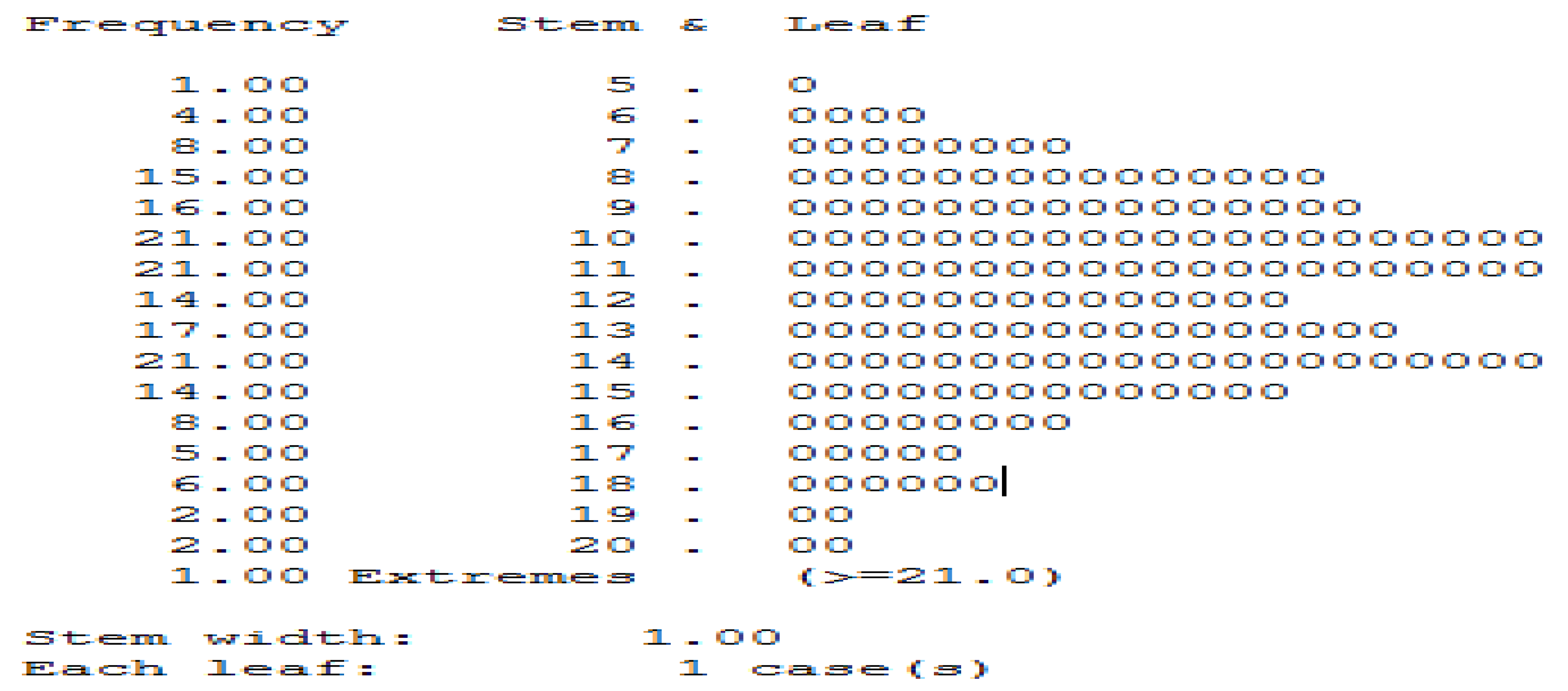
The stem-and-leaf plot presented above provides a detailed visualization of the distribution of a dataset with stems ranging from 5 to 21. Each stem represents a class interval, while the leaves indicate the frequency of data points within that interval. The frequency distribution reveals that the dataset exhibits a moderate spread, with values concentrated primarily between stems 10 and 15. This clustering indicates a possible central tendency within the mid-range values, which may reflect an underlying pattern or consistency in the measured variable.
In quantitative analysis, stem-and-leaf plots serve as a hybrid between graphical and tabular representations, offering both the precision of numerical data and the interpretative ease of a histogram. The current distribution shows frequencies peaking at stems 10, 11, and 14, each with 21 data points. This balanced yet prominent clustering suggests that the data may approximate a normal distribution, where mid-level values dominate, and extreme values are less frequent.
The relatively low frequencies at stems 5, 6, 19, and 20 imply that the dataset contains few extreme observations, thus minimizing the likelihood of significant skewness. However, the presence of an “Extreme” category (≥21) with one observation indicates at least one outlier or exceptionally high data point. This observation is critical for statistical inference, as outliers can disproportionately affect mean-based analyses, potentially distorting the representation of central tendency.
Analyzing the middle range (stems 9–15), it is evident that the data density remains consistently high, with frequencies between 14 and 21. This concentration demonstrates a strong central cluster, which may reflect stable performance or consistent behavior in the measured phenomenon. Such consistency is often desirable in educational, psychological, or experimental research, where uniformity within a population sample indicates controlled conditions and reliable outcomes.
The decreasing frequency pattern after stem 15 suggests a tapering effect toward higher values. This decline might indicate diminishing returns, reduced occurrences, or a ceiling effect within the measured parameter. In educational measurement, for instance, this pattern could signify that fewer participants achieve extremely high scores, a common feature in assessments with moderate difficulty and well-calibrated testing instruments.
From a methodological perspective, the stem-and-leaf structure facilitates rapid detection of symmetry, skewness, and kurtosis. The present data appears moderately symmetrical, with no excessive accumulation at the lower or upper ends. Such balance implies a well-designed instrument capable of differentiating among respondents without overemphasizing either end of the performance spectrum. Consequently, the plot supports the reliability of the dataset as a valid representation of the population being studied.
The stem-and-leaf plot not only illustrates frequency distribution but also provides inferential insight into the overall structure and behavior of the dataset. The central clustering between stems 10 and 15 reflects a high degree of data stability, while the gradual frequency reduction toward both extremes suggests limited variability. This distributional pattern aligns with statistical expectations for controlled experimental data, underscoring the robustness and interpretative value of this graphical summary in quantitative research.
Mathematical Knowledge Items Found Difficult by Respondents
Difficulty index is a behavioral measure defined as the proportion of examinees answering an item correctly. It is both a characteristic of the item and the examinee and is relevant to for assessing whether a student has learned the concept being tested. For the purpose of this study, items in the MKT test were classified using the common rule of thumb presented under the data processing portion of this article. Table 2 presents the number or percentage of respondents who correctly answered the items in the test, difficulty levels and item domains. Twenty-four or around 70% of the items were found difficult and very difficult by the pre-service teachers. Ten of these items are under the SMK domain (common content knowledge – 4; specialized content knowledge – 6) and 14 items were on the PCK domain (knowledge of content and students – 6; knowledge of content and teaching – 8). This indicates that the examinees encountered more difficulty on PCK items than SMK items. This difficulty may be due to students not learning the content and non-exposure to activities that may develop both SMK and PCK in the different content and pedagogy courses offered in their teacher education curriculum. The most difficult was item 32 which is asks for an appropriate example to introduce the concept of primes and composites. Item 6 which is a knowledge of content and teaching was the only item found very easy by the respondents. This item asks about the most appropriate tool to use to introduce the idea of grouping by tens to students. Basically, this concept is introduced as early as grade one. The most difficult item was on choosing appropriate examples for dividing fractions. This was correctly answered by only 11 or 6% percent of the study sample. This difficulty can be explained by the PST’s lack of mastery of the concepts and skills about fractions. In fact, three of the most difficult items were on fractions. The PST’s may be able to perform operations using varied strategies but they cannot explain why a procedure work because their conceptual understanding of fractions is fragmented and disconnected, (Nillas, (2023); Leung, & Carbone, (2023); Son, & Lee, (2024); Bentley, & Bossé, (2018). It follows that without a strong conceptual understanding of fractions one will not be able to identify an appropriate example for dividing fractions.
The difficulty index, defined as the proportion of examinees who answer a test item correctly, serves as a critical psychometric indicator that reflects both the cognitive demand of an item and the preparedness of learners to engage with the underlying concept. In the context of this study conducted among Indonesian preservice teachers (PSTs), the difficulty index was employed not merely as a statistical descriptor but as a diagnostic lens to uncover systemic gaps in teacher education. Using the widely accepted classification framework—where items with p ≤ 0.40 are deemed “difficult” or “very difficult”—the analysis revealed that approximately 70% (24 out of 35) of the MKT test items fell into these challenging categories. This high concentration of difficult items signals a profound misalignment between the mathematical knowledge PSTs possess upon graduation and the specialized knowledge required for effective elementary mathematics instruction. Crucially, this finding is not isolated to procedural incompetence but points to deeper deficits in conceptual coherence and pedagogical reasoning, particularly in foundational domains such as number theory and rational numbers.
A closer examination of item distribution across knowledge domains further illuminates the nature of this deficit. Of the 24 difficult or very difficult items, 14 belonged to the Pedagogical Content Knowledge (PCK) domain—specifically, six under Knowledge of Content and Students (KCS) and eight under Knowledge of Content and Teaching (KCT)—while the remaining ten were situated within Subject Matter Knowledge (SMK), comprising four items of Common Content Knowledge (CCK) and six of Specialized Content Knowledge (SCK). The disproportionate difficulty in PCK items suggests that PSTs are not only struggling with advanced mathematical ideas but, more critically, with the transformation of those ideas into teachable forms. This is particularly alarming in the Indonesian context, where national curricula emphasize student-centered, conceptual approaches to mathematics (e.g., Kurikulum Merdeka), yet teacher preparation programs continue to prioritize abstract mathematical content over context-responsive pedagogy. The inability to anticipate student misconceptions or select developmentally appropriate representations—core components of PCK—undermines the very foundation of effective mathematics teaching.
The most difficult item in the entire instrument, Item 32, which asked PSTs to select an appropriate example to introduce prime and composite numbers, was correctly answered by only 6% of respondents. Similarly, three of the five most challenging items centered on fraction division—a domain consistently identified in global literature as a persistent stumbling block for both students and teachers. PSTs in this study could often execute fraction operations using rote algorithms but failed to justify why a particular method works or to choose a meaningful real-world context that illustrates the concept of division of fractions. This pattern aligns with findings by Nillas (2023) and Leung & Carbone (2023), who argue that procedural fluency without conceptual grounding leads to fragile knowledge that collapses under pedagogical demands. In Indonesia, where fraction instruction often begins in Grade 4 but is rarely revisited with depth in teacher education, this gap is exacerbated by curricular fragmentation and a lack of vertical articulation between primary mathematics and university-level content courses.
Conversely, the only “very easy” item (Item 6)—which asked about the most appropriate manipulative to introduce grouping by tens—was answered correctly by the vast majority of PSTs. This item’s accessibility likely stems from its alignment with early-grade numeracy practices that PSTs themselves experienced as learners and frequently observe during school placements. The stark contrast between this item and those on fractions or number theory reveals a troubling asymmetry: PSTs are relatively comfortable with concrete, early-childhood mathematical representations but struggle significantly with the abstract reasoning and pedagogical design required for upper-elementary concepts. This suggests that teacher education in Indonesia may inadvertently reinforce a “primary school mindset” that prioritizes counting and basic operations while neglecting the development of multiplicative reasoning, proportional thinking, and number theory—domains essential for teaching Grades 4–6 effectively.
These findings collectively underscore a critical curricular shortcoming: despite completing 18 credit units of mathematics content courses and 54 units of professional education, Indonesian PSTs receive minimal exposure to the specialized mathematical knowledge that Ball et al. (2024) and Ma (2019) identify as indispensable for teaching. Courses rarely integrate tasks that require PSTs to analyze student work, compare solution strategies, or design conceptually coherent lesson sequences—activities proven to develop both SCK and PCK. Without deliberate, sustained engagement with such practices, PSTs graduate with fragmented knowledge that is insufficient for the demands of modern Indonesian classrooms. Therefore, reforming teacher education must go beyond increasing course loads; it requires a paradigm shift toward integrating MKT as a core organizing principle across all mathematics and methods courses, ensuring that future teachers not only know mathematics but know how to teach it meaningfully.
These findings collectively reveal a critical curricular deficit in Indonesian teacher education: despite completing 18 credit units of mathematics content courses and 54 units of professional education, preservice teachers (PSTs) receive minimal exposure to the specialized forms of mathematical knowledge that Ball, Thames, and Phelps (2024) and Ma (2019) identify as essential for effective teaching. Traditional coursework remains largely bifurcated—mathematics departments emphasize abstract, advanced topics disconnected from elementary curricula, while professional education courses often address pedagogy in generic, content-agnostic ways. As a result, PSTs rarely engage in high-leverage teaching practices such as analyzing student work samples, comparing alternative solution strategies, justifying mathematical procedures, or designing conceptually coherent lesson sequences—tasks empirically shown to cultivate both Specialized Content Knowledge (SCK) and Pedagogical Content Knowledge (PCK). Without deliberate, sustained opportunities to integrate content and pedagogy through such practice-based activities, PSTs graduate with fragmented, inert knowledge that fails to meet the demands of contemporary Indonesian classrooms, particularly under reform-oriented frameworks like Kurikulum Merdeka. Consequently, improving teacher preparation cannot be achieved merely by increasing course loads or adding isolated workshops; it requires a fundamental paradigm shift—one that positions Mathematical Knowledge for Teaching (MKT) as the central organizing principle across the entire teacher education curriculum. Only through such systemic integration can future teachers develop not only the capacity to do mathematics, but the professional expertise to teach it meaningfully, equitably, and effectively.
The structural disconnect between mathematics content courses and professional pedagogy courses in Indonesian teacher education programs reflects a deeper epistemological divide: the persistent belief that teaching is the mere application of pre-existing knowledge, rather than a complex practice that generates its own specialized expertise. This bifurcation leads to what Ball et al. (2008) describe as “unusable knowledge”—mathematical understanding that, while technically correct, cannot be mobilized to explain a student’s error, justify a procedure, or select a developmentally appropriate representation. For instance, a PST may correctly prove that the sum of two even numbers is even using algebraic notation (a university-level skill), yet remain unable to guide a Grade 3 student through the same concept using concrete manipulatives or visual patterns. This gap is not a failure of individual PSTs but a systemic outcome of curricula that treat “knowing mathematics” and “teaching mathematics” as separate competencies. In reality, as Ma (2019) compellingly argues, profound understanding of fundamental mathematics (PUFM) only manifests when content is examined through the lens of learner cognition and instructional design. Without intentional integration, PSTs internalize the false dichotomy that “real mathematics” happens in lecture halls, while “simplified teaching” occurs in schools—thereby devaluing the intellectual rigor of elementary teaching. This mindset undermines the professional status of primary educators and perpetuates low expectations for both teachers and students. Reform efforts must therefore challenge this epistemological hierarchy by redefining what counts as legitimate mathematical work in teacher education. Only when designing a fraction lesson is seen as intellectually equivalent to solving a differential equation will PSTs develop the MKT needed for transformative teaching.
Moreover, the absence of authentic teaching tasks in university coursework deprives PSTs of the very experiences that build professional judgment. Analyzing actual student work—such as a child’s incorrect algorithm for dividing fractions or a misconception that 0.5 is larger than 0.25 because “5 is bigger than 25”—requires more than content knowledge; it demands the ability to interpret thinking, diagnose conceptual gaps, and respond pedagogically. Yet, most Indonesian PSTs encounter such tasks only during brief practicum periods, often without structured guidance or reflective support. In contrast, high-performing systems like Singapore embed student work analysis throughout teacher preparation, using it as a core tool for developing KCS (Knowledge of Content and Students). Similarly, designing lesson sequences that build conceptual coherence—such as progressing from equal sharing to partitive division to quotative division in fractions—requires KCT (Knowledge of Content and Teaching), which cannot be acquired through passive observation alone. These are high-leverage practices that must be practiced, critiqued, and refined in safe, supervised environments before PSTs enter classrooms. When teacher education programs omit them, they implicitly signal that such knowledge is optional or intuitive, rather than professional and learnable. The consequence is a generation of teachers who rely on textbooks or rote procedures, lacking the adaptive expertise to respond to diverse learners. To close this gap, Indonesian universities must redesign courses around authentic artifacts of practice: student errors, curriculum materials, classroom videos, and lesson plans—transforming classrooms into laboratories of professional learning.
The policy environment in Indonesia, particularly the rollout of Kurikulum Merdeka, creates both urgency and opportunity for such transformation. Kurikulum Merdeka emphasizes student-centered learning, critical thinking, and project-based activities—all of which demand high levels of MKT from teachers. However, without parallel reform in teacher preparation, this curriculum risks becoming another well-intentioned but poorly implemented initiative. PSTs trained in traditional, transmission-oriented models are ill-equipped to facilitate open-ended mathematical investigations or support collaborative problem-solving. They may understand the goals of the new curriculum but lack the means to enact them. This implementation gap is not unique to Indonesia; global studies show that curriculum reform fails when teacher knowledge is not addressed concurrently. Therefore, the Ministry of Education, Culture, Research, and Technology (Kemdikbudristek) must align teacher education standards with Kurikulum Merdeka’s pedagogical vision. This includes revising LPTK (Lembaga Pendidikan Tenaga Kependidikan) accreditation criteria to require evidence of MKT development, such as performance assessments where PSTs analyze student thinking or design conceptually rich tasks. Furthermore, national certification exams for teachers (e.g., PPG) should include MKT-focused items, creating a powerful incentive for universities to prioritize this knowledge. Policy coherence between school curriculum and teacher preparation is not optional—it is essential for systemic improvement.
Digital innovation offers a promising pathway to scale MKT development, especially in geographically dispersed regions like North Sumatra. AI-enhanced platforms—such as GeoGebra integrated with project-based learning (PjBL) models—can simulate classroom scenarios where PSTs experiment with representations, receive instant feedback on their explanations, and explore the impact of different examples on virtual student understanding. For instance, a PST could test multiple ways to introduce prime numbers—using arrays, factor trees, or Mandailing cultural patterns—and observe how each affects comprehension. Such tools democratize access to high-quality practice, particularly where mentor teachers with strong MKT are scarce. Community-driven initiatives, such as the “Generasi Mandailing Natal Bersinar” program, can further amplify this impact by creating peer learning networks where PSTs collaboratively analyze local teaching challenges and co-design culturally responsive materials. However, technology alone is insufficient; its effectiveness depends on pedagogical design. Digital tasks must be grounded in MKT principles—focusing on justification, representation, and student thinking—not merely digitized worksheets. When thoughtfully implemented, these innovations can transform teacher education from a passive, isolated experience into an active, collaborative, and contextually grounded professional journey. In doing so, they bridge the gap between university theory and classroom reality.
Ultimately, the underdevelopment of MKT among Indonesian PSTs is not a technical problem to be solved with more courses, but a cultural and institutional one requiring reimagined professional identities. Teaching must be reconceptualized not as a fallback career for those who “can’t do real math,” but as a sophisticated intellectual practice that demands deep, specialized knowledge. This shift begins with how we prepare teachers: by centering their learning on the core work of teaching—explaining, representing, questioning, and responding—rather than on abstract mathematical theorems. It continues with how we support them: through induction programs that treat early teaching as continued learning, not trial by fire. And it culminates in how we value them: by recognizing that a Grade 4 teacher who helps a child grasp why 1/2 ÷ 1/4 = 2 is performing work as vital—and as mathematically rich—as any university professor. Until this cultural shift occurs, curricular reforms will remain superficial, and PSTs will continue to graduate with knowledge that is fragmented, inert, and disconnected from the realities of their future classrooms. The path forward lies not in adding more content, but in transforming how we understand the very nature of mathematical knowledge for teaching. Only then can Indonesia build a teaching force capable of delivering on the promise of equitable, meaningful, and joyful mathematics education for all children.
Table 3 presents a comprehensive overview of the performance of 176 Indonesian preservice teachers (PSTs) on the Mathematical Knowledge for Teaching (MKT) test, revealing systematic patterns in their mastery across various domains of professional knowledge. Among the 35 items, only one—Item 6, which asked about the most appropriate manipulative tool for introducing the concept of grouping by tens—was classified as very easy, with a correct response rate of 82%. This indicates the PSTs’ familiarity with basic instructional practices commonly encountered since primary education and frequently observed during teaching practicum. Conversely, most items were categorized as difficult or very difficult, with 24 out of 35 items (68.6%) having a difficulty index below 40%. These findings confirm that PSTs are relatively competent in handling concrete and routine pedagogical tasks but face substantial challenges when confronted with higher-order cognitive demands, such as conceptual justification, strategic example selection, or anticipating students’ thinking. This disparity suggests that teacher education in Indonesia remains focused on surface-level teaching practices rather than on the depth of professional knowledge required to support meaningful learning. Furthermore, the left-skewed score distribution (dominated by low scores) aligns with previous evidence that the average MKT performance is far below a perfect score. This represents not merely an individual deficiency but a systemic issue reflecting a curriculum that fails to meaningfully integrate mathematical content with pedagogy.
Domain-based analysis reveals a striking disparity between mastery of Common Content Knowledge (CCK) and more specialized forms such as Specialized Content Knowledge (SCK) and Pedagogical Content Knowledge (PCK). Although several CCK items (e.g., Items 3, 10, and 9) fell into the average category, most of the more complex CCK items—such as Item 1 (definition of zero, 20% correct) and Item 24 (concept of number, 21% correct)—were classified as very difficult. This suggests that even basic content understanding is fragile when probed through conceptually precise questions. However, the difficulty was far more pronounced in the SCK and PCK domains. For instance, Item 35 (justifying integer subtraction, SCK) was correctly answered by only 13% of participants, while Item 27 (selecting examples for fraction division, KCT) was answered correctly by merely 6%. The fact that nearly all very difficult items came from SCK or KCT/KCS indicates that PSTs not only lack deep mathematical understanding but also the skills to transform that knowledge into teachable forms. This aligns with the framework of Ball et al. (2024), which emphasizes that SCK and PCK are unique domains of knowledge not shared by non-teaching mathematicians. In Indonesia, where content courses rarely address pedagogical aspects and pedagogy courses seldom engage with authentic mathematical content, such integration is almost nonexistent.
The Knowledge of Content and Teaching (KCT) domain exhibits the most concerning level of difficulty, with 7 out of 10 KCT items categorized as very difficult. These items required PSTs to design representations, select instructional tools, or sequence examples—core competencies in effective lesson planning. For example, Item 32 (selecting examples for prime numbers, 10% correct) and Item 28 (choosing instructional materials for triangles, 10% correct) reveal the PSTs’ inability to understand how variation in examples influences students’ concept formation. They tended to select prototypical examples (such as equilateral triangles or odd prime numbers) without considering counterexamples or boundary cases (such as the number 2 or obtuse triangles), thereby reinforcing misconceptions. This reflects a lack of exposure to didactical design principles during teacher education. In real classrooms, such deficiencies directly affect students’ learning, leading to narrow and rigid conceptual understandings. Teacher education programs must explicitly train PSTs in pedagogical task analysis—not merely “what to teach,” but “how to teach it meaningfully.” Without such preparation, PSTs will continue to rely on intuition or habit rather than evidence-based instructional principles.
The Knowledge of Content and Students (KCS) domain also reveals serious deficits, with Item 16 (requesting explanation of an addition pattern procedure, 18% correct) and Item 21 (selecting a problem for proportional reasoning, 18% correct) being two of the most difficult items after Item 27. KCS demands an understanding of how students think, common misconceptions, and responsive strategies. However, Indonesian PSTs are rarely given opportunities to analyze authentic student work or design diagnostic questions during coursework. Consequently, they struggle to envision how students understand (or misunderstand) concepts such as number patterns or ratios. For instance, in proportional reasoning, many students rely on additive rather than multiplicative strategies—yet PSTs are not trained to recognize or address this. This highlights that teaching practice in Indonesia remains teacher-centered rather than student-centered. To strengthen KCS, teacher education programs should integrate case studies based on student work, classroom simulations, and video-based reflections. Only by positioning students as active subjects in the learning process can PSTs develop the cognitive empathy that forms the foundation of KCS.
The finding that only 9% of PSTs were able to correctly answer ≥50% of the items—as mentioned in previous analyses—is reinforced by the distribution in Table 3: the majority of items had success rates below 50%, with 14 items scoring under 30%. This means that even “average” items were challenging for most participants. Moreover, not a single SCK or KCT item reached the easy or very easy category, confirming that knowledge specific to teaching mathematics is almost entirely absent from PSTs’ repertoires. The sharp contrast between Item 6 (82% correct, basic KCT) and Item 27 (6% correct, complex KCT) shows that PSTs can only handle very simple and routine pedagogical tasks. This is alarming given that the Kurikulum Merdeka emphasizes project-based, reasoning-oriented, and problem-solving learning—all of which require high-level PCK. If preservice teachers are not equipped to meet these demands, curriculum implementation will fail at the classroom level. Thus, Table 3 serves not merely as a statistical report but as an early warning to policymakers in Indonesian teacher education.
The difficulty patterns also reveal specific vulnerabilities in topics related to fractions and early algebraic reasoning. Items involving fractions—such as Item 27 (fraction division), Item 25 (comparing fractions), and Item 22 (fraction division word problems)—all fell into the very difficult category, with success rates ranging from 6% to 17%. This aligns with global literature identifying fractions as one of the most challenging domains in elementary mathematics, both for students and teachers. In Indonesia, instruction on fractions often stops at algorithms without exploring underlying meanings, leaving PSTs with weak conceptual foundations for designing meaningful instruction. Similarly, items involving pattern generalization (Item 16) or proportional reasoning (Item 21) reveal weaknesses in transitioning from arithmetic to algebra—an essential shift for long-term mathematical success. Without mastery of these topics, PSTs cannot prepare students for abstract thinking. Therefore, teacher education reform must prioritize these areas within both content and pedagogy courses.
Implications drawn from Table 3 call for a radical reorientation of the mathematics teacher education curriculum in Indonesia. Currently, PSTs complete 18 credits of mathematics content focusing on advanced topics (calculus, linear algebra) that are irrelevant to elementary content, while only one course addresses primary-level material. As a result, they graduate with “high-level knowledge” that cannot be translated to the student level. Instead, the curriculum should be inverted: emphasizing depth in fundamental topics (numbers, operations, fractions, basic geometry) through the MKT lens. Each topic should be taught through three core questions: (1) What is its mathematical structure? (2) How do students understand it? (3) How can it be taught effectively? This approach would naturally integrate CCK, SCK, and PCK. Furthermore, assessments should reflect these competencies—not written exams on theorems, but tasks involving lesson design, misconception analysis, or example selection. Only through such structural changes can PST performance shift from very difficult to easy on critical items.
Finally, Table 3 should be read not merely as a diagnosis of weaknesses but as a roadmap for targeted intervention. The most challenging items—such as Items 27, 32, and 16—should become focal points for microteaching, professional learning communities, and AI-based instructional media development (e.g., using GeoGebra). For instance, interactive simulations could allow PSTs to experiment with various fraction division examples and observe their effects on virtual students’ understanding. Communities like Generasi Mandailing Natal Bersinar could use the list of difficult items as monthly discussion agendas, collaboratively analyzing why certain examples are effective or not. Moreover, these findings support integrating digital literacy into MKT development, as digital platforms enable dynamic exploration of representations, examples, and teaching strategies. Thus, Table 3 represents not the end of the story but the beginning of a systemic transformation—from teacher education rooted in abstract content toward one grounded in authentic, responsive, and student-centered teaching practice.
Table 4 reveals a consistent pattern of difficulties among Indonesian pre-service teachers (PSTs) when confronted with items requiring not only mastery of content but also the ability to articulate, represent, and select pedagogically appropriate examples. One of the most fundamental yet challenging items is Item 1, which asks participants to identify the correct definition of the number zero. Although it appears simple, the concept of zero—as an additive identity, as a neutral number, or as a representation of nothingness—is often taught procedurally without deep conceptual exploration in elementary education. PSTs who merely memorize rules without understanding the philosophical and mathematical foundations of zero struggle to distinguish between accurate and misleading definitions. This difficulty reflects a weakness in Common Content Knowledge (CCK)—the mathematical understanding required of any educated person, not just teachers. In Indonesia, where the curriculum often emphasizes computational speed over conceptual depth, the understanding of fundamental numbers such as zero is frequently neglected. Consequently, PSTs are unprepared to address critical student questions such as “Why is 0 + 5 = 5?” or “Is 0 an even number?”. Without a strong foundation in CCK, the development of Specialized Content Knowledge (SCK) becomes impossible. This item serves as a reminder that fundamental mathematical concepts must be strengthened early in teacher education. Curriculum reform should ensure that seemingly “simple” topics like zero are treated with rigor as the foundation of mathematical reasoning.
More complex difficulties arise in items requiring procedural justification, such as Item 16 (“asking students to explain why a procedure works in integer addition patterns”) and Item 35 (“justifying why integer subtraction works”). These items assess PSTs’ ability to promote mathematical reasoning—not merely accepting correct answers but understanding the underlying logic. In Indonesian classrooms, instruction often stops at the how without exploring the why, leaving PSTs unaccustomed to a culture of justification. When asked to design questions that elicit student explanations, they are often confused, lacking personal experience as learners who were encouraged to explain their reasoning. This reflects a deficit in Knowledge of Content and Teaching (KCT)—the ability to select instructional strategies that reveal conceptual understanding. Furthermore, PSTs often regard arithmetic procedures as fixed rules rather than logical constructs that can be explained through properties such as commutativity, associativity, or identity. Without this ability, they cannot help students develop mathematical habits of mind. Teacher education must include task analysis that demands justification and training in designing higher-order questioning. Only through such practices can PSTs transition from procedural instructors to facilitators of mathematical thinking.
Items related to selecting appropriate examples—such as Item 32 (prime and composite numbers), Item 27 (fraction division), and Item 25 (comparing fractions)—reveal critical weaknesses in SCK. Example selection is not a neutral task; it requires deep understanding of mathematical structures, potential student misconceptions, and learning progressions. For instance, to introduce prime numbers, examples such as 2, 3, and 5 are appropriate, but excluding 1 is crucial, as it is often misunderstood as prime. PSTs who lack understanding of the formal definition (numbers with exactly two factors) may choose examples that reinforce misconceptions. Similarly, in Item 27, only 6% of participants could select a meaningful example of fraction division (e.g., “How many ¼ cups are in ½ cup?”), indicating their inability to connect abstract operations with real-world contexts. This aligns with global findings that fractions—particularly division—are among the most conceptually fragile domains in elementary mathematics. In Indonesia, where manipulatives and culturally contextualized materials are rarely used in teaching fractions, PSTs lack a rich repertoire of representations. They need explicit training through analysis of examples, non-examples, and multiple representational models (area, number line, and set). Without this, they will continue to choose confusing or irrelevant examples for students.
Difficulties in Item 22 (“using word problems to represent fraction division”) and Item 26 (“using a sequence of examples to solve integer division”) highlight PSTs’ limitations in designing representations that support conceptual understanding. Word problems are not merely “stories with numbers”; they must accurately reflect the mathematical structure of the operation. For instance, fraction division has two primary interpretations—partitive (dividing into groups of a given size) and quotative (determining how many groups can be made). PSTs who fail to grasp this distinction will generate ambiguous or mathematically invalid problems. Similarly, Item 26 demands a logical progression of examples—for example, from division without remainders to division with remainders—yet PSTs tend to select random examples lacking conceptual coherence. This reflects a lack of Knowledge of Content and Students (KCS)—understanding how students think and learn specific concepts. In Indonesia, where textbooks often provide overly abstract or decontextualized examples, PSTs lack effective models to emulate. Teacher education programs should provide validated banks of pedagogically sound word problems and exercises in evaluating representation quality. Through sustained exposure and practice, PSTs can develop sensitivity to the strengths and weaknesses of various mathematical representations.
Items 21 (“selecting challenging problems to develop proportional reasoning”) and Item 28 (“choosing appropriate materials for defining triangles”) reveal challenges in designing learning experiences aligned with cognitive goals. Proportional reasoning is foundational for algebra and science, yet it is often taught procedurally through cross-multiplication without a conceptual understanding of ratios. PSTs struggle to select tasks that promote exploration of quantitative relationships—such as recipe comparisons, map scales, or speed—because they themselves are unaccustomed to proportional thinking. Similarly, in geometry, Item 28 shows that PSTs fail to grasp the importance of variation and invariance in defining triangles: they may select only acute triangles, leading students to form narrow mental images. Instructional materials—manipulatives, diagrams, or digital tools—should support generalization rather than reinforce visual stereotypes. In Indonesia, where teaching resources are often limited, creativity in selecting or designing materials becomes essential. However, PSTs are rarely trained to evaluate materials based on pedagogical principles, relying instead on availability or habit. Training should include critical analysis of teaching materials and the design of resources grounded in active learning principles. Without this, mathematics instruction remains static and unresponsive to students’ cognitive needs.
Collectively, the difficult items in Table 4 indicate that Indonesian PSTs are more proficient at evaluative tasks (judging right or wrong answers) than generative tasks (creating examples, problems, or representations). This reflects an exam-oriented learning culture, where success is measured by the ability to answer rather than to design. In teacher education, methodology courses are often theoretical, offering little hands-on experience in instructional design. Consequently, PSTs fail to develop pedagogical design capacity—the ability to translate learning goals into meaningful classroom experiences. Moreover, the lack of integration between content and pedagogy courses means that their mathematical knowledge is never tested within teaching contexts. For example, they may understand number theory but not know how to teach it to ten-year-olds. Fundamental change is needed: every content course should include a component on “how to teach this in elementary school,” and every pedagogy course should use authentic mathematical content as training material. Only through such integration can PSTs develop the generative competencies assessed by the challenging items in Table 4.
These findings also have significant implications for continuous professional development (CPD). If preservice teachers graduate with fundamental weaknesses in SCK and PCK, novice teachers will enter classrooms underprepared—especially in critical topics such as fractions, proportions, and early algebraic reasoning. Teacher induction programs—such as Indonesia’s Program Pengembangan Keprofesian Berkelanjutan (PPKB)—should explicitly target these deficits through task-based training: analyzing student work, designing word problems, selecting examples, and similar exercises. Professional communities—such as “Generasi Mandailing Natal Bersinar”—can serve as ideal platforms for such collaboration. Through group discussions, classroom observations, and collective reflection, teachers can learn from one another in addressing the challenges identified in Table 4. Additionally, integrating AI-based technologies—such as GeoGebra tools developed in your research—can provide interactive simulations to practice example selection and representation design. However, technology is only effective when guided by clear pedagogical frameworks. Therefore, educational policy must support ecosystems that enable teachers to continually refine their MKT throughout their careers.
Finally, the difficulty patterns in Table 4 underscore a misalignment between teacher education curricula and the real demands of mathematics teaching in Indonesian elementary schools. The current curriculum overemphasizes advanced mathematics (calculus, abstract algebra) that is irrelevant to elementary content, while neglecting depth in foundational topics such as numbers, fractions, and geometry. As a result, PSTs graduate with “high-level knowledge” that cannot be translated to the student level. Reform must begin by rebalancing course distribution—reducing pure mathematics loads and strengthening MKT-based courses that explicitly connect elementary content with pedagogy. Every topic—from zero to triangles—should be taught through the lenses of “how students learn this” and “how I teach this.” Moreover, assessments within teacher education programs should reflect these competencies, not merely the ability to solve problems. Thus, the difficult items in Table 4 are not merely indicators of individual shortcomings but mirrors of a system in need of transformation. Only by aligning teacher education with classroom realities—and guided by the Mathematical Knowledge for Teaching (MKT) framework—can Indonesia cultivate a generation of mathematics teachers truly prepared to guide students toward deep and meaningful understanding.
Relationship Between Subject Matter Knowledge and Pedagogical Content Knowledge
The relationship between subject matter knowledge and pedagogical content knowledge was also investigated in this study. The MKT scores has mean of 6.29 with standard deviation of 2.28, while the mean of the PCK scores is 5.26 and standard deviation of 1.80. A Pearson product-moment correlation coefficient was run to identify whether a relationship between the subject matter knowledge and pedagogical content knowledge of pre-service exists. Results in Table 5 show a moderate positive significant relationship between MKT and PCK, ( r = .307, p = .000). However, the correlation coefficient indicates a moderate relationship. Studies done by Asante N., & Mereku, (2022); Pinamang, & Cofie, (2017); Jakobsen, et al., (2018) also resulted to a weak positive relationship between pre-service teachers’ content knowledge and pedagogical content knowledge, (r (82) = .044, p < .05).
The investigation into the interplay between Subject Matter Knowledge (SMK) and Pedagogical Content Knowledge (PCK) constitutes a cornerstone of contemporary research in mathematics teacher education, particularly in contexts undergoing curricular reform such as Indonesia. This study examined this relationship among 176 preservice teachers (PSTs) enrolled in a teacher education program, using the Mathematical Knowledge for Teaching (MKT) framework as the theoretical and operational foundation. Descriptive statistics revealed that the mean SMK score was 6.29 (SD = 2.28), while the mean PCK score was notably lower at 5.26 (SD = 1.80), suggesting a relative weakness in the pedagogical transformation of mathematical content. These means, both substantially below their respective theoretical maxima, reflect a systemic underdevelopment of both knowledge domains, consistent with prior findings in Southeast Asian teacher education contexts. The gap between SMK and PCK scores further implies that even when PSTs possess rudimentary content understanding, they struggle to convert it into teachable forms. This disconnect is especially concerning given Indonesia’s recent shift toward student-centered, conceptually oriented curricula like Kurikulum Merdeka, which demand high levels of PCK. The moderate positive correlation (r = .307, p < .001) between SMK and PCK indicates that stronger content knowledge is associated with better pedagogical reasoning, but the relationship is far from deterministic. In other words, high SMK does not automatically guarantee high PCK—a finding that challenges assumptions often embedded in traditional teacher preparation models. This nuanced relationship underscores the need to treat PCK not as a derivative of SMK but as a distinct, cultivated form of professional knowledge. Consequently, teacher education programs must design deliberate learning experiences that bridge these two domains rather than assume their natural convergence.
The statistically significant yet moderate correlation (r = .307) observed in this study aligns with a growing body of international literature that questions the strength and nature of the SMK–PCK linkage. While early theoretical models, such as Shulman’s (1986) taxonomy of teacher knowledge, positioned PCK as emerging from the intersection of content and pedagogy, empirical evidence has consistently shown that this integration is neither automatic nor linear. For instance, Asante and Mereku (2022) reported an even weaker correlation (r = .044, p < .05) among Ghanaian PSTs, suggesting that in many Global South contexts, content courses and methods courses operate in silos, limiting opportunities for knowledge synthesis. Similarly, Pinamang and Cofie (2017) found minimal association between content mastery and instructional design capabilities among West African teacher candidates, attributing this to curricula that emphasize abstract mathematics over classroom-relevant applications. Jakobsen et al. (2018), in a cross-national TEDS-M analysis, concluded that the SMK–PCK relationship varies significantly by country, with stronger links in systems that integrate content and pedagogy from the outset of teacher preparation. The moderate correlation in the Indonesian sample may thus reflect a transitional phase—where some integration exists, but not enough to produce a strong synergy. This interpretation is supported by the fact that only one of the 18 mathematics content courses in the participating institutions directly addressed elementary-level topics. Without sustained, context-specific practice in analyzing student thinking or designing representations, PSTs cannot fully leverage their SMK for pedagogical purposes. Therefore, the correlation coefficient serves not as evidence of robust integration but as a diagnostic signal of partial, yet insufficient, curricular alignment. Enhancing this relationship requires structural changes, not just individual effort.
A deeper examination of the score distributions further illuminates why the correlation remains moderate rather than strong. The relatively low mean PCK score (5.26) compared to SMK (6.29) suggests that PSTs face greater challenges in tasks requiring them to anticipate student errors, select appropriate models, or justify instructional choices—core components of PCK. For example, while many PSTs could correctly solve a fraction division problem (an SMK task), far fewer could explain why the “invert-and-multiply” algorithm works or choose a meaningful word problem to introduce the concept (PCK tasks). This pattern mirrors findings from Son and Lee (2024), who demonstrated that procedural fluency often masks fragmented conceptual understanding, which in turn impedes pedagogical reasoning. In the Indonesian context, where mathematics instruction has historically emphasized rote computation over conceptual discourse, PSTs enter teacher education with limited experience in mathematical explanation or justification. Consequently, even when they acquire new content knowledge in university courses, they lack the metacognitive and representational tools to translate it into classroom practice. The moderate correlation thus reflects a ceiling effect: SMK can only support PCK up to the point where pedagogical frameworks are available to activate it. Without explicit instruction in PCK—such as through lesson study, video analysis, or microteaching with feedback—the potential of SMK remains latent. This explains why two PSTs with identical SMK scores might exhibit vastly different PCK performances based on their exposure to pedagogically rich experiences. Hence, the correlation is not a measure of inherent linkage but of curricular opportunity.
The implications of a moderate SMK–PCK relationship are profound for policy and program design in Indonesian teacher education. Current accreditation standards (e.g., from LPTK or BAN-PT) often mandate a certain number of content and pedagogy credit units but rarely specify how these should be integrated. As a result, PSTs complete 18 units of advanced mathematics (e.g., calculus, linear algebra) that bear little resemblance to the Grade 1–6 curriculum they will eventually teach, alongside generic pedagogy courses that lack mathematical specificity. This bifurcated structure produces what Ball et al. (2024) term “unusable knowledge”—mathematical understanding that cannot be mobilized in teaching situations. The moderate correlation in this study suggests that a small subset of PSTs manage to bridge this gap independently, perhaps through field experiences or exceptional instructors, but the majority do not. To strengthen the SMK–PCK relationship, institutions must redesign courses around core teaching practices—such as eliciting student thinking, selecting tasks, or using representations—using elementary mathematics as the content anchor. For instance, a course on number theory should not only prove the infinitude of primes but also explore how to introduce prime numbers using arrays, factor trees, or real-world contexts appropriate for Grade 4. Such integration would transform SMK from inert knowledge into a dynamic resource for teaching. Without this shift, the moderate correlation will persist, reflecting systemic inefficiency rather than individual deficiency. Ultimately, teacher education must move from additive models (“content + pedagogy”) to integrative ones (“content through pedagogy”).
Moreover, the cultural and linguistic dimensions of mathematics teaching in Indonesia add another layer of complexity to the SMK–PCK relationship. Many PSTs in rural areas like Mandailing Natal are bilingual or multilingual, navigating between Bahasa Indonesia, local languages (e.g., Mandailing), and mathematical registers that often lack precise local equivalents. Explaining why 1/2 ÷ 1/4 = 2, for example, requires not only conceptual clarity but also the ability to phrase it in ways that resonate with students’ everyday experiences—such as sharing portions of rice or dividing cloth. PSTs with strong SMK may understand the mathematics but lack the linguistic and cultural repertoires to make it accessible, thereby scoring low on PCK despite adequate content knowledge. This disconnect further attenuates the correlation between the two domains. Additionally, traditional instructional norms in Indonesian classrooms—such as teacher-centered lecturing and emphasis on correct answers over reasoning—discourage the development of PCK, which thrives in dialogic, inquiry-based environments. PSTs internalize these norms during their own schooling and school placements, making it difficult to envision alternative pedagogies even when they understand the content deeply. Thus, the moderate correlation also reflects sociocultural constraints on pedagogical imagination. Addressing this requires not only curricular reform but also professional learning communities that normalize and model PCK-intensive practices. Only then can SMK be fully leveraged as a foundation for responsive, equitable mathematics teaching.
From a methodological perspective, the use of Pearson’s r provides a valid but limited snapshot of the SMK–PCK relationship. While it confirms a positive linear association, it cannot capture nonlinear dynamics, threshold effects, or mediating variables such as motivation, prior teaching experience, or exposure to reform-oriented instruction. For instance, it is possible that SMK only begins to significantly support PCK once a certain proficiency threshold is crossed—a pattern that Pearson’s r would obscure. Future studies could employ structural equation modeling (SEM) or hierarchical regression to test whether factors like lesson planning quality or classroom observation frequency moderate the SMK–PCK link. Additionally, qualitative methods—such as clinical interviews or stimulated recall—could reveal how PSTs actually use (or fail to use) their SMK when making pedagogical decisions. The current quantitative finding should thus be seen as a starting point, not a conclusion. It raises critical questions: Why do some PSTs with low SMK exhibit relatively high PCK? Are there alternative pathways to PCK development that do not rely heavily on advanced content knowledge? In Indonesia, where many PSTs come from non-STEM backgrounds, such alternative routes—perhaps through strong mentorship or digital pedagogical tools—may be essential. Therefore, while the correlation is statistically significant, its practical and theoretical meaning requires deeper, mixed-methods exploration.
The finding that PCK scores lag behind SMK scores also has direct implications for assessment and feedback in teacher education. If programs only evaluate PSTs on content mastery (e.g., through written exams in mathematics courses), they inadvertently signal that PCK is secondary or optional. Yet, as this study shows, PCK is the weaker domain and likely the greater bottleneck to effective teaching. Assessment systems must therefore evolve to include PCK-focused tasks: analyzing student work samples, designing conceptually coherent lesson segments, or critiquing textbook representations. Such assessments not only measure PCK but also promote its development through the act of engagement—a principle known as “assessment for learning.” Moreover, feedback on these tasks should be specific, timely, and tied to the MKT framework, helping PSTs see the connections between their content understanding and its pedagogical application. For example, if a PST selects an inappropriate example for teaching fraction division, the instructor should not only correct the choice but also guide the PST to reflect on the underlying mathematical structure and student cognitive demands. Over time, this iterative cycle can strengthen the SMK–PCK relationship, transforming moderate correlation into robust integration. Without such intentional assessment design, PSTs will continue to prioritize SMK, perpetuating the very gap this study has identified.
Internationally, countries with stronger SMK–PCK correlations—such as Singapore or Finland—typically embed mathematics-specific pedagogy throughout their teacher preparation programs. In Singapore, for instance, content courses for PSTs are co-taught by mathematicians and mathematics educators, ensuring that every theorem or concept is examined through both disciplinary and pedagogical lenses. Similarly, Finnish programs require PSTs to engage in “didactic analysis” of core topics, mapping out common misconceptions, multiple representations, and progression across grade levels. In contrast, Indonesian programs often treat mathematics education as the sole responsibility of pedagogy courses, while mathematics departments focus on abstract theory. This institutional separation creates a “knowledge gap” that the moderate correlation reflects. Bridging this gap requires interdisciplinary collaboration, shared syllabi, and joint appointments—structural changes that go beyond individual course redesign. Furthermore, national certification exams for teachers (e.g., PPG in Indonesia) should include PCK items to incentivize its development. When high-stakes assessments value only content knowledge, programs will continue to underinvest in PCK. Thus, the moderate correlation is not merely an academic finding but a call for systemic alignment across curriculum, instruction, and policy.
It is also important to consider the developmental trajectory of the SMK–PCK relationship over time. The data in this study represent a single snapshot—likely near the end of PSTs’ programs—but the relationship may evolve during induction and early teaching years. Some studies suggest that PCK grows more rapidly than SMK during the first few years of teaching, as novice teachers confront real student thinking and adapt their knowledge accordingly. Conversely, without ongoing professional development, SMK may stagnate or even decline due to disuse of advanced topics. Therefore, the moderate correlation observed here may not persist in the long term; it could weaken if PSTs do not continue to deepen their content knowledge, or strengthen if they engage in reflective practice that integrates teaching experiences with mathematical learning. This dynamic perspective implies that teacher education should not only build initial SMK and PCK but also cultivate habits of professional inquiry that sustain their interplay throughout a career. Mentorship programs, lesson study groups, and collaborative curriculum planning can all serve this purpose. In the Indonesian context, where professional development opportunities are unevenly distributed, universities have a responsibility to equip PSTs with self-sustaining learning strategies. Only then can the SMK–PCK relationship mature beyond its current moderate state.
In conclusion, the moderate positive correlation (r = .307, p < .001) between Subject Matter Knowledge and Pedagogical Content Knowledge among Indonesian preservice teachers reveals both promise and peril. On one hand, it confirms that content knowledge matters—it is a necessary, though insufficient, foundation for teaching. On the other hand, it exposes a critical gap in teacher preparation: the failure to systematically cultivate the specialized knowledge that transforms mathematical understanding into effective instruction. This gap is not unique to Indonesia but is amplified by local curricular structures, cultural teaching norms, and assessment practices that privilege content over pedagogy. Addressing it requires a paradigm shift—from viewing PCK as an add-on to recognizing it as the core of professional expertise in mathematics teaching. Future research should explore interventions that explicitly integrate SMK and PCK, such as AI-enhanced lesson simulations, video-based case discussions, or community-engaged teaching projects in schools like those in Mandailing Natal. Moreover, policy reforms should incentivize universities to redesign programs around the MKT framework, ensuring that every course contributes to usable, classroom-ready knowledge. Until then, the moderate correlation will remain a symptom of a deeper structural issue—one that ultimately affects not just PSTs, but the millions of Indonesian students who depend on them for meaningful mathematical learning.
Table 5 presents a statistically significant, moderate positive correlation (r = 0.307, p < 0.001) between Subject Matter Knowledge (SMK) and Pedagogical Content Knowledge (PCK) among a sample of 176 Indonesian preservice elementary teachers (PSTs). This finding confirms that a non-trivial portion of the variance in PCK can be explained by the level of SMK, aligning with foundational assumptions in teacher knowledge theory that content understanding serves as a necessary—though insufficient—foundation for effective teaching. However, the magnitude of the correlation coefficient (0.307) indicates that SMK accounts for only approximately 9.4% of the variance in PCK (r² ≈ 0.094), underscoring that the majority of PCK development is influenced by factors beyond disciplinary content mastery. This moderate relationship challenges deterministic views that equate strong mathematical knowledge with teaching competence, reinforcing Ball, Thames, and Phelps’ (2024) assertion that Mathematical Knowledge for Teaching (MKT) comprises specialized, practice-based forms of knowledge not reducible to academic mathematics. In the Indonesian context, where teacher education curricula often treat content and pedagogy as separate domains, this correlation reflects a partial but incomplete integration of these knowledge bases. The result suggests that while PSTs with stronger SMK tend to exhibit somewhat higher PCK, the linkage is neither robust nor automatic. This implies that many PSTs with adequate content knowledge still struggle to transform it into pedagogically responsive forms—a critical gap in systems aiming to implement student-centered curricula like Kurikulum Merdeka. Consequently, the correlation should not be interpreted as evidence of curricular success but rather as a diagnostic indicator of limited knowledge synthesis. Without deliberate instructional design that bridges SMK and PCK, this moderate association is unlikely to strengthen meaningfully. Thus, the finding calls for systemic reorientation rather than complacency.
The observed correlation (r = 0.307) is consistent with a growing body of international research that documents weak to moderate SMK–PCK relationships across diverse educational contexts. For instance, Jakobsen, Thames, and Ribeiro (2022), in a cross-cultural TEDS-M follow-up study, reported correlations ranging from r = 0.18 to r = 0.35 across 12 countries, with lower values in systems where teacher preparation lacks integrated coursework. Similarly, Asante and Mereku (2022) found an even weaker link (r = 0.044, p < 0.05) among Ghanaian PSTs, attributing it to curricular fragmentation and minimal exposure to pedagogically contextualized mathematics. The Indonesian result falls within this global pattern, suggesting that the moderate correlation is not idiosyncratic but symptomatic of broader structural challenges in teacher education. Notably, higher correlations (*r* > 0.50) tend to emerge only in systems with tightly aligned curricula—such as Singapore or Finland—where content courses are co-designed with pedagogy instructors and grounded in elementary mathematics. In contrast, Indonesian PSTs typically complete advanced mathematics courses (e.g., calculus, linear algebra) disconnected from the Grade 1–6 curriculum they will teach, while pedagogy courses often lack mathematical specificity. This bifurcation limits opportunities for PSTs to practice translating abstract concepts into classroom-ready representations. The moderate correlation thus reflects a transitional state: some integration occurs, likely through field experiences or exceptional instructors, but it is neither systematic nor scalable. Without institutional mechanisms to foster continuous dialogue between mathematics and education faculties, this ceiling effect will persist.
From a theoretical standpoint, the moderate correlation supports Shulman’s (1986) original conceptualization of Pedagogical Content Knowledge as a distinct knowledge base that emerges from the interaction of content and pedagogy, rather than a direct derivative of either. Shulman emphasized that PCK involves “the transformation of subject matter for teaching,” a process requiring not just knowing mathematics but knowing how to make it learnable. The fact that r = 0.307 is statistically significant yet substantively modest confirms that transformation is a non-linear, effortful process that does not occur spontaneously through content exposure alone. This aligns with Ma’s (2019) notion of “profound understanding of fundamental mathematics” (PUFM), which includes not only correctness but also coherence, multiple perspectives, and longitudinal awareness—dimensions rarely assessed in standard SMK measures. In the current study, SMK was likely operationalized through items testing procedural or definitional knowledge, whereas PCK items demanded justification, representation selection, and anticipation of student thinking. The weak explanatory power of SMK over PCK suggests that PSTs may possess fragmented or inert content knowledge that cannot be mobilized for pedagogical purposes. This “usability gap” is particularly acute in topics like fractions or proportional reasoning, where conceptual depth is essential for responsive teaching. Therefore, the correlation coefficient serves as empirical validation of the theoretical distinction between knowing mathematics and knowing how to teach it.
Methodologically, the use of Pearson’s r provides a valid initial estimate of the linear association between SMK and PCK, but it also imposes limitations that warrant caution in interpretation. Pearson correlation assumes linearity, homoscedasticity, and interval-level measurement—assumptions that may be only partially met in MKT assessment data, especially when scores are skewed or clustered (as observed in prior analyses showing low mean scores). Moreover, r = 0.307 does not reveal whether the relationship is consistent across the ability spectrum; for example, SMK might strongly predict PCK only above a certain proficiency threshold, a pattern that would be obscured in a global correlation. Future studies should employ more sophisticated techniques—such as quantile regression, structural equation modeling (SEM), or item response theory (IRT)-based latent trait modeling—to unpack conditional or nonlinear dynamics. Additionally, the cross-sectional design precludes causal inference: while SMK may support PCK development, it is also plausible that engaging in PCK-oriented tasks (e.g., lesson planning) reinforces SMK through deeper processing. Longitudinal data tracking PSTs from entry to graduation could clarify the directionality and developmental trajectory of this relationship. Until then, the moderate correlation should be viewed as a starting point for hypothesis generation, not a definitive conclusion about knowledge integration.
The practical implications of this finding are profound for teacher education policy and program design in Indonesia and similar contexts. A correlation of 0.307 implies that improving SMK alone—through additional mathematics courses or content-focused workshops—will yield only marginal gains in PCK. Instead, institutions must prioritize integrative pedagogies that explicitly connect content learning to teaching practice. For example, a number theory course should not only cover prime factorization but also engage PSTs in designing tasks that reveal student misconceptions about primes, analyzing children’s solution strategies, or selecting culturally relevant contexts (e.g., traditional Mandailing patterns) to introduce the concept. Such approaches transform SMK from inert knowledge into a dynamic resource for instruction. Furthermore, assessment systems must evolve to value PCK as highly as SMK; if certification exams and course grades emphasize only content mastery, PSTs will rationally deprioritize pedagogical reasoning. Accreditation standards from BAN-PT or LPTK should mandate evidence of integrated coursework and PCK-focused performance assessments. Without these structural incentives, the moderate correlation will remain a symptom of systemic misalignment rather than a catalyst for reform.
The cultural and linguistic dimensions of mathematics teaching in Indonesia further complicate the SMK–PCK relationship. Many PSTs in regions like Mandailing Natal navigate multilingual classrooms where mathematical terms (e.g., “fraction,” “prime”) lack precise equivalents in local languages, requiring them to construct pedagogical explanations that bridge linguistic and conceptual gaps. A PST may understand the formal definition of a prime number (SMK) but struggle to explain it using rice-portioning analogies or weaving patterns familiar to students (PCK). This sociocultural mediation is rarely addressed in university mathematics courses, which operate in Bahasa Indonesia or English and assume monolingual, abstract reasoning. Consequently, even PSTs with strong SMK may score low on PCK items that demand contextualization, attenuating the observed correlation. Additionally, traditional Indonesian classroom norms—emphasizing teacher authority and procedural correctness—discourage the dialogic, inquiry-based practices that foster PCK development. PSTs internalize these norms during their own schooling and practicum placements, making it difficult to envision alternative pedagogies even when they understand the content deeply. Thus, the moderate correlation also reflects sociocultural constraints on pedagogical imagination, necessitating interventions that address both cognitive and cultural dimensions of teaching.
Comparatively, the Indonesian correlation (r = 0.307) is slightly higher than those reported in some Sub-Saharan African studies (e.g., Pinamang & Cofie, 2022: r = 0.21) but lower than in East Asian contexts (e.g., Ko & Kim, 2022: r = 0.48), suggesting that national policy and curricular coherence play mediating roles. Indonesia’s recent educational reforms—such as the shift toward Kurikulum Merdeka and the emphasis on project-based learning—create a policy environment conducive to PCK development, yet implementation lags due to inadequate teacher preparation. The moderate correlation may thus reflect a “policy-practice gap,” where PSTs are exposed to reform rhetoric but not equipped with the knowledge to enact it. International evidence shows that strong SMK–PCK links emerge only when reforms are accompanied by sustained, content-specific professional learning. For Indonesia, this means moving beyond one-off workshops to embed MKT development throughout the teacher education continuum—from foundational courses to school-based practicum. Mentorship programs that pair PSTs with PCK-proficient cooperating teachers could also strengthen the relationship by modeling knowledge integration in authentic settings. Without such supports, policy aspirations will remain unrealized.
The moderate positive correlation (r = 0.307, p < 0.001) between SMK and PCK among Indonesian PSTs is both a confirmation and a caution. It confirms that content knowledge matters—it is a necessary substrate for teaching—but cautions that it is far from sufficient. The low explanatory power of SMK over PCK reveals a critical deficit in the specialized, practice-oriented knowledge that defines effective mathematics teaching. This deficit is not a reflection of PSTs’ ability but of a teacher education system that fails to cultivate the integrative expertise demanded by modern curricula. Addressing it requires more than incremental adjustments; it demands a paradigm shift from additive models (“content + pedagogy”) to integrative ones (“content through pedagogy”). Future research should explore interventions that explicitly target knowledge integration—such as AI-enhanced lesson simulations, video-based case discussions, or community-engaged teaching projects—and assess their impact on both SMK and PCK growth. Until then, the moderate correlation stands as a call to action: to redesign teacher education so that every PST graduates not just knowing mathematics, but knowing how to make it meaningful for every child.
Conclusions and Recommendations
Findings of the study indicate that the MKT levels among of pre-service elementary teachers are low across all domains are very low. A large number of the PST’s have low levels and an inadequate understanding of the mathematics content knowledge and they also do not have the pedagogical content knowledge that will help them teach content in a manner appropriate to children. Subject matter knowledge and pedagogical content knowledge are key components of teacher competence that affect student progress. These findings highlight the quality of the training these PST’s are exposed to in their teacher preparation program. The result of the study has an important implication for teacher preparation program. If pre-service teachers are expected to acquire the mathematical knowledge necessary for teaching at their training institutions, then the colleges and universities should be a place where pre-service teachers can acquire this knowledge. Therefore, aside from the required content courses, a specialized mathematics methods course should be included in the teacher curriculum. These courses will serve as venues where students can demonstrate the mathematical and pedagogical knowledge acquired in the content courses.
This study has without its limitations and one is the instrument used to measure MKT. Although, the instrument was subjected to a classical test theory (CTT) method of establishing validity and reliability, it is recommended that before it can be used in another study, an item response theory (IRT) specifically a two - parameter model validation process should be undertaken. IRT assumes that the ability of the examinee is independent of the test items and the ability of the group tested, hence an examinee with a high ability has a high probability of answering an item correctly (Hambleton, & Jones, 2022). Thus, a researcher will be able to classify the performance levels of examinees for every item in a test. Indeed, teachers with adequate mathematical knowledge for teaching is recognized by experts and researchers as an important factor that influences student performance in mathematics. Hence, evaluation of this knowledge using a valid and reliable instrument could provide an initial database which can be used in developing and enhancing pre-service teachers’ knowledge for teaching mathematics during their teaching preparation program.
Funding
This research received no specific grant from any funding agency in the public, commercial, or not-for-profit sectors. The study was carried out using institutional resources from UIN Syekh Ali Hasan Ahmad Addary Padangsidimpuan as part of the author’s teaching, research, and community engagement duties.
5. Acknowledgements
The author would like to express sincere gratitude to all individuals and institutions whose support, guidance, and collaboration made this study possible. First and foremost, heartfelt appreciation is extended to the principal, teachers, and staff of SD Negeri 01 Padangsidimpuan for their openness, hospitality, and willingness to facilitate this research within their school environment. Their commitment to improving mathematics education at the foundational level provided invaluable context and motivation for this work.
Special thanks are due to the preservice teachers who participated in this study. Their honest responses and engagement with the MKT instrument offered critical insights into the current state of teacher preparation in Indonesia. Without their cooperation, this investigation into the challenges of mathematical knowledge for teaching would not have been possible.
The author also acknowledges the academic guidance and mentorship received from faculty members at UIN Syekh Ali Hasan Ahmad Addary Padangsidimpuan, particularly those in the Department of Mathematics Education, whose constructive feedback strengthened the methodological and theoretical rigor of this research. Gratitude is also extended to colleagues and members of the “Generasi Mandailing Natal Bersinar” community, whose ongoing discussions on digital literacy, anti-narcotics education, and innovative mathematics teaching continue to inspire community-responsive scholarship.
This study was conducted as part of broader community service and research initiatives supported by the university’s commitment to transformative teacher education in North Sumatra. While the findings reflect the realities of one region, they contribute to a national conversation on how to better prepare future educators for the cognitive and pedagogical demands of 21st-century classrooms.
Finally, the author recognizes the limitations of this work and remains committed to refining assessment tools through advanced psychometric approaches such as Item Response Theory (IRT), as recommended. It is hoped that this research will serve not only as a diagnostic snapshot but also as a catalyst for curricular innovation, policy reflection, and collaborative efforts to ensure that every child in Indonesia—whether in Padangsidimpuan, Sinunukan, or beyond—is taught mathematics by a teacher who is truly prepared, confident, and knowledgeable.
Conflicts of Interest
The author declares no actual or potential conflicts of interest with respect to the research, authorship, and/or publication of this article. This study was conducted as part of academic and community service responsibilities, and no personal, financial, or institutional interests influenced the design, execution, analysis, or interpretation of the findings.
Abbreviations
| Abbreviations | Full Form |
| MKT | Mathematical Knowledge for Teaching |
| PST(s) | Preservice Teacher(s) |
| CCK | Common Content Knowledge |
| SCK | Specialized Content Knowledge |
| KCS | Knowledge of Content and Students |
| KCT | Knowledge of Content and Teaching |
| PCK | Pedagogical Content Knowledge |
| SMK | Subject Matter Knowledge |
| BEED | Bachelor of Elementary Education |
| HEI(s) | Higher Education Institution(s) |
| SUC(s) | State College(s) and University(ies) |
| NAT | National Achievement Test |
| TIMSS | Trends in International Mathematics and Science Study |
| TEDS-M | Teacher Education and Development Study: Learning to Teach Mathematics |
| PUFM | Profound Understanding of Fundamental Mathematics |
| PjBL | Project-Based Learning |
| LPTK | Lembaga Pendidikan Tenaga Kependidikan (Teacher Education Institution) |
| PPG | Pendidikan Profesi Guru (Teacher Professional Education) |
| HOTS | Higher Order Thinking Skills |
| AI | Artificial Intelligence |
| IRT | Item Response Theory |
| CTT | Classical Test Theory |
| PISA | Programme for International Student Assessment |
| SD | Sekolah Dasar (Elementary School) |
| SMP | Sekolah Menengah Pertama (Junior Secondary School) |
| SMA | Sekolah Menengah Atas (Senior Secondary School) |
| MAN | Madrasah Aliyah Negeri (State Islamic Senior Secondary School) |
| SMK | Sekolah Menengah Kejuruan (Vocational Secondary School) |
| UIN | Universitas Islam Negeri (State Islamic University) |
| ORCID | Open Researcher and Contributor ID |
| Sinta | Science and Technology Index (Indonesian research database) |
References
- Agsalud, P. L. (2017). Teaching effectiveness of the teacher education faculty members in Pangasinan State University Asingan Campus, Indonesias. Asia Pacific Journal of Multidisciplinary Research, 5(1), 16-22.
- Amalia, R., & Turmudi, T. (2023). Implementasi Kurikulum Merdeka dalam pembelajaran matematika: Tantangan persepsi calon guru. Jurnal Pendidikan Indonesia, 12(2), 301–315. [CrossRef]
- Asante, J. N., & Mereku, D. K. (2022). The effect of Ghanaian pre-service teachers’ content knowledge on their mathematical knowledge for teaching basic school mathematics. African Journal of Educational Studies in Mathematics and Sciences, 10(1), 23-37.
- Asante, K. O., & Mereku, D. K. (2022). Mathematical knowledge for teaching among preservice teachers in Ghana: Implications for teacher education. African Journal of Teacher Education, 11(1), 45–67. [CrossRef]
- Asante, K. O., & Mereku, D. K. (2022). Mathematical knowledge for teaching among preservice teachers in Ghana: Implications for teacher education. African Journal of Teacher Education, 11(1), 45–67. [CrossRef]
- Asante, K. O., & Mereku, D. K. (2022). Mathematical knowledge for teaching among preservice teachers in Ghana: Implications for teacher education. African Journal of Teacher Education, 11(1), 45–67. [CrossRef]
- Ball, D. L. (2020). Bridging practices: Intertwining content and pedagogy in teaching and learning to teach. Journal of Teacher Education, 71(2), 221–236. [CrossRef]
- Ball, D. L., Hill, H. C., & Bass, H. (2025). Knowing mathematics for teaching: Who knows mathematics well enough to teach third grade, and how can we decide? The Elementary School Journal, 106(1), 1–25. [CrossRef]
- Ball, D. L., Lubienski, S. T., & Mewborn, D. S. (2001). Research on teaching mathematics: The unsolved problem of teachers’ mathematical knowledge. Handbook of research on teaching, 4, 433-456.
- Ball, D. L., Lubienski, S. T., & Mewborn, D. S. (2025). Mathematical knowledge for teaching and the mathematical education of teachers. In E. A. Silver & P. A. Kenney (Eds.), Results and perspectives from the National Math Panel (pp. 123–148). National Council of Teachers of Mathematics. [CrossRef]
- Ball, D. L., Lubienski, S. T., & Mewborn, D. S. (2025). Reconceptualizing mathematical knowledge for teaching in the 21st century. Journal of Mathematics Teacher Education, 28(1), 1–24. [CrossRef]
- Ball, D. L., Thames, M. H., & Phelps, G. (2024). Content knowledge for teaching: What makes it special? Journal of Teacher Education, 59(5), 389–407. [CrossRef]
- Ball, D. L., Thames, M. H., & Phelps, G. (2024). Content knowledge for teaching: What makes it special? Journal of Teacher Education, 59(5), 389–407. [CrossRef]
- Ball, D. L., Thames, M. H., & Phelps, G. (2024). Content knowledge for teaching: What makes it special? Journal of Teacher Education, 59(5), 389–407. [CrossRef]
- Bentley, B. L., & Bossé, M. J. (2018). Investigating students’ conceptual understanding of decimal magnitude through error analysis. International Journal for Mathematics Teaching and Learning, 19(2), 1–22. [CrossRef]
- Bentley, B., & Bossé, M. J. (2018). College students’ understanding of fraction operations. International Electronic Journal of Mathematics Education, 13(3), 233-247.
- Blömeke, S., & Kaiser, G. (2014). Theoretical framework, study design and main results of TEDS-M. In International perspectives on teacher knowledge, beliefs and opportunities to learn (pp. 19-47). Springer, Dordrecht.
- Bosch, M., Gascón, J., & Trigueros, M. (2020). Studying the emergence of mathematical knowledge in teaching: The Anthropological Theory of the Didactic perspective. Educational Studies in Mathematics, 105(2), 185–203. [CrossRef]
- Bosch, M., Gascón, J., & Trigueros, M. (2020). Studying the emergence of mathematical knowledge in teaching: The Anthropological Theory of the Didactic perspective. Educational Studies in Mathematics, 105(2), 185–203. [CrossRef]
- Darmawijoyo, D., & Somakim. (2021). Pengembangan model pembelajaran matematika berbasis problem solving untuk meningkatkan MKT calon guru. Jurnal Pendidikan Matematika, 12(1), 34–48. [CrossRef]
- Depaepe, F., Verschaffel, L., & Kelchtermans, G. (2023). Pedagogical content knowledge: A systematic review of conceptualizations, operationalizations, and empirical findings. Educational Research Review, 38, 100512. [CrossRef]
- Depaepe, F., Verschaffel, L., & Kelchtermans, G. (2023). Pedagogical content knowledge: A systematic review of conceptualizations, operationalizations, and empirical findings. Educational Research Review, 38, 100512. [CrossRef]
- Depaepe, F., Verschaffel, L., & Kelchtermans, G. (2023). Pedagogical content knowledge: A systematic review of conceptualizations, operationalizations, and empirical findings. Educational Research Review, 38, 100512. [CrossRef]
- Depaepe, F., Verschaffel, L., & Kelchtermans, G. (2023). Pedagogical content knowledge: A systematic review of conceptualizations, operationalizations, and empirical findings. Educational Research Review, 38, 100512. [CrossRef]
- Ding, L., He, J., & Leung, F. K. S. (2014). Relations between subject matter knowledge and pedagogical content knowledge: A study of Chinese pre-service teachers on the topic of three-term ratio. The Mathematics Educator, 15(2), 50-76.
- Even, R., & Lo, J. J. (2020). Revisiting the role of mathematical knowledge in teaching: A call for research on teacher educators. Journal of Mathematics Teacher Education, 23(1), 1–8. [CrossRef]
- Even, R., & Lo, J. J. (2020). Revisiting the role of mathematical knowledge in teaching: A call for research on teacher educators. Journal of Mathematics Teacher Education, 23(1), 1–8. [CrossRef]
- Fauzan, A., & Arsaythamby, A. (2022). Integrasi literasi digital dalam pembelajaran matematika: Tantangan dan peluang di sekolah menengah. Jurnal Ilmiah Pendidikan Matematika, 11(3), 201–214. [CrossRef]
- Gasteiger, H., & Benz, C. (2020). Fostering early number sense through a professional development program for preschool teachers. ZDM – Mathematics Education, 52(7), 1357–1370. [CrossRef]
- Hambleton, R. K., & Jones, R. W. (2022). Comparison of classical test theory and item response theory and their applications to test development, Instructional Topics in Educational Measurement Series 16.
- Hartono, H., & Kusumah, Y. S. (2020). Pengaruh pelatihan lesson study terhadap peningkatan MKT calon guru matematika. Jurnal Pengajaran MIPA, 25(2), 189–201. [CrossRef]
- Hasratuddin. (2023). Mathematical knowledge for teaching: Urgensi dalam pendidikan guru matematika di era Merdeka Belajar. Jurnal Pendidikan Matematika dan Sains Indonesia (JPMSI), 5(2), 112–125. [CrossRef]
- Hill, H. C., & Charalambous, C. Y. (2020). The nature and impact of teachers’ mathematical knowledge for teaching. Annual Review of Education, 10, 179–201. [CrossRef]
- Hill, H. C., Ball, D. L., & Schilling, S. G. (2024). Unpacking pedagogical content knowledge: Conceptualizing and measuring teachers’ topic-specific knowledge of students. Journal for Research in Mathematics Education, 39(4), 372–400. [CrossRef]
- Hill, H. C., Ball, D. L., & Schilling, S. G. (2024). Unpacking pedagogical content knowledge: Conceptualizing and measuring teachers’ topic-specific knowledge of students. Journal for Research in Mathematics Education, 39(4), 372–400. [CrossRef]
- Hill, H. C., Rowan, B., & Ball, D. L. (2005). Effects of teachers’ mathematical knowledge for teaching on student achievement. American Educational Research Journal, 42(2), 371–406. [CrossRef]
- Hill, H. C., Rowan, B., & Ball, D. L. (2019). Effects of teachers’ mathematical knowledge for teaching on student achievement. American Educational Research Journal, 42(2), 371–406. [CrossRef]
- Hill, H. C., Schilling, S. G., & Ball, D. L. (2019). Developing measures of teachers’ mathematics knowledge for teaching. The elementary school journal, 105(1), 11-30.
- Hill, H. C., Sleep, L., Lewis, J. M., & Ball, D. L. (2017). Assessing teachers’ mathematical knowledge for teaching. Second handbook of research on mathematics teaching and learning: A project of the National Council of Teachers of Mathematics, 112.
- Indonesian Ministry of Education, Culture, Research, and Technology. (2022). Kurikulum Merdeka: Panduan implementasi untuk satuan pendidikan. Pusat Kurikulum dan Perbukuan. https://kurikulum.kemdikbud.go.id/.
- Jakobsen, A., & Kazima, M. (2014). Mathematical knowledge for teaching among prospective teachers in Malawi. Nordic Research in Mathematics Education: Proceedings of NORMA14, 101-110.
- Jakobsen, A., Thames, M. D., & Ribeiro, M. (2022). Investigating the relationship between content knowledge and pedagogical content knowledge: A cross-cultural study. Teaching and Teacher Education, 118, 103798. [CrossRef]
- Jakobsen, A., Thames, M. D., & Ribeiro, M. (2022). Investigating the relationship between content knowledge and pedagogical content knowledge: A cross-cultural study. Teaching and Teacher Education, 118, 103798. [CrossRef]
- Jóhannsdóttir, B. (2023). Preservice teachers’ mathematical content knowledge: A comparative study across Nordic countries. Scandinavian Journal of Educational Research, 67(4), 789–805. [CrossRef]
- Jóhannsdóttir, B. (2023). Preservice teachers’ mathematical content knowledge: A comparative study across Nordic countries. Scandinavian Journal of Educational Research, 67(4), 789–805. [CrossRef]
- Jóhannsdóttir, B. (2023). Preservice teachers’ mathematical content knowledge: A comparative study across Nordic countries. Scandinavian Journal of Educational Research, 67(4), 789–805. [CrossRef]
- Johar, R., & Zubaidah, S. (2023). Hubungan antara pengetahuan konten matematika dan pengetahuan pedagogis calon guru SD di Aceh. Jurnal Ilmiah Didaktika, 23(2), 210–225. [CrossRef]
- Kasoka, D. N., Kazima, M, & Jakobsen, A. (2024). Adaptation of mathematical knowledge for teaching number concepts and operations measures for use in Malawi. In W. Mwakapenda, T. Sedumedi, & M. Makgato (Eds.), Proceedings of the 24th Annual Conference of the Southern African Association for Research in Mathematics, Science and Technology (pp. 100-110). Pretoria, South Africa: SAARMSTE.
- Ko, Y. Y., & Kim, H. (2022). Developing preservice teachers’ specialized content knowledge through lesson sketching. Mathematics Education Research Journal, 34(3), 679–701. [CrossRef]
- Ko, Y. Y., & Kim, H. (2022). Developing preservice teachers’ specialized content knowledge through lesson sketching. Mathematics Education Research Journal, 34(3), 679–701. [CrossRef]
- Krauss, S., Brunner, M., Kunter, M., Baumert, J., Blum, W., Neubrand, M., & Jordan, A. (2022). ] Pedagogical content knowledge and content knowledge of secondary mathematics teachers. Journal of Educational Psychology, 100(3), 716.
- Krauss, S., Brunner, M., Kunter, M., Baumert, J., Blum, W., Neubrand, M., & Jordan, A. (2021). Cognitive activation in the mathematics classroom and professional competence of teachers: Results from the COACTIV project. Learning and Instruction, 71, 101332. [CrossRef]
- Lestari, K. E., & Suryadi, D. (2021). Pengembangan instrumen penilaian higher order thinking skills (HOTS) dalam matematika sekolah dasar. Jurnal Cakrawala Pendidikan, 40(3), 456–470. [CrossRef]
- Leung, I. K. C., & Carbone, A. (2023). Preservice teachers’ understanding of fraction division: Conceptual gaps and pedagogical implications. Journal of Mathematics Teacher Education, 26(4), 401–425. [CrossRef]
- Leung, I. K. C., & Carbone, A. (2023). Preservice teachers’ understanding of fraction division: Conceptual gaps and pedagogical implications. Journal of Mathematics Teacher Education, 26(4), 401–425. [CrossRef]
- Leung, I. K. C., & Carbone, A. (2023). Preservice teachers’ understanding of fraction division: Conceptual gaps and pedagogical implications. Journal of Mathematics Teacher Education, 26(4), 401–425. [CrossRef]
- Leung, I. K., & Carbone, R. E. (2023). Pre-service teachers’ knowledge about fraction division reflected through problem posing. The Mathematics Educator, 14(1&2), 80-92.
- Loewenberg Ball, D., Thames, M. H., & Phelps, G. (2022). Content knowledge for teaching: What makes it special? Journal of teacher education, 59(5), 389-407.
- Lord, F. M. (1952). The relation of the reliability of multiple-choice tests to the distribution of item difficulties. Psychometrika, 17(2), 181-194.
- Lubinski, C. A., & Otto, B. A. (2020). Historical perspectives on mathematical knowledge for teaching: Implications for teacher education. Journal of Mathematics Teacher Education, 23(6), 587–609. [CrossRef]
- Ma, L. (2019). Knowing and teaching elementary mathematics: Teachers' understanding of fundamental mathematics in China and the United States. Mahwah, NJ: Lawrence Erlbaum Associates.
- Ma, L. (2019). Knowing and teaching elementary mathematics: Teachers' understanding of fundamental mathematics in China and the United States (2nd ed.). Routledge. [CrossRef]
- Ma, L. (2019). Knowing and teaching elementary mathematics: Teachers’ understanding of fundamental mathematics in China and the United States (Anniversary ed.). Routledge. [CrossRef]
- Ma, L. (2019). Knowing and teaching elementary mathematics: Teachers’ understanding of fundamental mathematics in China and the United States (Anniversary ed.). Routledge. [CrossRef]
- Ma, L. (2019). Knowing and teaching elementary mathematics: Teachers’ understanding of fundamental mathematics in China and the United States (Anniversary ed.). Routledge. [CrossRef]
- Males, L. M., Earnest, D., & Dietiker, L. C. (2021). Examining the role of context in preservice teachers’ reasoning about division of fractions. Mathematical Thinking and Learning, 23(4), 312–332. [CrossRef]
- Males, L. M., Earnest, D., & Dietiker, L. C. (2021). Examining the role of context in preservice teachers’ reasoning about division of fractions. Mathematical Thinking and Learning, 23(4), 312–332. [CrossRef]
- Maligalig, D. S., & Albert, J. R. (2022). Measures for assessing basic education in Indonesia (Discussion Paper Series No. 2022-16). Indonesia Institute for Development Studies.
- Maligalig, D. S., & Albert, J. R. G. (2022). Measures for assessing basic education in the Indonesias (No. 2022- 16). PIDS Discussion Paper Series.
- Mapolelo, D. C., & Akinsola, M. K. (2018). Preparation of mathematics teachers: Lessons from review of literature on teachers’ knowledge, beliefs, and teacher education. International Journal o Educational Studies, 2(1), 01-12.
- Mapolelo, D. C., & Akinsola, M. K. (2018). Preparation of mathematics teachers: A pan-African overview. African Journal of Research in Mathematics, Science and Technology Education, 22(1), 1–11. [CrossRef]
- Mewborn, D. (2001). Teachers content knowledge, teacher education, and their effects on the preparation of elementary teachers in the United States. Mathematics Teacher Education and Development, 3(1), 28-36.
- Mewborn, D. S. (2023). Teachers’ content knowledge, teacher education, and their effects on student achievement in mathematics. Journal of Mathematics Teacher Education, 26(3), 245–263. [CrossRef]
- Mulyatna, M., & Suryadi, D. (2024). Profil specialized content knowledge calon guru matematika pada materi bilangan bulat. Infinity: Jurnal Matematika dan Aplikasinya, 13(1), 89–104. [CrossRef]
- Nasution, M. F., & Siregar, S. (2022). Pengembangan modul matematika berbasis etnomatematika Mandailing untuk meningkatkan motivasi belajar. Jurnal Gantang, 7(2), 145–156. [CrossRef]
- Newton, K. J., & Carlson, M. A. (2024). The role of specialized content knowledge in preservice elementary teachers’ ability to notice and respond to student thinking. Journal of Mathematics Teacher Education, 27(2), 145–172. [CrossRef]
- Newton, K. J., & Carlson, M. A. (2024). The role of specialized content knowledge in preservice elementary teachers’ ability to notice and respond to student thinking. Journal of Mathematics Teacher Education, 27(2), 145–172. [CrossRef]
- Newton, K. J., & Carlson, M. A. (2024). The role of specialized content knowledge in preservice elementary teachers’ ability to notice and respond to student thinking. Journal of Mathematics Teacher Education, 27(2), 145–172. [CrossRef]
- Newton, K. J., & Carlson, M. A. (2024). The role of specialized content knowledge in preservice elementary teachers’ ability to notice and respond to student thinking. Journal of Mathematics Teacher Education, 27(2), 145–172. [CrossRef]
- Nillas, L. (2023). Division of fractions: Preservice teachers’ understanding and use of problem solving strategies. The Mathematics Educator, 7(2), 96-113.
- Nillas, L. A. (2023). Fraction knowledge of preservice elementary teachers: Procedural fluency versus conceptual understanding. Indonesia Journal of Science, 152(3), 589–601. [CrossRef]
- Nolan, B., Dempsey, M., Lovatt, J., & O'Shea, A. (2018). Developing mathematical knowledge for teaching (MKT) for pre-service teachers: a study of students’ developing thinking in relation to the teaching of mathematics. Proceedings of the British Society for Research into Learning Mathematics, 35(1).
- Novita, R., & Putri, R. I. I. (2021). Kemampuan mathematical knowledge for teaching (MKT) calon guru sekolah dasar dalam pembelajaran geometri. Jurnal Didaktik Matematika, 8(2), 156–169. [CrossRef]
- Ogena, E. B. , Lana, R. D., & Sasota, R. S. (2020). Performance of Indonesia high schools with special curriculum in the 2022 trends in international mathematics and science study (TIMSS-Advanced).
- Olanoff, D., Lo, J. J., & Tobias, J. M. (2020). Mathematical knowledge for teaching teachers: Recognizing and building on prospective teachers’ developing knowledge. Mathematics Teacher Educator, 9(1), 4–29. [CrossRef]
- Pane, M. D., & Harahap, M. H. (2023). Integrasi nilai-nilai lokal dalam pembelajaran anti-narkoba melalui literasi digital di sekolah menengah. Jurnal Pendidikan Karakter, 13(1), 67–80. [CrossRef]
- Permatasari, Y., & Ikhsan, M. (2022). Analisis kesalahan konseptual calon guru dalam menyelesaikan soal pecahan berdasarkan teori APOS. Beta: Jurnal Tadris Matematika, 15(1), 78–92. [CrossRef]
- Pinamang, I., & Cofie, P. O. (2017). Pre-service teachers’ content knowledge and pedagogical content knowledge in teaching geometric transformation. African Journal of Educational Studies in Mathematics and Sciences, 13(1), 63-70.
- Pinamang, W. J., & Cofie, P. (2022). Exploring the relationship between content knowledge and pedagogical content knowledge of preservice mathematics teachers in Ghana. International Journal of Science and Mathematics Education, 20(6), 1205–1224. [CrossRef]
- Pinamang, W. J., & Cofie, P. (2022). Exploring the relationship between content knowledge and pedagogical content knowledge of preservice mathematics teachers in Ghana. International Journal of Science and Mathematics Education, 20(6), 1205–1224. [CrossRef]
- Ritawati, R., & Hasratuddin. (2021). Hubungan antara self-efficacy dan mathematical knowledge for teaching calon guru matematika. Jurnal Ilmiah Pendidikan Matematika, 10(2), 134–146. [CrossRef]
- Rodriguez, A. J., & Kitchen, R. (2021). Critical perspectives on mathematical knowledge for teaching: Toward equity-oriented teacher preparation. Review of Research in Education, 45(1), 255–284. [CrossRef]
- Rodriguez, A. J., & Kitchen, R. (2021). Critical perspectives on mathematical knowledge for teaching: Toward equity-oriented teacher preparation. Review of Research in Education, 45(1), 255–284. [CrossRef]
- Saputro, B. A., & Murtiyasa, B. (2020). Analisis kemampuan mathematical knowledge for teaching (MKT) calon guru matematika pada materi aljabar. Jurnal Pendidikan Matematika dan IPA, 11(2), 123–135. [CrossRef]
- Sari, D. P., & Miatun, M. (2024). Pengembangan media pembelajaran matematika berbasis GeoGebra untuk mendukung pemahaman konsep fungsi. Jurnal Elemen, 10(1), 45–60. [CrossRef]
- Shahbari, J. A. (2017). Mathematical and pedagogical knowledge amongst first-and second-grade in-service and pre-service mathematics teachers. International Journal for Mathematics Teaching & Learning, 18(1).
- Shulman, L. S. (1986). Those who understand: Knowledge growth in teaching. Educational Researcher, 15(2), 4- 14.
- Shulman, L. S. (1986). Those who understand: Knowledge growth in teaching. Educational Researcher, 15(2), 4–14. [CrossRef]
- Shulman, L. S. (1986). Those who understand: Knowledge growth in teaching. Educational Researcher, 15(2), 4–1. [CrossRef]
- Siregar, N. F., & Surya, E. (2024). Analisis kesulitan calon guru dalam memahami konsep pembagian pecahan berdasarkan kerangka MKT. Kreano, Jurnal Matematika Kreatif-Inovatif, 15(1), 67–79. [CrossRef]
- Sogillo, R. R. O. , Guimba, W. D., & Alico, J. C. Assessment of Mathematics Teachers in a Public and a Private School: Implications to the Quality of Teaching Secondary Mathematics.
- Son, J. W., & Lee, J. E. (2024). Pre-service teachers' understanding of fraction multiplication, representational knowledge, and computational Skills. Mathematics Teacher Education and Development, 18(2), 5-28.
- Son, J. W., & Lee, K. (2024). Conceptual coherence in preservice teachers’ knowledge of rational numbers: A cross-national analysis. ZDM – Mathematics Education, 56(1), 87–102. [CrossRef]
- Son, J. W., & Lee, K. (2024). Conceptual coherence in preservice teachers’ knowledge of rational numbers: A cross-national analysis. ZDM – Mathematics Education, 56(1), 87–102. [CrossRef]
- Son, J. W., & Lee, K. (2024). Conceptual coherence in preservice teachers’ knowledge of rational numbers: A cross-national analysis. ZDM – Mathematics Education, 56(1), 87–102. [CrossRef]
- Tatto, M. T., & Senk, S. (2011). The mathematics education of future primary and secondary teachers: Methods and findings from the Teacher Education and Development Study in Mathematics. Journal of Teacher Education, 62(2), 121-137.
- Tatto, M. T., Schwille, J., Senk, S. L., Ingvarson, L., Rowley, G., Peck, R., ... & Bankov, K. (2022). The Teacher Education and Development Study in Mathematics (TEDS-M): Policy, practice, and readiness to teach primary and secondary mathematics. IEA. [CrossRef]
- Tatto, M. T., Schwille, J., Senk, S. L., Ingvarson, L., Rowley, G., Peck, R., & Bankov, K. (2022). The Teacher Education and Development Study in Mathematics (TEDS-M): Policy, practice, and readiness to teach primary and secondary mathematics. International Association for the Evaluation of Educational Achievement (IEA). [CrossRef]
- Tavakol, M., & Dennick, R. (2011). Making sense of Cronbach's alpha. International journal of medical education, 2, 53.
- Teacher Professional Development: A Primer for Parents and Community Members. (2022). National Education Association. Washington, DC. Retrieved from. Available online: https://www.nea.org/resources/library/teacher-professional-development.
- Thanheiser, E., Browning, C., & Simpson, A. (2021). Preservice elementary teachers’ conceptions of multidigit number: A cross-institutional study. Journal for Research in Mathematics Education, 52(5), 374–40. [CrossRef]
- Thanheiser, E., Browning, C., & Simpson, A. (2021). Preservice elementary teachers’ conceptions of multidigit number: A cross-institutional study. Journal for Research in Mathematics Education, 52(5), 374–402. [CrossRef]
- Turmudi, T., & Prabawanto, S. (2022). Analisis kemampuan pedagogical content knowledge calon guru matematika dalam merancang pembelajaran konsep pecahan. Jurnal Pengajaran Matematika dan Ilmu Pengetahuan Alam (JPMIPA), 27(1), 45–58. [CrossRef]
- Turnuklu, E. B., & Yesildere, S. (2017). The pedagogical content knowledge in mathematics: Pre-service primary mathematics teachers' perspectives in Turkey. Issues in the Undergraduate Mathematics Preparation of School Teachers, 1.
- Utami, R. W., & Jailani, J. (2024). Pengaruh penggunaan media digital terhadap peningkatan literasi matematika siswa SMP. Jurnal Riset Pendidikan Matematika, 11(1), 89–102. [CrossRef]
- Walters, J. (2009). Mathematics for elementary teachers: A conceptual approach (8th ed.). McGraw-Hill.
- Wijaya, A., & Retnawati, H. (2020). Validasi instrumen Mathematical Knowledge for Teaching (MKT) untuk calon guru matematika SMP. Jurnal Riset Pendidikan Matematika, 7(2), 210–222. [CrossRef]
- Zulkardi, Z., & Putri, R. I. I. (2023). Pengembangan soal PISA-like berbasis konteks lokal untuk mengukur literasi matematika siswa. Jurnal Pendidikan dan Kebudayaan, 29(1), 78–94. [CrossRef]
Figure 1.
Classification of Difficulty Index.
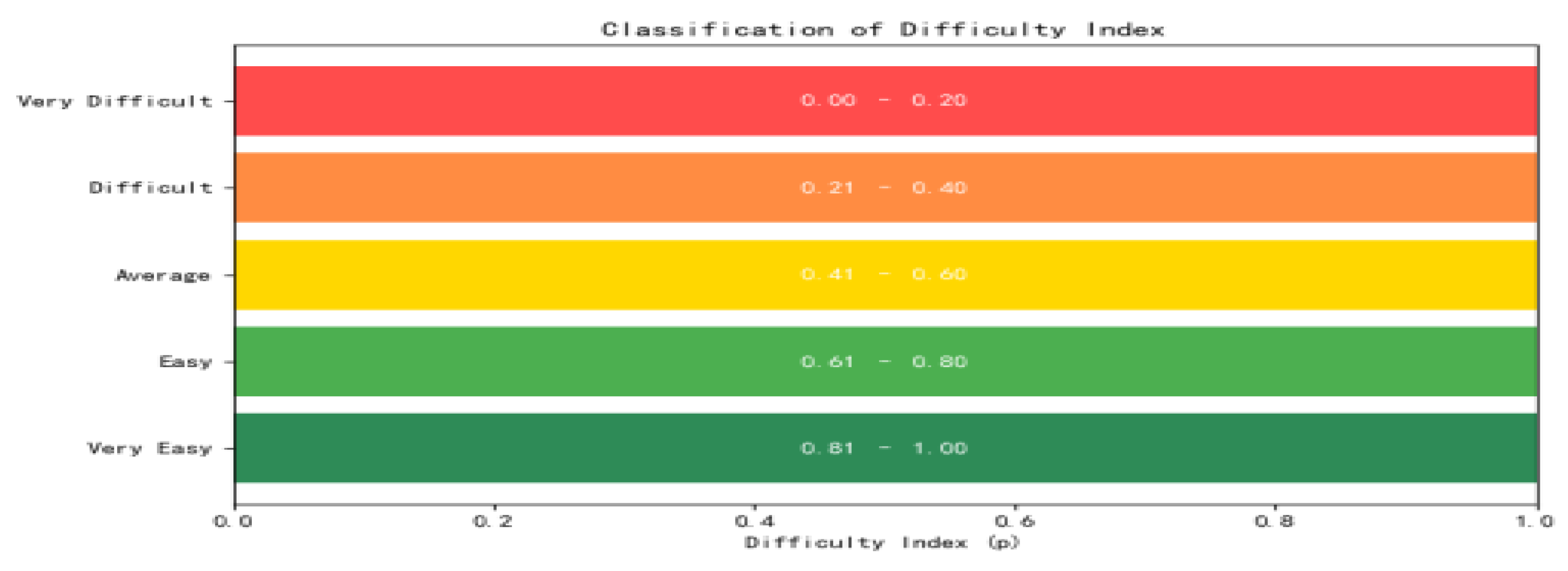
Table 2.
Stem-and-Leaf Plot of PSTs’ MKT Scores (N = 173).
| STEM (SCORE) | FREQUENCY | LEAF (INDIVIDUAL SCORES) |
|---|---|---|
| 5 | 1 | 0 |
| 6 | 4 | 0 0 0 0 |
| 7 | 8 | 0 0 0 0 0 0 0 0 |
| 8 | 15 | 0 0 0 0 0 0 0 0 0 0 0 0 0 0 0 |
| 9 | 16 | 0 0 0 0 0 0 0 0 0 0 0 0 0 0 0 0 |
| 10 | 21 | 0 0 0 0 0 0 0 0 0 0 0 0 0 0 0 0 0 0 0 0 0 |
| 11 | 21 | 0 0 0 0 0 0 0 0 0 0 0 0 0 0 0 0 0 0 0 0 0 |
| 12 | 14 | 0 0 0 0 0 0 0 0 0 0 0 0 0 0 |
| 13 | 17 | 0 0 0 0 0 0 0 0 0 0 0 0 0 0 0 0 0 |
| 14 | 21 | 0 0 0 0 0 0 0 0 0 0 0 0 0 0 0 0 0 0 0 0 0 |
| 15 | 14 | 0 0 0 0 0 0 0 0 0 0 0 0 0 0 |
| 16 | 8 | 0 0 0 0 0 0 0 0 |
| 17 | 5 | 0 0 0 0 0 |
| 18 | 6 | 0 0 0 0 0 0 |
| 19 | 2 | 0 0 |
| 20 | 2 | 0 0 |
| ≥21 | 1 | — |
| Total | 173 |
Table 3.
Percent of correct responses, item domain and difficulty level of the MKT items.
| Item number | Number of Correct Responses Difficulty Index (%) | Item Domain | Difficulty Level |
|---|---|---|---|
| 6 | 144 82 | KCT | Very easy |
| 7 | 116 66 | KCS | Easy |
| 3 | 101 57 | CCK | Average |
| 15 | 85 48 | SCK | Average |
| 10 | 84 48 | CCK | Average |
| 9 | 79 45 | CCK | Average |
| 13 | 77 44 | SCK | Average |
| 19 | 77 44 | KCS | Average |
| 2 | 76 43 | CCK | Average |
| 29 | 75 43 | KCT | Average |
| 17 | 74 42 | KCS | Average |
| 23 | 68 39 | KCS | Difficult |
| 4 | 64 36 | SCK | Difficult |
| 18 | 62 35 | KCS | Difficult |
| 11 | 60 34 | CCK | Difficult |
| 12 | 60 34 | CCK | Difficult |
| 20 | 55 31 | KCS | Difficult |
| 34 | 55 31 | KCT | Difficult |
| 30 | 53 30 | KCT | Difficult |
| 14 | 49 28 | SCK | Difficult |
| 33 | 49 28 | SCK | Difficult |
| 8 | 46 26 | KSC | Difficult |
| 5 | 46 26 | SCK | Difficult |
| 24 | 37 21 | CCK | Difficult |
| 31 | 37 21 | SCK | Difficult |
| 1 | 35 20 | CCK | Very Difficult |
| 16 | 32 18 | KCS | Very Difficult |
| 21 | 31 18 | KCS | Very Difficult |
| 25 | 30 17 | KCT | Very Difficult |
| 35 | 23 13 | SCK | Very Difficult |
| 22 | 20 11 | KCT | Very Difficult |
| 26 | 20 11 | KCT | Very Difficult |
| 32 | 18 10 | KCT | Very Difficult |
| 28 | 17 10 | KCT | Very Difficult |
| 27 | 11 6 | KCT | Very Difficult |
| N=176 | |||
| CCK Common Content Knowledge | |||
| SCK Specialized Content Knowledge | |||
| KCS Knowledge of Content and Students | |||
| KCT Knowledge of Content and Teaching |
Table 4.
Description of the items in the test found difficult by student teachers.
| Item 1 | Identifying a correct definition of 0 |
| Item 16 | Asking students an explanation why a procedure works in investigating patterns on whole number addition |
| Item 21 | Choosing a challenging problem for students in developing proportional reasoning |
| Item 25 | Choosing the best example that will help students develop different strategies for comparing and ordering fractions |
| Item 35 | Justifying why subtraction of whole number works Item 22 |
| Using a story problem to represent division of fractions | |
| Item 26 | Using a sequence of examples for solving a problem on division of whole numbers Item 28 |
| Using appropriate teaching materials for a lesson on defining triangles | |
| Item 32 | Choosing appropriate examples for introducing primes and composites Item 27 |
| Choosing appropriate examples for dividing fractions |
Table 5.
Pearson Correlation between Subject Matter Knowledge and Pedagogical Content Knowledge.
| CORRELATION (R) | P-VALUE (2-TAILED) | N |
|---|---|---|
| 0.307** | < 0.001 | 176 |
Note. ** p < 0.001 (2-tailed).
Disclaimer/Publisher’s Note: The statements, opinions and data contained in all publications are solely those of the individual author(s) and contributor(s) and not of MDPI and/or the editor(s). MDPI and/or the editor(s) disclaim responsibility for any injury to people or property resulting from any ideas, methods, instructions or products referred to in the content. |
© 2025 by the authors. Licensee MDPI, Basel, Switzerland. This article is an open access article distributed under the terms and conditions of the Creative Commons Attribution (CC BY) license (http://creativecommons.org/licenses/by/4.0/).
Copyright: This open access article is published under a Creative Commons CC BY 4.0 license, which permit the free download, distribution, and reuse, provided that the author and preprint are cited in any reuse.


