

Submitted:
09 October 2025
Posted:
15 October 2025
You are already at the latest version
Abstract
The objective of this study was to evaluate the changes in the fruit quality of blackcurrant ‘Tihope’ cv. during storage in regular atmosphere (RA), controlled atmosphere (CA), and in modified atmosphere packaging (MAP). Flesh firmness (elasticity), total soluble solids, titratable acidity, content of vitamin C, polyphenols, sugars, and antioxidant capacity were measured at harvest, after storage, and after shelf life (1 day at 18 °C or 2 days at 10 °C). The incidence of storage disorders and diseases was also monitored. Additionally, the sensory quality of the stored fruit was also analysed. The fruit of the 'Tihope' cultivar can be stored at 0 °C, in a regular atmosphere, up to 20 days without any negative effect on its quality. Storage in a controlled atmosphere or in MAP packaging allows the extension of the storage period of blackcurrants even up to 33 days, thereby delaying the occurrence of fruit damage and loss of firmness. After storage, vitamin C, polyphenols, sugars, and antioxidant activity remained at a high level similar to the harvest period.
Keywords:
controlled atmosphere
; firmness
; health-promoting compounds
; MAP
; storage
1. Introduction
Blackcurrant (Ribes nigrum L.) is a species commonly cultivated in many temperate-climate countries. Poland is one of the leading producers of blackcurrant fruit and one of its main exporters, also in processed form. According to FAOSTAT data [1] (accessed 15 April 2024), in 2021 and 2022, the production of currants (including blackcurrants) amounted to 152,000 tonnes and 145,800 tonnes, respectively.
Most blackcurrant fruits are processed and consumed as juices, nectars, jams, or purees, but fresh fruit can also be a valuable addition to a healthy diet. Blackcurrants contain, among others, minerals and antioxidant compounds, mostly vitamin C, anthocyanins and flavonols [2,3,4,5,6,7,8,9,10,11,12,13]. Although the amount of polyphenols and antioxidant activity decreases during processing (drying, juice production, etc.) the final content depends on the parameters of the process. It is also important that side products from the processing industry could be a good source of bioactive compounds. Michalska et al. [14,15] reported that blackcurrant pomace powders are still a valuable source of polyphenolic compounds, among which anthocyanins are the dominant group.
Fresh berry fruits are perishable and have a short postharvest life. Storage allows the extension of the fruit processing period as well as the availability of fresh fruit on the market.
For the fresh fruit market, the fruit must be uniform, with the appropriate colour specific for the cultivar, firm, free of decay and mechanical injury. The berries should be harvested fully mature, but not overripe. Fruits intended for storage and then to the fresh market should be picked with the stem, carefully to avoid mechanical damage. Blackcurrants belong to the ‘soft fruit’, which are characterized by a high metabolic rate and are perishable (the main postharvest disease is grey mould rot - Botrytis cinerea) [16]. To reduce metabolic activity and fungal development, it is advisable to quickly cool the fruit after harvesting to the storage temperature. Because blackcurrant fruits are not sensitive to low temperature, the recommended storage temperature is in the range of --0.5 to 0 °C and relative humidity (RH) of 95% [17,18]. Batzer and Helm [19] reported that the storage duration of black currant can be 1.5 weeks while maintaining optimal storage conditions. The use of a controlled atmosphere (CA) makes it possible to extend the storage period to 3 weeks [20,21]. Modified atmosphere packaging (MAP) can be used to extend the postharvest life of fruits in a similar way to controlled atmosphere (CA) storage. The modified atmosphere packaging, using various plastic films limiting gas diffusion, changes the composition of the atmosphere in and around fresh fruit as a result of their respiration. MAP is known to extend storage and shelf life of various berry fruits [22,23,24,25,26]. In the literature, little information can be found on different storage methods and their impact on the quality of blackcurrant fruit.
The objective of the present study was to determine changes in the quality of ‘Tihope’ blackcurrant fruit during storage in different technologies – regular atmosphere, controlled atmosphere, and modified atmosphere packaging (RA, CA, MAP, respectively).
2. Materials and Methods
The three independent storage experiments were carried out in the years 2021, 2022, and 2023 at the Fruit and Vegetable Storage and Processing Department at the National Institute of Horticultural Research in Skierniewice, Poland.
Plant Material
The fruits of ‘Tihope’ blackcurrant cultivars were obtained from the commercial plantation located in Ostrowiec near Łowicz (central Poland, 52°09′30″N 20°12′00″E). The plants were grown in a production system using integrated plant protection. Blackcurrants were hand-harvested at the commercial maturity stage based on skin colour and taste.
Experimental Conditions
After harvest, the fruits were cooled to storage temperature (0 °C) using forced air flow (for 3 hours), and then stored in a regular atmosphere, controlled atmosphere (15% CO2: 2.5% O2), or in MAP packaging (Xtend bags intended for blueberries, placed in regular atmosphere). The mean values of oxygen and carbon dioxide concentration inside the bags are given in Table 1. The currants were stored for 8 (in 2021), for 13 and 20 days (in 2022), and for 18 and 33 days (in 2023). After removal from storage, the fruits were placed for 1 day at 18 °C or for 2 days at 10 °C to simulate shelf life.
Measurements and Analyses
At harvest, after storage, and after shelf life (SL), the following parameters were determined: flesh firmness (FF), total soluble solids (TSS), titratable acidity (TA), content of sugars (sucrose, glucose, and fructose), total polyphenols, vitamin C (L-ascorbic acid), antioxidant activity (ABTS), and sensory quality.
The firmness of the fruits (elasticity) was assessed on fruits from the medial part of the clusters by the penetrometric method using a Zwick Roell Z010 (Germany) instrument, equipped with a flat plunger of 12,7 mm diameter. The results are expressed in N as the force required for deforming the fruit by 10%. Measurements were made in three replicates of ten fruits each.
The percentage of TSS was measured in the freshly prepared fruit pulp using the Atago PR-101 (Japan) electronic refractometer. TA was measured with the potentiometric method by titration of an aqueous solution of fruit pulp with 0.1 N NaOH to the end point pH 8.1, using Mettler Toledo DL 21 (Swiss) automatic titrator. Acidity was expressed as an equivalent percentage of citric acid. The TSS/acid ratio was also calculated. For the determination of TSS and TA, three replicates were used on each analysis date.
Sugar analysis: sucrose, glucose, and fructose were determined by high-performance liquid chromatography methods according to European Standard EN 12630. Separation of sugars was conducted using Aminex HPX-87C column (300 mm x 7.5 mm) with a pre-column on the Agilent 1200 HPLC system, equipped with a differential refractometric detector. The sugars were quantified by a calibration curve for saccharose, glucose, and fructose, and the results were expressed as g·kg-1 f.m.
The content of L-ascorbic acid was determined by high-performance liquid chromatography (Agilent 1200 HPLC system, equipped with a DAD detector). Analysis was performed using a Supelco LC-18 column (250 mm x 4.6 mm; 5 µm), and the detection of L-ascorbic acid was by absorbance at 244 nm. The results were expressed as mg·100g-1 f.m., and quantified by a calibration curve for the L-ascorbic acid standard.
The total polyphenols content (TPC) was measured by a modified spectrophotometric method [27] using Folin–Ciocalteu phenol reagent. The absorbance was read against the prepared blank at 765 nm (UviLine 9400 spectrophotometer, SI Analytics, Germany). The polyphenols content was expressed as mg of gallic acid equivalents in mg·100g-1 f.m. of the analysed sample.
The antioxidant activity was determined using the method described by Re et al. [28], using ABTS●+ radical cation. The detailed measurement procedure was according to Oszmiański and Wojdyło [29]. The absorbance of the reaction mixture was measured at 734 nm using a Cary 3E UV-Visible spectrophotometer (Varian). The linear regression method was used to calculate the concentration of extract, leading to a 50% decrease in the absorbance of the ABTS●+ solution, which was recalculated to mg of Trolox equivalents per gram of fruit sample.
For the respiration rate (carbon dioxide released by fruit) and ethylene production, the samples of fruits (approximately 50 g) were enclosed in gas-tight containers for 1 hour. After the incubation period at 18 °C, gas samples of 1 ml each were taken from the upper space of the containers (headspace). The amount of ethylene was measured using a gas chromatograph HP 5890 II, (Hewlett Packard, USA). The carbon dioxide was determined using the CheckMate II device (Dansensor, Denmark).
Analyses of sensory quality were performed using the scaling-profiling method. The fruits were evaluated by 7-10 trained people recruited from staff from the National Institute of Horticulture Research. Fruit samples were served in individual plastic containers covered with a lid and the following features were evaluated: appearance (colour, shine, size), aroma (currant, off), hardness, taste (currant, sweet, sour, astringent, bitter), and on the end, the overall quality, that was defined as the sensory impression of the balance and harmony of all attributes and their interactions. The results are presented on a scale from 0 to 10 units, where “0” indicates low quality and “10” denotes high quality of the fruit.
Data Processing and Statistical Methods
Data were statistically analyzed using STATISTICA 13.1 software package [30]. Data are presented as a means ± standard deviation (SD) or compared using one factor ANOVA by post-hoc Tukey test.
3. Results and Discussion
Berries, including blackcurrants, are delicate and perishable fruits. The main problems during storage and commodity turnover are rotting and loss of fruit quality (mainly softening) [16,31]. The durability of berries after harvest and the possibility of storing them depend on many factors, and one of the most important is the proper choice of the storage technology. Storage experiments with the use of 3 different technologies (RA, CA, MAP) were carried out on the ‘Tihope’ fruits due to their good storability and suitability as a dessert variety. The results presented by Pluta et al. [32], and Pluta and Żurawicz [33] indicated that the fruits of ‘Tihope’ cultivars, in addition to processing, are also recommended for fresh consumption.
The rate of respiration (CO2 production) and ethylene production of blackcurrant fruits of ‘Tihope’ cv. at harvest are seasonal depending and varied from 27 µlCO2/g*h to above 49 µlCO2/g*h and from 0.2 µlC2H4/kg*h to 0.5 µlC2H4/kg*h, respectively (Table 2a, Table 2b and Table 2c). However, ethylene production was not detectable very often. It corresponds well with the data presented by Gross et al. [17]. There was no clear effect of storage conditions on respiration rate and ethylene production.
Table 3a, Table 3b and Table 3c present results of the firmness, total soluble solids content (TSS), titratable acidity (TA) measurements, and a calculated ratio of TSS/TA in the fruits from seasons 2021, 2022, and 2023. All those parameters were seasonally dependent.
The fruit firmness at harvest period varied from 1.43 N (in 2021) to 1.87 N (in 2022), TSS from 13.47% in 2022 to 16.43% in 2021, and TA from 3.65% in 2022 to 4.09% in 2023. Regardless of the season, storage of fruits in CA and MAP bags allowed for maintaining higher fruit firmness compared to regular atmosphere. Firmness of currants decreased after transferring them to the higher temperature (18⁰C, 10⁰C) or after extend the storage time. The fruits stored in CA were characterized by higher firmness compared to the fruits stored in RA. Also, fruits stored in MAP usually had higher firmness compared to fruits stored in RA, but it was not always statistically significant. The different effect of using MAP packaging than CA was probably due to a different concentration of carbon dioxide inside the packaging. In our experiments, we used MAP packaging intended for blueberry storage, where the CO2 concentration remained at the level of 8-10% (depending on storage time and season) (Table 1) while in CA 15% of CO2 was kept. As described by the authors in the experiments of Gudkovskii at al. [31], the concentration of CO2 was 3-7%. Differences in the composition of the atmosphere inside the packages may result from the different permeability of packages to gases and/or the different intensity of respiration of packed fruit. The key element of fruit storage in MAP packaging is the appropriate selection of the type of packaging and the amount of fruit to obtain the optimal CO2 concentration inside the bags. In the research on blackcurrant storage, Gudkovskii et al. [31] have noticed the beneficial effect of CA application on the preservation of fruit firmness; however, unlike in our research, they found the negative effect of MAP packaging on this quality parameter.
As shown in Table 3a, Table 3b and Table 3c there was no unequivocal effect of the storage technology on the soluble solids content and the titratable acidity of ‘Tihope’ blackcurrants.
Black currants are rich sources of health-promoting compounds, among others, vitamin C and polyphenols [5,6,10,12,13,31,32,33,34,35,36,37]. Our results confirmed these findings. The content of vitamin C, polyphenols, and antioxidant activity of ‘Tihope’ fruits freshly harvested and stored in RA, CA or MAP are presented in Table 4a, Table 4b and Table 4c, respectively for the years 2021, 2022, and 2023,.
Depending on the season, blackcurrants of ‘Tihope’ cultivar contained from 287.3 to 336.5 mg/100g FW of polyphenols, from 116.7 to 175.0 mg/100g FW of vitamin C, and from 5.7 to 9.1 mg Trolox/g of antioxidant activity during the harvest period. The seasonal fluctuation of these compounds was also described by Rachtan-Janicka et al. [12], Tian et al. [13] and Pott et al. [38].
The content of sugars (sucrose, glucose, and fructose) in ‘Tihope’ blackcurrant fruits after 8 days of storage (in 2021), 13 days of storage (in 2022), and 33 days of storage (in 2023) at RA, CA, and MAP are presented in Table 5a, Table 5b and Table 5c.
Similar to other quality parameters, the sugar content (sucrose, glucose and fructose) was also seasonally dependent. The sucrose content varied from 11.2 g/kg (in 2021) to 15.0 g/kg (in 2022), and glucose from 22.2 g/kg (in 2021) to 23.5 g/kg (in 2022), and fructose from 34.8 g/kg (in 2021) to 37.1 g/kg (in 2022).
There was no clear effect of any of the applied storage technologies on the content of polyphenols, vitamin C, sugars and antioxidant activity. According to the literature, storage temperature is the main factor influencing the content of some antioxidants. Generally, high temperature promotes their losses (mainly ascorbic acid), and high CO2 storage decreases polyphenols content and antioxidant capacity [8,39,40]. In our experiments, storage in RA, CA or MAP even up to 33 days at 0 °C (as well as during shelf life at 10 and 18 °C) caused only slight changes in the content of the tested compounds, without reducing their health-promoting value.
The sensory analyses of stored fruits were carried out after 8 days of storage (0 days SL, 1 day SL at 18 °C, and 2 days SL at 10 °C), and after 13 days of storage (0 days SL, 1 day SL at 18 °C, and 2 days SL at 10 °C) in the years 2021 and 2022, respectively. In 2023, the sensory analyses were performed after 18 and 33 days of storage (0 days SL, 1 day SL at 18 °C, and 2 days SL at 10 °C). Data from the sensory analyses are presented in Figure 1a, Figure 1b, Figure 1c and Figure 1d.
Regardless of the season, there was no negative effect of CA and MAP technologies on the sensory quality of currants. The fruits after 8 days of storage and after shelf life at 18 °C or 10 °C in 2021 were scored from 5.2 to 7.1 points at overall sensory quality (Figure 1a). However the fruits stored in MAP were rated the highest, with statistically significant differences found only in the case of currants after an additional 2 days of shelf life at 10 °C. Similar relationships were recorded in 2022 for fruits stored for 13 days (Figure 1b). In 2023, after 18 days of storage plus 2 days at 10 °C, fruits from all storage technologies obtained high scores (close to 7 on a 10-point scale) (Figure 1c). After 33 days of storage, the overall quality of fruits stored under CA or in MAP bags was still scored above 6 on a 10-point scale (Figure 1d).
High sensory quality scores for fruit from all storage technologies result from small differences in quality characteristics presented in Table 3a, Table 3b and Table 3c.
Up to 13 days of storage, as well as after the shelf life, no rotting of the fruits was observed in any of the combinations used. Single damaged fruits appeared only after 20 days (in 2022), and after 18 days (in 2023) storage in RA (data not shown). In fruits stored in CA or MAP, no damaged fruits were noted. These results confirm the effect of high CO2 concentrations on the inhibition of microorganisms’ development [20,21,29,41]. Inhibition of the development of grey mold in blackcurrants stored in CA and MA compared to storage in regular atmosphere was also observed by Gudkovskii et al. [31].
5. Conclusions
The obtained results indicate good storability of fruits of the ‘Tihope’ cultivar. There was no negative impact of storage on the content of health-promoting compounds. After storage, currants still remain a rich source of vitamin C, and polyphenols and retain high antioxidant activity. The fruit of the ‘Tihope’ cultivar can be stored in a regular atmosphere for 20 days without any negative effect on its quality. Storage in a controlled atmosphere or in MAP packaging allows the extension of the storage period of blackcurrants up to 33 days, thereby delaying the occurrence of fruit damage and loss of firmness. Particularly noteworthy is the possibility of using MAP packaging for fruit storage. It is a more reliable method for storing relatively small amounts of fruits (blackcurrants are still a niche product for storing in the fresh market), as it is much cheaper compared to a controlled atmosphere (especially considering the investment cost). It is advisable to conduct further research to optimize this method for currant fruit.
Author Contributions
Conceptualization, A.S. and K.P.R.; methodology, A.S. and K.P.R.; validation, A.S., K.P.R. and M.M-F.; formal analysis, A.S and K.P.R.; investigation, A.S., E.R., A.W. and J.Sz-G.; resources, Z.B.J.; data curation, A.S.; writing—original draft preparation, A.S.; writing—review and editing, K.P.R., M.M-F. and Z.B.J.; visualization, A.S.; supervision, A.S. and K.P.R.; project administration, A.M. and A.S.; funding acquisition, A.M.
Funding
This work was done in the frame of the project “Improving plant quality and economy for a more sustainable and efficient berry production” (NOR/POLNOR/QualityBerry/0014/2019-00) and supported by the Norwegian Financial Mechanism 2014-2021 (EEA and Norway Grants).
Data Availability Statement
Data supporting the results presented in this publication are available upon request from the corresponding author.
Conflicts of Interest
The authors declare no conflicts of interest.
Abbreviations
The following abbreviations are used in this manuscript:
| RA | Regular atmosphere |
| CA | Controlled atmosphere |
| MAP | Modified atmosphere packaging |
| SL | Shelf life |
| FF | Flesh firmness |
| TSS | Total soluble solids |
| TA | Titratable acidity |
References
- FAOSTAT (//www.fao.org/faostat/en/#data/TP). https://www.fao.org/faostat/en/#data/QCL/visualize.
- Gheribi, E. Związki polifenolowe w owocach i warzywach. Medycyna Rodzinna 2011, 4/2011, 111–115. [Google Scholar]
- Gopalan, A.; Reuben, S.C.; Ahmad, S.; Darvesh, A.S.; Hohmann, J.; Bishayee, A. The health benefits of blackcurrants. Food Funct. 2012, 3, 795–809. [Google Scholar] [CrossRef]
- Gryszczyńska, B.; Iskra, M.; Gryszczyńska, A.; Budzyń, M. Aktywność przeciwutleniająca wybranych owoców jagodowych. Postępy Fitoterapii 2011, 4/2011, 265–274. [Google Scholar]
- Jurgiel-Malecka, G.; Buchwał, A. Charakterystyka składu chemicznego owoców porzeczki uprawianej w regionie Pomorza Zachodniego. Żywność. Nauka. Technologia. Jakość 2016, 6, 90–101. [Google Scholar] [CrossRef]
- Kowalski, R.; Gonzalez de Mejia, E. Phenolic composition, antioxidant capacity and physical characterization of ten blackcurrant (Ribes nigrum) cultivars, their juices, and the inhibition of type 2 diabetes and inflammation biochemical markers. Food Chemistry 2021, 359, 129889. [Google Scholar] [CrossRef] [PubMed]
- Lister, C.E.; Wilson, P.E.; Sutton, K.H.; Morrison, S.C. Understanding the health benefits of blackcurrants. Acta Hortic. 2002, 585, 443–449. [Google Scholar] [CrossRef]
- Manganaris, G.A.; Goulas, V.; Vicente, A.R.; Terry, L.A. Berry antioxidants: small fruits providing large benefits. J. Sci. Food Agric. 2013, 94, 825–833. [Google Scholar] [CrossRef]
- Nile, S.H.; Park, S.W. Edible berries: Bioactive components and their effect on human health. Nutrition 2014, 30, 134–144. [Google Scholar] [CrossRef] [PubMed]
- Nour, V.; Trandafir, I.; Ionica, M.E. Ascorbic acid, anthocianins, organic acids and mineral content of some black and red currant cultivars. Fruits 2011, 66, 353–362. [Google Scholar] [CrossRef]
- Okatan, V. Antioxidant properties and phenolic profile of the most widely appreciated cultivated berry species: A comparative study. Folia Hort. 2020, 32, 79–85. [Google Scholar] [CrossRef]
- Rachtan-Janicka, J.; Ponder, A.; Hallmann, E. The effect of organic and conventional cultivations on antioxidants content in blackcurrant (Ribes nigrum L.) species. Appl. Sci. 2021, 11, 5113. [Google Scholar] [CrossRef]
- Tian, Y.; Laaksonen, O.; Haikonen, H.; Vanag, A.; Ejaz, H.; Linderborg, K.; Karhu, S.; Yang, B. Compositional diversity among blackcurrant (Ribes nigrum) cultivars originating from European countries. J. Agric. Food Chem. 2019, 67, 5621–5633. [Google Scholar] [CrossRef]
- Michalska, A.; Wojdyło, A.; Lech, K.; Łysiak, G.P.; Figiel, A. Effect of different drying techniques on physical properties, total polyphenols and antioxidant capacity of blackcurrant pomace powders. LWT – Food Science and Technology 2017, 78, 114–121. [Google Scholar] [CrossRef]
- Michalska, A.; Wojdyło, A.; Łysiak, G.P.; Lech, K.; Figiel, A. Functional relationships between phytochemicals and drying conditions during the processing of blackcurrant pomace into powders. Advanced Powder Technology 2017, 28, 1340–1348. [Google Scholar] [CrossRef]
- Vicente, A.R.; Sozzi, G.O. Ripening and postharvest storage of ‘soft fruits’. Fruit, Vegetable and Cereal Science and Biotechnology 2007, 1, 95–103. [Google Scholar]
- Gross, K.C.; Wang, C.Y.; Saltveit, M. The Commercial Storage of Fruits, Vegetables, and Florist and Nursery Stocks. Agriculture Handbook Number 66, United States Department of Agriculture, Agricultural Research Service, 2016.
- Story, A.; Simons, D.H. Handling and Storage Practices for Fresh Fruit and Vegetables. Australian United Fresh Fruit and Vegetable Association Ltd., Victoria, Australia, 1989.
- Batzer, U.; Helm, H.-. -U. Lagerung von Beerenobst (Storage of small fruits). Erwerbsobstbau 1999, 41, 51–55. [Google Scholar]
- Prange, R.K. Currant, Gooseberry, and Eldelberry. In: The commercial storage of fruits, vegetables, and florist and nursery stocks. Gross, K.C.; Wang, Ch.Y.; Saltveit, M. (Eds.), USDA, Agricultural Research Service. Agriculture Handbook 66, 2004, 306–309.
- Thompson, A.K.; Prange, R.K.; Bancroft, R.; Putttongsiri, T. Recommended storage conditions for selected crops. In: Controlled atmosphere storage of fruits and vegetables. 2018, 116-191. [CrossRef]
- Adobati, A.; Uboldi, E.; Franzetti, L.; Limbo, S. Shelf life extension of raspberry: Passive and active modified atmosphere inside master bag solutions. Chemical Engineering Transactions 2015, 44, 337–342. [Google Scholar] [CrossRef]
- Briano, R.; Giuggioli, N.R.; Girgenti, V.; Peano, C. Biodegradable and compostable film and modified atmosphere packaging in postharvest supply chain of raspberry fruits (cv. Grandeur). Journal of Food Processing and Preservation 2015, 39, 2061–2073. [Google Scholar] [CrossRef]
- Huynh, N.K.; Wilson, M.D.; Eyles, A.; Stanley, R.A. Recent advances in postharvest technologies to extend the shelf life of blueberries (Vaccinium sp.), raspberries (Rubus idaeus L.) and blackberries (Rubus sp.). Journal of Berry Research 2019, 9, 687–707. [Google Scholar] [CrossRef]
- Pinto, L.; Palma, A.; Cefola, M.; Pace, B.; D’Aquino, S.; Carboni, C.; Baruzzi, F. Effect of modified atmosphere packaging (MAP) and gaseous ozone pre-packaging treatment on the physico-chemical, microbiological and sensory quality of small berry fruit. Food Packaging and Shelf Life 2020, 26, 100573. [Google Scholar] [CrossRef]
- Stewart, D.; Oparka, J.; Johnstone, C.; Iannetta, P.P.M.; Davies, H.V. Effect of modified atmosphere packaging (MAP) on soft fruit quality. Annu. Rep. Scottish Crop Research Institute, 1999, 119-124.
- Tsao, R.; Yang, R. Optimization of a new mobile phase to know the complex and real polyphenolic composition: towards a total phenolic index using high-performance liquid chromatography. J. Chromatogr. 2003, A 1018, 29–40. [Google Scholar] [CrossRef]
- Re, R.; Pellegrini, N.; Proteggente, A.; Pannala, A.; Yang, M.; Rice-Evans, C. Antioxidant activity applying an improved ABTS radical cation decolorization assay. Free Radic. Biol. Med. 1999, 26, 1231–1237. [Google Scholar] [CrossRef]
- Oszmiański, J.; Wojdyło, A. Effects of various clarification treatments on phenolic compounds and color of apple juice. Eur. Food Res. Technol. 2007, 224, 755–762. [Google Scholar] [CrossRef]
- Dell Inc. (1984 - 2016). Dell Statistica (data analysis software system), version 13.1 software.dell.com.
- Gudkovskii, V.A.; Kozhina, L.V.; Akimov, M.Y.; Zhidekhina, T.V. Innovative storage technology of modern commercial black currant cultivars. Acta Hortic. 2020, 1277, 487–493. [Google Scholar] [CrossRef]
- Pluta, S.; Żurawicz, E.; Pruski, K. Suitability of fruits of selected blackcurrant (Ribes nigrum L.) cultivars for fresh market. Journal of Berry Research 2012, 2, 23–31. [Google Scholar] [CrossRef]
- Pluta, S.; Żurawicz, E. ‘Tihope’ blackcurrant. HortScience 2015, 50, 1096–1098. [Google Scholar] [CrossRef]
- Rubinskiene, M.; Viskelis, P.; Jasutiene, I.; Duchovskis, P.; Bobinas, C. Changes in biologically active constituents during ripening in black currants. Journal of Fruit and Ornamental Plant Research 2006, 14 (suppl. 2), 237–246. [Google Scholar]
- Siksnianas, T.; Stanys, V.; Sasnauskas, A.; Viskelis, P.; Rubinskiene, M. Fruit quality and processing potential in five new blackcurrant cultivars. Journal of Fruit and Ornamental Plant Research 2006, 14 (suppl. 2), 265–271. [Google Scholar]
- Sasnauskas, A.; Trajkovski, V.; Strautina, S.; Tikhonova, O.; Siksnianas, T.; Rubinskiene, M.; Viskelis, P.; Lanauskas, J.; Valiuskaite, A.; Rugienius, R.; Bobinas, C. Evaluation of blackcurrant cultivars and perspective hybrids in Lithuania. Agronomy Research 2009, 7 (special issue II), 737–743. [Google Scholar]
- Viskelis, P.; Anisimoviene, N.; Rubinskiene, M.; Jankovska, E.; Sasnauskas, A. Physical properties, antocianins and antioxidant activity of blackcurrant berries of different maturities. Journal of Food, Agriculture & Environment 2010, 8, 159–162. [Google Scholar]
- Pott, D.M.; Duran-Soria, S.; Allwood, J.W.; Pont, S.; Gordon, S.L.; Jennings, N.; Austin, C.; Stewart, D.; Brennan, R.M.; Masny, A.; Sonsteby, A.; Kruger, E.; Jarret, D.; Vallarino, J.G.; Usadel, B.; Osorio, S. Dissecting the impact of environment, season and genotype on blackcurrant fruit quality traits. Food Chemistry 2023, 402, 134360. [Google Scholar] [CrossRef]
- Gil, M.I.; Holcroft, D.M.; Kader, A.A. Changes in strawberry anthocyanins and other polyphenols in response to carbon dioxide treatments. Journal of Agricultural and Food Chemistry 1997, 45, 1662–1667. [Google Scholar] [CrossRef]
- Kevers, C.; Falkowski, M.J.; Tabart, J.; Defraigne, J.O.; Dommes, J.; Pincemail, J. Evolution of antioxidant capacity during storage of selected fruits and vegetables. Journal of Agricultural and Food Chemistry 2007, 55, 8596–8603. [Google Scholar] [CrossRef] [PubMed]
- Van der Steen, C.; Jacxsens, L.; Devlieghere, F.; Debevere, J. Combining high oxygen atmospheres with low oxygen modified atmosphere packaging to improve the keeping quality of strawberries and raspberries. Postharvest Biology and Technology 2002, 2002 26, 49–58. [Google Scholar] [CrossRef]
Figure 1a.
Sensory quality ‘Tihope’ blackcurrants after 8 days of storage at RA, CA, and MAP. Season 2021. (Means followed by the same letter are not significantly different at p=0.05 according to Tuckey’s test (separately for each analysed term). Vertical bars denote ± SD).
Figure 1a.
Sensory quality ‘Tihope’ blackcurrants after 8 days of storage at RA, CA, and MAP. Season 2021. (Means followed by the same letter are not significantly different at p=0.05 according to Tuckey’s test (separately for each analysed term). Vertical bars denote ± SD).
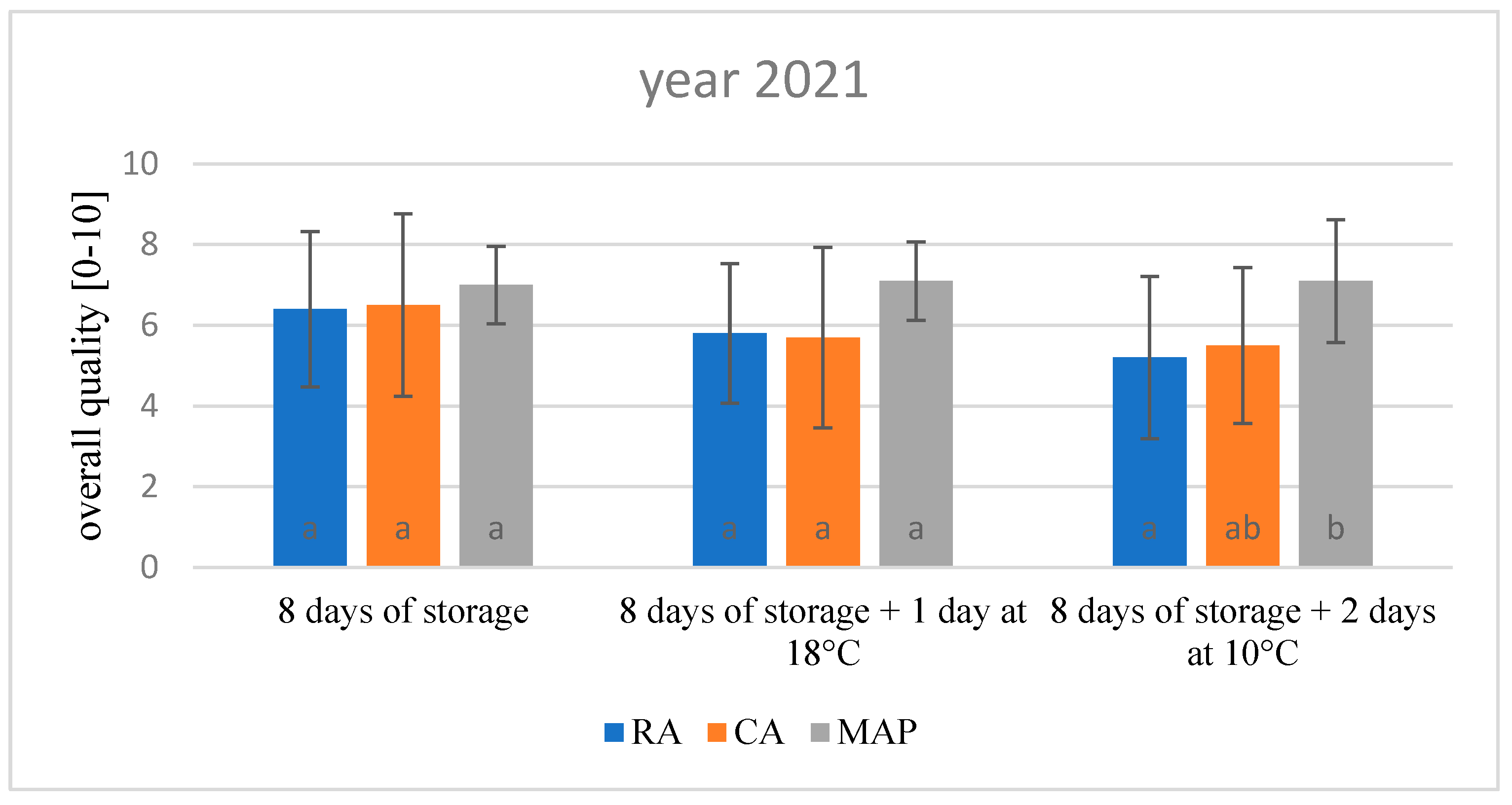
Figure 1b.
Sensory quality ‘Tihope’ blackcurrants after 13 days of storage at RA, CA, and MAP. Season 2022. (Means followed by the same letter are not significantly different at p=0.05 according to Tuckey’s test (separately for each analysed term). Vertical bars denote ± SD).
Figure 1b.
Sensory quality ‘Tihope’ blackcurrants after 13 days of storage at RA, CA, and MAP. Season 2022. (Means followed by the same letter are not significantly different at p=0.05 according to Tuckey’s test (separately for each analysed term). Vertical bars denote ± SD).
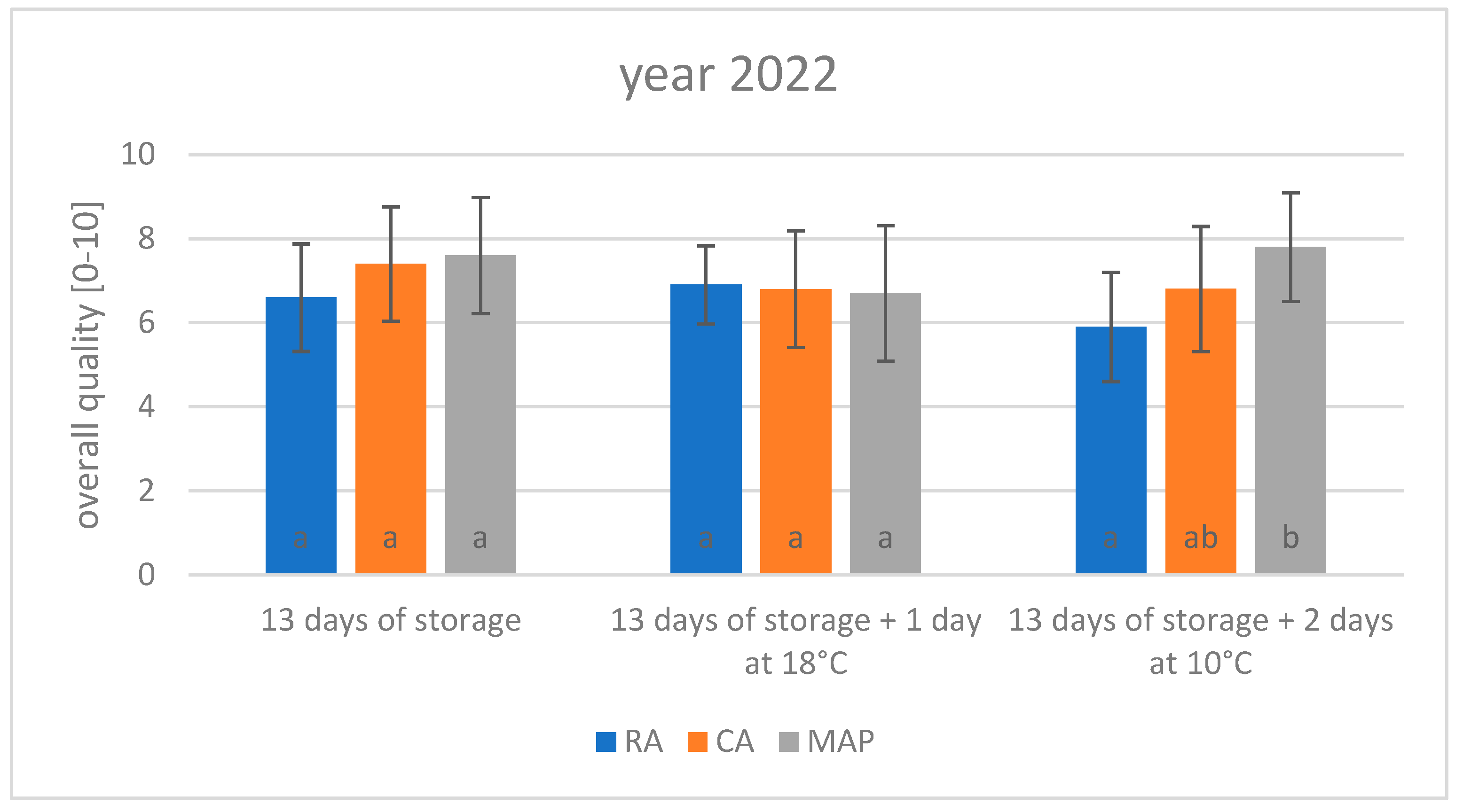
Figure 1c.
Sensory quality ‘Tihope’ blackcurrants after 18 days of storage at RA, CA, and MAP. Season 2023. (Means followed by the same letter are not significantly different at p=0.05 according to Tuckey’s test (separately for each analysed term). Vertical bars denote ± SD).
Figure 1c.
Sensory quality ‘Tihope’ blackcurrants after 18 days of storage at RA, CA, and MAP. Season 2023. (Means followed by the same letter are not significantly different at p=0.05 according to Tuckey’s test (separately for each analysed term). Vertical bars denote ± SD).
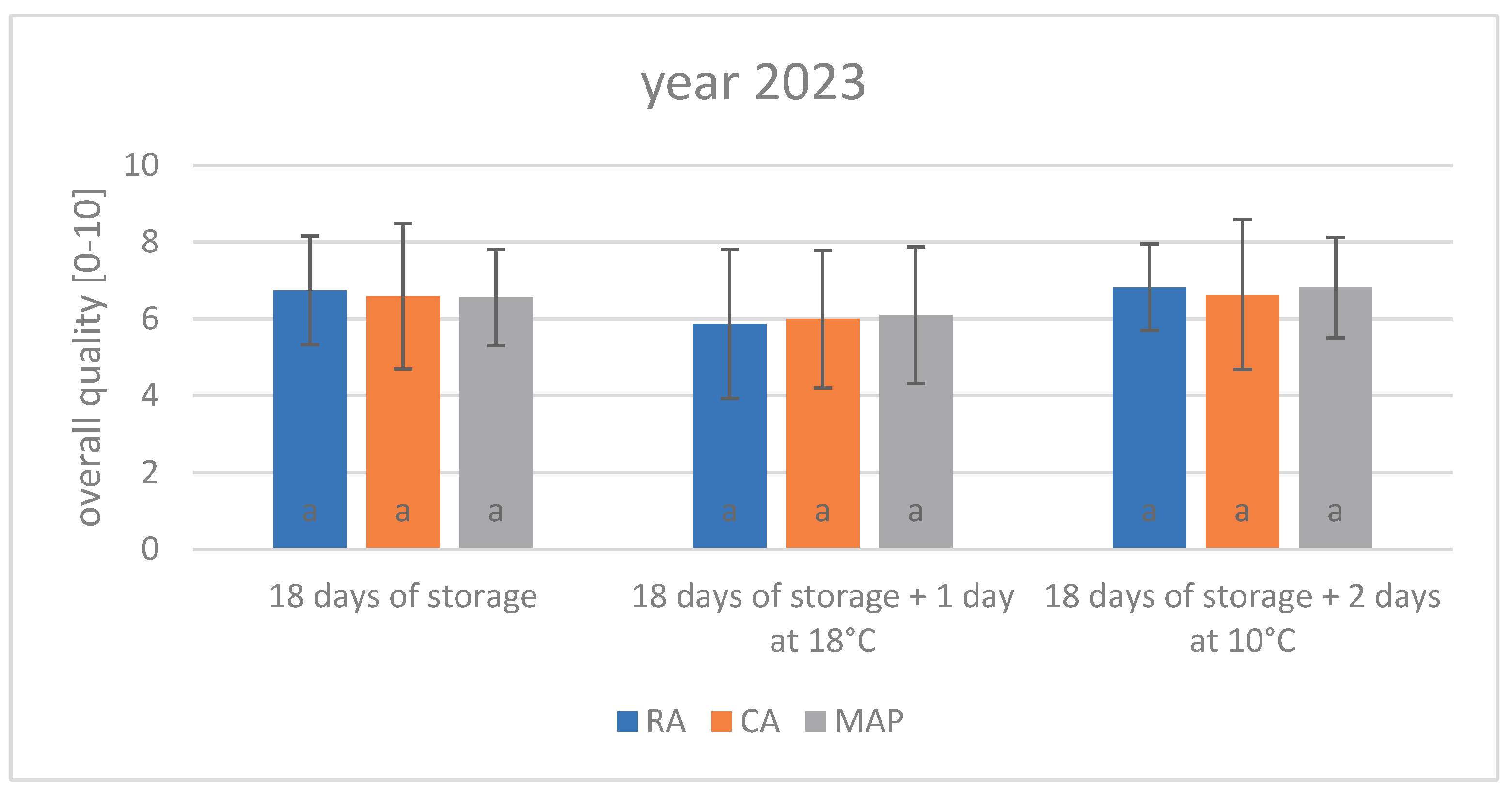
Figure 1d.
Sensory quality ‘Tihope’ blackcurrants after 33 days of storage at RA, CA, and MAP. Season 2023. (Means followed by the same letter are not significantly different at p=0.05 according to Tuckey’s test (separately for each analysed term). Vertical bars denote ± SD).
Figure 1d.
Sensory quality ‘Tihope’ blackcurrants after 33 days of storage at RA, CA, and MAP. Season 2023. (Means followed by the same letter are not significantly different at p=0.05 according to Tuckey’s test (separately for each analysed term). Vertical bars denote ± SD).
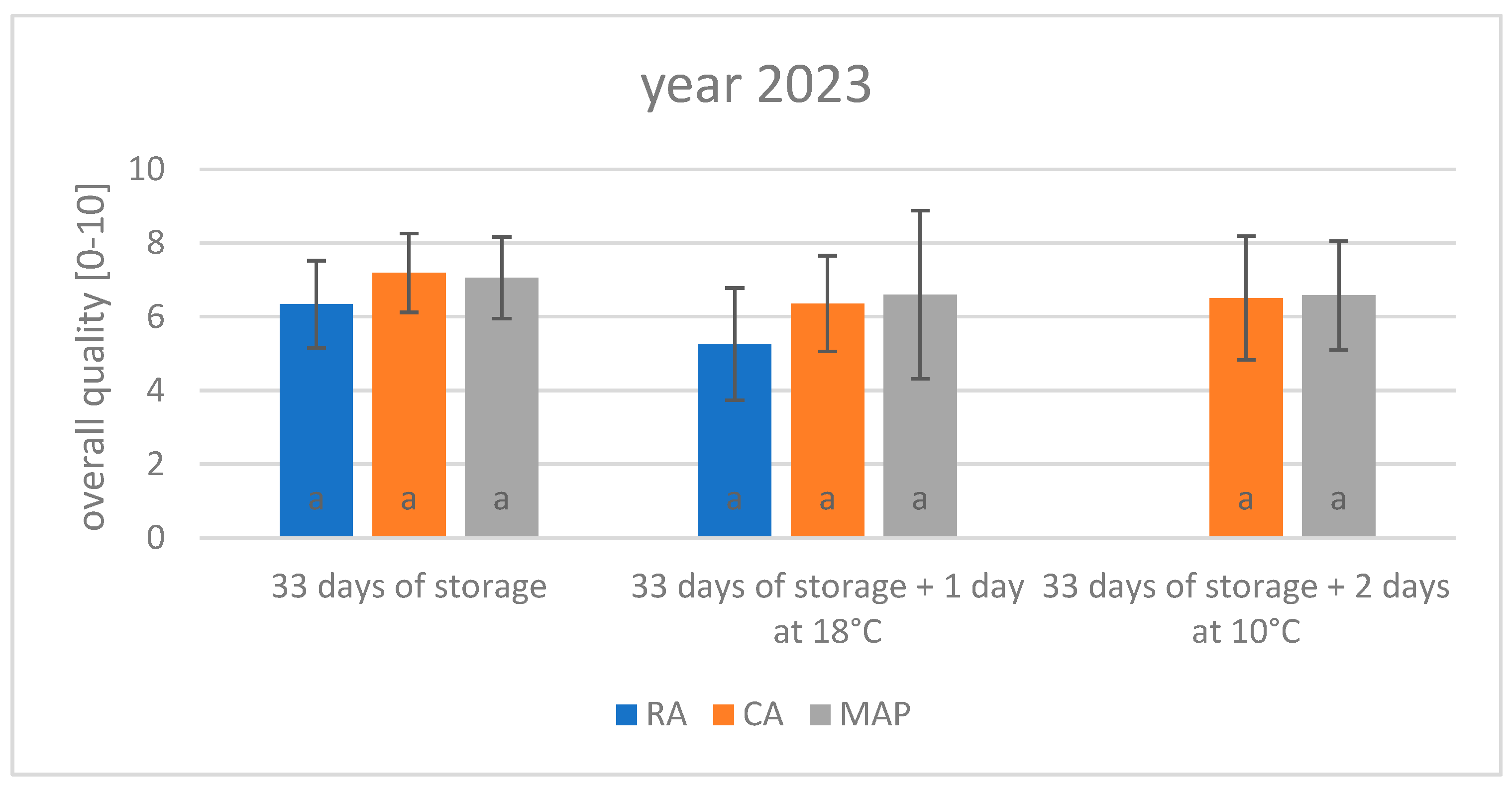

Table 1.
The concentration of oxygen, carbon dioxide and ethylene in MAP packaging during storage of blackcurrant fruit of ‘Tihope’ cv.
Table 1.
The concentration of oxygen, carbon dioxide and ethylene in MAP packaging during storage of blackcurrant fruit of ‘Tihope’ cv.
| Length of Fruit Storage in MAP | O2 (%) |
CO2 (%) |
Ethylene (ppm) |
|---|---|---|---|
| 2021 | |||
| 8 days of storage | 8.17 ±0.670 | 0.144 ±0.0101 | |
| 2022 | |||
| 13 days of storage | 12.9 ±1.15 | 9.70 ±1.054 | 0.065 ±0.0070 |
| 20 days of storage | 13.4 ±0.35 | 9.50 ±0.495 | 0.049 ±0.0070 |
| 2023 | |||
| 18 days of storage | 14.4 ±0.01 | 7.9 ±1.280 | 0.038 ±0.0035 |
| 33 days of storage | 14.4 ±0.01 | 8.6 ±0.490 | 0.028 ±0.0007 |
Table 2a.
The effect of storage conditions on CO2 and ethylene production by ‘Tihope’ fruits. Season 2021.
Table 2a.
The effect of storage conditions on CO2 and ethylene production by ‘Tihope’ fruits. Season 2021.
| Term of analyses | Storage technology | CO2 (µl/g h) |
Ethylene (µl/kg h) |
|---|---|---|---|
| Harvest | - | 27.01 ±0.26 * | 0.02 ±0.001 |
| 8 days of storage | RA CA MAP |
26.96 ±0.47 30.13 ±4.77 34.81 ±0.52 |
Not detectable Not detectable Not detectable |
| 8 days of storage + 1 day at 18 °C |
RA CA MAP |
27.58 ±0.55 28.59 ±0.75 25.98 ±5.60 |
Not detectable Not detectable Not detectable |
| 8 days of storage + 2 days at 10 °C |
RA CA MAP |
32.73 ±4.23 36.18 ±0.90 27.86 ±1.64 |
0.07 ±0.012 0.03 ±0.033 0.03 ±0.018 |
* The data are expressed as mean ± SD.
Table 2b.
The effect of storage conditions on CO2 and ethylene production by ‘Tihope’ fruits. Season 2022.
Table 2b.
The effect of storage conditions on CO2 and ethylene production by ‘Tihope’ fruits. Season 2022.
| Term of analyses | Storage technology | CO2 (µl/g h) |
Ethylene (µl/kg h) |
|---|---|---|---|
| Harvest | - | 49.37 ±1.80 | 0.05 ±0.022 |
| 13 days of storage | RA CA MAP |
37.80 ±1.08 33.27 ±4.85 34.51 ±0.60 |
0.04 ±0.017 0.02 ±0.005 0.05 ±0.010 |
| 13 days of storage + 1 day at 18 °C |
RA CA MAP |
29.51 ±4.41 32.49 ±4.46 37.44 ±1.75 |
0.04 ±0.018 0.05 ±0.022 0.07 ±0.035 |
| 13 days of storage + 2 days at 10 °C |
RA CA MAP |
27.76 ±0.26 37.67 ±5.00 26.15 ±0.74 |
0.05 ±0.029 0.06 ±0.019 0.04 ±0.004 |
| 20 days of storage | RA CA MAP |
34.25 ±0.67 26.63 ±0.81 33.37 ±4.36 |
0.10 ±0.048 0.04 ±0.013 0.08 ±0.020 |
| 20 days of storage + 1 day at 18 °C |
RA CA MAP |
25.69 ±0.51 26.63 ±0.81 27.02 ±2.32 |
0.11 ±0.054 0.11 ±0.029 0.07 ±0.057 |
| 20 days of storage + 2 days at 10 °C |
RA CA MAP |
31.71 ±5.11 28.45 ±0.86 37.62 ±6.71 |
0.13 ±0.046 0.07 ±0.038 0.11 ±0.015 |
* The data are expressed as mean ± SD.
Table 2c.
The effect of storage conditions on CO2 and ethylene production by ‘Tihope’ fruits. Season 2023.
Table 2c.
The effect of storage conditions on CO2 and ethylene production by ‘Tihope’ fruits. Season 2023.
| Term of analyses | Storage technology | CO2 (µl/g h) |
Ethylene (µl/kg h) |
|---|---|---|---|
| Harvest | - | 42.31 ±0.81 | 0.04 ±0.010 |
| 18 days of storage | RA CA MAP |
38.53 ±0.57 39.37 ±3.25 46.28 ±1.92 |
Not detectable Not detectable Not detectable |
| 18 days of storage + 1 day at 18 °C |
RA CA MAP |
28.90 ±0.43 30.24 ±3.64 39.97 ±3.64 |
0.06 ±0.036 0.03 ±0.026 0.04 ±0.022 |
| 18 days of storage + 2 days at 10 °C |
RA CA MAP |
41.80 ±5.13 35.80 ±0.90 39.30 ±5.44 |
0.04 ±0.010 0.01 ±0.015 0.09 ±0.051 |
| 33 days of storage | RA CA MAP |
34.67 ±0.30 43.24 ±0.62 43.93 ±0.49 |
0.06 ±0.018 0.02 ±0.008 0.03 ±0.001 |
| 33 days of storage + 1 day at 18 °C |
RA CA MAP |
28.90 ±5.01 31.75 ±5.40 35.14 ±0.39 |
0.10 ±0.009 0.09 ±0.014 0.16 ±0.039 |
| 33 days of storage + 2 days at 10 °C |
RA CA MAP |
- 35.75 ±1.08 41.93 ±6.21 |
- 0.04 ±0.013 0.14 ±0.022 |
* The data are expressed as mean ± SD.
Table 3a.
The effect of storage conditions on fruit quality of ‘Tihope’ cultivar. Season 2021.
| Term of analyses | Storage technology |
Firmness (N) |
TSS (%) |
TA (%) |
TSS/TA |
|---|---|---|---|---|---|
| Harvest | - | 1.43 | 16.43 | 3.72 | 4.42 |
| 8 days of storage | RA CA MAP |
1.41 a 1.47 a 1.41 a |
15.17 a 15.03 a 15.17 a |
3.86 a 3.90 a 3.76 a |
3.93 a 3.85 a 4.03 a |
| 8 days of storage + 1 day at 18 °C |
RA CA MAP |
1.11 a 1.34 b 1.31 b |
15.83 b 14.70 a 16.20 b |
3.84 a 3.83 a 3.75 a |
4.12 b 3.84 a 4.32 b |
| 8 days of storage + 2 days at 10 °C |
RA CA MAP |
1.12 a 1.43 b 1.19 a |
13.93 a 14.73 ab 15.10 b |
3.91 a 3.90 a 3.81 a |
3.56 a 3.78 ab 3.97 b |
| 14 days of storage | RA CA MAP |
0.93 a 1.71 c 1.29 b |
16.10 b 14.47 a 14.83 a |
3.75 a 3.73 a 3.83 a |
4.29 b 3.88 a 3.87 a |
| 14 days of storage + 1 day at 18 °C |
RA CA MAP |
1.15 a 1.57 b 1.20 a |
14.87 a 14.33 a 16.53 b |
3.78 a 3.82 a 3.68 a |
3.93 a 3.75 a 4.49 b |
| 14 days of storage + 2 days at 10 °C |
RA CA MAP |
1.20 a 1.64 b 1.13 a |
15.33 b 13.87 a 14.37 ab |
3.74 a 3.96 a 3.96 a |
4.10 a 3.50 a 3.64 a |
* Means followed by the same letter are not significantly different at p=0.05 according to Tuckey’s test (separately for each analysed term).
Table 3b.
The effect of storage conditions on fruit quality of ‘Tihope’ cultivar. Season 2022.
| Term of analyses | Storage technology |
Firmness (N) | TSS (%) |
TA (%) |
TSS/TA |
|---|---|---|---|---|---|
| Harvest | - | 1.87 | 13.47 | 3.65 | 3.69 |
| 13 days of storage | RA CA MAP |
1.19 a 1.71 c 1.51 b |
15.70 a 15.23 a 14.90 a |
3.31 a 3.55 b 3.63 b |
4.74 b 4.29 a 4.10 a |
| 13 days of storage + 1 day at 18 °C |
RA CA MAP |
1.08 a 1.68 b 1.01 a |
16.17 b 13.87 a 14.10 a |
3.63 a 3.62 a 3.97 b |
4.46 b 3.83 a 3.55 a |
| 13 days of storage + 2 days at 10 °C |
RA CA MAP |
1.04 a 1.36 b 1.24 b |
14.07 a 15.30 b 15.40 b |
3.70 ab 3.77 b 3.64 a |
3.80 a 4.06 b 4.23 c |
| 20 days of storage | RA CA MAP |
0.99 a 1.58 b 1.10 a |
15.40 a 13.80 a 15.17 a |
3.72 a 3.84 b 3.71 a |
4.14 b 3.59 a 4.09 b |
| 20 days of storage + 1 day at 18 °C |
RA CA MAP |
0.93 a 1.17 b 0.95 a |
15.60 a 16.23 a 15.63 a |
3.70 b 3.46 a 3.70 b |
4.22 a 4.69 b 4.22 a |
| 20 days of storage + 2 days at 10 °C |
RA CA MAP |
0.84 a 1.44 b 0.92 a |
16.33 b 15.70 b 14.77 a |
3.29 a 3.56 b 3.74 c |
4.96 c 4.41 b 3.95 a |
* Means followed by the same letter are not significantly different at p=0.05 according to Tuckey’s test (separately for each analysed term).
Table 3c.
The effect of storage conditions on fruit quality of ‘Tihope’ cultivar. Season 2023.
| Term of analyses | Storage technology |
Firmness (N) |
TSS (%) |
TA (%) |
TSS/TA |
|---|---|---|---|---|---|
| Harvest | - | 1.50 | 14.03 | 4.09 | 3.43 |
| 18 days of storage | RA CA MAP |
0.78 a 1.53 c 1.19 b |
13.90 a 14.60 b 14.80 b |
3.90 a 3.95 a 3.95 a |
3.56 a 3.69 b 3.75 b |
| 18 days of storage + 1 day at 18 °C |
RA CA MAP |
0.90 a 1.67 c 1.26 b |
14.50 a 14.03 a 14.10 a |
3.83 a 3.87 a 3.89 a |
3.79 a 3.63 a 3.63 a |
| 18 days of storage + 2 days at 10 °C |
RA CA MAP |
0.85 a 1.39 c 1.10 b |
14.27 b 14.60 b 13.77 a |
3.93 a 4.11 b 3.96 ab |
3.63 a 3.56 a 3.48 a |
| 33 days of storage | RA CA MAP |
0.54 a 1.32 b 1.41 b |
14.40 a 15.27 b 14.07 a |
3.89 b 3.68 a 3.87 b |
3.70 a 4.15 b 3.64 a |
| 33 days of storage + 1 day at 18 °C |
RA CA MAP |
0.49 a 1.19 c 0.84 b |
14.73 c 14.30 b 13.23 a |
3.89 a 3.77 a 3.80 a |
3.79 b 3.79 b 3.48 a |
| 33 days of storage + 2 days at 10 °C |
RA CA MAP |
-** 1.06 b 0.78 a |
- 14.33 b 13.47 a |
- 3.96 b 3.78 a |
- 3.62 a 3.57 a |
* Means followed by the same letter are not significantly different at p=0.05 according to Tuckey’s test (separately for each analysed term); ** no fruits.
Table 4a.
The effect of storage conditions on the content of phenolic compounds, vitamin C, and antioxidant capacity in ‘Tihope’ blackcurrant fruits after 8 days of storage at RA, CA, and MAP. Season 2021.
Table 4a.
The effect of storage conditions on the content of phenolic compounds, vitamin C, and antioxidant capacity in ‘Tihope’ blackcurrant fruits after 8 days of storage at RA, CA, and MAP. Season 2021.
| Term of analyses | Storage technology |
ABTS (mg Trolox/g) |
TPC (mg/100g) |
Vitamin C (mg/100g) |
|---|---|---|---|---|
| Harvest | - | 7.2 ±0,01 | 330.3 ±5.86 | 146.2 ±0.83 |
| 8 days of storage | RA CA MAP |
8.4 ±0.00 8.0 ±0.07 5.2 ±0.02 |
320.4 ±4.77 333.8 ±0.08 349.7 ±5.82 |
159.1 ±5.74 158.1 ±2.50 143.9 ±1.02 |
| 8 days of storage + 1 day at 18 °C |
RA CA MAP |
8.6 ±0.14 8.9 ±0.10 9.8 ±0.01 |
314.4 ±2.31 335.7 ±3.52 357.2 ±1.02 |
134.6 ±2.59 142.9 ±3.89 140.5 ±9.54 |
| 8 days of storage + 2 days at 10 °C |
RA CA MAP |
8.2 ±0.02 8.7 ±0.06 8.1 ±0.10 |
339.0 ±2.07 374.8 ±1.33 369.8 ±3.24 |
134.9 ±0.93 147.3 ±1.20 138.0 ±1.48 |
* Mean ± SD.
Table 4b.
The effect of storage conditions on the content of phenolic compounds, vitamin C, and antioxidant capacity in ‘Tihope’ blackcurrant fruits after 13 days of storage at RA, CA, and MAP. Season 2022.
Table 4b.
The effect of storage conditions on the content of phenolic compounds, vitamin C, and antioxidant capacity in ‘Tihope’ blackcurrant fruits after 13 days of storage at RA, CA, and MAP. Season 2022.
| Term of analyses | Storage technology |
ABTS (mg Trolox/g) |
TPC (mg/100g) |
Vitamin C (mg/100g) |
|---|---|---|---|---|
| Harvest | - | 9.1 ±0.06 | 336.5 ±3.14 | 175.0 ±3.22 |
| 13 days of storage | RA CA MAP |
9.4 ±0.07 9.4 ±0.09 8.8 ±0.10 |
350.5 ±0.46 330.4 ±4.04 329.5 ±0.43 |
181.6 ±0.68 178.7 ±0.49 171.0 ±1.37 |
| 13 days of storage + 1 day at 18 °C |
RA CA MAP |
11.0 ±0.08 7.4 ±0.00 9.7 ±0.03 |
364.6 ±3.43 300.1 ±0.68 334.3 ±2.57 |
187.5 ±2.93 151.0 ±1.76 175.8 ±0.29 |
| 13 days of storage + 2 days at 10 °C |
RA CA MAP |
9.7 ±0.03 10.2 ±0.05 9.9 ±0.04 |
359.6 ±12.32 368.9 ±0.75 361.0 ±0.43 |
181.8 ±1.17 187.8 ±0.88 178.6 ±1.07 |
* Mean ± SD.
Table 4c.
The effect of storage conditions on the content of phenolic compounds, vitamin C, and antioxidant capacity in ‘Tihope’ blackcurrant fruits after 33 days of storage at RA, CA, and MAP. Season 2023.
Table 4c.
The effect of storage conditions on the content of phenolic compounds, vitamin C, and antioxidant capacity in ‘Tihope’ blackcurrant fruits after 33 days of storage at RA, CA, and MAP. Season 2023.
| Term of analyses | Storage technology |
ABTS (mg Trolox/g) |
TPC (mg/100g) |
Vitamin C (mg/100g) |
|---|---|---|---|---|
| Harvest | - | 5.7 ±0.03* | 287.3 ±0.67 | 116.7 ±2.69 |
| 33 days of storage | RA CA MAP |
6.4 ±0.06 6.7 ±0.06 7.4 ±0.01 |
299.0 ±2.25 300.2 ±1.03 331.1 ±5.10 |
114.2 ±1.37 135.2 ±3.30 131.3 ±2.41 |
| 33 days of storage + 1 day at 18 °C |
RA CA MAP |
7.0 ±0.04 6.3 ±0.03 7.0 ±0.00 |
295.9 ±2.06 283.2 ±3.56 298.2 ±3.32 |
119.8 ±3.87 108.8 ±1.03 122.5 ±0.47 |
| 33 days of storage + 2 days at 10 °C |
RA CA MAP |
-** 6.5 ±0.01 7.1 ±0.00 |
- 283.4 ±4.90 294.5 ±3.87 |
- 111.1 ±0.13 114.3 ±0.85 |
* Mean ± SD; ** no fruits.
Table 5a.
The content of sugars (sucrose, glucose, and fructose) in ‘Tihope’ blackcurrant fruits after 8 days of storage at RA, CA, and MAP. Season 2021.
Table 5a.
The content of sugars (sucrose, glucose, and fructose) in ‘Tihope’ blackcurrant fruits after 8 days of storage at RA, CA, and MAP. Season 2021.
| Term of analyses | Storage technology |
Sucrose (g/kg) |
Glucose (g/kg) |
Fructose (g/kg) |
|---|---|---|---|---|
| Harvest | - | 11.2 ±0.23* | 22.2 ±0.07 | 34.8 ±0.11 |
| 8 days of storage | RA CA MAP |
10.3 ±0.20 11.4 ±0.12 15.0 ±0.00 |
25.7 ±0.08 25.8 ±0.04 27.7 ±0.06 |
40.0 ±0.24 40.5 ±0.02 42.7 ±0.05 |
| 8 days of storage + 1 day at 18 °C |
RA CA MAP |
12.4 ±0.25 12.4 ±0.24 11.2 ±0.14 |
23.6 ±0.21 22.3 ±0.03 25.4 ±0.14 |
38.0 ±0.64 39.3 ±0.32 39.9 ±0.00 |
| 8 days of storage + 2 days at 10 °C |
RA CA MAP |
10.3 ±0.68 11.6 ±0.07 11.5 ±0.19 |
25.9 ±0.06 25.9 ±0.48 24.9 ±0.80 |
40.5 ±0.55 40.5 ±0.81 39.1 ±0.46 |
* Mean ± SD.
Table 5b.
The content of sugars (sucrose, glucose, and fructose) in ‘Tihope’ blackcurrant fruits after 8 days of storage at RA, CA, and MAP. Season 2022.
Table 5b.
The content of sugars (sucrose, glucose, and fructose) in ‘Tihope’ blackcurrant fruits after 8 days of storage at RA, CA, and MAP. Season 2022.
| Term of analyses | Storage technology |
Sucrose (g/kg) |
Glucose (g/kg) |
Fructose (g/kg) |
|---|---|---|---|---|
| Harvest | - | 15.0 ±0.28* | 23.5 ±0.57 | 37.1 ±0.30 |
| 13 days of storage | RA CA MAP |
11.3 ±0.44 11.5 ±0.06 10.8 ±0.07 |
25.0 ±0.21 22.7 ±0.14 21.8 ±0.31 |
41.4 ±0.33 36.4 ±0.25 36.3 ±0.07 |
| 13 days of storage + 1 day at 18 °C |
RA CA MAP |
11.1 ±0.02 7.7 ±0.02 10.7 ±0.03 |
24.3 ±0.22 18.3 ±0.39 21.7 ±0.20 |
41.3 ±0.28 29.4 ±0.10 38.0 ±0.18 |
| 13 days of storage + 2 days at 10 °C |
RA CA MAP |
10.6 ±0.02 13.0 ±0.22 10.4 ±0.02 |
21.8 ±0.25 23.9 ±0.33 22.0 ±0.23 |
38.0 ±0.25 39.1 ±0.26 37.5 ±0.23 |
* Mean ± SD.
Table 5c.
The content of sugars (sucrose, glucose, and fructose) in ‘Tihope’ blackcurrant fruits after 33 days of storage at RA, CA, and MAP. Season 2023.
Table 5c.
The content of sugars (sucrose, glucose, and fructose) in ‘Tihope’ blackcurrant fruits after 33 days of storage at RA, CA, and MAP. Season 2023.
| Term of analyses | Storage technology |
Sucrose (g/kg) |
Glucose (g/kg) |
Fructose (g/kg) |
|---|---|---|---|---|
| Harvest | - | 12.5 ±0.11* | 22.6 ±0.18 | 36.0 ±0.02 |
| 33 days of storage | RA CA MAP |
7.5 ±0.03 10.0 ±0.11 11.9 ±0.05 |
22.0 ±1.32 25.6 ±0.23 26.1 ±0.13 |
37.1 ±0.12 37.9 ±0.85 42.8 ±0.31 |
| 33 days of storage + 1 day at 18 °C |
RA CA MAP |
6.5 ±0.02 8.8 ±0.05 8.6 ±0.02 |
24.4 ±0.17 22.7 ±0.20 27.1 ±0.10 |
43.9 ±0.24 36.0 ±0.34 43.0 ±0.11 |
| 33 days of storage + 2 days at 10 °C |
RA CA MAP |
-** 8.7 ±0.03 6.2 ±0.04 |
- 26.1 ±0.21 25.1 ±0.20 |
- 40.1 ±0.16 42.0 ±0.25 |
* Mean ± SD; ** no fruits.
Disclaimer/Publisher’s Note: The statements, opinions and data contained in all publications are solely those of the individual author(s) and contributor(s) and not of MDPI and/or the editor(s). MDPI and/or the editor(s) disclaim responsibility for any injury to people or property resulting from any ideas, methods, instructions or products referred to in the content. |
© 2025 by the authors. Licensee MDPI, Basel, Switzerland. This article is an open access article distributed under the terms and conditions of the Creative Commons Attribution (CC BY) license (http://creativecommons.org/licenses/by/4.0/).
Copyright: This open access article is published under a Creative Commons CC BY 4.0 license, which permit the free download, distribution, and reuse, provided that the author and preprint are cited in any reuse.


