

Submitted:
27 September 2025
Posted:
29 September 2025
You are already at the latest version
Abstract
Integrating grit, growth mindset, and personalized blended learning offers a promising strategy to enhance academic and non-cognitive outcomes, particularly in high-stakes testing contexts where performance pressures are intense. While previous research has established the individual value of grit, mindset, and blended learning, few studies have examined their combined impact. This study evaluates the Mind-Grit Pathways frame-work, designed to align with Sustainable Development Goal 4 (SDG 4) by fostering equi-table, high-quality, and technology-enhanced education. Using a quasi-experimental pre-test/post-test design, the study involved 11th-grade students from two urban high schools. The treatment group (n = 501) engaged in a blended learning model enriched with grit and mindset development, while the control group (n = 488) followed traditional instruction. Data sources included statewide test scores and validated grit and mindset surveys, analyzed through ANCOVA, correlation, and subgroup comparisons. Results revealed significant gains in all subjects for the treatment group—Math (η² = .935), Read-ing (η² = .882), English (η² = .694), and Science (η² = .910)—alongside improvements in grit (η² = .248) and growth mindset (η² = .289). Growth mindset strongly correlated with achievement (r > .81), grit showed moderate links (r ≈ .18–.21), and demographic effects were minimal. Overall, the framework demonstrates scalable potential for transforming 21st-century education.

Keywords:
blended learning
; personalized learning
; growth mindset
; grit
; educational equity
; high-stakes testing
; SDG 4
; academic achievement
1. Introduction
1.1. Background and Rationale
Grit and growth mindset emerge as foundational constructs in the pursuit of academic resilience and long-term achievement. Grit, defined as sustained passion and perseverance toward long-term goals, contributes to student persistence in demanding educational environments [1,2]. A growth mindset—the belief that intelligence and abilities develop through effort and learning—has been associated with improved motivation, greater academic engagement, and resilience [3,4].
Blended learning environments, which integrate face-to-face instruction with online platforms, provide flexible and student-centered learning opportunities [5]. Personalized learning extends this model by customizing content, pace, and feedback to students’ individual needs and progress, fostering ownership and persistence [6]. While prior research has examined the independent effects of grit, growth mindset, and blended or personalized learning, few studies have examined their combined influence—particularly in high-stakes testing contexts where students face increased academic pressure and accountability demands.
1.2. Purpose of the Study
This study evaluates the Mind-Grit Pathways framework (Figure 1), an integrated intervention that combines grit, growth mindset, personalized learning, and blended instruction. The framework supports both cognitive and non-cognitive development, with the goal of enhancing student outcomes in high-stakes testing environments. It also addresses broader global priorities by promoting inclusive and technology-enhanced learning models.
The purpose of this study is to examine the effects of an innovative intervention designed to improve students’ academic performance in high-stakes testing. The intervention is based on a comprehensive framework, termed Mind-Grit Pathways, which integrates grit, growth mindset, blended learning, and personalized learning pathways (Figure 1). This study investigates the impact of this framework on both academic achievement and the development of grit and mindset among 11th-grade students. Implemented within a southwestern urban school district, this framework aimed to address the academic needs of students by fostering resilience and adaptability through a structured, supportive, and technology-enhanced learning environment.
1.3. Significance of the Study
This study fills a critical gap in the literature by exploring how academic and non-cognitive supports function synergistically within a structured, student-centered learning environment. It aligns with the objectives of SDG 4, which emphasizes inclusive and equitable education and the promotion of lifelong learning opportunities for all [7]. This integrative approach offers a scalable model for education systems aiming to promote equity and excellence through innovation.
1.4. Research Objectives
The study seeks to:
- Evaluate the impact of the framework on Math, Reading, English, and Science performance (SDG 4.1).
- Measure changes in grit and growth mindset (SDG 4.5).
- Analyze correlations between academic and non-cognitive outcomes (SDG 4.4).
- Examine demographic subgroup effects (SDG 4.5).
- Assess the influence of teacher professional development on implementation fidelity and instructional quality (SDG 4.c).
- Determine the framework’s contributions to the overarching goals of SDG 4.
1.5. Research Questions
In light of the objectives of this research, the following research questions guide this study:
- To what extent does the Mind-Grit Pathways framework improve academic performance in high-stakes testing? (SDG 4.1)
- How does the intervention influence grit and growth mindset scores? (SDG 4.5)
- What relationships exist between academic achievement, grit, and mindset? (SDG 4.1 & 4.4)
- How do gender, race/ethnicity, parental education, socioeconomic status, and living situation affect outcomes? (SDG 4.5)
- How does teacher training contribute to instructional effectiveness within the framework?
2. Literature Review
2.1. Growth Mindset and Grit in Education
Growth mindset and grit have received substantial attention for their roles in fostering academic perseverance and long-term success. Growth mindset refers to the belief that abilities and intelligence are not fixed but develop through effort and learning [3]. Students who hold a growth mindset are more likely to embrace challenges and persist despite difficulties, which supports their academic performance [3]. Research has shown that growth mindset moderates the effects of socioeconomic adversity, helping students from disadvantaged backgrounds maintain high levels of achievement [4].
Grit, defined as perseverance and sustained passion for long-term goals, also predicts academic success. Duckworth et al. [1] have introduced the construct and later developed the Short Grit Scale [2] to measure it reliably. Studies have linked higher grit scores to improved attendance, better grades, and stronger engagement across school settings [8]. Although growth mindset and grit are distinct constructs, researchers have suggested that a growth mindset may promote the development of grit by reinforcing beliefs about the value of sustained effort [3,9].
Despite these insights, most empirical studies have examined grit and mindset in isolation. The combined influence of these traits within structured educational interventions—particularly in high-stakes assessment contexts—has not been fully explored.
2.2. Blended and Personalized Learning
Blended learning merges digital technologies with traditional instruction, offering students more control over pace and modality. This hybrid model supports differentiated learning and can enhance both engagement and outcomes [5]. Meta-analyses have reported that blended learning produces significantly greater academic gains than traditional instruction, especially when paired with evidence-based strategies [10].
Personalized learning extends this model by tailoring instruction to individual strengths, needs, and interests. Pane et al. [6] have shown that personalized learning improves student autonomy, mastery, and test performance—particularly among learners who struggle in conventional classrooms. Bingham et al. [11] have also found that personalized learning supports student motivation when it incorporates self-directed tasks and timely feedback.
The literature has established the positive impact of both blended and personalized learning, especially when digital platforms are integrated to promote flexibility and mastery. These instructional approaches align with SDG Target 4.4, which advocates for digital skills and innovative teaching strategies to enhance education quality. However, few studies have examined how these methods interact with non-cognitive interventions such as grit and mindset training in high-stakes learning contexts.
2.3. High-Stakes Testing and Educational Equity
High-stakes testing remains a central component of educational accountability, yet it often intensifies performance disparities. These tests influence graduation, promotion, and funding decisions, creating significant pressure on both students and schools [12]. Students from under-resourced backgrounds may face additional challenges, including limited academic support and heightened test anxiety [13]. Interventions that promote adaptive traits—such as resilience, motivation, and goal orientation—have shown promise in mitigating these stressors.
Growth mindset and grit have been effective in reducing the negative psychological effects of high-stakes environments. Yeager et al. [14,15] have demonstrated that mindset-based interventions reduce anxiety, improve perseverance, and strengthen academic outcomes. Despite this, research has not fully examined how these traits interact with instructional models such as blended learning when applied systematically across entire school populations.
2.4. Summary of Gaps Addressed by This Study
The existing literature has established that growth mindset, grit, and personalized or blended instruction each positively influence academic outcomes. However, the intersection of these components—particularly their integration into a single, structured framework—remains underexplored. Few studies have examined how grit and mindset interact with adaptive, technology-based instructional models to influence outcomes in high-stakes testing environments. This study addresses this gap by evaluating the Mind-Grit Pathways framework, which integrates cognitive and non-cognitive strategies within a personalized blended learning model to support both academic performance and psychological resilience.
3. Materials and Methods
3.1. Research Design
This study adopts a quasi-experimental pre-test/post-test design to evaluate the impact of a blended learning intervention that incorporates grit and growth mindset development. The design includes a treatment and a control group and examines academic and non-cognitive outcomes under real-world school conditions. This approach is suitable for educational settings where random assignment is not feasible [16].
The study aligns with SDG 4 by promoting cognitive and non-cognitive skill development (Target 4.1), advancing educational equity (Target 4.5), and strengthening teacher capacity through professional development (Target 4.c). The design enables analysis of academic achievement, mindset, grit, and the moderating role of demographic variables.
3.2. Participants and Setting
The study involves 989 11th-grade students from two demographically similar high schools in a southwestern U.S. urban district during the 2017–2018 academic year. The treatment group (n = 501) participates in the Mind-Grit Pathways intervention, while the control group (n = 488) continues with traditional instruction. The schools are matched on baseline academic performance to ensure comparability.
3.3. Description of the Intervention
The Mind-Grit Pathways framework combines blended and personalized learning strategies with structured development of growth mindset and grit. The intervention consists of three interdependent components:
- Blended Learning Environment: Students engage with a combination of face-to-face instruction and digital content, allowing for flexible, multimodal learning experiences [5].
- Personalized Learning Pathways: Instruction is customized based on student strengths, needs, and learning pace. Digital platforms provide real-time feedback and allow for mastery-based progression [6].
Teachers in the treatment group receive targeted professional development before implementation. Training focuses on using the online platform, differentiating instruction, and integrating mindset and grit principles. Research has emphasized that professional development is essential for effective blended learning implementation [18].
3.4. Data Collection Instruments
Data collection includes standardized test scores, validated psychological surveys, and demographic information.
- Academic Performance: Statewide high-stakes test scores in Math, Reading, English, and Science serve as outcome variables. Pre- and post-test data enable within- and between-group comparisons, with adjustments for baseline performance [12].
3.5. Data Analysis Procedures
A multi-step analytical approach ensures rigorous evaluation of the intervention:
- Descriptive Statistics: Means, standard deviations, and frequencies summarize all variables.
- Reliability Analysis: Cronbach’s alpha assesses internal consistency of the grit and mindset scales [19].
- ANCOVA: Pre-test scores are used as covariates to evaluate intervention effects on academic and non-cognitive outcomes, isolating the treatment’s impact [20].
- Correlation Analysis: Pearson’s correlation coefficients examine relationships between post-intervention academic scores, grit, and mindset [21].
This methodology supports a comprehensive assessment of both learning and psychological outcomes, contributing to the literature on holistic, technology-enhanced educational frameworks.
4. Results
4.1. Instrument Reliability
4.2. Baseline Comparisons
Pre-intervention analyses confirm that the treatment and control groups are statistically equivalent in academic performance across all subjects. Table 2 shows no significant differences (p > .05), and all effect sizes are negligible (η² = 0.000), supporting the internal validity of the design.
4.3. Academic Outcomes in High-Stakes Testing
ANCOVA results reveal significant improvements in the treatment group’s post-test scores, even after adjusting for pre-intervention differences. Table 3 displays the adjusted means and associated effect sizes, all of which are large (η² > .69), demonstrating the strong impact of the intervention on academic achievement.
4.5. Non-Cognitive Outcomes: Grit and Growth Mindset
Students in the treatment group report significantly higher post-intervention scores in both grit and growth mindset:
- Grit: Treatment group mean = 3.83; Control group mean = 3.01; η² = .248 (p < .001).
- Growth Mindset: Treatment group mean = 40.41; Control group mean = 33.53; η² = .289 (p < .001).
These findings confirm that the intervention effectively fosters non-cognitive skill development, contributing to SDG 4.5.
4.6. Correlations Between Academic and Non-Cognitive Outcomes
Correlation analysis supports the predictive value of non-cognitive traits on academic performance. As shown in Table 4, growth mindset positively and strongly correlates strongly with all academic subjects, while grit shows moderate positive associations.
5. Discussion
5.1. Academic Impact of the Mind-Grit Pathways Framework
The findings demonstrate that the Mind-Grit Pathways framework produces significant academic gains across all tested subjects—Math, Reading, English, and Science. The large effect sizes observed (η² ranging from .694 to .935) suggest that the integration of blended and personalized learning with non-cognitive development fosters meaningful academic advancement. These outcomes support existing research that has documented the positive effects of blended learning on student achievement [5,10] and extend this literature by showing that combining academic content with psychological skill-building amplifies impact.
The high degree of improvement across content areas aligns with SDG Target 4.1, which emphasizes improving learning outcomes in foundational academic subjects. By situating cognitive instruction within a flexible, student-centered environment, the framework allows students to master content at their own pace while receiving continuous feedback—both academic and motivational. This dual focus contributes to a deeper engagement with learning and addresses performance gaps often seen in high-stakes contexts [12].
5.2. Growth in Non-Cognitive Outcomes and Their Influence
Beyond academic improvements, the intervention significantly enhances students’ grit and growth mindset scores. The development of these traits contributes to a learning environment in which students persist through challenges and view failure as a path to growth [3]. The substantial effect sizes (η² = .248 for grit; η² = .289 for mindset) indicate that the non-cognitive elements of the framework are not ancillary but integral to the learning process.
The strong correlations between mindset and academic outcomes (r > .81) confirm that growth mindset serves as a reliable predictor of academic performance. These results reinforce prior research by Claro et al. [4] and Yeager et al. [14], which has shown that students who believe in their capacity to grow are more likely to succeed—especially under pressure. While grit demonstrates moderate correlations, its consistent relationship with academic success affirms its role in sustaining long-term effort [1,8].
These findings support SDG Target 4.4, which encourages the development of skills for lifelong learning, including resilience, adaptability, and self-regulation. The framework promotes these competencies by embedding them into daily instructional routines.
5.3. The Role of Teachers and Professional Development
Teacher training proves essential in implementing the framework effectively. Professional development provided to the treatment school ensures instructional fidelity and consistency across classrooms. The success of the intervention reflects not only student engagement but also teacher competence in delivering content through digital platforms while supporting growth mindset and grit.
These findings affirm the importance of SDG Target 4.c, which calls for improving teacher training and professional capacity. The integration of mindset and grit training into professional learning demonstrates how teacher development can influence both academic and psychological outcomes for students.
5.4. Implications for Policy and Practice
The scalability of the Mind-Grit Pathways framework lies in its use of accessible technologies, structured teacher training, and curriculum-aligned growth mindset and grit strategies. Its alignment with multiple targets of SDG 4 makes it relevant for international education systems seeking holistic, future-oriented reform. Policymakers can leverage these findings to support models that bridge academic and non-cognitive development, particularly in systems with performance pressures and equity concerns.
6. Conclusions
6.1. Summary of Key Findings
This study demonstrates that the Mind-Grit Pathways framework significantly enhances both academic and non-cognitive outcomes in high-stakes testing environments. The integration of blended learning, personalized instruction, and structured development of grit and growth mindset results in large and consistent improvements across Math, Reading, English, and Science. Students in the intervention group outperform their peers in both standardized test scores and psychological resilience, confirming the power of holistic, student-centered education.
The findings offer robust support for Sustainable Development Goal 4. The academic gains contribute to Target 4.1 by improving learning outcomes; the equitable impact across demographics aligns with Target 4.5; and the importance of teacher preparation affirms Target 4.c. The strong relationship between mindset and academic achievement, along with the equitable effects across subgroups, suggests that growth mindset and grit serve as critical drivers of inclusive excellence.
The implications for educational policy and practice are clear. First, effective interventions must address both academic content and student mindset. Second, blended and personalized models should be scaled with attention to non-cognitive development. Third, investments in teacher training are essential to ensure fidelity of implementation and long-term sustainability. This framework offers a scalable model that aligns with global priorities for inclusive, equitable, and quality education.
6.2. Limitations and Future Research Directions
Although the findings are strong and statistically robust, several limitations require consideration. First, the quasi-experimental design—while rigorous—does not involve random assignment. Despite careful matching between treatment and control groups, the possibility of unmeasured confounding variables cannot be fully ruled out. Future studies should replicate the model using randomized controlled trials to strengthen causal inferences.
Second, while the current study uses validated instruments and statewide assessments, it focuses on a single school district in the southwestern United States. The generalizability of the findings to rural, international, or lower-resourced contexts remains unknown. Cross-cultural and cross-contextual research would enhance understanding of how the framework performs in varied educational systems.
Third, although the study captures immediate post-intervention effects, it does not explore long-term outcomes. Future research should investigate the durability of academic gains and the sustained development of grit and mindset. Longitudinal studies that follow students into college or the workforce would provide valuable insights into the lifelong implications of such interventions.
Fourth, while equity outcomes are promising, further qualitative research is needed to understand the lived experiences of different student subgroups. Mixed-methods designs could illuminate the mechanisms by which mindset and grit interventions operate across lines of race, class, and gender.
Finally, future studies should explore variations of the framework with different combinations of non-cognitive traits (e.g., self-efficacy, emotional regulation), instructional delivery models (e.g., fully online, hybrid), and teacher support systems.
Despite these limitations, the Mind-Grit Pathways framework presents a compelling model for advancing academic success, non-cognitive development, and educational equity in the 21st century.
6.3. Unique Contributions of the Study
The Mind-Grit Pathways study makes several unique contributions to both research and practice by integrating cognitive and non-cognitive dimensions of learning within a technology-enhanced framework. By combining grit, growth mindset, blended learning, and personalized learning, the study moves beyond examining these constructs in isolation and instead explores their synergistic effects in high-stakes testing environments. The findings provide compelling evidence for how holistic, student-centered approaches can advance both academic achievement and equity, while also offering practical implications for educators and policymakers.
- Integrated framework: The study introduces the Mind-Grit Pathways framework, the first to combine grit, growth mindset, blended learning, and personalized learning in a single structured model.
- Academic outcomes: The study demonstrates large and statistically significant improvements across core academic subjects, including Math, Reading, English, and Science.
- Non-cognitive outcomes: The study provides evidence of substantial gains in grit and growth mindset, showing that non-cognitive development is integral to academic success.
- Mindset as a predictor: The study establishes growth mindset as a strong predictor of academic performance, with stronger correlations than grit, which shows moderate links.
- Teacher role: The study highlights the critical role of teacher professional development in ensuring implementation fidelity and quality outcomes.
- Policy alignment: The study aligns directly with global education goals by promoting quality, equity, lifelong learning, and teacher capacity building.
- Scalability: The study offers a model that can be scaled across diverse educational systems using accessible technologies and structured supports.
- Methodological rigor: The study employs a quasi-experimental design with robust data analysis, strengthening the validity of findings while acknowledging contextual limitations.
- Literature gap: The study fills a key gap by examining the combined effects of cognitive and non-cognitive interventions within high-stakes testing contexts.
Funding
This research did not receive any specific grant from funding agencies in the public, commercial, or not-for-profit sectors.
Informed Consent Statement
Informed consent was obtained from all participants involved in this research. All student and teacher participation was voluntary, and no identifiable personal data was collected.
Permission to Reproduce Material: No copyrighted material requiring permission for reproduction has been used in this manuscript.
Clinical Trial Registration: Not applicable.
Data Availability Statement
The data used in this study was collected in accordance with the policies and guidelines set forth by the relevant educational institution and approved by its governing board. In compliance with institutional regulations, all reported findings are based on aggregate data, ensuring that no individual student’s information is disclosed. The raw data collected during the study cannot be shared publicly or with third parties due to confidentiality agreement and data protection policies. However, summary statistics and analysis results supporting the findings of this study are available from the corresponding author upon reasonable request.
Conflicts of Interest
The author declares no conflicts of interest related to this study.
Ethics Approval Statement
This study was conducted in accordance with ethical standards and was reviewed and approved by the relevant institutional review board (IRB).
Appendix
Appendix A: Mindset Scale for Growth vs. Fixed Mindset Assessment by Carol Dweck
The Growth vs. Fixed Mindset Assessment, developed by Carol Dweck evaluates beliefs about intelligence, personality, and abilities to classify individuals on a fixed-to-growth mindset continuum. Participants indicate their level of agreement with each statement, scored based on either a fixed or growth orientation. This assessment serves as a diagnostic tool for identifying mindset, which can influence educational and personal development outcomes.
The items included in the assessment are as follows:
- Your intelligence is something very basic about you that you can’t change very much. (F)
- No matter how much intelligence you have, you can always change it quite a bit. (G)
- You can always substantially change how intelligent you are. (G)
- You are a certain kind of person, and there is not much that can be done to really change that. (F)
- You can always change basic things about the kind of person you are. (G)
- Music talent can be learned by anyone. (G)
- Only a few people will be truly good at sports – you have to be “born with it.” (F)
- Math is much easier to learn if you are male or maybe come from a culture that values math. (F)
- The harder you work at something, the better you will be at it. (G)
- No matter what kind of person you are, you can always change substantially. (G)
- Trying new things is stressful for me, and I avoid it. (F)
- Some people are good and kind, some are not – it is not often that people change. (F)
- I appreciate when parents, coaches, teachers give me feedback about my performance. (G)
- I often get angry when I get feedback about my performance. (F)
- All human beings without a brain injury or birth defect are capable of the same amount of learning. (G)
- You can learn new things, but you can’t really change how intelligent you are. (F)
- You can do things differently, but the important parts of who you are can’t really be changed. (F)
- Human beings are basically good, but sometimes make terrible decisions. (G)
- An important reason why I do my schoolwork is that I like to learn new things. (G)
- Truly smart people don’t need to try hard. (F)
Each item is rated using a Likert scale:
- Fixed Mindset (F) items are scored from 0 (Strongly Agree) to 3 (Strongly Disagree).
- Growth Mindset (G) items are scored from 3 (Strongly Agree) to 0 (Strongly Disagree).
Scoring:
- Strong Growth Mindset: 45–60 points
- Growth Mindset with Some Fixed Ideas: 34–44 points
- Fixed Mindset with Some Growth Ideas: 21–33 points
- Strong Fixed Mindset: 0–20 points
Appendix B: 12-Item Grit Scale by Angela Duckworth
The 12-Item Grit Scale, developed by Angela Duckworth (1), evaluates perseverance and sustained interest in long-term goals. This scale uses a 5-point Likert scale with items divided into "Perseverance of Effort" and "Consistency of Interest." Respondents rate how well each statement applies to them, with scoring designed to identify their level of grit.
Items included in the scale are as follows:
- I have overcome setbacks to conquer an important challenge. (PoE)
- New ideas and projects sometimes distract me from previous ones. (CoI)
- My interests change from year to year. (CoI)
- Setbacks don’t discourage me. (PoE)
- I have been obsessed with a certain idea or project for a short time but later lost interest. (CoI)
- I am a hard worker. (PoE)
- I often set a goal but later choose to pursue a different one. (CoI)
- I have difficulty maintaining my focus on projects that take more than a few months to complete. (CoI)
- I finish whatever I begin. (PoE)
- I am diligent. (PoE)
- I have achieved a goal that took years of work. (CoI)
- I become interested in new pursuits every few months. (PoE)
Scoring:
- Perseverance of Effort (PoE) items range from 5 ("Very much like me") to 1 ("Not like me at all").
- Consistency of Interest (CoI) items range from 1 ("Very much like me") to 5 ("Not like me at all").
The final grit score is calculated as the average score across all 12 items, yielding a range from 1 (low grit) to 5 (high grit), indicative of an individual's sustained commitment and interest in long-term goals.
References
- Duckworth, A. L.; Peterson, C.; Matthews, M. D.; Kelly, D. R. Grit: Perseverance and Passion for Long-Term Goals. J. Pers. Soc. Psychol. 2007, 92, 1087–1101. [Google Scholar] [CrossRef] [PubMed]
- Duckworth, A. L.; Quinn, P. D. Development and Validation of the Short Grit Scale (Grit–S). J. Pers. Assess. 2009, 91, 166–174. [Google Scholar] [CrossRef]
- Dweck, C. S.; Yeager, D. S. Mindsets: A View from Two Eras. Perspect. Psychol. Sci. 2019, 14, 481–496. [Google Scholar] [CrossRef] [PubMed]
- Claro, S.; Paunesku, D.; Dweck, C. S. Growth Mindset Tempers the Effects of Poverty on Academic Achievement. Proc. Natl. Acad. Sci. U. S. A. 2016, 113, 8664–8668. [Google Scholar] [CrossRef] [PubMed]
- Dziuban, C.; Graham, C. R.; Moskal, P. D.; Norberg, A.; Sicilia, N. Blended Learning: The New Normal and Emerging Technologies. Int. J. Educ. Technol. Higher Educ. 2018, 15, 3. [Google Scholar] [CrossRef]
- Pane, J. F.; Steiner, E. D.; Baird, M. D.; Hamilton, L. S. Continued Progress: Promising Evidence on Personalized Learning; Rand Corporation, 2017a. https://www.rand.org/pubs/research_reports/RR1365.
- United Nations. Transforming Our World: The 2030 Agenda for Sustainable Development, 2015. https://sdgs.un.org/2030agenda.
- Eskreis-Winkler, L.; Shulman, E. P.; Beal, S. A.; Duckworth, A. L. The Grit Effect: Predicting Retention in the Military, the Workplace, School and Marriage. Front. Psychol. 2014, 5, 36. [Google Scholar] [CrossRef] [PubMed]
- Credé, M.; Tynan, M. C.; Harms, P. D. Much Ado About Grit: A Meta-analytic Synthesis of the Grit Literature. J. Pers. Soc. Psychol. 2017, 113, 492–511. [Google Scholar] [CrossRef]
- Li, K. C.; Wong, B. T.; Cheung, S. K. Effects of Blended Learning on Students’ Academic Performance: A Meta-analysis. Educ. Technol. Soc. 2022, 25, 1–16. [Google Scholar]
- Bingham, A. J.; Pane, J. F.; Steiner, E. D.; Hamilton, L. S. Ahead of the Curve: Implementation Challenges in Personalized Learning School Models; Rand Corporation, 2018. https://www.rand.org/pubs/research_reports/RR2042.html.
- Koretz, D. The Testing Charade: Pretending to Make Schools Better; University of Chicago Press, 2017. [CrossRef]
- Patall, E. A.; Zambrano, J. High-Stakes Testing and Educational Inequality. In Advances in Motivation Science; Vol. 6; Elliot, A. J., Ed.; Academic Press, 2019.
- Yeager, D. S.; Hanselman, P.; Walton, G. M.; Murray, J. S.; Crosnoe, R.; Muller, C.; Tipton, E.; Schneider, B.; Hulleman, C. S.; Hinojosa, C. P.; Paunesku, D.; Romero, C.; Flint, K.; Roberts, A.; Trott, J.; Iachan, R.; Buontempo, J.; Yang, S. M.; Carvalho, C. M.; Hahn, P. R.; Gopalan, M.; Mhatre, P.; Ferguson, R.; Duckworth, A. L.; Dweck, C. S. A National Experiment Reveals Where a Growth Mindset Improves Achievement. Nature 2019, 573, 364–369. [Google Scholar] [CrossRef] [PubMed]
- Yeager, D. S.; Hanselman, P.; Muller, C.; Tipton, E.; Schneider, B. Where Does a Brief Mindset Intervention Impact Achievement Most? Evidence from a Randomized Trial in U.S. High Schools. Educ. Eval. Policy Anal. 2019, 41, 317–342. [Google Scholar]
- Reichardt, C. S. Quasi-Experimentation: A Guide to Design and Analysis; Guilford Press, 2019.
- Duckworth, A. L.; Gross, J. J. Self-Control and Grit: Related but Separable Determinants of Success. Curr. Dir. Psychol. Sci. 2014, 23, 319–325. [Google Scholar] [CrossRef] [PubMed]
- Yu, Z.; Wu, D.; Deng, R. Teachers’ Readiness for Blended Learning: A Systematic Review. Educ. Res. Rev. 2023, 38, 100502. [Google Scholar]
- Cho, E.; Kim, S. Cronbach’s Coefficient Alpha: Well-Known but Poorly Understood. Organ. Res. Methods 2015, 18, 207–230. [Google Scholar] [CrossRef]
- Field, A. Discovering Statistics Using IBM SPSS Statistics, 5th ed.; Sage Publications, 2018.
- Murphy, K. R.; Myors, B. Statistical Power Analysis: A Simple and General Model for Traditional and Modern Hypothesis Tests, 5th ed.; Routledge, 2023.
Figure 1.
Components of the Mind-Grit Pathways Framework.
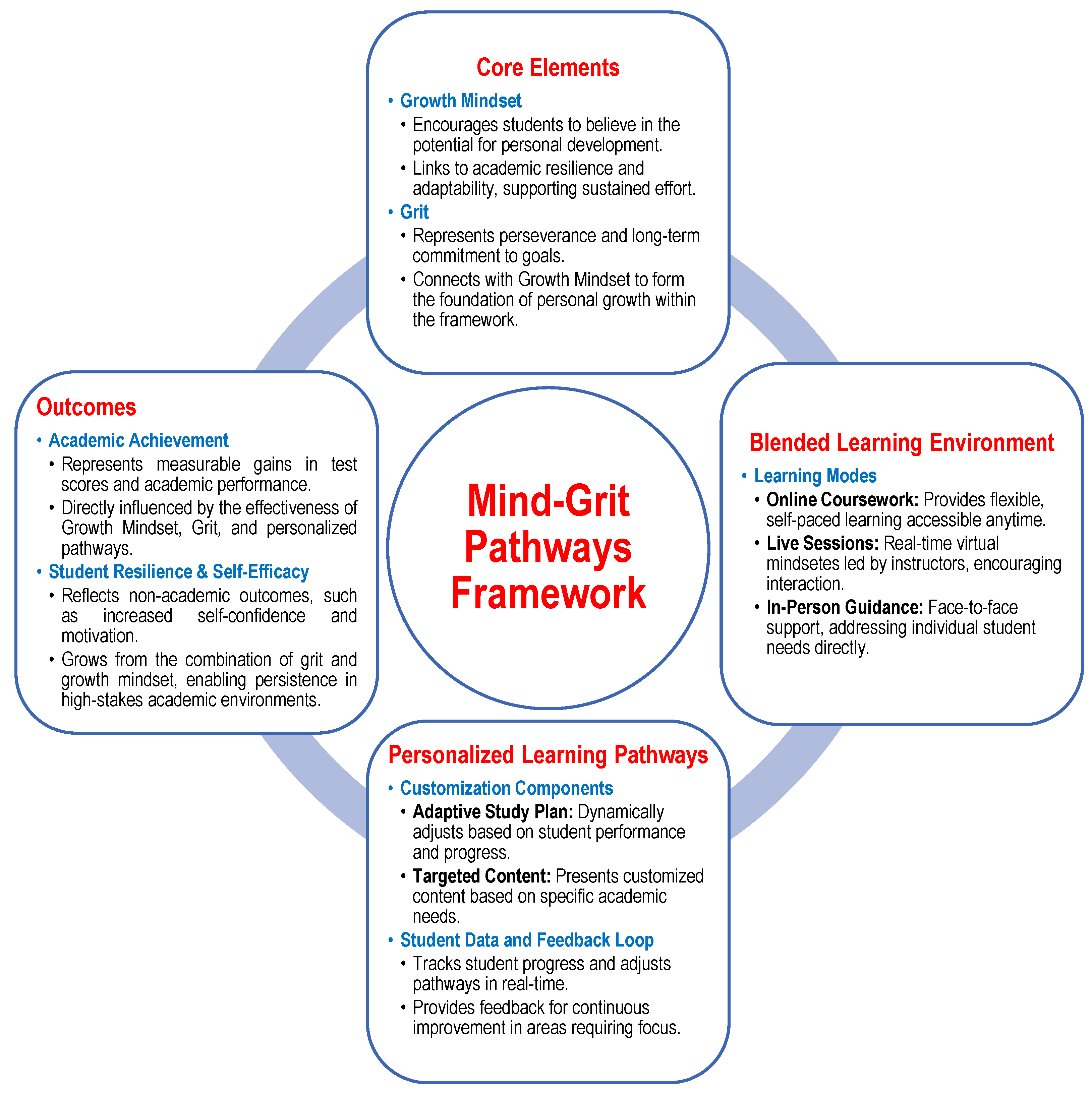

Table 1.
Reliability Statistics for Grit and Mindset Scales.
| Scale | Cronbach's Alpha | Number of Items |
| Pre-Intervention Grit | 0.843 | 12 |
| Post-Intervention Grit | 0.896 | 12 |
| Pre-Intervention Mindset | 0.872 | 20 |
| Post-Intervention Mindset | 0.868 | 20 |
Table 2.
Baseline Comparisons: Pre-Intervention Test Scores.
| Subject | Group Mean (Control) | Group Mean (Treatment) | F Statistic | p-value | Partial Eta Squared |
| Math | 20.53 | 20.34 | 0.336 | 0.562 | 0.000 |
| Reading | 20.21 | 20.12 | 0.088 | 0.767 | 0.000 |
| English | 20.08 | 20.00 | 0.062 | 0.803 | 0.000 |
| Science | 20.26 | 20.19 | 0.047 | 0.828 | 0.000 |
Table 3.
ANCOVA Results for Post-Intervention Academic Performance.
| Subject | Adjusted Mean (Control) | Adjusted Mean (Treatment) | F Statistic | p-value | Partial Eta Squared |
| Math | 21.999 | 25.952 | 13327.932 | 0.000 | 0.935 |
| Reading | 22.728 | 26.972 | 6924.249 | 0.000 | 0.882 |
| English | 22.985 | 27.024 | 2103.139 | 0.000 | 0.694 |
| Science | 22.607 | 26.626 | 9390.503 | 0.000 | 0.910 |
Table 4.
Correlation Matrix for Academic and Non-Cognitive Outcomes.
| Variable | Math | Reading | English | Science |
| Post-Grit Score | .179 | .213 | .207 | .210 |
| Post-Mindset Score | .833 | .841 | .811 | .873 |
Disclaimer/Publisher’s Note: The statements, opinions and data contained in all publications are solely those of the individual author(s) and contributor(s) and not of MDPI and/or the editor(s). MDPI and/or the editor(s) disclaim responsibility for any injury to people or property resulting from any ideas, methods, instructions or products referred to in the content. |
© 2025 by the authors. Licensee MDPI, Basel, Switzerland. This article is an open access article distributed under the terms and conditions of the Creative Commons Attribution (CC BY) license (http://creativecommons.org/licenses/by/4.0/).
Copyright: This open access article is published under a Creative Commons CC BY 4.0 license, which permit the free download, distribution, and reuse, provided that the author and preprint are cited in any reuse.


