

Submitted:
19 September 2025
Posted:
22 September 2025
You are already at the latest version
Abstract
This study validates an empirical model of attitudinal indicators to assess the inclusion of students with physical motor disabilities in higher education. Grounded in the tripartite model of attitude and framed within the social model of disability, the research employed the SACIE-R scale to measure emotional, cognitive, and behavioral predispositions among 384 faculty members from private universities in El Salvador, selected through stratified sampling. Exploratory factor analysis (EFA) identified three latent dimensions—concerns and general attitudes, inclusive feelings, and cognitive–affective tension—explaining 56.36% of the variance, with strong reliability (Cronbach’s α = 0.876). Chi-square tests revealed significant attitudinal differences by age, sex, training, and institutional affiliation. The resulting model translates latent predispositions into observable indicators of inclusive teaching competencies, providing a diagnostic and evaluative tool for higher education institutions. Beyond the Salvadoran context, the framework demonstrates potential scalability across Latin American systems with comparable socio-educational conditions. Importantly, the model contributes to the Sustainable Development Goals (SDG 4, SDG 10, and SDG 16) by supporting inclusive and equitable quality education, reducing structural inequalities, and informing governance policies grounded in human rights. Findings highlight persistent attitudinal barriers and limited faculty preparedness, underscoring the need for sustainable institutional strategies. This research advances the debate on educational sustainability by linking faculty attitudes to long-term policy development, capacity-building, and institutional accountability.
Keywords:
Inclusive education
; Faculty attitudes
; Disability inclusion
; Higher education
; Sustainable Development Goals (SDGs)
; Educational sustainability
; Attitudinal indicators
1. Introduction
Higher education has emerged as a strategic platform for advancing inclusive societies, particularly in the Global South, where structural inequalities disproportionately affect people with disabilities (Filippou et al., 2025; McKinney & Swartz, 2022; Nawire et al., 2025; Osuna-Juárez & González-Castellano, 2024). Despite normative and discursive progress, attitudinal, pedagogical, and organizational barriers continue to restrict access, retention, and full participation of students with physical motor disabilities (PMD) in Latin American universities (Fernández-Batanero et al., 2022; Maldonado-Garcés et al., 2025; Newman et al., 2021; Osuna-Juárez & González-Castellano, 2024; Villouta & Villarreal, 2022).
This study deliberately focuses on PMD, as mobility-related barriers remain among the most visible and pressing challenges for inclusive higher education in El Salvador and across Latin America. Restricting the analysis to PMD ensures methodological rigor. The recognition of the right to inclusive education—enshrined in the Convention on the Rights of Persons with Disabilities (UN, 2025) and reaffirmed by the Sustainable Development Goals (particularly SDG 4.5)—underscores the urgency of guaranteeing equitable conditions across all educational levels, including higher education (Mendoza-González et al., 2022; UNESCO, 2020).
Recent scholarship underscores that sustainable disability inclusion in higher education requires progress not only on SDG 4.5 but also on SDG 10 (reducing inequalities) and SDG 16 (building inclusive and accountable institutions), which frame institutional policies and governance for long-term change (Fuchs et al., 2023; Veres et al., 2025).
Recent studies also highlight that advancing SDG 10 on reducing inequalities and SDG 16 on building inclusive institutions is essential for embedding disability inclusion within sustainable higher education systems (Fuchs et al., 2023; Veres et al., 2025).
Extensive research highlights that faculty attitudes are a decisive factor in either facilitating or hindering inclusive education processes (Carrillo-Sierra et al., 2025; Papoudi & Antonopoulou, 2025). However, in Latin America—and especially in El Salvador—empirical evidence on faculty attitudes toward students with disabilities remains scarce, fragmented, and often lacks psychometrically validated instruments (Navarro-Montaño et al., 2021).
This gap limits the capacity of higher education institutions (HEIs) to accurately assess faculty predispositions, design effective training programs, and evaluate the implementation of institutional inclusion policies (Carballo et al., 2021; Lopatina et al., 2024; Oswal et al., 2025). Recent sustainability research emphasizes that addressing such gaps is fundamental for advancing SDG 10 by reducing inequalities through evidence-based policies (Veres et al., 2025).
From a critical perspective, it is necessary to move beyond normative declarations by incorporating tools that systematically assess faculty attitudes as measurable constructs (Booth & Ainscow, 2002; Durand & Crimmins, 1988). Negative or ambivalent attitudes often act as symbolic barriers that reproduce exclusionary dynamics, even when physical infrastructure and accessible technologies are available (Murdaca et al., 2018; Vogiatzi et al., 2023).
Faculty beliefs, emotions, and behavioral predispositions remain decisive in determining the success of inclusive practices (Lombardi et al., 2011; San Martin et al., 2021; Schwab & Alnahdi, 2020). At the same time, strengthening institutional frameworks for inclusion is essential to advance SDG 16, which emphasizes accountable and participatory governance in higher education (Fuchs et al., 2023; Hassan, 2025; Mendoza-González et al., 2022; Uriarte et al., 2025).
In this context, empirical models that disaggregate and quantify the emotional, cognitive, and behavioral components of attitudes are essential (Breckler, 1984; Charitaki et al., 2024; Netzer et al., 2018; Svenningsson et al., 2022). This study addresses this need by proposing and validating an empirical model of attitudinal indicators based on the SACIE-R scale (Faculty Attitudes toward Inclusive Education—Revised), adapted to the Salvadoran higher education context.
The scale was subjected to EFA, which revealed three latent dimensions: emotional disposition, inclusive commitment, and perception of barriers, together explaining a significant proportion of attitudinal variance (Mayorga, 2024). A quantitative design was selected to provide robust statistical evidence that supports institutional diagnostics, cross-institutional comparisons, and the development of faculty improvement strategies (Lautenbach & Heyder, 2019; Losada et al., 2022; Solis-Grant et al., 2022).
These validated attitudinal indicators offer a reliable tool for developing faculty improvement strategies and monitoring inclusion policies (Solis-Grant et al., 2022). By linking individual dispositions to institutional frameworks, the model contributes to SDG 4 by fostering inclusive education and to SDG 16 by strengthening higher education governance with evidence-based tools, thereby advancing educational sustainability in the region (Uriarte et al., 2025).
The study also aims to contribute a replicable tool for other Latin American countries with similar socio-educational characteristics (Pinto-Delacadena et al., 2024; Santos et al., 2023), thus addressing both theoretical and practical gaps in the literature on the inclusion of students with disabilities in higher education.
Unlike broader international instruments such as the Multidimensional Attitudes Scale Toward Persons with Disabilities (MAS) or the Attitudes Toward Students with Disabilities in Inclusive Settings (ATSI), the novelty of this study lies in validating a faculty-specific model that operationalizes attitudes into measurable indicators directly linked to teaching competencies.
This contextual sensitivity represents a distinctive contribution to the literature on inclusive higher education. Its focus on faculty-specific scenarios and inclusion-related dilemmas allows for a more precise operationalization of attitudes within higher education contexts (Emmers et al., 2020).
Moreover, the SACIE-R has demonstrated adaptability across Latin American cultural settings, making it especially suitable for the Salvadoran context, where standardized instruments remain scarce. By providing an evidence-based tool for regional adaptation, the study contributes to SDG 10 by reducing inequalities in access to higher education and to SDG 16 by strengthening institutional frameworks that support inclusive and sustainable educational policies (Fuchs et al., 2023).
Building on this rationale, the SACIE-R was selected as the most appropriate instrument to validate in the Salvadoran higher education context. This study represents the first formal validation of the SACIE-R in El Salvador and one of the few systematic validations in Central America. A comparative summary of these tools is provided in Supplementary Table S1 to underscore the model’s innovation and alignment with inclusive teaching standards.
Furthermore, the methodological approach aligns with international quality assurance standards, including those of the European Association for Quality Assurance in Higher Education (ENQA) and the Index for Inclusion by Booth and Ainscow (2002). It also integrates frameworks on inclusive teaching competencies endorsed by multilateral organizations, ensuring both international comparability and contextual adaptation.
The validation of this model is particularly relevant in light of expanding access to higher education and the growing diversity of student populations, which call for differentiated, culturally responsive, and pedagogically grounded strategies (Durand & Crimmins, 1988; Murdaca et al., 2018; Vogiatzi et al., 2023). By providing a reliable tool for inclusive policy and practice, this study advances SDG 4 by promoting equitable access to quality education and contributes to SDG 16 by strengthening institutional frameworks that sustain inclusive governance in higher education (Veres et al., 2025).
Ultimately, this article aims to provide a statistically validated model for assessing higher education faculty attitudes toward the inclusion of students with physical motor disabilities. By combining methodological rigor, contextual relevance, and practical utility, this model serves as a diagnostic, formative, and evaluative tool. It supports institutional improvement and faculty development while advancing the principles of inclusive education, human rights, and social justice. In doing so, the study also contributes to SDG 4 by promoting inclusive and equitable quality education, and to SDG 10 by reducing barriers that perpetuate inequalities in higher education.
Grounded in this rationale, the study is structured around two research questions that guide its empirical validation:
(RQ1) What are the underlying dimensions of university faculty attitudes toward the inclusion of students with PMD in Salvadoran higher education?
(RQ2) How valid and reliable is the culturally adapted SACIE-R scale for assessing these attitudes?
1.1. Definitions of Key Terms
This section defines the central concepts that underpin the proposed empirical model of attitudinal indicators, ensuring conceptual clarity and alignment with the theoretical framework, research objectives, and psychometric design of the study.
1.1.1. Inclusive Education
Inclusive education is a rights-based and equity-driven approach that ensures full participation, access, and learning opportunities for all students, regardless of disability, background, or personal characteristics. In the context of higher education, it entails the systematic removal of pedagogical, structural, and attitudinal barriers, and the promotion of institutional cultures that embrace diversity and social justice.
1.1.2. Physical Motor Disability
A physical motor disability refers to a condition that affects a person’s ability to move, coordinate, or perform physical tasks due to neuromuscular, skeletal, or central nervous system impairments. In higher education, students with PMD may require environmental adaptations, assistive technologies, and inclusive pedagogical practices to enable meaningful participation in academic life.
1.1.3. Faculty Attitudes
Faculty attitudes encompass the emotional, cognitive, and behavioral tendencies of university instructors toward the inclusion of students with disabilities. These attitudes influence teaching practices, perceptions of diversity, and the implementation of inclusive policies. Positive attitudes are essential to cultivating inclusive and accessible learning environments.
1.1.4. Attitudinal Indicators
Attitudinal indicators are empirically measurable variables that reflect faculty members’ predispositions toward inclusion. In this study, they are operationalized through three latent factors identified via EFA: emotional disposition, inclusive commitment, and perception of barriers. These indicators provide the basis for evaluating institutional progress in inclusive education.
1.1.5. Emotional Disposition
Emotional disposition refers to the affective responses of faculty toward students with physical motor disabilities. This includes attitudes of empathy, discomfort, fear, or emotional openness, which directly influence interpersonal interactions and willingness to support inclusive practices in the classroom.
1.1.6. Inclusive Commitment
Inclusive commitment denotes the degree of engagement and proactive involvement of faculty in adapting their teaching methods, curricula, and learning environments to meet the needs of students with disabilities. It reflects the ethical and pedagogical responsibility to uphold inclusive values.
1.1.7. Perception of Barriers
Perception of barriers involves faculty recognition of institutional, pedagogical, or personal challenges that may impede inclusion. This includes perceived limitations such as inadequate training, lack of resources, or rigid academic structures that hinder inclusive practices.
1.2. Literature Review
1.2.1. Inclusive Education and Physical Motor Disabilities in Higher Education
Inclusive education in higher education is increasingly recognized as a transformative approach that dismantles structural, epistemological, and attitudinal barriers that exclude students with disabilities (Moriña, 2017). Frameworks such as the UN Convention on the Rights of Persons with Disabilities (UN, 2025) and Sustainable Development Goal 4.5 (UNESCO, 2020) have created global momentum toward inclusive practices.
Despite this progress, implementation across higher education institutions remains uneven, particularly in the Global South, where policies often fail to reach classroom practices (Altes et al., 2024; Figueiredo et al., 2024; Filippou et al., 2025; Lantsova et al., 2024; Nawire et al., 2025; Oswal et al., 2025; Solis-Grant et al., 2023). At the same time, recent bibliometric analyses highlight that universities are increasingly integrating sustainability agendas, although the incorporation of equity and inclusion as part of these agendas remains limited and fragmented (Veres et al., 2025).
In Latin American universities, students with PMD continue to encounter barriers despite normative advances. PMD refers to limitations in movement, coordination, or physical functioning caused by neurological, muscular, or skeletal conditions. Many universities address accessibility mainly through infrastructure, neglecting deeper attitudinal and pedagogical transformations (Barrera-Corominas et al., 2019; Fuentes et al., 2022; Méndez et al., 2024; Osuna-Juárez & González-Castellano, 2024).
Recent scholarship highlights the importance of moving beyond accessibility to embrace Universal Design for Learning (UDL) principles, which proactively design for diversity (Griful-Freixenet et al., 2021; Moriña et al., 2025). Critical disability studies in Latin America also reveal how colonial legacies shape educational models that reproduce exclusion through epistemic and institutional norms (Emmerich & Hormel, 2021).
In El Salvador, inclusive education policies have been adopted nationally, but their application in higher education institutions remains inconsistent and weakly monitored (UNESCO, 2020). Faculty attitudes are central to this gap: negative or ambivalent perceptions often lead to low expectations, minimal accommodations, and limited opportunities for participation (Carrillo-Sierra et al., 2025; Mayorga, 2024).
This study addresses these gaps by offering empirical evidence from El Salvador and proposing an attitudinal model grounded in local realities. It frames inclusion not only as access but also as transformation of pedagogies, mindsets, and institutional cultures, positioning it as a cornerstone of educational sustainability aligned with SDGs 4, 10, and 16.
1.2.2. Faculty Attitudes as Critical Determinants of Inclusion
Faculty perceptions are shaped by discipline, prior experience, and institutional support (Goodwin et al., 2024; Papadakaki et al., 2022). STEM faculty often show greater resistance than those in social sciences and education (O’Leary et al., 2020).
In Latin American universities, deficit and charity-based conceptions remain influential, shaping expectations and willingness to accommodate students (Sánchez-Prada et al., 2025).
Validated instruments are crucial for assessing faculty attitudes toward inclusion, particularly in Latin American contexts where psychometric tools remain scarce. Recent initiatives, such as the Questionnaire on Attitudes towards Disability in Higher Education (QAD-HE), provide evidence of the importance of culturally adapted scales (Fuentes et al., 2021).
Faculty attitudes—affective, cognitive, and behavioral predispositions toward inclusion—are central to implementing inclusive practices (Breckler, 1984; Charitaki et al., 2024; Netzer et al., 2018; Svenningsson et al., 2022). These dispositions directly affect teaching, classroom dynamics, and curriculum.
Yet, even initiatives framed as inclusive curricula may inadvertently reproduce exclusion if underlying institutional norms and power dynamics are not critically addressed (Stentiford, 2022). This highlights the complexity of fostering genuine attitudinal change in higher education.
Negative or ambivalent attitudes often stem from limited exposure to disability discourse and insufficient training (Lombardi et al., 2011; San Martin et al., 2021; Schwab & Alnahdi, 2020). Universities that embed inclusive pedagogical frameworks report improved perceptions (Carballo et al., 2021; Papadakaki et al., 2022). Still, many professors demonstrate low levels of psychological readiness and self-perceived competence for inclusive teaching, underlining the importance of sustained professional development (Shutaleva, 2023). This underscores the close connection between teacher competence and educational sustainability.
Measuring dispositions requires validated scales. The SACIE-R, adapted to El Salvador, identifies three dimensions: emotional disposition, inclusive commitment, and perceived barriers (Mayorga, 2024).
Other culturally adapted tools also help detect resistance points and design interventions (Altes et al., 2024; Figueiredo et al., 2024; Filippou et al., 2025). Over time, exposure to diverse students and structured reflection can improve attitudes (Nagase et al., 2025).
This study contributes by validating SACIE-R in Central America, expanding the psychometric repertoire in inclusive education research.
Tools such as ATSI and MAS have been valuable but insufficient to capture cultural and institutional nuances (Carrillo-Sierra et al., 2025; Emmers et al., 2020). The SACIE-R provides a multidimensional framework better suited for policy, diagnosis, and faculty development, supporting inclusive and sustainable higher education.
1.2.3. The Role of Faculty Training and Institutional Policies
Faculty attitudes are widely recognized as critical determinants in the implementation of inclusive education in higher education. These attitudes—affective, cognitive, and behavioral—shape how instructors accommodate students with disabilities (Breckler, 1984; Charitaki et al., 2024; Netzer et al., 2018; Svenningsson et al., 2022). Positive attitudes foster inclusive strategies, while negative or ambivalent ones perpetuate systemic inequalities (Gámez-Calvo et al., 2025; Lombardi et al., 2011; San Martin et al., 2021; Schwab & Alnahdi, 2020).
Several factors influence these attitudes: discipline, prior interactions with students with disabilities, institutional support, and training levels (Goodwin et al., 2024; Papadakaki et al., 2022). In STEM, predisposition is often lower compared to humanities or education, where social justice discourses are more prevalent (O’Leary et al., 2020). This gap suggests the need for tailored faculty development programs across fields.
In Latin America, deficit-oriented or charity-based views of disability remain embedded in cultural and institutional narratives (Sánchez-Prada et al., 2025). These perceptions limit faculty commitment to accommodations and inclusive practices. Overcoming them requires more than technical training; it calls for critical reflection on academic ableism, power relations, and normative teaching standards.
Validated instruments are crucial to monitor these dispositions. The SACIE-R scale, adapted in this study, offers a culturally sensitive tool capturing emotional disposition, inclusive commitment, and perceived barriers (Mayorga, 2024). Disaggregating these dimensions provides a nuanced view of how inclusion is supported—or hindered—within universities.
Evidence shows faculty attitudes are not immutable. Exposure to students with disabilities, reflective training, and institutionalized policies can enhance perceptions over time (Ainscow et al., 2025; Nagase et al., 2025). Measuring attitudes thus becomes both diagnostic and formative, guiding continuous improvement and fostering equity in higher education.
2. Materials and Methods
2.1. Research Design
This study adopted a quantitative, non-experimental, cross-sectional design. This approach is suitable for examining attitudinal variables as they naturally occur and for identifying latent constructs within the social sciences. The main objective was to construct and validate an empirical model of attitudinal indicators to assess university faculty perceptions regarding the inclusion of students with PMD in higher education institutions in El Salvador.
The design enabled a statistically robust analysis of patterns and relationships across a large dataset. To achieve this, EFA and internal consistency tests were applied, allowing the identification of latent dimensions and the evaluation of measurement reliability.
The validated SACIE-R scale was culturally and contextually adapted to the Salvadoran setting. This adaptation followed a rigorous process that included expert review for face and content validity, a pilot test to refine clarity and semantics, and online administration via institutional email networks and Google Forms. Psychometric properties were examined using IBM SPSS Statistics v.26 to confirm the instrument’s reliability and construct validity.
2.2. Research Instrument
The SACIE-R scale served as the main data collection instrument. It includes 12 items grouped into three theoretically grounded and empirically validated components: (a) Emotional Disposition (items reflecting empathy, discomfort, or anxiety toward students with PMD), (b) Inclusive Commitment (items assessing beliefs about students’ right to inclusive education, pedagogical flexibility, and institutional responsibility), and (c) Perception of Barriers (items related to perceived constraints such as lack of resources, insufficient training, or concerns about academic quality).
For clarity, these labels represent the theoretical constructs guiding the initial design. Following the EFA, the empirical results suggested slightly different labels—Concerns and General Attitudes, Inclusive Feelings, and Cognitive–Affective Tension—that better captured the attitudinal structure observed in the Salvadoran faculty sample. Each item was measured on a four-point Likert scale (1 = Strongly Disagree; 4 = Strongly Agree).
The instrument was adapted from Spanish-language versions validated in Latin America and reviewed by four experts in inclusive education and psychometrics. In addition, a demographic section collected information on sex, age, teaching experience, disciplinary area, and prior inclusive education training. A pilot test with 20 faculty members demonstrated high internal consistency (Cronbach’s α > 0.80), confirming the reliability of the scale as a diagnostic and evaluative tool in higher education settings.
2.3. Sampling Technique
A stratified random sampling strategy was implemented to ensure representativeness across institutions and disciplines. The target population comprised university faculty from private higher education institutions in El Salvador who were actively teaching undergraduate programs. Faculty members from all areas of knowledge were included without disciplinary exclusion, provided they held active teaching responsibilities.
A total of 384 respondents participated, exceeding the minimum required sample size for factor analysis based on a subject-to-item ratio above 5:1 (Qu, 2007). The dataset met key statistical assumptions for factor analysis, with a Kaiser-Meyer-Olkin (KMO) value of 0.85 and a significant Bartlett’s Test of Sphericity (p < 0.001). These results supported the appropriateness of factor extraction and dimensional reduction techniques.
Given the categorical nature of the SACIE-R responses and sociodemographic variables, Chi-square tests were employed to explore associations. While alternative models such as ANOVA or regression could be applied, the exploratory aim of this study justified the use of Chi-square, with future research encouraged to expand the analysis through more complex multivariate approaches. These indicators confirmed the suitability of the dataset for subsequent exploratory and confirmatory factor analyses, described in the following sections.
2.4. Statistical Validation of the Model
To validate the proposed attitudinal model, the statistical analyses were organized hierarchically in four consecutive stages. First, a set of descriptive statistics was calculated to characterize the sample and establish the initial context of the study. Second, the reliability of the instrument was assessed to ensure internal consistency of the adapted SACIE-R scale. Third, an EFA was conducted to identify the latent structure underlying the items and to examine construct validity.
A Confirmatory Factor Analysis (CFA) was performed to test the robustness of the three-factor solution and to verify the goodness-of-fit of the measurement model. This sequential design ensured a comprehensive psychometric validation, moving from descriptive and exploratory approaches toward confirmatory analyses that strengthen the empirical and theoretical contributions of the study.
2.5. Ethical Considerations and Approval
This study complied with the ethical principles established in the Declaration of Helsinki (World Medical Association, 2025) and international guidelines for research involving human participants (Masso et al., 2025). Prior to completing the questionnaire, participants received detailed information about the study objectives, voluntary nature of participation, confidentiality of data, and their right to withdraw at any time without consequences. Electronic informed consent was obtained before survey access, and no personally identifiable information was collected. All responses were anonymized, coded, and stored on secure servers with restricted access, ensuring privacy and minimizing to zero any physical, psychological, or legal risks. Ethical approval was granted by the Research Ethics Committee of the coordinating university (Resolution No. CEI-USAM-2024-030, issued on 25 January 2024), confirming the study’s compliance with institutional and international standards of academic integrity and professional ethics.
3. Results and Discussion
3.1. Descriptive Analysis of the Sample
The final sample consisted of 384 university faculty members from private higher education institutions in El Salvador. A slight majority of participants were male (56.3%), while 43.8% identified as female. The most represented age group was 30–34 years (21.1%), and the majority of respondents (65.9%) fell within the 25 to 44-year range, indicating a relatively young teaching population.
Only 5.5% of respondents reported having received specialized training in inclusive education, highlighting significant gaps in professional development for inclusion. Moreover, 21.6% of faculty indicated having contact with individuals with PMD within the university context. Among them, the most common frequency of interaction was once per week (62.7%), and 57.8% reported this contact occurred in their role as instructors of students with PMD.
These findings point to limited experiential exposure and training, underscoring the need for capacity-building strategies to strengthen inclusive practices in higher education. Comparable results have been reported in other Latin American settings, where faculty often lack structured preparation for disability inclusion (D’Angelo & Singal, 2024; Vaillant, 2011). Such patterns emphasize the urgency of sustainable faculty development policies to bridge the persistent gap between inclusion discourse and classroom practice.
3.2. Instrument Reliability
The psychometric reliability of the adapted SACIE-R scale was evaluated using Cronbach’s alpha. The instrument, composed of 12 items grouped into three dimensions, showed high internal consistency. Emotional Disposition (5 items) obtained α = 0.862, Concerns (4 items) α = 0.819, and Inclusive Commitment (3 items) α = 0.842. The overall scale reliability reached α = 0.876.
All coefficients exceeded the conventional acceptability threshold of 0.70, confirming the robustness of the instrument for assessing faculty attitudes toward the inclusion of students with PMD in higher education (Qu, 2007). These results provide strong evidence of internal consistency and support the instrument’s application in institutional diagnostic and formative processes.
Similar levels of reliability have been reported in international studies validating the SACIE-R scale in higher education contexts (Forlin et al., 2011; Loreman et al., 2014). This convergence reinforces the instrument’s utility not only for El Salvador but also for broader regional and international comparability, contributing to sustainable strategies in faculty development and inclusion monitoring
3.3. Exploratory Factor Analysis
To examine construct validity and identify the latent structure of the SACIE-R scale, an EFA was conducted using the Maximum Likelihood extraction method with Varimax rotation. Bartlett’s Test of Sphericity yielded statistically significant results (χ2(66) = 1242.35, p < 0.001), and the Kaiser–Meyer–Olkin (KMO) measure was 0.788, exceeding the minimum criterion of 0.70 (Qu, 2007). These indices confirmed the suitability of the data for factor analysis.
Factor extraction followed the eigenvalue-greater-than-one rule, resulting in three latent factors that jointly explained 56.36% of the total variance, surpassing the 40% threshold typically considered acceptable in the social sciences (Lim & Jahng, 2019; Peterson, 1994). Specifically, Factor 1 explained 26.45% of the variance (Emotional Disposition), Factor 2 accounted for 19.83% (Inclusive Commitment) and Factor 3 contributed 10.07% (Perception of Barriers). This factorial solution is consistent with previous SACIE-R validations in international higher education settings (Forlin et al., 2011; Loreman et al., 2014), strengthening the comparability of the Salvadoran results.
These findings confirm the theoretical structure of the SACIE-R scale and its utility in operationalizing faculty attitudes as multidimensional constructs aligned with affective, cognitive, and behavioral components (Table 1).
The rotated component matrix clarified the contribution of individual items, with only loadings ≥ 0.40 retained (see Table 2). The three-factor solution aligns with the tripartite theoretical model of attitudes, encompassing affective, cognitive, and behavioral dimensions. Factor 1 (Concerns and General Attitudes) grouped items related to stress, discomfort, or avoidance toward students with PMD. Factor 2 (Inclusive Feelings) included items expressing empathy, openness, and readiness for inclusion. Factor 3 (Cognitive-Affective Tension) comprised items reflecting insecurity, lack of preparation, or internal conflict regarding inclusion.
This factorial structure reinforces the multidimensional nature of faculty attitudes toward inclusion, consistent with the tripartite model of affective, cognitive, and behavioral components (Ajzen, 2005; Forlin et al., 2011). These results also provide a foundation for subsequent CFA, which tested the stability of this three-factor solution.
3.4. Confirmatory Factor Analysis
The CFA was conducted in R (lavaan 0.6-19), treating the 4-point Likert items as ordered categorical indicators. We used the robust weighted least squares estimator (WLSMV), with latent variances fixed to 1 (std.lv = TRUE), pairwise handling of missing data, and freely estimated factor covariances and thresholds. Reverse-worded items were recoded so that higher scores indicated more inclusive attitudes (P6 and P10) (Note on Item Labeling. For clarity in the presentation of the factorial analyses, each questionnaire item was assigned an abbreviated code: P1, P2, P3, …, Pn, corresponding to the numbering of the instrument. For example, P1 = Question 1, P2 = Question 2, and so forth. This labeling system was applied consistently across tables and figures, including the confirmatory factor analysis models (See Supplementary Table S2)).
Guided by the EFA and the theoretical rationale of the instrument, we specified a three-factor structure: (a) Inclusive Feelings (P5, P7, P8, P10 reversed), capturing favorable beliefs and emotions toward inclusion; (b) Concerns and General Attitudes (P9, P12), reflecting support for integration practices; and (c) Cognitive–Affective Tension (P1, P4, P6 reversed), indexing ambivalence between willingness and perceived self-efficacy. Based on modification indices, a residual correlation between P7 and P8 was included within Inclusive Sentiments. This specification is referred to as the main model (Figure 1).
To test robustness, a sensitivity model was also estimated. This specification added a residual correlation (P4 ~~ P6) within Cognitive–Affective Tension, reflecting expected local dependence between performance expectations and perceived preparedness. The sensitivity model is presented in Figure 2.
Model evaluation relied on several fit indices: Comparative Fit Index (CFI), Tucker–Lewis Index (TLI), Root Mean Square Error of Approximation (RMSEA, 90% CI), and Standardized Root Mean Square Residual (SRMR). Table 3 reports the global fit indices for the main and sensitivity models. Table 4 summarizes the standardized factor loadings, while Table 5 presents composite reliability (CR) and average variance extracted (AVE) values. Discriminant validity was assessed by comparing AVE values with squared latent correlations, reported in Supplementary Tables S4 and S5.
3.5. Empirical Model of Attitudinal Indicators
Drawing on the EFA results, an empirical model of attitudinal indicators was developed to explain how faculty attitudes influence the participation of students with PMD in higher education. The model comprises three latent dimensions: Concerns and General Attitudes, Inclusive Feelings, and Cognitive–Affective Tension regarding Reasonable Adjustments.
The framework is grounded in the social model of disability, which reframes disability as the outcome of systemic barriers embedded in institutional cultures. Using structuration theory, faculty attitudes—both explicit and implicit—are conceptualized as structuring agents that can reproduce or challenge inequality. From a cultural capital perspective, the model highlights “inclusive capital,” defined as the knowledge, values, and pedagogical dispositions required to support diverse student populations.
Furthermore, the model aligns with the sensitization phase of the attitude-change process, a critical stage that precedes the acquisition of inclusive competencies. This connection is supported by recent research on inclusive education (Álvarez-Castillo et al., 2025; Cotán et al., 2021; Mora et al., 2021; Moriña, 2022; Stentiford & Koutsouris, 2021; Valle-Flórez et al., 2021).
Ten empirical indicators were derived from the SACIE-R scale and mapped to professional practices. These include inclusive teaching methodologies and tutoring support; awareness-raising initiatives, universal design, and technological accessibility; capacity to address special educational needs and implement reasonable adjustments; inclusive assessment and curriculum design; and alignment with accreditation and quality assurance frameworks.
In applied contexts, the model contributes both theoretically and practically by translating attitudinal inclusion into measurable dimensions relevant to institutional quality frameworks. Validated through descriptive, inferential, and confirmatory analyses, it can support institutional diagnostics, identify training needs, inform professional development, guide evaluation systems, and underpin the development of policies based on human rights and equity. Consistency with the ESG (2015) and national policy guidelines reinforces its relevance, while its validation advances educational sustainability and aligns with international applications of the SACIE-R (Forlin et al., 2011; Loreman et al., 2014).
3.6. Differences by Sociodemographic Variables
Building on the validated three-factor structure of the SACIE-R scale confirmed through CFA, inferential analyses were conducted using Chi-square tests to examine potential attitudinal differences across faculty subgroups. The variables considered included age, sex, type of institution, and prior training in inclusive education. This procedure allowed us to test whether sociodemographic attributes influence faculty perceptions of inclusion within the Salvadoran higher education context.
Comparable subgroup analyses have been widely reported in international validations of the SACIE-R scale (Forlin et al., 2011; Loreman et al., 2014). These studies highlight how personal and institutional characteristics shape readiness for inclusive teaching, reinforcing the need for sustained training policies that promote equitable and sustainable professional development opportunities for faculty.
3.6.1. Significant Associations by Variable
Statistically significant associations (p < 0.05) emerged across several sociodemographic groups, confirming the robustness of the validated three-factor model derived from the CFA. Age-related differences appeared in attitudes toward adapting the teaching–learning process (P6, p = 0.029) and in reported emotional discomfort (P8, p = 0.017), suggesting that pedagogical flexibility and emotional readiness vary across generations of faculty.
Sex differences were also evident. Faculty diverged in their responses regarding avoidance of contact with students with PMD (P3, p = 0.053), perceptions of infrastructure and technological adaptations (P4, p = 0.026), emotional discomfort (P8, p = 0.043), and difficulty overcoming first impressions (P10, p = 0.052). These results indicate that male and female faculty may experience disability inclusion through distinct emotional and cognitive pathways.
Institutional context and prior training further shaped attitudes. Faculty from different institutional types reported significant differences in perceptions of adaptations (P4, p = 0.023), workload concerns (P5, p = 0.039), integration of underperforming students (P9, p = 0.009), and teaching competence (P11, p = 0.011). Moreover, structured training in inclusive education was associated with more favorable attitudes toward integrating students with low performance (P9, p = 0.023).
These findings are consistent with international evidence showing that professional development enhances faculty preparedness for inclusion (Forlin et al., 2011; D’Angelo & Singal, 2024). They reinforce the need for sustainable, long-term training policies in higher education that align with validated attitudinal models and contribute to internationally comparable benchmarks for inclusive practices.
3.6.2. Persistent Negative Attitudes
Although most subgroup differences reflected variations in the intensity rather than the direction of positive attitudes, some persistent negative patterns were evident within the CFA-validated model. Resistance to individualized academic programs (P12) appeared more frequently among faculty aged 25–29 and 55–59 (p = 0.009). Likewise, low teaching confidence (P11) was reported primarily by professors in public institutions (p = 0.011) and those without prior training (p = 0.509), with 63.6% expressing concerns about their competence. These findings suggest that limitations are linked more to gaps in professional preparedness than to outright rejection of inclusion.
To complement the Chi-square tests, effect sizes were calculated using Cramer’s V. Although several associations reached statistical significance (p < 0.05), most effect sizes were small to moderate (0.10–0.24). This indicates that contextual and demographic variables shape faculty attitudes in meaningful ways, but their influence remains modest.
Similar patterns have been reported in other Latin American contexts, where lack of training and institutional support—rather than negative predispositions—explain attitudinal barriers (D’Angelo & Singal, 2024; Vaillant, 2011). These convergent findings emphasize that sustainable improvements depend on systematic faculty development and institutional strategies aligned with inclusive policies
3.6.3. Comparison by Contact with Students with Disabilities
Further analysis examined whether faculty attitudes differed according to prior contact with students with physical motor disabilities. Within the CFA-validated structure of the SACIE-R, no statistically significant differences emerged across the three factors. Positive responses in General Attitudes were nearly identical among faculty with (72.5%) and without contact (71.8%). Similarly, Inclusive Feelings exceeded 93% in both groups, while approximately 30% of responses in Concerns reflected anxiety or stress-related attitudes regardless of contact experience.
Item-level analysis, however, highlighted persistent challenges. Low teaching preparedness (P11) was reported by 68.9% of faculty with contact and 61.1% without. Other items—such as curriculum adaptation (P2), infrastructure and technological adjustments (P4), and individualized programs (P12)—also generated high concern in both groups. These patterns suggest that while inclusive discourse is widespread, its translation into confident and competent teaching practices remains limited.
Comparable findings have been reported internationally, where contact alone does not guarantee preparedness, and sustained professional development together with structural support are required to achieve genuine inclusion (Forlin et al., 2011; Sharma & Jacobs, 2016). This underscores the importance of moving beyond exposure toward long-term training policies and institutional strategies that reinforce educational sustainability.
3.6.4. Implications
The persistence of attitudinal barriers—particularly regarding instructional adaptation, professional competence, and emotional readiness—reveals systemic gaps that hinder the translation of inclusive intentions into practice. These challenges are not unique to El Salvador, as similar patterns are observed across Latin America, where faculty training for inclusion remains limited or fragmented (Anzelin, 2025; D’Angelo & Singal, 2024; Vaillant, 2011). By validating these indicators through both EFA and CFA, this study provides a robust basis for understanding how such barriers are structured within higher education.
International research also confirms that positive attitudes alone are insufficient without structured professional development and institutional support. Faculty confidence and preparedness require ongoing training and organizational frameworks that normalize inclusive practices (Forlin et al., 2011; Sharma & Jacobs, 2016). These findings underscore the need for interventions that address attitudes not only as individual traits but as outcomes shaped by systemic and institutional contexts.
Moving beyond awareness campaigns, policies must prioritize comprehensive and sustained faculty development (Ainscow et al., 2025). Embedding inclusion-related criteria into quality assurance frameworks can enhance the participation of students with physical motor disabilities. Such actions are essential for strengthening governance and promoting educational sustainability across higher education in Latin America (Anzules-Falcones et al., 2025; Fuchs et al., 2023; Loreman et al., 2014; Uriarte et al., 2025).
3.7. Representation of the Model
The empirically validated model of attitudinal indicators—originally identified through EFA and subsequently confirmed by CFA—is presented in Figure 3. This model captures the complexity of faculty attitudes toward the inclusion of students with PMD by grouping them into three latent dimensions.
These factors are: (1) Concerns and General Attitudes, (2) Inclusive Feelings, and (3) Cognitive–Affective Tension. Together, they reflect the tripartite structure of attitudes—affective, cognitive, and behavioral—using observable indicators derived from the SACIE-R scale.
The model provides a clear bridge between abstract constructs and measurable faculty competencies. By doing so, it enables more precise institutional diagnoses of attitudinal barriers and opportunities.
Finally, this framework offers strategic value for higher education institutions. It supports planning, training, and pedagogical transformation, embedding inclusion into quality assurance processes and contributing to sustainable educational governance.
3.7.1. Factor-Level Structure
Factor 1: Concerns and General Attitudes. This factor comprises five indicators reflecting anxiety, stress, and general perceptions regarding inclusive practices. These include discomfort when teaching students with disabilities, concerns about workload, and skepticism about the feasibility of academic integration. Comparable findings have been reported in Latin America and internationally, where ambivalent predispositions persist as symbolic barriers to inclusion (D’Angelo & Singal, 2024; Forlin et al., 2011; Loreman et al., 2014; Vaillant, 2011). Confirmed in the CFA, this dimension underscores how attitudinal barriers remain a critical challenge for sustainable and equitable higher education.
Factor 2: Inclusive Feelings. The second factor comprises four indicators linked to empathy and openness toward inclusion. These reflect positive predispositions such as willingness to interact with students with physical motor disabilities and readiness to embrace diversity in teaching. Evidence from Chile shows that inclusive attitudes are closely connected to teachers’ self-efficacy and intentions to apply inclusive practices (San Martin et al., 2021), while studies with pre-service teachers highlight affective dispositions as strong predictors of engagement (Tuncay, 2022). This factor illustrates how emotional foundations can sustain institutional commitments to equity and diversity.
Factor 3: Cognitive-Affective Tension. The third factor consists of three indicators capturing perceived barriers, such as limited preparation, difficulties in accommodations, and doubts about teaching competence. This tension between inclusive ideals and practical readiness was also confirmed by the CFA and has been observed internationally, where contact alone does not ensure teacher confidence (Sharma & Jacobs, 2016).
By mapping SACIE-R items to these professional indicators and validating them through both EFA and CFA, the model contributes to international discussions on inclusive attitudes. It reinforces its empirical robustness and offers a framework to inform sustainable faculty development policies in higher education.
3.7.2. Strategic Utility
The representation of the model has significant practical value for higher education institutions. Confirmed through both EFA and CFA, it provides a robust framework to assess faculty attitudes toward inclusion. First, it enables diagnostic assessments of attitudinal barriers, offering institutions a reliable tool to identify strengths and weaknesses in inclusive practices. Second, it informs the design of professional development programs that move beyond awareness campaigns toward sustainable and continuous faculty training.
Third, the model aligns with institutional quality assurance processes, including faculty evaluation, curriculum review, and accreditation mechanisms. By embedding inclusive education into these core strategies, universities can normalize inclusive practices and foster long-term cultural change. Figure 4 and Supplementary Table S6 reinforce this conceptual linkage between attitudes and professional performance, consistent with international standards promoted by the European Association for Quality Assurance in Higher Education (ENQA) and the European Higher Education Area (EHEA) (A detailed mapping of questionnaire items, latent factors, inclusive teaching competencies, and institutional quality criteria is provided in Supplementary Table S6).
Drawing on attitude change models (Günay et al., 2023; Siyal et al., 2023), the framework positions inclusive attitudes as both measurable and modifiable. This strategic perspective offers a practical roadmap for institutional transformation by enabling longitudinal monitoring of faculty development efforts. It also strengthens international comparability and supports evidence-based strategies that contribute to educational equity and sustainability for students with disabilities.
3.8. Discussion
This study provides robust evidence for a three-dimensional structure of university faculty attitudes in El Salvador regarding the inclusion of students with PMD. The identified dimensions—(1) Concerns and General Attitudes, (2) Inclusive Feelings, and (3) Cognitive–Affective Tension—offer a comprehensive and empirically grounded framework for interpreting the complexity of inclusive attitudes in higher education settings.
This factorial structure, validated through both exploratory and confirmatory factor analyses (EFA and CFA), responds to the limitations of unidimensional models and addresses the pressing need to contextualize attitudinal constructs within Latin American socio-educational realities. In doing so, it contributes to advancing educational sustainability and aligns with international commitments such as the SDGs, particularly SDG 4 on inclusive quality education.
The first dimension, Concerns and General Attitudes, reflects the persistence of latent resistance and symbolic barriers to inclusion. Faculty members reported discomfort, stress, and a perceived increase in workload when interacting with students with PMD. These results were confirmed in the CFA, which consolidated this factor as a key attitudinal barrier in the Salvadoran context.
Consistent with previous research highlighting emotional discomfort and avoidance behaviors as covert forms of exclusion (Lombardi et al., 2011; San Martin et al., 2021; Schwab & Alnahdi, 2020), these internalized tensions indicate that discursive normalization of inclusion does not necessarily lead to pedagogical transformation. Addressing these barriers requires sustainable professional development strategies that transform attitudes into concrete inclusive practices.
In contrast, the second dimension, Inclusive Feelings, captures positive emotional predispositions—such as empathy, recognition of rights, and support for integration. These attitudes align with international frameworks, including the UN Convention on the Rights of Persons with Disabilities and the Sustainable Development Goal 4.5 on equitable access to education (UNESCO, 2020). The CFA confirmed this factor as a stable component of the attitudinal structure, reinforcing its explanatory value in the Salvadoran higher education context.
However, this normative alignment does not automatically translate into effective implementation of inclusive practices. A persistent gap between belief and action has been widely documented in Latin American universities, where policies exist but remain unevenly applied in classroom settings (Altes et al., 2024; Figueiredo et al., 2024; Filippou et al., 2025; Lantsova et al., 2024; Nawire et al., 2025; Oswal et al., 2025; Solis-Grant et al., 2023). This gap underscores the need for institutional strategies that ensure inclusive feelings are transformed into sustainable pedagogical action.
The third dimension, Cognitive–Affective Tension, reveals a critical challenge: faculty insecurity about their ability to adequately support students with PMD. With 94.5% of respondents lacking formal training in inclusive education, these insecurities reflect not only personal limitations but also systemic deficits in professional development.
Such findings resonate with broader regional evidence showing that insufficient pedagogical training perpetuates attitudinal inertia and constrains instructional innovation (Guzzardo et al., 2021). Within our study, this dimension was also empirically confirmed through CFA, reinforcing its robustness as a key barrier to inclusive higher education in Latin America.
Beyond its practical implications, the identification of cognitive–affective tension represents a theoretical contribution that distinguishes this study from prior international validations of attitudinal instruments such as MAS or ATSI. While existing scales typically capture affective and cognitive predispositions separately, the emergence of this factor highlights the intertwined nature of emotions and perceived competence in teaching students with disabilities.
This construct broadens the explanatory capacity of the tripartite attitude model by introducing a dimension especially relevant in contexts with limited training and institutional support, such as those found in many Latin American higher education systems. Its empirical confirmation through CFA strengthens its international comparability and underscores its value for advancing inclusive and sustainable educational policies.
The inferential analyses deepen these insights by identifying significant, although nuanced, relationships between sociodemographic variables and attitudinal responses. Differences in age, gender, institutional affiliation, and training background influenced perceptions and attitudes toward inclusion. Yet, most variations were associated with intensity rather than direction, confirming a generally favorable attitudinal climate tempered by contextual differences (O’Leary et al., 2020). Importantly, these associations gain robustness by being analyzed within a factorial structure validated through CFA.
A particularly salient finding is the absence of significant differences between faculty members who reported contact with students with PMD and those who did not. This challenges the prevailing assumption that direct interaction functions as a protective factor against negative attitudes (Nagase et al., 2025). It suggests that contact, in isolation, may be insufficient to generate attitudinal change unless it is coupled with intentional reflection and structured professional development, reinforcing the need for sustainable faculty training strategies.
This finding underscores the need to reinterpret the role of “contact” within inclusive education frameworks. In the Salvadoran higher education context, interaction with students with PMD appears to normalize coexistence but does not translate into greater self-efficacy or pedagogical readiness.
Attitudinal change seems contingent on reflective training opportunities, institutional mentoring, and sustained exposure linked to professional development programs. Without these complementary strategies, contact alone may reduce overt prejudice but fail to transform teaching practices into inclusive actions. Importantly, these conclusions are strengthened by the CFA validation of the three-factor structure, which confirms that faculty readiness cannot be explained solely by frequency of contact.
Recent research in Education Sciences highlights the complex interaction between attitudes, institutional cultures, and inclusive practices. For example, Lister et al. (2022) show that accessibility and inclusion require a systemic approach across higher education institutions, not only individual faculty commitment. Similarly, Woodcock et al. (2023) emphasize that teachers’ beliefs in inclusive education are strongly associated with their levels of self-efficacy, which directly influence classroom management and instructional strategies.
Our findings reinforce this international evidence by demonstrating that attitudinal indicators among faculty are central predictors of disability inclusion in the Salvadoran higher education context. This alignment suggests that cultural and contextual differences notwithstanding, attitudinal constructs retain explanatory power across diverse educational systems.
The empirical model proposed in this study transforms abstract constructs into measurable indicators aligned with inclusive teaching competencies and institutional quality frameworks. This operationalization represents a valuable contribution to the field by enabling HEIs to monitor inclusion practices, identify training gaps, and design targeted interventions grounded in human rights-based educational principles (Arvelo-Rosales et al., 2021; Lautenbach & Heyder, 2019; Losada et al., 2022; Solis-Grant et al., 2022). The robustness of this model is further supported by both exploratory and confirmatory factor analyses, which validate its three-dimensional structure.
Beyond its psychometric value, the model functions as a strategic mechanism for institutional transformation, bridging the gap between inclusive discourse and pedagogical action. By offering an empirically grounded framework, it facilitates international comparability and supports sustainable governance in higher education, positioning attitudinal indicators as core levers for advancing disability inclusion in line with global standards.
Although the model demonstrated good overall fit indices and acceptable levels of composite reliability for two of the factors, the discriminant validity analysis using the Fornell–Larcker criterion revealed a limitation. Specifically, the squared correlation between the “Concerns and General Attitudes” and “Cognitive–Affective Tension” factors exceeded the average variance extracted (AVE) of the former, indicating a high degree of overlap.
This result suggests that, in practice, faculty members’ general attitudes toward disability and their perceived cognitive–affective tensions are closely intertwined. Rather than undermining the model, this overlap reflects the reality that beliefs, concerns, and self-efficacy perceptions often co-occur in shaping inclusive teaching practices. Nevertheless, future studies could test a second-order or bifactor structure to capture this shared variance while retaining the theoretical distinctions among the three dimensions.
Despite its empirical robustness supported by both exploratory and confirmatory factor analyses, the SACIE-R scale presents theoretical limitations that merit critical reflection. Originally developed in Spain and later adapted in Latin America, it carries assumptions rooted in Western epistemologies that may not fully capture local understandings of disability, pedagogy, or institutional dynamics in Central America. In contexts marked by religious, collectivist, or charity-based traditions, the construct of “inclusion” may be interpreted differently, affecting how respondents perceive and react to survey items.
Another limitation concerns the absence of intersectional perspectives. The SACIE-R does not explicitly incorporate variables such as ethnicity, rural–urban divides, or linguistic diversity, all of which can significantly shape attitudinal dispositions. Future iterations of the model should consider localized validation studies and include contextually grounded constructs to strengthen regional applicability and cultural sensitivity.
Beyond these constraints, the validated model represents a strategic advancement in inclusive education research. Its adaptation to the Salvadoran context bridges theoretical constructs with institutional realities, offering an operationalizable framework for faculty self-assessment and professional development.
Unlike other instruments that may overlook the multidimensional nature of attitudes in Global South settings, this model combines psychometric rigor with contextual relevance. It thus holds promise not only for academic research but also for accreditation processes, sustainable institutional governance, and the design of equity-driven training programs. Future applications may include longitudinal tracking, mixed-methods triangulation, and cross-national comparisons to further consolidate its international and sustainable impact.
One limitation that deserves deeper discussion is the potential influence of cultural and regional biases. While instruments such as SACIE-R and related scales have demonstrated validity in Europe and Australia, their transferability to Latin America may involve cultural nuances (Charitaki et al., 2024; Papoudi & Antonopoulou, 2025). In Central America, attitudes toward disability are shaped by socio-political conditions, limited institutional resources, and persistent stigmatization. These factors may not be fully captured by tools originally developed in the Global North. Addressing this gap in future validation studies would enhance cross-cultural comparability and theoretical robustness.
Our findings, supported by both exploratory and confirmatory factor analyses, contribute to this debate by showing that validated attitudinal indicators can be recalibrated to reflect local realities. As summarized in Table S7, the model not only advances theoretical understanding but also provides a roadmap for institutional action consistent with international frameworks on inclusive education. This dual contribution strengthens its relevance for both research and practice.
Beyond statistical validation, the results carry strategic implications for higher education policy. As Gámez-Calvo et al. (2025) argue, attitudes toward disability among future professionals are strongly shaped by curricular experiences and institutional environments. In this sense, universities in El Salvador should not only measure inclusion attitudes but also embed them into faculty development programs, accreditation standards, and institutional quality indicators.
Such initiatives align with international recommendations for integrating inclusion into higher education governance, ensuring that attitudinal change is sustained through concrete institutional policies.
4. Conclusions
This study offers a validated empirical model of attitudinal indicators for assessing university faculty predispositions toward the inclusion of students with PMD in Salvadoran higher education. Grounded in exploratory and confirmatory factor analysis (EFA and CFA), the model identifies three latent dimensions—Concerns and General Attitudes, Inclusive Feelings, and Cognitive–Affective Tension—that together explain 56.36% of the total variance.
This tripartite structure provides a nuanced, multidimensional framework to understand faculty attitudes beyond declarative statements, enabling more precise institutional diagnosis and targeted interventions.
Findings reveal that while affective endorsement of inclusive education is relatively widespread, critical challenges persist. Faculty members express concerns about preparedness, workload, and the feasibility of reasonable accommodations. The fact that over 94% of respondents lacked formal training in inclusive education underscores a significant professional development gap and highlights the symbolic and practical barriers that continue to hinder implementation of inclusive practices.
The proposed model contributes to the operationalization of “inclusive attitudes” by transforming them into measurable and actionable indicators aligned with professional teaching competencies. These indicators hold practical utility for multiple stakeholders: they can guide faculty development programs, inform curriculum redesign processes, support accreditation and quality assurance frameworks, and track alignment with global standards such as SDG 4.5 and the UN Convention on the Rights of Persons with Disabilities. Importantly, the CFA validation reinforces the robustness of the model, increasing its credibility for institutional and cross-national applications.
Although sociodemographic differences were not pronounced, the study points to the need for context-sensitive strategies that consider institutional affiliations, training opportunities, and disciplinary cultures. The minimal attitudinal impact of direct contact with students with disabilities further suggests that exposure alone is insufficient to foster change. Instead, sustainable transformation requires structured reflection, institutional commitment, and pedagogical reorientation rooted in inclusive values.
By bridging abstract constructs and teaching realities, this research advances inclusive higher education not only in El Salvador but also across the Global South. The model offers a replicable framework for assessing and strengthening inclusion policies, contributing directly to SDG 4 (quality education), SDG 10 (reduced inequalities), and SDG 16 (inclusive institutions).
4.1. Practical Implications
The validated empirical model offers higher education institutions in El Salvador—and potentially throughout Latin America—a strategic, evidence-based tool to identify and address attitudinal barriers to inclusion. By translating abstract dispositions into measurable and observable indicators, universities can move beyond declarative commitments toward actionable transformation of structures and teaching practices.
In practical terms, the CFA-validated indicators equip educational leaders with a framework to:
- −
- Design and implement targeted faculty development programs on inclusive pedagogies.
- −
- Integrate inclusive competencies into teaching evaluation and promotion criteria.
- −
- Align accreditation processes with national and international standards such as ENQA and SDG 4.5.
- −
- Develop student support services tailored to the barriers identified through the model.
- −
- Support organizational change through data-driven policies that promote accountability and a culture of inclusion.
Table 6 summarizes these strategic implications, aligning attitudinal indicators with institutional policies to bridge the gap between inclusive discourse and effective structural implementation (A comprehensive overview of the strategic implications of attitudinal indicators—linking questionnaire items, latent factors, inclusive teaching competencies, and institutional quality criteria—is presented in Supplementary Table S7).
4.2. Theoretical Implications
From a theoretical perspective, this study contributes to the advancement of inclusive education research by operationalizing faculty attitudes as a multidimensional construct. This integration of theory and empirical validation strengthens conceptual clarity and provides a replicable model for further inquiry.
A central innovation is the identification of “cognitive–affective tension” as a distinct latent dimension, which expands the traditional tripartite model of attitudes. Unlike existing international instruments such as MAS and ATSI, this construct captures the interplay between emotions and self-perceived pedagogical competence. The inclusion of CFA validation further reinforces the theoretical robustness of this contribution.
Overall, the model enhances the explanatory power of attitudinal research, particularly in Global South contexts where institutional resources and cultural understandings of disability diverge from those of the Global North.
4.3. Limitations and Future Research
While the study presents robust statistical and conceptual findings, several limitations must be acknowledged. First, the sample was limited to private universities in El Salvador, which may restrict generalizability to public institutions or other national contexts. Second, the study focused exclusively on physical motor disabilities, thereby excluding variations in attitudes toward other impairment categories such as sensory, intellectual, or psychosocial disabilities. Third, the reliance on self-reported data introduces potential social desirability bias.
Future research should therefore:
- −
- Apply the model across public and diverse institutional settings, both within and beyond El Salvador.
- −
- Extend the scope to include multiple disability types to capture the full spectrum of faculty attitudes.
- −
- Conduct longitudinal studies to track attitudinal changes following professional development and institutional reforms.
Although the model was developed for PMD, its theoretical underpinnings—the tripartite attitude model and the social model of disability—are not exclusive to this group. With contextual revalidation, the framework can be adapted to sensory, intellectual, or psychosocial disabilities. This delimitation reinforces methodological rigor while opening a pathway for comprehensive, comparative analyses that promote sustainable inclusive transformation in higher education.
Supplementary Materials
The following supporting information can be downloaded at the website of this paper posted on Preprints.org.
Author Contributions
C.A.E.M.: conceptualization, methodology, formal analysis and investigation, writing—original draft preparation, writing—review and editing, supervision; M.I.F.P.: conceptualization, methodology, writing—review and editing.
Funding
This research was funded by Universidad Salvadoreña Alberto Masferrer (USAM).
Informed Consent Statement
Informed consent was obtained from all subjects involved in the study.
Data Availability Statement
The datasets generated and analyzed during the current study are not publicly available due to institutional data protection policies but are available from the corresponding author on reasonable request. All data have been anonymized to ensure the confidentiality and privacy of participants.
Conflicts of Interest
The authors declare no conflicts of interest.
References
- Ainscow, M., Calderón-Almendros, I., Duk, C., & Viola, M. (2025). Using professional development to promote inclusive education in Latin America: possibilities and challenges. Professional Development in Education, 51(1), 149-166. [CrossRef]
- Ajzen, I. (2005). Attitudes, personality and behaviour. McGraw-hill education (UK). https://psycnet.apa.org/record/1989-97547-000.
- Altes, T. K., Willemse, M., Goei, S. L., & Ehren, M. (2024). Higher education teachers’ understandings of and challenges for inclusion and inclusive learning environments: A systematic literature review. Educational Research Review, 43, 100605. [CrossRef]
- Álvarez-Castillo, J. L., Fernández-Caminero, G., Hernández-Lloret, C. M., González-González, H., & Espino-Díaz, L. (2025). Inclusive practices among university teaching staff. Confirmation of a model based on personal predictors. European Journal of Higher Education, 15(1), 65-88. [CrossRef]
- Anzelin, I., Pineda-Báez, C., Perdomo, I. M. M., Galli, M., & Calderón, D. (2025). Inclusion in higher education in Argentina, Colombia, and Ecuador: Conceptualizations, advancements and challenges in access, retention, and graduation. International Journal of Educational Research, 132, 102645. [CrossRef]
- Anzules-Falcones, W., Martin-Castilla, J. I., & Tulcanaza-Prieto, A. B. (2025). Holistic Approach in Higher Education in Latin America to Adapt to New Social and Labor Needs: Challenges for Quality Assurance. Education Sciences, 15(8), 1035. [CrossRef]
- Arvelo-Rosales, C. N., Alegre de la Rosa, O. M., & Guzmán-Rosquete, R. (2021). Initial training of primary school teachers: Development of competencies for inclusion and attention to diversity. Education Sciences, 11(8), 413. [CrossRef]
- Barrera-Corominas, A., Ceacero, D. C., & Sallán, J. G. (2019). Predictors of Vulnerability in Latin American Higher Education. In Intercultural Studies in Higher Education: Policy and Practice (pp. 169–193). Cham: Springer International Publishing. [CrossRef]
- Blanco-Portela, N., R-Pertierra, L., Benayas, J., & Lozano, R. (2018). Sustainability leaders’ perceptions on the drivers for and the barriers to the integration of sustainability in Latin American higher education institutions. Sustainability, 10(8), 2954. [CrossRef]
- Booth, T., & Ainscow, M. (2002). Index for inclusion: developing learning and participation in schools. Centre for Studies on Inclusive Education (CSIE). https://unesdoc.unesco.org/ark:/48223/pf0000176347.
- Breckler, S. J. (1984). Empirical validation of affect, behavior, and cognition as distinct components of attitude. Journal of personality and social psychology, 47(6), 1191. [CrossRef]
- Carballo, R., Morgado, B., & Cortés-Vega, M. D. (2021). Transforming faculty conceptions of disability and inclusive education through a training programme. International Journal of Inclusive Education, 25(7), 843-859. [CrossRef]
- Carrillo-Sierra, S. M., Pinzón-Ochoa, M., Rangel-Pico, A. N., Paris-Pineda, O. M., Gómez Vásquez, M. F., Álvarez Anaya, W. A., & Rivera-Porras, D. (2025). Perceptions of Barriers to Inclusion in Students with Disabilities in Higher Education Institutions. Societies, 15(2), 37. [CrossRef]
- Cash, C. M., Cox, T. D., & Hahs-Vaughn, D. L. (2021). Distance educators attitudes and actions towards inclusive teaching practices. Journal of the Scholarship of Teaching and Learning, 21(2), 15-42. [CrossRef]
- Charitaki, G., Kourti, I., Gregory, J. L., Ozturk, M., Ismail, Z., Alevriadou, A., … & Demirel, C. (2024). Teachers’ attitudes towards inclusive education: a cross-national exploration. Trends in Psychology, 32(4), 1120-1147. [CrossRef]
- Cotán, A., Aguirre, A., Morgado, B., & Melero, N. (2021). Methodological strategies of faculty members: Moving toward inclusive pedagogy in higher education. Sustainability, 13(6), 3031. [CrossRef]
- D’Angelo, S., & Singal, N. (2024, May). Inclusive education in the Dominican Republic: teachers’ perceptions of and practices towards students with diverse learning needs. In Frontiers in Education (Vol. 9, p. 1387110). Frontiers Media SA. [CrossRef]
- Durand, M. V., & Crimmins, D. B. (1988). Identifying the variables maintaining self-injurious behavior. Journal of Autism and Developmental disorders, 18(1), 99-117. [CrossRef]
- Emmers, E., Baeyens, D., & Petry, K. (2020). Attitudes and self-efficacy of teachers towards inclusion in higher education. European Journal of Special Needs Education, 35(2), 139-153. [CrossRef]
- Emmerich, M., & Hormel, U. (2021). Unequal inclusion: The production of social differences in education systems. Social Inclusion, 9(3), 301-312. [CrossRef]
- ESG, E. (2015). Standards and guidelines for quality assurance in the European higher education area (ESG). EURASHE: Brussels, Belgium. https://www.eqar.eu/kb/esg/.
- Fernández-Batanero, J. M., Montenegro-Rueda, M., & Fernández-Cerero, J. (2022). Access and participation of students with disabilities: The challenge for higher education. International journal of environmental research and public health, 19(19), 11918. [CrossRef]
- Figueiredo, M. C. D., Coelho, O., & Veiga, A. (2024). Inclusive Education in Portuguese Higher Education: A Study on the Conceptual (In) Definition of Students in Institutional Documents. Education Sciences, 14(6), 572. [CrossRef]
- Filippou, K., Acquah, E. O., & Bengs, A. (2025). Inclusive policies and practices in higher education: A systematic literature review. Review of Education, 13(1), e70034. [CrossRef]
- Forlin, C., Earle, C., Loreman, T., & Sharma, U. (2011). The sentiments, attitudes, and concerns about inclusive education revised (SACIE-R) scale for measuring pre-service teachers’ perceptions about inclusion. Exceptionality education international, 21(3). [CrossRef]
- Fuchs, P. G., Finatto, C. P., Birch, R. S., de Aguiar Dutra, A. R., & de Andrade Guerra, J. B. S. O. (2023). Sustainable development goals (SDGs) in Latin-American universities. Sustainability, 15(11), 8556. [CrossRef]
- Fuentes, V., Pérez-Padilla, J., de la Fuente, Y., & Aranda, M. (2022). Creation and validation of the Questionnaire on Attitudes towards Disability in Higher Education (QAD-HE) in Latin America. Higher Education Research & Development, 41(5), 1514-1527. [CrossRef]
- Gámez-Calvo, L., Muñoz-Jiménez, J., & Gozalo, M. (2025). The importance of positive attitudes toward disability among future health and education professionals: A comparative study. Education Sciences, 15(1), 61. [CrossRef]
- Goodwin, E. C., Pais, D., He, J., Gin, L. E., & Brownell, S. E. (2024). Perspectives from undergraduate life sciences faculty: Are we equipped to effectively accommodate students with disabilities in our classrooms?. CBE—Life Sciences Education, 23(2), ar18. [CrossRef]
- Griful-Freixenet, J., Struyven, K., & Vantieghem, W. (2021). Toward more inclusive education: an empirical test of the universal design for learning conceptual model among preservice teachers. Journal of Teacher Education, 72(3), 381-395. [CrossRef]
- Günay, N. S. Y., Elaldı, Ş., & Çifçi, M. (2023). Effect of inclusive practices on attitudes: A meta-analysis study. South African Journal of Education, 43(1), 1-12. [CrossRef]
- Guzzardo, M. T., Khosla, N., Adams, A. L., Bussmann, J. D., Engelman, A., Ingraham, N., … & Taylor, S. (2021). “The ones that care make all the difference”: Perspectives on student-faculty relationships. Innovative Higher Education, 46(1), 41-58. [CrossRef]
- Hassan, M. M., & Ahmad, A. R. (2025). Systematic literature review on the sustainability of higher education institutions (HEIs): dimensions, practices and research gaps. Cogent Education, 12(1), 2549789. [CrossRef]
- Lantsova, I., Kutsuri, G., Shcherbatykh, L., Gladysheva, M., Grebennikova, V., Morán López, P., … & Dudnik, O. (2024). New model of inclusive higher education practices in megacities’ universities. Emerging Science Journal, 8(Special Issue), 35-57. [CrossRef]
- Lim, S., & Jahng, S. (2019). Determining the number of factors using parallel analysis and its recent variants. Psychological methods, 24(4), 452. [CrossRef]
- Lister, K., Pearson, V. K., Coughlan, T., & Tessarolo, F. (2022). Inclusion in uncertain times: Changes in practices, perceptions, and attitudes around accessibility and inclusive practice in higher education. Education Sciences, 12(8), 571. [CrossRef]
- Lombardi, A. R., Murray, C., & Gerdes, H. (2011). College faculty and inclusive instruction: Self-reported attitudes and actions pertaining to Universal Design. Journal of Diversity in Higher Education, 4(4), 250. [CrossRef]
- Lopatina, H., Tsybuliak, N., Popova, A., Hurenko, O., & Suchikova, Y. (2024). Inclusive education in higher education institution: Are Ukrainian faculty members’ ready for it?. Research in Education, 118(1), 49-72. [CrossRef]
- Loreman, T. J., Forlin, C., & Sharma, U. (2014). Measuring indicators of inclusive education: A systematic review of the literature. Measuring Inclusive Education. 3(1), 165-187. [CrossRef]
- Losada Puente, L., Fiuza Asorey, M., & Bana Castro, M. (2022). What defines inclusion in higher education institutions? Validation of an instrument based on the ‘index for inclusion’. International Journal of Disability, Development and Education, 69(1), 91-105. [CrossRef]
- Maldonado-Garcés, V., Sánchez-García, J. C., Hernández-Sánchez, B., Acosta-Vargas, P., & Araujo, E. (2025). Physical Accessibility in Higher Education: Evaluating a University Campus in Ecuador for Sustainable Inclusion. Sustainability, 17(12), 5652. [CrossRef]
- Mayorga, C. A. E. (2024). Teaching Attitudes and the Participation of Individuals with Physical Motor Disabilities in Higher Education in El Salvador. Journal of Multidisciplinary Studies in Human Rights & Science (JMSHRS), 6(6). [CrossRef]
- Masso, A., Gerassimenko, J., Kasapoglu, T., & Beilmann, M. (2025). Research ethics committees as knowledge gatekeepers: The impact of emerging technologies on social science research. Journal of Responsible Technology, 21, 100112. [CrossRef]
- Mendoza-González, R., Luján-Mora, S., Otón-Tortosa, S., Sánchez-Gordón, M., Rodríguez-Díaz, M. A., & Reyes-Acosta, R. E. (2022). Guidelines to establish an office of student accessibility services in higher education institutions. Sustainability, 14(5), 2635. [CrossRef]
- Méndez, L. J., Llanes, J., & Montané, A. (2024). Are students with disabilities truly present in universities? An international analysis from a participatory approach. International Journal of Inclusive Education, 28(13), 3143-3157. [CrossRef]
- McKinney, E. L., & Swartz, L. (2022). Integration into higher education: experiences of disabled students in South Africa. Studies in Higher Education, 47(2), 367-377. [CrossRef]
- Moriña, A. (2017). Inclusive education in higher education: challenges and opportunities. European Journal of Special Needs Education, 32(1), 3-17. [CrossRef]
- Moriña, A. (2022). Faculty members who engage in inclusive pedagogy: methodological and affective strategies for teaching. Teaching in Higher Education, 27(3), 371-386. [CrossRef]
- Moriña, A., Carballo, R., & Doménech, A. (2025). Transforming higher education: a systematic review of faculty training in UDL and its benefits. Teaching in Higher Education, 1-18. [CrossRef]
- Mora, A. M. M., Chiva, I., & Lloret-Catala, C. (2021). Faculty perception of inclusion in the university: Concept, policies and educational practices. Social Inclusion, 9(3), 106-116. [CrossRef]
- Murdaca, A. M., Oliva, P., & Costa, S. (2018). Evaluating the perception of disability and the inclusive education of teachers: the Italian validation of the Sacie-R (Sentiments, Attitudes, and Concerns about Inclusive Education–Revised Scale). European Journal of Special Needs Education, 33(1), 148-156. [CrossRef]
- Nagase, D., Hashimoto, S., Watanabe, A., & Kawano, Y. (2025). Educators’ Perspectives on LGBTQ Students with Disabilities: A Nationwide Survey in Special Needs Schools in Japan. Education Sciences, 15(8), 995. [CrossRef]
- Navarro-Montaño, M. J., López-Martínez, A., & Rodríguez-Gallego, M. (2021). Research on quality indicators to guide teacher training to promote an inclusive educational model. Revista Electrónica Educare, 25(1), 182-200. [CrossRef]
- Nawire, A. W., Musungu, S., Kioupi, V., Nzuve, F., & Giannopoulos, G. (2025). Student and Staff Views on Inclusion and Inclusive Education in a Global South and a Global North Higher Education Institution. Education Sciences, 15(1), 49. [CrossRef]
- Netzer, L., Gutentag, T., Kim, M. Y., Solak, N., & Tamir, M. (2018). Evaluations of emotions: Distinguishing between affective, behavioral and cognitive components. Personality and Individual Differences, 135, 13-24. [CrossRef]
- Newman, L. A., Madaus, J. W., Lalor, A. R., & Javitz, H. S. (2021). Effect of accessing supports on higher education persistence of students with disabilities. Journal of Diversity in Higher Education, 14(3), 353. [CrossRef]
- O’Leary, E. S., Shapiro, C., Toma, S., Sayson, H. W., Levis-Fitzgerald, M., Johnson, T., & Sork, V. L. (2020). Creating inclusive classrooms by engaging STEM faculty in culturally responsive teaching workshops. International Journal of STEM education, 7(1), 32. [CrossRef]
- Osuna-Juárez, A., & González-Castellano, N. (2024). Understanding professors’ and students with disabilities’ perceptions of inclusive higher education: A systematic literature review. European Journal of Special Needs Education, 39(5), 774-788. [CrossRef]
- Oswal, N., Al-Kilani, M. H., Faisal, R., & Fteiha, M. (2025). A Systematic Review of Inclusive Education Strategies for Students of Determination in Higher Education Institutions: Current Challenges and Future Directions. Education Sciences, 15(5), 518. [CrossRef]
- Papadakaki, M., Maraki, A., Bitsakos, N., & Chliaoutakis, J. (2022). Perceived knowledge and attitudes of faculty members towards inclusive education for students with disabilities: Evidence from a Greek university. International journal of environmental research and public health, 19(4), 2151. [CrossRef]
- Papoudi, D., & Antonopoulou, K. (2025). Autism Knowledge, Perceptions of Potential Outcomes and Attitudes About Autism Education in Greece. Education Sciences, 15(3), 275. [CrossRef]
- Peterson, R. A. (1994). A meta-analysis of Cronbach’s coefficient alpha. Journal of consumer research, 381-391. [CrossRef]
- Pinto-Delacadena, P. A., Liern, V., Acosta-Vargas, P., & Vinueza-Cabezas, A. (2024). A multicriteria approach to ranking Latin-American universities based on region-specific criteria. Technological Forecasting and Social Change, 208, 123725. [CrossRef]
- Qu, X. (2007). Multivariate Data Analysis. Technometrics, 49(1), 103–104. [CrossRef]
- San Martin, C., Ramirez, C., Calvo, R., Muñoz-Martínez, Y., & Sharma, U. (2021). Chilean teachers’ attitudes towards inclusive education, intention, and self-efficacy to implement inclusive practices. Sustainability, 13(4), 2300. [CrossRef]
- Sánchez-Prada, A., Delgado-Álvarez, C., & Gurdián-Fernández, A. (2025). Scale of Subtle Prejudices Towards Disability at the University: Validation in Mexican Population. European Journal of Investigation in Health, Psychology and Education, 15(4), 51. [CrossRef]
- Santos, G. F. D., Vives Vergara, A., Fuentes-Alburquenque, M., de Sousa Filho, J. F., Paiva, A. S., Useche, A. F., … & Diez-Roux, A. V. (2023). Socioeconomic urban environment in Latin America: Towards a typology of cities. Sustainability, 15(8), 6380. [CrossRef]
- Siyal, S., Liu, J., Ma, L., Kumari, K., Saeed, M., Xin, C., & Hussain, S. N. (2023). Does inclusive leadership influence task performance of hospitality industry employees? Role of psychological empowerment and trust in leader. Heliyon, 9(5). [CrossRef]
- Schwab, S., & Alnahdi, G. (2020). Do they practise what they preach? Factors associated with teachers’ use of inclusive teaching practices among in-service teachers. Journal of Research in Special Educational Needs, 20(4), 321-330. [CrossRef]
- Sharma, U., & Jacobs, D. K. (2016). Predicting in-service educators’ intentions to teach in inclusive classrooms in India and Australia. Teaching and teacher education, 55, 13-23. [CrossRef]
- Shutaleva, A., Martyushev, N., Nikonova, Z., Savchenko, I., Kukartsev, V., Tynchenko, V., & Tynchenko, Y. (2023). Sustainability of inclusive education in schools and higher education: Teachers and students with special educational needs. Sustainability, 15(4), 3011. [CrossRef]
- Solis-Grant, M. J., Espinoza-Parçet, C., Sepúlveda-Carrasco, C., Pérez-Villalobos, C., Rodríguez-Núñez, I., Pincheira-Martínez, C., … & Aránguiz-Ibarra, D. (2022). Inclusion at universities: Psychometric properties of an inclusive management scale as perceived by students. PLoS one, 17(1), e0262011. [CrossRef]
- Solis-Grant, M. J., Bretti-López, M. J., Espinoza-Parçet, C., Pérez-Villalobos, C., Rodríguez-Núñez, I., Pincheira-Martínez, C., & Sepúlveda-Carrasco, C. (2023). Inclusion in the university: Who assumes responsibility? A qualitative study. Plos one, 18(1), e0280161. [CrossRef]
- Stentiford, L., & Koutsouris, G. (2021). What are inclusive pedagogies in higher education? A systematic scoping review. Studies in Higher Education, 46(11), 2245-2261. [CrossRef]
- Stentiford, L., & Koutsouris, G. (2022). Critically considering the ‘inclusive curriculum’in higher education. British Journal of Sociology of Education, 43(8), 1250-1272. [CrossRef]
- Svenningsson, J., Höst, G., Hultén, M., & Hallström, J. (2022). Students’ attitudes toward technology: exploring the relationship among affective, cognitive and behavioral components of the attitude construct. International Journal of Technology and Design Education, 32(3), 1531-1551. [CrossRef]
- Tuncay, A. A., & Kizilaslan, A. (2022). Pre-service teachers’ sentiments, attitudes and concerns about inclusive education in Turkey. European Journal of Special Needs Education, 37(2), 309-322. [CrossRef]
- UNESCO. (2020). Global Education Monitoring Report: Inclusion and education—All means all. United Nations Educational, Scientific and Cultural Organization. [CrossRef]
- United Nations [UN]. (August 28, 2025). Convention on the Rights of Persons with Disabilities (CRPD). Retrieved on August 28, 2025 from https://social.desa.un.org/issues/disability/crpd/convention-on-the-rights-of-persons-with-disabilities-crpd.
- Uriarte, S., Baier-Fuentes, H., & Geldes, C. (2025). Ten Years of Sustainable Development Goals in Latin America and the Caribbean: A Review and Research Agenda. Sustainability, 17(17), 8084. [CrossRef]
- Vaillant, D. (2011). Preparing teachers for inclusive education in Latin America. Prospects, 41(3), 385-398. [CrossRef]
- Valle-Flórez, R. E., de Caso Fuertes, A. M., Baelo, R., & García-Martín, S. (2021). Faculty of education professors’ perception about the inclusion of university students with disabilities. International journal of environmental research and public health, 18(21), 11667. [CrossRef]
- Veres, C., Tănase, M., Bacos, I. B., & Kardos, M. (2025). Sustainable Universities: A Bibliometric and Thematic Analysis in Higher Education. Sustainability, 17(5), 1817. [CrossRef]
- Villouta, E. V., & Villarreal, E. T. (2022). University access policies for persons with disabilities: Lessons from two Chilean universities. International Journal of Educational Development, 91(C), 102577. [CrossRef]
- Vogiatzi, X. A., Charitaki, G., & Kourkoutas, E. (2023). Assessing psychometric properties of the sentiments, attitudes and concerns about inclusive education scale in a Greek-speaking sample of in-service teachers. Technology, Knowledge and Learning, 28(1), 207-223. [CrossRef]
- Woodcock, S., Gibbs, K., Hitches, E., & Regan, C. (2023). Investigating teachers’ beliefs in inclusive education and their levels of teacher self-efficacy: Are teachers constrained in their capacity to implement inclusive teaching practices?. Education Sciences, 13(3), 280. [CrossRef]
- World Medical Association. (2025). World Medical Association Declaration of Helsinki: ethical principles for medical research involving human participants. Jama, 333(1), 71-74. [CrossRef]
Figure 1.
Confirmatory factor analysis main model specification. Note. Estimates shown are standardized loadings; P6 and P10 are modeled as reversed indicators. Estimation used WLSMV with ordered-categorical indicators and latent variances fixed to 1. Three correlated latent factors with ordinal indicators (4-point Likert). Standardized loadings (λ) are displayed on paths; double-headed arrows denote latent covariances. Residual correlation specified between P7 and P8.
Figure 1.
Confirmatory factor analysis main model specification. Note. Estimates shown are standardized loadings; P6 and P10 are modeled as reversed indicators. Estimation used WLSMV with ordered-categorical indicators and latent variances fixed to 1. Three correlated latent factors with ordinal indicators (4-point Likert). Standardized loadings (λ) are displayed on paths; double-headed arrows denote latent covariances. Residual correlation specified between P7 and P8.
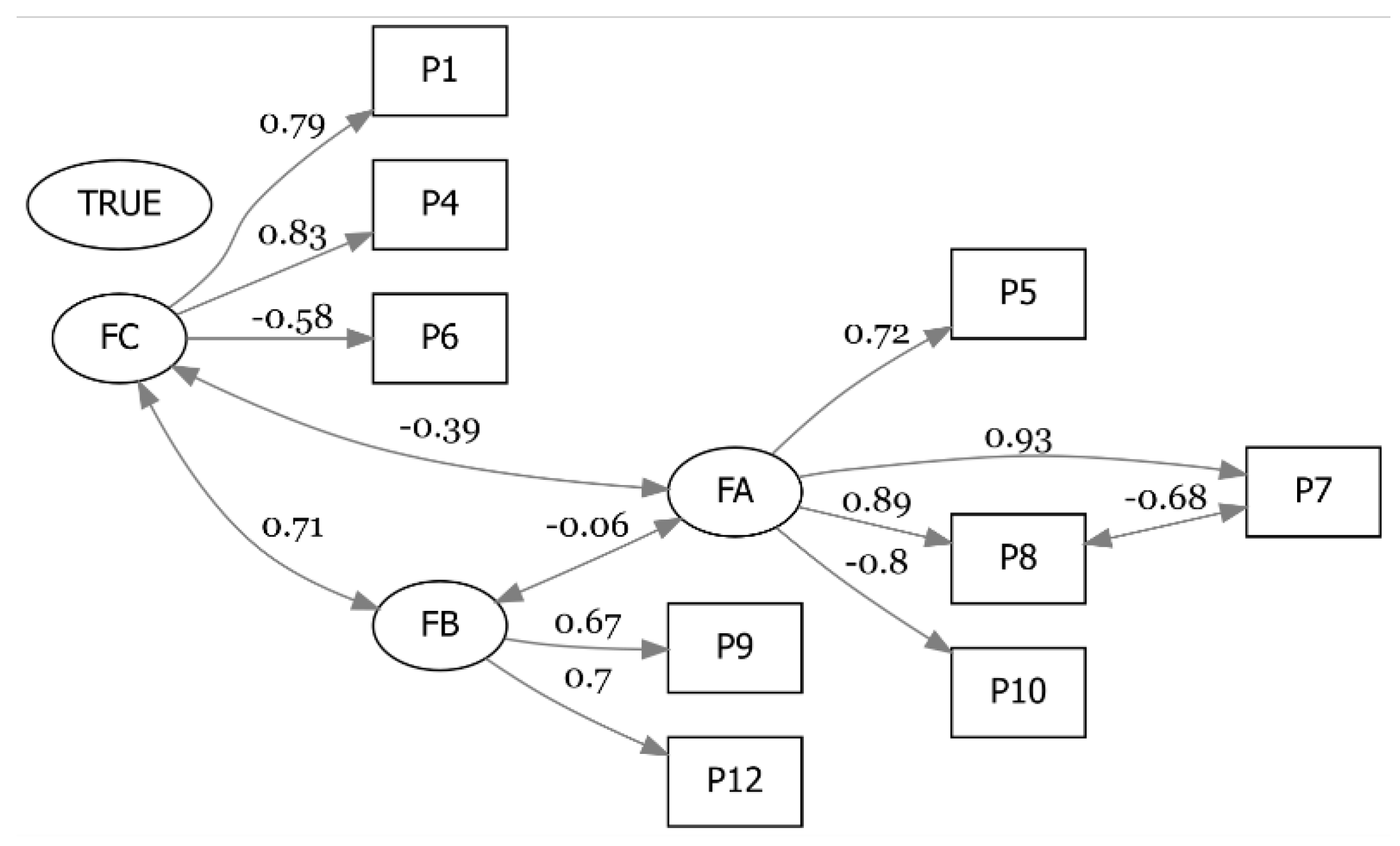
Figure 2.
Confirmatory factor analysis sensitivity model specification. Note. Estimates are standardized loadings; P6 and P10 were modeled as reversed indicators. Estimation used WLSMV with ordered-categorical indicators and latent variances fixed to 1. The model retains the same three-factor structure as the main specification, with residual correlations specified between P7 and P8 and additionally between P4 and P6. Standardized loadings (λ) are displayed on paths, and double-headed arrows represent latent covariances (see Supplementary Table S3).
Figure 2.
Confirmatory factor analysis sensitivity model specification. Note. Estimates are standardized loadings; P6 and P10 were modeled as reversed indicators. Estimation used WLSMV with ordered-categorical indicators and latent variances fixed to 1. The model retains the same three-factor structure as the main specification, with residual correlations specified between P7 and P8 and additionally between P4 and P6. Standardized loadings (λ) are displayed on paths, and double-headed arrows represent latent covariances (see Supplementary Table S3).
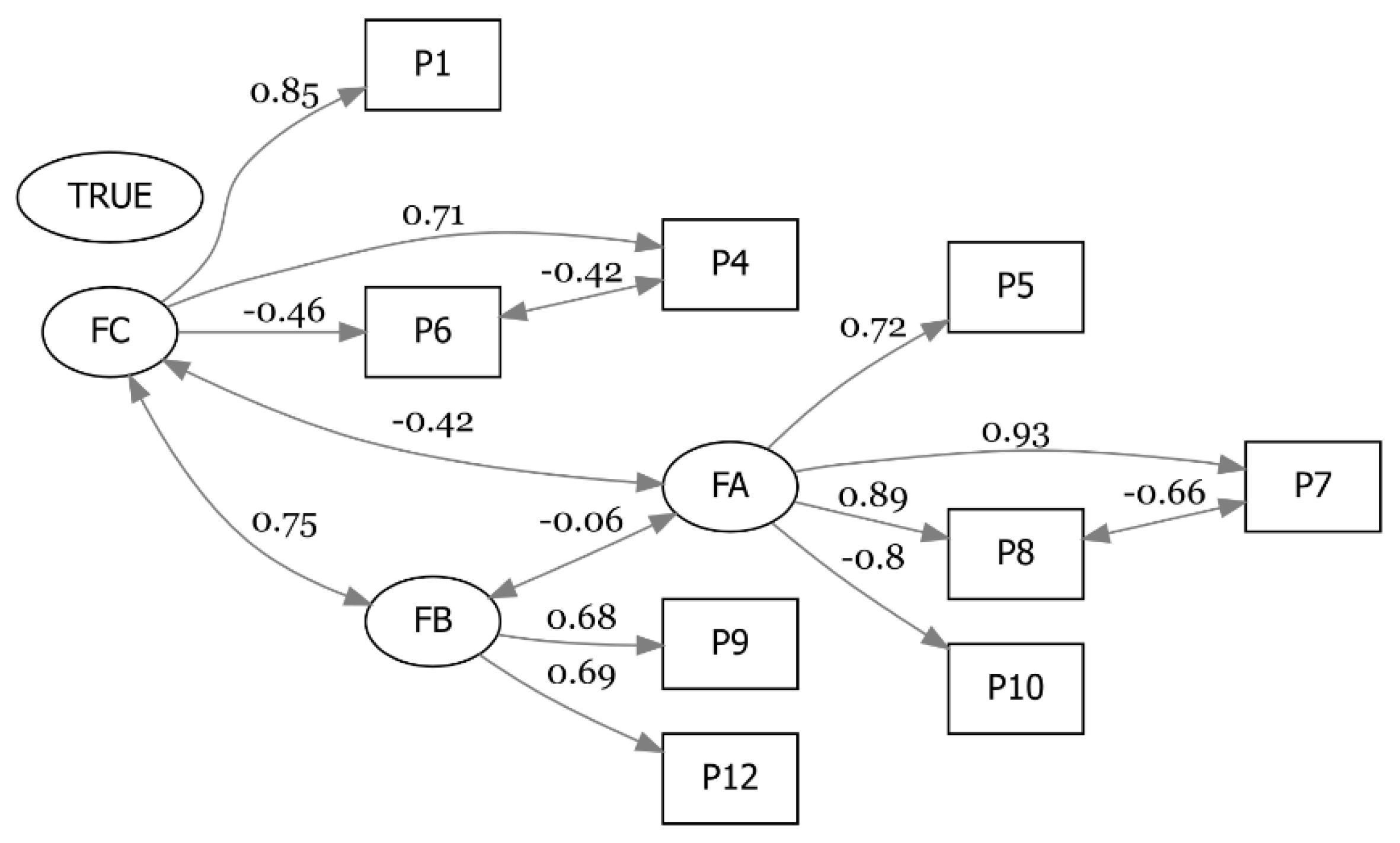
Figure 3.
Validated Empirical Model of Faculty Attitudes Toward Inclusion of Students with PMD. Note. The model integrates three latent factors confirmed through CFA: Concerns and General Attitudes, Inclusive Feelings, and Cognitive–Affective Tension. Each factor clusters observable indicators from the SACIE-R scale, providing a framework for institutional diagnosis and pedagogical planning.
Figure 3.
Validated Empirical Model of Faculty Attitudes Toward Inclusion of Students with PMD. Note. The model integrates three latent factors confirmed through CFA: Concerns and General Attitudes, Inclusive Feelings, and Cognitive–Affective Tension. Each factor clusters observable indicators from the SACIE-R scale, providing a framework for institutional diagnosis and pedagogical planning.
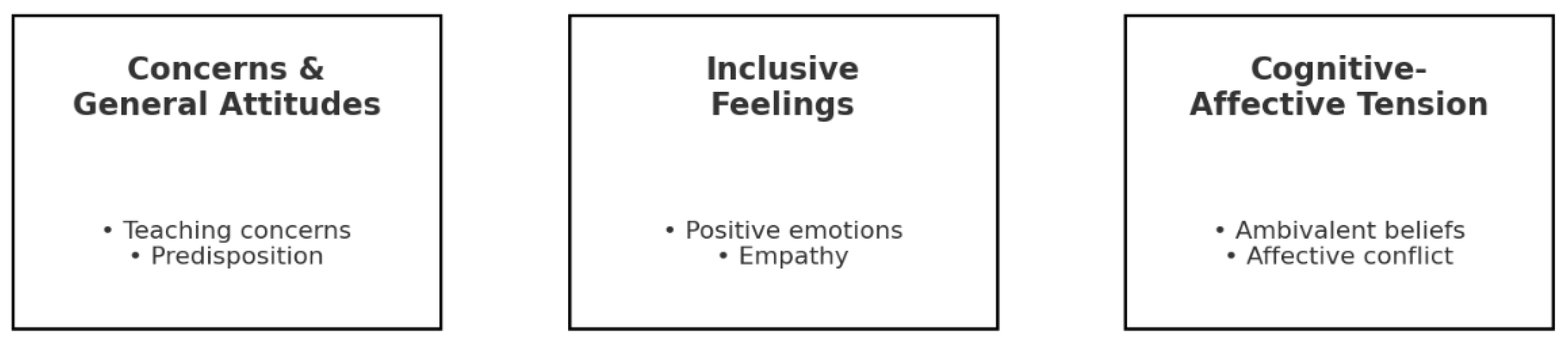
Figure 4.
Validated attitudinal indicators and teaching competencies for PMD inclusion. Note. Latent attitudes were modeled through three correlated factors: Concerns and General Attitudes, Inclusive Feelings, and Cognitive–Affective Tension. Indicators are derived from the SACIE-R items (P1–P12); for detailed item loadings, see Table 4 and Supplementary Table S6.
Figure 4.
Validated attitudinal indicators and teaching competencies for PMD inclusion. Note. Latent attitudes were modeled through three correlated factors: Concerns and General Attitudes, Inclusive Feelings, and Cognitive–Affective Tension. Indicators are derived from the SACIE-R items (P1–P12); for detailed item loadings, see Table 4 and Supplementary Table S6.
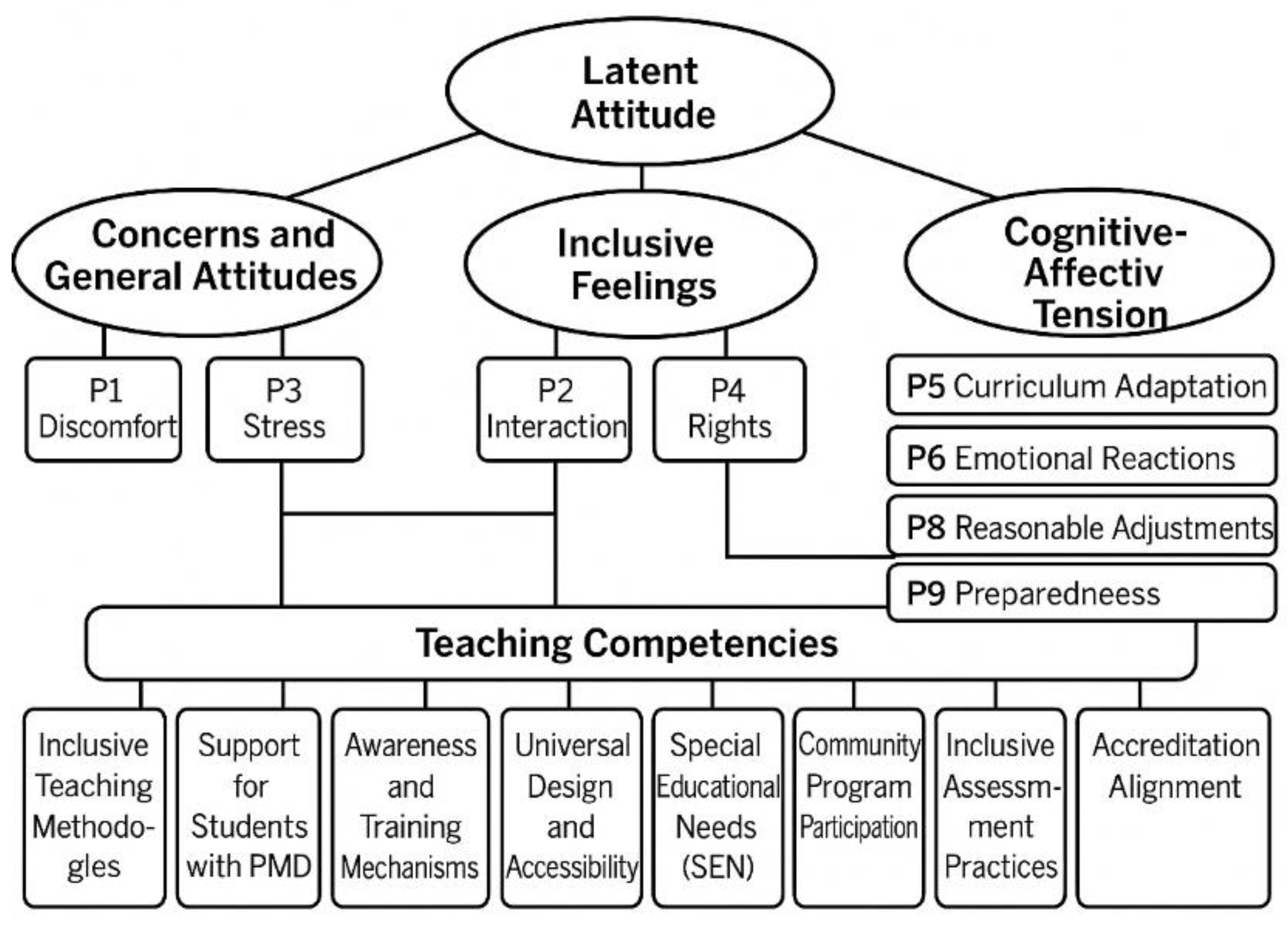

Table 1.
Total Variance Explained.
| Latent Factor | Initial Eigenvalues | ||
|---|---|---|---|
| Total | % of Variance | Cumulative % | |
| 1 | 3.174 | 26.454 | 26.454 |
| 2 | 2.380 | 19.832 | 46.286 |
| 3 | 1.208 | 10.070 | 56.357 |
| 4 | 0.897 | 7.477 | 63.834 |
| 5 | 0.746 | 6.220 | 70.054 |
| 6 | 0.659 | 5.488 | 75.542 |
| 7 | 0.623 | 5.192 | 80.734 |
| 8 | 0.572 | 4.764 | 85.498 |
| 9 | 0.560 | 4.665 | 90.163 |
| 10 | 0.418 | 3.482 | 93.645 |
| 11 | 0.406 | 3.383 | 97.028 |
| 12 | 0.357 | 2.972 | 100 |
Table 2.
Rotated Factor Matrix.
| Items | Factor | ||
|---|---|---|---|
| 1 | 2 | 3 | |
| P7. I am concerned about being more stressed due to having students with physical motor disabilities in my class | 0.770 | ||
| P10. I find it difficult to overcome the impression caused by meeting people with severe physical motor disabilities | 0.724 | ||
| P8. I am afraid to look directly at a person with a physical motor disability | 0.707 | ||
| P5. I am concerned that my workload will increase due to having students with physical motor disabilities in my class | 0.576 | ||
| P3. I tend to end my contact with people with physical motor disabilities as soon as possible | 0.501 | ||
| P1. Students with physical motor disabilities should be in regular classes | 0.646 | ||
| P9. Students who frequently fail subjects should be in regular classes | 0.591 | ||
| P12. Students who need an individualized academic program should be in regular classes | 0.543 | ||
| P4. Students with physical motor disabilities should have everything adapted to attend regular classes (physical and technological infrastructure) | 0.500 | ||
| P11. I am concerned about not having the knowledge and skills needed to teach students with physical motor disabilities | 0.514 | ||
| P2. I consider it difficult to give adequate attention to all students in a classroom | 0.443 | ||
| P6. The teaching-learning process should be adapted for students with physical motor disabilities to attend regular classes | 0.432 | ||
Table 3.
Confirmatory factor analysis global fit indices for the main and sensitivity models (WLSMV).
Table 3.
Confirmatory factor analysis global fit indices for the main and sensitivity models (WLSMV).
| Index | Main model | Sensitivity model |
|---|---|---|
| Chi-square | 47.913 | 31.398 |
| Df | 23 | 22 |
| p-value | 0.002 | 0.088 |
| CFI | 0.993 | 0.997 |
| TLI | 0.989 | 0.996 |
| RMSEA | 0.053 | 0.033 |
| RMSEA 90% CI (lower) | 0.032 | 0.000 |
| RMSEA 90% CI (upper) | 0.074 | 0.058 |
| SRMR | 0.058 | 0.047 |
| CFI (robust) | 0.917 | 0.951 |
| TLI (robust) | 0.871 | 0.920 |
| RMSEA (robust) | 0.123 | 0.097 |
Note. Estimator = WLSMV; items treated as ordered categorical; latent variances fixed to 1 (std.lv = TRUE). RMSEA = root mean square error of approximation; SRMR = standardized root mean square residual; CFI = comparative fit index; TLI = Tucker − Lewis index.
Table 4.
Standardized factor loadings (λ) by factor and item for the main and sensitivity CFA models.
Table 4.
Standardized factor loadings (λ) by factor and item for the main and sensitivity CFA models.
| Factor | Item | λ (Main) | λ (Sensitivity) |
|---|---|---|---|
| Inclusive Feelings (FA) | P5 | 0.718 | 0.720 |
| P7 | 0.929 | 0.929 | |
| P8 | 0.892 | 0.890 | |
| P10 (reversed) | -0.798 | -0.799 | |
| Concerns and General Attitudes (FB) | P9 | 0.675 | 0.677 |
| P12 | 0.695 | 0.693 | |
| Cognitive–Affective Tension (FC) | P1 | 0.794 | 0.853 |
| P4 | 0.825 | 0.712 | |
| P6 (reversed) | -0.583 | -0.462 |
Note. Standardized estimates shown. Negative signs for reversed items (P6, P10) reflect polarity; interpretation follows magnitude.
Table 5.
Composite reliability (CR) and average variance extracted (AVE) by factor for the main and sensitivity models.
Table 5.
Composite reliability (CR) and average variance extracted (AVE) by factor for the main and sensitivity models.
| Factor | CR (Main) | AVE (Main) | CR (Sensitivity) | AVE (Sensitivity) |
|---|---|---|---|---|
| Inclusive Feelings (FA) | 0.627 | 0.703 | 0.626 | 0.703 |
| Concerns and General Attitudes (FB) | 0.585 | 0.470 | 0.585 | 0.470 |
| Cognitive–Affective Tension (FC) | 0.323 | 0.550 | 0.359 | 0.483 |
Note. CR = composite reliability; AVE = average variance extracted. A common rule-of-thumb is AVE ≥ 0.50 for convergent validity.
Table 6.
Strategic Implications of Attitudinal Indicators for Institutional Policy Implementation.
| Attitudinal Indicator | Related Professional Competency | Proposed Institutional Policy/Action |
|---|---|---|
| 1. Implementation of inclusive teaching methodologies | Inclusive pedagogical planning | Incorporate inclusive teaching modules in faculty development programs |
| 2. Support for students with PMD | Academic accompaniment and tutoring | Establish formal mentorship systems for students with disabilities |
| 3. Awareness and training mechanisms | Community and inter-institutional engagement | Organize workshops and sensitization campaigns with disability advocacy groups |
| 4. Training in universal design and accessibility | Curriculum innovation | Include UDL (Universal Design for Learning) criteria in curriculum review processes |
| 5. Addressing special educational needs (SEN) | Adaptation to diverse learning profiles | Create a certification path in inclusive higher education teaching |
| 6. Use of reasonable adjustments | Pedagogical flexibility | Develop institutional guidelines for reasonable accommodation |
| 7. Participation in disability-focused programs | Civic and social responsibility | Link faculty service requirements to disability community outreach projects |
| 8. Inclusive assessment practices | Equitable evaluation systems | Revise assessment policies to integrate inclusive evaluation formats |
| 9. Curriculum design with inclusive criteria | Strategic curricular reform | Require inclusive curriculum frameworks in new program design |
| 10. Alignment with accreditation and quality standards | Institutional accountability | Integrate inclusion indicators into internal quality assurance mechanisms |
Disclaimer/Publisher’s Note: The statements, opinions and data contained in all publications are solely those of the individual author(s) and contributor(s) and not of MDPI and/or the editor(s). MDPI and/or the editor(s) disclaim responsibility for any injury to people or property resulting from any ideas, methods, instructions or products referred to in the content. |
© 2025 by the authors. Licensee MDPI, Basel, Switzerland. This article is an open access article distributed under the terms and conditions of the Creative Commons Attribution (CC BY) license (http://creativecommons.org/licenses/by/4.0/).
Copyright: This open access article is published under a Creative Commons CC BY 4.0 license, which permit the free download, distribution, and reuse, provided that the author and preprint are cited in any reuse.


