

Submitted:
05 September 2025
Posted:
08 September 2025
You are already at the latest version
Abstract
Introduction: The relationship between rejection sensitivity and non-suicidal self-injurious (NSSI) behaviors has been documented; however, the mechanisms leading to NSSI remain unexplored. This study examined whether bullying victimization and loneliness mediate the association between rejection sensitivity and NSSI among in-school adolescents. Method: A total of 300 students (ages 13-16) from seventh to ninth grades in Birjand, Iran completed validated measures of rejection sensitivity, bullying victimization, loneliness, and NSSI. Data were analyzed using SPSS and Hayes’ PROCESS macro with 5,000 bootstrap resamples. Results: Approximately 38.7% of the participants reported experiencing victimization at least two to three times per month. The direct effect of rejection sensitivity on NSSI was not significant (β = 0.102, p > .05), whereas victimization significantly mediated this relationship (β = 0.296, p < .001). Victimization predicted loneliness (β = 0.332, p < .001), which in turn was associated with higher NSSI (β = 0.241, p < .001), revealing a full serial mediation. Conclusion: These findings suggest that adolescents high in rejection sensitivity are more likely to experience peer victimization, fostering loneliness and increasing the likelihood of engaging in NSSI. Interventions focusing on reducing bullying and enhancing socio-emotional support may help prevent self-injurious behaviors among vulnerable youth.
Keywords:
adolescence
; rejection sensitivity
; non-suicidal self-injury
; bullying victimization
; loneliness
Introduction
Adolescence is a critical developmental period characterized by heightened interpersonal sensitivity [1], during which non-suicidal self-injury (NSSI) can occur. NSSI is most commonly defined as the direct and deliberate destruction of one’s own body tissue without suicidal intent and for purposes not socially sanctioned, such as cutting, burning, or hitting oneself [2,3]. Key risk factors for NSSI include mental disorders, adverse childhood experiences [4], emotion dysregulation [5], and lack of social support [6], with rejection sensitivity emerging as a significant vulnerability [7,8].
Rejection sensitivity refers to the cognitive–affective disposition to anxiously expect, readily perceive, and intensely react to cues of interpersonal rejection [9]. Individuals high in rejection sensitivity are more likely to interpret ambiguous social interactions as rejecting and to respond with heightened emotional and behavioral reactions [10]. During adolescence, rejection sensitivity becomes especially relevant [11]. Theoretical frameworks such as interpersonal models of NSSI [3] and emotion regulation perspectives [12] suggest that adolescents who perceive frequent or intense social rejection may engage in non-suicidal self-injurious behaviors as a maladaptive strategy to regulate negative affect, reduce interpersonal distress, or communicate their emotional pain to others.
Empirical evidence indicate that adolescents with higher rejection sensitivity are at greater risk for self-injurious behavior, often through social anxiety, depressive symptoms, or interpersonal stress [7,8]. However, the direct association is inconsistent, suggesting that mediating or moderating factors may influence this relationship. It appears that contextual factors, such as experiences of peer victimization, may help explain how rejection sensitivity translates into self-injurious behaviors. Bullying victimization, in particular, represents a salient social stressor during adolescence that may exacerbate feelings of rejection and intensify the risk of NSSI.
Bullying victimization, defined as repeated peer aggression involving a power imbalance, can take physical, verbal, relational, or cyber forms and is linked to negative psychosocial outcomes in adolescents [13,14,15,16]. Theoretical models, including social-ecological and interpersonal vulnerability frameworks, suggest that adolescents with high rejection sensitivity may perceive bullying as personal rejection, intensifying emotional distress and increasing the risk of non-suicidal self-injury (NSSI) as a maladaptive coping strategy [17,18]. Although studies have shown independent associations between rejection sensitivity, bullying victimization, and NSSI [8,19], few have directly examined victimization as a mediating mechanism. Related research indicates that peer victimization mediates the link between interpersonal vulnerabilities, such as emotion dysregulation or alexithymia, and NSSI, [20], supporting the rationale for examining bullying victimization as a potential mediator between rejection sensitivity and NSSI.
Loneliness, defined as the distress arising from a perceived gap between desired and actual social relationships [21], may help explain the link between rejection sensitivity and NSSI. It is influenced by factors such as social skill deficits, low self-worth, limited peer acceptance, lack of belonging, victimization, and heightened interpersonal sensitivity [22,23,24,25,26,27]. Adolescents high in rejection sensitivity tend to interpret ambiguous social cues as exclusion, fostering perceptions of social disconnection and increasing loneliness [28]. Loneliness, in turn, is associated with maladaptive emotion regulation and greater psychological distress [29,30], both of which increase the risk of NSSI [31]. These findings suggest that loneliness may act as a psychosocial pathway linking rejection sensitivity to self-injurious behaviors in adolescents.
Victimization contributes to adolescent loneliness through both social and affective mechanisms [32]. Social-ecological theory emphasizes that peer relationships are crucial for adolescents’ sense of belonging, and being targeted disrupts these bonds, fostering social isolation [17]. Empirical evidence consistently shows that victimized youth report higher levels of loneliness than their non-victimized peers [33,34,35]. Longitudinal research indicates that victimization, including bullying, is a strong predictor of loneliness, even after controlling for family factors [25]. Cross-sectional studies further reveal positive associations between both overt and relational victimization and loneliness [36], and nationally representative data confirm graded relationships between face-to-face and cyberbullying and the frequency of loneliness [37]. Collectively, these findings suggest that repeated peer aggression undermines social connectedness and amplifies adolescents’ subjective experience of loneliness.
The Interpersonal Theory of Suicide [38] suggests that rejection sensitivity may lead to non-suicidal self-injury through both interpersonal and intrapersonal pathways, with thwarted belongingness—manifesting as loneliness—acting as a proximal risk factor. Adolescents high in rejection sensitivity are more likely to perceive rejection and experience peer victimization, which undermines social connectedness and heightens loneliness. Consequently, victimization and loneliness may function as serial mediators linking rejection sensitivity to NSSI. While prior studies have established individual associations among these variables [36,39,40], few have examined this sequential pathway. The present study addresses this gap by testing bullying victimization and loneliness as mediators, thereby contributing to theoretical understanding and identifying potential targets for preventive interventions.
Method
The present study was basic in purpose and employed a descriptive–correlational design. The target population consisted of male and female junior high school students enrolled in seventh, eighth, and ninth grades who were actively attending school during data collection and able to provide informed consent. In accordance with recommended guidelines for mediation analysis, which suggest a minimum sample of 200 participants [41], a total of 300 students were recruited to enhance generalizability and account for possible attrition. A convenience sampling strategy was adopted due to practical constraints, including limitations in accessibility, time, and resources. Eligibility criteria included active enrollment in grades seven to nine, sufficient language proficiency to understand and complete the study instruments, and the ability to provide informed consent. Students were excluded if they had severe cognitive or developmental impairments that prevented meaningful participation, were experiencing acute psychiatric conditions. Ethical principles were rigorously observed. Informed consent was obtained from both students and their parents. Participation was voluntary, with the right to withdraw at any point without consequence. Confidentiality was safeguarded through anonymized data coding and secure storage. Given the sensitive focus on non-suicidal self-injury and bullying, students were informed of counseling services for additional support. The study adhered to the Declaration of Helsinki, ensuring participants’ rights, dignity, and welfare were fully respected. Data analysis was performed using SPSS version 26.0. Descriptive statistics summarized demographic and study variables. Pearson correlations examined associations among key constructs, and Hayes’ PROCESS macro (Model 6) tested the hypothesized serial mediation model. Bootstrapping with 5,000 resamples was used to estimate indirect effects and generate 95% bias-corrected confidence intervals.
Rejection Sensitivity Questionnaire (RSQ): This questionnaire was developed by Downey and Feldman [9] to assess individual differences in the tendency to anxiously expect, readily perceive, and intensely react to potential rejection. The RSQ consists of 18 hypothetical interpersonal scenarios, each presented in two parts. In the first part, respondents rate the degree of anxiety or concern they would experience in the given situation. In the second part, they indicate the perceived likelihood of acceptance or rejection by the other person involved (e.g., You ask a friend to do you a big favor. How concerned or anxious would you be about whether he/she would agree? How likely do you think it is that your friend would agree to help you?). Responses are scored on a six-point Likert scale, and rejection sensitivity scores are computed by multiplying expectancy of rejection by anxiety ratings across items. The RSQ has shown strong psychometric properties, with the original study reporting a Cronbach’s alpha of 0.83, supporting its internal consistency and construct validity across diverse populations. In the Persian adaptation, the RSQ demonstrated satisfactory convergent validity through its positive correlations with measures of worry and acceptable divergent validity via its negative correlations with self-esteem scales. The instrument also showed good internal consistency, with a Cronbach’s alpha of .84 [42].
Olweus Bully/Victim Questionnaire (OBVQ): The original version of this self-report questionnaire was developed by Dan Olweus in 1986 and revised in 1996 to assess experiences of bullying and victimization among school-aged children [43]. The questionnaire has been widely used internationally and includes 10 items measuring different forms of bullying, such as verbal, physical, relational, and, in more recent adaptations, cyberbullying. Respondents indicate the frequency of their experiences on a 5-point Likert scale ranging from (1) “It has not happened to me at school in the past two months” to (5) “Several times a week.” The OBVQ has demonstrated strong psychometric properties across multiple studies, with Cronbach’s alpha coefficients typically reported above 0.80, indicating high internal consistency [44]. The Persian version of the OBVQ was validated by Rezapour et al. [45] among Iranian middle school students. Reliability analyses indicated acceptable internal consistency, with Cronbach’s alpha reported as 0.80 for the victimization scale.
Adult Social and Emotional Loneliness Scale (SELSA): The Adult Social and Emotional Loneliness Scale (SELSA) was developed by DiTomaso et al. [46]. The original version consists of 15 items, assessing three subscales: romantic loneliness (five items), family loneliness (five items), and social loneliness (five items). Emotional loneliness is derived from the combined scores of the romantic and family subscales, whereas social loneliness reflects difficulties in forming or maintaining broader social relationships. Items are rated on a 5-point Likert scale, ranging from 1 (strongly disagree) to 5 (strongly agree), with higher scores indicating greater loneliness. Psychometric evaluations in the original study confirmed its construct validity and internal consistency, with Cronbach’s alpha values ranging from 0.78 to 0.92 across subscales [46]. In Iran, Jokar and Salimi [47] validated the Persian version, which was adapted into 14 items following item refinement. Their findings demonstrated adequate convergent and discriminant validity through correlations with related psychological constructs. Reliability was also supported, with Cronbach’s alpha coefficients reported as 0.92 for romantic loneliness, 0.84 for family loneliness, and 0.78 for social loneliness [47].
Self-Harm Inventory (SHI): The Self-Harm Inventory (SHI) is a 22-item self-report questionnaire designed to assess a broad range of self-destructive behaviors. Each item requires a dichotomous response (yes/no) regarding the occurrence of specific behaviors, such as cutting, burning, or overdosing. The total score is the sum of endorsed items, with higher scores indicating a greater variety of self-harming behaviors [48]. The Self-Harm Inventory (SHI) has demonstrated satisfactory psychometric properties in its original development study. Internal consistency, as assessed by Cronbach’s alpha, was reported at 0.83, indicating good reliability across the 22 items. Test–retest reliability over a two-week interval yielded a coefficient of 0.81, supporting the temporal stability of the instrument. Construct validity was examined through correlations with measures of borderline personality disorder traits, with higher SHI scores observed among participants meeting criteria for borderline personality disorder, providing evidence for criterion-related validity. Additionally, a cutoff score of 5 or more successfully distinguished individuals with borderline personality disorder, with 83.7% of the identified cases correctly classified.
Results
Participants’ mean age was 14.38 years (SD = 0.69), ranging from 13 to 16 years. Of the total sample, 53.7% (n = 161) were female. In terms of grade level, 76.7% (n = 230) were ninth graders and 23.3% (n = 70) were eighth graders. Prior to analysis, the dataset was screened for missing values, which were subsequently imputed using the mean. Univariate outliers were assessed via box plots, revealing two outliers for the bullying victimization variable and three for non-suicidal self-injurious behaviors; no outliers were detected for the remaining variables. Scores exceeding these thresholds were adjusted by adding two standard deviations to the respective means. Multivariate outliers were evaluated using Mahalanobis distances, with significance determined through a chi-square test at p < 0/001, based on the number of predictor variables [49]. This procedure identified three cases with Mahalanobis distances exceeding the critical value of 16.27, which were subsequently excluded from the analysis.
The statistical assumptions required for testing the serial mediation model were systematically evaluated. Examination of univariate normality indicated acceptable skewness and kurtosis values for all study variables, consistent with recommended thresholds [50]. Multivariate normality was assessed through standardized residuals and the Kolmogorov–Smirnov test, which supported the assumption of normality (Z = 0/04, df = 297, p > 0/05). Potential common method bias was evaluated using Harman’s single-factor test, which showed that the first factor accounted for 16.82% of the variance, well below the 50% threshold, thereby indicating no serious bias. Multicollinearity diagnostics further supported the robustness of the data. Tolerance values for the predictor variables ranged from .82 to .90, and variance inflation factors (VIFs) were between 1.11 and 1.22, both within the acceptable ranges [51]. The assumption of independence of errors was also confirmed, as the Durbin–Watson statistic was 1.98, falling within the recommended interval of 1.5 to 2.5 [52]. Collectively, these results demonstrated that the data met the necessary assumptions for conducting mediation analysis.
Descriptive statistics for all study variables are presented in Table 1.
As presented in Table 1, all study variables were significantly correlated (p < 0/01). Among these associations, bullying victimization demonstrated the strongest correlation with non-suicidal self-injurious behaviors (r = 0/41, p < 0/01). Out of the total sample, 115 participants (38.7%) reported experiencing victimization at least two to three times per month. Regarding the specific forms of victimization, the prevalence rates were 30.0% for verbal victimization, 18.2% for social victimization, 10.4% for physical victimization, and 9.4% for cyber victimization.
The serial mediation model was tested using Hayes’ PROCESS macro (Model 6) in SPSS. As shown in Table 2, rejection sensitivity was a significant positive predictor of bullying victimization (β = 0.296, p < 0.001). Victimization, in turn, significantly predicted non-suicidal self-injury (β = 0.297, p < 0.001). These results suggest that adolescents with higher rejection sensitivity were more likely to experience victimization, which subsequently increased their likelihood of engaging in self-injurious behaviors. The direct effect of rejection sensitivity on non-suicidal self-injury was not statistically significant (β = 0.102, p > 0.05), indicating that its influence operated primarily through indirect pathways. Likewise, rejection sensitivity was not a significant predictor of socio-emotional loneliness (β = 0.094, p > 0.05). In contrast, loneliness was significantly associated with non-suicidal self-injury (β = 0.241, p < 0.001), suggesting its independent role as a risk factor. Finally, victimization significantly predicted loneliness (β = 0.332, p < 0.001), supporting its mediating role between rejection sensitivity and self-injurious behaviors. Figure 1 presents the path model with the estimated coefficients.
Bootstrap analyses were conducted with 5,000 resamples to test the indirect effects, and the results are presented in Table 3. The findings indicated that bullying victimization and loneliness fully mediated the relationship between rejection sensitivity and non-suicidal self-injury. Three specific indirect pathways were identified. First, rejection sensitivity had a significant indirect effect on non-suicidal self-injury through bullying victimization, which accounted for 64.92% of the total indirect effect. Second, the indirect pathway from rejection sensitivity to non-suicidal self-injury through loneliness alone was not significant. Third, a significant serial mediation pathway was observed, such that rejection sensitivity predicted bullying victimization, which in turn predicted loneliness, and this sequence significantly predicted non-suicidal self-injury. This indirect pathway accounted for 17.16% of the total indirect effect.
Discussion
This study examined whether victimization and loneliness mediated the association between rejection sensitivity and NSSI. The findings showed that the direct effect of rejection sensitivity on NSSI was not significant, a result consistent with recent research [7,8]. This suggests that the relationship may be more complex than previously assumed, with indirect pathways exerting greater influence than direct effects. Other mediating factors, such as interpersonal dynamics or loneliness, may further account for the link between rejection sensitivity and NSSI.
The results indicated that victimization functioned as a significant independent mediator in the association between rejection sensitivity and NSSI. This outcome is consistent with prior research that has documented the link between rejection sensitivity and victimization [53], as well as the association between victimization and NSSI [54]. Theoretically, according to the Rejection Sensitivity Model [9], adolescents who are highly rejection-sensitive interpret ambiguous peer behaviors as hostile, increasing their vulnerability to victimization. These adverse peer experiences, in turn, trigger self-injurious behavior as a maladaptive emotion regulation strategy, consistent with the Affect Regulation Model of NSSI [3].
Another finding was that loneliness did not play a significant independent mediating role in the relationship between rejection sensitivity and NSSI. This finding is consistent with studies showing that loneliness often exerts its influence indirectly or in interaction with other risk factors rather than as a standalone mediator [55]. From a theoretical perspective, interpersonal models of NSSI [3] suggest that experiences of rejection may contribute to self-injurious behaviors primarily when combined with additional interpersonal stressors, such as bullying victimization, rather than through loneliness alone. Loneliness may amplify vulnerability but may not directly account for NSSI without the presence of acute external triggers, supporting the view that indirect pathways better explain the association between rejection sensitivity and NSSI.
The present study found that the relationship between rejection sensitivity and non-suicidal self-injury (NSSI) was fully and serially mediated by victimization and loneliness. This pathway can be understood through established theoretical perspectives. Rejection sensitivity, increases the likelihood of hostile attribution biases and maladaptive responses in peer interactions [9]. Such patterns may elicit negative reactions from peers, thereby elevating the risk of being targeted for victimization [28]. Victimization, in turn, contributes to social withdrawal and erosion of perceived belongingness, which are core antecedents of loneliness [56]. Loneliness has been linked to social isolation, depression, and anxiety [57,58] , all of which may increase vulnerability to maladaptive coping strategies such as NSSI [59]. From an interpersonal perspective [1], experiences of exclusion and loneliness amplify psychological pain, which adolescents may attempt to regulate through self-injurious behaviors. Thus, the serial mediation observed in this study highlights how rejection sensitivity indirectly fosters NSSI through a cascading process involving peer victimization and the development of loneliness.
Conclusion
This study investigated the serial mediating roles of bullying victimization and loneliness in the relationship between rejection sensitivity and non-suicidal self-injury (NSSI) among in-school adolescents. Results indicated that rejection sensitivity indirectly influenced NSSI through increased victimization and subsequent loneliness, highlighting the complex interpersonal mechanisms underlying self-injurious behaviors. Strengths include the use of a serial mediation model that integrates peer relational and emotional processes. Limitations involve the cross-sectional design, reliance on self-report measures, convenience sampling, and the lack of control for contextual factors such as socioeconomic status. Despite these constraints, the findings provide theoretical support for interpersonal and developmental models emphasizing peer rejection and social disconnection. Practically, the results underscore the importance of school-based interventions targeting bullying, social isolation, and emotion regulation to reduce adolescents’ risk for NSSI.
Conflicts of Interest
The author declares no conflicts of interest.
Ethical Approval
This study was conducted in accordance with the ethical principles of the Declaration of Helsinki. Participation was voluntary, and informed written consent was obtained from all participants and their parents or legal guardians. Measures were taken to ensure confidentiality, anonymity, and the psychological well-being of all participants throughout the research process.
Declaration of Generative AI and AI-Assisted Technologies
During the preparation of this manuscript, generative AI tools (ChatGPT, OpenAI, 2025) were used solely for language editing, paraphrasing, and improving clarity. The final content was reviewed and edited by the author to ensure accuracy, scientific rigor, and integrity. The author takes full responsibility for the content of the final manuscript.
Acknowledgments
The author sincerely thanks all participating students, their parents, and the school staff for their cooperation in this study.
References
- Jaworska, N.; MacQueen, G. Adolescence as a unique developmental period. Journal of psychiatry & neuroscience: JPN 2015, 40, 291. [Google Scholar]
- Klonsky, E.D.; Victor, S.E.; Saffer, B.Y. Nonsuicidal self-injury: what we know, and what we need to know. Can. J. Psychiatry. 2014, 59, 565–568. [Google Scholar] [CrossRef] [PubMed]
- Nock, M.K. Self-injury. Annual review of clinical psychology 2010, 6, 339–363. [Google Scholar] [CrossRef]
- Wang, Y.-J.; Li, X.; Ng, C.H.; Xu, D.-W.; Hu, S.; Yuan, T.-F. Risk factors for non-suicidal self-injury (NSSI) in adolescents: A meta-analysis. EClinicalMedicine 2022, 46. [Google Scholar] [CrossRef]
- He, K.; Chen, L.; Fan, H.; Sun, L.; Yang, T.; Liu, H.; Wang, K. Effects of rumination and emotional regulation on non-suicidal self-injury behaviors in depressed adolescents in China: a multicenter study. Psychology research and behavior management 2025, 18, 271–279. [Google Scholar] [CrossRef]
- Zhou, Q.; Liang, Y.; Gao, Y.; Liu, X. Social support and non-suicidal self-injury in adolescents: The differential influences of family, friends, and teachers. Journal of youth and adolescence 2025, 54, 414–425. [Google Scholar] [CrossRef]
- Zhao, J.; Li, A.; Li, K.; Zhao, F. How Is Rejection Sensitivity Linked to Non-Suicidal Self-Injury? Exploring Social Anxiety and Regulatory Emotional Self-Efficacy as Explanatory Processes in a Longitudinal Study of Chinese Adolescents. Behavioral Sciences 2024, 14, 943. [Google Scholar] [CrossRef] [PubMed]
- Jiang, Y.; Ren, Y.; Liu, T.; You, J. Rejection sensitivity and adolescent non-suicidal self-injury: Mediation through depressive symptoms and moderation by fear of self-compassion. Psychology and Psychotherapy: Theory, Research and Practice 2021, 94, 481–496. [Google Scholar] [CrossRef]
- Downey, G.; Feldman, S.I. Implications of rejection sensitivity for intimate relationships. Journal of personality and social psychology 1996, 70, 1327. [Google Scholar] [CrossRef]
- Romero-Canyas, R.; Downey, G. Rejection sensitivity as a predictor of affective and behavioral responses to interpersonal stress: A defensive motivational system. In The Social Outcast; Psychology Press, 2013; pp. 131–154. [Google Scholar]
- Somerville, L.H. The teenage brain: Sensitivity to social evaluation. Current directions in psychological science 2013, 22, 121–127. [Google Scholar] [CrossRef]
- Gratz, K.L. Risk factors for and functions of deliberate self-harm: An empirical and conceptual review. Clinical Psychology: Science and Practice 2003, 10, 192. [Google Scholar] [CrossRef]
- Olweus, D.; Hart, C. Bullies on the playground: The role of victimization. Children on playgrounds: Research perspectives and applications 1993, 85–128. [Google Scholar]
- Hong, J.S.; Espelage, D.L. A review of research on bullying and peer victimization in school: An ecological system analysis. Aggression and violent behavior 2012, 17, 311–322. [Google Scholar] [CrossRef]
- Modecki, K.L.; Minchin, J.; Harbaugh, A.G.; Guerra, N.G.; Runions, K.C. Bullying prevalence across contexts: A meta-analysis measuring cyber and traditional bullying. Journal of Adolescent Health 2014, 55, 602–611. [Google Scholar] [CrossRef]
- Samadieh, H.; Soleimani, S. Family Functioning and Bullying Experiences: The Mediating Role of Emotion Regulation Difficulties in Early Adolescence. 2025.
- Bronfenbrenner, U. The ecology of human development: Experiments by nature and design; Harvard university press, 1979. [Google Scholar]
- Prinstein, M.J.; Boergers, J.; Vernberg, E.M. Overt and relational aggression in adolescents: Social-psychological adjustment of aggressors and victims. Journal of clinical child psychology 2001, 30, 479–491. [Google Scholar] [CrossRef] [PubMed]
- Wen, A.; Shi, J.; Wu, N.; Yuan, L. The relationship between bullying victimization and non-suicidal self-injury in adolescents: a moderated mediation model. Current Psychology 2024, 43, 23779–23792. [Google Scholar] [CrossRef]
- Ruan, Q.-N.; Liu, L.; Shen, G.-H.; Wu, Y.-W.; Yan, W.-J. Alexithymia and peer victimisation: interconnected pathways to adolescent non-suicidal self-injury. BJPsych open 2024, 10, e46. [Google Scholar] [CrossRef]
- Perlman, D.; Peplau, L.A. Toward a social psychology of loneliness. Personal relationships 1981, 3, 31–56. [Google Scholar]
- Zhao, J.; Wu, Y.; Yuan, J.; Miao, J.; Wang, X.; Yang, Y.; Zang, S. Association between interpersonal sensitivity and loneliness in college nursing students based on a network approach. BMC nursing 2024, 23, 864. [Google Scholar] [CrossRef]
- Qualter, P.; Brown, S.L.; Rotenberg, K.J.; Vanhalst, J.; Harris, R.A.; Goossens, L.; Bangee, M.; Munn, P. Trajectories of loneliness during childhood and adolescence: Predictors and health outcomes. Journal of adolescence 2013, 36, 1283–1293. [Google Scholar] [CrossRef]
- Samadieh, H.; Rezaei, M. A serial mediation model of sense of belonging to university and life satisfaction: The role of social loneliness and depression. Acta Psychologica 2024, 250, 104562. [Google Scholar] [CrossRef]
- Matthews, T.; Caspi, A.; Danese, A.; Fisher, H.L.; Moffitt, T.E.; Arseneault, L. A longitudinal twin study of victimization and loneliness from childhood to young adulthood. Development and psychopathology 2022, 34, 367–377. [Google Scholar] [CrossRef]
- Reshvanloo, F.T.; Rezvani, T.S.; Samadiye, H.; Kareshki, H. Psychometric Properties of the Basic Need Satisfaction in Relationships with Friends Scale in University Students. Knowledge & Research in Applied Psychology 2023, 24, 121–132. [Google Scholar] [CrossRef]
- Tanhaye Reshvanloo, F.; Samadieh, H.; Goli, B. Psychometric Properties of the Sense of Belonging Instrument Among University Students: Testing the Theory of Human Relatedness. Social Psychology Research 2024, 14, 17–32. [Google Scholar]
- London, B.; Downey, G.; Bonica, C.; Paltin, I. Social causes and consequences of rejection sensitivity. Journal of Research on Adolescence 2007, 17, 481–506. [Google Scholar] [CrossRef]
- Preece, D.A.; Goldenberg, A.; Becerra, R.; Boyes, M.; Hasking, P.; Gross, J.J. Loneliness and emotion regulation. Personality and Individual Differences 2021, 180, 110974. [Google Scholar] [CrossRef]
- Moradi, M.; Ghanaei Chamanabad, A. Predicting Social and Emotional Loneliness in Students Based on Emotional Dysregulation: The Moderating Role of Gender. Recent Innovations in Psychology 2024, 1, 1–16. [Google Scholar]
- Zhang, B.; Zhang, W.; Sun, L.; Jiang, C.; Zhou, Y.; He, K. Relationship between alexithymia, loneliness, resilience and non-suicidal self-injury in adolescents with depression: a multi-center study. BMC psychiatry 2023, 23, 445. [Google Scholar] [CrossRef] [PubMed]
- Gazelle, H.; Rudolph, K.D. Moving toward and away from the world: Social approach and avoidance trajectories in anxious solitary youth. Child Development 2004, 75, 829–849. [Google Scholar] [CrossRef]
- Kochenderfer, B.J.; Ladd, G.W. Peer victimization: Cause or consequence of school maladjustment? Child development 1996, 67, 1305–1317. [Google Scholar] [CrossRef]
- Boivin, M.; Hymel, S. Peer experiences and social self-perceptions: a sequential model. Developmental psychology 1997, 33, 135. [Google Scholar] [CrossRef]
- Graham, S.; Bellmore, A.D.; Mize, J. Peer victimization, aggression, and their co-occurrence in middle school: Pathways to adjustment problems. Journal of abnormal child psychology 2006, 34, 349–364. [Google Scholar] [CrossRef]
- Storch, E.A.; Masia-Warner, C. The relationship of peer victimization to social anxiety and loneliness in adolescent females. Journal of adolescence 2004, 27, 351–362. [Google Scholar] [CrossRef] [PubMed]
- Madsen, K.R.; Damsgaard, M.T.; Petersen, K.; Qualter, P.; Holstein, B.E. Bullying at school, cyberbullying, and loneliness: national representative study of adolescents in Denmark. International journal of environmental research and public health 2024, 21, 414. [Google Scholar] [CrossRef]
- Van Orden, K.A.; Witte, T.K.; Cukrowicz, K.C.; Braithwaite, S.R.; Selby, E.A.; Joiner Jr, T.E. The interpersonal theory of suicide. Psychological review 2010, 117, 575. [Google Scholar] [CrossRef] [PubMed]
- Taylor, P.J.; Jomar, K.; Dhingra, K.; Forrester, R.; Shahmalak, U.; Dickson, J.M. A meta-analysis of the prevalence of different functions of non-suicidal self-injury. Journal of affective disorders 2018, 227, 759–769. [Google Scholar] [CrossRef] [PubMed]
- Liu, R.T.; Sheehan, A.E.; Walsh, R.F.; Sanzari, C.M.; Cheek, S.M.; Hernandez, E.M. Prevalence and correlates of non-suicidal self-injury among lesbian, gay, bisexual, and transgender individuals: A systematic review and meta-analysis. Clinical psychology review 2019, 74, 101783. [Google Scholar] [CrossRef]
- Fritz, M.S.; MacKinnon, D.P. Required sample size to detect the mediated effect. Psychological science 2007, 18, 233–239. [Google Scholar] [CrossRef]
- Mohammadian, Y.; Mahaki, B.; Lavasani, F.F.; Dehghani, M.; Vahid, M.A. The psychometric properties of the Persian version of interpersonal sensitivity measure. Journal of Research in Medical Sciences 2017, 22, 10. [Google Scholar] [CrossRef]
- Olweus, D. Revised Olweus bully/victim questionnaire. Journal of Psychopathology and Behavioral Assessment 1996. [Google Scholar]
- Solberg, M.E.; Olweus, D. Prevalence estimation of school bullying with the Olweus Bully/Victim Questionnaire. Aggressive Behavior: Official Journal of the International Society for Research on Aggression 2003, 29, 239–268. [Google Scholar] [CrossRef]
- Rezapour, M.; Soori, H.; Khodakarim, S. Testing psychometric properties of the perpetration of bullying and victimization scales with olweus bullying questionnaire in middle schools. ارتقای ایمنی و پیشگیری از مصدومیت ها 2014, 1, 212–221.
- DiTommaso, E.; Brannen, C.; Best, L.A. Measurement and validity characteristics of the short version of the social and emotional loneliness scale for adults. Educational and Psychological Measurement 2004, 64, 99–119. [Google Scholar] [CrossRef]
- Jowkar, B. Psychometric properties of the short form of the social and emotional loneliness scale for adults (SELSA-S). International Journal of Behavioral Sciences 2012, 5, 311–317. [Google Scholar]
- Sansone, R.A.; Wiederman, M.W.; Sansone, L.A. The self-harm inventory (SHI): Development of a scale for identifying self-destructive behaviors and borderline personality disorder. Journal of clinical psychology 1998, 54, 973–983. [Google Scholar] [CrossRef]
- Meyers, L.S.; Gamst, G.; Guarino, A.J. Applied multivariate research: Design and interpretation; Sage publications, 2016. [Google Scholar]
- West, S.G.; Finch, J.F.; Curran, P.J. Structural equation models with nonnormal variables: Problems and remedies. 1995.
- Stevens, J.P. Exploratory and confirmatory factor analysis. In Applied multivariate statistics for the social sciences; Routledge, 2012; pp. 337–406. [Google Scholar]
- Neter, J.; Kutner, M.H.; Nachtsheim, C.J.; Wasserman, W. Applied linear statistical models. 1996.
- Dill, E.J.; Vernberg, E.M.; Fonagy, P.; Twemlow, S.W.; Gamm, B.K. Negative affect in victimized children: The roles of social withdrawal, peer rejection, and attitudes toward bullying. Journal of abnormal child psychology 2004, 32, 159–173. [Google Scholar] [CrossRef]
- Serafini, G.; Aguglia, A.; Amerio, A.; Canepa, G.; Adavastro, G.; Conigliaro, C.; Nebbia, J.; Franchi, L.; Flouri, E.; Amore, M. The relationship between bullying victimization and perpetration and non-suicidal self-injury: a systematic review. Child Psychiatry & Human Development 2023, 54, 154–175. [Google Scholar]
- Huang, X.; Liu, H.; Lan, Z.; Deng, F. The effect of loneliness on non-suicidal self-injury behavior in Chinese junior high school adolescents: A moderated mediation model. Psychology research and behavior management 2023, 1831–1843. [Google Scholar] [CrossRef] [PubMed]
- Qualter, P.; Vanhalst, J.; Harris, R.; Van Roekel, E.; Lodder, G.; Bangee, M.; Maes, M.; Verhagen, M. Loneliness across the life span. Perspectives on psychological science 2015, 10, 250–264. [Google Scholar] [CrossRef]
- Wolters, N.E.; Mobach, L.; Wuthrich, V.M.; Vonk, P.; Van der Heijde, C.M.; Wiers, R.W.; Rapee, R.M.; Klein, A.M. Emotional and social loneliness and their unique links with social isolation, depression and anxiety. Journal of Affective Disorders 2023, 329, 207–217. [Google Scholar] [CrossRef]
- Saeidi Rezvani, T.; Tanhaye Reshvanloo, F.; Samadiye, H.; Kareshki, H. Psychometric Properties of the General Belongingness Scale in University Students. Journal of Applied Psychological Research 2021, 11, 113–130. [Google Scholar]
- Guan, M.; Liu, J.; Li, X.; Cai, M.; Bi, J.; Zhou, P.; Wang, Z.; Wu, S.; Guo, L.; Wang, H. The impact of depressive and anxious symptoms on non-suicidal self-injury behavior in adolescents: a network analysis. BMC psychiatry 2024, 24, 229. [Google Scholar] [CrossRef] [PubMed]
Figure 1.
Model Predicting Non-Suicidal Self-injury.
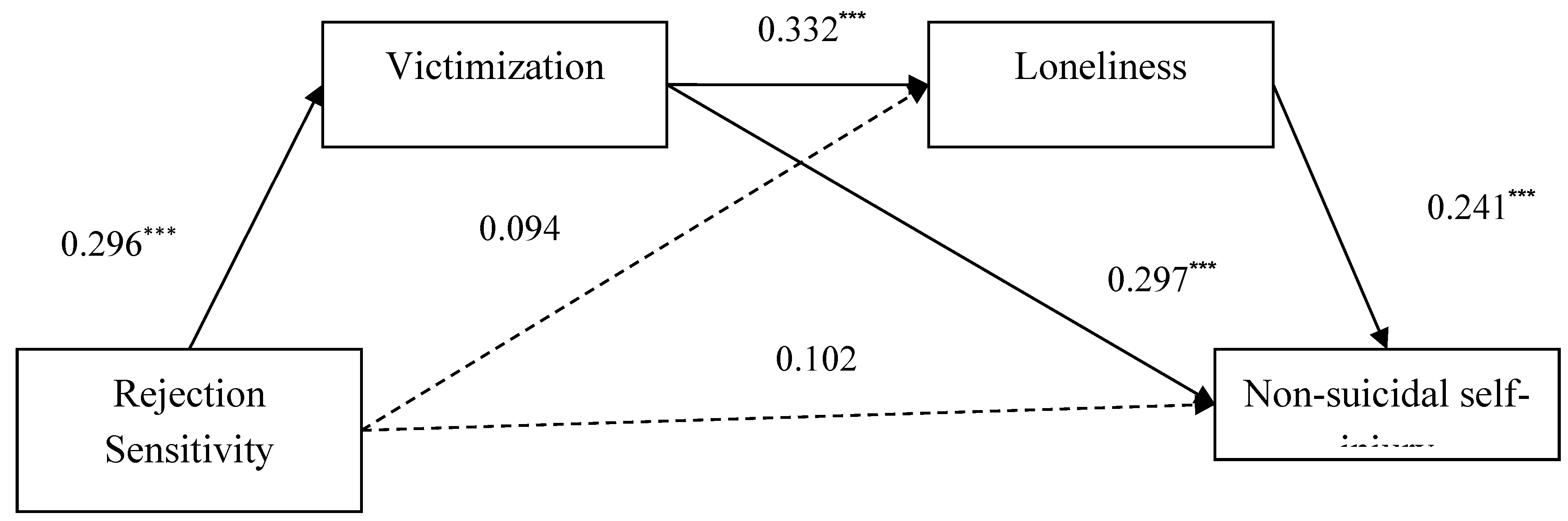

Table 1.
Descriptive Statistics and Correlation between Study Variables.
| Variable | 1 | 2 | 3 | 4 |
| 1. Rejection Sensitivity | 1 | |||
| 2. Victimization | 0.30** | 1 | ||
| 3. Loneliness | 0.19** | 0.36** | 1 | |
| 4. Non-suicidal self-injury | 0.24** | 0.41** | 0.37** | 1 |
| Mean | 48.32 | 6.19 | 28.85 | 4.23 |
| Standard Deviation | 15.63 | 6.81 | 9.79 | 4.19 |
**P < 0.01.
Table 2.
Standardized Regression Weights for Predicting Non-suicidal Self-injury.
| Regression Equation (N = 297) | Fit Indicator | Coefficient and Significance | ||||
| Outcome Variable | Predictor Variables | R | R2 | F | β | t |
| Victimization | Rejection Sensitivity | 0.295 | 0.087 | 28.272 | 0.296*** | 5.317 |
| Loneliness | Rejection Sensitivity | 0.371 | 0.137 | 23.444 | 0.094 | 1.665 |
| Victimization | 0.332*** | 5.852 | ||||
| Non-suicidal self-injury | Rejection Sensitivity | 0.237 | 0.056 | 17.555 | 0.237*** | 4.189 |
| Non-suicidal self-injury | Rejection Sensitivity | 0.486 | 0.236 | 30.218 | 0.102 | 1.911 |
| Victimization | 0.297*** | 5.260 | ||||
| Loneliness | 0.241*** | 4.392 | ||||
*** p < 0.001.
Table 3.
The Total, Direct, and Indirect Effects.
| Effects | Boot SE | Boot LLCI | Boot ULCI | |
|---|---|---|---|---|
| Total effect | 0.063 | 0.015 | 0.033 | 0.093 |
| Direct effect | 0.027 | 0.014 | -0.0008 | 0.055 |
| Total indirect effect | 0.134 | 0.032 | 0.075 | 0.205 |
| Indirect effect 1 | 0.087 | 0.026 | 0.042 | 0.146 |
| Indirect effect 2 | 0.022 | 0.016 | -0.006 | 0.059 |
| Indirect effect 3 | 0.023 | 0.008 | 0.009 | 0.043 |
Note: Boot SE indicates the standard error, and Boot LLCI and Boot ULCI denote the lower and upper bounds, respectively, of the 95% confidence intervals for the indirect effects as estimated by the bootstrap method. Indirect effect 1: rejection sensitivity → victimization → self-injury; indirect effect 2: rejection sensitivity → loneliness → self-injury; indirect effect 3: rejection sensitivity → victimization → loneliness → self-injury.
Disclaimer/Publisher’s Note: The statements, opinions and data contained in all publications are solely those of the individual author(s) and contributor(s) and not of MDPI and/or the editor(s). MDPI and/or the editor(s) disclaim responsibility for any injury to people or property resulting from any ideas, methods, instructions or products referred to in the content. |
© 2025 by the authors. Licensee MDPI, Basel, Switzerland. This article is an open access article distributed under the terms and conditions of the Creative Commons Attribution (CC BY) license (http://creativecommons.org/licenses/by/4.0/).
Copyright: This open access article is published under a Creative Commons CC BY 4.0 license, which permit the free download, distribution, and reuse, provided that the author and preprint are cited in any reuse.


