

Submitted:
12 August 2025
Posted:
13 August 2025
You are already at the latest version
Abstract
Researchers observed that even if one’s environmental concern was high, people would delegate others to take responsibility for climate change mitigation and undertake sustainable actions. In this study, we explored how citizens of different countries in Central Europe, Central Asia and the Middle East perceived responsibility for mitigating and reducing climate change consequences of various collective and individual agents. Also, we asked about the role of cultural values, environmental worldviews and beliefs in the intractability of climate change in the prediction of the responsibility distribution. The total sample consisted of N = 1267 participants from Belarus, Lithuania, Poland, the United Arab Emirates and Uzbekistan. We created the list of 11 collective and individual entities as accountable for mitigation and sustainable activities. We used the Collindex scale to measure collectivistic and individualistic values, the NEP scale to measure anthropocentric and ecocentric worldviews, and two questions concerning the intractability beliefs. Results showed that participants attributed more responsibility to collective agents than to individuals across countries. The predictors’ patterns indicated that ecocentric worldviews consistently increased perceived responsibility of both collective and individual actors, whereas anthropocentrism reduced the attribution of collectives’ responsibility. Collectivistic values appeared to foster greater expectations of individuals. Also, differences between national samples were observed.
Keywords:
climate change
; mitigation
; cultural values
; New Environmental Paradigm
; intractability
; cross-cultural study
Who Is Most Responsible for the Mitigation of Climate Change?
An Intercultural Study in Central Europe, Central Asia, and the Middle East
Climate change mitigation refers to any action taken by governments, businesses, and people to reduce the flow of heat-trapping greenhouse gases into the atmosphere to make the impact of climate change less severe. Also, mitigation includes enhancing carbon sinks that remove greenhouse gases from the atmosphere by protecting and restoring forests and critical ecosystems. Reducing and avoiding emissions requires changing almost every sphere of people’s lives, and at every level of functioning of societies and individuals, from how economies work, and what everyday choices are made by individuals [1]. Mitigation efforts include transitioning to renewable energy sources, reducing energy consumption, changing agricultural practises, and changing individuals’ habits concerning transportation or diet [2]. The climate change issue is fundamentally collective because everyone acts in ways that benefit themselves but produce greenhouse gas emissions. Therefore, efforts to address the impacts of climate change must also be collective, as the problem is too vast and complex to be solved by a single individual or entity [3]. There is considerable psychological literature on personal beliefs, emotions, and attitudes toward climate change [2,4,5,6,7]. There is a significant gap in research regarding how people perceive the responsibility for climate change action among different stakeholders. Understanding these perceptions is crucial for fostering effective collaboration and accountability in the fight against climate change.
In this study, we aimed to examine how citizens of countries in Central Europe, Central Asia, and the Middle East attribute responsibility for climate change mitigation to various entities. Also, we are interested in the role of cultural values, ecological worldviews, and beliefs in the intractability of climate change in shaping opinions about responsibility distribution and sustainable practises.
Responsible agents. First of all, it should be underscored that before ascribing responsibility to someone, one must admit that a climate change problem exists, and it should be resolved by taking proper actions. For people who deny or minimise the consequences of climate change, responsibility issues are of less importance or even irrelevant to their lives. Nevertheless, research shows that responsibility for mitigation is the major concern for most individuals and for collective bodies, such as corporations or governments [3,8,9].
It is reasonable to expect that responsibility for climate change mitigation should be shared across different actors, such as governments, corporations, international organizations, and individuals, within their means. For example, governments have the means and power to implement policies and regulations appropriate to achieve mitigation and sustainability aims, and to cooperate on climate issues with their counterparts at the international level [10,11]. Stoddart and his colleagues explored environmental group members' opinions on responsibility and discovered that among the top four responsibilities, the government was perceived as the most responsible, followed by individuals, “everyone,” and corporations [12]. Becker & Sparks’s qualitative study, in which many participants agreed that the government should play a crucial role in addressing climate change; though along with members of the public and corporations [13] confirmed these findings.
Nowadays, corporations have even more power, which enables them to invest in the research and development of cleaner technologies, transition to sustainable business models, and disseminate best practices across the globe [3,9,14]. The list of collective agents can be quite extensive, comprising numerous organizations, such as universities, cities, sub-national governments, and businesses [3].
Also, individuals can contribute to mitigation efforts by adopting sustainable practices in their daily lives, such as reducing energy consumption, using public transportation, consuming less meat, and minimizing waste [8]. Some people may help to achieve mitigation goals indirectly by increasing public and individual awareness of environmental threats and by teaching and supporting sustainable behaviours in children, community members, and social media users. These may be parents [15], teachers [11,16], religious leaders [17,18], social media influencers [19,20], as well as community leaders, respected by others.
Besides, individuals can also play a role in advocating for climate action by supporting policies that promote sustainability and checking on how governments and businesses operate within climate issues [3,21].
In the study on a German representative sample, the following actors were assessed as responsible for climate protection measures: politicians, economists, individuals, the society, industrialized countries, emerging economies and developing countries. It occurred that every actor was considered to be highly responsible. However, developing countries were held the least responsible compared to other actors, while the highest responsibility was attributed to industrialized countries. The individuals were assumed to be less responsible than politicians, economists, or society in general [22]. The study carried out in Australia also showed that people placed more responsibility on groups and organisations, and less on individuals, for both causing and responding to climate change, regardless of their opinion on the causes of climate change [23].
If people believe that such a large number of entities are responsible for climate change action, it may generate diffusion of responsibility, which in turn will interfere with mitigation efforts [8]. Individuals may think that their actions are meaningless and point to politicians or businesses; politicians may place responsibility back onto individuals, etc. [10]. Indeed, the study with focus groups carried out in Switzerland revealed that individuals tend to justify their lack of engagement in mitigation efforts by blaming others for inaction, including governments [22].
The distribution of responsibility among numerous actors may depend on how individuals perceive the actors: their intention to act in the name of the right cause, their ability to act efficiently, their power to make a substantial impact, and their means to do so. Perception of responsible others may be entangled in social, political, and cultural contexts, as well as in psychological factors [10,11,13,24,25]. For example, in democratic states, the government is trusted more than in less democratic countries, so citizens may grant governmental institutions more rights to act in the environmental domain [10]. On the other hand, in countries ruled by authoritarian leaders, people may accept strict government controls as given and comply with governmental regulations [26]. It is worth noticing that interpersonal trust is higher in democratic societies, so people tend to believe that others are involved in the battle against climate change as much as everybody is [21].
Cultural context. We defined cultural context in terms of collectivistic and individualistic value orientations. There are mixed research results concerning the relationship between collectivism and individualism and attitudes toward the environment. Cultural values may support or diminish efforts undertaken to alleviate climate change and work for sustainability. Preference for collectivistic values may result in higher concern for climate change, seen as a common good — belonging to the community - degradation; therefore, people may attribute more responsibility to various agents fighting for the restoration of the environment for the benefit of society. Positive links between collectivistic orientation and sustainable behaviours are evidenced in many studies [27,28,29]. However, there are also ambiguous findings [30]. Furthermore, some studies deliver contradictory results [31,32,33], showing negative relationships between collectivism and attitudes toward climate change concern.
Individualistic values promote egocentric interests, a lifestyle framed by seeking pleasure, excitement, and self-fulfilment, regardless of others’ needs. So, people of individualistic orientation may be less interested in the community's goals and be indifferent to responsibility issues [25], except for being responsible for taking care of themselves [34]. Xue and his colleagues found in Chinese participants that higher scores on individualism were associated with reduced support for policies to mitigate climate change [26]. However, it is observed more pro-environmental activities in individualistic societies than in collectivistic cultures [33,34,35]. The widespread presence of environmental groups is more likely in individualistic societies rather than in collectivistic societies, due to the individualists’ ability to form temporary groups aimed at achieving a specific goal rather than basing their activity on stable, long-lived groups [34]. Also, there are studies showing the lack of a relationship between the individualism-collectivism dimension and environmental performance [9].
Such ambivalent and even contradictory findings make it difficult to predict who people of collectivistic or individualistic orientation delegate to bear responsibility for climate change mitigation. Obviously, the concept of culture is more complex, and collectivistic–individualistic dimensions couldn’t be treated as sufficient proxy factors for the whole cultural context.
Ecological worldviews. The concept of the New Ecological Paradigm introduced by Dunlap and his colleagues [36,37,38,39] captured well the dilemma of human-nature relationships. The NEP approach is based on the belief that human beings depend on a natural world that has its own intrinsic value, regardless of its usefulness to humans. The NEP scale has been widely used to measure pro-ecological worldviews understood as a multifaceted concept, comprising the five hypothesized facets: acknowledgement of the reality of limits to growth, anti-anthropocentrism, the fragility of nature’s balance, rejection of human exemptionalism, and the possibility of an ecocrisis [39]. However, studies show that the NEP scale can be applied as a measurement of a one-dimensional construct, representing a general pro-environmental concern, or multidimensional constructs [39]. The latter may reflect at least bipolar beliefs as pro-environmental and anti-environmental views, which may be called ecocentric and anthropocentric views, respectively [40,41]. Anthropocentric beliefs claim human domination over nature and rights to use natural resources satisfying human needs, without regard to harm made to nature. Therefore, anthropocentrism puts into question the human role in the climate disaster. The tension between anthropocentrism and ecocentrism lies in the lack of balance between how much humans take from nature and how much nature can offer to humans. Such a balance requires taking into account concerns both for the environment and for humans.
Looking at the ecological worldviews as related to responsibility issues, we may expect that ecocentrism can generate a high tendency to attribute responsibility for climate change mitigation to collective bodies as much as to individuals, because ecocentrism predicts pro-environmental engagement and willingness to protect nature [42]. In contrast, anthropocentrism, in ignoring human responsibility in causing and resolving problems, can make people indifferent to mitigation, even to refuse to participate in mitigation and sustainable activities.
Intractability. Intractability of climate change refers to the challenges posed by a multitude of various factors, which make mitigation actions ineffective. The array of factors include scientific complexity of the climate issues, economic short-term interests, lack of global consensus, political polarization, cultural norms and habits, lack of public awareness and engagement and other [43].
The perception of the intractability of climate change may hamper people’s willingness to undertake actions to reduce greenhouse gas emissions. Perceived intractability refers to one’s belief that climate change cannot be addressed by individual action [25]; therefore, a single person cannot be obliged to act. People feel they lack the ability or sense of empowerment to undertake actions that will "make the difference" on climate change. It could be seen as one "dragon" - among other "dragons" - of inaction [24]. According to Gifford, environmental or climate-related inaction has many reasons, which may be categorised as lack of proper knowledge on environmental and climate issues; as a variety of psychological processes interfering with effective action; and action can be inadequate because it makes too little of a difference. As Jennifer Kent noted: In the US and UK research 75% (consumers) stated that they were concerned about global warming “but challenged to see how their action could make a difference” and only 9% indicated both concern and willingness to take action. In the Australian research, an equal number expressed concern but not willingness to act (75%) ([8], p. 142). Belinda Xie and her colleagues used the term “mitigation response inefficacy” for the perceived inability of the response effectively to reduce or control a threat. They found high correlation scores between mitigation response inefficacy and unwillingness to act for climate benefits [44].
Intractability of climate change, perceived by individuals, may have an impact on the distribution of the responsibility in such a way that people would consider collective bodies more responsible for tackling climate issues than individuals. Although, they may assume, quite rightly, that the global problem of climate change requires the combined actions of many individuals working together, but more likely they call on governments and other public institutions to act [45,46]. Likewise, putting too much of the responsibility on governments may diminish individuals’ motivations to be involved personally; such a tendency was observed in the sample of young Australians [47].
The Present Study
The current study aimed to explore the perception of responsibility for climate change mitigation ascribed to a number of collective and individual actors. Research on responsibility distribution usually focuses on responsibility attributed to collective entities such as governments, corporations, organisations, and to individual entities presented simply as unspecific individuals. We expanded the list of responsible agents by including more collective actors, e.g. countries-polluters, and rich countries, and by including individuals having a special status or playing special roles in the society: scientists, rich people, social activists, religious leaders, and teachers. The larger set of actors may provide a better insight into the process of responsibility distribution.
We intended to explore the cultural and psychological contexts in which the distribution of climate change responsibility took place. Shifting responsibility to others may be caused by morally dubious intentions of avoiding personal responsibility, but also it may be a perfectly rational act, as the best way of tackling mitigation problems in given circumstances. Thus, we wanted to learn how cultural context sets the stage for deciding to whom responsibilities should be transferred: collectives or individuals. We focus on collectivistic and individualistic values as the most relevant to the dilemma of choosing between collective and individual actors.
As for psychological factors shaping opinions about responsibility for mitigation, we proposed cognitive variables: beliefs about human-nature relationships and beliefs in climate change intractability. Beliefs about human – nature relationships, i.e. ecological worldviews, reflect one’s concern for the environment in general, while intractability of climate change – concern for climate. Both concepts may have an impact on a tendency to attribute responsibility, regardless of whether agents represent collectives or individuals.
Lastly, we addressed these objectives by studying different samples coming from countries understudied in the environmental psychology. We chose five countries, in three geographical regions: Belarus, Lithuania, and Poland in Central Europe; the United Arab Emirates in the Middle East; and Uzbekistan in Central Asia. Table 1 provides basic regional and cultural characteristics.
The study was approved by the Ethics Committee of the Psychology Institute, Polish Academy of Sciences.
Three European countries shared a common history in the XVI-XVII century, creating the Polish-Lithuanian Commonwealth, which included contemporary Belarus, and recent history as post-Soviet states. The dominant religion is Christianity: Roman Catholic in Poland and Lithuania, and Russian Orthodox in Belarus. Also, according to Hofstede scores, they share a similar position on the individualistic dimension, with Lithuania as the most individualistic country out of the three. Belonging to the Western cultural zone, the prevailing cognition style is analytical. They differ from each other as regards the ranking of the GDP per capita, since Belarus occupies the lowest position in the group; and the ranking of the EPI, with – again – Belarus having the lowest rank.
The United Arab Emirates share with Uzbekistan the Islamic religion and low scores on individualism. However, the position of Uzbekistan on an individualistic dimension we can infer from the scores of its closest neighbour, Kazakhstan, because there is no data on Uzbekistan in the Hofstede research. Also, both countries may share the same cognition style, i.e., holistic, though Uzbekistan people may be familiar with analytic thinking as well. Regarding rankings in GDP per capita, the UAE and Uzbekistan occupy opposite positions: the UAE as the richest country, and Uzbekistan as the poorest one. The difference in the EPI is also quite large; however, both countries are located quite low in this ranking.
As regards the Democracy Index, produced by the Economist Intelligence Unit, we have two democratic states, which are Lithuania and Poland, and three states – the UAE, Uzbekistan, and Belarus – with a low democracy index.
According to a recent analysis by Kitayama and Salvador [48], the holistic cognitive style, typical for Arab and Far East cultures, is complemented by Western analytical, argumentative thinking. It is especially true for countries that “have historically served as a hub for trade and cultural exchanges between Eastern and Western regions (p.516)”. Living where they do, residents of the UAE and Uzbekistan likely possess access to either cognitive style.
We posed the following research questions:
RQ1. How do citizens of different countries distribute responsibility for climate change mitigation across various actors?
RQ2. Which cultural values: collectivistic or individualistic, predict best an attribution of responsibility for mitigation to collective and individual actors?
RQ3. Do cognitive beliefs about human-nature relationships and beliefs in the intractability of climate change predict attribution of climate change mitigation to collective and individual actors?
Since the study has an exploratory character, we have planned no specific hypotheses.
Method
Participants
The total sample consisted of N = 1268 participants recruited through convenience sampling at the local universities; 30% were males, 72% were students, with a mean age of approximately 23 years. In the UAE, foreigners made up 88.1% of the population as of 2020, reflecting the unique characteristics of the country. The largest group of non-UAE nationals is South Asians, who account for 59.4% of the foreign population. The demographic structure of our sample for the UAE closely mirrors these population characteristics.
Table 2. provides characteristics of national samples.
Measures
The study used a demographic questionnaire that collected participants’ information on their age, gender, occupation, confession and ethnicity, listed in the participants section, followed by the subsequent questionnaires.
Responsibility for Climate Change Mitigation. We made a list of 12 entities: everyone, social activists, teachers, religious leaders, scientists, political leaders, businesses, governments, the richest people, rich countries, and countries-polluters, and media as those who should to take responsibility for climate change mitigation. We gave examples of responsible activities for each agent (Table 3). We asked participants to Choose the option that best corresponds with how you feel about the statement on a scale from 1- the least responsibility to 5- the greatest responsibility.
To investigate the factor structure of the measure for the total sample, we performed an exploratory factor analysis (EFA) using the principal components method with V+arimax rotation on the measure. Bartlett’s test of sphericity was significant, χ2(66) = 5629, p<.001, and the Kaiser-Meyer-Olkin measure of sampling adequacy was .90. The analysis revealed two-factor solution that explained 54,6% of the total variance. Factor loadings showed that seven items were loaded on the first factor, which explained 31,80% of variance, and five items on the second factor, which explained 22,80% of variance. One item (media) had similar high loadings on two factors (.443 and .572), so we excluded it from subsequent analyses.
Based on the first factor items, we created the variable “Collective responsible agents”. (Resp_coll). This category included businesses, governments, politicians, countries_pollluters, rich people, rich countries and scientists. Reliability was satisfactory: Cronbach’s α coefficients: .86 (total); .89 (Belarus); .84 (Lithuania); .86 (Poland); .81 (the UAE); .80 (Uzbekistan). Based on the second factor items, we created the variable “Individual responsible agents” (Resp_Individ). This category included everyone, teachers, activists and religious leaders. Reliability was satisfactory. Cronbach’s α coefficients: .75 (total); .75 (Belarus); .78 (Lithuania); .68 (Poland); .69 (the UAE); .70 (Uzbekistan).
Cultural Values. We used the COLINDEX scale [30] to measure collectivistic and individualistic values. The scale comprises 13 items reflecting collectivistic (6 items) and individualistic (7 items). Participants were asked to evaluate how important the values were to them as principles guiding their lives, on the 5-point scale where 1 – completely unimportant, 5 – very important.
We performed a confirmatory factor analysis (CFA) on the total sample using a two-factor structure. The two-structure solution was not supported as having an adequate fit in this sample as indicated by model fit indices: χ2(64) = 613,84, p<.000; Comparative Fit Index (CFI) =.849; root mean square error of approximation (RMSEA) = .082, 90% confidence interval (CI) = [.077, .088], standardized root mean squared residual (SRMR) = .059. An exploratory factor analysis (principal components method with Varimax rotation; Bartlett’s test χ2(78) = 3700, p<.001, KMO = .835) revealed a three-factor solution, which explained 51,43% of total variance. Factor loadings showed that items were loaded on the first factor, which explained 20,67% of variance, and four items on the second factor, which explained 17,37% of variance; and three items on the third factor, which explained 13,39% of variance.
We created three variables based on the three-factor solution. The first variable represents collectivistic values (Values_collect): obedience, respect for elders, politeness, security, self-discipline, order; Cronbach’s α coefficients: .77 (total); .83 (Belarus); .72 (Lithuania); .71 (Poland); .77 (the UAE); .74 (Uzbekistan). The second variable represents individualistic values manifesting a tendency to have an indulgent life (Values_Ind_indulg): exciting life, pleasure, varied life, being daring; Cronbach’s α coefficients: .72 (total); .65 (Belarus); .73 (Lithuania); .70 (Poland); .66 (the UAE); .62 (Uzbekistan). The third variable also represents individualistic values, but with a focus on self-realization (Values_Ind_real): creativity, freedom, independence; Cronbach’s α coefficients: .53 (total); .58 (Belarus); .61 (Lithuania); .53 (Poland); .48 (the UAE); .53 (Uzbekistan).
Ecological Worldviews. We employed the New Ecological Paradigm (NEP) Scale (Dunlap & Van Liere, 1978) to measure ecological worldviews. We added one item to the original 15-item scale, referring to the last pandemic situation across the globe: The fundamental reason for the emergence of pandemics is that we failed to live in harmony with nature. Respondents were asked to indicate how much they agree with the statements on 5-point scale where 1 – strongly disagree, 5 – strongly agree.
Following EFA solution (principal components method with varimax rotation; Bartlett’s test χ2(120) = 4087, p<.001, KMO = .828), we identified two factors that explained 38,11% of total variance: the first factor explained 19,60% of variance, and the second factor explained 18,51% of variance.
The first factor (9 items) represents ecocentric worldview (Cronbach’s α coefficients: .74 (total); .73 (Belarus); .65 (Lithuania); .81 (Poland); .69 (the UAE); .74 (Uzbekistan). The second factor (7 items) represents an anthropocentric worldview; Cronbach’s α coefficients: .75 (total); .66 (Belarus); .66 (Lithuania); .71 (Poland); .70 (the UAE); .58 (Uzbekistan). Ecocentric worldview examples: Plants and animals have as much right as humans to exist. The balance of nature is very delicate and easily upset. Anthropocentric worldview examples: Humans have the right to modify the natural environment to suit their needs. Humans were meant to rule over the rest of nature.
Intractability of climate change. To measure the belief in intractability of climate change, we asked participants to indicate how much they agreed with two following statements: My individual action would likely do little to aid the fight against climate change and Climate change is an unstoppable process; we cannot do anything about it. They used 5-point scale where 1 – strongly disagree, 5 – strongly agree.
Each scale was back-translated from English into Russian for Belarusian participants, and into Lithuanian, Polish, and Uzbek for relevant national samples. The questionnaire for UAE participants was provided in English, which is a common and informally the most spoken language of the country.
Analytical Strategy
We ran an invariance measurement analysis by comparing the factor structure, factor loading, and intercepts of three measures across five national samples [49,50] with AMOS v.29 [51] (Table S1).
Invariance of three measurement instruments is supported by the data only at the metric level. Changes in fit indices between the configural and the metric invariance models are smaller than cutoff criteria for RMSEA (∆ <.015) and SRMR (∆ <.03) indices, except ∆ CFI which is close to criterion (.014; .031; .018). This implies that data across national samples are comparable only in terms of covariances and regression coefficients, so the only meaningful analyses that can be performed in the total sample and across national samples are correlational and regression analyses. Because of the lack of scalar invariance, we cannot compare mean scores between national samples.
Therefore, we will analyse the distribution of mean scores of the responsibility for climate change mitigation within national samples. Then, we will perform several hierarchical regression analyses in the total sample and in national samples to find predictors of the tendency to attribute responsibility for mitigation to various actors. We used the SPSS v. 29.
Results
Descriptive Statistics
Means, standard deviations and bivariate correlations between the examined variables are presented in Table 5.
When considering cultural values mean scores, self-realization individualistic values are rated highest in each national sample, with collectivistic values second, and self-indulgent individualistic values after that (Table 4). The differences between the pair of values are statistically significant (p<.001), but the effect sizes of the differences are small to medium. Only the Polish sample showed a large effect size for the difference between individualistic values (Cohen’s d = 1.02) (Table S2). Similarly, each country sample reveals significant mean score differences between anthropocentric and ecocentric worldviews, showing higher scores of ecocentric view than scores of anthropocentric view. Yet, here we have effect sizes that are large or very large, except for Uzbekistan where the effect size is very small (Cohen’s d = .12). Concerning responsibility for mitigation variables, their difference is statistically significant across all national samples, with a medium-to-large effect size, except in Uzbekistan where Cohen's d is near 0. It's worth mentioning that the mean scores for the intractability variable in each national sample are near the midpoint of the 5-point scale (2.83; 2,97; 3,06; 3,07) or below the midpoint (2,53).
RQ1. Distribution of the responsibility for climate change mitigation across various actors
Findings revealed that, concerning both the total and national samples, participants felt all entities mentioned should bear responsibility for climate change mitigation (almost all scores were above the midpoint of the 5-point scale) (Figure 1a–e). But, as noted earlier, participants assigned higher responsibility to collective bodies compared to individuals (Table 5 and Table 6). In the Belarusian sample, the relevant means are: 4.04 vs 3.50; Cohen’s d = .73; in the Lithuanian sample: 4.49 vs 3.90; Cohen’s d = .74; in the Polish sample: 4.07 vs 3.14; Cohen’s d = 1.00; in the UAE sample: 4.35 vs 4.09; Cohen’s d = .43; in the Uzbekistan sample: 3.79 vs 3.68; Cohen’s d = .02.
Regarding mean scores of attributions of the responsibility assigned to collective agents (Figure 1a–e; Tables S3 and S4 scientists (M=4.20) were ranked highest in Belarus, businesses (4.70) in Lithuania and Poland (M=4.26), governments (M=4.60) in the UAE, and politicians (M=3.92) in Uzbekistan. The lowest rankings were assigned to rich people by Belarus (M=3.92) and the Emirates (M=4.17), and to reach countries by Lithuania (M=4.14), Poland (M=3.82) and Uzbekistan (M=3.63).
Teachers in Lithuania (M=4.20), Poland (M=3.61), and the Emirates (M=4.14) ranked highest among individual agents responsible for mitigation, while Belarusians (M=3.85) and Uzbeks (M=3.88) ranked highest an agent named “everyone”. Social activists had the lowest ranking in the Lithuanian (M=3.62), Polish (M=2.49), UAE (M=3.71) and Uzbek (3.71) samples, while Belarusians ranked the lowest religious leaders (M=3.00).
RQ2 and RQ3. Predictors of attribution of responsibility for climate change mitigation
We performed a hierarchical multiple regression analyses in the total sample and in national samples to examine the extent to which cultural values, ecological worldviews and belief in the intractability of climate change predict attribution of mitigation responsibility to collective and individual actors. Each of these two variable sets and a single variable (i.e. intractability) were entered in the regression equation on separate steps. In Table 5, we report regression analysis results for attribution of responsibility to collective agents in the total sample.
Model 1 included three cultural factors. Individualistic self-realization values were the only significant predictor, which accounted for 3.7% of variance. Model 2 added ecological worldviews factors to examine whether worldviews explain additional variance in attribution of responsibility beyond that explained by cultural values. Both variables, i.e. anthropocentrism and ecocentrism, are significant predictors (anthropocentrism is a negative predictor) and additionally explain 16.2% of variance. Model 3 added one more variable: belief in climate change intractability, which is significant only on p<.05 and added a very small amount of variance – 0.3% All predictors collectively explain 20.1% of total variance in attribution of responsibility to collective agents.
So, the higher the preference for individualistic self-realization values (creativity, independence, freedom), the lower the anthropocentric orientation, and the higher the ecocentric orientation, the higher the tendency to ascribe mitigation responsibility to collective agents.
Table 6 reports the results of regression analyses on predicting collective agents’ responsibility in national samples. The table contains beta coefficients calculated in Model 3. In each sample, the models are significant and explain from 12% (UAE) to 28% (Uzbekistan) of variance. However, the pattern of three significant predictors found in the total sample, we can observe only in the Lithuanian sample. In Poland and the United Arab Emirates, responsibility of collective agents can be predicted solely by anthropocentrism and ecocentrism, while in Belarus only by ecocentrism. In the Uzbekistan sample, in addition to ecocentric orientation, a new predictor occurred, which is collectivistic values.
We repeated the above hierarchical regression analyses for responsibility ascribed to individual agents (Table 7 and Table 8). As previously, Model 1 included cultural values. Collectivistic and individualistic self-realization values are significant predictors and accounted for 9.2% of variance in attribution of responsibility to individuals. Model 2 added anthropocentrism and ecocentrism to cultural values and additionally explained 21.7% of total variance despite the fact that individualistic values lost their significance. It turned out that collectivistic values remained a significant predictor in this model, along with an ecocentric orientation. The belief in climate change intractability, included in the model 3, became a significant predictor and added 2.8% of variance. In sum, the amount of total variance explained in the final model was 24.6%.
Therefore, valuing collectivism more, having a more ecocentric view, and perceiving the climate change intractability as less strong are associated with a higher tendency to place mitigation responsibility on individual actors.
Collectivistic values were significant predictors of responsibility attribution across national samples, as evidenced by hierarchical regression analyses presented in Table 8. Notably, the Belarusian sample exhibits a weaker, yet still significant association for this predictor. Furthermore, the ecocentric worldview emerges as a primary predictor across most national samples, with the exception of Lithuania. In the Lithuanian sample, an anthropocentric perspective significantly and negatively predicts responsibility attribution, diverging from the pattern observed in other countries. Additionally, the belief that climate change is intractable predicts a decreased sense of responsibility in Poland, Belarus and Lithuania; however, this relationship is not observed in the United Arab Emirates and Uzbekistan. Interestingly, in Uzbekistan, both anthropocentric and ecocentric orientations serve as significant positive predictors of responsibility attribution.
Discussion
There are many reasons why we should inquire about how people view responsibility for acting on climate change. To start with, although individuals are aware of climate change, they are often hesitant to alter their behaviours significantly. These activities, such as waste sorting, reducing shower duration, and unplugging electronics when not in use, are somewhat beneficial; however, they are unlikely to induce substantial mitigation effects [1,8,11]. Nevertheless, many people find it difficult to include these habits in their daily routines. Furthermore, convincing people to change their lifestyle – such as eating less meat, driving cars less, or avoiding extra flights, which have the greatest potential to cut greenhouse emissions – is much more difficult, if not impossible. Naturally, adopting the most effective behaviours requires greater effort and can be psychologically and financially demanding. Therefore, we should not be surprised that people tend to avoid deeper mitigation efforts, reject personal responsibility, and prefer to pass the task onto others.
Studies often examine how avoiding personal responsibility connects to assigning responsibility to others, mainly seeking psychological explanations [8,24,25,47,52]. Schmitt et al. [14] argue that focussing only on psychological causes of climate inaction, while ignoring context, overlooks the "complex interplay between psychological tendencies, social relations and social structures" (p.123), particularly power dynamics. Authors claim that individuals in societies often lack the power to act meaningfully, even within pro-environmental groups. On the other hand, certain people or organizations, especially those in power, counteract climate efforts, striving to sustain their profitable status quo, even with environmental and human consequences (Schmitt et al., 2020). Individuals may realize their inability to influence global change through their personal agency. Feelings of powerlessness may turn people to those who have more power to act. These include governments, international corporations, businesses and other collective institutions which have the capacity to make decisions and have the means to implement them [3,47]. In particular, governments play a crucial role in addressing climate change. For example, governments can set regulations concerning the reduction of emissions, invest in environment-friendly public infrastructure, promote public awareness on climate issues, and ensure international cooperation in the environmental domain. So, it seems reasonable to hold governments and other collective bodies responsible for climate change mitigation.
Similarly, our study results showed that respondents attributed greater responsibility to collective actors than to individual actors, confirming findings from other researchers [10,22,23]. However, the government was ranked highest only in the UAE. Politicians and businesses got high rankings in Lithuania, Poland and Uzbekistan. The quite interesting finding is that scientists (perceived as a collective body - a scientific community) were those who received the highest ranking in Belarus, Poland, and Uzbekistan. Evidently, respondents delegate taking action on climate change to those who are the most able to do something meaningful: politicians and governments, as having the power to set regulations and elaborate strategies, scientists, as capable of developing technologies, and businesses responsible for implementing climate-friendly solutions.
Respondents had to assess the responsibility of four individual entities: teachers, religious leaders, social activists and “everyone”. Responsibility of “everyone” was described in the questionnaire as performing typical individual activities such as sorting waste or saving water in the household, indicating personal responsibility. Teachers, religious leaders and activists are those who can affect people indirectly by spreading knowledge, convincing them to live more sustainably, increasing awareness, or triggering politicians. Attributing responsibility mostly to teachers suggests that respondents recognized the importance of ecological education. Personal responsibility for climate change mitigation (admitting that everyone is responsible) was estimated as high as teachers’ responsibility, but much lower than collective agents’ responsibility.
What is most striking is how low social activists were placed in the ranking. In the Polish sample, their responsibility scores were put below the midpoint of the scale, which suggests that respondents had low regard for their actions. Religious leaders got the lowest rankings in the Christian countries, i.e. Belarus, Lithuania and Poland, while in the Islamic countries, Uzbekistan and the Emirates, their responsibility was estimated relatively high. These results mirror the current role of religion and religious institutions in more secular European cultures and, on the other hand, in more traditional Islamic cultures. Notably, environmental literature is showing a trend of relating religion with sustainability issues, a trend seen both in Islamic authors and Western authors [53,54,55,56,57]. In summary, our data showed how people distribute responsibility for climate change mitigation across collective and individual actors. People believe collective entities bear more responsibility than individuals, and the most accountable for this are scientists, businesses and governments. They also recognize teachers as key agents advocating for change, and they do not hesitate to assign accountability to individual persons, though not as heavily as to collective agents.
We considered cultural values, ecological worldviews, and belief in the intractability of climate change, seeking predictors of the tendency to attribute mitigation responsibility to collective and individual agents. As cultural values (collectivistic and individualistic) provide more lifestyle insight, in this study, we prefer them over environmental values (e.g. biospheric, [42]. It was found that collectivistic values did not relate to the allocation of responsibility to collectives, but instead significantly predicted the responsibility of individual agents, including personal responsibility. Inclination to see responsible actors in individuals rather than in collectives might be linked to collectivistic views on how a community operates. An efficient community is based on strong community leaders and common efforts of community members [58], so leaders and every member are accountable for vital decisions, particularly in addressing climate change. On the other hand, collective agents as defined in this study (governments, businesses, politicians) may be perceived as too distant from community life to be trusted sufficiently and depended on.
When it comes to individualistic values, the split into self-indulgence and self-realization values was important and had some consequences for outcomes. Results showed that the first type of values had no relevance to the distribution of responsibility, either across collectives or across individuals, while self-realization values proved to be a significant predictor of responsibility assigned to collective agents. The way that two types of individualistic values work differently with environmental issues clarifies the mixed results seen when studying culture's connection to environmental attitudes [26,32,33,59]. If one’s life is guided by values aimed at pleasure, stimulation, instant gratification, worrying about the grim future is unlikely, so there is not much interest in the mitigation of climate change responsibility issues. On the contrary, when values centre on life's meaning, individuals are more inclined to care for the planet and look to collective agents who can alter the future.
The ecocentric worldview is a strong positive predictor of assigning responsibility for mitigation both to collective and individual actors. An ecocentric viewpoint signifies a person's environmental concern and worry about the harms of climate change on the environment (Dunlap, 2008). So, ecocentricity means that all actors should participate in mitigation activities. Conversely, anthropocentrism is a strong negative predictor of mitigation accountability of collective bodies. It seems that there is a similar tendency regarding individual agents; however, the positive link between anthropocentrism and individual responsibility, found in the Uzbekistan sample, works against this tendency and complicates the results (beta coefficient in the total sample is zero). Still, individuals with an anthropocentric view often minimize climate change damage [36], making them less likely to believe in the need to involve significant actors like governments or companies.
The mean scores of beliefs in the intractability of climate change in national samples are around / below the midpoint of the scale, i.e. from M=2.53 to M=3.07. It implies that respondents aren't completely sure that individual actions are pointless or climate change is unstoppable. Nevertheless, those who think in that way tend to diminish accountability for mitigation placed on collective agents and, to some extent, on individual agents. The negative relationship between intractability beliefs and responsibility for mitigation occurred only in the Belarusian, Lithuanian and Polish samples. In the Emirates and Uzbekistan samples, intractability beliefs are irrelevant to opinions on who should bear responsibility. The difference between countries needs to be explained in future studies.
Limitations
Several limitations of the present study should be acknowledged.
Firstly, the sampling method relied on convenience sampling at local universities, which resulted in a large proportion of young, highly educated participants (over 70% students, mean age 23, mostly women). This restricts the generalisability of the results to the broader populations of the studied countries, particularly older age groups, people outside higher education, and rural residents.
Further, the measurement invariance analysis showed only metric invariance across the five national samples, meaning that mean-level comparisons between countries are not meaningful. The lack of scalar invariance restricts the extent of cross-national conclusions and indicates that some of the variation in responses may stem from cultural or linguistic interpretation differences rather than genuine attitudinal disparities. Also, it is likely that we didn’t detect and answer properly to response-bias problems in some samples, such as an acquiescent responding (i.e. uncritical acceptance of an item) [60], which may supress or inflate associations between variables.
Moreover, although the study used a relatively broad list of responsible entities, the selection of actors and their descriptions may have influenced the responses. Providing examples of typical activities for each entity could have anchored participants’ perceptions, possibly inflating or lowering responsibility attributions depending on the salience or perceived feasibility of those activities.
Furthermore, the Uzbek sample warrants special consideration. The cognitive style in Uzbekistan can be described as holistic/analytical [48]. Holistic thinking means one can hold conflicting beliefs on the same topic and not feel cognitive dissonance [61]. So, maybe this is why there was high positive correlation between anthropocentric and ecocentric beliefs in the Uzbekistan sample. Also, the country has relatively low exposure to public climate change discourse compared to Western samples. Limited personal experience with climate-related activism, coupled with strong community orientation, might have shaped responses in ways not fully captured by the current predictors. In particular, the positive association of anthropocentrism with responsibility attribution in Uzbekistan diverges from patterns in other countries, which may reflect unique socio-cultural interpretations of responsibility and human–nature relations, as well as some aspects of cognitive style.
Similarly, the multi-ethnic population in the UAE presents a challenge when interpreting culture-related aspects of this study findings. The country is home to many international youth considered residents, and these individuals often embody a hybrid cross-cultural identity known as a “Third Culture Kids” [62,63]. Multicultural individuals may perceive themselves as “global citizens”, which could lead to a stronger connection to and sense of responsibility for global issues like climate change, as suggested by research [64]. Our sample, however, reflected the demographic characteristics of the UAE, with most participants being of South Asia and Arab descent, thus making it somewhat representative of the youth living in the region. Nonetheless, the generalizability is limited due to the factors mentioned earlier. Importantly, both no-Western samples from Uzbekistan and the UAE are valuable because prior research on these groups is limited. Future research should delve deeper into the cultural contexts of these groups, as these factors may influence their beliefs4 regarding responsibility for climate change mitigation.
Finally, the study did not address potential social desirability bias, especially given that climate change is a socially sensitive and morally charged topic. Respondents might have over-reported support for pro-environmental responsibility distribution to align with perceived social norms.
Conclusions
Despite these limitations, the study provides meaningful insights into how responsibility for climate change mitigation is attributed in under-researched cultural contexts, including Central Asia and the Middle East. Across all countries, collective entities — particularly scientists, businesses, and governments — were perceived as more responsible than individuals. However, teachers and the notion of “everyone” also received high responsibility scores, suggesting that individual agency is not dismissed entirely. The predictors’ patterns indicate that ecocentric worldviews consistently increase perceived responsibility across both collective and individual actors, whereas anthropocentrism reduces the attribution of collectives’ responsibility. Collectivistic values appear to foster greater expectations from individuals, possibly reflecting a cultural emphasis on community participation in problem-solving.
These findings underline the complex interplay between cultural values, cognitive orientations, and perceptions of climate change intractability. They suggest that public communication and policy strategies should be tailored to cultural contexts: in societies where personal efficacy is low, strengthening trust in both collective and individual action may be crucial; in others, emphasising the moral and practical capacities of both community members and institutions could foster broader engagement. In sum, while the research cannot provide conclusive cross-national comparisons, it highlights important attitudinal patterns and cultural nuances that can inform climate change mitigation campaigns and further cross-cultural studies.
Supplementary Materials
The following supporting information can be downloaded at the website of this paper posted on Preprints.org, Table S1. Results of invariance measurement analyses for the Responsibility for Climate Change Mitigation scale, the Cultural Values scale, and the New Ecological Paradigm scale.
Author Contributions
Conceptualization: AK, MM, PU, RS, DU, BN, KK Methodology: AK, MM, PU, RS, DU Data Collection: MM, PU, BN, VM, RS, KK Formal Analysis: AK, MM, PU, VM Data Curation: AK Writing – original draft preparation: AK Writing – review and editing: MM, PU
Funding
The authors received no external funding.
Informed Consent Statement
Informed consent was obtained from all individual participants included in the study.
Availability of Data and Materials
Data is available on reasonable request by sending an email to the corresponding author.
Code Availability
Not applicable.
Conflicts of Interest
The authors declare no conflict of interest.
References
- Stoddard, I.; Anderson, K.; Capstick, S.; Carton, W.; Depledge, J.; Facer, K.; Gough, C.; Hache, F.; Hoolohan, C.; Hultman, M.; et al. Three Decades of Climate Mitigation: Why Haven’t We Bent the Global Emissions Curve? Annu. Rev. Environ. Resour. 2021, 46, 653–689.
- Swim, J.K.; Clayton, S.; Doherty, T.J.; Gifford, R.; Howard, G.S.; Reser, J.P.; Stern, P.C.; Weber, E.U. Psychology & Global Climate Change. Addressing a Multifaceted Phenomenon and Set of Challenges. A Report of the APA Task Force on the Interface Between Psychology and Global Climate Change; 2009;
- Hormio, S. Collective Responsibility for Climate Change. WIREs Clim. Chang. 2023, 14, e830. [CrossRef]
- Pychology and Climate Change. Human Perceptions, Impacts, and Responses; Clayton, S., Manning, C., Eds.; Elsevier. Academic Press: London, 2019; ISBN 9781119130536.
- Milfont, T.L.; Schultz, P.W. The Role of Attitudes in Environmental Issues. In The handbook of attitudes; Taylor and Francis Ltd., 2018; pp. 337–364.
- Environmental Psychology. An Introduction; Steg, L., Van Den Berg, A.E., de Groot, J.I.M., Eds.; BPS & Wiley and Sons, Ltd: Chichester, UK, 2013; ISBN 978-0-470-97638-8.
- Tam, K.P.; Milfont, T.L. Towards Cross-Cultural Environmental Psychology: A State-of-the-Art Review and Recommendations. J. Environ. Psychol. 2020, 71, 101474. [CrossRef]
- Kent, J. Individualized Responsibility: “If Climate Protection Becomes Everyone’s Responsibility, Does It End up Being No-One’s?” Cosmop. Civ. Soc. An Interdiscip. J. 2009.
- Ringov, D.; Zollo, M. Corporate Responsibility from a Socio-Institutional Perspective: The Impact of National Culture on Corporate Social Performance. Corp. Gov. 2007, 7, 476–485. [CrossRef]
- Falck, R. How Politicians and the Population Attribute Responsibility for Climate Change Mitigation: No Indication of a ‘Governance Trap’ in Norway. Env. Polit. 2024, 33. [CrossRef]
- Wynes, S.; Nicholas, K.A. The Climate Mitigation Gap: Education and Government Recommendations. Enviromental Res. Lett. 2017, 12. [CrossRef]
- Stoddart, M.C.J.; Tindall, D.B.; Greenfield, K.L. “Governments Have the Power”? Interpretations of Climate Change Responsibility and Solutions Among Canadian Environmentalists. Organ. Environ. 2012, 25, 39–58. [CrossRef]
- Becker, S.; Sparks, P. Talking about Climate Change Mitigation: People’s Views on Different Levels of Action. Sustainability 2018, 10, 1357. [CrossRef]
- Schmitt, M.T.; Neufeld, S.D.; Mackay, C.M.L.; Dys-Steenbergen, O. The Perils of Explaining Climate Inaction in Terms of Psychological Barriers. J. Soc. Issues 2020, 76, 123–135. [CrossRef]
- Nche, G.C.; Achunike, H.C.; Okoli, A.B. From Climate Change Victims to Climate Change Actors: The Role of Eco-Parenting in Building Mitigation and Adaptation Capacities in Children. J. Environ. Educ. 2019, 50, 131–144. [CrossRef]
- Hermans, M.; Korhonen, J. Ninth Graders and Climate Change: Attitudes towards Consequences, Views on Mitigation, and Predictors of Willingness to Act. Int. Res. Geogr. Environ. Educ. 2017, 26, 223–239. [CrossRef]
- Chryssavagis, J. Ecumenical Patriarch Bartholomew: Insights into an Orthodox Christian Worldview. Int. J. Environ. Stud. 2007, 64, 9–18. [CrossRef]
- Johnston, L. The Religious Dimensions of Sustainability: Institutional Religions, Civil Society, and International Politics since the Turn of the Twentieth Century. Relig. Compass 2010, 176–189. [CrossRef]
- Maiella, R.; La Malva, P.; Marchetti, D.; Pomarico, E.; Di Crosta, A.; Palumbo, R.; Cetara, L.; Di Domenico, A.; Verrocchio, M.C. The Psychological Distance and Climate Change: A Systematic Review on the Mitigation and Adaptation Behaviors. Front. Psychol. 2020, 11, 1–14.
- Ortega-Egea, J.M.; García-de-Frutos, N.; Antolín-López, R. Why Do Some People Do “More” to Mitigate Climate Change than Others? Exploring Heterogeneity in Psycho-Social Associations. PLoS One 2014, 9. [CrossRef]
- Cologna, V.; Siegrist, M. The Role of Trust for Climate Change Mitigation and Adaptation Behaviour: A Meta-Analysis. J. Environ. Psychol. 2020, 69.
- Stoll-Kleemann, S.; O’Riordan, T.; Jaeger, C.C. The Psychology of Denial Concerning Climate Mitigation Measures: Evidence from Swiss Focus Groups. Glob. Environ. Chang. 2001, 11. [CrossRef]
- Leviston, Z.; Walker, I. The Influence of Moral Disengagement on Responses to Climate Change. Asian J. Soc. Psychol. 2021, 24. [CrossRef]
- Gifford, R. The Dragons of Inaction: Psychological Barriers That Limit Climate Change Mitigation and Adaptation. Am. Psychol. 2011, 66, 290–302. [CrossRef]
- Xiang, P.; Zhang, H.; Geng, L.; Zhou, K.; Wu, Y. Individualist-Collectivist Differences in Climate Change Inaction: The Role of Perceived Intractability. Front. Psychol. 2019, 10. [CrossRef]
- Xue, W.; Hine, D.W.; Marks, A.D.G.; Phillips, W.J.; Zhao, S. Cultural Worldviews and Climate Change: A View from China. Asian J. Soc. Psychol. 2016, 19, 134–144. [CrossRef]
- Arısal, İ.; Atalar, T. The Exploring Relationships between Environmental Concern, Collectivism and Ecological Purchase Intention. Procedia - Soc. Behav. Sci. 2016, 235, 514–521. [CrossRef]
- McCarty, J.A.; Shrum, L.J. The Influence of Individualism, Collectivism, and Locus of Control on Environmental Beliefs and Behavior. J. Public Policy Mark. 2001, 20, 93–104. [CrossRef]
- Segev, S. Modelling Household Conservation Behaviour among Ethnic Consumers: The Path from Values to Behaviours. Int. J. Consum. Stud. 2015, 39, 193–202. [CrossRef]
- Kwan-Shing Chan, D. COLINDEX. A Refinement of Three Collectivism Measure. In Individualism and collectivism. Theory, method, and applications; Kim, U., Triandis, H.C., Kagitcibasi, C., Choi, S.-C., Yoon, G., Eds.; SAGE Publications: Thousand Oakes, 1994; pp. 200–210.
- Lahuerta-Otero, E.; González-Bravo, M.I. Can National Culture Affect the Implementation of Common Sustainable Policies? A European Response. Cross-Cultural Res. 2018, 52, 468–495. [CrossRef]
- Onel, N.; Mukherjee, A. The Effects of National Culture and Human Development on Environmental Health. Environ. Dev. Sustain. 2014, 16, 79–101. [CrossRef]
- Vachon, S. International Operations and Sustainable Development: Should National Culture Matter? Sustain. Dev. 2010, 18, 350–361. [CrossRef]
- Dangelico, R.M.; Fraccascia, L.; Nastasi, A. National Culture’s Influence on Environmental Performance of Countries: A Study of Direct and Indirect Effects. Sustain. Dev. 2020, 28, 1773–1786. [CrossRef]
- Leong, L.Y.C.; Fischer, R.; McClure, J. Are Nature Lovers More Innovative? The Relationship between Connectedness with Nature and Cognitive Styles. J. Environ. Psychol. 2014, 40, 57–63. [CrossRef]
- Dunlap, R.E.; Jones, R.E. Environmental Concern: Conceptual and Measurement Issues. Handb. Environ. Sociol. 2002.
- Dunlap, R.E.; Van Liere, K.D. The “New Environmental Paradigm”: A Proposed Measuring Instrument and Preliminary Results. J. Environ. Educ. 1978, 9, 10–19.
- Dunlap, R.E. The New Environmental Paradigm Scale: From Marginality to Worldwide Use. J. Environ. Educ. 2008, 40, 3–18. [CrossRef]
- Dunlap, R.E.; Van Liere, K.D.; Mertig, A.G.; Jones, R.E. Measuring Endorsement of the New Ecological Paradigm: A Revised NEP Scale. J. Soc. Issues 2000, 56, 425–442. [CrossRef]
- Gagnon Thompson, S.C.; Barton, M.A. Ecocentric and Anthropocentric Attitudes toward the Environment. J. Environ. Psychol. 1994, 14. [CrossRef]
- Sockhill, N.J.; Dean, A.J.; Oh, R.R.Y.; Fuller, R.A. Beyond the Ecocentric: Diverse Values and Attitudes Influence Engagement in pro-Environmental Behaviours. People Nat. 2022, 4. [CrossRef]
- de Groot, J.I.M.; Steg, L. Value Orientations to Explain Beliefs Related to Environmental Significant Behavior: How to Measure Egoistic, Altruistic, and Biospheric Value Orientations. Environ. Behav. 2008, 40, 330–354. [CrossRef]
- Thomas, V. Intractability of Climate Change. In Risk and Resilience in the Era of Climate Change.; Palgrave macmillan: Singapore, 2024; pp. 113–142.
- Xie, B.; Brewer, M.B.; Hayes, B.K.; McDonald, R.I.; Newell, B.R. Predicting Climate Change Risk Perception and Willingness to Act. J. Environ. Psychol. 2019, 65. [CrossRef]
- Lorenzoni, I.; Pidgeon, N.F. Public Views on Climate Change: European and USA Perspectives. In Proceedings of the Climatic Change; 2006; Vol. 77.
- Bickerstaff, K.J.; Simmons, P.; Pidgeon, N. Constructing Responsibilities for Risk: Negotiating Citizen - State Relationships. Environ. Plan. A 2008, 40. [CrossRef]
- Fielding, K.S.; Head, B.W. Determinants of Young Australians’ Environmental Actions:The Role of Responsibility Attributions, Locus of Control, Knowledge and Attitudes. Environ. Educ. Res. 2012, 18. [CrossRef]
- Kitayama, S.; Salvador, C.E. Cultural Psychology: Beyond East and West. Annu. Rev. Psychol. 2024, 75, 495–526.
- Byrne, B.M.; Shavelson, R.J.; Muthén, B. Testing for the Equivalence of Factor Covariance and Mean Structures: The Issue of Partial Measurement Invariance. Psychol. Bull. 1989, 105, 456–466. [CrossRef]
- Cieciuch, J.; Davidov, E.; Schmidt, P.; Algesheimer, R. How to Obtain Comparable Measures for Cross-National Comparisons. Kolner Z. Soz. Sozpsychol. 2019, 71, 157–186. [CrossRef]
- Byrne, B.M. Structural Equation Modeling with AMOS. Basic Concepts, Applications, and Programming; 2nd ed.; Routledge: New York, 2010;
- Gifford, R.; Nilsson, A. Personal and Social Factors That Influence Pro-Environmental Concern and Behaviour: A Review. Int. J. Psychol. 2014, 49, 141–157. [CrossRef]
- El Jurdi, H.A.; Batat, W.; Jafari, A. Harnessing the Power of Religion: Broadening Sustainability Research and Practice in the Advancement of Ecology. J. Macromarketing 2017, 37, 7–24. [CrossRef]
- Konisky, D.M. The Greening of Christianity? A Study of Environmental Attitudes over Time. Env. Polit. 2018, 27, 267–291. [CrossRef]
- Mo, Y.; Zhao, J.; Tang, T.L.P. Religious Beliefs Inspire Sustainable HOPE (Help Ourselves Protect the Environment): Culture, Religion, Dogma, and Liturgy—The Matthew Effect in Religious Social Responsibility. J. Bus. Ethics 2023, 184, 665–685. [CrossRef]
- Preston, J.L.; Baimel, A. Towards a Psychology of Religion and the Environment. Curr. Opin. Psychol. 2021, 40, 145–149.
- York, M. Religion and the Environmental Crisis. In Ecotheology - Sustainability and religions of the world; Hufnagel, L., Ed.; Intechopen, 2022.
- Kemmelmeier, M.; Kemmelmeier, M.; Burnstein, E.; Burnstein, E.; Krumov, K.; Krumov, K.; Genkova, P.; Genkova, P.; Kanagawa, C.; Kanagawa, C.; et al. Individualism, Collectivism and Authoritarianism in Seven Societies. J. Cross. Cult. Psychol. 2003, 34, 304–322. [CrossRef]
- Shields, T.; Zeng, K. The Reverse Environmental Gender Gap in China: Evidence from “The China Survey”*. Soc. Sci. Q. 2012, 93, 1–20. [CrossRef]
- Johnson, T.P.; Shavitt, S.; Holbrook, A.L. Survey Response Syles across Cultures. In Cross-cultural research and methods in psychology; Matsumoto, D., Van De Vijver, F.J.R., Eds.; Cambridge University Press: Cambridge, 2011; pp. 130–175.
- Nisbett, R.E.; Choi, I.; Peng, K.; Norenzayan, A. Culture and Systems of Thought: Holistic versus Analytic Cognition. Psychol. Rev. 2001, 108, 291–310. [CrossRef]
- Dillon, A.; Ali, T. Global Nomads, Cultural Chameleons, Strange Ones or Immigrants? An Exploration of Third Culture Kid Terminology with Reference to the United Arab Emirates. J. Res. Int. Educ. 2019, 18, 77–89. [CrossRef]
- Habeeb, H.; Hamid, A.A.R.M. Exploring the Relationship between Identity Orientation and Symptoms of Depression among Third Culture Kids College Students. Int. J. Instr. 2021, 14, 999–1010. [CrossRef]
- Mosanya, M.; Kwiatkowska, A. New Ecological Paradigm and Third Culture Kids: Multicultural Identity Configurations, Global Mindset and Values as Predictors of Environmental Worldviews. Int. J. Psychol. 2023, 2023. [CrossRef]
| i | |
| ii | |
| ii | |
| vi |
Figure 1.
Mean scores of responsibility distribution in the national samples.
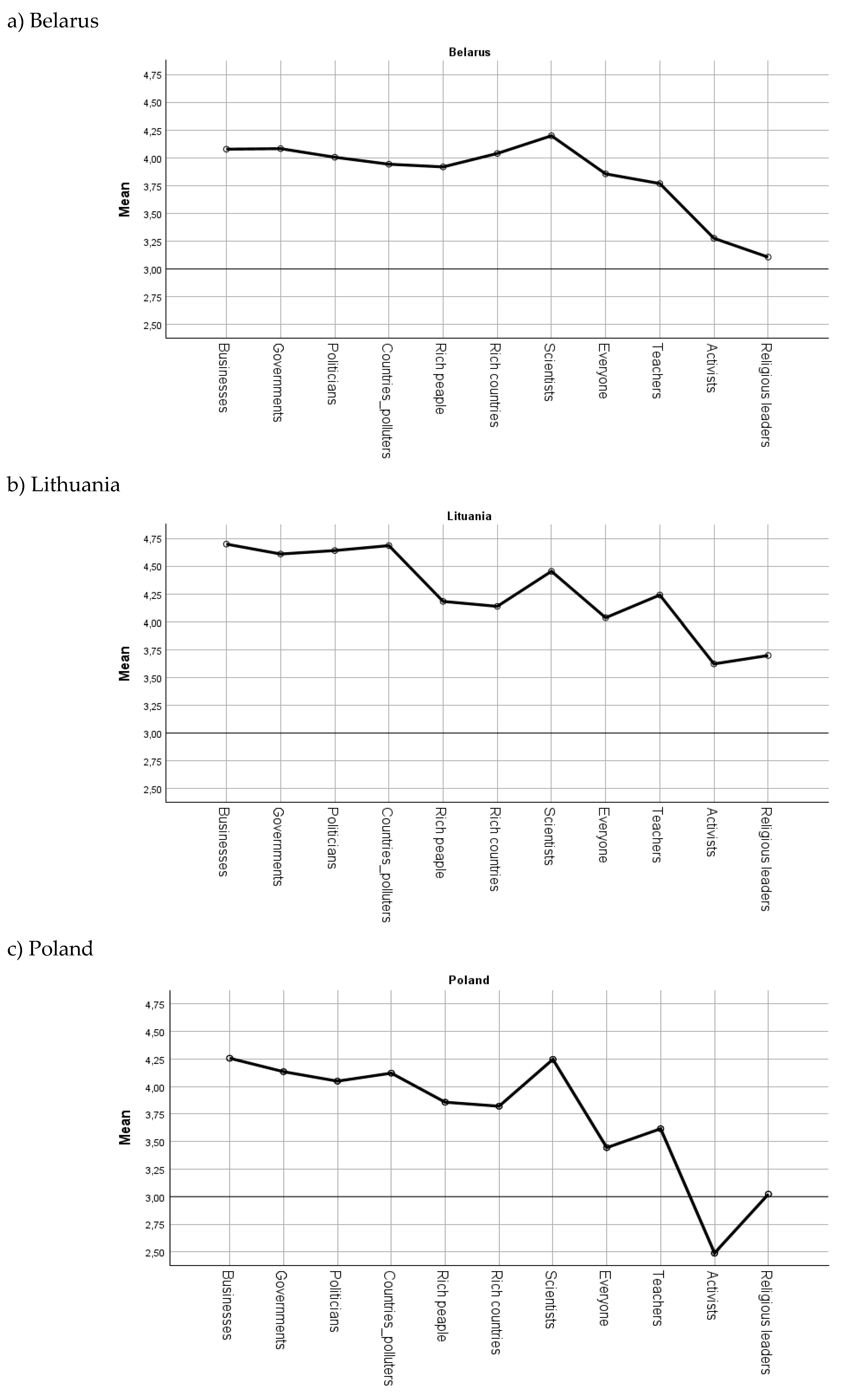
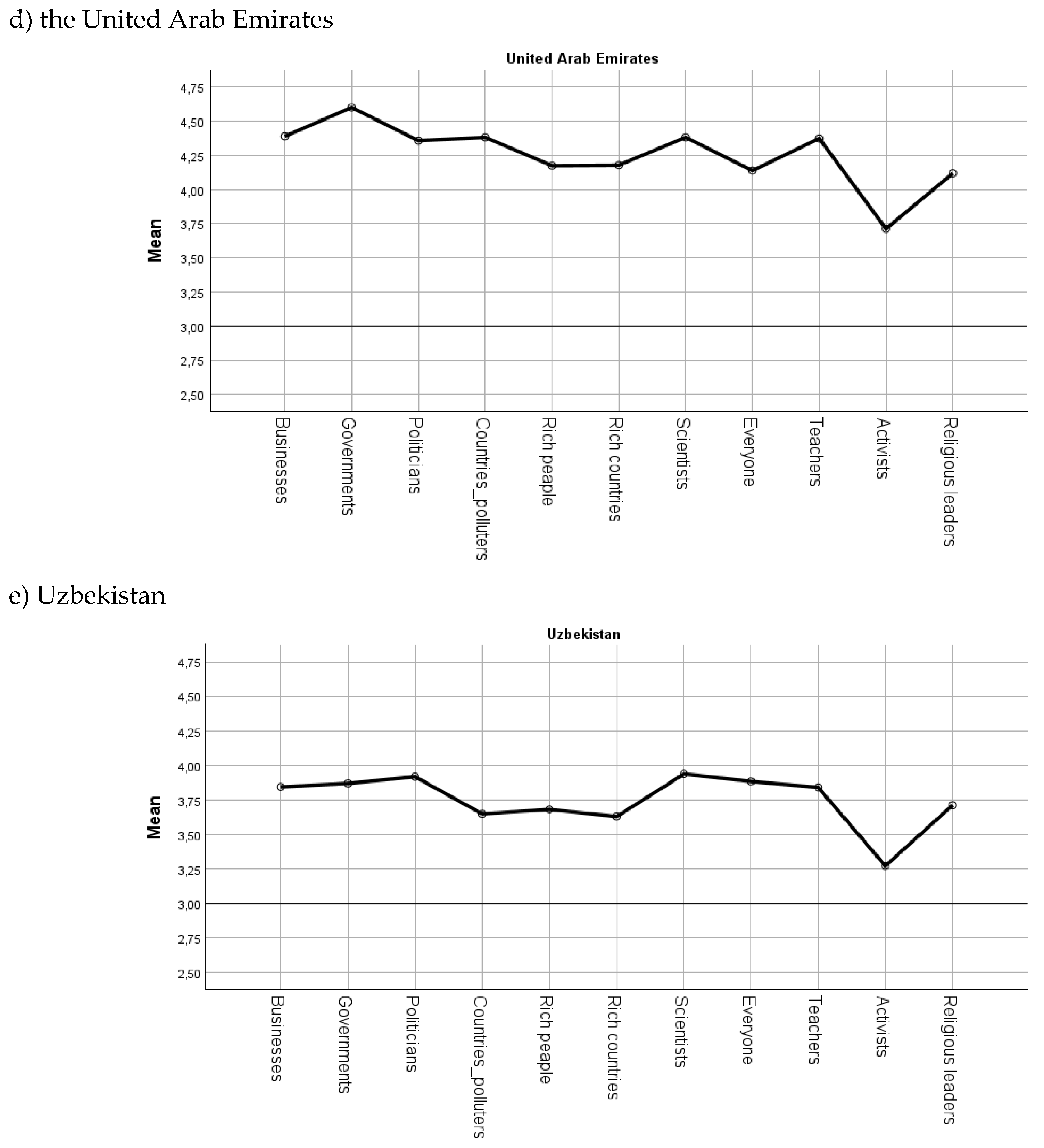

Table 1.
Basic regional and cultural characteristics of Belarus, Lithuania, Poland, the UAE and Uzbekistan.
Table 1.
Basic regional and cultural characteristics of Belarus, Lithuania, Poland, the UAE and Uzbekistan.
| Country | Geographical region | GDP per capita / Rank*) | Democracy Index**) | EPI 2024 / Rank ***) | Individualism ****) | Cognitive Style | Dominant Religion |
| Belarus | Central Europe | $22 591 / 70 | 1.99 | 58.1 /32 | 48 | Analytical | Christianity /Orthodox |
| Lituania | Central Europe | $48 397 / 35 | 7.59 | 63.9 /22 | 55 | Analytical | Christianity /Catholic |
| Poland | Central Europe | $43 269 / 39 | 7.4 | 64.4 / 19 | 47 | Analytical | Christianity /Catholic |
| UAE | Middle East | $ 87 729 / 6 | 3.07 | 52.0 / 53 | 36 | Holistic /Analytical | Islam |
| Uzbekistan | Central Asia | $9 533 / 116 | 2.1 | 42.9 /104 | Kazakhstan - 20 | Holistic /Analytical | Islam |
*) World Bank 2022; number of countries = 177; 1. **) Democracy Index 2024; range 0–10 (most democratic); made of sub-indices of electoral pluralism, civil liberties, political participation, democratic culture, and functioning of government. 2. ***)The 2024 EPI combines 58 indicators across 11 issue categories, ranging from climate change mitigation and air pollution to waste management, sustainability of fisheries and agriculture, deforestation, and biodiversity protection. 3. ****) After Hofstede scores 4.
Table 2.
National samples’ characteristics.
| Country | N | Age M (SD) | N & % of females | N & % of students | Dominant religion | Dominant ethnicity |
| Belarus | 207 | 23,16 (5,18) | 140 (67.63) | 87 (42.03) | Christianity Orthodox | Belarusian (90%) |
| Lituania | 225 | 23.97 (5.63 | 184 (81.78) | 112 (49.78) | Christianity Catholic | Lithuanian (90%) |
| Poland | 303 | 22.60 (5.79) | 206 (67.76) | 261 (85.86) | Christianity Catholic | Polish (95%) |
| UAE | 251 | 23.30 (8.30) | 163 (64.94) | 189 (75.30) | Islam | South Asia & Arab (50%) |
| Uzbekistan | 281 | 22.04 (5.86) | 239 (85.05) | 267 (95.02) | Islam | Turkish (100%) |
| Total | 1267 | 22.97 (6.30) | 932 (73.50) | 916 (72.24) |
Table 3.
The list of the responsible agents .
| 1 | Every person (e.g. sorting waste, recycling, saving energy, less consumerist lifestyle) |
| 2 | Social activists (e.g. organising protests, sending appeals to politicians) |
| 3 | Teachers (e.g. teaching about sustainability, climate change, etc.) |
| 4 | Religious leaders (e.g. promoting respect towards nature through their teachings) |
| 5 | Scientists (e.g. technology development) |
| 6 | Political leaders (e.g. lobbying and environmentally friendly decision-making) |
| 7 | Businesses (e.g. introducing environmentally friendly technological solutions) |
| 8 | Governments (e.g. introduction of legal regulations). |
| 9 | The richest people, billionaires (e.g. donating part of their income to the environment, giving up a luxurious lifestyle) |
| 10 | Rich countries (e.g. as environmental protection is expensive, poor countries cannot afford hence, the responsibility relies on countries with high GDP) |
| 11 | Countries with the highest carbon footprint (e.g. it's imperative for these countries to transition their economies to be more environmentally friendly) |
| 12 | Media (e.g. news reporting, investigation, publication) |
Table 4.
Descriptive statistics in the total sample and national samples.
| Variable | Country | M (SD) | 2 | 3 | 4 | 5 | 6 | 7 | 8 |
| 1 Values Collect |
BL | 4.29(.66) | .39** | .48** | .24** | .30** | -.04 | .06 | .23** |
| LT | 4.04(.58) | .30** | .25** | .05 | .22** | -.11 | .02 | .24** | |
| PL | 3.82(.66) | .14* | .19** | .32** | -.01 | -.01 | -.12* | .16** | |
| UAE | 4.23(.62) | .13* | .15* | .35** | .04 | .01 | -.01 | .19** | |
| UZ | 4.40(.58) | .50** | .60** | .27** | .30** | .02 | .41** | .38** | |
| Total | 4.14(.66) | .36** | .33** | .36** | .13** | .04 | .02 | .28** | |
| 2 Values Ind_Indul |
BL | 4.10(.65) | x | .48** | .29** | .14* | -.03 | .01 | .13 |
| LT | 3.77(.72) | x | .38** | .13 | .21** | -.03 | .02 | .15* | |
| PL | 3.51(.71) | x | .30** | .02 | .07 | -.04 | .04 | .04 | |
| UAE | 3.91(.71) | x | .31** | .16* | .05 | .17** | .04 | .05 | |
| UZ | 4.20(.72) | x | .53** | .30** | .30** | .02 | .29** | .15* | |
| Total | 3.89(.75) | x | .39** | .29** | .12** | .05 | .04 | .16** | |
| 3 Values Ind_Real |
BL | 4.41(.58) | x | .14* | .26** | -.08 | .13 | .15* | |
| LT | 4.34(.58) | x | -.02 | .28** | -.15* | .19** | .11 | ||
| PL | 4.30(.59) | x | .05 | .22** | -.20** | .16** | .28** | ||
| UAE | 4.44(.52) | x | .05 | .18** | -.03 | .09 | .15* | ||
| UZ | 4.34(.67) | x | .24** | .35** | .07 | .30** | .24** | ||
| Total | 4.36(.60) | x | .07* | .27** | -.07* | .18** | .21** | ||
| 4 NEP_Anth |
BL | 3.19 (.59) | x | .02 | .17* | -.08 | .05 | ||
| LT | 2.56 (.57) | x | -.32** | .17* | -.25** | -.25** | |||
| PL | 2.78 (.70) | x | -.56** | .26** | -.35** | -.27** | |||
| UAE | 3.06 (.72) | x | -.10 | .30** | -.22** | .01 | |||
| UZ | 3.81 (.63) | x | .51** | .16** | .34** | .29** | |||
| Total | 3.09 (.78) | x | -.17** | .26** | -.23** | -.01 | |||
| 5 NEP_Eco |
BL | 3.98(.52) | x | -.15* | .37** | .45** | |||
| LT | 4.09(.47) | x | -.22** | .32** | .26** | ||||
| PL | 3.79(.68) | x | -.28** | .32** | .47** | ||||
| UAE | 4.11(.55) | x | -.11 | .27** | .37** | ||||
| UZ | 3.64(.74) | x | .06 | .43** | .35** | ||||
| Total | 3.90(.64) | x | -.16** | .40** | .40** | ||||
| 6 Intractability |
BL | 3.07 (.87) | x | .05 | -.24** | ||||
| LT | 2.53 (.79) | x | -.19** | -.22** | |||||
| PL | 2.97 (.95) | x | -.21** | -.41** | |||||
| UAE | 2.83 (.99) | x | -.05 | -.06 | |||||
| UZ | 3.06 (.88) | x | .03 | -.03 | |||||
| Total | 2.90 (.92) | x | -.16** | -.22** | |||||
| 7 Resp_Collectives |
BL | 4.04 (.73) | x | .54** | |||||
| LT | 4.49 (.61) | x | .43** | ||||||
| PL | 4.07 (.80) | x | .40** | ||||||
| UAE | 4.35 (.61) | x | .53** | ||||||
| UZ | 3.79 (.77) | x | .51** | ||||||
| Total | 4.13 (.76) | x | .48** | ||||||
| 8 Resp_Individuals |
BL | 3.50 (.79) | x | ||||||
| LT | 3.90 (.84) | x | |||||||
| PL | 3.14 (.87) | x | |||||||
| UAE | 4.09 (.67) | x | |||||||
| UZ | 3.68 (.85) | x | |||||||
| Total | 3.64 (.88) | x |
Note:. *) p <.01; **) p<.001; italics show p >.01. Abbreviations: BL – Belarus; LT – Lithuania, PL – Poland, UAE – the United Arab Emirates, UZ – Uzbekistan.
Table 5.
Hierarchical regression analysis results for responsibility of collective agents in the total sample.
Table 5.
Hierarchical regression analysis results for responsibility of collective agents in the total sample.
| Predictors | Model 1 | Model 2 | Model 3 | |||
| B (CI) | β | B(CI) | β | B(CI) | β | |
| Val_Collect | -.04 (-.11; .03) | -.03 | .01 (-.05; .08) | .01 | .01 (-.05; .08) | .01 |
| Val_Ind_Indulg | -.03 (-.10;03) | -.03 | .01 (-.05; .06) | .01 | .01 (.-05; .06) | .01 |
| Val_Ind_Realiz | .26 (.19; 34) | .21*** | .13 (.06; .20) | .10*** | .12 (.05; .19) | .10*** |
| Anthropocentrism | -.18 (-.23;.12) | .18*** | -.16 (-.22; -.11) | -.17*** | ||
| Ecocentrism | .41 (.34; .47) | .34*** | .40 (.34; .46) | .34*** | ||
| Intractability | -.05 (-.09; -.01) | -.05* | ||||
| F (df) | 15.97 (3;1263) *** | 62.42 (5;1261)*** | 52.90 (6;1260)*** | |||
| R2 (Adj R2) | .037 (.034) | .198 (.195) | .201 (.197) | |||
| ∆R2 | .037*** | .162*** | .003* | |||
Note: ***) p<.001; *) p<.05.
Table 6.
Hierarchical regression analysis results for collective agents in the national samples: Beta coefficients in the final model.
Table 6.
Hierarchical regression analysis results for collective agents in the national samples: Beta coefficients in the final model.
| Belarus | Lithuania | Poland | Emirates | Uzbekistan | |
| Val_Collect | -.07 | -.06 | -.07 | .04 | .28*** |
| Val_Ind_Indulg | -.04 | -.05 | .01 | .06 | .04 |
| Val_Ind_Realiz | .09 | .14* | .10 | .08 | -.01 |
| Anthropocentrism | -.06 | -.15* | -.21** | -.23*** | .11 |
| Ecocentrism | .36*** | .23*** | .15* | .25*** | .28*** |
| Intractability | -.07 | -.10 | -.10 | .03 | .01 |
| F (df) | 6.02 (6;200)*** | 6.59 (6:218)*** | 9.80 (6;296)*** | 5.54 (6;244)*** | 17.91 (6;274)*** |
| R2 | .15 | .15 | .17 | .12 | .28 |
Note: ***) p<.001; *) p<.05.
Table 7.
Hierarchical regression analysis results for individual agents’ responsibility in the total sample.
Table 7.
Hierarchical regression analysis results for individual agents’ responsibility in the total sample.
| Predictors | Model 1 | Model 2 | Model 3 | |||
| B (CI) | β | B(CI) | β | B(CI) | β | |
| Val_Collect | .30 (.22;.38) | .23*** | .30 (.22;.38) | .23*** | .29 (.22; .37) | .22*** |
| Val_Ind_Indulg | .03 (-.03; .10) | .03 | .04 (-.02; .11) | .03 | .04 (-.02; .11) | .04 |
| Val_Ind_Realiz | .18 (.09; 26) | .12*** | .04 (-.04; .12) | .03 | .02 (-.06; .10) | .01 |
| Anthropocentrism | -.05 (-.11; .01) | -.04 | .00 (-.06; .06) | .00 | ||
| Ecocentrism | .49 (.42; .56) | .36*** | .46 (.39; .53) | .34*** | ||
| Intractability | -.17 (-.22; -.12) | -.18*** | ||||
| F (df) | 42.70 (3; 1263)*** | 69.99 (5; 1261)*** | 68.41 (6; 1260)*** | |||
| R2 (Adj R2) | .092 (.090) | .217 (.214) | .246 (.242) | |||
| ∆R2 | .092*** | .125*** | .028*** | |||
Note: ***) p<.001; *) p<.05.
Table 8.
Hierarchical regression analysis results for individual agents in the national samples: Beta coefficients in the final model.
Table 8.
Hierarchical regression analysis results for individual agents in the national samples: Beta coefficients in the final model.
| Belarus | Lithuania | Poland | Emirates | Uzbekistan | |
| Val_Collect | .09 | .19** | .16** | .18** | .33*** |
| Val_Ind_Indulg | .04 | .11 | -.05 | .08 | -.13 |
| Val_Ind_Realiz | -.04 | -.03 | .13 ** | .04 | .01 |
| Anthropocentrism | .05 | -.21** | -.06 | -.02 | .14* |
| Ecocentrism | .40*** | .11 | .33*** | .34*** | .22*** |
| Intractability | -.19** | -.14* | -.28*** | -.06 | -.07 |
| F (df) | 10.92 (6;200)*** | 7.44 (6;218)*** | 25.98 (6;296)*** | 8.80 (6;244)*** | 13.58 (6;274)*** |
| R2 | .25 | .17 | .34 | .18 | .23 |
Note: ***) p<.001; *) p<.05.
Disclaimer/Publisher’s Note: The statements, opinions and data contained in all publications are solely those of the individual author(s) and contributor(s) and not of MDPI and/or the editor(s). MDPI and/or the editor(s) disclaim responsibility for any injury to people or property resulting from any ideas, methods, instructions or products referred to in the content. |
© 2025 by the authors. Licensee MDPI, Basel, Switzerland. This article is an open access article distributed under the terms and conditions of the Creative Commons Attribution (CC BY) license (http://creativecommons.org/licenses/by/4.0/).
Copyright: This open access article is published under a Creative Commons CC BY 4.0 license, which permit the free download, distribution, and reuse, provided that the author and preprint are cited in any reuse.


