
Submitted:
10 August 2025
Posted:
13 August 2025
You are already at the latest version
Abstract
In recent years, under the background of the development of communication technology, the popularization of smart phones and the acceleration of the pace of life, online short video has developed rapidly. Compared with previous video products, online short video has a short time, but it can enable users to watch continuously, and even produce a certain degree of addictive behavior. Why do individuals have this phenomenon? Many studies attribute the reason to recommendation algorithms for online short videos. However, this paper explores this phenomenon from the perspective of flow experience. Firstly, based on the flow theory and referring to previous studies, according to the characteristics of online short video, the software function application and social impact were included in the measurement range. Then, 8 variables and the research model were explored by using theoretical assumptions. Next, the different influence of each variable on the flow experience of online short video were measured through 710 samples under different dimensions. This study identified the factors that contribute to platform perceived control and challenges in the flow experience of online short videos, the relationships between these variables, and how they affect the flow of online short videos. Finally, the study explores the formation of flow experience of online short video, provides advance research and reference for the academic, social and economic area beyond algorithmic recommendation systems.
Keywords:
online short video
; flow experience
; platform perceived control
; challenge
; social media
1. Introduction
1.1. Background
Nowadays, the Internet industry and mobile communication technology have made great development. The dissemination of information has not only stopped in pictures and words. With the reduction of network traffic cost and the continuous popularization of large screen smart phones, video art is more and more recognized by the market. individual's way of appreciating image art has been greatly expanded. They no longer stop at traditional TV and cinema movies, but transfer great energy to the appreciation of online video.
Further analysis of the video market illustrated that in recent years, online short video has ushered in a blowout development. 5g communication technology, which will be applied on a large scale, enable short video forms with short time to better grasp the video needs of users in fragmented life. In 2024, an online behavior survey covering over 190 countries worldwide showed that there were 2.63 billion users of short videos on the internet, accounting for approximately 51.2% of the global internet population [1]. Flow experience is also called flow theory. Flow experience in the field of positive psychology means that when individuals are engaged in activities, if they are fully involved in the situation, pay attention, and filter out all irrelevant perceptions, which means that they enter the state of flow [2]. In the first quarter of 2024, the average daily usage time of online short videos was 95 minutes per person, surpassing social media's 61 minutes and games' 48 minutes [3]. Another data on high-frequency users of online short videos shows that 68% of users open them more than 5 times a day, an increase of 12% compared to 2023 [4].They watch or shoot and share short videos one by one, ignoring the passage of time.
Short video is a new network media art in recent years. Most of the previous theories concerning flow experience only involved exhibition, game and interaction design. Quite a few researches on the flow experience of online social media only focus on the field of text and image, and rarely involve online video. On the other hand, many studies have unilaterally summarized the behavior of online short video users as content distribution systems formed by algorithms. However, previous study also pointed that algorithms are essentially products of 'bounded rationality' and cannot predict all scenarios (Simon, 1956). [5] This study aims at the development background of the current online short video market with a large scale and user groups, and studies the flow experience of network short video users in the viewing process, which has the following objectives:
1) What variables affect the flow experience and lead people to become flow to short online videos?
2) What role do these variables play in the online short video flow experience?
3)What relationship do the variables have an impact on the online short video flow experience.
2. Theoretical Background
2.1. Flow Experience
According to Csikszentmihalyi's research in 1977, flow experience is further defined as the overall feeling that individuals feel when they concentrate on action. When in an flow experience, individuals focus on their activities and enter a common pattern. The characteristic of this model is that the focus of consciousness is reduced, so that irrelevant perceptions and thoughts are filtered out; Even lose self-consciousness; Can respond to clear goals and feedback; Have a sense of control over the environment and be mentally happy [6].
Csikszentmihalyi designed the initial three channel model of flow experience [7]. He proposed that flow experience can be realized only when skill and challenge exceed a certain level [8]. Through the two measurement dimensions of skill and challenge, in the figure, higher challenges and lower skill requirements represent anxiety channels, and lower challenges and higher skill requirements represent boredom channels. From the perspective of users, users will feel anxious when the task challenge is more difficult than the skill level; When the task challenge difficulty is lower than the skill requirement level, the user will feel tired.
After further in-depth research based on the three interval model, researchers at the University of Milan found that challenges and skills are balanced. When the two dimensions are at a relatively low level, flow experience does not necessarily occur. It is possible only when the challenges and skills faced by individuals are lower than the daily average. Massimini and Carli (1988) of the University of Milan established a four interval model [9].
More scholars have deeply explored the development of flow experience model, especially regarding people's feelings, including massimini, Carli (1988) [10], Ellis, voelkl & Morris (1994) [11].
In 1992, Trevino and Webster regarded flow experience as an intermediary dimension between human-computer communication in a study on assessing the impact of e-mail and audio mail on individuals. The study proposes that flow experience has four measurable dimensions, including control, concentration, curiosity and internal interest. This study involves skill, but there are no challenge [12].
A study on flow experience and human-computer interaction In 1996, Hoffman and Novak divided the core measurement dimensions of flow experience into three core dimensions: skill, challenge and concentration. When these three dimensions are at a high level, the flow experience will be launched. At the same time, interactivity and remote presentation can improve the flow intensity [13].
In 2004, chin lung Hsu and HSI Peng Lu expanded their research on online games based on TAM Technology Acceptance Model and took flow experience as a variable to explore why people like to play online games [14]. For the research of network short video, we can learn from the analysis of Chin lung Hsu and HSI Peng Lu. Online games also have social attributes, so social impact is incorporated into the model as a variable, and the relationship between social attributes and user behavior is considered.
Gan Chunmei and Ming Xinyu proposed that when users experience a high level of emotional excitement during use In 2023, they are often more willing to continue using them for the use of short videos [15].The flow experience can let social media users being willing to repeat certain behaviors to constantly experience this feeling [16].
2.2. Online Short Video
In 2008, Antony Mayfield put forward the concept of social media in what is social media: a new type of online media, which can give users great participation space, including open discussion, communication and dialogue, with the characteristics of socialization [17]. In other words, the content of traditional news newspapers, radio, television, films and other media is fully edited by media operators, pursuing mass production and sales. Emerging social media mostly appear on the Internet. In terms of online short video, the content can be selected or edited by users, and the production can be divided into groups or small groups. It pays attention to the gathering of good friends and can form an online community by itself.
Social beta, an Android platform application, defined online short video as "a video whose length is counted in seconds, which mainly benefits from the rapid shooting and beautification editing of mobile intelligent terminals, and a new video form that can be shared and seamlessly connected in real time on the social media platform" [18]. Wang Wenbin, a Chinese scholar, defined it as "generally within 20 minutes, most of which are within 5 minutes. It mainly relies on mobile intelligent terminals and is suitable for sharing on social media platforms [19]."
At present, the earliest starting point of online short video traced by mainstream researchers is 2011. Viddy in the United States took the lead in releasing a mobile short video social application with shooting, editing and sharing functions [20].
For China, starting point for online short video is the Kwai Fu application in November 2012, which transformed from the original pure tool application to the short video community platform. In August 2013, "secpai" settled in Sina Weibo client, attracting tens of millions of customers and officially opening the era of short video.
In 2017, mainstream browsers successively opened short video windows, Chinese Internet giants settled in short video platforms, Tencent restarted micro vision, Alibaba launched 2 billion "big fish" short video plan, and announced Tu dou's entry into the short video market. Baidu also invested in Renren video and launched good-looking video online [21].
Compared with the traditional video media platform, the online short video platform has the data push technology, the supply-demand relationship of short video content is highly accurate, and the social function becomes more and more important in the development process. The content provider of traditional video media is basically a professional organization. The users of online short video platform have multiple identities and can be video producers, uploaders, sharers, viewers, commentators and disseminators. Therefore, the social network formed maintains the users' dependence on the network short video platform [22].
In 2016, Xue Yang and Xu Zhengliang, based on SOR, stimulus organism response model, constructed the behavior theoretical model of wechat users on the network multimedia social platform by using the flow experience theory [23]. The research involves the information attention behavior of reading, likes and comments shared by online social platforms and the relationship between forwarding, comment forwarding and information sharing behavior created. Moreover, the relationship between platform ease of use, interactivity, content usefulness, entertainment and flow experience is studied and discussed.
Wei Gao, Zhao Liu and Jingyuan Li observed SNS users using attribution theory in 2017 to explore the relationship between social existence and social media addiction. It is found that the sense of social existence has a positive impact on the sense of belonging and enjoyment. Sense of belonging has a positive impact on happiness including escapism, pleasure and arousal. In particular, escapism and pleasure will lead to a certain degree of online social media addiction [24].
In 2020, during the research on the impact of short video humor elements and camera perspective on user experience and technology acceptance, Yunwen Wang found that properly adjusting humor and successive perspective can improve user experience, and proved the application value of the extended human-computer interaction theory for short video software [25].
A research on interactive video design methods and flow experience In 2023, scholar Bian Yu think that flow experience is triggered by the characteristics of the activity itself and the individual traits of the participant, manifested as a psychological state of selflessness and focus [26].
3. Conceptual Framework
3.1. Platform Part
With the advent of the Internet age, the information available to individuals is growing rapidly. The progress of technology also makes the mainstream media of network information change from text and pictures to video. Gangbu Qingsan proposed that the activities of transmitting, receiving, processing, processing and storing information through more and more abundant media can be called information behavior [27]. The online short video platform concentrates various types of short video. Facing content producers and users, how to manage and classify complex information and let users get effective video information is particularly paramount for flow experience. Therefore, in this part, this study explores the variables that the short video platform can affect the flow experience, which is used to establish the core model.
3.1.1. Ineractivity
A three-stage concept of virtual reality was proposed by Steuer in 1992. When the pages on the website load quickly, the website responds quickly to each click, and users are interested, interactivity will occur [28]. Generally speaking, users receive the information provided by the network platform, and then quickly get feedback to the network platform. The flow of information forms interactivity. According to Schlosser's research in 2000, interactive websites can make users feel happy during their visit, and their satisfaction with the services provided by the website is also improved in this process. This shows the importance of interactivity to the effect of network experience.
Chase and Dasu's research on online experience in 2001 illustrated that when users get better flow effect, they will be sincerely convinced and really participate in online experience [29]. In the process of better experience, information flows and feeds back continuously. In other words, flow and better online experience is generated in the process of continuous interactive behavior. For the network short video, especially the mobile terminal, the operation of the software platform filters out the complex information instructions played by the media in the past, and the instructions with low application rate are merged and deleted, making the interactive process more rapid. Skadberg y x, & Kimmel J R (2004) [30] and Choi D H, Kim J, & Kim s h (2007) [31] respectively take interactivity as an important variable that may affect flow experience in the research of human-computer interaction between web pages and learning systems. Therefore, the hypothesis is as follows:
H1:
Platform interactivity significantly have a positive effect on flow experience.
3.1.2. Perceived Ease of Use
Technology Acceptance Model (TAM) was proposed by Davis in 1989. Its purpose is to use rational behavior theory to explain the decisive factors that computers are widely accepted. One of the two key variables is perceived ease of use [32]. In Davis' rational behavior theory, perceived ease of use refers to the perceived effect of the individual on the ease of using a technology system. The simpler the individual feels, the more acceptable the system is, and the more difficult the system is, the more likely it is to be abandoned by the individual. Csikszentmihalyi (1975) believes that the feasibility of individual activities can encourage the generation of flow experience [33]. This feasibility can be understood as the scope of behavior that individuals can make in activities. The greater the feasibility, the easier flow is. Combined with ease of use, ease of use reduces the cost of individual thinking, reaction and decision-making in the process of activities, which is conducive to further expanding the scope of activities and increasing the feasibility of activities.
The network short video platform integrates operations such as selection, playback, fast forward, comment, like and sharing. Unlike mouse click, the video operation of touch screen can be completed by sliding in one interface with gestures, which greatly improves the ease of use of the platform. Webster linked ease of use to immersive experience in human-computer interaction in 1989 [34]. In 1992, Trevino and Webster regarded ease of use as a pre factor of "flow" in their research on the interactive media of voice mail [35]. Therefore, the hypothesis is as follows:
H2:
Platform perceived ease of use significantly have a positive effectt on flow experience.
3.1.3. Perceived Control
Perceived control refers to a cognitive state in which individuals have confidence in the ability to respond to and influence an event [36]. Perceived control can make individuals have a positive emotional response to behavioral activities in the service environment, and has a positive effect on improving user experience [37]. In 2000, Novak, Hoffman and Yung 2000 proposed in their research on the network environment that perceived control is based on the ability of users to browse network information efficiently, or the degree of positive feedback from the network to users' information needs [38]. Among the services of the online short video platform, users can find the video or video related operation services they need. Whether the information presented is consistent with users' expectations will produce perceived control. According to the research done by Ghani, supnick & Rooney in 1991 [39] and Trevino and Webster in 1992 [40], perceived control is able to predict flow experience. Therefore, the hypothesis is as follows:
H3:
Platform perceived control significantly have a positive effect on flow experience.
In 1994, Ghani and Deshpande found in subsequent research that individual perceived control can lead to flow experience through skills in activities, and skills can also affect flow experience [41]. Taking online finance as an example, many customers attach importance to online financial services, on the one hand, because of its convenience, on the other hand, because on the basis of ensuring transaction security, the previous complex financial service process has become simple, which enhances the ability of perceived control and reduces uncertainties [42]. For the activities of online short video platform, skills include the ability to appreciate, shoot, comment, analyze and forward. With the optimization of interface, the improvement of service design and the development of related plug-ins, this ability is mastered by more and more users through platform interactivity and perceived ease of use. Taking mobile phone video tiktok as an example, in order to further promote the short video of mobile phone, the video editing software is equipped with clips. The most important professional editing software includes editing, filtering, special effects and so on. It optimizes the operation interface and simplifies the editing process. The purpose is to enhance the perceived control ability by improving the manipulation skills of mobile phone users on short video media. Therefore, the hypotheses are as follows:
H4:
Platform perceived control significantly have a positive effect on platform interactivity
H5:
Platform perceived control significantly have a positive effect on platform perceived ease of use
H6:
Platform interactivity plays a mediating role between platform perceived control and flow experience
H7:
Perceived ease of use plays a mediating role between platform perceived control and flow experience
3.2. Social Part
Tajfel, a British scholar, first put forward the social identity theory in 1986 to explain how individual dependence on group membership affects individual social perception, social attitude and social behavior [43]. Online short video is supported by the rapid expansion of the Internet. As a network social media, online short video is different from film or television. The audience no longer only unilaterally appreciates the image content. The media platform is also given the social mission. The network environment promotes the interaction between users through the social affordability supported by the social technical characteristics of the platform [44]. Therefore, social influence is an aspect that must be considered in flow experience. In this part, this study will summarize the variables that affect the flow experience in the social part, which will be used to establish the core model.
3.2.1. Social Relations
With the development of Internet technology, users can share text, pictures, music, video and other files on various social platforms through mobile phones. In the process of short video users' appreciation, creation and forwarding, the social influence between friends offline expands the mobility of content, and the common online interests and hobbies will make them have the same value recognition, so as to promote lasting content production and sharing among users. Therefore, relying on the online and offline social influence, the network's interpersonal circle has been continuously expanded. In this process, users' internal motivation to use online short video has been continuously strengthened.
In a 2020 study on social media, Curley and policies took social attributes as influencing factors for measuring flow experience, and emphasized the concept of group flow experience. The study suggests that when the individuals in the group have the same social identity as the group, the possibility of flow experience is greater [45]. Therefore, Therefore, the hypothesis is as follows:
H8:
Social relations significantly have a positive effect on the flow experience.
3.2.2. Social Promotion
The socialization of online short video is not only played on a simple short video social platform, but also connected to other types of social platforms. Taking China as an example, short video can be shared on many social media such as wechat, microblog and today's headlines, and the social scope has been greatly expanded. In this process, the socialization of online short video allows users to get the attention, attention and help of other users in the social network to meet their needs for social support [46].
The short video created or shared can get the attention, forwarding, likes, comments and other behaviors of other users, which will give the forwarder a certain sense of achievement and satisfaction. The accumulation and ranking of attention, forwarding, likes and comments also enable the creator or forwarder to be recognized by the mainstream value of the society, and finally form the social volume. At the same time, social identity also brings the creator or forwarder the improvement of social status in the social circle. In 2011, Zhou T and Lu y proposed in their research on instant messaging that users use instant messaging to interact with friends, colleagues and relatives. Whether these groups adopt mobile instant messaging platform will affect their adoption and use decisions [47]. So that the social promotion role in the social process is able to affect the user's psychological state and willingness to continue to use. Therefore, the hypothesis is as follows:
H9:
Social promotion significantly have a positive effect on the flow experience.
3.2.3. Challenge
The challenge in the network online environment refers to the opportunity for individuals to obtain more behavioral activities on the network and the subsequent fun [48]. The previous hypothesis mentioned that in the social platform of online short video, when users watch, forward and create short video, the accumulation of attention, forwarding, likes and comments will bring users a certain sense of pleasure, so as to improve their social identity and bring higher social activity to new works. When new works are faced with old themes, low production standards and lack of hot spots, social activity decreases. Finally formed the challenge form of facing the popularity of social media. As Anand and sternthal pointed out in their research in 1990, if a website lacks enough challenges, it will lead to users' boredom and boredom, and enough challenges will have a positive impact on users' attitude and immersive experience [49]. Therefore, this study makes the following assumptions.
H10:
Challenge significantly have a positive effect on the flow experience.
The social exchange theory, which was widely spread in the 1960s, was founded by hormans of the United States. This theory has been further developed with the efforts of Blau and Emerson. Blau believes that all social activities are exchange, and that exchange activities that can bring rewards or benefits dominate all human behaviors [50]. From this perspective, the benefits of online short video can also be considered as one of the challenges. For traditional media, the media is responsible for collecting information and obtaining benefits from the audience through text, radio and television communication. The audience obtains benefit feedback through random disclosure. Different from the traditional multimedia, whether the creator or the platform, the revenue of online short video products is directly linked to the traffic. Traffic is the most original revenue in the process of online short video operation. Whether it is viewers, content creators, or reprints, it is one of the most direct use motives of online short video users to earn revenue through continuous click and play of video. What are the criteria for considering flow investment? Social media can bring clear goals and feedback. The matching challenge is caused by users' ability to participate in the online environment [51]. Therefore, the standard of consideration is the social activity reflected by the amount of attention, forwarding, likes and comments in the social circle behind social relations and social promotion. Therefore, the hypotheses are as follows:
H11:
Challenge significantly have a positive effect on social relations
H12:
Challenge significantly have a positive effect on social promotion
H13:
Social relations play a mediating role between challenge and flow experience
H14:
Social promotion plays a mediating role between challenge and flow experience
3.3. Content Entertainment
2018 in the study on the attachment mechanism of platform users,Scholar Xia Baoguo put forward that the conversational customer relationship management platform, where participants provide content and lead interactions. Users share information through interaction and strengthen interpersonal and human-machine relationships by participating in entertaining platform activities [52]. Wolfinbarger and Gilly (2011) pointed out that experience oriented consumers place greater emphasis on obtaining hedonic benefits through online social interaction behaviors, and value the entertaining experiences obtained from entertaining behaviors during the interaction process [53]. It can be inferred that While platform interactivity and social relations significantly have a positive relationship with online short videos, the content entertainment has an impact on both groups. Therefore, the hypothesis are as follows:
H15:
The content entertainment plays a significant moderating role between platform interactivity and flow experience.
H16:
The content entertainment plays a significant moderating role between social relations and flow experience.
4. Study Methods
4.1. Measurement
This study includes 8 variables. Each variable uses three items(questions) to measure , collecting questionnaire data by online survey. In order to ensure the preciseness of data sources, all the items in this study are developed from previous studies.The items of flow experience comes from Chang 's research on the continuous use of online social games from the perspective of flow experience in 2011 [54].
In the platform part, the items of perceived control was developed from the research on flow experience and satisfaction with online financial services by Xin Ding D, Hu P J H, Verma r in 2010 [55]. The items of platform perceived ease of use were developed from the research on online social platforms conducted by Hyun et al [56] in 2021. The items of platform interactivity were developed from the research items of online social game platform by Chang [57] The items of content entertainment referred to the research on Internet short video addiction by Zhang et al in 2019 [58].
In the social part, the items of challenge referred to Novak, Hoffman, and Y. Yung's research on customer experience measurement in network environment in 2000 [59]. The items of social relations and social promotion referred to Li Zhen's [60] exploration of short video production motivation in 2020 and Hsu and Lu'sresearch on online games and flow experience in 2004 [61].
ALL the 8 variables composed of 24 questions were investigated with the 7-level Likert scale, ranging from 1 (strongly disagree) to 7 (strongly agree). See appendix for detail.
4.2. Data Collection
The questionnaire used the software of Questionnaire Star in the form of network questionnaire, and the social platforms such as wechat and QQ with a large number of user groups collect data from users with online short video experience were used for data collection. A total of 800 questionnaires were sent in this study, and 710 valid questionnaires were finally recovered on December 2024, with an effective rate of 88.8%. See Table 1 for the profile of respondents
The data demonstrates that 76.3% of the respondents have college or bachelor degree. At the same time, most respondents are distributed in first and second tier cities. The number of respondents aged 18 ~ 30 is the largest, accounting for 47.5% of the total samples. In terms of income, respondents mostly focused on the three standards of 1000 ~ 5000 yuan, 5000 ~ 8000 yuan and 8000 ~ 17000 yuan, accounting for 35.1%, 24.9% and 20.4% of the sample review respectively. In general, the samples come from different gender, age, education level, daily living city and income group, so the sample distribution of this study has a certain universality.
4.3. Ethics Statement
All methods of this study were performed in accordance with all applicable international,domestic ethical regulations, the relevant guidelines and regulations. We have obtained approval from ZHENJIANG COLLEGE, who is responsible for academic ethical evaluation, supervision, and other related duties, including any relevant details and ensuring informed consent was obtained from all participants and their legal guardians.
5. Results
5.1. Measurement Model
This study used the confirmatory factor analysis (CFA) method, which is commonly considered by the academic community to test the effectiveness of the research model [62]. Confirmatory Factor Analysis (CFA) is a statistical technique used to validate the factor structure of a set of observed variables. CFA allows researchers to test hypotheses about the relationship between observed variables and their underlying structures. Researchers use theoretical knowledge, empirical research, or a combination of both to hypothesize relationship models in advance, and then conduct statistical tests on the hypotheses [64].
Credibility (Cronbach’s alpha), composite reliability (CR), average variance extracted (AVE), convergent validity and discriminant validity were tested by the results of factor loading.
The results in Table 2 illustrate that the factor loadings of all indicators are higher than 0.70, which is higher than the general level. Cronbach’s alpha and CR values are higher than 0.8, and the AVE values of all constructs are above 0.7. Terefore, the results of this study show good reliability and convergent validity [65].
5.2. Path Analysis
Path analysis is an extension of multiple regression analysis, which uses quantitative data to explore various causal processes behind specific outcomes [70].According to the model path, use SPSS 24 software for path analysis. After testing, Table 4 and Figure 1 indicate the path coefcient (β), signifcance (P), t value (t), and R square (R ²) of the structural model.
From the first dimension, to flow experience, perceived control of online short video platform( β= 0.449, t = 17.189, P < 0.001), challenge( β= 0.473, t = 18.103, P < 0.001) significantly have positive effect on flow experience of online short video, R square (R ²) is 0.603, standardization coefficient β values are close, all exceeding 0.4.
The significantly positive correlation between the other 4 variables of the second dimension and the flow experience of online short video is also established (R ²= 0.451). To flow experience, the impact of platform ease of use( β= 0.303 , t = 10.085, P < 0.001) and social relations (β= 0.264 , t = 8.823, P < 0.001) are relatively higher. β values of social promotion( β= 0.198 , t = 6.479, P < 0.001) is the lowest, 0.198. To sum up, in the path analysis test of significant positive impact between variables and flow experience, R ² values are all greater than 0.19, T values are greater than 1.96 and P values are less than 0.05. Therefore, hypotheses H1-H3, H8-H10 are supported.
In the platform part, platform perceived control significantly has a positive effect on platform perceived interactivity( β= 519,t=16.159,P<0.001,R ²= 0.269) and platform ease of use( β= 0.620,t=21.053,P<0.001,R ²= 0.385).
In the social part, challenge significantly has a positive effect on social relations( β= 0.480***,t=14.564,P<0.001,R ²= 0.231) and social promotion( β= 0.439***,t=13.011,P<0.001,R ²= 0.193).
Therefore, hypotheses H4, H5 and H11, H12 are established.
5.3. Mediation Analysis
Psychologist Edward chase Tolman think that there are a series of mediating factors between stimulus and response that is not able to be observed directly, but could be inferred from the preconditions of inducing behavior and the final behavior outcome itself. These factors are mediating variables [71].
In the path analysis of the previous step, it has been proved that the platform part, H1-H5; Social part H8-H12, all hypotheses were supported. So on this basis, with the Number of bootstrap samples was 1000 for bias corrected bootstrap confidence intervals , and the level of confidence is 95% for all confidence intervals in output, the mediating effect of variables were tested by process213 version.
In the platform part, after detecting, the direct effect value of platform perceived control on the flow experience of online short video is 0.569 , and the confidence interval CI [0.476,0.661]. When platform interactivity and platform ease of use are tested as mediating variables, the indirect effect value on flow experience of online short video is 0.197, CI [0.112,0.287], excluding 0. The T values involved in the above analysis are greater than 1.96 and the P values are less than 0.05. Therefore, the mediating role of platform interactivity and platform perceived ease of use between platform perceived control and flow experience of online short video is established. Platform perceived control affects flow experience of online short video through platform interactivity and platform perceived ease of use. Therefore, hypotheses H6 and H7 are supported. See Figure 2.
In the social part, after detecting, the direct effect of the challenge on the flow experience of online short video is 0.524, and the confidence interval CI [0.459,0.590]. When social relations and social promotion are tested as mediating variables, the indirect effect value on the flow experience of online short video is 0.140, CI [0.097,0.192], excluding 0. The T values involved in the above analysis are greater than 1.96 and the P values are less than 0.05. Therefore, the mediating role of social relations and social promotion between challenge and flow experience of online short video is established, and challenge have an impact on flow experience of online short video through social relations and social promotion. Therefore, hypotheses H13 and H14 are supported. See Figure 3 for details.
5.4. Moderating Analysis
Moderating variables are the core of business and social science theory [72]。A moderating variable refers to a variable that “influences the nature of the effect of an antecedent on an outcome” [73].
with 1000 of Number of bootstrap samples for bias corrected bootstrap confidence intervals and 95% of Level of confidence for all confidence intervals in output are computed, this study used process213 version to analyze the moderating effect of content entertainment from platform interactivity, social relations to flow experience of online short video.
After testing, moderating analysis between platform interactivity and flow experience of online short video, P value is more than 0.05, and the confidence interval Ci [-0.030,0.47], including 0. The moderation is not established. Moderating analysis between social relations and flow experience of online short video, P value is more than 0.05, and the confidence interval Ci [-0.044,0.33], including 0. The moderation is not established. Therefore, the H15 and H16 are unsupported. as shown in Figure 1.
6. Discussion
6.1. Academic Implication
According to the research done by Csikszentmihalyi in his early years, if individuals want to enter the state of flow experience, individual activities need a clear goal. However, for the behavior of viewing online short video, there are various types of short video and the video duration is short, so the concept of clear goal is not applicable to the flow experience of online short video.
In particular, most of previous studies did not put the Social challenge as a variable into the flow experience of short video, nor did they explore the challeng’s mediating relationship with social factors and flow experience. Especially, some studies suggest that the fragmented nature of short videos does not bring about an intrinsic flow experience(Rheinberg, 2008) [74], and further research suggests that this micro flow cannot be converted into deep focus(Chen et al., 2020) [75].
The concept of social challenge established by our research institute provides a different perspective, which proves the existence of deep flow experience in online short videos from the challenging characteristics, and the mediating effect of social relations and social promotion also proves the existence of users' intrinsic motivation.
Combined with the results of this study, the existence of challenges enriches the social compensation theory to a certain extent. It believes that people with high social anxiety and low social ability will often use virtual social glance to compensate for the lack of interpersonal relations [76].
6.2. Social Implication
At present, many users have further developed addictive behavior from the viewing of online short videos, showing the characteristics of continuous viewing and unstoppable. Similarly, SNS users stay on the website for too long without meaningful behavior, which inhibits other parts of life and ultimately affects their mental health [79].
This is because users' flow experience for too long is beyond the scope of health. Many scholars consider algorithms as the core of the flow experience in online short videos.The algorithm recommendation system pushes content that matches the difficulty level through user profiles, maintaining a "challenge skill" balance(Kou et al., 2021) [80]. However, Chen's experimental results in 2008 showed that when the algorithm fully predicted user preferences, the standard deviation of challenge difficulty decreased by 47% and the incidence of heart flow decreased by 32% [81].
A richer perspective of this research results in the social part show that social relations and social promotion has a mediating effect between challenge and flow experience. Combined with the research of Zhang, Wu, & Liu on the addictive behavior of online short video in 2019 [82], this study further shows that people with social anxiety and social isolation in reality are more likely to have a sense of pleasure and have an flow experience when watching online short video.
This study provides a basis for finding potential drivers of addiction, and can design relevant video experiences for relevant platforms or departments to help users avoid addiction while enjoying online short videos.
For example, a healthy viewing time is exceeded, users are divided into three levels according to the time they continue to watch. The longer time users go on watching, the higher level they are. Set different reminder functions according to different levels. In the first level, set reminder function with short reminding time. The second level, reminding with a longer time, and temporarily turn off the comment function within the reminding time. The third level, set the reminder function with a longer time, and turn off the functions of comment, like, collection and forwarding within the reminder time.
According to the time of continuous flow experience, short video platform could gradually weaken the factors such as perceptual control, challenge, forming a buffer area for sensory experience. Finally, the platform ensures the physical and mental health of users while obtaining user stickiness.
6.3. Economic Implication
It is able to be inferred from the research results that even if the main communication carrier is film and television media, complex interface interaction and weakened interactivity attributes are not easy for users to achieve a better flow experience during the constructing of short video platform. The platform side should improve the interactivity and ease of use of the platform according to this study. Especially in the process of updating the platform, while continuously optimizing the interactivity, the ease of use cannot be affected. Fast and simple experience logic is also an indispensable factor for users to achieve flow experience. Therefore, developers of short video platform should increase the function and cost performance of a single page, reduce the number of pages, increase the function of a single page, and realize multi-function conversion and less page switching .
In a 2017 study on the flow experience of online consumers, Lee and Wu pointed out that if you want to achieve a deep-seated flow effect, consumers should face fewer challenges than the skills used in action [83]. Therefore, the improvement of perceived control, interactivity and ease of use of online short video platform should focus on social experience with challenges. The short video developers should reduce the acquisition cost of users' social information. In the limited mobile screen space, on the one hand, the platform developers should ensure the video playing space, on the other hand, it should improve the convenient use of social functions, so that viewing and social functions is allowed to be experienced at the same time.
7. Conclusion and limitation
Because of the positive impact of perceived control and challenge on flow experience of online short video, the operation mode of online short video has been different from the previous network TV and online cinema.
By using the interactivity and ease of use of the platform, social relations and social promotion in social aspects to form appropriate perceived control and challenges, which is similar to the cooperation between the operation skills in the game and the challenges in different stages.
If users want to achieve flow experience, we can infer that the experience of online short video to users is very close to the mode of online digital game. In the field of digital games, it has a broad concept of challenge. It has demand and stimulation. It is a framework that encourages players to find uncertain points [84]. At the same time, the study from Zhou (2022) shows that algorithmic recommendation systems do not have stability, and overly personalized recommendations may lead to "information cocoons" that make users feel limited in their choices. From this perspective, algorithms are not the core element of flow experience in the future development of online short videos. Exploring the challenge boundaries of maintaining balance is a research focus on preventing addiction to online short videos and achieving a healthy online short video environment.
Therefore, this study provides a richer exploration perspective for flow experience beyond algorithmic recommendation systems, in the future, it is suggested that scholars should pay more attention to the relationship between challenge and skills, the internal operation mode of the flow system, and the influence of users' internal psychological factors, continuously improving the flow experience effect of online short video finally.
Although the objectives were fully considered before this study and the rigor and scientificity of the research were maintained as much as possible in the research process, it is inevitable that there are some limitations in some aspects
In the research process, through daily observation and communication, users from different countries, ages, genders and occupations have certain differences in their preferences for different content of online short videos. Due to the strong variability of the content of short videos, it is also impossible to dynamically track and observe users in the research process. However, in order to achieve better sample universality, this study involves a large sample size, so it can not been divided more accurately.
It is hoped that in future research, more accurate division and measurement of age, gender and other characteristics is able to be made for Eastern and Western users, so as to form a more targeted research.
Author Contribution Statement
Cheng Zheng and Xiong Yanfei wrote the main manuscript text. Cheng Zheng provided conceptualization, methodology, validation, visualization and data curation. Xiong Yanfei contributed Formal analysis, Investigation and supervision. All authors reviewed the manuscript.
Funding Declaration
This study is supported by the following funds:(1) 2024SJYB1665;2024 Project of Philosophy and Social Science Research in Colleges and Universities of Jiangsu Province;Research on Continuous Watching Behavior of Online Short Video Users under Flow Theory; (2) 2023JGA262;2023 Guangxi Higher Education Undergraduate Teaching Reform Project; Training practice and innovation of design talents under the background of "integration of arts and sciences and industry driving".
Data Availability
The datasets used or analysed during the current study are available from the corresponding author on reasonable request.
Conflict of Interest
With the kind request to consider it for publication in the Journal of IEEE Access. The author claims that none of the material in the paper has been published for publication elsewhere. Te authors declare that we have no financial and personal relationships with other people or organizations that can inappropriately influence our work, there is no professional or other personal interest of any nature or kind in any product, service or company that could be construed as influencing the position presented in, or the review of.
References
- We Are Social《Global Digital Trends 2024》.
- 《百度百科》https://baike.baidu.com/item/沉浸体验/50886748?fr=aladdin.
- We Are Social《Global Digital Trends 2024》.
- GWI《Social Media Trends 2024》.
- Simon, H. (1956). Rational Choice and the Structure of Environments. Psychological Review, 63.
- Csikszentmihalyi, M. Beyond Boredom and Anxiety, second printing[J]. 1977.
- Csikszentmihalyi, M. Beyond Boredom and Anxiety, second printing[J]. 1977.
- Csikszentmihalyi M, Csikszentmihalyi I S.Optimal experience (Psychological studies of flow in consciousness) || Flow and writing[J]. 1988, 10.1017/CBO9780511621956(9):150-171. [CrossRef]
- 张迪. 基于心流理论的短视频APP界面设计研究[D]. 合肥工业大学, 2020. [CrossRef]
- Massimini F, Carli M. 16. The systematic assessment of flow in daily experience[J]. 1988.
- Ellis G D, Voelkl J E, Morris C. Measurement and analysis issues with explanation of variance in daily experience using the flow model[J]. Journal of leisure research 1994, 26, 337–356. [Google Scholar] [CrossRef]
- Trevino L K, Webster J. Flow in computer-mediated communication: Electronic mail and voice mail evaluation and impacts[J]. Communication research 1992, 19, 539–573. [Google Scholar] [CrossRef]
- Novak T P, Hoffman D L. Measuring the flow experience among web users[J]. Interval Research Corporation 1997, 31, 1–35. [Google Scholar]
- Hsu C L, Lu H P. Why do people play on-line games? An extended TAM with social influences and flow experience[J]. Information & management 2004, 41, 853–868. [Google Scholar]
- 甘春梅,明昕宇. SOR视角下短视频用户间歇性中辍意愿的实证研究 [J]. 情报科学 2023, 41, 153–160. [CrossRef]
- PELET J-É,ETTIS S,COWART K. Optimal experience of flow enhanced by telepresence:Evidence from social mediause[J]. Information & Management, 2017, 54, 115–128.
- Antony May field(2008). What is social media. Icrossing ebook Publish, Sp annerworks.
- 《2020中国网络视听发展研究报告》.
- 汪文斌. 以短见长——国内短视频发展现状及趋势分析 [J]. 电视研究 2017, (05): 18-21.
- 腾云. 移动短视频发展的传播学研究[D]. 大连理工大学, 2016.
- 艾瑞咨询《中国短视频企业营销策略白皮书》.
- 周迪,董雪峰,吴悠然,等. 短视频行业的平台定位模型研究——以抖音、快手为例 [J]. 研究与发展管理 2019, 31, 37-50+159. [CrossRef]
- Hsu C L, Lu H P. Why do people play on-line games? An extended TAM with social influences and flow experience[J]. Information & management 2004, 41, 853–868. [Google Scholar]
- Gao W, Liu Z, Li J. How does social presence influence SNS addiction? A belongingness theory perspective[J]. Computers in Human Behavior 2017, 77, 347–355. [Google Scholar] [CrossRef]
- Wright, C. Are beauty bloggers more influential than traditional industry experts?[J]. Journal of Promotional Communications 2017, 5. [Google Scholar]
- 边瑜. 基于心流理论的互动视频设计方法研究[D]. 辽宁科技大学, 2023. [CrossRef]
- 冈部庆三 . 关于 “信息行为调查”的预备调查研究 [M]. 东京: 东京大学新闻研究所,1987.
- Steuer, J. Defining Virtual Reality: Dimensions Determining Telepresence. Journal of Communication 1992, 42, 73–93. [Google Scholar] [CrossRef]
- Chase R B, Dasu S. Want to perfect your company's service? Use behavioral science[J]. Harvard business review 2001, 79, 78–84. [Google Scholar]
- Skadberg Y X, Kimmel J R. Visitors' flow experience while browsing a Web site: Its measurement, contributing factors and consequences[J]. Computers in Human Behavior.
- Choi D H, Kim J, Kim S H. ERP training with a web-based electronic learning system: The flow theory perspective[J]. International Journal of Human-Computer Studies 2007, 65, 223–243. [Google Scholar] [CrossRef]
- Davis F, D. Perceived usefulness, perceived ease of use, and user acceptance of information technology[J]. MIS quarterly 1989, 319–340. [Google Scholar] [CrossRef]
- Csikszentmihalyi M,Csikszentmihalyi I. Beyond boredom and anxiety: The experience of play in work and games. San Francisco: Jossey-Bass 1975, 78.
- Webster, J. (1989). Playfulness and computers at work. Unpublished doctoral dissertation, New York Universtiy New York ork.
- Davis. Perceived usefulness,perceived ease of use,and user acceptance of informa tiontechnology[J]. Mis Quarterly 1989, 13, 319–340. [CrossRef]
- Ajzen, I. “The Theory of Planned Behavior. Organizational Behavior and Human Decision Processes 1991, 50, 179–211. [Google Scholar] [CrossRef]
- Quelch, J. A. and L. R. Klein. The Internet and International Marketing. Sloan Management Review 1996, 37, 60–75. [Google Scholar]
- Novak, T. P., D. L. Hoffman, and Y. Yung. Measuring the Customer Experience in Online Environments: A Structural Modeling Approach. Marketing Science 2000, 19, 22–42. [CrossRef]
- Ghani, Jawaid A., Roberta Supnick, & Pamela Rooney (1991), "The Experience of Flow in Computer-Mediated and in Face-to-Face Groups," Proceedings of the Twelfth International Conference on Information Systems, DeGross, J.I, I. Benbasat, G. DeSanctis, and C. M. Beath, Eds., New York, New York, December 16-18.
- Trevino, Linda Klebe and Jane Webster, "Flow in Computer-Mediated Communication," Communication Research 1992, 19, 539–573.
- Ellis, Gary D. , Judith E. Voelkl, and Catherine Morris, Measurement and Analysis Issues with Explanation of Variance in Daily Experience Using the Flow Model. Journal of Leisure Research 1994, 26, 337–356. [Google Scholar] [CrossRef]
- Ding, X., R. Verma, and Z. Iqbal. Self-Service Technology and Online Financial Service Choice. International Journal of Service Industry Management 2007, 18, 246–268. [CrossRef]
- 于晓娟. 移动社交时代短视频的传播及营销模式探析[J]. 出版广角, 2016.
- Zhang H,Lu Y,Gupta S,et al. What motivates customers to participate in social commerce? The impact of technological environments and virtual customer experiences. Infor⁃ mation & Management 2014, 51, 1017–1030. [Google Scholar]
- Curley E, Polites G. The Optimal Experience: Social Identity and IT Identity as Antecedents of Group Flow in Social Media Use[J]. 2020.
- Liang T P H Y T, L. What Drives Social Commerce:The Role of Social Support and Relationship Quality[J]. Interna⁃ tional Journal of Electronic Commerce 2011, 16, 69–90. [Google Scholar] [CrossRef]
- Zhou T, Lu Y. Examining mobile instant messaging user loyalty from the perspectives of network externalities and flow experience[J]. Computers in Human Behavior 2011, 27, 883–889. [Google Scholar] [CrossRef]
- Novak, T. P., D. L. Hoffman, and Y. Yung. Measuring the Customer Experience in Online Environments: A Structural Modeling Approach. Marketing Science 2000, 19, 22–42. [CrossRef]
- Anand, P. and Sternthal, B. Ease of Message Processing as a Moderator of Repetition Effects in Advertising. Journal of Marketing Research. 1990, 27, 345–353. [Google Scholar] [CrossRef]
- 詹恂,严星. 微信用户持续使用意向影响因素及使用与满足研究 [J]. 现代传播 2014, 36, 130–134.
- Curley E, Polites G. The Optimal Experience: Social Identity and IT Identity as Antecedents of Group Flow in Social Media Use[J]. 2020.
- 夏保国. 社会化客户关系管理平台的用户依恋机制研究[D]. 华中科技大学, 2018.
- Wolfinbarger,M.,Gilly,M.Shopping online for freedom, control and fun. California Management Review 2001, 43, 34–55. [CrossRef]
- Chang C, C. Examining users′ intention to continue using social network games: A flow experience perspective[J]. Telematics and Informatics 2013, 30, 311–321. [Google Scholar] [CrossRef]
- Xin Ding D, Hu P J H, Verma R, et al. The impact of service system design and flow experience on customer satisfaction in online financial services[J]. Journal of Service Research 2010, 13, 96–110. [Google Scholar] [CrossRef]
- Hyun H, Thavisay T, Lee S H. Enhancing the role of flow experience in social media usage and its impact on shopping[J]. Journal of Retailing and Consumer Services 2021, 102492.
- Chang C, C. Examining users′ intention to continue using social network games: A flow experience perspective[J]. Telematics and Informatics 2013, 30, 311–321. [Google Scholar] [CrossRef]
- Zhang X, Wu Y, Liu S. Exploring short-form video application addiction: Socio-technical and attachment perspectives[J]. Telematics and Informatics 2019, 42, 101243. [Google Scholar] [CrossRef]
- Novak T P, Hoffman D L, Yung Y F. Measuring the customer experience in online environments: A structural modeling approach[J]. Marketing science 2000, 19, 22–42. [Google Scholar] [CrossRef]
- 李珍. UGC短视频生产动因探究[D].华南理工大学,2020.
- Hsu C L, Lu H P. Why do people play on-line games? An extended TAM with social influences and flow experience[J]. Information & management 2004, 41, 853–868. [Google Scholar]
- 周旭武. 结构方程模型方法的实现与应用[D]. 大连理工大学, 2009.
- 田飞. 用结构方程模型建构指标体系 [J]. 安徽大学学报(哲学社会科学版) 2007, 92-95.
- Diana, D. Suhr.(2006). Exploratory or Confirmatory Factor Analysis? Statistics and Data Analysis, SUGI 31.
- Fornell C, Larcker D F. Structural equation models with unobservable variables and measurement error. Algebra and statistics. Market. Res 1981, 8, 382–388. [Google Scholar]
- Hair J F, Black W C, Babin B J, Anderson R E, Tatham R L (2006). Multivariate Data Analysis. Prentice Hall. New Jersey.
- Nunnally, J.C. , Bernstein, I.H., 1978. Psychometric Theory. McGraw-Hill, New York, pp. 387–405. The role of university in the development of entrepreneurial vocations: a Spanish study.
- Fornell C, Larcker D F. Evaluating structural equation models with unobservable variables and measurement error[J]. Journal of marketing research 1981, 18, 39–50. [Google Scholar] [CrossRef]
- Gefen D, Straub D, Boudreau M C. Structural equation modeling and regression: Guidelines for research practice[J]. Communications of the association for information systems 2000, 4, 7. [Google Scholar]
- Lleras, C. Path analysis[J]. Encyclopedia of social measurement 2005, 3, 25–30. [Google Scholar]
- 叶浩生(1998). 《西方心理学史》. 人民教育出版社出版 P233.
- Andersson, U., Cuervo-Cazurra, A., & Nielsen, B. From the Editors: Explaining interaction effects within and across levels of analysis. Journal of International Business Studies 2014, 45.
- Aguinis, H. , Edwards, J. R., & Bradley, K. J. Improving Our Understanding of Moderation and Mediation in Strategic Management Research. Organizational Research Methods 2017, 20. [Google Scholar]
- Rheinberg, F. (2008). Intrinsic Motivation and Flow. In Motivation and Action. Cambridge University Press.
- Chen, L.; et al. Flow on TikTok: The Impact of Short Video Features on User Engagement. JMIR 2020, 22. [Google Scholar]
- Zhang X, Wu Y, Liu S. Exploring short-form video application addiction: Socio-technical and attachment perspectives[J]. Telematics and Informatics 2019, 42, 101243. [Google Scholar] [CrossRef]
- Fernandez K C, Levinson C A, Rodebaugh T L. Profiling: Predicting social anxiety from Facebook profiles[J]. Social Psychological and Personality Science 2012, 3, 706–713. [Google Scholar] [CrossRef]
- Poley M E M, Luo S. Social compensation or rich-get-richer? The role of social competence in college students’ use of the Internet to find a partner[J]. Computers in Human Behavior 2012, 28, 414–419. [Google Scholar] [CrossRef]
- Krasnova H, Wenninger H, Widjaja T, et al. Envy on Facebook: a hidden threat to users’ life satisfaction?[J]. 2013.
- Kou, Y.; et al. (2021). Algorithmic Balancing of Challenge-Skill in Short Video Platforms. CHI'21.
- Chen, K. , et al. The Impact of Adaptive Difficulty Adjustment on the Flow Experience in E-Learning. Computers in Human Behavior 2008, 24, 2541–2563. [Google Scholar]
- Zhang X, Wu Y, Liu S. Exploring short-form video application addiction: Socio-technical and attachment perspectives[J]. Telematics and Informatics 2019, 42, 101243. [Google Scholar] [CrossRef]
- Lee C H, Wu J J. Consumer online flow experience: The relationship between utilitarian and hedonic value, satisfaction and unplanned purchase[J]. Industrial Management & Data Systems 2017, 117, 2452–2467. [Google Scholar]
- Aguinis H, Edwards J R, Bradley K J. Improving our understanding of moderation and mediation in strategic management research[J]. Organizational research methods 2017, 20, 665–685. [Google Scholar] [CrossRef]
- Iversen S, M. In the double grip of the game: Challenge and Fallout 3[J]. Game Studies 2012, 12, 1–12. [Google Scholar]
Figure 1.
Path analysis results.  *p<0.05, **p <0.01, ***p<0.001. FL= Flow experience of online short video. PC= Platform perceived control, CH= Challenge,PE= Platform ease of use, PI= Platform interactivity, SR= Social relations, SP= Social promotion, CE= Content entertainment.
*p<0.05, **p <0.01, ***p<0.001. FL= Flow experience of online short video. PC= Platform perceived control, CH= Challenge,PE= Platform ease of use, PI= Platform interactivity, SR= Social relations, SP= Social promotion, CE= Content entertainment.
Figure 1.
Path analysis results. *p<0.05, **p <0.01, ***p<0.001. FL= Flow experience of online short video. PC= Platform perceived control, CH= Challenge,PE= Platform ease of use, PI= Platform interactivity, SR= Social relations, SP= Social promotion, CE= Content entertainment.
*p<0.05, **p <0.01, ***p<0.001. FL= Flow experience of online short video. PC= Platform perceived control, CH= Challenge,PE= Platform ease of use, PI= Platform interactivity, SR= Social relations, SP= Social promotion, CE= Content entertainment.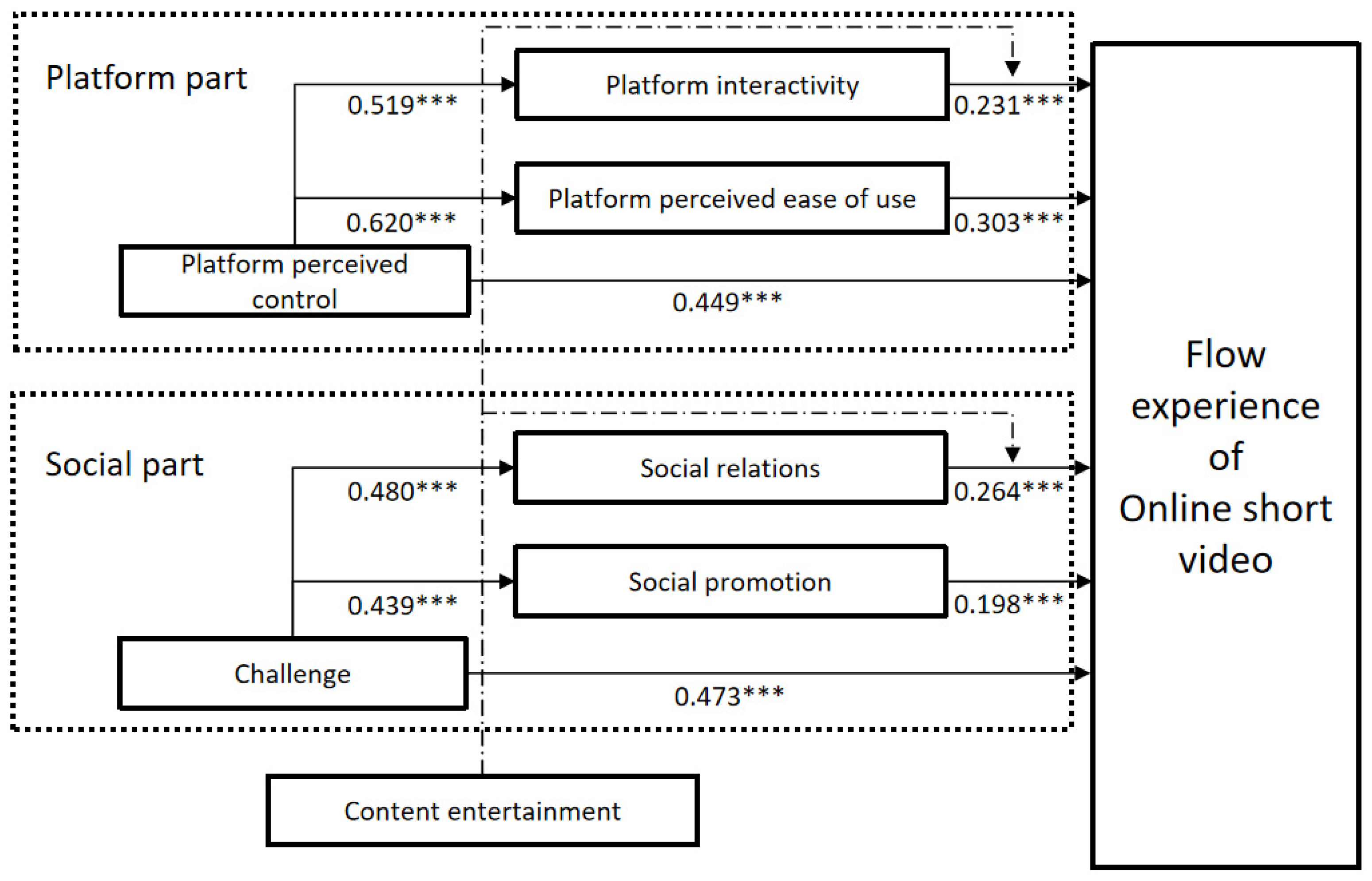
Figure 2.
Mediation analysis of Platform part.
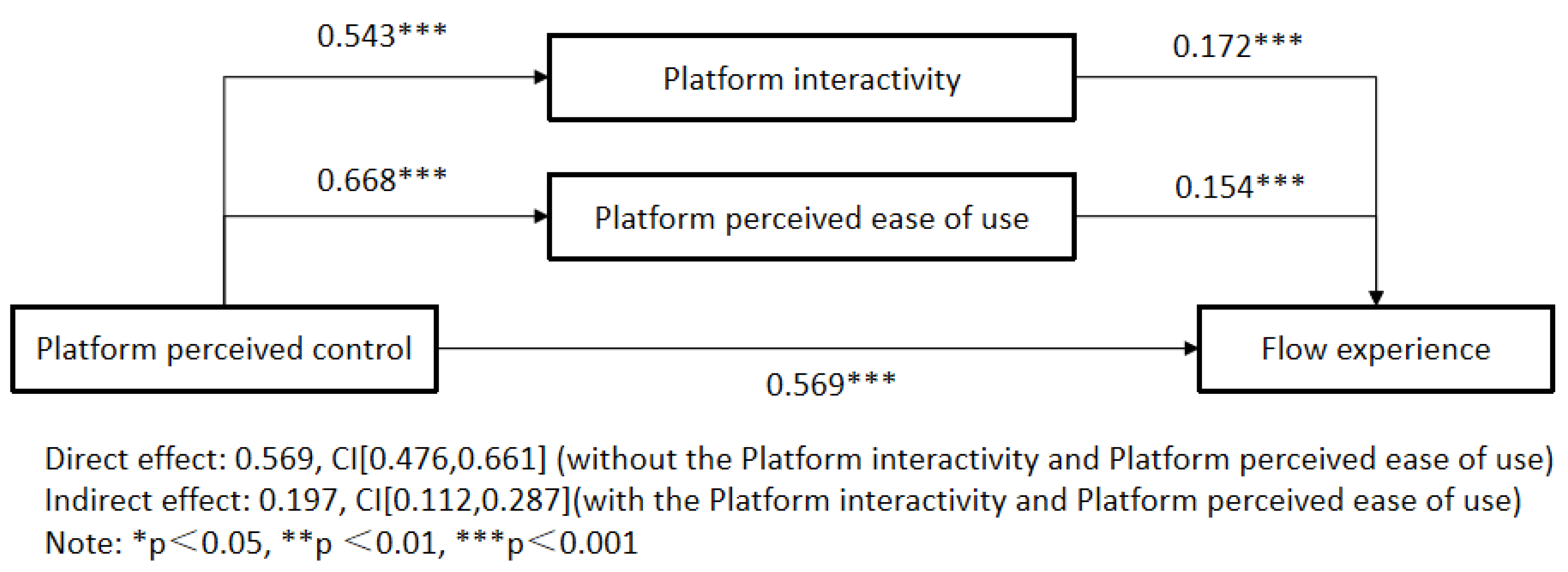
Figure 3.
Mediation analysis of Social part.
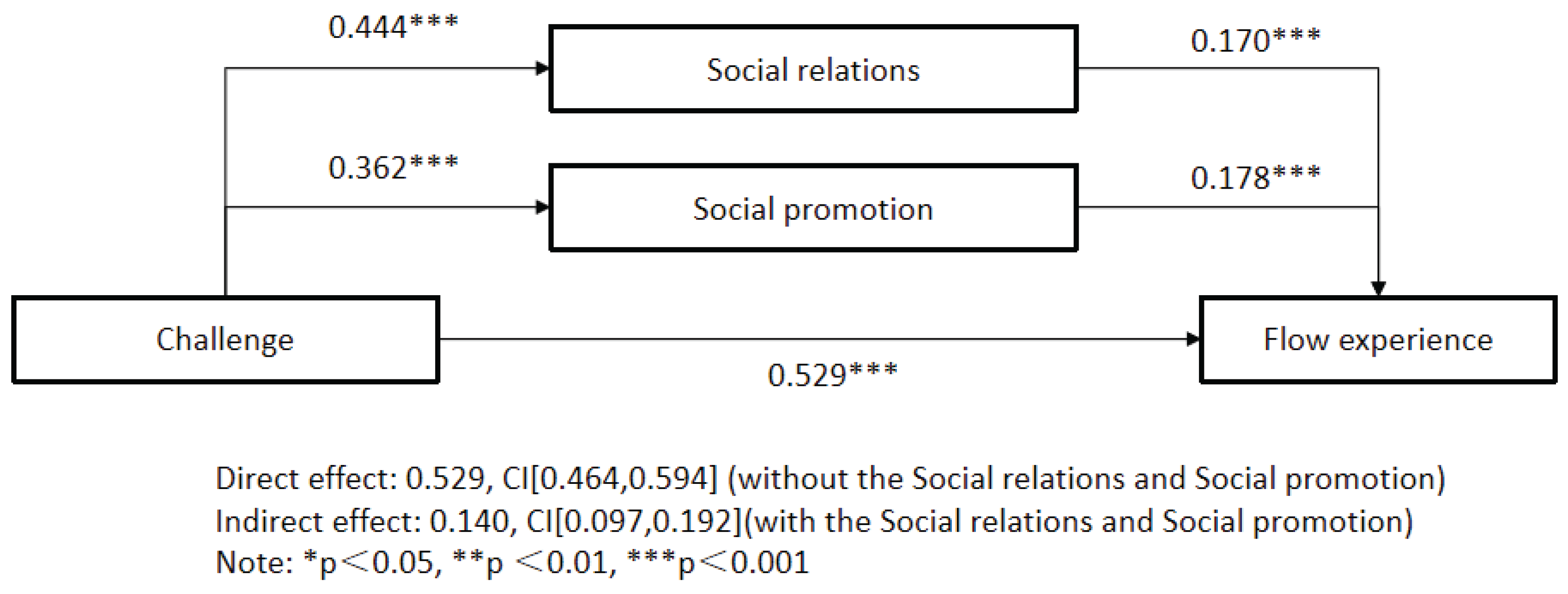

Table 1.
Profile of respondents.
| Measure | Items | Frequency | Percentage |
|---|---|---|---|
| Gender | Male | 333 | 0.469 |
| Female | 377 | 0.531 | |
| Age (years) | <18 | 72 | 0.101 |
| 18~30 | 337 | 0.475 | |
| 30~40 | 136 | 0.192 | |
| 40~50 | 121 | 0.170 | |
| >50 | 44 | 0.062 | |
| Education | High school or less | 80 | 0.113 |
| Some college or Bachelor’s degree | 542 | 0.763 | |
| Master's degree | 60 | 0.085 | |
| Doctoral degree | 28 | 0.039 | |
| City | Tier-1 | 257 | 0.362 |
| Tier-2 | 320 | 0.451 | |
| Tier-3 | 71 | 0.100 | |
| Tier-4 and Below | 62 | 0.087 | |
| Income(Yuan) | <1000 | 93 | 0.131 |
| 1000~5000 | 249 | 0.351 | |
| 5000~8000 | 177 | 0.249 | |
| 8000~17000 | 145 | 0.204 | |
| >17000 | 46 | 0.065 |
Table 2.
Reliability and convergent validity.
| Indecator | Factor loading | Cronbach’s alpha | CR | AVE | |
|---|---|---|---|---|---|
| Flow experience | FL1 | 0.941 | 0.935 | 0.958 | 0.885 |
| FL2 | 0.947 | ||||
| FL3 | 0.934 | ||||
| Platform perceived control | PC1 | 0.904 | 0.908 | 0.926 | 0.806 |
| PC2 | 0.904 | ||||
| PC3 | 0.885 | ||||
| Challenge | CH1 | 0.908 | 0.920 | 0.933 | 0.822 |
| CH2 | 0.907 | ||||
| CH3 | 0.905 | ||||
| Platform perceived ease of use | PE1 | 0.909 | 0.927 | 0.934 | 0.826 |
| PE2 | 0.914 | ||||
| PE3 | 0.903 | ||||
| Platform interactivity | PI1 | 0.897 | 0.906 | 0.923 | 0.799 |
| PI2 | 0.908 | ||||
| PI3 | 0.876 | ||||
| Social relations | SR1 | 0.907 | 0.916 | 0.929 | 0.812 |
| SR2 | 0.904 | ||||
| SR3 | 0.893 | ||||
| Social promotion | SP1 | 0.877 | 0.890 | 0.912 | 0.776 |
| SP2 | 0.864 | ||||
| SP3 | 0.902 | ||||
| Content entertainment | CE1 | 0.860 | 0.865 | 0.906 | 0.764 |
| CE2 | 0.863 | ||||
| CE3 | 0.898 |
Table 3.
Square Root of AVE values and correlation coefcient of variables.
| PC | CH | PE | PI | SR | SP | CE | FL | |
| PC | 0.898 | |||||||
| CH | 0.413 | 0.908 | ||||||
| PE | 0.600 | 0.302 | 0.904 | |||||
| PI | 0.522 | 0.272 | 0.295 | 0.893 | ||||
| SR | 0.307 | 0.466 | 0.256 | 0.246 | 0.900 | |||
| SP | 0.301 | 0.417 | 0.252 | 0.297 | 0.27 | 0.888 | ||
| CE | 0.242 | 0.332 | 0.232 | 0.084 | 0.229 | 0.115 | 0.875 | |
| FL | 0.636 | 0.665 | 0.466 | 0.442 | 0.455 | 0.403 | 0.438 | 0.944 |
Table 4.
Path analysis results.
| Structural Path | Coefficient | T-value | R² |
| PC→FL | 0.449*** | 17.189 | 0.603 |
| CH→FL | 0.473*** | 18.103 | |
| PE→FL | 0.303*** | 10.085 | 0.451 |
| PI→FL | 0.231*** | 7.588 | |
| SR→FL | 0.264*** | 8.823 | |
| SP→FL | 0.198*** | 6.479 | |
| PC→PE | 0.620*** | 21.053 | 0.385 |
| PC→PI | 0.519*** | 16.159 | 0.269 |
| CH→SR | 0.480*** | 14.564 | 0.231 |
| CH→SP | 0.439*** | 13.011 | 0.193 |
Disclaimer/Publisher’s Note: The statements, opinions and data contained in all publications are solely those of the individual author(s) and contributor(s) and not of MDPI and/or the editor(s). MDPI and/or the editor(s) disclaim responsibility for any injury to people or property resulting from any ideas, methods, instructions or products referred to in the content. |
© 2025 by the authors. Licensee MDPI, Basel, Switzerland. This article is an open access article distributed under the terms and conditions of the Creative Commons Attribution (CC BY) license (http://creativecommons.org/licenses/by/4.0/).
Copyright: This open access article is published under a Creative Commons CC BY 4.0 license, which permit the free download, distribution, and reuse, provided that the author and preprint are cited in any reuse.


