

Submitted:
23 March 2025
Posted:
24 March 2025
You are already at the latest version
Abstract
Water security has become a pressing issue in Central Asia due to increasing climate variability, rising water demand, and geopolitical challenges surrounding transboundary river management. This paper examines the complexities of water resource governance in the region, emphasizing the interplay between national interests and regional cooperation. Using the Regional Security Complex Theory, we analyze how social, economic, environmental, and political factors influence water diplomacy among Central Asian states. Key challenges include water scarcity, climate change impacts, the development of the Kushtepa Canal in Afghanistan, and the growing tensions over transboundary river basins, particularly in the Aral Sea basin. The intricate linkages between water, energy, and agriculture further complicate decision-making processes among riparian nations. While recent diplomatic efforts signal a shift towards enhanced regional cooperation, existing agreements remain fragmented, and a sustainable, long-term governance framework is still lacking. This study underscores the importance of an integrated, basin-wide approach to transboundary water management. We argue that a cohesive regional water strategy—grounded in international legal frameworks and supported by collaborative governance mechanisms—can mitigate conflicts and promote water security in Central Asia. Strengthening institutional capacity, leveraging technological innovations, and incorporating Afghanistan as an upstream stakeholder are critical steps toward a more resilient and cooperative water governance model.
Keywords:
transboundary water management
; water security
; regional cooperation
; hydro-politics
; Central Asia
; Kushtepa Canal
; climate change
; Aral Sea basin
1. Introduction
Water resource management is a critical issue in Central Asia, influencing regional economic development, political stability, and environmental sustainability. The United Nations (UN) projects indicate that global freshwater scarcity will become one of the major challenges of the 21st century, potentially surpassing concerns about fossil fuel shortages [1]. In Central Asia, where water resources are abundant yet unevenly distributed, the management of transboundary water bodies—particularly the Amu Darya and Syr Darya rivers—has been a source of geopolitical tensions [2,3,4,5,6]. Central Asia's major river systems are shared across multiple nations, with 86% of water resources originating in upstream countries such as Kyrgyzstan and Tajikistan, while downstream nations (Uzbekistan, Turkmenistan, and Kazakhstan) depend heavily on these water sources for irrigation, agriculture, and industry [5,7,8]. The transition from Soviet-era water governance—which relied on a centralized system of hydropower dams and irrigation networks—to independent national policies has led to political disputes over water access, hydroelectric energy, and irrigation [1,9,10].
Current Climate Conditions: Climate change is further exacerbating water-related challenges in the region [11,12]. Rising temperatures are accelerating glacier melt, altering river flow regimes, and increasing the frequency of droughts [13,14,15,16]. Some reports suggest that over 30% of Central Asia’s glaciers could disappear by 2050, severely impacting water availability in downstream areas [12,17,18,19]. Additionally, water pollution, ecosystem degradation, and biodiversity loss pose serious threats to environmental sustainability, yet regional cooperation on these issues remains limited [20,21,22,23,24]. The climate in Central Asia is warming at a rate significantly faster than the global average, with temperatures rising by 1.5–2°C over the past 70 years and projections suggesting further increases of 1.5–2.8°C by 2060 and up to 5.1–5.8°C by 2100 [25,26]. This warming has already led to a 30% reduction in glacier area over the past 50–60 years, with predictions indicating glacier volume could decline by 50% with a 2°C rise and by 78% with a 4°C increase. These changes threaten water availability, with expected reductions of up to 5% in the Syr Darya basin and 15% in the Amu Darya basin by 2050. In Uzbekistan, water deficits could rise from 3 billion m³ before 2015 to 7 billion m³ by 2030 and 15 billion m³ by 2050 [25,26]. Climate change is also causing more frequent and extreme weather events such as floods, droughts, and heatwaves, highlighting the urgent need for improved early warning systems, enhanced risk management, and new adaptation strategies. As water demand grows due to population and economic development, particularly in agriculture where over 90% of land depends on irrigation, the region’s water deficit worsens. The volume of water available per person has dropped from 8,400 m³ to 2,500 m³ annually over the past 40 years and could fall below 1,700 m³ by 2030. To meet basic needs, an additional 500–700 million m³ of water may be required each year. Central Asia also ranks among the least efficient regions globally in water use, consuming 2.5 m³ per dollar of GDP [25,26]. Even under scenarios with stable or increased runoff in the Amu Darya and Syr Darya rivers, future deficits could range from 8% to as high as 33%. With the population expected to reach 90–100 million by 2050, the region could face a water shortage of 25–30%, and agricultural water demand may grow by 30% by 2030. Addressing these challenges requires regional cooperation and more rational water use, which the UN estimates could provide an economic benefit of around 5% of GDP—or approximately $20 billion [25,26].
The geopolitical landscape of Central Asia has been shaped by historical disputes over water allocation. With the collapse of the Soviet Union and the shift to market economies, the previously integrated water-energy exchange system broke down, leading to hydropolitical deadlocks [2,27,28]. Upstream nations (Kyrgyzstan and Tajikistan) prioritize hydropower generation, while downstream countries (Uzbekistan, Turkmenistan, and Kazakhstan) require a stable and predictable water supply for irrigation [29,30,31]. This tension escalated in the 1990s, when Kyrgyzstan and Tajikistan resumed construction of major hydroelectric projects, raising security concerns in Uzbekistan, which relies on seasonal water releases for its agricultural sector [32,33]. Despite these challenges, regional dialogue on water cooperation has been revived in recent years. Between 2018 and 2024, multiple high-level meetings among Central Asian leaders focused on water governance, infrastructure, and transboundary river management [34,35,36,37]. This growing engagement signals a renewed opportunity to develop collaborative water-sharing agreements, improve water governance frameworks, and strengthen regional water security [7,8,38].
Given the complexity of water-related conflicts in Central Asia, this study aims to examine the decision-making processes surrounding water security from national and regional perspectives. Specifically, the research focuses on the tensions between national sovereignty and regional cooperation in transboundary river governance, with an emphasis on policy solutions, sustainable water management strategies, and climate adaptation measures [2,39].
2. Research Methods
This study is based on a comprehensive analysis of official documents from Central Asian countries and international organizations, including the Food and Agriculture Organization of the United Nations (FAO), the World Bank, the Asian Development Bank (ADB), USAID, and the International Water Management Institute (IWMI). These sources provide insights into national water policies, regional cooperation frameworks, and international best practices in water governance and digitalization.
The methodological foundation of this research is built upon a combination of qualitative and quantitative approaches. The study employs data collection, generalization, systematization, and analysis techniques to evaluate the methods, algorithms, procedures, and digitalization trends within the water sector. Special emphasis is placed on understanding the current state of digital transformation in water management, assessing its development trajectory, and reviewing expert evaluations of digital integration across the region.
A comparative analysis approach is applied to assess transboundary water governance in Central Asia. This includes a comparative legal examination of water policies, treaties, and regulatory frameworks, as well as an economic assessment of water management strategies and investment mechanisms. By integrating policy analysis with technical assessments of water resource management, this research aims to identify gaps, opportunities, and challenges in the region’s water governance landscape.
3. Results
3.1. Water Resource Management in Central Asia: Historical Context and Contemporary Challenges
The efficient management of water resources has become increasingly critical for Central Asian countries due to global climate change and anthropogenic pressures [40,41]. Historically, water distribution in the region was regulated by the Scientific and Technical Council of the USSR's Ministry of Water Management, with agreements still influencing contemporary water governance. Key documents outlining transboundary water-sharing mechanisms include Protocol No. 413 (February 7, 1984) for the Syr Darya River basin and Protocol No. 566 (March 12, 1987) for the Amu Darya. These agreements allocated 46% of the Syr Darya’s flow to Uzbekistan (22.7 billion cubic meters), 44% to Kazakhstan, 8% to Tajikistan, and 2% to Kyrgyzstan. Similarly, in the Amu Darya basin, 48.2% of water is allocated to Uzbekistan, 35.8% to Turkmenistan, 15.4% to Tajikistan, and 0.6% to Kyrgyzstan, excluding Afghanistan.
Following the collapse of the Soviet Union, the Almaty Agreement of 1992 was signed, establishing regional cooperation on water governance. Under this agreement, key water management infrastructure of regional significance was transferred to Basin Organizations (BOs) for collective operation while maintaining national ownership.
- BO Amu Darya oversees 84 hydropower stations, including 36 head river water intakes, 169 hydro-posts, and 386 kilometers of interstate canals in Tajikistan, Turkmenistan, and Uzbekistan.
- BO Syr Darya manages 198 hydraulic structures, with 21 located on major tributaries such as the Naryn, Syr Darya, Karadarya, and Chirchik rivers.
Despite agreements ensuring joint financing for infrastructure maintenance, funding remains inconsistent, affecting regional cooperation. Furthermore, Afghanistan remains outside of these agreements, yet its increasing water consumption is significantly impacting regional hydropolitics.
3.2. The Qush Tepa Canal: A Disruptive Development in Transboundary Water Management
One of the most contentious recent developments is Afghanistan's Qush Tepa Canal, which, upon completion, is expected to divert 13 cubic kilometers of water annually from the Amu Darya River [42,43]. The canal spans 281 kilometers in length, 100 meters in width, and 8 meters in depth, with a projected intake of 650 cubic meters per second from the Afghanistan-Tajikistan border. This project will irrigate between 550,000 and 585,000 hectares in Balkh, Jowzjan, and Faryab provinces [44,45].
This canal, a revived component of Afghanistan's 1955-1961 Economic and Social Seven-Year Plan, has now reached one-third of its planned length and is anticipated to be completed within five years. However, its construction raises concerns among Uzbekistan, Turkmenistan, and Tajikistan, which depend on Amu Darya flows for agricultural and hydropower purposes. Experts, such as Jahan Taganova, a New York-based water security analyst, warn that the project will exacerbate regional water scarcity, intensify interstate disputes, and potentially trigger hydro-political conflicts.
3.3. Legal and Institutional Framework for Water Governance in Central Asia
The legal framework governing water resource management in Central Asia varies significantly between nations. A comparative analysis of Kazakhstan national water legislations and policies reveals key disparities:
- International Treaties and Agreements – All international water-related treaties ratified by the Republic of Kazakhstan, which establish frameworks for transboundary water cooperation and management.
- Constitutional Provisions – Article 6 of the Constitution of the Republic of Kazakhstan, which defines the legal status and ownership of natural resources, including water.
-
National Water and Environmental Legislation – Key legislative acts governing water resource management, including:
- Water Code of the Republic of Kazakhstan (July 9, 2003, No. 481-II)
- Code on Administrative Offenses (January 9, 2007, No. 212-III)
- Environmental Code (2007)
- Land Code (June 20, 2003, No. 442-II)
- National Water Resource Management Strategy – Presidential Decree approving the National Plan for Integrated Water Resource Management and Water Use Efficiency Improvement (2009-2025), aimed at ensuring sustainable water use and addressing water security challenges.
- Government Regulations and Policy Frameworks – Resolutions and legislative acts that influence public administration and regulatory mechanisms for water resource management, such as the Resolution of the Government of Kazakhstan (January 28, 2009, No. 67).
- Regulatory Framework for Water Governance – National laws and regulations that govern water use, conservation, and distribution, ensuring compliance with environmental and sustainability standards.
- Subordinate Legislative Acts – Sector-specific regulations and executive orders that support the implementation of national water policies and ensure alignment with broader environmental objectives.
- Customary Practices in Water Management – Traditional and regionally accepted practices influencing business and community-level water use, particularly in rural and agricultural sectors.
- Economic and Trade-Related Water Regulations – Legislative frameworks governing water-related business activities, including commercial water use, hydropower development, and irrigation for agricultural enterprises.
- Public-Private Partnership and Stakeholder Engagement Mechanisms – Policies and initiatives facilitating collaboration between the government, private sector, and civil society in water resource management, ensuring inclusive and sustainable governance.
We will analyze the regulatory and legal frameworks governing water resource management in Central Asian countries, as summarized in Table 1.
The analysis of national water legislation across the five Central Asian states reveals a broadly comparable hierarchy of normative legal acts. However, key differences exist, particularly in Kyrgyzstan, where the Constitution does not explicitly establish the supremacy of ratified international treaties. Moreover, a major shortcoming across the region is the inconsistent incorporation of international legal principles into national water governance frameworks.
A fundamental challenge in the region is the absence of a cohesive and comprehensive conceptual framework for water resource utilization and conservation. This gap has led to fragmented and often conflicting approaches to water governance among Central Asian countries [13,55,56]. A striking example is Turkmenistan’s Water Code, where Article 3 defines the state water fund to include rivers, reservoirs, lakes, inter-farm canals, drainage collectors, other surface water bodies, groundwater resources, and even the Caspian Sea along Turkmenistan’s state border. However, Article 82 of the same code only addresses the procedural aspects of transboundary water utilization without providing a clear legal definition of transboundary waters. Consequently, apart from this provision, Turkmenistan lacks a well-defined legal framework governing shared water resources. Within its legal hierarchy, the Water Code is subordinate to both international treaties and the Constitution, which means it lacks the authority to establish binding transboundary water management protocols.
Similarly, Uzbekistan's Law on Water and Water Use shares conceptual similarities with Kazakhstan’s Water Code. Article 3 of Uzbekistan’s law declares water resources as state property, emphasizing rational utilization and state-led protection. While this aligns with Kazakhstan’s approach, a lack of explicit mechanisms for transboundary water cooperation creates challenges in regional water governance [57]. To effectively assess the robustness of water laws, it is essential to consider their position within the National Legal Act (NLA) hierarchy. Across all five states, foundational legislation related to water—whether codified or not—forms the backbone of national water governance. However, despite the presence of national water laws, their implementation remains inconsistent, with significant variations in enforcement and interpretation. Ultimately, the legal frameworks governing water resources in Central Asia require significant harmonization to address regional water challenges [58]. Establishing a unified, integrated water management framework that aligns national legislation with international legal standards would be a crucial step toward ensuring sustainable and equitable water resource utilization across the region.
3.4. Aims and Objectives of Water Legislation in the Republic of Kazakhstan
The primary objective of Kazakhstan's water legislation is to establish and maintain an ecologically sustainable and economically efficient system for water utilization, conservation, and management. This framework aims to ensure the equitable distribution of water resources while enhancing water supply and sanitation services. Additionally, it seeks to protect water bodies from overuse and contamination, thereby preserving both human well-being and the ecological balance of the country’s water systems.
The responsibilities outlined in the Water Code encompass several key areas. It mandates the implementation of state policies for the rational use and conservation of water resources, ensuring their long-term sustainability. Furthermore, it provides a regulatory framework governing water supply, wastewater treatment, and sanitation infrastructure to promote efficiency and equitable access. Sustainable water utilization is a priority, necessitating conservation measures and protective strategies to mitigate environmental degradation. To strengthen water governance, the legislation establishes a comprehensive legal framework that guides resource allocation, technological advancements, and institutional management. It also ensures law and order in all aspects of water utilization, protection, supply, and sanitation, reinforcing accountability and compliance. Additionally, it defines fundamental principles for water governance, including sanitation policies and regulatory mechanisms, to foster a cohesive and efficient water management system. Research and exploration play a crucial role in advancing water security. The Water Code mandates the oversight of scientific research and integrated management strategies for hydromelioration systems, water infrastructure, and resource sustainability. It also outlines strategies for land reclamation, ensuring the protection of human populations and economic assets from hydrological risks such as floods and droughts.
A distinctive feature of Kazakhstan’s Water Code is its direct provisions on transboundary water management (Section 11, Chapter 31). This legal framework sets clear guidelines for international cooperation on shared water resources, making it one of the most structured and comprehensive regulatory mechanisms in Central Asia. From a legal and theoretical perspective, it serves as a robust foundation for developing a broader regional approach to water governance, promoting collaboration and sustainable resource management across national borders. The Water Code of 2003 established a comprehensive framework for the management of water basins in Kazakhstan, emphasizing the formation of basin organizations that incorporate all relevant stakeholders. These organizations are tasked with overseeing water distribution, conservation efforts, and the implementation of sustainable management practices. To promote equitable and efficient water utilization, the code introduced the concept of environmental revenues, which aims to balance water supply and consumption while ensuring long-term resource sustainability. In 2009, the National Strategy for Integrated Basin Management was introduced, followed by the implementation of a State Water Resources Management Program, aligning Kazakhstan’s water governance policies with international best practices.
Despite Kazakhstan’s efforts to enhance water governance, regional hydropolitics continue to present significant challenges [56] McKinney. In 2017, relations between Kyrgyzstan and Kazakhstan became particularly strained due to disputes over transboundary water resources. As an upstream nation, Kyrgyzstan holds a strategic position in controlling water flow to downstream countries, including Kazakhstan. This geopolitical dynamic led to tensions, culminating in a public statement by former Kyrgyz President Almazbek Atambayev, who threatened to restrict water access to Kazakhstan during a press conference, exacerbating diplomatic friction between the two nations.
However, following the election of President Sooronbay Jeenbekov, bilateral relations began to improve. During Jeenbekov’s official visit to Kazakhstan, diplomatic negotiations prioritized water and energy cooperation, aiming to establish a more sustainable and collaborative approach to transboundary water management. One key aspect of these discussions was the reactivation of the International Fund for Saving the Aral Sea (IFAS), a crucial regional initiative that had previously seen Bishkek suspend its participation in 2018. As a result of these efforts, both Astana and Bishkek reaffirmed their commitment to viewing transboundary water resources as a shared regional asset, emphasizing the need for cooperative governance to ensure water security for all nations involved. This diplomatic shift marked an important step toward fostering trust, collaboration, and long-term sustainability in Central Asia’s water sector.
Uzbekistan initially opposed the construction of the Kambar-Ata-1 and Kambar-Ata-2 hydroelectric power plants in Kyrgyzstan, citing concerns over potential disruptions to downstream water supply. However, through diplomatic negotiations, a shift toward cooperation in the water and energy sector emerged. By 2017, Uzbekistan and Kyrgyzstan reached an agreement, signaling their willingness to collaborate on hydropower projects. This commitment was formalized through the signing of a memorandum of understanding between the National Energy Holding Company of Kyrgyzstan and Uzbekhydroenergo, outlining a cooperative framework for the Kambar-Ata-1 hydropower plant project.
Meanwhile, Tajikistan has prioritized the development of the Rogun hydroelectric power plant on the Vakhsh River, a project that has been at the core of the country’s energy and economic strategy. However, this project has raised significant geopolitical and economic concerns in the region. Ajdar Kurtov, editor-in-chief of National Strategy Issues at the Russian Institute for Strategic Studies, has argued that a single hydroelectric power plant will not resolve all of Tajikistan’s energy challenges. Instead, the Rogun Dam project has been framed as a symbol of national progress, despite its economic and logistical complexities [59]. The post-construction phase of the Rogun project presents considerable challenges, particularly regarding the procurement and distribution of electricity. The high cost of construction and limited market demand for its electricity pose financial risks. Kazakhstan, a key regional player, has no significant need for additional energy from the project, and alternative markets are fraught with economic and logistical constraints. The CASA-1000 project, which aims to export electricity to Pakistan, India, and Afghanistan, faces hurdles due to Afghanistan’s increasing domestic energy ambitions and its growing focus on self-sufficiency. Additionally, Pakistan's energy sector has been strengthening ties with China, potentially limiting its reliance on Tajikistan’s energy exports.
These developments highlight the complex interplay between water management, energy security, and regional geopolitics in Central Asia. While hydropower projects offer economic potential, they also present challenges related to transboundary water governance, international energy markets, and political cooperation among the region’s nations.
In recent years, the modernization and development of national legislative frameworks in Central Asia have advanced toward a more structured and collaborative approach. A significant step in this direction is the operationalization of the Interstate Coordination Commission on Water Management of the Central Asian States, which serves as a platform for regional water governance and cooperative decision-making among riparian nations.
The economies of Central Asian states are characterized by high energy and capital intensity, particularly in the agricultural and industrial sectors, both of which heavily rely on water resources. However, despite these dependencies, water use efficiency in the region remains significantly lower than global standards (Table 2). This inefficiency highlights the urgent need for policy reforms, improved water management strategies, and stronger regional cooperation to ensure sustainable resource utilization and long-term economic stability in the face of growing water scarcity and climate variability.
In 2021, water use efficiency in Central Asian countries varied significantly, ranging from $0.842/m³ in Kyrgyzstan to $7.2/m³ in Kazakhstan. Across the region, the average water use efficiency is projected to be between $2 and $2.5 per cubic meter, which remains substantially lower than the global weighted average of $19.01 per cubic meter. In contrast, two-thirds of countries worldwide exhibit water use efficiency rates between $5 and $100 per cubic meter. Notably, four out of the five Central Asian nations—excluding Kazakhstan—rank among the top 10 global outliers in this metric, based on an analysis of 168 countries. The regional economy is predominantly agrarian, with service-oriented sectors playing a relatively minor role in natural resource consumption. This economic structure contributes to one of the lowest water use efficiency rates globally, averaging $2.50 per cubic meter, while industrialized nations achieve rates as high as $1,096 per cubic meter due to greater efficiency in resource utilization.
The effectiveness and fairness of water resource distribution in Central Asia largely depend on the availability, accuracy, and analysis of hydrological data [61]. Kazhydromet, Kazakhstan's national hydrometeorological service, plays a crucial role in monitoring environmental, meteorological, and hydrological conditions. As of 2022, Kazhydromet operated 377 hydrological stations, providing essential data for water management and climate adaptation planning. A key area of focus in improving water governance is the digital transformation of the water sector, particularly in Kazakhstan and Uzbekistan [62]. Both countries have taken legislative steps to integrate digital technologies into water resource regulation. Kazakhstan's Aerospace Committee, under the Ministry of Digitalization, is actively testing flood monitoring devices, reflecting a broader commitment to leveraging digital tools for real-time water management, pollution control, and disaster preparedness. Regarding the water resources of the Aral Sea, it is essential to define and quantify the water basin extents for each Central Asian nation, ensuring alignment with the specific requirements and allocation frameworks established for regional water management (Table 3).
The data presented in the table highlights notable discrepancies and exclusions in the regulation of legal standards among Central Asian nations, particularly regarding the establishment of equitable water management frameworks. One key example is Afghanistan, which remains outside many regional agreements, raising concerns about its role in the broader transboundary water governance structure.
Meanwhile, Kazakhstan has intensified its efforts in water cooperation, expanding its focus to include non-governmental organizations (NGOs), environmental movements, and political entities that contribute to regional environmental initiatives. These efforts have enhanced the role of water user associations, basin organizations, and other civic institutions in decision-making processes. NGOs play an active role by organizing seminars, conferences, and public discussions, as well as implementing practical initiatives such as tree planting and the restoration of water protection zones. Additionally, Kazakhstani NGO representatives are actively engaged in the Global Water Partnership for Central Asia and the Caucasus, where they contribute to public participation in integrated water resource management efforts across the region. Kazakhstan's active participation in global water resource events and its endorsement of key international conventions on water management underscore its commitment to aligning national policies with International Water Law. These efforts highlight the recognition of NGOs as equal stakeholders in water governance, ensuring their involvement in decision-making, policy implementation, and project execution. This inclusive approach is further reinforced within Kazakhstan's updated water legislation, which formally codifies the role of NGOs in the sustainable management and protection of water resources.
Clause 3 of Article 63 of the Water Code of the Republic of Kazakhstan grants public associations the authority to conduct public oversight on the utilization and conservation of water resources. The execution of this oversight is determined by these associations in accordance with their charters and in collaboration with state entities responsible for regulatory enforcement. This provision ensures greater transparency and civic participation in water governance, reinforcing the role of non-governmental stakeholders in sustainable water management. Currently, Kazakhstan has established a comprehensive legislative framework that supports the development of a broader conceptual approach to water governance across Central Asia. The country has also laid the foundation for greater public participation in decision-making processes regarding water use and conservation. Other regional nations are making efforts to enhance public engagement in addressing water-related challenges, but discrepancies in national legislation and governance structures continue to present obstacles. These inconsistencies, coupled with the increasingly complex demands of water resource management, are expected to remain significant challenges for an extended period [2,3,5,8,36,37,45,55,58,59,64].
To facilitate regional cooperation, the Interstate Coordination Commission for Water Management of Central Asia (ICWC) was established under the 1992 agreement on transboundary water management. Initially, the commission consisted of three core executive bodies: the Secretariat, the Syr Darya Basin Organization, and the Amu Darya Basin Organization. Over time, the Scientific and Information Center of the ICWC and the Coordination and Metrological Center were also established, further strengthening regional collaboration on water governance, data exchange, and policy coordination. However, despite these institutional mechanisms, political and economic differences among Central Asian states continue to hinder the development of a truly integrated water management strategy.
3.5. Transboundary Basin Organizations and Their Challenges
Transboundary basin organizations can generally be categorized into three distinct groups, as illustrated in Figure 1. Among them, the Interstate Coordination Commission for Water Management of Central Asia (ICWC) falls into the second type of organization. According to the 1992 agreement, the ICWC is responsible for establishing and approving water consumption limits for each member republic, as well as for the entire region (Article 8). Additionally, the commission is tasked with ensuring strict compliance with permit and limit regulations (Article 10).
Despite its mandate, the Amu Darya Basin Organization and the Syr Darya Basin Organization have never acquired the status of interdepartmental regulatory entities with authoritative oversight. During periods of low water availability, challenges in enforcing agreed-upon water flow and consumption limits become even more pronounced, as the ICWC and its associated Basin Organizations struggle to maintain allocations and commitments. Notably, the World Trade Organization's (WTO) authority does not extend across the entire river basin, and its decisions remain advisory rather than legally binding. Experts widely acknowledge that the 1992 agreement has not been fully implemented. One of the most critical gaps is the lack of an accountability framework for violations of water-sharing agreements and resource limitations. While a mechanism for enforcing compliance should have been integrated into the agreement, no formal sanctions or punitive measures have been developed to date. Additionally, funding for basin organizations remains unevenly distributed. The Amu Darya Basin Organization is primarily financed by Uzbekistan and Turkmenistan, whereas the Syr Darya Basin Organization relies on contributions from Kazakhstan and Uzbekistan. However, these financial contributions do not follow the principle of proportional parity and shared participation as outlined in Article 9 of the agreement.
3.6. Institutional Stability and International Best Practices
One of the key characteristics of effective basin organizations is their ability to maintain long-term institutional stability, even amid political and economic disparities among riparian states. This stability is critical for ensuring predictable water management and reducing geopolitical tensions over shared resources [35]. An exemplary model of an international water governance structure is the International Joint Commission (IJC) between the United States and Canada. This organization was established under the 1909 Boundary Waters Treaty and operates with equal representation from both nations. The IJC has a supranational jurisdiction that ensures autonomous decision-making beyond the direct influence of either government. Additionally, the commission maintains offices in both countries, reinforcing its role as an independent arbitrator in transboundary water disputes. By examining successful international water governance frameworks, it becomes evident that Central Asian basin organizations require stronger institutional structures, enhanced regulatory authority, and improved financial mechanisms to ensure sustainable and equitable water management across the region.
4. Conclusions
The management of transboundary rivers in Central Asia is a complex and multifaceted challenge that intersects with national security, economic stability, and regional cooperation. Water remains a strategically vital resource for Central Asian nations, underpinning economic development, energy security, and agricultural sustainability. However, despite the recognition of its importance, water governance in the region remains fragmented, with diverging national interests and competing priorities influencing policy decisions. Historically, water management in Central Asia was coordinated through centralized Soviet-era institutions, which ensured a balance between hydropower generation in upstream countries (Kyrgyzstan and Tajikistan) and irrigation needs in downstream nations (Uzbekistan, Kazakhstan, and Turkmenistan). However, following the dissolution of the Soviet Union, independent states pursued divergent water management strategies, prioritizing national sovereignty over regional cooperation [65]. The resulting hydropolitical tensions have made integrated and cooperative management of transboundary water resources increasingly difficult.
A key finding of this study is that effective water management in Central Asia requires a holistic, integrated approach that considers the interconnected social, economic, environmental, and political dimensions of transboundary river systems. The theory of regional security complexes (TRSC) provides a useful analytical lens for understanding how water conflicts and cooperation in Central Asia are influenced by national security concerns and broader geopolitical dynamics. Furthermore, the concept of hydro-hegemony highlights the role of state power in shaping water governance, emphasizing that upstream and downstream nations wield differing degrees of influence over transboundary water resources.
One of the most pressing issues in regional water governance is the need to formally incorporate Afghanistan, an upstream riparian state, into existing water-sharing negotiations. Under international law, Afghanistan has the right to utilize the waters of the Amu Darya, yet its role in regional water governance has remained largely informal. Historical treaties between Afghanistan and the USSR (1958) provide a legal foundation for future cooperation, with Tajikistan, Turkmenistan, and Uzbekistan recognized as the legal successors of the Soviet-era agreements under the Vienna Convention. However, these agreements primarily address border water management rather than comprehensive water-sharing mechanisms, underscoring the need for updated, regionally inclusive legal frameworks.
International water law has evolved significantly, transitioning from absolute territorial sovereignty to the principle of shared water governance. The 1992 UNECE Convention on the Protection and Use of Transboundary Watercourses and International Lakes and the 1997 UN Convention on the Non-Navigational Uses of International Watercourses provide a broad framework for equitable water management. However, these agreements are largely recommendatory and lack binding enforcement mechanisms, making them insufficient substitutes for basin-specific agreements among Central Asian nations.
Water resource management is deeply tied to national and regional security, particularly in relation to energy and food security [66]. Hydropower plays a crucial role in the region’s electricity generation, accounting for approximately one-third of total energy consumption. Upstream nations, particularly Tajikistan and Kyrgyzstan, depend heavily on water availability for hydropower production, while downstream nations prioritize irrigation for agriculture [67]. The conflicting priorities of hydropower and irrigation have fueled tensions over water allocation, with downstream countries perceiving upstream infrastructure projects as potential threats to water availability.
Despite ongoing conflicts, there is increasing momentum toward regional water cooperation. Since 2018, multiple high-level meetings have facilitated dialogue on transboundary water governance, trade, and infrastructure development. However, the persistence of political and economic disparities has hindered the establishment of a fully coordinated regional water strategy. The presence of multiple bilateral and multilateral agreements among Central Asian states indicates a willingness to engage in cooperative water management, yet these frameworks often lack enforcement mechanisms and fail to guarantee effective collaboration.
One of the key insights from global water management practices is that conflict resolution in transboundary basins is most successful when there is an equitable distribution of both costs and benefits among riparian states. Successful models, such as the cooperative management of the Shu and Talas Rivers between Kazakhstan and Kyrgyzstan, demonstrate the potential for profit-sharing mechanisms that incentivize mutual cooperation. In this approach, upstream countries receive compensation for services provided to downstream users, creating a balanced system that promotes long-term collaboration.
Ultimately, the sustainable management of transboundary water resources in Central Asia requires the development of a comprehensive regional water strategy that integrates economic, legal, and environmental considerations. While existing agreements provide a foundation for cooperation, further progress will depend on the willingness of states to adopt shared management frameworks, resolve disputes through transparent negotiation, and invest in collaborative water infrastructure projects. Future water security in Central Asia hinges on the ability of regional governments to move beyond unilateral decision-making and embrace cooperative governance mechanisms that ensure equitable and sustainable water use for all.
Author Contributions
writing—original draft preparation, A.P.; writing—review and editing, B.J.; supervision, S.T. All authors have read and agreed to the published version of the manuscript.
Acknowledgments
Authors acknowledge support given by Academy of Public Administration under the President of the Republic of Kazakhstan, Astana, Kazakhstan.
Conflicts of Interest
The authors declare no conflicts of interest.
References
- Koncagül, E. and R. Connor, The United Nations World Water Development Report 2023: partnerships and cooperation for water; facts, figures and action examples. 2023.
- Abdullaev, I., et al., Current challenges in Central Asian water governance and their implications for research, higher education, and science-policy interaction. Central Asian Journal of Water Research, 2025. 11(1): p. 47-58.
- Janusz-Pawletta, B., Current legal challenges to institutional governance of transboundary water resources in Central Asia and joint management arrangements. Environmental earth sciences, 2015. 73(2): p. 887-896. [CrossRef]
- McKinney, D.C., Cooperative management of transboundary water resources in Central Asia. In the Tracks of Tamerlane: Central Asia’s Path to the 21st Century. Washington, DC: National Defense University, 2004: p. 187-220.
- Mukhammadiev, B., Challenges of transboundary water resources management in Central Asia, in The Aral Sea: The Devastation and Partial Rehabilitation of a Great Lake. 2013, Springer. p. 233-251.
- Wang, X., et al., Water resources management and dynamic changes in water politics in the transboundary river basins of Central Asia. Hydrology and Earth System Sciences, 2021. 25(6): p. 3281-3299. [CrossRef]
- Janusz-Pawletta, B. and M. Gubaidullina, Transboundary water management in Central Asia. Legal framework to strengthen interstate cooperation and increase regional security. Cahiers d’Asie centrale, 2015(25): p. 195-215.
- Xenarios, S., et al., Current and future challenges of water security in Central Asia. Global Water Security: Lessons Learnt and Long-Term Implications, 2018: p. 117-142.
- Amirova, I., M. Petrick, and N. Djanibekov, Community, state and market: Understanding historical water governance evolution in Central Asia. 2022.
- Punkari, M., et al., Climate change and sustainable water management in Central Asia. ADB Central and West Asia working paper series, 2014. 5.
- Isaev, E., et al., High-resolution dynamic downscaling of historical and future climate projections over Central Asia. Cent. Asian J. Water Res, 2024. 10: p. 91-114. [CrossRef]
- Sadyrov, S., et al., High-resolution assessment of climate change impacts on the surface energy and water balance in the glaciated Naryn River basin, Central Asia. Journal of Environmental Management, 2025. 374: p. 124021. [CrossRef]
- Bernauer, T. and T. Siegfried, Climate change and international water conflict in Central Asia. Journal of Peace Research, 2012. 49(1): p. 227-239. [CrossRef]
- Reyer, C.P., et al., Climate change impacts in Central Asia and their implications for development. Regional Environmental Change, 2017. 17: p. 1639-1650. [CrossRef]
- Siegfried, T., et al., Will climate change exacerbate water stress in Central Asia? Climatic Change, 2012. 112: p. 881-899.
- White, C.J., T.W. Tanton, and D.W. Rycroft, The impact of climate change on the water resources of the Amu Darya Basin in Central Asia. Water Resources Management, 2014. 28: p. 5267-5281. [CrossRef]
- Kong, L., et al., Climate Change Impacts and Atmospheric Teleconnections on Runoff Dynamics in the Upper-Middle Amu Darya River of Central Asia. Water, 2025. 17(5): p. 721. [CrossRef]
- Kozhagulov, S., et al., Trends in Atmospheric Emissions in Central Asian Countries Since 1990 in the Context of Regional Development. 2025.
- Sidle, R., et al., Dynamics in the Water Towers of the Pamir and Downstream Consequences. 2022.
- Rogers, A., Predicting Biodiversity Loss: A Global Analysis of Red List Index Trends and Key Drivers (2002–2021). Available at SSRN 5106872.
- Toymbaeva, D., D. Mamatova, and X. Ergashev, GEOECOLOGICAL PROBLEMS OF UZBEKISTAN AND THEIR IMPACT ON THE REGION. Web of Humanities: Journal of Social Science and Humanitarian Research, 2025. 3(2): p. 15-26.
- Wang, X., et al., Spatiotemporal Dynamics and Driving Mechanism of Aboveground Biomass Across Three Alpine Grasslands in Central Asia over the Past 20 Years Using Three Algorithms. Remote Sensing, 2025. 17(3): p. 538. [CrossRef]
- Wang, X., et al., Scale effects of spatial patterns of ecosystem services in the Tarim River Basin in Central Asia. Environmental Monitoring and Assessment, 2025. 197(3): p. 1-22. [CrossRef]
- Sidle, R.C., et al., Sediment sources, erosion processes, and interactions with climate dynamics in the Vakhsh River Basin, Tajikistan. Water, 2023. 16(1): p. 122. [CrossRef]
- Bank, A.D. In Numbers: Climate Change in Central Asia. 2025 February 24, 2025; Available from: https://www.adb.org/ru/news/features/numbers-climate-change-central-asia.
- Bank, W. Country Profiles with Climate Risks. 2021 February 21, 2025; Available from: https://climateknowledgeportal.worldbank.org/country-profiles.
- Karchegani, A.M., A. Mohammadpour, and M. Tavakoli, Assessing the Determinants of Effective Transboundary Water Resource Management Strategies in the Harirud River Basin, Iran.
- Spoor, M. and L. Thiemann, Hydro-Authoritarianism: Mega-Engineering the (Semi-) Arid Regions of Central Eurasia and China. Europe-Asia Studies, 2025: p. 1-22. [CrossRef]
- Feng, K., et al., Spatiotemporal Dynamics of Drought and the Ecohydrological Response in Central Asia. Remote Sensing, 2025. 17(1): p. 166. [CrossRef]
- Karimov, A., et al., Of transboundary basins, integrated water resources management (IWRM) and second best solutions: The case of groundwater banking in Central Asia. Water Policy, 2012. 14(1): p. 99-111. [CrossRef]
- Michael, B., Approaches to optimize Uzbekistan’s investment in irrigation technologies. Экoнoмическая пoлитика, 2020. 15(2): p. 136-147.
- Bhat, S.A., M.I. Wani, and P.S.U. Irfan, Renewable and Non-Renewable Energy Potential of Central Asian States: An Analysis in Market Demand. Peerzada Shams Ul, Renewable and Non-Renewable Energy Potential of Central Asian States: An Analysis in Market Demand.
- Chowdhury, A., Z. Tadjoeddin, and Y. Vidyattama, Landlocked Central Asia: The Peril of Transition, in Structural Transformation as Development: Path Dependence and Geopolitics. 2025, Springer. p. 173-202.
- Aituarova, G. and T.L. Kh, THE ROLE OF INTERNATIONAL AND REGIONAL ORGANIZATIONS IN SOLVING THE PROBLEM OF WATER SHORTAGE IN CENTRAL ASIA. Вестник науки, 2025. 4(2 (83)): p. 352-358.
- Balas, A., The European Union's Role in Addressing Environmental Disputes in Central Asia: Evaluating the Effectiveness of a “Reluctant 3rd Party”, in European Union Governance in Central Asia. 2025, Routledge. p. 111-130.
- Goziyev, R., The Challenges of Maintaining Regional Security in Central Asia Amid Modern Threats, in International Relations Dynamics in the 21st Century: Security, Conflicts, and Wars. 2025, IGI Global Scientific Publishing. p. 349-368.
- Qudbidinova, K., DEHYDRATION CHALLENGES IN CENTRAL ASIA: A LOOMING CRISIS. Web of Scientists and Scholars: Journal of Multidisciplinary Research, 2025. 3(2): p. 141-148.
- Horsman, S., Transboundary water management and security in Central Asia, in Limiting institutions? 2018, Manchester University Press. p. 86-104.
- Anghelescu, A.-M. and I.-D. Onel, The EU's Green Normative Power in Central Asia: The Case of the Aral Sea and Water Management Policies in Kazakhstan and Uzbekistan, in European Union Governance in Central Asia. 2025, Routledge. p. 91-110.
- Brody, M., et al., The Global Energy and Water Exchanges (GEWEX) Project in Central Asia: The Case for a Regional Hydroclimate Project. 2024, Springer. [CrossRef]
- van Oevelen, P., et al. A New Gewex Regional Hydroclimate Activity in Central Asia. in EGU General Assembly Conference Abstracts. 2024.
- Faqiryar, J.N. Food-Climate Nexus in the North River Basin of Afghanistan: A Case Study of the Qush Tepa National Irrigation Canal. 2024. MISC.
- Kuchins, A.C., et al., Afghanistan’s Qoshtepa Canal and Water Security in Central Asia. 2024.
- Sarbiland, H. and I. Stanikzai, Qosh Tepa Canal Impact On Economic Development: Historical Significance And Assessing SDGs 2030 In Afghanistan. Educational Administration: Theory and Practice, 2024. 30(7): p. 593-601. [CrossRef]
- Wesch, S., Central Asia: Challenges and Opportunities by Way of the Middle Corridor. Climate. Changes. Security: Navigating Climate Change and Security Challenges in the OSCE Region, 2024: p. 175-193.
- Berdiyev, A., Concept for the Development of the Water Management Sector in Turkmenistan. Document for Discussions, Changes, and Additions. 2018.
- Kazakhstan, R.o., Water Code of the Republic of Kazakhstan. 2003.
- Kazakhstan, R.o. Message of the President of the Republic of Kazakhstan N. Nazarbayev to the People of Kazakhstan, December 14, 2012. 2012 25 October 2018; Available from: http://www.akorda.kz/ru/addresses/addresses_of_president/poslanie-prezidenta-republics-kazakhstan-nnazarbaeva-narodu-kazahstana-14-dekabrya-2012-g.
- Kazakhstan, R.o. Strategy "Kazakhstan-2050". 2018 25 October 2018; Available from: http://www.akorda.kz/ru/official_documents/strategies_and_programs.
- Republic, K., Sustainable Development Strategy of the Kyrgyz Republic for 2018–2040 (Project) "TAZA KOOM. ZHANGY DOOR". 2017, Republic of Uzbekistan.
- Turkmenistan, Water Code of Turkmenistan. 2004.
- Turkmenistan, National Climate Change Strategy of Turkmenistan. 2018.
- Uzbekistan, R.o., Law on Water and Water Use. 1993.
- Uzbekistan, R.o. Strategy of Action on Five Priority Directions of Development of the Republic of Uzbekistan in 2017–2021. 2018 25 October 2018; Available from: http://old.lex.uz/pages/getpage.aspx?lact_id=3107042.
- Libert, B. and A. Lipponen, Challenges and opportunities for transboundary water cooperation in Central Asia: findings from UNECE's regional assessment and project work. International Journal of Water Resources Development, 2012. 28(3): p. 565-576. [CrossRef]
- Mosello, B., Water in Central Asia: a prospect of conflict or cooperation? Journal of Public and International Affairs, 2008.
- Xie, L. and I.A. Ibrahim, Is the ecosystem approach effective in transboundary water systems: Central Asia as a case study? Wiley Interdisciplinary Reviews: Water, 2021. 8(5): p. e1542.
- Izquierdo, L., et al., Water crisis in Central Asia: Key challenges and opportunities. Graduate Program in International Affairs, New School University, 2010. 7.
- Mamatova, Z., D. Ibrokhimov, and A. Dewulf, The wicked problem of Dam governance in Central Asia: Current trade-offs, future challenges, prospects for cooperation. International journal of water governance, 2016. 4: p. 1-10.
- Vinokurov, E., et al., Regulation of the Water and Energy Complex of Central Asia. 2022, Eurasian Development Bank: Almaty, Moscow.
- Khikmatov, F., et al., Hydrometeorological conditions of low-water years in the mountain rivers of Central Asia. International journal of scientific & technology research, 2020. 9(02): p. 2880-2887.
- Hamidov, A., et al., How Can Intentionality and Path Dependence Explain Change in Water-Management Institutions in Uzbekistan? International Journal of the Commons, 2020. 14: p. 16-29.
- Asia, P.o.k.o.w.r.a.e.o.C. Formation of Surface Runoff Water Resources in the Aral Sea Basin. 2018 October 25, 2018; Available from: http://www.cawater-info.net/aral/water.htm.
- Duzdaban, E., Water issue in Central Asia: Challenges and opportunities. Eurasian Research Journal, 2021. 3(1): p. 45-62.
- Amirova, I., M. Petrick, and N. Djanibekov, Long- and short-term determinants of water user cooperation: Experimental evidence from Central Asia. World Development, 2019. 113: p. 10-25. [CrossRef]
- Sidle, R.C., et al., Food security in high mountains of Central Asia: A broader perspective. BioScience, 2023. 73(5): p. 347-363. [CrossRef]
- Kasymov, U. and A. Hamidov, Comparative Analysis of Nature-Related Transactions and Governance Structures in Pasture Use and Irrigation Water in Central Asia. Sustainability, 2017. 9: p. 1633.
Figure 1.
Transboundary Basin Organizations.
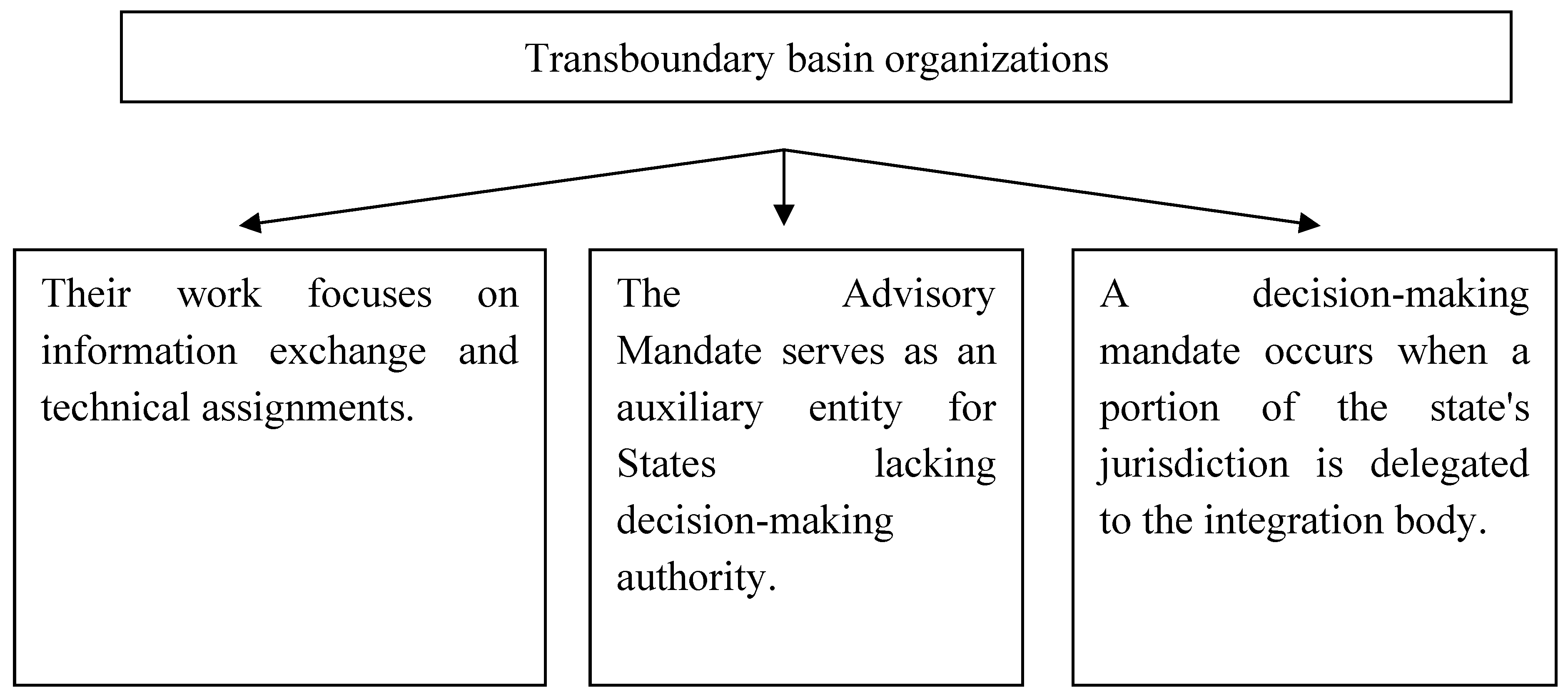

Table 1.
Regulatory and Legal Frameworks for Water Resource Management in Central Asian States.
| State | Key Regulatory and Legal Acts on Water Resources | National Water Strategy |
| Republic of Kazakhstan | - Constitution of Kazakhstan (1995) - Water Code (2003) - Environmental Code (2007) - National Plan for Collaborative Water Resource Management and Efficiency Improvement (2009-2025) - Concept of the Green Economy (2013) - State Water Resources Management Program (2014) |
Strategy 2050: - Comprehensive analysis of national water management strategies and conservation efforts - Adoption of advanced technologies for groundwater extraction and efficient usage - Implementation of moisture-conserving technologies - Addressing nationwide water supply issues by 2050 - Resolving irrigation water challenges by 2040 |
| Republic of Kyrgyzstan | - Constitution of Kyrgyzstan (2010) - Water Code (2005) - Environmental Protection Act (1999) - Law on Associations of Water Users (2002) |
Sustainable Development Strategy 2040: - Implementation of water conservation and recycling technologies - Establishment of a national water recycling and replenishment system - Ensuring universal access to potable water - Transitioning towards a market-based water management system - Strengthening oversight of mining operations to prevent water contamination |
| Republic of Uzbekistan | - Constitution of Uzbekistan (1992) - Law on Water and Water Use (1993) - Nature Conservation Act (1992) - Environmental Control Act (2013) |
Strategy for Further Development: - Expansion of water-conserving technologies to rehabilitate degraded lands - Expansion of potable water networks in rural areas - Construction of 415 km of new water supply infrastructure |
| Republic of Tajikistan | - Constitution of Tajikistan (1994) - Water Code (2000) - Law on Water Users Associations (2006) - Environmental Protection Act (2011) - Drinking Water and Sanitation Act (2010) |
National Development Strategy 2030: - Development and expansion of hydropower infrastructure - Modernization of existing hydro and thermal power plants - Implementation of Integrated Water Resources Management (IWRM) - Strengthening water sector institutions - Optimization of irrigation and reclamation practices - Strengthening policies to prevent water pollution - Rehabilitation of irrigation and drainage systems to increase water availability - Support for the development of Water Users Associations (WUA) |
| Republic of Turkmenistan | - Constitution of Turkmenistan (1992) - Water Code (2004, revised in 2016) - Law on Nature Protection (2014) - Law on Drinking Water (2010) |
Water Management Development Framework 2030: - Ensuring environmental protection and sustainable resource use - Strengthening the legal framework governing water resources - Encouraging public and inter-industry participation in water infrastructure development - Establishing community-based water management councils (Mirabs) - Expanding e-government initiatives for water sector transparency - Increasing the reuse of treated wastewater |
Table 2.
Status of water use efficiency indicators in Central Asia, 2021, USD/m3.
| Indicators | Turkmenistan | Kazakhstan | Kyrgyzstan | Uzbekistan | Tajikistan |
| Irrigated land | 0.146 | 0.035 | 0.102 | 0.458 | 0.227 |
| Industry | 28,916 | 11,556 | 5,504 | 12,026 | 1,643 |
| Services | 19,228 | 31,380 | 17,298 | 14,026 | 5,472 |
| General indicators | 1,525 | 7,201 | 0.842 | 1,431 | 0.882 |
Note: Compiled by the author based on [60].
Table 3.
Surface water resources of the Aral Sea basin (average annual runoff, km3/year).
| State | River basin | Aral Sea Basin | ||
| Syr Darya | Amu Darya I | km 3 | % | |
| Kazakhstan | 2,516 | - | 2,516 | 2,2 |
| Kyrgyzstan | 27.54 2 | 1,654 | 29,196 | 25.2 |
| Tajikistan | 1,005 | 58,732 | 59,737 | 51.5 |
| Turkmenistan | - | 1,405 | 1,405 | 1,2 |
| Uzbekistan | 5,562 | 6,791 | 12,353 | 10.6 |
| Afghanistan and Iran | - | 10,814 | 10,814 | 9.3 |
| Aral Sea Basin Summary | 36,625 | 79,396 | 116,021 | 100 |
Note: Compiled by the author based on [63].
Disclaimer/Publisher’s Note: The statements, opinions and data contained in all publications are solely those of the individual author(s) and contributor(s) and not of MDPI and/or the editor(s). MDPI and/or the editor(s) disclaim responsibility for any injury to people or property resulting from any ideas, methods, instructions or products referred to in the content. |
© 2025 by the authors. Licensee MDPI, Basel, Switzerland. This article is an open access article distributed under the terms and conditions of the Creative Commons Attribution (CC BY) license (http://creativecommons.org/licenses/by/4.0/).
Copyright: This open access article is published under a Creative Commons CC BY 4.0 license, which permit the free download, distribution, and reuse, provided that the author and preprint are cited in any reuse.


