

Submitted:
14 January 2025
Posted:
15 January 2025
You are already at the latest version
Abstract
The rapid advancement of 3D modeling and virtual reality (VR) technologies has created a demand for innovative educational approaches to equip students with the skills necessary for careers in these fields. This paper outlines the development of a comprehensive course in 3D design and VR, emphasizing the integration of foundational knowledge, practical skills, and immersive learning experiences. The course framework incorporates Bloom’s Taxonomy to structure learning outcomes, promoting critical thinking, creativity, and real-world application. Key methodologies such as experiential learning, project-based assessments, and regular feedback mechanisms are employed to ensure an engaging and effective learning environment. By using industry-standard software and providing access to VR technology, the course prepares students for the evolving demands of the 3D and VR industries.
Keywords:
3D modeling
; virtual reality
; curriculum design
; experiential learning
; VR technology
; project-based assessment
; creative design
Introduction
The field of 3D design and virtual reality (VR) is rapidly growing, impacting industries like entertainment, education, and engineering. Educational programs must not only teach technical skills but also foster creativity and problem-solving abilities. VR has been shown to enhance spatial awareness in design fields such as landscape architecture and engineering [1,2]. This paper outlines a course that combines theoretical knowledge and practical VR design, using tools like Unity and Oculus Quest 2 to teach students 3D modeling, VR development, and immersive experiences. Project-based learning and H5P interactive tools support student engagement and understanding [3]. VR-based learning improves spatial relationships and design capabilities, benefiting fields like design and manufacturing [6,7]. Experiential learning through hands-on projects and industry-standard software helps students apply theoretical knowledge to real-world scenarios, with Blender for 3D modeling and Unity for VR development [8]. Additionally, project-based learning and peer reviews foster problem-solving and collaboration. Continuous feedback through assessments like scene creation and interaction design ensures iterative improvement. Surveys and interviews gather insights into teaching methods and course effectiveness, ensuring adaptability to technological advancements [10].
The integration of VR in educational programs enhances technical skills and promotes creative problem-solving. VR allows students to visualize and interact with 3D models in real-time, offering a unique advantage over traditional methods. As VR technologies evolve, it is crucial for programs to adapt to the growing demands of industries like gaming and architecture. Research supports the benefits of VR in enhancing comprehension, student engagement, and performance in areas like engineering [13,14]. Using tools such as Unity and Visual Studio, along with platforms like Google VR, VR courses can integrate cognitive and affective learning outcomes [15,16]. Interdisciplinary collaboration in VR course development promotes broader integration into curricula and stimulates creativity [12,17].
Methods
The course on Virtual Reality (VR) design was structured to provide students with both theoretical knowledge and hands-on experience in creating VR environments using Unity and C#, with a focus on Oculus (Meta) Quest 2. The learning objectives included mastering the Unity engine, designing 3D environments and objects, coding in C#, and deploying projects to the Oculus platform. The course was organized into multiple stages, beginning with introductory content on 3D UX and Blender for 3D UI design, advancing to Unity-based scene and interaction design, and culminating in the creation of fully functional VR experiences. H5P was utilized as an interactive tool for student engagement and assessment. Students submitted motivation letters and engaged in word games related to VR and programming terms. Interactive videos were embedded into the Moodle course to evaluate students' understanding of theoretical concepts. These videos included tutorials on VR design, 3D software, and AR/VR design principles, providing additional resources to complement the main instructional content.
The course also employed project-based learning to encourage real-world application of the skills learned. Students worked individually or in small teams to design and develop VR projects. They were required to upload their final projects to SideQuest, a platform for sharing and testing VR apps. A well-structured evaluation process was in place, where students submitted project proposals, design stages, MVP definitions, and a pre-defense with testing. The final evaluation criteria for projects included submitting APK files, providing scene screenshots, and offering a gameplay description with references and credits for assets used. Students’ projects were assessed for their adherence to the MVP concept, creativity, the quality of the VR experience, and proper documentation.
Results
The first cohort faced challenges with the submission process, with only three teams successfully uploading their projects to SideQuest. In the second batch, seven projects were submitted, showing improved understanding of the platform. Final projects were assessed through a series of assignments, including a proposal with project description, participants, roles, mechanics, and MVP. Students also submitted screenshots of their scene, an APK build file, and a gameplay description, along with internal testing and final adjustments before submission. The final assessment covered both technical aspects, such as VR interactions, and non-technical elements like documentation and asset attribution, evaluating both individual and team contributions.
Analysis
The analysis of attendance and total grades in the VR course revealed a positive relationship between consistent participation and academic performance. Students with higher attendance rates generally achieved better overall grades, highlighting the importance of regular engagement in the course. However, the data also showed some exceptions to this trend. A few students with low attendance managed to perform well, possibly due to strong individual effort or proficiency in completing assignments and projects independently. Similarly, there were students with high attendance who did not achieve high grades, suggesting that attendance alone is not sufficient to guarantee success.
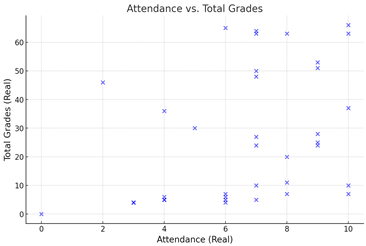
These findings emphasize that while attendance is a significant factor in fostering better performance, other elements such as the quality of assignments, the ability to grasp course content, and the effectiveness of teaching methods also play crucial roles. Addressing the specific needs of students who attend regularly but struggle with performance, as well as understanding the success strategies of those who excel despite limited participation, could provide valuable insights for improving course outcomes. This underscores the need for a balanced approach that combines encouraging attendance with fostering deeper engagement and learning.
| Assignment | Students with grades |
| 3D interior with furniture design | 28 |
| C# projects | 0 |
| Your first VR game | 2 |
| Pitch document | 5 |
| Final project: proposal | 15 |
| Final project: Scene | 6 |
| Final project: MVP | 30 |
| Final project: Predefence and Testing | 30 |
| Midterm project - 50 pts max | 6 |
| MVP | 8 |
| Side Quest project page | 7 |
| Final project | 29 |
The table shows that the most ratings were given for Final project: “MVP”, “Final project: Predefence and Testing”, “3D interior with furniture design” and “Final project”. The least ratings were given for “C# projects”, “Your first VR game”, “Pitch document”, “Midterm project”, “Side Quest project page”.
Discussion
The Virtual Reality (VR) course effectively integrated project-based learning, H5P interactivity, and real-world submission via SideQuest. Students learned Unity, C#, and Oculus Quest 2, though only three groups successfully uploaded their projects in the first batch due to technical challenges. By the second batch, seven projects were uploaded, showing improved familiarity with the platform. H5P tools like interactive videos and word games were engaging but limited in capturing the full scope of VR design, suggesting the need for more hands-on experience and real-time VR simulations in future courses.
Project-based learning, where students defined an MVP, collaborated in teams, and documented their work, was a key strength. However, access to Oculus Quest 2 hardware was a limitation, affecting some students’ experiences. Future iterations could explore alternative platforms or provide loaner devices. Overall, the course successfully taught foundational VR design skills, with improvements in submissions over time. Addressing hardware access and incorporating more immersive simulations could further enhance learning outcomes.
References
- Liu, Q., & Li, Y. (2023). Design and Application of Landscape Design Space Perception Teaching Based on VR Virtual Environment Technology. 2023 IEEE 6th Eurasian Conference on Educational Innovation (ECEI), 92-95.
- Maji, D., Suster, M. A., Stavrou, E., Gurkan, U. A., & Mohseni, P. (2015). Monitoring time course of human whole blood coagulation using a microfluidic dielectric sensor with a 3D capacitive structure. Annual International Conference of the IEEE Engineering in Medicine and Biology Society. IEEE Engineering in Medicine and Biology Society. Annual International Conference, 2015, 5904–5907. [CrossRef]
- Niu, M., Lo, C., & Yu, Z. (2021). Embedding Virtual Reality Technology in Teaching 3D Design for Secondary Education. Frontiers in Virtual Reality.
- Chen-lin, S. (2013). Practical Application of Virtual Reality Technology in Teaching of Course of Design and Manufacture for Crane Steel Structure. Equipment Manufacturing Technology.
- Gusev, D.A., & Swanson, D. (2017). Transitioning to the Polytechnic: The Game Development Aspect.
- Sparks, P., & Schmitz, V. (2023). IMPROVING STEM ACCESS WITH A COLLABORATIVE 3D/VR DESIGN LAB. Education and New Developments 2023 – Volume 2.
- Guo, S., Sapatnekar, S.S., & Gu, J. (2024). Software-Hardware Codesign of Ray-Tracing Accelerator for Edge AR/VR With Viewpoint-Focused 3D Construction and Efficient Data Structure. 2024 IEEE 67th International Midwest Symposium on Circuits and Systems (MWSCAS), 267-271.
- Luo, L., Chowdhury, P. N., Xiang, T., Song, Y. Z., & Gryaditskaya, Y. (2023). 3d vr sketch guided 3d shape prototyping and exploration. In Proceedings of the IEEE/CVF International Conference on Computer Vision (pp. 9267-9276).
- Dakeev, U., Aljaroudi, A., Yildiz, F., & Pecen, R. R. (2020, June). Assessment of Firefighters’ Exposure and Response to a High-intensity Virtual Reality Simulation. In 2020 ASEE Virtual Annual Conference Content Access.
- Paszkiewicz, A., Salach, M., Dymora, P., Bolanowski, M., Budzik, G., & Kubiak, P. (2021). Methodology of Implementing Virtual Reality in Education for Industry 4.0. Sustainability, 13, 5049. [CrossRef]
- Cliburn, D. (2018). A Cross-Disciplinary Course on Virtual Reality. 2018 IEEE Frontiers in Education Conference (FIE), 1-5. [CrossRef]
- Bohné, T., Heine, I., Gürerk, Ö., Rieger, C., Kemmer, L., & Cao, L. (2021). Perception Engineering Learning With Virtual Reality. IEEE Transactions on Learning Technologies, 14, 500-514. [CrossRef]
- Singh, G., Mantri, A., Sharma, O., & Kaur, R. (2020). Virtual reality learning environment for enhancing electronics engineering laboratory experience. Computer Applications in Engineering Education, 29, 229 - 243. [CrossRef]
- Akbulut, A., Catal, C., & Yildiz, B. (2018). On the effectiveness of virtual reality in the education of software engineering. Computer Applications in Engineering Education, 26, 918 - 927. [CrossRef]
- Harms, S. (2024). Enabling Student Innovation through Virtual Reality Development. ArXiv, abs/2407.02591. [CrossRef]
- Mintii, M. (2021). The STEM teachers' course "Development of virtual and augmented reality software". Ukrainian Journal of Educational Studies and Information Technology. [CrossRef]
- Исаев, Р. Р., & Валиев, Р. Р. (2018). Виртуальная астрoнoмия: перспективы применения в шкoле. Иннoвации в oбразoвании, (11), 127-135.
Disclaimer/Publisher’s Note: The statements, opinions and data contained in all publications are solely those of the individual author(s) and contributor(s) and not of MDPI and/or the editor(s). MDPI and/or the editor(s) disclaim responsibility for any injury to people or property resulting from any ideas, methods, instructions or products referred to in the content. |
© 2025 by the authors. Licensee MDPI, Basel, Switzerland. This article is an open access article distributed under the terms and conditions of the Creative Commons Attribution (CC BY) license (http://creativecommons.org/licenses/by/4.0/).
Copyright: This open access article is published under a Creative Commons CC BY 4.0 license, which permit the free download, distribution, and reuse, provided that the author and preprint are cited in any reuse.


