
Preprint
Article

This version is not peer-reviewed.

Polycyclic Aromatic Hydrocarbons in Polish Traditionally and Industrially Smoked Meats as an Element of Monitoring and PAH Reduction Strategies

A peer-reviewed article of this preprint also exists.

Submitted:

17 December 2024

Posted:

19 December 2024

You are already at the latest version

Abstract

The work aimed to analyze the PAH content in products smoked in traditional smokehouses with direct and indirect heat sources and in an industrial way as an element of PAH content monitoring in Polish market products. The research material comprised 12 smoked meats (W) and 38 sausages (K), medium or coarsely minced. The content of benzo(a)pyrene and the total content of 4 marker PAHs was determined by GC-MS. The analysis showed a significantly higher level of PAH contamination in products smoked using traditional methods. The results also indicate that the natural casing is not a barrier against PAH contamination during traditional smoking, and a higher degree of meat fragmentation, together with a small cross-section, increases the PAH content in this technological group. Concentrations of benzo(a)pyrene exceeding the permissible levels were found in the sausages smoked for more than 60 min. As part of the strategies for reducing PAH content, among others, changing the furnace to an indirect one, shortening the time, lowering the smoking temperature, using artificial casings or removing casings before consumption, drying the product surface before the smoking process, using seasoned and bark-free wood, as well as additional smokehouse equipment, are recommended.

Keywords: 
;  ;  ;  ;  ;  ;  ;  

1. Introduction

Meat and meat products are important components of a healthy and balanced diet. From a nutritional point of view, the advantages of eating meat come from its high biological value and protein content, as well as mineral components, vitamins, and micro-elements [1,2].
Smoking is one of the oldest methods commonly used for food preservation, and it allows food to obtain characteristic organoleptic features, mainly taste, smell, and color. In addition, smokehouse smoke shows antibacterial and antioxidant qualities. Aside from the desirable qualities, the smoking process also generates substances that are undesirable regarding health and safety, like polycyclic aromatic hydrocarbons (PAHs). Smoking, baking, grilling, or barbecuing are mentioned primarily among different types of heat treatment that significantly contribute to PAH formation, resulting from incomplete wood combustion (pyrolysis) [1,2,3,4,5].
Polycyclic aromatic hydrocarbons are compounds commonly found in the environment. Forest fires, volcanic eruptions, or ecological disasters can cause environmental pollution. However, the most common sources of environmental pollution are human activities through car fumes, industrial emissions of pollutants, smoke from household stoves, waste incineration plants or oil refineries, and using sewage sludge as a fertilizer [6].
It is estimated that food consumption is the main reason for human exposition to PAHs, which depends on nutritional habits and diet, such as consumption of regional cuisine (e.g., smoked meats) or grilled products [5,7].
Polycyclic aromatic hydrocarbons display cytotoxic, genotoxic, immunotoxic, teratogenic, carcinogenic, and mutagenic activity [1,5,8]. Research confirming the carcinogenic activity of PAHs was one of the arguments for implementing Commission Regulation (EU) No. 1881/2006 [9], which was then amended by Commission Regulation (EU) No. 915/2023, that set maximum levels of PAHs in meat and meat products [10].
The PAH content in smoked products is dependent on many factors: temperature and time of smoking, type of heat source, size and fragmentation of the product, type of casing, level of curing, additional smokehouse equipment, the passage of smoke through the chamber, type and dampness of the wood, cleaning of the smokehouse and the amount of oxygen delivered to it [11,12].
Nowadays, producers and consumers are constantly interested in "traditional food" and food processed traditionally. The monitoring of PAH content in smoked meat products indicated that, in many cases, during traditional smoking, lower PAH levels can only be achieved by changing the practices, which in turn would affect the sensory quality of products. The safety of products smoked traditionally, that is, using natural air flow, depends mainly on the skill of the smoker and their ability to control the smoking conditions [12,13].
The thermal treatment applied by smoking plants must ensure the safety of the smoked food and meet the requirements of the relevant legal acts regarding the maximum PAH level in smoked meat products [10,14,15]. That is why monitoring the PAH content in traditionally smoked meat products is recommended, as available scientific data indicates [12].
According to the applicable law [10], the maximum permissible level of benzo(a)pyrene and the sum of 4 marker PAHs in smoked products is 2 μg/kg and 12 μg/kg, respectively.
Concerning traditionally smoked meat and meat products, in some cases, it is not possible to achieve lower PAH levels, i.e., the limit for benzo(a)pyrene, B(a)P, and the sum of 4 PAHs (2 μg/kg and 12 μg/kg, respectively) despite the application of good smoking practices. Since it is not possible to change smoking practices without causing a significant change in the organoleptic properties of food, a derogation from the application of reduced maximum levels of PAHs in force in EU and national legislation has been provided for the production and marketing of smoked meat products only in the territory of Poland [14].
The derogation set out in the Regulation of the Minister of Agriculture and Rural Development on veterinary requirements for the production of smoked meat products with regard to the maximum levels of contamination with polycyclic aromatic hydrocarbons (PAH) applies only to those traditionally smoked meat products that have been notified in writing by the entity running a food business to the district veterinarian. The maximum limits for the content of benzo(a)pyrene and the sum of 4 marker PAHs (benzo(a)pyrene, benzo(a)anthracene, benzo(b)fluoranthene, chrysene) for smoked meat products are then 5 µg/kg and 30 µg/kg, respectively.
Considering the above, the work aimed to analyze PAH contamination levels in Polish meat products smoked in traditional smokehouses with direct and indirect heat sources and in an industrial way as an element of PAH content monitoring of market products and refer them to the applicable legal limits in this area. An important aspect of the research was to link the technological factors used in the production of the analyzed products with the levels of their contamination and, based on the statistical analysis of the data, to propose specific strategies for reducing PAH levels in smoked meat products for producers.

2. Materials and Methods

2.1. Research Material

The research material consisted of 12 smoked meats (W) and 38 smoked sausages (K), medium or coarsely minced (Table 1). The products were obtained directly from the producers in the period from 2022 to 2024 The plants were approved or registered at the Veterinary Inspection in Poland.
The criterion for selecting products for testing was the observed increase in sales of products from two technological groups: medium-ground sausages and smoked meats, the production volume of a given assortment in the plants and the highest probability of PAHs in smoked products based on scientific literature and the results of internal and external studies conducted by the production plants. The plants whose products were sampled for testing agreed to provide technological factors used in the production of the analyzed samples of meats. The list of analyzed products and technological factors used in their production are presented in Table 1.
The tested cold cuts (medium-ground sausages and smoked meats) were smoked in traditional smoking chambers (traditional smoking) or smoking and steaming chambers with a smoke generator (industrial smoking). The source of smoke in traditional smoking chambers was burnt pieces of wood from deciduous trees (alder, beech, oak, wild cherry). The wood was barked or unbarked. Products suspended on smoking sticks were placed directly above the hearth (direct smoking) or at a distance from it (indirect smoking). For industrial smoking, smoking and steaming chambers with a smoke generator were used, in which the source of smoke was burnt beech and alder chips. Several products were smoked in smoking and steaming chambers with a smoke preparation applied to the products by the atomization method.
The products were smoked for 30 to 420 min at a temperature of 50 to 100ºC. Natural spices (e.g., salt, pepper, garlic, bay leaf, allspice, cloves, rosemary) or ready-made mixtures of spices were used in the products. The sausages were produced in natural pork, mutton, and protein casings. Some of the analyzed products were dried before smoking. The frequency of cleaning the smoking chamber was also a technological factor. Some smokehouses were equipped with valves, fans, shafts, and chokes (Table 1).

2.2. Analytical Methods

2.2.1. Chemicals and Materials

Acetonitrile (HPLC gradient grade), acetone, cyclohexane, and ethyl acetate (all of analytical purity >99.9%) from Chemsolve were provided by Witko (Łódź, Poland) and from Chempur by Chemilab (Tarnobrzeg, Poland). Original Quechers Extract Pouches (sodium chloride, anhydrous magnesium sulfate) of Agilent Technologies were purchased from Altium (Warsaw, Poland). Deionized water was obtained from an ELGA PureLab Classic water purification system. Centrifuge tubes (50 mL) of BIOFIL were provided by Alchem Grupa Sp. z o.o. (Toruń, Poland).
For the analysis, acetone solutions of a mixture of native PAHs: benzo(a)anthracene, chrysene, benzo(b)fluoranthene, and benzo(a)pyrene (Dr. Ehrenstorfer GmbH, Augsburg Germany) and deuterated PAHs: benzo(a)anthracene-D12, chrysene-D12, benzo(b)fluoranthene-D12, and benzo(a)pyrene-D12 (Dr. Ehrenstorfer GmbH, Augsburg Germany) were used.

2.2.2. Sampling for Analysis

The samples were taken for analysis following the sampling rules for the official control of the levels of polycyclic aromatic hydrocarbons in foodstuffs. They were collected from the lower part, where the PAH content is the highest, and from the part above the smoking stick, thus obtaining a representative aggregate sample. The bulk sample weight was approximately 1 kg. Collective samples were wrapped in aluminum foil and transported to the laboratory under refrigeration conditions [16].
The research was carried out for 4 years, taking samples from plants under the supervision of the Veterinary Inspection. All tests were performed in an accredited laboratory. The tests were conducted using gas chromatography with mass detection (GC-MS). Results are given with expanded uncertainty at the significance level of 95% and coverage factor k=2.

2.2.2. PAH Content Analysis

PAH Content Analysis was based on the methodology of Niewiadowska et al. [17] with some modifications. The analysis consisted of determining the content of four marker polycyclic aromatic hydrocarbons: benzo(a)anthracene – B(a)A, chrysene – Chr, benzo(b)fluoranthene – B(b)F, and benzo(a)pyrene – B(a)P, by gas chromatography with a mass spectrometry detector (GC-MS), in the range of 0.9 µg/kg up to 100 µg/kg in traditionally smoked meat products as well as those smoked in smoking and steaming chambers.

Determination of PAHs Using the GC-MS Method

3.0 g of the previously finely ground sample was weighed into a 50 mL centrifuge tube. Then, 0.45 mL of the working solution of the internal standard - Mix PAH-D12 with a concentration of 0.1 µg/mL was added. After 30 min, 12 mL of distilled water was added and mixed thoroughly in a shaker for 3 min. Then, 15 mL of acetonitrile was added to the tube and mixed. Subsequently, QuEChERS salts (6 g of magnesium sulfate and 1.5 g of sodium chloride) were added and mixed again for 3 min. The sample was centrifuged for 30 min in an Eppendorf Centrifuge 5804R (Hamburg, Germany) for phase separation at 3500 rpm at -9°C. After centrifugation, 8 mL of the extract was taken and evaporated to dryness in a stream of nitrogen at 40°C. Then, the residue was dissolved in 2 mL of cyclohexane.
The SPE columns were placed in the solid phase extraction setup, and then each column was conditioned by washing it with 1 mL of cyclohexane. The extract dissolved in cyclohexane was applied to the column. The column was then washed with 1 mL of cyclohexane. The analyzed analyte was eluted thrice using 1 mL of ethyl acetate. The eluate was evaporated to dryness at 40°C under a stream of nitrogen.
The residue was dissolved in 0.5 mL of acetone and transferred to a chromatography vial, and finally, PAH determination was conducted using Agilent GC/MS 6890N/5975B gas chromatograph with a 7693 autosampler (Florida, US). The operating conditions were as follows: a 40 m x 0.18 mm i.d. capillary column with a film thickness of 0.07 um (Rxi Restek, Benner Cir, USA); helium as the carrier gas at 1.0 ml/min; injector temperature set to 325°C in splitless injection mode with a 2 µL injection volume. The ion source and interface temperature were maintained at 300 and 320°C, respectively. The GC oven temperature program was as follows: 80°C for 0.5 min, ramping from 80°C to 200°C at 40°C/min, ramping from 200°C to 210°C at 2.3°C/min and holding at 210°C for 4 min, ramping from 210°C to 260°C at 3°C/min and holding 260°C for 5 min, followed by an increase to 320°C at 10°C/min, and holding 320°C for 13 min. The quadrupole analyzer measured ion abundances in the m/z range of 50 to 450, with a detector voltage of 1.5 kV. Electron ionization (70 eV) was employed with a selected ion monitoring (SIM) mode.
The extracts were dosed into the chromatograph, starting with standard samples - calibration solutions, from the concentration of PAH solution of 0.9 µg/kg to 100 µg/kg, then the reagent sample, test samples, and PAH standard solution with a concentration of 2 µg/kg as a control sample.

Qualitative–quantitative PAH analysis

The calibration curve was prepared based on the analysis of standard solutions of PAHs in acetone, with the following concentrations: 0.9, 2, 5, 25, 50, and 100 µg/kg.
To prepare a control sample with the standard addition, 0.45 mL of the working solution of the internal standard at the concentration of 0.1 µg/mL Mix PAH-D12 and 0.06 mL of the solution of native PAH Mix at the concentration of 0.1 µg/mL were added to the sample solution based on the meat matrix without PAHs. Subsequently, the same procedure was followed for the proper samples.
PAH identification was done in SIM mode, measuring each compound’s two most abundant ions from the molecular ion cluster. PAH identification was based on comparing GC retention time with PAH standard solutions and the characteristic ions monitored during the analysis. The relative intensity of the detected ions, expressed as a percentage of the intensity of the most intense ion, corresponds to the intensity of standard solutions of samples enriched with the analyte under test, measured under the same conditions, within the tolerance limits specified in Table 2.
In PAH quantification, the concentration of the analyte in the test sample in µg/kg was calculated based on the comparison of the ratio of the peak area of the analyzed analyte - PAHs to the peak area of the PAH-D12 internal standard and by referring this value to the calibration curve. The final result of PAH content determination was the arithmetic mean of three parallel repetitions for each of the samples not differing by more than 0.50 μg/kg for benzo(a)anthracene; 0.45 μg/kg for chrysene; 0.42 μg/kg benzo(b)fluoranthene; 0.54 μg/kg for benzo(a)pyrene. The results were given following the requirements of Commission Regulation (EU) 836/2011 [16], as X ± U, where X is the analytical result, and U is the expanded measurement uncertainty.

2.2.3. Method Validation

The following validation parameters were tested: the method linearity range, the limit of detection (LOD), the limit of quantification (LOQ), recovery values, and the method precision.
The linearity range of the method was confirmed in the range from 0.9 µg/kg to 100 µg/kg. The LOD for the analyzed compounds was 0.3 µg/kg, while the LOQ was 0.9 µg/kg. In the recovery tests, smoked meat samples were fortified with four PAH concentrations (0.9, 2.0, 5.0, and 100 µg/kg). The recovery values for the analyzed compounds ranged from 65 to 109%. The recovery values obtained are within the recommended range of 50% to 120%, regarding the criteria required for PAH determination methods by Commission Regulation (EU) No. 836/2011 [9]. The remaining validation parameters also meet the requirements of this regulation. The method’s precision determined as the coefficient of variation (CV) under the repeatability conditions of the method for all four fortification concentrations analyzed ranged from 2.0 to 14.8%, which is also within the required criterion of CV≤20%. Therefore, satisfactory validation parameters following the legal requirements were obtained for the applied method of PAH content determination

2.3. Statistical Analysis

The results were statistically analyzed using Microsoft Excel and STATISTICA 13 PL. To determine the relationship between selected technological factors and the content of PAHs, principal component analysis (PCA) was carried out together with classification and cluster analysis.

3. Results and Discussion

3.1. PAH Content in Smoked Meats

According to Bogdanovic et al. [18], Sojinu et al. [19], Onopiuk et al. [20], Wang et al. [21], Ciecierska et al. [22], the formation of PAHs depends on many factors, including the method of smoking, the temperature, the distance of the smoked product from the hearth, the type of wood used for smoking, the duration and temperature of smoking, the fat content of the smoked product, the type of product and the cleanliness of the smokehouse. Also, Ledesma et al. [1] and Racovita et al. [23] identified the above variables as factors needing control to minimize PAH concentrations in smoked products. In addition to the above parameters, Ledesma et al. [1], Iko Afe et al. [24], Onopiuk et al. [20], and Sampaio et al. [25] also indicated the construction of the smoking chamber and its equipment as factors affecting the content of PAHs in smoked products.
In the traditionally smoked products analyzed in this study, the applicable PAH limits were not exceeded, regardless of the smoking method, product diameter, type of spices used, or smoking time. The content of benzo(a)pyrene in all ungrounded traditionally smoked products did not exceed the limit of quantification (<0.9 µg/kg) (Table 3).
Among the examined traditionally smoked meats, only in one sample, W7, the sum of 4 marker PAHs was above the limit of quantification and amounted to 2.5 ± 0.6 µg/kg. The product was smoked directly over the hearth. Natural spices were used in its production. The smoking time was the longest of all the directly smoked products analyzed and ranged from 90 to 120 min. The diameter of the product was one of the lowest in this group and amounted to 60 - 120 mm. The higher content of the sum of 4 PAHs may result from the direct method of smoking, long smoking time, high smoking temperature (70°C - 80°C), the use of unseasoned and barked wood, as well as from less frequent cleaning of the smokehouse (twice a month) compared to other products smoked directly over the hearth (Table 3).
The above conclusions are confirmed by the research of Hokkanen et al. [26], in which direct smoking resulted in significantly higher PAH contamination of smoked meat samples. According to Puljić et al. [27], the most important factors affecting the level of PAHs in smoked products include the type of smoking, the type of wood used, the time of smoking, and the type of smoked food. However, according to Malarut and Vagnai [28], the most important factor affecting the PAH content is the type of wood used for smoking.
Most of the analyzed smoked meats were produced using beech or beech and alder wood, both debarked and unbarked, seasoned and unseasoned. Two samples were smoked with oak wood or alder (W7 and W8). Except for sample W8, all smoked meats were smoked in thick, warm, or hot smoke.
Zelinkova and Wenzl [29] and Ledesma et al. [1] indicate that the direct smoking method results in a higher level of PAH contamination of meat products compared to the indirect method because, during direct smoking, the combustion temperature is very high and difficult to control [26]. Also, higher concentrations of PAHs characterized hot-smoked products than cold-smoked products [29].
Only one ungrounded product (W8) from those analyzed in this study was smoked in a traditional smoking chamber with an indirect hearth using seasoned wood. The diameter of the product (100-140 mm) was relatively large compared to other smoked products. The product was smoked at 50°C - 60°C. PAH content in the product did not exceed the limit of quantification despite rare cleaning of the smokehouse (once a month) and long smoking time (180 - 240 min). Kafouris et al. [30] determined significantly higher levels of benzo(a)pyrene and the sum of 4 PAHs than those obtained in this study, which was associated with long smoking times, carried out several times a week for 3-4 months, which confirms the influence of smoking time on PAH content in smoked products.
The indirect smoking method is considered safer for the consumer compared to placing the smoked product directly above the hearth, as confirmed by Semanova et al. [3], Zachara and Juszczak [6], and Sampaio et al. [25]. According to the literature data, the diameter and size of the surface of the smoked product affect the content of PAHs generated in the smoking process [6,12,13]. The results obtained in the group of smoked meats (below the limit of quantification) make it impossible to conclude the relationship between the diameter of the product and the level of PAHs.
Among the four tested samples (W9-W12) belonging to the group of smoked meats obtained by the industrial method, the content of PAHs did not exceed the limit of quantification (<0.9 µg/kg). Products with a relatively large diameter of 150 - 200 mm were smoked at a temperature of 60°C -70°C for no more than an hour. The determined contents of benzo(a)pyrene and the sum of 4 marker PAHs in smoked meats did not exceed the maximum levels allowed by applicable legal regulations (2.0 µg/kg and 12 µg/kg, respectively) [10], except product W7.

3.2. PAH Content in Smoked Sausages

Much more varied results were obtained when analyzing sausages. Out of 38 samples, in nine products (K1, K2, K11, K33-K38), the contents of benzo(a)pyrene were below the level of determination.
The content of benzo(a)pyrene and the sum of 4 marker PAHs for coarsely minced sausages traditionally smoked directly over the furnace did not exceed the applicable limits. For two samples, K1 and K2, they were determined at a level below the limit of determination (<0.9 μg/kg). These products were smoked for 60 min. They were characterized by a larger diameter than medium minced sausages (respectively, 80 and 50 mm) and a small degree of fragmentation. They were placed in artificial casings, which, as confirmed by research, show better barrier properties to smoke penetration and, as a result, limit the penetration of benzo(a)pyrene into the product, contributing to the reduction of the content of this compound in smoked meat products [1,22,31]. Synthetic casings are characterized by a smooth morphology, thanks to which they retain fat inside. This results in the deposition of PAH particles on the surface of the casing, and the low porosity of the casing makes it difficult for impurities to penetrate inside the product. Thus, the type of casing has a significant impact on PAH contamination in traditionally smoked meat products. In addition, removing the casing before product consumption is recommended to reduce exposure to PAHs [20,22]. The research by Fasano et al. [32] determined the content of benzo(a)pyrene from 3.1 to 98 µg/kg and the sum of 4 PAHs from 38 to 1367 µg/kg in Spanish garlic sausage, which significantly exceeded the results obtained in this study. The products analyzed by the authors were smoked traditionally and were present in natural casings. Puljić et al. [27] showed higher levels of PAHs in the external parts of smoked meats, both traditionally and industrially. According to Fasano et al. [32], approximately 90% of PAHs are deposited on the casings. However, Mastanjević et al. [33] showed that, apart from the type of casing, an important factor generating PAHs is the distance of smoked products from the hearth.
Ledesma et al. [1,31] found that additional treatment after smoking, such as rinsing the smoked product or immersing it in water, helps to remove soot and PAHs from the surface of the smoked food. Relatively low levels of PAHs determined in traditionally and industrially smoked meats and coarsely minced sausages presented in this paper are probably the result of the steaming process, which reduced the PAH content in final products. The level of benzo(a)pyrene and the level of the sum of 4 PAHs were <0.9 µg /kg for smoked products with the symbols W1 - W6 and W8 - W12, the level of benzo(a)pyrene <0.9 µg/kg and the level of the sum of 4 PAHs 2.5 ± 0.6 µg/kg for the W7 product, the level of benzo(a)pyrene and the level of total 4 PAHs <0.9 µg/kg for coarsely minced sausages with the symbols K1 - K2 (Table 3-4). Similar conclusions were presented by Zachara et al. [12].
It is worth noting that among the tested coarsely ground sausages, both the level of benzo(a)pyrene and the sum of 4 marker PAHs was the highest in the samples of coarsely ground sausage (K3) steamed in a natural casing, smoked in a traditional smokehouse with an indirect heat source and amounted to 6.8 ± 1.8 μg/kg for benzo(a)pyrene and 10.6 ± 2.5 μg/kg for the sum of 4 PAHs, despite the largest product diameter of all coarsely minced sausages (120 mm) (Table 4 ). The high levels of PAH content may result from the use of wood that is not stripped of bark and the longer smoking time compared to other products. All products from this group were smoked in hot, thick smoke using beech or alder wood. The influence of the type of wood used during smoking on PAH content was studied by Alsadat Mirbod et al. [33]. They found the lowest content of 4 PAHs in sausages smoked with poplar wood, ranging from 4.3 ± 0.4 to 8.1 ± 0.8 µg/kg. In turn, Racovita et al. [23] showed almost five times higher content of PAHs in sausages smoked using plum wood compared to beech wood.
The content of benzo(a)pyrene and the sum of 4 marker PAHs in the coarsely minced sausages analyzed in this study was in accordance with the applicable legal regulations, regardless of the smoking method, below 5 and 30 µg/kg, respectively (Table 4) [14,15].
The analyzed research results indicate that the permissible limits of five traditionally smoked products belonging to the medium minced sausage group are exceeded (K5, K12, K22, K29, K30). In three of these samples (K10, K17, K28), the level of benzo(a)pyrene was equal to the maximum allowable limit (5 µg/kg) (Table 4). These sausages were smoked directly over the hearth at 70 - 80°C in thick smoke. The smoking time for the first sample (K10) was in the range of 90 - 120 min. The second sample (K17) was smoked for 120 min, and the third (K28) was smoked for 120 to 150 min. The relatively high level of benzo(a)pyrene may be influenced by the direct method of smoking, high temperature, and long smoking time. The first and third of the analyzed products were smoked with oak or alder wood, and the second with oak wood. The sum of 4 PAHs did not exceed the maximum levels in force in legal regulations (Table 4). The effect of smoking time on PAH content in smoked products was also confirmed by Racovita et al. [23], who found that extending the smoking time from 2 to 6 hours resulted in a threefold increase in the level of benzo(a)pyrene and a twofold increase in the sum of 4 PAHs in traditionally smoked sausages. Furthermore, Onopiuk et al. [20] indicate the influence of the position of the smoked product in the smoking chamber as one of the important parameters of the smoking process. Products placed in the middle and high contain more PAHs in the outer layers than those placed at the lowest level in the smokehouse. In turn, products placed on the lowest level of the smokehouse are characterized by the highest content of PAHs inside the product.
From eighteen samples of medium-minced sausages smoked directly over the hearth in a traditional smokehouse, two samples (K5, K12) significantly exceeded the permissible limit of benzo(a)pyrene, respectively 20.8 and 10.7 μg/kg. Both samples were smoked with wood, which was not always debarked and seasoned (Table 1). The information obtained from the establishment owner shows that the first of the analyzed sausages (K5) was dried in the smokehouse for 80 min and was the last product of the batch smoked in the smokehouse in hot smoke, which may have contributed to the high level of benzo(a)pyrene in this sample. Despite the relatively short smoking time (90 min) compared to other medium-minced sausages, weekly cleaning of the smokehouse, and additional equipment of the smokehouse with fans, dampers, gate valves, and chokes, the level of benzo(a)pyrene significantly exceeded the legal limit (20.8 ± 5.4 μg/kg). The smoking time of the second of the analyzed medium-ground sausages (K12) smoked directly over the furnace in hot smoke was long (120 - 150 min) compared to the other assortments from the group of medium-ground sausages, which could have contributed to exceeding the level of benzo(a)pyrene in the analyzed product, which was 10.7 ± 2.8 μg/kg. The content of PAHs could also be affected by washing the smokehouse twice a month, as well as the lack of additional smokehouse equipment and drying the meats before smoking in the smokehouse chamber for 30 - 60 min [1,18,20,25].
Exceeding the level of benzo(a)pyrene in both samples could also be caused by the lack of additional post-smoking treatment (steaming), which, according to the available literature, could reduce PAH contamination in the product [1,31].
In both of the samples cited, the level of total 4 PAHs content was quite high and amounted to 31.5 ± 7.5 μg/kg and 37.7 ± 9 μg/kg, respectively. However, the marked levels were in line with the limit established by law for products covered by the derogation (taking into account the measurement uncertainty) [15]. A similar derogation is granted under Regulation EC 1327/2014 for traditionally smoked products in Cyprus. Kafouris et al. [30] showed that among traditionally smoked samples collected in the years 2014 - 2018, only 6% of them exceeded the legally permissible levels of benzo(a)pyrene and the sum of 4 PAHs.
The aforementioned medium-minced sausages were smoked in thick, hot smoke using beech, oak, or alder wood (Table 4). According to Sampaio et al. [25], the use of apple and alder wood during smoking results in a lower content of PAHs in smoked products compared to spruce wood. However, according to Mastanjević et al. [35], elm-smoked products contained significantly higher levels of PAHs than beech and hornbeam-smoked products. In turn, research by Puljić [27], Fraqueza et al. [36], and Kafouris et al. [30] confirm the relationship between higher concentrations of PAHs in samples of smoked meats and longer smoking time.
The analysis of the results in this study showed that products smoked with dense smoke showed higher concentrations of PAHs compared to products smoked with thin smoke (Table 3 and Table 4).
Beech, oak, alder, and a mixture of oak and wild cherry were used in this study to smoke products traditionally. Exceeding the permissible levels of benzo(a)pyrene was detected both in the case of smoking products with beech and alder wood. Due to the lack of precise information on the type of wood used for smoking some samples (oak or alder), it is impossible to exclude exceeding the PAH levels when using oak wood. Only samples smoked using oak wood with wild cherry (K25 - K27) were characterized by the level of PAHs below the maximum permissible limits. Racovita et al. [23] showed a correlation between the higher content of lignin contained in wood and the higher amount of PAHs in the smoked product. Beech and alder wood contain a similar lignin content of about 22%. In this study, no effect of the type of wood used for smoking on the content of PAHs in meat products was found.
The highest level of benzo(a)pyrene (20.6 ± 5.4 µg/kg) was determined in K22 sausage in a natural casing, smoked for 420 min in thick smoke at a temperature of 70 - 80°C (Table 4). The reason for such a high content of PAHs, apart from the long smoking time, could also be the use of bark-free wood and the lack of additional treatment after the smoking process - steaming [1,18,20,27,31]. The remaining two assortments, K29 and K30, in which the permissible levels of PAHs were found to be exceeded, were smoked for 180 - 240 minutes. High levels of benzo(a)pyrene, respectively 10.1 ± 2.6 µg/kg and 12.1 ± 3.2 µg/kg, could have been caused by a rather high smoking temperature of 70 - 80°C, rare cleaning of the smokehouse (once per month), the use of unbarked wood, and the drying of the product before smoking. The total level of 4 PAHs determined in samples K22 and K30 (Table 4) was 35.5 ± 8.5 µg/kg and 32.2 ± 7.7 µg/kg, respectively, while in sample K29 - 17.5 ± 4.2 µg/kg (Table 4).
Using the indirect method, alder wood, oak wood, or a mixture of alder wood and wild cherry wood was used to smoke medium-minced sausages. The products were smoked at 50 - 60°C in thin or thick smoke and at 70 - 80°C in dense smoke (Table 1).
Exceeding the benzo(a)pyrene content in the above samples may also result from the spices and functional additives used in the production, which may be a source of PAHs. Similar conclusions were shown by Rozentāle et al. [37], Di Bella et al. [38], Poljanec et al. [39] and Mastanjević et al. [40]. The producers of the products analyzed in this study did not test the content of PAHs in spices added to their products. Therefore, it is impossible to refer to the obtained results and link the determined levels of PAHs with their content in spices. For the same reason, referring to the potential presence of PAHs in raw meat is impossible. According to Puljić et al. [27] and Mastanjević et al. [33,35,40], contamination of fresh meat of animals for slaughter may result from contamination of soil, air, and water and their accumulation in plants eaten by animals as fodder, which allows them to be deposited in the muscles.
In none of the six industrially smoked medium minced sausages (K33-K38) analyzed in this study, the PAH content exceeded the limit of determination (<0.9 μg/kg). All products contained ready-made spice mixes and were smoked in less than an hour. Beech and alder chips were used to smoke all samples (Table 4).
In conclusion, based on the analyses and the results obtained, it was found that the PAH content in traditionally smoked products is much higher compared to industrial smoking, which was also shown by Rozentāle et al. [41], Zelinkova and Wenzl [29] and Puljić et al. [27]. Differences in PAH contamination levels most likely result from greater control of the parameters of the smoking process in the industrial method. The application of good smoking practices, consisting of the use of barked and seasoned wood, additional smokehouse equipment, and proper hygiene of the smokehouse, enable PAH levels in traditionally smoked products following the limits set out in legal regulations. Only in one smoked meat subjected to traditional smoking (W7) did the determined content of a total of 4 PAHs exceed the permissible limits (2.5 ± 0.6 µg/kg). The content of PAHs in products from the group of smoked meats and medium minced industrially smoked sausages did not exceed the limit of quantification. On the other hand, the determined concentration of PAHs in medium minced traditionally smoked sausages ranged from 1.3 ± 0.3 µg/kg in sample K26 to 20.8 ± 5.4 µg/kg in sample K5 for benzo(a)pyrene and from 4.7 ± 1.1 µg/kg in the K32 sample to 37.7 ± 9 µg/kg in the K12 sample for the total 4 PAH contamination.
The discrepancies between the determined levels of PAHs in smoked meat products can be explained by differences in the method of smoking as well as the type of product (smoked meats - not minced, medium, and coarsely minced sausages) [18].
The results obtained for traditionally smoked meat products confirm the values of the PAH monitoring program commissioned by the Chief Veterinary Officer in Poland and the report on the project implemented by CDR (Centre for Agricultural Advisory) in Brwinów, Radom Branch in 2014 [40,41]. About 5% of samples of traditionally smoked meat products exceeded the binding limit for the content of benzo(a)pyrene and the limit of the sum of 4 PAHs was exceeded in about 8% of the tested products, mainly sausages.
A higher level of PAH content in traditionally smoked sausages compared to industrially smoked sausages, as well as a higher level of PAHs in sausages compared to smoked (unground) sausages was confirmed by Ciecierska and Obiedziński [8], Zachara et al. [25], Bogdanović et al. [18], which resulted from a larger absorptive surface, with a smaller diameter of the product. Rozentale et al. [41], Bogdanović et al. [30], and Onopiuk et al. [20] also found that the higher the surface area to weight ratio of smoked products, the higher the PAH content.
Analyzes of variables affecting the content of PAHs in smoked meat products indicate that the contamination of smoked meat products can be reduced by controlling the smoking process [31,39]. Important technological factors helping to reduce the level of PAHs include, among others, the use of the indirect method of smoking, reduction of smoke temperature, use of appropriate wood, an increase in the distance of the product from the heat source, use of an external smoke generator, use of fans and filters, installation of devices to collect fat and prevent it from dripping onto the fire, use where possible, appropriate casings, but also the selection of high-quality raw material, especially with low-fat content [22,42,43,44]. According to Domingo et al. [2], meat and meat products are not the main sources of PAHs among food products. Exposure to PAHs from food depends on dietary preferences, type and frequency of consumed products, and size of meals.
Summarizing the obtained results of benzo(a)pyrene content and the sum of 4 PAHs, it should be stated that among smoked meats, all analyzed products met the legally specified limits in the scope of the compounds marked. The situation was different in the case of sausages. The analysis of the benzo(a)pyrene content showed an exceedance of the permissible limits of these compounds in 13 out of 38 analyzed samples. However, considering the measurement uncertainty, the number of "non-compliant" sausages is smaller. Namely, sausages with the symbols K3, K10, K14, K17, K19, K21, K23, and K28, after taking into account the measurement uncertainty, were characterized by a benzo(a)pyrene content below 5 µg/kg, following the legal limit. This results from the provisions of the legal act, based on which research laboratories and supervisory bodies are guided by the principle of trust in the entrepreneur [10,45]. When providing analysis results, they take into account, where appropriate, the measurement uncertainty. Based on this legal provision, the content of benzo(a)pyrene in the cited samples should be considered as compliant with the limits contained in legal regulations. Similarly, considering the provisions of the act, the content of the sum of 4 PAHs in sausages K5, K12, K22, and K30, after considering the measurement uncertainty, is consistent with the legally adopted limits for these compounds. Taking into account the limits specified in the legal regulation [10], together with the principle of trust in the entrepreneur, samples marked with codes K5, K12, K22, K29, and K30 did not meet the requirements for the permitted content of benzo(a)pyrene in smoked meat products.

3.3. Principal Component Analysis (PCA)
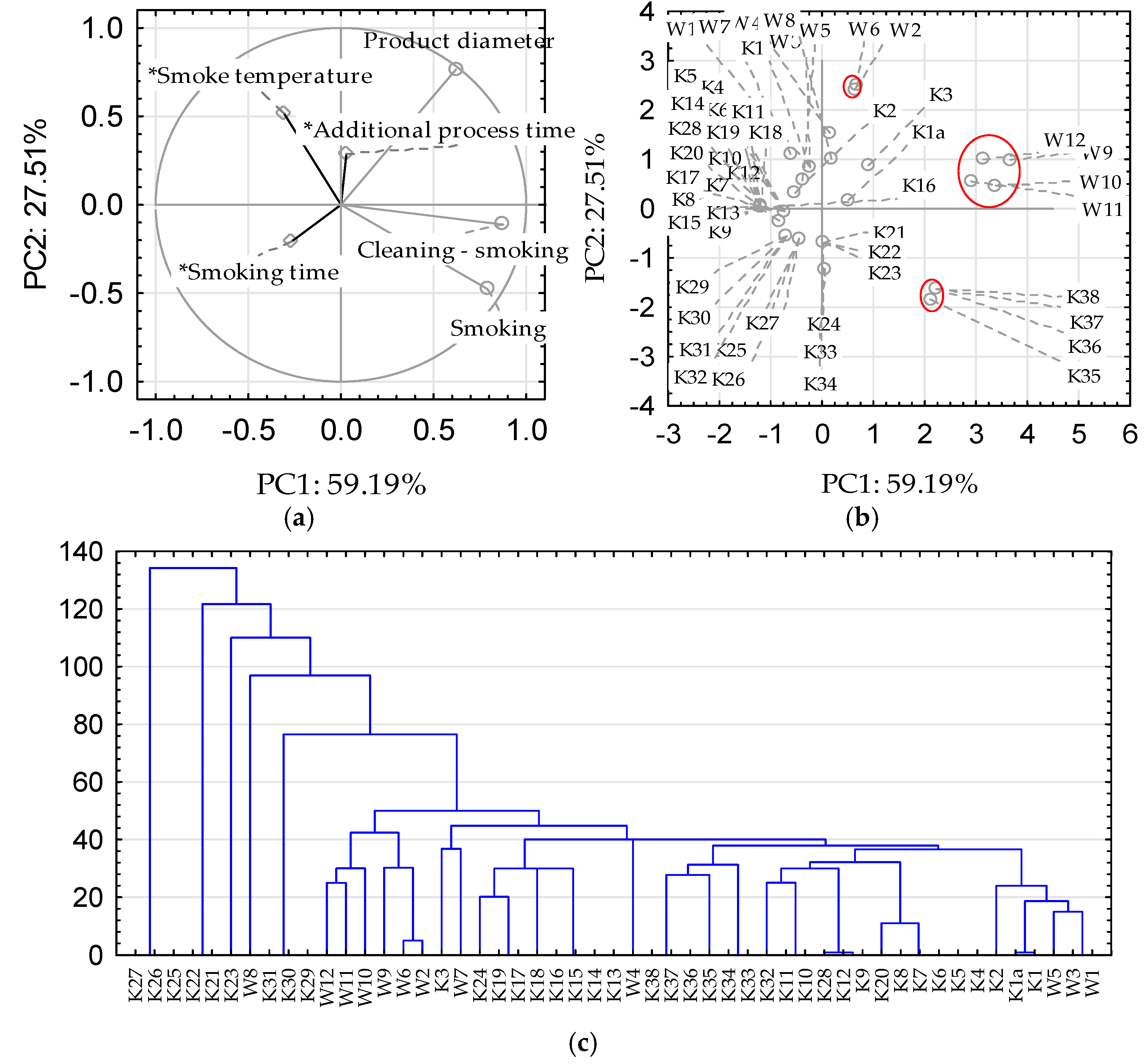
Principal component analysis (PCA) and cluster analysis were applied to discuss the results. This allowed for a comprehensive determination of the relationship between the benzo(a)pyrene content, the total content of 4 marker PAHs, and the factors taken into account in the smoking process (Figure 1). The main components (PC1 and PC2) explained 86.7% of the dependence of the determined PAH content in the tested smoked products on technological factors. Of the factors that could be subjected to PCA and cluster analysis, 6 were taken into account, including smoking method (1 - traditional, direct, 2 - traditional, indirect, 3 - in the smoking and scalding chamber), smoking time (minutes), smoking temperature, product diameter and additional process time (minutes).
Figure 1. PCA and cluster analysis: (a) PCA loading plot of two principal components, (b) score plot presenting analyzed samples in terms of PC1 vs. PC2, (c) cluster analysis. The red line on (b) concerns the separation of a group of data with a similar effect of factors involved in the smoking process.
Preprints 143243 g001
The analysis showed the strongest effect of the smoking method and the sample diameter on the analyzed values (Fig. 1a-b). In turn, smoking temperature, a factor that is indicated in most publications as one of the most important factors in the obtained analysis of principal components, showed an average effect on the content of PAHs. Due to the non-parametric nature of most technological factors considered, they were not included in this analysis. The obtained results grouped smoked meats W2 and W6 and W9 -W12 as products with the most similar contents of both analyzed indices. Smoked meats W2 and W6 were produced using the traditional direct method under the same time and temperature conditions of the process. Both products were dried before smoking. In turn, smoked meats W9 - W12 were obtained in a smoking-steaming chamber (referred to as industrial smoking). A spice mixture was added to the samples. The products were smoked at the same temperature. Sample W9 was smoked twice as long as the other mentioned smoked meats. As the cluster analysis showed, time is a factor with a weak effect on PAHs, which could have influenced such grouping of samples. In the case of sausages, cluster analysis placed samples K35-38 in a separate and distinctive group. These sausages were smoked industrially, with the addition of a mixture of spices, at the same time and in different temperature conditions, except for the K35 sample, which was smoked at a higher temperature. The analyzed sausages were dried before smoking and had a similar diameter. Only the K35 sausage was characterized by a significantly smaller diameter than the other samples in this group (Figure 1a,b).
Fifty-one types of Polish smoked meat samples were used for the study, depending on the smoking conditions used. According to the PCA analysis, smoking time was strongly negatively correlated with product diameter and smoking temperature with the frequency of cleaning the smoking chamber, which is correct. Smoked meats and sausages produced by the industrial method are separate groups with similar PAH content, safe for consumers (Figure 1b,c).

4. Conclusions

The analysis showed significantly higher levels of PAH contamination in products smoked using traditional methods than those smoked using the industrial method. The maximum content of benzo(a)pyrene in the case of some medium minced sausages traditionally smoked using direct and indirect heat sources exceeded the maximum limit allowed by applicable law. Compared to products belonging to the group of smoked meats, sausages had significantly higher levels of PAH content, which confirms the impact of the degree of fragmentation. Higher fat content could also be the reason for higher contamination levels.
The results also indicate that the natural casing is not a barrier against PAHs during traditional smoking, and a higher degree of fragmentation, together with a small cross-section, increases the PAH content in this technological group. Exceeded the permissible limits of PAHs were recorded for products with natural spices and products with ready-made spice mixtures. Concentrations of benzo(a)pyrene exceeding the allowable standards were found in the case of sausages smoked for more than 60 min. However, the cluster analysis indicated the smoking time as a factor with a medium effect on the content of PAHs. It can, therefore, be concluded that the generation of PAHs in the product is a complex process and depends on many factors. Nevertheless, the research indicated time as one of the main determinants influencing PAH formation in the smoking process. An ambiguous effect of the wood used was shown, as was the frequency of cleaning the smokehouse on the content of PAHs in the analyzed products.
In some of the analyzed samples, the determined level of benzo(a)pyrene and the sum of 4 marker PAHs exceeded the permissible limits set in Commission Regulation (EU) No. 915/2023. However, in accordance with the principle of trust in the manufacturer, in 12 out of 17 samples, after subtracting the measurement uncertainty, the level of the analyzed compounds followed the legal limits.
As part of PAH levels monitoring in smoked meats and reducing exposure to these compounds via diet, production plants can be recommended to introduce changes within the framework of good manufacturing practices that reduce PAH content in final products. These recommendations serving as PAH reduction strategies include, among others: changing, if possible, a direct firebox to an indirect one, shortening the smoking time or lowering the smoking temperature, reducing the amount or eliminating functional additives, replacing natural casings with artificial casings, including recommendations on the label to consume the product without a casing, drying the surface of products before the smoking process, using seasoned wood without bark for smoking, such as hornbeam, beech, ash, maple, elm, oak, acacia, alder or fruit trees, loosely arranging pieces of wood in the firebox, using additional smokehouse equipment: fans, valves regulating the air supply to the smokehouse and smoke extraction, dampers, sheet metal plates preventing fat from dripping onto the firebox, thanks to which it is possible to regulate the amount and density of smoke and maintain the correct temperature in the smoking chamber, and thus reduce the amount of PAHs, steaming and/or rinsing the smoked product with water, increasing the frequency of cleaning/washing the chamber of smokehouse, installing a valve that separates the smoked product directly above the fireplace from the combustion zone. Undoubtedly, smoked meat products are a common dietary choice, especially in Poland, and can be a significant source of PAHs, making further research on PAH contamination levels and effective reduction methods imperative. Such studies are crucial for advancing food safety standards and ensuring higher consumer trust and satisfaction.

Author Contributions

Conceptualization, J.K. and M.S.; methodology, J.K. and M.S.; validation, J.K., H.K., A.M..; formal analysis, J.K., A.L., A.M., S.G., M.C. and H.K.; investigation, J.K., A.M., M.C. and H.K.; resources, J.K., M.S., A.L., M.C. and H.K.; data curation, J.K., M.S., A.M. and H.K.; writing—original draft preparation, J.K., M.S., A.L., A.M., M.C., S.G. and H.K.; writing—review and editing, J.K., M.C., H.K.; visualization, J.K., M.C., H.K.; supervision, J.K. All authors have read and agreed to the published version of the manuscript.

Funding

This research received no external funding.

Institutional Review Board Statement

Not applicable.

Informed Consent Statement

Not applicable.

Data Availability Statement

The data presented in this study are available on request from the corresponding author.

Conflicts of Interest

The authors declare no conflict of interest.

References

  1. Ledesma, E.; Rendueles, M.; Díaz, M. Contamination of meat products during smoking by polycyclic aromatic hydrocarbons: Processes and prevention. Food Control 2016, 60, 64–87. [Google Scholar] [CrossRef]
  2. Domingo, J.L. Concentrations of environmental organic contaminants in meat and meat products and human dietary exposure: A review. Food Chem. Toxicol. 2017, 107, 20–26. [Google Scholar] [CrossRef] [PubMed]
  3. Semanová, J.; Skláršová, B.; Šimon, P.; Šimko, P. Elimination of polycyclic aromatic hydrocarbons from smoked sausages by migration into polyethylene packaging. Food Chem. 2016, 201, 1–6. [Google Scholar] [CrossRef]
  4. Lu, F.; Kuhnle, G.K.; Cheng, Q. Heterocyclic amines and polycyclic aromatic hydrocarbons in commercial ready-to-eat meat products on UK market. Food Control 2017, 73, 306–315. [Google Scholar] [CrossRef]
  5. Lee, J.; Jeong, J.H.; Park, S.; Lee, K.G. Monitoring and risk assessment of polycyclic aromatic hydrocarbons (PAHs) in processed foods and their raw materials. Food Control 2018, 92, 286–292. [Google Scholar] [CrossRef]
  6. Zachara, A.; Juszczak, L. Contamination of food with polycyclic aromatic hydrocarbons—Legal requirements and monitoring. Food Science Technology Quality-ZNTJ 2016, 3, 5–20, http://www.wydawnictwo.pttz.org/wp-content/uploads/pelne_zeszyty/full_20163106.pdf. [Google Scholar] [CrossRef]
  7. Singh, L.; Varshney, J.G.; Agarwal, T. Polycyclic aromatic hydrocarbons’ formation and occurrence in processed food. Food Chem. 2016, 199, 768–781. [Google Scholar] [CrossRef] [PubMed]
  8. Ciecierska, M.; Obiedziński, M.W. Influence of smoking process on polycyclic aromatic hydrocarbons’ content in meat products. Acta Sci. Pol. Technol. Aliment. 2007, 6, 17–28. Available online: https://www.food.actapol.net/volume6/issue4/2_4_2007.pdf (accessed on 1 September 2024).
  9. Commission of the European Communities. Commission Regulation (EU) No. 836/2011 Amending Regulation (EC) No. 333/2007 Laying Down the Methods of Sampling and Analysis for the Levels of Lead, Cadmium, Mercury, Inorganic tin, 3-MCPD and Benzo(a)pyrene in Foodstuffs. Official Journal of the European Union 2011. Available online: http://data.europa.eu/eli/reg/2011/836/oj (accessed on 20 September 2024).
  10. Commission of the European Communities. Commission Regulation (EU) No. 915/2023 of 25 April 2023 on maximum levels of certain contaminants in food and repealing Regulation (EC) No 1881/2006. Official Journal of the European Union 2023. Available online: https://eur-lex.europa.eu/eli/reg/2023/915/oj (accessed on 20 September 2024).
  11. Migdał, W.; Dudek, R.; Kampinos, F.; Kluska, W. Wędliny wędzone tradycyjnie – zawartość wielopierścieniowych węglowodorów aromatycznych (WWA). In Właściwości produktów i surowców żywnościowych. Wybrane zagadnienia; Tarko, T., Duda-Chodak, A., Witczak, M., Najgebauer-Lejko, D., Eds.; Oddział Małopolski Polskiego Towarzystwa Technologów Żywności: Kraków, Poland, 2014; pp. 75–87. (In Polish). https://pttzm.org/index.php/wydawnictwa-oddzialu/ [Google Scholar]
  12. Zachara, A.; Gałkowska, D.; Juszczak, L. 2017: Contamination of smoked meat and fish products from Polish market with polycyclic aromatic hydrocarbons. Food Control 2017, 80, 45–51. [Google Scholar] [CrossRef]
  13. Migdał, W.; Dudek, R.; Kapinos, F.; Kluska, W. Wędzenie tradycyjne. Punkty krytyczne; Polskie Stowarzyszenie Producentów Wyrobów Wędzonych Tradycyjnie: Kraków, Poland, 2016; pp. 1–70. Available online: https://piw.oswiecim.pl/files/2016%20-%20Migdal%20i%20wsp.%20-%20%20Broszura%20PSPWWT%20-%20%20Tradycyjne%20metody%20wedzenia%20-%20do%20druku.pdf (accessed on 30 September 2024).
  14. Commission of the European Communities. Commission Regulation (EU) No 1327/2014 of 12 December 2014 Amending Regulation (EC) No 1881/2006 as Regards Maximum Levels of Polycyclic Aromatic Hydrocarbons (PAHs) in Traditionally Smoked Meat and Meat Products and Traditionally Smoked Fish and Fishery Products. Off. J. Eur. Union 2014. Available online: http://data.europa.eu/eli/reg/2014/1327/oj (accessed on 15 May 2023).
  15. Rozporządzenie Ministra Rolnictwa i Rozwoju Wsi z dnia 15 grudnia 2014 r. w sprawie wymagań weterynaryjnych przy produkcji produktów mięsnych wędzonych w odniesieniu do najwyższych dopuszczalnych poziomów zanieczyszczeń wielopierścieniowymi węglowodorami aromatycznymi (WWA) (Dz. U. 2018 poz. 1102). Available online: https://isap.sejm.gov.pl/isap.nsf/download.xsp/WDU20140001845/O/D20141845.pdf (accessed on 01 December 2024). (In Polish)
  16. Commission of the European Communities. Commission Regulation (EU) No. 836/2011 of 19 August 2011 Amending Regulation (EC) No. 333/2007 Laying Down the Methods of Sampling and Analysis for the Official Control of the Levels of Lead, Cadmium, Mercury, Inorganic tin, 3-MCPD and Benzo(a)pyrene in Foodstuffs. Official Journal of the European Union 2011, L 215/9. Available online: https://eur-lex.europa.eu/LexUriServ/LexUriServ.do?uri=OJ:L:2011:215:0009:0016:EN:PDF (accessed on 30 October 2024).
  17. Niewiadowska, A.; Kiljanek, T.; Semeniuk, S.; Niemczuk, K.; Żmudzki, J. Polycyclic aromatic hydrocarbons (PAHs) in smoked meat and fish. Vet. Med.-Sci. Pract. 2016, 72, 383–388. [Google Scholar] [CrossRef]
  18. Bogdanović, T.; Pleadin, J.; Petričević, S.; Listeš, E.; Sokolić, D.; Marković, K.; Ozogul, F.; Šimat, V. The occurrence of polycyclic aromatic hydrocarbons in fish and meat products of Croatia and dietary exposure. J. Food Compos. Anal. 2019, 75, 49–60. [Google Scholar] [CrossRef]
  19. Sojinu, O.S.; Olofinyokun, L.; Idowu, A.O.; Mosaku, A.M.; Oguntuase, B.J. Determination of Polycyclic Aromatic Hydrocarbons (PAHs) In Smoked Fish and Meat Samples In Abeokuta. J. Chem. Soc. Nigeria 2019, 44, 96–106. [Google Scholar]
  20. Onopiuk, A.; Kołodziejczak, K.; Szpicer, A.; Wojtasik-Kalinowska, I.; Wierzbicka, A.; Półtorak, A. Analysis of factors that influence the PAH profile and amount in meat products subjected to thermal processing. Trends Food Sci. Technol. 2021, 115, 366–379. [Google Scholar] [CrossRef]
  21. Wang, Z.; Ng, K.; Warner, R.D.; Stockmann, R.; Fang, Z. Reduction strategies for polycyclic aromatic hydrocarbons in processed foods. Compr. Rev. Food Sci. Food Saf. 2022, 21, 1598–1626. [Google Scholar] [CrossRef]
  22. Ciecierska, M.; Dasiewicz, K.; Wołosiak, R. Method of minimizing polycyclic aromatic hydrocarbon content in homogenized smoked meat sausages using different casing and variants of meat–fat raw material. Foods 2023, 12, 4120. [Google Scholar] [CrossRef]
  23. Racovita, R.C.; Secuianu, C.; Ciuca, M.D.; Israel-Roming, F. Effects of Smoking Temperature, Smoking Time, and Type of Wood Sawdust on Polycyclic Aromatic Hydrocarbon Accumulation Levels in Directly Smoked Pork Sausages. J. Agric. Food Chem. 2020, 68, 9530–9536. [Google Scholar] [CrossRef]
  24. Iko Afé, O.H.; Douny, C.; Kpoclou, Y.E.; Igout, A.; Mahillon, J.; Anihouvi, V.; Hounhouigan, D.J.; Scippo, M.L. Insight about methods used for polycyclic aromatic hydrocarbons reduction in smoked or grilled fishery and meat products for future re-engineering: A systematic review. Food Chem. Toxicol. 2020, 141, 111372. [Google Scholar] [CrossRef]
  25. Sampaio, G.R.; Guizellini, G.M.; da Silva, S.A.; de Almeida, A.P.; Pinaffi-Langley, A.C.C.; Rogero, M.M.; de Camargo, A.C.; Torres, E.A.F.S. Polycyclic Aromatic Hydrocarbons in Foods: Biological Effects, Legislation, Occurrence, Analytical Methods, and Strategies to Reduce Their Formation. Int. J. Mol. Sci. 2021, 22, 6010. [Google Scholar] [CrossRef] [PubMed]
  26. Hokkanen, M.; Luhtasela, U.; Kostamo, P.; Ritvanen, T.; Peltonen, K.; Jestoi, M. Critical Effects of Smoking Parameters on the Levels of Polycyclic Aromatic Hydrocarbons in Traditionally Smoked Fish and Meat Products in Finland. J. Chem. 2018, 1–14. [Google Scholar] [CrossRef]
  27. Puljić, L.; Mastanjević, K.; Kartalović, B.; Kovačević, D.; Vranešević, J.; Mastanjević, K. The Influence of Different Smoking Procedures on the Content of 16 PAHs in Traditional Dry Cured Smoked Meat “Hercegovačka Pečenica”. Foods 2019, 8, 690. [Google Scholar] [CrossRef] [PubMed]
  28. Malarut, J.A.; Vangnai, K. Influence of wood types on quality and carcinogenic polycyclic aromatic hydrocarbons (PAHs) of smoked sausages. Food Control 2018, 85, 98–106. [Google Scholar] [CrossRef]
  29. Zelinkova, Z.; Wenzl, T. The Occurrence of 16 EPA PAHs in Food—A Review. Polycycl. Aromat. Compd. 2015, 35, 248–284. [Google Scholar] [CrossRef] [PubMed]
  30. Kafouris, D.; Koukkidou, A.; Christou, E.; Hadjigeorgiou, M.; Yiannopoulos, S. Determination of polycyclic aromatic hydrocarbons in traditionally smoked meat products and charcoal grilled meat in Cyprus. Meat Sci. 2020, 164, 108088. [Google Scholar] [CrossRef] [PubMed]
  31. Ledesma, E.; Rendueles, M.; Díaz, M. Characterization of natural and synthetic casings and mechanism of BaP penetration in smoked meat products. Food Control 2015, 51, 195–205. [Google Scholar] [CrossRef]
  32. Fasano, E.; Yebra-Pimentel, I.; Martinez-Carballo, E.; Simal-Gándara, J. Profiling, distribution and levels of carcinogenic polycyclic aromatic hydrocarbons in traditional smoked plant and animal foods. Food Control 2016, 59, 581–590. [Google Scholar] [CrossRef]
  33. Mastanjević, K.; Kartalović, B.; Petrović, J.; Novakov, N.; Puljić, L.; Kovačević, D.; Jukić, M.; Lukinac, J.; Mastanjević, K. Polycyclic aromatic hydrocarbons in the traditional smoked sausage Slavonska kobasica. J. Food Compos. Anal. 2019, 83, 103282. [Google Scholar] [CrossRef]
  34. Alsadat Mirbod, M.; Hadidi, M.; Huseyn, E.; Mousavi Khaneghah, A. Polycyclic aromatic hydrocarbon in smoked meat sausages: Effect of smoke generation source, smoking duration, and meat content. Food Sci. Technol (Campinas) 2022, 42. [Google Scholar] [CrossRef]
  35. Mastanjević, K.; Kartalović, B.; Lukinac, J.; Jukić, M.; Kovačević, D.; Petrović, J.; Habschied, K. Distribution of Polycyclic Aromatic Hydrocarbons in Traditional Dry Cured Smoked Ham Slavonska Šunka. Appl. Sci. 2020, 10, 92. [Google Scholar] [CrossRef]
  36. Fraqueza, M.J.; Laranjo, M.; Alves, S.; Fernandes, M.H.; Agulheiro-Santos, A.C.; Fernandes, M.J.; Potes, M.E.; Elias, M. Dry-Cured Meat Products According to the Smoking Regime: Process Optimization to Control Polycyclic Aromatic Hydrocarbons. Foods 2020, 9, 91. [Google Scholar] [CrossRef]
  37. Rozentāle, I.; Yan Lun, A.; Zacs, D.; Bartkevičs, V. The occurrence of polycyclic aromatic hydrocarbons in dried herbs and spices. Food Control 2018, 83, 45–53. [Google Scholar] [CrossRef]
  38. Di Bella, G.; Potortì, A.G.; Ben Tekaya, A.; Beltifa, A.; Ben Mansour, H.; Sajia, E.; Bartolomeo, G.; Naccari, C.; Dugo, G.; Lo Turco, V. Organic contamination of Italian and Tunisian culinary herbs and spices. J. Environ. Sci. Health Part B 2019, 54, 345–356. [Google Scholar] [CrossRef] [PubMed]
  39. Poljanec, I.; Radovčić, N.M.; Karolyi, D.; Petričević, S.; Bogdanović, T.; Listeš, E.; Medić, H. Polycyclic aromatic hydrocarbons in four different types of Croatian dry-cured hams. Meso 2019, 21, 458–468. [Google Scholar] [CrossRef]
  40. Mastanjević, K.; Puljić, L.; Kartalović, B.; Grbavac, J.; Jukić Grbavac, M.; Nadaždi, H.; Habschied, K. Analysis of Polycyclic Aromatic Hydrocarbons in Heregovački pršut-Traditionally Smoked Prosciutto. Int. J. Environ. Res. Public Health 2020, 17, 5097. [Google Scholar] [CrossRef] [PubMed]
  41. Rozentāle, I.; Stumpe-Vīksna, I.; Začs, D.; Siksna, I.; Melngaile, A.; Bartkevičs, V. Assessment of dietary exposure to polycyclic aromatic hydrocarbons from smoked meat products produced in Latvia. Food Control 2015, 54, 16–22. [Google Scholar] [CrossRef]
  42. Dolatowski, Z.; Niewiadowska, A.; Kiljanek, T.; Borzęcka, M.; Semeniuk, S.; Żmudzki, J. Poradnik Dobrego Wędzenia. Centrum Doradztwa Rolniczego w Brwinowie O/Radom, Radom. 2014. Available online: https://poznan.cdr.gov.pl/catalog/uploads/2014-PORADNIK-DOBREGO-WEDZENIA.pdf. (In Polish)
  43. Parker, J.K.; Lignou, S.; Shankland, K.; Kurwie, P.; Griffiths, H.D.; Baines, D.A. Development of a Zeolite Filter for Removing Polycyclic Aromatic Hydrocarbons (PAHs) from Smoke and Smoked Ingredients while Retaining the Smoky Flavor. J. Agric. Food Chem. 2018, 66, 2449–2458. [Google Scholar] [CrossRef]
  44. Zastrow, L.; Schwind, K.H.; Schwägele, F.; Speer, K. Influence of Smoking and Barbecuing on the Contents of Anthraquinone (ATQ) and Polycyclic Aromatic Hydrocarbons (PAHs) in Frankfurter-Type Sausages. J. Agric. Food Chem. 2019, 67, 13998–14004. [Google Scholar] [CrossRef]
  45. Ustawa 2018. Ustawa z dnia 6 marca 2018 r. - Prawo przedsiębiorców - Act 2018. Act of 6 March 2018 – Entrepreneurs’ Law (tekst jednolity Dz.U. 2024 poz 236). Available online: https://isap.sejm.gov.pl/isap.nsf/download.xsp/WDU20240000236/U/D20240236Lj.pdf (accessed on 1 December 2024). (In Polish)

Table 1. List of analyzed products and technological factors.
Sample codes Grinding Type of smoking Type of spices Type of wood Wood seasoning Wood debarking Frequency of cleaning the smoking chamber [per month] Type of casings Product diameter [mm] Smoking time [min] Smoke temperature [ºC] Application of an additional process Additional smokehouse equipment
W1 S 1 N B Y/N Y/N 4 lack 80 60-90 70-100/ dense smoke drying (W) 60-90 min., steaming valves, fans, shafts, chokes
W2 S 1 N B Y/N Y/N 4 lack 150-200 60-90 70-100/ dense smoke drying (W) 60-90 min., steaming valves, fans, shafts, chokes
W3 S 1 N B Y/N Y/N 4 lack 80 60-90 70-100/ dense smoke drying (W) 60-90 min., steaming valves, fans, shafts, chokes
W4 S 1 N B Y/N Y/N 4 lack 120 60-90 70-100/ dense smoke drying (W) 60-90 min., steaming valves, fans, shafts, chokes
W5 S 1 N B Y/N Y/N 4 lack 50 -80 60-90 70-100/ dense smoke drying (W) 60-90 min., steaming valves, fans, shafts, chokes
W6 S 1 N B Y/N Y/N 4 lack 150-200 60-90 70-100/ dense smoke drying (W) 60-90 min., steaming valves, fans, shafts, chokes
W7 S 1 N O/A Y/N Y/N 2 lack 60 - 120 90-120 70-80/ dense smoke drying (W) 90-120 min., steaming lack
W8 S 2 M O/A Y Y/N 1 lack 100 - 140 180-240 50-60/ rare smoke drying (W) 90 min., steaming chokes
W9 S 3 M B-A ND ND each time after production lack 180 60 60-70/ dense smoke drying (W) 90 min., steaming lack
W10 S 3 M B-A ND ND each time after production lack 150 30 60-70/ dense smoke drying (W) 90 min., steaming lack
W11 S 3 M B-A ND ND 8 lack 150 30 60-70/ dense smoke drying (W) 120 min., steaming lack
W12 S 3 M B-A ND ND 8 lack 150-200 30 60-70/ dense smoke drying (W) 120 min., steaming lack
K1 C 1 N B Y/N Y/N 4 O
(protein casing)
80 60 70-80/ dense smoke drying (W) 80 min., steaming valves, fans, shafts, chokes
K2 C 1 N B Y/N Y/N 4 O (protein casing) 50 60 70-80/ dense smoke drying (W) 80 min., steaming valves, fans, shafts, chokes
K3 C 2 N A Y Y/N 4 N 120 120 70-80/ dense smoke drying (H) 120 min., steaming chokes
K4 M 1 N B Y/N Y/N 4 N 28-32 90 70-80/ dense smoke drying (W) 80 min. valves, fans, shafts, chokes
K5 M 1 N B Y/N Y/N 4 N 28-32 90 70-80/ dense smoke drying (W) 80 min. valves, fans, shafts, chokes
K6 M 1 N B Y/N Y/N 4 N 28-32 90 70-80/ dense smoke drying (W) 80 min. valves, fans, shafts, chokes
K7 M 1 N B Y/N Y/N 4 N 28-32 90 70-80/ dense smoke drying (W) 80 min. valves, fans, shafts, chokes
K8 M 1 N B Y/N Y/N 4 N 28-32 90 70-80/ dense smoke drying (W) 80 min. valves, fans, shafts, chokes
K9 M 1 N O/A Y/N Y/N 2 N 28-32 120-150 70-80/ dense smoke drying (W) 30-60 min. lack
K10 M 1 N O/A Y/N Y/N 2 N 28-32 90-120 70-80/ dense smoke drying (W) 30-60 min lack
K11 M 1 N O/A Y/N Y/N 2 N 28-32 90-120 70-80/ dense smoke drying (W) 30-60 min lack
K12 M 1 N O/A Y/N Y/N 2 N 28-32 120-150 70-80/ dense smoke drying (W) 30-60 min lack
K13 M 1 N O Y Y/N 2 N 28-32 60 70-80/ dense smoke drying (W) 120 min., steaming shafts
K14 M 1 N O Y Y/N 2 N 28-32 60 70-80/ dense smoke drying (W) 120 min shafts
K15 M 1 N O Y Y/N 2 N 28-32 60 70-80/ dense smoke drying (W) 120 min shafts
K16 M 1 M O Y Y/N 2 N 28-32 60 70-80/ dense smoke drying (W) 120 min shafts
K17 M 1 N O Y Y/N 2 N 28-32 120 70-80/ dense smoke drying (W) 120 min shafts
K18 M 1 N O Y Y/N 2 N 28-32 90 70-80/ dense smoke drying (W) 120 min shafts
K19 M 1 N O Y Y/N 2 N 28-32 120 70-80/ dense smoke drying (W) 120 min shafts
K20 M 1 N B Y/N Y/N 4 N (sheep casing) 18 90 70-80/ dense smoke drying (W) 80 min valves, fans, shafts, chokes
K21 M 2 N A Y Y/N 4 N 28-32 420 70-80/ dense smoke drying (H) 120 min shafts
K22 M 2 N A Y Y/N 4 N 28-32 420 70-80/ dense smoke drying (H) 120 min shafts
K23 M 2 N A Y Y/N 4 N 28-32 300 50-60/ dense smoke drying (H) 120 min shafts
K24 M 2 N A Y Y/N 4 N 28-32 120 50-60/ dense smoke drying (H) 120 min., steaming shafts
K25 M 2 N O-W Y Y/N 2 N 28-32 360 50-60/ rare smoke brak shafts
K26 M 2 N O-W Y Y/N 2 N 28-32 360 50-60/ rare smoke brak shafts
K27 M 2 N O-W Y Y/N 2 N 28-32 360 50-60/ rare smoke brak shafts
K28 M 1 N O/A Y/N Y/N 2 N 28-32 120-150 70-80/ dense smoke drying (W) 30-60 min lack
K29 M 2 M O/A Y Y/N 1 N 28-32 180-240 70-80/ dense smoke drying (W) 60 min chokes
K30 M 2 M O/A Y Y/N 1 N 28-32 180-240 70-80/ dense smoke drying (W) 60 min chokes
K31 M 2 M O/A Y Y/N 1 N 28-32 180-240 70-80/ dense smoke drying (W) 60 min chokes
K32 M 2 M O/A Y Y/N 1 N 28-32 90-120 50-60/ rare smoke drying (W) 60 min., steaming chokes
K33 M 3 M B-A ND ND 1 N 28-32 30 60-70/ dense smoke drying (W) 60-90 min., steaming lack
K34 M 3 M B-A ND ND 1 N 28-32 30 60-70/ dense smoke drying (W) 60-90 min., steaming lack
K35 M 3 M B-A ND ND each time after production N (sheep casing) 18 55 60-70/ dense smoke drying (W) 45 min., steaming lack
K36 M 3 M B-A ND ND each time after production N 28-32 30 60-70/ dense smoke drying (W) 45 min., steaming, lack
K37 M 3 M B-A ND ND each time after production N 28-32 30 60-70/ dense smoke drying (W) 45 min., steaming lack
K38 M 3 M B-A ND ND each time after production N 28-32 30 60-70/ dense smoke drying (W) 45 min., steaming lack
Grinding - S - not ground, M - medium-grinded, C - coarsely ground. Smoking - 1 - traditional, direct, 2 - traditional, indirect, 3 - in the smoking and scalding chamber. Type of spices - N - natural, M - mixture of spices. Type of wood - B - beech, O - oak, A - alder, W - wild cherry. Wood seasoning - Y - yes/ N – no. Wood debarking - Y - yes/ N – no. Type of casings - N - natural, O – another. An additional process: steaming, and drying: in the production hall (H), in the smoking chamber (W).
Table 2. Maximum allowable tolerance limits for relative ion intensities when using mass spectrometry technique.
Relative Intensity (% of Base Peak) EI-GC-MS (Relative)
> 50 % ± 10 %
>20 % do 50 % ± 15 %
>10 % do 20 % ± 20 %
≤10 % ± 50 %
Table 3. The content of benzo(a)pyrene and the sum of 4 marker PAHs in the analyzed smoked meats.
Sample Codes Benzo(a)pyrene Content [µg/kg] Measurement Uncertainty Total Content of 4 PAHs [µg/kg] Measurement Uncertainty
W1 <0.9 (<LOQ) lack <0.9 lack
W2 <0.9 lac <0.9 lack
W3 <0.9 lack <0.9 lack
W4 <0.9 lack <0.9 lack
W5 <0.9 lack <0.9 lack
W6 <0.9 lack <0.9 lack
W7 <0.9 lack 2.5 0.6
W8 <0.9 lack <0.9 lack
W9 <0.9 lack <0.9 lack
W10 <0.9 lack <0.9 lack
W11 <0.9 lack <0.9 lack
W12 <0.9 lack <0.9 lack
Code: W1-W12 - smoked meats from different producers.
Table 4. The content of benzo(a)pyrene and the sum of 4 marker PAHs in the analyzed smoked sausages.
Sample Codes Benzo(a)pyrene Content [µg/kg] Measurement Uncertainty Total Content of 4 PAHs [µg/kg] Measurement Uncertainty
K1 <0.9 (<LOQ) lack <0.9 lack
K2 <0.9 lack <0.9 lack
K3 6.8 1.8 10.6 2.5
K4 2.4 0.6 10.4 2.5
K5 20.8 5.4 31.5 7.5
K6 3.3 1.2 18.9 3.9
K7 6.2 1.6 22.8 5.4
K8 4.3 1.1 13.6 3.2
K9 4.4 1.2 15.1 3.6
K10 6.8 1.8 17.9 4.3
K11 <0.9 lack 5.2 1.2
K12 10.7 2.8 37.7 9.0
K13 2.7 0.7 6.2 1.5
K14 6.0 1.6 13.7 3.3
K15 4.5 1.2 8.5 2.1
K16 4.8 1.2 7.2 1.7
K17 6.8 1.8 13.6 3.2
K18 3.2 0.8 5.3 1.3
K19 5.7 1.5 15.2 3.6
K20 2.7 0.7 12.4 3.0
K21 5.3 1.4 20.4 4.9
K22 20.6 5.4 35.5 8.5
K23 5.3 1.4 11.4 2.7
K24 3.5 0.9 11.5 2.7
K25 3.5 0.9 12.1 2.9
K26 1.3 0.3 7.2 1.7
K27 4.2 1.1 16.8 4.0
K28 6.7 1.7 21.0 5.0
K29 10.1 2.6 17.5 4.2
K30 12.1 3.2 32.2 7.7
K31 3.2 0.8 12.1 2.9
K32 1.6 0.4 4.7 1.1
K33 <0.9 lack <0.9 lack
K34 <0.9 lack <0.9 lack
K35 <0.9 lack <0.9 lack
K36 <0.9 lack <0.9 lack
K37 <0.9 lack <0.9 lack
K38 <0.9 lack <0.9 lack
Code: K1-K38 - smoked sausages from different producers.
Disclaimer/Publisher’s Note: The statements, opinions and data contained in all publications are solely those of the individual author(s) and contributor(s) and not of MDPI and/or the editor(s). MDPI and/or the editor(s) disclaim responsibility for any injury to people or property resulting from any ideas, methods, instructions or products referred to in the content.
Copyright: This open access article is published under a Creative Commons CC BY 4.0 license, which permit the free download, distribution, and reuse, provided that the author and preprint are cited in any reuse.
Prerpints.org logo

Preprints.org is a free preprint server supported by MDPI in Basel, Switzerland.

Subscribe

Disclaimer

Terms of Use

Privacy Policy

Privacy Settings

© 2025 MDPI (Basel, Switzerland) unless otherwise stated