
Submitted:
15 December 2024
Posted:
16 December 2024
You are already at the latest version
Abstract
To explore the spatio-temporal variation and transfer of ecosystem service value (ESV) in Jiuquan City from 2005 to 2020 to help ecological development. Based on the equivalent factor method and grid analysis to analyze the spatial and temporal changes in the value of ecosystem services in Jiuquan City, the fracture point model and field strength model were applied to calculate the transfer of ecological service value in seven districts and counties of Jiuquan City.From 2005 to 2020, the ESV of Jiuquan City showed an overall increasing trend, and all individual ESVs showed an increasing trend, with the ESV of regulating services showing the most significant growth. The top three secondary ESVs are: hydrological regulation, climate regulation, and environmental purification. The value of regulating services accounts for the largest share, followed by support services, supply services and cultural services. From 2005 to 2020, the distribution of high and low ESV zones in Jiuquan City does not change significantly, with the high value zones mainly located in Sujhou District, south of Suebei County and Yumen City, and the low value zones are concentrated in Dunhuang City, Guazhou County, north of Suebei County and Jinta County. The ESVs shifted outward from each district in the study area were, in descending order, Guazhou County, Subei County, Yumen City, Dunhuang City, Akse County, Jinta County, and Suzhou District. Guazhou and Subei counties were the main ESV exporters. Areas with high ESV exports tended to have high ESV values. Hydrologic regulation is the service type with the largest transfer volume, accounting for 19.00% of the total ESV transfer in Jiuquan City. The ecological condition of Jiuquan City is good.
Keywords:
ecosystem service value
; spatiotemporal evolution
; equivalent factor method
; Jiuquan City
; spatial transfer
1. Introduction
The evolution of land use not only profoundly changes the surface structure and functions, affecting the distribution pattern of landscapes, but is also closely related to ecosystem service functions, becoming the main driving force promoting the change of ecosystem service value [1]. The scientific estimation of ecological service value not only improves people's awareness of ecological protection, but also plays an indispensable role in the ecological protection and ecological development of the region [2,3]. The spatiotemporal changes of ecological service value can reflect the health status of ecosystems and the trend of changes in the ecological environment, providing multi-dimensional information for understanding the interaction between ecosystems and human society, and is of great significance for promoting sustainable development.
Since Krutilla first proposed the concept of "existence value" in 1967, the theory of ecosystem service value assessment has gradually developed into an important branch of ecological economics. Costanza et al. [4] constructed an ecosystem service value assessment system, which has enjoyed a high reputation in the international academic community and has been widely used. Research on ESV abroad mainly focuses on theoretical frameworks, quantitative analysis, assessment, and prediction [5,6]. Chinese scholars such as Xie Gaodi [7,8,9,10] based on China's specific national conditions and unique geographical conditions, have constructed a set of ecosystem service value equivalent factor systems that conform to scientific principles and are close to China's actual conditions. This system is widely used in regional ecological research in China.
Jiuquan City, as the core city of the Hexi Corridor, is both a national key ecological functional area and a restricted development area in Gansu Province. The ecological value of Jiuquan City is crucial to the ecological security, economic development, and social stability of the region and even the whole country. So far, research on ecology in Jiuquan City has mainly focused on the construction of demonstration areas and comprehensive evaluation of ecological environment quality, etc., lacking research on ESV analysis, etc. In view of this, based on the research results of domestic and foreign scholars, this paper has revised the equivalent factor according to the actual data of Jiuquan City, and systematically studied the ESV of the seven districts and counties in Jiuquan City and their spatial changes and inter-regional transfer, which is helpful for protecting and utilizing the biodiversity of this region, enhancing the region's water resource management capabilities, and ensuring the water source security of the Yellow River Basin. In addition, the research results are helpful for alleviating the problem of water resource shortage in the region, promoting the coordinated development of agriculture, and providing scientific basis for the prevention and control of desertification, thereby effectively protecting valuable cultivated land resources, maintaining ecological balance and biodiversity, and providing a solid guarantee for the healthy development of China's agriculture. Ultimately, these research results will help to enhance the value of ecotourism, promote local economic development, increase residents' income, and provide a strong guarantee for national security and cultural heritage, achieving harmonious coexistence between humans and nature.
2. Materials and Methods
2.1. Introduction to the Study Area
Jiuquan City is located in the northwest of Gansu Province, at the western end of the Hexi Corridor, and is a national transportation hub and strategic location. As shown in Figure 1, Jiuquan has a vast municipal area, accounting for 42% of the area of Gansu Province, and the terrain is high in the south and low in the north, with an overall inclination from southwest to northeast. The city is dominated by a cold temperate arid climate, with the western edge region belonging to a warm temperate arid climate, and the southern Qilian Mountains being a cold alpine semi-arid to semi-humid climate, with significant vertical climatic differences. In addition, Jiuquan City has a large temperature difference between day and night and rich heat resources, which provide strong support for local agricultural development. However, the rainfall is small, with an average annual value of 81.8 mm, making it the region with the least rainfall in Gansu Province. The rainfall decreases from south to north, with a difference of up to 4.2 times between north and south. As of 2023, Jiuquan City governs one district, two cities, and four counties, namely Suzhou District, Yumen City, Dunhuang City, Jinta County, Guazhou County, Subei Mongolian Autonomous County (referred to as Subei County), and Akesai Kazakh Autonomous County (referred to as Akesai County).
2.2. Data Sources
Socio-economic data such as grain yield, sown area, and grain prices come from the "Jiuquan Yearbook" [11], "Gansu Development Yearbook" [12], "National Agricultural Product Cost-Benefit Data Compilation" and "China Statistical Yearbook" [13]. The four-period land use remote sensing data of Jiuquan City from 2005 to 2020 come from the annual China Land Cover Dataset (CLCD) from Landsat released by Yang Jie et al. [14] on the GEE platform, with a spatial resolution of 30m×30m. It is combined with ArcGIS10.8 for reclassification to obtain the six categories required for this paper: cultivated land, forest land, grassland, water area, construction land, and unused land.
2.3. Research Methods
Before, there are two main methods for the estimation of ecosystem service value: the equivalent factor method and the functional value method [15,16,17]. The functional value method starts from the supply function of the ecosystem, transforms different ecological materials into monetary value according to the theory of the market, and focuses more on economic value. However, this method needs to calculate the natural ecological value under a single land use type, involving a large number of model parameters and data information, and the calculation process is relatively complex. In contrast, the equivalent factor method shows higher convenience in terms of operation. This method sets a unit ecosystem as a standard functional unit that provides ecological service products, which not only simplifies the calculation process but also facilitates extensive promotion and application. In addition, the results obtained by the equivalent factor method have higher comparability, which is convenient for in-depth analysis and research [18,19,20]. Therefore, this research adopts the equivalent factor method and, based on the latest research results of Xie Gaodi, uses the grain yield and sown area data of each district and county in Jiuquan City from 2005 to 2020 to study the spatiotemporal evolution of ecosystem service value in Jiuquan City [21,22].
2.3.1. Economic Value of Unit Area Grain Crops
According to the ecosystem service equivalent factor table proposed by Xie Gaodi, and the grain crop price and unit area grain crop yield of Jiuquan City from 2005 to 2020, the economic value of unit area grain crops is revised. The final result is that the average market value of grain crops produced per unit area every year is 1/7, and the revision method is as follows:
Where is the annual market value of food crops per unit area of farmland in the study area (CNY/hm2); is the price of food crops (CNY); and is the annual yield of food crops per unit area (kg/hm2).
2.3.2. Total Ecosystem Service Value
The formula is
Where is the coefficient of ecosystem service value; is the value of equivalent ecosystem service value per unit area given by Xie Gao Di in 2010; ESV is the total amount of ecosystem service value; and is the area of the ith class of land-use type (hm2).
2.3.3. Ecological Service Function Action Boundary
Use the breakpoint model to determine the spatial range of ecological service value that the export region can affect. The calculation formula for the range of the action boundary of ecological service functions is:
Where is the maximum action radius range of ecological service value for the export region i to the surrounding area; is the distance between the geometric centers of the ecological service value export region and the import region; Vi is the ecological service value of the export region; Vj is the ecological service value of the import region; i represents the export region; j represents the import region.
2.3.4. Ecological Service Value Transfer Intensity
The field strength model can determine the intensity of ecological service value transferred from the export region to the import region per unit area. The formula for ecological service value transfer intensity is:
Where Sij is the average transfer intensity of ecosystem service value from the export region i to the import region j; Vi is the ESV of the export region; Dij is the distance between the geometric center points of the export region and the import region.
2.3.5. Ecological Service Value Transfer Volume
The formula for ecological service value transfer volume is:
Where Vij is the total amount of ecosystem service value transferred from region i to region j; Kij is the natural transfer experience coefficient of ecological service value from region i to region j, with a value range of [0,1], which is positively correlated with the frequency and scale of the medium of transmission (such as water, wind, and biology) of ecological service, and is affected by natural factors; A is the area where the region intersected with the ecological radiation buffer zone within the radiation radius of the export region.
Take the geometric center of each district and county in Jiuquan City as the center of the circle, and combine the maximum radius of ecological service value action to carry out buffer analysis to obtain the required ecological radiation buffer zone; and perform intersection processing between the import region and the ecological radiation buffer zone to obtain the area affected by ecological radiation.
According to the relevant research results of predecessors, the value of k in the formula is mainly determined by the spatial transfer medium of ecological service functions [23,24,25] , and combined with the actual situation of each district and county in Jiuquan City, the k value of ecological service functions with rivers as the medium is set to 0.8, the k value of ecological service functions with the atmosphere as the medium is set to 0.6, and the k value of ecological service functions with soil and biology as the medium is set to 0.5. If the medium is two or more, the average k value is taken.
3. Results
3.1. Estimation and Analysis of Ecosystem Service Value
3.1.1. Evaluation Model Indicator Revision
Based on the sown area, yield, and average purchase price of the main grain crops in the research area, the average economic value of unit area grain crops in the research area from 2005 to 2020 is calculated to be CNY 8,148.74, and the data of the ecosystem service value equivalent factor table based on the unit area ecosystem service value constructed by Xie Gaodi in 2010 is revised. Based on the grain production data of Jiuquan City, the ESV conversion table of Jiuquan City is estimated, as shown in Table 1, and the evaluation model is constructed.
3.1.2. Total Ecosystem Service Value
Using Arcgis10.8 to draw the land use type distribution map of Jiuquan City from 2005 to 2020, it can be seen that the land use types in the research area have not changed significantly during this period, as shown in Figure 2. However, by further calculating the ESV of the research area, it is found that the research area's ESV shows a state of rising first and then falling, and the overall trend is rising, with the ESV increasing from CNY 503,634,431,000 to CNY 542,196,411,000, as shown in Figure 3 (a). The change rate of ESV from 2015 to 2020 is the lowest, while the change rate from 2005 to 2010 is the highest, as shown in Figure 3 (b). From 2005 to 2015, the ESV of the research area showed an upward trend, increasing from CNY 503,634,431,000 to CNY 567,395,617,000. During this period, the ESV of the five land use types all increased. From 2015 to 2020, the ESV of the research area showed a downward trend, decreasing from CNY 567,395,617,000 to CNY 542,196,411,000. During this period, the ESV of the five land use types all decreased to a certain extent, with the ESV of forest land changing the least, as shown in Table 2 and Figure 3.
3.1.3. Single Ecosystem Service Values
From 2005 to 2020, the composition structure of the individual ecosystem service values (ESVs) in Jiuquan City remained relatively stable with minimal fluctuations, as shown in Table 3. The average values of regulating services, supporting services, provisioning services, and cultural services from 2005 to 2020 were CNY 3,605,979.67 million, CNY 1,124,149.07 million, CNY 347,977.86 million, and CNY 56,567.93 million, respectively. Regulating services had the largest share, with an average proportion of 63.89% over the years, while provisioning services had the smallest share, with an average proportion of 6.17% over the years. The large share of regulating service value indicates that Jiuquan City's ecosystem is dominated by natural ecosystems.
Looking at individual ESVs from 2005 to 2020, all ESVs except for water resource supply within provisioning services showed an upward trend. From 2005 to 2020, provisioning services experienced the largest change, with a total decrease of 0.55%, while regulating services decreased by 0.31%, supporting services increased by 0.36%, and cultural services increased by 0.02%. The changes in individual ESVs during the study period were closely related to the changes in cultivated land, forest land, grassland, and water area.
Through the analysis of secondary ecosystem service values, it was found that hydrological regulation and climate regulation services within regulating services accounted for the largest proportion. The secondary ecosystem service values, in descending order, are: hydrological regulation, climate regulation, purification of the environment, soil conservation, biodiversity, gas regulation, aesthetic landscape, raw material production, food production, water supply, and maintenance of nutrient cycles. As shown in Table 3, among the secondary ecosystem service values, hydrological regulation had the largest proportion, with an average proportion of 27.66% over the years; climate regulation followed, with an average proportion of 18.07% over the years; and the maintenance of nutrient cycle service function had the lowest average proportion over the years, with a value of 0.86%. The dominance of hydrological regulation is due to the fact that there are many important rivers and irrigation districts within Jiuquan City, and Jiuquan City has an arid climate, with low average annual rainfall and high evaporation, so superior hydrological regulation technology has become crucial, reflecting the ESV response to land use structure during the study period.
3.2. Patterns of distribution of changes in the value of ecosystem services
3.2.1. Patterns of value distribution of ecosystem services at the grid scale
Based on the grid scale, spatial autocorrelation analysis was used to explore the spatial distribution characteristics and variation patterns of ESV in Jiuquan City. Using ArcGIS10.8 software to create a fishnet and zoning statistics tool, due to the large area of Jiuquan City, the spatial region of the research area was divided into 10kmx10km pixel units, and divided into low-value areas (CNY 0-800 million), lower-value areas (CNY 800- 2,500 million), medium-value areas (CNY 2,500 million - 8,000 million), higher-value areas (CNY 8,000 - 25,000 million), and high-value areas (>CNY 25,000 million) to obtain the spatial distribution maps of ecosystem service values in Jiuquan City from 2005 to 2020, as shown in Figure 4.
Overall, there are significant differences in the spatial distribution of ESV in each district of Jiuquan City. From 2005 to 2020, the area of high ESV in Jiuquan City has decreased, and low-value areas are mainly distributed in Jinta County, the central part of Akesai County, Dunhuang City, Guazhou County, and the northern part of Subei County. In 2000, medium-value areas were mainly distributed in Subei County, Suzhou District, and the eastern part of Akesai County. From 2005 to 2020, there was no significant change in the overall high and low ESV areas in Jiuquan City.
3.2.2. Patterns of change in the value of ecosystem services at the grid scale
Using the GIS grid scale method to divide 10km×10km grids for ESV spatial pattern visualization, the ESV change spatial distribution of the seven districts and counties in Jiuquan City was obtained, as shown in Figure 5. Overall, more than 30% of the areas in the seven districts and counties of Jiuquan City from 2005 to 2020 all showed a significant downward trend. Between 2005 and 2010, ESV positive growth areas were concentrated in Subei Mongolian Autonomous County (south), Akesai County, Yumen City, and Suzhou District, among which the increment in Yanshan District was the most significant. Between 2010 and 2015, a large number of ESV increases were observed in all seven districts and counties of Jiuquan City. Dunhuang City and the northern part of Subei County had a significant increase in ESV compared to previous years, mainly distributed in the central part of Dunhuang City and the southwestern part of the northern part of Subei County, and the central part of Yumen City and the northwestern part of Akesai County also had a significant increase in ESV. Between 2015 and 2020, the ESV in the seven districts and counties of Jiuquan City changed significantly. Except for Akesai County and Jinta County, the ESV in the other five districts and counties all showed a trend of large-scale reduction.
3.3. Transfers of ecosystem service values
3.3.1. Value of ecosystem services in 2020
Since the city developed rapidly in 2020 and the ESV change was the most significant during this period, 2020 was selected as the period for studying the ESV transfer changes in Jiuquan City, which can also provide a reference for the future urban development of Jiuquan City. The ESV of Jiuquan City and the ESV of each district and county in Jiuquan City were obtained by the equivalent factor method, as shown in Table 4 and Table 5.
In 2020, the ESV of Jiuquan City was CNY 12,042,500,870. Grassland accounted for the absolute leading position in the entire research area, with a share of 59.85%, which was significantly higher than other land use types, indicating that grassland plays a crucial role in maintaining the ecological environment of Jiuquan City, while the ESV contributed by forest land accounted for only 0.01%.
In 2020, the ESV of Jiuquan City districts and counties, in descending order, were: subei county, akse county, guazhou county, yumen city, dunhuang city, jinta county, suzhou district, whose ESV was CNY 5860760.09 million, CNY 3350761.44 million, CNY 1040259.92 million, CNY 933994.65 million, CNY 902105.91 million, respectively, CNY 756023.58 million, CNY 469557.25 million. The single ecosystem service functions of Jiuquan City districts and counties were dominated by hydrological regulation, climate regulation and purification, with Akse and Jinta counties accounting for the largest proportion of hydrological regulation, with 33.87% and 28.37% respectively; Subei County and Yumen City accounting for the largest proportion of climate regulation, with 20.46% and 20.02% respectively; and Dunhuang and Guazhou counties accounting for the largest proportion of purification, with 22.35% and 17.59%, as shown in Figure 6.
3.3.2. Value transfer of ecosystem services in 2020
This research selected six service functions with the largest proportion in the research area: hydrological regulation, climate regulation, environmental purification, soil conservation, maintenance of biodiversity, and gas regulation. The geometric center points of each district and county in Jiuquan City were used as ecological impact centers, and the impact boundaries of six ecological functions of each district and county in Jiuquan City were obtained according to the breakpoint model.
Research on ecosystem service functions shows that due to significant differences in the generating body and function of different ecological service functions, their transfer characteristics also show diversity. By synthesizing the research results and opinions of domestic and foreign scholars [26], the general law of spatial transfer of ecosystem service functions can be obtained, as shown in Table 6. According to formula (5), the ecological service transfer intensity was obtained, and the ESV transfer volume was obtained using formula (6), as shown in Table 7.
In 2020, the total ESV transfer volume in the research area was CNY 523.08 billion. Among the six service types in the research area, the ESV transfer volume of hydrological regulation was the largest, reaching CNY 994.08 billion, accounting for 19.00% of the total ESV transfer volume in the research area; soil conservation accounted for 13.57% of the total ESV transfer volume in the research area, with the smallest transfer volume. Guazhou County transferred the largest ESV outward, with a value of CNY 1226.57 billion; secondly, Subei County transferred CNY 1207.03 billion outward; Yumen City, Dunhuang City, Akesai County, and Jinta County transferred less ESV outward, with values of CNY 874.36 billion, CNY 684.20 billion, CNY 448.78 billion, and CNY 414.64 billion, respectively; Suzhou District transferred the least ESV outward, with a value of CNY 37.516 billion.
4. Discussion
Jiuquan City is not only the largest city in Gansu Province, but also a part of the Hexi Corridor region. The ecological environment of Jiuquan City is fragile and vulnerable to human activities [27]. Research on ecology in Jiuquan City is mainly focused on ecological optimization, risk assessment, etc., and there is relatively little research on the spatiotemporal changes of ecosystem service value in Jiuquan City [28,29]. This paper, based on the four-period land use data of each district and county in Jiuquan City in 2005, 2010, 2015, and 2020, combined with the equivalent factor method and grid analysis method, analyzed the spatiotemporal variation characteristics of ESV in Jiuquan City from 2005 to 2020. From 2005 to 2020, the total ESV of the research area showed a state of rising first and then falling, with an overall upward trend, and the total ESV increased from CNY 503,634,431,000 to CNY 542,196,411,000. ESV increased from 2005 to 2015 and decreased from 2015 to 2020, reaching a peak in 2015 and then decreasing; From 2005 to 2020, the secondary ESVs with the highest proportion of secondary service functions, hydrological regulation and climate regulation, both showed an upward trend, which is consistent with the overall trend of the spatiotemporal changes of ESV in Gansu Province from 2000 to 2020 [30].
The ecological service value of Jiuquan City mainly depends on grassland and unused land, which together contribute nearly 82% of the ecological service value in the region and play a leading role in key ecological services such as climate regulation, hydrological regulation, and soil conservation. These ecological service functions are mainly transferred from Guazhou County and Subei County to surrounding areas, providing necessary ecological products and services for the entire region. In order to alleviate the contradiction between economic development and ecological protection, this paper provides new ideas for ecological compensation from the perspective of spatial transfer of ecological service value in each region of Jiuquan City. The total ESV transfer volume of the research area reached CNY 523.08 billion. Among them, Guazhou County, as the main exporter of ecological service value, transferred the largest amount of ecosystem service value to other regions, reaching as high as CNY 1,226.57 billion, accounting for 23.45% of the total transfer volume. The main influencing factors of ecological service value transfer between regions include the ESV of each region and the distance between regions. Specifically, the transfer volume is positively correlated with the ESV of the region and negatively correlated with the distance between regions. In this research, Guazhou County has a higher ESV and a small area, located in the far east of Jiuquan City, far away from surrounding areas, so the ESV transfer volume to surrounding areas is also the largest.
This paper adopts the equivalent factor method, which significantly reduces the amount of data required and simplifies the calculation process compared to other methods. However, there is a certain subjectivity in the determination of the equivalent factor table, which may lead to the final calculation result being overestimated. This research also has some shortcomings. First, the ESV assessment model is not perfect. The structure and morphology of ecosystems change constantly with environmental changes, so ecosystem service functions and values are a dynamic process of change [23]. In addition, when calculating the transfer of ecological service value, due to the uncertainty of ecological service value assessment, in more complex situations, the applicability of the model needs to be improved and strengthened. According to the research results, the negative ESV of Jiuquan City's ecosystem service exposes many problems. In terms of land use, Jiuquan City has the largest area of unused land, but its ecological value is small, and reducing the area of desert and other unused land can greatly improve the ecological value of Jiuquan City. By carrying out desertification prevention and control projects, promoting land greening work, and carefully building a sand prevention and fixation forest network, we are committed to creating a solid ecological defense line to ensure that ecological security is effectively guaranteed. In terms of water resource management, promote advanced water-saving irrigation technologies such as drip irrigation and sprinkler irrigation, and at the same time strengthen the management strategy of integrated water and fertilizer in farmland, to significantly improve the utilization efficiency of water resources. In response to the problem of waste gas emissions, make full use of Jiuquan City's abundant solar energy and wind energy resources, promote the development of renewable energy, so as to reduce environmental pollution. Reduce reliance on coal and reduce waste gas emissions.
5. Conclusions
The total ESV of Jiuquan City showed an upward trend from 2005 to 2020. Among the single ESVs of the seven districts and counties in Jiuquan City, except for water resource supply, all single ESVs showed an upward trend during the study period, with the largest change in provisioning services. Provisioning services include 3 secondary service functions, which have a great impact on the regional ecological environment, and the changes in each single ESV during the study period are closely related to the changes in grassland, cultivated land, forest land, and water area. The supply service and regulatory service value provided by each district and county in Jiuquan City are generally in a state of decrease, while the value of support services and cultural services is generally on the rise.
From 2005 to 2020, the composition structure of single ESVs in Jiuquan City was relatively stable, and the amplitude of change was small. The secondary ESVs are, in descending order: hydrological regulation, climate regulation, environmental purification, soil conservation, biodiversity, gas regulation, aesthetic landscape, raw material production, food production, water supply, and maintenance of nutrient cycles. The value of regulatory services accounted for the largest share, indicating that Jiuquan City's ecosystem is dominated by natural ecosystems. The most obvious advantage of hydrological regulation is related to the fact that there are many rivers and irrigation districts in Jiuquan City and a wide distribution of water areas.
Under the 10kmx10km grid scale, the high-value areas of ESV spatial distribution in Jiuquan City are mainly distributed in Suzhou District, Subei County (south), and Yumen City, while the low-value areas are concentrated in Dunhuang City, Guazhou County, the northern part of Subei County, Jinta County, and the central part of Akesai County. The spatial distribution of ESV in Jiuquan City changed significantly, and more than 30% of the areas in the seven districts and counties of Jiuquan City from 2005 to 2020 all showed a significant downward trend. From 2005 to 2015, the ecological conditions of Jiuquan City were continuously optimized, and from 2015 to 2020, the ESV in Jiuquan City showed a large area of negative growth.
The ESV transferred outward from each region in the research area is, in descending order: Guazhou County, Subei County, Yumen City, Dunhuang City, Akesai County, Jinta County, and Suzhou District. ESV areas also transfer more ESV. The research area is the service type with the largest transfer volume, accounting for 19.00% of the total ESV transfer volume of the research area.
References
- Wei, L.; Liu, J.; Zheng, Z.; Ding, X.; Xie, D. Spatio-temporal change of land use and ecosystem service value in Shandong Province. Journal of Xi'an University of Technology 2024, 1–15. Available online: http://kns.cnki.net/kcms/detail/61.1294.N.20241010.2048.006.html.
- Pan, D.; Yan, H.; Han, T.; Sun, B.; Jiang, J.; Liu, X.; Li, X.; Wang, H. Evaluation of the service function value of grassland ecosystems in Gansu Province using the equivalence factor method. Pratacultural Science 2021, 38, 1860–1868. [Google Scholar] [CrossRef]
- Liu, H.; Cao, X.; Zhang, C. Research Progress of Ecosystem Service Valuation. Journal of Green Science and Technology 2024, 26, 273–280. [Google Scholar] [CrossRef]
- Costanza, R.; Arge; Groot, R.; Belt, M. The Value of the World's Ecosystem Services and Natural Capital. Ecological Economics 1997. [Google Scholar] [CrossRef]
- Bolund, P.; Hunhammar, S. Ecosystem services in urban areas. Ecological economics 1999, 29, 293–301. [Google Scholar] [CrossRef]
- Kozak, J.; Lant, C.; Shaikh, S.; Wang, G. The geography of ecosystem service value: The case of the Des Plaines and Cache River wetlands, Illinois. Applied Geography 2011, 31, 303–311. [Google Scholar] [CrossRef]
- Xie, G.; Xiao, Y.; Zhen, L.; Lu, C. Study on ecosystem services value of food production in China. Chinese Journal of Eco-Agriculture 2005, 10–13. [Google Scholar]
- Xie, G.; Zhang, C.; Zhang, L.; Chen, W.; Li, S. Improvement of the Evaluation Method for Ecosystem Service Value Based on Per UnitArea. Journal of Natural Resources 2015, 30, 1243–1254. [Google Scholar] [CrossRef]
- Xie, G.; Zhen, L.; Lu, C.; Xiao, Y.; Chen, C. Expert Knowledge Based Valuation Method of Ecosystem Services in China. Journal of Natural Resources 2008, 911–919. [Google Scholar] [CrossRef]
- Xie, G.; Xiao, Y.; Lu, C. Study on Ecosystemservices: Progress Limitation and Basic Paradigm. Chinese Journal of Plant Ecology 2006, 191–199. [Google Scholar] [CrossRef]
- Office, J.L.H. Jiuquan Yearbook; Dunhuang Literary Publishing House: Lanzhou, 2021. [Google Scholar]
- Statistics, G.P.B.o. Gansu Statistical Yearbook; China Statistics Press: Beijing, 2021. [Google Scholar]
- Statistics, N.B.o. China Statistical Yearbook; China Statistics Press: Beijing, 2021. [Google Scholar]
- Yang, J.; Huang, X. 30 m annual land cover and its dynamics in China from 1990 to 2019. Earth System Science Data Discussions 2021, 2021, 1–29. [Google Scholar] [CrossRef]
- Shao, W.; Chen, M.; Liu, H. Comparison of the Functional Value Approach and the Equivalent Factor Approach to Ecological Value Accounting. Agriculture and Technology 2021, 41, 105–107. [Google Scholar] [CrossRef]
- Wang, N.; Li, X.; Tao, W.; Wei, J.; Huang, H.; Wang, P. A Review of Research on Evaluation of Ecosystem Service Function Value. Journal of Green Science and Technology 2022, 24, 44–49. [Google Scholar] [CrossRef]
- Zhang, J.; Zhou, Y.; Yuan, Y.; Zhou, J. Comparative study of methods for accounting for the value of ecosystem services. Environment and Sustainable Development 2023, 48, 110–118. [Google Scholar] [CrossRef]
- Li, J.; Qiu, J.; Amani-Beni, M.; Wang, Y.; Yang, M.; Chen, J. A Modified Equivalent Factor Method Evaluation Model Based on Land Use Changes in Tianfu New Area. Land 2023, 12, 1335. [Google Scholar] [CrossRef]
- Zhang, Z.; Shi, J.; Qu, L.; Li, J. Evaluation of Forest Ecosystem Services in Yunnan Province Based on Value Equivalent Factor Per Unit Area. Forest Inventory and Planning 2022, 47, 67–73. [Google Scholar] [CrossRef]
- Lu, R.; Yin, H.; Zhu, L.; Zou, Z.; Tian, K. Value Assessment of Ecosystem Services in Qinling-Daba Mountain Based on Equivalence Factor Method. Journal of Henan University(Natural Science) 2022, 52, 379–391. [Google Scholar] [CrossRef]
- Shang, Y.; Wang, D.; Liu, S.; Li, H. Spatial-Temporal Variation and Mechanisms Causing Spatial Differentiation of Ecosystem Services in Ecologically Fragile Regions Based on Value Evaluation: A Case Study of Western Jilin, China. Land 2022, 11, 629. [Google Scholar] [CrossRef]
- Zheng, H.; Li, H. Spatial–temporal evolution characteristics of land use and habitat quality in Shandong Province, China. Scientific Reports 2022, 12, 15422. [Google Scholar] [CrossRef] [PubMed]
- Tan, Y.; Jiang, Y.; Zhou, S. Spatio-temporal Evolution of Ecosystem Service Value in Tourist Cities: Taking Guilin City of Guangxi as an Example, in China. Journal of Guangxi Normal University(Natural Science Edition) 2024, 1–19. [Google Scholar] [CrossRef]
- Fan, X.; Gao, J.; Wen, W. Exploratory Study on Eco-Assets Transferring and the Valuating Models. Research of Environmental Sciences 2007, 160–164. [Google Scholar] [CrossRef]
- Zhang, Y.; Mao, X.; Wei, X.; Zhang, Z.; Tang, W.; Zhou, H.; Ma, J.; Yin, X.; Tong, L. Wetland value and its radiation pattern of the Huangshui National Wetland Park. Acta Ecologica Sinica 2022, 42, 569–580. [Google Scholar] [CrossRef]
- Chen, L.; Mou, Z.; Qin, H.; Su, Q. Study on Ecological Service Function and Its Radiation Effect of Wetland Ecosystem. Environmental Science & Technology 2017, 40, 179–186. [Google Scholar] [CrossRef]
- Ma, Z.; Wang, X.; Wang, X.; Ding, Q.; Qu, H. Present Situationand Dynamic Analysis of Land Desertification in Jiuquan City, Gansu Province. Chinese Journal of Agricultural Resources and Regional Planning 2018, 39, 141–147. [Google Scholar] [CrossRef]
- Qiu, S.; Yu, Q.; Liu, H.; Wang, H.; Li, S.; Yue, D. The optimization of ecological spatial network in Jiuquan City based on the evaluation of ecological environment quality. Journal of Nanjing Forestry University(Natural Sciences Edition) 2024, 48, 199–208. [Google Scholar] [CrossRef]
- Zhang, J. Assessment of Contamination, Source Analysis and Ecological Risk for Heavy Metals in Beida River Sediments of Jiuquan City. Water Purification Technology 2024, 43, 151–157+181. [Google Scholar] [CrossRef]
- Liang, Y. Temporal and spatial changes of Ecosystem Service Value in Agro-pastoral Ecotone of Gansu Province. master, Gansu Agricultural University, Lanzhou, 2023.
Figure 1.
Location and scope of Jiuquan City.
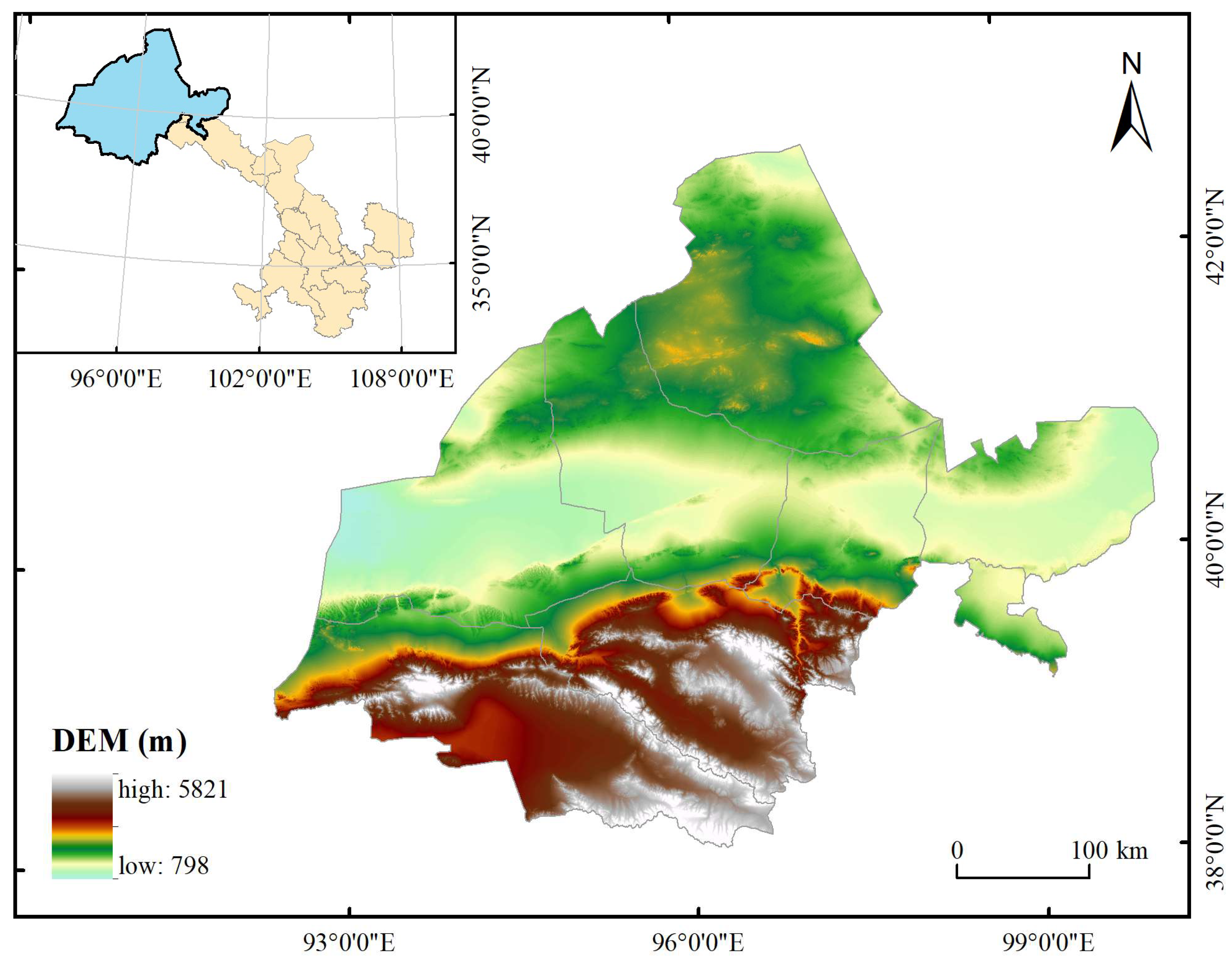
Figure 2.
Comparison of land use types in Jiuquan City from 2005 to 2020.
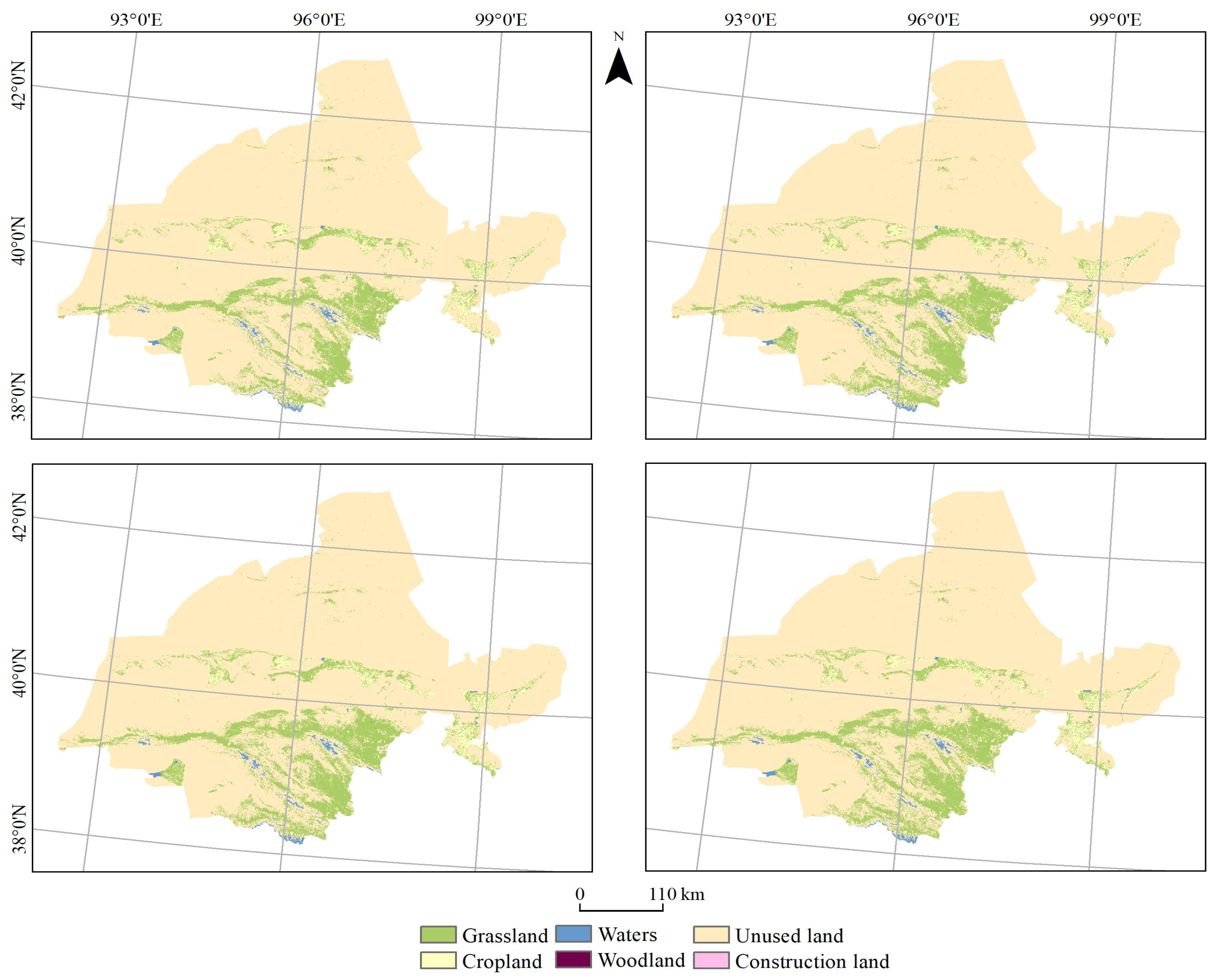
Figure 3.
The total value of ecosystem services and its rate of change in Jiuquan City from 2005 to 2020. (a) Total annual value of ecosystem services in Jiuquan; (b) Rate of change in the value of ecosystem services in Jiuquan, 2005-2020.
Figure 3.
The total value of ecosystem services and its rate of change in Jiuquan City from 2005 to 2020. (a) Total annual value of ecosystem services in Jiuquan; (b) Rate of change in the value of ecosystem services in Jiuquan, 2005-2020.
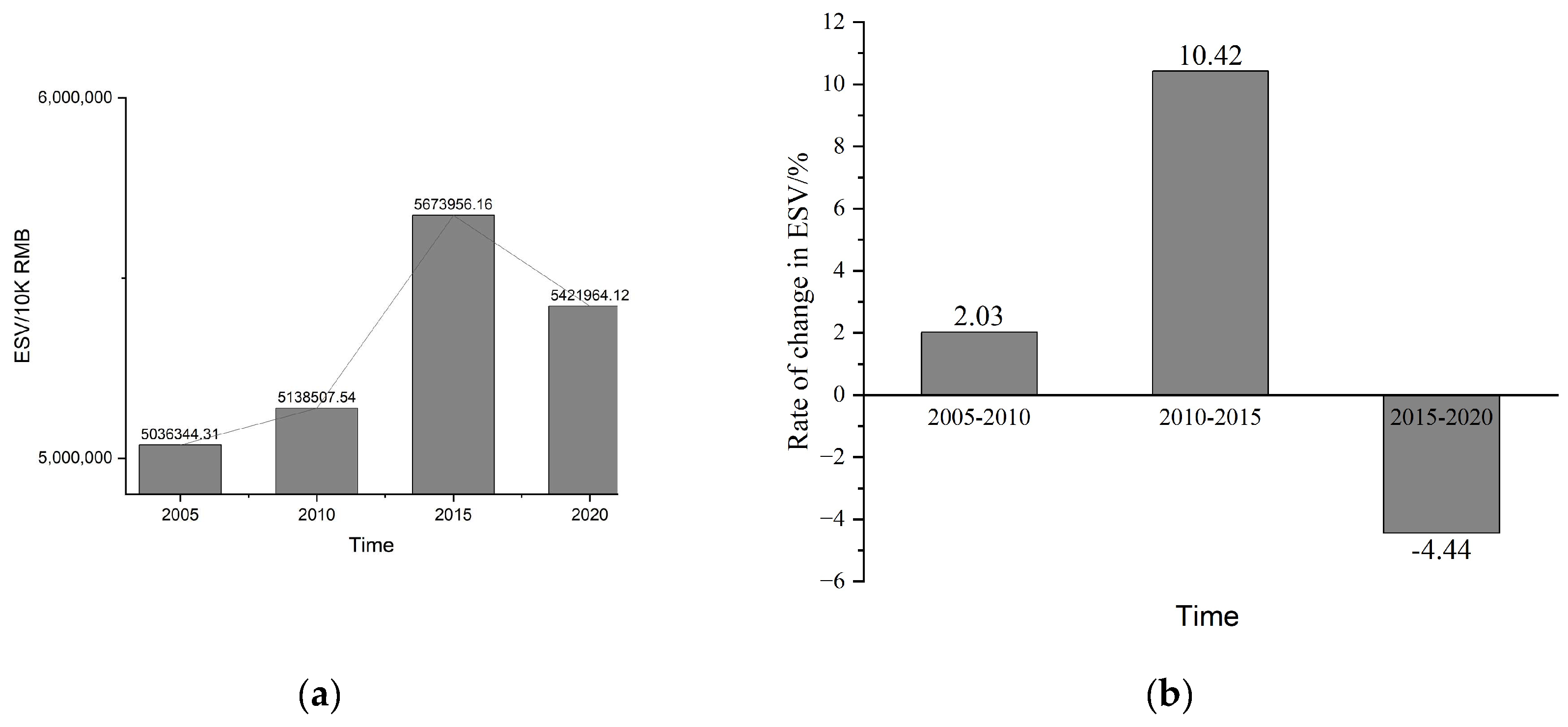
Figure 4.
Spatial distribution pattern of ESV in each district and county of Jiuquan City from 2005 to 2020
Figure 4.
Spatial distribution pattern of ESV in each district and county of Jiuquan City from 2005 to 2020
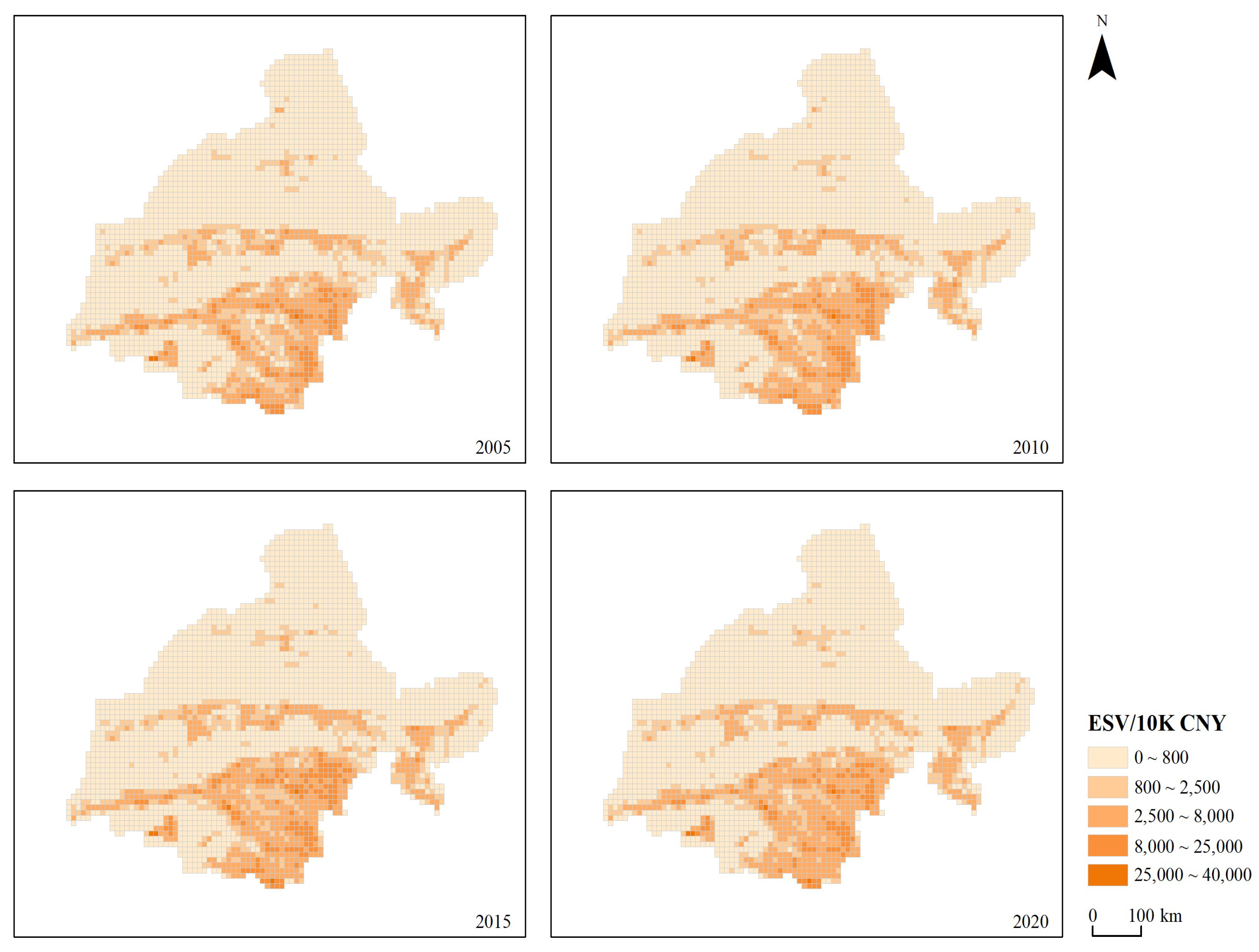
Figure 5.
Spatial variation of ESV in seven districts and counties of Jiuquan City
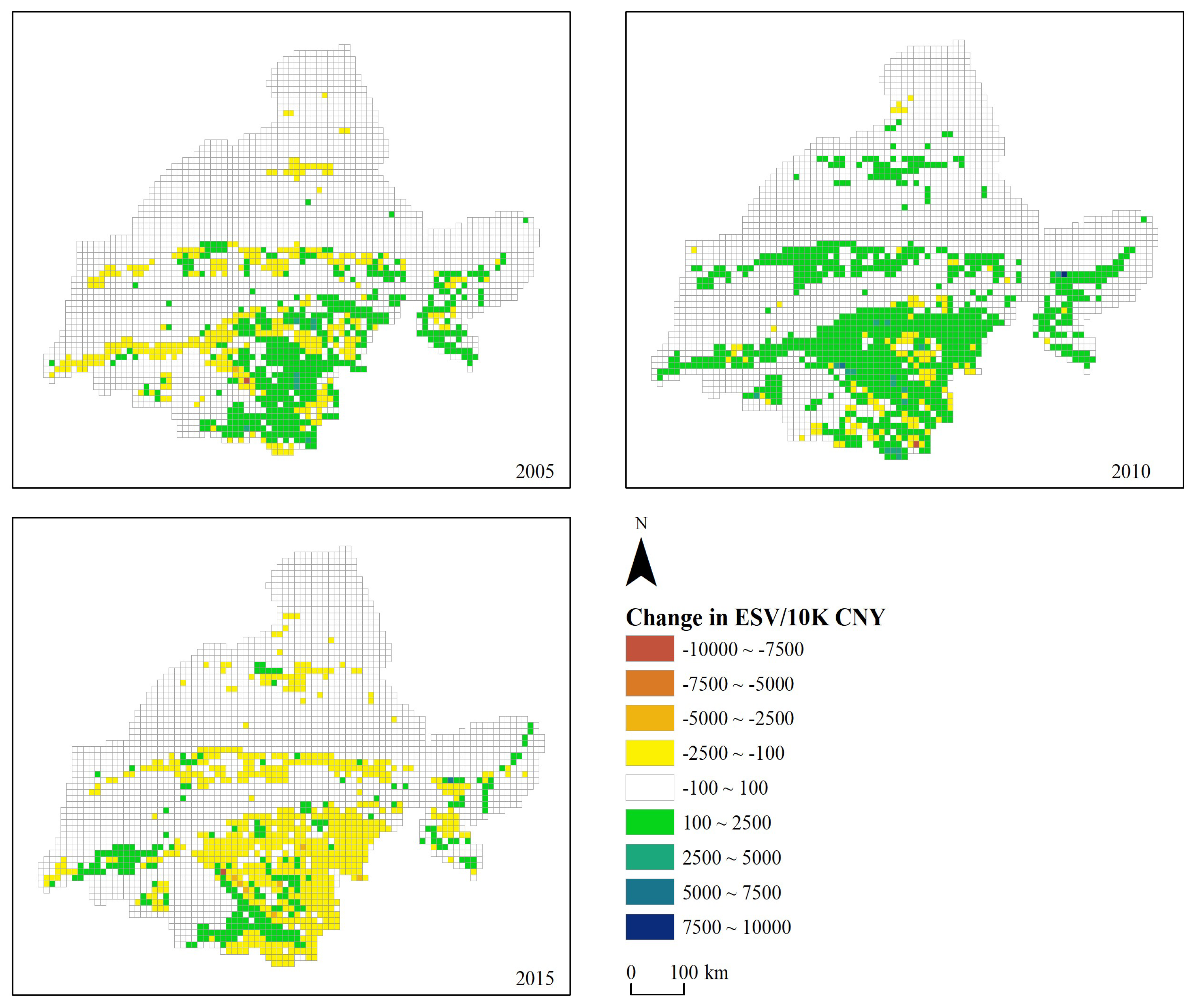
Figure 6.
Proportion of individual ecological service functions in each district and county of Jiuquan City (%). (a) Proportion of individual ecological service functions in Suzhou District; (b) Proportion of individual ecological service functions in Jinta County; (c) Proportion of individual ecological service functions in Guazhou County; (d) Proportion of individual ecological service functions in Subei County; (e) Proportion of individual ecological service functions in Akesai County; (f) Proportion of individual ecological service functions in Yumen City; (g) Proportion of individual ecological service functions in Dunhuang City.
Figure 6.
Proportion of individual ecological service functions in each district and county of Jiuquan City (%). (a) Proportion of individual ecological service functions in Suzhou District; (b) Proportion of individual ecological service functions in Jinta County; (c) Proportion of individual ecological service functions in Guazhou County; (d) Proportion of individual ecological service functions in Subei County; (e) Proportion of individual ecological service functions in Akesai County; (f) Proportion of individual ecological service functions in Yumen City; (g) Proportion of individual ecological service functions in Dunhuang City.
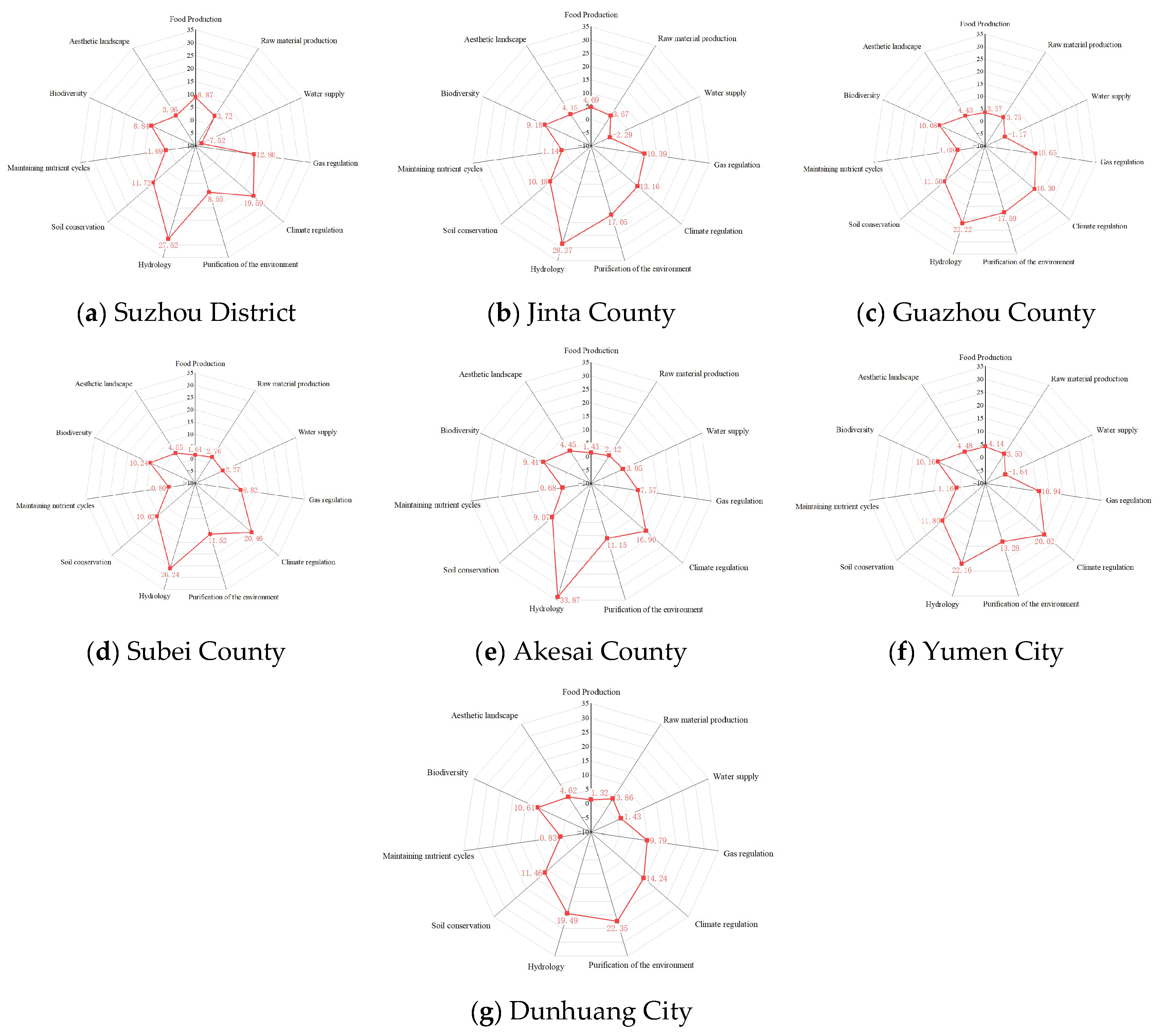

Table 1.
Modified ecosystem service value equivalents for different land use types in Jiuquan City.
| Type of service | Function Type | Value of ecosystem services | ||||
| Cropland | Woodland | Grassland | Waters | Unused land | ||
| supply service | Food Production | 1.105 | 0.2525 | 0.2333 | 0.4367 | 0.005 |
| Raw material production | 0.245 | 0.58 | 0.3433 | 0.2433 | 0.03 | |
| Water supply | -1.305 | 0.3 | 0.19 | 4.3467 | 0.01 | |
| Regulatory services | Gas regulation | 0.89 | 1.9075 | 1.2067 | 0.95 | 0.065 |
| Climate regulation | 0.465 | 5.7075 | 3.19 | 2.1433 | 0.05 | |
| Purification of the environment | 0.135 | 1.6725 | 1.0533 | 3.1033 | 0.205 | |
| Hydrology | 1.495 | 3.735 | 2.3367 | 44.5333 | 0.12 | |
| Support Services | Soil conservation | 0.52 | 2.3225 | 1.47 | 1.08 | 0.075 |
| Maintaining nutrient cycles | 0.155 | 0.1775 | 0.1133 | 0.0833 | 0.005 | |
| Biodiversity | 0.17 | 2.115 | 1.3367 | 3.4767 | 0.07 | |
| cultural service | Aesthetic landscape | 0.075 | 0.9275 | 0.59 | 2.2367 | 0.03 |
Table 2.
Total amount of ESV in Jiuquan from 2005 to 2020 (unit: CNY 104).
| Year | Total ESV | ||||
| Cropland | Woodland | Grassland | Waters | Unused land | |
| 2005 | 141056.65 | 701.19 | 2808253.23 | 833986.74 | 1252346.50 |
| 2010 | 153077.60 | 673.71 | 3002341.65 | 811101.69 | 1171312.89 |
| 2015 | 188564.52 | 735.92 | 3371700.66 | 860101.89 | 1252853.17 |
| 2020 | 186213.98 | 735.08 | 3245006.25 | 785758.72 | 1204250.09 |
Table 3.
Proportion of individual ESV and function in Jiuquan City from 2005 to 2020
| Type of service | Function Type | 2005 | 2010 | 2015 | 2020 | ||||
| ESV/CNY billion | Percentage/% | ESV/CNY billion | Per-centage/% | ESV/CNY billion | Percentage/% | ESV/CNY billion | Percentage/% | ||
| supply service | Food Production |
10.90 | 2.63% | 11.54 | 2.24% | 13.34 | 2.35% | 12.94 | 2.39% |
| Raw material production | 14.84 | 2.95% | 15.09 | 2.94% | 16.75 | 2.95% | 16.13 | 2.97% | |
| Water supply | 7.43 | 1.48% | 7.06 | 1.37% | 6.93 | 1.22% | 6.22 | 1.15% | |
| Regulatory services | Gas regulation |
44.78 | 8.89% | 46.17 | 8.98% | 51.53 | 9.08% | 49.63 | 9.15% |
| Climate regulation |
88.21 | 17.52% | 92.80 | 18.06% | 103.77 | 18.29% | 99.77 | 18.40% | |
| Purification of the environment |
67.75 | 13.45% | 66.87 | 13.01% | 72.97 | 12.86% | 69.99 | 12.91% | |
| Hydrology | 141.65 | 28.12% | 142.77 | 27.78% | 156.22 | 27.53% | 147.52 | 27.21% | |
| Support Services | Soil conservation |
51.65 | 10.26% | 53.22 | 10.36% | 59.19 | 10.43% | 56.94 | 10.50% |
| Maintaining nutrient cycles |
4.24 | 0.84% | 4.41 | 0.86% | 4.96 | 0.87% | 4.79 | 0.88% | |
| Biodiversity | 49.54 | 9.84% | 50.77 | 9.88% | 56.14 | 9.89% | 53.80 | 9.92% | |
| cultural service | Aesthetic landscape |
22.63 | 4.49% | 23.16 | 4.51% | 25.58 | 4.51% | 24.47 | 4.51% |
Table 4.
ESV of seven districts and counties of Jiuquan City in 2020 (unit: CNY 104)
| Type of service | Function Type | Value of ecosystem services | ||||
| Cropland | Woodland | Grassland | Waters | Unused land | ||
| supply service | Food Production | 52092.77 | 9.42 | 62757.29 | 5478.57 | 9054.51 |
| Raw material production | 11549.98 | 21.64 | 92347.09 | 3052.29 | 54327.07 | |
| Water supply | -61521.33 | 11.20 | 51109.66 | 54531.01 | 18109.02 | |
| Regulatory services | Gas regulation | 41957.07 | 71.19 | 324600.15 | 11918.11 | 117708.66 |
| Climate regulation | 21921.39 | 213.00 | 858104.33 | 26888.52 | 90545.12 | |
| Purification of the environment | 6364.28 | 62.42 | 283335.83 | 38932.09 | 371234.99 | |
| Hydrology | 70478.45 | 139.38 | 628568.14 | 558687.29 | 217308.29 | |
| Support Services | Soil conservation | 24514.24 | 86.67 | 395427.39 | 13549.01 | 135817.68 |
| Maintaining nutrient cycles | 7307.13 | 6.62 | 30477.50 | 1045.03 | 9054.51 | |
| Biodiversity | 8014.27 | 78.93 | 359569.92 | 43616.53 | 126763.17 | |
| cultural service | Aesthetic landscape | 3535.71 | 34.61 | 158708.95 | 28060.26 | 54327.07 |
| Total | 186213.98 | 735.08 | 3245006.25 | 785758.72 | 1204250.09 | |
Table 5.
ESV of districts and counties in Jiuquan City in 2020 (unit: CNY 104)
| Type of service | Function Type | Value of ecosystem services | ||||||
|
Suzhou District |
Jinta County |
Guazhou County |
Subei County |
Axe County |
Yumen City |
Dunhuang City |
||
| supply service | Food Production | 41626.57 | 35467.42 | 37140.76 | 94195.42 | 47810.58 | 38641.88 | 11950.82 |
| Raw material production | 17489.01 | 27738.81 | 39020.90 | 161881.94 | 80933.30 | 32654.15 | 34802.93 | |
| Water supply | 35306.32 | -17281.73 | -12152.40 | 133109.49 | 102060.36 | -15348.17 | 12864.15 | |
| Regulatory services |
Gas regulation | 60370.66 | 78538.12 | 110806.97 | 516917.66 | 253730.16 | 102197.81 | 88339.51 |
| Climate regulation | 91989.42 | 99517.52 | 169512.04 | 1199167.30 | 566227.67 | 187031.14 | 128495.80 | |
| Purification of the environment |
40628.30 | 128876.34 | 183019.07 | 675030.99 | 373461.88 | 124073.59 | 201637.97 | |
| Hydrology | 129708.52 | 214493.34 | 231103.15 | 1538109.24 | 1134922.27 | 206945.57 | 175842.00 | |
| Support Services |
Soil conservation | 55013.54 | 79236.40 | 119668.30 | 622596.89 | 304019.72 | 110230.28 | 103360.63 |
| Maintaining nutrient cycles | 7922.92 | 8628.23 | 11242.28 | 47082.13 | 22927.15 | 10860.38 | 7455.05 | |
| Biodiversity | 41505.00 | 69434.27 | 104815.74 | 600038.77 | 315472.74 | 94865.12 | 95704.88 | |
| cultural service | Aesthetic landscape | 18609.62 | 31374.87 | 46083.10 | 272630.28 | 149195.61 | 41842.88 | 41652.18 |
| Total | 469557.25 | 756023.58 | 1040259.92 | 5860760.09 | 3350761.44 | 933994.65 | 902105.91 | |
Table 6.
Spatial transfer of ecosystem services
| Type of service | Function Type | Transfer range/km | Transfer characteristics |
| supply service | Food Production | — | Basically no transfer, attenuation |
| Raw material production | — | Basically no transfer, attenuation | |
| Regulatory services | Gas regulation | 102~104 | Atmosphere as transfer medium, shrinking during transfer |
| Climate regulation | 10~103 | Atmosphere as transfer medium, gradually shrinking during transfer | |
| Purification of the environment | 10~102 | Atmosphere and river as transfer medium, diminishing during transfer | |
| Hydrology | 10~102 | Soil and river as transfer medium, gradually shrinking during transfer | |
| Support Services | Soil conservation | 102~103 | Soil and water conservation is gradually declining with soil and vegetation as the medium, and soil formation is basically not transferring and declining. Nutrient cycling irregular transfer by river, atmosphere, soil, basically no attenuation in the transfer |
| Maintaining nutrient cycles Biodiversity |
103 | Transfer irregular, transfer does not occur in the obvious attenuation | |
| cultural service | Aesthetic landscape | — | Basically, no transfer or attenuation occurs |
Table 7.
Value transfer of ecosystem services in districts and counties of Jiuquan City in 2020 (unit: CNY 108)
Table 7.
Value transfer of ecosystem services in districts and counties of Jiuquan City in 2020 (unit: CNY 108)
| City | Value transfers of ecosystem services | Total | |||||
| Gas conditioning | Climate regulation | Hydrological regulation | Environmental purification | Soil conservation |
Maintains biodiversity |
||
| Suzhou→ Akesai | 3.66 | 3.66 | 4.27 | 3.96 | 3.05 | 3.86 | 22.44 |
| Suzhou→ Yumen | 10.70 | 10.70 | 12.49 | 11.60 | 8.92 | 11.30 | 65.71 |
| Suzhou→ Jinta | 27.32 | 27.32 | 31.88 | 29.60 | 22.77 | 28.84 | 167.73 |
| Suzhou→ Dunhuang | 2.60 | 2.60 | 3.03 | 2.81 | 2.17 | 2.74 | 15.95 |
| Suzhou→ Guazhou | 4.49 | 4.49 | 5.24 | 4.87 | 3.74 | 4.74 | 27.58 |
| Suzhou→ Subei | 12.34 | 12.34 | 14.39 | 13.37 | 10.28 | 13.02 | 75.74 |
| Jinta→ Akesai | 4.65 | 4.65 | 5.42 | 5.03 | 3.87 | 4.90 | 28.52 |
| Jinta→ Suzhou | 7.58 | 7.58 | 8.84 | 8.21 | 6.31 | 8.00 | 46.50 |
| Jinta→ Yumen | 16.64 | 16.64 | 19.41 | 18.02 | 13.86 | 17.56 | 102.12 |
| Jinta→ Dunhuang | 3.87 | 3.87 | 4.51 | 4.19 | 3.22 | 4.08 | 23.73 |
| Jinta→ Guazhou | 7.32 | 7.32 | 8.54 | 7.93 | 6.10 | 7.73 | 44.94 |
| Jinta→ Subei | 27.50 | 27.50 | 32.08 | 29.79 | 22.92 | 29.03 | 168.82 |
| Guazhou→ Akesai | 23.67 | 23.67 | 27.61 | 25.64 | 19.72 | 24.98 | 145.30 |
| Guazhou→ Suzhou | 0.25 | 0.25 | 0.29 | 0.27 | 0.20 | 0.26 | 1.51 |
| Guazhou→ Yumen | 17.28 | 17.28 | 20.16 | 18.72 | 14.40 | 18.24 | 106.08 |
| Guazhou→ Jinta | 5.17 | 5.17 | 6.03 | 5.60 | 4.31 | 5.45 | 31.72 |
| Guazhou→ Dunhuang | 31.71 | 31.71 | 37.00 | 34.35 | 26.43 | 33.47 | 194.67 |
| Guazhou→ Subei | 121.73 | 121.73 | 142.02 | 131.88 | 101.44 | 128.49 | 747.29 |
| Subei→ Akesai | 44.76 | 44.76 | 52.22 | 48.49 | 37.30 | 47.24 | 274.76 |
| Subei→ Yumen | 35.13 | 35.13 | 40.99 | 38.06 | 29.28 | 37.08 | 215.68 |
| Subei→ Dunhuang | 6.19 | 6.19 | 7.23 | 6.71 | 5.16 | 6.54 | 38.02 |
| Subei→ Gua Zhou | 110.54 | 110.54 | 128.96 | 119.75 | 92.11 | 116.68 | 678.58 |
| Akesai→ Yumen | 0.04 | 0.04 | 0.05 | 0.05 | 0.04 | 0.05 | 0.27 |
| Akesai→ Dunhuang | 10.82 | 10.82 | 12.62 | 11.72 | 9.02 | 11.42 | 66.42 |
| Akesai→Guazhou | 1.85 | 1.85 | 2.16 | 2.01 | 1.54 | 1.95 | 11.37 |
| Akesai→Subei | 60.39 | 60.39 | 70.45 | 65.42 | 50.32 | 63.74 | 370.72 |
| Yumen→Akesai | 12.24 | 12.24 | 14.27 | 13.26 | 10.20 | 12.92 | 75.11 |
| Yumen→Suzhou | 2.94 | 2.94 | 3.43 | 3.18 | 2.45 | 3.10 | 18.05 |
| Yumen→ Jinta | 16.29 | 16.29 | 19.01 | 17.65 | 13.58 | 17.20 | 100.02 |
| Yumen→ Dunhuang | 9.84 | 9.84 | 11.48 | 10.66 | 8.20 | 10.38 | 60.39 |
| Yumen→ Guazhou | 26.09 | 26.09 | 30.44 | 28.27 | 21.74 | 27.54 | 160.17 |
| Yumen→ Supei | 75.03 | 75.03 | 87.54 | 81.29 | 62.53 | 79.20 | 460.62 |
| Dunhuang→ Akesai | 44.20 | 44.20 | 51.57 | 47.89 | 36.84 | 46.66 | 271.36 |
| Dunhuang→ Suzhou | 0.20 | 0.20 | 0.23 | 0.21 | 0.16 | 0.21 | 1.21 |
| Dunhuang→ Yumen | 5.21 | 5.21 | 6.07 | 5.64 | 4.34 | 5.50 | 31.96 |
| Dunhuang→Jinta | 2.88 | 2.88 | 3.37 | 3.13 | 2.40 | 3.04 | 17.71 |
| Dunhuang→Guazhou | 31.13 | 31.13 | 36.32 | 33.73 | 25.94 | 32.86 | 191.13 |
| Dunhuang→ Subei | 27.83 | 27.83 | 32.47 | 30.15 | 23.19 | 29.37 | 170.83 |
| Total | 852.07 | 852.07 | 994.08 | 923.07 | 710.06 | 899.40 | 5230.75 |
Disclaimer/Publisher’s Note: The statements, opinions and data contained in all publications are solely those of the individual author(s) and contributor(s) and not of MDPI and/or the editor(s). MDPI and/or the editor(s) disclaim responsibility for any injury to people or property resulting from any ideas, methods, instructions or products referred to in the content. |
© 2024 by the authors. Licensee MDPI, Basel, Switzerland. This article is an open access article distributed under the terms and conditions of the Creative Commons Attribution (CC BY) license (http://creativecommons.org/licenses/by/4.0/).
Copyright: This open access article is published under a Creative Commons CC BY 4.0 license, which permit the free download, distribution, and reuse, provided that the author and preprint are cited in any reuse.


