

Submitted:
19 November 2024
Posted:
20 November 2024
You are already at the latest version
Abstract
(1) Background: This paper presents the results of analyzes of the level of pedestrian safety after introducing changes to road traffic law for vulnerable road users. The relationship between drivers and pedestrians is important for the sustainable development of road transport, where more and more emphasis is being placed on the privileged position of pedestrians and cyclists. (2) Methods: The study covered the number of injured and fatalities in road accidents in Poland from 2001 to 2022, divided into pedestrians on and off crossings, and drivers and passengers. (3) Results: The improvement in road safety over the last two decades has been significant as the number of road accident victims in Poland has almost tripled. The safety of pedestrians, as vulnerable road users, has improved to a greater extent than that of other road users. In relation to the general road situation, safety at pedestrian crossings has deteriorated. (4) Conclusions: The analyzes show that the change in regulations did not significantly reduce the number of accidents at pedestrian crossings. It turned out that the introduced legal regulations had a certain effect in large cities. Moreover, the paper examines the impact of improving road infrastructure (construction of expressways) on the number of pedestrian victims. The results of this analysis indicate a faster decline in the number of pedestrian victims in counties where modern road solutions are being developed.
Keywords:
road safety
; pedestrian safety
; pedestrian crossing
; sustainable transport safety
1. Introduction
The United Nations indicates road safety as one of the key goals to achieve sustainable development [1]. Road accidents constitute a significant economic and social problem. Growing urban population and the growth in the motorization rate, with the majority of societies being mobile, are the reason for the increased traffic intensity on the roads [2,3]. Ignoring the issue of road safety adversely affects sustainable development in developing and developed countries [4,5]. Therefore, the risk of road accidents increases. The number of accidents in European countries varies. The consequences of road accidents, despite the increase in motorization, are less tragic than a few years ago. Despite these favorable changes, one of the goals of transport policy is still to reduce the number of accident victims and people with serious injuries. It is worth noting that in many countries there is no division into a road accident and a collision, as is the case in Polish law, which often makes international comparisons difficult. The literature also defines road accidents in different ways.
The definition of a road accident indicates that it is a sudden road incident that causes disruptions in road traffic. As a result of these disruptions, people involved in the incident lost their lives or suffered bodily injuries. A road accident fatality is a person who died as a result of injuries sustained at the scene or within 30 days of the accident. A seriously injured person is a person who has suffered a severe disability, a serious incurable disease, or a long-term disease that actually poses a threat to life, total or significant incapacity for work (for a period longer than 7 days). However, an injured person in a road accident is defined as a person who suffered bodily injuries and received medical help [6,7,8].
What distinguishes a road accident from a road collision is the scale and nature of the consequences resulting from the incidents. A collision is a road incident that results in material losses. The problem of estimating the costs of accidents is also a complex issue, due to the consequences of the incidents.
A review of the literature on road accidents mainly indicates analyzes of the number of fatalities and research into the causes of these incidents. Scientific literature defines the road accident severity index as the average number of fatalities per 100 accidents [9,10,11]. This is mainly because a fatal accident and a road fatality are defined in the same way. There are no studies that distinguish between a serious accident with a seriously injured person and a minor accident with a slightly injured person (in different countries there are differences in the number of days of recovery or hospitalization of a person after a road accident). The gap in research is caused by the lack of common definitions of the severity of road accidents (apart from the mentioned fatal accidents) and the paucity of data on other accidents (information on injuries suffered) [12].
It should be emphasized that Europe, compared to other countries, has a higher level of safety for pedestrians and cyclists. Unfortunately, the observed improvement in safety is progressing at a slower pace compared to the safety of passengers in vehicles [13]. All road users are at risk of an accident, but pedestrians, as unprotected road users, are at greater risk of health damage as a result of a road accident [14,15]. Accidents involving unprotected road users usually end tragically since, unlike drivers, pedestrians are not protected by the bodywork or seat belts. That is why it is so important to take actions to ensure the necessary protection of life and health.
Pedestrian crossings are divided into crossings [16]:
- on one level;
- collision-free two-level;
- single-level with a refuge safety island.
The factors that influence the safety of pedestrians at crossings and surrounding environmental factors include: lighting and the level of technical infrastructure of crossings, the level of traffic, visibility and location, the level of accessibility of the crossing and its signage [17,18,19,20,21,22,23,24,25,26]. Many studies in the literature have been devoted to the characteristics of accidents with pedestrians, an analysis of the behavior of both pedestrians and drivers at crossings [27,28,29,30,31,32] and an assessment of the solutions introduced to increase pedestrian safety [33,34,35,36,37]. Research often ignores the human factor, i.e., the behavior of people approaching and on the lanes. Maintaining an appropriate level of vigilance, both for pedestrians and drivers, is a key element in avoiding a road accident [38,39].
2. Materials and Methods
The aim of the research conducted in this paper is to analyze changes in the level of road safety in Poland in recent years, with particular emphasis on accidents that take place at pedestrian crossings. In mid-2021, road traffic regulations regarding pedestrian-driver relations at pedestrian crossings were changed. These changes clearly privileged the position of pedestrians. The paper attempts to assess the impact of the introduced change in road traffic regulations on the safety of pedestrians at crossings.
The article uses data on accidents from the Accident and Collision Registration System (https://sewik.pl/search) and data presented by the Central Statistical Office (Local Data Bank). Information on the opened sections of expressways and motorways was obtained from the website of the General Directorate for National Roads and Motorways.
Many pedestrians still die on Polish roads (Figure 1), also at intersections and pedestrian crossings. Compared to Western European countries located in a similar climatic zone (the weather factor significantly affects the number of pedestrian accidents), our country does not fare well—in Germany, the Netherlands, Belgium, not to mention the Scandinavian countries, the pedestrian fatality rate is several times lower. Infrastructure problems are also a key issue—in post-communist countries, there is still a lack of separation between pedestrian and road traffic, which results in a large number of accidents.
Therefore, in Poland, places where pedestrians should feel safe are not. When comparing Polish law to the law in other European Union countries, there are differences in the regulations regarding pedestrians. Most countries provide for pedestrian protection when approaching a pedestrian crossing and signaling their intention to cross the road (Denmark, the Czech Republic, Norway, Belgium, Austria, the Netherlands, Switzerland and Germany) [40].
Polish regulations regarding pedestrians at crossings changed on June 1, 2021, along with the amendment to the provisions contained in the Road Traffic Law. Article 13 of the Act (Road Traffic Law) obliged the driver of a vehicle approaching a pedestrian crossing to exercise particular caution and give way to a pedestrian who is on such a crossing. The issues of speed adjustment (reducing speed so as not to endanger pedestrians entering and crossing the crossing) were regulated by regulations regarding road signs and signals. The change introduced in the regulations applies not only to pedestrian priority during the so-called ”crossing” the road, but also indicates the intention to enter a pedestrian crossing and the need to be particularly careful and reduce speed [41,42,43,44,45,46,47,48,49]. It should be emphasized that the regulations do not provide a definition specifying a pedestrian ”entering” the road. That is why this provision raises so many doubts, ambiguities and freedom of interpretation. It is worth emphasizing that the obtained priority on pedestrian lanes does not release these road users from the obligation to assess the road situation and exercise particular caution when crossing the road and entering the lanes.
It is worth paying attention to the situation when a pedestrian crosses a pedestrian crossing on a dual carriageway, which is divided by a safety island. Then, such a transition should be treated as two separate ones. In addition, the Road Traffic Act (pursuant to the amendment to the Road Traffic Law, in force from September 21, 2022) contains the definition of a suggested crossing, which by definition is not a pedestrian crossing: ”An unmarked, technically adapted place enabling crossing a road, a bicycle path or tracks by pedestrians, which are not pedestrian crossings” [50].
The following research problems and hypothesis were formulated:
- comparison of the rate of improvement of pedestrian safety (in general and at crossings) before and after the introduction of new regulations—in the context of changes in the general situation on the roads;
- assessment of the impact of infrastructure development, in particular the construction of expressways, on the number of accidents and their consequences in general and among pedestrians;
- assessment of the perception of the new regulations by drivers and pedestrians—with the working hypothesis that drivers have adapted to a greater extent to the privileged position of pedestrians and that the changes were different in metropolitan traffic and different in the countryside;
- as a result of the introduction of pedestrian privileges, due to different reactions of drivers and pedestrians themselves, the ratio of the number of people killed and injured may change—the accident severity index may decrease.
The verification of the research objective required the use of a diverse range of research instruments. The paper is empirical in nature and its main part is the analysis of data on road accidents with the separation of the pedestrian group, including incidents at pedestrian crossings. The analysis consisted of tabular and graphical presentation of the dynamics of the number of accidents and victims of accidents in general, among pedestrians and at pedestrian crossings for the period before and after the introduction of new regulations. The chi-square test of independence was used to assess the significance of changes in the severity of accidents before and after the introduction of the regulations.
3. Results
3.1. Victims of Road Accidents in Poland from 2001 to 2022
In order to properly assess the impact of changes in regulations regarding pedestrian crossings on the safety of this group of road users, they should be presented in a broader context, against the background of the total number of accidents and their victims. Obviously, the key measure is the number of people killed in road accidents, as it contains information on both the number of accidents and their severity. From 2001 to 2022, the number of road accident victims in Poland decreased almost threefold (Figure 2), so we can talk about very favorable changes. A particularly strong decline occurred from 2008 to 2010 and after 2019. The factors influencing the improvement of road safety include: expansion of road infrastructure, improvement of the functioning of emergency medical services, but also the fact of owning and using increasingly modern and safer cars. It is relatively difficult to assess the impact of changes in regulations as their possible positive effects overlap with the previously mentioned factors.
It is worth emphasizing that the safety of pedestrians has improved even more than that of other road users, as evidenced by the decreasing share of pedestrians among all accident victims. In 2001, pedestrians accounted for one third of all people killed in accidents, while the most recent data available shows that this share has fallen to less than one quarter.
At the same time, the share of pedestrians killed at crossings increased (from approximately 5.4 to 7.6%), which proves that positive changes in this area are taking place more slowly. Therefore, it seems justified to look for additional legal solutions that could improve the situation at crossings. However, when analyzing this issue, it should be remembered that the share of pedestrians killed at crossings in the total number of accident victims on Polish roads is small (in 2022 it was less than 8%). Therefore, even the most radical and effective actions may not be visible in the overall accident statistics.
3.2. Accidents at Crossins in the Background of the General Road Situation
Road safety improves relatively least at pedestrian crossings, although it should be remembered that every 10-12 people who die on the roads die there. Figure 3 shows the dynamics of the number of injured people from 2001 to 2022, broken down into total accidents, pedestrian accidents and pedestrian accidents at crossings.
As one can see, the change in regulations did not significantly reduce the number of accidents at pedestrian crossings. The total number of people injured in accidents decreased, but the number of pedestrian accidents remained relatively stable compared to the previous year. Moreover, after pedestrians were given priority at crossings, in the first year the number of injured people increased compared to the previous year. This fact is relevant because a year earlier there was a significant decrease in the number of accidents. This may not be the fault of the drivers, but the fault of pedestrians since, when given the right of way, pedestrians reduced their vigilance and attention, forgetting that the car covers a certain braking distance before it stops, and that there is also the driver’s reaction time. Therefore, changes in drivers’ behavior are visible—a decrease in the number of accidents).
The next figure shows the dynamics of the number of accident victims in the years 2001-2022 (Figure 4).
The number of accident victims decreased both overall and in the case of pedestrians in general, especially within pedestrian crossings. This is most likely the result of greater attention from drivers who reduce their speed, thus eliminating the effects of pedestrians’ carelessness.
3.3. Accidents at Crossroads in Provincial Cities
A separate analysis of road traffic safety was carried out, with particular emphasis on pedestrians, in provincial cities. Covering the analysis of a homogeneous group of large cities should, to some extent, eliminate the effect of random factors and facilitate the assessment of the impact of changes in regulations introduced in June 2021 on pedestrian safety.
The chart (Figure 5) shows the number of road accident victims in provincial cities in the same division as in the case of previous analyzes (Figure 3 and Figure 4).
In the case of large cities, the share of pedestrians among all road victims dropped from approximately 60% in 2010 to 44% in 2022. This means that the level of pedestrian safety in provincial cities increased to a greater extent than that of other road users. The decline in the number of tragic incidents at pedestrian crossings was small for many years, only in 2019 there was a significant breakthrough, as a result of which, throughout the analyzed period, the improvement in safety at pedestrian crossings was only slightly lower than among pedestrians in general. At this point, a remark should be made, which applies to all analyzes presented in this work, that with the development of infrastructure and the construction of new housing estates, the number of pedestrian crossings may increase, which, of course, may lead to an increase in the number of accidents recorded there, while maintaining the same level. accident rates within them.
3.4. Detailed Analysis of Roadtraffic Safety in 2019 and 2022
Based on the results presented so far, it is not possible to state a significant increase in pedestrian safety at crossings after the introduction of new regulations in June 2021. Any comparisons were made difficult by the fact that the regulations were introduced during the year, and additionally, in 2020 and 2021, various restrictions on social mobility and data from this period cannot be considered authoritative. Therefore, the next concept is to analyze only the data from 2019 and 2022. The number of people killed and injured in accidents in general, among pedestrians and at crossings in 2019 and 2022 was compared (Table 1). The percentage change in these values was determined, both for the whole of Poland and separately for all provincial cities.
There is no visible impact of the new legal regulations on the safety of pedestrians at crossings throughout the country. If this were the case, the decrease in the number of victims (and injured) at crossings should be clearly greater than for all accidents or all pedestrians. Meanwhile, the scale of the decline in the number of fatalities is very similar for all groups: for all accidents by 34.8%, for pedestrians by 42%, and at pedestrian crossings by 38%.
The situation is slightly different in provincial cities, where the decrease in victims at crossings (by 47.3%) was greater than the decrease in the number of fatalities in all accidents (by 25.6%). Therefore, it can be hypothesized that the new legal regulations have had some effects in large cities.
In the table the severity index, defined as the risk of death of the injured person was also calculated. It is worth noting the greater decrease in the severity index of accidents among pedestrians and at crossings than for all accidents—a lower severity index means a lower risk of pedestrian death, which should probably be attributed to greater driver attention. This positive change is particularly visible in provincial cities, where the severity of accidents at pedestrian crossings dropped by almost 25%. However, it should be emphasized that the decrease in the severity of accidents at crossings may result from greater driver caution and/or less pedestrian caution. These conclusions are very important, but due to the smaller number of incidents in provincial cities, they are not statistically significant (p above 0.05). However, in the scope of data for the whole of Poland, the decrease in the severity index of accidents among pedestrians between 2019 and 2022 was statistically significant (p = 0.0064).
3.5. Infrastructure Development and Change in Road Traffic Safety
The analysis of the impact of regulations on road safety is difficult since this phenomenon is influenced by many factors at the same time, additionally linked by mutual interactions. An attempt to assess the scale of the impact of infrastructure expansion on the level of road safety was made. The data on the number of people killed in accidents in the province were used. The Lublin Province was divided into districts—the choice of this region was dictated by the significant expansion of expressways in recent years. The area was divided into two parts, depending on the location of the expressway in a given district. The first group included the following districts: Janów, Kraśnik, Lublin, including the city of Lublin itself, Puławy, Ryki and Świdnica, while the second group included all the remaining ones. Long sections of the S12, S17 and S19 expressways run through the above-mentioned counties, replacing former sections of national roads with the same numbers.
Figure 6 shows the dynamics of the number of people killed in road accidents in the districts of the Lublin Province depending on the location of the expressway in their area.
The actual impact of building an expressway on road safety is difficult to estimate precisely because:
- only the connection of the road network into a logical whole should significantly reduce the number and severity of accidents;
- in the above-mentioned districts there are, of course, also other national, provincial and district roads where traffic may increase due to the possibility of access to the expressway;
- building an expressway in a given district may result in taking over some traffic from other, sometimes quite distant districts, so it is difficult to expect any radical differences.
Despite these reservations, some positive phenomena can be noticed in the pace of improvement of road traffic safety in the specified districts.
The presented dynamics of the number of pedestrians killed in road accidents (Figure 7) indicates that in the districts through which the expressway runs, a greater decrease in the number of pedestrian victims is visible.
This is a logical, although at first glance not obvious, effect resulting from reducing the number of contacts between pedestrians and cars. Just a few years ago, a person travelling from Rzeszów to Warsaw via Lublin had well over 100 pedestrian crossings on their route, located in numerous villages, towns and cities. Currently, all transit on this route through the Lublin Province takes place without any interaction with pedestrian traffic, on a two-lane expressway.
4. Discussion
The level of road safety and the changes taking place can be assessed based on the number of road accidents and their consequences. The improvement in road safety over the last two decades has been significant as the number of road accident victims in Poland has almost tripled. Additionally, the safety of pedestrians, as vulnerable road users, has improved to a greater extent than that of other road users (less than a quarter of those killed in 2022 were pedestrians, and 20 years earlier, pedestrians were every third victim). However, relatively, in relation to the general road situation, safety at pedestrian crossings has deteriorated—the percentage of people who died in these locations increased from 2001 to 2022 from 5.4 to 7.6%.
The concept of sustainable development, particularly popular in the policy of the European Union, also influences the direction of changes in road traffic regulations. In the countries, and consequently also in cities of the EU, pedestrians and cyclists are increasingly favored, while more and more restrictions affect car drivers. However, the legal changes introduced in Poland, privileging pedestrians, have not, so far, brought about any significant changes in accident statistics. Protectionism, contrary to intentions, does not always work well for groups covered by special protection—analysis of the accident severity index at crossings suggests that drivers have assimilated the new rules, which has reduced the risk of pedestrian death in the event of an accident. On the other hand, the number of people injured at crossings, which increased in 2022, suggests that pedestrians abuse the right of way at crossings.
The analyses presented in the paper have a number of limitations resulting from the variability in time of the number of pedestrian crossings, their markings, the number and mobility of pedestrians themselves (the issue of ageing societies), or the number and technical condition of cars. There are more factors that make it difficult to compare the number of accidents in two different time periods, and additionally the number of accidents among pedestrians depends to a very large extent on weather conditions, and is very seasonal. However, despite all these reservations, the presented results show quite clearly that the concept of sustainable development in the aspect of road traffic regulations, although undoubtedly correct, does not indicate easy and unambiguous solutions.
5. Conclusions
The main conclusions of the study are that the change in road traffic regulations introduced in mid-2021 has so far not had a significant impact on the reduction in the number of accidents and their victims at pedestrian crossings. This is the case for the entire country, but some improvement in safety at pedestrian crossings can be seen in provincial cities (a decrease in the number of victims by approximately 16% over the years 2010-2012). In large cities, we can therefore talk about an increase in safety in relation to other traffic, which may be caused by changes in regulations.
It should be emphasized that the behavior of pedestrians and drivers has the greatest impact on safety at pedestrian crossings. Both vehicle drivers and pedestrians on the road should remember about themselves and the lives of others. Reducing the number of accidents, fatalities and injuries cannot be achieved only by changing the law.
The analyses will be continued after obtaining data for the following years (2023 and 2024), because then it will be possible to more reliably assess the long-term effects of introducing a privileged position for pedestrians at crossings in Polish road traffic.
Author Contributions
Conceptualization, M.N. and M.S.; methodology, M.N. and M.S.; software, M.N. and M.S.; validation, M.N. and M.S.; formal analysis, M.N. and M.S.; investigation, M.N. and M.S.; resources, M.N. and M.S.; data curation, M.N. and M.S.; writing—original draft preparation, M.N. and M.S.; writing—review and editing, M.N. and M.S.; visualization, M.N. and M.S.; supervision, M.N. and M.S.; project administration, M.N. and M.S.; funding acquisition, M.N. and M.S. All authors have read and agreed to the published version of the manuscript.
Funding
This research received no external funding.
Institutional Review Board Statement
Not applicable.
Informed Consent Statement
Not applicable.
Data Availability Statement
Not applicable
Acknowledgments
Not applicable
Conflicts of Interest
The authors declare no conflict of interest.
References
- Jamroz, K.; Budzyński, M.; Romanowska, A.; Żukowska, J.; Oskarbski, J.; Kustra, W. Experiences and Challenges in Fatality Reduction on Polish Roads. Sustainability. 2019, 11, 959. [CrossRef]
- Jackisch, J.; Sethi, D.; Mitis F.; Szymański, T.; Arra, I. European Facts and Global Status report on road Safety 2015, World Health Organization, Regional Office for Europe. 2015. https://iris.who.int/handle/10665/326340.
- Zhong, W.; Du, L. Predicting Traffic Casualties Using Support Vector Machines with Heuristic Algorithms: A Study Based on Collision Data of Urban Roads. Sustainability. 2023, 15, 2944. [CrossRef]
- Haghshenas, S.S; Guido, G.; Vitale, A.; Astarita, Vittorio. Assessment of the Level of Road Crash Severity: Comparison of Intelligence Studies. Expert Systems with Applications. 2023, 234, 121118. [CrossRef]
- Guido, G.; Haghshenas, S.S.; Haghshenas, S.S.; Vitale, A.; Gallelli, V.; Astarita, V. Prioritizing the Potential Smartification Measures by Using an Integrated Decision Support System with Sustainable Development Goals (a Case Study in Southern Italy). Safety. 2022, 8, 35. [CrossRef]
- Ustawa z dnia 20 czerwca 1997 r.—Prawo o ruchu drogowym (Dz. U. z 2022 r. poz. 988, z późn. zm.) https://isap.sejm.gov.pl/isap.nsf/DocDetails.xsp?id=WDU20220000988).
- Zarządzenie nr 635 Komendanta Głównego Policji z dnia 30 czerwca 2006 r. w sprawie metod i form prowadzenia przez Policję statystyki zdarzeń drogowych https://www.infor.pl/akt-prawny/U27.2006.011.0000067,metryka,zarzadzenie-nr-635-komendanta-glownego-policji-w-sprawie-metod-i-form-prowadzenia-przez-policje-statystyki-zdarzen-drogowych.html).
- International Transport Forum, ROAD SAFETY REPORT 2021, POLAND (https://www.itf-oecd.org/sites/default/files/poland-road-safety.pdf.
- Sobolewski, M. Wskaźnik ciężkości wypadków drogowych w porównaniach międzynarodowych. Logistyka 2015, 3/CD 1, pp. 4506-4511.
- Żukowska, J. Diagnoza stanu bezpieczeństwa transportu w Polsce [w] Zintegrowany System Bezpieczeństwa Transportu: Synteza/ red. Krystek, R. Wydawnictwa Komunikacji i Łączności, Warszawa, 2010, pp. 35-51.
- Szczęsny, P.; Rymarz, J. Korelacja wybranych wskaźników bezpieczeństwa ruchu drogowego na przykładzie Polski i krajów sąsiednich, Mechanika, Wyd. Politechniki Krakowskiej, R. 109, z. 5-M, 2012, pp. 153-162.
- Malin, F.; Silla, A.; Mledenoović, M. Prevalence and factors associated with pedestrian fatalities and serious injuries: Case Finland. European Transport Research Review. 2020, Vol. 12. [CrossRef]
- Luoma, J.; Sivak, M. Why is road safety in the US not on par with Sweden, the UK, and the Netherlands? Lessons to be learned. European Transport Research Review. 2014, Vol. 6, No. 3, pp. 295–302. [CrossRef]
- Gryzik, R.; Kozłowski, W. Poprawa bezpieczeństwa pieszych poprzez budowę aktywnych przejść dla pieszych. Transport miejski i regionalny. 2019, Vol. 1, pp. 32-35. https://yadda.icm.edu.pl/baztech/element/bwmeta1.element.baztech-3801da12-3006-4816-81bc-c74dd2f6438e.
- Chen, Z.; Chen, X.; Wang, R.; Gao, M. Characterization of Pedestrian Crossing Spatial Violations and Safety Impact Analysis in Advance Right-Turn Lane. Int. J. Environ. Res. Public Health. 2022, 19, 9134. [CrossRef]
- Jamroz, K.; Gaca, S.; Michalski, L.; Kieć, M.; Budzynski, M.; Gumińska, L.; Kustra, W.; Mackun, T.; Oskarbska, I.; Rychlewska, J.; Ryś, Artur.; Wachnicka, J.; Wierzbicka, J. Ochrona pieszych. Podręcznik dla organizatorów ruchu pieszego. Ministerstwo Infrastruktury i Rozwoju. Sekretariat Krajowej Rady BRD. 2014. [CrossRef]
- Yang, J.; Deng, W.; Wang, J.; Li, Q.; Wang, Z. Modeling pedestrians’ road crossing behavior in traffic system micro-simulation in China. Transportation Research Part A: Policy and Practice. 2006, 40, pp. 280-290. [CrossRef]
- Tomczuk, P.; Wytrykowska, A. Analiza czynników wpływających na bezpieczeństwo pieszego na przejściu dla pieszych typu “zebra” niesterowanym sygnalizacją Analiza świetlną. Logistyka. 2015, No 4, pp. 1082-1083.
- Bazyl, O.; Persia, L. & Usami, D.S., A methodology to assess pedestrian crossing safety. European Transport Research Review. 2010, Vol. 2, No. 3, pp. 129–137. [CrossRef]
- Elvik, R.; Sørensen, M.W.; Nævestad, T.O. Factors influencing safety in a sample of marked pedestrian crossings selected for safety inspections in the city of Oslo. Accid Anal Prev. 2013, 59, pp. 64-70. [CrossRef]
- Chebanyuk,K.; Prasolenko, O.; Burko, D.; Galkin, A.; Lobashov, O.; Shevchenko, A.; Usami, D.S.; Persia, L. Pedestrians influence on the traffic flow parameters and road safety indicators at the pedestrian crossing, Transportation Research Procedia. 2020, Vol. 45, pp. 858-865. [CrossRef]
- Dorohin, S.; Zelikov, V.; Denisov, G. Improvement of road traffic safety in the zone of unsignalled pedestrian crossings, Transportation Research Procedia. 2018, Vol. 36, pp. 122-128. [CrossRef]
- Marić, B.; Lipovac, K.; Nešić, M.; Đerić, M. The Influence of a Countdown Display On Pedestrian Behavior at a Signalized Pedestrian Crossing Equipped with a Pedestrian Refuge Island. Transportation Research Procedia. 2021, Vol. 55, pp. 1720-1728. [CrossRef]
- Bendak, S.; Alnaqbi, A.; Alzarooni, M.; Aljanaahi, S.; Alsuwaidi, S. Factors affecting pedestrian behaviors at signalized crosswalks: An empirical study. Journal of Safety Research. 2021, 76(8). [CrossRef]
- Budzynski, M.; Gobis, A.; Guminska, L.; Jelinski, L.; Kiec, M.; Tomczuk, P. Assessment of the Influence of Road Infrastructure Parameters on the Behaviour of Drivers and Pedestrians in Pedestrian Crossing Areas. Energies. 2021, 14, 3559. [CrossRef]
- Idzior, M. Analysis of factors influencing pedestrians’ safety in the road traffic. Motor Transport. 2021, 64(2), pp. 24—29. [CrossRef]
- Hualong, Z.; Cunbao, Z.; Feng, C. & Yuan, Y. W., Effects of mobile phone use on pedestrian crossing behavior and safety at unsignalized intersections. Canadian Journal of Civil Engineering. 2019, Vol. 46, No. 5, pp. 381-388. [CrossRef]
- Dąbrowska-Lorenc, M.; Sicińska, K.; Zielińska, A. Road users’ behaviour study in areas of zebra crosswalks, Transport Problems. 2021, Vol. 16, No. 3, 185-198. [CrossRef]
- Ziółkowski, R., Speed analyses and modeling in pedestrian crossing areas. Transport Problems. 2023,. Vol. 18(2), pp. 111-122. [CrossRef]
- Olszewski, P.; Szagała, P.; Wolański, M.; Zielińska, A. Pedestrian fatality risk in accidents at unsignalized zebra crosswalks in Poland. Accident Analysis & Prevention. 2015, Vol. 84, pp. 83-91. [CrossRef]
- Kruszyna, M.; Matczuk-Pisarek, M. The Effectiveness of Selected Devices to Reduce the Speed of Vehicles on Pedestrian Crossings. Sustainability. 2021, 13, 9678. [CrossRef]
- Aghabayk, K.; Esmailpour, J.; Jafari, A.; Shiwakoti, N. Observational-based study to explore pedestrian crossing behaviors at signalized and unsignalized crosswalks. Accid. Anal. Prev. 2021, 151, 105990. [CrossRef]
- Vignali, V.; Pazzini, M.; Ghasemi, N.; Lantieri, C.; Simone, A.; Dondi, G. The safety and conspicuity of pedestrian crossing at roundabouts: The effect of median refuge island and zebra markings. Transportation Research Part F: Traffic Psychology and Behaviour. 2020; Vol. 68; pp. 94-104. [CrossRef]
- Cunbao, Z; Feng, C.; Yuanyuan, W. Evaluation of pedestrian crossing behavior and safety at uncontrolled mid-block crosswalks with different numbers of lanes in China. Accident Analysis & Prevention. 2019, Vol. 123, pp. 263-273. [CrossRef]
- Dąbrowska-Lorenc, M.; Sicińska, K. Survey of pedestrians and car drivers’ attitudes at the area of pedestrian crossings over period of time. Transport Problems. 2021, Vol. 16, No. 4. [CrossRef]
- Ragland, D.R.; Grembek, O.; Orrick, P.; Felschundneff, G. Roadway and Infrastructure Design and Its Relation to Pedestrian and Bicycle Safety: Basic Principles, Applications, and Benefits. UC Berkeley: Safe Transportation Research & Education Center; 2013. https://escholarship.org/uc/item/9qg3s59b.
- Ahmed, T.; Moeinaddini, M.; Almoshaogeh, M.; Jamal, A.; Nawaz, I.; Alharbi, F. A New Pedestrian Crossing Level of Service. (PCLOS) Method for Promoting Safe Pedestrian Crossing in Urban Areas. Int. J. Environ. Res. Public Health. 2021, 18, 8813. [CrossRef]
- Kęsicka, S.; Wachnicka, J. Analiza wpływu zachowań niechronionych użytkowników dróg na ich poziomie bezpieczeństwa w obrębie przejść dla pieszych bez sygnalizacji świetlnej. Transport miejski i regionalny. 2021, Vol. 2, pp. 5-13. https://yadda.icm.edu.pl/baztech/element/bwmeta1.element.baztech-920ca812-1b41-4408-8ed3-a06f7d7ea1ea/c/TMiR_02_2021_Kesicka.pdf.
- Yang, Z.; Gong, Z.; Zhang, Q.; Wang, J. Analysis of pedestrian-related crossing behavior at intersections: A Latent Dirichlet Allocation approach, International. Journal of Transportation Science and Technology. 2023, Vol. 12, Issue 4, 2023, pp. 1052-1063. [CrossRef]
- Available at: https://www.brd24.pl/prawo/jak-kraje-ue-chronia-pieszych/.
- Available at: https://sip.lex.pl/akty-prawne/dzu-dziennik-ustaw/prawo-o-ruchu-drogowym-16798732/art-26 (Art. 26. Prawo o ruchu drogowym. Zachowanie kierującego przed i na przejściu dla pieszych).
- Krzemień, P. Fakultatywny obowiązek zmniejszenia prędkości przed przejściem dla pieszych w kontekście zakazu wchodzenia bezpośrednio przed jadący pojazd. Paragraf na Drodze. 2022, Vol. 1, 21. [CrossRef]
- Stefański, R.A. Obowiązki kierujących pojazdami i pieszych przechodzących przez przejście dla pieszych po nowelizacji ustawy Prawo o ruchu drogowym. Paragraf na Drodze. 2022, Vol. 1, pp. 7-19. [CrossRef]
- Krzemień, P. Znaczenie pojęcia „pieszy wchodzący”—Głos polemiczny. Paragraf na Drodze, 2022, Vol. 4, 21–42. [CrossRef]
- Krzemień, P. Pierwszeństwo pieszego „wchodzącego” na przejście dla pieszych. Nowy przepis Prawa o ruchu drogowym w świetle procesu legislacyjnego, wystąpień posłów i senatorów oraz zasad opiniowania wypadków drogowych. Paragraf na Drodze, 2021, Vol. 3, pp. 7-32. (http://www.paragraf.ies.krakow.pl/paragraf-na-drodze-32021/).
- Małecki, M. Pierwszeństwo pieszego wchodzącego na przejście: Wchodzenie to proces, a nie podniesienie nogi. 2021. Available at: https://www.dogmatykarnisty.pl/2021/06/pierwszenstwo-pieszego-wchodzacego-na-przejscie/ (access: 09.07.2022 r.) https://ruj.uj.edu.pl/xmlui/bitstream/handle/item/307774/malecki_pierwszenstwo_pieszego_wchodzacego_na_przejscie_dla_pieszych_2021.pdf?sequence=1&isAllowed=y.
- Zhou Y.; Tan, G.; Zhong, R.; Li y.; Gou, C. PIT: Progressive Interaction Transformer for Pedestrian Crossing Intention Prediction, IEEE Transactions on Intelligent Transportation Systems. 2023, Vol. 24, No. 12, pp. 14213-14225. [CrossRef]
- Xin, X.; Jia, N.; Ling, S.; He, Z. The effect of the ‘yield to pedestrians’ policy on risky pedestrian behaviors: Is it a ‘two-edged sword’?, Transportation Research Part A: Policy and Practice. 2023, Vol. 178, 103870. [CrossRef]
- Zhou, Z.; Liu, Y.; Liu, B.; Ouyang, M.; Tang, R. Pedestrian Crossing Intention Prediction Model Considering Social Interaction between Multi-Pedestrians and Multi-Vehicles. Transportation Research Record. 2023, 2678 (4). [CrossRef]
- Ustawa z dnia 20 czerwca 1997 r. Prawo o ruchu drogowym art. 2 pkt 11a (Dz.U.2023.1047 t.j.).
Figure 1.
Road accident casualty rate among pedestrians in selected European countries (2019). Source: own study based on Eurostat data
Figure 1.
Road accident casualty rate among pedestrians in selected European countries (2019). Source: own study based on Eurostat data
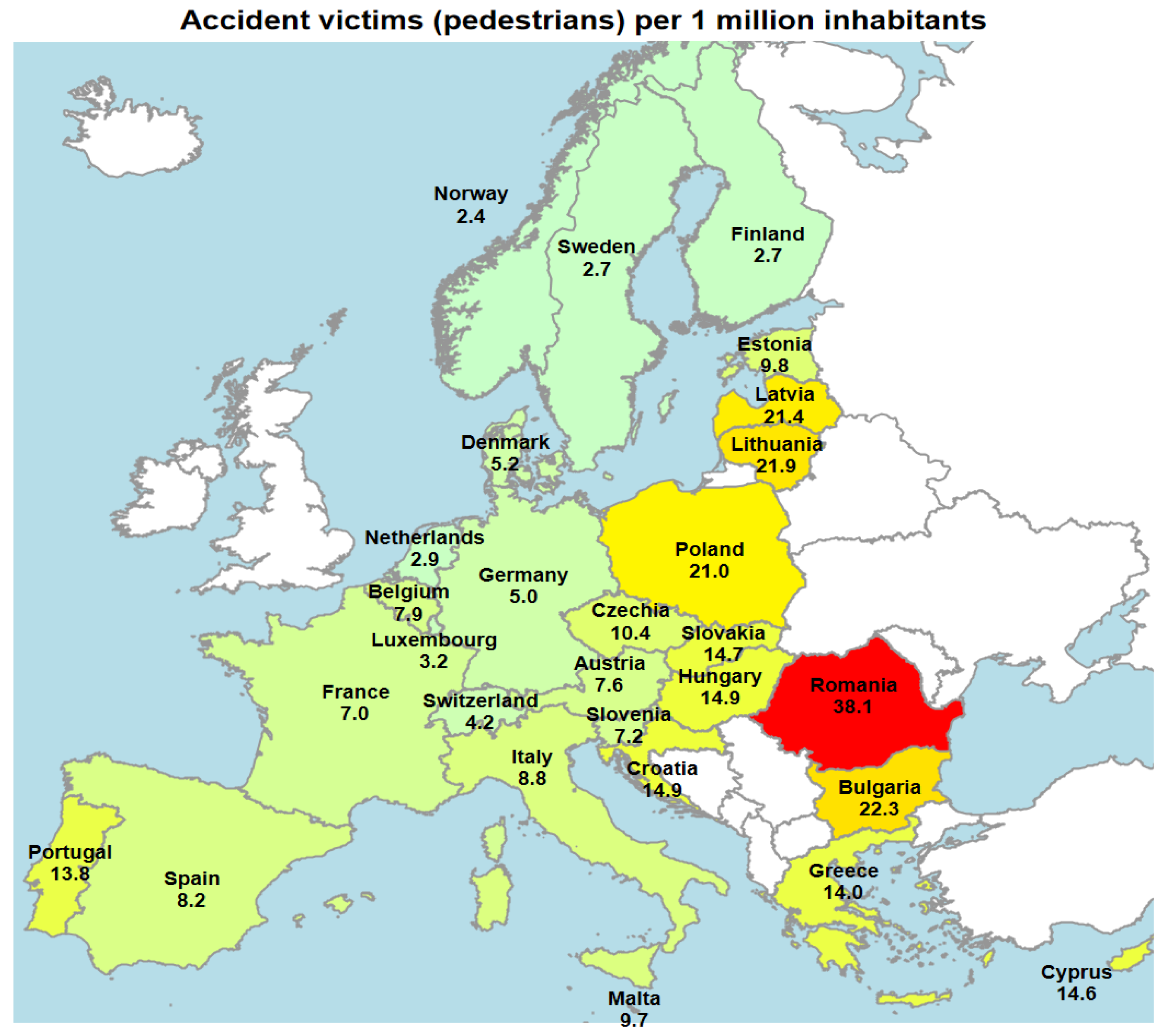
Figure 2.
Road traffic safety in 2001-2022. Source: own study based on statystyka.policja.pl/st/ruch-drogowy/76562,Wypadki-drogowe-raporty-roczne.html
Figure 2.
Road traffic safety in 2001-2022. Source: own study based on statystyka.policja.pl/st/ruch-drogowy/76562,Wypadki-drogowe-raporty-roczne.html
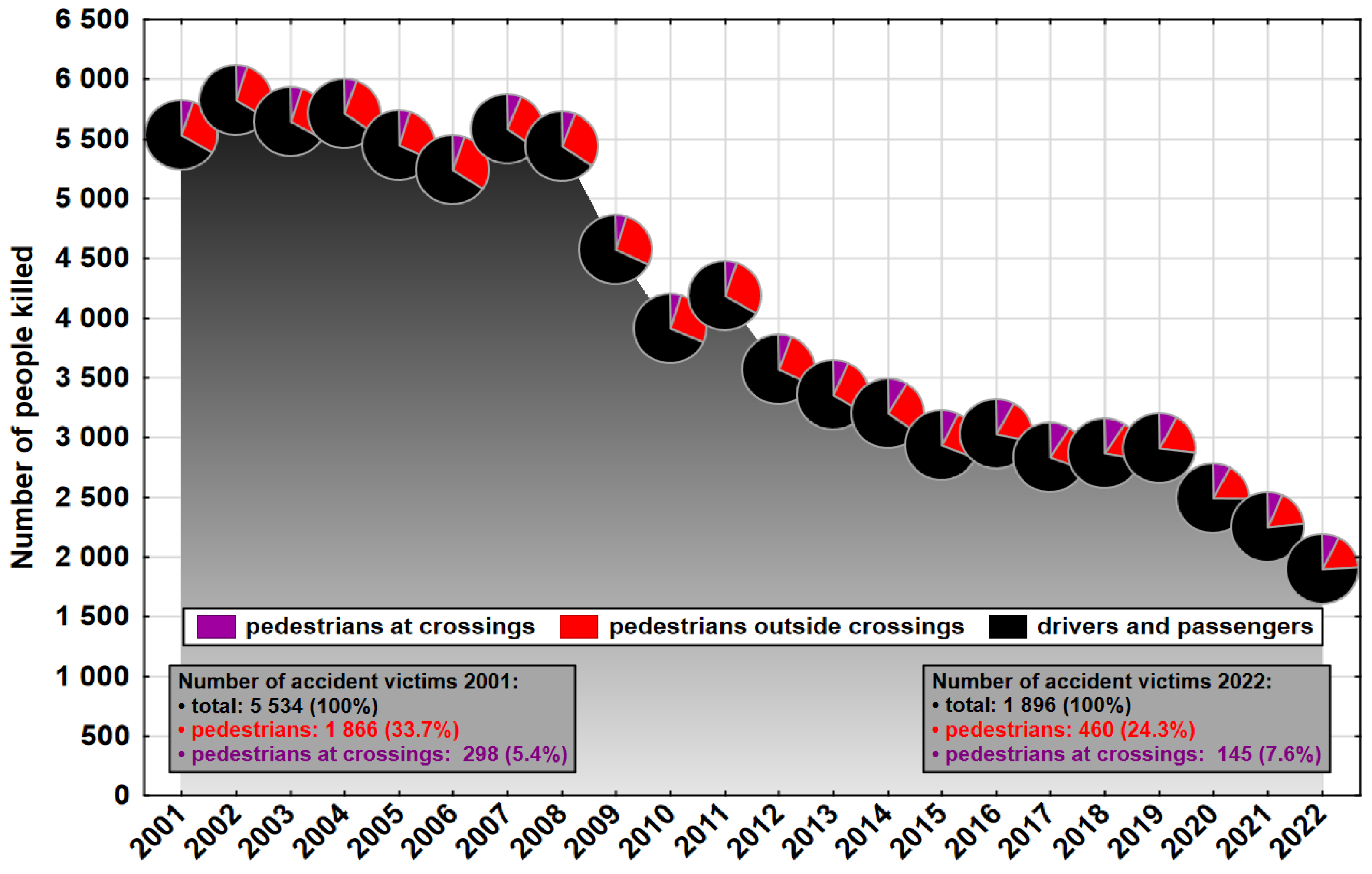
Figure 3.
Dynamics of the number of people injured in accidents 2001-2022 (2001=100). Source: own study based on statystyka.policja.pl/st/ruch-drogowy/76562,Wypadki-drogowe-raporty-roczne.html
Figure 3.
Dynamics of the number of people injured in accidents 2001-2022 (2001=100). Source: own study based on statystyka.policja.pl/st/ruch-drogowy/76562,Wypadki-drogowe-raporty-roczne.html
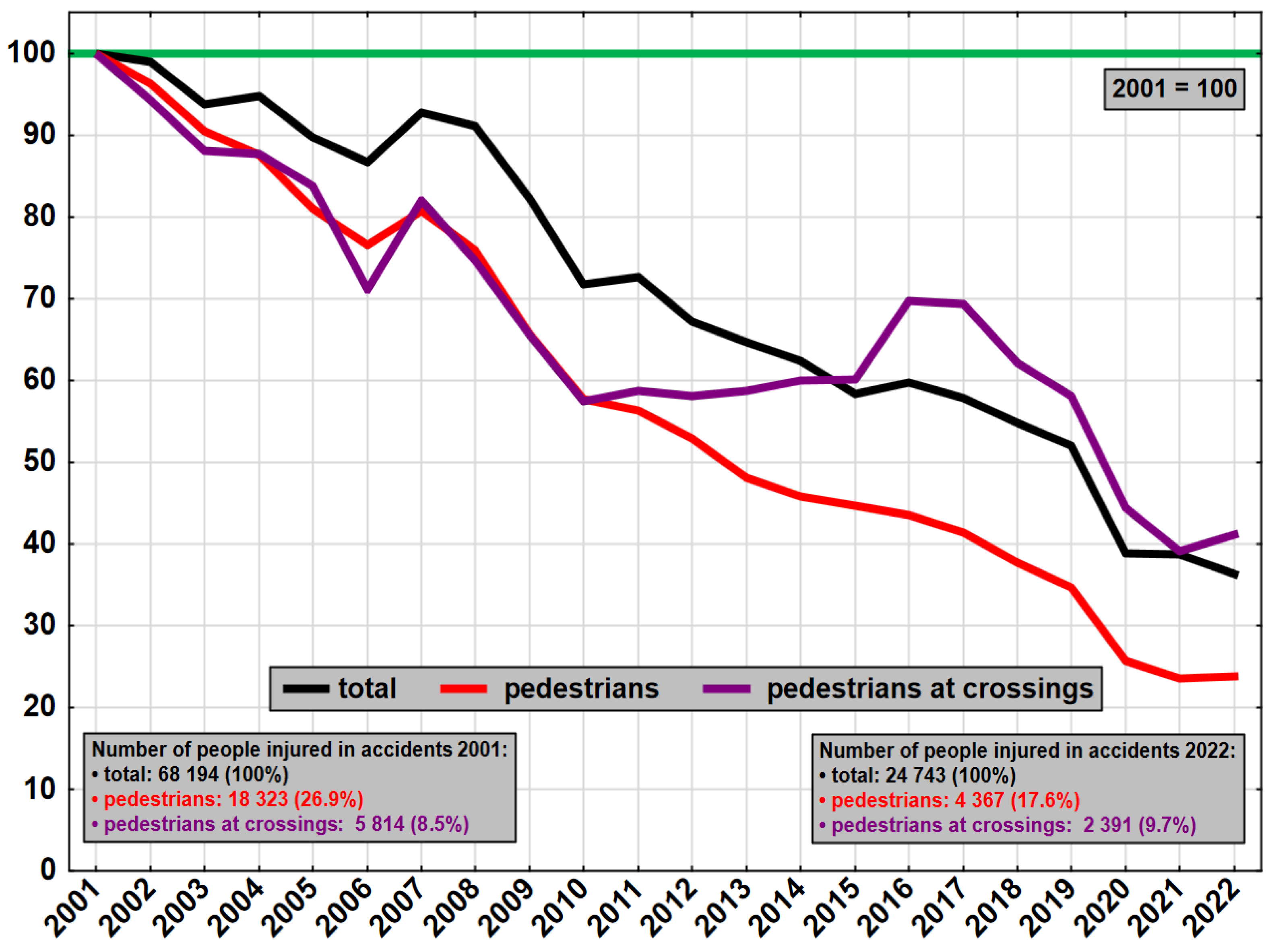
Figure 4.
Dynamics of the number of accident victims 2001-2022 (2001=100). Source: own study based on statystyka.policja.pl/st/ruch-drogowy/76562,Wypadki-drogowe-raporty-roczne.html
Figure 4.
Dynamics of the number of accident victims 2001-2022 (2001=100). Source: own study based on statystyka.policja.pl/st/ruch-drogowy/76562,Wypadki-drogowe-raporty-roczne.html
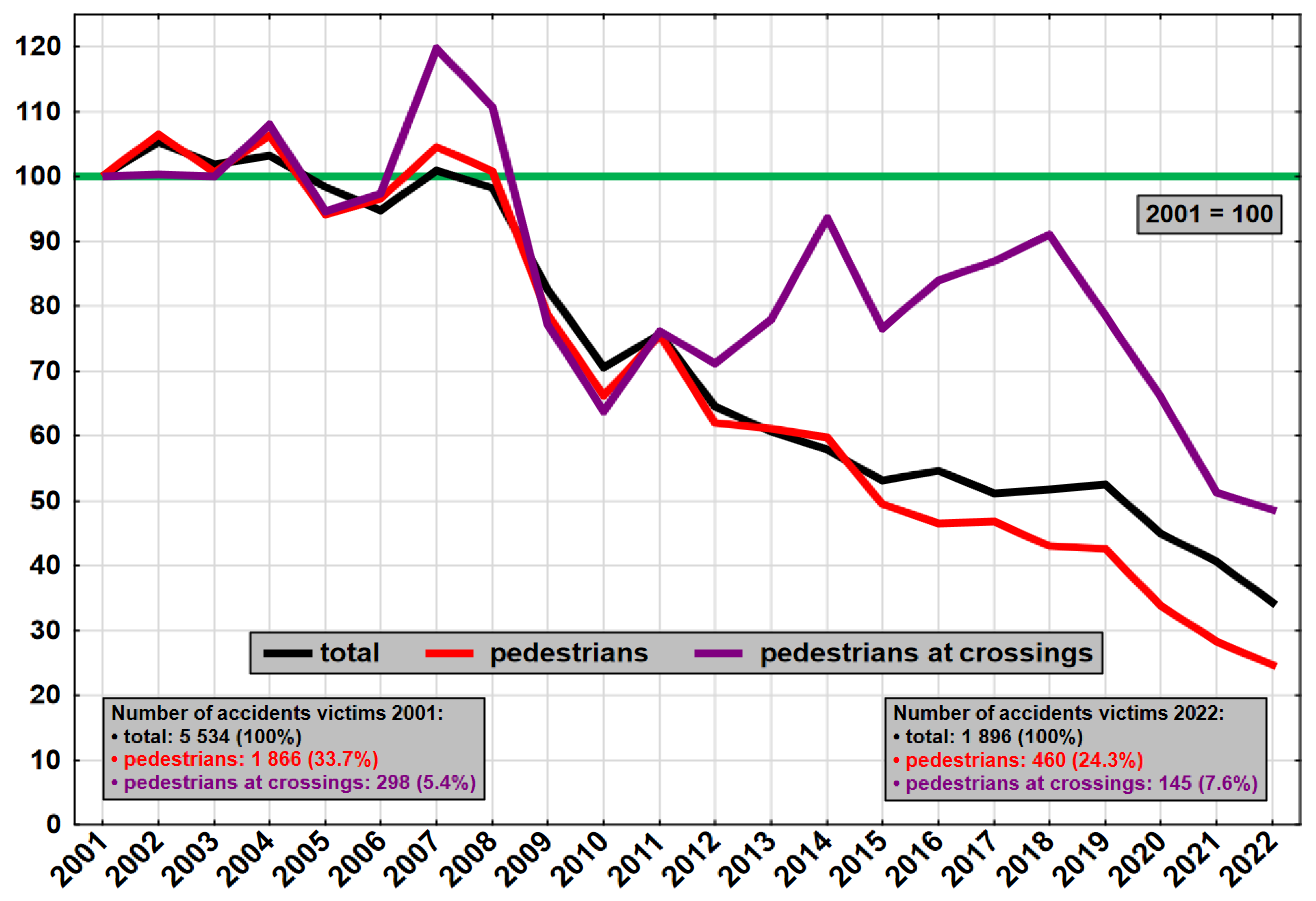
Figure 5.
Dynamics of the number of people killed in road accidents in provincial cities in total, among pedestrians and among pedestrians at crossings. Source: own study based on data from www.sewik.pl
Figure 5.
Dynamics of the number of people killed in road accidents in provincial cities in total, among pedestrians and among pedestrians at crossings. Source: own study based on data from www.sewik.pl
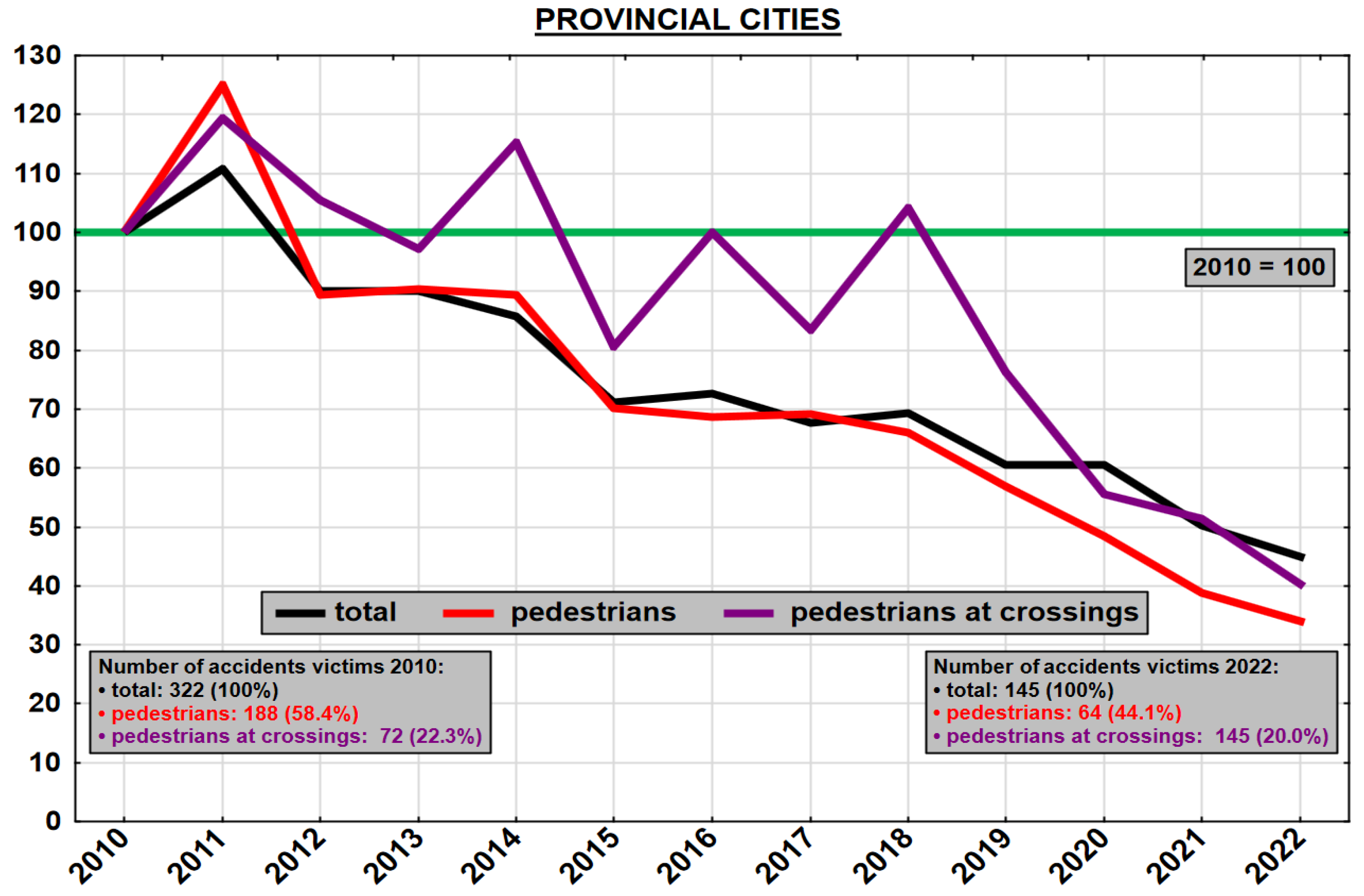
Figure 6.
Comparison of the dynamics of the number of people killed in road accidents in the districts of the Lublin Province depending on the location of the expressway in their area. Source: own study based on data from www.sewik.pl
Figure 6.
Comparison of the dynamics of the number of people killed in road accidents in the districts of the Lublin Province depending on the location of the expressway in their area. Source: own study based on data from www.sewik.pl
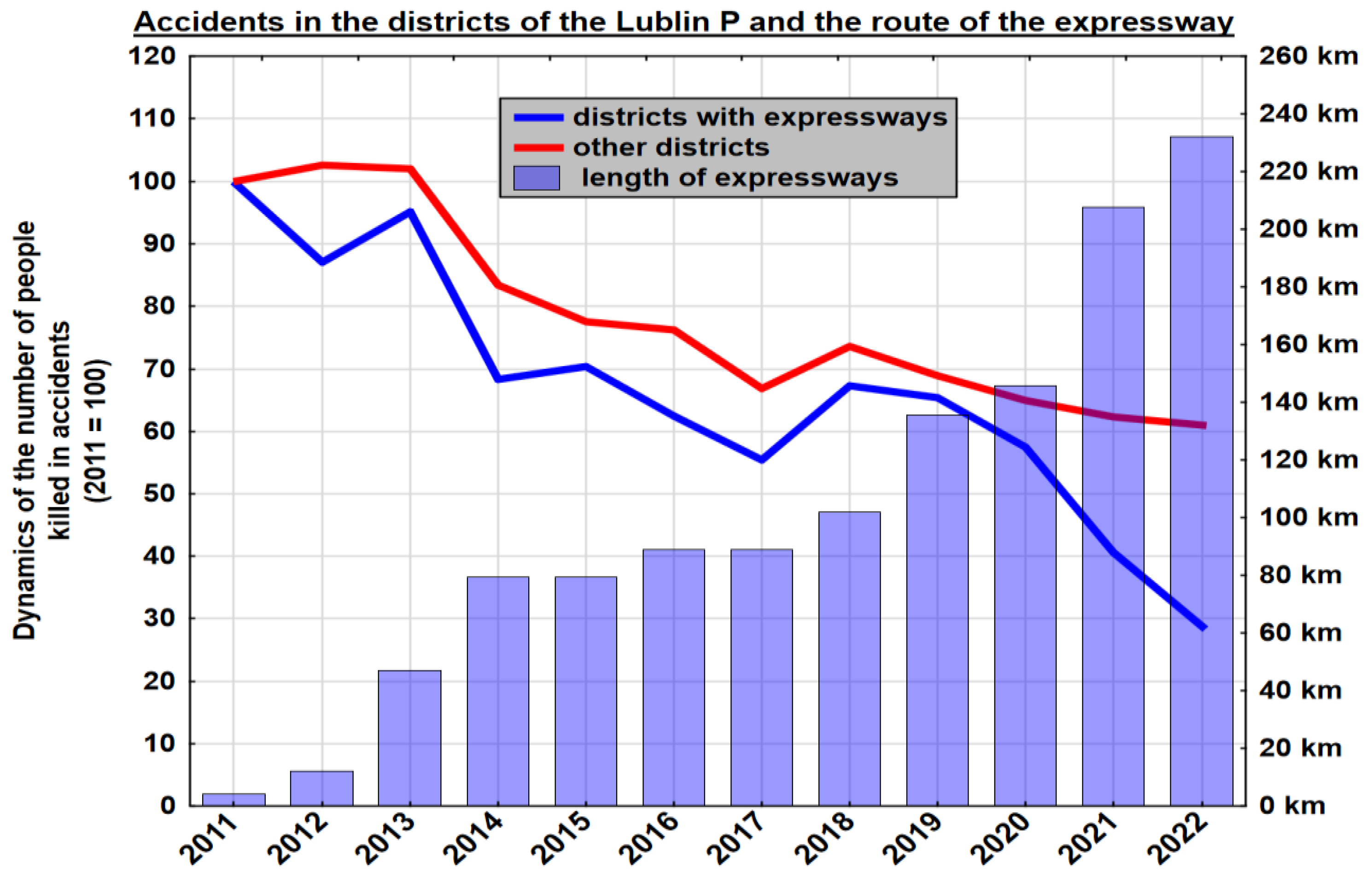
Figure 7.
Comparison of the dynamics of pedestrians killed in road accidents in the districts of the Lublin Province depending on the location of the expressway in their area. Source: own study based on data from www.sewik.pl.
Figure 7.
Comparison of the dynamics of pedestrians killed in road accidents in the districts of the Lublin Province depending on the location of the expressway in their area. Source: own study based on data from www.sewik.pl.
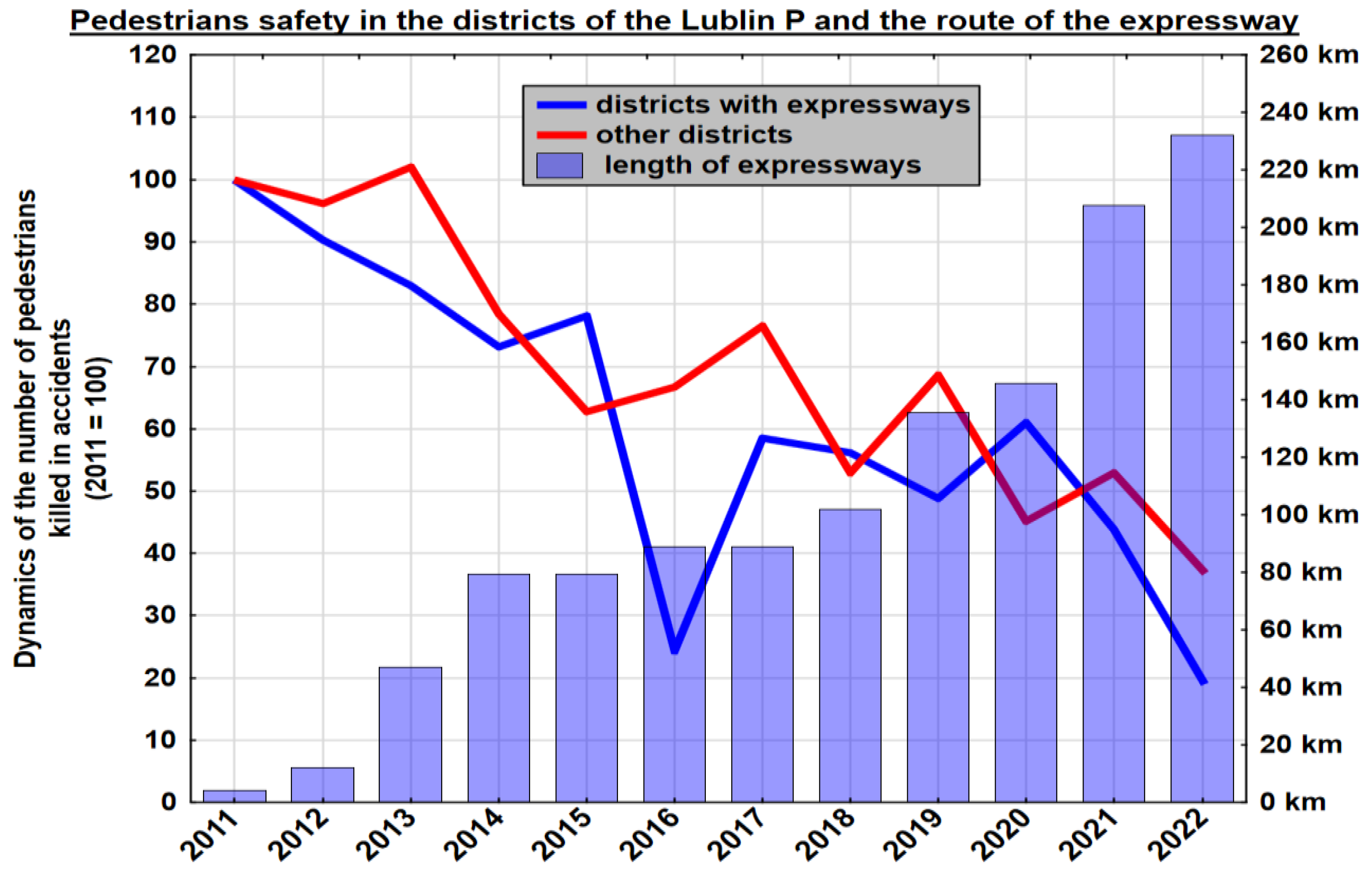

Table 1.
Change in the number of injured and victims in road accidents, and the severity index between 2019 and 2022 (including pedestrians and pedestrians at crossings)
Table 1.
Change in the number of injured and victims in road accidents, and the severity index between 2019 and 2022 (including pedestrians and pedestrians at crossings)
| Type of incident | All accidents | Pedestrians | Pedestrians at crossings | ||||||
| No.of incidents | Dynamics (2019 = 100) | No.of incidents | Dynamics (2019 = 100) | No.of incidents | Dynamics (2019 = 100) | ||||
| 2019 | 2022 | 2019 | 2022 | 2019 | 2022 | ||||
| POLAND | |||||||||
| killed | 2 909 | 1 896 | 65.2 | 793 | 460 | 58.0 | 234 | 145 | 62.0 |
| injured | 35 477 | 24 743 | 69.7 | 6 361 | 4 367 | 68.7 | 3 375 | 2 391 | 70.8 |
| severity1) | 7.6% | 7.1% | 93.9 | 11.1% | 9.5% | 86.0 | 6.5% | 5.7% | 88.2 |
| p2) | 0.0272 | 0.0064 | 0.2191 | ||||||
| PROVINCIAL CITIES | |||||||||
| killed | 195 | 145 | 74.4 | 107 | 64 | 59.8 | 55 | 29 | 52.7 |
| injured | 7 844 | 5 982 | 76.3 | 2 190 | 1 577 | 72.0 | 1 259 | 865 | 68.7 |
| severity1) | 2.4% | 2.4% | 97.6 | 4.7% | 3.9% | 83.7 | 4.2% | 3.2% | 77.5 |
| p2) | 0.8199 | 0.2498 | 0.2561 | ||||||
1) severity in this table was defined as the risk of death of the injured person, i.e., the ratio of the number of people killed to the total number of injured; 2) p value calculated using the chi-square test of independence. Source: own study based on data from www.sewik.pl
Disclaimer/Publisher’s Note: The statements, opinions and data contained in all publications are solely those of the individual author(s) and contributor(s) and not of MDPI and/or the editor(s). MDPI and/or the editor(s) disclaim responsibility for any injury to people or property resulting from any ideas, methods, instructions or products referred to in the content. |
© 2024 by the authors. Licensee MDPI, Basel, Switzerland. This article is an open access article distributed under the terms and conditions of the Creative Commons Attribution (CC BY) license (http://creativecommons.org/licenses/by/4.0/).
Copyright: This open access article is published under a Creative Commons CC BY 4.0 license, which permit the free download, distribution, and reuse, provided that the author and preprint are cited in any reuse.


