

Submitted:
12 November 2024
Posted:
12 November 2024
You are already at the latest version
Abstract
This study aims to establish the pest management approach for pests of stored maize and determine the current control practices. Semi-structured questionnaires were administered to 77 smallholder farmers from 16 villages at King Sabata Dalindyebo local municipality in Eastern Cape Province of South Africa. Results revealed that metal tanks tend to be the most preferred (81.82%) storage facility for storing maize. The study found that Sitophilus zeamaisi Motschulsky and Sitotroga cerealella (Olivier) were the major storage insect pests of maize. Farmers reported managing these pests using inorganic pesticide (84.42%) namely aluminium phosphide. The continued indiscriminate use of this pesticide in protecting stored maize in this region could be a health hazard to humans and may result in the development of pest resistance.
Keywords:
Postharvest
; Sitophilus zeamais
; aluminium phosphide
; Smallholder farmers
1. Introduction
Maize cultivation performs well in a vast range of regions, including the tropics, subtropics and temperate zones [1]. Albeit maize is predominantly grown in Latin America, Asia and sub-Saharan African countries like South Africa, where it plays a pivotal role in food security and agricultural economy [2]. The total amount of maize production worldwide is approximately 1.137 million metric tonnes [2]. In South Africa maize is the most important staple crop in terms of production and consumption [3]. Farmers normally rely on their storage techniques and knowledge to preserve maize during the long off-season period before the next harvest [4].
Maize storage practices in South Africa among commercial and smallholder farmers vary significantly and are influenced by economic resources and access technologies [5]. Commercial maize farmers predominantly use metal silos for grain storage, which is considered the most effective method in South Africa in protecting maize [6]. On the other hand, smallholder farmers mostly use inqolobane, metal containers and sack [7]. Nonetheless, these maize storage methods used by smallholder farmers are ineffective except for metal containers [8].
Maize plays a major role in the food security of small-scale farmers as food and cash crop for millions of rural farm families [9]. However, this beneficial food material has several challenges [10]. Studies in sub-Saharan Africa which includes South Africa, have shown that maize is susceptible to infestation by rodents, fungi, and insect pests during the storage period [11]. For example, farmers and workers postulated that, rodent infestation is influenced by the presence of waste and spilled grains near grain storage facilities [12]. Further, research findings have elucidated that, poor postharvest practices and storage facilities have extensively contributed on maize grain being contaminated by mycotoxin due to fungal infestation. Similarly, high temperatures and poor storage conditions favour insect pest infestations [13].
Some of the major primary insect pests of maize includes maize weevils, Sitophilus zeamais Motschulsky (Coleoptera: Curculionidae), rice weevil, Sitophilus oryzae (Linnaeus) (Coleoptera: Curculionidae), maize grain moths, Sitotroga cerealella (Olivier) (Lepidoptera: Gelechiidae) and larger grain borer, Prostephanus truncates (Horn) (Coleoptera: Bostrichidae) that directly contribute significantly to postharvest losses through feeding and reproduction, impacting the quality and quantity of stored grain [14]. Indirectly, the presence and feeding of these insect pests can elevate grain temperature and moisture levels stimulating grain deterioration and enhancing fungal activity [15].
Consequently, primary insect pests attracts secondary insect pests of maize such as rust-red flour beetle, Tribolium castaneum (Herbst) (Coleoptera: Terebrionidae), flat grain beetle, Cryptolestes pusillus (Schohnerr) (Coleoptera: Cucuridae), saw toothed grain beetle, Oryzaephilus surinamensis (Linnaeus) (Coleoptera: Silvanidae) and grain mites, Acarus siro (Linnaeus) (Acarina: Acaridae), which cannot damage the whole grain but infest grains that are either mechanically damaged or previously infested by primary pests [16].
Various methods have been used in the management of these insect pests, including chemical control, biological control, cultural control, and others [17]. Nonetheless, the use of inorganic pesticides like aluminium phosphide, malathion, ethyl formate, etc., has been reported as the commonly preferred method in managing insect pests of maize [18]. However, the extensive usage of these pesticides results in resistance to targeted pests like maize weevils reducing their effectiveness [19]. Moreover, there are growing concerns on human health hazards and contamination of the environment at large due to excessive use of inorganic pesticides [20]. Thus, there is a need to develop integrated pest management approach that is safe and cost-effective for smallholder farmers [21].
Despite of these challenges caused by storage pests of maize, there is a paucity of information on farmers’ knowledge and practices in managing these pests in some parts of Eastern Cape province [22]. To establish effective pest management approaches for smallholder farmers, this study aims to delineate their knowledge and current control practices. Thus, the objectives of the current study were to: (1) document methods used by smallholder farmers to store maize; (2) evaluate farmers’ knowledge of storage pests of maize; (3) determine practices used by farmers in managing storage pests of maize.
2. Materials and Methods
2.1. Study Area
The study was conducted in King Sabata Dalindyebo local municipality (KSDM) (31° 38’ 15.8” S, 28° 30’ 30.1” E) under Oliver Reginald Tambo District Municipality (ORTDM) in the Province of Eastern Cape, South Africa. The specific study sites in KSDM were 16 villages (Baziya, Nyibeni, Ndibela, Ngcotyeni, Bityi, Gunjane, Mokolweni, Etafeni, Kukhambi, Kugutya, Manyosini, Chanti, Qunu, Krakra, Noncwenga and Mayenge). According to KSDM annual report [23], The KSDM is the largest from the five local municipalities within ORTDM in terms of surface area, which covers about 302 700 hectares with approximately 520 000 human population. The annual rainfall in the ORTDM varies, but on average, it’s about 900 millimetres per year [24]. Rainfall is usually higher during the summer months, between December and February, while winters are generally drier. Farming systems are diverse with subsistence farming being common among local communities. Additionally, maize, sorghum, beans, and vegetables are among the staple crops grown by smallholder farmers [25].
2.2. Data Collection
The questionnaire survey was conducted from November 2023 to March 2024 to determine farmers’ current knowledge and control practices for maize storage insect pests. Purposive sampling was conducted, where farmers who are willing to participate were selected from 16 villages. The list of the farmers came from Ukhanyo Farmer Development (UFD) and the Department of Rural Development and Agrarian Reform (DRDAR). A semi-structured questionnaire with both open and closed ended questions were administered to 77 smallholder farmers. Prior administering the questionnaire, the purpose of the study was explained to all farmers and written consent obtained. The questionnaire was piloted using 10 farmers to ensure its validity. Information sought includes, (i) farmers socio-demographic profile, (ii) farm characteristics, (iii) purpose of farming maize, and (iv) facilities used to store maize and their knowledge on stored maize pests, and v) control practices used for maize weevils.
2.3. Data Analysis
Questionnaire data were summarized, and descriptive data analysis conducted using frequencies and percentages Microsoft excel 365.
3. Results and Discussion
3.1. Socio-Demographic Characteristics of Farmers
A total of 77 farmers from 16 villages in ORTDM in Eastern Cape Province (ECP) participated in the current study. The results show the majority of the maize farmers were males (71.43%), while the remaining (28.57%) were females (Table 1). This result agrees with other research findings on gender differences in agriculture. For example, Agbugba et al. [26] reported that in Amathole District in ECP from a total of 109 farmers 66.1% were males. Similarly, Kibirige [27] indicated that in Chris Han District in ECP 66% of farmers were males. These findings can be attributed to the fact that most households are headed by men [24]. Additionally, agricultural land is normally allocated to males than females due to sociocultural norms and patriarchal constructs [28].
In terms of age, education and farming experience, the current study found that majority (62.34%) of farmers were elderly people above 56 years, over 90% of them had formal education and 76.62% had 10 years of farming experience (Table 1). Similar findings were reported by Afolayan et al. [29], who found that most farmers in OR Tambo District, Amathole District and Chris Han District in ECP were above 56 years and more than 90% farmers had formal education (primary, secondary and tertiary) with over 10 years of farming experience. These results may be true that farming is practiced by older age group of people in Eastern Cape Province because youth in rural areas are migrating to cities in search of better living and opportunities [30]. On the other hand, the education and farming experience plays a pivotal role for farmers in understanding and adoption of sustainable practices for effective farming performance [31].
3.2. Farm Characteristics
The result of the current study shows that most farmers (70.13%) had 1 hectare (Figure 1) and predominantly used their land for cultivating yellow maize (90.91%) than white maize (3.90%), and only 5.19% cultivated both yellow and white maize. Similar results were reported by Mdoda and Gidi [32], which demonstrates that majority (60%) of smallholder farmers from OR Tambo, Amathole and Chris Hani Districts in ECP, their farm size was ranging from 0.5 to 2.5 hectares and 50.6% of them are growing maize. Moreover, Sibanda et al. [33] reported that the majority (70.8%) of smallholder farmers preferred yellow maize than white maize. This can be attributed to the fact that yellow maize has multipurpose by feeding livestock, poultry and for human consumption, which then make it to have a better market value [33].
3.3. Purpose of Farming
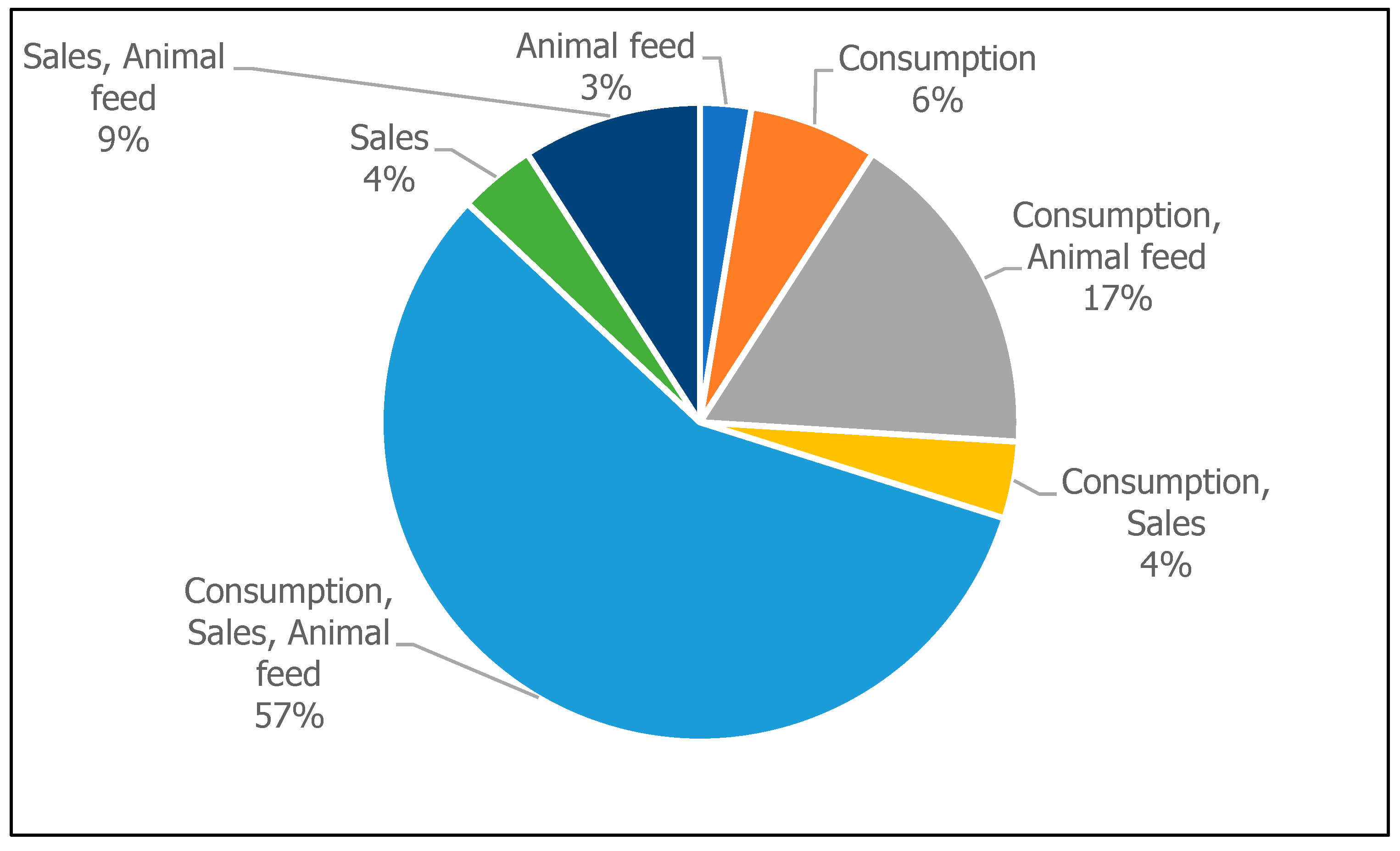
Maize was mainly grown and stored for human consumption, income generating and for feeding livestock by most farmers (57%) (Figure 2). Whereas 3% of the farmers used their maize as livestock feed (Figure 4). These findings concur with the results reported by Nzeyimana and Odularu [34], which shows that 67.8% of farmers use maize for various purposes such as human consumption, livestock feed and generating income. This shows that maize has multifunctional role in agriculture and significantly contribute to household food security [35].
Figure 4.
Percentage of farmers and how they use stored maize.
3.4. Facilities Used to Store Maize, Storage Forms of Maize, Farmers’ Knowledge of Storage Pests and Control Practices
A large proportion of farmers (81.82%) in the current study store their maize in metal tanks, followed by those who store maize in sacks in their houses (7.79%) (Table 2). Conversely, Thamaga-Chitja [8] reported about 20 years ago that 52% of farmers in KwaZulu Natal used inqolobane to store maize as opposed to metal tanks and sacks. The results shows that the farmers are progressively moving from the use of traditional storage techniques to modern ones [23]. The reason being the modern techniques for storing maize, such as hermetic bags and metal containers offer noteworthy advantages in reducing postharvest losses, particularly from insect pests [36]. However, they present challenges such as high initial cost and advance knowledge for implementation, as that can impede their adoption by smallholder farmers [37].
The current study found that most farmers (97.40%) stored their maize in shelled form, and the stored maize was mostly infested by maize weevils (89.61%) and maize grain moths (74.03%) (Table 2). These results are in consonance with many other studies. For example, Mendoza et al. [38], stated that 90% of farmers dry their maize and store them in a shelled form. The reason being shelled maize is less liable to spoilage and infestation by pests. The removal of the protective husk lowers the moistness and provides less conducive conditions for microbial growth [39]. In this region, farmers managed maize storage pests mostly through phosphine fumigation in the form of aluminium phosphide tablets (84.42%) (Table 2). Megerssa et al. [40], reported that in Ethiopia, about 58.7% of farmers had insects as their most common pest of stored maize, with maize weevils being the most important followed by maize grain moths. Furthermore, Megerssa et al. [40] observed most farmers (75.3%) use inorganic pesticides like aluminium phosphide compared to traditional practices (17%) like the use botanical biopesticides and cultural practices. Their findings support those reported in this study.
Despite the effective contribution of aluminium phosphide in pest management, its indiscriminate usage has led to acute and chronic harmful effects on humans and the development of resistance by the insect pests [41]. The side effects are likely to affect maize farmers in the Eastern Cape, South Africa. To safeguard aluminium phosphide poisoning, farmers should implement safety measures like participating in training programs and using personal protective equipment (PPE) when using this chemical [42,43]. We intend to start sensitizing maize farmers in this region and propose training workshops to address this danger.
3.6. Conclusion and Recommendations
Subsistence farmers mostly had formal education which helped those adopting recent storage innovations like using metal tanks than traditional silos for storing their maize. Most of them had a farm size of 1 hectare and predominantly cultivated yellow maize. Metal tanks tend to be the most preferred storage facility for storing maize. Even though this method is likely to favour pest infestation, especially the weevils. Several weevil species are known to infest stored maize. Nonetheless, only one weevil species was reported Sitophilus zeamais and a moth Sitotroga cerealella. There is a possibility that other stored maize pests occur in this region but were not detected during the current study. The study found that insect pest control tactics were dominated by chemical pesticides namely aluminium phosphide. Concern for human health-related issues emanating from the use of this pesticide in preserving maize, necessitates an effort to find alternative methods that are safe to supplement this current method.
Funding
This research received no external funding.
Ethical statement
The ethical clearance certificate was obtained for this study at Walter Sisulu University, here is the protocol number-WSU/FNS-GREC/2024/02/11/G12.
Authorship contribution statement
Bongumusa Charles Gumede: Writing – original draft, Methodology, Investigation, Formal analysis, Writing – review & editing. Simon Kamande Kuria: Writing – review & editing, Methodology, Supervision.
Informed Consent Statement
All participants provided informed consent to participate in the study, and data were anonymised, treated confidentially, and stored securely.
Data Availability Statement
The data presented in this study are available in the tables, figures of the current manuscript.
Acknowledgments
The authors would like to appreciate and recognize the contributions of Ukhanyo Farmer Development (UFD), Department of Rural Development Agrarian Reform (DRDAR), Mentors from UFD, Extension officers from DRDAR for providing necessary information about maize farmers and assisting in administration of questionnaires. We are extremely thankful to all maize farmers from KSD municipality for participating in our questionnaires. Extend our gratitude to Walter Sisulu University, Department of Biological and Environmental Sciences, Mthatha Campus for assisting us with transportation.
Conflicts of interest
The authors declare that there are no conflicts of interest regarding this work.
References
- L. Kuonen, L. Norgrove, Mulching on family maize farms in the tropics: A systematic review, Current Research in Environmental Sustainability 4 (2022) 100194. [CrossRef]
- O. Erenstein, M. Jaleta, K. Sonder, et al., Global maize production, consumption and trade: trends and R&D implications, Food security 14(2022) 1295-1319.
- A. Diko, W. Jun, Influencing factors of maize production in South Africa: The Case of Mpumalanga, free state and North West Provinces. Asian Journal of Advances in Agricultural Research, 14(2020), pp.25-34.
- H. Machekano, B.M. Mvumi, R. Rwafa, Postharvest knowledge, perceptions and practices of African small-scale maize and sorghum farmers, Julius-Kühn-Archiv (2018).
- A. Boakye, Estimating agriculture technologies’ impact on maize yield in rural South Africa, SN Business & Economics 3(2023) 149.
- K.N. Nwaigwe, An overview of cereal grain storage techniques and prospects in Africa, Journal of Bioscience and Bioengineering 4 (2019) 19-25.
- L.M. Mangena-Netshikweta, D.R. Katerere, P. Mngqawa, Grain production by rural subsistence farmers in selected districts of Limpopo and Mpumalanga provinces of South Africa, Botswana Journal of African Studies 30(1) (2016).
- J.M. Thamaga-Chitja, S.L. Hendriks, G.F. Ortmann, et al., Impact of maize storage on rural household food security in Northern Kwazulu-Natal, Journal of Consumer Sciences 32 (2004). [CrossRef]
- R. Santpoort, The drivers of maize area expansion in sub-Saharan Africa. How policies to boost maize production overlook the interests of smallholder farmers, Land 9(2020) 68. [CrossRef]
- J. Swai, E. Mbega, A. Mushongi, and P. Ndakidemi, Post-harvest losses in maize store-time and marketing model perspectives in Sub-Saharan Africa, Journal of Stored Products and Postharvest Research 10 (2019).
- N. Fufa, T. Zeleke, D. Melese, et al., Assessing storage insect pests and post-harvest loss of maize in major producing areas of Ethiopia, International Journal of Agricultural Science and Food Technology 7(2021) 193-198.
- S. Khanam, M. Mushtaq, Farmers’ knowledge, attitudes and practices towards rodent pests and their management in rural Pothwar, Pakistan, Pure and Applied Biology (PAB) 10(2021) 1181-1193.
- H.T. Duguma, Indigenous knowledge of farmer on grain storage and management practice in Ethiopia, Food and Science Nutrition Technology 5(2020) 1-4.
- M. Tadesse, Post-harvest loss of stored grain, its causes and reduction strategies, Food Science and Quality Management 96 (2020) 26-35.
- M.B. Saeed, M.D. Laing, Biocontrol of maize weevil, Sitophilus zeamais Motschulsky (Coleoptera: Curculionidae), in maize over a six-month storage period, Microorganisms 11(2023): 1261.
- M. Berhe, B. Subramanyam, M. Chichaybelu, et al., Post-harvest insect pests and their management practices for major food and export crops in East Africa: An Ethiopian case study, Insects 13(2022) 1068. [CrossRef]
- K.D. Ileke, L.C. Nwosu, and E.O. Emeribe, Control of stored products arthropod pests, Forensic Entomology (2023) 75.
- S. Tiwari, R.B. Thapa, S. Sharma, Use of botanicals for weevil management: An integrated approach of maize weevil (Sitophilus zeamais) management in a storage condition, Journal of the Institute of Agriculture and Animal Science 35 (2018) 167-72. [CrossRef]
- I.A.T. de Araújo Ribeiro, R. da Silva, A.G. da Silva, et al., Chemical characterization and insecticidal effect against Sitophilus zeamais (maize weevil) of essential oil from Croton rudolphianus leaves, Crop protection 129 (2020) 105043.
- M.S. AL-Ahmadi, Pesticides, anthropogenic activities, and the health of our environment safety, In Pesticides-use and misuse and their impact in the environment, IntechOpen (2019).
- C.A. Damalas, S.D. Koutroubas, Farmers’ exposure to pesticides: toxicity types and ways of prevention, Toxics 1 (2017) 1-10. [CrossRef]
- P.A. Mkenda, E. Mbega, P.A. Ndakidemi, Accessibility of agricultural knowledge and information by rural farmers in Tanzania-A review, Journal of Biodiversity Environmental Sciences 11 (2017) 216-228.
- KSDM DRAFT ANNUAL REPORT 2022-2023, https://lg.treasury.gov.za/supportingdocs/EC157/EC157_Annual%20Report%20Draft_2023_Y_20240205T131821Z_nomandelan.pdf.
- M. Mtyobile, S. Mhlontlo, Evaluation of tillage practices on selected soil chemical properties, maize yield and net return in OR Tambo District, South Africa, Journal of Agricultural Extension and Rural Development 13(2021) 158-164.
- Eastern Cape Provincial Government (ECPG). The Eastern Cape – The Home of Legends (2021/2023), https://ecprov.gov.za/the-eastern-cape.aspx.
- I.K. Agbugba, M. Christian, A. Obi, Economic analysis of smallholder maize farmers: Implications for public extension services in Eastern Cape, South African Journal of Agricultural Extension 48 (2020) 50-63. [CrossRef]
- D. Kibirige, Smallholder commercialization of maize and social capital in the Eastern Cape Province of South Africa. International Journal of Economics, commerce and management, 4(2016), pp.236-252.
- Chiwuzie, E.M. Prince, S.T. Olawuyi, Women and Land Governance in Selected African Countries: A Review, Journal of Law, Society and Development 9 (2022) 1-12.
- A.J. Afolayan, P. Masika, O.O. Odeyemi, Farmers' knowledge and experience of indigenous insect pest control in the Eastern Cape province of South Africa, Indilinga African Journal of Indigenous Knowledge Systems 5(2006) 167-174. [CrossRef]
- S. Qange, L. Mdoda, Factors affecting subsistence farming in rural areas of Nyandeni local municipality in the Eastern Cape Province, South African Journal of Agricultural Extension 48(2020) 92-105.
- D. Bese, E. Zwane, P. Cheteni, The use of sustainable agricultural methods amongst smallholder farmers in the Eastern Cape province, South Africa, African Journal of Science, Technology, Innovation and Development 13(2021) 261-271. [CrossRef]
- L. Mdoda, L.S. Gidi, Impact of Land Ownership in Enhancing Agricultural Productivity in Rural Areas of Eastern Cape Province, South African Journal of Agricultural Extension 51(2023) 1-23.
- M. Sibanda, A. Mushunje, C.S. Mutengwa, Factors influencing the demand for improved maize open pollinated varieties (OPVs) by smallholder farmers in the Eastern Cape Province, South Africa, Journal of Cereals and Oilseeds 7(2016) 14-26. [CrossRef]
- E. Nzeyimana, G. Odularu, Small holder farmers’ postharvest management behaviour and influence on maize production cycle in Rwanda, International Journal of Scientific and Research Publications 14 (2024) 93-105.
- M.G. Nenna, E.G. Osegbue, C.G. Ojiako-Chigozie, Assessment of Maize Storage Techniques Utilized by Small Scale Farmers in Anambra State, Nigeria, International Journal of Agriculture and Earth Science 5(2023)1-14. [CrossRef]
- T.K. Mekonen, B.Y. Wubetie, Determinants of the use of hermetic storage bags for maize storage among smallholder farmers in northwest Ethiopia, Advances in Agriculture 2021(2021) 6644039. [CrossRef]
- S. Tiwari, R.B. Thapa, S. Sharma, Use of botanicals for weevil management: An integrated approach of maize weevil (Sitophilus zeamais) management in a storage condition, Journal of the Institute of Agriculture and Animal Science 35 (2018) 167-72. [CrossRef]
- J.R. Mendoza, L. Sabillón, R. Howard, et al., Assessment of handling practices for maize by farmers and marketers in food-insecure regions of Western Honduras, Journal of Agriculture and Food Research 16 (2024) 101140. [CrossRef]
- C.N. Nwogu, B.N. Nwankwojike, O.S. Onwuka, et al., Design and Development of a Second-class Lever for Maize Shelling Operation (2024).
- M. Megerssa, M. Negeri, E. Getu, Farmers’ perceptions, existing knowledge and current control methods of major stored maize grain insect pests in West Showa, Ethiopia, Archives of Phytopathology and Plant Protection 54(2021) 1778-1796. [CrossRef]
- Y.M. Shabana, M.E. Abdalla, A.A. Shahin, et al., Efficacy of plant extracts in controlling wheat leaf rust disease caused by Puccinia triticina, Egyptian Journal of Basic Applied Sciences 1 (2017) 67-73. [CrossRef]
- S. Katwal, K. Malbul, S.K. Mandal, et al., “Successfully managed aluminium phosphide poisoning: A case report”. Annals of Medicine and Surgery 70 (2021) 102868.
- L. Shi, T. Jian, Y. Tao, et al., Case report: acute intoxication from phosphine inhalation, International Journal of Environmental Research and Public Health 20(2023) 5021.
Figure 1.
Farm size under maize cultivation in KSD municipality.


Table 1.
Socio-demographic information of small-scale farming in KSD municipality.
| Variables | Frequency | Percentage (%) | |
|---|---|---|---|
| Gender | Male | 55 | 71.43 |
| Female | 22 | 28.57 | |
| Age (years) | 18-35 | 4 | 5.19 |
| 36-55 | 25 | 32.47 | |
| 56+ | 48 | 62.34 | |
| Education level | None | 12 | 15.58 |
| Primary | 21 | 27.27 | |
| Secondary | 38 | 49.35 | |
| Tertiary | 6 | 7.79 | |
| Farming experience (years) | 1 | 1 | 1.30 |
| 2-5 | 11 | 14.29 | |
| 6-9 | 6 | 7.79 | |
| 10+ | 59 | 76.62 |
Table 2.
Maize storage, storage form and pest control practices.
| Variables | Frequency | Percentage (%) |
|
|---|---|---|---|
| Methods used to store | Metal tanks | 63 | 81.82 |
| Metal tanks and sacks in residential houses | 8 | 10.39 | |
| Sacks in residential houses | 6 | 7.79 | |
| Storage form | Shelled maize | 75 | 97.40 |
| Unshelled maize | 2 | 2.60 |
|
| Maize weevils infestation | Yes | 69 | 89.61 |
| No | 8 | 10.39 | |
| Other pests apart from maize weevils | Grain moths | 57 | 74.03 |
| Control practices | Use of chemical (Aluminium Phosphide) | 65 | 84.42 |
| Use of chemical (Aluminium Phosphide) and other control practices (dry pepper, camphor and wood ash) | 10 | 12.99 | |
| Doing nothing | 1 | 1.30 | |
| Removing affected grains | 1 | 1.30 | |
Disclaimer/Publisher’s Note: The statements, opinions and data contained in all publications are solely those of the individual author(s) and contributor(s) and not of MDPI and/or the editor(s). MDPI and/or the editor(s) disclaim responsibility for any injury to people or property resulting from any ideas, methods, instructions or products referred to in the content. |
© 2024 by the authors. Licensee MDPI, Basel, Switzerland. This article is an open access article distributed under the terms and conditions of the Creative Commons Attribution (CC BY) license (http://creativecommons.org/licenses/by/4.0/).
Copyright: This open access article is published under a Creative Commons CC BY 4.0 license, which permit the free download, distribution, and reuse, provided that the author and preprint are cited in any reuse.


