

Submitted:
11 November 2024
Posted:
12 November 2024
You are already at the latest version
Abstract
The development of the Arctic is a priority for the Russian government as it has great economic potential. However, the benefits for indigenous population are unclear, as economic expansion affects traditional livelihoods and social development, and oil and gas extraction affect the environment, as well as very little is known about the transformations in Russian indigenous communities. In this paper relevant policies and data analysis of economic development are used to identify gaps in the Arctic agenda of the Russian Federation. The research builds on the conceptual foundations of social-environmental frameworks, policy management and livelihoods. Statistical analysis is used to find correlations in socio-economic data published by The Federal State Statistics Service. The authors go on to propose new indicators for the assessment of traditional lifestyles. The results show that despite rapid development of the market economy, as well as an expansion of oil and gas companies’ activity in the Arctic, there are not enough policies to provide redistribution of the revenue to improve indigenous livelihoods. An evaluation of metrics and examination of related legislative documents as well as a literature review also support the idea that indigenous people benefit little from the current socio-economic situation.
Keywords:
traditional economy
; subsistence economy
; indigenous livelihoods
; social-environmental frameworks
; policy management
1. Introduction
The administrative division of the Russian Federation has a federal type and comprises six types of federal subjects (excluding Ukrainian territories): 21 republics, nine krais, 46 oblasts, two federal cities, autonomous oblast and four autonomous okrugs Constitution of the Russian Federation, 1993. In addition to the official administrative-territorial division, in accordance with [1,2] Federal Districts were created, which are not provided for by the Constitution of the Russian Federation. At the same time, each district has an authorised representative of the President of the Russian Federation in the federal district. The representative coordinates the work of federal executive bodies existing at the district level. Some administrative-territorial units lie within the so-called Arctic zone of the Russian Federation. The term “Arctic zone of the Russian Federation” (AZRF) was introduced by the Soviet Council of Ministers’ Arctic Commission on April 22, 1989, and includes nine regions: the Sakha Republic, or Yakutia; Krasnoyarsk Krai; Murmansk Oblast; Arkhangelsk Oblast; Nenets Autonomous Okrug; Chukotka Autonomous Okrug; Yamalo-Nenets Autonomous Okrug; Komi Republic; and the Republic of Karelia. The AZRF covers four federal districts: Northwestern Federal District, Ural Federal District, Siberian Federal District and Far Eastern Federal District [3].
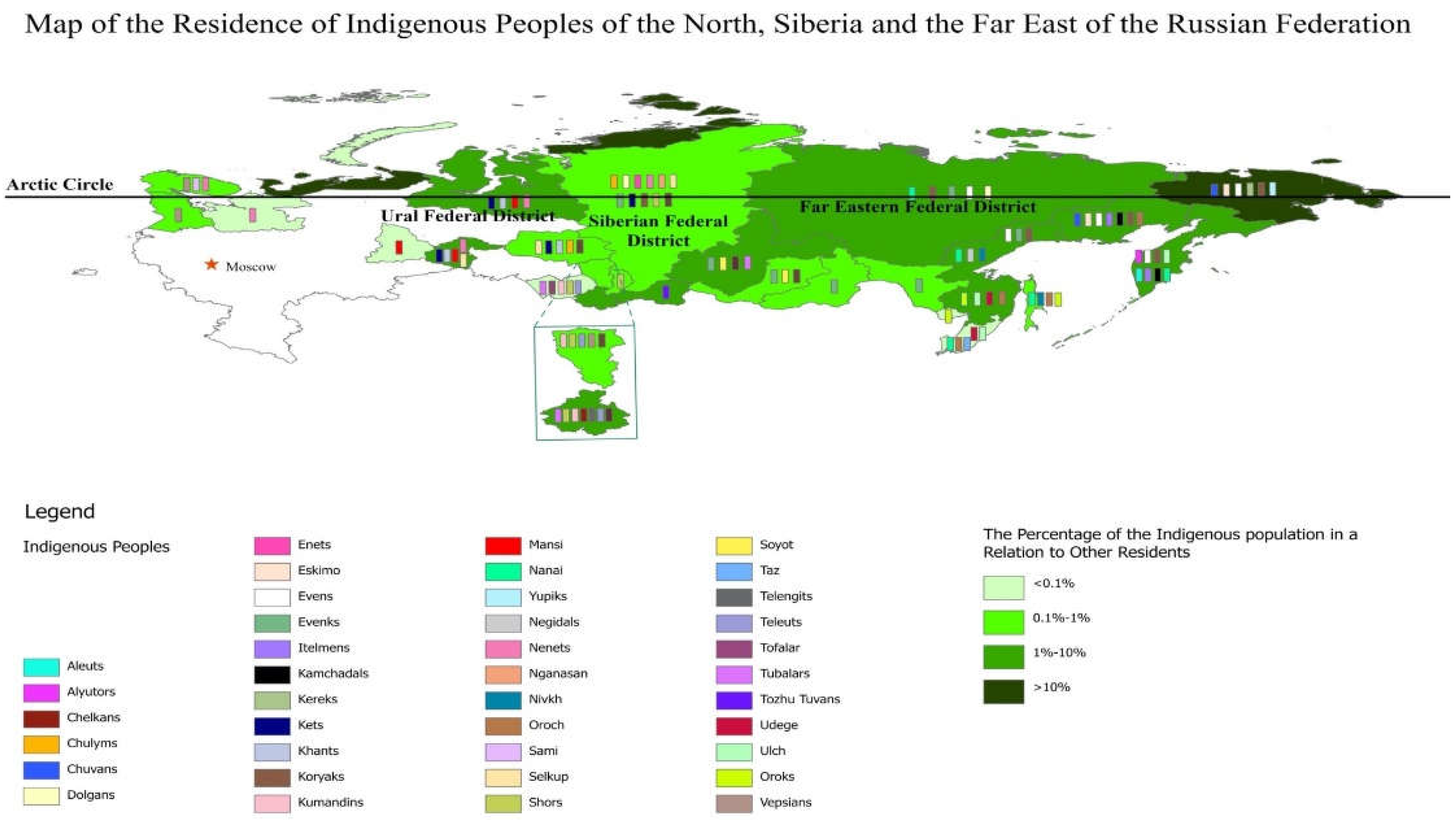
The Arctic zone of Russia covers 4.8 million km² (28% of the country). According to [4] it is home to 2.6 million indigenous and non-indigenous peoples, more than half the population of the global Arctic. Figure 1 shows the indigenous peoples of Russia, as well as places of their residence. The map was created based on the latest population Census held in 2020. Forty different ethnic groups of indigenous peoples live in Russia. The density of indigenous population was calculated for different federal subjects of the Russian Federation. As shown on the map, the territories with the greatest density of the indigenous population (more than 30%) are situated above the Arctic Circle and now are parts of Arkhangelsk Oblast, Krasnoyarsk Krai and Chukotka Autonomous Okrug. It is important to note that until 2007, the territory within Krasnoyarks Krai was an independent administrative unit: Taimyr (Dolgan-Nenets) Autonomous Okrug. However, after an enlargement of administrative units in Russia, this territory ceased to exist and was included in the nearby regions. However, a fieldwork survey [5], 2019 conducted after the unification of administrative units showed that the indigenous people were dissatisfied with the consequences of the unification. It was argued that the region began to be treated as a resource base, and the number of federal services (allocation of budget funds and qualified personnel, social support) which were specially provided to these autonomous regions has significantly decreased.
[6] provides statistics showing that there are 85,000 people living in the places of traditional residence and traditional economic activities in the AZRF in 2023 which were allocated by the Government [7]. Most people living in these territories follow traditional subsistence livelihoods, which according to [8] include animal husbandry (including nomadic husbandry such as reindeer breeding, horse breeding, yak breeding, sheep breeding), fishing, commercial hunting, processing and sale of hunting products, farming and breeding, processing of medicinal plants, indigenous arts and crafts and folk crafts, and construction of traditional dwellings [9]. The importance of this special socio-economic structure for preserving northern indigenous communities’ identity has been emphasised by many researchers e. g. [10,11,12]. However, when studying governance in the Russian Arctic, a few Russian researchers emphasise that authorities do not consider the specifics of the traditional socio-economic structure as a determining factor in governance policy e. g. [13]. Therefore, it is relevant to assess how the current policy landscape appears in the light of the need of indigenous peoples to support their traditional livelihoods. To perform such an assessment the paper was divided to cover three main areas.
Figure 1.
A map of the Residence of Indigenous Peoples of the North, Siberia and the Far East of the Russian Federation Created by the authors, based on the statistic numbers from [14].
Figure 1.
A map of the Residence of Indigenous Peoples of the North, Siberia and the Far East of the Russian Federation Created by the authors, based on the statistic numbers from [14].
First, the relations between economic growth in the Russian Arctic and social development of indigenous peoples in this region are little studied. At the same time, it is important to understand to what extent the indigenous population are the beneficiaries of all exported oil and gas of the Russian Federation, as according to [15] indigenous peoples inhabit most of the areas containing oil and gas deposits in the Russian Arctic and sub-Arctic. This paper will, therefore, evaluate whether market economy expansion contributes to social development of indigenous communities. Second, Russia strives to implement a policy that has contradictory elements. Failures in complex planning appear due to the intention of authorities to implement a policy based both on international priorities and national interests. This paper attempts to identify contradictions and offers potential solutions based on a socially and environmentally oriented conceptual framework. Third, there is a lack of assessment by [6], which provides only very generalized information on a limited number of indicators. Based on this information, it is difficult to analyse all aspects and consequences of regional management. This paper will recommend evidence-based replacement of some indicators and additional indicators that might be deployed.
Modern concepts of equality, and national and cultural identity of indigenous peoples have evolved throughout the 20th century and have been enshrined in several international documents. Separation of the term “indigenous” in relation to a group of the population first occurred in [16,17,18,19,20]. In Russia, the rights of indigenous people appear at different levels of the legislation system. They are mentioned in the “Concept of State National Policy” [21]. In 1998, the Russian Federation ratified the Framework Convention for the Protection of National Minorities, which strengthened the legal status of the indigenous peoples. [22] (article 69) guarantees the rights of indigenous peoples. The rights of indigenous peoples are enshrined in several federal laws [2,4,23]. Moreover, In Russia, there are special documents describing the governance of the Arctic zone and the life of the indigenous peoples: [24,25,26,27]. [24,25] are two fundamental documents which were issued by the Government of The Russian Federation to formulate modern Arctic’s agenda in Russia.
Russian researchers follow the legislative framework proposed by the Russian Government which defines priority areas for studies of indigenous peoples in the Russian Arctic. Their works in social science, however, use approaches which differ from a western perspective. For example, one of the differences of Western science from its Russian counterpart is a prioritization of an indigenous identity as a key factor for economic and social sustainability in the Arctic under ongoing environmental changes [28,29,30]. It is important to note that the same priorities are stipulated in international initiatives e.g., [31] and in some national Arctic strategic documents [32,33,34]. Regarding natural science in the Arctic, Western researchers perform an extensive study of current changing bio-physical conditions in the Arctic (e. g. such natural conditions as: melting permafrost, shifting vegetation and altered characteristics of Arctic cyclones) e.g., [35,36,37]. Meanwhile, Russian researchers in natural science focus on computer reconstruction of biological or climatic situations in the past in the Arctic region e. g. [38,39,40] and the state of the permafrost e. g. [41]. Topics regarding the extraction of minerals prevail over other issues in many Russian social science research papers. Even in papers that consider the social development of the region, the importance of oil and gas extraction is explained as a key factor for the well-being of the local population e. g. [42,43]. Even though a few authors [44,45] emphasise the importance of diversification of economic activities in a more ecologically sound manner, they still believe that currently the oil and gas extraction benefits communities, largely in the way that it contributes to local budgets. However, these papers do not investigate if there is indeed a real and positive correlation between the intensification of the oil and gas extraction and the improvement of population well-being. Generally, it is a noticeable feature of many studies that they were conducted within conceptual framework provided by a series of decrees [24,25,26,27] which are the agenda setting documents and form the strategy for the development of the AZRF. These documents all together create an Agenda for the development of the Russian Arctic; however, as each document specifies a particular level of a policy’s implementation, including a general provision and a framework, a more detailed sectoral plan for the Arctic’s development until 2035, as well as specific projects for the implementation of general provisions and a sectoral plan, the resultant agenda is overly complex and subject to internal contradictions.
Other Russian authors perform an analysis of agenda-setting documents that are devoted to such issues as the correspondence of terminology and formulations. For example, the discrepancy between Russian practice and foreign standards in such key terms as: “indigenous peoples” and “indigenous national minorities”; “nation” and “nationality” is described in works [46,47]. Terminological inconsistencies affect the rights of indigenous peoples to land, and when it comes to the participation in some specific supportive initiatives [48]. This problem appeared when Russia did not adopt The United Nations Declaration on the Rights of Indigenous Peoples. According to [20] (articles 29-31) “Indigenous peoples have the right to own and control the lands they possess, as well as the right to compensation for the taking of their lands. States shall provide legal recognition of their lands through fair and open processes”. However, in Russian legislative terminology [49] “indigenous peoples” call “indigenous population”, and they don’t possess the rights to own the land. This land is rented to them by the State. Moreover, [50] note the vague wording and an absence of a timeline at Arctic’s agenda-setting documents. The policy analysis is mainly performed within the context of [24,25,26,27], however, it is important to consider both national and international initiatives, as authorities strive to implement a policy based on both international priorities and national interests. These two directions have many contradictory points. While [31] prioritize social and environmental problems, an extensive development of natural resources is an important part of [24,25] (see above). Moreover, many Russian and non-Russian papers regarding socio-economic assessment in the AZRF e. g. [51,52,53] have a common problem: insufficient statistical data for an effective analysis. However, there are few papers specifically addressing the development of socio-economic indicators for the evaluation of oil and gas production impacts on Indigenous populations [54]. [55,56] produce a set of indicators for socio-economic evaluation, which, however, can provide a highly simplified outcome. For example, there are no specific indicators for evaluation of indigenous peoples’ livelihoods in the Arctic. Simplified approaches in evaluation do not comply with international recommendations e. g. [31,57], which argue for the creation of comprehensive socio-cultural and socio-environmental indicators for more detailed monitoring of indigenous populations.
2. Materials and Methods
The evaluation of the current socio-economic situation in the Russian Arctic is based on a statistical analysis of how economic growth between 2016 and 2021 correlated with social development in the Arctic indigenous communities at the same period. The analysis was based on statistical information on the socio-economic development of the Arctic zone of the Russian Federation produced by [6]. The correlation analysis was performed with the following equation 1:
Where is the covariance
X and Y are the sample means of the array
is a standard deviation of X
is a standard deviation of A comparative analysis of paired correlation coefficients was performed to assess the relationship between economic growth and social dynamics. Further, a calculation of all correlation coefficients in the array (see above) was made and their significance tested. The strength of correlations was assessed using [58] which shows whether the mathematical association between two random variables (X and Y) is strong or weak. The method uses the Student’s t-test, applying the tabular value of t for four degrees of freedom at a significance level of 0.05 (t=2.776).
Further, gap analysis techniques [59,60] Местo для ввoда текста.were used to evaluate contradictions at each stage of the policy life cycle. This holistic approach was developed by [61]. To perform this part of the research, policy characteristics were identified within the context derived from [24,26,27]. This allowed us to identify tensions between economic expansion and social development in the Arctic communities and offer potential solutions. If a general policy life cycle developed by [61] is adjusted to indigenous communities in the Russian Arctic, it can have five stages:
1. International institutions (The UN, AC) create a modern Arctic agenda.
2. Russian institutions (Scientific Institutions: The Russian Academy of Science, Arctic and Antarctic Research Institute; and line ministers: the Ministry of the Development of the Russian Far East and Arctic) formulate policy of the Russian Federation in the Arctic.
3. The President is responsible for the decision-making process by issuing e.g., [25].
4. An implementation process is performing by the Government of the Russian Federation issuing e.g., [26], and relative projects implemented in the Arctic under the supervision of local authorities.
5. Evaluation process conducted by scientific institutions (metrics and indicators developed by various institutions and used by [6]). Therefore, policy gaps in the Russian Arctic can be understood as inconsistencies between the current state in the policy landscape and the goals set by [20,31].
However, existing metrics cannot provide enough information for a comprehensive analysis of relations between the market development of the Arctic and indigenous communities. Therefore, a system of new indicators based on livelihoods capital [62] and ecosystem services [63] was proposed to assess socio-economic activities and their links to nature. [64] proposed five steps in the development and reporting of indicators, among them the first three steps can be used to create a new set of indicators: establishing the purpose of the indicators; designing the conceptual framework; selecting and designing the indicators. The other two steps are used for “Interpreting and reporting the indicators. Maintaining and reviewing the indicators”. Therefore, here we used only the first three steps, which can be adjusted to the context of current research.
In Russia, statistical indicators are primarily used to evaluate the progress in policy implementation and to create a scientific rationale which can be used by the government to develop the Arctic agenda of the Russian Federation. [6] cooperates with scientific institutions and line ministers. To create a conceptual framework, key features of indigenous communities need to be identified. [10,65,66] identify the type of economic activity as a key feature, since the traditional economy is inextricably linked with the indigenous way of life and culture. [67,68,69] highlight an association with indigenous community, special relationships within groups, and close ties with the land as key features of indigenous identity. [70,71] believe that awareness of oneself as an integral part of the environment is a basic feature of the indigenous worldview. Therefore, conceptual frameworks which consider socio-economic relations and the environment in close interaction as a complex system, such as ecosystem services (ES) and a sustainable livelihood can be used to define indicators. The development of ecosystem services analysis can be traced back to [72]. Classifications of ecosystem services have been refined during the last 20 years, leading to the final revised MA’s classification presented by [73]. The sustainable livelihood concept was proposed and developed within the sustainable development framework and was mentioned for the first time by [74]. Indicators can be considered within five characteristics of livelihood capital described by [75]. When considering criteria for selecting indicators two specific features can be mentioned: firstly, there is a trend that Arctic indicators are based only on quantitative data. At the same time, most of [31,57] refer to composite indicators, where quantitative and qualitative data must be both considered. Secondly, some of the existing indicators are not relevant to current policies or do not cover the full range of policy interventions, so new indicators should be topical.
3. Results
Economic growth in the Arctic region is associated with oil and gas extraction and mining (more than 50% of the Arctic GRP) [76]. The commissioning of oil and gas wells grows every year, and 80% of companies which operate in this field are national-level monopolies [77]. Meanwhile, indigenous people are mainly involved in the traditional economy [78]. The key data of economic development are presented in Table 1 and Figure 2.
The analysis of metrics shows the following tendencies between 2016 and 2021: metrics which show a significant growth include commissioning of oil and gas wells, revenue of organizations, household consumption. Moreover, some infrastructural metrics rose during the studying period: commissioning of hospital and education facilities. However, commissioning of environmental facilities is unstable and fluctuating. Meanwhile, other key metrics declined over the period of study: the net migration rate per 1000 people and the rate of natural population growth. The coronavirus pandemic, which outbroke in 2019, might have affected some economic indicators as can be seen from Table 1 and Figure 2. For example, declining trends in real GDP growth and revenue of organizations are evident during 2020, but sharp growth in 2021.
Moreover, some other negative tendencies cannot be associated with the coronavirus pandemic as they show these trends during the whole studying period. For instance, the statistics in postgraduate education: the number of with 8 people in 2016 and 4 people in 2017 and 2018; then there is no data for 2019 and 2020 and 8 people for 2021 postgraduates (according to the federal statistical observation form No. 1-NK this form only includes PhD students who graduated in an observation year with a PhD diploma [6]). Even though there is no obvious decline, there is an absence of data every second year in this statistical data set, and a very low maximum number (8 people per year) for the whole AZRF. Together with another scientific performance metric “the number of employees performing research and development’ which also decreased, it gives the reason to believe that scientific development is proceeding at a slow pace.
Finally, while all metrics described above do not specify indigenous and non-indigenous population, there is one specific metric which reflects indigenous livelihoods – number of reindeer. Even though this metric had a steady increase from 2016 to 2019, it decreased in 2021. It is difficult to understand whether such a sudden decline is connected to the coronavirus pandemic because no research has been done yet regarding the consequences of the pandemic on reindeer breeding in AZRF.
Further, the correlation analysis was made based on statistical metrics. Table 1 presents the list of statistical metrics derived from [6]. The selection of metrics (Table 2) for a correlation analysis between socio-economic metrics (results of an analysis presented at Table 3) was based on their quantitative characteristics, the comprehensive coverage of various socio-economic characteristics, and their availability in open statistical databases. It was difficult to obtain specific data regarding traditional economic performance in Russian Arctic communities, as well as data over a longer period. It is important to note that the correlation analysis gives only mathematical associations which need a further review of the literature to identify links between them and policies. Figure 3 presents correlation pairs created by 24 metrics from Table 2. The name of the metric in Figure 3 is replaced by the serial number of each metric (see serial number for each metric at Table 2). Metrics are arranged in the same order horizontally and vertically. The correlation coefficient for each pair of metrics can be found as the number at the intersection of columns and rows. Values with the highest correlation which are greater than or equal to 0.9 are highlighted in red.
A review of relevant documents proposed by the Russian Government and international organizations is another way to get more insights of policies implemented in indigenous communities. All Russian governmental documents for the development of the AZRF create a hierarchy system. This system can be considered based on policy cycle theory [79]. Agenda-setting documents are at the top of this hierarchy system. There are two main agenda-setting documents [24,25]. These documents are presidential decrees, and have a broad nature, covering areas that are not specified in the international agenda-setting recommendations issued by [31]. Moreover, international documents (Ibid.) and Russian documents [24,25] prioritise different policies. While (Ibid.) describe in detail sections such as education and culture, infrastructure, healthcare, international cooperation, [31] prioritize the minimisation of hazardous pollutant emissions into the atmosphere and water bodies and climate change. Generally, the policies highlighted in (Ibid.) are very briefly described in [24,25]. After studying these documents, sixteen main policy categories were selected. These categories are presented in Figure 3.
The lower level in this hierarchy system is represented by implementation-oriented documents [26,80]. [26] was proposed by the Government of the Russian Federation as an action plan to implement main provisions described in [25]. Moreover, the document focuses on adaptation and more detailed formulation of policies described in agenda-setting documents [24,25]. [26] this document inclines towards raw materials extraction policies and specific infrastructure projects and pays less attention to social development and indigenous populations. The content of this action plan is divided into two parts. The first part is the list of measures which describe in detail policies formulated by (Ibid). It is important to note that these measures are not real projects but just aimed at adopting broadly described policies at agenda-setting documents to AZRF realms and are written in a more action-oriented manner than policy categories at Ibid. The second part of [26] is real projects proposed by the Government of the Russian Federation to be implemented at each Russian Arctic’s region.
Therefore, to understand how main concepts regarding socio-economic development of the Arctic region are represented at the different levels of a hierarchy system of the documents proposed by the Russian government, all measures and projects from [26] were counted and assigned to the corresponding policy categories from [24,25]. Table 3 presents policy categories derived from (Ibid.) and examples of corresponding measures derived from the first part of [26].
Figure 4 shows as proportions how measures are distributed among different policy categories. Figure 5 shows a distribution of real projects derived from the second part of [26] for different AZRF’s regions. The comparison of results of Figure 5 with the map Figure 1 gives more insights into the socio-economic development of the regions with the highest density of indigenous population. In the second part of (Ibid.) only projects in seven out of sixteen studied policies (infrastructure; minerals, oil and gas extraction; emergency protection; human health; education and support of domestic production) are proposed for the regions where indigenous population density more than 30% (Arkhangelsk Oblast, Krasnoyarsk Krai, Chukotka Autonomous Okrug).
4. Discussion
Seven main metrics create most association pairs in the correlation analysis: GRP, household consumption, revenue of organizations, migration rate, natural population growth and infrastructural metrics (length of public roads, oil and gas well construction). Table 4 shows key associations between these seven metrics. These mathematical associations, along with the information derived from quantitative assessment of project redistributions in Arctic regions, should be re-assessed via qualitative analysis of relevant documents and literature to understand the way statistical results coincide with policy-setting documents, and, therefore, to get more insights on policy contradictions.
Authors should discuss the results and how they can be interpreted from the perspective of previous studies and of the working hypotheses. The findings and their implications should be discussed in the broadest context possible. Future research directions may also be highlighted.
Some of the metrics, obtained through mathematical correlation, are also reflected in the scientific literature and legislative documents devoted to the management in the AZRF. Russia’s Arctic Strategy until 2035 [25] stipulates some main features of the Arctic region: specific nature of local households’ consumption, problems concerning migration rate and natural population growth, as well as new opportunities for economic growth due to climate change. The Strategy identifies a decrease in natural population growth as one of the key threats to the Arctic zone. However, the document contains very little information on how this threat should be treated. The document states that the Arctic is the leading region in the development of the economy of the Russian Federation due to the high potential for mining. At the same time, the document does not contain information about the connections between the economic development of the region and an improvement of the living standards for indigenous populations. Given the absence of such connections in the agenda-setting document, it is not surprising that there are currently no specific projects for the redistribution of oil and gas revenues to support the indigenous peoples. Regarding economic metrics, such as GRP and household consumption (Ibid.) emphasises some positive prospects and new opportunities which arise in the region after the climate change affects the Northern Sea Route. However, the document also highlights negative trends, such as an uneven economic development of the Arctic region, and the predominance of mining and the export of natural resources from the region. As for household consumption, the document indicates the high resource consumption of households and their dependence on the import of products and fuel from other regions. Moreover, extreme weather conditions and poor infrastructure are described as main problems which impede migration to the region.
Other sources of information where links between main aspects of life in the Arctic can be traced are scientific papers devoted to a complex analysis of the management in the AZRF. These papers have interdisciplinary nature and cover main social-economic and environmental aspects. For instance, [81,82] describe links identified during the statistical analysis such as GRP, migration, natural population growth and household consumption, which were also identified during the correlation analysis. The authors emphasize an extraction of raw materials as the main feature of a regional economy and argue that if the government continues value mining above services and scientific development, it will impede the development of services-oriented economy and, therefore, household consumption in the region. Moreover, researchers describe poor infrastructure as one of the main factors which negatively affect migration and natural population growth in the region. Other authors [3,83] traced the root of an outflow migration and a low natural population growth to differences in infrastructural development between Arctic’s cities and villages. In further support of this idea, several authors e.g., [84] point to the good current infrastructure for a new incoming population, for example, for the birth of children in northern cities, developed kindergartens and overall safety.
However, the studies do not explain how children from remote indigenous communities can obtain benefits of this infrastructure. According to [85] the rural population of the Arctic is migrating to big cities due to better living conditions and infrastructure. [86,87] propose solutions to the depopulation problem by settling the Arctic territory with migrants from other territories and intensifying the development of infrastructure at the biggest Arctic’s cities. However, [84,88] indicate that natural population growth mainly occurs in regions with large indigenous populations. The depopulation tendency is continuing because intensification of infrastructure development in the Arctic region is not taking place in communities where it could currently induce natural population growth. This contradiction between policy and the situation on the ground is reflected in mathematical correlations where the declining natural population growth has strong negative associations with main economic metrics, which are increasing.
Other problems were not identified during the correlation analysis but often appear during the review of the literature: healthcare, education and environmental issues. [89,90] argue that the negative effect of climate change in the Arctic can outweigh its positive influence, and in the long term, affect the GRP of the region, and education and healthcare systems. Regarding healthcare issues in the Arctic region, [26] emphasises the need for improving the level of healthcare for indigenous people, as well as the development of education standards. At the same time, [6] does not offer specific healthcare statistics for indigenous populations. Furthermore, data on education and science, especially in the field of higher education, remains unified for indigenous and non-indigenous populations. Even though [91] indicate the development of branches of leading Russian universities in the Arctic in recent years, just as with the healthcare statistics, generalized data such as these do not make it possible to assess how the situation in indigenous communities has changed.
Some associations from the correlation analysis are refuted. Others were relatively new and not reflected in the literature. For example, reindeer farming and GRP show a strong association. Even though the impact of reindeer breeding on the regional economy has been studied by many authors, the significance of this activity is mainly viewed in the context of an indigenous identity; however, its importance for GRP is also a matter of discussion in scientific literature. While [92,93] consider reindeer breeding importance for GRP insignificant, other authors e.g., [94] disagree and emphasise that different approaches should be applied to study the economic efficiency of reindeer herding. The retail sector is another issue which has been little studied. Retail revenue has a strong negative association with such metrics as natural population growth, and a positive correlation with migration and urbanisation rates. This association (as well as another strong negative correlation between natural population growth and revenue of organizations) can be traced in a study by [95] on unemployment, gender and a depopulation of the Russian Arctic through discrepancies between the development of different sectors of local economy, including retail. Authors concluded that despite GRP growing faster in the Arctic, the indigenous populations migrate to other regions due to an inability to participate in the main economic activity – mining. Moreover, these same authors emphasise that female workers are more vulnerable to all negative results of economic disproportions in the region.
Another economic metric in the correlation analysis which does not receive enough attention from the scientific community is the revenue of organizations. Mathematical associations of this metric with the length of public roads, commissioning of oil and gas facilities as well as migration rates can be traced in [26]. It contains a special list of infrastructure projects for different Arctic regions (including commissioning of oil and gas wells, building new roads and airports). The development of infrastructure around main mining sites can increase the efficiency and the revenue of organizations. Active mining in the Russian Arctic region, as well as the creation of infrastructure for the development of a market economy, led to an increase in GRP and an influx of migrant workers. However, the benefit for the indigenous population remains doubtful. Indigenous communities primarily depend on traditional economic activities and are little involved in the oil and gas sector. A social survey by [96] shows that indigenous people are concerned about their future as mining companies affect their traditional livelihoods by creating new oil and gas extraction fields. However, due to a lack of education, indigenous people have little opportunities to get jobs in such companies.
These examples show that compared with incoming migrants the indigenous populations benefit little from the current socio-economic system in the Arctic. Firstly, they are not engaged in the dominant type of economic activities, such as mining. Secondly, the government inefficiently redistributes the revenue from an economic expansion to social development and support of indigenous livelihoods. This can be concluded from the lack of correlation between fast economic growth and some social metrics in education, consumption, science, environmental protection and local population growth, which are declining or fluctuating (see Figure 2 and Table 1). An examination of policy life-cycle stages leads to the same conclusion. First, there are contradictions in prioritizing policies between international agenda-setting documents e. g. [31] and Russian agenda-setting documents [24,25], and the document regarding policy implementation [26]. For example, the priority of socially oriented policies decreases from agenda-setting documents to policy implementation plans, leading to a limited number of relevant socially oriented projects implemented on the ground. Moreover, the indigenous context does not appear in priority projects for each federal subject (i.e., the various federal regions) in the Arctic (Ibid.), nor in specific indicators for measuring socio-economic development of the Arctic region, such as those proposed by [6].
Policy imbalances identified above could arise due to fundamental contradictions in the governance of the Arctic that have been identified during this study. The contradictions mean that despite the intended holistic and multi-level approach taken by the Russian government to address the governance issues in the Arctic, there are some conceptual points in these documents oppose each other by their nature. Firstly, [25] describes the paramount importance of the region in terms of mining and, at the same time, emphasises the critical situation in local communities caused by environmental degradation. Many researchers e. g. [97,98,99] study how the Russian Arctic environment has deteriorated due to the excessive industrial development of AZRF during recent years. However, the prioritisation of these two contradictory points in the Russian Arctic agenda-setting document [25] may be the reason behind an ineffective deployment of environmental measures. This also may be the reason for an imbalance between the number of socio-environmental and mining projects (Figure 5).
Secondly, (Ibid.) stresses the development of international cooperation (via AC), or via the development of the Northern Sea Route; however, (Ibid.) also stipulates an increasing control over the AZRF territory, underlying its military and defence importance. These contradictions can be the motive which induces the secrecy of statistical information, and the difficulty experienced by international observers in working with indigenous communities, the problem described in some recent studies e. g. [100]. This contradiction leads to a situation in which it becomes difficult to perform a scientific analysis of Russian Arctic policy efficiencies by Russian or foreign researchers, and it also impedes progress in international cooperation. For example, in the current study an analysis of key policy-formation documents, together with statistical data analysis, shows that social problems, such as depopulation and migration were viewed by policymakers as the most significant challenges for the governance in the Russian Arctic. These metrics both created most mathematical association pairs and were prioritised in policy-setting documents as well as in scientific literature. However, some key issues indicated by mathematical associations in this paper are still little studied in scientific literature. For example, how the development of rural areas relates to the predominant indigenous population. Due to incoherent data with an absence of some statistical metrics every second year, lack of fieldwork permissions noted by some researchers e.g., [101] and other difficulties, researchers mainly focus on the Arctic’s GRP and infrastructural development as two main drivers for an improvement of life conditions in the Arctic, and, therefore, consider them as a main motive to solve depopulation problems.
Thirdly, [25] declares attempts in supporting indigenous identity, however, many researchers studied that indigenous communities are ongoing the process of further assimilation e. g. [69,102,103]. This contradiction may be the cause of the unification of indigenous and non-indigenous data and the lack of indigenous support-oriented projects. The indigenous population is rarely studied separately from migrants. The unification of indigenous and non-indigenous populations in research and statistics leads to an imbalance between the expansive development of a market economy and the decline of a traditional socioeconomic structure; this was observed during the quantitative analysis. Thus, the problems experienced in implementing policies on socio-economic development of the indigenous population of the Russian Arctic can be rooted in the contradictions described here that are contained in the main document on the strategic development of the Russian Arctic [25].
4.1. Recommendations for Indicator Development
Clearly, conceptual shifts, are needed to eliminate policy gaps and to balance the relations between market-based and traditional economic development in the Russian Arctic. A new conceptual framework, together with a traditional socio-economic metrics approach, should specify the indigenous context, for example, an assessment of indigenous livelihoods capital and an evaluation of the prioritization of ecosystem services. It is proposed by [31] to include the indigenous context separately in statistical analysis for Arctic regions because indigenous communities are more vulnerable to ongoing changes, and because lifestyles of indigenous and non-indigenous populations in the Arctic vary drastically. Moreover, Russian scientists [104] emphasise that the neglect of an indigenous context leads to a chronic imperfection of policies in the AZRF. Therefore, additional indicators that evaluate the indigenous context can serve for better policy assessment. It is proposed to create five composite indicators, which are listed below (and see Table 5).
1) Adaptability index: to show the ability of indigenous communities to adapt to the changing environment while relying on traditional livelihoods and maintaining indigenous culture, such as traditional methods of production, the ability to follow a seasonal lifestyle, and the strong link between indigenous life and nature. Researchers describe different aspects of indigenous life that play an important role in their adaptability capacity. Changes in livelihood strategies and the seasonal lifestyle as key processes in an adaptation capacity of indigenous people are described by [105]. At the same time, the importance of adaptation strategies at the level of a household is shown by [106,107] analysed strategies around the use of cash together with harvest products to adapt the traditional economy to market realms. [108] proposed key areas of traditional household production which can help to evaluate perspectives on traditional livelihood capacities. These included an evaluation of the production of goods for own use and for selling; infrastructure assessment; an evaluation of the state of reindeer pastures in an area, and other areas of traditional economic activities; assessment of technical equipment necessary for traditional economic activities. According to [109] some of the key areas for an assessment of changes in the seasonal lifestyle of indigenous communities are animal habitats and their movements, and the ability of indigenous people to predict these changes.
2) The self-identity index: this includes some specific indigenous self-determination concepts such as attachment to the land and an indigenous membership. Indigenous membership is the right described in UNDRIP and has been broadly analysed by scientists e. g. [110], who describe membership as a crucial right for the survival of indigenous people and their self-determination. Indigenous membership is described as an ability of a community to determine their duties, the membership itself, and an ability to maintain relationships with non-community representatives across the community’s border. Further, many scientists emphasise the rights to the land as an important part of indigenous self-identity [67,68,69]. At the same time [111,112] proposed an evaluation of indigenous jurisdiction and laws as the main factor by which to assess progress in the development of indigenous land rights. A use of a native language as an important part of a self-identity is highlighted by [30,113]. In this study, intergenerational changes in the use of native languages as well as the influence of urbanization and education level were described as the main factors that determined the linguistic changes. Along with native languages, traditional knowledge is another important way to represent self-identity by indigenous people. However, many scientists e. g. [114,115] emphasize that only when such knowledge is used together with modern science can it increase resilience in indigenous communities. Other research [116] focuses on application of indigenous knowledge to various everyday activities, which also might be an important factor to assess the general level of self-identity representation in indigenous communities.
3) Health index (both scientific data and self-perception). According to [117] self-perception of health is very important for indigenous people as it affects their quality of life. The main idea is to understand how health affects the ability to perform a traditional lifestyle, and how this lifestyle is affected by diseases. Other issues that need to be evaluated in this category might be associated with climate change, health infrastructure degradation due to permafrost, and the prevention and treatment of specific Arctic diseases [118,119].
4) Capacity index (including participation in normal education and access to traditional knowledge). The idea behind this composite indicator is to understand the ability to communicate with non-native cultures to the benefit of the group. [88] proposed to study migration and education aspects to understand the capacity of the human capital in the region. The improvement of the employment ratio of indigenous and non-indigenous people and a proactive youth policy, as well as the creation of relevant infrastructure, were suggested as main strategies to improve the capacity of indigenous communities. At the same time [120] proposed a framework to study indigenous political representation as a factor that can increase capacity in terms of a recognition and a protection of rights. The authors developed a model of indigenous political representation based on recognition, protection and decolonisation and applied it to assess the capacity of indigenous communities. Intercommunity communication in the Arctic has been studied by many scientists e.g., [121,122,123] and is described as a main factor in improving the community’s capacity and resilience in many ways, especially in terms of improving livelihoods and facing environmental changes.
5) Ecological Index (including traditional environmental knowledge). This index should be based on traditional environmental knowledge indicators and a scientific assessment to understand the difference between indigenous and scientific knowledge when dealing with local environmental issues. [122] studied special intercommunity strategies created by indigenous people to improve their livelihoods, which were declining. Special indigenous approaches to maintain ecological sustainability were studied by [6]. These papers emphasised specific indigenous methods for waste treatment, which might be one of the most important factors to maintain ecological sustainability in such remote communities. This is due to the wastewater treatment being problematic in harsh Arctic conditions, and facilities in many communities cannot provide a satisfactory level of treatment. This, therefore, leads to many other environmental and health issues. The use of wetlands, natural systems functioning as sinks and transformers for wastewater treatment, is described as a potential ecosystem-based solution.
Based on the literature discussed above, additional indicators are proposed here. Table 5 shows the five composite indexes and their constituent indicators, which are specific to the Arctic indigenous context and can be used together with metrics proposed by (Ibid.) to evaluate the complex socio-economic development of indigenous communities in the Russian Arctic. Such complex evaluation would help to incorporate indigenous context into federal policies, which in turn would empower indigenous people, and motivate them to participate in local management, and create specific strategies to overcome modern challenges.
5. Conclusions
The Arctic is a priority region in the development of Russia, both in terms of geopolitics and economic potential. However, current policies are not based on a holistic approach and heavily prioritize the further expansion of the market economy in the region. This cannot but affect the life of the indigenous population, which requires more flexible and integrated adaptation strategies. Weak expression of indigenous themes in key policy documents, as well as scarce statistical data and the lack of specific indicators, all make it difficult to create strategies for the development of the Arctic region considering the interests of the indigenous population. In this paper, a new conceptual framework for the development of policies in the Arctic has been proposed, as well as several indicators to measure indigenous context.
Further, more study on specific adaptation strategies in traditional and indigenous communities is needed to identify new models of cooperation between market and traditional economies, e. g., new ways to increase the involvement of indigenous communities in market relations and to enhance the contribution of oil and gas companies to support traditional livelihoods, in a shift from prioritising mining and industrial development over social development of the Arctic region. Moreover, more work on statistical indicators and evaluation methods is needed to assess processes that are ongoing in traditional communities. It is also important not to concentrate on one community but to perform a comparison analysis to identify common challenges, specific features, and best practices. All these would not only serve a scientific goal to create a holistic view of ongoing processes in traditional communities, but also, from a practical point of view, boost economic growth, social development and environmental sustainability.
This section is not mandatory but can be added to the manuscript if the discussion is unusually long or complex.
Author Contributions
Conceptualization, Derendiaeva, O. and Hutton, C.; methodology, Derendiaeva, O. and Hutton, C..; formal analysis, Derendiaeva, O. and Hutton, C.; investigation, Derendiaeva, O. and Hutton, C.; data curation, Derendiaeva, O. and Hutton, C.; writing—original draft preparation, Derendiaeva, O.; writing—review and editing, Hutton, C. and Edwards, M.; visualization, Derendiaeva, O.; supervision, Hutton, C.; consultation – Edwards, M. All authors have read and agreed to the published version of the manuscript.
Data Availability Statement
Rosstat, 2016-2021, socio-economic data for the Arctic Zone of the Russian Federation. Rosstat.gov.ru. Available online: from https://rosstat.gov.ru/storage/mediabank/arc_zona.html
Federal laws and orders are available online: http://www.kremlin.ru/acts/bank/
Russian Population Census 2020. Rosstat.gov.ru. Available online: https://rosstat.gov.ru/vpn/2020
Conflicts of Interest
The authors declare no conflicts of interest.
References
- Decree of The President of The Russian Federation dated May 13, 2000 No. 849. Kremlin.ru. Available online: http://www.kremlin.ru/acts/bank/15492 (accessed on 10/04/2024).
- Federal Law Dated July 20, 2000 No 104-FZ. Kremlin.ru. Available online: http://www.kremlin.ru/acts/bank/15841 (accessed on 11/04/2024).
- Lagutina, M. Russia’s Arctic policy in the twenty-first century: national and international dimensions. Lexington Books: Maryland, United States, 2019; pp. 5-10.
- The Russian Federation, Arctic Council. Arctic-council.org. Available online: https://arctic-council.org/about/states/russian-federation/ (accessed on 10/04/2024).
- Okunev, I. , & Oskolkov, P. Consequences of Involution of Russian Regions (Comparative Analysis Based on Expert Interviews). J. Political Theory Political Philos. Sociol. Politics Polit. 2019, 92, 149–166. [Google Scholar] [CrossRef]
- Rosstat, 2016-2021, Arctic Zone of The Russian Federation. Rosstat.gov.ru. Available online: from https://rosstat.gov.ru/storage/mediabank/arc_zona.html (accessed on 11/04/2024).
- Federal law Dated April 30, 1999 No. 82-FZ. Kremlin.ru. Available online: http://www.kremlin.ru/acts/bank/13778 (accessed on 08/04/2024).
- Order of The Government of Russia Dated May 8, 2009 No 631-r. Government.ru. Available online: http://government.ru/docs/30064/ (accessed on 10/04/2024).
- Tishkov, V. Russian Arctic: indigenous peoples and industrial development. Institute of Ethnology and Anthropology. N. N. Miklukho-Maklay RAS: Moscow, Russia, 2016, pp. 50-60.
- Arruda, G. , & Krutkowski, S. Arctic governance, indigenous knowledge, science and technology in times of climate change: Self-realization, recognition, representativeness. Journal of Enterprising Communities 2017, 11(4), pp. 514–528. [CrossRef]
- Derendyaeva, O. Climatic Risks of Hydrocarbon Production in the Arctic Zone of the Russian Federation. In Energy of the Russian Arctic: Ideals and Realities; Valery I. Salygin Eds.; Springer: Heidelberg, Germany, 2022; pp. 425–439. [CrossRef]
- Kuokkanen, R. (b). Indigenous Economies, Theories of Subsistence, and Women. Exploring the Social Economy Model for Indigenous Governance. Am. Indian Q. 2011, 35, 215–240. [Google Scholar] [CrossRef]
- Sannikova, Y. Traditional economy of the indigenous people of the North Yakutia in the post-Soviet period: some research results. Arctic and North 2017, 28, pp. 92–105. [CrossRef]
- Russian Population Census 2020. Rosstat.gov.ru. Available online: https://rosstat.gov.ru/vpn/2020 (accessed on 10/04/2024).
- Tysiachniouk, M. , & Olimpieva, I. Caught between traditional ways of life and economic development: Interactions between indigenous peoples and an oil company in numto nature park. Arctic Review on Law and Politics 2019, 10, pp. 56–78. [Google Scholar] [CrossRef]
- Convention C050 - Recruiting of Indigenous Workers Convention, 1936. International Labour Organization. Available online: https://www.ilo.org/dyn/normlex/en/f?p=1000:12100:14416074785345::NO::P12100_SHOW_TEXT:Y: (accessed: 08/04/2024).
- Convention C064 - Contracts of Employment (Indigenous Workers) Convention, 1939. International Labour Organization. Available online: https://www.ilo.org/dyn/normlex/en/f?p=NORMLEXPUB:12100:0::NO::P12100_ILO_CODE:C064 (accessed on 08/04/2024).
- Convention C169. Indigenous and Tribal Peoples Convention, 1989. International Labour Organization. Available online: https://www.ilo.org/dyn/normlex/en/f?p=NORMLEXPUB:55:0::NO::P55_TYPE,P55_LANG,P55_DOCUMENT,P55_NODE:REV,en,C169,/Document (accessed on 08/04/2024).
- Convention C107 - Indigenous and Tribal Populations Convention, 1957. International Labour Organization. Available online: https://www.ilo.org/dyn/normlex/en/f?p=NORMLEXPUB:12100:0::NO::P12100_ILO_CODE:C107 (accessed on 08/04/2024).
- United Nations Declaration on the Rights of Indigenous Peoples United Nations. Un.org. Available online: https://www.un.org/development/desa/indigenouspeoples/wp-content/uploads/sites/19/2018/11/UNDRIP_E_web.pdf (accessed on 13/04/2024).
- Decree of The President of The Russian Federation Dated June 15, 1996 No 909. Kremlin.ru. Available online: http://www.kremlin.ru/acts/bank/9571 (accessed: 08/04/2024).
- Constitution of the Russian Federation of December 12, 1993 as amended on July 1, 2020. Kremlin.ru. Available online: http://www.kremlin.ru/acts/constitution (accessed on 07/04/2024).
- Federal law Dated October 20, 2022 No 403-FZ. Kremlin.ru. Available online: http://www.kremlin.ru/acts/bank/48443 (accessed on 08/04/2024).
- Decree of The President of The Russian Federation Dated March 5, 2020 No 164. Kremlin.ru. Available online: http://www.kremlin.ru/acts/bank/45255 (accessed on 08/04/2024).
- Decree of The President of The Russian Federation Dated October 26, 2020 No 645. Kremlin.ru. Available online: http://www.kremlin.ru/acts/bank/45972 (accessed on 08/04/2024).
- Order of The Government of Russia Dated April 15, 2021 No 996. Government.ru. Available online: http://government.ru/docs/42000/ (accessed on 13/04/2024).
- Order of The Government of Russia Dated March 30, 2021 No 484. Garant.ru. Available online: https://base.garant.ru/400534977/?ysclid=luul5suez077285619 (accessed on 11/04/2024).
- Gad, U., Jacobsen, U., & Strandsbjerg, J. Politics of sustainability in the Arctic: A Research Agenda. In Springer Polar Sciences, Fondahl, G., Wilson, G. Eds.; Springer: Berlin, Germany, 2017; Volume 1, pp. 13–23.
- Jokela, T. , Coutts, G. , & Huhmarniemi, M. Tradition and Innovation in Arctic Sustainable Art and Design. Human Culture Education 2020, 1, pp. 84–99. [Google Scholar] [CrossRef]
- Nuttall, M. Indigenous Peoples, Self-determination and the Arctic Environment. The Arctic 2019, pp. 377–409. [CrossRef]
- Recommendations, Arctic Council, 2021. Arctic Council. Available online: https://arctic-council.org/explore/work/policy-recommendations/ (accessed on 11 April 2024).
- Canada’s Arctic and Northern Policy Framework. Government of Canada. Available online: https://www.rcaanc-cirnac.gc.ca/eng/1562782976772/1562783551358 (accessed on 11 April 2024).
- Kingdom of Denmark Strategy for the Arctic. Ministry of foreign affairs of Denmark. Available online: https://um.dk/en/foreign-policy/the-arctic (accessed on 11 April 2024).
- The Norwegian Government’s Arctic Policy, 2021. Government.no. Available online: https://www.regjeringen.no/en/dokumenter/arctic_policy/id2830120/ (accessed on 11 April 2024).
- Lintott, B. , & Rees, G. Arctic Heritage at Risk: Insights into How Remote Sensing, Robotics and Simulation Can Improve Risk Analysis and Enhance Safety. Remote Sens. 2023, 15, 1–10. [Google Scholar] [CrossRef]
- Manna, S. , Das, D., Mukherjee, S., & Saha, A. Impact of Climate Change on Biodiversity of Arctic Biome. Journal of Climate Change 2022, 8(2), pp. 35–39. [CrossRef]
- Vincent, W. , Lemay, M., & Allard, M. Arctic permafrost landscapes in transition: towards an integrated Earth system approach. Arctic science 2017, 3(2), pp. 39–64. [CrossRef]
- Andreev, A. , & Klimanov, V. Quantitative Holocene climatic reconstruction from Arctic Russia. Journal of Paleolimnology 2000, 24(1), pp. 81–91. [CrossRef]
- Klimenko, V. A composite reconstruction of the Russian Arctic climate back to A.D. 1435. The Polish Climate in the European Context: An Historical Overview 2010, pp. 295–326. [CrossRef]
- Tarasov, P. , Andreev, A., Anderson, P., Lozhkin, A., Leipe, C., Haltia, E., Nowaczyk, N., Wennrich, V., Brigham-Grette, J., & Melles, M. A pollen-based biome reconstruction over the last 3.562 million years in the Far East Russian Arctic – new insights into climate–vegetation relationships at the regional scale. Climate of the Past 2013, 9(6), pp. 2759–2775. [CrossRef]
- Malkova, G. , Drozdov, D., Vasiliev, A., Gravis, A., Kraev, G., Korostelev, Y., Nikitin, K., Orekhov, P., Ponomareva, O., Romanovsky, V., Sadurtdinov, M., Shein, A., Skvortsov, A., Sudakova, M., & Tsarev, A. Spatial and Temporal Variability of Permafrost in the Western Part of the Russian Arctic. Energies 2022, 15, pp. 1-19. [CrossRef]
- Romasheva, N. , Smirnova, N., & Lvov, V. Problems and prospects for the development of Arctic oil and gas resources in Russia. Russ. Econ. Internet J. 2018, 2, 83–95. [Google Scholar]
- Zaikov, K. , Kondratov, N., Kudryashova, E., Lipina, S., & Chistobaev, A. Scenarios for the development of the Arctic region (2020–2035). Arctic and North 2019, 35, pp. 5–24. [CrossRef]
- Kryukov, V. , & Kryukov, Yu. The Economy of the Arctic in the Modern Coordinate System. Outlines of Global Transformations: Politics, Economics, Law 2020, 12(5), pp. 25–52. [CrossRef]
- Vylegzhanina, A. Certain socioeconomic problems of development of the Arctic territories. Studies on Russian Economic Development 2017, 28(2), pp. 180–190. [CrossRef]
- Sokolova, F. Indigenous people of the Arctic: concept, the status of culture. Arct. North 2013, 12, 1–19. [Google Scholar]
- Vinokurova, U. The problem of legal definition of the indigenous peoples of the Arctic. Russia: Society, Politics, History 2022, 2(2), pp. 35–48. https://www.ru-society.com/jour/article/view/22/14.
- Nosov, S., Bondarev, B., Gladkov, A., & Gassiy, V. Land Resources Evaluation for Damage Compensation to Indigenous Peoples in the Arctic (Case-Study of Anabar Region in Yakutia). Resources 2019, 8(3), pp.1-13. [CrossRef]
- Federal law Dated July 24, 2002 No 101-FZ. Kremlin.ru. Available online: http://www.kremlin.ru/acts/bank/18935 (accessed on 7 April 2024).
- Federov, V. , Zhuravel, V., Grinyaev, S., & Medvedev, D. Scientific approaches to defining the territorial boundaries of the Arctic. IOP Conference Series: Earth and Environmental Science 2019, 302(1), pp. 1-7. [CrossRef]
- Gassiy, V. , & Potravny, I. The assessment of the socio-economic damage of the indigenous peoples due to industrial development of Russian Arctic. Czech Polar Reports 2017, 7(2), pp. 257–270. [CrossRef]
- Nenasheva, M. Social Impact Assessment as a Tool for Sustainable Development of the Russian Arctic. Economic and Social Changes: Facts, Trends, Forecast 2019, 2 (62), pp. 196-210. [CrossRef]
- Sleptsov, A. , & Petrova, A. Ethnological Expertise in Yakutia: The Local Experience of Assessing the Impact of Industrial Activities on the Northern Indigenous Peoples. Resources 2019, 8(3), 1-17. [CrossRef]
- Stroykov, G. , Vasilev, Y., & Zhukov, O. Basic Principles (Indicators) for Assessing the Technical and Economic Potential of Developing Arctic Offshore Oil and Gas Fields. Journal of Marine Science and Engineering 2021, 9(12), pp. 1-23. [CrossRef]
- Gutman, S. , & Teslya, A. Selecting and assessing indicators for monitoring environmental safety in the Russian Arctic. IOP Conference Series: Earth and Environmental Science 2019, 302(1), pp. 1-10. [CrossRef]
- Kozlov, A. , Gutman, S., Zaychenko, I., & Rytova, E. The Strategy for the Development of the Arctic Zone of the Russian Federation through The Concept of a Regional Indicators System. Mediterranean Journal of Social Sciences 2015, 6(5 S4), pp. 379-386. [CrossRef]
- The United Nations Resolution A/RES/68/261. Undocs.org. Available online: https://undocs.org/Home/Mobile?FinalSymbol=A%2FRES%2F68%2F261&Language=E&DeviceType=Desktop&LangRequested=False (accessed on 11 April 2024).
- Chaddock, R. Principles and Methods of Statistics. Houghton Mifflin: Boston, United States, 1925; pp. 200-230.
- Balm, G. Benchmarking and gap analysis: what is the next milestone? Benchmarking for Quality Management & Technology 1996, 3(4), pp. 28–33. [CrossRef]
- Ibbs, C. , & Kwak, Y. Assessing Project Management Maturity. Project management journal 2000, 31(1), pp. 32–43. [CrossRef]
- Lasswell, H. Conflict and leadership: the process of decision and the nature of authority. Conflict in Society 1966, pp. 210-228.
- Liu, M., Feng, X., Wang, S. & Zhong, Y. Does poverty-alleviation-based industry development improve farmers’ livelihood capital? Journal of Integrative Agriculture 2021, 20(4), 915–926. [CrossRef]
- Millennium Ecosystem Assessment, 2005. Millenniumassessment.org. 2005. Available online: https://www.millenniumassessment.org/en/index.html (accessed on 11 April 2024).
- Good Practice Guidelines for Indicator Development and Reporting, 2009. OECD. Available online: https://www.oecd.org/development/evaluation/qualitystandards.pdf (accessed on 11 April 2024).
- Kuokkanen, R. (a). From Indigenous Economies to Market-Based Self-Governance: A Feminist Political Economy Analysis. Can. J. Political Sci. 2011, 44, 275–297. [Google Scholar] [CrossRef]
- Zamarayeva, Y. , Kistova, A., Pimenova, N., Reznikova, K., & Seredkina, N. Taymyr reindeer herding as a branch of the economy and a fundamental social identification practice for indigenous peoples of the Siberian Arctic. Mediterranean Journal of Social Sciences 2015, 6(3), pp. 225–232. [CrossRef]
- Gover, K. Tribal Constitutionalism: State, Tribes, and the Governance of Membership in Australia, Canada, New Zealand and the Univted States; Oxford University press: Oxford, United Kingdom, 2012; pp. 1–56. [Google Scholar]
- Jacobs, B. Indigenous identity: Summary and future directions. Statistical Journal of the IAOS 2019, 35, pp. 147–157. [CrossRef]
- Koptseva, N. , & Kirko, V. The impact of global transformations on the processes of regional and ethnic identity of indigenous peoples Siberian arctic. Mediterranean Journal of Social Sciences 2015, 6(3), pp. 217–224. [CrossRef]
- Cocks, M. Biocultural diversity: Moving beyond the realm of “indigenous” and “local” people. Human Ecology 2006, 34(2), pp. 185–200. [CrossRef]
- Tassell-Matamua, N. , Lindsay, N., Bennett, A., & Masters-Awatere, B. Maori cultural identity linked to greater regard for nature: Attitudes and (less so) behavior. Ecopsychology 2021, 13(1), pp. 9–18. [CrossRef]
- Millennium Ecosystem Assessment, 2005. Millenniumassessment.org. Available online: https://www.millenniumassessment.org/en/index.html (accessed on 11 April 2024).
- EU ecosystem assessment. Publications Office of the EU, 2021. Available online: https://op.europa.eu/en/publication-detail/-/publication/81ff1498-b91d-11eb-8aca-01aa75ed71a1/language-en#:~:text=The%20EU%20ecosystem%20assessment%20analysed,and%20lakes%2C%20and%20marine%20ecosystems (accessed on 11 April 2024).
- Report of the World Commission on Environment and Development. Our Common Future, 1987. The United Nations. Available online: https://gat04-live-1517c8a4486c41609369c68f30c8-aa81074.divio-media.org/filer_public/6f/85/6f854236-56ab-4b42-810f-606d215c0499/cd_9127_extract_from_our_common_future_brundtland_report_1987_foreword_chpt_2.pdf (accessed on 11 April 2024).
- Lax, J., & Krug, J. Livelihood assessment: A participatory tool for natural resource dependent communities. Thunen Working Papers 7; Johann Heinrich von Thunen Institute, Federal Research Institute for Rural Areas, Forestry and Fisheries: Braunschweig, Germany, 2024; pp. 1-21.
- Chapargina, A. , & Dyadik, N. Statistical Analysis of the Financial Solvency of the Russian Arctic Regions. Voprosy Statistiki 2021, 28(1), pp. 28–37. [CrossRef]
- Selin, V., & Vyshinskaya, Yu. The economy of the Arctic region and corporations at the present stage. Bulletin of the Kola Science Center RAS 2015, 4(23), pp. 90–99. https://cyberleninka.ru/article/n/ekonomika-arkticheskih-regionov-i-korporatsiy-na-sovremennom-etape?ysclid=luuxfwlpxb701461478.
- Tishkov, V. Russian Arctic: indigenous peoples and industrial development. Institute of Ethnology and Anthropology. N. N. Miklukho-Maklay RAS: Moscow, Russia, 2016; pp. 1-272.
- Anderson, J. E., Brady, D.W., Bullock, III, C.S., & Stewart, Jr., J. Public policy and politics in America; Brooks/Cole: Monterey, CA, 1984; pp. 1-434.
- Order of the Government of Russia Dated 11 April, 2021 No 978-r. Government.ru. Available online: http://government.ru/docs/42009/ (accessed on 11 April 2024).
- Drozdova, I. , Alievskaya, N., & Belova, N. Problems and Prospects for the Development of the Arctic Zone of the Russian Federation. Lecture Notes in Civil Engineering 2023, 206, pp.137–143. [CrossRef]
- Larchenko, V. , & Kolesnikov, R. Regions of the Russian Arctic Zone: State and Problems at the Beginning of the New Development Stage. International Journal of Engineering & Technology 2018, 7(3.14), pp. 369-375. [CrossRef]
- Leksin, V. , & Porfiriev, B. The Russian Arctic: The Logic and Paradoxes of Change. Studies on Russian Economic Development 2019, 30(6), pp. 594–605. [CrossRef]
- Zamyatina, N., & Plyasov, A. Russian Arctic: a new understanding of ongoing processes; URSS: Moscow, Russia, 2020; pp. 1–400. [Google Scholar]
- Sokolova, F. Indigenous people of the Arctic: concept, the status of culture. Arct. North 2013, 12, 1–19. [Google Scholar]
- Khoteeva, E. , & Stepus, I. Population Migration in the Russian Arctic in Statistical Estimates and Regional Management Practice. Problems of Territory’s Development 2023, 2 (124), pp. 110-128. [CrossRef]
- Rudenko, D. The population dynamics in the Russian Arctic. Mir [World] (Modernization. Innovation. Research) 2016, 6(4(24)), pp. 51–57. [CrossRef]
- Korchak, E. The long-term dynamics of the social space of the Russian Arctic. Arctic and North 2020, 38, pp. 121–139. [CrossRef]
- Ilinova, A. , & Dmitrieva, D. Sustainable Development of the Arctic Zone of the Russian Federation: Ecological Aspect. Biosciences, Biotechnology Research Asia 2016, 13, pp. 2101-2106. [CrossRef]
- Tsvetkov, V. , Dudin, M., & Yuryeva, A. Strategic development of the arctic region in the context of great challenges and threats. Economy of Regions 2020, 16(3), pp. 680–695. [CrossRef]
- Gutenev, M. , Lagutina, M., & Sergunin, A. Russian Universities as Actors of Arctic Science Diplomacy. Vysshee Obrazovanie v Rossii 2023, 32(8–9), pp. 70–88. [CrossRef]
- Kurelyk, A. Reindeer’s breeding at Yakutsk Republic of Soviet Union; Knizhnoe izdatelstvo: Yakutsk, Russia, 1982; pp. 1–159. [Google Scholar]
- Syrovatsky, D. (2000). Organization and economy of reindeer’s breeding; Sakhapolygrphizdat, Yakutsk, Russia, 2000; pp. 1-407.
- Tarasov, M. , Val, O., & Teryutina, M. Economic efficiency and development of the third domain of reindeer husbandry (in the republic of Sakha). E3S Web of Conferences 2023, 389, pp. 1-10. [CrossRef]
- Gerasimova, I. , Oblova, I., & Golovina, E. The Demographic Factor Impact on the Economics of the Arctic Region. Resources 2021, 10(11), pp.1-16. [CrossRef]
- Potravnaya, E. , & Kim, H. Economic behavior of the indigenous peoples in the context of the industrial development of the Russian arctic: A gender-sensitive approach. Region: Regional Studies of Russia, Eastern Europe, and Central Asia 2020, 9(2), pp. 101–126. [CrossRef]
- Mardikian, L. , & Galani, S. Protecting the Arctic Indigenous Peoples’ Livelihoods in the Face of Climate Change: The Potential of Regional Human Rights Law and the Law of the Sea. Human Rights Law Review 2023, 23(3), pp. 1–24. [CrossRef]
- Matveeva, V. , Alekseenko, A., Karthe, D., & Puzanov, A. Manganese Pollution in Mining-Influenced Rivers and Lakes: Current State and Forecast under Climate Change in the Russian Arctic. Water 2022, 14(7), pp. 1-22. [CrossRef]
- Romasheva, N. , Dmitrieva, D., Tcvetkov, P., Cherepovitsyn, A., & Vladimirovich, F. Energy Resources Exploitation in the Russian Arctic: Challenges and Prospects for the Sustainable Development of the Ecosystem. Energies 2021, 14(24), pp. 1-31. [CrossRef]
- Vladimirova, V. Continuous Militarization as a Mode of Governance of Indigenous People in the Russian Arctic. Politics and Governance 2024, 12, pp. 1-15. [CrossRef]
- Sergunin, A. , & Shibata, A. Implementing the 2017 Arctic Science Cooperation Agreement: Challenges and Opportunities as regards Russia and Japan. Yearbook of Polar Law 2022, 14, pp. 45–75. [CrossRef]
- Petrov, A. Lost Generations? Indigenous Population of the Russian North in the Post-Soviet Era. Canadian Studies in Population 2008, 35(2), pp. 269-290. [CrossRef]
- Rozanova, M. Indigenous urbanization in Russia’s arctic the case of nenets autonomous region. Sibirica 2019, 8(3), pp. 54–91. [CrossRef]
- Klokov, K., Krasovskaya, T., & Yamskov, A. Problems of a transition to the sustainable development of territories with indigenous population in the Russian Arctic; Institute of Anthropology and Ethnology: Moscow, Russia, 2001; pp. 1–23. [Google Scholar]
- Tonkopeeva, M., Corell, R., Maynard, N., Turi, E., Eira, I., Oskal, A., & Mathiesen, S. Framing Adaptation to Rapid Change in the Arctic. In Reindeer Husbandry; Mathiesen, S.D., Eira, I.M.G., Turi, E.I., Oskal, A., Pogodaev, M., Tonkopeeva, M., Eds.; Springer Polar Sciences: Cham, Switzerland, 2023; Volume 1, pp. 15–35. [Google Scholar] [CrossRef]
- Berman, M. , Nicolson, C., Kofinas, G., Tetlichi, J., & Martin, S. Adaptation and sustainability in a small arctic community: Results of an agent-based simulation model. Arctic 2004, 57(4), pp. 401–414. [CrossRef]
- Poppel, B., & Kruse, J. The Importance of a Mixed Cash- and Harvest Herding Based Economy to Living in the Arctic – An Analysis on the Survey of Living Conditions in the Arctic (SLiCA). In Quality of Life and the Millennium Challenge; Møller, V., Huschka, D., Eds.; Springer: Dordrecht, Netherlands, 2008; Volume 35, pp. 27–42. [Google Scholar] [CrossRef]
- Leonov, S. , & Shevareva, Y. Problems and perspectives of the development of traditional activities of indigenous peoples from the Russian Arctic and the Far East. Regional Studies 2017, 4(2), pp. 26-44. [CrossRef]
- Orbaek, J. Borre. Arctic alpine ecosystems and people in a changing environment. Polar Rec. 2008, 44, 367–369. [Google Scholar]
- Imai, S., & Gunn, K. Indigenous Belonging: A Commentary on Membership and Identity in the United Nations Declaration on the Rights of Indigenous Peoples; Oxford University Pres: Oxford, United Kingdom, 2013; pp. 1–37. [Google Scholar]
- Eide, A. Indigenous Self-Government in the Arctic, and their Right to Land and Natural Resources. Yearbook of Polar Law 2009, 1, pp. 245–281. [CrossRef]
- Penikett, T. An Unfinished Journey: Arctic Indigenous Rights, Lands, and Jurisdiction? Seattle Univ. Law Rev. 2008, 37, 1127–1156. [Google Scholar]
- Varnai, Z. , & Szeverenyi, S. Identity and language in an Arctic city: the case of the indigenous peoples in Dudinka. Yearbook of Finno-Ugric Studies 2022, 16(4), pp. 701–720. [CrossRef]
- Luo, Y. , Yang, L., Lobanov, A. A., Andronov, S. V., Lidiya, &, & Lobanova, P. Sino-Russian cooperation on the sustainable utilization of Arctic biological resources: modernizing traditional knowledge. Advances in Polar Science 2020, 31(3), pp. 224-235. [CrossRef]
- Wheeler, H. , Danielsen, F., Fidel, M., Hausner, V., Horstkotte, T., Johnson, N., Lee, O., Mukherjee, N., Amos, A., Ashthorn, H., Ballari, O., Behe, C., Breton-Honeyman, K., Retter, G., Buschman, V., Jakobsen, P., Johnson, F., Lyberth, B., Parrott, J., Vronski, N. The need for transformative changes in the use of Indigenous knowledge along with science for environmental decision-making in the Arctic. People and Nature 2020, 2(3), pp. 544–556. [CrossRef]
- Savvinova, A. , & Zakharov, M. Indigenous knowledge transfer through participatory mapping: attitude of the arctic population to communications using mental maps. Abstracts of the ICA 2023, 6, pp. 1–2. [CrossRef]
- Gallardo-Peralta, L. , Sanchez-Moreno, E., & Herrera, S. Aging and Family Relationships among Aymara, Mapuche and Non-Indigenous People: Exploring How Social Support, Family Functioning, and Self-Perceived Health Are Related to Quality of Life. International Journal of Environmental Research and Public Health 2022, 19(15), pp. 1-17. [CrossRef]
- Parkinson, A. , & Evengård, B. Climate change, its impact on human health in the Arctic and the public health response to threats of emerging infectious diseases. Global Health Action 2009, 2(1), pp. 1-3. [CrossRef]
- Revich, B. , Eliseev, D., & Shaposhnikov, D. Risks for Public Health and Social Infrastructure in Russian Arctic under Climate Change and Permafrost Degradation. Atmosphere 2022, 13(4), pp. 1-16. [CrossRef]
- Williams, M. , & Schertzer, R. Is Indigeneity like Ethnicity? Theorizing and Assessing Models of Indigenous Political Representation. Canadian Journal of Political Science 2019, 52(4), pp. 677–696. [CrossRef]
- Berkes, F. , & Jolly, D. Adapting to climate change: Social-ecological resilience in a Canadian western arctic community. Ecology and Society 2002, 5(2), pp. 1-31. [CrossRef]
- Borish, D. , Cunsolo, A., Snook, J., Shiwak, I., Wood, M., Dale, A., Flowers, C., Goudie, J., Hudson, A., Kippenhuck, C., Purcell, M., Russell, G., Townley, J., Mauro, I., Dewey, C., & Harper, S. “It’s like a connection between all of us”: Inuit social connections and caribou declines in Labrador, Canada. Ecology and Society 2022, 27(4), pp. 1-17. [CrossRef]
- Curry, T. , Meek, C., & Berman, M. Informal institutions and adaptation: patterns and pathways of influence in a remote Arctic community. Local Environment 2021, 26(9), pp. 1070–1091. [CrossRef]
Figure 2.
Economic development in the Russian Arctic, 2016-2021; data derived from [6] and adjusted to the inflation.
Figure 2.
Economic development in the Russian Arctic, 2016-2021; data derived from [6] and adjusted to the inflation.
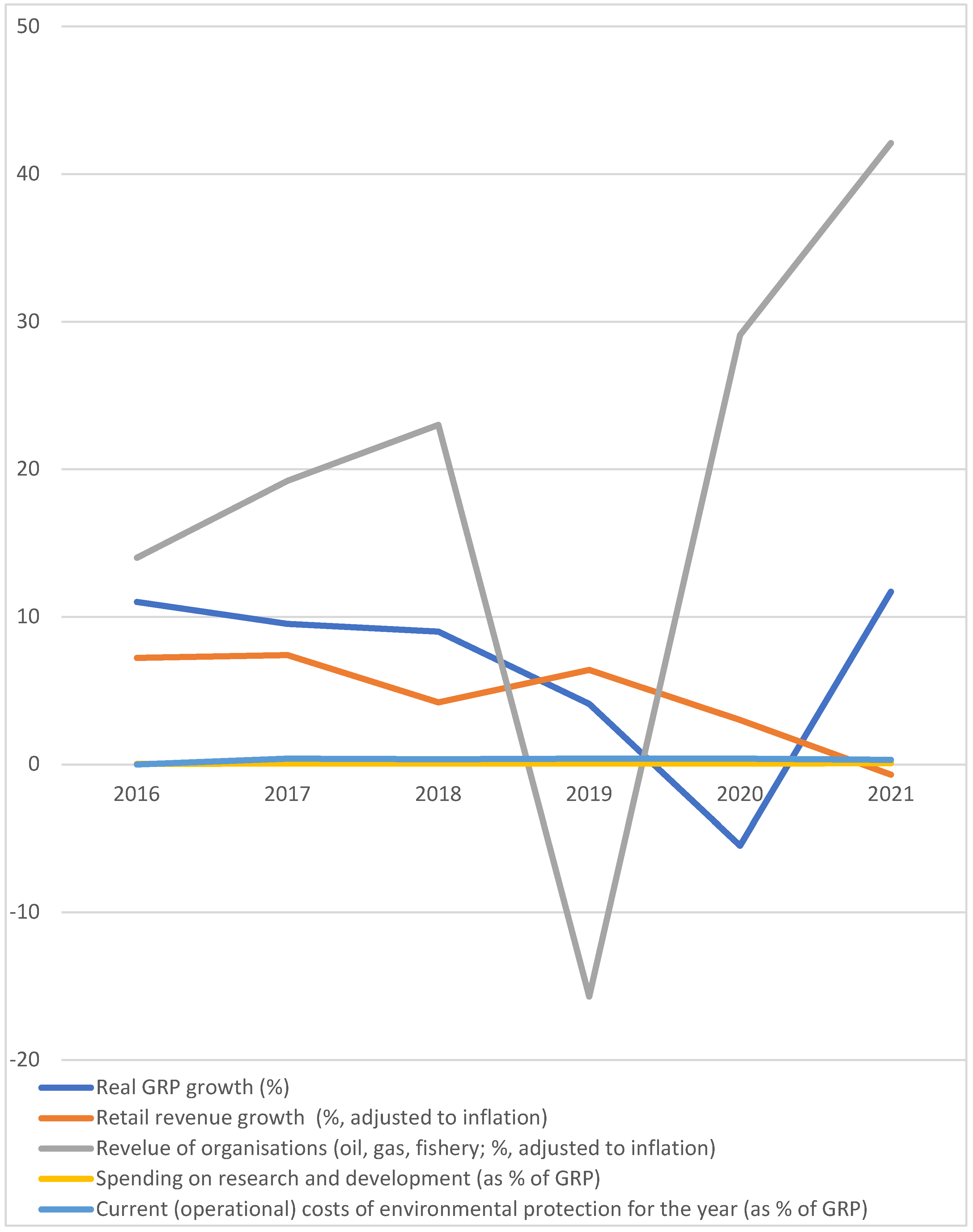
Figure 3.
Correlation pairs for metrics from [6]. The red squares mean every correlation over 0.9/-0.9.
Figure 3.
Correlation pairs for metrics from [6]. The red squares mean every correlation over 0.9/-0.9.
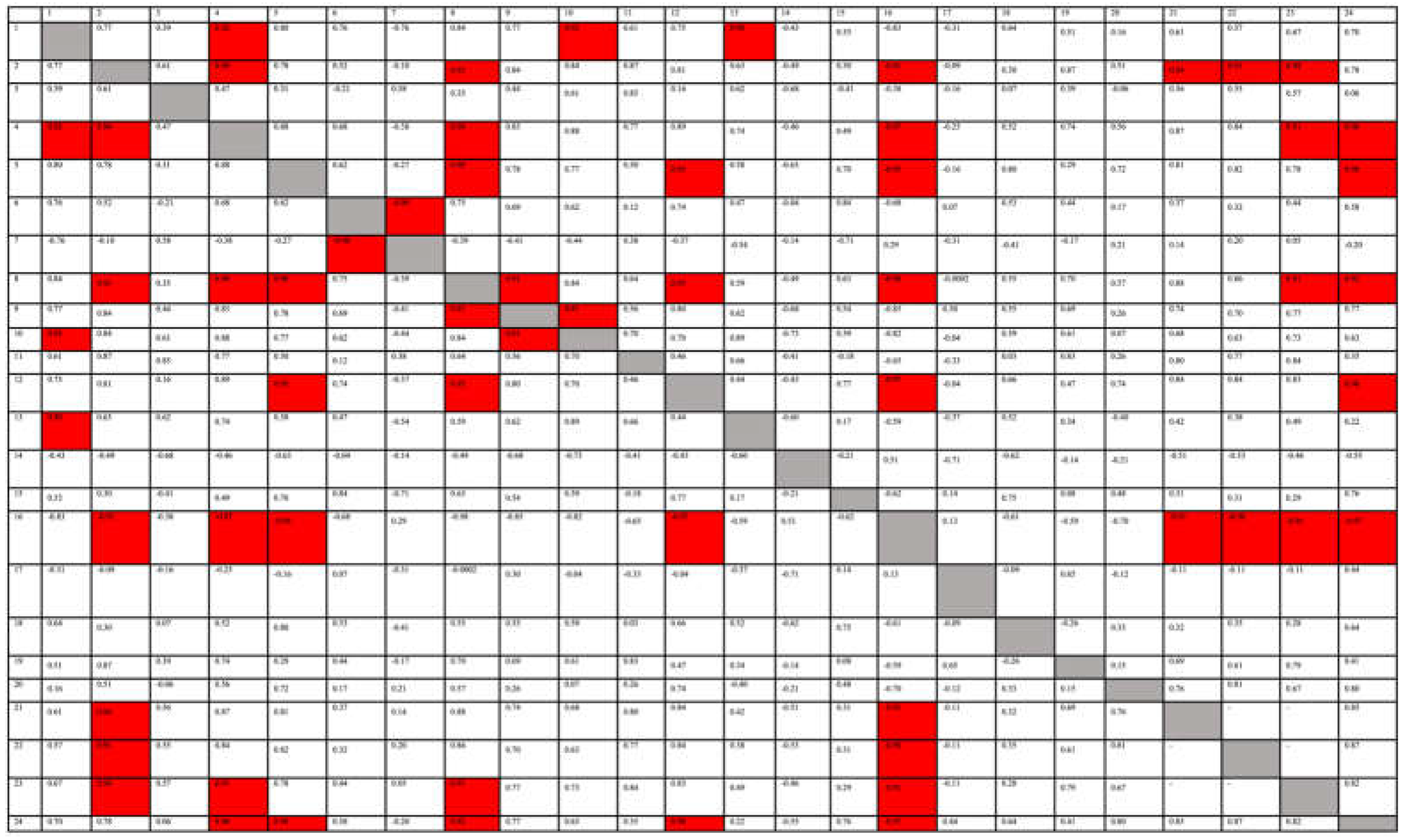
Figure 4.
The distribution of measures among different policy categories. Source: created by the author with the information from: [24,25,26].
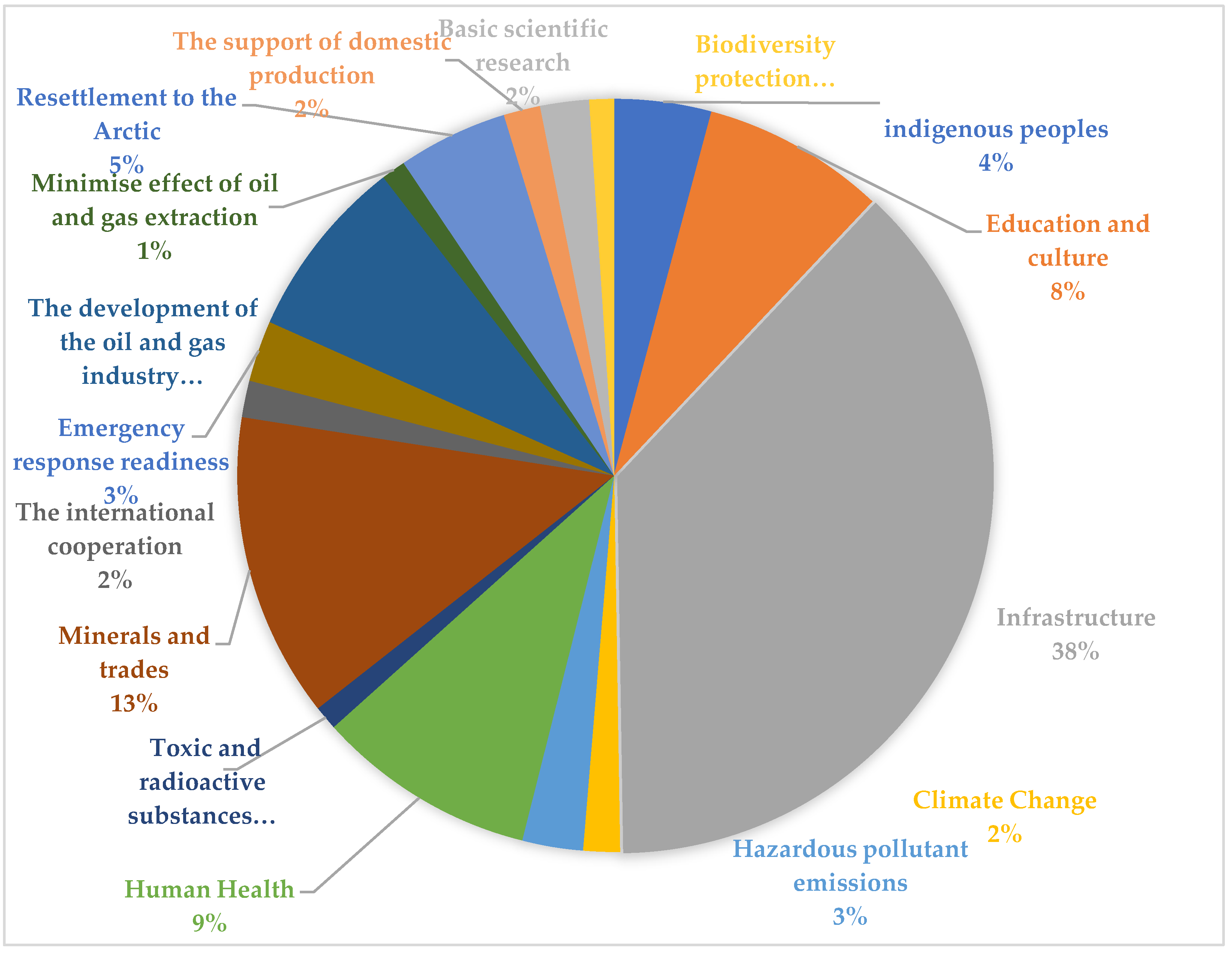
Figure 5.
The distribution of projects proposed for an implementation of different policies in the Arctic region. The red colour indicates policies which have implementation projects in the Arctic regions; symbol  indicates policies that score zero for each district. Source: created by the author and with the information from [26].
indicates policies that score zero for each district. Source: created by the author and with the information from [26].
Figure 5.
The distribution of projects proposed for an implementation of different policies in the Arctic region. The red colour indicates policies which have implementation projects in the Arctic regions; symbol indicates policies that score zero for each district. Source: created by the author and with the information from [26].
indicates policies that score zero for each district. Source: created by the author and with the information from [26].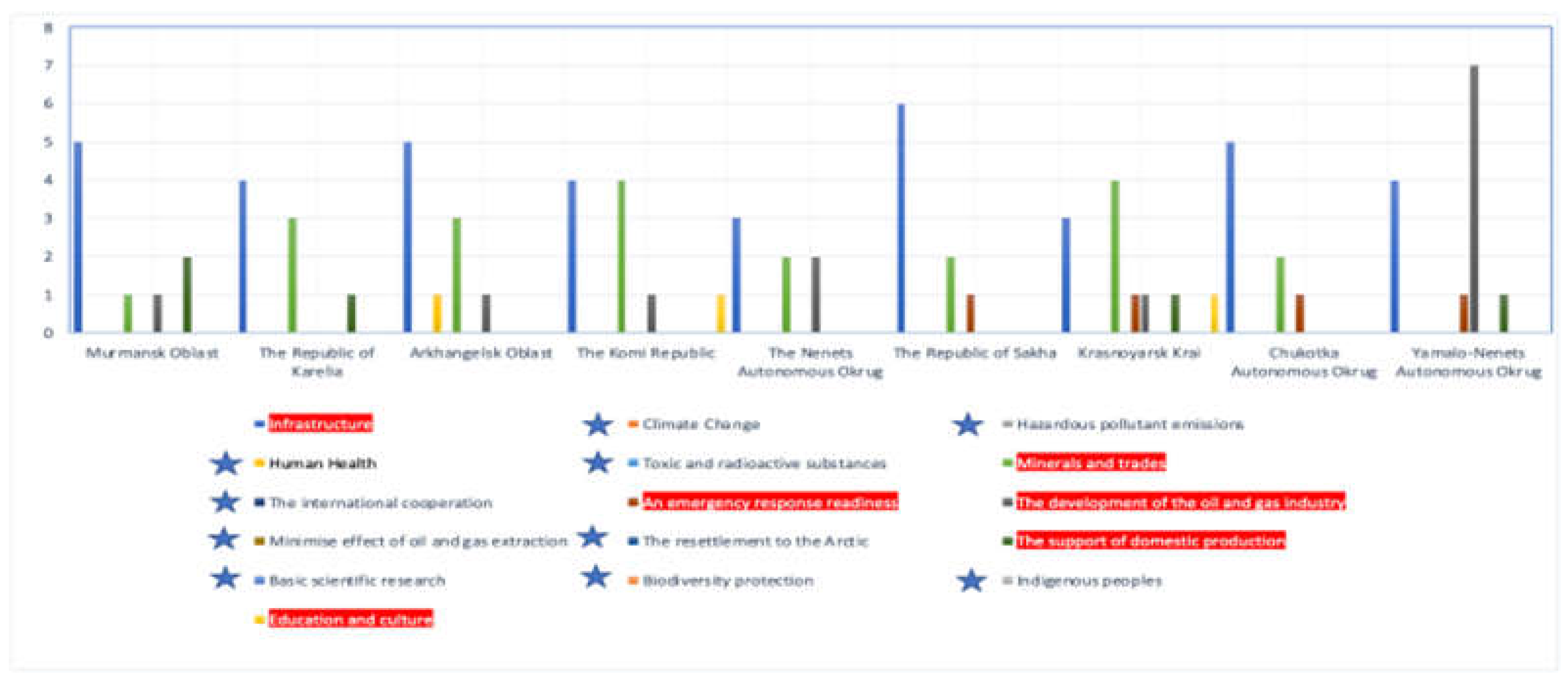

Table 1.
Socio – economic metrics in the Russian Arctic, 2016-2021; data derived from [6].
Table 1.
Socio – economic metrics in the Russian Arctic, 2016-2021; data derived from [6].
| 2016 | 2017 | 2018 | 2019 | 2020 | 2021 | ||
|---|---|---|---|---|---|---|---|
| Metrics | |||||||
| 1 | Gross domestic product (million rubles) | 6570457 | 7196332 | 7843960 | 8169184 | 7719007 | 8625972 |
| 2 | Annual household consumption (rubles/per member) | 314954 | 329106 | 349151 | 395803 | 448546 | 443441 |
| 3 | Investment (without small businesses, million rubles) | 1789620.46 | 4195337.04 | 11555152.5 | 7208736.41 | 16463976.7 | 6156112.19 |
| 4 | Retail revenue (million rubles) | 483656.134 | 524062.823 | 542519.184 | 578931.192 | 597223.62 | 639859.95 |
| 5 | Revenue of organizations (million rubles) | 4520822.66 | 5434362.21 | 6636308.46 | 5605402.56 | 7247074.06 | 10256409.7 |
| 6 | Balanced financial result (profit minus loss, million rubles) | 942630.231 | 732191.981 | 932936.889 | 1888492.82 | 765763.035 | 2345965.49 |
| 7 | Postgraduate graduation in the reporting year (people) | 8 | 4 | 4 | N/A | N/A | 8 |
| 8 | Unemployment rate (according to the methodology of the International Labor Organization/ %) | N/A | 5.6 | 5.3 | 4.6 | 6 | 4.7 |
| 9 | The coefficient of migration rate of the population per 1000 people | -5.9 | -6 | -5.1 | -3.8 | -3 | -1 |
| 10 | Spending on research and development (million rubles) | 4068 | 3392 | 4421 | 4606 | 4781 | 5264 |
| 11 | Share of the population that are active Internet users in the total population (%) | 82.9 | 82.9 | 88.4 | 88.5 | 88.6 | 90.3 |
| 12 | The number of pupils in organizations engaged in educational activities for educational programs of preschool education, supervision and care of children | 154415 | 158399 | 159295 | 161376 | 166295 | 160996 |
| 13 | The length of public roads (km) | 5642.9 | 5970.1 | 6230.8 | 7309.3 | 9079.9 | 14413.6 |
| 14 | The number of reindeer (agricultural organizations that are not related to small businesses) | 210014 | 350491 | 564509 | 547580 | 476548 | 524348 |
| 15 | Commissioning of | N/A | 494 | 3 | 401 | 59 | 80 |
| environmental facilities (Wastewater treatment) | |||||||
| plants, thousand m3 per day) | |||||||
| 16 | Commissioning of General educational organizations (student desks from building and reconstruction) | 1003 | 510 | 720 | 865 | 0 | 2980 |
| 17 | Rate of natural population growth in the Arctic zone of the Russian Federation (per 1000 people) | 3.1 | 2.2 | 1.5 | 0.7 | -1 | -3.6 |
| 18 | Number of employees performing research and development | 3615 | 3023 | 3291 | 3302 | 3315 | 3304 |
| 19 | Commissioning of hospital organizations (number of beds from building and reconstruction) | 0 | 24 | 240 | 0 | 7 | 335 |
| 20 | Current (operational) costs of environmental protection in the Arctic zone Russian Federation for the year/ million rubles | N/A | 32132.9 | 32281.1 | 38146.1 | 38691.8 | 36577.1 |
| 21 | The total area of the housing stock, on average, per inhabitant of the land territories of the Arctic zone Russian Federation (square meters) | N/A | 24.9 | 24.4 | 24.3 | 25 | 25.3 |
| 22 | Assessment of the permanent population of the land territories of the Arctic Zone of the Russian Federation on an average per year (Countryside and Urban) | 2374945 | 2411003 | 2401965 | 2435369 | 2612242 | 2599316 |
| – Countryside | 2120864 | 2143653 | 2135925 | 2142074 | 2263076 | 2256464 | |
| – Urban | 254081 | 267350 | 266040 | 293295 | 349166 | 342852 | |
| 23 | Commissioning of gas wells (unit) | N/A | 250 | 238 | 290 | 291 | 494 |
| 24 | Commissioning of new oil wells (unit) | N/A | 699 | 752 | 670 | 860 | 902 |
Table 2.
The list of statistical metrics Rosstat, 2016-2021.
| No | Metric |
|---|---|
| 1 | GRP |
| 2 | Household consumption |
| 3 | Investments |
| 4 | Retail revenue |
| 5 | Revenue of organizations |
| 6 | Balanced financial result |
| 7 | Unemployment rate |
| 8 | The coefficient of migration rate |
| 9 | Spending on research and development |
| 10 | Share of the population that are active Internet users |
| 11 | The number of pupils in organizations engaged in educational activities |
| 12 | The length of public roads |
| 13 | The number of reindeers |
| 14 | Commissioning of environmental facilities |
| 15 | Commissioning of General educational organizations |
| 16 | Rate of natural population growth |
| 17 | Number of employees performing research and development |
| 18 | Commissioning of hospital organizations |
| 19 | Current (operational) costs of environmental protection |
| 20 | The total area of the housing stock |
| 21 | The number of the residential population |
| 22 | The number of the residential population: Urban |
| 23 | The number of the residential population: Countryside |
| 24 | Commissioning of oil and gas wells |
| Categories for measures |
Examples of proposed measures | Total number of proposed measures |
|---|---|---|
| Indigenous people | Ensure the preservation and promotion of cultural heritage; providing indigenous peoples with mobile sources of energy supply; promoting the comprehensive development of the young generation of indigenous peoples | 6 |
| Education and culture | Improve the availability of general education; establish in the Arctic branches of federal universities; build sports facilities | 10 |
| Infrastructure | Build roads, airports, railway facilities; create infrastructure for sea ports and new shipping routes; | 66 |
| Climate Change | An adaptation of the economy and infrastructure of the Arctic zone to climate change; The development of a unified system of state environmental monitoring | 3 |
| Hazardous pollutant emissions |
The minimization of emissions into the atmospheric air, discharges into water bodies; The state support for activities in the field of waste management in the Arctic zone | 5 |
| Human health | The modernisation of primary health care; disease prevention measures; state financing of medical care, taking into account the low population density | 17 |
| Toxic and radioactive substances |
The prevention of highly toxic and radioactive substances entering the Arctic zone from the abroad; A regular assessment of the environmental consequences of anthropogenic impact on the environment caused by the transfer of pollutants from the states of North America, Europe and Asia | 2 |
| Minerals and trades | The development of minerals, state support and private investments; The provision of state support to projects for the creation of fish processing complexes, greenhouses, livestock complexes | 25 |
| International cooperation |
The development of general principles for the implementation of investment projects with the participation of foreign capital; Ensuring the implementation of the Agreement to strengthen international Arctic scientific cooperation; An active participation in the work of the AC and other international forums | 3 |
| Emergency response readiness |
The development of technologies, creation of technical means and equipment for carrying out emergency rescue operations and extinguishing fires; The development of Arctic complex emergency rescue centres; Increasing the level of security of critical and potentially dangerous facilities | 5 |
| The development of oiland gas industry | An introduction of a special economic regime that facilitates the implementation of private investment in geological exploration in the Arctic; The preparation of materials necessary to substantiate the outer limit of the continental shelf; The provision of state support measures aimed at the creation and development of technologies for the development of oil and gas fields | 14 |
| Minimise an effect of oil and gas extraction |
The prevention of negative environmental consequences during the extraction of natural resources; Ensuring the rational use of associated petroleum gas in order to minimize its flaring | 2 |
| Resettlement to the Arctic from other regions of the Russian Federation |
Programs for providing settlers with the land; Financial benefits for migrants | 9 |
| Support of domestic production |
Stimulate the use of Russian-made industrial products | 3 |
| Basic scientific research |
Support fundamental and applied scientific research | 4 |
| Biodiversity protection |
The creation of specially protected natural areas; state support for the intensification of forest’s reforestation, the development of aviation to protect forests from fires | 2 |
Table 4.
Key association pairs derived from a correlation analysis.
| Number | Association | Type of association |
|---|---|---|
| 1. | GRP – The number of reindeer | Positive |
| 2. | Household consumption – The coefficient of migration rate | Positive |
| 3. | Household consumption – Rate of natural population growth | Negative |
| 4. | The length of public roads – Rate of natural population growth | Negative |
| 5. | The length of public roads – Revenue of organizations | Positive |
| 6. | The length of public roads – The coefficient of migration rate | Positive |
| 7. | Rate of natural population growth – Revenue of organizations | Negative |
| 8. | Rate of natural population growth – The coefficient of migration rate | Negative |
| 9. | Rate of natural population growth – Commissioning of oil and gas wells | Negative |
| 10. | The coefficient of migration rate – Commissioning of oil and gas wells | Positive |
| 11. | Revenue of organizations – Commissioning of oil and gas wells | Positive |
Table 5.
Additional indicators to evaluate traditional livelihoods in Russian Arctic.
| Composite indexes | Specific indicators |
|---|---|
| Adaptability index |
Production methods 1. Households producing goods only for their own needs compared with households selling their products (% of the total households studied); 2. The revenue of households from selling the goods they produced (rubles); 3. Household connection to electricity networks (%); 4. Household distance from roads (km); 5. Number of motorboats in fishery households (units); 6. Fisheries mechanisation power/ fish outputs (Watts/ tons); 7. Reindeer farm mechanization power/ number of reindeers (Watts/livestock capita); 8. How the overall sea hunting area divided between households; 9. Monthly household spending on purchasing food (rubles); 10. Access to electricity (% of population); 11. Gasification of households (% of population); 12. Type of electricity source (e. g., batteries). Seasonal lifestyle 13. Access of households to climate information and agro-advisory services (% of households); 14. The number of households using traditional weather and climate forecasting knowledge in daily life (% of households); 15. Reindeer movements from one pasture to another (days); 16. Flooding situation (days and square kilometres affected); 17. Reindeer pastures (square kilometres/ livestock capita); 18. Livestock affected by rabies (%); 19. Sea / river level (meters at different months). Household livelihood strategies 20. Number of households involved in traditional economic activities: fishing, hunting, reindeer breeding compared with overall number of households (%); 21. Gender distribution in performing traditional economic activities (overall number) (%); 22. Head of the household (gender); 23. Level of education (years at school and higher education institutions); 24. Vehicles per households (units); 25. Household members migrating for work to other regions in Russia as a proportion to households where all members live together (%); 26. Households where children are involved in traditional economic activities (%); 27. Primary food provider (gender); 28. Households who gave up nomadic life style in favour to other economic activities (% of households); 29. Access to the internet (hours spend online per day). Usage of cash 30. Households create handicrafts for obtaining cash (% of households); 31. How often households purchasing goods from the mainland (times per year); 32. Households involved in barter activities (%); 33. Representation of banks at the cities within access for indigenous villages (units). |
| Self-Identity index |
Indigenous membership 34. Population involved in activities of indigenous people’s organizations (% of population); 35. Annual cross-community indigenous activities which are performed regularly (number of activities and people participated); 36. The existence of tribal membership criteria (types and number of criteria); 37. People’s self-description, whether as “indigenous” or “Russian” (% of population); 38. Community acceptance of non-indigenous representatives (low/high); Rights to land 39. Gender differences with secure rights to land (%); 40. Percentage of households who have any documented evidence of their properties and land (%); 41. Percentage of households who were forced to change their original place of living within last 40 years (%); 42. The level of protection of indigenous rights to land (number of legal documents which secure indigenous rights to their land); 43. Households that have secure access to fishery areas and/or reindeer pastures (% of households). Usage of native language 44. People who use native language in everyday communication (% to the whole population); 45. Evidence of written material in native language (number of evidences/ documents); 46. Study of native language at school (studying hours per months for pupils); 47. Young people use native language in everyday communication (% of young people under 18); 48. People using Russian language as a primary language (% to the whole population); 49. People who can write in native language (% to the whole population); 50. People who can speak at least two languages (% to the whole population). Application of traditional knowledge 51. Use of indigenous knowledge in routine life: e. g. food storage, waste treatment vs conventional knowledge (number of examples); 52. An application of traditional medicine (number of examples/ household); 53. Use of indigenous knowledge and conventional knowledge in organising nomadic activities (% of examples); 54. Households involved in traditional crafting (% of households); 55. Transmission of indigenous knowledge through generations (% of young people under 18 and older population who declare to use indigenous knowledge in everyday life); 56. Oral and written traditional cultural materials; 57. Evidence of application of copyrights to indigenous knowledge; 58. National-level legislation for the protection of indigenous knowledge (number of examples). |
| Health index |
Health self-perception 59. Rating of self-perceived health status (males/females; children under 18; 25-34 years old; 35-44 years old; 45-54 years old; 55-64 years old; 65+ years old); 60. People report having long-term chronic health problems (% of population); 61. Rating of self-perceived health status by people with different education levels (1 to 5 ratings). Changes in morbidity specific to indigenous population 62. An assessment of Northern-specific diseases: hypertension, urolithiasis, diseases of the musculoskeletal system (% of the population); 63. Infants’ health development assessment 64. The distance from indigenous communities to the nearest hospitals (km); 65. Alcoholism by gender (% to the population); 66. Infectious diseases (the correlation number between temperature changes, sea level rise and % of population affected by infectious diseases); 67. Mortality rates (age groups, male/females); 68. Injury incidence (% of all hospitals admission); 69. Suicide incidence (number of declared cases). |
| Capacity index |
Representation at the government 70. Indigenous people in the regional government (%); 71. Indigenous people in the federal government (%); 72. Russian indigenous people in international indigenous organizations (%); 73. The existence of indigenous people’s organizations (number of organizations); 74. Population participating in elections (% of population); 75. The existence of self-government in local communities (number of examples); 76. The communication between communities’ local council or the elders and local authorities (number of cases during the year). Intercommunity social links 77. Product exchange between different communities (rubles); 78. Knowledge exchange between communities (number of examples); 79. Existing routes between different communities (total length in km); 80. Intercommunity social events (number of examples). Participation in the market economy 81. Number of working migrants in households (people); 82. Revenue of households (rubles/year); 83. Monthly spendings of households (rubles); 84. Examples of selling goods beyond the Arctic Region (rubles). Education structure 85. Classroom time for pupils from indigenous communities (hours); 86. Accessibility of schools (km from indigenous communities); 87. Availability of transport for sending indigenous pupils to schools (units); 88. Access to internet learning (number of available programs); 89. Access to internet (% of households); 90. Indigenous population in colleges (% of the young population); 91. Indigenous population with higher education (% of young people enrolled in universities programs); 92. Branches of Universities in Arctic regions (universities in Arctic cities as a proportion to the local population (indigenous and non-indigenous); 93. Indigenous people involved in research and development (% of population); 94. People involved in sustainable development education programs (% of the population). |
| Ecological Index |
Methods to deal with waste 95. Waste reduction by implementation of specific community practices: sharing items, avoiding waste (% of waste reduced by implementing special practices); 96. Combination of conventional and indigenous waste treatment practices (% of waste covered by combined waste treatment practices); 97. Landfills (square meters). Natural resource management Communities’ natural resources management strategies; 98. Federal funding to support indigenous natural resource management strategies (rubles); 99. Indigenous rights to the land with specific natural resources (number of documents). |
Disclaimer/Publisher’s Note: The statements, opinions and data contained in all publications are solely those of the individual author(s) and contributor(s) and not of MDPI and/or the editor(s). MDPI and/or the editor(s) disclaim responsibility for any injury to people or property resulting from any ideas, methods, instructions or products referred to in the content. |
© 2024 by the authors. Licensee MDPI, Basel, Switzerland. This article is an open access article distributed under the terms and conditions of the Creative Commons Attribution (CC BY) license (http://creativecommons.org/licenses/by/4.0/).
Copyright: This open access article is published under a Creative Commons CC BY 4.0 license, which permit the free download, distribution, and reuse, provided that the author and preprint are cited in any reuse.


