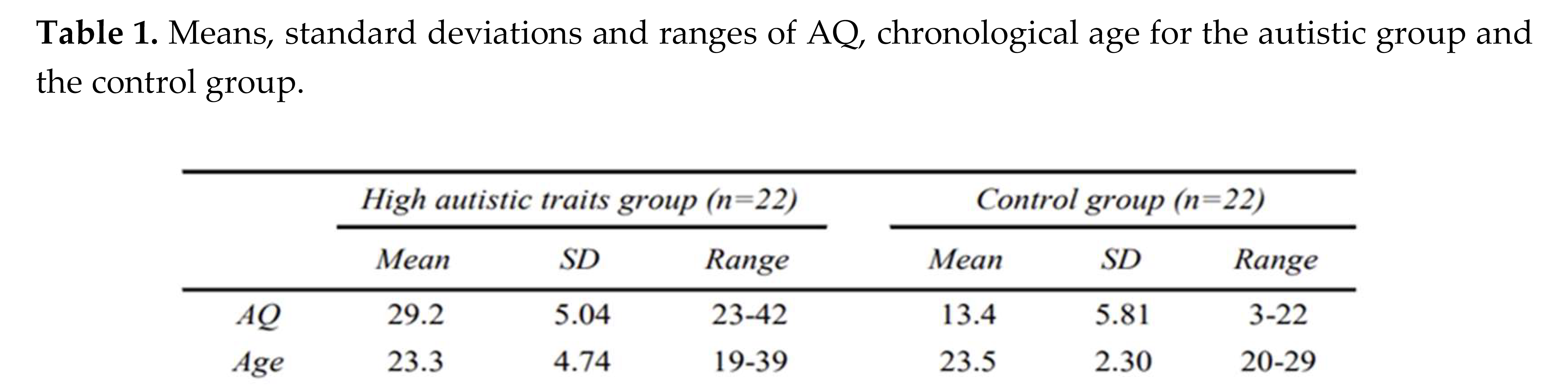
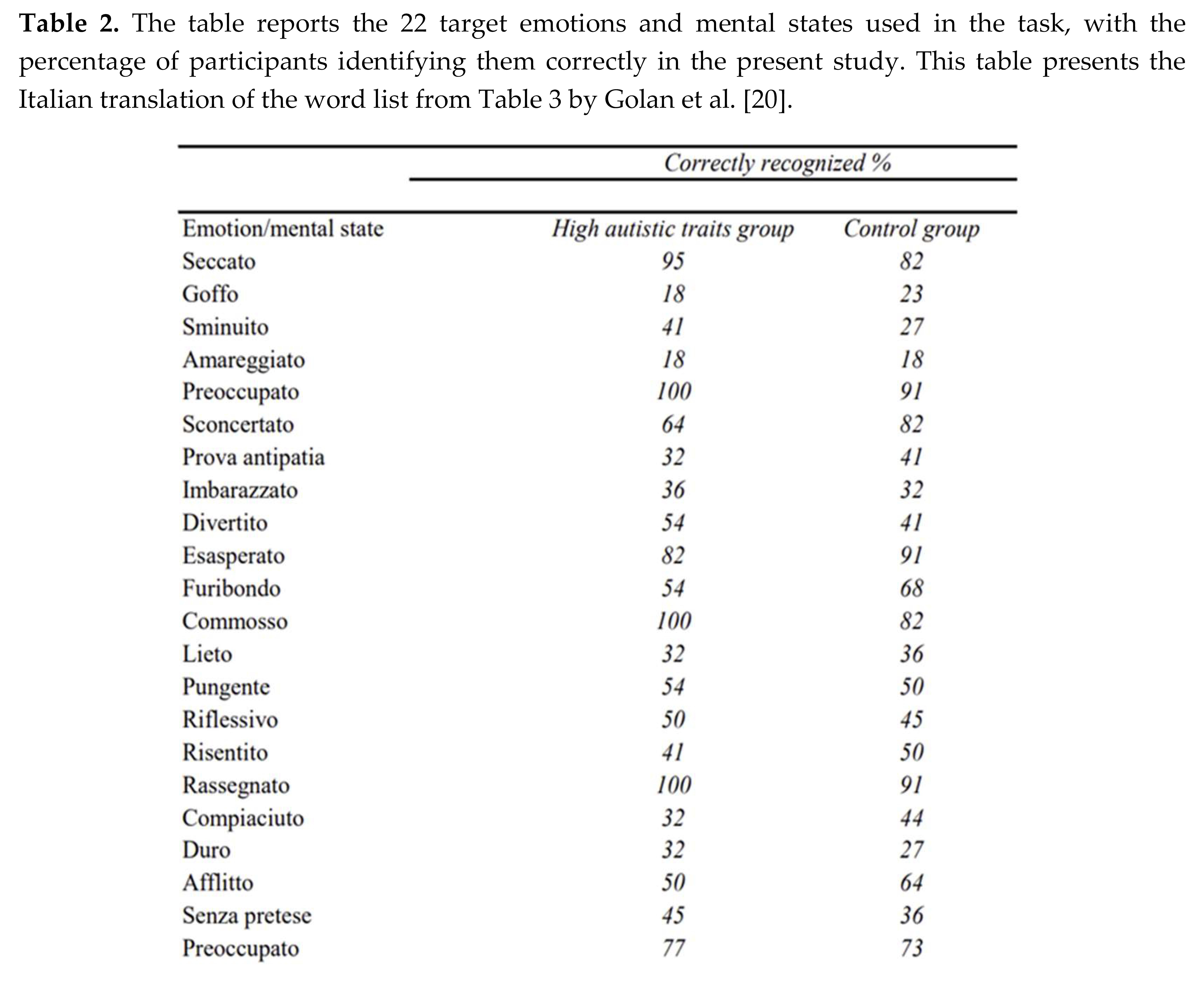
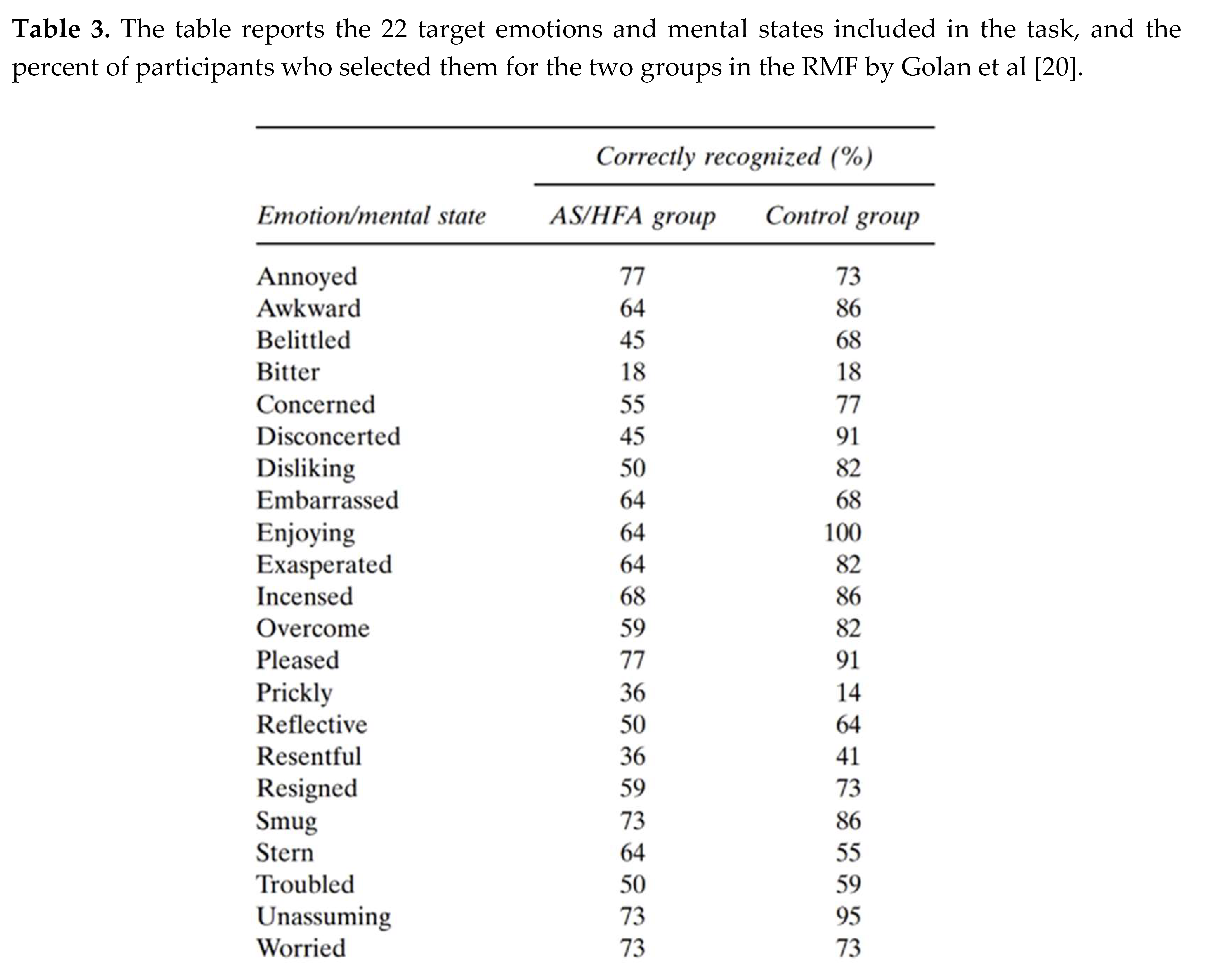
Appendix A. Emotional Response Frequencies in RMF Items: Comparison Between ASC and Control Groups
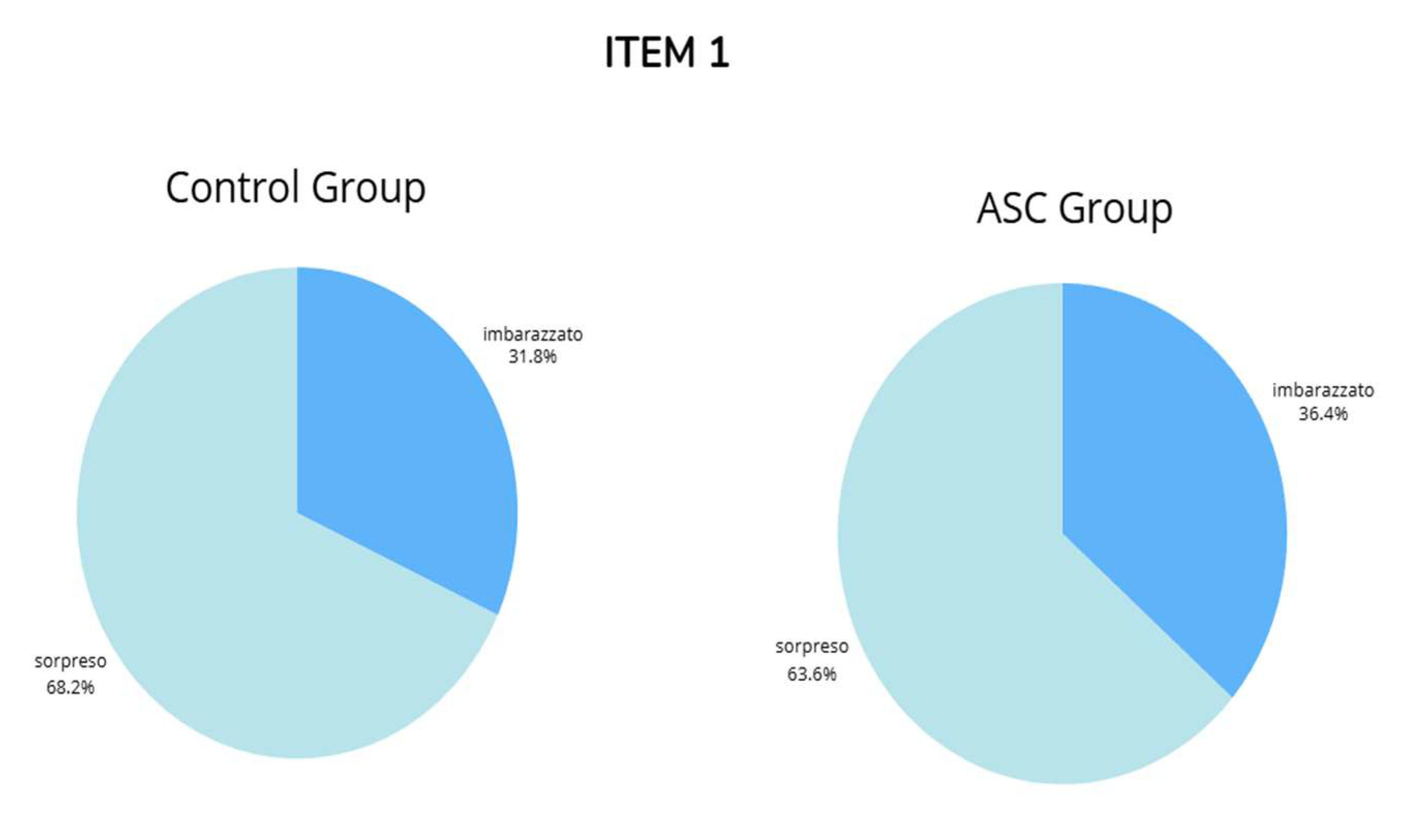
Starting from the first item presented in the RMF, both groups did not exhibit a significant difference in their responses. For both groups, the only other emotion selected besides the correct one “Imbarazzato” (31.8% for the Control group versus 36.4% for the ASC group) was "Sorpreso"(68.2% for the Control group versus 63.6% for the ASC group). The other potential options were: “Infastidito”, “Interessato” (
Figure A1).
Figure A1.
Emotional terms and their frequencies selected by the participants from both groups (Controls and ASC) for item 1 of RMF. The correct response is colored in Electric Blue.
Figure A1.
Emotional terms and their frequencies selected by the participants from both groups (Controls and ASC) for item 1 of RMF. The correct response is colored in Electric Blue.
In the second item presented, besides the correct answer (Compiaciuto), each of the various options was chosen. The correct response was predominantly selected by the group with Controls (44.4%), followed by “Subdolo” (37%), “Esitante” (14.8%) and “Cattivo” (3.7%). The group with ASC predominantly linked the character in the clip to “Subdolo” in the majority of instances (45.5%). The accurate emotion (Compiaciuto) was selected merely 31.8% of the time, indicating a notably poorer performance than the Control group (
Figure A2).
Figure A2.
Emotional terms and their frequencies selected by the participants from both groups (Controls andASC) in the RMF, item 2. The correct response is colored in Electric Blue.
Figure A2.
Emotional terms and their frequencies selected by the participants from both groups (Controls andASC) in the RMF, item 2. The correct response is colored in Electric Blue.
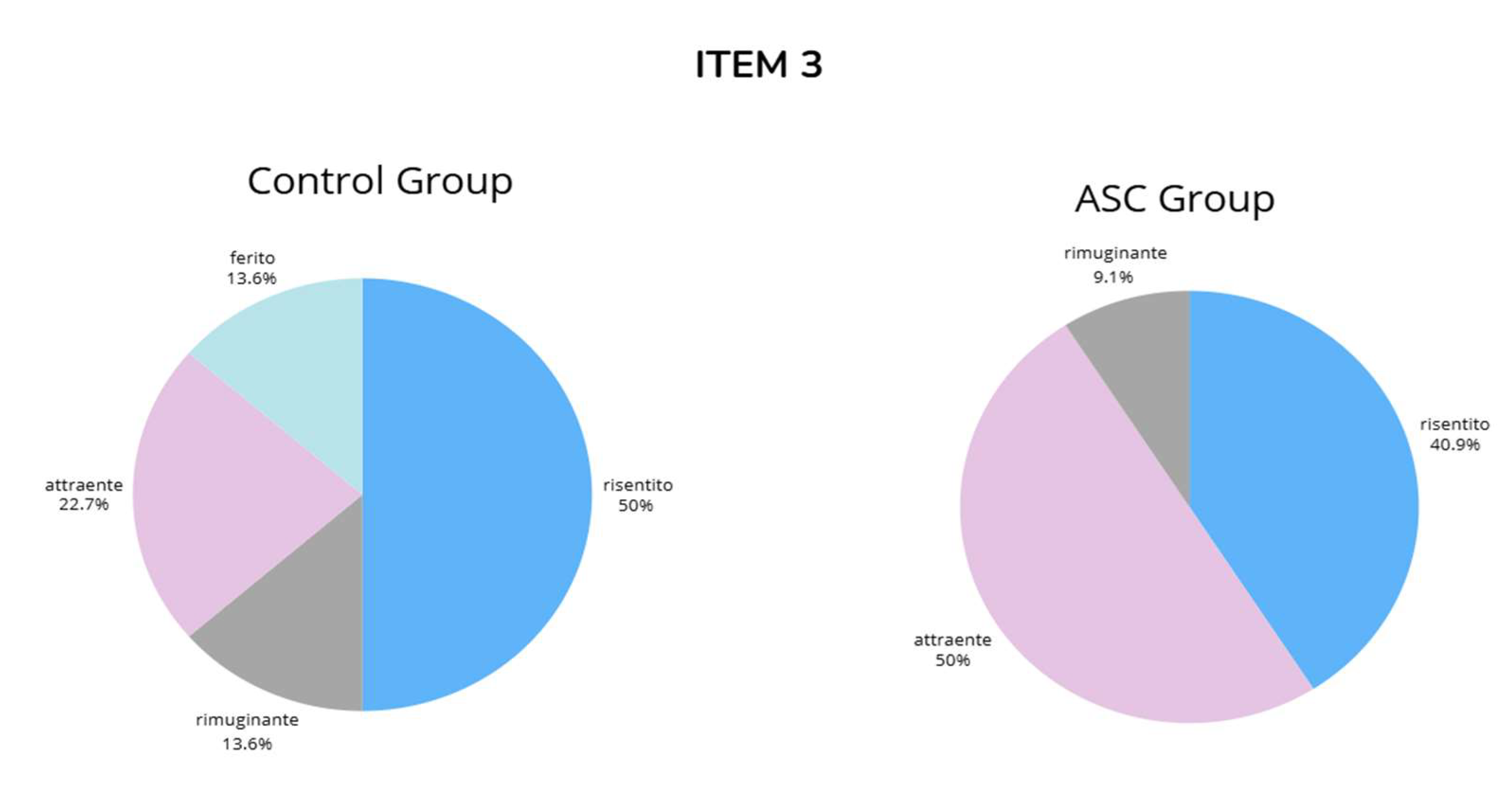
In the third item, notable discrepancies emerged in the responses between the two groups. The group with Controls predominantly opted for the correct response “Risentito” (50%), followed by “Attraente” (22.7%), “Ferito” (13.6%), “Rimuginante” (13.6%). In contrast, within the Control group, 50% of the selections selected “Attrente”, while 40.9% chose the correct option (Risentito), with only a marginal 9.1% opting for “Rimuginante” (
Figure A3).
Figure A3.
Emotional terms and their frequencies selected by the participants from both groups (Controls and ASC), RMF, item 3. The correct response is colored in Electric Blue.
Figure A3.
Emotional terms and their frequencies selected by the participants from both groups (Controls and ASC), RMF, item 3. The correct response is colored in Electric Blue.
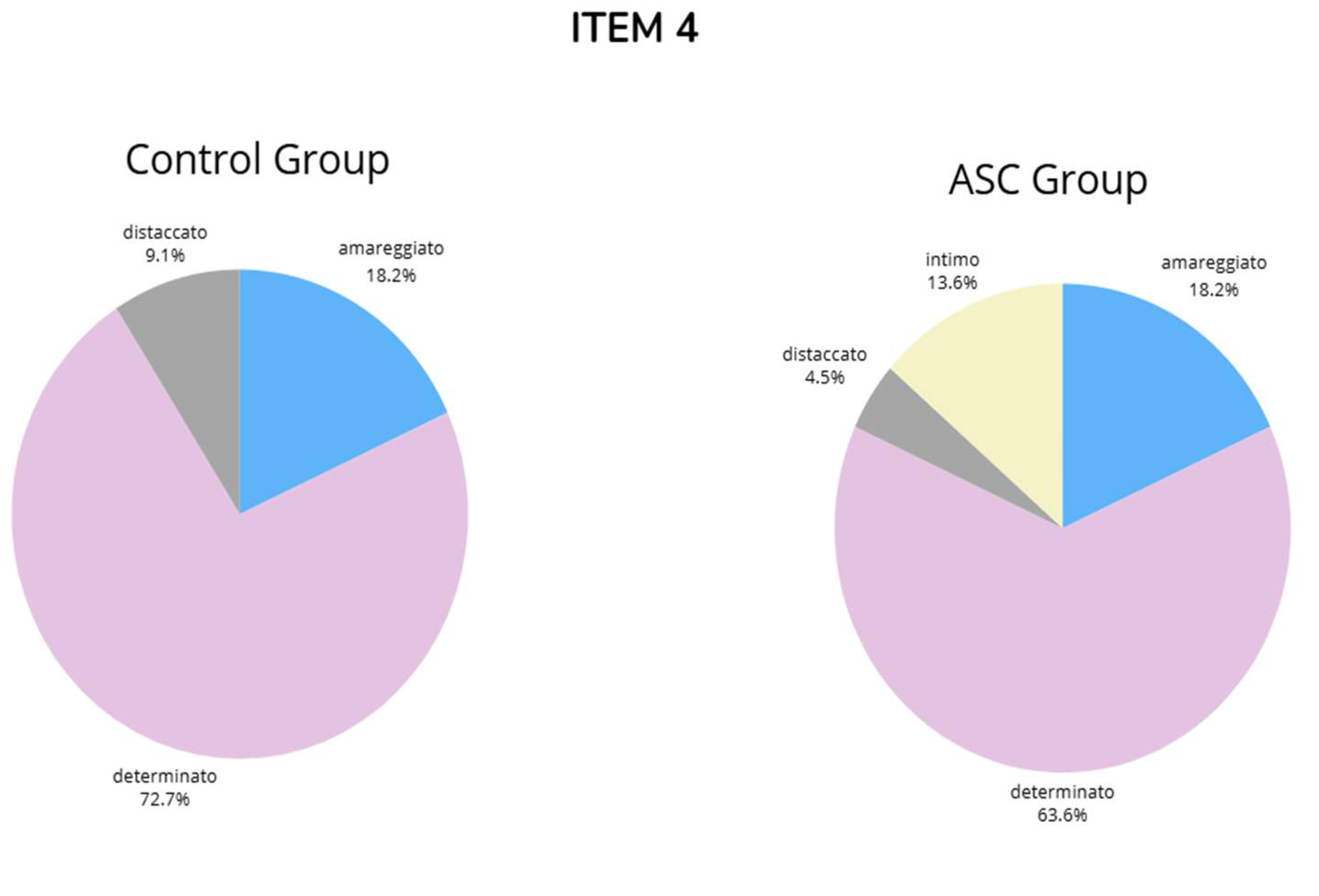
As for the fourth item, for both groups, the most commonly selected emotion word was “Determinato” (72.7% for the Control group versus 63.3% for the ASC group), followed as a secondary choice by the correct response “Amareggiato”, with an accuracy percentage of 18.2% for both groups. Within the Control group, only one other option, “Distaccato”, was chosen at 9.1%. However, in the ASC group, both “Intimo” (13.6%) and “Distaccato” (4.5%) were also selected (
Figure A4).
Figure A4.
Emotional terms and their frequencies selected by the participants from both groups (Controls and ASC), RMF, item 4. The correct response is colored in Electric Blue.
Figure A4.
Emotional terms and their frequencies selected by the participants from both groups (Controls and ASC), RMF, item 4. The correct response is colored in Electric Blue.
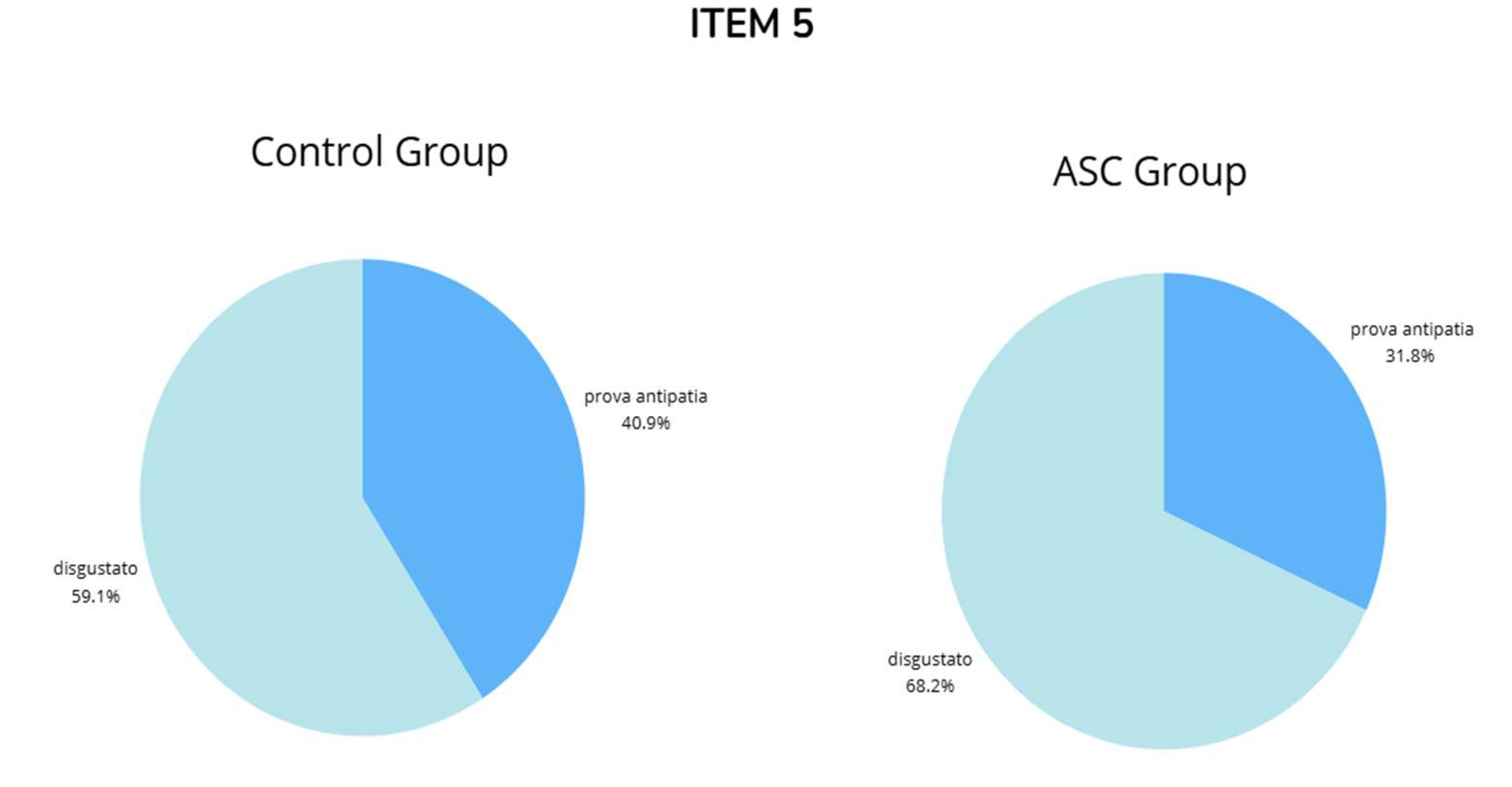
The performance on the fifth item exhibited a comparable outcome across the two groups; both groups favored the option 'Disgusted' (59.1% for the Control group versus 68.2% for the ASC group). The ASC group selected the correct response 'Aversion' a fewer number of times than the control group, indicating a better performance by the Control group (40.9% for the Control group versus 31.8% for the ASC group). The other potential options were: “Insicuro”, “Nervoso” (
Figure A5).
Figure A5.
Emotional terms and their frequencies selected by the participants from both groups (Controls and ASC), RMF, item 5. The correct response is colored in Electric Blue.
Figure A5.
Emotional terms and their frequencies selected by the participants from both groups (Controls and ASC), RMF, item 5. The correct response is colored in Electric Blue.
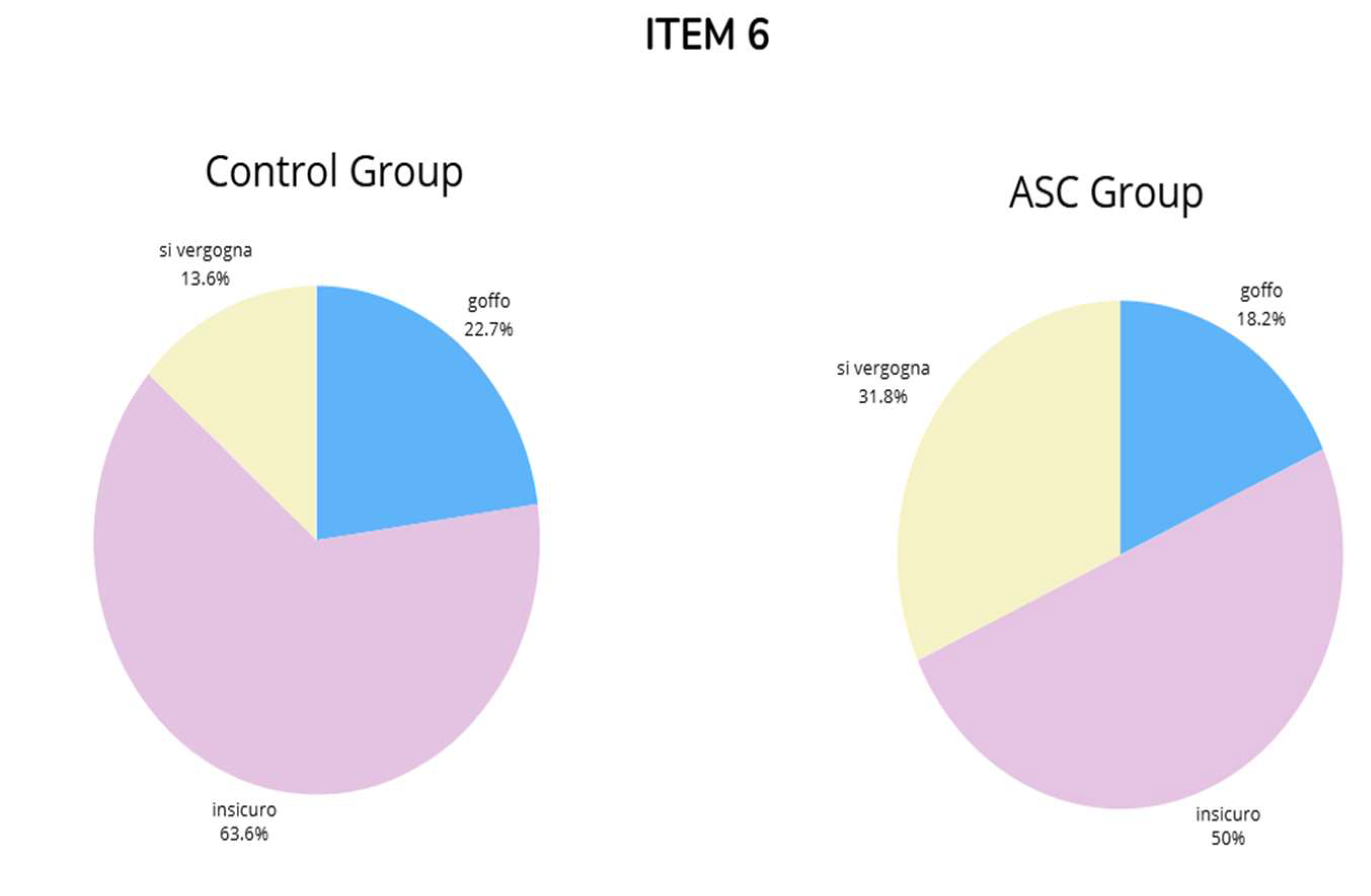
Both groups in the sixth item more frequently chose the emotion “Insicuro” with a rate of 63.6% for the Control group and 50% for the ASC group. The correct option “Goffo” was selected only 22.7% of the time by the Control group and 18.2% by the ASC group. The other option chosen by both groups was “Si vergogna”, accounting for 13.6% for the Control group and 31.8% for the ASC group. As evident from these results, both groups predominantly associated the mood of the main character in the clip with an emotion different from the correct one. However, the group with lower autistic traits performed comparatively better than the group with higher autistic traits (
Figure A6).
Figure A6.
Emotional terms and their frequencies selected by the participants from both groups (Controls and ASC group), RMF, item 6. The correct response is colored in Electric Blue.
Figure A6.
Emotional terms and their frequencies selected by the participants from both groups (Controls and ASC group), RMF, item 6. The correct response is colored in Electric Blue.
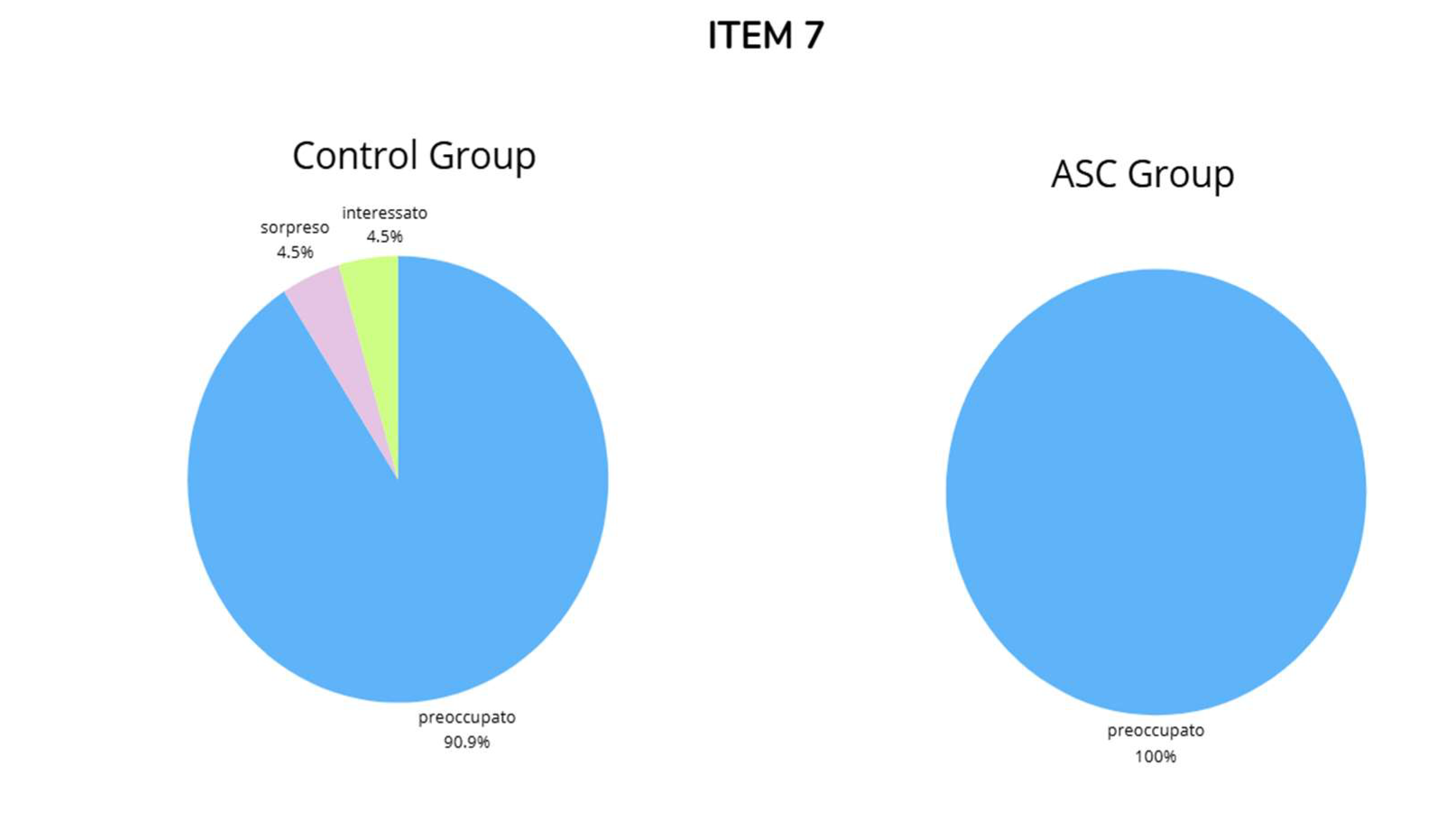
For the seventh item, the group with ASC group consistently chose the correct emotion 100% of the time, showcasing exceptional accuracy and precision. Conversely, the Control group opted for the correct response “Preoccupato” 90.9% of the time, with “Interessato” and “Sorpreso” each at 4.5% (
Figure A7).
Figure A7.
Emotional terms and their frequencies selected by the participants from both groups (Controls and ASC), RMF, item 7. The correct response is colored in Electric Blue.
Figure A7.
Emotional terms and their frequencies selected by the participants from both groups (Controls and ASC), RMF, item 7. The correct response is colored in Electric Blue.
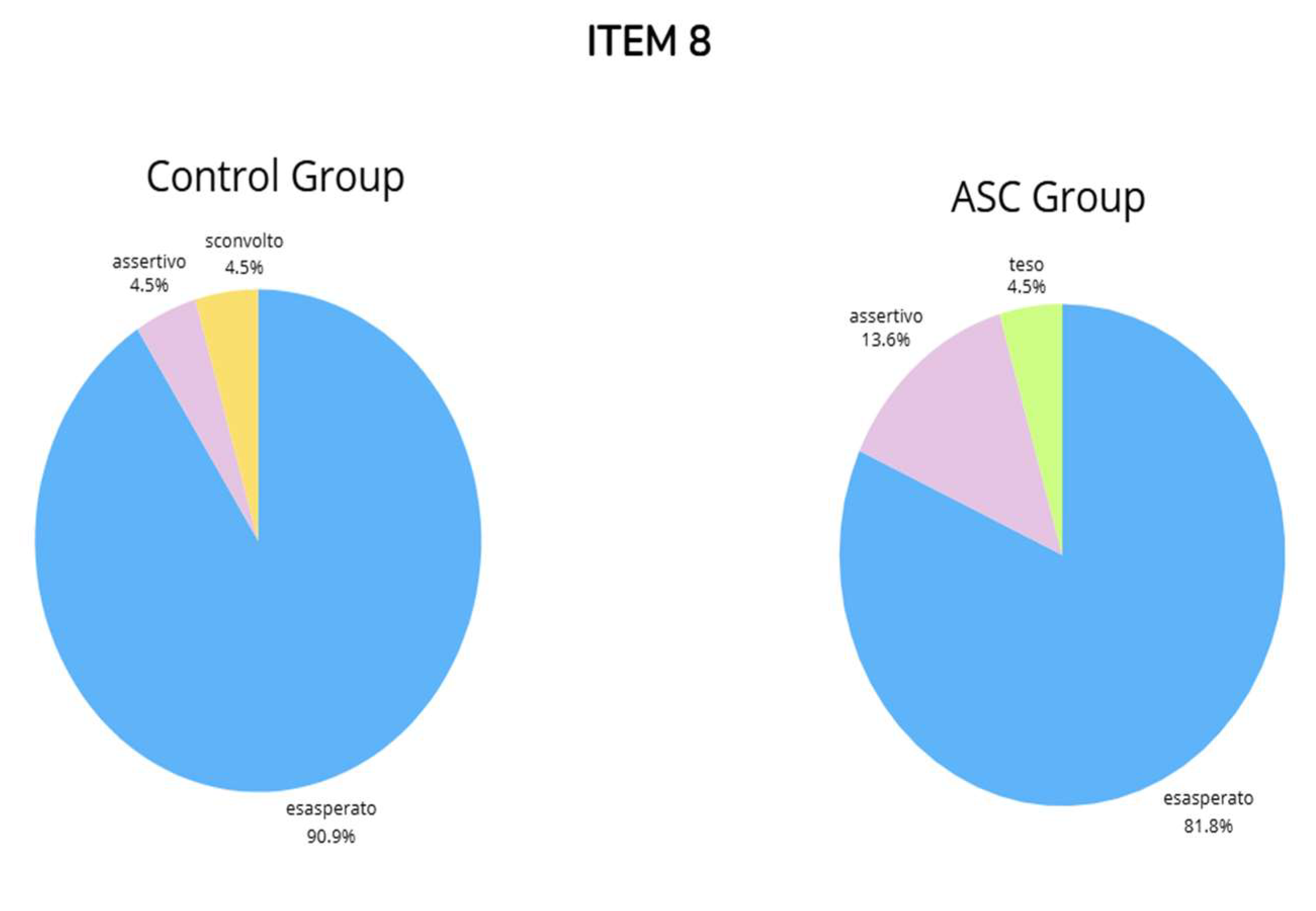
The performance in the eighth item slightly varied between the two groups. Indeed, both predominantly selected the correct option “Esasperato” (90.9% for the Control group versus 81.8% for the ASC group). However, there is a notable difference in the remaining emotions chosen. Both groups opted for “Assertivo” with the higher autistic traits group selecting it more frequently (13.6%), followed by “Teso” (4.5%). Conversely, the lower autistic traits group chose “Assertivo” and “Sconvolto” with equal frequency, each at 4.5% (
Figure A8).
Figure A8.
Emotional terms and their frequencies selected by the participants from both groups (Controls and ASC), RMF, item 8. The correct response is colored in Electric Blue.
Figure A8.
Emotional terms and their frequencies selected by the participants from both groups (Controls and ASC), RMF, item 8. The correct response is colored in Electric Blue.
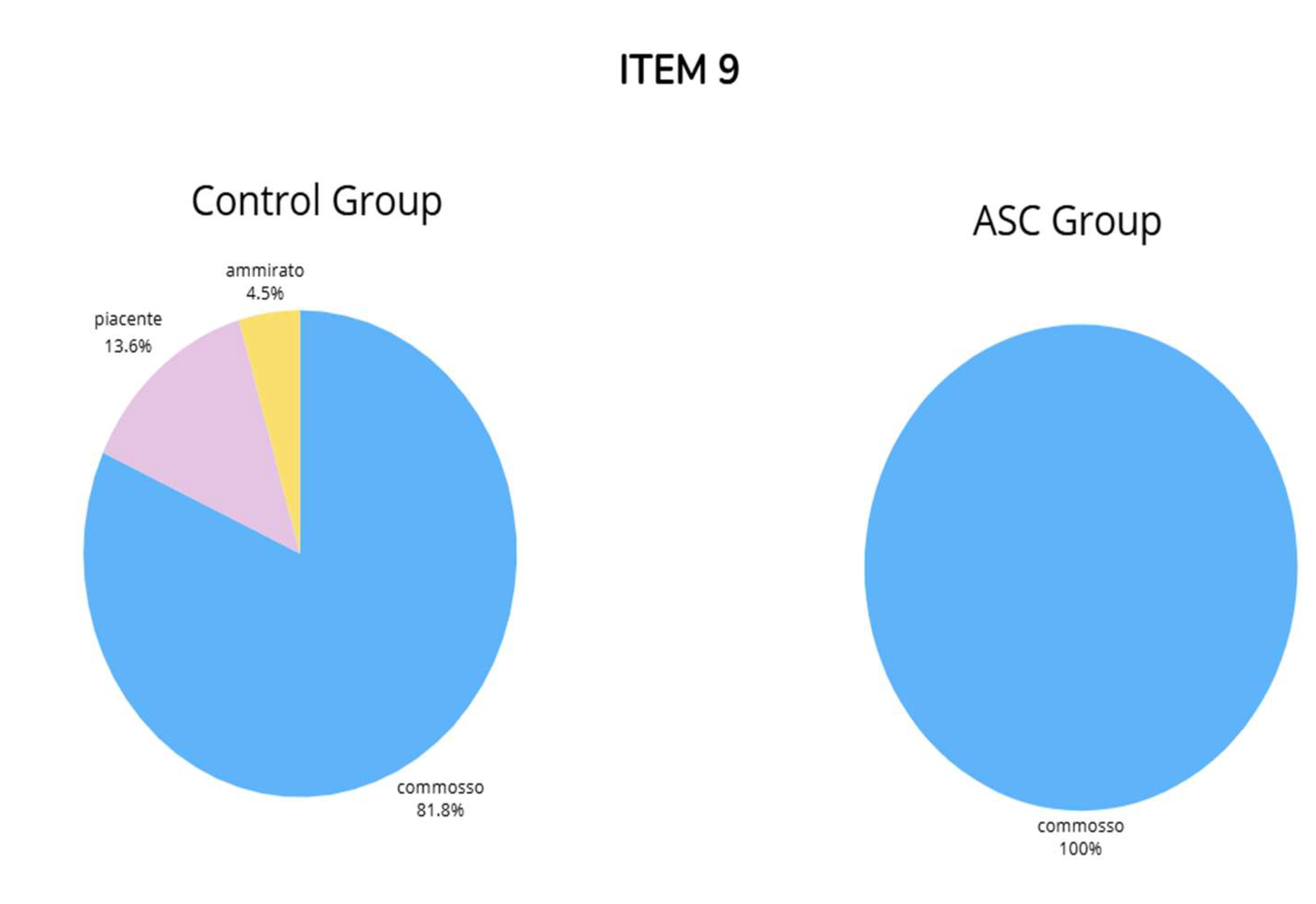
In the ninth item, the ASC group consistently chose the correct emotion (Commosso) in every instance, while the Control group selected “Commosso” only 81.8% of the time, opting for “Piacente” in 13.6% of cases and “Ammirato” in 4.5% of cases (
Figure A9).
Figure A9.
Emotional terms and their frequencies selected by the participants from both groups (Controls and ASC), RMF, item 9. The correct response is colored in Electric Blue.
Figure A9.
Emotional terms and their frequencies selected by the participants from both groups (Controls and ASC), RMF, item 9. The correct response is colored in Electric Blue.
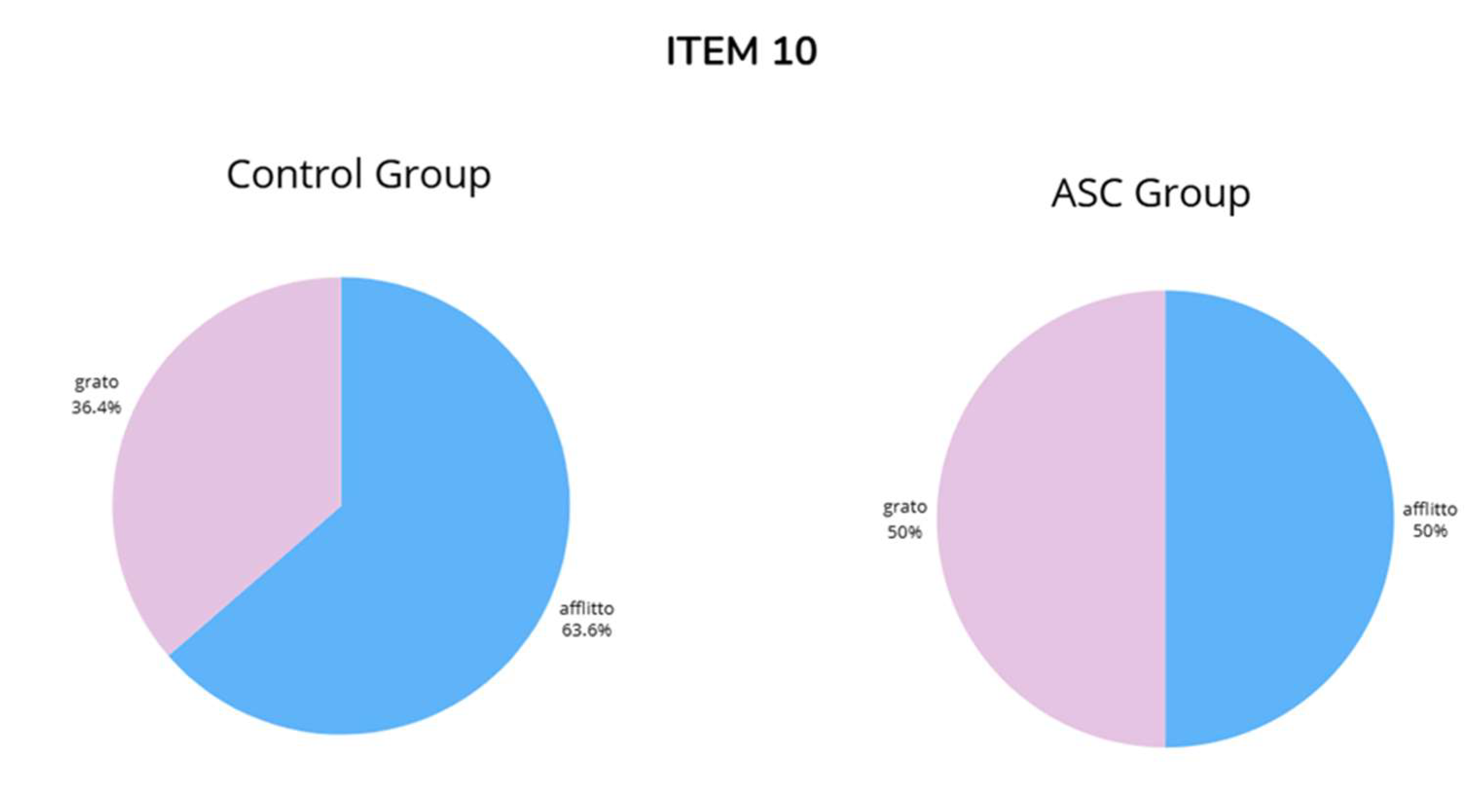
In the tenth item, the group with Controls outperformed the group with higher autistic traits, choosing the correct response “Afflitto” the 63% of the time, followed by “Grato” at 36.6%. Conversely, the other group selected “Afflitto” and “Grato” 50% of the time, respectively (
Figure A10).
Figure A10.
Emotional terms and their frequencies selected by the participants from both groups (Controls and ASC), RMF, item 10. The correct response is colored in Electric Blue.
Figure A10.
Emotional terms and their frequencies selected by the participants from both groups (Controls and ASC), RMF, item 10. The correct response is colored in Electric Blue.
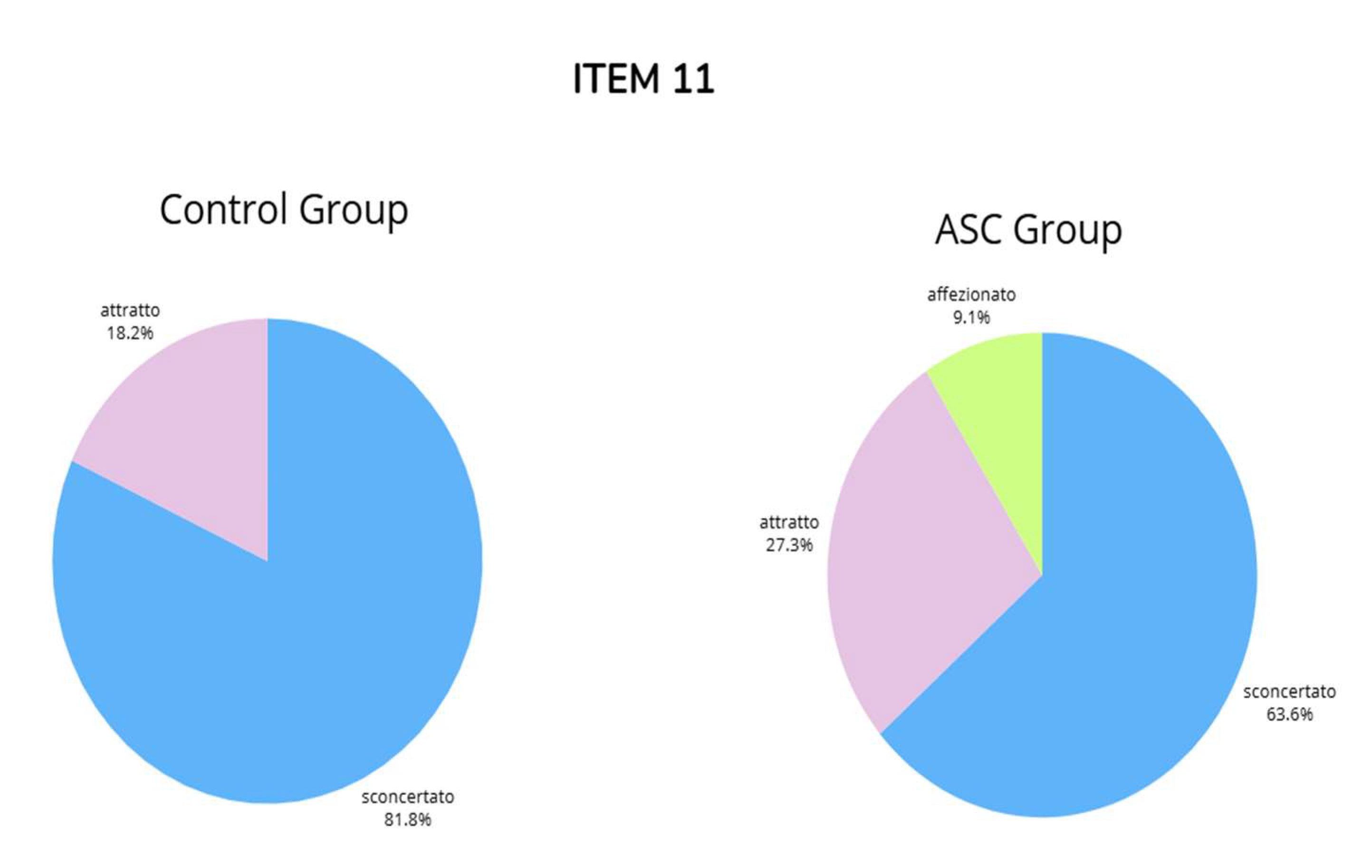
Analyzing the performance of the two groups in the eleventh item, the Control group exhibited a superior performance, preferring the correct option (Sconcertato) 81.8% of the time, followed by a solitary other emotion (Attratto), chosen 18.2% of the time. The ASC group selected the correct option only 63.6% of the time, with a considerable number of participants choosing “Attratto” (27.3%) and “Affezionato” (9.1%) (
Figure A11).
Figure A11.
Emotional terms and their frequencies selected by the participants from both groups (Controls and ASC), RMF, item 11. The correct response is colored in Electric Blue.
Figure A11.
Emotional terms and their frequencies selected by the participants from both groups (Controls and ASC), RMF, item 11. The correct response is colored in Electric Blue.
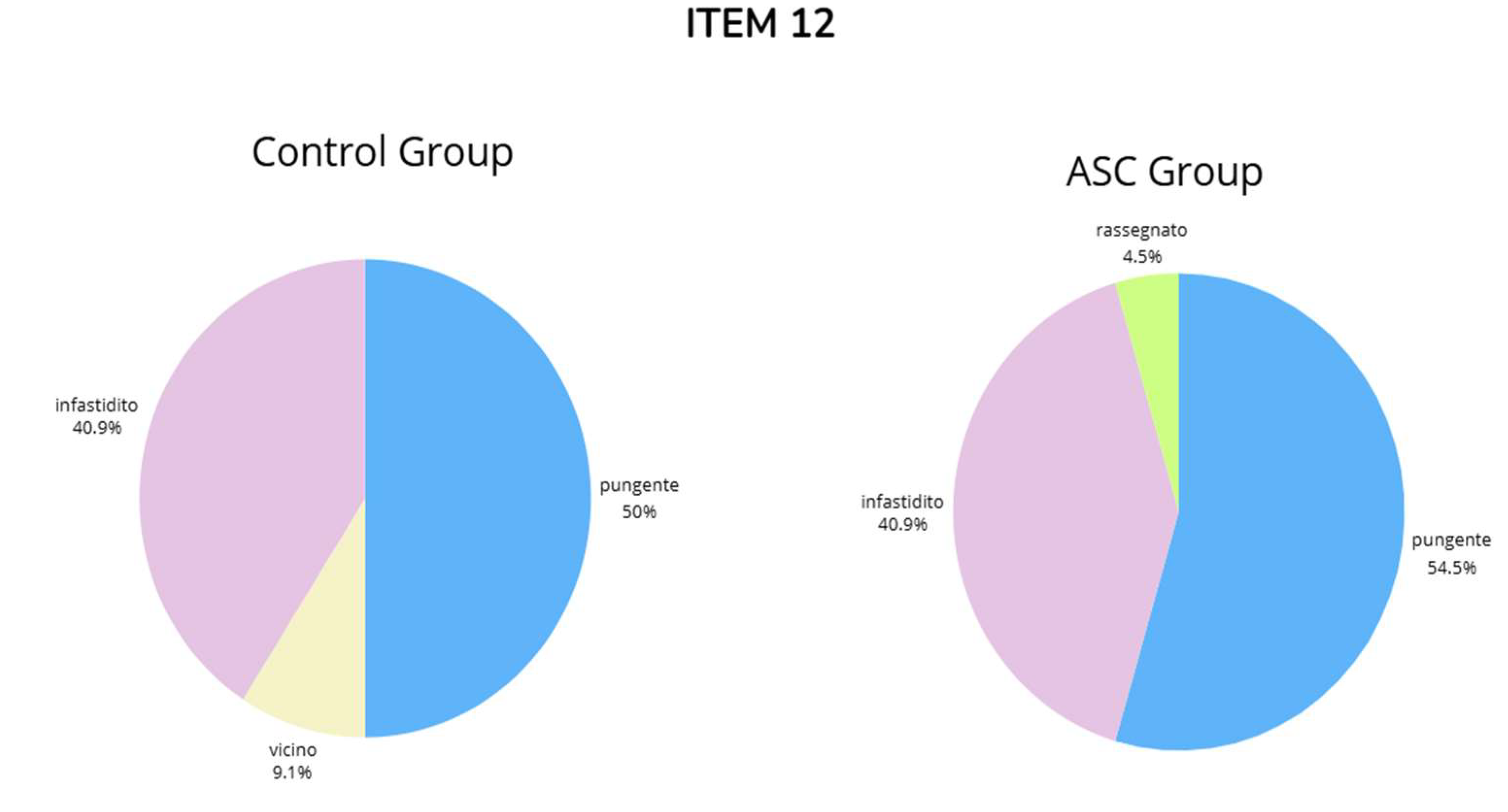
In the twelfth item, the correct response “Pungente” was chosen by the group with lower autistic traits 50% of the time, followed by “Infastidito” (40.9%) and “Vicino” (9.1%). Meanwhile, in the ASC group, the correct response was chosen 54.5% of the time, also followed by “Infastidito” at a frequency of 40.9%, and “Rassegnato” in 4.5% of cases (
Figure A12).
Figure A12.
Emotional terms and their frequencies selected by the participants from both groups (Controls and ASC), RMF, item 12. The correct response is colored in Electric Blue.
Figure A12.
Emotional terms and their frequencies selected by the participants from both groups (Controls and ASC), RMF, item 12. The correct response is colored in Electric Blue.
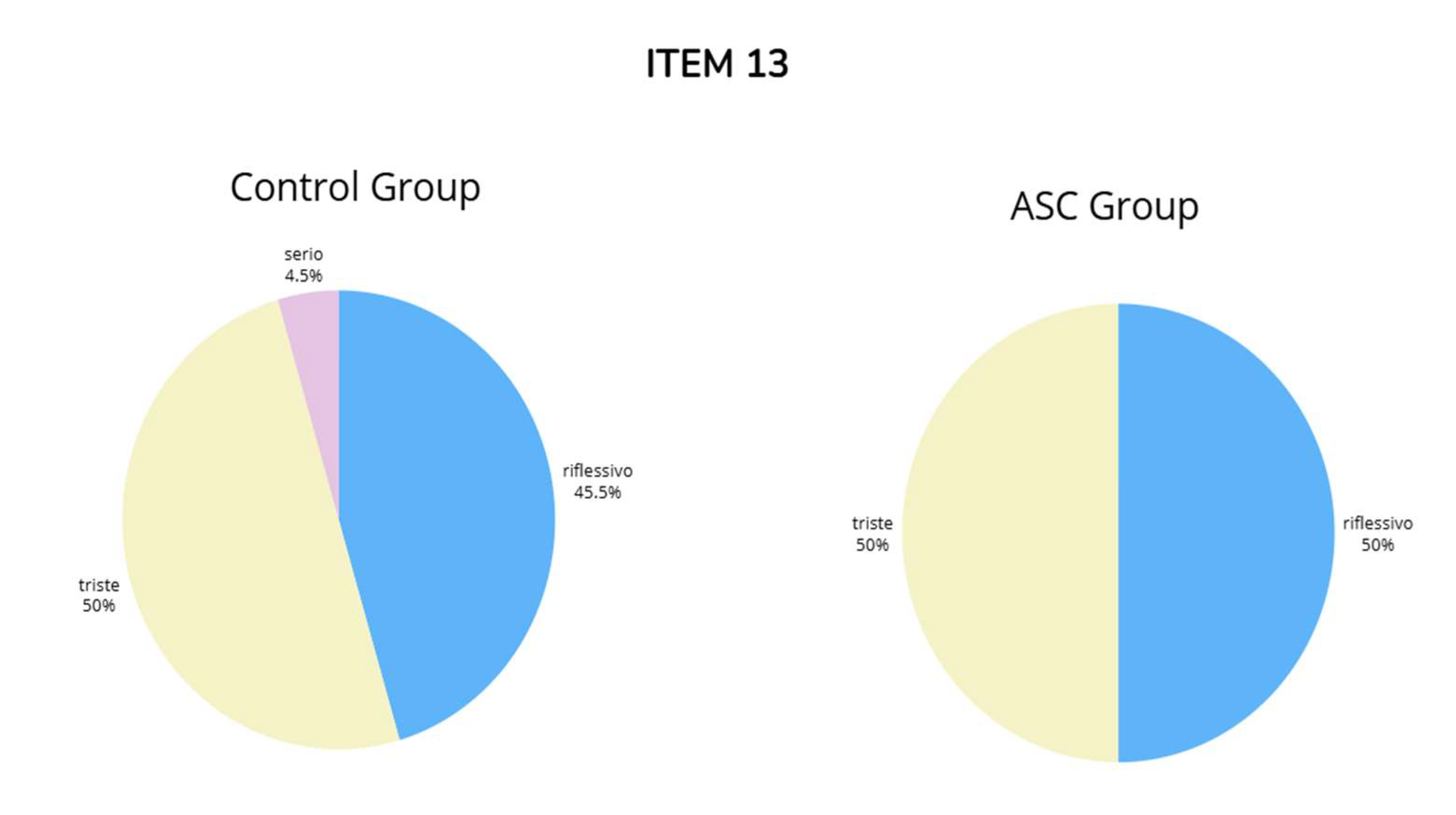
Observing the responses to the thirteenth item, for both groups, the answer “Triste” was selected 50% of the time, followed by the correct response “Riflessivo” with a frequency of 45.5% for the ASC group and 50% for the Control group. Only in the Control group another emotion was chosen (Serio) in 4.5% of cases (
Figure A13).
Figure A13.
Emotional terms and their frequencies selected by the participants from both groups (Controls and ASC), RMF, item 13. The correct response is colored in Electric Blue.
Figure A13.
Emotional terms and their frequencies selected by the participants from both groups (Controls and ASC), RMF, item 13. The correct response is colored in Electric Blue.
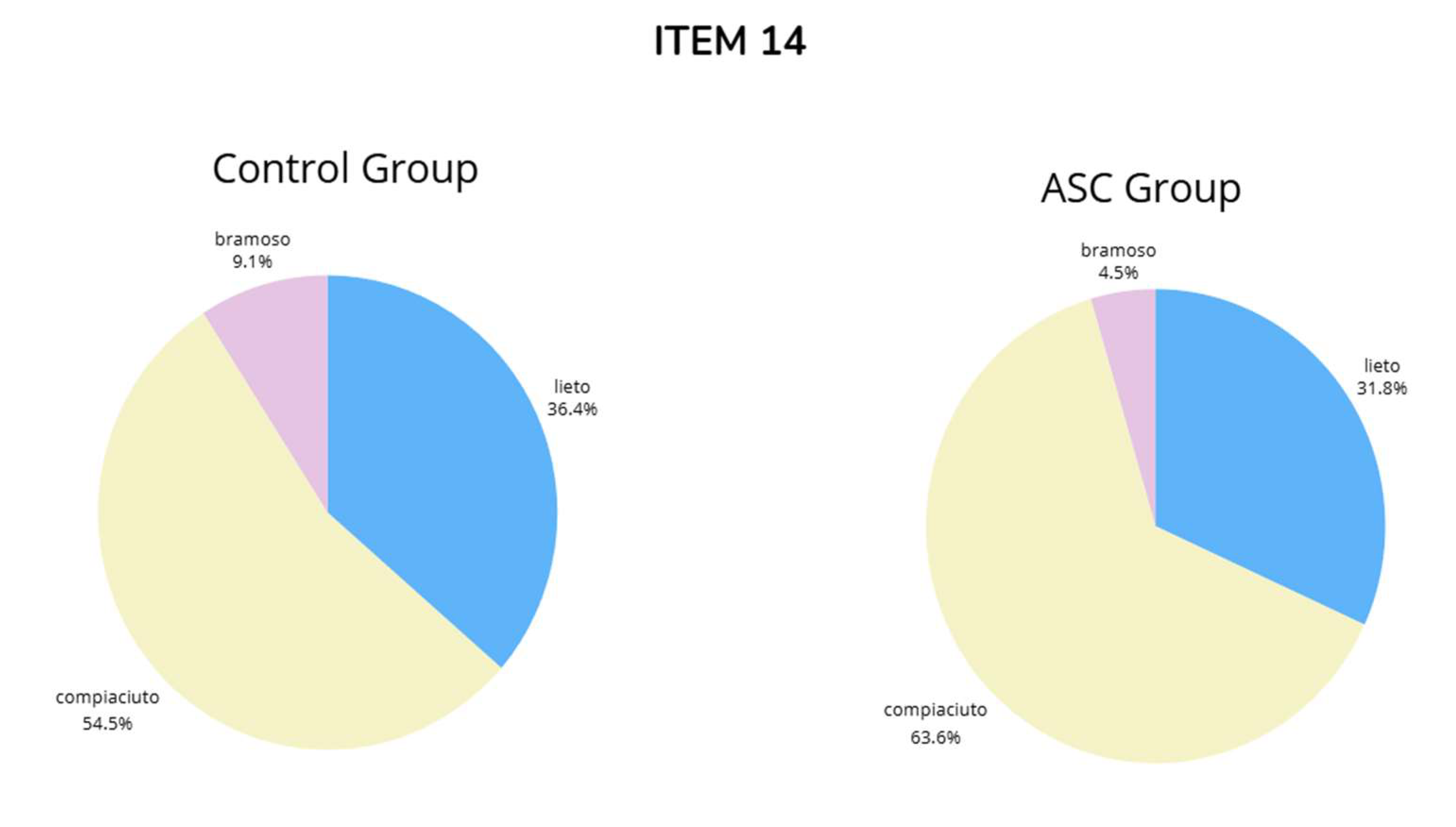
In the fourteenth item, the emotion “Compiaciuto” was chosen most often by both groups, with a frequency of 54.5% among participants with Controls and 63.6% among participants with ASC group. The correct response “Lieto” was selected in 36.4% of cases by the Control group, followed by “Bramoso” at 9.1%. For the ASC group, the correct response was chosen in 31.8% of cases, also followed by “Bramoso” at 4.5% (
Figure A14).
Figure A14.
Emotional terms and their frequencies selected by the participants from both groups (Controls and ASC), RMF, item 14. The correct response is colored in Electric Blue.
Figure A14.
Emotional terms and their frequencies selected by the participants from both groups (Controls and ASC), RMF, item 14. The correct response is colored in Electric Blue.
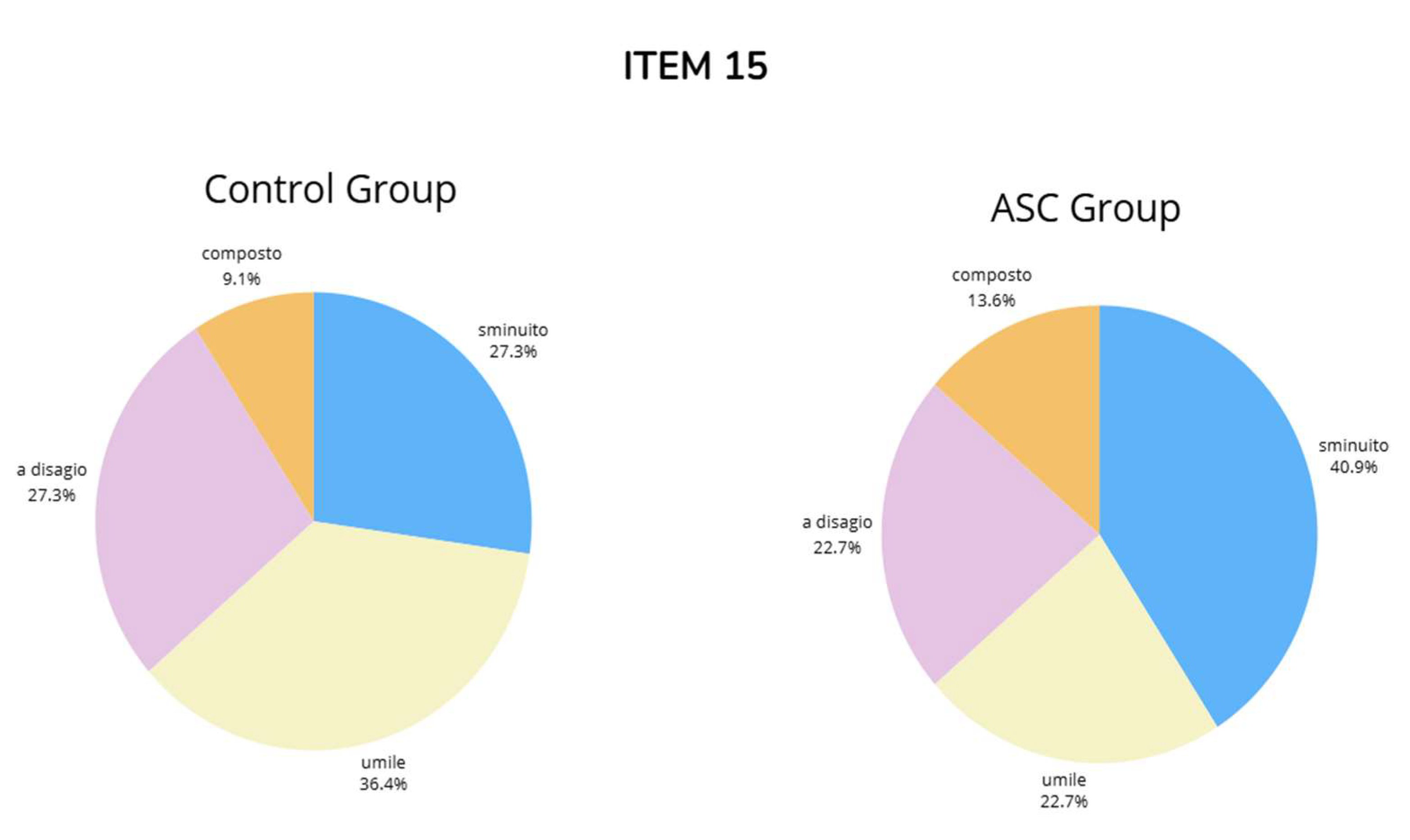
In the fifteenth item, both groups selected all four options, but with different frequencies. In the Control group, “Umile” was the most chosen (36.4%), followed by the correct option “Sminuito” (27.3%), then “A disagio” (27.3%), and “Composed” (9.1%). In the ASC group, “Sminuito” was the predominant choice (40.9%), followed by “Umile” and “A disagio” (22.7% each), and “Composed” (13.6%) (
Figure A15).
Figure A15.
Emotional terms and their frequencies selected by the participants from both groups (Controls and ASC), RMF, item 15. The correct response is colored in Electric Blue.
Figure A15.
Emotional terms and their frequencies selected by the participants from both groups (Controls and ASC), RMF, item 15. The correct response is colored in Electric Blue.
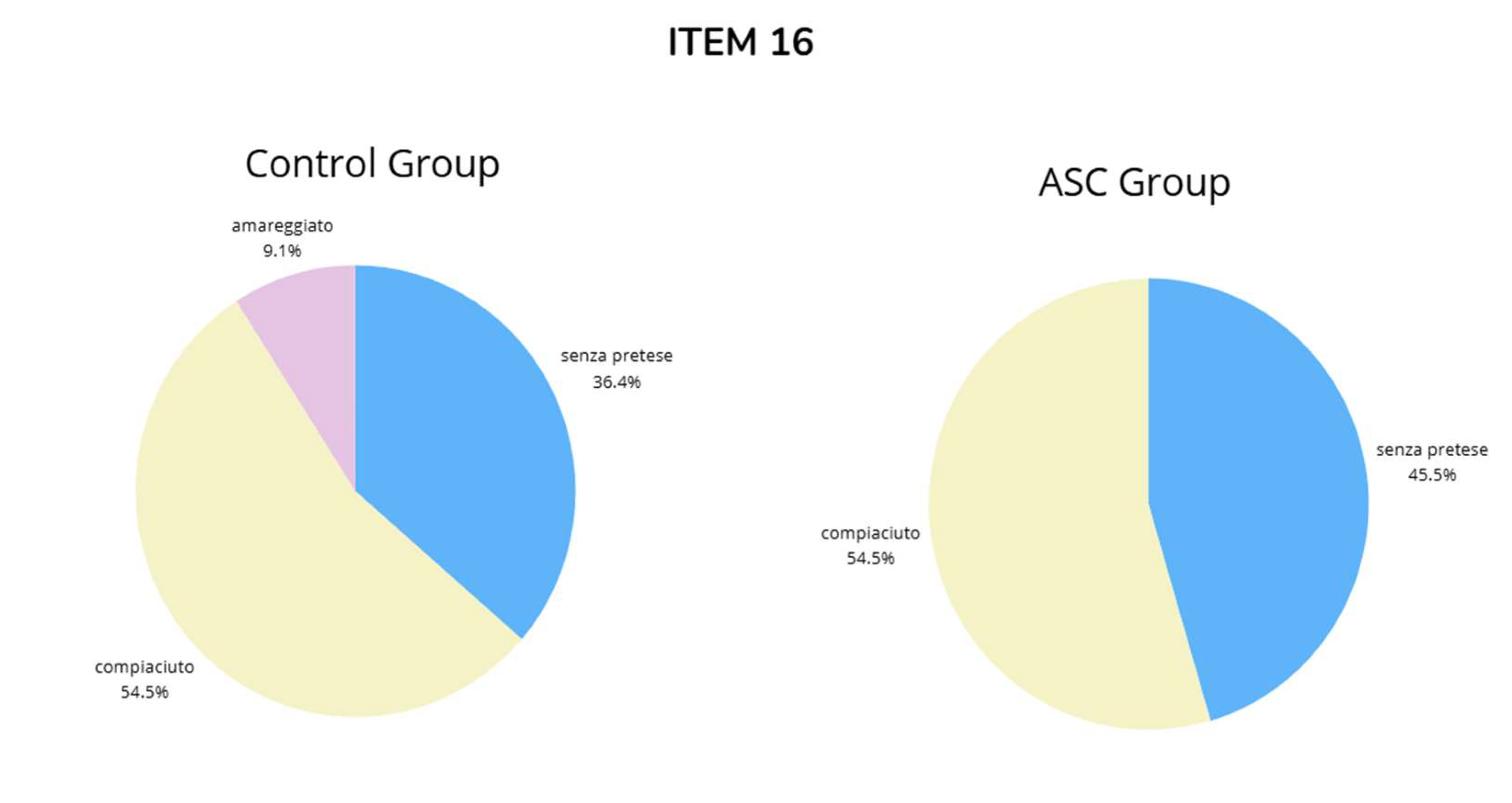
The frequencies at which the correct emotion (Senza pretese) was chosen in the sixteenth item was 36.4% in the Control group and 45.5% in the ASC group. Participants with Controls selected the emotion “Compiaciuto” (54.5%) more frequently and also chose “Amareggiato” (9.1%). Conversely, the Control group predominantly selected “Compiaciuto” in 54.5% of cases (
Figure A16).
Figure A16.
Emotional terms and their frequencies selected by the participants from both groups (Controls and ASC), RMF, item 16. The correct response is colored in Electric Blue.
Figure A16.
Emotional terms and their frequencies selected by the participants from both groups (Controls and ASC), RMF, item 16. The correct response is colored in Electric Blue.
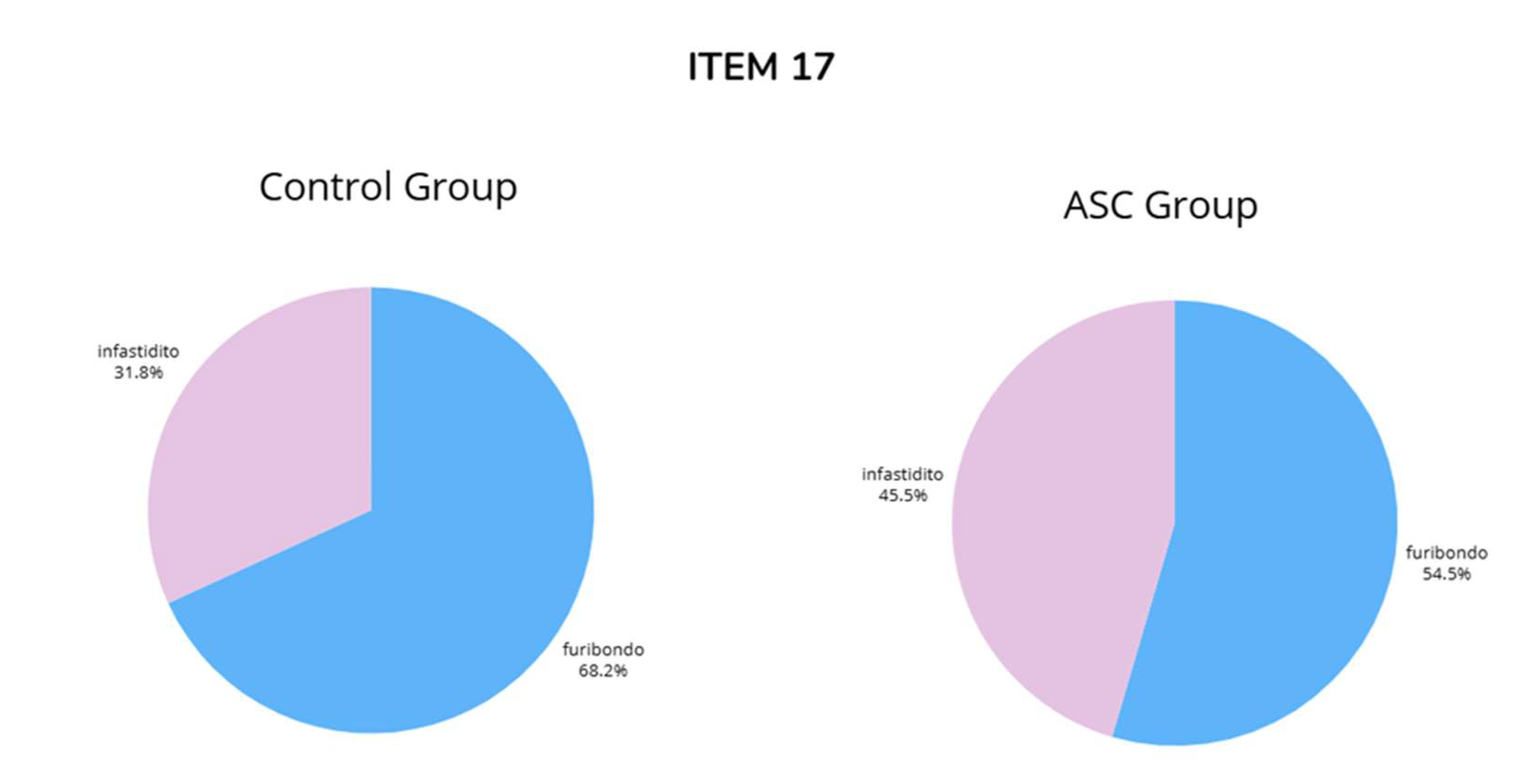
In the seventeenth item, “Furibondo” (the correct response) was the most chosen response by both groups, selected 68.2% of the time by the Control group and 54.5% by the ASC group. Participants also chose “Infastidito”, selected 31.8% of the time by the ASC group and 45.5% by the Control group (
Figure A17).
Figure A17.
Emotional terms and their frequencies selected by the participants from both groups (Controls and ASC), RMF, item 17. The correct response is colored in Electric Blue.
Figure A17.
Emotional terms and their frequencies selected by the participants from both groups (Controls and ASC), RMF, item 17. The correct response is colored in Electric Blue.
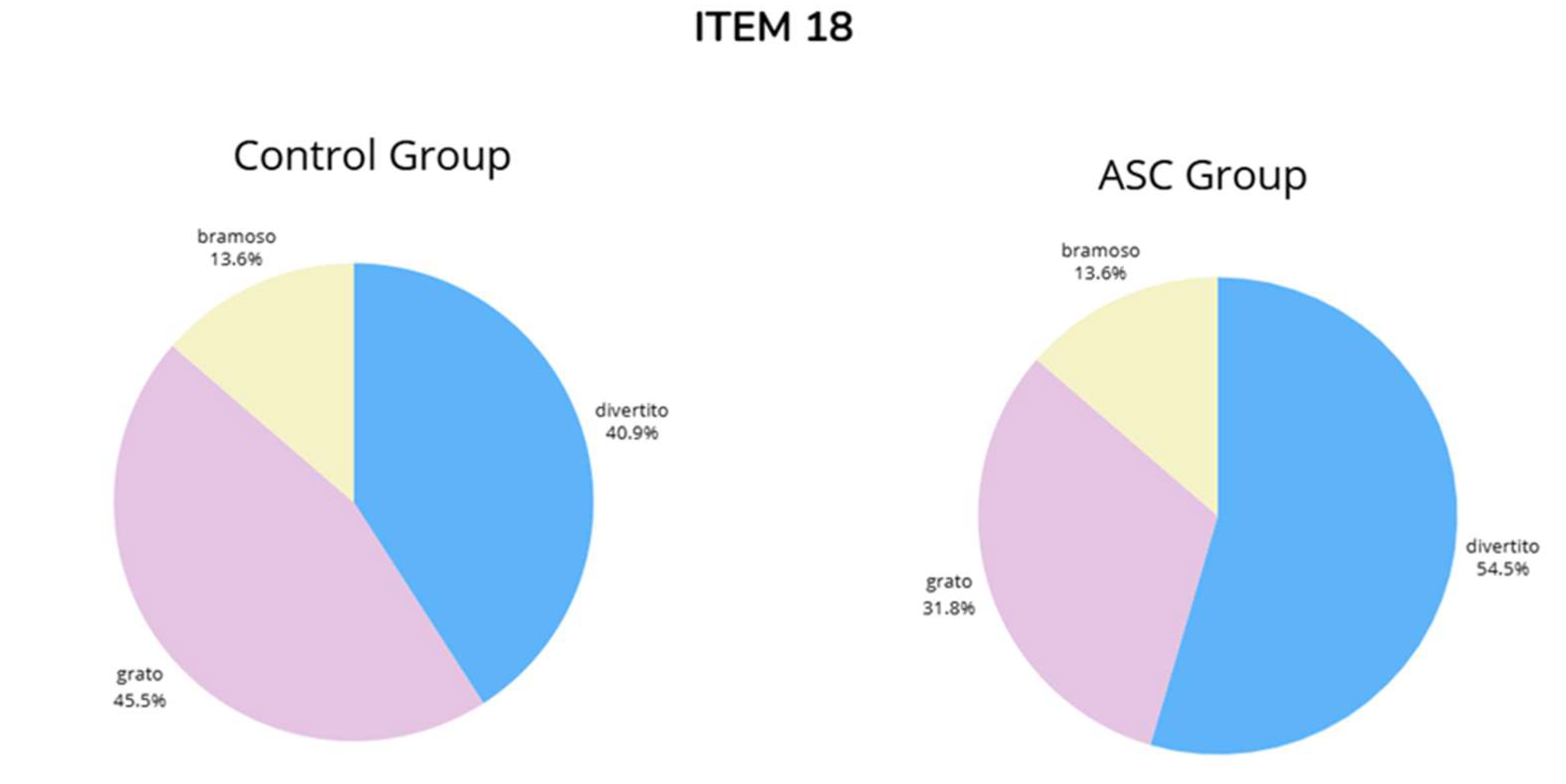
In the eighteenth item, the correct response “Divertito” was chosen by the Control group only 40.9% of the time. Surprisingly, the most frequently chosen emotion was “Grato” at a rate of 45.5%, while “Bramoso” was also selected, albeit not often (13.6%). In the ASC group, “Divertito” was accurately chosen in 54.5% of instances. “Grato” was selected only 31.8% of the time, and “Bramoso” in the 13.6% of the cases (
Figure A18).
Figure A18.
Emotional terms and their frequencies selected by the participants from both groups (Controls and ASC), RMF, item 18. The correct response is colored in Electric Blue.
Figure A18.
Emotional terms and their frequencies selected by the participants from both groups (Controls and ASC), RMF, item 18. The correct response is colored in Electric Blue.
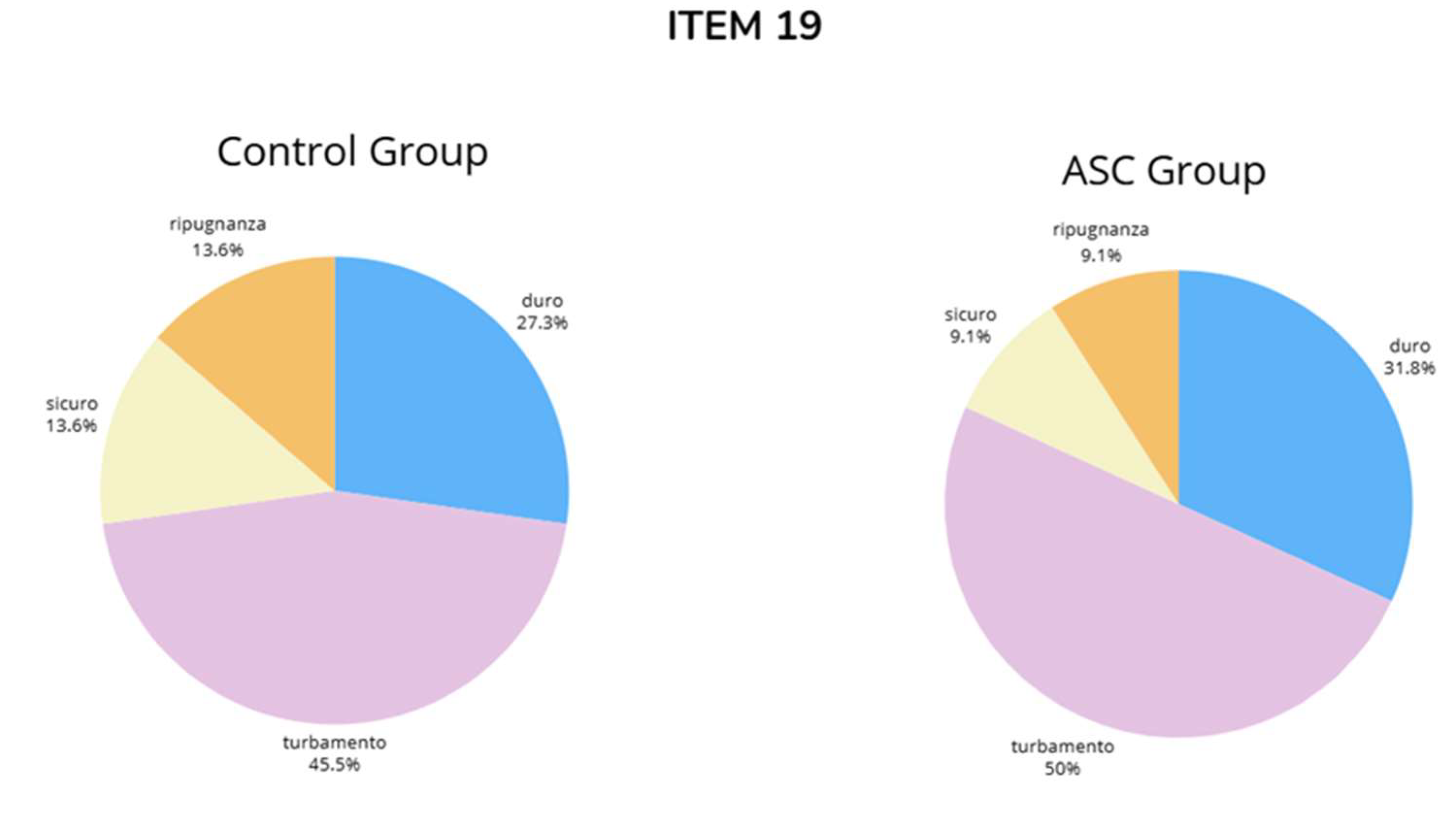
Regarding the performance in the nineteenth item, the most chosen option by both groups was “Turbamento”, selected 45.5% of the time by the Control group and 50% by the ASC group. The correct emotion (Duro) was selected in 27.3% of cases by the Control group and in 31.8% of cases by participants with ASC. “Ripugnanza” and “Sicuro” were chosen 13.6% of the time by the Control group, and 9.1% of the time by the ASC group (
Figure A19).
Figure A19.
Emotional terms and their frequencies selected by the participants from both groups (Controls and ASC), RMF, item 19. The correct response is colored in Electric Blue.
Figure A19.
Emotional terms and their frequencies selected by the participants from both groups (Controls and ASC), RMF, item 19. The correct response is colored in Electric Blue.
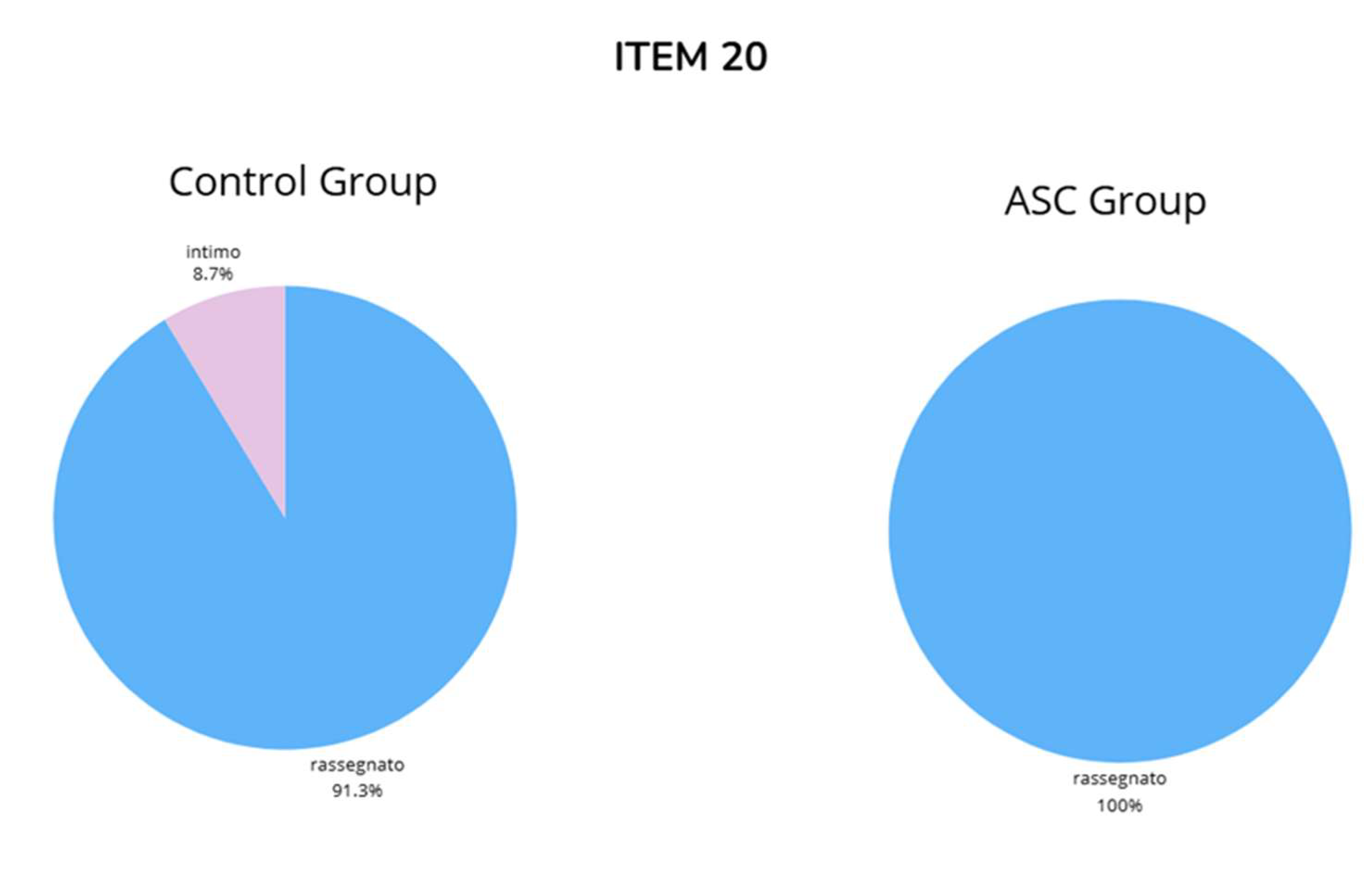
In the twentieth item, the ASC group unanimously chose the correct response “Rassegnato”, demonstrating a ceiling performance. In contrast, the Control group chose the correct emotion in 91.3% of instances. The alternative option selected was “Intimo”, noted in 8.7% of cases (
Figure A20).
Figure A20.
Emotional terms and their frequencies selected by the participants from both groups (Controls and ASC), RMF, item 20. The correct response is colored in Electric Blue.
Figure A20.
Emotional terms and their frequencies selected by the participants from both groups (Controls and ASC), RMF, item 20. The correct response is colored in Electric Blue.
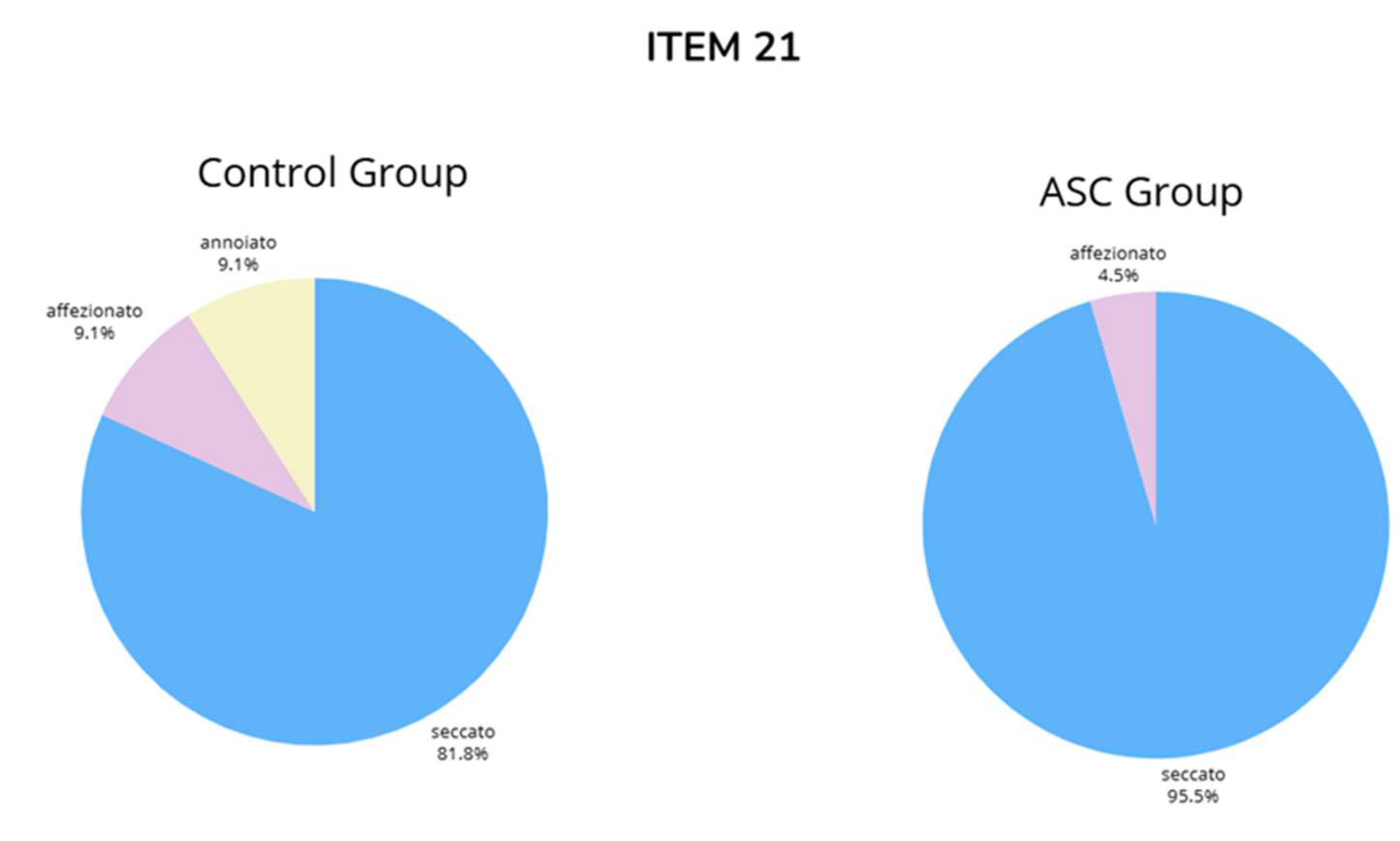
An enhanced performance by the ASC group is discernible in the twenty-first item, where they consistently chose the accurate option (Seccato) 95.5% of the time, and selected “Affezionato” only 4.5% of the instances. In contrast, the Control group selected the correct response 81.8% of the time, followed by “Annoiato” and “Affezionato” (9.1% each) (
Figure A21).
Figure A21.
Emotional terms and their frequencies selected by the participants from both groups (Controls and ASC), RMF, item 21. The correct response is colored in Electric Blue.
Figure A21.
Emotional terms and their frequencies selected by the participants from both groups (Controls and ASC), RMF, item 21. The correct response is colored in Electric Blue.
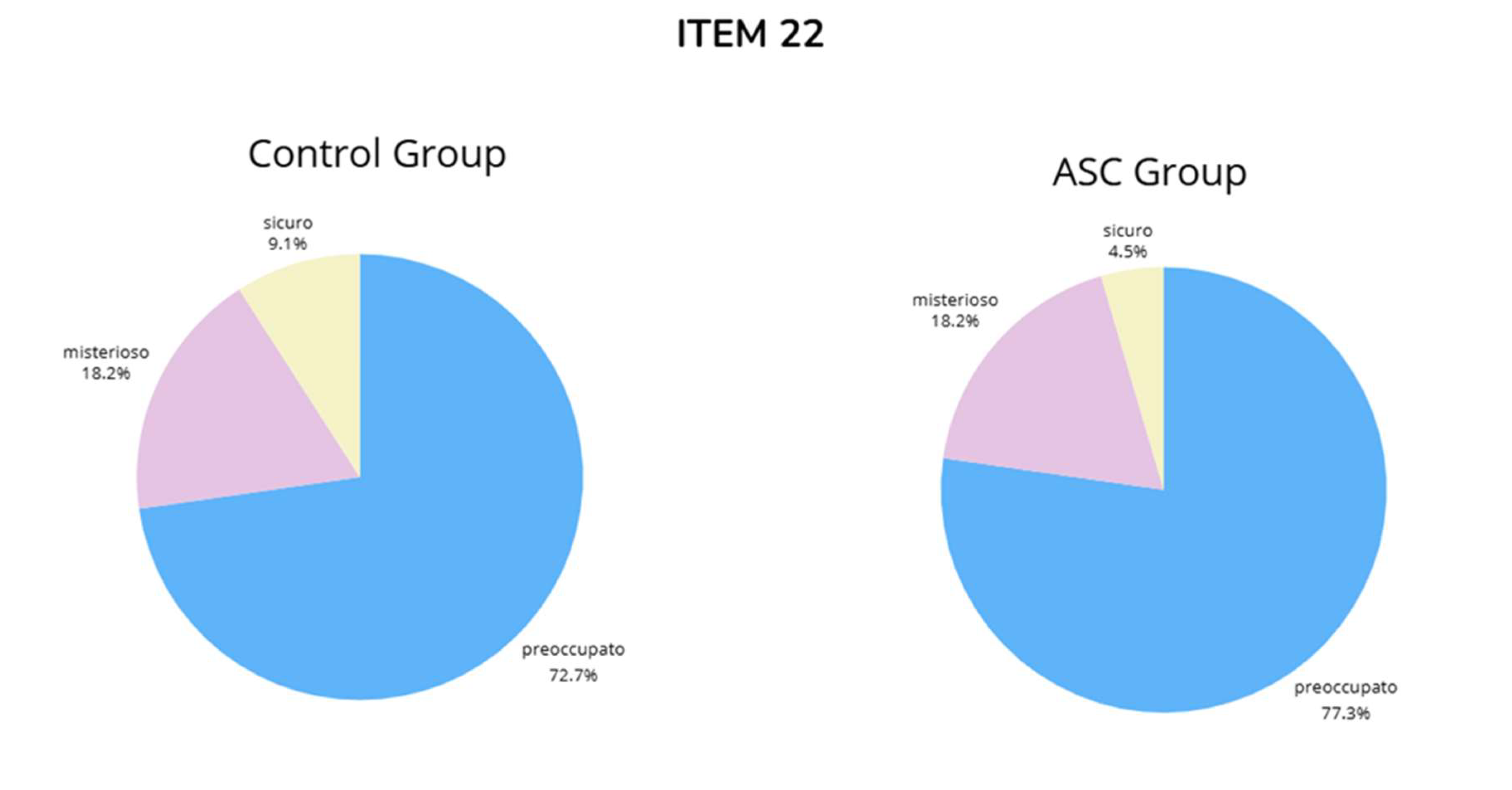
To conclude, in the final item, the correct response (Preoccupato) was chosen 72.7% of the time by the Control group and 77.3% by the ASC group. Other options selected were “Misterioso” (18.2% for both groups) and “Sicuro” (9.1% for Controls traits group and 4.5% for high traits group) (
Figure A22).
Figure A22.
Emotional terms and their frequencies selected by the participants from both groups (Controls and ASC), RMF, item 22. The correct response is colored in Electric Blue.
Figure A22.
Emotional terms and their frequencies selected by the participants from both groups (Controls and ASC), RMF, item 22. The correct response is colored in Electric Blue.