

Submitted:
26 August 2024
Posted:
27 August 2024
You are already at the latest version
Abstract
Managing plant diseases caused by phytopathogenic fungi, like anthracnose caused by Colletotrichum species, is a challenge. Different methods are being sought to identify compounds with antibiotic properties. The Trichoderma strains represent a source of novel molecules with antifungal properties, including Volatile Organic Compounds (VOCs), the production of which is influenced by the medium’s nutrient content. In this study, we assessed the VOCs produced in dual confrontation systems performed in two culture media by Trichoderma strains (T. atroviride IMI206040, T. asperellum T1 and T3, and Trichoderma sp. T2) against Colletotrichum acutatum. We analyze the VOCs profiles using gas chromatography coupled with mass spectrometry. The Luria Bertani medium (LB) stimulated VOCs production with antifungal properties in most systems. We determined the 2-pentyl furan, dimethyl disulfide, and α-phellandrene antifungal activity in vitro. The equimolar mixture of those VOCs (250 µM) generated 14% C. acutatum diametral growth inhibition. The infective ability and the disease severity caused by the mycelium exposed to the VOCs mixture significantly diminished on strawberry leaves. The application of those VOCs as biofumigants could contribute to managing anthracnose. The use of LB represents a feasible strategy to identify VOCs with antifungal properties even between Trichoderma strains belonging to the same species.
Keywords:
antifungal compounds
; secondary metabolites
; microbe interactions
1. Introduction
The phytopathogenic Colletotrichum genus comprises approximately 600 species, which are the causal agents of the disease known as anthracnose [1,2]. Colletotrichum acutatum and C. gloeosporioides are the most critical species in the Colletotrichum complex. These phytopathogens can affect different hosts, including tropical and subtropical fruits[3] and cause significant economic losses of up to 50%[4]. The mode of infection of Colletotrichum species begins with a biotrophic phase through the germination of resistance structures (appressors and spores), which results in the development of subcuticular or intracellular hyphae. Subsequently, it passes to the necrotrophic phase, which includes the proliferation of hyphae and the formation of infective structures to repeat its life cycle [5]. This structure remains dormant when conditions are unfavorable for germination; therefore, conducting its control is a complicated task [3]. Currently, different chemical methods are used to counteract anthracnose [6]. However, their excessive application induces resistance to phytopathogens [7], as well as the deterioration of consumer and producer health [8]. Therefore, alternative treatment options must be considered. In this sense, the use of biological control agents (BCA) is a strategy that aims to reduce disease-producing activity caused by a pathogen through the application of one or more organisms [9]. BCA are a source of different molecules with antimicrobial activity; for example, Trichoderma species produce diffusible and volatile organic compounds (DOCs and VOCs, respectively) with antagonistic effect [10,11]. Furthermore, Trichoderma interacts with various microorganisms within the same microbial community through VOCs emission, which functions as signal molecules that allow them to modulate their metabolism according to the population sensed, creating a hostile environment for the growth of pathogens. Moreover, the diversity of antifungal VOCs produced by Trichoderma occurs in a strain-dependent manner[12], and their production could be affected by distinct factors, e.g., the chemical composition of the culture medium[13]. Trichoderma harzianum, T. atroviride, T. hamatum, T. longibrachiatum, T. koningii, and T. viride are among the Trichoderma species most studied as BCA. Recently, other species belonging to viride clade like Trichoderma asperellum have gained attention[14]. The goal of the present work was to determine the T. asperellum strains’ ability to produce novel VOCs with fungicidal properties against C. acutatum, through dual confrontation systems performed in two culture media.
2. Materials and Methods
2.1. Strains and Culture Conditions
The BCA strains employed in this study were Trichoderma atroviride IMI206040, T. asperellum T1, Trichoderma sp. 2, T. asperellum T3, C. acutatum, and Escherichia coli (which was used as a negative control). All species were cultivated on potato dextrose agar (PDA, DIBICO®) and Luria-Bertani (LB) media at room temperature (21 ± 2°C) in the dark for 10 d prior to bioassays.
2.2. Phylogenetic Analysis of Trichoderma Strains
To construct the phylogenetic tree of T. asperellum T1, Trichoderma sp. 2, and T. asperellum T3, the ITS sequences of Trichoderma strains and that from Nectria eustromatica were obtained from the GenBank database (Table 1). The downloaded sequences were aligned with SeaView v.5.05 using MUSCLE [15] and edited manually. The aligned sequences were used to perform the Bayesian inference analysis in BEASTv.2.7.3 [16] using the TN93 substitution model and estimated parameter priors with the Yule model. Three independent Markov chains of 10,000,000 replicates were run with sampling every 10,000. The sample parameters were combined with LogCombiner, and basic parameters were checked in Tracer v.1.7.2 [17]. The sampled trees were combined with LogCombiner and then summarized with TreeAnnotator. The posterior probability was calculated for each node in a maximum clade credibility tree with a burn-in of 10%. Phylogenetic trees were visualized with FigTree v.1.4.4. N. eustromatica was used to root the tree.
2.3. Antagonistic Activity of VOCs Produced by Trichoderma Strains against C. acutatum in Two Culture Media
The biocontrol ability of the Trichoderma strains against C. acutatum was evaluated through dual confrontations systems. For this bioassay, 20 mL of PDA medium was placed on Petri dishes (9-cm in diameter) and inoculated at the center with an 8-mm in diameter of colonized propagule from 10 d old culture, either antagonistic or phytopathogenic strains. The inoculated Petri bases were placed opposite each other and sealed with Parafilm® [18]. This methodology allowed the interaction between both microorganisms via VOCs emission. The dual confrontations systems were denominated as follows: C. acutatum: vs. Trichoderma strains (Cavs.T1, Cavs.T2, Cavs.T3, and Cavs.IMI). In the bioassays performed on PDA medium, the phytopathogenic strain was inoculated first and Trichoderma strains (IMI206040, T1, T2, or T3) were inoculated 72 h afterward. In contrast, for the dual confrontation performed on LB medium, both C. acutatum and Trichoderma strains were inoculated simultaneously. A system of Petri dishes inoculated with C. acutatum vs. E. coli was employed as a negative control. The bioassays were incubated at room temperature in darkness until the control saturated the base of the Petri dish or had no growth for 3 d in a row. The growth of the phytopathogenic strains was measured using a ruler each 24 h. Growth inhibition was determined using the following equation: growth inhibition ([(control growth–treated growth) /control growth] × 100) [19]. The experiments were repeated three times, with six replicates per treatment.

Table 1.
Accession numbers for ITS sequences used for the phylogenetic tree.
| Microorganism | Strain | GenBank accession number | Reference |
|---|---|---|---|
| Trichoderma atroviride | IMI206040 | AF278795 | [20] |
| Trichoderma atroviride | CBS693.94 | KF576214 | [21] |
| Trichoderma atroviride | DAOM 222144 | AF456916 | Unpublished (Dodd, S. L., Lieckfeldt, E., and Samuels, G. J.) |
| Trichoderma afarasin | DIS 314F | FJ442259 | Unpublished (Chaverri, P., Samuels, G. J., and Evans, H. C.) |
| Trichoderma atrobrunneum | GJS 04-67 | FJ442273 | |
| Trichoderma lentiforme | DIS 218E | FJ442220 | |
| Trichoderma afroharzianum | GJS 04-186 | FJ442265 | |
| Trichoderma rifaii | DIS 337F | FJ442621 | |
| Trichoderma asperelloides | GJS 04-187 | JN133553 | [23] |
| Trichoderma asperelloides | GJS 04-116 | GU198301 | [24] |
| Trichoderma asperellum | GJS 05-328 | GU198318 | |
| Trichoderma asperellum | GJS 06-294 | GU198307 | |
| Trichoderma asperellum | GJS 90-7 | GU198317 | |
| Trichoderma yunnanense | CBS 121219 | GU198302 | |
| Trichoderma asperellum | GJS 01-294 | EU856297 | [25] |
| Trichoderma asperellum | CGMCC 6422 | KF425754 | [26] |
| Trichoderma gamsii | GJS 04-09 | DQ315459 | [27] |
| Trichoderma harzianum | T55 | MW857216 | Unpublished (Tang,G. and Gong,G.) |
| Trichoderma harzianum | T18 | MW857216 | [28] |
| Trichoderma harzianum | T2 | OR794127 | Unpublished (Alamr, A., Omar, A. F. and Hamed, K. E.) |
| Trichoderma harzianum | CBS 226.95 | AY605713 | Unpublished (Druzhinina, I. S., Bissett, J., and Kubicek, C. P. |
| Trichoderma harzianum | T11 | MT940829 | Benouzza, S) |
| Trichoderma hispanicum | S453 | JN715595 | [29] |
| Trichoderma samuelsii | S5 | JN715596 | |
| Trichoderma inhamatum | CBS 273.78 | MH861134 | [30] |
| Trichoderma pleuroti | CBS:124387 | MH863369 | |
| Trichoderma pleuroticola | CBS:124383 | MH863368 | |
| Nectria eustromatica | CBS:125578 | MH863715 | |
| Trichoderma junci | CBS 120926 | FJ860761 | [31] |
| Trichoderma valdunense | CBS 120923 | NR_134418 | [32] |
| Trichoderma viride | CBS 119325 | NR_138441 | |
| Trichoderma lieckfeldtiae | GJS 00-14 | DQ109528 | [33] |
| Trichoderma theobromicola | Dis 85f | DQ109525 | |
| Trichoderma asperellum | T1 | PQ043841 | This work |
| Trichoderma sp. | T2 | PQ043842 | |
| Trichoderma asperellum | T3 | PQ043843 |
2.4. Identification of VOCs
The VOCs produced individually by all strains, as well as those produced in dual confrontations systems (Cavs.T1, Cavs.T2, and Cavs.T3), performed on LB medium were analyzed.
The confrontation systems were performed and incubated at room temperature in the dark for 5 d. The VOCs were collected using a blue solid-phase microextraction (SPME) fiber (PDMS/DVB) (Supelco, Inc., Bellafonte, PA, USA) and desorbed at 180°C for 30 s in the injection port of a gas chromatograph (Agilent Technologies® 7890 B GC system, Foster City, CA, USA) equipped with an MS detector 5973 from Agilent and a free fatty acid-phase capillary column (HP-FFAP) (30 m x 0.25 mm I.D., film thickness of 0.25 μm). Helium was used as the carrier gas (1 mL/min), and the detector temperature was 230°C. The oven program was set at an initial temperature of 40°C for 5 min, followed by a steady increase of 3°C per min until a final temperature of 220°C was reached and maintained for 5 min. The post-run temperature was set to 300°C for three minutes. The compounds were identified by comparison with mass spectra from the NIST/EPA/NIH Mass Spectral Database 11 and NIST Mass Spectral Search Program 2.0; Chemstation Agilent Technologies Rev. D.04.00 2002 [34]. Three independent determinations were made for each strain and confrontation systems.
2.5. Analysis of the Antifungal Activity of the Synthetic VOCs Identified against C. acutatum
The antifungal activities of 2-pentyl furan, dimethyl disulfide, and α-phellandrene were evaluated individually against C. acutatum. For this, a colonized propagule (8-mm in diameter) from 10 d old of C. acutatum cultures was placed on PDA medium at the center of the Petri dish. Additionally, a filter paper disc (Whatman number four) was placed on the Petri dish lid with 0, 250, 500, and 1,000 µM of each compound, individually. The inoculated Petri bases were placed on a Petri dish lid containing the compounds and were sealed with Parafilm®, generating a head space volume of 60 mL. The head space of the Petri dishes was used to adjust VOCs concentrations. The assays were incubated at room temperature until the control strain saturated the base of the Petri dish or had no growth for 3 d in a row. Diametral growth was measured, and the percentage of inhibition was plotted. Furthermore, the phytopathogen mycelium was observed using a Meiji Techno MX5300L Co. biological microscope with a Meiji Infinit 1 metallographic camera with a 40X objective. Cell viability was evaluated by erioglaucine (Sigma-Aldrich) staining, with slight modifications [35].
2.6. Bioassays of Synthetic VOCs Mixtures on the Growth and Development of C. acutatum
The concentrations that generated the most significant effects on phytopathogen colonies were selected to formulate different mixtures. Bioassays were performed as mentioned above and the mixture of synthetic VOCs were placed on the filter paper disc. The following VOCs combinations were evaluated α-phellandrene plus 2-pentyl furan (α-P+2-P); α-phellandrene plus dimethyl disulfide (α-P+DD); and α-phellandrene plus dimethyl disulfide plus 2-pentyl furan (α-P+DD+2-P), each compound was assessed at 250 µM.
All bioassays described previously were incubated at room temperature until the control saturated the base of the Petri dish or had no growth for 3 d in a row. Diametral growth was measured, and the percentage of inhibition was plotted. Likewise, at the end of the experiment, phytopathogenic mycelia were observed, as described previously.
2.7. Analysis of the Infectivity of the Mycelium of C. acutatum Exposed to Synthetic VOCs
Healthy leaves from strawberry (Fragaria x ananassa Duch. Cv. Albion) were surface-disinfected with 1% Triton X-100 for 5 min, after with 70% ethanol for 1 min, and with a sodium hypochlorite for 10 min [36]. After washing three times in sterile deionized water, the leaves were transferred to a wet-chamber and inoculated with an 8-mm in diameter colonized propagule from the culture of C. acutatum exposed to the α-P+DD+2-P mixture as was previously described. A culture of C. acutatum without VOCs exposition was used as control. Leaves were incubated at room temperature for 6 d in dark conditions. To analyze the infective activity of C. acutatum exposed to VOCs, propagules was withdrawn from the leaves, and these were chemically treated for tissue clarification, the leaves from each treatment were incubated 2 h in a clearing solution (glacial acetic acid/ethanol (95%) 1:4 (v/v)) with continue agitation. The clearing solution was replaced each hour until the tissue was light yellow. Leaves were transferred to 70% ethanol solution and incubated at 4°C overnight, after that they were rinsed with sterile deionized and incubated with 0.5 M EDTA until their evaluation. The leaves from each treatment were stained with erioglaucine (Sigma-Aldrich) and representatives leaves from each treatment were chosen and imaged using Normaski optics on Meiji Techno MX5300L Co. biological microscope with a Meiji Infinit 1 metallographic camera with a 4X, 10X, and 40X objectives.
2.8. Statistical Analysis
GraphPad Prism v.10.2.3 for Windows (Boston, Massachusetts USA, www.graphpad.com) was used to perform statistical analyses. For the confrontation systems, synthetic VOCs antifungal activity, and severity evaluation, the data were expressed as the means ± SD of six repetitions. All data were analyzed by one-way ANOVA followed by the Tukey's post hoc test. Differences were considered significant at α = 0.01. The principal component analysis (PCA) was performed using factoextra package (version 1.0.7) and heatmap with the pheatmap package (version 1.0.12) both analyses were performed with the R software (version 2024.04.2+764) (Posit team, 2024. RStudio: Integrated Development Environment for R. Posit Software, PBC, Boston, MA. URL http://www.posit.co/.) The VOCs´ abundance dataset was standardized previously to perform the multivariate analyses.
3. Results
3.1. Molecular Identification of Trichoderma Strains
The most common species of the Trichoderma genus employed as BCA include T. harzianum, T. hamatum, T. longibrachiatum, T. koningii, T. viride, T. polysporum, and recently, research has focused on T. asperellum [23,24]. To identify the species to which the Trichoderma strains that were used in this work belonged, we achieved molecular identification and phylogenetic analysis of the Trichoderma strains. In this sense, the Bayesian analysis of the ITS sequences situated the Trichoderma strains together in the clade asperellum with a score of posterior probability of 0.99; albeit Trichoderma sp. T2 was separated from the group (Figure 1). This result indicates that the three Trichoderma strains used in this work correspond to T. asperellum.
3.2. Antagonistic Activity of VOCs Produced by Trichoderma Strains against C. acutatum
Microbial VOCs with antagonistic effects have attracted attention, thus, culture of BCA in different media has been recommended to identify new molecules with antibiotic properties [5,25,26]. In this study, we determined the effect of the culture media (PDA and LB) on the production of VOCs by BCA (T. atroviride IMI206040, T. asperellum T1, Trichoderma sp. T2, and T. asperellum T3). In addition, we analyzed the VOCs emitted during the confrontation between C. acutatum and Trichoderma strains, with the aim of identifying bioactive VOCs that inhibit the growth of the phytopathogen. For this purpose, strain IMI206040 was used as a reference to estimate the effectiveness of T. asperellum strains.
Our results in the dual confrontation on PDA medium showed that the least efficient strains were T3 and T2, which inhibited the mycelial diametral growth of C. acutatum in 12.82% and 25.46%, respectively. In contrast, the most effective strains were IMI206040 and T1 with 47.41% and 42.14%, respectively (Table 2). Otherwise, we observed that the biocontrol activity for those strains changed on LB medium. The least competent was T1 with 33.96% of diametral growth inhibition in C. acutatum. Moreover, the most effective strains were T2, T3, and IMI206040 with 56.86%, 51.84%, and 49.94%, of diametral growth inhibition, respectively (Table 1). These results indicate that the T. asperellum strains could be effective BCA.
The results observed in the antagonistic bioassays suggest that the Trichoderma´s biocontrol activity is specific for each strain. This ability can be differentially influenced by factors like nutrient source, increasing or diminishing it.
3.3. Identification of VOCs
The LB culture medium was the one that produced the most significant changes in the inhibition of C. acutatum growth and morphology. These results suggest that the chemical composition of the medium favored the production of volatiles with antifungal potential. Thus, the compounds produced individually and in the dual confrontation systems were determined by GC-MS.
Under our experimental conditions the total amount of VOCs emitted by the strains on LB medium were: 10, 40, 34, 35, and 51 for Ca, IMI206040, T1, T2, and T3, respectively (Table S1). The VOCs were identified as alcohols, aromatics, carboxylic acids, esthers, ethers, heterocyclic compounds, indolines, ketones, organosulfurs, terpenes, thiocyanates, thiols, and unknowns. The most abundant chemical classes for Ca were sulfur compound and unknowns, 56.54% and 35.26, respectively, while for Trichoderma strains the VOCs´ composition was similar, but in different proportions: ketones (36.01%), terpenes (31.29%), and unknowns (20.57%) for IMI206040; ketones (33.44%), heterocyclic compounds (26.39%), and terpenes (20.38%) for T1; ketones (49.94%), heterocyclic compounds (15.58%), organosulfurs (10.79%), and terpenes (9.43%) for T2; ketones (48.18%), terpenes (23.79%), and heterocyclic compounds (8.83%) for T3 (Figure 2a). The composition of VOCs profiles of Trichoderma strains reflects the diversity of chemical compounds that the species of this genus could produce. This represents a pool of compounds with antifungal potential that can be explored.
Concerning dual confrontations, we only assessed the VOCs profile produced in dual confrontation systems between T. asperellum strains and C. acutatum on LB medium. In this sense, the identified VOCs mixture was composed principally of heterocyclic compounds, ketones, organosulfurs, thiols, and unknowns. The VOCs profile for Cavs.T1 system was conformed principally by ketones (42.35%), heterocyclic compounds (26.36%), and unknowns (13.42%), while for Cavs.T2 system were ketones (39.39%), thiols (18.78%), unknowns (14.45%), and heterocyclic compounds (12.79%); finally, the principal VOCs identified in the Cavs.T3 system were ketones (35.55%), heterocyclic compounds (22.76%), unknowns (15.92%), and thiols (14.98%) (Figure 2b). The number of VOCs detected in the dual confrontation systems was reduced in comparison with those produced individually, it suggests that the Trichoderma strains redirection their metabolism to produce antifungal compounds. Hence, the compounds that integrate the principal´s chemical classes could possess antifungal potential.
In this sense, the most abundant compounds identified for each chemical class were: 6-Pentyl-2H-pyran-2-one from ketones group with 41.55%, 38.16%, and 32.44% for Cavs.T1, Cavs.T2, and Cavs.T3, respectively; 2-pentylfuran from heterocyclic compounds with 20.44%, 3.47%, and 7.81%, respectively; methanethiol from thiols with 10.62%, 18.78%, and 14.98% for Cavs.T1, Cavs.T2, and Cavs.T3, respectively; finally from unknowns group, the compound with a retention time of 19.69 min was most abundant with 9.15%, 8.85%, and 10.90% for Cavs.T1, Cavs.T2, and Cavs.T3, respectively (Table 3). These compounds could be responsible for the antifungal activity against C. acutatum, although we do not discard the possible contribution of the other compounds to the inhibitory effect.
The VOCs profiles produced by the strains assessed in this work were similar but in different proportions. Hence, to identify VOCs patterns that differentiate the strains and the dual confrontation systems according to their VOCs profiles we performed a principal component analysis (PCA). In this sense, the individual VOCs profiles of T. asperellum strains (T1, T2, and T3) were separated from T. atroviride IMI206040 and C. acutatum (Figure 3a). The two first principal components described 63.8% of the variation in the dataset.
On the other hand, for dual confrontation systems, the PCA analysis highlighted the VOCs profile detected in Cavs.T1 from the other two systems analyzed, while the profile´s Cavs.T2 and Cavs.T3 were grouped closely. The system with the major variation was Cavs.T2. The two first components described 67.3% of the variation in the dataset (Figure 3b). These results suggest that the strains corresponding to the Trichoderma genus possess a versatile biosynthetic machinery, which represents a source of new molecules with possible antifungal potential.
The heatmap and two-dimensional hierarchical analysis from the individual VOCs profiles on LB medium showed defined clusters. The IMI206040 strain was separated from the rest of the strains analyzed, as well as Ca strain, while the three T. asperellum strains were grouped closely. The IMI206040 strain over-produced twenty-five compounds e.g., 3-octanone, p-menth-1-en-8-ol, and unknowns (RT 38.77 and 45.13). For Ca strain, all the compounds detected were characteristic of it, hence, nine of them were overproduced, e.g., dimethyl disulfide and unknowns (RT 16.57 and 1.55). For the T1 strain, overproduced twelve compounds among them 3-cyclohepten-1-one, 2-pentyl furan, squalene, unknow (a 204 m.w. sesquiterpene TR 30.03), and others. For the T2 strain, ten compounds were overproduced, e.g., unknown (RT 27.79), 2-pentyl furan, 4-chloroanisole, and 6-pentyl-2H-pyran-2-one. Finally, the T3 strain overproduced fifteen compounds, among them 4-vynilanisole, β-phellandrene, β-farnesene, 2-butanone, 2-methyl-1-butanol, and others (Figure 3c).
On the other hand, in the dual confrontation systems, Cavs.T2 and Cavs.T3 integrated a subgroup, while Cavs.T1 was separated from those. The overproduced compounds for dual confrontation systems were: unknown (a 204 m.w. sesquiterpene RT 31.77) and 2-pentyl furan for the Cavs.T1 system, for the Cavs.T2 system, seven compounds were overproduced among them 6-pentyl-2H-pyran-2-one, dimethyl disulfide, (+)-δ-carene, and α-phellandrene; while for the Cavs.T3 system eight compounds were overproduced including β-phellandrene, unknown (RT 16.69), 3-cyclohepen-1-one, α-phellandrene, and others (Figure 3d). The VOCs described above could be considered as markers of each system analyzed. In the case of the dual confrontation systems, those VOCs could have antifungal potential against C. acutatum.
3.4. Antifungal Activity of Synthetic VOCs against C. acutatum
3.4.1. Antifungal Activity of Synthetic VOCs Individually Assessed against C. acutatum In Vitro
Three marker compounds from dual confrontation systems were selected to assess their antifungal activity against C. acutatum. The selection criteria of those compounds were: their overproduction in the dual confrontation systems, we considered compounds whose antifungal activity had not been reported against C. acutatum, their availability in the market, and accessibility. Under these criteria, the synthetic compounds selected were 2-pentyl furan, dimethyl disulfide, and α-phellandrene.
The synthetic VOCs assessed do not caused significant diametral growth inhibition of C. acutatum in neither of the concentrations assessed (250, 500, and 1,000 µM) (Figure 4a, b). Albeit the synthetic VOCs generated a discrete inhibition effect on the phytopathogen; they caused similar alterations in the colonies´ morphology (Figure 4a). The C. acutatum colonies exposed to the synthetic VOCs individually, developed lax colonies with alterations in their pigmentation (gray to white). They showed laxed aerial mycelium in the colony surface with sporulation rings on the edge of it. Additionally, the C. acutatum colonies exposure to 2-pentyl furan at 1,000 µM developed vegetative mycelium on the colony border (Figure 4a).
In response to the VOCs, the hyphae of C. acutatum showed different alterations in the three colony zones analyzed (center, middle, and edge). C. acutatum showed thinning hyphae at all concentrations of 2-pentyl furan assessed in all samples analyzed (Figure S1a). Similarly, dimethyl disulfide provokes curling, vacuolization, shortening hyphae, and distortion hyphae at 250 µM in the whole C. acutatum colony. The exposition to 500 µM dimethyl disulfide caused depolymerization of the hyphae at the middle and edge zones from the colony. Additionally, this compound stimulated the C. acutatum sporulation in the middle zone from the colony at 1,000 µM (Figure S1b). Finally, α-phellandrene induced sporulation at 250 µM on the entire colony, as well as thinning hyphae and curling hyphae, at higher concentrations in the distinct zones analyzed (Figure S1C).
These results indicate that synthetic VOCs could have antifungal properties, since those compounds alter the hyphae development and pigmentation, which may diminish the infectious capacity of C. acutatum.
3.4.2. Antifungal Activity of Synthetic VOCs Mixtures against C. acutatum In Vitro
The synthetic VOCs generated common and specific microscopic alterations at the different concentrations assessed in C. acutatum. This suggests that VOCs have distinct targets that affect the development of phytopathogens. Furthermore, hyphae alterations such as vacuolization, depolymerization, and curling indicate damage to cellular processes such as hyphae polarized growth, cell-wall biosynthesis, and altered membrane potential. Hence, mixtures of those compounds could increase the inhibitory effect over the growth of C. acutatum.
In this sense, we assessed three mixtures of synthetic VOCs: α-phellandrene plus 2-pentyl furan (α-P+2-P); α-phellandrene plus dimethyl disulfide (α-P+DD); and α-phellandrene plus dimethyl disulfide plus 2-pentyl furan (α-P+DD+2-P), each compound was assessed at 250 µM. The combination of the synthetic VOCs increased the diametral growth inhibition of C. acutatum. The mixtures α-P+2-P, α-P+DD, and α-P+DD+2-P caused ~6%, ~10%, and ~14% diametral growth inhibition of C. acutatum, respectively (Figure 5a, b). This result indicates that the VOCs had an additive effect over the diametral growth inhibition of C. acutatum.
Additionally, the colonies´ morphology showed alterations more drastic than those caused individually. The α-P+2-P mixture induced the development of white laxed mycelium at the center of the colony´ fungal; the effect described above was more evident when C. acutatum was exposed to the α-P+DD mixture as reflected by the formation of holes in the mycelium. Furthermore, this mixture induced the development of vegetative mycelium at the colony edge. The α-P+DD+2-P mixture occasioned similar effects to those observed when C. acutatum was exposed to the α-P+DD mixture, but without the development of vegetative mycelium (Figure 5a).
At the microscopical level, the VOCs mixtures assessed induced alterations over the hyphae development. The exposition of C. acutatum to the α-P+2-P mixture induced swelling and curling hyphae, while the α-P+DD mixture caused swelling hyphae, vacuolization, and sporulation. Finally, the α-P+DD+2-P induced thinning and depolymerization of the hyphae in addition to the effects described previously (Figure 5c).
These results reinforced the hypothesis that the exposition of C. acutatum to the VOCs mixture could affect the phytopathogen´s infective ability.
3.5. Analysis of the Infectivity of the Mycelium of C. acutatum Exposed to the α-P+DD+2-P Mixture
Normal hyphae development, as well as the melanization of those, are necessary for the pathogen´s successful penetration of plant tissues. Since the principal alterations observed in the mycelia of C. acutatum exposed to the α-P+DD+2-P mixture included development of white colonies (decreased melanization) and alteration of the development of hyphae, we hypothesized that those fungal mycelia have the infective ability diminished. To probe our hypothesis, we determined the infectivity of C. acutatum using an ex-vivo technique employing leaves from strawberries (Fragaria x ananassa Duch. Cv. Albion, a host of the phytopathogen).
In this sense, C. acutatum´ mycelium untreated infected the strawberry leaves, and that developed necrose in both abaxial and adaxial tissues, the infection severity reached ~60% of the surface leaves; also, C. acutatum´ mycelium exposed to VOCs infected the strawberries leaves but in a lowest efficient manner than that developed by the mycelium untreated, the infection was delimited to the contact zone with the propagule without develop necroses, the infection severity was <10% of the surface leaves (Figure 6a, b).
To verify the presence of the fungus in the strawberry tissues we performed a microscopic analysis, the hyphae of C. acutatum were localized in the inner tissues leaves. Hyphae´ C. acutatum mycelium no treated were more abundant than those exposed to the VOCs (Figure 6c). These results indicate that the VOCs assessed in this work could contribute to diminishing the infection occasioned by C. acutatum.
4. Discussion
Colletotrichum is among the most important phytopathogens worldwide. It affects a wide range of tropical, subtropical, and temperate crops [27,28]. C. acutatum is a cosmopolitan pathogen that causes anthracnose in economically important crops [29,30].
Synthetic fungicides have been used to reduce losses due to anthracnose in the pre- or post-harvest stages, [44]. However, its constant application induces resistance to disease-causing agents [45]. Therefore, it is necessary to administer higher doses of those compounds. This action generates residuals in the food and environment, and damages to the health of consumers and producers [33,34].
Due to collateral effects, other control strategies have been sought, such as the use of antagonistic microorganisms to obtain antimicrobial compounds produced by bacteria and fungi [48] such as Trichoderma spp. or B. subtilis [36,37]. However, it is necessary to develop strategies to identify new compounds with antimicrobial activity.
In this sense, we reported a differential effect of the Trichoderma´s biocontrol activity against Colletotrichum gloeosporioides in vitro performing the dual confrontations on the media PDA and LB [40]. The LB medium favored the biocontrol activity of most Trichoderma strains assessed; however, their hydrolytic activity diminished in that medium, indicating that the increment in the antagonistic activity was due to the modulation of another biocontrol mechanism, like antibiosis.
The biosynthesis of antibiotic compounds can be induced through the modulation of secondary metabolism. Achimón et al., [38] reported the effect of different carbohydrates (glucose, fructose, xylose, sucrose, and lactose) on the biosynthesis of molecules derived from terpenes with antimicrobial properties. It is well known that nutritional content determines the microbes´ metabolism [52]. A distinct carbon source induces the biosynthesis of different metabolites, including antifungal molecules, such as VOCs.
Therefore, in the present study, we assessed the effect of two culture media (PDA and LB) on the Trichoderma´s biocontrol activity through VOCs´ production against C. acutatum, the antifungal activity of identified synthetics VOCs, and the infectivity ability of the C. acutatum´ mycelium exposed to those VOCs.
The diametral growth inhibition of C. acutatum in the dual confrontation systems performed on PDA and LB reached differential values. In the bioassays performed on LB medium, the diametral growth inhibition over C. acutatum reached values 2.23 and 4.05 folds higher (for Cavs.T2 and Cavs.T3), compared with those registered on PDA medium. For the Cavs.T1 and Cavs.IMI systems, the inhibitory effect was similar in both media (Table 1). López-Hernández et al., [40] reported similar results, when assessing the antifungal potential of Trichoderma sp. (T1, T2, and T3) against Fusarium graminearum in LB and PDA, obtaining higher inhibition percentages in the bioassays performed in LB medium, which were 1.28 folds higher than those observed in PDA medium. These results suggest that the composition and abundance of VOCs produced in LB and PDA are different.
The increase in the diametral growth inhibition of C. acutatum on LB medium probably was due to the amino acids contained in it [54]. The amino acids promoted the biosynthesis of antifungal VOCs more effectively than the PDA medium. Bruce et al., [42] demonstrated that the amino acid composition of the medium affects the production of fungicidal VOCs by Trichoderma aureoviride. Additionally, Ling et al., [43] reported that VOCs produced by B. subtilis in LB medium inhibited the growth of Mucor circinelloides, Fusarium arcuatisporum, Alternaria iridiaustralis, and Colletotrichum fiorinia, efficiently up to 73%. Moreover, Havenga et al., [44] demonstrated that the nutrient source (34 carbon sources and 20 amino acids) showed distinct effects on the antifungal potential of B. subtilis over C. gloeosporioides. The carbon sources that generated the highest inhibition values were citric acid, galactose, pyruvate, and benzoate. On the other hand, the amino acids that generated major inhibition in the phytopathogen were L-Aspartic-acid and L(+) asparagine. Hence, modification of the composition of nutritional sources is a strategy to improve the production of secondary metabolites with antifungal potential.
The VOCs produced in the dual confrontations systems generated morphological alterations in the mycelia of the pathogenic colonies. The C. acutatum colonies showed aerial mycelial growth, colony pigmentation changes, and irregular colony edge growth (Figure 1a), suggesting that the composition and abundance of VOCs produced in the different systems assessed are different and that they possess potential antifungal with distinct action mechanisms [58]. These results indicate that using this culture medium is a good strategy to identify VOCs with antifungal potential.
Hence, we analyzed the VOCs produced individually by the strains and those in the dual confrontation systems on LB medium using GC-MS. Each strain individually assessed produced a differential VOCs profile, both in composition and abundance. Individually, T. asperellum T3 was the highest producer with 51 compounds, followed by T. atroviride IMI206040, Trichoderma sp. T2, T. asperellum T1, and C. acutatum, with 40, 35, 34, and 10 VOCs, respectively (Table S1). C. acutatum produced principally organosulfur and unknown compounds, while the most abundant VOCs produced by T. atroviride were ketones, terpenes, and unknowns. On the other hand, T. asperellum T1, Trichoderma sp. T2, and T. asperellum T3 produced principally ketones, terpenes, and heterocyclic compounds (Figure 2a).
This indicates that the Trichoderma species possess a versatile metabolism, founded on the high number of genes involved in secondary metabolites production [59]. Albeit the Trichoderma strains assessed in this work belong to the same phylogenetic clade (Trichoderma), their VOC profiles showed notable differences even between the T. asperellum strains, e.g., in the production of heterocyclic compounds, ketones, and terpenes (Figure 2a, Table S1). Hence, the VOC profile production of Trichoderma occurs in a strain-dependent manner. In this sense, Guo et al., [47,48] demonstrated that the Trichoderma harzianum, T. hamatum, T. reseei, and T. velutinum strains produced specific VOC profiles.
Trichoderma species produce secondary metabolites with antimicrobial properties including volatile and non-volatile molecules, those compounds restrict the growth and development of other fungi. In this sense, when the Trichoderma strains were confronted with C. acutatum, the VOCs diversity they produced was reduced drastically. In those systems the number of VOCs detected were 9, 12, and 12 for Cavs.T1, Cavs.T2, and Cavs.T3, respectively (Table 2). This indicates that Trichoderma strains modulate their metabolism in response to fungal pathogens or other microorganisms. In this sense, Guo et al., [47] reported that the VOCs profiles of Trichoderma harzianum, T. hamatum, and T. velutinum were modulated (positively or negatively) when they were confronted with L. bicolor.
Although the chemical diversity of the VOCs produced in the dual confrontation systems was similar in chemical classes (Figure 2b), their abundance was different, e.g., for the Cavs.T1 system the 2-pentyl furan abundance was 5.89 and 2.62 folds higher than those produced in the Cavs.T2 and Cavs.T3 systems, respectively; for the Cavs.T2 system the dimethyl disulfide was 1.70 and 1.9 folds higher than those registered in Cavs.T1 and Cavs.T3 systems, respectively; finally, for the Cavs.T3 system the 6-ethoxy-2,2,4-trimethyl-1,2,3,4-tetrahydroquinoline abundance was 2.52 and 1.6 folds higher than those produced in the Cavs.T1 and Cavs.T2 systems, respectively. These results suggest that the Trichoderma strains produce VOC profiles in a strain-dependent manner in response to C. acutatum.
The multivariate analyses (PCA and heatmap and two-dimensional hierarchical dendrograms) proved the previous assumption. The VOC profiles allowed discrimination of the variation between T. atroviride IMI204060 and T. asperellum strains; some compounds were identified as markers for each strain (Figure 3a, c, Table S2), as well as for the dual confrontation systems (Figure 3b, d, Table S3). We chose some marker VOCs identified in the dual confrontation systems to determine if they had antifungal properties against C. acutatum.
In this sense, we assessed the antifungal activity of 2-pentyl furan, dimethyl disulfide, and α-phellandrene against C. acutatum. None of the compounds evaluated had a significant inhibitory effect on the C. acutatum growth. However, they caused colonies´ morphological alterations, the three compounds caused the development of white lax mycelium (Figure 4). At microscopic level, the VOCs caused hyphae´ abnormal development, e.g., vacuolization, distortion, thinning, and depolymerization. Additionally, the α-phellandrene stimulated the C. acutatum sporulation (Figure S1). Those effects indicated that C. acutatum faces stressful conditions in response to the exposition to VOCs.
The diversity of alterations observed suggests that the VOCs have different action targets. The hyphae´ vacuolization indicates that there is an injury to the fungal cell wall and plasma membrane, which triggers damage to the protoplasm, reducing the cell viability [60]. The hyphae´ depolymerization and distortion suggests affectations in the tubulin cytoskeleton, as this structure is an essential requirement for proper polarized growth, the alterations in the formation of this cellular structure affect fungal morphogenesis and cause abnormal development of the hyphae [61]. The stimulated sporulation in C. acutatum could be related to the survival of fungi [62].
Since the compounds assessed were identified as part of a VOCs blend in the dual confrontation systems, combining those compounds will generate an additive or synergistic effect on the growth inhibition of C. acutatum. In this sense, the C. acutatum diametral growth inhibition increased when it was exposed to the different VOCs combinations, the mixture most effective was α-P+DD+2P reaching ~14% diametral growth inhibition (Figure 5a, b). Additionally, the microscopic alterations were more severe than those caused individually, this mixture caused hyphae swelling, depolymerization, and thinning (Figure 5c). These results reinforced the hypothesis that the VOC mixture generates an additive effect and affects the same pathways but at different points, generating increased alterations when the compounds were mixed.
In this sense, some monoterpenes could alter the plasma membrane, resulting in intracellular leaks, derived from an increase in cell membrane permeability of fungi [52,53]. Hence, it is hypothesized that α-phellandrene could cause damage to the cell membrane, allowing the internalization of the other two VOCs and enhancing their toxic effects on C. acutatum. Zhang et al., [54] demonstrated that α-phellandrene provoke loss of cytoplasmic material and distortion of the mycelium in Penicillium cyclopium, causing an increase of their membrane permeability. The α-phellandrene potentiating effect was recently assessed by Bhattacharya et al., [55], assessing it in combination with fluconazole and amphotericin B, individually. Both combinations caused a synergistic effect against Candida albicans.
On the other hand, Lin et al., [56] demonstrated the antifungal activity of dimethyl disulfide against Magnaporthe oryzae, Gibberella fujikuroi, Sarocladium oryzae, Phellinus noxius, Colletotrichum fructicola, and Candida albicans. Humphris et al., [57] reported that the ability of dimethyl disulfide to inhibit growth can be attributed to alterations in protein synthesis, which participates in fungal growth.
On the other hand, the 2-pentyl furan antifungal activity was demonstrated against Monilinia fructicola [69], Sclerotinia sclerotiorum, and Fusarium oxysporum [70]; however, their antifungal mechanism has not been probed. This molecule is classified as heterocyclic compound; hence, it could share similar action mechanisms like glucan synthesis inhibition [71] which constitute the cell-wall.
In addition to the microscopic alterations, the fungal colonies exposed to the VOCs mixture developed white mycelium. This indicates that the melanin production in C. acutatum was diminished (Figure 4 and 5). Since the hyphae melanization is required to that appressoria effectively penetrate plant tissues we assessed their infective ability on strawberry leaves ex vivo. The exposition to the VOCs mixture significantly diminished the disease severity caused by C. acutatum on the strawberry leaves by ~85% (Figure 6). The laccases are responsible for melanin biosynthesis, and their production favors the pathogenicity of some fungus, hence, C. acutatum exposition to the VOCs mixture could inhibit their activity [19].
5. Conclusions
The evaluation of the antagonistic activity of T. asperellum in different culture media (e.g., LB medium) represents a strategy feasible to identify novel VOCs with antifungal properties even between Trichoderma strains belonging to the same species. Moreover, the application of the VOCs identified as biofumigants offers a strategy that could contribute to managing plant diseases caused by fungi, like the anthracnose produced by C. acutatum. Additional research is necessary to determine if the effectiveness of the VOCs identified in this work could be extrapolated to other Colletotrichum species.
Supplementary Materials
The following supporting information can be downloaded at the website of this paper posted on Preprints.org. Figure S1: Microscopic analysis of mycelium of C. acutatum exposed to synthetic VOCs; Table S1: VOCs produced by the fungal microorganisms on LB; Table S2: All data PCA´ loadings from VOCs produced by the fungal microorganisms on LB; Table S3: All data PCA´ loadings from VOCs produced on dual confrontation systems on LB.
Author Contributions
Conceptualization, M.N.C.A.; methodology, M.N.C.A., L.I.M.R., P.I.B.O., and I.H.H.; software, M.N.C.A. and I.H.H.; validation, M.N.C.A. and L.I.M.R.; formal analysis, M.N.C.A., M.G.A., J.L.A.O; investigation, M.N.C.A., M.G.A., I.H.H., and J.L.A.O.; resources, M.N.C.A., L.I.M.R., and I.H.H; data curation, L.I.M.R. and M.N.C.A; writing—original draft preparation, M.N.C.A.; writing—review and editing, M.N.C.A., L.I.M.R., P.I.B.O., and I.H.H.; visualization, M.N.C.A., M.G.A., L.I.M.R., J.L.A.O., P.I.B.O., and I.H.H.; supervision, M.N.C.A.; project administration, M.N.C.A. and I.H.H..; funding acquisition, M.N.C.A. and I.H.H. All authors have read and agreed to the published version of the manuscript.”
Funding
This work was funded by Convocatoria de Fortalecimiento de Cuerpos Académicos (2015) PRODEP de la Secretaría de Educación Pública de México, DSA/103.5/15/10775, and Convocatoria 2023: Proyectos de Investigación Científica, Desarrollo Tecnológico e Innovación del Tecnológico Nacional de México 17411.23-PD.
Acknowledgments
The strains used in this work were kindly donated: T. asperellum T1 and T3 by Juan Boyzo Marín, Trichoderma sp. T2 by M.C. Alberto Flores García from Instituto de Investigaciones Químico Biológicas (IIQB-UMSNH), T. atroviride IMI206040 by Dra. Ana Laura Guillén Nepita from Facultad de Ciencias Médicas y Biológicas “Dr. Ignacio Chávez" (UMSNH), and the phytopathogenic fungus C. acutatum by M.C. Luis María Suárez Rodríguez from Instituto de Investigaciones Químico Biológicas (IIQB-UMSNH).
Conflicts of Interest
The authors declare no conflicts of interest.
References
- Jayawardena, R.S.; Hyde, K.D.; Chen, Y.J.; Papp, V.; Palla, B.; Papp, D.; Bhunjun, C.S.; Hurdeal, V.G.; Senwanna, C.; Manawasinghe, I.S.; et al. One stop shop IV: taxonomic update with molecular phylogeny for important phytopathogenic genera: 76–100 (2020). Fungal Divers 2020, 103, 87–218. [Google Scholar] [CrossRef]
- Silva, A.O.; Savi, D.C.; Gomes, F.B.; Gos, F.M.W.R.; Silva, G.J.; Glienke, C. Identification of Colletotrichum species associated with postbloom fruit drop in Brazil through GAPDH sequencing analysis and multiplex PCR. Eur J Plant Pathol 2017, 147, 731–748. [Google Scholar] [CrossRef]
- Wharton, P.S.; Diéguez-Uribeondo, J. The biology of Colletotrichum acutatum. Anales del Jardín Botánico de Madrid 2004, 61, 3–22. [Google Scholar] [CrossRef]
- Da Lio, D.; Cobo-DÍaz, J.F.; Masson, C.; Chalopin, M.; Kebe, D.; Giraud, M.; Verhaeghe, A.; Nodet, P.; Sarrocco, S.; Le Floch, G.; et al. Combined Metabarcoding and Multi-locus approach for Genetic characterization of Colletotrichum species associated with common walnut (Juglans regia) anthracnose in France. Sci Rep 2018, 8. [Google Scholar] [CrossRef]
- Dean, R.; Van Kan, J.A.L.; Pretorius, Z.A.; Hammond-Kosack, K.E.; Di Pietro, A.; Spanu, P.D.; Rudd, J.J.; Dickman, M.; Kahmann, R.; Ellis, J.; et al. The Top 10 fungal pathogens in molecular plant pathology. Mol Plant Pathol 2012, 13, 414–430. [Google Scholar] [CrossRef] [PubMed]
- Mohammed, A. An Overview of Distribution, Biology and the Management of Common Bean Anthracnose. J Plant Pathol Microbiol 2013, 04. [Google Scholar] [CrossRef]
- Segaran, G.; Sathiavelu, M. Fungal endophytes: A potent biocontrol agent and a bioactive metabolites reservoir. Biocatal Agric Biotechnol 2019, 21. [Google Scholar] [CrossRef]
- Nicolopoulou-Stamati, P.; Maipas, S.; Kotampasi, C.; Stamatis, P.; Hens, L. Chemical Pesticides and Human Health: The Urgent Need for a New Concept in Agriculture. Front Public Health 2016, 4. [Google Scholar] [CrossRef]
- Alabouvette, C.; Olivain, C.; Steinberg, C. Biological control of plant diseases: The European situation. Eur J Plant Pathol 2006, 114, 329–341. [Google Scholar] [CrossRef]
- Inayati, A.; Sulistyowati, L.; Aini, L.Q.; Yusnawan, E. Antifungal activity of volatile organic compounds from Trichoderma virens. In Proceedings of the AIP Conference Proceedings; American Institute of Physics Inc., 2019; Vol. 2120, pp. 1–8. [Google Scholar]
- Gajera, H.; Domadiya, R.; Patel, S.; Kapopara, M.; Golakiya, B. Molecular mechanism of Trichoderma as bio-control agents against phytopathogen system-a review. Curr Res Microbiol Biotechnol 2013, 1, 133–142. [Google Scholar]
- Guo, Y.; Jud, W.; Ghirardo, A.; Antritter, F.; Benz, J.P.; Schnitzler, J.P.; Rosenkranz, M. Sniffing fungi – phenotyping of volatile chemical diversity in Trichoderma species. New Phytologist 2020, 227, 244–259. [Google Scholar] [CrossRef] [PubMed]
- Guo, Y.; Ghirardo, A.; Weber, B.; Schnitzler, J.P.; Philipp Benz, J.; Rosenkranz, M. Trichoderma species differ in their volatile profiles and in antagonism toward ectomycorrhiza Laccaria bicolor. Front Microbiol 2019, 10. [Google Scholar] [CrossRef] [PubMed]
- Gualtieri, L.; Monti, M.M.; Mele, F.; Russo, A.; Pedata, P.A.; Ruocco, M. Volatile Organic Compound (VOC) Profiles of Different Trichoderma Species and Their Potential Application. Journal of Fungi 2022, 8. [Google Scholar] [CrossRef]
- Gouy, M.; Guindon, S.; Gascuel, O. Sea view version 4: A multiplatform graphical user interface for sequence alignment and phylogenetic tree building. Mol Biol Evol 2010, 27, 221–224. [Google Scholar] [CrossRef]
- Bouckaert, R.; Vaughan, T.G.; Barido-Sottani, J.; Duchêne, S.; Fourment, M.; Gavryushkina, A.; Heled, J.; Jones, G.; Kühnert, D.; De Maio, N.; et al. BEAST 2.5: An advanced software platform for Bayesian evolutionary analysis. PLoS Comput Biol 2019, 15. [Google Scholar] [CrossRef]
- Rambaut, A.; Drummond, A.J.; Xie, D.; Baele, G.; Suchard, M.A. Posterior summarization in Bayesian phylogenetics using Tracer 1.7. Syst Biol 2018, 67, 901–904. [Google Scholar] [CrossRef] [PubMed]
- Barakat, F.M.; Abada, K.A.; Abou-Zeid, N.M.; El-Gammal, Y.H.E. Effect of volatile and non-volatile compounds of Trichoderma spp. on Botrytis fabae the causative agent of faba bean chocolate spot. American Journal of Life Sciences 2014, 2, 11–18. [Google Scholar] [CrossRef]
- Emanuel, R.V.; César Arturo, P.U.; Lourdes Iveth, M.R.; Homero, R. de la C.; Mauricio Nahuam, C.A. In vitro growth of Colletotrichum gloeosporioides is affected by butyl acetate, a compound produced during the co-culture of Trichoderma sp. and Bacillus subtilis. 3 Biotech 2020, 10. [Google Scholar] [CrossRef]
- Kubicek, C.P.; Herrera-Estrella, A.; Seidl-Seiboth, V.; Martinez, D.A.; Druzhinina, I.S.; Thon, M.; Zeilinger, S.; Casas-Flores, S.; Horwitz, B.A.; Mukherjee, P.K.; et al. Comparative genome sequence analysis underscores mycoparasitism as the ancestral life style of Trichoderma. Genome Biol 2011, 12. [Google Scholar] [CrossRef]
- Skoneczny, D.; Oskiera, M.; Szczech, M.; Bartoszewski, G. Genetic diversity of Trichoderma atroviride strains collected in Poland and identification of loci useful in detection of within-species diversity. Folia Microbiol (Praha) 2015, 60, 297–307. [Google Scholar] [CrossRef]
- Hanafy, A.M.; Al-Mutairi, A.A.; Al-Reedy, R.M.; Al-Garni, S.M. Phylogenetic affiliations of Bacillus amyloliquefaciens isolates produced by a bacteriocin-like substance in goat milk. Journal of Taibah University for Science 2016, 10, 631–641. [Google Scholar] [CrossRef]
- Chaverri, P.; Samuels, G.J. Evolution Of Habitat Preference And Nutrition Mode In A Cosmopolitan Fungal Genus With Evidence Of Interkingdom Host Jumps And Major Shifts In Ecology. Evolution (N Y) 2013, 67, 2823–2837. [Google Scholar] [CrossRef] [PubMed]
- Samuels, G.J.; Ismaiel, A.; Bon, M.C.; De Respinis, S.; Petrini, O. Trichoderma asperellum sensu lato consists of two cryptic species. Mycologia 2010, 102, 944–966. [Google Scholar] [CrossRef]
- Samuels, G.J.; Ismaiel, A. Trichoderma evansii and T. lieckfeldtiae: two new T. hamatum-like species. Mycologia 2009, 101, 142–146. [Google Scholar] [CrossRef]
- Jiang, H.; Zhang, L.; Zhang, J. ze; Ojaghian, M.R.; Hyde, K.D. Antagonistic interaction between Trichoderma asperellum and Phytophthora capsici in vitro. J Zhejiang Univ Sci B 2016, 17, 271–281. [Google Scholar] [CrossRef]
- Samuels, G.J.; Dodd, S.; Lu, B.S.; Petrini, O.; Schroers, H.J.; Druzhinina, I.S. The Trichoderma koningii aggregate species. Stud Mycol 2006, 56, 67–133. [Google Scholar] [CrossRef]
- Benttoumi, N.; Colagiero, M.; Sellami, S.; Boureghda, H.; Keddad, A.; Ciancio, A. Diversity of nematode microbial antagonists from algeria shows occurrence of nematotoxic Trichoderma spp. Plants 2020, 9, 1–14. [Google Scholar] [CrossRef]
- Jaklitsch, W.M.; Stadler, M.; Voglmayr, H. Blue pigment in Hypocrea caerulescens sp. Nov. And two additional new species in sect. Trichoderma. Mycologia 2012, 104, 925–941. [Google Scholar] [CrossRef]
- Vu, D.; Groenewald, M.; de Vries, M.; Gehrmann, T.; Stielow, B.; Eberhardt, U.; Al-Hatmi, A.; Groenewald, J.Z.; Cardinali, G.; Houbraken, J.; et al. Large-scale generation and analysis of filamentous fungal DNA barcodes boosts coverage for kingdom fungi and reveals thresholds for fungal species and higher taxon delimitation. Stud Mycol 2019, 92, 135–154. [Google Scholar] [CrossRef]
- Jaklitsch, W.M. European species of Hypocrea Part I. The green-spored species. Stud Mycol 2009, 63, 1–91. [Google Scholar] [CrossRef]
- Robbertse, B.; Strope, P.K.; Chaverri, P.; Gazis, R.; Ciufo, S.; Domrachev, M.; Schoch, C.L. Improving taxonomic accuracy for fungi in public sequence databases: applying “one name one species” in well-defined genera with Trichoderma/Hypocrea as a test case. Database (Oxford) 2017, 2017. [Google Scholar] [CrossRef]
- Samuels, G.J.; Suarez, C.; Solis, K.; Holmes, K.A.; Thomas, S.E.; Ismaiel, A.; Evans, H.C. Trichoderma theobromicola and T. paucisporum: two new species isolated from cacao in South America. Mycol Res 2006, 110, 381–392. [Google Scholar] [CrossRef]
- Gutiérrez-Luna, F.M.; López-Bucio, J.; Altamirano-Hernández, J.; Valencia-Cantero, E.; De La Cruz, H.R.; Macías-Rodríguez, L. Plant growth-promoting rhizobacteria modulate root-system architecture in Arabidopsis thaliana through volatile organic compound emission. Symbiosis 2010, 51, 75–83. [Google Scholar] [CrossRef]
- González, M.S.; Diamont, D.P.; Gutiérrez, B. Nota técnica de tinción de estructuras fúngicas con colorantes vegetales como una alternativa no contaminante; 2011; Vol. 23.
- Saint-Vincent, P.M.B.; Ridout, M.; Engle, N.L.; Lawrence, T.J.; Yeary, M.L.; Tschaplinski, T.J.; Newcombe, G.; Pelletier, D.A. Isolation, characterization, and pathogenicity of two Pseudomonas syringae pathovars from Populus trichocarpa seeds. Microorganisms 2020, 8, 1–20. [Google Scholar] [CrossRef] [PubMed]
- Yao, X.; Guo, H.; Zhang, K.; Zhao, M.; Ruan, J.; Chen, J. Trichoderma and its role in biological control of plant fungal and nematode disease. Front Microbiol 2023, 14. [Google Scholar] [CrossRef]
- Di Marco, S.; Metruccio, E.G.; Moretti, S.; Nocentini, M.; Carella, G.; Pacetti, A.; Battiston, E.; Osti, F.; Mugnai, L. Activity of Trichoderma asperellum Strain ICC 012 and Trichoderma gamsii Strain ICC 080 Toward Diseases of Esca Complex and Associated Pathogens. Front Microbiol 2022, 12. [Google Scholar] [CrossRef]
- Siameto, E.N.; Okoth, S.; Amugune, N.O.; Chege, N.C. Antagonism of Trichoderma farzianum isolates on soil borne plant pathogenic fungi from Embu District, Kenya. J Yeast Fungal Res 2010, 1, 47–54. [Google Scholar]
- Bautista-Ortega, P.I.; Hernández-Hernández, I.; Pérez-Pérez, R.; Soria-Leal, S.-L.L.Y.; Chávez-Avilés, M.N. Modulación diferencial de la actividad enzimática lítica de la pared celular entre Trichoderma sp. y Bacillus subtilis durante el biocontrol de Colletotrichum gloeosporioides in vitro. Ciencia Latina Revista Científica Multidisciplinar 2022, 6, 732–768. [Google Scholar] [CrossRef]
- Oo, M.M.; Oh, S.-K. Chilli anthracnose (Colletotrichum spp.) disease and its management approach. Korean Journal of Agricultural Science 2016, 43, 153–162. [Google Scholar] [CrossRef]
- Baroncelli, R.; Talhinhas, P.; Pensec, F.; Sukno, S.A.; Floch, G. Le; Thon, M.R. The Colletotrichum acutatum species complex as a model system to study evolution and host specialization in plant pathogens. Front Microbiol 2017, 8. [Google Scholar] [CrossRef]
- Liu, F.; Wang, M.; Damm, U.; Crous, P.W.; Cai, L. Species boundaries in plant pathogenic fungi: A Colletotrichum case study. BMC Evol Biol 2016, 16. [Google Scholar] [CrossRef] [PubMed]
- Kefialew, Y.; Ayalew, A. Postharvest biological control of anthracnose (Colletotrichum gloeosporioides) on mango (Mangifera indica). Postharvest Biol Technol 2008, 50, 8–11. [Google Scholar] [CrossRef]
- Bazie, S.; Ayalew, A.; Woldetsadik, K. Integrated management of postharvest banana anthracnose (Colletotrichum musae) through plant extracts and hot water treatment. Crop Protection 2014, 66, 14–18. [Google Scholar] [CrossRef]
- Chanchaichaovivat, A.; Ruenwongsa, P.; Panijpan, B. Screening and identification of yeast strains from fruits and vegetables: Potential for biological control of postharvest chilli anthracnose (Colletotrichum capsici). Biological Control 2007, 42, 326–335. [Google Scholar] [CrossRef]
- Lebailly, P.; Vigreux, C.; Godard, T.; Sichel, F.; Bar, E.; Letalaer, J.Y.; Henry-Amar, M.; Gauduchon, P.; 1772, E.A. Assessment of DNA damage induced in vitro by etoposide and ž / two fungicides carbendazim and chlorothalonil in human lymphocytes with the comet assay. Mutat Res 1997, 375, 205–217. [Google Scholar] [CrossRef]
- Harper, D.R. Biological Control by Microorganisms. In Encyclopedia of Life Sciences; Wiley, 2006.
- Sinuco León, D.C.; Pérez Cortés, A.C.; Moreno Sarmiento, N.C. Evaluación de la actividad fungicida e identificación de compuestos orgánicos volátiles liberados por Trichoderma viride. Rev Colomb Biotecnol 2017, 19, 63–70. [Google Scholar] [CrossRef]
- Araújo, F.F.; Henning, A.A.; Hungria, M. Phytohormones and antibiotics produced by Bacillus subtilis and their effects on seed pathogenic fungi and on soybean root development. World J Microbiol Biotechnol 2005, 21, 1639–1645. [Google Scholar] [CrossRef]
- Achimón, F.; Krapacher, C.R.; Jacquat, A.G.; Pizzolitto, R.P.; Zygadlo, J.A. Carbon sources to enhance the biosynthesis of useful secondary metabolites in Fusarium verticillioides submerged cultures. World J Microbiol Biotechnol 2021, 37. [Google Scholar] [CrossRef]
- Yalage Don, S.M.; Gambetta, J.M.; Steel, C.C.; Schmidtke, L.M. Elucidating the interaction of carbon, nitrogen, and temperature on the biosynthesis of Aureobasidium pullulans antifungal volatiles. Environ Microbiol Rep 2021, 13, 482–494. [Google Scholar] [CrossRef]
- López-Hernández, K.M.; Pérez-Pérez, R.; Orozco-Montes, S.; Chávez-Avilés, M.N. Análisis de la actividad antagónica de Trichoderma sp. sobre Fusarium graminearum, agente causal de fusariosis en trigo Triticum aestivum. In Ciencia transdisciplinar para el desarrollo y la supervivencia de la humanidad; 2021; pp. 184–195 ISBN 978-958-53278-4-9.
- Sezonov, G.; Joseleau-Petit, D.; D’Ari, R. Escherichia coli physiology in Luria-Bertani broth. J Bacteriol 2007, 189, 8746–8749. [Google Scholar] [CrossRef]
- Bruce, A.; Wheatley Ron, E.; Humphris, S.N.; Hackett, C.A.; Florence, M.E.J. Production of Volatile Organic Compounds by Trichoderma in media containing different amino acids and their effect on selected wood decay fungi. Holzforschung 2000, 54, 481–486. [Google Scholar] [CrossRef]
- Ling, L.; Zhao, Y.; Tu, Y.; Yang, C.; Ma, W.; Feng, S.; Lu, L.; Zhang, J. The inhibitory effect of volatile organic compounds produced by Bacillus subtilis CL2 on pathogenic fungi of wolfberry. J Basic Microbiol 2021, 61, 110–121. [Google Scholar] [CrossRef]
- Havenga, W.; Jager, D.; Korsten, L. Factors affecting biocontrol efficacy of Bacillus subtilis against Colletotrichum gloeosporioides; 1999; Vol. 22.
- da Silva, L.R.; Inglis, M.C.V.; Moraes, M.C.B.; Magalhães, D.M.; Sifuentes, D.N.; Martins, I.; de Mello, S.C.M. Morphological and protein alterations in Sclerotinia sclerotiorum (Lib.) de Bary after exposure to volatile organic compounds of Trichoderma spp. Biological Control 2020, 147. [Google Scholar] [CrossRef]
- Vicente, I.; Baroncelli, R.; Hermosa, R.; Monte, E.; Vannacci, G.; Sarrocco, S. Role and genetic basis of specialised secondary metabolites in Trichoderma ecophysiology. Fungal Biol Rev 2022, 39, 83–99. [Google Scholar] [CrossRef]
- Zheng, J.; Tang, C.; Deng, C.; Wang, Y. Involvement of a response regulator VdSsk1 in stress response, melanin biosynthesis and full virulence in verticillium dahlia. Front Microbiol 2019, 10. [Google Scholar] [CrossRef] [PubMed]
- Pöhlmann, J.; Risse, C.; Seidel, C.; Pohlmann, T.; Jakopec, V.; Walla, E.; Ramrath, P.; Takeshita, N.; Baumann, S.; Feldbrügge, M.; et al. The Vip1 Inositol Polyphosphate Kinase Family Regulates Polarized Growth and Modulates the Microtubule Cytoskeleton in Fungi. PLoS Genet 2014, 10. [Google Scholar] [CrossRef]
- Han, Y. chao; Zeng, X. guo; Guo, C.; Zhang, Q. hua; Chen, F. ying; Ren, L.; Chen, W. dong; Qin, L. Reproduction response of Colletotrichum fungi under the fungicide stress reveals new aspects of chemical control of fungal diseases. Microb Biotechnol 2022, 15, 431–441. [Google Scholar] [CrossRef] [PubMed]
- Lagrouh, F.; Dakka, N.; Bakri, Y. The antifungal activity of Moroccan plants and the mechanism of action of secondary metabolites from plants. J Mycol Med 2017, 27, 303–311. [Google Scholar] [CrossRef]
- Marei, G.I.K.; Abdel Rasoul, M.A.; Abdelgaleil, S.A.M. Comparative antifungal activities and biochemical effects of monoterpenes on plant pathogenic fungi. Pestic Biochem Physiol 2012, 103, 56–61. [Google Scholar] [CrossRef]
- Zhang, J. hong; Sun, H. long; Chen, S. yang; Zeng, L.I.; Wang, T. tao Anti-fungal activity, mechanism studies on α-Phellandrene and Nonanal against Penicillium cyclopium. Bot Stud 2017, 58. [Google Scholar] [CrossRef]
- Bhattacharya, R.; Sharma, P.; Bose, D.; Singh, M. Synergistic potential of α-Phellandrene combined with conventional antifungal agents and its mechanism against antibiotic resistant Candida albicans. CABI Agriculture and Bioscience 2024, 5. [Google Scholar] [CrossRef]
- Lin, Y.T.; Lee, C.C.; Leu, W.M.; Wu, J.J.; Huang, Y.C.; Meng, M. Fungicidal activity of volatile organic compounds emitted by burkholderia gladioli strain bbb-01. Molecules 2021, 26. [Google Scholar] [CrossRef]
- Humphris, S.N.; Bruce, A.; Buultjens, E.; Wheatley, R.E. The effects of volatile microbial secondary metabolites on protein synthesis in Serpula lacrymans. FEMS Microbiol Lett 2002, 210, 215–219. [Google Scholar] [CrossRef]
- Liu, C.; Yin, X.; Wang, Q.; Peng, Y.; Ma, Y.; Liu, P.; Shi, J. Antagonistic activities of volatiles produced by two Bacillus strains against Monilinia fructicola in peach fruit. J Sci Food Agric 2018, 98, 5756–5763. [Google Scholar] [CrossRef]
- Wu, Y.; Yuan, J.; E, Y.; Raza, W.; Shen, Q.; Huang, Q. Effects of volatile organic compounds from Streptomyces albulus NJZJSA2 on growth of two fungal pathogens. J Basic Microbiol 2015, 55, 1104–1117. [Google Scholar] [CrossRef]
- Kawakami, K.; Kazuo, K.; Fujisawa, T.; Morita, C.; Suzuki, T. US20070191395A1 2007, 1–79.
Figure 1.
Bayesian tree inferred from ITS sequences of Trichoderma strains. Branch lengths are proportional to phylogenetic distance. The posterior probability values are shown in front of nodes. Nectria eustromatica was used to root the tree. The T1, T2 and T3 strains assessed in this work, as well as the reference strains (T. atroviride IMI206040) are shown in red and blue, respectively.
Figure 1.
Bayesian tree inferred from ITS sequences of Trichoderma strains. Branch lengths are proportional to phylogenetic distance. The posterior probability values are shown in front of nodes. Nectria eustromatica was used to root the tree. The T1, T2 and T3 strains assessed in this work, as well as the reference strains (T. atroviride IMI206040) are shown in red and blue, respectively.
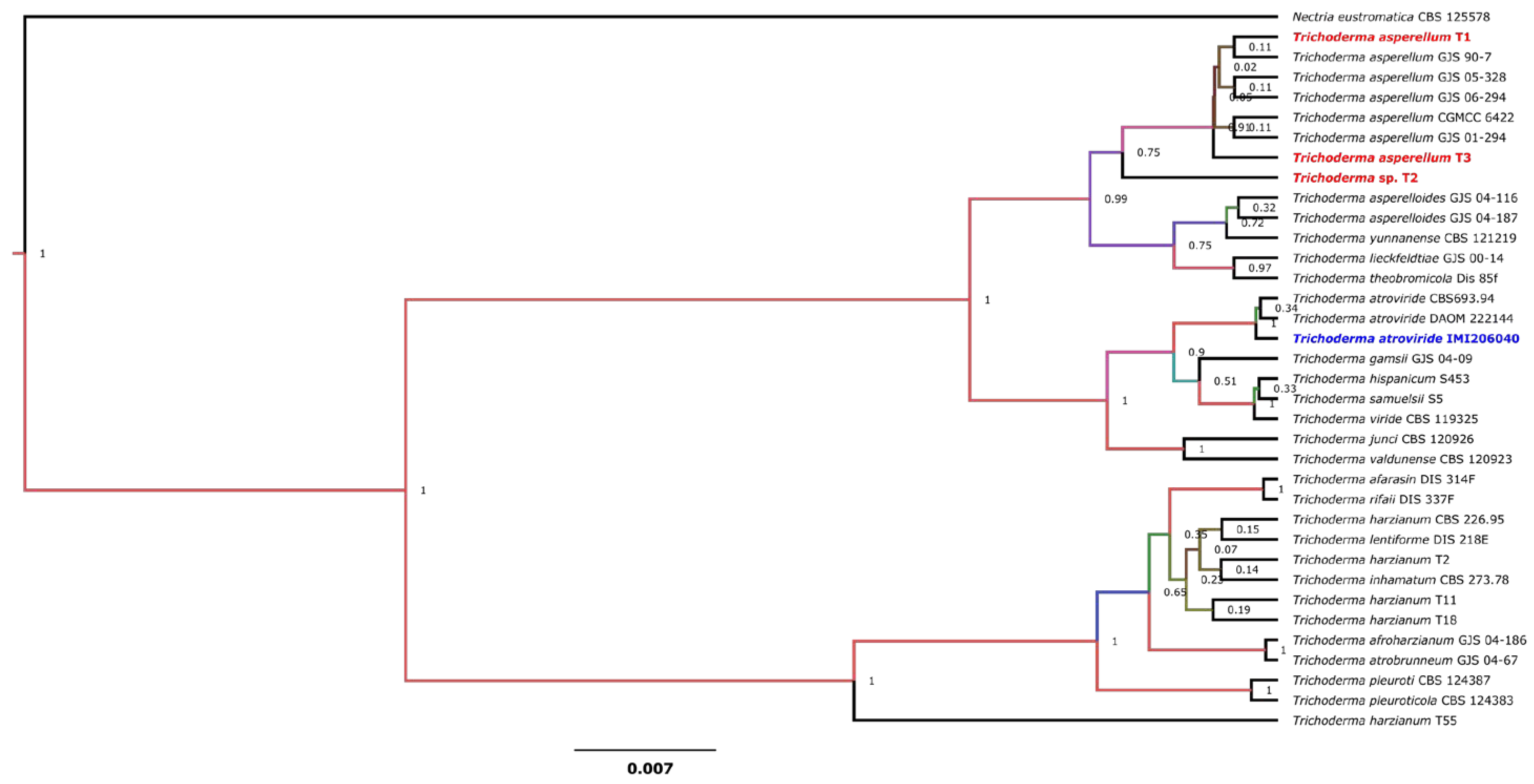
Figure 2.
Composition of VOCs profiles produced by the strains of study on LB medium. a) Profiles of VOCs produced individually by the strains. b) Profiles of VOCs produced in dual confrontation systems.
Figure 2.
Composition of VOCs profiles produced by the strains of study on LB medium. a) Profiles of VOCs produced individually by the strains. b) Profiles of VOCs produced in dual confrontation systems.
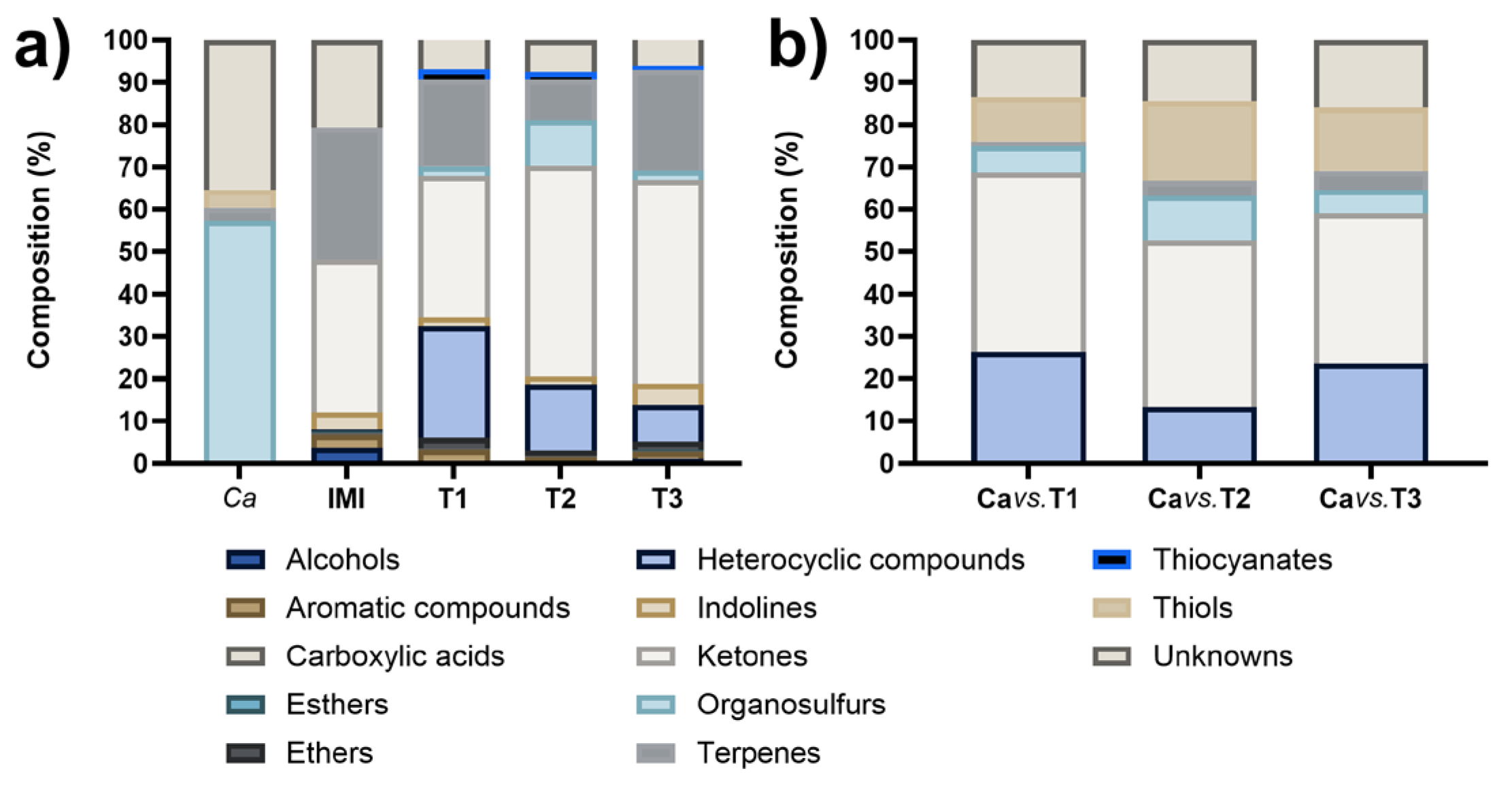
Figure 3.
Multivariate analyses of VOCs produced on LB medium. a-b) PCAs. a) PC1 and PC2 of VOCs produced individually. b) PC1 and PC2 of VOCs produced in dual confrontation systems, the variance explained by each principal component is reported in parenthesis. c-d) Heatmap and two-dimensional hierarchical dendrograms of VOCs produced by the strains: c) individually, and d) in dual confrontation systems. Each colored cell on the map corresponds to the concentration value following a green chromatic scale from low to high production.
Figure 3.
Multivariate analyses of VOCs produced on LB medium. a-b) PCAs. a) PC1 and PC2 of VOCs produced individually. b) PC1 and PC2 of VOCs produced in dual confrontation systems, the variance explained by each principal component is reported in parenthesis. c-d) Heatmap and two-dimensional hierarchical dendrograms of VOCs produced by the strains: c) individually, and d) in dual confrontation systems. Each colored cell on the map corresponds to the concentration value following a green chromatic scale from low to high production.
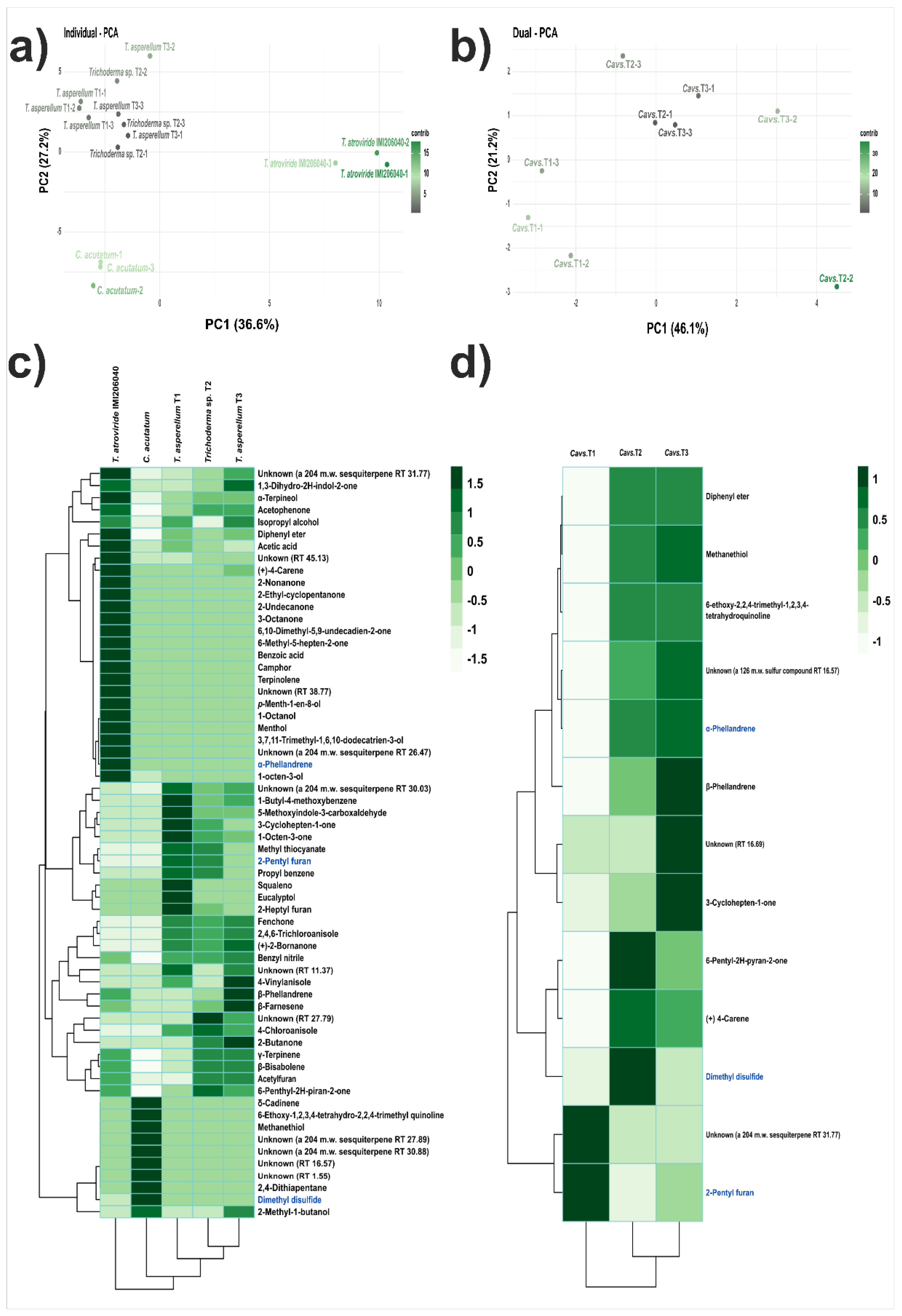
Figure 4.
Antifungal activity of synthetic VOCs against C. acutatum. a) Representative photographs from the C. acutatum colonies exposed to synthetic VOCs. b) Diametral growth inhibition. The data in b) represent the media of an n = 6 ± SD. ns = no statistically significant changes.
Figure 4.
Antifungal activity of synthetic VOCs against C. acutatum. a) Representative photographs from the C. acutatum colonies exposed to synthetic VOCs. b) Diametral growth inhibition. The data in b) represent the media of an n = 6 ± SD. ns = no statistically significant changes.
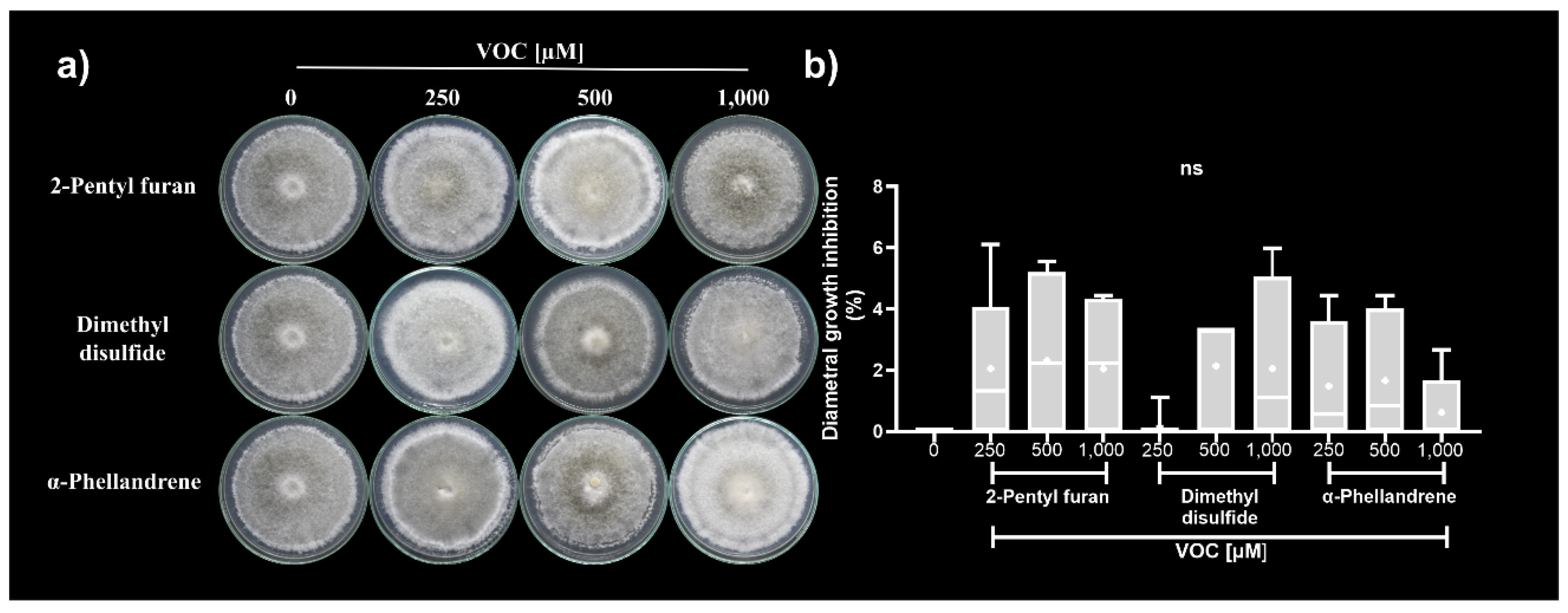
Figure 5.
Antagonistic effect of the mixture of the synthetic VOCs on C. acutatum. a) Representative photographs from the C. acutatum colonies exposed to synthetic VOCs mixtures. α-P+2-P (α-phellandrene plus 2-pentyl furan); α-P+DD (α-phellandrene plus dimethyl disulfide); and α-P+DD+2-P (α-phellandrene plus dimethyl disulfide plus 2-pentyl furan), each compound was assessed at 250 µM. b) Diametral growth inhibition. c) Representative micrographs of mycelia of C. acutatum after 14 d of exposition to the VOCs´ mixtures described above. The mycelial samples were taken from three C. acutatum´ colony areas (center, middle, and edge), they were mixed with a drop of brilliant blue and visualized under a microscope with the 40X objective. TH (Thin Hyphae), CH (Curling Hyphae), Sp (Spores), SH (Swelling Hyphae), Vc (vacuolization), and Dp (depolymerization). Data in b) are presented as the mean ± SD, n = 6. Different letters represent different statistically significant means (0.01 significance level in Tukey´s post hoc test).
Figure 5.
Antagonistic effect of the mixture of the synthetic VOCs on C. acutatum. a) Representative photographs from the C. acutatum colonies exposed to synthetic VOCs mixtures. α-P+2-P (α-phellandrene plus 2-pentyl furan); α-P+DD (α-phellandrene plus dimethyl disulfide); and α-P+DD+2-P (α-phellandrene plus dimethyl disulfide plus 2-pentyl furan), each compound was assessed at 250 µM. b) Diametral growth inhibition. c) Representative micrographs of mycelia of C. acutatum after 14 d of exposition to the VOCs´ mixtures described above. The mycelial samples were taken from three C. acutatum´ colony areas (center, middle, and edge), they were mixed with a drop of brilliant blue and visualized under a microscope with the 40X objective. TH (Thin Hyphae), CH (Curling Hyphae), Sp (Spores), SH (Swelling Hyphae), Vc (vacuolization), and Dp (depolymerization). Data in b) are presented as the mean ± SD, n = 6. Different letters represent different statistically significant means (0.01 significance level in Tukey´s post hoc test).
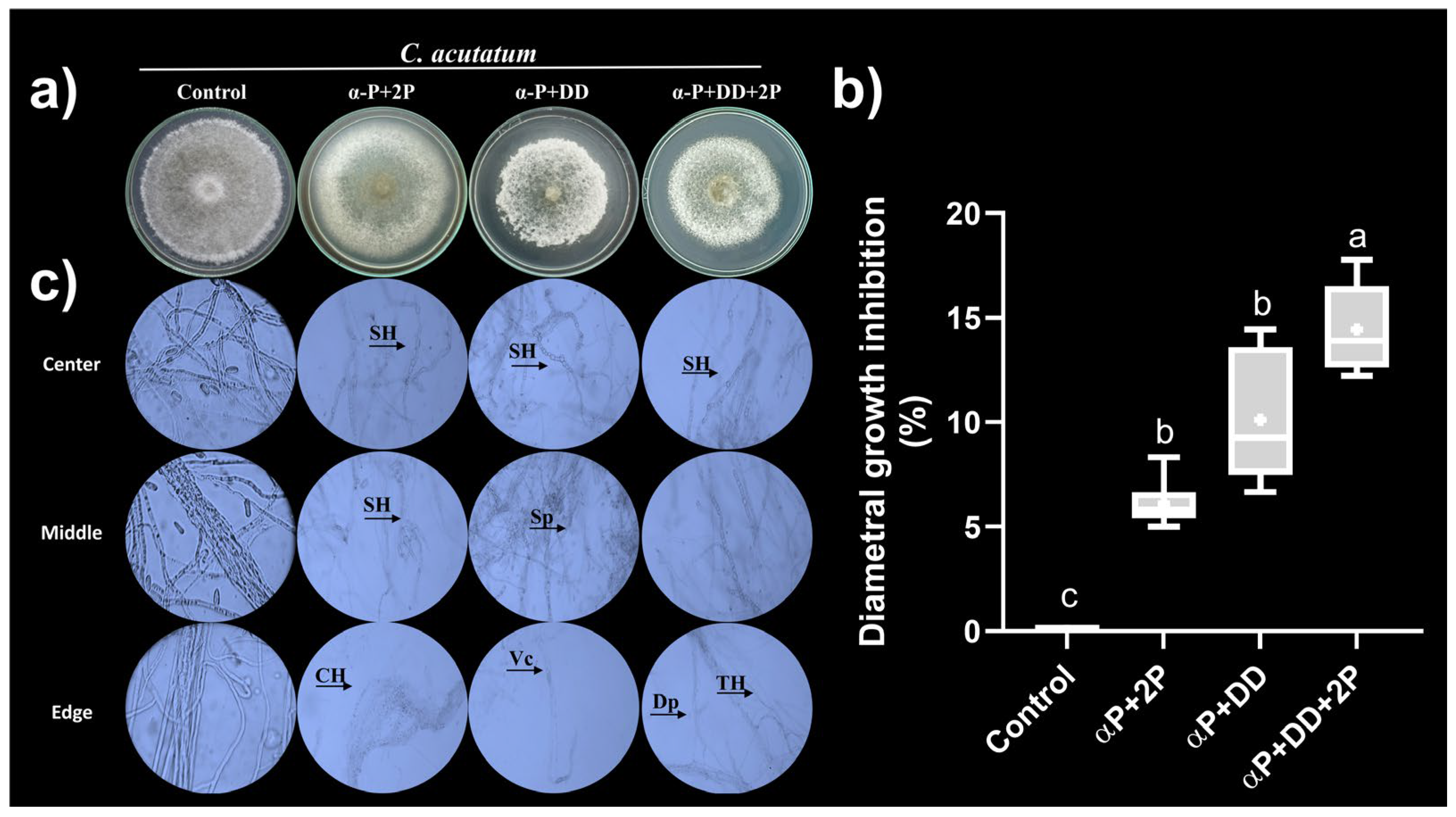
Figure 6.
The infective ability of C. acutatum on strawberry leaves. a) Representative photographs of strawberry leaves by the abaxial and adaxial sides. b) Severity. c) Representative micrographs of the hyphae of C. acutatum developed into the inner tissues of strawberry leaves. The samples were taken from the infected zones from strawberry leaves; they were mixed with a drop of brilliant blue and visualized under a microscope with the 10X and 20X objective. The black arrows indicate the hyphae presence in the analyzed zone. Data in b) are presented as the mean ± SD, n = 6. Different letters represent different statistically significant means (0.01 significance level in Tukey´s post hoc test).
Figure 6.
The infective ability of C. acutatum on strawberry leaves. a) Representative photographs of strawberry leaves by the abaxial and adaxial sides. b) Severity. c) Representative micrographs of the hyphae of C. acutatum developed into the inner tissues of strawberry leaves. The samples were taken from the infected zones from strawberry leaves; they were mixed with a drop of brilliant blue and visualized under a microscope with the 10X and 20X objective. The black arrows indicate the hyphae presence in the analyzed zone. Data in b) are presented as the mean ± SD, n = 6. Different letters represent different statistically significant means (0.01 significance level in Tukey´s post hoc test).
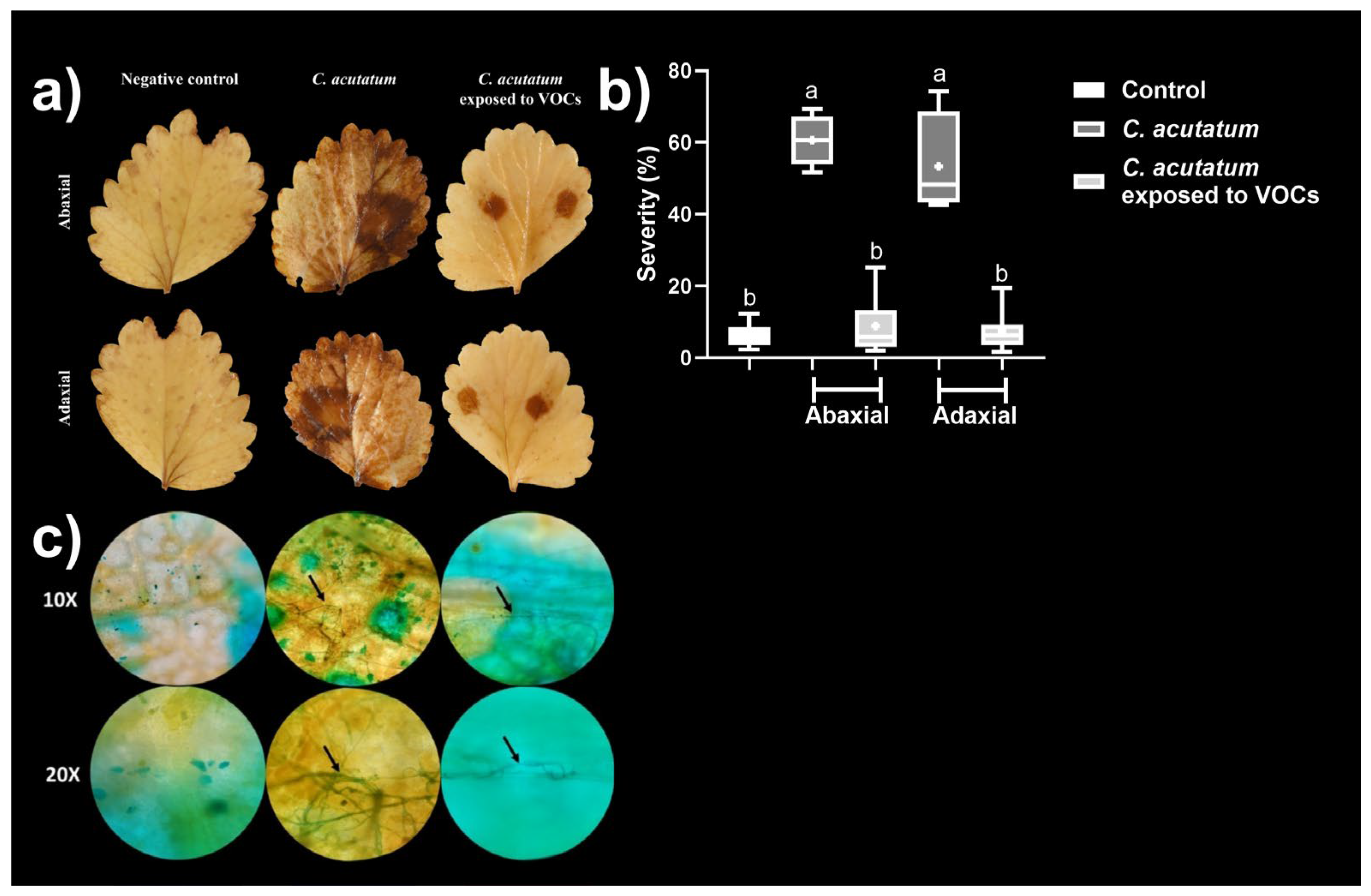
Table 2.
Antagonistic activity of Trichoderma strains against C. acutatum in different media.
| Bioassay | C. acutatum diametral growth inhibition (%) | |
|---|---|---|
| Media | ||
| PDA | LB | |
| Control | 3.94 ± 3.35c | 1.23 ± 5.55c |
| T. atroviride IMI206040 | 47.41 ± 5.77a | 49.94 ± 1.66a |
| T. asperellum T1 | 42.14 ± 4.72a | 33.96 ± 9.23b |
| Trichoderma sp. T2 | 25.46 ± 4.75b | 56.86 ± 2.60a |
| T. asperellum T3 | 12.82 ± 3.71c | 51.85 ± 3.31a |
Note: Data are meant ± SD, n=6. Different letters represent different statistically significant means by medium (PDA or LB) (0.01 significance level in Tukey´s post hoc test).
Table 3.
VOCs produced in dual confrontation systems on LB medium
| Compound | Retention Time (min) |
Abundance relative (%) | ||
|---|---|---|---|---|
|
C. acutatum vs. T. asperellum T1 (Cavs.T1) |
C. acutatum vs. Trichoderma sp. T2 (Cavs.T2) |
C. acutatum vs. T. asperellum T2 (Cavs.T3) |
||
| Methanethiol | 0.93 | 10.62 | 18.78 | 14.98 |
| 3-Cyclohepten-1-one | 2.73 | 0.80 | 1.23 | 3.11 |
| Dimethyl disulfide | 5.40 | 6.23 | 10.48 | 5.56 |
| α-Phellandrene | 8.53 | - | 1.26 | 1.49 |
| (+)-4-Carene | 9.16 | - | 1.89 | 2.00 |
| β-Phellandrene | 10.27 | - | 0.41 | 0.98 |
| 2-Pentylfuran | 11.84 | 20.44 | 3.47 | 7.81 |
| Unknown (a 126 m.w. sulfur compound) | 16.57 | 4.27 | 5.60 | 5.02 |
| Unknown | 19.69 | 9.15 | 8.85 | 10.90 |
| Unknown (a 204 m.w. sesquiterpene) | 31.77 | 1.02 | - | - |
| 6-ethoxy-2,2,4-trimethyl-1,2,3,4- tetrahydroquinoline |
37.30 | 5.92 | 9.32 | 14.95 |
| Diphenyl ether | 41.68 | - | 0.55 | 0.76 |
| 6-Pentyl-2H-pyran-2-one | 46.90 | 41.55 | 38.16 | 32.44 |
Note: Compounds were tentatively identified based on NIST library searches.
Disclaimer/Publisher’s Note: The statements, opinions and data contained in all publications are solely those of the individual author(s) and contributor(s) and not of MDPI and/or the editor(s). MDPI and/or the editor(s) disclaim responsibility for any injury to people or property resulting from any ideas, methods, instructions or products referred to in the content. |
© 2024 by the authors. Licensee MDPI, Basel, Switzerland. This article is an open access article distributed under the terms and conditions of the Creative Commons Attribution (CC BY) license (http://creativecommons.org/licenses/by/4.0/).
Copyright: This open access article is published under a Creative Commons CC BY 4.0 license, which permit the free download, distribution, and reuse, provided that the author and preprint are cited in any reuse.


