

Submitted:
31 December 2025
Posted:
01 January 2026
You are already at the latest version
Abstract
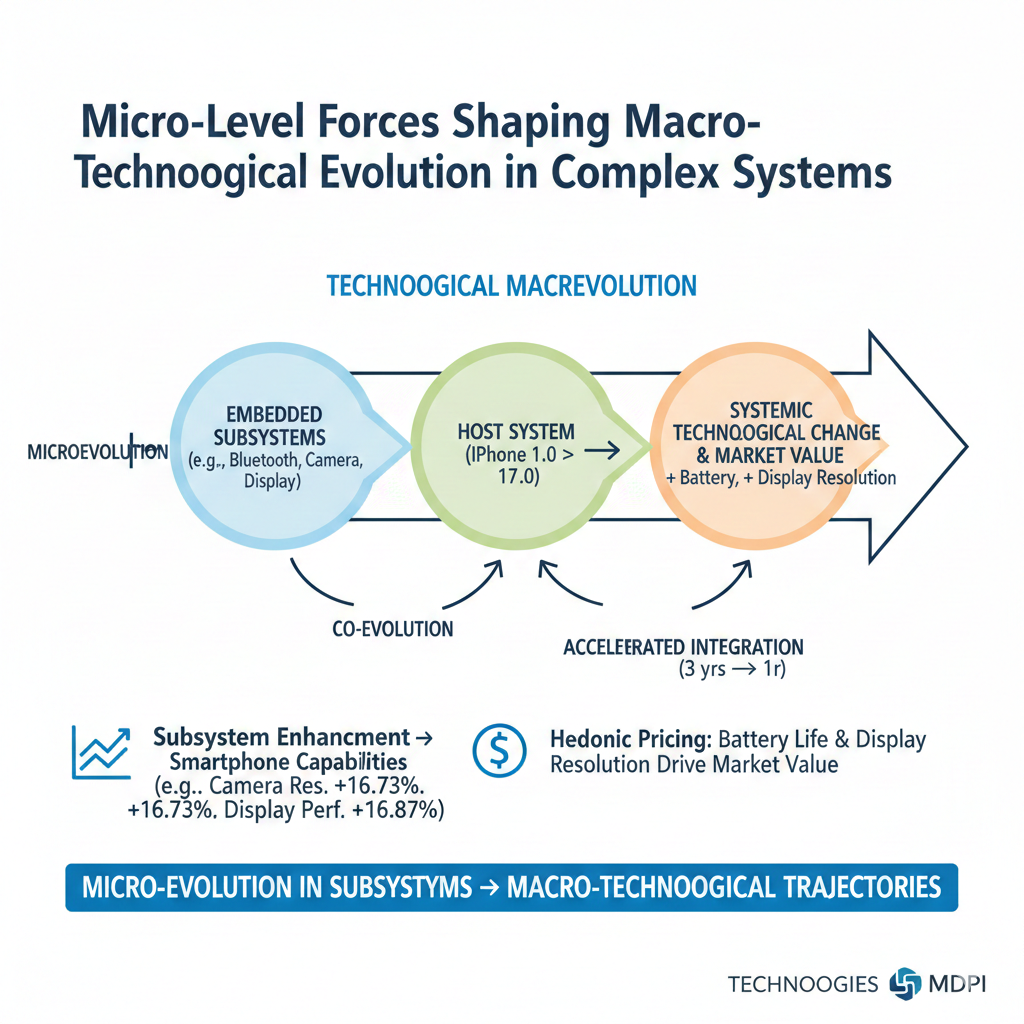
Understanding how technologies evolve within rapidly changing environments is a central challenge in innovation studies. This paper introduces the concept of technological macroevolution, driven by evolutionary dynamics within embedded subsystems, to explain mechanisms underlying systemic technological change. Building on existing theories, this study develops a conceptual and applied framework supported by a longitudinal case analysis of iPhone technology (2007–2025) as a host system interacting with Bluetooth technologies and other embedded subsystems. Findings reveal that successive Bluetooth versions (2.0 to 6.0) preceded and enabled macroevolutionary advances in iPhone models (1.0 to 17), with the temporal lag between subsystem evolution and host integration decreasing from three years to one—indicating accelerated technological co-evolution. Empirical evidence shows that subsystem enhancements, such as camera resolution (+16.73%) and display performance (+16.87%), significantly drive the macroevolution of smartphone capabilities. Hedonic pricing analysis further identifies battery life and display resolution as primary technological drivers of innovation and market value. These results support the hypothesis that microevolution in subsystems is a fundamental mechanism shaping macro-level technological trajectories, offering new insights for forecasting technological evolution and guiding innovation strategies. Overall, this study extends theories of technological change by highlighting subsystem evolution as a critical force in systemic innovation.
Keywords:
technological evolution
; complex systems
; subsystem dynamics
; innovation trajectories
; co-evolutionary mechanisms
; host technologies
; design strategies
; technological forecasting
; smartphone technology
; Bluetooth evolution
; systemic innovation
Copyright: This open access article is published under a Creative Commons CC BY 4.0 license, which permit the free download, distribution, and reuse, provided that the author and preprint are cited in any reuse.


