

Submitted:
23 December 2025
Posted:
24 December 2025
You are already at the latest version
Abstract
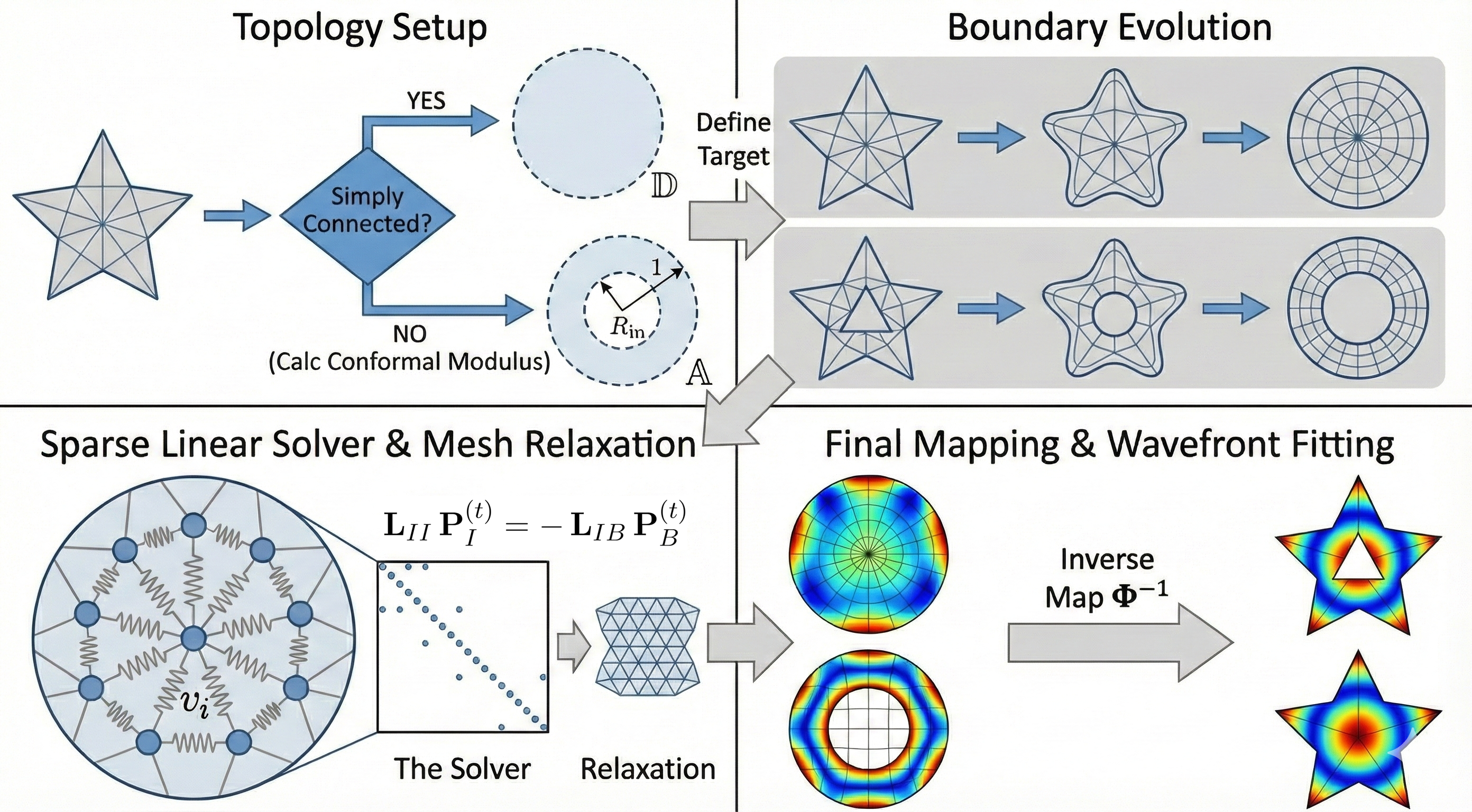
In freeform optical metrology, wavefront fitting over non-circular apertures is hindered by the loss of Zernike polynomial orthogonality and severe sampling grid distortion inherent in standard conformal mappings. To address the resulting numerical instability and fitting bias, we propose a unified framework curve shortening flow (CSF)-guided progressive quasi-conformal mapping (CSF-QCM), which integrates geometric boundary evolution with topology-aware parameterization. CSF-QCM first smooths complex boundaries via curve-shortening flow, then solves a sparse Laplacian system for harmonic interior coordinates, thereby establishing a stable diffeomorphism between physical and canonical domains. For doubly connected apertures, it preserves topology by computing the conformal modulus via Dirichlet energy minimization and simultaneously mapping both boundaries. Benchmarked against state-of-the-art methods (e.g., Fornberg, Schwarz-Christoffel and Ricci flow) on representative irregular apertures, CSF-QCM suppresses area distortion and restores discrete orthogonality of the Zernike basis, reducing the Gram matrix condition number from >900 to < 8. This enables high-precision reconstruction with RMS residuals as low as $3\times10^{-3}\lambda$ and up to 92\% lower fitting errors than baselines. The framework provides a unified, computationally efficient, and numerically stable solution for wavefront reconstruction in complex off-axis and freeform optical systems.
Keywords:
freeform surface metrology
; wavefront fitting
; quasi-conformal mapping
; curve shortening flow
; non-circular aperture
Copyright: This open access article is published under a Creative Commons CC BY 4.0 license, which permit the free download, distribution, and reuse, provided that the author and preprint are cited in any reuse.


