

Submitted:
11 December 2025
Posted:
12 December 2025
You are already at the latest version
Abstract
This study provides a comprehensive overview of research and advancements on carbon materials with regard to practical targets for hydrogen storage in terms of gravimetric and volumetric capacities. For the sake of clarity, only the most relevant references on hydrogen storage by adsorption are presented, although the study was conducted in the same exhaustive manner as the one initially carried out by Anne C. Dillon and Michael J. Heben [Appl. Phys. A 2001, 72, 133–142] with a particular emphasis on emerging technologies and potential applications in various sectors, and focusing on the importance of carbon-based materials with high specific surface areas and porous structures optimised to maximise adsorption — including at high pressure —, while primarily limiting references herein to experimentally validated results. It therefore offers insights into the porous materials as well as the methodologies — including a fully comprehensive and so far proven highly transferable intermolecular hydrogen model combining van-der-Waals's and Coulomb's forces — used to improve hydrogen solid storage efficiency.
Keywords:
carbon-based sorbents
; hydrogen
; gravimetric capacity
; volumetric capacity
; physical adsorption
; Lennard-Jones potential
; quadrupole moment
1. Introduction
Hydrogen has been considered for over a century as the utopian fuel of the future [1]; with the highest gravimetric density of all fuels on the one hand (120 MJ/kgH₂ on a lower heating value basis), and its environmental friendliness and potential abundance on the other, hydrogen is still expected to play a pivotal role as an energy vector in the ongoing transition from fossil fuels to renewable energies – the term ‘hydrogen economy’ was coined as early as in 1970 to fit with the theoretical notion of an economical system where hydrogen serves as the primary energy carrier [2]. As part of this perspective, various carbon-based materials have been investigated with regard to solid-state hydrogen storage. However, hydrogen also has a very low volumetric density which so far makes transporting or storing it difficult and expensive [3], especially in the case of on-board applications for which solid-state hydrogen storage is nevertheless considered to be the safest and most efficient route [4]. This latter consideration has prompted an extensive effort to provide solutions proving technically mature and economically suitable. In this regard, carbon-based materials had and still have to be compared to other materials.
In addition to the establishment of the International Association for Hydrogen Energy in the broader context of the actual development of a sustainable hydrogen energy system [5,6], some major international projects began to emerge from the mid-1970s onwards, such as the Euro-Québec Hydro-Hydrogen Pilot Project which aimed both to look into applications and to demonstrate the feasibility of supplying clean, renewable primary energy in the form of relatively inexpensive hydropower-produced liquid hydrogen shipped to Europe from Canada [7,8,9]. In 2001, a first comprehensive review provided a brief history of the hydrogen adsorption studies on activated carbons (ACs) as well as comments on the experimental and theoretical investigations of the hydrogen adsorption properties of nanostructured carbon materials whose elaboration had just started in the previous years [10]. Interest in hydrogen as a fuel had indeed grown dramatically, and many advances in hydrogen utilisation technologies had already been made. Since on-board hydrogen storage for light-duty vehicles was constituting a significant challenge, the U.S. Department of Energy (DoE) had specifically set gravimetric- and volumetric-capacity targets at values of 4.5 wt% (0.045 kgH₂/kgsystem) and 36 g/L (36 kgH₂/msystem3) – for 2005 –, respectively, with the aim of strategically providing researchers with an appropriate incentive for assessing the performance of their results accordingly. Interestingly, and as pointed out by the reviewers, most of the literature reviewed in 2001 did refer to the DoE’s targets although the values were actually not measured or predicted for a whole system (i.e. tank and instrumentation included). Consequently, and this point is still relevant nowadays, most claims of reaching or exceeding the DoE’s targets do not provide the evidence for any normalised comparison of system performance to the targets.
Despite the lack of normalised comparison, the 2001 review provided guidance for research in the domain of hydrogen storage technologies, along with other influential but generally more topic-focused publications [11,12,13,14,15], and indirectly but strikingly highlighted the fact that each technology possessed desirable characteristics which can make it suitable for particular applications, because no approach satisfied all of the efficiency, size, weight, cost and safety requirements for transportation or utility use. As a matter of fact, storage of gaseous hydrogen in high-pressure vessels and of liquid hydrogen in cryogenic tanks has for instance been commercially deployed although gaseous hydrogen occupies a large volume at room temperature even at high pressure, and extremely low temperatures are required to liquefy hydrogen, respectively. Since the 2001 review was dealing with carbon adsorbents as an inherently safe and potentially high energy density alternative for hydrogen storage, it focused on activated carbons which had already been extensively studied (e.g., [16,17,18,19]) and on the then newly developed nanostructured carbon materials (e.g., [13,14,20,21]); an updated review of these two categories will therefore be herein carried out and presented in the next section together with a supplementary subsection devoted to the carbon materials whose potential for hydrogen storage has emerged in the meantime. The following sections will subsequently describe the implementation of theoretical as well as experimental means to better meet practical targets, and draw the comparisons needed for reassessing carbon-based material performances as regards solid-state hydrogen storage.
2. Carbon-Based Physisorbing Materials
In terms of operational challenges, and although the low adsorption enthalpy involved in molecular adsorption on porous materials makes low operating temperatures more favourable, the physical adsorption of hydrogen has several advantages. Hydrogen is reversibly stored by physisorption, and since no energy barrier exists between the gas phase and the adsorbed state, fast adsorption and desorption kinetics are specifically at hand. Yet, in terms of safety, hydrogen would not be instantaneously released – as in the case of pure compression – but more gradually over time, enough to significantly reduce the risk of explosion. Furthermore, owing to the low heat of adsorption involved in the physisorption of hydrogen, the process may be monitored either without additional thermal-control systems or with a minimal heat management in order to optimise the charge-discharge cycle.
In this review, the most relevant carbon-based materials for hydrogen storage by adsorption are consequently considered, irrespective of their actual fulfillment of all the targets set by the DoE for light-duty vehicles – especially in terms of temperature range –, but based, owing to their light weight and high surface area, on their adsorptive capacities as well as on their thermal and chemical stabilities.
As mentioned above, there are different ways that the amount of gas adsorbed on a material is reported in the literature. Unless specified, it is reasonable to assume that no attempt was made to correct for the free volume of the container, leaving the role played by the adsorbent actually unclear; in such cases, the amount of hydrogen contained in an adsorbent-filled container is simply plotted as a function of the pressure. Contrarily, the rigorous method of reporting consists of correcting the raw data for the gas compressed into the non-adsorbing free volume of the container, leading to the thermodynamically important specification of an ‘excess’ amount which corresponds to the excess gas present in the pores over that which would be present under the normal density at the equilibrium pressure [22]. This approach requires the determination of the skeletal volume of the adsorbent by means of buoyancy measurements with helium as fluid [23]. Within this approach, a plot of the excess amount versus pressure often exhibits a maximum (e.g., [24] Figure 3). Beyond this maximum value, the bulk gas density increases more rapidly with pressure than the adsorbed density, and higher hydrogen-storage densities could ultimately be achieved in a given container by removing the adsorbent (e.g., [24] Figure 4), whether the adsorbent be carbon-based or not [25,26,27]. An intermediate definition terms a ‘total’ amount (to be distinguished from the amount purely totalling real adsorption and compression) which should correspond to the amount of gas contained in the supposedly active volume of the adsorbent, this volume being determined from the saturation values obtained in nitrogen-adsorption isotherms. However, this particular definition does not provide useful information neither on the intrinsic behaviour of an adsorbent, nor for the building of storage tanks.
2.1. Activated Carbons
As stated by Yahya et al., the term ‘activated carbon’ can basically be referred as carbonaceous materials with high porosity, high physicochemical stability, high adsorptive capacity, high mechanical strength, and high degree of surface reactivity, as well as with a surface area which can be differentiated from elemental carbon by the oxidation of the carbon atoms located at the outer and inner surfaces [28] (p. 219). Activated carbons therefore gained much attention. Since the cost of adsorption storage at 150 K and 54 bar (5.4 MPa) using an activated carbon compared very favourably with those for hydrogen gas (at 200 bar), liquid hydrogen, and metal hydride (FeTiH₂) [29], solid-state hydrogen storage began to be seen as a realistic way of storage, even at room temperature – although adsorption was initially spotted as an inexpensive means to store hydrogen by adsorption at cryogenic temperatures [16] –, and therefore potentially suitable for light-duty vehicles [30]. By that time indeed, it was still recorded in the proceedings of the DoE's Hydrogen Program review that high-pressure and cryogenic hydrogen storage systems were impractical for vehicular applications due to safety concerns and volumetric constraints [31]. A 2-D model for the non-isothermal storage of hydrogen by adsorption at moderate pressure, with the right amount to enable a vehicle to travel 500 km on one charge, was soon developed, based on the Equilibrium Theory of Adsorption and experimentally validated in a tank filled with an activated-carbon adsorbent bed [32]. In terms of storage tank design, the control of the heat transfer inside the adsorbent bed is indeed critical for its filling-stage optimisation [33,34].
Early work had focused on the adsorptive properties of activated carbons typically obtained by thermochemical processing but originating from various mineralogical or organic precursors, providing a large variety of environments for binding hydrogen, and preventing stabilisation above cryogenic temperatures. It was initially asserted that hydrogen could be stored on carbon at volumetric densities approaching values available with liquid hydrogen [35] and the investigations led to the general conclusion that the more open, porous carbon materials tended to adsorb more hydrogen than the denser ones. More precisely, it has since then been established that, particularly at low pressures and at low temperatures, the amount of hydrogen adsorbed on a carbon material is mainly determined by its accessible surface area coupled with a well-defined, narrow micropore size distribution. It has even been shown by Chahine et al. through experimental results that a linear relationship exists between the hydrogen storage capacities and the specific surface area, namely with a 1wt% increase per 500 m2/g of surface area for carbon adsorbents at 77 K [18,36]; this kind of relation is consequently commonly referred to as 'Chahine’s rule' or as analogous to it (e.g., [37,38,39]). This helps understand why, despite their heterogeneity, activated carbons with specific surface areas sometimes exceeding 3000 m2/g and high micropore volumes (>1 cm3/g) readily looked promising.
For the best activated carbon accredited by the 2001 review, with an hydrogen uptake of 4.8wt% at 87 K and 60 bar [40] – notwithstanding a previously claimed hydrogen uptake of 9wt% at 113 K and 55 bar for another activated carbon [41,42] –, the weight of the carbon-fibre-wrapped pressure vessel and of the vacuum jacket was appropriately taken into account, which provided the opportunity to measure the total-system performances, namely 4.2wt% and 16.8 g/L. However, since hydrogen could be stored in the tank at 4.8wt% and 16.5 g/L at the same pressure and temperature without the carbon, such a storage system would not have significantly benefitted from the incorporation of the adsorbent, compared to a previous study on a commercially available activated carbon AX-31M in a Kevlar pressure vessel which had actually provided at least sufficient total-system performances of 5.13wt% and 17.18 g/L at 150 K and 55 bar [29].
Owing to their exceptionally large surface area, their microporous nature, and the possibility of an economic and scalable production, activated carbons remained excellent candidates for efficient hydrogen storage systems and kept being studied in that respect (e.g., [43,44,45,46,47,48]). Experimental data on hydrogen adsorption can be compared to the predictions of hydrogen density in the slit-like pores of model carbon structures calculated by the Dubinin theory according which, at any given temperature and pressure, a better adsorption capacity can relate to a biporous structure, but an optimal one would have to specifically relate to a structure with pore sizes which can hold two layers of adsorbed hydrogen [49]. Conversely, for a given structure, it is noticeable that the best performances have regularly been mainly obtained at low temperature (70–90 K typically) and under moderate pressure, far from the ambient conditions. For example, it has been shown for activated carbon F12/350 investigated up to 150 K that the best hydrogen uptakes occur in the 65 K temperature region, namely 8.2wt% at 65 K compared to 6.8wt% at 78 K under the same 42 bar pressure level, for instance [16]. Alongside cryogenics, high-pressure physisorption of hydrogen has benefitted from truly dedicated advances, such as the implementation of equipment capable of operating at up to 700 bar [19,50], providing a basis for comparison with compressed hydrogen storage at this pressure level. In this case, progress ultimately led to the implementation of a volumetric device designed to combine extreme conditions for obtaining excess adsorption isotherms at 77 K under pressures of up to 500 bar; for commercially available activated carbon AX21, the highest value of hydrogen uptake reached 5.2wt% at 29 bar and the highest total volumetric capacity reached 54.4 g/L at 240 bar [24].
‘Superactivated’ carbons, for their part, refer to ultrahigh surface area carbons (3000–3500 m2/g typically) which are produced by a fully controlled chemical process. When obtained via chemical activation of polypyrrole with KOH, such carbons exhibit large pore volumes (up to ~2.6 cm3/g) and mainly possess two pore systems, in the micropore range (~1.2 nm) and in the small mesopore range (2.2–3.4 nm), respectively. Tuning of their textural properties can be achieved through the control of the activation parameters (temperature and amount of KOH) and their hydrogen uptake can reach 7.03wt% at 77 K and 20 bar [51]. Some studies report even higher uptake values for certain samples [52]. Also, their volumetric capacities are in the order of 30 to 40 g/L [53]. These elevated storage capacities are due to the fact that, in their case, high porosity is not detrimental to packing density.
The experimental evidence of an upper limit – around 6.4wt% for a BET surface area of 2630 m2/g – for hydrogen storage at 77 K on activated carbons had however been claimed a little earlier [54], together with the assertion that such a direct correlation between BET surface area and hydrogen uptake holds as far as the contribution of micropore broadening is lower than that of microporosity development. Since the value of this upper limit was close to the theoretical calculations of Schlapbach and Züttel [15], this claim proved impactful and it is, for instance, still in order to more clearly circumvent this upper limit that the potential of oxygen-rich activated carbons has been explored; cellulose-acetate-derived carbons, combining high surface area (3800 m2/g) and pore volume (1.8 cm3/g) itself arising almost entirely (>90%) from micropores, did exhibit enhanced storage capacities of 8.9wt% and 48 g/L at 77 K and 30 bar [55].
Another possible limitation lay in the fact that the volumetric hydrogen uptake of porous materials is directly related to packing density, whereas the high surface area materials that are likely to have large gravimetric hydrogen uptakes tend to have a low density. To address this conundrum, zeolite-templated carbons (ZTCs), which constitute a class of porous carbons with defined atomistic structure [56,57], have been specifically designed to benefit from the high surface area of the zeolite template and, owing to their excellent mechanical stability, to possibly undergo densification with hardly any loss in porosity. The resulting storage capacities are 7.0wt% and 50 g/L at 77 K and 20 bar [58]. Given the unique molecular structure of zeolite-templated carbons, theoretical simulations have suggested that they may achieve a volumetric hydrogen uptake of 50 g/L at 77 K and 50 bar [59].
Increasing the porosity of carbonaceous materials is not the only way to increase their hydrogen uptake capacity. For instance, Chahine and Bose initiated the improvement of commercially available activated carbon AX21 by means of solidification in order to enhance the storage capacities of a high-pressure tank at 300 K [60]. Densification (with or without binders) makes it possible to increase volumetric storage but can reduce the hydrogen uptake if the micropores are blocked. For instance, by using cellulose acetate as a precursor to adjust the KOH activation conditions, it is possible to synthesize porous carbons with a given gravimetric hydrogen capacity. By applying high pressure to pelletise the porous carbon powder with a binder to a higher density, an enhanced volumetric hydrogen capacity can then be achieved while retaining the gravimetric one [61]. This approach led to the elaboration of activated-carbon monoliths (ACMs), easier to handle than powder, and combining good mechanical properties and high density. Hydrogen storage capacities of 4.3wt% and 39.3g/L at 77 K and 40 bar have been reported [62].
Another way to increase the hydrogen uptake capacity consists in doping the adsorbents with different metals, which should combine physisorption and chemisorption effects. Yet, Pd- and Ni-doping of activated carbon AC35, although successfully operated, has led to a significant reduction of its specific surface area [63,64]. Similar results have been obtained since then, as for an activated carbon derived from rice husks and modified with magnesium and nickel salts [65]. This time, the reduction in performance was again attributed to a decrease in specific surface area (confirmed by BET analysis) but also to a lower abundance of oxygen-containing functional groups (identified via FTIR spectroscopy), likely caused by partial pore blockage due to metal deposition.
2.2. Nanostructured Carbon Materials
It has early been estimated that hydrogen coverage per unit surface area would be substantially larger on specific nanostructures than on activated carbons [86]. Such nanostructures include single-walled carbon nanotubes (SWCNTs), multi-walled carbon nanotubes (MWCNTs), and graphite nanofibres.
By assuming that an array of SWCNTs would have a surface area close to the theoretical maximum for graphite (∼ 2620m2/g) and a density of ∼ 1 g/cm3, it was calculated that filling a 2 nm diameter tube with hydrogen molecules would produce storage capacities of 5.1 wt% and 54 g/L [10]. That result appears to be consistent with the hydrogen uptake of 4.2 wt% achieved reproducibly at room temperature under a pressure of 100 bar for a SWCNT sample with a mean diameter of ∼ 1.85 nm [13] while a hydrogen uptake of 8wt% was observed at 77 K and 120 bar for purified laser-generated SWCNTs with a mean diameter of ∼ 1.3 nm [21]. Other early studies employed Monte Carlo numerical simulations to determine that SWCNTs would slightly increase the amount of hydrogen stored in a given volume over that stored by an activated carbon material AX-21 at 298 K and 100 bar [20,87].
More recently, the hydrogen adsorption capacities of SWCNTs and MWCNTs at temperatures of 77 and 300 K have been investigated using molecular dynamics simulations. It has been found that, at 77 K and 100 bar, SWCNTs can store molecular hydrogen with a maximum gravimetric density of 8.33wt%, compared to 6.56, 4.55, and 3.18 wt% for MWCNTs, whereas the storage capacity is less than 1 wt.% at 300 K [88]. The effect of endohedral transition-metal atoms on the hydrogen storage capacity of carbon nanotubes has also been demonstrated by using reactive molecular dynamics simulations; an increase in the volume fraction of those atoms would lead to an increase in the concentration of physisorbed hydrogen molecules around SWCNTs by approximately 1.6 times compared to pure SWCNTs [89].
Graphite nanofibres constitute another example of an engineered material that can, this time, be produced with three distinct structures designated as ‘tubular’, ‘platelet’ or ‘herringbone’ whether the graphite platelets are arranged parallel, perpendicular, or at a 45° angle with respect to the fibre axis, respectively. The spacing between graphite layers in each case is the same as for conventional graphitic carbon and the nanofibres typically range in diameter from 5 to 500 nm. Hydrogen-storage densities exceeding 50 and 60wt% at room temperature and 120 bar were initially reported for the platelet and herringbone structures respectively [12]; it was then believed that, owing to the unique structural conformation of graphite nanofibres, such an extraordinary hydrogen-storage capacity was not totally unexpected in view of calculations based on statistical mechanical fluids theory which indicated that when fluids are confined within narrow nanopores, their behaviour does not conform to that predicted by classical thermodynamic methods. However, by using a system specially designed to withstand a 120 bar pressure over a relatively long period of time (days) with minimal leakage, as required for studying adsorption phenomena which exhibit very slow equilibrium times such as those reported in the literature for graphite nanofibres [12,97], it was determined that carbon nanofibres can adsorb up to 0.7wt% hydrogen at 105 bar [86], which is two orders of magnitude below; this initiated a controversy about the so-called 'super' storage of graphite nanofibres that has been fuelled by the subsequent failed attempts by other investigators to reach similar results with supposedly similar materials [98]. Yet, it has more recently been shown, on the one hand, that the accumulation of ~20–30wt% of 'reversible' high-density hydrogen intercalated in nanocavities between the base carbon layers in graphite nanofibres could be connected with the Kurdjumov phenomenon [99,100] and the spillover effect (see next subsection) in terms of thermoelastic phase equilibrium, and, on the other hand, that it should be possible to once again observe the appearance of a thermal desorption peak corresponding to an amount of ~8wt% 'irreversible' chemisorbed hydrogen with certain kinetic and thermodynamic characteristics, provided the detailed activation parameters are replicated [101].
2.3. More Recent Investigations
More recently launched investigations include new carbon-based materials – fullerenes, graphene, and templated carbons – as well as new processes.
A fullerene is a carbon compound whose molecule consists of carbon atoms interconnected by single and double bonds, forming a closed mesh that includes rings of five to seven carbon atoms [102]. One obvious advantage of this compound is its ability to be pelletised without any binder. When combined with another nanomaterial such as carbon nanotubes, this compound can also significantly enhance its distribution as well as its catalytic properties [103]. There is a versatile structure of fullerenes having different numbers of carbon such as C60, C55, C70, C90, and C120, which have distinct hydrogen capacities; for instance, C60 can theoretically reversibly store hydrogen up to 7.7wt% by forming fullerene hydride C60Hx. However, high temperature and pressure (400-450 °C, 600-800 bar) are currently required to produce hydrogenated fullerenes (with a hydrogen content of up to 6.1wt% actually for C60Hx) by direct hydrogenation in gaseous hydrogen atmosphere [104].
Graphene-related materials, particularly graphene sheets and graphene oxides, have excellent surface properties for hydrogen adsorption due to their high thermal and electrical conductivities and their ability to be functionalised in order to improve adsorption capacity. Structurally, 'graphane' (CxHx) is crumpled, rather than planar, because each hydrogen atom bonded to carbon pulls it a small distance out of the plane. First-principles studies show that the chemisorption of hydrogen on both sides of graphene, i.e., with full coverage of hydrogen (~ 7.7 wt%), is the lowest energy structure due to the strain associated with the sp2 to sp3 conversion [105,106]. Pioneer studies laid the foundation for current research for the use of graphene as a hydrogen storage material, exploring different doping and modification methods to improve its gas storage capacity [107,108,109,110,111,112,113,114]. The hydrogen adsorption on basal graphite planes functionalised by hydrogen atoms has been studied by molecular modelling and numerical simulation; the excess hydrogen physisorption is estimated equal to 7.5wt% at 77 K and 10 bar, but reaches 1.5wt% only at 293 K and 300 bar. The strong molecular packing at the maximal adsorption for 77 K explains the decrease of the excess adsorption for pressures larger than 50 bar since no more molecule can be added to the adsorbed layer while the bulk density increases [115]. Amongst the many forms of graphene and its derivatives, tetra-penta-octagonal graphene (TPOG) [116] exhibits noticeably good thermodynamic and mechanical stability, and uniform pore size. It was found that Li and Na atoms could be stably bound to the TPOG substrate, with the metal atoms transferring a significant amount of charge to the substrate. Adsorption calculations revealed that the 2Li@TPOG system adsorbs 8 H2 molecules, which corresponds to a hydrogen uptake of 10.7wt%, while the 2Na@TPOG system adsorbs 12 H2 molecules, which corresponds to a hydrogen uptake of 12.7wt% [117]. Hydrogen can also be stored on carbon-based nanomaterials, such as graphene-carbon-nanotube hybrids with an expected highly reversible uptake of 5.9 wt% at room temperature and 100 bar [118].
Hydrogen storage in carbon nanomaterials can also be enhanced through hydrogen spillover which refers to catalytic dissociation of hydrogen molecules, initiating weak chemisorption and used as a means to initiate room temperature hydrogen storage, followed by surface diffusion to the catalytic support. Despite several publications on that matter, no configuration has yet demonstrated a high capacity, confirming the idea that spillover has not yet enabled significant and reproducible hydrogen storage [119]. Spillover on ordered carbon-based structures is followed by the transfer of atomic hydrogen to the carbon support, progressively transforms sp² graphene into hydrogenated sp³ regions of the graphane type [120]. It has been observed experimentally that the H atoms remain trapped until programmed heating, confirming a strongly stabilised chemisorbent component [121,122]. The desorption involves the breaking of strongly stabilised C–H bonds in a graphane-like sp³ network, which explains the high temperatures generally required to release hydrogen [120]. A fully hydrogenated graphene state would correspond, once local saturation is reached, to a thermodynamically stabilised graphane. Since the quantum effects at low temperature can be estimated in the framework of the Feynman–Hibbs scheme [123], an estimate of hydrogen storage on functionnalised graphene has been carried out [115]; pure graphane represents a reserve (7.7wt%) of chemically bound atomic hydrogen, to which could be added the molecular-hydrogen physisorption at 77 K and 10 bar (7.5wt%), theoretically leading to a total storage capacity of 15.2wt% only recoverable by strong thermal desorption. Indeed, the chemisorbed fraction increases the overall capacity but becomes thermodynamically difficult to reverse, while a labile physisorbed fraction persists locally around these highly attractive hydrogenated sites on the carbonaceous solid surface.
Besides zeolites, as already mentioned above for activated carbons, other crystalline materials, such as isoreticular Metal Organic Framework (MOF), can be used to produce templated carbon materials, such as MOF-derived hierarchically porous carbons with an excess hydrogen uptake of up to 3.25wt% at 77 K and 1 bar [124]. Research on templated carbons is still ongoing (e.g., [124,125,126,127,128,129]).
Amongst the various materials reviewed in this subsection, it can be stated that graphene-based ones offer hydrogen absorption capacities of interest, compared to those of activated carbons and carbon nanotubes.
At the end of this section, it should also be mentioned that the literature selected herein does not necessarily reflect the whole range of successive steps of 'record' storage capacity values (e.g., [51,127,130,131]), because the selection is actually based on only three successive stages (see section 4).
3. Implementation of Means to Better Assess Performances
Being able to adequately assess the performances of the investigated adsorbents is key for ultimately meeting practical requirements.
3.1. Numerical-Experiment Improvements
Sdanghi et al. have attributed the progress achieved over the last two decades, as regards the understanding of sorption phenomena in narrow pores, to the development and application of microscopic methods relying on the density functional theory of inhomogeneous fluids and on computer simulation methods such as Monte Carlo and molecular dynamic simulations [127]. As indicated in the previous section, a whole range of carbon-based materials has indeed benefitted from predictive simulations (e.g., [132,133]) while screening and machine-learning-based studies directly aim to identify materials that can offer good gravimetric and volumetric storage capacities. This latter approach integrates the fact that gravimetric capacity decreases when porous materials become over-compacted, whereas volumetric capacity decreases when pore sizes are too open [134].
In terms of predictive simulations, a noticeable improvement relies on the introduction of a revisited molecular-hydrogen interaction model using a Lennard-Jones term completed, in terms of molecular anisotropy inclusion, by a permanent quadrupolar contribution which reflects the intramolecular charge distribution [19,135]. This robust model has been used to reproduce the typical maximum of excess adsorption under pressure [136,137,138,139]. Although developed for hydrogen storage, this model has been successfully transferred to the oil sector as well as to the geological and geothermal domains, and, more recently, to the exploration of natural 'white' hydrogen resources [140,141,142,143].
3.2. Experimental Improvements
Cryogenic adsorption is useful because it combines high gas density with lower compression energy. Under these conditions, an adsorbed phase forms inside the pore network, which helps delay desorption when heat enters the storage tank. Before it can be widely deployed, the cryogenic system still depends on insulation quality, even though they operate at lower pressure than high-pressure tanks, they still need multilayer insulation and controlled heat input to avoid losses during non-use periods. These conditions are directly linked to the DoE's dormancy requirements [144,145]. However, the development of specific cryogenic equipment for hydrogen storage testing has not been as significant as was the case in support of ‘high-temperature’ superconductors (initially characterised at liquid helium/nitrogen temperatures only).
4. Comparative Evaluation
4.1. U.S. DoE’s Technical-System Targets
The DoE’s technical-system targets have been established for the sake of normalised comparison; two sets of targets are typically determined for any ten-year period whereas ‘ultimate’ values were intended to refer to long-term targets. These ‘ultimate’ values have however evolved over time and two major revisions of the DoE’s technical-system targets took place in 2009 and 2017, due to the need to re-adjust unrealistically laid down requirements which were impacting the very ability to meet the targets previously set for 2010 and 2015, and for 2020 and 2025, respectively; in the latest update, the ‘short-term’ capacity targets for 2015 were simply shifted to 2025 and the ‘ultimate’ capacity targets have been significantly reduced (Table 1).
Other DoE requirements for light-duty vehicles include a system filling time in the range from 3 to 5 min, a minimum delivery pressure from storage system of 5 bara and a maximum one of 12 bara, as well as a minimum delivery temperature of -40 °C and a maximum one of 85 °C [144].
It is worth mentioning that the presentation of so-called ‘most relevant’ materials depicted in Figure 1 suffers from the fact that many outstanding results are omitted each time either the volumetric or the gravimetric capacity alone is reported. As previously mentioned, and irrespective of the real and perceived success of a program which includes many other requirements for light-duty vehicles, the capacity targets set by the DoE have provided a useful framework to which a majority of researchers worldwide keep referring their findings. Conversely, the major revisions of 2009 and 2017 also show that some interactive process is at play between target values and results, as illustrated by Figure 1 for carbon-based materials alone.
By discriminating between three different periods – prior to 2005, since 2015, and in between –, it is possible, as depicted in Figure 1, to reassess the ability of carbon-based physisorbing materials to keep pace with evolving targets for hydrogen storage. In this regard, activated carbons which were earlier assumed not to be effective in storing hydrogen, because only a small fraction of the pores in their supposedly wide pore size distribution would be small enough to interact strongly with hydrogen molecules [148], kept providing enhanced storage capacities whereas actual performances of carbon nanotubes remain on a now lower level. Yet, activated carbons do not meet the requirements for light-duty vehicles and must therefore be considered – based on their high surface area, their cost effectiveness and their versatility – for many other applications where their limited hydrogen storage at room temperature and their temperature sensitivity are not critical [119].
4.2. Other Comparisons
Although the rationale for prompting an extensive effort aimed at finding carbon-based materials that would provide technically mature and economically suitable solutions has proved futile for light-duty vehicles, many other applications depend on the availability of hydrogen storage options that meet the requirements of efficiency, quick or easy hydrogen release, technical and economic feasibility, environmental sustainability, and safety. In this regard, and as previously stated, carbon-based materials must still be compared with other materials, not only in terms of gravimetric and volumetric capacities, but also in terms of the respective advantages and disadvantages of their supposed implementation.
Metal-organic frameworks (MOFs) rely on weak physisorption interactions requiring cryogenic conditions combined with a prior densification step [26,149,150,151,152,153]. Although their total gravimetric capacities are relatively high, their excess ones are much lower [154]. By using hybrid methods (machine learning and molecular modelling) to predict most promising MOF structures and optimal storage capacities, it has been shown that total storage capacities of up to 10wt% and 60 g/L should be reached at 77 K [155]. However, whilst activated carbons generally exhibit good mechanical stability and are amenable to compaction, MOFs tend to collapse and lose their porosity even at low compaction pressures [58].
High-entropy alloys (HEAs) constitute a very active research topic where predictions rely on data-driven machine learning [156,157,158]. The most promising HEA with trade-off properties within the targeted compositional space has been identified, so far, to be (TiVNb)75Cr5Mo20 which shows a maximum capacity of 2.6 wt%, a reasonable enthalpy of hydride formation (-38.6 kJ/molH₂), and a reversible gravimetric capacity of 1.42wt% at room temperature [159].
Mg-based hydrides store hydrogen chemically, enabling high capacities at the cost of heat management challenges. Tank filling process can be limited due to the powder thermal conductivity and the absorption temperature [160]. Although LiBH4 – a complex hydride [161,162] – has the highest gravimetric capacity (18.5wt%) and Mg2FeH6 – a ternary metal hydride [163] – the highest volumetric capacity (150 g/L), MgH2 has the low dissociation energy required for reversibility, and is therefore often considered a good compromise [164,165,166,167]. Yet, Mg-based alloys suffer from slow hydrogenation / dehydrogenation kinetics and thermodynamics [168,169] and require the development of more adequate fabrication methods [170].
5. Conclusions
The present study deals with the suitability for solid-state hydrogen storage of carbon-based physisorbing materials, namely activated carbons, carbon nanotubes, graphite nanofibres, fullerenes, graphene-related materials, and templated carbons.
Since a majority of researchers worldwide keep referring their findings to the U.S. Department of Energy’s gravimetric- and volumetric-capacity targets which have been set at levels that may allow commercial and practical viability for light-duty vehicles, the study focuses first on presenting the most relevant references in terms of gravimetric and volumetric capacities, although the review was conducted in an exhaustive manner.
By discriminating between three different periods – prior to 2005, since 2015, and in between –, as depicted in Figure 1, the study does manage to reassess the ability of the different classes of carbon-based adsorbents to keep pace with the evolving targets for hydrogen storage.
Since not all the requirements for light-duty vehicles are met – even for activated carbons –, additional comparisons are made with other candidates for hydrogen storage, actually broadening the final scope far beyond the sole scope of light-duty vehicles.
Author Contributions
Conceptualisation, F.L. and P.L.; writing—original draft preparation, F.L. and P.L.; writing—review, F.L., P.L. and C.C.; supervision, F.L. All authors have read and agreed to the published version of the manuscript.
Conflicts of Interest
The authors declare no conflicts of interest.
References
- Winebrake, J.J. Hype or Holy Grail? The Future of Hydrogen in Transportation. Strateg. Plan Energy Environ. 2002, 22, 20–34. [Google Scholar] [CrossRef]
- Rampai, M.M.; Mtshali, C.B.; Seroka, N.S.; Khotseng, L. Hydrogen production, storage, and transportation: recent advances. RSC Adv. 2024, 14, 6699–6718. [Google Scholar] [CrossRef]
- Zhang, L.; Jia, C.; Bai, F.; Wang, W.; An, S.; Zhao, K.; Li, Z.; Li, J.; Sun, H. A comprehensive review of the promising clean energy carrier: Hydrogen production, transportation, storage, and utilization (HPTSU) technologies. Fuel 2024, 355, 129455. [Google Scholar] [CrossRef]
- Reardon, H.; Hanlon, J.M.; Hughes, R.W.; Godula-Jopek, A.; Mandal, T.K.; Gregory, D.H. Emerging concepts in solid-state hydrogen storage: the role of nanomaterials design. Energy Environ. Sci. 2012, 5, 5951–5979. [Google Scholar] [CrossRef]
- Veziroglu, T.N.; Basar, O. Dynamics of a universal hydrogen fuel system. In Proceedings of the Hydrogen Economy Miami Energy Conference, Miami Beach, FL, USA, 18-20 March 1974; Plenum Press: New York, NY, USA, 1975; pp. 1309–1326. [Google Scholar]
- Goltsov, V.A.; Veziroglu, T.N. From hydrogen economy to hydrogen civilization. Int. J. Hydrogen Energ. 2001, 26, 909–915. [Google Scholar] [CrossRef]
- Gretz, J.; Drolet, B.; Kluyskens, D.; Sandmann, F.; Ullman, O. Status of the Hydro-Hydrogen Pilot Project (EQHHPP). Int. J. Hydrogen Energ. 1994, 19, 169–174. [Google Scholar] [CrossRef]
- Bahbout, A.; Kluyskens, D.; Wurster, R. Status Report on the Demonstration Phases of the Euro-Québec Hydro-Hydrogen Pilot Project. In Proceedings of the 12th World Hydrogen Energy Conference, Buenos Aires, Argentina, 21-26 June 1998; pp. 495–512. [Google Scholar]
- Lamari Darkrim, F.; Malbrunot, P.; Tartaglia, G.P. Review of hydrogen storage by adsorption in carbon nanotubes. Int. J. hydrogen Energ. 2002, 27, 193–202. [Google Scholar] [CrossRef]
- Dillon, A.C.; Heben, M.J. Hydrogen storage using carbon adsorbents: past, present and future. Appl. Phys. A 2001, 72, 133–142. [Google Scholar] [CrossRef]
- Iijima, S. Helical microtubules of graphitic carbon. Nature 1991, 354, 56–58. [Google Scholar] [CrossRef]
- Chambers, A.; Park, C.; Baker, R.T.K; Rodriguez, N.M. Hydrogen Storage in Graphite Nanofibers. J. Phys. Chem. B 1998, 102, 4253–4256. [Google Scholar] [CrossRef]
- Liu, C.; Fan, Y.Y.; Liu, M.; Cong, H.T.; Cheng, H.M.; Dresselhaus, M.S. Hydrogen Storage in Single-Walled Carbon Nanotubes at Room Temperature. Science 1999, 286, 1127–1129. [Google Scholar] [CrossRef]
- Dillon, A.C.; Jones, K.M.; Bekkedahl, T.A.; Kiang, C.H.; Bethune, D.S.; Heben, M.J. Storage of hydrogen in single-walled carbon nanotubes. Nature 1997, 386, 377–379. [Google Scholar] [CrossRef]
- Schlapbach, L.; Züttel, A. Hydrogen-storage materials for mobile applications. Nature 2001, 414, 353–358. [Google Scholar] [CrossRef]
- Carpetis, C.; Peshka, W. A study on hydrogen storage by use of cryoadsorbents. Int. J. Hydrogen Energ. 1980, 5, 539–554. [Google Scholar] [CrossRef]
- Agarwal, R.K.; Noh, J.S.; Schwarz, J.A.; Davini, P. Effect of surface acidity of activated carbon on hydrogen storage. Carbon 1987, 25, 219–226. [Google Scholar] [CrossRef]
- Chahine, R.; Bénard, P. Performance study of hydrogen adsorption storage systems. In Proceedings of the 12th World Hydrogen Energy Conference, Buenos Aires, Argentina, 21-26 June 1998; pp. 979–986. [Google Scholar]
- Darkrim, F.; Vermesse, J.; Malbrunot, P.; Levesque, D. Monte Carlo simulations of nitrogen and hydrogen physisorption at high pressures and room temperature. Comparison with experiments. J. Chem. Phys. 1999, 110, 4020–4027. [Google Scholar] [CrossRef]
- Darkrim, F.; Levesque, D. Monte Carlo simulations of hydrogen adsorption in single-walled carbon nanotubes. J. Chem. Phys. 1998, 109, 4981–4984. [Google Scholar] [CrossRef]
- Ye, Y.; Ahn, C.C.; Witham, C.; Fultz, B.; Liu, J.; Rinzler, A.G.; Colbert, D.; Smith, K.A.; Smalley, R.E. Hydrogen adsorption and cohesive energy of single-walled carbon nanotubes. Appl. Phys. Lett. 1999, 74, 2307–2309. [Google Scholar] [CrossRef]
- Herbst, A.; Harting, A. Thermodynamic Description of Excess Isotherms in High-Pressure Adsorption of Methane, Argon and Nitrogen. Adsorption 2002, 8, 111–123. [Google Scholar] [CrossRef]
- Malbrunot, P.; Vidal, D.; Vermesse, J.; Chahine, R.; Bose, T.K. Adsorbent Helium Density Measurement and Its Effect on Adsorption Isotherms at High Pressure. Langmuir 1997, 13, 539–544. [Google Scholar] [CrossRef]
- Weinberger, B.; Darkrim Lamari, F. High pressure cryo-storage of hydrogen by adsorption at 77K and up to 50MPa. Int. J. Hydrogen Energ. 2009, 34, 3058–3064. [Google Scholar] [CrossRef]
- Goldsmith, J.; Wong-Foy, A.G.; Cafarella, M.J.; Siegel, D.J. Theoretical limits of hydrogen storage in metal–organic frameworks: Opportunities and trade-offs. Chem. Mater. 2013, 25, 3373–3382. [Google Scholar] [CrossRef]
- Colón, Y.J.; Fairen-Jimenez, D.; Wilmer, C.E.; Snurr, R.Q. High-throughput screening of porous crystalline materials for hydrogen storage capacity near room temperature. J. Phys. Chem. C 2014, 118, 5383–5389. [Google Scholar] [CrossRef]
- Ahmed, A.; Seth, S.; Purewal, J.; Wong-Foy, A.G.; Veenstra, M.; Matzger, A.J.; Siegel, D.J. Exceptional hydrogen storage achieved by screening nearly half a million metal-organic frameworks. Nat. Commun. 2019, 10, 1–9. [Google Scholar] [CrossRef]
- Yahya, M.A.; Al-Qodah, Z.; Ngah, C.W.Z. Agricultural bio-waste materials as potential sustainable precursors used for activated carbon production: A review. Renew. Sustain. Energy Rev. 2015, 46, 218–235. [Google Scholar] [CrossRef]
- Amankwah, K.A.G.; Noh, J.S.; Schwarz, J.A. Hydrogen Storage on Superactivated Carbon at Refrigeration temperatures. Int. J. Hydrogen Energ. 1989, 14, 437–447. [Google Scholar] [CrossRef]
- Lamari, M.; Aoufi, A.; Malbrunot, P.; Pentchev, I. Storage of Hydrogen by Adsorption at Room Temperature: Realistic Way of Storage. In Proceedings of the 8th Canadian Hydrogen Workshop, Toronto, Canada, 28-30 May 1997; pp. 352–366. [Google Scholar]
- Jensen, C.M.; Takara, S. Catalytically Enhanced Systems for Hydrogen Storage. In Proceedings of the 2000 DOE Hydrogen Program Review, San Ramon, CA, USA, 9-11 May 2000; pp. 588–593. [Google Scholar]
- Delahaye, A.; Aoufi, A.; Gicquel, A.; Pentchev, I. Improvement of hydrogen storage by adsorption using 2-D modeling of heat effects. AIChE J. 2002, 48, 2061–2073. [Google Scholar] [CrossRef]
- Mota, J.P.B.; Rodrigues, A.E.; Saatdjian, E.; Tondeur, D. Dynamics of natural gas adsorption storage systems employing activated carbon. Carbon 1997, 35, 1259–1270. [Google Scholar] [CrossRef]
- Lamari, M.; Aoufi, A.; Malbrunot, P. Thermal effects in dynamic Storage of Hydrogen by Adsorption. AIChE J. 2000, 46, 632–646. [Google Scholar] [CrossRef]
- Carpetis, C.; Peschka, W. On the storage of hydrogen by use of cryoadsorbents. In Proceedings of the 1st World Hydrogen Energy Conference, Miami Beach, FL, USA, 1-3 March 1976; pp. 9C:45–9C:54. [Google Scholar]
- Chahine, R.; Bose, T.K. Characterization and optimization of adsorbents for hydrogen storage. In Proceedings of the 11th World Hydrogen Energy Conference, Stuttgart, Germany, 23-28 June 1996. [Google Scholar]
- Balderas-Xicohténcatl, R.; Schlichtenmayer, M.; Hirscher, M. Volumetric Hydrogen Storage Capacity in Metal–Organic Frameworks. Energy Technol. 2018, 6, 578–582. [Google Scholar] [CrossRef]
- Bobbitt, N.S.; Snurr, R.Q. Molecular modelling and machine learning for high-throughput screening of metal-organic frameworks for hydrogen storage. Mol. Simul. 2019, 45, 1069–1081. [Google Scholar] [CrossRef]
- Ramirez-Vidal, P.; Sdanghi, G.; Celzard, A.; Fierro, V. High hydrogen release by cryo-adsorption and compression on porous materials. Int. J. Hydrogen Energ. 2022, 47, 8892–8915. [Google Scholar] [CrossRef]
- Schwarz, J.A. Activated Carbon-Based Hydrogen Storage System. In Proceedings of the 1993 DOE/NREL Hydrogen Program Review, Cocoa Beach, FL, USA, 4-6 May 1993; pp. 89–102. [Google Scholar]
- Amankwah, K. Hydrogen Storage Technology. Presentation at the Workshop on Hydrogen Storage Technologies, Golden, CO, USA, 11 November 1992; 1992. [Google Scholar]
- Heben, M.J. Carbon Nanotubules for Hydrogen Storage. In Proceedings of the 1993 DOE/NREL Hydrogen Program Review, Cocoa Beach, FL, USA, 4-6 May 1993; pp. 79–88. [Google Scholar]
- Wang, H.; Gao, Q.; Hu, J. High hydrogen storage capacity of porous carbons prepared by using activated carbon. J. Am. Chem. Soc. 2009, 131, 7016–7022. [Google Scholar] [CrossRef]
- Choi, Y.-K.; Park, S.-J. Preparation and characterization of sucrose-based microporous carbons for increasing hydrogen storage. J. Ind. Eng. Chem. 2015, 28, 32–36. [Google Scholar] [CrossRef]
- Heo, Y.-J.; Park, S.-J. Synthesis of activated carbon derived from rice husks for improving hydrogen storage capacity. J. Ind. Eng. Chem. 2015, 31, 330–334. [Google Scholar] [CrossRef]
- Bader, N.; Ouederni, A. Optimization of biomass-based carbon materials for hydrogen storage. J. Energy Storage 2016, 5, 77–84. [Google Scholar] [CrossRef]
- Sethia, G.; Sayari, A. Activated carbon with optimum pore size distribution for hydrogen storage. Carbon 2016, 99, 289–294. [Google Scholar] [CrossRef]
- Zhao, W.; Luo, L.; Wang, H.; Fan, M. Synthesis of bamboo-based activated carbons with super-high specific surface area for hydrogen storage. BioRes. 2017, 12, 1246–1262. [Google Scholar] [CrossRef]
- Fomkin, A.; Pribylov, A.; Men’shchikov, I.; Shkolin, A.; Aksyutin, O.; Ishkov, A.; Romanov, K.; Khozina, E. Adsorption-Based Hydrogen Storage in Activated Carbons and Model Carbon Structures. Reactions 2021, 2, 209–226. [Google Scholar] [CrossRef]
- de la Casa-Lillo, M.A.; Lamari Darkrim, F.; Cazorla-Amorós, D.; Linares-Solano, A. Hydrogen Storage in Activated Carbons and Activated Carbon Fibers. J. Phys. Chem. B 2002, 106, 10930–10934. [Google Scholar] [CrossRef]
- Sevilla, M.; Mokaya, R.; Fuertes, A.B. Ultrahigh surface area polypyrrole-based carbons with superior performance for hydrogen storage. Energy Environ. Sci. 2011, 4, 2930–2936. [Google Scholar] [CrossRef]
- Chen, Y.; Wang, J.; Yuan, L.; Zhang, M.; Zhang, C. Sc-Decorated Porous Graphene for High-Capacity Hydrogen Storage: First-Principles Calculations. Materials 2017, 10, 894. [Google Scholar] [CrossRef]
- Khan, N.A.; Hassan, M.; Lee, H.J.; Jhung, S.H. Preparation, characterization, and applications in adsorption. Chem. Eng. J. 2023, 474, 145472. [Google Scholar] [CrossRef]
- Fierro, V.; Szczurek, A.; Zlotea, C.; Marêché, J.F.; Izquierdo, M.T.; Albiniak, A.; Latroche, M.; Furdin, G.; Celzard, A. Experimental evidence of an upper limit for hydrogen storage at 77 K on activated carbons. Carbon 2010, 48, 1902–1911. [Google Scholar] [CrossRef]
- Blankenship, L.S.; Balahmar, N.; Mokaya, R. Oxygen-rich microporous carbons with exceptional hydrogen storage capacity. Nat. Commun. 2017, 8, 1545. [Google Scholar] [CrossRef]
- Nishihara, H.; Kyotani, T. Zeolite-templated carbons – three-dimensional microporous graphene frameworks. Chem. Commun. 2018, 54, 5648–5673. [Google Scholar] [CrossRef]
- Taylor, E.E.; Garman, K.; Stadie, N.P. Atomistic Structures of Zeolite-Templated Carbon. Chem. Mater. 2020, 32, 2742–2752. [Google Scholar] [CrossRef]
- Masika, E.; Mokaya, R. Exceptional gravimetric and volumetric hydrogen storage for densified zeolite templated carbons with high mechanical stability. Energy Environ. Sci. 2014, 7, 427–434. [Google Scholar] [CrossRef]
- Roussel, T.; Bichara, C.; Gubbins, K.E.; Pellenq, R.J.M. Hydrogen storage enhanced in Li-doped carbon replica of zeolites: A possible route to achieve fuel cell demand. J. Chem. Phys. 2009, 130, 174717. [Google Scholar] [CrossRef]
- Chahine, R.; Bose, T.K. Low-pressure adsorption storage of hydrogen. Int. J. Hydrogen Energ. 1994, 19, 161–164. [Google Scholar] [CrossRef]
- Matsutaka, H.; Kashifuku, A.; Orii, T.; Miyajima, D.; Uchiyama, N.; Wada, S.; Nishihara, H. Densification of cellulose acetate-derived porous carbon for enhanced volumetric hydrogen adsorption performance. J. Mater. Chem. A 2025, 13, 22392. [Google Scholar] [CrossRef]
- Jordá-Beneyto, M.; Lozano-Castelló, D.; Suárez-García, F.; Cazorla-Amorós, D.; Linares-Solano, A. Advanced activated carbon monoliths and activated carbons for hydrogen storage. Micropor. Mesopor. Mat. 2008, 112, 235–242. [Google Scholar] [CrossRef]
- Chilev, Ch.; Darkrim Lamari, F.; Ljutzkanov, L.; Simeonov, E.; Pentchev, I. Hydrogen storage systems using modified sorbents for application in automobile manufacturing. Int. J. Hydrogen Energ. 2012, 37, 10172–10181. [Google Scholar] [CrossRef]
- Zhao, W.; Fierro, V.; Zlotea, C.; Izquierdo, M.T.; Chevalier-César, C.; Latroche, M.; Celzard, A. Activated carbons doped with Pd nanoparticles for hydrogen storage. Int. J. Hydrogen Energ. 2012, 37, 5072–5080. [Google Scholar] [CrossRef]
- Idrissov, N.; Aidarbekov, N.; Kuspanov, Z.; Askaruly, K.; Tsurtsumia, O.; Kuterbekov, K.; Zeinulla, Z.; Bekmyrza, K.; Kabyshev, A.; Kubenova, M.; et al. Effect of Metal Modification of Activated Carbon on the Hydrogen Adsorption Capacity. Nanomaterials 2025, 15, 1503. [Google Scholar] [CrossRef]
- Contescu, C.I.; Adhikari, S.P.; Gallego, N.C.; Evans, N.D.; Biss, B.E. Activated Carbons Derived from High-Temperature Pyrolysis of Lignocellulosic Biomass. C 2018, 4, 51. [Google Scholar] [CrossRef]
- Rowlandson, J.L.; Edler, K.J.; Tian, M.; Ting, V.P. Toward process-resilient lignin-derived activated carbons for hydrogen storage applications. ACS Sustain. Chem. Eng. 2020, 8, 2186–2195. [Google Scholar] [CrossRef]
- Cazorla-Amorós, D.; Alcañiz-Monge, J.; de la Casa-Lillo, M.A.; Linares-Solano, A. CO₂ as an Adsorptive to Characterize Carbon Molecular Sieves and Activated Carbons. Langmuir 1998, 14, 4589–4596. [Google Scholar] [CrossRef]
- Rzepka, M.; Lamp, P.; de la Casa-Lillo, M.A. Physisorption of Hydrogen on Microporous Carbon and Carbon Nanotubes. J. Phys. Chem. B 1998, 102, 10894–10898. [Google Scholar] [CrossRef]
- Hirscher, M.; Becher, M.; Haluska, M.; Dettlaff-Weglikowska, U.; Quintel, A.; Duesberg, G.S.; Choi, Y.-M.; Downes, P.; Hulman, M.; Roth, S.; Stepanek, I.; Bernier, P. Hydrogen storage in sonicated carbon materials. Appl. Phys. A 2001, 72, 129–132. [Google Scholar] [CrossRef]
- Kowalczyk, P.; Tanaka, H.; Hołyst, R.; Kaneko, K.; Ohmori, T.; Miyamoto, J. Storage of Hydrogen at 303 K in Graphite Slitlike Pores from Grand Canonical Monte Carlo Simulation. J. Phys. Chem. B 2005, 109, 17174–17183. [Google Scholar] [CrossRef]
- Ströbel, R.; Garche, J.; Moseley, P.T.; Jörissen, L.; Wolf, G. Hydrogen storage by carbon materials. J. Power Sources 2006, 159, 781–801. [Google Scholar] [CrossRef]
- Kikkinides, E.S.; Konstantakou, M.; Georgiadis, M.C.; Steriotis, Th.A.; Stubos, A.K. Multiscale Modeling and Optimization of H2 Storage Using Nanoporous Adsorbents. AIChE J. 2006, 52, 2964–2977. [Google Scholar] [CrossRef]
- Bénard, P.; Chahine, R. Storage of hydrogen by physisorption on carbon and nanostructured materials. Scr. Mater. 2007, 56, 803–808. [Google Scholar] [CrossRef]
- Gallego, N.C.; He, L.; Saha, D.; Contescu, C.; Melnichenko, Y.B. Hydrogen confinement in carbon nanopores: Extreme densification at ambient temperature. J. Am. Chem. Soc. 2011, 133, 13794–13797. [Google Scholar] [CrossRef]
- Marco-Lozar, J.P.; Kunowsky, M.; Suarez-Garcia, F.; Carruthers, J.D.; Linares-Solano, A. Activated carbon monoliths for gas storage at room temperature. Energy Environ. Sci. 2012, 5, 9833–9842. [Google Scholar] [CrossRef]
- Xiao, J.; Wang, J.; Cossement, D.; Bénard, P.; Chahine, R. Finite element model for charge and discharge cycle of activated carbon hydrogen storage. Int. J. Hydrogen Energ. 2012, 37, 802–810. [Google Scholar] [CrossRef]
- Marco-Lozar, J.P.; Kunowsky, M.; Carruthers, J.D.; Linares-Solano, A. Gas storage scale-up at room temperature on high density carbon materials. Carbon 2014, 76, 123–132. [Google Scholar] [CrossRef]
- Kunowsky, M.; Marco-Lózar, J.P.; Linares-Solano, A. Material Demands for Storage Technologies in a Hydrogen Economy. J. Renew. Energy 2013, 1, 878329. [Google Scholar] [CrossRef]
- Thommes, M.; Kaneko, K.; Neimark, A.V.; Olivier, J.P.; Rodriguez-Reinoso, F.; Rouquerol, J.; Sing, K.S.W. Physisorption of gases, with special reference to the evaluation of surface area and pore size distribution (IUPAC Technical Report). Pure Appl. Chem. 2015, 87, 1051–1069. [Google Scholar] [CrossRef]
- Allendorf, M.D.; Hulvey, Z.; Gennett, T.; Ahmed, A.; Autrey, T.; Camp, J.; Cho, E.S.; Furukawa, H.; Haranczy, M.; Head-Gordon, M.; et al. An assessment of strategies for the development of solid-state adsorbents for vehicular hydrogen storage. Energy Environ. Sci. 2018, 11, 2784–2812. [Google Scholar] [CrossRef]
- Sdanghi, G.; Schaefer, S.; Maranzana, G.; Celzard, A.; Fierro, V. Application of the modified Dubinin-Astakhov equation for a better understanding of high-pressure hydrogen adsorption on activated carbons. Int. J. Hydrogen Energ. 2019, 45, 25912–25926. [Google Scholar] [CrossRef]
- Czarna-Juszkiewicz, D.; Cader, J.; Wdowin, M. From coal ashes to solid sorbents for hydrogen storage. J. Clean. Prod. 2020, 270, 122355. [Google Scholar] [CrossRef]
- Doğan, Z.S.; Doğan, E.E.; Bicil, Z.; Kizilduman, B.K. The effect of Li-doping and doping methods to hydrogen storage capacities of some carbonaceous materials. Fuel 2025, 396, 135280. [Google Scholar] [CrossRef]
- Assyl, Sh.; Botakoz, S.; Saule, Zh. Dimensions, structure, and morphology variations of carbon-based materials for hydrogen storage: a review. Discover Nano 2025, 20, 115. [Google Scholar] [CrossRef]
- Poirier, E.; Chahine, R.; Bose, T.K. Hydrogen adsorption in carbon nanostructures. Int. J. Hydrogen Energ. 2001, 26, 831–835. [Google Scholar] [CrossRef]
- Wang, Q.; Johnson, J.K. Optimization of Carbon Nanotube Arrays for Hydrogen Adsorption. J. Phys. Chem. B 1999, 103, 4809–4813. [Google Scholar] [CrossRef]
- Mishra, S.; Kundalwal, S.I. Comparative analysis of hydrogen sorption in large-sized single-walled carbon nanotubes and multi-walled carbon nanotubes: A molecular dynamics study. Mater. Today 2024, 114, 1–6. [Google Scholar] [CrossRef]
- Khalilov, U.; Uljayev, U.; Mehmonov, K.; Nematollahi, P.; Yusupov, M.; Neyts, E.C. Can endohedral transition metals enhance hydrogen storage in carbon nanotubes? Int. J. Hydrogen Energ. 2024, 55, 604–610. [Google Scholar] [CrossRef]
- Petrushenko, I.K. DFT Calculations of Hydrogen Adsorption inside Single-Walled Carbon Nanotubes. Adv. Mater. Sci. Eng. 2018, 9876015. [Google Scholar] [CrossRef]
- Jokar, F.; Nguyen, D.D.; Pourkhalil, M.; Pirouzfar, V. Effect of Single- and Multiwall Carbon Nanotubes with Activated Carbon on Hydrogen Storage. Chem. Eng. Technol. 2021, 44, 387–394. [Google Scholar] [CrossRef]
- Zheng, J.; Wang, Ch.-G.; Zhou, H.; Ye, E.; Xu, J.; Li, Z.; Loh, X.J. Current Research Trends and Perspectives on Solid-State Nanomaterials in Hydrogen Storage. Research 2021, 2021, 3750689. [Google Scholar] [CrossRef]
- Sakr, M.A.S.; Abdelsalam, H.; Teleb, N.H.; Abd-Elkader, O.H.; Zhang, Q. Exploring the structural, electronic, and hydrogen storage properties of hexagonal boron nitride and carbon nanotubes: insights from single-walled to doped double-walled configurations. Sci. Rep. 2024, 14, 4970. [Google Scholar] [CrossRef]
- Yalçinkaya, F.N.; Doğan, M.; Bicil, Z.; Kizilduman, B.K. Effect of functionalization and Li-doping methods to hydrogen storage capacities of MWCNTs. Fuel 2024, 372, 132274. [Google Scholar] [CrossRef]
- Nemati, B.; Kamali, M.; Zandi, S.; Aminabhavi, T.M.; Raf Dewil, R.; Costa, M.E.V.; Capela, I. Simplified hydrogen storage in nanocomposites optimized by artificial intelligence. Chem. Eng. J. 2025, 524, 169414. [Google Scholar] [CrossRef]
- Bicil, Z. Adsorptıon kinetics and mechanism of hydrogen on pristine and functionalized multi-walled carbon nanotubes. Fuel 2026, 403, 136130. [Google Scholar] [CrossRef]
- Park, C.; Anderson, P.E.; Chambers, A.; Tan, C.D.; Hidalgo, R.; Rodriguez, N.M. Further studies of the interaction of hydrogen with graphite nanofibers. J. Phys. Chem. B 1999, 103, 10572–10581. [Google Scholar] [CrossRef]
- Maeland, A.J. The storage of hydrogen for vehicular use—A review and reality check. Int. Sc. J. Altern. Energy Ecol. 2002, 1, 19–29. [Google Scholar]
- Koval’, Y.M. Features of Relaxation Processes During Martensitic Transformation. Usp. Fiz. Met. 2005, 6, 169–196. [Google Scholar]
- Lobodyuk, V.A.; Estrin, E.I. Martensitic Transformations; Cambridge International Science Publishing: Cambridge, UK, 2014. [Google Scholar]
- Nechaev, Y.S.; Denisov, E.A.; Cheretaeva, A.O.; Shurygina, N.A.; Kostikova, E.K.; Öchsner, A.; Davydov, S. Y. On the Problem of “Super” Storage of Hydrogen in Graphite Nanofibers. C 2022, 8, 23. [Google Scholar] [CrossRef]
- Kroto, H.W.; Heath, J.R.; O’Brien, S.C.; Curl, R.F.; Smalley, R.E. C60: Buckminsterfullerene. Nature 1985, 318, 162–163. [Google Scholar] [CrossRef]
- Kumar, M.; Kumar, S. Fullerene for Green Hydrogen Energy Application. In Carbon-based Nanomaterials for Green Applications; Kumar, U., Sonkar, P.K., Tripathi, S.L., Eds.; Wiley: Hoboken, NJ, USA, 2024; pp. 141–161. [Google Scholar] [CrossRef]
- Loufty, R.O.; Wexler, E.M. Feasibility of fullerene hydride as a high capacity hydrogen storage material. In Proceedings of the 2001 DOE Hydrogen Program Review, Baltimore, MD, USA, 17-19 April 2001; pp. 467–477. [Google Scholar]
- Sluiter, M.H.F.; Kawazoe, Y. Cluster expansion method for adsorption: Application to hydrogen chemisorption on graphene. Phys. Rev. B 2003, 68, 085410. [Google Scholar] [CrossRef]
- Abe, J.O.; Popoola, A.P.I.; Ajenifuja, E.; Popoola, O.M. Hydrogen energy, economy and storage: Review and recommendation. Int. J. Hydrogen Energ. 2019, 44, 15072–15086. [Google Scholar] [CrossRef]
- Zecho, T; Güttler, A.; Sha, X.; Jackson, B.; Küppers, J. Adsorption of hydrogen and deuterium atoms on the (0001) graphite surface. J. Chem. Phys. 2002, 117, 8486–8492. [Google Scholar] [CrossRef]
- Patchkovskii, S.; Tse, J.S.; Yurchenko, S.N.; Zhechkov, L.; Heine, Th; Seifert, G. Graphene nanostructures as tunable storage media for molecular hydrogen. Proc. Natl. Acad. Sci. 2005, 102, 10439–10444. [Google Scholar] [CrossRef]
- Lee, C.; Wei, X.; Kysar, J.W.; Hone, J. Measurement of the Elastic Properties and Intrinsic Strength of Monolayer Graphene. Science 2008, 321, 385–388. [Google Scholar] [CrossRef]
- Ao, Z.M.; Jiang, Q.; Zhang, R.Q.; Tan, T.T.; Li, S. Al doped graphene: A promising material for hydrogen storage at room temperature. J. Appl. Phys. 2009, 105, 074307. [Google Scholar] [CrossRef]
- Srinivas, G.; Zhu, Y.; Piner, R.; Skipper, N.; Ellerby, M.; Ruoff, R. Synthesis of graphene-like nanosheets and their hydrogen adsorption capacity. Carbon 2010, 48, 630–635. [Google Scholar] [CrossRef]
- Ivanovskaya, V.V.; Zobelli, A.; Teillet-Billy, D.; Rougeau, N.; Sidis, V.; Briddon, P.R. Hydrogen adsorption on graphene: a first principles study. Eur. Phys. J. B 2010, 76, 481–486. [Google Scholar] [CrossRef]
- Wang, L.; Stuckert, N.R.; Yang, R.T. Unique hydrogen adsorption properties of graphene. AIChE J. 2010, 57, 2902–2908. [Google Scholar] [CrossRef]
- Dicko, M.; Seydou, M.; Darkrim Lamari, F.; Langlois, P.; Maurel, F.; Levesque, D. Hydrogen adsorption on graphane: An estimate using ab-initio interaction. Int. J. Hydrogen Energ. 2017, 42, 10057–10063. [Google Scholar] [CrossRef]
- Darkrim Lamari, F.; Levesque, D. Hydrogen adsorption on functionalized graphene. Carbon 2011, 49, 5196–5200. [Google Scholar] [CrossRef]
- Bhattacharya, D.; Jana, D. First-principles calculation of the electronic and optical properties of a new two-dimensional carbon allotrope: tetra-penta-octagonal graphene. Phys. Chem. Chem. Phys. 2019, 21, 24758–24767. [Google Scholar] [CrossRef]
- Xu, L.; Chen, Y.; Zhao, K.; Li, J.; Gao, R.; Feng, R. Hydrogen storage performances of TPO-graphene system: first-principles calculations. Phys. Chem. Chem. Phys. 2025, 27, 23951–23965. [Google Scholar] [CrossRef]
- Juneja, P.; Ghosh, S. Hydrogen storage using novel graphene-carbon nanotube hybrid. Mater. Today 2023, 76, 406–411. [Google Scholar] [CrossRef]
- Umar, A.A.; Hossain, M.M. Hydrogen storage via adsorption: A review of recent advances and challenges. Fuel 2025, 387, 134273. [Google Scholar] [CrossRef]
- Shen, H.; Li, H.; Yang, Zh.; Li, Ch. Magic of hydrogen spillover: Understanding and application. Green Energy Environ. 2022, 7, 1161–1198. [Google Scholar] [CrossRef]
- Lueking, A.; Yang, R.T. Hydrogen Spillover from a Metal Oxide Catalyst onto Carbon Nanotubes—Implications for Hydrogen Storage. J. Catal. 2002, 206, 165–168. [Google Scholar] [CrossRef]
- Lueking, A.; Yang, R.T. Hydrogen storage in carbon nanotubes: Residual metal content and pretreatment temperature. AIChE J. 2003, 49, 1556–1568. [Google Scholar] [CrossRef]
- Feynman, R.P.; Hibbs, A.R. Quantum Mechanics and Path Integrals; McGraw-Hill: New York, NY, USA, 1965. [Google Scholar]
- Yang, S.J.; Kim, T.; Im, J.H.; Kim, Y.S.; Lee, K.; Jung, H.; Park, C.R. MOF-derived hierarchically porous carbon with exceptional porosity and hydrogen storage capacity. Chem. Mater. 2012, 24, 464–470. [Google Scholar] [CrossRef]
- Almasoudi, A.; Mokaya, R. Preparation and hydrogen storage capacity of templated and activated carbons nanocast from commercially available zeolitic Imidazolate framework. J. Mater. Chem. 2011, 22, 146–152. [Google Scholar] [CrossRef]
- Jiang, H.-L.; Liu, B.; Lan, Y.-Q.; Kuratani, K.; Akita, T.; Shioyama, H.; Zong, F.; Xu, Q. From metal–organic framework to nanoporous carbon: Toward a very high surface area and hydrogen uptake. J. Am. Chem. Soc. 2011, 133, 11854–11857. [Google Scholar] [CrossRef]
- Sdanghi, G.; Canevesi, R.L.S.; Celzard, A.; Thommes, M.; Fierro, V. Characterization of Carbon Materials for Hydrogen Storage and Compression. C 2020, 6, 46. [Google Scholar] [CrossRef]
- Gabe, A.; Ouzzine, M.; Taylor, E.E.; Stadie, N.P.; Uchiyama, N.; Kanai, T.; Nishina, Y.; Tanaka, H.; Pan, Zh.-Z.; Kyotani, T.; Nishihara, H. High-density monolithic pellets of double-sided graphene fragments based on zeolite-templated carbon. J. Mater. Chem. A 2021, 9, 7503–7507. [Google Scholar] [CrossRef]
- Samantaray, S.S.; Putnam, S.T.; Stadie, N.P. Volumetrics of Hydrogen Storage by Physical Adsorption. Inorganics 2021, 9, 45. [Google Scholar] [CrossRef]
- Zhao, W.; Fierro, V.; Aylon, E.; Izquierdo, M.T.; Celzard, A. High-performances carbonaceous adsorbents for hydrogen storage. J. Phys.: Conf. Ser. 2013, 416, 012024. [Google Scholar] [CrossRef]
- Blankenship, L.S.; Mokaya, R. Cigarette butt-derived carbons have ultra-high surface area and unprecedented hydrogen storage capacity. Energy Environ. Sci. 2017, 12, 2552–2562. [Google Scholar] [CrossRef]
- Mpourmpakis, G.; Froudakis, G.E.; Lithoxoos, G.P.; Samios, J. Effect of curvature and chirality for hydrogen storage in single-walled carbon nanotubes: A Combined ab initio and Monte Carlo investigation. J. Chem. Phys. 2007, 126, 144704. [Google Scholar] [CrossRef]
- Mpourmpakis, G.; Tylianakis, E.; Froudakis, G.E. Carbon Nanoscrolls: A Promising Material for Hydrogen Storage. Nano Lett. 2007, 7, 1893–1897. [Google Scholar] [CrossRef]
- Altintaş, Ç.; Keskin, S. On the shoulders of high-throughput computational screening and machine learning: Design and discovery of MOFs for H2 storage and purification. Mater. Today Energy 2023, 38, 101426. [Google Scholar] [CrossRef]
- Hirschfelder, J.O.; Curtiss, C.F.; Bird, R.B. Molecular Theory of Gases and Liquids; Wiley: New York, NY, USA, 1954. [Google Scholar]
- Gallo, M.; Nenoff, T.M.; Mitchell, M.C. Selectivities for binary mixtures of hydrogen/methane and hydrogen/carbon dioxide in silicalite and ETS-10 by Grand Canonical Monte Carlo techniques. Fluid Phas. Equilibr 2006, 247, 135–142. [Google Scholar] [CrossRef]
- Ustinov, E.; Tanaka, H.; Miyahara, M. Low-temperature hydrogen-graphite system revisited: Experimental study and Monte Carlo simulation. J. Chem. Phys. 2019, 151, 024704. [Google Scholar] [CrossRef]
- Popov, M.N.; Dengg, T.; Gehringer, D.; Holec, D. Adsorption of H2 on Penta-Octa-Penta Graphene: Grand Canonical Monte Carlo Study. C 2020, 6, 20. [Google Scholar] [CrossRef]
- Wang, L.; Cheng, J.; Jin, Z.; Sun, Q.; Zou, R.; Meng, Q.; Liu, K.; Su, Y.; Zhang, Q. High-pressure hydrogen adsorption in clay minerals: Insights on natural hydrogen exploration. Fuel 2023, 344, 127919. [Google Scholar] [CrossRef]
- Ferrando, N.; Ungerer, P. Hydrogen/hydrocarbon phase equilibrium modelling with a cubic equation of state and a Monte carlo method. Fluid Phase Equilibr. 2007, 254, 211–223. [Google Scholar] [CrossRef]
- Rajaura, R.S.; Srivastava, S.; Sharma, V.; Sharma, P.K.; Lal, C.; Singh, M.; Palsania, H.S; Vijay, Y.K. Role of interlayer spacing and functional group on the hydrogen storage properties of graphene oxide and reduced graphene oxide. Int. J. Hydrogen Energ. 2016, 41, 9454–9461. [Google Scholar] [CrossRef]
- Lopez-Lazaro, C.; Bachaud, P.; Moretti, I.; Ferrando, N. Predicting the phase behavior of hydrogen in NaCl brines by molecular simulation for geological applications. BSGF-Earth Sci. Bull. 2019, 190, 7. [Google Scholar] [CrossRef]
- Zhang, J.; Clennell, M.B.; Dewhurst, D.N. Transport Properties of NaCl in Aqueous Solution and Hydrogen Solubility in Brine. J. Phys. Chem. B 2023, 127, 8900−8915. [Google Scholar] [CrossRef]
- U.S. Department of Energy. Hydrogen and Fuel Cell Technologies Office. DOE Technical Targets for Onboard Hydrogen Storage for Light-Duty Vehicles. Available online: https://www.energy.gov/eere/fuelcells/doe-technical-targets-onboard-hydrogen-storage-light-duty-vehicles (accessed on 5 December 2025).
- Kurtz, J.; Ainscough, C.; Simpson, L.; Caton, M. Hydrogen Storage Needs for Early Motive Fuel Cell Markets. In Technical Report NREL/TP-5600-52783, November 2012.
- U.S. Departement of Energy. Hydrogen and Fuel Cell Technologies Office. Target Explanation Document: Onboard Hydrogen Storage for Light-Duty Fuel Cell Vehicles. https://www.energy.gov/eere/fuelcells/articles/target-explanation-document-onboard-hydrogen-storagelight-duty-fuel-cell.
- Ahluwalia, R.K.; Hua, T.Q.; Peng, J.K.; Papadias, D.; Kumar, R. System Level Analysis of Hydrogen Storage Options. In Proceedings of the 2011 DOE Hydrogen Program Review, Washington, DC, USA, 9-13 May 2011. [Google Scholar]
- Dillon, A.C.; Gennett, T.; Alleman, J.L.; Jones, K.M.; Parilla, P.A.; Heben, M.J. Carbon Nanotube Materials for Hydrogen Storage. In Proceedings of the 2000 DOE Hydrogen Program Review, San Ramon, CA, USA, 9-11 May 2000; pp. 421–440. [Google Scholar]
- Li, H.; Eddaoudi, M.; O’Keeffe, M; Yaghi, O.M. Design and synthesis of an exceptionally stable highly porous metal-organic framework. Nature 1999, 402, 276–279. [Google Scholar] [CrossRef]
- Férey, G. Hybrid porous solids: past, present, future. Chem. Soc. Rev. 2008, 37, 191–214. [Google Scholar] [CrossRef]
- Klebanoff, L.E.; Ott, K.C.; Simpson, L.J.; O’Malley, K.; Stetson, N.T. Accelerating the Understanding and Development of Hydrogen Storage Materials: A Review of the Five-Year Efforts of the Three DOE Hydrogen Storage Materials Centers of Excellence. Metall. Mater. Trans. E 2014, 1, 81–117. [Google Scholar] [CrossRef]
- Villajos, J.A. Experimental Volumetric Hydrogen Uptake Determination at 77 K of Commercially Available Metal-Organic Framework Materials. C 2022, 8, 5. [Google Scholar] [CrossRef]
- Salimi, S.; Akhbari, K.; Farnia, S.M.F.; Tylianakis, E.; Froudakis, G.E.; White, J.M. Solvent-Directed Construction of a Nanoporous Metal-Organic Framework with Potential in Selective Adsorption and Separation of Gas Mixtures Studied by Grand Canonical Monte Carlo Simulations. ChemPlusChem 2024, 89, e202300455. [Google Scholar] [CrossRef]
- Huynh, N.T.X.; Ngan, V.T.; Ngoc, N.T.Y.; Chihaia, V.; Son, D.N. Hydrogen storage in M(BDC) (TED)0.5 metal–organic framework: physical insights and capacities. RSC Adv. 2024, 14, 19891–19902. [Google Scholar] [CrossRef]
- Siegel, D.J.; Ahmed, A.; Kuthuru, S.; Matzger, A.; Purewal, J.; Veenstra, M. HyMARC Seedling: Optimized Hydrogen Adsorbents via Machine Learning and Crystal Engineering. In Proceedings of the 2019 DOE Hydrogen and Fuel Cells Program, Arlington, VA, USA, 29 April – 1 May 2019. [Google Scholar] [CrossRef]
- Sahlberg, M.; Karlsson, D.; Zlotea, C.; Jansson, U. Superior hydrogen storage in high entropy alloys. Sci. Rep. 2016, 6, 36770. [Google Scholar] [CrossRef]
- Hájková, P.; Horník, J.; Čižmárová, E.; Kalianko, F. Metallic Materials for Hydrogen Storage—A Brief Overview. Coatings 2022, 12, 1813. [Google Scholar] [CrossRef]
- Qureshi, T.; Khan, M.M.; Pali, H.S. The future of hydrogen economy: Role of high entropy alloys in hydrogen storage. J. Alloy. Compd. 2024, 1004, 175668. [Google Scholar] [CrossRef]
- Agafonov, A.; Pineda-Romero, N.; Witman, M.D.; Enblom, V.; Sahlberg, M.; Nassif, V.; Lei, L.; Grant, D.M.; Dornheim, M; Ling, S.; Stavila, V.; Zlotea, C. Promising Alloys for Hydrogen Storage in the Compositional Space of (TiVNb)100-x(Cr,Mo)x High-Entropy Alloys. ACS Appl. Mater. Interfaces 2025, 17, 41991–42003. [Google Scholar] [CrossRef]
- de Rango, P.; Chaise, A.; Charbonnier, J.; Fruchart, D.; Jehan, J.; Marty, Ph.; Miraglia, S.; Rivoirard, S.; Skryabina, N. Nanostructured magnesium hydride for pilot tank development. J. Alloy. Compd. 2007, 446–447, 52–57. [Google Scholar] [CrossRef]
- Züttel, A.; Rentsch, S.; Fischer, P.; Wenger, P.; Sudan, P.; Mauron, Ph.; Emmenegger, Ch. Hydrogen storage properties of LiBH₄. J. Alloy. Compd. 2003, 356-357, 515–520. [Google Scholar] [CrossRef]
- Mauron, Ph.; Buchter, F.; Friedrichs, O.; Remhof, A.; Bielmann, M.; Zwicky, Ch.N.; Züttel, A. Stability and Reversibility of LiBH4. J. Phys. Chem. B 2008, 112, 906–910. [Google Scholar] [CrossRef]
- Didisheim, J.-J.; Zolliker, P.; Yvon, K.; Fischer, P.; Schefer, J.; Gubelmann, M.; Williams, A.F. Dimagnesium iron(II) hydride, Mg2FeH6, containing octahedral FeH64- anions. Inorg. Chem. 1984, 23, 1953–1957. [Google Scholar] [CrossRef]
- Sakintuna, B.; Lamari-Darkrim, F.; Hirscher, M. Metal hydride materials for solid hydrogen storage: A review. Int. J. Hydrogen Energ. 2007, 32, 1121–1140. [Google Scholar] [CrossRef]
- Galey, B.; Auroux, A.; Sabo-Etienne, S.; Dhaher, S.; Grellier, M.; Postole, G. Improved hydrogen storage properties of Mg/MgH₂ thanks to the addition of nickel hydride complex precursors. Int. J. Hydrogen Energ. 2019, 44, 28848–28862. [Google Scholar] [CrossRef]
- Fruchart, D.; Jehan, M.; Skryabina, N.; de Rango, P. Hydrogen Solid State Storage on MgH2 Compacts for Mass Applications. Metals 2023, 13, 992. [Google Scholar] [CrossRef]
- Lamari, F.; Weinberger, B.; Langlois, P.; Fruchart, D. Instances of Safety-Related Advances in Hydrogen as Regards Its Gaseous Transport and Buffer Storage and Its Solid-State Storage. Hydrogen 2024, 5, 387–402. [Google Scholar] [CrossRef]
- Wu, C.Z.; Wang, P.; Yao, X.; Liu, C.; Chen, D.M.; Lu, G.Q.; Cheng, H.M. Effect of carbon/noncarbon addition on hydrogen storage behaviors of magnesium hydride. J. Alloy. Compd. 2006, 414, 259–264. [Google Scholar] [CrossRef]
- Krishna, R.; Titus, E.; Salimian, M.; Okhay, O.; Rajendran, S.; Rajkumar, A.; Sousa, J.M.G.; Ferreira, A.L.C.; Gil, J.C.; Gracio, J. Hydrogen Storage for Energy Application. In Hydrogen Storage; Liu, J., Ed.; IntechOpen: London, UK, 2012; pp. 243–266. [Google Scholar] [CrossRef]
- Shokano, G.; Dehouche, Z.; Galey, B.; Postole, G. Development of a Novel Method for the Fabrication of Nanostructured Zr(x)Ni(y) Catalyst to Enhance the Desorption Properties of MgH₂. Catalysts 2020, 10, 849. [Google Scholar] [CrossRef]
Figure 1.
Storage capacities of most relevant carbon-based physisorbing materials. Pre-2005 results are marked with squares and post-2015 ones with triangles. The lines correspond to the DoE’s targets (solid lines for the ultimate targets) and the marks are solid only when the capacities were accordingly measured for the whole system – as with liquid (LH₂), compressed (cH₂), and cryo-compressed (CcH₂) hydrogen (diamonds) –, as expected for the sake of normalised comparison.
Figure 1.
Storage capacities of most relevant carbon-based physisorbing materials. Pre-2005 results are marked with squares and post-2015 ones with triangles. The lines correspond to the DoE’s targets (solid lines for the ultimate targets) and the marks are solid only when the capacities were accordingly measured for the whole system – as with liquid (LH₂), compressed (cH₂), and cryo-compressed (CcH₂) hydrogen (diamonds) –, as expected for the sake of normalised comparison.
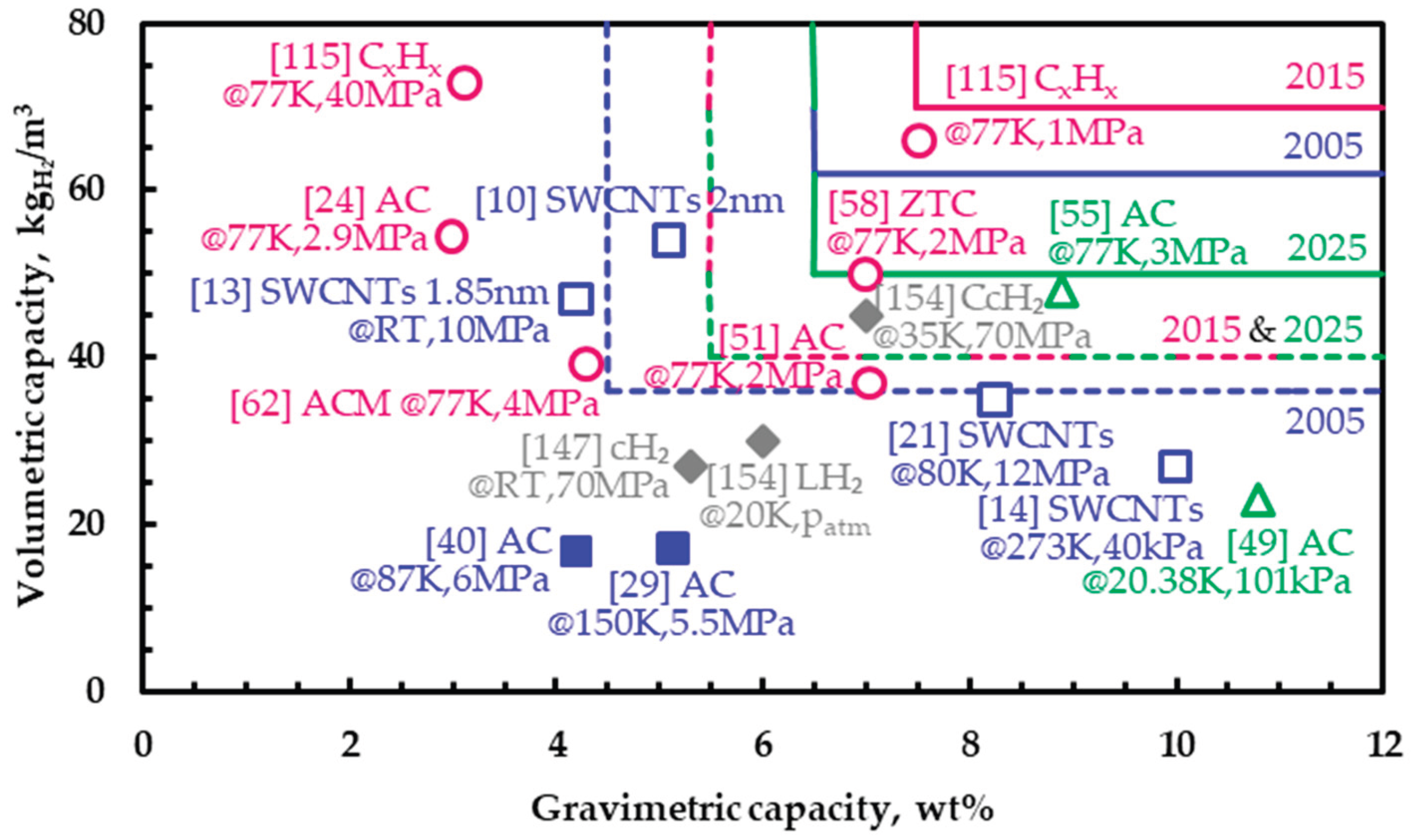

Table 1.
U.S. Department of Energy’s technical-system capacity targets for light-duty vehicles.
| Targeta | 2005 | 2015b | 2025b |
| Volumetric capacity (kgH₂/msystem3) | 36 | 40 | 40 |
| ‘Ultimate’ volumetric capacity (kgH₂/msystem3) | 62 | 70 | 50 |
| Gravimetric capacity (kgH₂/kgsystem) | 0.045 | 0.055 | 0.055 |
| ‘Ultimate’ gravimetric capacity (kgH₂/kgsystem) | 0.065 | 0.075 | 0.065 |
a 'H₂' and 'system' informations purposefully attached to SI units.b After revision [146].
Disclaimer/Publisher’s Note: The statements, opinions and data contained in all publications are solely those of the individual author(s) and contributor(s) and not of MDPI and/or the editor(s). MDPI and/or the editor(s) disclaim responsibility for any injury to people or property resulting from any ideas, methods, instructions or products referred to in the content. |
© 2025 by the authors. Licensee MDPI, Basel, Switzerland. This article is an open access article distributed under the terms and conditions of the Creative Commons Attribution (CC BY) license (http://creativecommons.org/licenses/by/4.0/).
Copyright: This open access article is published under a Creative Commons CC BY 4.0 license, which permit the free download, distribution, and reuse, provided that the author and preprint are cited in any reuse.


