
Submitted:
11 December 2025
Posted:
12 December 2025
You are already at the latest version
Abstract
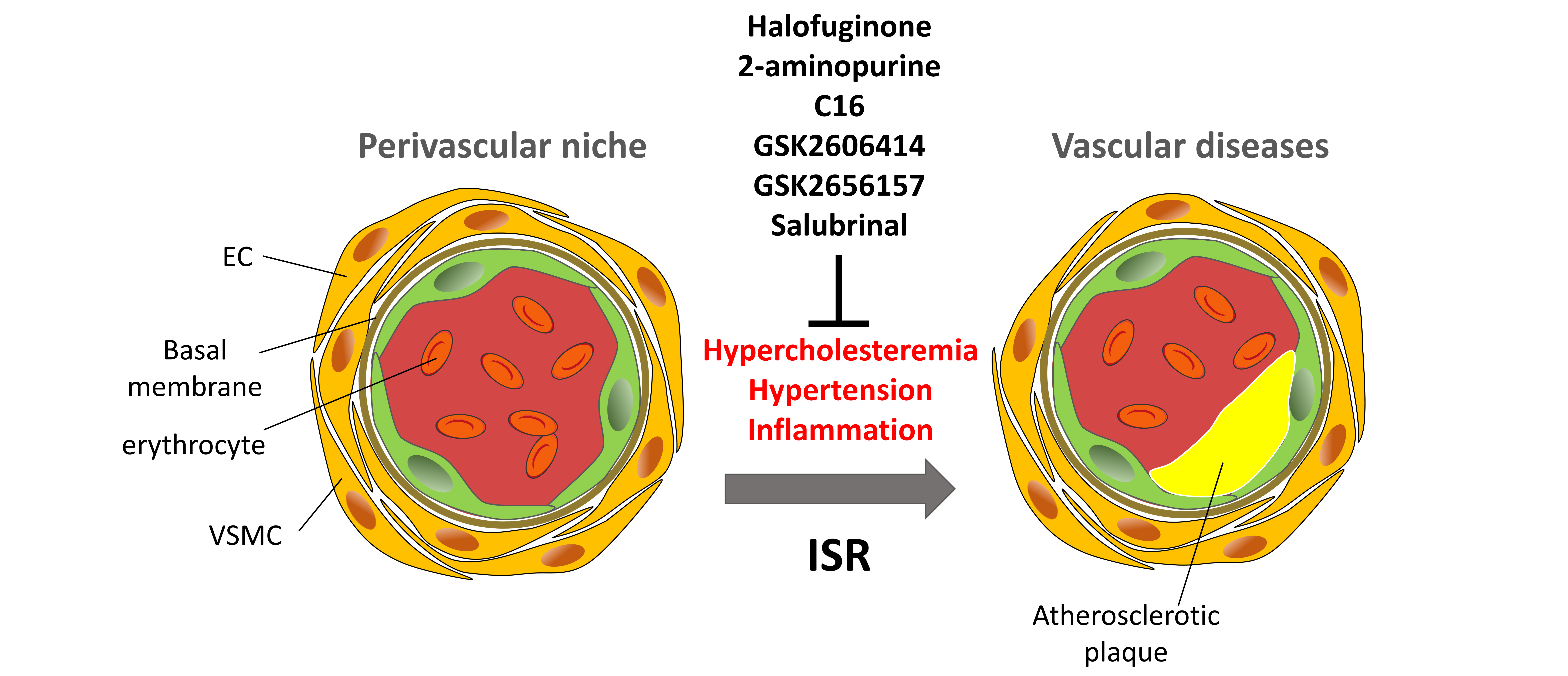
Vascular dysfunction lies at the core of cardiovascular diseases—the leading cause of global morbidity and mortality. Despite their prevalence, therapeutic options remain limited, in part due to an incomplete understanding of the molecular mechanisms driving vascular pathology. The Integrated Stress Response (ISR), an evolutionarily conserved signaling network activated by di-verse stressors, represents a critical but underexplored mechanism in vascular biology. This re-view examines the dual roles of the core ISR kinases—PERK, GCN2, HRI and PKR—in vascular homeostasis and pathology, including atherosclerosis, pulmonary hypertension, and angiogenesis. We advance a conceptual framework in which the ISR functions as a context-dependent, double-edged sword: while PERK and PKR promote inflammation, apoptosis, and vascular re-modeling, GCN2 mediates protective effects. The outcome of ISR activation is shaped by cell type, stress duration and intensity, and downstream signaling bias (e.g., ATF4 vs. CHOP dominance). We further discuss pharmacological ISR modulators—including 2-aminopurine, C16, salubrinal, halofuginone, GSK2606414, and GSK2656157—which have demonstrated beneficial effects in preclinical models by suppressing inflammation, reducing apoptosis, and attenuating disease progression. Collectively, the ISR emerges as a critical regulatory node in vascular pathophysiology, and its selective, context-aware modulation represents a promising avenue for therapeutic intervention.
Keywords:
integrated stress response
; pulmonary arterial hypertension
; pulmonary veno-occlusive disease
; thrombosis
; restenosis
; pulmonary capillary hemangiomatosis
; PERK
; PKR
; GCN2
; cardiovascular diseases
Copyright: This open access article is published under a Creative Commons CC BY 4.0 license, which permit the free download, distribution, and reuse, provided that the author and preprint are cited in any reuse.


