

Submitted:
09 December 2025
Posted:
11 December 2025
You are already at the latest version
Abstract
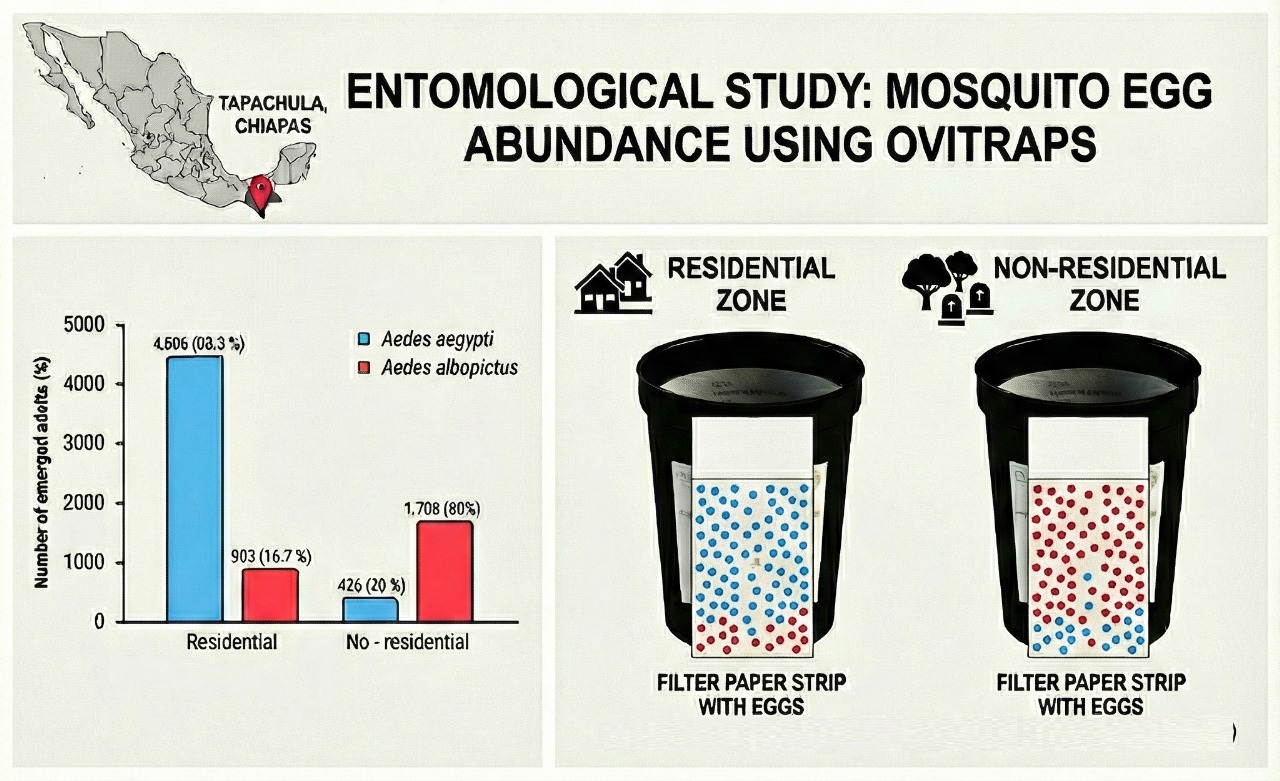
Dengue outbreaks highlight the need to quantify how environments sustain populations of the mosquito vectors Ae. aegypti and Ae. albopictus. Most control activities focus on households, while non-residential premises receive little attention. We conducted a cross-sectional ovitraps survey in August 2025 in Tapachula, Chiapas, Mexico, deploying 593 ovitraps: 297 in residential neighborhoods and 293 in non-residential sites. We collected 42,758 eggs; 61.5% (n = 26,316) came from residential areas and 38.5% (n = 16,442) from non-residential areas. Ovitrap positivity was higher in residential versus in non-residential areas (92.6% vs. 87.0%; p = 0.025), and the mean number of eggs per ovitrap (88.6 ± 5.1 vs. 56.1 ± 3.3 eggs; p < 0.001), yielding 298.0 vs. 175.3 eggs/ha, respectively. From a subsample of 16,965 eggs, 7,543 adults emerged (44.5%), dominated by Ae. aegypti in residential areas (83.3%) and Ae. albopictus in non-residential areas (80.0%). Vector burden differed by species: Ae. aegypti densities were higher in residential areas (51.0 vs. 4.5 adults/ha), whereas Ae. albopictus densities were higher in non-residential sites (18.2 vs. 10.2 adults/ha). These patterns show that both residential and non-residential premises are important sources of dengue vectors and should be included in integrated surveillance and control strategies.
Keywords:
Aedes aegypti
; Ae. albopictus
; dengue
; entomological surveillance
; oviposition
; ovitraps
; vector control
Copyright: This open access article is published under a Creative Commons CC BY 4.0 license, which permit the free download, distribution, and reuse, provided that the author and preprint are cited in any reuse.


