Submitted:
09 December 2025
Posted:
10 December 2025
You are already at the latest version
Abstract
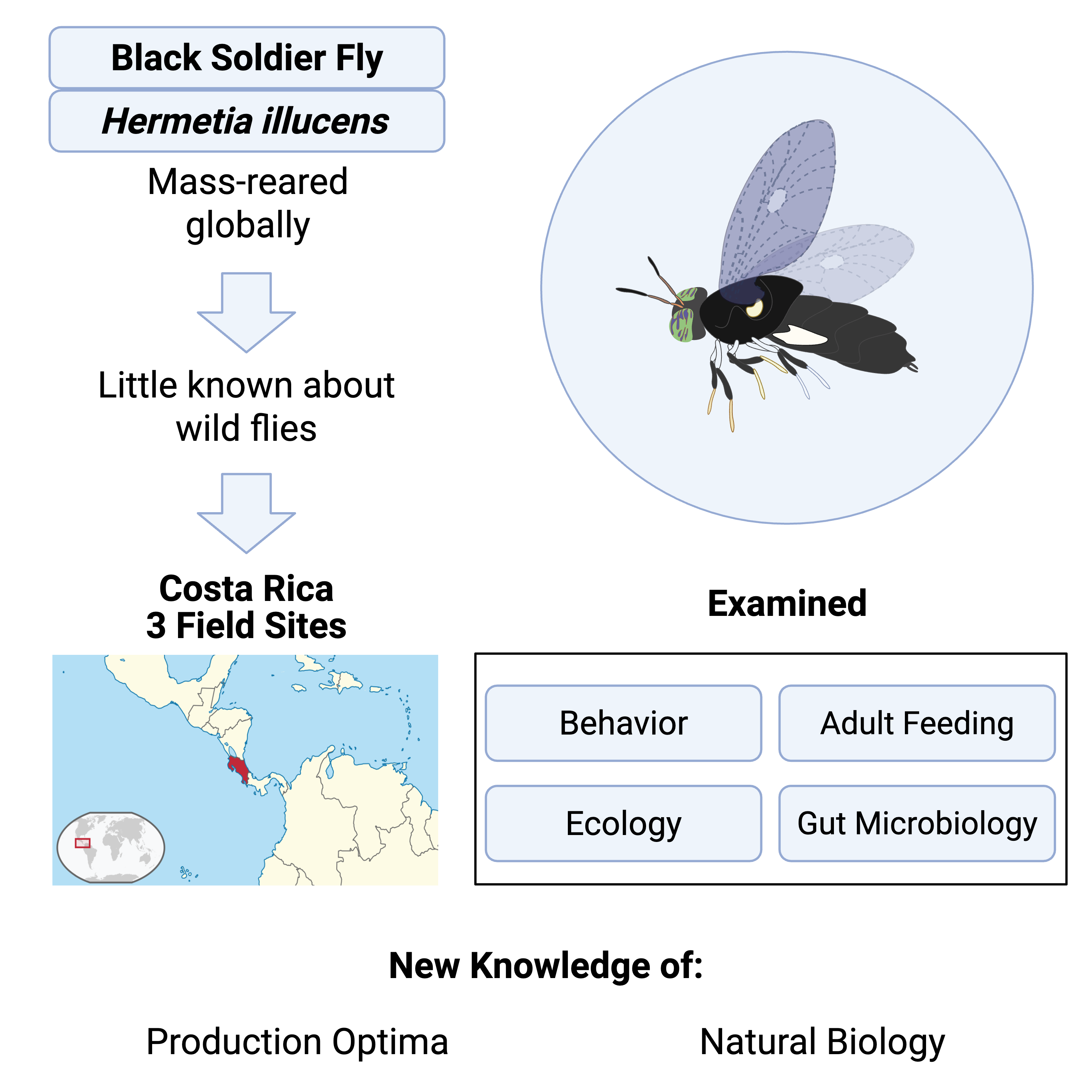
The black soldier fly (Hermetia illucens) is a globally important species, yet little is known about the behavior of adults in nature. Here, we investigated (a) whether wild populations exhibit lekking behaviors, (b) whether wild adults feed, and (c) the microbial diversity of the adult gut. Fieldwork was conducted in Alajuela Province, San Ramon, Costa Rica at three sites (a field station, a local farm, and an ecolodge compost facility). At all three sites, a highly female-skewed sex ratio (F:M=0.98) was observed. Despite many sampling attempts within 30-m of the oviposition site, no mating behaviors were directly observed within this radius, mostly due to the lack of males. Modeling confirmed female abundance declined sharply with increasing distance, and indeed no individuals were observed beyond a 7.5-m radius from the oviposition site, supporting the hypothesis that males and females may occupy distinct habitats in the wild, consistent with lekking. Modeling also revealed BSF were mostly observed between 9:00-14:30, with a peak at 12:00-noon. BSF sightings peaked at 34.7 °C, 78.5% RH, and 8000 µW/cm2 of UV-AB light, while none were observed past 40°C. The presence of vertebrate DNA in the guts of adults revealed that 100% of individuals previously fed as adults, possibly to supplement nutritional reserves during long-distance flights. Lastly, microbial community analysis revealed a core community of microbes present within the gut of wild-caught BSF. By considering spatial molecular ecology at three field sites, this study highlights the strong association of the black soldier fly with human-modified environments, suggesting environmental structure and resource availability may play a large role in shaping wild fly behavior. This work presents the first detailed field report of H. illucens in the Neotropics and offers some critical insights for future fieldwork as well as baseline traits for industrial applications.