

Submitted:
23 November 2025
Posted:
09 December 2025
You are already at the latest version
Abstract
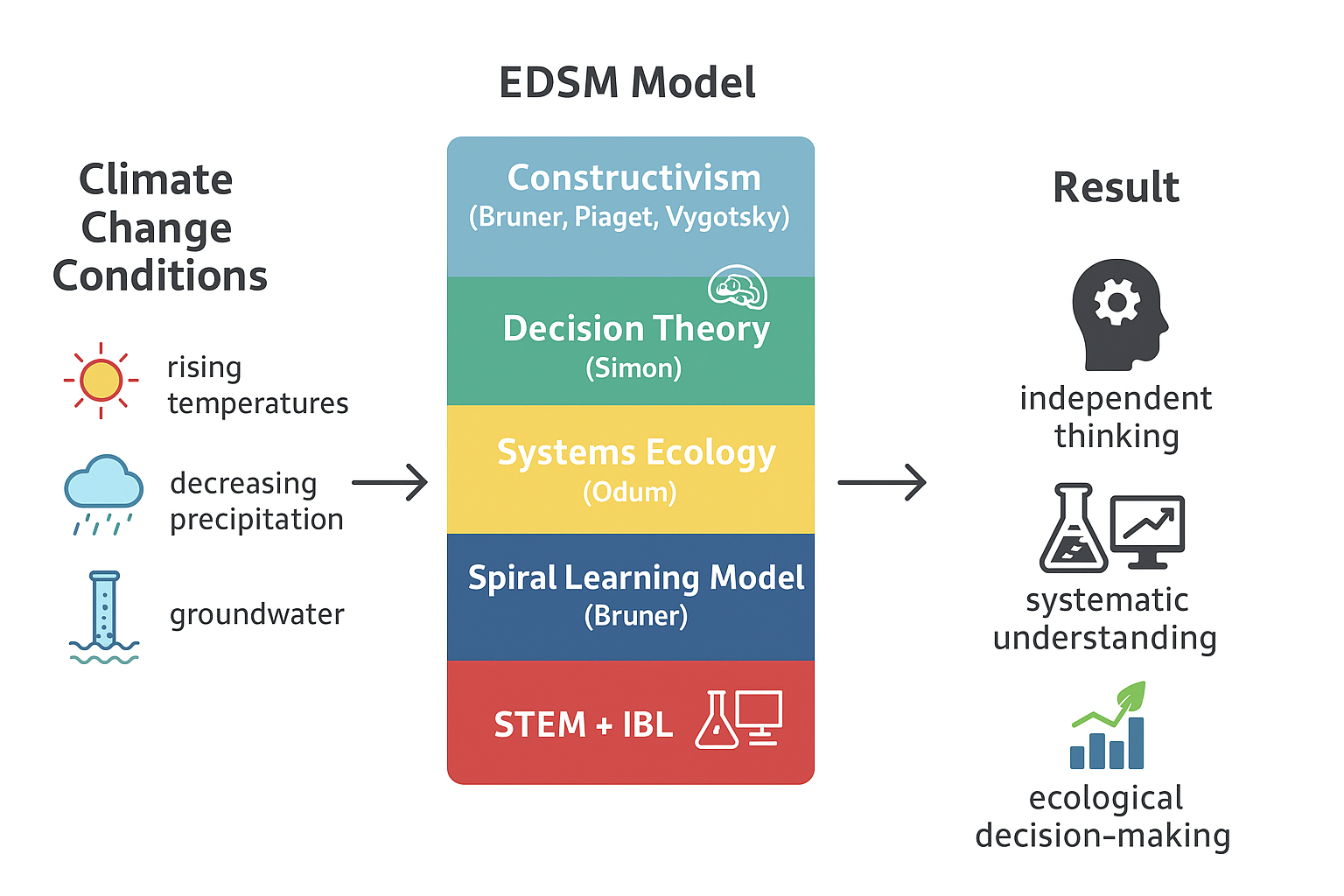
Under ongoing climate change, environmental conditions in complex global arid and semi-arid ecosystems are rapidly deteriorating. According to NASA observations, the average annual air temperature in the northeastern regions of Kazakhstan and the Republic of Uzbekistan has increased by +1.03°C over the past 40 years (1984–2024). Forecasts derived from a linear regression model indicate that if the current warming trend continues, by 2070 the average annual temperature is expected to rise by an additional +1.47°C, reaching approximately 7.00°C. This projected warming suggests further intensification of environmental challenges in arid regions, including groundwater depletion, soil salinization (degradation), and heightened risks to food security. Consequently, equipping younger generations with high-quality knowledge based on clear analytical algorithms, and integrating complex ecological issues with modern educational technologies, requires innovative and effective methodological approaches. This study responds to this need by introducing the Eco-Decision Spiral Model (EDSM). Empirical findings show that students’ acquisition and practical application of relevant knowledge through the EDSM reached an average of 87.04%, while the comparative WSWNW model demonstrated a more limited effectiveness of 75.48%. The model’s integration with Benjamin Bloom’s classic cognitive taxonomy, STEM and inquiry-based learning principles, Herbert Simon’s bounded rationality and Scientific Decomposition approach, Howard T. Odum’s systems ecology concept, and several other foundational educational frameworks plays a significant role in strengthening learners’ ability to understand, critically analyze, and independently make decisions regarding complex ecological systems. Moreover, the model is highly aligned with international standards such as UNESCO ESD, OECD Education 2030/2040, and the NGSS. This compatibility not only supports the applicability of EDSM in global environmental education and scientific research, but also demonstrates its methodological value in advancing the goals defined within these international initiatives.
Keywords:
J. Bruner’s concept
; bounded rationality
; scientific decomposition
; systems ecology
; eco-decision spiral model (EDSM)
; STEM
; inquiry-based learning (IBL)
; WSWNW
1. Introduction
1.1. Problem Statement and Scientific Rationale
In recent years, climate-induced processes have exerted significant adverse impacts on both surface and groundwater ecosystems. Atmospheric disturbances-particularly the intensification of the “greenhouse effect” caused by the accumulation of greenhouse gases in the troposphere-have contributed to additional global warming. As a result, arid and semi-arid regions are increasingly experiencing soil salinization, excessive evaporation of groundwater, and deterioration of its quality and quantity due to intensive groundwater extraction for irrigation purposes [1,2]. This phenomenon is widely recognized as the outcome of the interaction between natural and anthropogenic factors in arid and semi-arid zones.
In regions characterized by extremely harsh climatic conditions-very hot, dry summers and severely cold winters-excessive evapotranspiration during the vegetation period leads to the upward movement of groundwater to sustain soil moisture, followed by its evaporation. This process results in the accumulation of whitish salt crusts on the soil surface. The problem becomes especially severe in countries that have not yet adopted modern irrigation technologies. In such contexts, irrigation practices often disregard local climatic constraints and geographical characteristics, ultimately contributing to the degradation of natural groundwater quality. This issue is particularly common in developing and underdeveloped countries. For instance, in Central Asian states, increasing groundwater salinity and declining groundwater levels have already become widespread and persistent challenges [3,4,5,6,7].
In other words, under conditions of climate change, reduced precipitation and intensified evaporation in arid and semi-arid climates are causing a rapid decline in groundwater levels and deterioration in water quality-problems that have now escalated from regional to global significance. In some areas, anthropogenic factors-such as agricultural irrigation, industrial activities, and medical waste-further threaten the quality of groundwater resources. Although this ecological challenge has long reached the level of a global crisis, educational systems in many countries still lack adequate development in this domain. Specifically, the integration of climate change impacts on drinking water quality, the intensification of water scarcity, and the projected consequences of continued warming remains insufficiently addressed in educational curricula [8,9].
This topic is often presented solely as theoretical information, while the practical processes of environmental awareness formation and decision-making for addressing emerging ecological problems are rarely taught effectively. The primary reason is the inherent complexity of these processes: explaining concepts such as how much soil moisture is lost with each degree of warming, or how increasing temperatures accelerate groundwater salinity requires simplified yet scientifically accurate instructional models-something largely absent in higher education.
In current educational practice, no systematized teaching framework exists for explaining complex ecological dynamics such as soil moisture depletion or groundwater salinization within arid and semi-arid ecosystems. Similarly, the ecological “succession” processes triggered by climate-induced degradation, and other hazardous environmental consequences, are not taught through practical and systematic models. Therefore, the need has emerged to develop a new pedagogical framework capable of explaining these processes clearly, scientifically, and practically. As a continuation of ongoing research aimed at addressing shortcomings in the higher educational system and advancing scientific solutions, this study proposes a new model grounded in fundamental theories-the Eco-Decision Spiral Model (EDSM)-with a focus on filling existing gaps in international research [10,11,12,13,14,15,16].
Why is the EDSM necessary?
Most existing pedagogical approaches rely heavily on theoretical knowledge, yet remain weak in teaching students the practical and systemic interconnections within complex ecological systems. Global environmental problems are inherently multi-variable, multi-stage, and multi-component; therefore, a spiral decision-making model is well-suited for addressing such dynamics [17]. The EDSM unpacks ecological processes step-by-step through the sequence: observation - analysis - problem diagnosis - decision alternatives - ecological outcome evaluation - revision. This structured progression makes the model superior to many traditional approaches.
1.2. The Role of the Model in Addressing Scientific-Pedagogical Gaps in the Global Education System and Minimizing Paradigmatic Structural Misalignments
Given its spiral-integrative structure, cross-competency approach, and alignment of cognitive, social, and behavioral mechanisms of decision-making, the EDSM model fills several scientific and pedagogical gaps present within international education standards. Numerous global frameworks-UNESCO’s ESD for 2030, the Greening Education Partnership, the OECD Learning Compass 2030 / Teaching Compass 2030, the P21 Framework for 21st-Century Skills, the NGSS, the EQF, and Bloom’s Taxonomy-identify separate competencies; however, they do not provide a unified model that explains how these competencies should be integrated or how sustainable decision-making is formed through a continuous spiral process [19,20].
While the ESD concept positions education at the core of achieving the SDGs and calls for transformation at the cognitive, socio-emotional, and behavioral levels, it lacks a clear mechanism detailing how these three domains interconnect and how they collectively translate into sustainable decision-making competence. The EDSM addresses this gap by modeling a spiral learning process that leads students from problem analysis to value-based decision-making. This ensures the practical integration of UNESCO ESD competencies (critical thinking, responsible behavior, global citizenship, environmental awareness), OECD Learning Compass competencies such as “student agency” and “transformative competencies,” and the P21 4Cs (creativity, critical thinking, communication, collaboration).
Furthermore, international literature highlights the scarcity of comprehensive didactic systems that articulate a continuous model of environmental decision-making within educational pathways aimed at achieving SDG 4, 5, 7, 8, and 13. The EDSM resolves this limitation by establishing-consistent with the Greening Education Partnership’s principle of preparing “climate-ready learners”-a unified structural mechanism that integrates the required learning environment, curriculum architecture, teacher competencies, and community-linked education [21,22,23,24].
In addition, within the OECD 2030/2040 framework, there remains an unresolved scientific gap regarding how “future-ready skills,” “agency,” and the triad of “skills-values–behavior,” as well as the P21 literacies (global literacy, ICT literacy, environmental literacy), should be developed in practice and in what sequence. The EDSM clarifies this process by delineating explicit stages and offering an integrative mechanism that prepares learners to navigate independently through emerging professions, uncertain socio-planetary challenges, and rapidly evolving technologies.
Consequently, by integrating the knowledge, skills, and values defined in international standards into a unified spiral process, the EDSM provides a comprehensive educational model of sustainable decision-making-a model that has not yet been fully articulated in the existing scientific literature. This significantly enhances the model’s scientific novelty and its potential for global application.
2. Materials and Methods
2.1. Organization of the Empirical Component: Methodology for the Practical Application of the New EDSM Model
A total of fifty undergraduate and college–lyceum students participated in the empirical phase of the study. The selected participants, aged between eighteen and twenty-five, were divided into two equal groups. To facilitate and accelerate the intensive learning of environmentally problematic topics, each group was instructed using both the newly developed EDSM model and the What? – So What? – Now What? (WSWNW) model, which served as a comparative framework for evaluating the effectiveness of the new approach.
The research focused on topics within the course General Ecology, particularly the section on “Environmental Conditions Resulting from Climate Change,” along with several related themes. All instructional sessions were conducted in both offline and online formats.
The logical structure of the lesson process implemented using the EDSM model is presented in Figure 1, following the schematic layout provided therein.
The instructional process based on the EDSM model was enriched with contemporary pedagogical approaches, including collaborative learning (team-based student work), pre-structured lesson plans, project-based learning methods (each session required students to complete a new project), the Visual-Auditory-Kinesthetic (VAK) multisensory approach, the flipped-classroom model, and selected elements of gamification.
Prior to the empirical study or instructional sessions, all students underwent a preparatory stage in which they were introduced to the stages of the EDSM model, its operational mechanism, the tasks they would be required to complete, and the digital tools and platforms to be used during the lessons. Short training modules were delivered for this purpose.
In the first stage of the lesson, students collectively analyzed an environmental problem on the basis of their prior knowledge and competencies. Through this process, they examined real situations occurring across ecological scales-from the largest ecosystem (the biosphere) to the smallest micro-ecosystems. To ensure scientifically grounded analysis, they identified the root cause of the problem and developed a structured cause-effect framework. At this stage, students analyzed multi-year datasets using software such as STATA, R, GIS tools, Python, and Microsoft Office. For rapid data sharing and collaborative processing, they used digital platforms such as Google Sheets and WhatsApp.
Throughout the lesson, students synthesized their ideas, developed various scenarios for environmental management, and applied analytical tools such as decision matrices, impact charts, and risk maps to evaluate these scenarios visually. The process was primarily collaborative: groups discussed each other’s solutions, defended opposing viewpoints using evidence, and ultimately developed a final solution scenario (structured argumentation).
To converge divergent arguments into a unified position or formulate a collective decision, students compared alternative solutions across environmental, economic, and social indicators. They were provided with tools such as cost–benefit analysis, environmental impact scoring, and stakeholder mapping. Each group presented its strategy through a concise “pitch-refinement” format.
In the final stage, students completed an online quiz for reinforcement and wrote a 300-word argument-based essay on the topic. A hard-copy version of the essay was submitted to the instructor within the last two class sessions. Through the argumentative essay, students articulated their reasoning, analyzed the theoretical and practical knowledge gained during the lesson, and demonstrated their ability to integrate it coherently. This method encouraged students to avoid passive learning and actively engage with theoretical content.
2.1.1. Methodology for Assessing Student Learning Outcomes Using an Analytical Rubric and Percentage-Based Grading
In this study, students’ essay-writing skills were evaluated using the assessment framework developed by the Harvard College Writing Program. This system considers core criteria such as thesis (central argument), structure, evidence and analysis, use of sources, and style. Each criterion is assessed using the A–D rating scale:
A: Excellent-demonstrates sophisticated analysis, a coherent and compelling argument, and clear, elegant prose.
B: Generally strong-high-quality work overall, though certain ideas may require deeper development or more substantial evidence.
C: Adequate-meets basic expectations but contains issues in structure, argumentation, or style.
D or below: Does not meet the required standards and exhibits substantial weaknesses.
This evaluation framework is based on standards developed by Head Preceptors Maxine Rodburg, Pat Kain, and Eric LeMay, ensuring consistent and fair assessment of students’ knowledge, skills, and learning outcomes. Additionally, this system enables students to identify their strengths and weaknesses and provides opportunities to address and improve those weaknesses. Test results were evaluated in accordance with international educational standards using a point-based and percentage-based grading methodology. Each correct answer was assigned a predetermined score, and total scores were converted to percentages out of a maximum of 100% (for 100 questions: A = 90-100%, B = 80-89%, C = 70-79%). This approach fully aligns with OECD, UNESCO, and U.S./U.K. educational standards and ensures that the results are consistent with international norms [25,26].
2.2. Scientific–Methodological Integration of the EDSM Model: A Methodological System Grounded in Global Fundamental Principles
2.2.1. Constructivist Theory: Avoiding Learner Passivity
The first component of the EDSM model is grounded in the global-fundamental research tradition of constructivist learning theory, which posits that “knowledge is not delivered to the learner in a ready-made form, but is actively constructed through the learner’s own cognitive engagement.” As emphasized by scholars such as Jerome Bruner, Piaget, and Vygotsky, the learning process unfolds as individuals compare new information with prior knowledge, identify similarities and differences, resolve cognitive conflicts, and adapt new concepts to their existing conceptual frameworks.
Jerome Bruner explains the construction of knowledge in constructivism through three stages of representation-enactive, iconic, and symbolic-whereby the learner constructs understanding first through concrete actions, then through visual models, and finally through abstraction and symbolic reasoning. Integrating this theoretical foundation into the EDSM model and applying it within the instructional process provides both learners and educators with highly effective opportunities. A constructivist learning environment transforms the learner from a passive recipient into an active agent engaged in inquiry; it strengthens independent thinking, critical analysis, reflection, exploration, creativity, and the ability to apply new skills to real-life situations.
Within this approach, the teacher or any instructor does not function as a traditional transmitter of knowledge but rather as a facilitator-guiding the learning process toward clear and meaningful outcomes, providing support, and offering temporary scaffolding when necessary. The facilitator identifies learners’ pre-existing conceptions and motivates them to construct new understanding independently through problem situations, experiments, dialogue, and collaborative inquiry. Consequently, constructivism enables learners to deepen their knowledge, apply it in authentic contexts, revise prior conceptions, and develop skills of inquiry, communication, collaboration, and evidence-based reasoning [27,28].
Overall, the theoretical perspectives advanced by J. Bruner and others-namely, the premise that “learning is reinforced through prior knowledge, and previously acquired concepts deepen and strengthen the acquisition of new knowledge through analysis”-provide a scientifically grounded mechanism that, when integrated into the new EDSM model, enhances its theoretical credibility. This integration supports learners in applying knowledge to real-life contexts, making independent decisions in complex situations, and developing the cognitive foundations and fundamental ideal constructs necessary for consolidating new concepts.
From another viewpoint, the hypothesis advanced by J. Bruner and colleagues-that learning is strengthened through prior knowledge-and the operational mechanisms of constructivist theory create an essential cognitive basis when incorporated into the EDSM model. This integration helps learners deepen existing knowledge, apply it in real-world settings, engage in autonomous decision-making, and reinforce new conceptual understanding. The logical structure of this theoretical process is presented in the supplemental materials of the article, as illustrated in Figure S1 [29].
2.2.2. Decision Theory (Herbert Simon): Enhancing the Operational Mechanism of the New EDSM Model Through Bounded Rationality and Scientific Decomposition
The second stage of the EDSM model-Scientific Decomposition-directly draws upon Herbert Simon’s decision theory and the concept of bounded rationality. As Simon emphasized, when individuals analyze complex problems, they are unable to evaluate all factors fully and perfectly; rather, within the constraints of available time, knowledge, information, and cognitive capacity, they attempt to break the problem into smaller, manageable components.
In the second stage of the EDSM model, the segmentation of ecological processes (for example, climate-precipitation-infiltration-groundwater) into sequential analytical units represents a didactic adaptation of what Simon described as a “simplified decision environment.” Applying the principle of bounded rationality in this phase reduces the learner’s cognitive load and brings the analysis of complex ecological systems to a level that aligns with realistic human information-processing capacity.
As a result, the scientific analysis process transforms an excessively complex ecological system into smaller, logical, and coherent segments, thereby cultivating in learners a decision-tree mode of thinking. Empirical studies demonstrate that the fragmentation method grounded in Simon’s approach significantly improves learners’ ability to understand complex ecological processes, construct cause-effect chains, and develop more accurate decisions in subsequent stages (such as solution development).
2.2.3. The Necessity of Integrating the “Systems Ecological Approach (Odum, 1971)” into the EDSM Model
In developing the new EDSM model, integrating the systems ecological approach (Odum, 1971) is of critical importance, as this approach conceptually reflects the interconnectedness of problems within natural and social systems. As emphasized in the works of the eminent scholar H.W. Odum, unifying natural and social sciences provides opportunities to design comprehensive systemic mechanisms for regional resource management and for addressing complex environmental challenges.
The application of the systems ecological approach within the EDSM model enables learners to understand key ecological issues-such as climate change, access to clean drinking water, and other large-scale environmental problems-through established ecological laws and systems-thinking principles. In this way, incorporating Odum’s systems ecology into the EDSM model facilitates not only the acquisition of information but also the development of advanced competencies such as identifying interdependencies within systems, optimizing resource use, and designing ecologically sustainable solutions.
2.2.4. The Necessity of Integrating Jerome Bruner’s Spiral Curriculum Model into the EDSM Framework
The integration of Bruner’s spiral curriculum model into the newly developed EDSM (Education Design and Skills Model) is scientifically well-substantiated. Bruner’s spiral model allows learners to progressively deepen their understanding by revisiting topics repeatedly, each time at a higher level of complexity. This pedagogical mechanism supports the systematic and structural organization of the learning process within the EDSM framework, particularly in well-structured disciplines such as science and mathematics.
The core feature of the spiral curriculum-revisiting concepts with incremental complexity-supports long-term retention and conceptual mastery [36,37]. At the same time, the EDSM model’s approach enables learners to connect topics within a broader conceptual and practical context, which aligns with Bruner’s principle of vertical integration. Moreover, the spiral model fosters a deep understanding of core concepts and enhances their transfer into practice-an aspect that fully complements the EDSM model’s “learner-centered and transfer-oriented” philosophy.
Thus, integrating the spiral curriculum model into the EDSM framework ensures meaningful reinforcement of topics, structured development of knowledge, and stimulation of higher-order critical thinking skills.
2.2.5. The Necessity of Integrating STEM and Inquiry-Based Learning Principles into the EDSM Model
The EDSM model is grounded in the systematic analysis of complex ecological and human–ecosystem processes, and its effectiveness can be enhanced through integration with STEM methodologies and inquiry-based learning (IBL) principles. The IBL approach fosters active learning by encouraging students to formulate scientific questions, design experiments, analyze results, and draw evidence-based conclusions. Concurrently, STEM methodologies integrate mathematics, technology, engineering, science, and arts, providing learners with the capacity to model complex systems and real-world processes [38,39].
Through the integration of IBL and STEM within the EDSM model, learners develop an understanding of complex ecological systems not only theoretically but also through experimental and simulation-based approaches. For instance, under climate change conditions in arid regions, students can observe processes such as excessive groundwater evaporation, increased salinity, and capillary rise in experimental or virtual laboratory settings. These processes, analyzed via the EDSM model, enable evaluation of energy and material flows, determination of system resilience limits, and understanding of long-term ecological consequences.
In this manner, IBL cultivates scientific literacy, constructivist knowledge, and critical thinking in learners, while STEM provides the interdisciplinary framework necessary for modeling complex systems and developing sustainable management decisions. Consequently, the EDSM model not only facilitates a systematic understanding of ecological laws but also equips learners with the competencies to make scientifically informed decisions and develop innovative solutions.
2.3. Analysis of Results from Applying the What? - So What? - Now What? (WSWNW) Model in Conjunction with the EDSM Model
The WSWNW model is a simple yet highly effective methodological approach designed to foster deep thinking in educational, research, and analytical processes. The method is structured around three progressive stages: “What?” (description), “So What?” (analysis and interpretation), and “Now What?” (action-oriented decisions and future planning). In the first stage, the investigated phenomenon, process, or dataset is objectively documented based on facts. In the second stage, the significance of this information is analyzed, including associated changes, cause–effect relationships, problems, and opportunities. The third stage involves the formulation of practical measures, strategic decisions, directions for improvement, or identification of new research needs based on the derived conclusions. The strength of the model lies in its universality, making it suitable for reflective teaching in education, clinical case analysis in healthcare, meaningful evaluation of data in scientific research, and data-driven decision-making in business. The WSWNW approach simplifies complex processes, eliminates subjective interpretations, and ensures neutral analysis, thereby supporting accurate interpretation, logical conclusions, and evidence-based decision-making. Its stepwise reflective mechanism is regarded as an effective, systematic model for researchers and educators to achieve rigorous analysis, sustainable improvements, and innovative solutions [40,41].
2.4. Brief Overview of the Teaching Material
The climatic factors shaping the general climate conditions of Central Asian countries, as well as those factors that degrade the ecological quality under these conditions, are largely similar. The most ecologically critical areas within these countries negatively affect soil, water, and atmospheric quality across the entire Central Asian region. The epicenter of such impacts corresponds primarily to the territories of the Republics of Uzbekistan and Kazakhstan. According to NASA data, ecological conditions in regions of Uzbekistan and Kazakhstan located between 35.0°-55.0° N latitude and 55.0°-75.0° E longitude have significantly deteriorated, and the region’s strong continentality exacerbates this deterioration under climate change, intensifying ecological stress. These northern and eastern latitudes encompass extensive areas including the Amudarya and Syrdarya basins, the Kyzylkum Desert, the Mongolian Steppe, and the southern steppe zones of Kazakhstan.
The region’s primary natural-climatic characteristics include cold winters, extremely hot summers, and very low annual precipitation. Landscapes are dominated by deserts, steppes, and semi-desert areas with saline soils. In recent years, due to the Aral Sea crisis, local populations in these areas have migrated elsewhere, as access to natural potable water is severely limited, groundwater levels have sharply declined, and water mineralization has increased.
Overall, the ecological catastrophe in Central Asia is characterized by the Aral Sea ecological disaster, scarcity of drinking and irrigation water, anthropogenic pressure, salinization of irrigated lands, and accelerated desertification, rendering the region increasingly inhospitable for sustainable ecosystems [42,43,44,45].
NASA’s data on the 40-year period from 1984 to 2024 regarding mean annual air temperature (Table 1)1 were analyzed and projected using a linear regression equation (Formula 1) [46]. This analysis addressed questions such as whether the mean annual air temperature (Y) in this large ecosystem has been increasing or decreasing over the years (X). Results indicate that from 1984 to 2025, the mean annual air temperature increased by +1.03°C. If this trend continues steadily over the next decades, by 2070 the mean annual air temperature is projected to rise by +1.47°C, potentially reaching an average of 7.00°C per year (Figure 2).
Y=a+bX (1);
Where: Y-dependent variable, X-independent variable, a-intercept of Y, b -regression coefficient.
3. Results and Discussion
3.1. Analysis of Empirical Research Results from the Application of the Eco-Decision Spiral Model (EDSM)
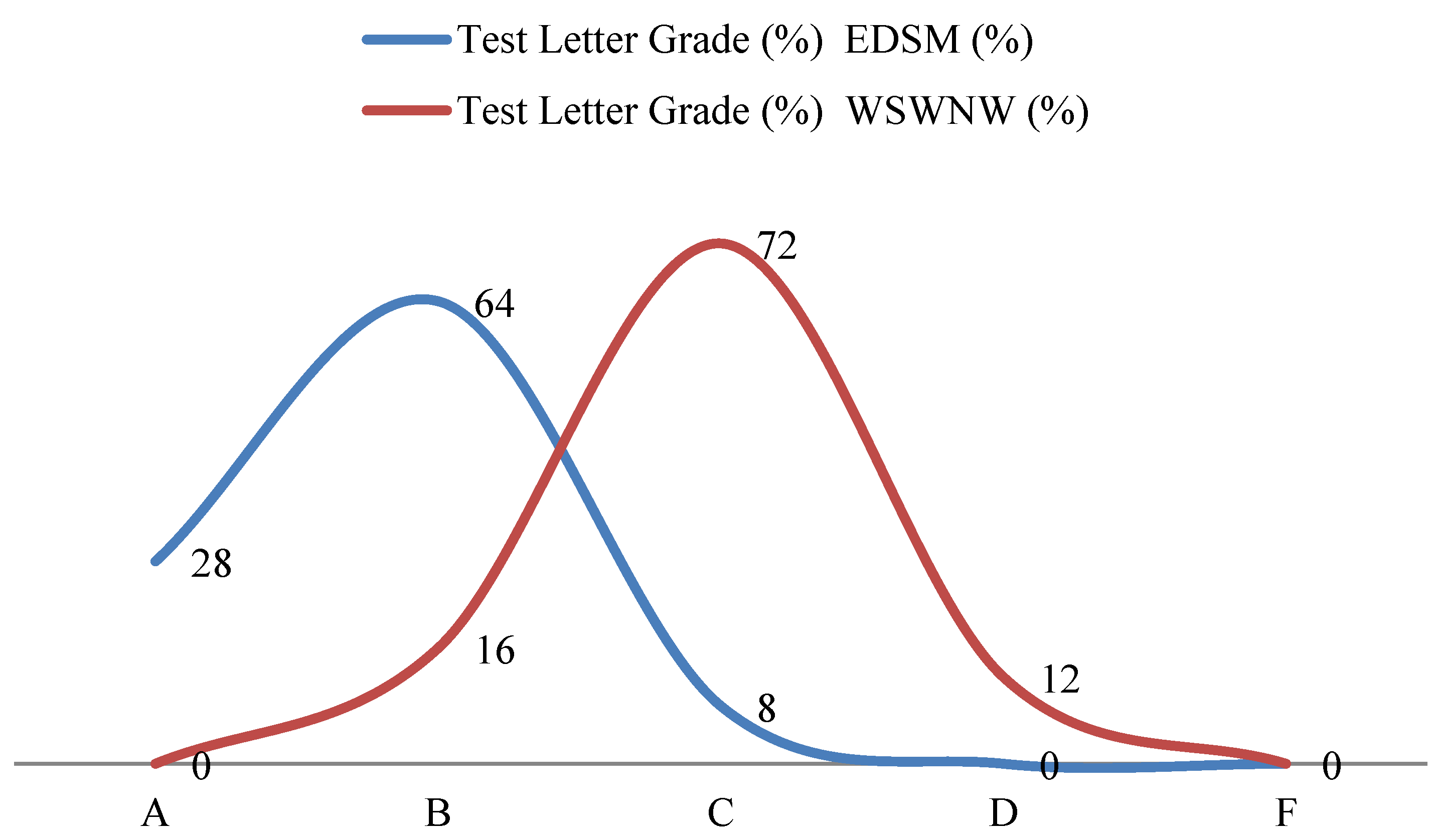
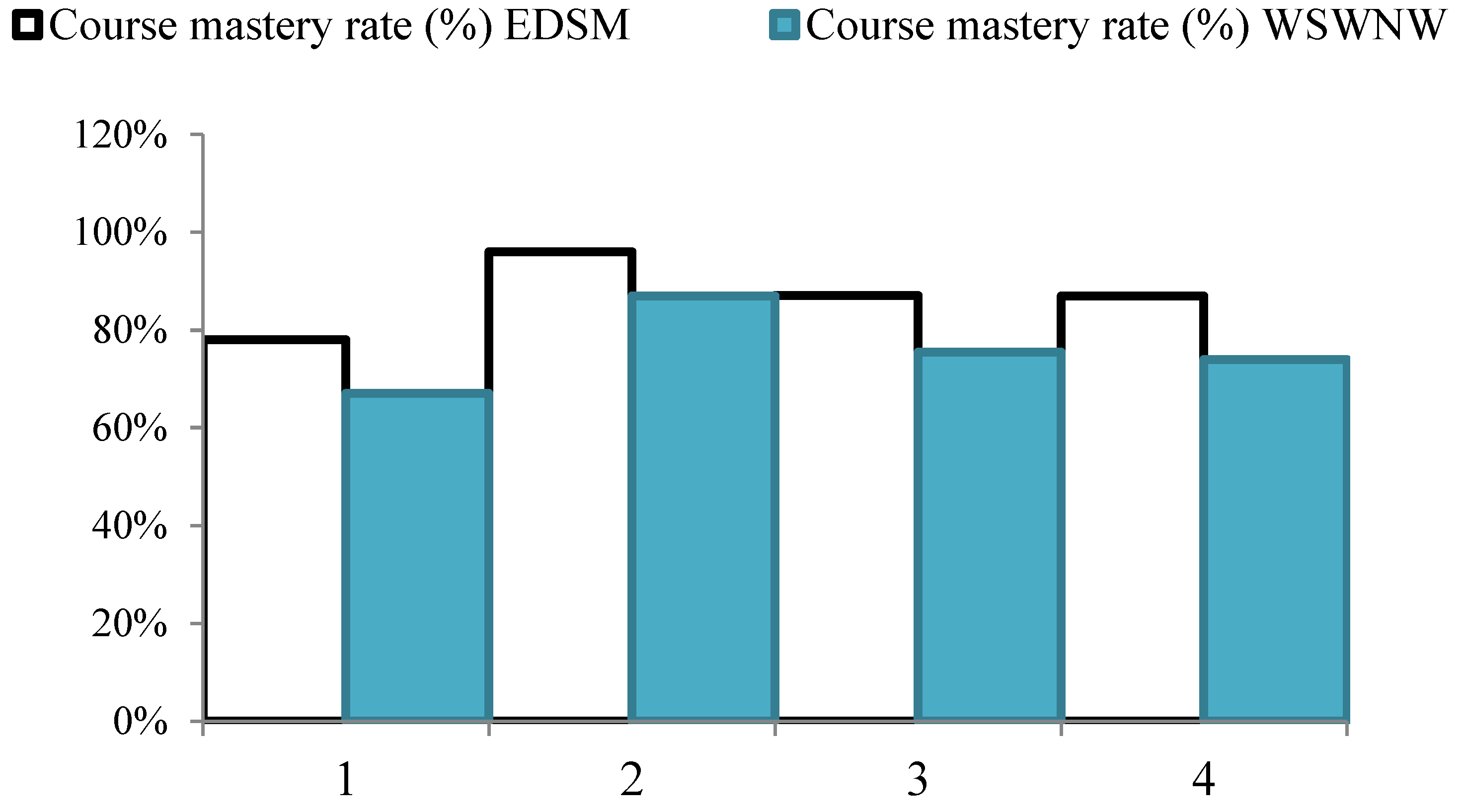
Empirical research results demonstrated a significant difference between the EDSM and WSWNW models. In the EDSM model, the conducted lessons were considerably more effective. According to the results, students’ overall scores in essay writing ranged from a minimum of 2.4 to a maximum of 4.0, with an average range of 3.14 to 3.96 and a median of 3.6. To assess students’ mastery of each topic, a test method was also employed. Test results showed a minimum of 78%, a maximum of 96%, an average range of 82.97-92.39%, and a median of 87%. The total number of students completing the course was 25, and their overall average mastery level was 87.04%.
For the WSWNW model, essay scores ranged from a minimum of 2.4 to a maximum of 3.6, with an average range of 2.75-3.25 and a median of 3. Test scores, expressed as percentages, ranged from 67% to 87%, with an average of 75.48 ± 5.55% and a median of 74%. With 25 students participating in the lessons, their overall course mastery level was 75.48%.
Overall, the effectiveness of the EDSM model was confirmed through empirical research. Students’ essay scores, test results, competency indices, and growth dynamics all demonstrated high average values, maintaining consistent stability throughout the learning process.
Figure 3.
The dynamics of students’ acquisition of the competencies prescribed by the general education curriculum within instructional processes structured according to contemporary educational models.
Figure 3.
The dynamics of students’ acquisition of the competencies prescribed by the general education curriculum within instructional processes structured according to contemporary educational models.
3.2. Advantages and Limitations of Educational Models in Interdisciplinary and Environmental Studies
The EDSM and WSWNW models differ in their effectiveness for mastering complex subjects in the learning process. The EDSM model is highly effective for in-depth study of ecological and multidisciplinary topics, enriched by the integration of STEM and inquiry-based learning, as well as constructivist and spiral learning theories. Students demonstrate high and stable performance in essays and tests, while their skills in analyzing complex problems and making practical decisions increase significantly. In contrast, the WSWNW model relies on a simple reflective approach, analyzing information in three stages, but its capacity for deep understanding of complex subjects is limited. The strength of the EDSM model lies in its scientific-methodological integration and practical effectiveness, whereas WSWNW excels in simplicity and rapid reflective analysis. Therefore, EDSM is recommended as the primary approach for complex ecological or interdisciplinary topics, while WSWNW is suitable for situations requiring simple or rapid analysis and reflection.
3.3. Alignment of the EDSM Model with International Educational Standards, Fundamental Concepts, and Empirical Effectiveness
Comparative analysis based on international educational concepts, models, and quality standards demonstrates that the new EDSM model is theoretically well-founded, didactically coherent, and fully compatible with the requirements of intensive higher education instruction. Comparative results with various international standards, concepts, and models aimed at enhancing educational quality-detailed in Table 4 show that the model aligns fully with Benjamin Bloom’s revised taxonomy, facilitating the seamless integration of prior knowledge with new information. It supports the sequential execution of six cognitive stages, from knowledge recall to analysis, evaluation, and creative synthesis. This alignment clearly reflects the model’s theoretical foundations and guarantees the development of high-level thinking skills in learners.

Table 2.
Results of statistical analysis of empirical research results.
| Statistical Parameters | EDSM | WSWNW | ||||||||
| Essay total score (A=4, B=3, C=2, D=1) | Test score (%) | Test letter grade (%) | Number of students who passed the course | Course mastery rate (%) | Essay total score (A=4, B=3, C=2, D=1) |
Test score (%) | Test letter grade (%) | Number of students who passed the course | Course mastery rate (%) | |
| Minimum | 2.4 | 78 | 8% (C), 0% (D, F), 28% (A) | 25 | 78% | 2.4 | 67 | A (0%), 0% (F), 12% (D), 16% (B) | 25 | 67% |
| Maximum | 4 | 96 | 64% (B) | 25 | 96% | 3.6 | 87 | 72% (C) | 25 | 87% |
| Mean±SD | 3.55 ± 0.41 | 87.68 ± 4.71 | – | – | 87.04% | 3 ± 0.25 | 75.48 ± 5.55 | – | – | 75.48% |
| Median | 3.6 | 87 | – | – | 87% | 3 | 74 | – | – | 74% |
Table 3.
Comparative Analysis of EDSM and WSWNW Educational Models (Limitations, Advantages, and Differences).
Table 3.
Comparative Analysis of EDSM and WSWNW Educational Models (Limitations, Advantages, and Differences).
| Aspect | EDSM (Eco-Decision Spiral Model) | WSWNW (What? - So What? - Now What?) | Similarities |
| Level of Knowledge Acquisition | Significantly high (empirical results: essay scores 3.14-3.96, test 82.97-92.39%, average 87.04%). | Lower (empirical results: essay 2.75-3.25, test 75.48 ± 5.55%, average 75.48%). | Both are based on systematic assessment of students’ learning processes. |
| Theoretical Basis | Constructivism, Spiral Learning, STEM and IBL, Systems Ecology Approach, Decision Theory (Simon). | Reflective Thinking (description - analysis - practical decision). | Both models contribute to developing students’ critical and logical thinking. |
| Effectiveness in Teaching Complex Topics | Aimed at in-depth study of complex ecological and multidisciplinary topics; integration with STEAM and IBL. | Simple and structured: learning in 3 stages (What? – So What? - Now What?). | Both models structure the learning process and ensure consistency. |
| Pedagogical Approach | High engagement, collaboration-oriented, enriched with gamification and multisensory (VAK) elements. | Reflective, based on individual and group analysis. | Both models encourage transition from passive listening to active learning. |
| Assessment System | Essays, tests, competency index, dynamic growth indicators. | Essays and tests (percentage and A-D grades). | Both models allow evaluation of learning outcomes in theoretical and practical aspects. |
| Advantages | Intensive mastery of complex ecological and multidisciplinary topics; high performance and stability; scientifically grounded; integration with STEM and IBL. | Simplicity and universality; systematic development of reflective thinking; practical decision-making. | Both develop students’ analytical, argumentative, and critical thinking skills. |
| Limitations | Complex in practice, requires high resources and time; initial preparation needed. | Limited depth for complex topics; theoretical and practical integration is constrained. | Both require a certain level of educational resources and methodological preparation. |
| Practical Applicability | Highly effective for modern higher education and complex ecological topics. | Simplified reflective approach; limited for complex topics. | Both models enhance educational quality, though the effectiveness may vary significantly depending on the field of application and objectives. |
Table 4.
Evaluation of EDSM Compliance with International Educational Standards.
| Standard/Model | Founding Organization/Scientist(s)/ Year Established |
Main Purpose(s) | The model’s compatibility with global educational quality (+/-) | EDSM Compatibility (+) / Incompatibility (–) |
| Bloom’s classic cognitive taxonomy [47,48] | Benjamin Bloom, Max Englehart, Edward Furst, Walter Hill, David Krathwohl (1956). | - To structure learning objectives by cognitive complexity - To guide curriculum design and assessment - To classify thinking skills into hierarchical levels - To support evidence-based teaching and evaluation | All six cognitive levels are aligned (+): Remembering (+) Understanding (+) Applying (+) Analyzing (+) Evaluating (+) Creating (+) | ++ |
| Education for Sustainable Development (ESD) [49] | 2000s (conceptual), official recognition 2005–2010 | Achieve SDGs through education; equip individuals to address social and environmental issues | Cognitive (knowledge), Socio-emotional (social-emotional), Behavioral (actions); lifelong learning | ++ |
| ESD for 2030 Framework [50] | 2021 (Berlin, UNESCO 2021 World Conference on ESD) | Implement ESD nationally and globally; advance policies; transform learning environments; empower youth | Advancing policy, Transforming learning environments, Building capacities of educators, Empowering youth, Accelerating local action | ++ |
| Greening Education Partnership [51] | 2022 (UN Secretary-General's Summit on Transforming Education) | Prepare learners for climate change; support schools, curricula, teacher training, and communities | Greening schools, Greening curricula, Teacher training & system capacities, Community engagement | ++ |
| Climate Change Education [52,53] | Ongoing, strengthened in 2022 through Greening Education Partnership | Educate about climate change; influence attitudes; promote positive actions | Teaching climate change and impacts, Integration in learning environments, Socio-economic & environmental context | ++ |
| OECD Future of Education and Skills 2030/2040 [54] | OECD (Organisation for Economic Co-operation and Development), 2015 (Education 2030, transitioning to Education 2040) | Prepare students for the 21st century; develop competencies for future jobs, societal challenges, and technologies; promote student agency, well-being, ethical and responsible actions; support teacher competencies and curriculum modernization | Student competencies: knowledge, skills, attitudes, values; Student agency & well-being; Teacher competencies (Teaching Compass 2030); Curriculum design, implementation, evaluation | ++ |
| Next Generation Science Standards (NGSS) [55] | NGSS Lead States (coalition of U.S. States), 2013–2014 | Improve K–12 science education; develop deep understanding of content; prepare students for college, careers, and citizenship | Three Dimensions: Crosscutting Concepts, Science & Engineering Practices, Disciplinary Core Ideas; Inquiry, problem solving, communication, collaboration, flexibility; Research-based K–12 standards | ++ |
| ISTE Standards for Educators & Leaders [56] | ISTE (International Society for Technology in Education), 1998–present | Equip higher education educators and leaders with the skills and knowledge to integrate technology effectively, foster high-impact and equitable learning, support professional growth, and lead digital-age transformation in educational institutions | Digital-age pedagogy, Effective use of technology for learning, Leadership in learning environments, Systemic change and culture transformation, Professional development and coaching, Equity and accessibility, Sustainability in technology use | ++ |
| European Qualifications Framework (EQF) [57] | European Commission, 2008 (revised 2017) | To enhance qualifications and skills in education and the labor market, make them transparent and comparable, and facilitate recognition abroad | Knowledge, skills, responsibility, and autonomy across 8 levels; based on learning outcomes; principles of quality assurance | ++ |
| Tuning Educational Structures in Europe [58] | European Commission (Socrates Programme) | Support implementation of the Bologna Process; enhance transparency, comparability, and quality of higher education; define generic and subject-specific competences; facilitate mobility and employability | Learning outcomes and competences (generic and subject-specific); curriculum design and evaluation; two-cycle degree structure; ECTS credit system; quality assurance; lifelong learning | ++ |
| Constructivist Learning Theory / Constructivism [59] | Jean Piaget (1967), Lev Vygotsky (1978), John Dewey (1916), Jerome Bruner (1961), Ernst von Glasersfeld (1995) | To develop critical thinking, promote active knowledge construction, facilitate learning based on prior knowledge and experiences, and encourage collaborative and authentic learning | Learner-centered knowledge construction; social and cognitive interaction; scaffolding; self-regulation; authentic learning; prior knowledge activation; collaborative learning; problem-solving | ++ |
| EAQA Standards and Guidelines for Quality Assurance in Higher Education [60] | QAHE / ISO, 2023 | To demonstrate quality assurance, continuous improvement, efficiency, and credibility in higher education | Institutional credibility; quality management; continuous improvement; student satisfaction; operational efficiency; international recognition | ++ |
| P21 Framework for 21st Century Skills [61] | Partnership for 21st Century Learning (US Dept. of Education, Apple, Microsoft, Cisco, SAP, NEA) / 2006 (first published), updated 2015 | To integrate 21st century skills (critical thinking, creativity, communication, collaboration) into core academic subjects, preparing students for college, career, and life | Core subjects (Lang Arts, Math, Science, History, Arts, Economics, Geography, Civics, World Languages); Interdisciplinary themes (Global, Financial, Civic, Health, Environmental Literacy); 4Cs (Critical Thinking, Creativity, Collaboration, Communication); Info/Media/Tech Skills; Life & Career Skills; Leadership & Responsibility; Support systems (Standards, Assessment, Curriculum, Instruction, PD, Learning Environments) | ++ |
Furthermore, the model is fully compatible or integrated with numerous international frameworks, including UNESCO’s Education for Sustainable Development (ESD) and “ESD for 2030,” which emphasize enhancing education quality through the combined development of cognitive, socio-emotional, and behavioral competencies. The model incorporates projects, problem-based scenarios, and other learning activities grounded in real ecological challenges, structured to manage educational processes according to specific objectives and timelines. This directly aligns with the competencies outlined in OECD’s Future of Education and Skills 2030 initiative-agency, responsibility, systems thinking, social collaboration, and preparation for future professions. Additionally, alignment with NGSS, ISTE standards, EQF, and P21 further confirms the EDSM model’s scientific and methodological robustness.
From another perspective, the mechanisms within the model are constructed based on laws derived from various fundamental educational theories and empirical findings of scholars. Essentially, it represents a systematic reorganization of previously scattered and fragmented empirical and foundational materials into a coherent framework.
4. Conclusion and Recommendations
The EDSM model demonstrates clear advantages over the WSWNW approach, enabling students to acquire knowledge and skills in ecological and multidisciplinary subjects more intensively and effectively. This, in turn, provides a significant advantage in teaching complex ecological and multidisciplinary topics in depth.
The WSWNW model, based on a simple reflective approach, proves effective for rapid analysis and teaching straightforward subjects; however, in complex and multidisciplinary courses, the application of the EDSM model is preferable.
Based on these conclusions, the following recommendations are proposed:
1. Integrating the EDSM model into higher education curricula can demonstrate high efficiency in preparing specialists capable of addressing complex global ecological and social challenges.
2. In the teaching process, applying EDSM as the primary model while integrating WSWNW as a supplementary reflective tool can enhance the overall effectiveness of instruction. This approach can simultaneously and robustly develop students’ competencies in systems thinking, decision-making, and reflective skills.
3. The EDSM model’s high alignment with UNESCO ESD, OECD 2030 competencies, NGSS, Benjamin Bloom’s taxonomy, and other standards makes it suitable as a primary methodological platform for designing curricula that meet international accreditation and quality assurance requirements.
Supplementary Materials
The following supporting information can be downloaded at the website of this paper posted on Preprints.org.
References
- Nunes, L. J. The rising threat of atmospheric CO2: a review on the causes, impacts, and mitigation strategies. Environments 2023, 10(4), 66. [Google Scholar] [CrossRef]
- Measho, S.; Li, F.; Pellikka, P.; Tian, C.; Hirwa, H.; Xu, N.; Chen, G. Soil salinity variations and associated implications for agriculture and land resources development using remote sensing datasets in Central Asia. Remote sensing 2022, 14(10), 2501. [Google Scholar] [CrossRef]
- Khasanov, S.; Kulmatov, R.; Li, F.; van Amstel, A.; Bartholomeus, H.; Aslanov, I.; Chen, G. Impact assessment of soil salinity on crop production in Uzbekistan and its global significance. Agriculture, Ecosystems & Environment 2023, 342, 108262. [Google Scholar] [CrossRef]
- Rajabova, N.; Sherimbetov, V.; Sadiq, R.; Farouk Aboukila, A. An Assessment of Collector-Drainage Water and Groundwater—An Application of CCME WQI Model. Water 2025, 17(15), 2191. [Google Scholar] [CrossRef]
- Rajabova, N.; Aboukila, A. F.; Toshev, S.; Obasuyi, G. E. Appraisal of Groundwater Status Applying the CCME WQI Model. E3S Web of Conferences, 2025; EDP Sciences; Vol. 648, p. 02001. [Google Scholar] [CrossRef]
- Rajabova, N.; Sherimbetov, V. Evaluation of Groundwater Quality Using WQI Models and Its Application to Plants Vulnerable to Ecological Stress. J. Stress Physiology & Biochemistry 2025, 21(3), 23–35. [Google Scholar]
- Kakabayev, A.; Yessenzholov, B.; Khussainov, A.; Rodrigo-Ilarri, J.; Rodrigo-Clavero, M. E.; Kyzdarbekova, G.; Dankina, G. The impact of climate change on the water systems of the Yesil River Basin in Northern Kazakhstan. Sustainability 2023, 15(22), 15745. [Google Scholar] [CrossRef]
- Quijano, S. A.; Cerón, V. A.; Guevera-Fletcher, C. E.; Bermúdez, I. M.; Gutiérrez, C. A.; Pelegrin, J. S. Knowledge in regard to environmental problems among university students in Cali, Colombia. Sustainability 2023, 15(21), 15315. [Google Scholar] [CrossRef]
- Nath, P. K.; Behera, B. A critical review of impact of and adaptation to climate change in developed and developing economies. Environment, development and sustainability 2011, 13(1), 141–162. [Google Scholar] [CrossRef]
- Xu, H.; Xu, F.; Lin, T.; Xu, Q.; Yu, P.; Wang, C.; Yuan, K. A systematic review and comprehensive analysis on ecological restoration of mining areas in the arid region of China: Challenge, capability and reconsideration. Ecological Indicators 2023, 154, 110630. [Google Scholar] [CrossRef]
- Vereecken, H.; Schnepf, A.; Hopmans, J. W.; Javaux, M.; Or, D.; Roose, T.; Young, I. M. Modeling soil processes: Review, key challenges, and new perspectives. Vadose zone journal 2016, 15(5), vzj2015–09. [Google Scholar] [CrossRef]
- Ffolliott, P. F. Arid and semiarid land stewardship: a 10-year review of accomplishments and contributions of the International Arid Lands Consortium; 2001. [Google Scholar]
- Gambella, F.; Quaranta, G.; Morrow, N.; Vcelakova, R.; Salvati, L.; Gimenez Morera, A.; Rodrigo-Comino, J. Soil degradation and socioeconomic systems’ complexity: Uncovering the latent nexus. Land 2021, 10(1), 30. [Google Scholar] [CrossRef]
- Zhang, X.; Jung, W.; Asari, M. Systematic Review of Environmental Education Teaching Practices in Schools: Trends and Gaps (2015–2024). Sustainability 2025, 17(19), 8561. [Google Scholar] [CrossRef]
- Ronau, R. N.; Rakes, C. R.; Niess, M. L. Educational technology, teacher knowledge, and classroom impact: A research handbook on frameworks and approaches; No Title, 2012. [Google Scholar]
- Schmidt, H.; Heinrich, K. K.; Reynolds, J.; Howeth, J. G. An Ecological Succession Lesson from a Beaver’s Point of View. The American Biology Teacher 2022, 84(4), 229–235. [Google Scholar] [CrossRef]
- Cai, C.; Jung, Y. S.; Pereira, R. V. V.; Brouwer, M. S.; Song, J.; Osburn, B. I.; Qian, Y. Advancing One Health education: integrative pedagogical approaches and their impacts on interdisciplinary learning. Science in One Health 2024, 3, 100079. [Google Scholar] [CrossRef]
- Purbrick, T. Military Cultural Property Protection Challenges and Opportunities. Journal of International Peacekeeping 2025, 27(4), 400–419. [Google Scholar] [CrossRef]
- Agbedahin, A. V. Sustainable development, Education for Sustainable Development, and the 2030 Agenda for Sustainable Development: Emergence, efficacy, eminence, and future. Sustainable development 2019, 27(4), 669–680. [Google Scholar] [CrossRef]
- Elias, D.; Sachathep, K.; Kulaponse, P. P. ESD currents: Changing perspectives from the Asia-Pacific; UNESCO Bangkok: Bangkok, 2009. [Google Scholar]
- Holst, J.; Brock, A.; Singer-Brodowski, M.; De Haan, G. Monitoring progress of change: Implementation of Education for Sustainable Development (ESD) within documents of the German education system. Sustainability 2020, 12(10), 4306. [Google Scholar] [CrossRef]
- Dlouhá, J.; Heras, R.; Mulà, I.; Salgado, F. P.; Henderson, L. Competences to address SDGs in higher education—A reflection on the equilibrium between systemic and personal approaches to achieve transformative action. Sustainability 2019, 11(13), 3664. [Google Scholar] [CrossRef]
- Khodamoradi, A. 21st Century Skills and Literacies: Fundamental Reform Document of Education (FRDE) vs. P21 Framework for 21st Century Learning. Iranian Journal of Comparative Education 2024, 7(4), 3250–3266. [Google Scholar] [CrossRef]
- Garay, I. S.; Quintana, M. G. B. 21st century skills. An analysis of theoretical frameworks to guide educational innovatión processes in chilean context. In the International Research & Innovation Forum; Springer International Publishing: Cham, April 2019; pp. 37–46. [Google Scholar] [CrossRef]
- Tobajas, M.; Molina, C. B.; Quintanilla, A.; Alonso-Morales, N.; Casas, J. A. Development and application of scoring rubrics for evaluating students’ competencies and learning outcomes in Chemical Engineering experimental courses. Education for Chemical Engineers 2019, 26, 80–88. [Google Scholar] [CrossRef]
- Chuang, P. L.; Yan, X. An investigation of the relationship between argument structure and essay quality in assessed writing. Journal of Second Language Writing 2022, 56, 100892. [Google Scholar] [CrossRef]
- Taber, K. S. Educational constructivism. Encyclopedia 2024, 4(4), 1534–1552. [Google Scholar] [CrossRef]
- Hayden, C. L.; Carrico, C.; Ginn, C. C.; Felber, A.; Smith, S. Social constructivism in learning: Peer teaching & learning; 2021. [Google Scholar]
- Ozdem-Yilmaz, Y.; Bilican, K. Discovery learning—jerome bruner. In Science education in theory and practice: An introductory guide to learning theory; Springer Nature Switzerland: Cham, 2025; pp. 173–187. [Google Scholar] [CrossRef]
- Higgins, C.; O'Leary, C.; McAvinia, C.; Ryan, B. J. Generating a Template for an Educational Software Development Methodology for Novice Computing Undergraduates: An Integrative Review. 2024. [Google Scholar] [CrossRef] [PubMed]
- Huang, F.; Zhou, D.; Wang, Q.; Hang, Y. Decomposition and attribution analysis of the transport sector’s carbon dioxide intensity change in China. Transportation Research Part A: Policy and Practice 2019, 119, 343–358. [Google Scholar] [CrossRef]
- Campitelli, G.; Gobet, F. Herbert Simon's decision-making approach: Investigation of cognitive processes in experts. Review of general psychology 2010, 14(4), 354–364. [Google Scholar] [CrossRef]
- Odom, S. L.; Peck, C. A.; Hanson, M.; Beckman, P. J.; Kaiser, A. P.; Lieber, J.; Schwartz, I. S. Inclusion at the preschool level: An ecological systems analysis. Social Policy Report: Society for Research in Child Development 1996, 10(2-3), 18–30. [Google Scholar]
- Bronfenbrenner, U. Ecological models of human development. International encyclopedia of education 1994, 3(2), 37–43. [Google Scholar]
- Schlüter, M.; Müller, B.; Frank, K. The potential of models and modeling for social-ecological systems research. Ecology and Society 2019, 24(1). [Google Scholar] [CrossRef]
- McLeod, S. Jerome Bruner Theory of Cognitive Development; 2024. [Google Scholar]
- Ireland, J.; Mouthaan, M. Perspectives on curriculum design: comparing the spiral and the network models. 2020. [Google Scholar] [CrossRef]
- Talavera-Mendoza, F.; Cayani Caceres, K. S.; Urdanivia Alarcon, D. A.; Gutiérrez Miranda, S. A.; Rucano Paucar, F. H. Teacher performance level to guide students in inquiry-based scientific learning. Education Sciences 2024, 14(8), 805. [Google Scholar] [CrossRef]
- Urdanivia Alarcon, D. A.; Talavera-Mendoza, F.; Rucano Paucar, F. H.; Cayani Caceres, K. S.; Machaca Viza, R. Science and inquiry-based teaching and learning: a systematic review. In Frontiers in Education; Frontiers Media SA, May 2023; Vol. 8. [Google Scholar] [CrossRef]
- Smith, W. B. So Now What? Foot & Ankle Specialist 2017, 10(2), 103–103. [Google Scholar] [CrossRef]
- Sivarajah, R. T.; Curci, N. E.; Johnson, E. M.; Lam, D. L.; Lee, J. T.; Richardson, M. L. A review of innovative teaching methods. Academic radiology 2019, 26(1), 101–113. [Google Scholar] [CrossRef]
- Liu, W.; Liu, L.; Gao, J. Adapting to climate change: gaps and strategies for Central Asia. Mitigation and Adaptation Strategies for Global Change 2020, 25(8), 1439–1459. [Google Scholar] [CrossRef]
- Lioubimtseva, E.; Henebry, G. M. Climate and environmental change in arid Central Asia: Impacts, vulnerability, and adaptations. Journal of Arid Environments 2009, 73(11), 963–977. [Google Scholar] [CrossRef]
- Adapting to climate change in Eastern Europe and Central Asia; Fay, M., Block, R., Ebinger, J., Eds.; World Bank Publications, 2010. [Google Scholar]
- Saidaliyeva, Z.; Muccione, V.; Shahgedanova, M.; Bigler, S.; Adler, C.; Yapiyev, V. Adaptation to climate change in the mountain regions of Central Asia: A systematic literature review. Wiley Interdisciplinary Reviews: Climate Change 2024, 15(5), e891. [Google Scholar] [CrossRef]
- James, G.; Witten, D.; Hastie, T.; Tibshirani, R.; Taylor, J. Linear regression. In An introduction to statistical learning: With applications in python; Springer international publishing: Cham, 2023; pp. 69–134. [Google Scholar] [CrossRef]
- Yunida, H.; Arthur, R. Bloom’s taxonomy approach to cognitive space using classic test theory and modern theory. East Asian Journal of Multidisciplinary Research 2023, 2(1), 95–108. [Google Scholar] [CrossRef]
- Tuma, F.; Nassar, A. K. Applying Bloom's taxonomy in clinical surgery: practical examples. Annals of medicine and surgery 2021, 69. [Google Scholar] [CrossRef]
- Holst, J.; Brock, A.; Singer-Brodowski, M.; De Haan, G. Monitoring progress of change: Implementation of Education for Sustainable Development (ESD) within documents of the German education system. Sustainability 2020, 12(10), 4306. [Google Scholar] [CrossRef]
- Leicht, A.; Byun, W. J. UNESCO’s Framework ESD for 2030. In IBE on Curriculum, Learning, and Assessment; 2021; Volume 89. [Google Scholar]
- Sharma, P. K. Galvanizing Education for Sustainable Development Practice Through the Greening Education Partnership: Steering Green Schools Towards 2030 and Beyond. Journal of Education for Sustainable Development 2025, 09734082251355099. [Google Scholar] [CrossRef]
- SZKOLA, S.; DENIGOT, T.; NAPOLI, V.; WILLIQUET, F. The Education For Climate Coalition; 2023. [Google Scholar]
- Salsabila, I. N. Green Education Movement: Integrating Environmental Education in the Curriculum to Address the Global Climate Crisis. International Journal of Social Research 2025, 3(1), 34–45. [Google Scholar] [CrossRef]
- Shek, D. T.; Chau, G. C.; Lee, B. M. Development of 21st-Century Skills: A Comprehensive Analysis Based on the OECD Learning Compass 2030. Promoting Holistic Development in University Students 2025, 17, 89. [Google Scholar] [CrossRef]
- Smith, P. S. What does a national survey tell us about progress toward the vision of the NGSS? Journal of Science Teacher Education 2020, 31(6), 601–609. [Google Scholar] [CrossRef]
- Crompton, H. Evidence of the ISTE Standards for Educators leading to learning gains. Journal of Digital Learning in Teacher Education 2023, 39(4), 201–219. [Google Scholar] [CrossRef]
- Skiba, R. Adaptation of Australian Qualifications in Building and Construction for Delivery within the European Qualifications Framework. International Education and Research Journal 2020, 6(5), 6–9. [Google Scholar]
- Antonazzo, L.; Weinel, M.; Stroud, D. Analysis of cross-European VET frameworks and standards for sector skills recognition. Deliverable D4. 2 2022. [Google Scholar]
- Frost, D.; Iacovelli, G.; O'Toole, T.; Cavallini, I.; Mørch Hauge, I.; Moura Sá, P.; Vezir Oguz, G. Tuning Educational Structures In Europe: Guidelines And Reference Points For The Design And Delivery Of Degree Programmes in Business. 2024. [Google Scholar]
- Becker, R. The European Approach for Quality Assurance of Joint Programmes; Outcomes Peer Learning Activity: The Hague, 2019; pp. 202–3. [Google Scholar]
- Khodamoradi, A. 21st Century Skills and Literacies: Fundamental Reform Document of Education (FRDE) vs. P21 Framework for 21st Century Learning. Iranian Journal of Comparative Education 2024, 7(4), 3250–3266. [Google Scholar] [CrossRef]
Figure 1.
General working mechanism of EDSM.
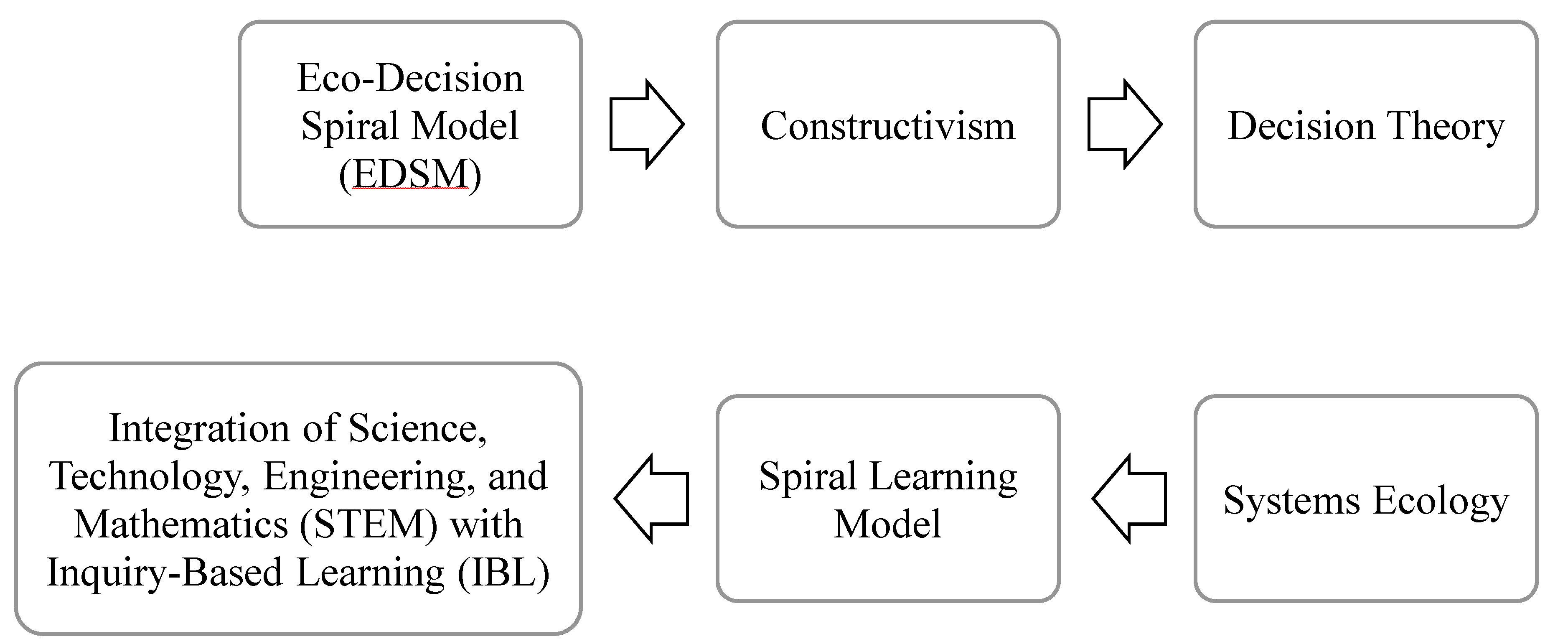
Figure 2.
Projected annual mean temperature trend in Kazakhstan and Uzbekistan by 2070.
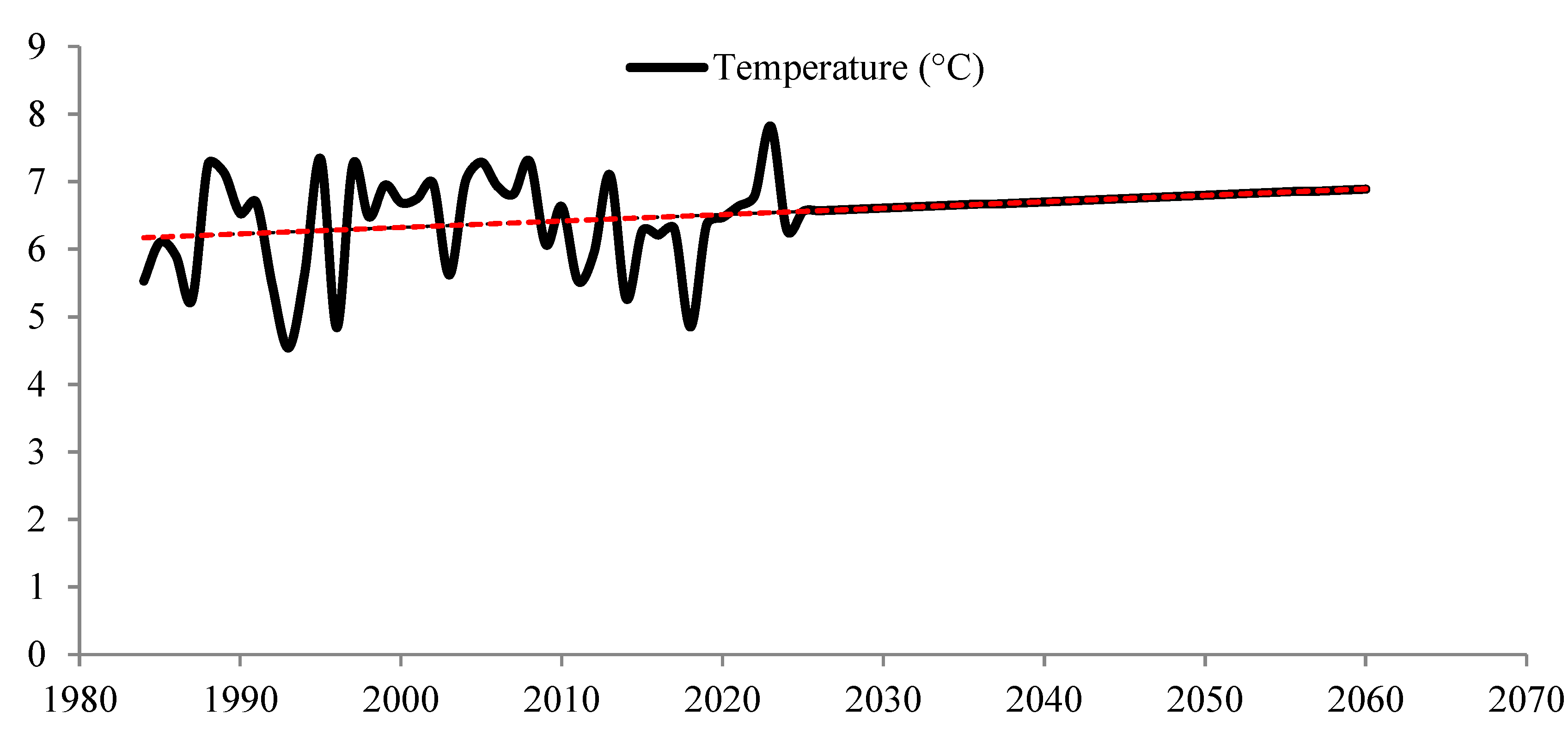
Table 1.
Average Annual Air Temperature in the Arid and Semi-Arid Zones of Northwestern Uzbekistan and Eastern Kazakhstan.
Table 1.
Average Annual Air Temperature in the Arid and Semi-Arid Zones of Northwestern Uzbekistan and Eastern Kazakhstan.
| Year | Winter Mean ± SD | Spring Mean ± SD | Summer Mean ± SD | Autumn Mean ± SD | Annual Mean ± SD | |||||
| Soil profile moisture (m³/m³) | Temperature (°C) |
Soil profile moisture (m³/m³) | Temperature (°C) |
Soil profile moisture (m³/m³) | Temperature (°C) |
Soil profile moisture (m³/m³) | Temperature (°C) |
Soil profile moisture (m³/m³) | Temperature (°C) |
|
| 1984 | 0.47 ± 0.015 | -15.02 ± 2.91 | 0.503 ± 0.021 | 6.57 ± 10.02 | 0.426 ± 0.011 | 25.46 ± 2.52 | 0.43 ± 0.010 | 6.13 ± 9.20 | 0.46 ± 0.020 | 5.53 ± 13.67 |
| 1985 | 0.463 ± 0.012 | -9.40 ± 2.50 | 0.470 ± 0.020 | 5.95 ± 8.83 | 0.43 ± 0.000 | 23.65 ± 2.55 | 0.437 ± 0.006 | 4.26 ± 8.77 | 0.45 ± 0.018 | 6.10 ± 10.97 |
| 1986 | 0.473 ± 0.015 | -12.27 ± 2.82 | 0.497 ± 0.021 | 6.70 ± 10.01 | 0.43 ± 0.000 | 22.83 ± 2.28 | 0.43 ± 0.006 | 5.60 ± 7.59 | 0.46 ± 0.020 | 5.90 ± 10.50 |
| 1987 | 0.483 ± 0.015 | -10.86 ± 2.71 | 0.540 ± 0.030 | 7.02 ± 6.04 | 0.443 ± 0.015 | 23.08 ± 1.21 | 0.44 ± 0.006 | 3.87 ± 6.03 | 0.47 ± 0.025 | 5.25 ± 9.21 |
| 1988 | 0.47 ± 0.012 | -10.54 ± 3.91 | 0.477 ± 0.021 | 9.37 ± 5.34 | 0.43 ± 0.000 | 25.84 ± 0.89 | 0.43 ± 0.006 | 7.67 ± 8.20 | 0.45 ± 0.020 | 7.26 ± 11.20 |
| 1989 | 0.453 ± 0.012 | -9.87 ± 3.38 | 0.510 ± 0.020 | 11.53 ± 9.00 | 0.437 ± 0.006 | 24.23 ± 2.17 | 0.437 ± 0.006 | 6.48 ± 8.17 | 0.46 ± 0.015 | 7.13 ± 10.37 |
| 1990 | 0.473 ± 0.015 | -11.93 ± 5.69 | 0.500 ± 0.020 | 11.37 ± 8.36 | 0.437 ± 0.006 | 23.87 ± 1.57 | 0.447 ± 0.017 | 8.34 ± 8.25 | 0.46 ± 0.020 | 6.53 ± 10.70 |
| 1991 | 0.483 ± 0.015 | -12.02 ± 5.88 | 0.513 ± 0.010 | 11.56 ± 8.18 | 0.43 ± 0.000 | 23.89 ± 1.26 | 0.443 ± 0.006 | 8.45 ± 8.64 | 0.46 ± 0.018 | 6.69 ± 10.70 |
| 1992 | 0.463 ± 0.015 | -9.56 ± 1.80 | 0.523 ± 0.035 | 7.63 ± 8.19 | 0.44 ± 0.012 | 21.74 ± 1.95 | 0.437 ± 0.006 | 4.58 ± 7.05 | 0.46 ± 0.020 | 5.46 ± 9.10 |
| 1993 | 0.453 ± 0.012 | -11.83 ± 1.71 | 0.500 ± 0.020 | 4.99 ± 3.53 | 0.44 ± 0.012 | 22.67 ± 1.67 | 0.43 ± 0.006 | 2.60 ± 10.36 | 0.45 ± 0.018 | 4.54 ± 9.56 |
| 1994 | 0.447 ± 0.012 | -13.19 ± 2.82 | 0.467 ± 0.020 | 5.77 ± 5.94 | 0.43 ± 0.000 | 23.88 ± 1.15 | 0.437 ± 0.006 | 6.21 ± 7.33 | 0.44 ± 0.018 | 5.63 ± 10.10 |
| 1995 | 0.483 ± 0.020 | -11.17 ± 5.92 | 0.500 ± 0.020 | 9.50 ± 6.24 | 0.43 ± 0.000 | 24.67 ± 1.54 | 0.443 ± 0.012 | 6.82 ± 5.55 | 0.46 ± 0.022 | 7.34 ± 9.75 |
| 1996 | 0.487 ± 0.012 | -12.52 ± 5.02 | 0.503 ± 0.015 | 8.83 ± 5.86 | 0.433 ± 0.006 | 22.23 ± 1.66 | 0.453 ± 0.012 | 7.08 ± 5.11 | 0.47 ± 0.018 | 4.84 ± 9.10 |
| 1997 | 0.483 ± 0.012 | -12.35 ± 6.14 | 0.533 ± 0.012 | 9.35 ± 7.34 | 0.433 ± 0.006 | 24.04 ± 1.25 | 0.43 ± 0.006 | 8.47 ± 8.25 | 0.46 ± 0.018 | 7.25 ± 9.90 |
| 1998 | 0.437 ± 0.012 | -11.44 ± 6.35 | 0.503 ± 0.015 | 9.29 ± 6.10 | 0.433 ± 0.006 | 26.41 ± 1.52 | 0.43 ± 0.006 | 5.23 ± 5.00 | 0.45 ± 0.018 | 6.48 ± 10.20 |
| 1999 | 0.443 ± 0.012 | -9.88 ± 2.18 | 0.473 ± 0.012 | 9.50 ± 6.01 | 0.43 ± 0.006 | 23.39 ± 2.59 | 0.423 ± 0.006 | 9.09 ± 7.02 | 0.45 ± 0.018 | 6.95 ± 9.90 |
| 2000 | 0.453 ± 0.012 | -9.67 ± 4.77 | 0.480 ± 0.012 | 10.90 ± 7.17 | 0.43 ± 0.000 | 24.25 ± 1.20 | 0.437 ± 0.006 | 7.53 ± 6.55 | 0.45 ± 0.018 | 6.69 ± 9.80 |
| 2001 | 0.453 ± 0.012 | -11.24 ± 6.16 | 0.470 ± 0.012 | 12.22 ± 6.01 | 0.43 ± 0.000 | 22.43 ± 0.88 | 0.443 ± 0.012 | 6.01 ± 7.25 | 0.45 ± 0.018 | 6.75 ± 10.10 |
| 2002 | 0.487 ± 0.018 | -8.00 ± 4.40 | 0.553 ± 0.015 | 6.78 ± 5.23 | 0.463 ± 0.012 | 22.35 ± 2.42 | 0.43 ± 0.006 | 7.53 ± 7.22 | 0.48 ± 0.022 | 6.97 ± 9.40 |
| 2003 | 0.453 ± 0.012 | -11.64 ± 4.11 | 0.523 ± 0.015 | 4.84 ± 6.33 | 0.473 ± 0.012 | 21.76 ± 3.32 | 0.437 ± 0.006 | 10.57 ± 4.29 | 0.46 ± 0.018 | 5.62 ± 8.87 |
| 2004 | 0.476 ± 0.015 | -10.80 ± 3.95 | 0.527 ± 0.015 | 7.81 ± 8.00 | 0.437 ± 0.006 | 22.77 ± 0.99 | 0.443 ± 0.006 | 13.02 ± 2.84 | 0.47 ± 0.018 | 7.00 ± 9.05 |
| 2005 | 0.457 ± 0.012 | -10.92 ± 5.91 | 0.513 ± 0.015 | 14.25 ± 9.05 | 0.43 ± 0.000 | 23.75 ± 1.38 | 0.43 ± 0.000 | 8.65 ± 3.80 | 0.46 ± 0.018 | 7.29 ± 9.60 |
| 2006 | 0.447 ± 0.012 | -13.79 ± 7.51 | 0.477 ± 0.015 | 10.54 ± 6.95 | 0.43 ± 0.000 | 23.52 ± 0.82 | 0.447 ± 0.012 | 7.36 ± 4.68 | 0.45 ± 0.018 | 6.93 ± 10.00 |
| 2007 | 0.463 ± 0.015 | -9.37 ± 4.34 | 0.527 ± 0.020 | 11.47 ± 6.95 | 0.433 ± 0.000 | 23.99 ± 1.38 | 0.437 ± 0.006 | 7.90 ± 4.61 | 0.47 ± 0.020 | 6.82 ± 9.10 |
| 2008 | 0.447 ± 0.012 | -12.82 ± 5.75 | 0.490 ± 0.012 | 10.92 ± 7.03 | 0.426 ± 0.006 | 24.47 ± 1.70 | 0.44 ± 0.012 | 8.31 ± 4.02 | 0.46 ± 0.018 | 7.30 ± 9.50 |
| 2009 | 0.493 ± 0.012 | -11.46 ± 3.63 | 0.533 ± 0.012 | 5.96 ± 7.92 | 0.44 ± 0.006 | 22.64 ± 0.64 | 0.453 ± 0.012 | 7.18 ± 4.26 | 0.48 ± 0.020 | 6.07 ± 8.95 |
| 2010 | 0.493 ± 0.012 | -11.46 ± 6.30 | 0.533 ± 0.012 | 10.97 ± 7.16 | 0.437 ± 0.006 | 24.51 ± 0.94 | 0.44 ± 0.012 | 9.53 ± 6.08 | 0.47 ± 0.020 | 6.63 ± 9.20 |
| 2011 | 0.443 ± 0.012 | -10.53 ± 5.32 | 0.47 ± 0.012 | 10.56 ± 3.74 | 0.433 ± 0.006 | 22.91 ± 1.32 | 0.437 ± 0.006 | 10.00 ± 4.00 | 0.45 ± 0.018 | 5.53 ± 8.90 |
| 2012 | 0.443 ± 0.012 | -16.72 ± 7.54 | 0.467 ± 0.012 | 11.21 ± 4.36 | 0.433 ± 0.006 | 25.53 ± 1.72 | 0.437 ± 0.006 | 6.81 ± 4.99 | 0.44 ± 0.018 | 5.95 ± 9.50 |
| 2013 | 0.447 ± 0.012 | -7.77 ± 5.05 | 0.493 ± 0.012 | 11.75 ± 7.04 | 0.433 ± 0.006 | 22.90 ± 0.69 | 0.437 ± 0.006 | 7.36 ± 4.49 | 0.45 ± 0.018 | 7.10 ± 9.20 |
| 2014 | 0.447 ± 0.012 | -14.70 ± 6.33 | 0.477 ± 0.012 | 7.57 ± 8.66 | 0.43 ± 0.000 | 24.36 ± 1.71 | 0.47 ± 0.012 | 6.97 ± 5.10 | 0.45 ± 0.018 | 5.27 ± 9.00 |
| 2015 | 0.493 ± 0.012 | -9.67 ± 5.56 | 0.543 ± 0.015 | 7.48 ± 4.40 | 0.453 ± 0.012 | 23.57 ± 1.65 | 0.443 ± 0.012 | 7.33 ± 5.32 | 0.48 ± 0.020 | 6.27 ± 8.90 |
| 2016 | 0.487 ± 0.012 | -6.71 ± 5.06 | 0.583 ± 0.015 | 8.58 ± 6.03 | 0.443 ± 0.006 | 22.84 ± 1.45 | 0.437 ± 0.006 | 7.69 ± 6.43 | 0.49 ± 0.022 | 6.21 ± 8.90 |
| 2017 | 0.457 ± 0.012 | -11.26 ± 5.12 | 0.503 ± 0.012 | 9.49 ± 4.84 | 0.433 ± 0.006 | 23.91 ± 1.16 | 0.437 ± 0.006 | 6.48 ± 5.48 | 0.46 ± 0.018 | 6.30 ± 9.00 |
| 2018 | 0.457 ± 0.012 | -13.90 ± 5.57 | 0.533 ± 0.012 | 4.63 ± 3.16 | 0.433 ± 0.006 | 23.48 ± 3.29 | 0.437 ± 0.006 | 5.46 ± 5.27 | 0.47 ± 0.020 | 4.85 ± 8.50 |
| 2019 | 0.453 ± 0.012 | -10.91 ± 5.96 | 0.517 ± 0.012 | 7.10 ± 8.13 | 0.433 ± 0.006 | 23.64 ± 2.53 | 0.44 ± 0.006 | 8.33 ± 6.56 | 0.46 ± 0.018 | 6.36 ± 9.10 |
| 2020 | 0.447 ± 0.012 | -10.01 ± 4.65 | 0.520 ± 0.012 | 8.87 ± 9.09 | 0.433 ± 0.006 | 23.76 ± 1.68 | 0.437 ± 0.006 | 4.62 ± 7.42 | 0.46 ± 0.018 | 6.47 ± 8.90 |
| 2021 | 0.453 ± 0.012 | -9.88 ± 5.36 | 0.500 ± 0.012 | 12.36 ± 6.79 | 0.433 ± 0.006 | 24.98 ± 1.61 | 0.437 ± 0.006 | 4.78 ± 9.07 | 0.45 ± 0.018 | 6.64 ± 9.00 |
| 2022 | 0.447 ± 0.012 | -11.72 ± 5.08 | 0.543 ± 0.015 | 11.35 ± 3.73 | 0.433 ± 0.006 | 23.49 ± 0.88 | 0.443 ± 0.012 | 6.67 ± 7.34 | 0.47 ± 0.020 | 6.80 ± 8.90 |
| 2023 | 0.457 ± 0.012 | -10.13 ± 5.62 | 0.533 ± 0.015 | 14.23 ± 7.78 | 0.433 ± 0.006 | 24.49 ± 2.36 | 0.46 ± 0.012 | 7.53 ± 6.55 | 0.47 ± 0.020 | 7.82 ± 9.50 |
| 2024 | 0.493 ± 0.012 | -11.19 ± 5.23 | 0.547 ± 0.015 | 7.31 ± 7.16 | 0.437 ± 0.006 | 23.44 ± 0.94 | 0.44 ± 0.012 | 7.80 ± 5.00 | 0.49 ± 0.020 | 6.28 ± 9.10 |
| 1 | POWERing the Future of Energy, Infrastructure, and Agroclimatology: https://power.larc.nasa.gov/
|
Disclaimer/Publisher’s Note: The statements, opinions and data contained in all publications are solely those of the individual author(s) and contributor(s) and not of MDPI and/or the editor(s). MDPI and/or the editor(s) disclaim responsibility for any injury to people or property resulting from any ideas, methods, instructions or products referred to in the content. |
© 2025 by the authors. Licensee MDPI, Basel, Switzerland. This article is an open access article distributed under the terms and conditions of the Creative Commons Attribution (CC BY) license (http://creativecommons.org/licenses/by/4.0/).
Copyright: This open access article is published under a Creative Commons CC BY 4.0 license, which permit the free download, distribution, and reuse, provided that the author and preprint are cited in any reuse.


