

Submitted:
08 December 2025
Posted:
09 December 2025
You are already at the latest version
Abstract
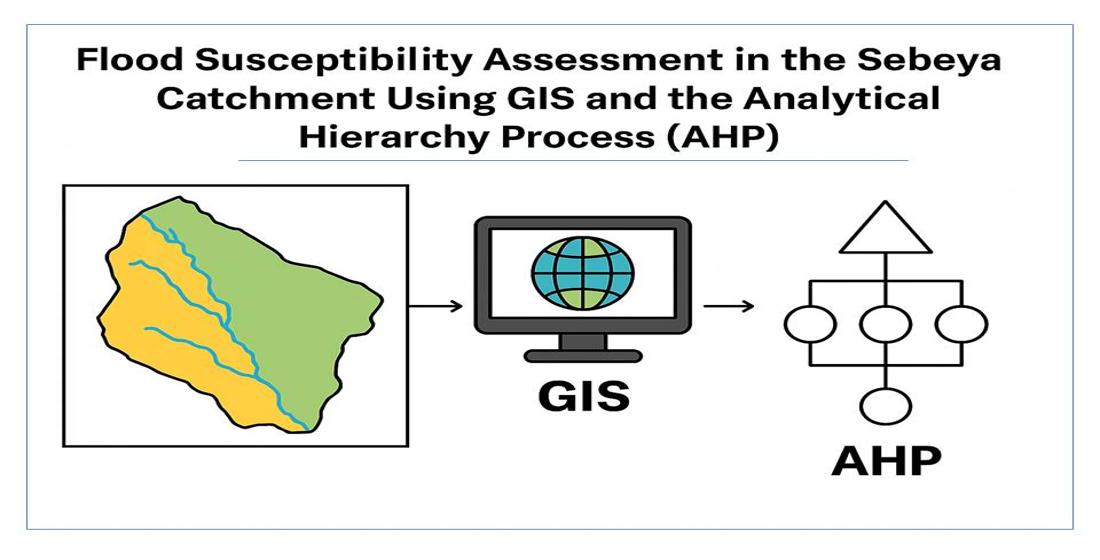
Flood susceptibility mapping is crucial for understanding flood-prone areas and mitigating the associated risks, particularly in vulnerable regions like the Sebeya Catchment. This study has adopted a GIS-AHP approach integrated with local community knowledge over flood susceptibility factors such as Topographic Wetness Index (WTI), Digital Elevation Model (DEM), Precipitation, Slope, Land Use/ Land Cover (LULC), Normalized Vegetative Index (NDVI), Distance to Roads, Distance to River, and Drainage Density. The pairwise comparison matrix was used to determine each factor's weight according to its influence in inducing flood. The findings revealed that 33.1% of the total area has a very and high susceptibility to floods, whereas the rest part of the catchment is moderately susceptible to floods. Most social economic activities in this study are located in high-risk zones, which significantly to appearance of flooding impacts. Current study indicates that, damage to infrastructure, loss of livelihoods, displacement of communities, and increased costs of disaster response are key consequences observed in affected regions. A confusion matrix approach was employed to validate the flood susceptibility map, and the results indicate an overall accuracy of 0.92, confirming strong model performance and reliability. The study further proposes adaptive strategies and provides recommendations for enhancing flood resilience, including improvement in land-use planning, use of early warning systems, and sustainable catchment management. Further studies should develop an economic-loss prediction model based on flood-susceptibility mapping.
Keywords:
Sebeya catchment
; GIS
; AHP
; flood susceptibility
Copyright: This open access article is published under a Creative Commons CC BY 4.0 license, which permit the free download, distribution, and reuse, provided that the author and preprint are cited in any reuse.


