

Submitted:
05 December 2025
Posted:
09 December 2025
You are already at the latest version
Abstract
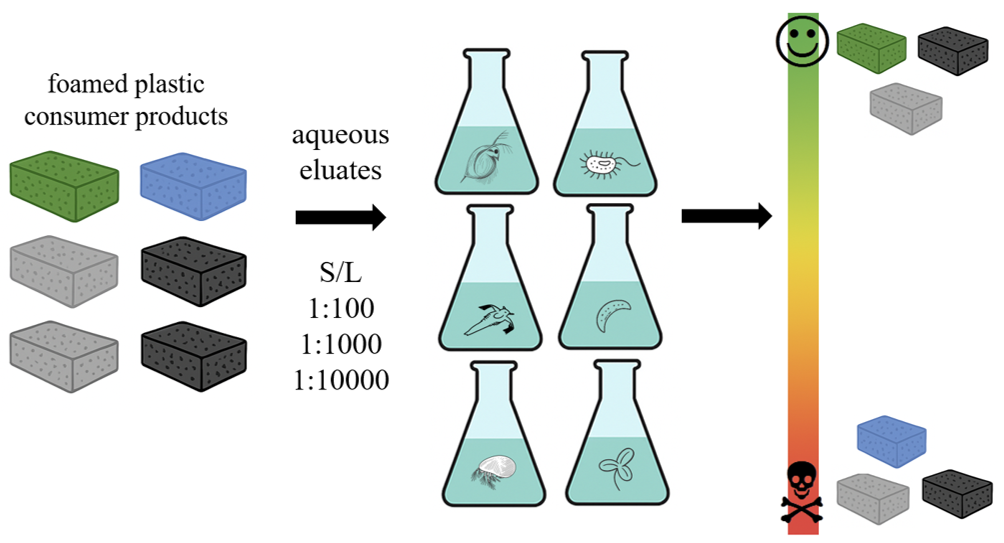
Plastic pollution is a global challenge. Despite plastics being complex chemical mixtures, hazard research has focused on particulate forms and the risks of plastics additives, especially for environmental organisms, remain poorly understood. This is a significant knowledge gap considering ubiquitous organismal exposure to plastics and the associated 16 000+ additives. The aim of this study was to provide ecotoxicological characterization of aqueous eluates of foamed plastic consumer products and propose a test battery for toxicity screening. For that, hazard of eluates of six randomly selected foamed plastic products was evaluated using aquatic decomposers, autotrophs and heterotrophs (Vibrio fischeri, Raphidocelis subcapitata, Lemna minor, Thamnocephalus platyurus, Heterocypris incongruens, Daphnia magna). Alarmingly, all plastic eluates affected the organisms, though toxicity varied among materials and species. Results showed that short-term contact may underestimate plastic eluate toxicity. To increase environmental relevance of hazard assessment of foamed plastic eluates, harmonizing leachate preparation, using natural water and avoiding (excessive) filtration of eluates should be considered. OECD/ISO assays with R. subcapitata, H. incongruens and D. magna (96 h) can be recommended as a minimal sensitive battery for effective screening of plastic eluate toxicity.
Keywords:
additives
; leachate
; polyethylene
; polyurethane
; ethylene vinyl acetate
; Raphidocelis subcapitata
; Heterocypris incongruens
; Daphnia magna
Copyright: This open access article is published under a Creative Commons CC BY 4.0 license, which permit the free download, distribution, and reuse, provided that the author and preprint are cited in any reuse.


