

Submitted:
14 September 2025
Posted:
16 September 2025
You are already at the latest version
Abstract
The IceCube discovery of a diffuse astrophysical neutrino flux up to the PeV scale and the LHAASO detection of ultrahigh-energy (UHE) γ-rays up to ∼PeV pose tight constraints on Galactic accelerators. In standard microphysics, diffusive shock acceleration (DSA) in finite-age sources is typically time- or loss-limited. We show that the Future–Mass Projection (FMP) framework—a causal, future-conditioned gravitational response calibrated on the Milky Way (MW)—provides a disciplined multiplicative boost (× √ D to ×D) to the classical budget, sufficient to lift ordinary environments over the thresholds required by PeV ν and PeV γ. With MW-validated values D(R0)≈1.46 and D(20–25 kpc)≈2.5–2.9, a representative Solar-circle SNR reaches Eν,max≃0.9–1.1 PeV (vs. 0.75 PeV classical), and outer-disk sites reach Eν,max ≃ 1.2–2.0 PeV. For a conservative molecular-cloud shock (J2108+5157–like), Eγ,max rises from ∼0.27 PeV (classical) to ∼0.45–0.73 PeV with FMP; for a moderate setup, from 1.26 PeV to ∼2.1–3.4 PeV. The program yields falsifiable predictions (radial trends, MC/CGM correlations, and a gentle R(z) drift).
Keywords:
dark matter
1. Context and Aim
IceCube established a diffuse astrophysical neutrino flux with deposited energies from TeV to PeV and an approximately isotropic distribution.1 UHE -rays up to PeV have been reported by LHAASO from multiple Galactic sources, including enigmatic cases like J2108+5157 with no obvious accelerator counterpart.2 Our aim is to quantify how much “headroom” is missing in classical Hillas/DSA estimates and whether FMP can supply just enough to reach the observed PeV scales without invoking new particle species.
2. Classical Budget in Brief
Confinement and timescale limits give
with hadronic yields and for interactions (spectrum-dependent).3
3. FMP in One Page
FMP augments the gravitational source with a causal, future-conditioned contribution . In the Newtonian limit:
On galaxy scales the effect is captured by
with a three-scale representation and a scaled outer component (“Plan B”) tied to the disk length . Milky Way fits (disk+bulge+gas+explicit CGM) yield and –. Thus free-fall/escape/shock speeds scale as , implying
4. Case 1: PeV Neutrinos from Solar-Circle and Outer-Disk Accelerators
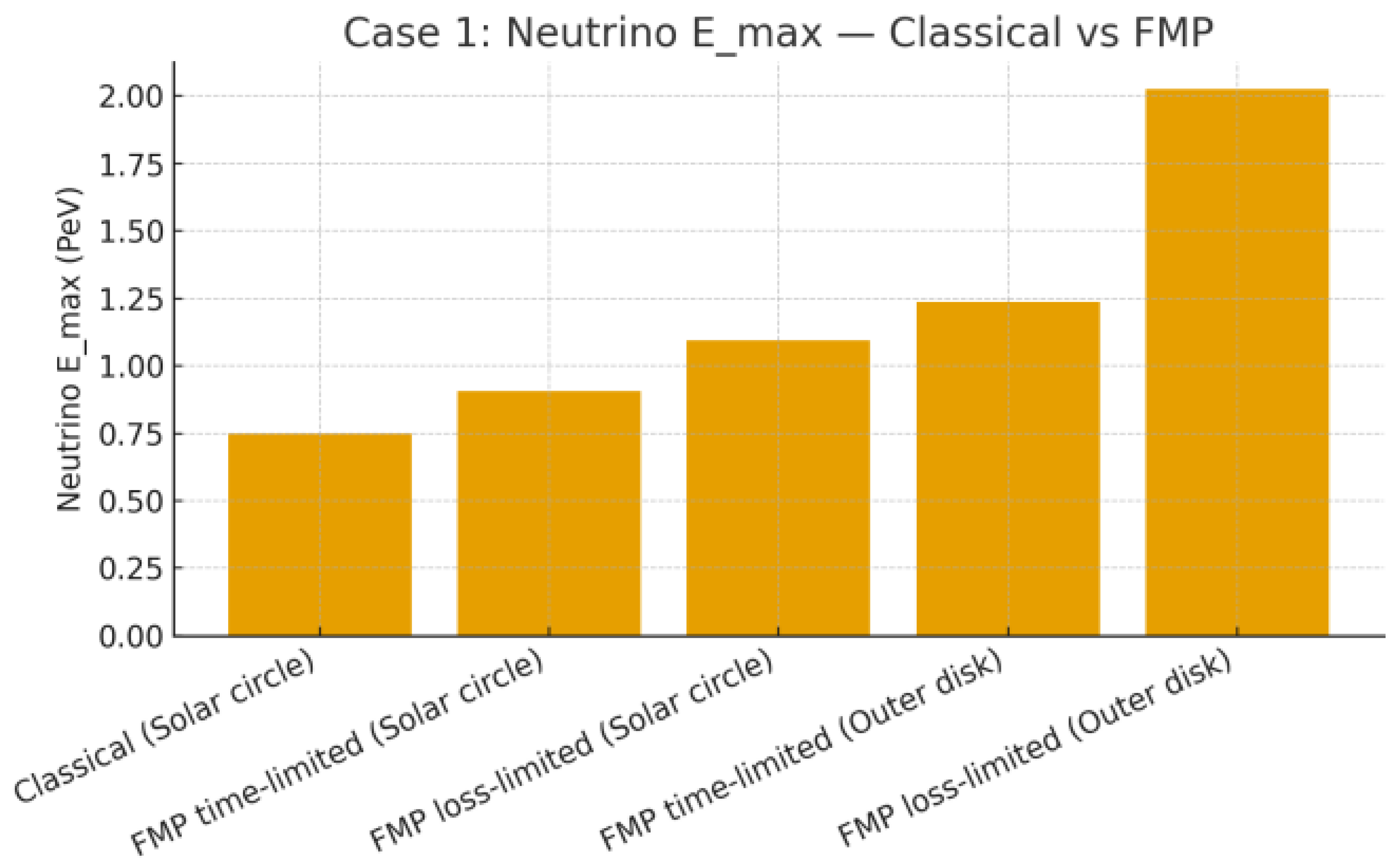
We adopt a representative SNR/superbubble near the Solar circle (classical): , , (). Then PeV and PeV. With FMP at : , giving –1.10 PeV. In the outer disk (, ): –2.03 PeV.
Figure 1.
Neutrino maximum energy (PeV) for a representative Galactic accelerator: classical vs. FMP at the Solar circle and in the outer disk. Bars show time-limited and loss-limited scalings.
Figure 1.
Neutrino maximum energy (PeV) for a representative Galactic accelerator: classical vs. FMP at the Solar circle and in the outer disk. Bars show time-limited and loss-limited scalings.
5. Case 2: PeV from Molecular-Cloud Shocks (J2108+5157-like)
For a conservative cloud-shock setup (C1): PeV PeV (insufficient for PeV). FMP (outer-like) lifts this to PeV (time-limited) or PeV (loss-limited). For a moderate setup (C2): PeV (classical) becomes –3.40 PeV with FMP.
Figure 2.
Gamma-ray maximum energy (PeV) for two molecular-cloud shock setups (C1 conservative, C2 moderate): classical vs. FMP.
Figure 2.
Gamma-ray maximum energy (PeV) for two molecular-cloud shock setups (C1 conservative, C2 moderate): classical vs. FMP.
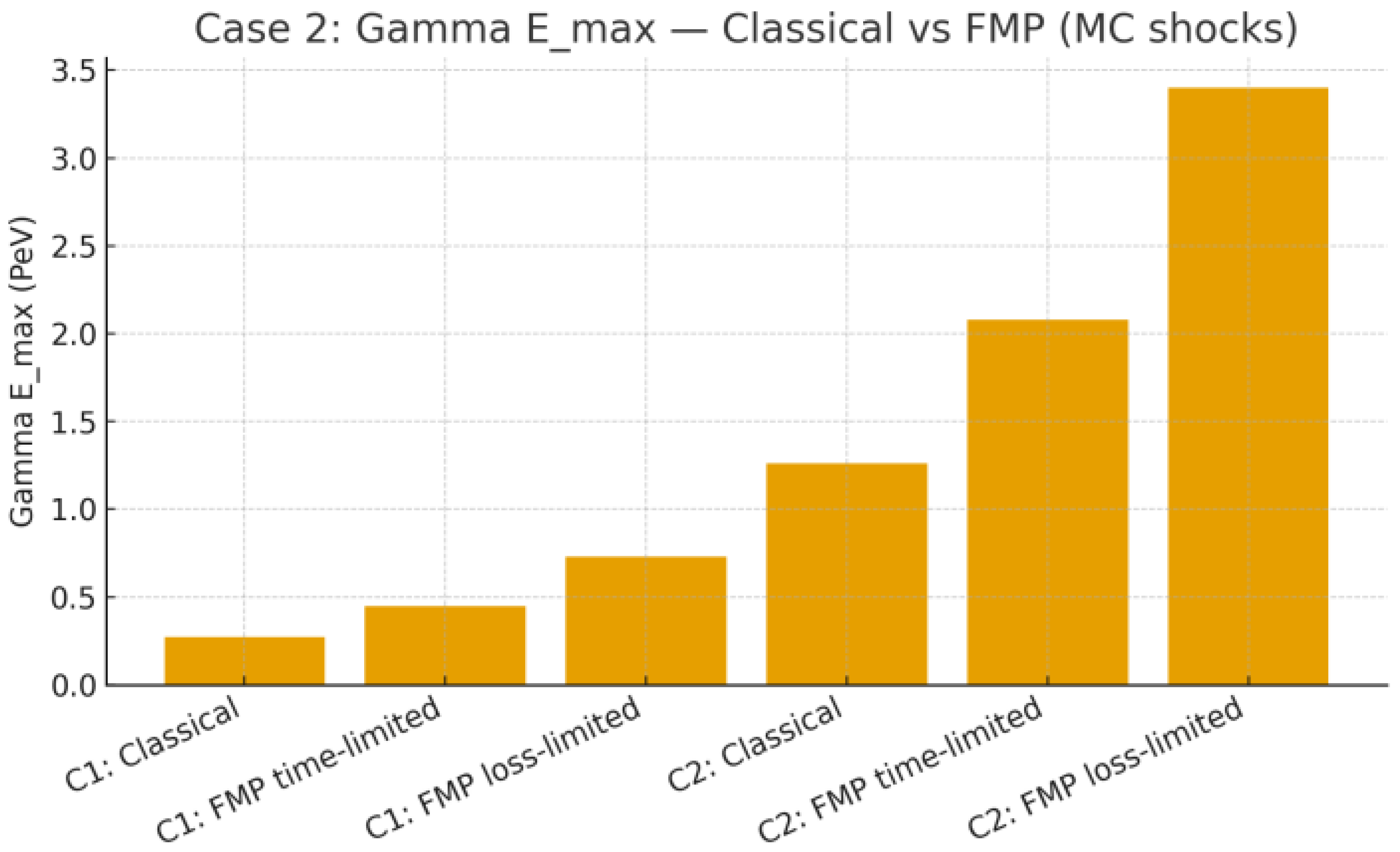
Figure 3.
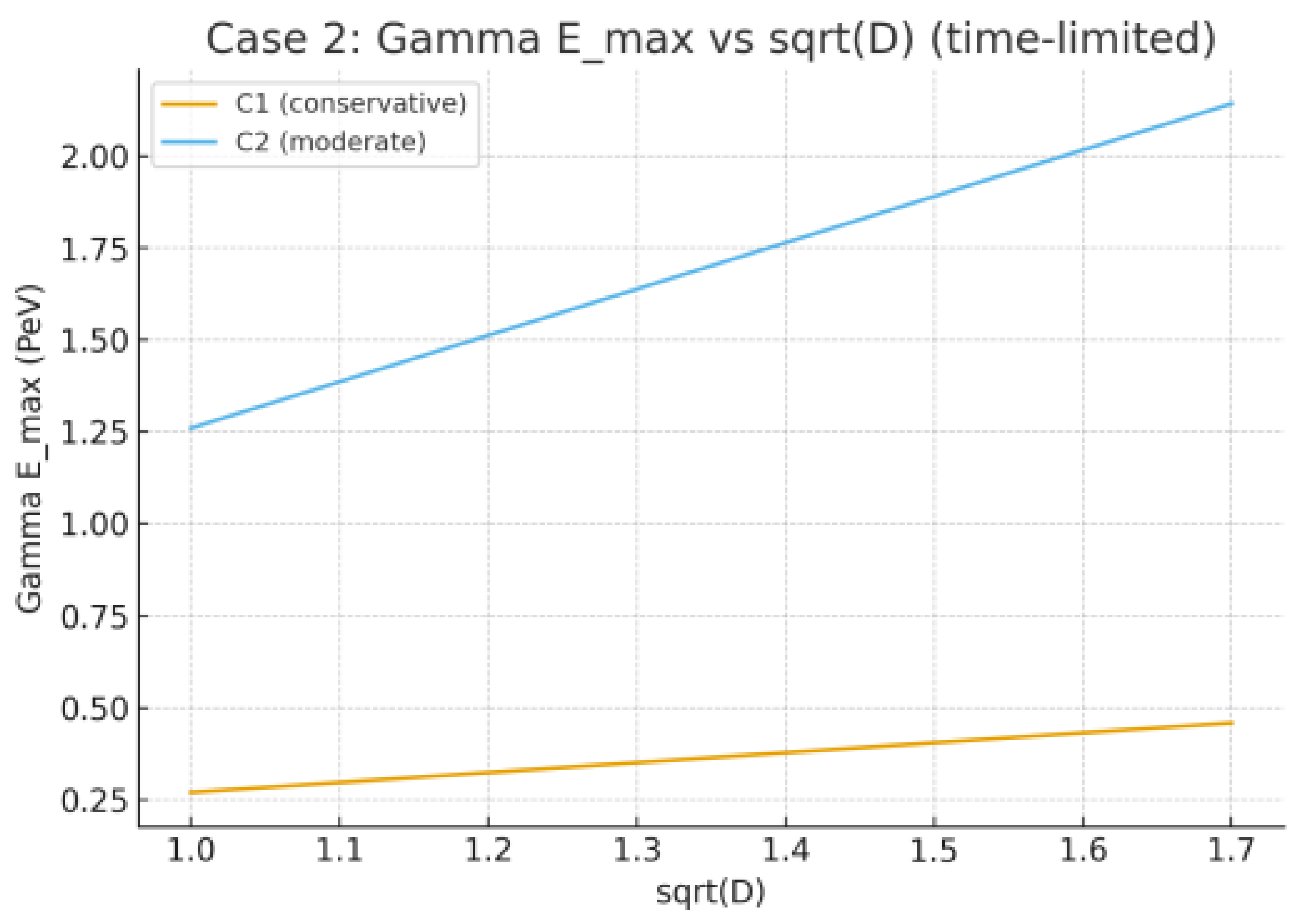
Trend of with in the time-limited regime for C1 and C2. A modest –1.7 already bridges the LHAASO threshold in conservative cases.
Figure 3.
Trend of with in the time-limited regime for C1 and C2. A modest –1.7 already bridges the LHAASO threshold in conservative cases.
6. Numerical Summary
| Case 1: Neutrinos | Scenario | (PeV) |
| Classical (Solar circle) | 0.75 | |
| FMP time-limited (Solar circle) | 0.91 | |
| FMP loss-limited (Solar circle) | 1.10 | |
| FMP time-limited (Outer disk) | 1.24 | |
| FMP loss-limited (Outer disk) | 2.03 | |
| Case 2: Gamma rays | Scenario | (PeV) |
| C1: Classical | 0.27 | |
| C1: FMP time-limited | 0.45 | |
| C1: FMP loss-limited | 0.73 | |
| C2: Classical | 1.26 | |
| C2: FMP time-limited | 2.08 | |
| C2: FMP loss-limited | 3.40 |
7. Discussion and Falsifiability
Key point. FMP does not alter microphysics; it gently deepens the effective potential where the baryon field is predictably convergent (disks/MCs/CGM), boosting by and—indirectly—compression and B. This supplies just enough headroom for PeV and sub-PeV/PeV without exotic particles. Predictions: (i) Radial trend—outer-disk environments should more readily achieve PeVatron conditions than inner-disk sites of otherwise similar microphysics. (ii) Environment—correlations with CGM/molecular-cloud density and pre-merger/streaming flows (higher Mach numbers). (iii) Cosmic drift—a mild evolution implies weak epoch-dependence of the most extreme attainable energies.
References
- IceCube Collaboration, Science 342, 1242856 (2013), doi: 10.1126/science.1242856; PRL 113, 101101 (2014). [CrossRef]
- LHAASO Collaboration, Nature 594, 33–36 (2021), doi: 10.1038/s41586-021-03498-z; see also A&A 673, A75 (2023) and subsequent J2108+5157 studies.
- S. R. Kelner, F. A. Aharonian, V. V. Bugayov, Phys. Rev. D 74, 034018 (2006). [CrossRef]
- FMP framework: covariant & Newtonian formulation; galaxy-scale D(R) with scaled outer response; MW calibrations; R(z) drift (project preprints).
| 1 | Science 342, 1242856 (2013), doi: 10.1126/science.1242856; PRL 113, 101101 (2014), doi: 10.1103/PhysRevLett.113.101101. |
| 2 | Nature 594, 33–36 (2021), doi: 10.1038/s41586-021-03498-z; see also A&A 673, A75 (2023) and later work on J2108+5157. |
| 3 | Kelner, Aharonian, Bugayov, PRD 74, 034018 (2006), doi: 10.1103/PhysRevD.74.034018. |
Disclaimer/Publisher’s Note: The statements, opinions and data contained in all publications are solely those of the individual author(s) and contributor(s) and not of MDPI and/or the editor(s). MDPI and/or the editor(s) disclaim responsibility for any injury to people or property resulting from any ideas, methods, instructions or products referred to in the content. |
© 2025 by the authors. Licensee MDPI, Basel, Switzerland. This article is an open access article distributed under the terms and conditions of the Creative Commons Attribution (CC BY) license (http://creativecommons.org/licenses/by/4.0/).
Copyright: This open access article is published under a Creative Commons CC BY 4.0 license, which permit the free download, distribution, and reuse, provided that the author and preprint are cited in any reuse.


