

Submitted:
25 August 2025
Posted:
26 August 2025
You are already at the latest version
Abstract
Demand for air connectivity coupled with the increasing forecasted passenger growth by 2040, implies an exigency in the aviation sector to adopt sustainable approaches for net zero emission by 2050. SAF is currently the immediate answer, however, ensuring further sustainability lies in the prospect of lowering carbon footprints in the entire life cycle of SAF. Despite the continuing technological advancements, the production of hydrogen used as a reagent to produce SAF cannot be omitted as a major source of fossil greenhouse gas emissions. The processing, conversion and refinement of feed entailing hydrodeoxygenation, decarboxylation, hydrogenation, isomerisation, and hydrocracking, requires substantial amounts of hydrogen for the approved ASTM routes of SAF. These processes saturate the unsaturated components in the bio-based feedstock, remove oxygen and adjust the hydrocarbon chain structure to comply with jet fuel standards. The utilised hydrogen comes from in-situ or ex-situ production processes, and the sources can range from renewables to non-renewables. A call to action has emerged to recognise the emission implications related to hydrogen usage and to overcome the environmental carbon footprint associated with the utilisation of conventional sources of hydrogen. Aside to the predictable proposal for the adoption of water electrolysis to generate hydrogen, other recommendations for environmental performance enhancement from the previous research encompass hydrothermal gasification, biomass gasification (with or without carbon capture) and biomethane with steam methane reforming (with or without carbon capture) owing to the lower greenhouse emissions compared to the fossil-based alternatives, the convincing status of the technology readiness level and the lower acidification potential. Usage of less hydrogen, identifying appropriate catalyst and increasing catalyst life in the deoxygenation process, low-cost iso-propanol as a hydrogen donor (oil-based feedstock), aerobic fermentation of sugar to 1,4 dimethyl cyclooctane with the intermediate formation of isoprene, aqueous phase reforming, single stage hydroprocessing, catalytic and co-pyrolysis of waste oil with solid feedstocks, selection of feedstock with high degree of saturation and use of monometallic and bimetallic sulphide catalyst could contribute to lowering the specific consumption of hydrogen in SAF pathways. Furthermore, endeavours relating to research and development are essential to bolster and enhance the field conducive to the seamless integration of the proposed hydrogen production processes with the existing and future SAF infrastructure. Techno-economic and life cycle assessments will provide evidence for feasibility of any chosen incorporation. Optimising the catalyst system, process conditions and automating process controls are the added benefits for the implementation of the systems. Also, breakthroughs in the material and metabolic science of the photoelectrochemical processes for producing hydrogen will have the potential to upgrade their technology readiness level. Creating a research database of the saturation level and content of sugar, lipid and oil in a range of biomass types will be an added advantage to select the appropriate feedstock for bio-based hydrogen pathways.
Keywords:
hydrogen
; SAF
; hydrogenation
; isomerisation
; hydrodeoxygenation
; hydrocracking
; gasification
1. Introduction
Amidst efforts to foster economic growth through global connectedness, the aviation industry currently faces an absolute necessity for decarbonisation endeavours, with a specified aim of attaining net-zero emissions by 2050. The anticipated growth in air travel to over 8 billion passengers by 2040 emphasises this urgency. The primary challenge is the ascending climate change caused by constant greenhouse gas emissions (with around 2.5% of global emissions originating from aviation), impacting the growing economy and the airline sector. To tackle this, the shift to renewable energy (targeting a 35-65% share by 2050) demands a substantial annual supply boost in Sustainable Aviation Fuels (SAF) to surpass production capacity of over 400 billion litres. Currently SAF is representing only 0.1% of the total jet fuel supply [1]. However, attaining sustainability should involve identifying major contributor to final fuel carbon footprint throughout the complete life cycle assessment of the SAF. Are sustainability criteria genuinely considered in relation to raw material, utility consumption, production, transportation, utilisation, and disposal of SAF? Each drop of SAF should be complaint with the ambition of achieving the net zero goals and the broader sustainability objectives. Continuing technological advancements and concerted efforts are deployed to produce environmentally responsible SAF, with the prevailing challenges being related to feedstock sourcing, utility consumption, and the strict fuel production and refining process. One such essential prospect lies in confronting the challenges associated with hydrogen used as a reagent in obtaining SAF as shown in the Figure 1.
2. Usage of Hydrogen
The American Society for Testing and Materials (ASTM, under references D7566 and D1655) has chronologically certified nine distinct SAF production routes between 2009 and 2020 as revealed in the review study by Shahriyar and Khanal (2022) [2]. It is found that biomass and other carbon-based feedstock contain substantial degree of unsaturation [2,3,4,5]. Hence, hydrogen is notably used as a fundamental component in producing a suitable biofuel with high volumetric density as pointed out in the various studies (Table 1). Considering the approved SAF pathways, various processes are conducted within a hydrogen rich environment such as the liquid fuel derived from Fischer-Tropsch (FT) process, hydrodeoxygenation (HDO), decarboxylation, hydrogenation, isomerisation, and hydrocracking. For Hydroprocessed Easters and Fatty Acids (HEFA) [5], subsequent to the cleaning and upgrading of the feedstock is a hydrogenation process that marks the initial conversion to saturated fatty acids using hydrogen. Additionally, hydrogen also serves to remove oxygen from the feedstock (HDO) yielding a blend of linear hydrocarbon chains along with the co-products water, carbon monoxide and carbon dioxide through decarboxylation and decarbonylation (DCOX). The resulting hydrocarbons are further adjusted to the SAF specification via hydrogen rich isomersation and severe cracking (HDC) methods. The problems associated with oxygen (acidity, corrosiveness, viscosity, high diffusivity and heating value) is detailed in the review [6]. All the major chemical reactions are illustrated in [2,7] including HDO, DCOX and HDC that convert the fatty acids to hydrocarbons in catalytic reactions. For the hydrogenation step in HEFA, 3, 6, and 9 mol of hydrogen are required for each mole of triolein, trilinolein, and trilinolenin as referred to in the techno-economic study by Tao et al. (2017) [8]. Previous techno-economic study [7] of producing bio-jet fuel from vegetable oil concluded that, hydrogen is the second highest contributor to the annual cost of the plant. However, the availability of affordable sources of hydrogen is crucial for large scale production of SAF [4]. Unlike in the other SAF approved routes, in the refining of FT synthesised output, the addition of hydrogen is aimed at the achievement of sufficiently high H2/CO ratios in upstream syngas production, as per the stoichiometric requirements of downstream catalytic syngas conversion [4,5]. Similarly, hydrogen use in the hydrogenation of olefins for Alcohol to Jet (ATJ) incurs additional cost [2]. For example, a hydrogen flowrate of 41.58 kg/h was used as indicated in the techno-economic evaluation study [9] of ATJ of the assessed plant capacity processing feed rate 6993 kg/h ethanol and 5557 kg/h isobutanol. Also, hydrogen contributed 7.5% (from ethanol) and 10.71% (from isobutanol)of the total yearly operating cost, thereby the reactant represented a major expense item in the cost inventory of the operation. Similarly, hydrogen production is the second major contributor to the total capital expenditure in case of HEFA and ATJ [10]. The post refining steps in Catalytic Hydrothermolysis Jet (CHJ) such as hydrogenation, hydrotreatment and decarboxylation also consume hydrogen [5]. In CHJ, further anaerobic fermentation process produces hydrogen to be of use in the hydrogenation process [3]. Hydrogen is also fed to the hydrotreating of farnesene in SIP [2]. The unsaturated farnesene undergoes hydrogenation for the eligible use as a jet fuel. Moreover, hydrodeoxygenation process is absent in Synthetic Isoparaffins from Hydroprocessed Fermented Sugars (SIP) but the hydrocracking and hydro isomerisation steps are similar to the ones adopted in the conventional refining of oil [3,11]. The consumption of hydrogen also increases to eliminate oxygen in the catalytic hydro processing step for the Fats, Oils and Grease (FOG) Coprocessing, which depends on the level of saturation of the renewable feedstock as explained by Bezergianni et al. (2018) in the review study of co-processing refinery with biomass based feedstocks [12]. Likewise, in an experimental study of co-hydroprocessing of the canola oil, the reaction stoichiometry of hydrogen requirement are 15 hydrogen moles (HDO step) and 6 hydrogen molecules(hydrodecarboxylation step) for each mole of triglyceride [13]. Hydrogen consumption for HDO lies between 26 and 30 kg per tonne of input oil seed [14]. Overall, hydrogen is a therefore crucial reactant for various stages involved in producing SAF and cannot not be overlooked.
3. Source of Hydrogen
Addressing the production of hydrogen is a noteworthy aspect for consideration in the perspective of reducing environmental impacts in SAF synthesis. In the HEFA or Hydroprocessed renewable jet fuel (HRJ) process, steam reforming of propane produced via isomerisation or cracking is the main source of hydrogen [11]. Researchers [15] mentioned that the existing production methodology involves obtaining hydrogen from natural gas through steam methane reforming (SMR). Hydrogen supply within SAF pathways can be delivered through either in-situ or ex-situ approaches. Hydrogen has contributed significantly in the overall well-to-wake release of harmful emissions as confirmed in the comparative life cycle study [15] analysis of HEFA, HTL, pyrolysis, DSHC and ATJ. The scenarios were evaluated using hydrogen produced via electrolysis from renewable electricity and the gasification of switchgrass technology, which have specifically proven reduction in the well to wake greenhouse emissions by 34% (HEFA) and between 20 and 30% (DSHC). Additionally, the sensitive study mentioned that the in-situ hydrogen production can generate low emissions compared to ex-situ hydrogen process (for example: hydrogen is produced from process off gases in pyrolysis method for jet fuel instead of directly using natural gas). The output ranges of emissions were mainly dependent on either the variation in consumption or the production route of hydrogen. The alternative source of feedstock and the method used for hydrogen production substantially impacts the fuel’s Global Warming Potential (GWP), which ranges from 60-66 g CO2 equivalent/MJ for natural gas and 32 to 73 g CO2 equivalent/MJ for gasification of lignin. This was evidenced in a life cycle assessment undertaken by Budsberg et al. (2016) [20], which investigated a novel fermentation technology utilising an acetogen pathway instead of ethanologen pathway to produce jet fuel from poplar. Additionally, the study concluded that gasification of hog fuel dictates lower emission output compared to using natural gas for hydrogen production.
Overall, it is observed that the production pathways for hydrogen used as a reactant in SAF synthesis plays a crucial role in life cycle greenhouse gas performance of SAF and thus to its ability to contribute towards net zero goals.
4. Strategy for Alleviating the Issues of Source of Hydrogen and Usage of Hydrogen
There is no denying of the fact that lifecycle greenhouse gas emissions related to aviation can be minimised through SAF. Hence, it is imperative to identify alternative hydrogen production methods and assess the possible variability in hydrogen consumption that directly or indirectly impact greenhouse emission throughout the entire life cycle of SAF [15] (Table 2).
4.1. Conventional Approach Impacting Greenhouse Gas Emission
Life cycle assessment studies carried out by de Jong et al. (2017) [15] and Seber et al. (2022) [21] specifically implied that the emission intensity of jet fuel can be alleviated via electrolysis using renewable electricity. The sensitivity study [15] on various biomass sources for hydrogen production has shown that electrolysis method using renewable electricity, followed by gasification of biomass, offers considerable advantage in lowering cradle to grave greenhouse emissions for six different SAF pathways. Water electrolysis method to produce hydrogen could reduce emissions by 9% in the sensitivity study of HEFA [21]. Hydrogen produced via water electrolysis represents an environmentally friendly alternative for ATJ and HEFA. This was confirmed in a techno-economic and environmental study focused on sugarcane bio-refineries in Brazil. The study found that the maximum value [10] of climate change impacts were: 25g CO2 equivalent/MJ jet fuel (ATJ) and 22.3g CO2 equivalent/MJ jet fuel (HEFA).

Table 2.
Summary of stances appropriate for hydrogen as a reactant to produce SAF.
| Study description | Research Problem | Research Output Emission benefit Cost |
Opportunity | |
|---|---|---|---|---|
| Feasibility of in-situ Catalytic Transfer Hydrogenation (CTH) to generate jet fuel from waste cooking oil in comparison to commercial Hydroprocessed Renewable Jet (HRJ) [22] | - High cost associated with the use of high-pressure hydrogen (25 to 100 bar) in HRJ or HEFA for proper mixing with oil - Storage and transportation issue of hydrogen - Relies on fossil source of hydrogen that emits harmful gases |
- 100 year GWP is 8% low in CTH without sequestering carbon | - Energy use for cooling in CTH is 59% low - 95% reduction in CAPEX of CTH compared to HRJ - CTH performs well in term of revenues except - Isopropanol contributes 68% of the total operation and maintenance cost |
- CTH profitable despite large input cost of isopropanol - Gas compression is costly compared to pumping isopropanol - CTH operates with cheaper catalyst (Activated carbon) unlike nickel-molybdenum based catalyst in hydrotreating HRJ - Performed nearly at atmospheric condition |
| Environmental assessment of first grade biorefinery based on conversion of sugar based feedstock (corn) to (DMCO) [23] | - How to produce SAF with the existing commercial first grade biorefineries? - To evaluate the environmental performance |
- Obtained average life cycle emission with and without carbon capture are: 36 g CO2 equivalent /MJ and 5 g CO2 equivalent /MJ | __ | - Corn to DMCO can bridge the SAF targets - Use of renewable source of hydrogen could further reduces emission during hydrogenation of DMCO - Effectual crop management practices could reduce the land use change - Prospect for economic viability study |
| Study of modified Nickel supported hexagonal mesoporous silica (HMS) in absence of hydrogen to produce renewable fuel [24] | - To identify the connection between the tested catalyst and the performance of deoxygenation (DO) in absence of hydrogen | - Improved the DO at 380ºC and free of hydrogen - 10 wt.% Nickel led to 92.5% conversion and 95.2% selectivity - Pore size and surface area of HMS played a critical part |
__ | - Ni/HMS is a promising catalyst to produce sustainable oil from non-edible oil feed with high conversion and performance in absence of hydrogen |
| Study of the enviro-economic effects for producing SAF from TOFA via catalytic deoxygenation under two scenarios of source of hydrogen – grey hydrogen (Case 1) and using hydrothermal gasification (Case 2) [26] | - Evaluate the integration of hydrothermal gasification to produce SAF | - Greenhouse reductions: 94% (Case 2) and 76% (Case 1) | - Minimum fuel selling price (MSP): USD $ 0.39/L (Case 2) against USD $ 0.62/L (Case 1) | - Economically and environmentally viable solution - Can process variety of waste feedstock such as sewage sludge, agricultural residues, FOG etc. -Optimisation of process to produce low-cost hydrogen |
| Study of enviro-economic implications on HEFA using in-situ hydrogen via APR [27] | - To assess the technical, economical, and environmental capacity of APR for improving the HEFA process | - Emission: 54% lower (11.7 g CO2 equivalent /MJ) than conventional method | - MSP: USD $ 1.84/kg, i.e., 17% lesser than SAF produced using hydrogen generated via electrolysis - Investment in capital: 6.6% higher - Direct manufacturing cost: 22% low due to less hydrogen demand externally and compression |
- Can be integrated in other approved SAF routes - Effect of cost of feedstock, plant capacity, yield of SAF requires further investigation for marketability |
| Study of cost, environmental impact, energy and exergy analysis of producing hydrogen from conventional and renewable sources [31] | - To compare and evaluate the different technologies depending on efficiencies for energy and exergy, the cost of generation, warming effect globally, and acidification potential (AP) inclusive social cost | - Energy efficiency is greatest in fossil fuel (83%) reforming and lowest in photocatalysis (2%) - Biomass gasification has best exergy efficiency (60%) - Photonic based hydrogen have almost zero GWP, AP and hence, negligible social cost of carbon (SCC) - Hydrogen via electrical methods have high GWP and SCC - Hydrogen produced from photonic resource have least AP, GWP and SCC - Hybrid and thermal based production methods perform better |
- Photoelectrochemical hydrogen is expensive (USD $ 10.36/kg hydrogen) | - Integrating the technologies with minimal environmental impacts can be the source of hydrogen. |
| Analysis of Bioenergy with carbon capture and storage (BECCS) for hydrogen production [30] | - To identify opportunity for removing carbon dioxide, renewable hydrogen from agricultural residues and other biomass wastes and provide insight for net zero economy of Europe | - Biohydrogen Carbon Capture Storage (BHCCS) can produce 12.5 Mtons of low carbon hydrogen and 133 Mtons of CO2 - Potential location for bio-hydrogen within desirable range from the suitable industries |
- Opportunity occurs for use of BECCS | |
4.2. Alternative Perspectives Impacting Variability in Hydrogen Usage and Greenhouse Gas Emission
Apart from the established potential of green hydrogen, the effectiveness of alternative methods for hydrogen production or utilisation of hydrogen depends on the choice of feedstock, catalyst, process condition and other parameters [15].
For instance, one process condition is the potential use of isopropanol as an in-situ hydrogen donor, which could replace the consumption of hydrogen (typically used for hydrogenation in HEFA) for saturating waste cooking oils containing up to 70 wt.% unsaturated components. The isopropanol used as a solvent (along with an activated carbon as a catalyst in a fixed bed reactor) is available at an affordable cost and can be easily separated from the reaction system [22].
Alternatively, another process is proposed wherein the aerobic fermentation of sugars produces isoprene as an intermediate. Being oxygen free, this eliminates the need of deoxygenation step [23]. Further, the dimerization of isoprene into high energy density 1,4 dimethylcyclooctane (DMCO) holds the potential to lower the lifecycle greenhouse gas emissions when hydrogenated with renewable hydrogen sources.
A single step hydroprocessing (either deoxygenation or simultaneous occurrence of deoxygenation, cracking, and isomerisation) of renewable jet fuel has a potential with the proper selection of solid or liquid biomass, optimum catalyst and process conditions for better yield and less dependence on hydrogen [6,14,24]. Zulkepli et al. (2018) affirmed that Ni/HMS catalyst offers promising option to produce sustainable biofuel from non-edible oil by enabling deoxygenation process without requiring hydrogen or solvent. Selecting feedstock with a high degree of saturation and making use of monometallic and bimetallic sulphide catalysts with proper acidic strength influence the consumption of hydrogen and necessity of further isomerisation and cracking [25].
Moreover, the prospect of hydrothermal gasification has emerged as a promising solution despite low yield [26]. The authors concluded that optimising the process parameters could further increase the hydrogen yield and reduce the associated cost.
Additionally, Aqueous Phase Reforming (APR) of glycerol (obtained as by product during hydrolysis of feedstock) is an eco-environmentally alternative option to provide in-situ hydrogen for use in HDO, hydroisomerisation and hydrocracking of SAF from vegetable oils [27]. In this approach, external hydrogen consumption is reduced than in the conventional HEFA process, due to the increased in-situ hydrogen production via APR of glycerol. However, selecting feedstock with lower content of triglycerides may reduce the glycerol fraction, thereby impacting the amount of in-situ hydrogen produced.
Besides, superior grade biofuels can be produced via catalytic and co-pyrolysis of waste oil with solid wastes containing high hydrogen content (waste cooking oil, waste lard, vegetable oil soap stock, waste motor oil, waste engine oil, lamb and chicken fats, waste polyolefins, waste polypropylene, high density polyethylene and others) [28]. A minor decline in emissions (approx. 1.2 g CO2 equivalent/MJ) can be achieved for advanced bio-jet fuels by replacing fossil methane steam reforming with bio-methane [29]. Finally, the bio-methane unit (via anaerobic digestion of agricultural residues and waste) integrated with SMR and carbon capture has an immediate potential in Europe as an alternative hydrogen supply source (produces up to 12.5 Mt hydrogen per year and removes yearly 133Mt CO2 from the atmosphere). These, though, require improvements in scaling up rates and commercialisation due to the status of the technology readiness level (TRL) [Biomass gasification (BG) without CCS: TRL-5 to 6 and 0.31 to 8.63 kg CO2 per kg H2; BG with CCS: TRL-3 to 5 and -17.5 to -11.66 kg CO2 per kg H2; Bio-methane with SMR: TRL-9 and 1.2 to 8.6 kg CO2 per kg H2; Bio-methane with SMR plus CCS: TRL-7 to 8 and -11.6 to -8.84 kg CO2 per kg H2]. Further benefits of these processes as indicated by Dincer and Acar [31] include lower acidification potential and a comparable cost with the other studied methods. Nonetheless, the GWP of biomass gasification is 5.83 kg CO2 eq. compared to 3.33 kg CO2 eq. for electrolysis. Hydrogen sourced via gasification of biomass has the potential to lessen GHG emission as affirmed by the sensitivity study performed by de Jong et al. (2017) [15].
Thus, these mentioned perspectives could hold promising and favourable conditions for production of aviation fuel.
5. Opportunities for Future Research and Development
Renewable oils derived from biomass via catalytic HDO still face challenges pertaining to high oxygen content, coking and impurities, which reduce the withstanding capacity of the applied catalyst. Future research endeavours prevails in optimising the catalyst system, process condition and the overall applied technology as concluded in the study [32,33]. Selection of catalyst with suitable pore size, surface area and preparation methods enhances the catalytic DO of non-edible oils to produce renewable fuel [24,34]. Other prospective research activities entail studying the usage of CoMo catalyst for DO under different process conditions (solvent free and hydrogen free) to produce jet range typical biofuel [34]. Furthermore, the potential application of nanosized Zn Al2O4 catalyst to decrease hydrogen consumption should be explored for the production of aviation fuel from varied biomass sources. This catalyst has shown promising result to produce aviation fuel from waste cooking oils as declared by El-Araby et al. (2020) [35] mainly due to its efficacy to reduce H/C ratio. The techno-economic research of single stage hydroprocessing with appropriate catalyst and feedstock has delivered important results relatively to the feasibility of these processes. Research should also focus on the refinement of data collection from the industrial practices, pilot, and laboratory scale projects to integrate other thermochemical routes such as gasification and biochemical paths with the present infrastructure of SAF pertaining to the availability of all raw materials. For instance, research database containing saturation, lipid and oil profiles will ensure selection of the right feedstock without compromising sustainability. Opportunities exist to impact the consumption of hydrogen via modifying catalyst, increasing the oil content of algal oil and lipids through genetic and advanced biotechnology methods [36]. In addition, exploring the viability of integrating APR with the other approved SAF pathways is a further opportunity to lower ex-situ hydrogen requirements [27]. To produce renewable fuels from bio-oils via catalytic HDO, future research objectives include overcoming challenges of tolerance of catalyst to coking and presence of impurities. Non-noble metal catalysts balance the functionality of hydrogenation with decreased hydrogen input while reducing poisoning risks [33]. More research is needed on the pyrolysis of waste oils and solid feedstock for SAF to compensate the aforementioned issue of hydrogen [37]. Regarding biomass gasification, although many research studies have been undertaken, the profitability of the integrated system depends on the investigation studies for various feedstocks, gasifying agents, subsequent uses and capital investment [38]. The laboratory, and pilot scale development of advancing technologies for producing hydrogen paves the way for intensifying the research activities as follows: identify opportunities to integrate alternative hydrogen methods with more established SAF pathways, reliable life cycle assessments for the chosen integration, breakthrough in materials and metabolic science for photoelectrochemical methods, process optimisation, low cost output, efficient process design and automated regulating system [31]. As evident, the sensitivity study performed by de Jong et al. [15] discussed that irrespective of the conversion technologies, low emission is also attributed to the use of residues or lignocellulosic type biomass compared to the oil and food based resources. The second type of feedstock uses fertilisers for cultivation thereby impacting the emission output. Thus, it is essential to investigate the crucial factors influencing emission during feedstock production and its treatment for hydrogen production.
6. Conclusions
To summarise, the current adopted treatment and upgrading processes in SAF synthesis have a considerable effect on the sustainability of the fuel. Hydrogen demand in the upgrading of SAF represents a serious sustainability challenge unless both the source of hydrogen and usage are carefully managed. Notwithstanding economic uncertainty, stressing on the environmental footprint is an obligation for a harmonised approach towards the selection of feedstock and technology. Renewable hydrogen serves as a fundamental opportunity to move towards additional sustainability in SAF. As avowed, careful considerations in the immediate and future research pursuits are essential for the integration of potentially promising processes into the existing and prospective SAF corridors.
Author Contributions
M.G.S. conceptualised and edited the content. M.B. and L.M. supervised and reviewed the subject.
Acknowledgments
This work is supported under the purview of the Ministerial Decree no. 351 dt. 04/09/2022 of National Recovery and Resilience Plan (PNRR), a part of the Next Generation European Union (NGEU) and administered under the Ministry of University and Research, Italy.
Conflicts of Interest
The authors have declared no competing interest.
References
- International Air Transport Association (IATA). Global Outlook for Air Transport: Highly Resilient, Less Robust — June 2023. IATA Economic Report, 24 pp. (2023).
- Shahriar, M. F. & Khanal, A. The current techno-economic, environmental, policy status and perspectives of sustainable aviation fuel (SAF). Fuel 325, 124905 (2022).
- Mupondwa, E., Li, X. & Tabil, L. Production of biojet fuel: Conversion technologies, technoeconomics, and commercial implementation. in Biofuels and Biorefining 157–213 (Elsevier, 2022). [CrossRef]
- Tiwari, R. et al. Environmental and economic issues for renewable production of bio-jet fuel: A global prospective. Fuel 332, 125978 (2023). [CrossRef]
- Wei, H. et al. Renewable bio-jet fuel production for aviation: A review. Fuel 254, 115599 (2019). [CrossRef]
- Why, E. S. K. et al. Renewable aviation fuel by advanced hydroprocessing of biomass: Challenges and perspective. Energy Conversion and Management 199, 112015 (2019). [CrossRef]
- Martinez-Hernandez, E., Ramírez-Verduzco, L. F., Amezcua-Allieri, M. A. & Aburto, J. Process simulation and techno-economic analysis of bio-jet fuel and green diesel production — Minimum selling prices. Chemical Engineering Research and Design 146, 60–70 (2019). [CrossRef]
- Tao, L., Milbrandt, A., Zhang, Y. & Wang, W.-C. Techno-economic and resource analysis of hydroprocessed renewable jet fuel. Biotechnol Biofuels 10, 261 (2017). [CrossRef]
- Geleynse, S., Brandt, K., Garcia-Perez, M., Wolcott, M. & Zhang, X. The Alcohol-to-Jet Conversion Pathway for Drop-In Biofuels: Techno-Economic Evaluation. ChemSusChem 11, 3728–3741 (2018).
- Klein, B. C. et al. Techno-economic and environmental assessment of renewable jet fuel production in integrated Brazilian sugarcane biorefineries. Applied Energy 209, 290–305 (2018). [CrossRef]
- Tanzil, A. H., Brandt, K., Wolcott, M., Zhang, X. & Garcia-Perez, M. Strategic assessment of sustainable aviation fuel production technologies: Yield improvement and cost reduction opportunities. Biomass and Bioenergy 145, 105942 (2021). [CrossRef]
- Bezergianni, S., Dimitriadis, A., Kikhtyanin, O. & Kubička, D. Refinery co-processing of renewable feeds. Progress in Energy and Combustion Science 68, 29–64 (2018). [CrossRef]
- Chen, J., Farooqi, H. & Fairbridge, C. Experimental Study on Co-hydroprocessing Canola Oil and Heavy Vacuum Gas Oil Blends. Energy Fuels 27, 3306–3315 (2013). [CrossRef]
- Chu, P. L., Vanderghem, C., MacLean, H. L. & Saville, B. A. Process modeling of hydrodeoxygenation to produce renewable jet fuel and other hydrocarbon fuels. Fuel 196, 298–305 (2017). [CrossRef]
- de Jong, S. et al. Life-cycle analysis of greenhouse gas emissions from renewable jet fuel production. Biotechnol Biofuels 10, 64 (2017).
- Morgan, T. et al. Catalytic deoxygenation of triglycerides to hydrocarbons over supported nickel catalysts. Chemical Engineering Journal 189–190, 346–355 (2012). [CrossRef]
- Yang, Y., Wang, Q., Zhang, X., Wang, L. & Li, G. Hydrotreating of C18 fatty acids to hydrocarbons on sulphided NiW/SiO2–Al2O3. Fuel Processing Technology 116, 165–174 (2013).
- Afonso, F. et al. Strategies towards a more sustainable aviation: A systematic review. Progress in Aerospace Sciences 137, 100878 (2023). [CrossRef]
- Klein-Marcuschamer, D. et al. Technoeconomic analysis of renewable aviation fuel from microalgae, Pongamia pinnata, and sugarcane. Biofuels, Bioproducts and Biorefining 7, 416–428 (2013). [CrossRef]
- Budsberg, E. et al. Hydrocarbon bio-jet fuel from bioconversion of poplar biomass: life cycle assessment. Biotechnology for Biofuels 9, 170 (2016). [CrossRef]
- Seber, G., Escobar, N., Valin, H. & Malina, R. Uncertainty in life cycle greenhouse gas emissions of sustainable aviation fuels from vegetable oils. Renewable and Sustainable Energy Reviews 170, 112945 (2022). [CrossRef]
- Barbera, E. et al. Techno-economic analysis and life-cycle assessment of jet fuels production from waste cooking oil via in situ catalytic transfer hydrogenation. Renewable Energy 160, 428–449 (2020). [CrossRef]
- Batten, R., Galant, O., Karanjikar, M. & Spatari, S. Meeting sustainable aviation fuel policy targets through first generation corn biorefineries. Fuel 333, 126294 (2023). [CrossRef]
- Zulkepli, S. et al. Modified mesoporous HMS supported Ni for deoxygenation of triolein into hydrocarbon-biofuel production. Energy Conversion and Management 165, 495–508 (2018). [CrossRef]
- Vásquez, M. C., Silva, E. E. & Castillo, E. F. Hydrotreatment of vegetable oils: A review of the technologies and its developments for jet biofuel production. Biomass and Bioenergy 105, 197–206 (2017). [CrossRef]
- Umenweke, G. C., Pace, R. B., Santillan-Jimenez, E. & Okolie, J. A. Techno-economic and life-cycle analyses of sustainable aviation fuel production via integrated catalytic deoxygenation and hydrothermal gasification. Chemical Engineering Journal 452, 139215 (2023). [CrossRef]
- Pipitone, G., Zoppi, G., Pirone, R. & Bensaid, S. Sustainable aviation fuel production using in-situ hydrogen supply via aqueous phase reforming: A techno-economic and life-cycle greenhouse gas emissions assessment. Journal of Cleaner Production 418, 138141 (2023). [CrossRef]
- Su, G., Ong, H. C., Mofijur, M., Mahlia, T. M. I. & Ok, Y. S. Pyrolysis of waste oils for the production of biofuels: A critical review. Journal of Hazardous Materials 424, 127396 (2022). [CrossRef]
- Neuling, U. & Kaltschmitt, M. Techno-economic and environmental analysis of aviation biofuels. Fuel Processing Technology 171, 54–69 (2018). [CrossRef]
- Rosa, L. & Mazzotti, M. Potential for hydrogen production from sustainable biomass with carbon capture and storage. Renewable and Sustainable Energy Reviews 157, 112123 (2022). [CrossRef]
- Dincer, I. & Acar, C. REVIEW AND EVALUATION OF HYDROGEN PRODUCTION METHODS FOR BETTER SUSTAINABILITY. Alʹtern. ènerg. èkol. 14–36 (2016). [CrossRef]
- Choudhary, T. V. & Phillips, C. B. Renewable fuels via catalytic hydrodeoxygenation. Applied Catalysis A: General 397, 1–12 (2011). [CrossRef]
- Misra, P., Alvarez-Majmutov, A. & Chen, J. Isomerization catalysts and technologies for biorefining: Opportunities for producing sustainable aviation fuels. Fuel 351, 128994 (2023). [CrossRef]
- Shim, J.-O. et al. Facile production of biofuel via solvent-free deoxygenation of oleic acid using a CoMo catalyst. Applied Catalysis B: Environmental 239, 644–653 (2018). [CrossRef]
- El-Araby, R., Abdelkader, E., El Diwani, G. & Hawash, S. I. Bio-aviation fuel via catalytic hydrocracking of waste cooking oils. Bulletin of the National Research Centre 44, 177 (2020). [CrossRef]
- Song, M. et al. Hydroprocessing of lipids: An effective production process for sustainable aviation fuel. Energy 283, 129107 (2023). [CrossRef]
- Emmanouilidou, E., Mitkidou, S., Agapiou, A. & Kokkinos, N. C. Solid waste biomass as a potential feedstock for producing sustainable aviation fuel: A systematic review. Renewable Energy 206, 897–907 (2023). [CrossRef]
- AlNouss, A., McKay, G. & Al-Ansari, T. A comparison of steam and oxygen fed biomass gasification through a techno-economic-environmental study. Energy Conversion and Management 208, 112612 (2020). [CrossRef]
Figure 1.
Realm of challenges and opportunities with hydrogen usage.
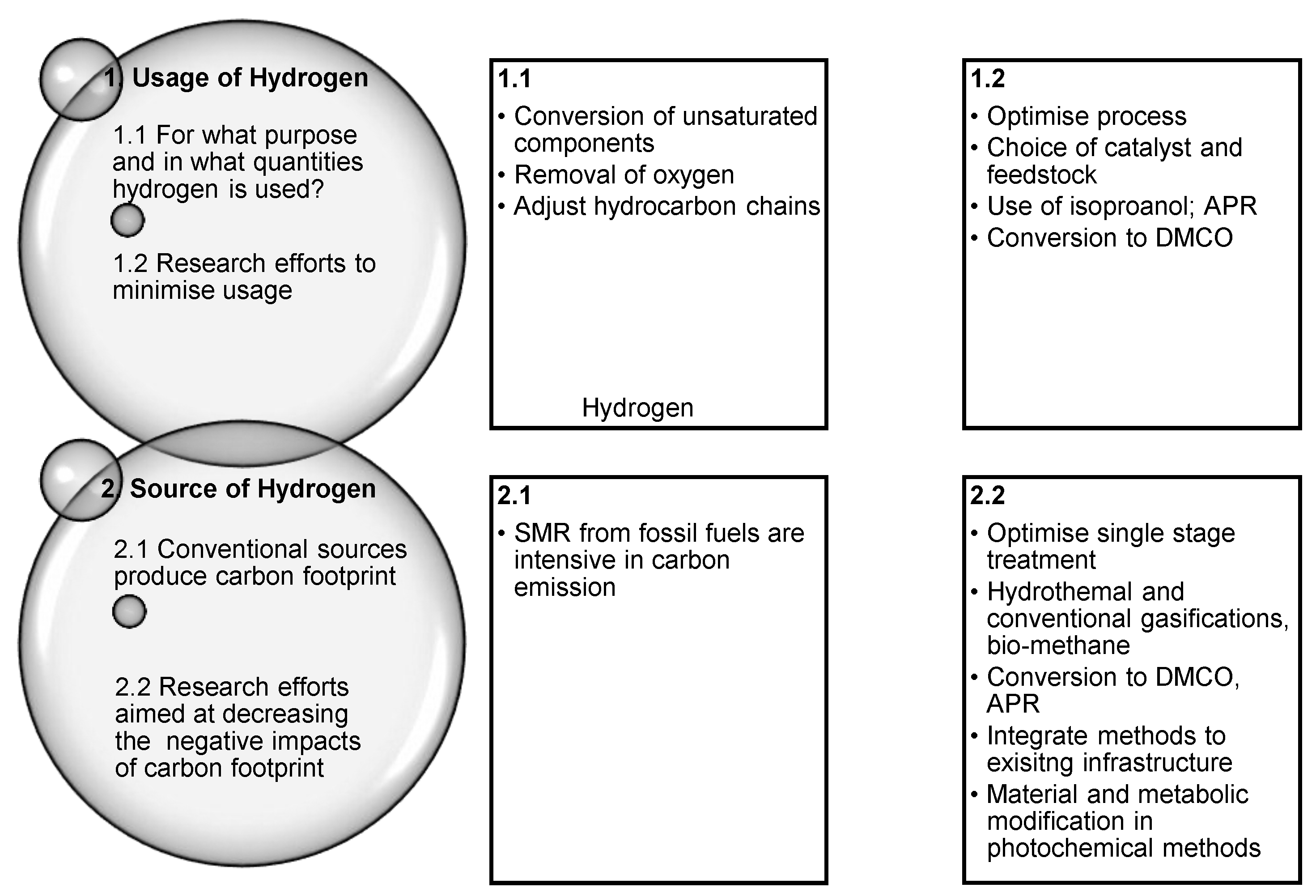
Table 1.
Hydrogen for producing SAF.
| Methods | Purpose | Quantity of hydrogen (From available studied sources) | Remarks |
|---|---|---|---|
|
FT-SPK (Synthetic Paraffinic Kerosene) & FT-SPK/A (Synthetic Paraffinic Kerosene with Aromatics) ~Carbon containing biomass |
a. Refining fuel [2,3] | - No use of hydrogen (comparative study in [15]) - 0.01 MT hr for 43 MT/hr corn stover [11] |
- Make up hydrogen is used in the refining of FT product [5] - Theoretically 0.351 kg H/kg lignocellulosic biomass for synthesis of fuel [11] |
|
HEFA-SPK & HC-HEFA-SPK (Hydrocarbon) ~Oil based including algae |
a. Hydrogenation [3] b. Hydrodeoxygenation [11] c. Decarboxylation [3] d. Isomerisation [3] e. Hydrocracking [3] |
- For per kg feedstock hydrodeoxygenation - 0.033 kg; Isomerisation - 0.019 kg [7] - Hydrotreating and isomerisation/hydrocracking: 0.020 to 0.04kg for varied feedstock, cross refer [3] - 4% of oil based feedstock (comparative study [11]) - 0.15 MJ/MJ renewable jet fuel (RJF) (comparative study as referred [15]) - 0.3 MT/hr for 7 MT/hr soyabean oil [11] - 31.7 kg/tonne palm oil, 33.3 kg/tonne macuaba oil and 37.7 kg/tonne soyabean oil. Up to 2000kg/h processing 4 million tonnes of feedstock/annum [10] |
- Transform unsaturated triglyceride and fatty acids to saturated compounds [16] - HDO & DCOX converts saturated substance to linear alkanes of C15 to C18 [17] - Branched alkanes based liquid fuel produced via isomerisation and hydrocracking [2] - Hydrogen is used to deoxygenate [15] |
|
ATJ-SPK ~Alcohol and sugar based |
a. Hydrogenation [1,2,3,18] | - 0.16% of feedstock (comparative study [11]) - 0.08 MJ/MJ RJF (comparative study as referred [15]) - 0.07 MT/hr for 39 MT/hr corn stover [11] |
- Paraffins are produced after saturating double bonds in olefins [2] |
|
CHJ ~Algae, oil derived from waste and plant |
a. Hydrogenation [3,18] b. Decarboxylation [3] c. Hydrotreatment [3] |
- | - Hydrogen is used in hydrogenation [2] - Straight, branched and cyclo-olefins are transformed to alkanes [5] |
|
SIP-HFS or DSHC (Direct Sugars to Hydrocarbons) ~Lignocellulosic, sugar based feedstock |
a. Hydrotreating [1,2,18] | - 1.04% of feedstock (from the comparative study [11]) - 0.52 MJ/MJ RJF for high blending ratio and 0.12 MJ/MJ RJF for 10% blending fuel (comparative study as referred [15]) - 0.6 MT/hr for 56 MT/hr corn stover [11] |
- Sugar containing feedstock are modified to farnesene, further transformed to jet fuel [2,15] - Branched molecules are formed after hydroisomerisation and hydrocracking [19] -High hydrogen consumption contributes to GHG emission [15] |
|
FOG Co-processing ~Oil based inputs |
a.Hydrodeoxygenation [2] |
- For hydro processing: 420-590 nl per litre liquid feed [12] | - Oil based feedstock deoxygenated in presence of hydrogen [2] - Hydrogen consumption increases by 7% [12], if lipid-based feedstock blending (waste cooking oil) increases from 10 to 30%. - Saturated feedstocks consume less hydrogen (such as palm oil, animal fats etc. targeted for renewable diesel) [12] -Lipid feed such as algae oil, camelina oil, linseed oil etc. with unsaturated fatty acids are suitable for aviation fuels [12] - Different catalyst combinations to be further explored to comprehend its effect on the extent of deoxygenation and hydrotreatment process apart from CoMo and NiMo catalysts [12]. |
Disclaimer/Publisher’s Note: The statements, opinions and data contained in all publications are solely those of the individual author(s) and contributor(s) and not of MDPI and/or the editor(s). MDPI and/or the editor(s) disclaim responsibility for any injury to people or property resulting from any ideas, methods, instructions or products referred to in the content. |
© 2025 by the authors. Licensee MDPI, Basel, Switzerland. This article is an open access article distributed under the terms and conditions of the Creative Commons Attribution (CC BY) license (https://creativecommons.org/licenses/by/4.0/).
Copyright: This open access article is published under a Creative Commons CC BY 4.0 license, which permit the free download, distribution, and reuse, provided that the author and preprint are cited in any reuse.


