Preprint
Article

This version is not peer-reviewed.

Cyclocondensation Reaction of C-Tetra(Ethyl)Pyrogallol[4]Arene: Its Study and the Evaluation of Its Thermodynamic Properties

A peer-reviewed article of this preprint also exists.

Submitted:

19 August 2025

Posted:

20 August 2025

You are already at the latest version

Abstract

Pyrogallol[4]arenes are polyhydroxylated compounds obtained by condensation between pyrogallol and different aldehydes. Depending on both the type of aldehyde (aromatic or aliphatic) and the reaction time, these compounds can be obtained in different conformations, the most common being the crown and chair conformations. Using the conventional synthesis method, it is possible to obtain, in addition to the chair or crown conformers, other molecular associations, such as dimer capsules. The research in this study focuses on the synthesis products obtained from the condensation between pyrogallol and propanal. These products obtained were characterized using spectroscopic methods, finding that it is possible to obtain, in addition to the crown conformation, the dimer capsule of the macrocycle. Finally, the volumetric properties of these conformers were evaluated in dimethylsulfoxide (DMSO) solution and at several temperatures.

Keywords: 
;  ;  ;  

1. Introduction

Pyrogallol is a phenolic compound with three hydroxyl groups (-OH) located at specific sites in its structure, which gives it unique interaction properties with both metals and other molecules. In the early 20th century, phenolic compounds were well studied for their oxidation and reduction properties. The reaction between pyrogallol and aldehydes can produce macrocyclic systems known as calix[4]pyrogallolarenes. These polyhydroxylated platforms contributed significantly to the study of conformational flexibility in macrocyclic molecules. This was the key to understanding how calixarenes, although initially considered rigid, can adapt to different shapes, giving them great versatility in their applications [1]. Calixarenes are polyhydroxylated compounds derived from the acid-catalyzed cyclocondensation reaction of phenolic compounds, such as pyrogallol and resorcinol, with aldehydes. This concept was introduced by C.D Gutsche in 1971, who investigated cyclic compounds with conformations similar to those of calix. The discovery of these compounds is part of the development of organic chemistry of phenolic compounds and macrocyclic molecules which, throughout the 20th century, generated great interest due to their properties and their potential in applications of supramolecular chemistry [2,3]. The calix prefix was established for these molecules because the initially synthetized t-butyl-calixarenes presented a cup-like shape. However, it has recently been found that all condensation products between aldehydes and resorcinol or pyrogallol have this shape, and therefore should be classified under this denomination. Therefore, it has been necessary to expand this classification, since a characteristic of t-butyl-calixarenes is their conformational flexibility, and many calixarene derivates also exhibit diverse conformations [4].
Pyrogallol[4]arenes are synthesized by acid-catalyzed condensation between pyrogallol and an aldehyde. Currently, there are three methods for the synthesis of pyrogallol[4}arenes: one is based on transition metal-catalyzed condensation, the second method consists of a reflux method in a mineral acid, and the third by grinding the reactants [4]. The most common synthesis methods for the productions of pyrogallolarenes use solvents such as ethanol, methanol, or solvent mixtures and involve long reaction times. In most cases, the reaction products are obtained by spontaneous precipitation in the reaction medium or it can be induced by increasing the polarity [5].
The functionalization of pyrogallol[4]arenes consists of the structural modification of either the lower or the upper rim of the molecule in order to broaden the possible molecular interactions and selectivity with different analytes. This modification can be performed in two ways: the first, from the synthesis of the macrocycle with a functionalized aldehyde that leads to the modification of the lower rim of the pyrogallol[4]arene; the second, after the synthesis of the base pyrogallolarene, the functionalization is carried out on the hydroxyl groups (of the upper rim) which allows to enlarge the cavity of the pyrogallol[4]arene for further applications in host-guest complexations or for the assembly with other supramolecular systems [5]. Functionalization in the resorcinarenes and pyrogallolarenes at the upper rim occurs, for example, by an acylation reaction with acetic anhydride and pyridine. In the case of functionalization at the lower rim, the synthesis allows changing the chain length linked to the methylene bridges by reaction with aliphatic aldehydes. It is also possible to introduce branched chains or chains containing a specific functional group. Some research work on the functionalization of pyrogallolarenes has mentioned the inclusion of both aliphatic and aromatics substituents [6], oxygenated groups or groups that radically increase their polarity, making them soluble in water [7], and fluorophore groups that can generate changes in their spectroscopic properties [8].
Pyrogallol[4]arenes have a high electronic density due to their structura. This presents a cavity that allows the interaction with different analytes; this characteristic offers the possibility of acting as a host system for the formation of host-guest complexes thanks to non-covalent molecular interactions that can occurs: cation-π, polar- π, and meanly CH-π interactions. Likewise, their structure allows interactions with the functional groups of the upper rim, which can influence the selectivity of the molecule [5]. These structural properties of the pyrogallolarenes have aroused great interest in recent years and their versatility has been studied in terms of a wide range of applications, such as their use in polymeric materials [9], heavy metal extraction agents [10], molecular filters [11], and others; and in their functionalized form, applications have been developed mainly as host-guest systems [1]. In this sense, the functionalization of pyrogallolarenes conformers has an important role since the orientation of the functional groups present in the molecule varies the way of interaction with other species and allows the formation of stable complexes with cations and anions [12,13,14]. As for the structural variant of capsules, applications have been indicated as catalysts in biological processes [15], initiators for controlled polymerization [16], chemical receptors for ammonium ions in amino acids [17], ion transport through bilayer membranes [18] and binding of molecules to polyester surfaces [19]. The synthesis of these compounds also leads to the generation of mixtures of conformers or molecular aggregates, so the problem of their research is based on the search for the appropriate methodology to obtain the capsule conformation of an alkyl pyrogallolarene, if possible as the only conformer.
Continuing with the study of the properties of pyrogallol[4]arenes [5,20,21], in the present article we show the reaction between pyrogallol and propanal to generate C-tetra(ethyl)pyrogallol[4]arene and the dimer capsule that is formed under the reaction conditions. The products thus obtained were characterized by using ESI-MS, FT-IR and NMR spectroscopy. In addition, their volumetric properties were studied in dimethylsulfoxide (DMSO) solution at several temperatures.

2. Results and Discussion

2.1. Reaction of Propionaldehyde with Pyrogallol

The cyclocondensation reaction between propionaldehyde and pyrogallol was carried out according to the conventional method for obtaining these macrocycles [20], which is carried out in a mixture of ethanol and water in an acidic medium under reflux conditions (Scheme 1). RP-HPLC analysis showed the formation of three products, after 4 hours of reaction, which were isolated and purified by column chromatography as described in the experimental part. Table 1 shows the RP-HPLC characterization of the crude of the reaction.
Following this procedure, two products were isolated: the crown conformer of C-tetra(ethyl)pyrogallol[4]arene (product 1) and the dimer capsule (product 2).
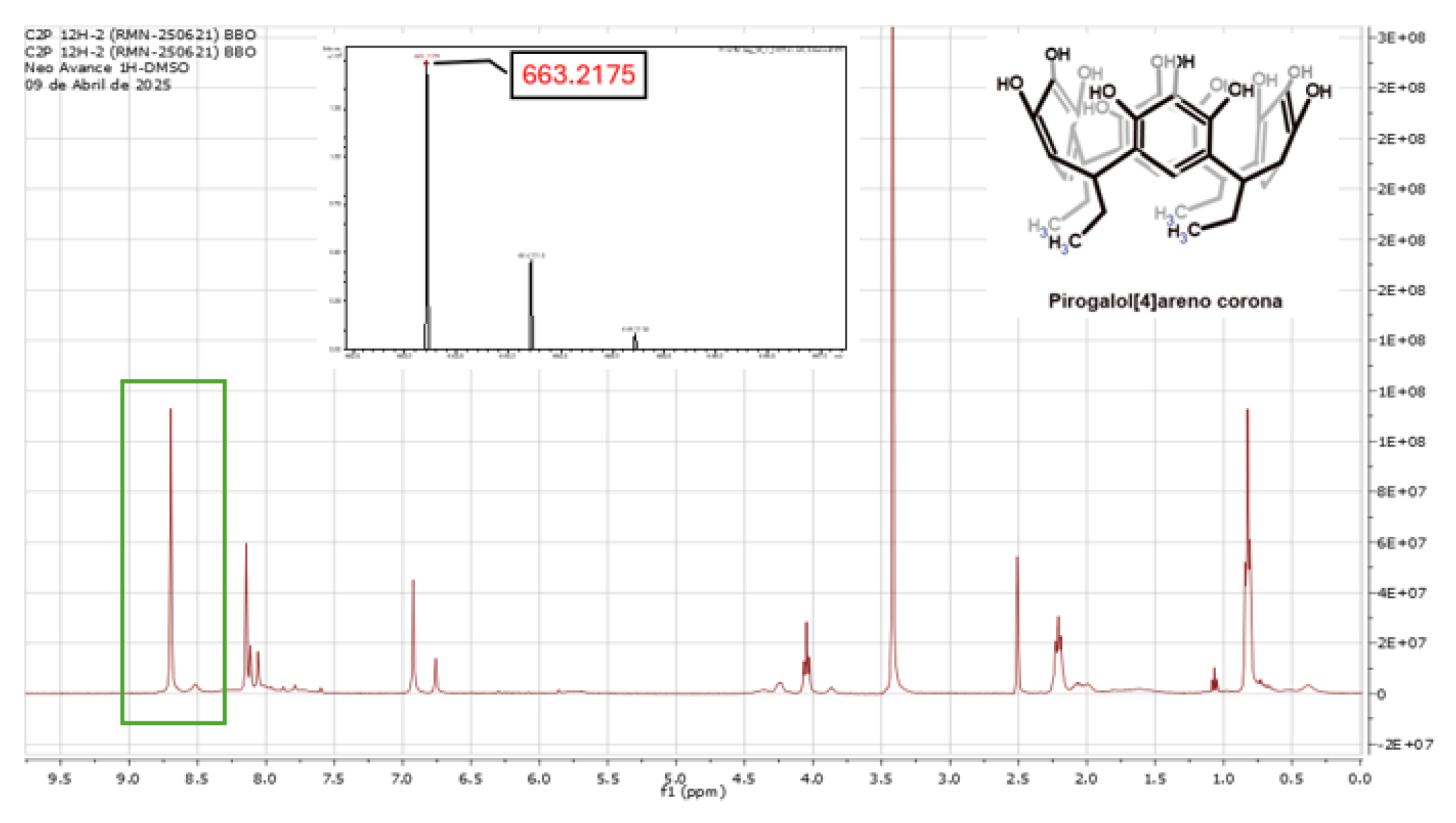
The crown conformer (from now on, also called as the monomer) was characterized by different spectroscopic techniques. The FT-IR spectrum showed a band at 3272 cm-1 corresponding to the hydroxyl groups ot the upper rim of the compound; the three bands at (2955, 2980 and 2868) cm-1 characteristic of ethyl groups; and the bands at (1621 and 1473) cm-1 indicating the presence of aromatic rings. The 1H NMR spectrum (Figure 1) showed a signal at 8.5 ppm and another at 8.7 ppm corresponding to the hydroxyl groups; the signals at 6.8 ppm and 6.9 ppm are characteristic of the aromatic hydrogens; the triplet between (4.03 – 4.07) ppm corresponds to the methylene bridge between the aromatic rings; the signals at 2.19 ppm and at 1.05 ppm correspond to the protons of the ethyl chains. The 13C NMR spectrum in DMSO-d6 (Figure 5) showed four characteristic signals from the aromatic region (140.0; 133.3; 124.9; 113.9 ppm) and three signals from the ethyl chains which were observed at (36.6; 26.4; 13.2 ppm). Finally, the ESI-MS spectrum confirmed the formation of the monomer compund since the highest intensity peak was obtained at a ratio m/z = 663.2 which matches the exact mass of the monomer (664.7 g/mol).
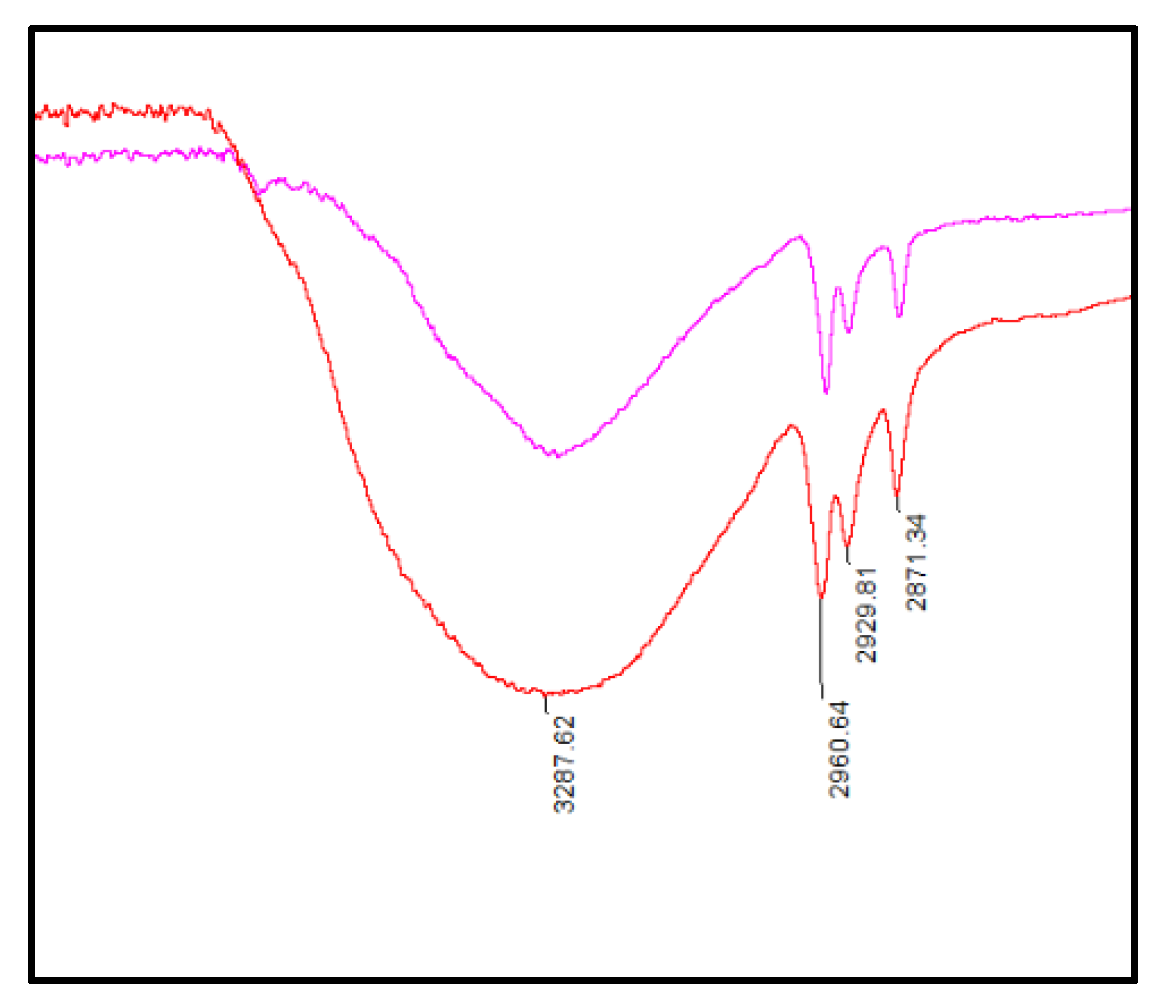
The characterization of the second isolated product, the dimer capsule of C-tetra(ethyl)pyrogallol[4]arene (2) (from now on, also called as the capsule), in principle showed a great similarity with the results obtained for (1). Regarding the FT-IR spectrum, the main difference was observed in the 3287 cm-1 band corresponding to the hydroxyls groups; as can be seen in Figure 2 this band is wider compared to that observed in the spectrum of (1), possibly due to the interaction between the OH groups.
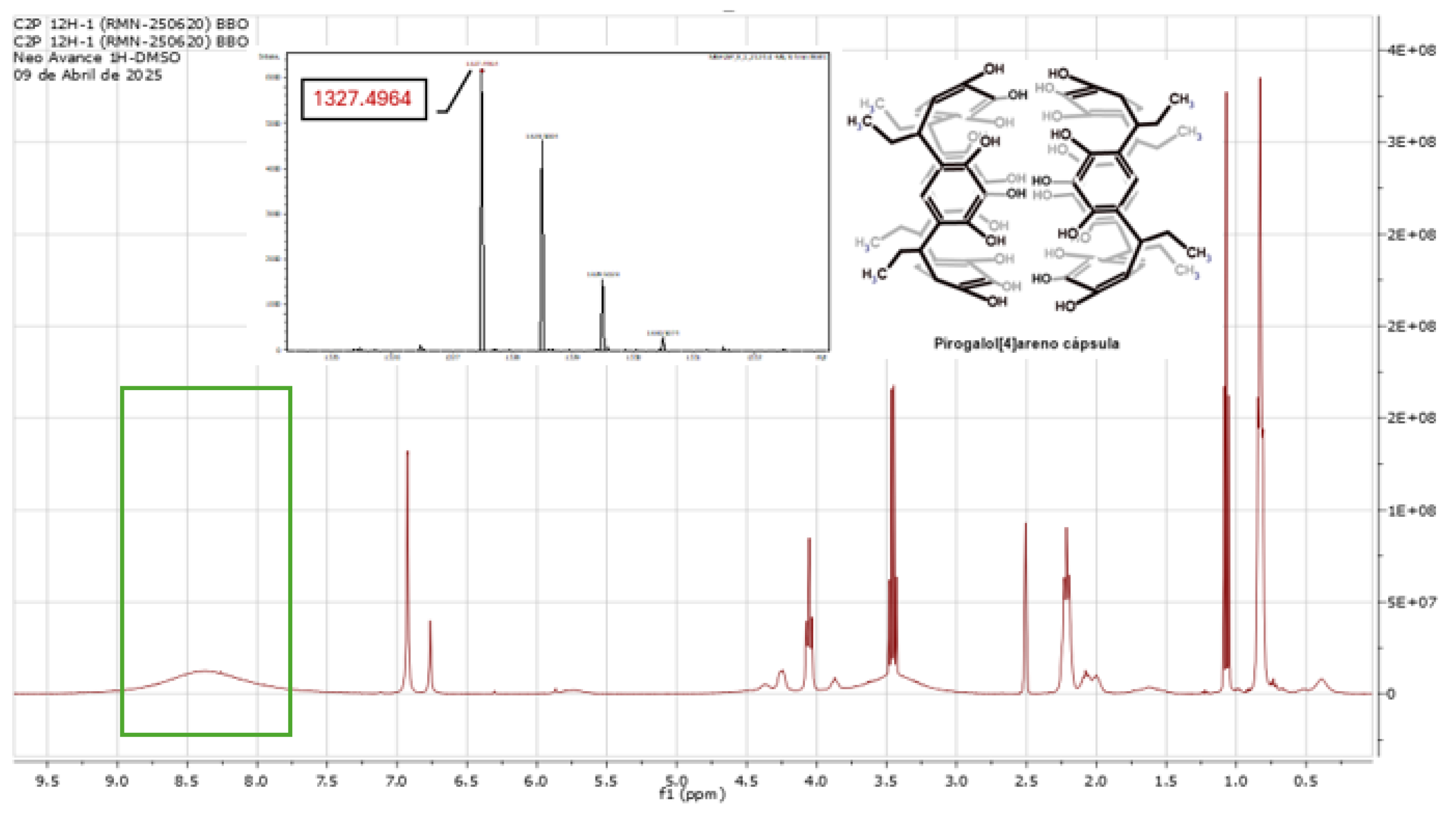
On the other hand, the analysis performed on the 1H NMR spectrum (Figure 3) presented the same the signals in the high field, corresponding to the aliphatic region; the main difference to highlight is observed in the hydroxyl signals of these spectra, where that of the capsule (2) presents a single wide signal at 8.4 ppm which was integrated for 12 protons; the shape of this signal indicates that there is an intense interaction between the hydroxyl groups of the molecule. The signals observed in the 13C NMR spectrum in DMSO-d6 in Figura 8 are very similar to those in the monomer spectrum (1); in addition to these, signals were observed at 56.5 ppm and 19.2 ppm indicating the presence of ethanol, so the possibility that ethanol lodges in the cavity to form the dimer can be considered. To confirm this, ESI-MS characterization was performed, which showed the highest intensity peak at a ratio m/z = 1327.5 a value consistent with the mass of the capsule (m/z = 1328.4); this corresponds to the expected signals for the C-tetra(ethyl)pyrogallol[4]arene and the expected structure for each pyrogallolarene according to similar studies [20,21,22,23].

2.2. Calculation of Apparent Molar Volume and Standard Molar Expansibility

From density measurements at different temperatures, apparent molar volume values were obtained using equation 1 [24].
V φ = M 2 ρ + 1000 ρ 0 ρ m ρ ρ 0
where, M2 is the molar mass of the solute; ρ and ρ 0 correspond to the density of the solution and the solvent, respectively, and m is the molal concentration.
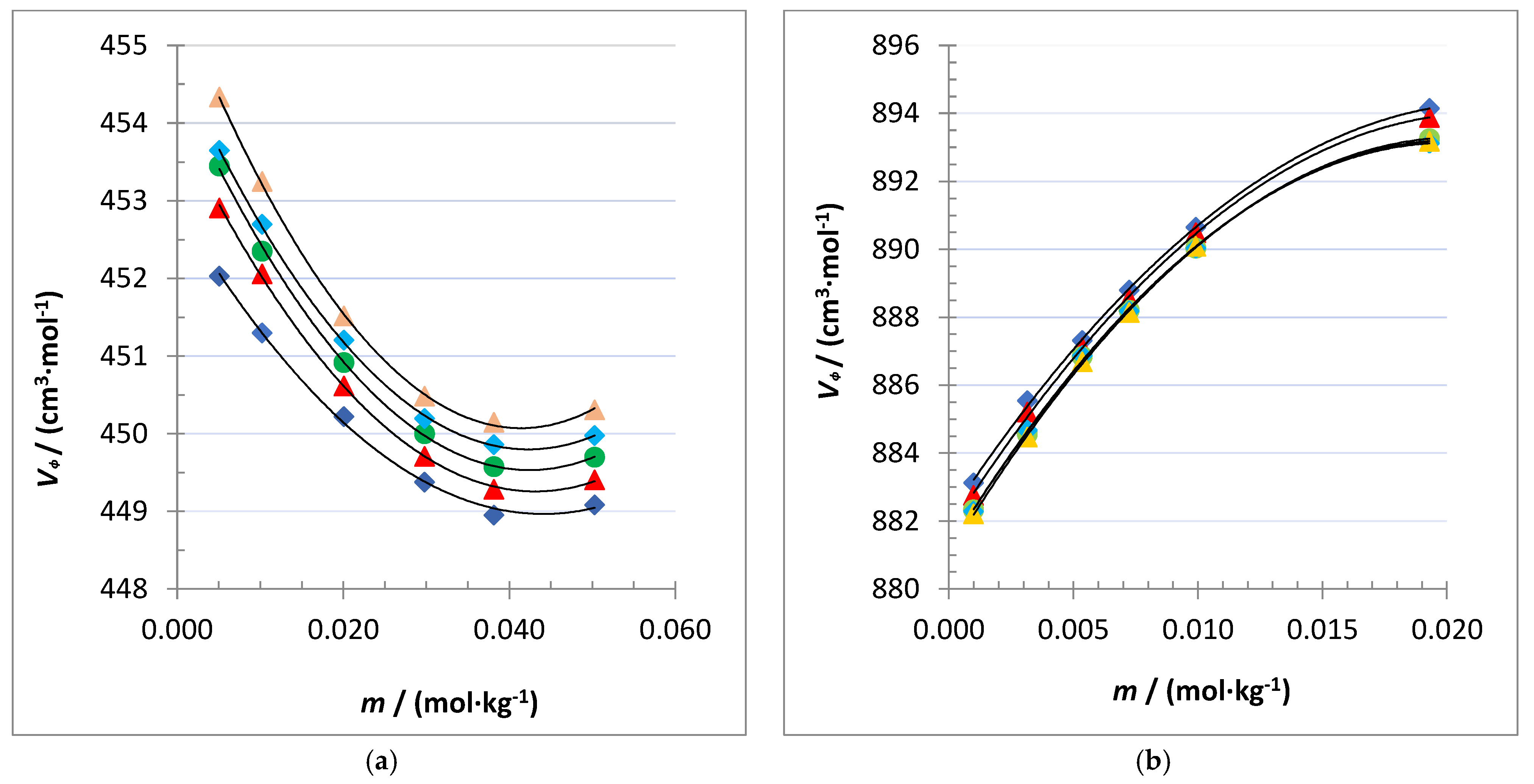
The apparent molar volume values for dilute solutions of both pyrogallolaneres, monomer and capsule, in DMSO and at different temperatures are shown in Table 2 and Table 3, respectively. Uncertainties in apparent molar volume, due to uncertainty in density and molality, were estimated from the law of propagation of uncertainty [25]; these values were lower than ± 0.80 cm3∙mol-1 for the solutions of the monomer, while for the capsule the uncertainties were smaller than ± 1.27 cm3∙mol-1. The highest uncertainty values were found for the lowest concentrations.
The dependance of the apparent molal volumes with concentration, for the two conformers studied is shown in Figure 4a,b. This dependence was analyzed, for the different temperatures studied, by least squares fit to the quadratic equation:
V ɸ =   V 2 o +   S v m +   B v m 2
where the limiting value of the partial molar volume at infinitesimal concentration, V ɸ , 2 o , is equal to the standard molar volume value, V 2 o , and S v and Bv are experimental parameters.
The variation of V 2 o with T for both conformers was analyzed through the linear relationship:
V 2 o = a +   b T
where T is the absolute temperature, and a and b are empirical parameters that were determined by fitting using the least squares method. Equation 3 was differentiated with respect to temperature to obtain the standard partial molar expansibility E 2 o = (   V 2 o   / T ) p = b . The values of V 2 o , Sv, Bv, a and b are shown in Table 4.
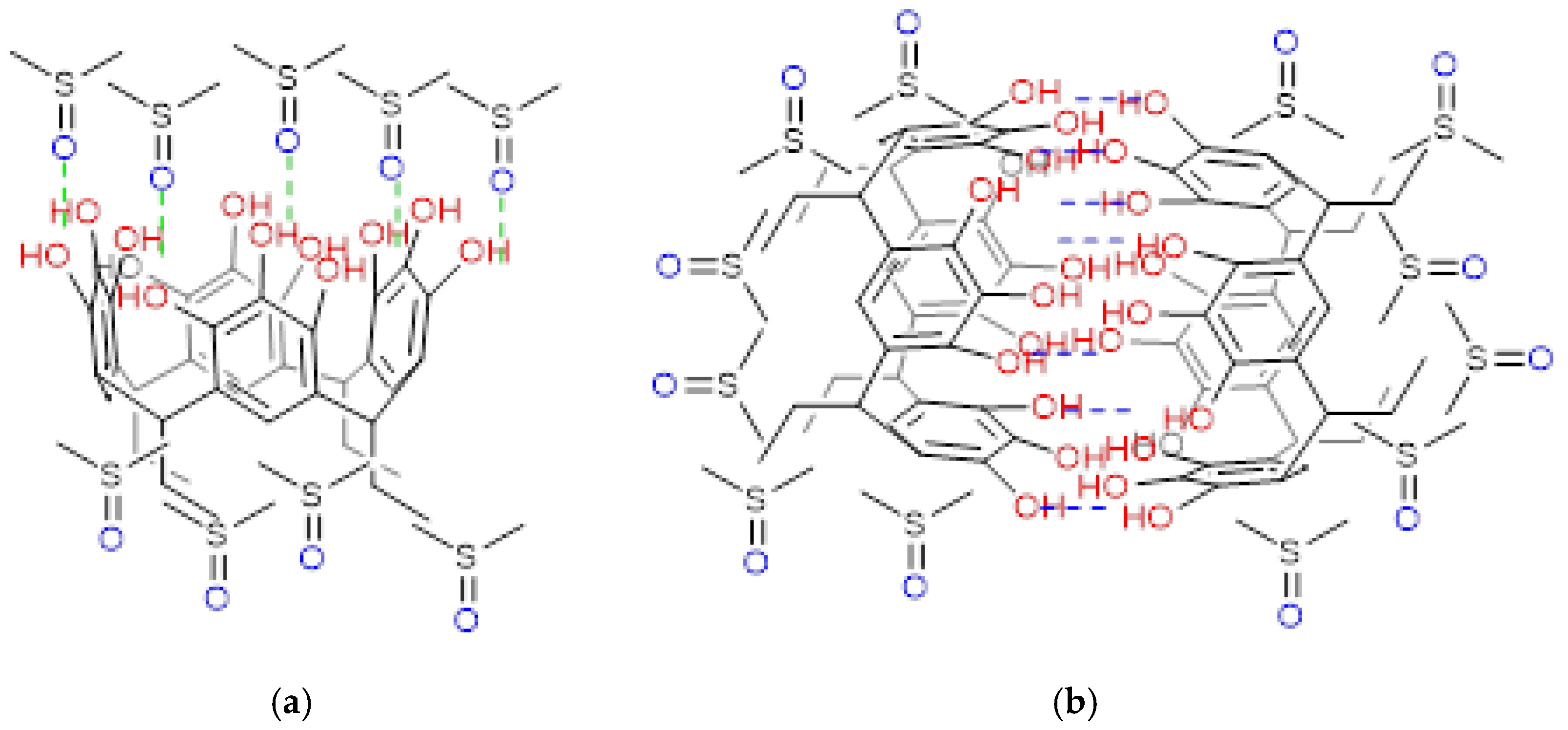
As it can be observed, the Vϕ values ​​obtained of for the monomer in DMSO decrease with the molal concentration ( S V <0 at all temperatures), while for the capsule, under the same conditions, the Vϕ values increase with that of m ( S V >0 at all temperatures). In the first case, the results could indicate that as the concentration increases the solute molecules are less solvated by the solvent and that is why there is a total volume less occupied by the solute and, therefore, a decrease in the volume of the apparent partial molar volume is appreciated. This may be due to the fact that the monomer is packaged in a more compact way as the concentration increases and, in this process, it expels the DMSO molecules that are on the sides and inside of the monomer conformer, which are not as strongly retained as those on the upper rim by interactions of the OH with the DMSO, which is an aprotic polar solvent. In the case of the capsule an opposite behavior is observed, with an increase in the apparent partial molar volume as its concentration increases. This could be due to the fact that the capsule disrupts the structure of the DMSO, causing it to expand with the addition of more molecules. This could be because the DMSO can no longer interact with the OH groups on the upper rim of the pyrogallolarene, since they are no longer available when the capsule is formed (Figure 5a), thus breaking down the solvent. In both cases, as the concentration of the solute in the solution increases, solute-solute interaction also increases and the apparent partial molar volume loses linearity with concentration.
On the other hand, because the apparent partial molal volume of the capsule is almost twice as large (i.e., 882.13 at 293.15 K) as that of the monomer (i.e., 452.92 at 293.15 K) at all temperatures studied, this behaviour suggests that the conditions under which the synthesis reaction took place are suitable for the monomer conformer and the capsule of the macrocycle to be effectively separated.
On the other hand, the standard molar expansibility [26] is positive for the monomer  ( E 2 o > 0 ) which indicates that, with increasing temperature, either the solvation sphere increases or there is a structural relaxation of the solvent molecules around the solute molecules. Nevertheless, in the case of dimer capsule pyrogallolarene the standard molar expansibility is negative ( E 2 o < 0 ) which implies that the molar volume decreases as the temperature increases (Table 3). This decrease could be due to two phenomena: a thermal contraction caused by a structural change in the solvent molecules around the solute molecules, which causes a rearrangement or compaction of the solvation sphere; or, more likely, that at higher temperatures some solvent molecules surrounding the capsule, which are not as strongly bound as in the case of the monomer alkylpyrogallolarene, leave the solvation sphere, causing the partial molar volume to decrease (Figure 5b).

3. Materials and Methods

IR spectra were recorded on a Thermo Fisher Scientific Nicolet iS10 FT–IR spectrometer with a monolithic diamond ATR accessory, and peaks are reported in cm-1. 1H- and 13C NMR spectra were recorded at 400 MHz on a Bruker Avance 400 instrument. Chemical shifts are reported in ppm, using the solvent residual signal. RP–HPLC analyses were performed over a Chomolith® C18 column (Merck, 50 mm) using an Agilent 1200 liquid chromatograph (Agilent, Omaha, NE, USA), analysis was performed in gradient mode from 5 to 90% of solvent B (MeCN with 0.05% TFA, trifluoroacetic acid) in solvent A (water with 0.05% TFA, trifluoroacetic acid). The time gradient was 16 min. Detection was carried out at 210 nm and the flow rate was 2 mL/min. The sample concentration was 1.0 mg/mL, and the injection volume was 10 μL. The products were analyzed on a Bruker Impact II LC Q-TOF MS equipped with electrospray ionization (ESI) in negative mode. The ESI source conditions were: End Plate Offset 500 V, Capillary 4500 V, Nebulizer 1.8 bar, Dry gas nitrogen 8.0 L/min, Dry Temp 220 ◦C. Scan mode AutoMS/MS with spectral range 20–1000 m/z, spectra rate 2 Hz and collision energy of 5.0 eV.

3.1. Synthesis of C-Tetra(Ethyl)Pyrogallol[4]Arene

X mmol of pyrogallol was dissolved in 20 mL of solvent mixture (EtOH:Water) in a reaction balloon, then 1 mL of 37% hydrochloric acid was added dropwise, and this mixture was placed in an ice bath for 30 minutes. After this time, x mmol of propionaldehyde was added dropwise, with stirring, and the mixture was taken to reflux at 80°C with constant stirring. After the reaction time had elapsed, the solvent was evaporated in a rotary evaporator, and the products were subsequently purified by column chromatography, using silica gel as the stationary phase and variable mixtures of chloroform-methanol as the mobile phase.
Tetra(ethyl)calix[4]pyrogallolarene (1) pink solid, mp>250ºC; IR(ATR) υ/cm-1 3272 (O-H, broad), 3050 (CH,Ar), 2950 (C-H, aliphatic), 1621 (-C=C, Ar); 1H NMR (400 MHz, DMSO-d6) δ 8.69 (s, 8H, OH); 8.51 (s, 4H, OH); 6.92 (s, 8H, Ar-H); 6.76 (s, 4H, Ar-H); 4.03-4.07 (t, 4H, CH), 2.19-2.23 (t, 8H, CH2); 1.05–1.08 (t, J = 8 Hz, 12H, CH3). 13C NMR (400 MHz, DMSO-d6) δ 140.0; 133.3; 124.9; 113.9; 36.6; 26.4; 13,5; 13.2. ESI-MS, observed m/z = 663.2 [M-1]. Calc. m/z = 664.7.
Tetra(ethyl)calix[4]pyrogallolarene (2) white solid, mp>250ºC; IR(ATR) υ/cm-1 3272 (O-H, broad), 3050 (CH,Ar), 2950 (C-H, aliphatic), 1621 (-C=C, Ar); 1H NMR (400 MHz, DMSO-d6) δ: 8.37 (s, 12H, OH); 6.93 (s, 4H, Ar-H); 4.05 (t, J=8 Hz 4H, CH), 2.19-2.23 (m, 8H, CH2); 0.83 (t, J = 8 Hz, 12H, CH3). 13C NMR (400 MHz, DMSO-d6) δ 140.0; 133.3; 124.9; 113.9; 36.6; 26.4; 13,5; 13.2. ESI-MS, observed m/z = 1327.5 [M-1]. Calc. m/z = 1328.4.

3.2. Volumetric Properties of Monomer and Capsule Pyrogallolarene in DMSO Solution

Density of dilute DMSO solutions of monomer and capsule pyrogallolanere was measured between 293.15 K and 313.15 K, in five-degree intervals, using an Anton Paar, DSA 5000M vibrating tube densimeter. The densimeter has a repeatability (s. d.) of ± 1∙10-6 g. cm-3. Its temperature repeatability (s.d.) is 0.001 degrees over both the temperature (0-100) °C and the pressure (0-116) psi ranges. The equipment was verified, as recommended by the supplier, with degassed Milli Q water (κ = 5.6 × 10⁻⁸ S cm−1) and air before each measurements series. From the density values, the apparent partial molar volumes, and through extrapolation, the limiting molar ones, as well as their temperature dependences were calculated. The values found for both conformers were compared, and their behavior was analyzed.
The solvent used was dimethylsulfoxide (DMSO) from Fluka, with a mass fraction purity ≥ 0.99 (CAS number 67-68-5). The density values obtained for the different temperatures studied were consistent with those reported in the literature [27].
The purified solutes, both the monomer and the capsule pyrogallolaneres, were stored in a desiccator over silica gel until further use.
All solutions were prepared by weighing using a Sartorius analytical balance whose uncertainty is 1∙10-5 g. in the range of interest. These solutions were degassed before use.

4. Conclusions

The crown tetra(ethyl)calix[4]pyrogallolarene and its dimer capsule were synthesized, isolated, purified and characterized, obtaining acceptable yields after their separation by column chromatography. A detailed analysis of the 1H-NMR spectra of the two separated products confirmed that the signal pattern corresponds exclusively to that of the crown-type conformation for 1. For the dimer capsule 2, the spectroscopic signals showed that the two dimer units are also in crown conformation, as well as that they present a broadening for the hydroxyl groups confirming the existence of a strong interaction at the upper rim of the dimer capsule. The formation of the dimer capsule was also confirmed by ESI-MS. Once the products were obtained, the density measurements performed on their DMSO solution showed a drastic change of the limiting partial molar volume, V0, for both products, at the studied temperatures (between 293.15 K and 313.15 K).

Author Contributions

For research articles with several authors, a short paragraph specifying their individual contributions must be provided. The following statements should be used Conceptualization, Mauricio Maldonado and Miguel Esteso; Data curation, Diana Martínez and Almudena Crespo; Formal analysis, Edilma Sanabria; Investigation, Diana Martínez and Almudena Crespo; Methodology, Diana Martínez and Almudena Crespo; Software, Edilma Sanabria; Supervision, Mauricio Maldonado and Miguel Esteso; Validation, Mauricio Maldonado and Miguel Esteso; Visualization, Edilma Sanabria; Writing – original draft, Diana Martínez, Almudena Crespo and Edilma Sanabria; Writing – review & editing, Mauricio Maldonado and Miguel Esteso. All authors have read and agreed to the published version of the manuscript.

Funding

This research received no external funding

Acknowledgments

Mauricio Maldonado and Diana Martínez would like to thank the “Universidad Nacional de Colombia” for its support; Almudena Crespo and Miguel A. Esteso would like to thank the “Universidad Católica de Ávila” for its support; Edilma Sanabria would like to thank the “Universidad Manuela Beltrán” for its support.

Conflicts of Interest

The authors declare no conflicts of interest.

Abbreviations

FT-IR Fourier Transform Infrared Spectroscopy
1H NMR 1H-Nuclear Magnetic Resonance
13C NMR 13C-Nuclear Magnetic Resonance
ESI-MS Electrospray Ionization Mass Spectrometry

References

  1. Zambrano, C.H.; Manzano, C.A.; Saltos, A.A.; Dueno, E.E.; Zeller, M. Síntesis de 2,8,14,20-tetra-n-butilpirogalol[4]areno y estudio computacional conformacional. ACI Av. Cienc. Ing. (Quito) 2010, 2, junio. [Google Scholar] [CrossRef]
  2. Davis, F.; Higson, S. Calixarenes. In Macrocycles: Constructions, Chemistry and Nanotechnology Applications; John Wiley & Sons, Ltd, Hoboken, Nueva Jersey, U.S., 2011; chapter 4, pp. 77-125.
  3. Bowley, N. Synthetic and structural studies of calix[4]pyrogallol[4]arenes: towards biological applications. Ph.D. Thesis, Nottingham Trent University, UK, 2008. [Google Scholar]
  4. Griffin, P. Pyrogallo4arenes: a synthetic investigation. Ph.D. Thesis, Dublin City University, 2007.
  5. Casas-Hinestroza, J.L.; Cifuentes, A.; Ibáñez, E.; Maldonado, M. Effect of the formation of capsules of tetra(propyl) pyrogallol[4]arene on the host-guest interaction with neurotransmitters, J. Mol. Struct. 2020, 1210, 128063. [Google Scholar] [CrossRef]
  6. Alshahateet, S.F.; Kooli, F.; Messali, M.; Judeh, Z.M.A.; ElDouhaibi, A.S. Synthesis and Supramolecularity of C -Phenylcalix[4] Pyrogallolarenes: Temperature Effect on the Formation of Different Isomers, J. Mol. Cryst. Liq. Cryst. 2007, 474, 89–110. [Google Scholar] [CrossRef]
  7. Gibb, B.C.; Chapman, R. G.; Sherman, J. C. Synthesis of Hydroxyl-Footed Cavitands. J. Org. Chem. 1996, 61, 1505–1509. [Google Scholar] [CrossRef]
  8. Barrett, E.S.; Dale, T.J.; Rebek Jr., J. Synthesis and Assembly of Monofunctionalized Pyrogallolarene Capsules Monitored by Fluorescence Resonance Energy Transfer. Chem. Commun. 2007, 4224–4226. [Google Scholar] [CrossRef] [PubMed]
  9. Yang, Y.; Swager, T. Main-chain calixarene polymers: conformational effects on polymerization. Macromolecules 2006, 39, 2013–2015. [Google Scholar] [CrossRef]
  10. Grannas, M.; Hoskins, B.; Robson, R. Synthesis and x-ray crystal structures of a calixarene-related, tetraamino, tetraphenolic, polynucleating macrocyclic ligand and its ZnII4 and CoIII3 derivates. Inorg.Chem. 1994, 33, 1071–1079. [Google Scholar] [CrossRef]
  11. Cave, G.; Dalgarno, S.; Antesberger, J.; Ferrarelli, M.; McKinlay, R.; Atwood, J. Investigations into chain length control over solid-state pyrogallol[4]arene nanocapsule packing. Supramol. Chem. 2008, 2), 157–159. [Google Scholar] [CrossRef]
  12. Hof, F.; Trembleau, L.; Ullrich, E.C.; Rebek Jr, J. Acetylcholine Recognition by a Deep, Biomimetic Pocket. Angew. Chemie Int. Ed. 2003, 42, 3150–3153. [Google Scholar] [CrossRef] [PubMed]
  13. Kim, S.K.; Kang, B.; Koh, H.S.; Yoon, Y.J.; Jung, S.J.; Jeong, B.; Lee, K.; Yoon, J. A New Imidazolium Cavitand for the Recognition of Dicarboxylates. Org. Lett. 2004, 6, 4655–4658. [Google Scholar] [CrossRef] [PubMed]
  14. Zhang, Q.; Adams, R.D.; Fenske, D. Stable hydrogen-bonded spherical capsules formed from self-assembly of pyrogallol[4]arenes, J. Inclusion Phenom. Macrocycl. Chem. 2005, 53, 275–279. [Google Scholar] [CrossRef]
  15. Gangemi, C.M.A.; Pappalardo, A.; Sfrazzetto, G.T. Applications of supramolecular capsules derived from resorcin[4]arenes, calix[n]arenes and metalloligands: from biology to catalysis, RSC Adv. 2015, 5, 51919-51933.
  16. Krause, T.; Gruner, M.; Kuckling, D.; Habicher, W.D. Novel starshaped initiators for the controlled radical polymerization based on resorcin[4]- and pyrogallol[4]arenes, Tetrahedron Lett. 2004, 45, 9635-9639. 45.
  17. Späth, A.; König, B. Molecular recognition of organic ammonium-ions in solution using synthetic receptors, Beilstein J. Org. Chem. 2010, 6, 132–133. [Google Scholar]
  18. Negin, S.; Li, R.; Kulikov, O.V.; Daschbach, M.M.; Gokel, G.W. Ion transport through bilayer membranes mediated by pyrogallol[4]arenes, Inorg. Chim. Acta 2014, 417, 177–185. [Google Scholar]
  19. Buschmann, H.J.; Schollmeyer, E. Improved adhesion of polyurethane coating to polyester fabrics due to the surface fixation of calixarenes, J. Adhes. Sci.Technol. 2010, 24, 113–121. [Google Scholar] [CrossRef]
  20. Casas-Hinestroza, J. L.; Pérez-Redondo, A.; Maldonado, M. Inclusion complexation between neurotransmitters with polyacetylated calix[4]pyrogallol arenes: 1H-NMR and crystallographic analysis. Res. Chem. Intermed. 2022, 48, 3091–3107. [Google Scholar] [CrossRef]
  21. Casas-Hinestroza, J.L.; Maldonado, M. Conformational Aspects of the O-acetylation of C-tetra(phenyl)calixpyrogallol[4]arene. Molecules 2018, 23, 1225. [Google Scholar] [CrossRef] [PubMed]
  22. Shivanyuk, A.; Rebek Jr., J. Hydrogen-bonded capsules in polar, protic solvents, Chem. Commun. 2001, 2374 -2375.
  23. Kumari, H.; Good, A.J.; Smith, V.J.; Barbour, L.J.; Deakyne, C.A.; Atwood, J.L. 18-Crown-6 templates offset-linked pyrogallol[4]arene dimers, Supramol. Chem. 2013, 25, 591–595. [Google Scholar]
  24. NanJi, S.; Marriot, R. Apparent molar volumes of isoprene and limonene in dense-phase CO2. J. Supercrit. Fluids 2025, 221, 106544. [Google Scholar] [CrossRef]
  25. Taylor, N.B.; Kuyatt, C.E. Guidelines for Evaluating and Expressing the Uncertainty of NIST Measurement Results. National Institute of Standards and Technology, Gaithersburg, U.S.; NIST Technical Note 1297.
  26. Tiantian, M.; Haiyun, H.; Mengjiao, Z.; Renzhong, L.; Junru, W.; Yanping, D. Effect of temperature on the physicochemical properties and solute–solvent interactions of a dilute solution of [Bmim][OAc] in DMSO. J. Mol. Liq. 2025, 418, 126717. [Google Scholar]
  27. Parvinder, V.; Kirtanjot, K. Thermodynamic insight of DMSO-DMA and DMSO-DMF binary mixtures across varying temperatures. J. Mol. Liq. 2024, 415, 126286. [Google Scholar]
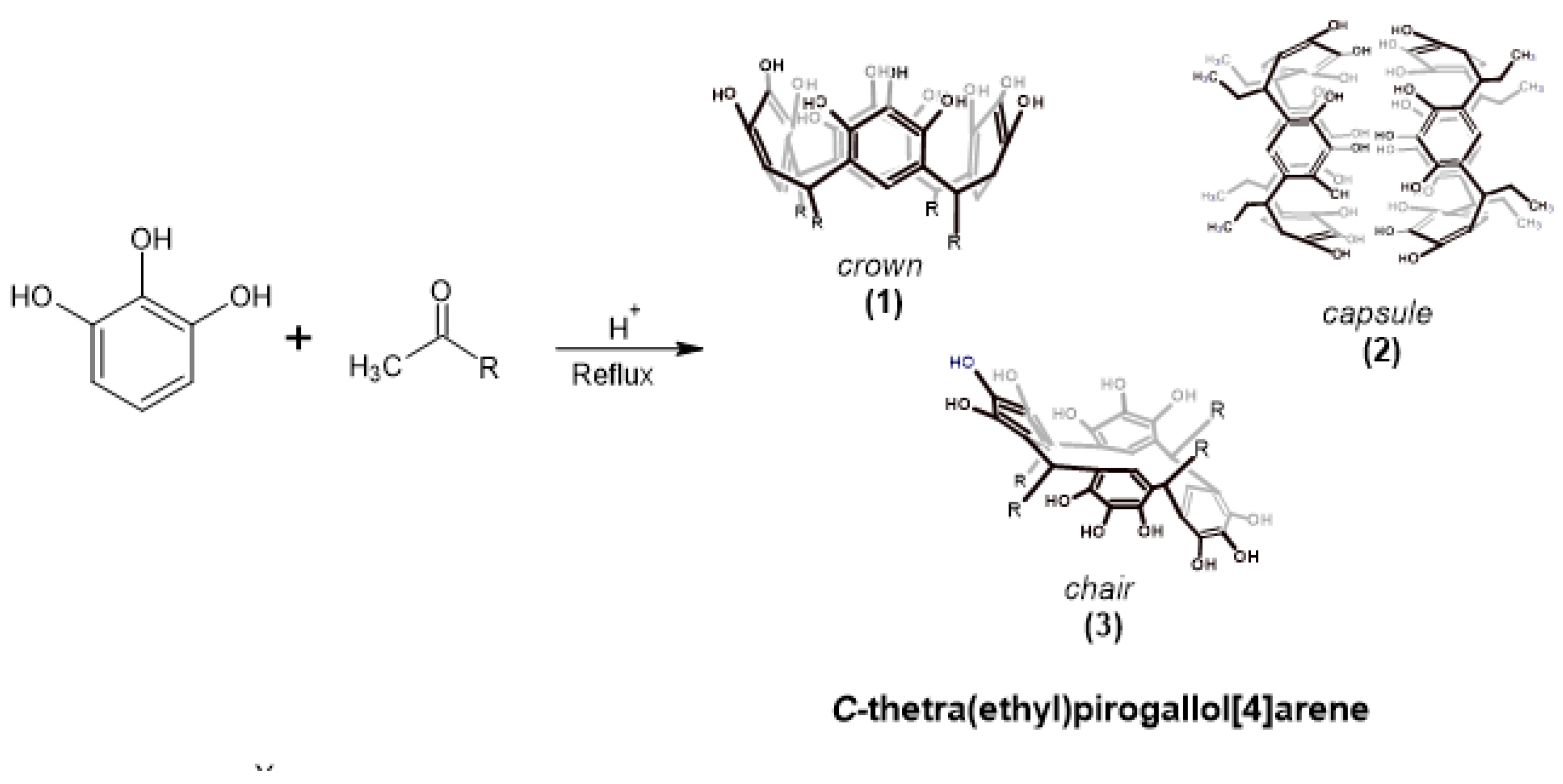
Scheme 1. Cyclocondensation reaction of propionaldehyde with pyrogallol.
Preprints 173125 sch001
Figure 1. 1H NMR and ESI-MS spectra of C-tetra(ethyl)pyrogallol[4]arene in crown conformation (1).
Preprints 173125 g001
Figure 2. Comparison between the infrared spectra of the crown conformer (1), in purple color, and the dimer capsule (2), in red color.
Preprints 173125 g002
Figure 3. 1H NMR and ESI-MS spectra of dimer capsule 2.
Preprints 173125 g003
Figure 4. Dependence of the apparent partial molar volumes on the concentration at 293.15 K (Preprints 173125 i001), 298.15 K (Preprints 173125 i002), 303.15 K (Preprints 173125 i003), 308.15 K (Preprints 173125 i004) and 313.15 K (Preprints 173125 i005) for: (a) crown pyrogalollarene, and (b) dimer capsule pyrogalollarene.

Preprints 173125 g004
Figure 5. Representation of the interactions (hydrogen bonds and Van der Waals) between DMSO and: a) crown conformer, b) dimer capsule, of C-tetra(ethyl)pyrogallol[4]arene.
Preprints 173125 g005
Table 1. Isolated products from the reaction of propionaldehyde with pyrogallol (Tables should be placed in the main text near to the first time they are cited).
Entry Retention time (min) Solvent
EtOH/H2O
Crown (1) 10.3 (22%)
Dimer capsule (2) 10.7 (40 %) -
Chair (3) 9.9 (30%)
Table 2. Values of ρ and Vϕ for the crown conformer alkylpyrogallorarene in DMSO in the temperature range from 293.15 to 313.15K.
T/K 293.15K 298.15K 303.15K 308.15K 313.15K
m /
(mol∙Kg-1)
ρ /
(g∙cm-3)
Vϕ /
(cm3∙mol-1)
ρ /
(g∙cm-3)
Vϕ /
(cm3∙mol-1)
ρ /
(g∙cm-3)
Vϕ /
(cm3∙mol-1)
ρ /
(g∙cm-3)
Vϕ /
(cm3∙mol-1)
ρ /
(g∙cm-3)
Vϕ /
(cm3∙mol-1)
0.0050758 1.101341 452.03 1.096327 452.91 1.091316 453.45 1.086307 453.65 1.081298 454.34
0.010235 1.102292 451.34 1.097283 452.06 1.092280 452.35 1.087276 452.71 1.082273 453.23
0.020099 1.104116 450.22 1.099122 450.62 1.094131 450.92 1.089140 451.20 1.084151 451.52
0.029782 1.105906 449.38 1.100925 449.71 1.095946 450.00 1.090970 450.19 1.085993 450.49
0.038165 1.107444 448.95 1.102473 449.28 1.097504 449.58 1.092535 449.86 1.087568 450.15
0.050296 1.109618 449.08 1.104662 449.40 1.099708 449.70 1.094754 449.98 1.089799 450.31
Standard uncertainties are: ur(m) = 1.0·10–3 mol·kg–1 (max), u(ρ) = 0.150 kg·m–3, u(Vϕ) = 0.1 cm3·mol–1, u(T) = 0.01 K.
Table 3. Values of ρ and Vϕ for the dimer capsule alkylpyrogallorarene in DMSO in the temperature range from 293.15 to 313.15K.
T/K 293.15K 298.15K 303.15K 308.15K 313.15K
m /
(mol∙Kg-1)
ρ /
(g∙cm-3)
Vϕ /
(cm3∙mol-1)
ρ /
(g∙cm-3)
Vϕ /
(cm3∙mol-1)
ρ /
(g∙cm-3)
Vϕ /
(cm3∙mol-1)
ρ /
(g∙cm-3)
Vϕ /
(cm3∙mol-1)
ρ /
(g∙cm-3)
Vϕ /
(cm3∙mol-1)
0.00099709 1.100766 883.13 1.095749 882.75 1.090732 882.33 1.085719 882.29 1.080707 882.21
0.0031561 1.101603 885.55 1.096593 885.21 1.091585 884.56 1.086578 884.68 1.081573 884.48
0.0053671 1.102448 887.32 1.097445 887.10 1.092443 886.85 1.087443 886.87 1.082445 886.69
0.0072539 1.103159 888.80 1.098163 888.53 1.093168 888.20 1.088174 888.19 1.083181 888.14
0.0099236 1.104152 890.65 1.099164 890.49 1.094180 890.03 1.089194 890.04 1.084208 890.10
0.019301 1.107575 894.15 1.102621 893.88 1.097675 893.26 1.092721 893.13 1.087763 893.18
Standard uncertainties are: ur(m) = 1.0·10–3 mol·kg–1 (max), u(ρ) = 0.150 kg·m–3, u(Vϕ) = 0.1 cm3·mol–1, u(T) = 0.01 K.
Table 4. Values of V 2 o , Sv and Bv for conformers crown and dimer capsule of pyrogallorarene in DMSO, in the temperature range (293.15-313.15) K. The parameters of equation 3, a and   E 2 o ( = b ) are also shown.
Pyrogallorarene T / K V 2 o S v Bv
Crown (monomer) 293.15 452.92 -178.96 2027.7
298.15 453.99 -219.79 2548.7
303.15 454.53 -235.81 2778.8
308.15 454.72 -233.36 2765.4
313.15 455.60 -267.27 3227.8
                  a = 424.02 (cm3∙mol-1)                E 2 o = b =   0.1004 (cm3∙mol-1∙K-1)
Dimer capsule 293.15 882.13 1108.5 -25197
298.15 881.71 1147.8 -26810
303.15 881.19 1181.9 -28845
308.15 881.19 1191.1 -29694
313.15 881.01 1209.1 -29971
                  a = 898.24(cm3∙mol-1)                E 2 o = b = -0.0552 (cm3∙mol-1∙K-1)
V 2 o in units of (cm3·mol−1), Sv in units of (cm3·kg·mol−2), and Bv in units of (cm3·kg2·mol−3).
Disclaimer/Publisher’s Note: The statements, opinions and data contained in all publications are solely those of the individual author(s) and contributor(s) and not of MDPI and/or the editor(s). MDPI and/or the editor(s) disclaim responsibility for any injury to people or property resulting from any ideas, methods, instructions or products referred to in the content.
Copyright: This open access article is published under a Creative Commons CC BY 4.0 license, which permit the free download, distribution, and reuse, provided that the author and preprint are cited in any reuse.
Prerpints.org logo

Preprints.org is a free preprint server supported by MDPI in Basel, Switzerland.

Subscribe

Disclaimer

Terms of Use

Privacy Policy

Privacy Settings

© 2026 MDPI (Basel, Switzerland) unless otherwise stated