

Submitted:
11 July 2025
Posted:
16 July 2025
You are already at the latest version
Abstract
Microbial bioextraction offers a sustainable strategy for the treatment of mining residues. This study evaluates the efficacy of a biologically derived reducing agent produced by Trichoderma harzianum Rifai in recovering metals (Ni, Co, Cu, Mn, Mg, and Fe) from acid-leached nickel tailings sourced from Moa, Cuba. The reducing agent was tested both independently and in combination with citric acid under varying conditions of temperature (30–60 °C), concentration (0.5–1 M), liquid-to-solid ratio (3–8 mL/g), and reaction time (1–3 hours), using tailings with a particle size of 0.045 mm. Mineralogical characterization was performed via X-ray diffraction (XRD). The biological agent exhibited moderate leaching performance, achieving extraction efficiencies of 42.91% for Mn, 36.86% for Ni, 35.57% for Cu, 34.89% for Mg, 24.56% for Co, and 13.7% for Fe. Selectivity was below 5% for Ni, Co, Fe, and Mn, while Mg and Cu showed selectivity values exceeding 9%. The combined use of the biological reducing agent with citric acid significantly enhanced metal extraction, reaching 66% for Mn, 70.83% for Ni, 97.19% for Cu, 69.54% for Mg, 47.15% for Co, and 56.59% for Fe, accompanied by a reduction in selectivity for all metals to below 3%. XRD analysis confirmed that no new mineral phases formed during the process. These results demonstrate the potential of Trichoderma harzianum as a biological reducing agent for managing nickel-bearing residues, attributed to its organic acid production and minimal alteration of the mineral matrix. Moreover, the synergistic effect observed with citric acid significantly improves metal recovery, providing a technically feasible and environmentally friendly solution for the mining industry. This work highlights the promise of biohydrometallurgical approaches for valorizing industrial residues.
Keywords:
biohydrometallurgy
; acid leaching
; metal recovery
; mining residues
; Trichoderma harzianum
1. Introduction
Metals have long played a crucial role in societal development due to their unique physical and chemical properties [1]. However, the depletion of high-grade ores and growing environmental concerns have driven the development of methods for processing low-grade mineral resources [2]. In Cuba, the Moa region in Holguín Province hosts significant nickel (Ni) and cobalt (Co) reserves, where high-pressure acid leaching (HPAL) is commonly employed for metal extraction [3]. This technology is known for its high efficiency and cost-effectiveness, achieving nickel recovery rates of up to 95% [2].
Over more than six decades of Ni and Co extraction, this activity has resulted in the accumulation of approximately 3 million tonnes of solid residues and 13.5 million tonnes of tailings annually—mainly generated during the sulfide precipitation stage. These materials are stored in large containment dams along the northern coast of Holguín (21°N, 31°W), near the processing facilities and Moa Airport [4]. The open-air accumulation of these residues poses significant environmental risks due to their sheer volume and composition, highlighting the need for sustainable recovery and remediation strategies [2,5].
To address this challenge, this study explores the use of a biological reducing agent (BRA) derived from the metabolic activity of Trichoderma harzianum Rifai as an alternative method for extracting and/or recovering valuable metals from solid residues generated by the nickel industry.
Several studies have demonstrated the potential of Trichoderma harzianum in the recovery and removal of metals. For example, Akhtar et al. (2007) [6] investigated uranium removal using both viable and non-viable fungal biomass and concluded that appropriate microorganisms could effectively remove uranium from aqueous media under optimized environmental conditions such as pH, temperature, biomass size, and contact time. Additionally, various microbial biomasses—including heterotrophic fungi and bacteria, as well as photoautotrophs like algae and cyanobacteria—have been reported to exhibit metal-binding properties and serve as potential biosorbents for selective metal recovery [7].
The use of organic acids and microorganisms in leaching processes has emerged as a sustainable alternative for recovering valuable metals, such as Ni and Co, from lateritic ores and their associated residues. Pioneering microbial species, particularly certain bacteria and fungi, have been widely studied for their cellular and biochemical mechanisms that enable metal bioleaching [8]. The efficacy of these methods depends on the type of acid used, operational parameters (e.g., pH, concentration, reaction time), and the mineralogical characteristics of the processed material. For example, Bosecker (1987, 1997) [9,10] demonstrated that citric acid at 0.5 M concentration could extract over 68% of Ni from lateritic ores (300 µm particle size) in 20 days. Bruguera-Amaran et al. (2018) [11] achieved up to 90% Ni extraction from serpentinized ores under similar conditions. The same research group also showed that tartaric acid could extract up to 90% Co, attributed to the formation of a tritartratocobalt(III) complex, as confirmed by infrared spectroscopy.
Nevertheless, the efficiency of organic acids varies significantly. Fernández et al. (2015) [12] compared inorganic acids (produced by Acidithiobacillus thiooxidans) with organic acids (produced by Aspergillus niger) and found that A. thiooxidans solubilized 100% of Ni and 80% of Co within 15 days, while A. niger only extracted 7% Ni and 16% Co. These findings suggest that the efficiency of organic acid-based leaching is highly dependent on the producing microorganism and the mineral matrix involved.
Pacsi, Achahui, and Cañari-Diaz (2022) [13] explained that organic acids function as chelating agents, forming soluble metal complexes and enhancing metal mobilization from the mineral structure. Castillo and Villafañe (2003) [14] supported this mechanism by showing that complex formation between Co and tartaric acid significantly improved metal recovery.
Heterotrophic bioleaching by fungi (e.g., Aspergillus) and bacteria (e.g., Acidithiobacillus) not only acidifies the leaching medium but also generates organic metabolites that facilitate metal solubilization. However, the microorganism's specific metabolic capabilities play a critical role in determining the success of this approach, as demonstrated by Fernández et al. (2015) [12].
An emerging strategy in metal recovery involves the use of biologically synthesized nanoparticles. Esquivel-Figueredo and Mas-Diego (2021) [15] reviewed the ability of Trichoderma species to produce stable silver nanoparticles (AgNPs) ranging from 8 to 60 nm under controlled pH (8.5), temperature (40 °C), and incubation time (120 h). Although their study did not target Ni or Co extraction, the findings suggest that biogenic nanomaterials could serve as catalysts or adsorbents in hydrometallurgical processes.
The Trichoderma genus has gained attention for its capacity to synthesize metallic nanoparticles (MNPs) due to its ability to reduce metal ions and stabilize the resulting structures [16]. Devi et al. (2013) showed that species such as T. asperellum, T. harzianum, T. longibrachiatum, T. pseudokoningii, and T. virens could extracellularly produce AgNPs characterized by a plasmon resonance peak at 420 nm and spherical morphology. These particles remained stable for over a month, protected by fungal-secreted reductase enzymes and polysaccharides acting as capping agents.
Diko et al. (2020) [17] further investigated the biosynthesis of selenium nanoparticles (SeNPs) by Trichoderma, identifying optimal conditions—alkaline pH (8.5), 40 °C, and 120 h—for reducing metal ions. Their work reinforced previous findings that organic molecules like proteins and polysaccharides stabilize nanoparticle structures and prevent agglomeration.
These insights suggest that biogenic nanoparticles could enhance the efficiency of metal recovery from mining residues, either as redox catalysts in leaching systems or as selective adsorbents due to their high surface area and affinity for metal ions.
From a reaction engineering perspective, parameters such as temperature, liquid-to-solid (L/S) ratio, and reaction time are critical for improving extraction yields. Levenspiel (1998) [18] and Smith et al. (2007) [19] explain that higher temperatures provide the necessary activation energy to overcome repulsive electronic forces between reacting species. Albright (2008) [20] added that temperature increases enhance molecular collision frequency and product formation rates—thus accelerating metal extraction from the mineral matrix.
In microbial leaching systems, both pulp density and contact time play essential roles. Leal Sanabria et al. (2022) [3] observed that cobalt extraction from laterite slag decreased significantly as solids concentration increased: from 71.4% Co at 5% (w/v) to 21.4% Co at 20%. This suggests that excessive solids hinder microbial activity and diffusion processes.
Similarly, Molina Matamala (2018) [21] noted that pH and the L/S ratio influence leaching outcomes. A highly acidic environment (pH ≈ 0.8) improved Fe2O3 dissolution but also impacted selectivity. Medina et al. (2008; 2009) [22,23] reported that increasing the L/S ratio enhanced metal recovery using pyroligneous and sulfuric acids, achieving up to 90% extraction under conditions ranging from 8 to 12 mL/g.
The composition of residues from acid leaching of lateritic ores is dominated by iron oxides (40.71–53% FeO), predominantly hematite (Fe2O3) [2]. These residues display a fine sandy-clay texture, with particle sizes under 0.5 mm. However, their high sulfur content (0.5–6.0%) limits their direct application in the steel industry due to embrittlement risks [24].
Comparative studies confirm that these Cuban residues share compositional features—such as 3–7% Al2O3 and 1–2.3% Cr2O3—with those reported by Pons Herrera et al. (2021), Cavinda (2019) [5], and Hernández Tirado (2018) [25]. Nonetheless, variations in CaO and MgO content suggest differences in mineral feedstocks or process parameters, consistent with Bruckard et al. (2010) [26].
Despite the low concentrations of Ni (0.02–0.25% NiO) and Co (0.01–0.08% CoO), these elements represent both economic value and environmental concern if left unrecovered. The presence of MnO (0.30–2.00%) aligns with reports associating manganese with goethite and hematite in Cuban residues [27,28].
XRD analyses indicate hematite as the dominant phase (>45% by weight) [29], confirming that acid processing leads to ferric oxide-rich residues through oxidation of precursor phases like goethite. Secondary phases—such as aluminum jarosite and basaluminite—form due to interactions between residual sulfates and released Al3+ ions at low pH, potentially encapsulating Ni and Co and hindering their recovery [12]. The occasional presence of hydrotalcite-like phases suggests localized pH increases, allowing retention of divalent cations within their layered structure [11,21].
This research introduces a novel biological treatment for solid residues from the nickel industry, aiming to enhance Ni and Co recovery by employing a reducing agent derived from Trichoderma harzianum Rifai. This is the first time such a biogenic extract is proposed for application in industrial residue treatment. The method promotes circular economy principles by converting harmful residues into secondary resources of economic value.
From an environmental standpoint, the approach offers a sustainable alternative for managing residues that currently pose ecological risks to coastal and surrounding ecosystems. Socially, it reduces pollution exposure for nearby populations and supports cleaner industrial practices.
To evaluate the potential of a biological reducing agent (BRA) produced by Trichoderma harzianum Rifai to extract and selectively recover target metal species from solid residues generated during acid nickel extraction. The study also aims to assess the effects of key operational variables—temperature, reaction time, and leaching agent concentration—on extraction efficiency. X-ray diffraction will be used to analyze the mineralogical transformations resulting from the application of the BRA and its combinations with citric acid.
2. Materials and Methods
The experimental evaluation of the biological reducing agent (BRA), obtained from the Trichoderma harzianum Rifai strain A-34, was carried out at the Physical Chemistry Laboratory of the Faculty of Chemical Engineering, University of Oriente, in Santiago de Cuba. Characterization of the samples was conducted at the Nickel Research Center (CEDINIQ), located on Yagrumaje Road, km 7, in Moa, Holguín Province, Cuba.
2.1. Characterisation of Tailings from the HPAL Process
The characterization of the tailings was conducted at CEDINIQ. The samples underwent conditioning by washing, drying, and classification. Grinding was performed at laboratory scale using a 0.073 m3 ball mill for five minutes. The ground material was then sieved into the following size fractions: –0.84 + 0.71 mm, –0.71 + 0.63 mm, –0.63 + 0.5 mm, –0.5 + 0.4 mm, –0.4 + 0.315 mm, –0.315 + 0.25 mm, –0.25 + 0.2 mm, –0.2 + 0.15 mm, –0.15 + 0.045 mm, and –0.045 + 0.0 mm.
Particle size distribution was analyzed at the Unit Operations and Processes Laboratory, Faculty of Chemical Engineering and Agronomy, University of Oriente. Results indicated that 80.95% of the tailings corresponded to the finest fraction (–0.045 mm), while 13.62% fell into the –0.15 + 0.045 mm range, confirming the extremely fine nature of the material.
Chemical and mineralogical characterization focused on the –0.045 mm fraction. Concentrations of Ni, Co, Fe, Mn, Mg, and Cu were determined via atomic absorption spectrophotometry (AAS) using a SOLAR 929 ATI UNICAM spectrometer, following the UPL-PT-A-07 method [30]. Total iron was measured volumetrically using the UPL-PT-V-02 method [31].
Phase identification was performed by X-ray diffraction (XRD) using a PANalytical X’PERT3 diffractometer under the following conditions: 2θ scan range from 4.0042° to 79.9962°, step size of 0.008°, Cu-Kα radiation with a nickel filter, 45 kV voltage and 40 mA current. Calibration was validated with a silicon standard. Phase identification was carried out using HighScore software.
2.2. Design of Batch Bioextraction Experiments
Bioextraction tests using the BRA enzymatic filtrate were conducted according to the experimental matrix shown in Table 1. A factorial 2ᵏ design was used to study the effects of key factors on metal extraction and selectivity. A control block using citric acid as a leaching agent was also included. The design was based on previous studies on organic acid leaching of oxidized low-grade ores and thermodynamic and equilibrium analyses for Ni and Co oxide dissolution.
Experiments were carried out in stirred batch reactors located in the Physical Chemistry Laboratory at the University of Oriente. Spherical-bottom glass reactors (500 and 1000 mL, Quickfit®, UK) were used with mechanical stirring. A thermostatic water bath was connected to the reactors to maintain a constant temperature.
Agitation was kept constant at 630 rpm, ensuring turbulent flow and avoiding particle settling. Based on the system’s hydrodynamic parameters, the stirring range was 614–683 rpm, yielding a Reynolds number of ~15,000, confirming turbulent regime conditions.
2.3. Determination of Metal Extraction and Selectivity
Metal extraction percentages and selectivity were calculated from the initial and final mass of the solid samples and the metal concentrations obtained by AAS. The selectivity (S) of each metal species was calculated as the ratio of its extraction efficiency (EMe) to the dilution factor (Ƴ) of the tailings.
The following equations were applied:
where EMe is the metal extraction, %; mi is the initial tailings mass, g; mf is final tailings mass, g; C(Me)i is the initial metal concentration, %; C(Me)f is the final metal concentration, % and SMe represents the selectivity.
3. Results
Quantitative chemical analysis of the residual tailings (Table 2) confirmed that the matrix is dominated by ferric oxides, exhibiting magnetic properties and a characteristic dark red coloration. Selection of the –0.045 mm particle size fraction was aimed at maximizing the surface area for the bioleaching process, thereby enhancing metal extraction efficiency.
As expected, iron exhibited the highest concentration (43.68%), with all other metal species present at significantly lower levels (<1%). This distribution is consistent with the fact that these tailings are residues from a process specifically designed to recover Ni and Co, leaving the bulk of other metals behind. The high Fe content (>40%) confirms that the material behaves mineralogically as a complex iron ore. Its origin in the final washing phase of the acid leaching process explains the depleted Ni and Co content.
These tailings are characterized by fine granulometry (–0.045 mm), which correlates with a high specific surface area and enhances their reactivity in leaching processes. Residual traces of valuable metals like Ni, Co, Cu, Mg, and Mn—though present at low concentrations—represent a potential for secondary recovery.
3.1. Bioextraction of Metal Species Using BRA
To evaluate the extraction and selectivity of the BRA for Ni, Co, Fe, Mn, Mg, and Cu, experimental design R-1 was implemented under the following conditions: temperature 60 °C, liquid-to-solid (L/S) ratio of 8 mL/g, and particle size –0.045 mm. This design was based on the findings of Maestigues-Palanco et al. (2023) [2], who demonstrated that higher temperatures and increased L/S ratios enhance the leaching of nickel and cobalt.
Figure 1 shows the extraction percentages obtained by Maestigues-Palanco et al. (2023) [2], along with the results of bioextraction from tailings using the BRA enzyme extract under experimental design R-1. This experimental design was conducted at 60 °C with a liquid-to-solid ratio of 8 mL/g of tailings. The extraction yields for nickel (36.86%) and cobalt (24.56%) exceeded those reported by Maestigues-Palanco et al. (2023) [2], despite being achieved at lower temperatures and liquid-to-solid ratios. Moreover, iron extraction was reduced, enhancing the selectivity for target metals such as nickel and cobalt.
Due to the high concentration of citric acid in the enzymatic extract (BRA), experimental design R-2 was implemented to optimize the extraction and selectivity of the metals Ni, Co, Fe, Mn, Mg, and Cu from the tailings of the acid leaching process for nickel extraction. This design utilized an upper limit of 8 mL/g of tailings, with temperature and time as the primary variables, while agitation speed and particle size were held constant.
Figure 2 presents the extraction percentages and selectivity results obtained during the bioextraction process using the enzymatic extract (BRA) according to the R-2 design. The results indicated that the highest extraction efficiencies were achieved for copper, magnesium, manganese, and nickel. A comparison between the R-2 and R-1 designs revealed that the increased citric acid concentration enhanced the leaching of Ni, Co, Fe, Mg, and Cu due to the acidification of the medium, which lowered the pH and promoted the release of these metals. Similarly, a liquid-to-solid ratio of 8 mL/g of tailings significantly influenced the extraction of all the metals analyzed (Ni, Co, Fe, Mn, Mg, and Cu), highlighting its critical role in the process.
Experiment 8 yielded the highest extraction efficiencies, using the maximum levels of the following parameters: temperature (60 °C), liquid-to-solid ratio (8 mL/g of tailings), and reaction time (3 hours). The corresponding extraction percentages were: 70.83% for Ni, 47.15% for Co, 69.54% for Mg, and 97.19% for Cu. The high extraction rate of copper can be attributed to its strong affinity for forming soluble complexes with citric acid.
In experiments 3 and 9, manganese extraction was lower than in the R-1 design, with values of 25.00% and 26.4%, respectively. This decrease was particularly evident under conditions of low temperature and short reaction time, as well as at higher and intermediate levels of the liquid-to-solid ratio. In experiment 6 (60 °C, a liquid-to-solid ratio of 3 mL/g, and a reaction time of 3 hours), a more uniform extraction was observed among the metal species, with the following values: Ni (49.41%), Co (47.44%), Mg (49.93%), and Mn (46.11%). However, Mg (62.85%) and Cu (96.91%) displayed significantly higher extraction efficiencies, reinforcing the trend noted in other trials.
The selectivity for metals (Ni, Co, Mn, Mg, and Cu) progressively decreased as iron (Fe) extraction increased, particularly in experiments with extended contact times of three hours. Reaction time (1–3 hours) emerged as one of the most influential factors, as it directly affected iron leaching, thereby impacting the selectivity for the other metals. In tests conducted at shorter durations (1 hour) and lower temperatures (30 °C), lower Fe extraction levels and higher selectivity for Ni, Co, Mn, Mg, and Cu were observed.
Figure 3 illustrates the effect of leaching time on the extraction of nickel, cobalt, iron, manganese, and magnesium using a combined solution of a biological reducing agent and citric acid at 60 °C, with a liquid-to-solid ratio of 8 mL/g of tailings and an agitation speed of 630 rpm. After two hours of reaction, iron and magnesium extraction reached equilibrium, stabilizing at values below 50% for Fe and 65% for Mg. In contrast, manganese, nickel, and cobalt demonstrated faster extraction kinetics, achieving recoveries above 50% within the first hour of leaching.
These results highlight significant differences in the leaching behavior of the metals studied. Manganese, nickel, and cobalt showed greater susceptibility to extraction during the initial stages of the process, while iron and magnesium required longer durations to reach maximum recovery under the evaluated conditions. The results from the R-2 experimental design were subjected to statistical analysis. Table 3 and Table 4 present the analysis of variance (ANOVA) for nickel and cobalt extraction and selectivity, respectively.
The main findings can be summarized as follows:
- The analysis of variance demonstrated that, within the investigated ranges, increasing reaction time, temperature, and the liquid-to-solid (L/S) ratio significantly enhanced the extraction of metallic species.
- The influence of longer reaction times and higher temperatures on metal extraction was statistically significant at the 95% confidence level for both nickel and cobalt.
- Nickel and cobalt exhibited similar extraction behaviors; however, cobalt generally required longer reaction times, likely due to its larger atomic radius and stronger association with certain mineralogical phases compared to nickel and iron. Increasing the temperature and L/S ratio notably improved nickel extraction, particularly at higher levels. This effect, however, was not observed for cobalt, where the L/S ratio did not have a statistically significant impact.
Results of the Bioextraction of Metal Species from Solid Residues Using Citric Acid Solutions.
As a control experiment, a randomized R-3 design was employed using citric acid solutions at concentrations of 0.5 M and 1 M, and temperatures of 30 °C and 60 °C. The stirring rate was maintained at 630 rpm, with a reaction time of 2 hours and a liquid-to-solid ratio of 8 mL/g of tailings. The outcomes are shown in Figure 4. The extraction efficiencies for Ni, Co, Mg, and Cu using citric acid (pH ≈ 1.6) were comparable to those obtained with the biological reducing agent (BRA). However, the extraction of Fe and Mn in experiments 1 to 3 was notably lower. As a result, the selectivity values for Ni, Co, Mn, Mg, and Cu remained within a similar range to those observed with the BRA.
Figure 4 illustrates that the highest metal extraction efficiencies were achieved in Experiment 4, which was conducted under the most extreme conditions of temperature and acid concentration (60 °C and 1 M citric acid, pH = 1.05). The corresponding extraction percentages were: 71.56% for Ni, 68.43% for Co, 60.32% for Fe, 64.63% for Mn, 72.08% for Mg, and 68.63% for Cu.
Experiment 1 (30 °C, 0.5 M) exhibited the highest selectivity, with values exceeding 5% for cobalt, magnesium, and manganese, and remaining below 20% for copper. This outcome was linked to the low iron extraction observed (5.39%), indicating that iron solubility was limited regardless of the applied temperature and pH conditions.
In contrast, Experiment 2 (60 °C, acidic pH) demonstrated a favorable influence of elevated temperature and low pH on the extraction of certain metals, particularly cobalt, which reached a recovery of 34.27%—a value comparable to the 24.56% obtained in the R-1 experimental design using the biological reducing agent (BRA). However, the increase in temperature also enhanced iron solubility; still, its extraction declined markedly (6.16%), likely as a result of the acidic environment.
Experiment 3 (30 °C, pH 1.05) yielded promising extraction efficiencies for nickel (25.31%), magnesium (42.23%), and copper (62.06%). Nevertheless, cobalt, iron, and manganese extractions remained relatively low despite the acidic conditions, suggesting that other variables may be limiting their recovery.
By comparison, Experiment 5 (45 °C, pH 1.24) produced extraction efficiencies similar to those of Experiment 4, which recorded the highest values overall. These findings highlight the critical role of both temperature and pH in enhancing extraction efficiency and promoting the transfer of metal species into the aqueous phase.
Analysis of variance (ANOVA) confirmed that both temperature and citric acid concentration had statistically significant effects on the extraction and selectivity of Ni, Co, Fe, Mn, Mg, and Cu within the tested range, at a 95% confidence level.
3.2. X-Ray Diffraction Results of Tailings After Leaching with Various Leaching Agents
To assess the mineralogical transformations of the solid residues following leaching, an X-ray diffraction (XRD) analysis was carried out to evaluate the effects of different leaching agents used in experimental designs R-1, R-2, and R-3. The study also included the characterization of untreated tailing samples, which served as a reference. The diffractograms of the bulk sample (Figure 5a) displayed broad patterns with elevated background signals and low peak intensities, indicating a generally low degree of crystallinity. The analysis identified a mixture of iron- and aluminum-bearing phases, with detailed compositions provided in Table 5.
The XRD diffractograms of the leached fractions (Figure 5b) revealed the characteristic composition of residual material from the HPAL (High Pressure Acid Leaching) process. The results indicated a predominance of iron-rich mineral phases, consistent with the composition of the original industrial ore. In addition to iron, notable amounts of aluminum, chromium, and silicon were detected—elements typically associated with lateritic mineral assemblages forming the residual matrix. The presence of calcium and sulfate compounds was attributed to the neutralization and precipitation steps of the metallurgical process, which may result in the formation of secondary phases that can impact leaching efficiency and hinder the release of valuable metals such as nickel and cobalt.
The diffractograms exhibited similar reflection patterns across all samples, with only minor variations in peak intensity (Figure 5b). This structural uniformity suggests that although the relative crystallinity of some phases may have changed, the leaching agents did not induce significant alterations in the overall mineralogical composition of the tailings.
Overall, the dominant phases identified in all samples were iron oxides, primarily hematite (α-Fe2O3) and magnetite (Fe3O4). In addition, hydrated aluminum sulfate (Al4(SO4)(OH)10·5H2O), various forms of calcium sulfate, and calcium- and aluminum-rich silicates were detected.
Other mineral phases, including quartz (SiO2), chromium-bearing minerals, and secondary silicates, were present only in trace amounts (less than 5% by mass). This confirms that no new mineralogical phases formed as a result of the leaching treatments. The findings suggest that the applied extraction conditions did not significantly alter the original mineralogical structure of the tailings.
4. Conclusions
The extraction efficiencies achieved through the independent use of the biological reducing agent (BRA) were 42.91% for manganese, 36.86% for nickel, 35.57% for copper, 34.89% for magnesium, 24.56% for cobalt, and 13.7% for iron. Selectivity values for the metallic species Ni, Co, Fe, and Mn were below 5%, whereas magnesium and copper exhibited higher selectivity levels, exceeding 9%.
When the biological reducing agent was combined with citric acid and oxalic acid solutions, the extraction efficiencies of the metals significantly increased, reaching 66% for manganese, 70.83% for nickel, 97.19% for copper, 69.54% for magnesium, 47.15% for cobalt, and 56.59% for iron. In this combined system, selectivity levels for all metallic species decreased to less than 3%.
X-ray diffraction analysis confirmed the absence of new mineral phases, indicating that no solid reaction products were formed during the leaching process.
Author Contributions
Conceptualization, R.M.-P., L.A.d.P., J.M., A.B.-S. and J.F.-O.; Methodology, R.M.-P, G.H.-R., and S.M.M.D.; Software, R.M.-P-, G.H.-R., L.P.-G. and S.M.M.D. Investigation, R.M.-P., L.P.-G., L.A.d.P., J.M., and A.B.-S.; Validation, R.M.-P, J.M., D.F., G.H.-R.; Writing—original draft preparation, R.M.-P., S.M.M.D, and L.P.-G.; Writing—review and editing, R.M.-P., G.H.-R., L.P.-G, L.A.d.P. and J.M.; Visualization, R.M.-P., G.H.-R., L.P.-G and D.F.; Supervision, G.H.-R., L.A.d.P., L.P.-G., J.M. and A.B.-S.; All authors have read and agreed to the published version of the manuscript.”.
Funding
This research received no external funding.
Data Availability Statement
The data presented in this study are available from the corresponding authors upon reasonable request.
Acknowledgments
The authors would like to thank the Technology Department of Empresa Mixta MoaNickel S.A. "Comandante Pedro Soto Alba," the Centro de Investigaciones del Níquel (CDINIQ), the Centro Nacional de Electromagnetismo Aplicado (CNEA), and the Analytical Chemistry Laboratory at the University of Hasselt in Belgium. These thanks are given in the context of the University Institutional Cooperation Program with the University of Oriente.
Conflicts of Interest
The authors declare no conflicts of interest.
References
- Bernadelli, C. , Plaza Cazón, J. d. C., Urbieta, M. S., & Donati, E. R. Biominería: los microorganismos en la extracción y remediación de metales. Industria & Química, 2017, 9, 47–56. [Google Scholar]
- Maestigues-Palanco, R. A. , Mas-Diego, S. M., & Pérez-García, L. Bioextracción de especies metálicas de colas filtradas de la industria metalúrgica con agente reductor biológico. Tecnología Química, 2003, 43, 638–659. [Google Scholar]
- Leal Sanabria, G. , Sánchez López, M. I., Ramírez Pérez, M. C., & Pons Herrera, J. A. Solubilización de níquel y cobalto presente en un escombro laterítico mediante el empleo de Acidithiobacillus thiooxidans Revista CENIC Ciencias Biológicas, 2022, 53, 197–206. [Google Scholar]
- Navarro Breffe, Y. (2017). Evaluación de las principales características físico – químicas del pasivo ambiental “colas viejas” para su posible uso industrial (Publication Number 389) [Trabajo de Diploma, Universidad de Moa "Dr. Antonio Núñez Jiménez" ]. Repositorio Nínive.
- Cavinda, A. P. V. (2019). Procedimiento para la evaluación de riesgos geo-ambientales en los Pasivos Ambientales Mineros [Trabajo de diplomaPara Optar Por El TítuloDe Ingeniero Geólogo, Universidad de Moa "Dr. Antonio Núñez Jiménez"]. Repositorio Nínive.
- Akhtar, K.; Akhtar, W.; Khalid, A. Removal and recovery of uranium from aqueous solutions by Trichoderma harzianum. Water Research 2007, 41, 1366–1378. [Google Scholar] [CrossRef] [PubMed]
- Tsezos, M. , Georgousis, Z. , Remoudaki, E. Mechanism of aluminium interference on uranium biosorption by Rhizopus arrhizus. Biotechnol. Bioeng. 1997, 55, 16–27. [Google Scholar] [CrossRef] [PubMed]
- Alfaro Aguilar, J. L. , & Rodríguez Fernández, S. Y. (2024). Influencia de la concentración de Acidithiobacillus ferrooxidans y Yarrowia lipolytica para remoción de cromo contenido en lodo residual mediante biolixiviación [Tesis de Ingeniería Química, Universidad Nacional de Trujillo]. Fondo Editorial.
- Bosecker, K. (1987). Leaching of lateritic nickel ores with heterotrophic microorganisms Fundamental and applied biohydrometallurgy. Proceedings of the sixth international symposium on biohydrometallurgy Vancouver, BC, Canada, -24, 1985. 21 August.
- Bosecker, K. Bioleaching: metal solubilization by microorganisms. FEMS Microbiology Reviews 1997, 20, 591–604. [Google Scholar] [CrossRef]
- Bruguera-Amaran, N. , Rodríguez-Gamboa, J. , Coto-Pérez, O., Capote-Flores, N., & Bassas-Noa, P. R. Estudio de la lixiviación de la serpentinita niquelífera con ácidos orgánicos. Minería y Geología, 2018, 16, 27–31. [Google Scholar]
- Fernández, A. D. , Sariol, L. R., Ramos, E. D., Coto, O., Gómez, A. C., Pérez, J. A. A., & Padilla, M. (2015).
- Pacsi Achahui, M. , & Cañari Diaz, J. J. (2022). Método de biolixiviación mediante la aplicación de hongos filamentosos en diversas fuentes de contaminación: revisión sistemática [Tesis para obtener el título profesional de Ingeniero Ambiental, Universidad César Vallejo]. Repositorio Institucional Universidad César Vallejo. Revista de Investigación en Ingeniería.
- Castillo, G. , & Villafañe, C. (2003). Recuperación de Ni y Co de la laterita ferruginosa del Estado Cojedes a través de la Biolixiviación con cultivos de Aspergillus niger (Publication Number 2) [Trabajo especial de grado para optar el Titulo de Ingeniero Metalúrgico, Universidad Central de Venezuela]. Saber UCV.
- Esquivel-Figueredo, R. d. l. C. , & Mas-Diego, S. M. Síntesis biológica de nanopartículas de plata: revisión del uso potencial de la especie Trichoderma Tecnología Química 2021, 33, 23–45. [Google Scholar]
- Devi, T. P. , Kulanthaivel, S. , Kamil, D., Borah, J. L., Prabhakaran, N., & Srinivasa, N. Biosynthesis of silver nanoparticles from Trichoderma species. Indian Journal of Experimental Biology 2013, 7, 543–547. [Google Scholar]
- Diko, C. S. , Qu, Y. , Henglin, Z., Li, Z., Nahyoon, N. A., & Fan, S. J. A. J. o. C. Biosynthesis and characterization of lead selenide semiconductor nanoparticles (PbSe NPs) and its antioxidant and photocatalytic activity. Arabian Journal of Chemistry 2020, 13, 8411–8423. [Google Scholar] [CrossRef]
- Levenspiel, O. (1998). Chemical reaction engineering (Vol. Third Edition ). John wiley & sons.
- Smith, J. M. , Van Ness, H. C., Abbott, M. M., & García, C. R. (2007). Introducción a la termodinámica en ingeniería química.
- Albright, L. (2008). Albright's chemical engineering handbook (E. b. L. F. Albright, W. L. Purdue University, & U. Indiana, Eds.). CRC Press.
- Molina Matamala, L. I. (2018). Identificación y análisis de agentes lixiviantes no convencionales para la recuperación de elementos de valor desde minerales, concentrados y escorias de fundición [Informe de Memoria de Título pata optar al Título de Ingeniero Civil Metalúrgico, UNIVERSIDAD DE CONCEPCIÓN]. Repositorio UDEC.
- Medina, M. P. , Cabrera, E. M., Ortega, G. G., Borges, S. A., del Campo Lafita, A. S., & Hernández, J. F. J. T. Q. Lixiviación de colas del proceso caron con lixiviante orgánico: ácido acético y ácido piroleñoso. Tecnología Química 2008, 28, 28–34. [Google Scholar]
- Medina, M. P. , Guasch, N. S., Roger, J. M., Borges, S. A., & Hernández, J. F. (2009). Lixiviación a escala de banco de las colas de la tecnología carbonato amoniacal con ácido piroleñoso de bagazo de caña. Tecnología Química, XXIX, 187-194.
- Díaz Bello, S. C. (2016). Modelamiento cinético del procesamiento de minerales lateríticos de níquel por vía pirometalúrgica (Publication Number 60) [Trabajo de grado - Doctorado, Universidad Nacional de Colmbia. Sede Medellín]. Repositorio Institucional UNAL.
- Hernández Tirado, R. (2018). Estudio pirometalúrgico del Pasivo Ambiental Colas viejas, de la empresa Comandante Pedro Sotto Alba, de Moa [Tesis presentada en opción al título del Ingeniero en Metalurgia yMateriales, Universidad de Moa "Dr. Antonio Núñez Jiménez" ]. Repositorio Nínive.
- Bruckard, W. J. , Calle, C. M., Davidson, R. H., Glenn, A. M., Jahanshahi, S., Somerville, M. A.,... Zhang, L. Smelting of bauxite residue to form a soluble sodium aluminium silicate phase to recover alumina and soda. Sage Journals 2010, 119, 18–26. [Google Scholar] [CrossRef]
- Ortíz Bárcenas, J. , & López Gómez, F. A. (2024). Memorias de las investigaciones realizadas para el procesamiento siderúrgico de minerales de hierro cubanos. Editorial CENIC.
- Suarez Leyva, A. (2022). Obtención de un producto metalizado base hierro, a partir de colas del proceso CARON [Trabajo de Diploma en Opción al título de Ingeniero en Metalúrgia y Materiales, Universidad de Moa "Dr. Antonio Núñez Jiménez" ]. Repositorio Nínive.
- Pons Herrera, J. A. , Ramírez Pérez, M. C., & Ortiz Bárcenas, J. (2021). Uso sustentable de los pasivos ambientales minero metalúrgicos sólidos, generados por la industria del Níquel en Moa, Cuba. Revista Angolana de Geociências, 2.
- CEDINIQ. (2022a). Determinación de cobre, zinc, magnesio, níquel, cobalto, hierro y manganeso. Método de Espectrofotometría de Absorción Atómica. In. La Habana, Cuba: Miniestrio de Ciencia, Tecnología y Medio Ambiente de Cuba.
- CEDINIQ. (2022b). Determinación hierro total. Método Volumétrico. (UPL-PT-V-02). In. La Habana, Cuba: Miniestrio de Ciencia, Tecnología y Medio Ambiente de Cuba.
Figure 1.
Metal extraction obtained by (a) (Maestigues-Palanco et al., 2023) [2]; (b). Experimental results from design R-1 using BRA.
Figure 1.
Metal extraction obtained by (a) (Maestigues-Palanco et al., 2023) [2]; (b). Experimental results from design R-1 using BRA.
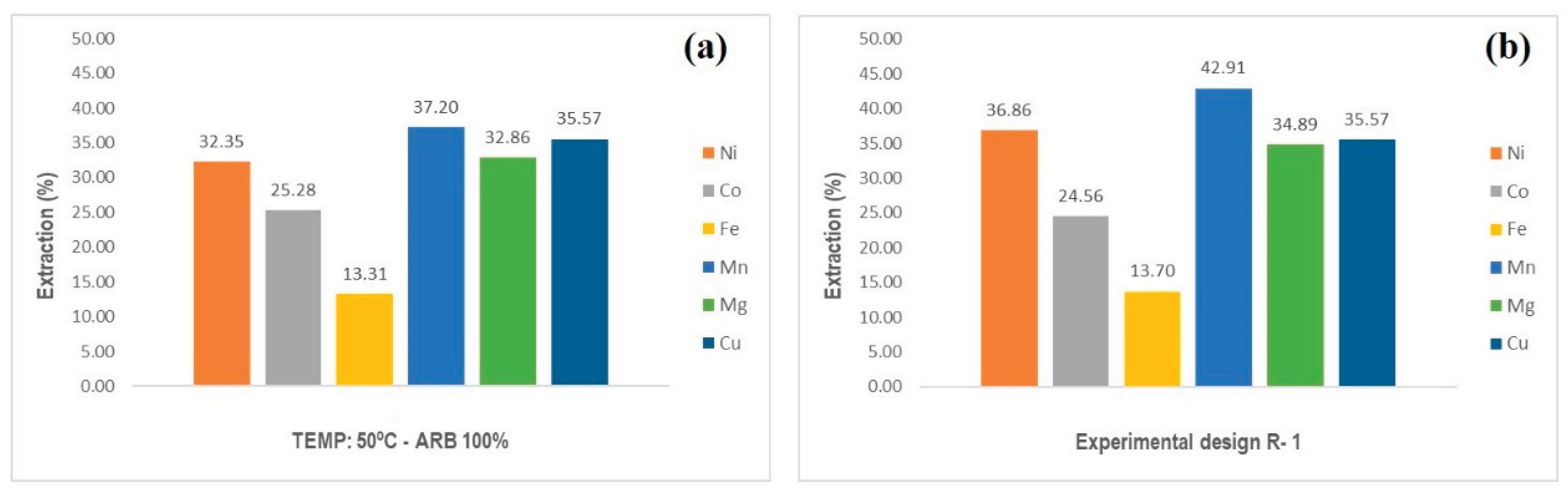
Figure 2.
Experimental design R-2 results: (a) Metal extraction; (b) Selectivity.
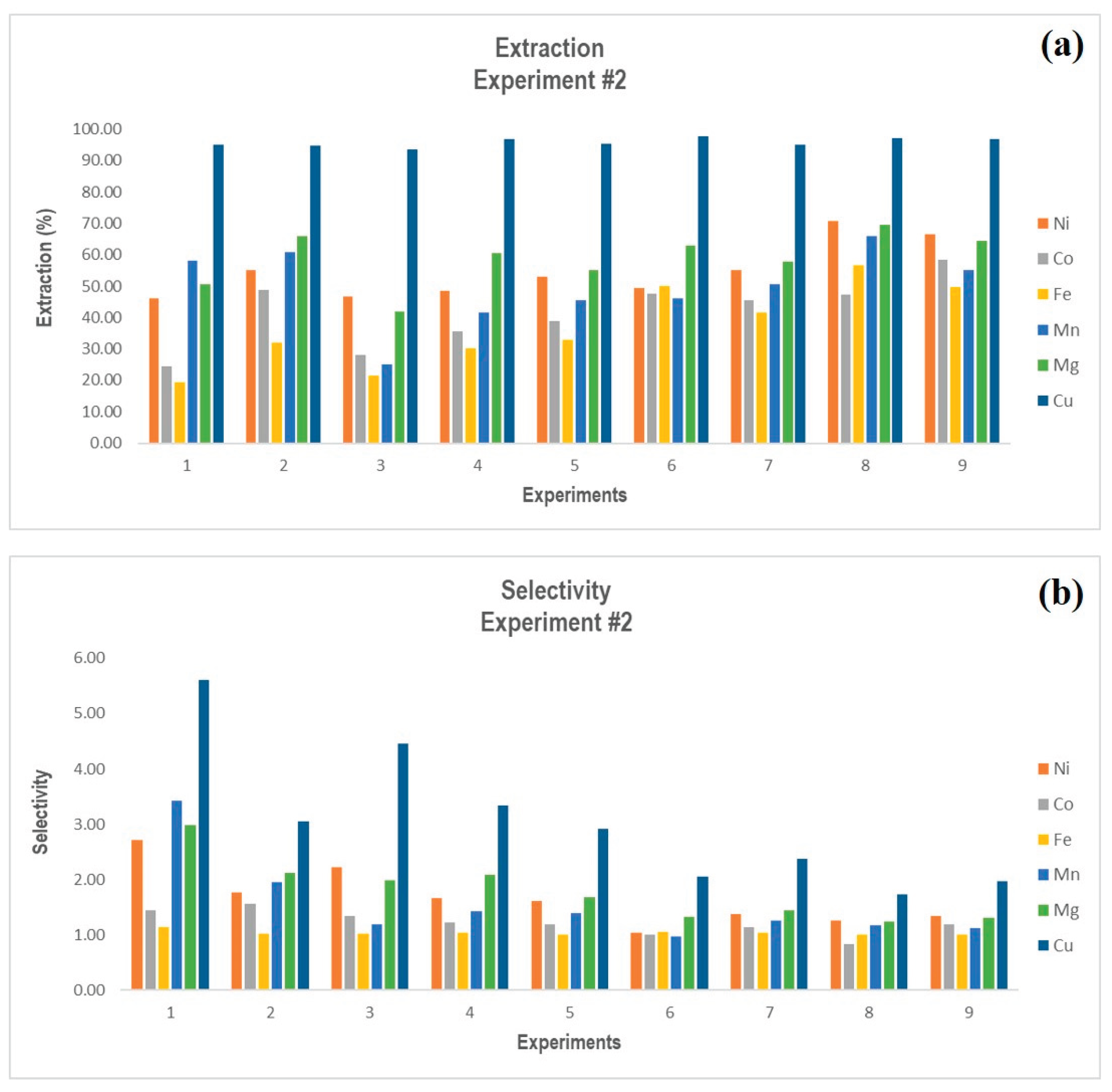
Figure 3.
Effect of leaching time on the extraction of metal species. Higher levels of temperature and L/S ratio of experimental design R-2.
Figure 3.
Effect of leaching time on the extraction of metal species. Higher levels of temperature and L/S ratio of experimental design R-2.
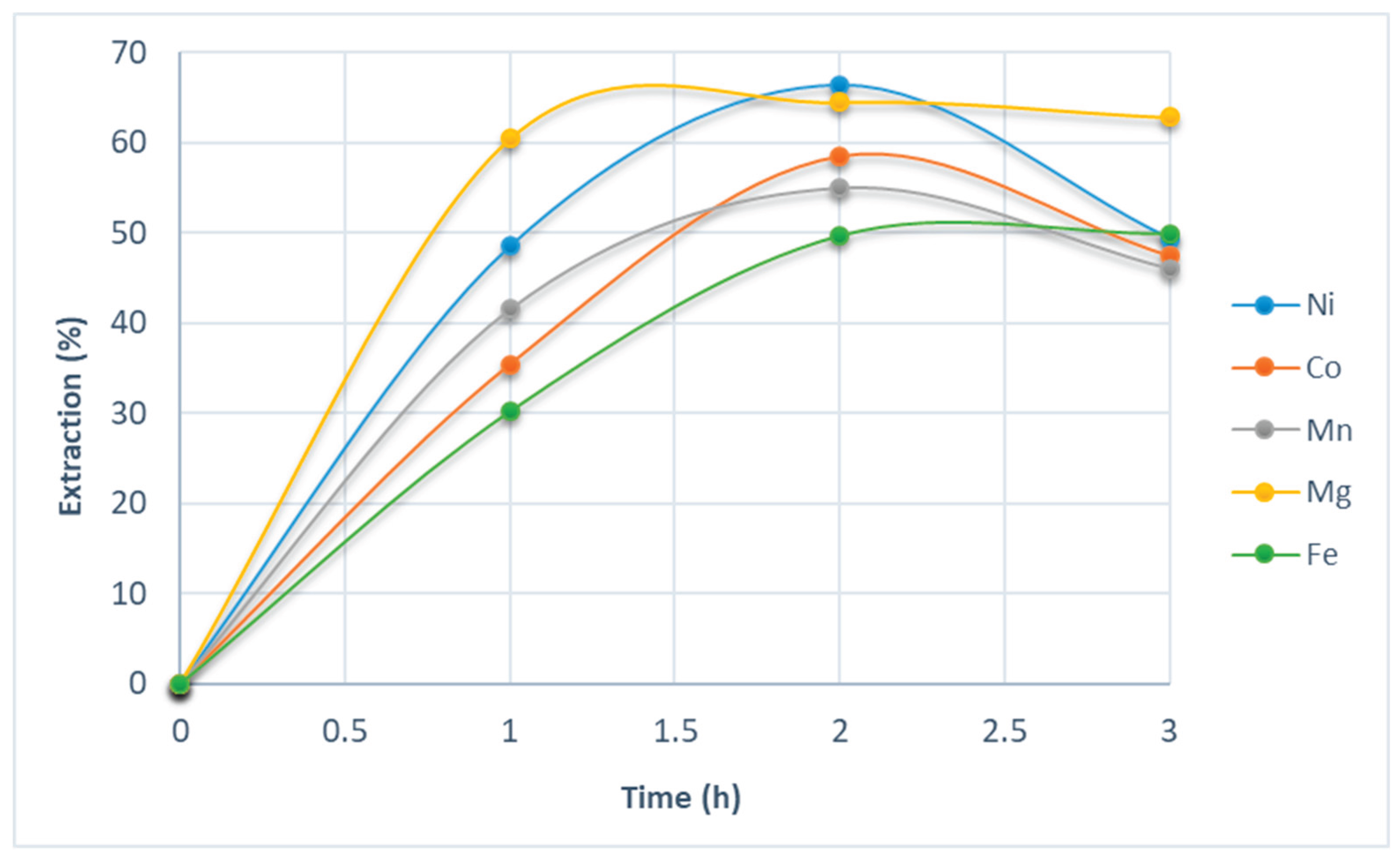
Figure 4.
Behavior for experimental design R-3 of: (a) Extraction of metallic species; (b) Selectivity.
Figure 4.
Behavior for experimental design R-3 of: (a) Extraction of metallic species; (b) Selectivity.
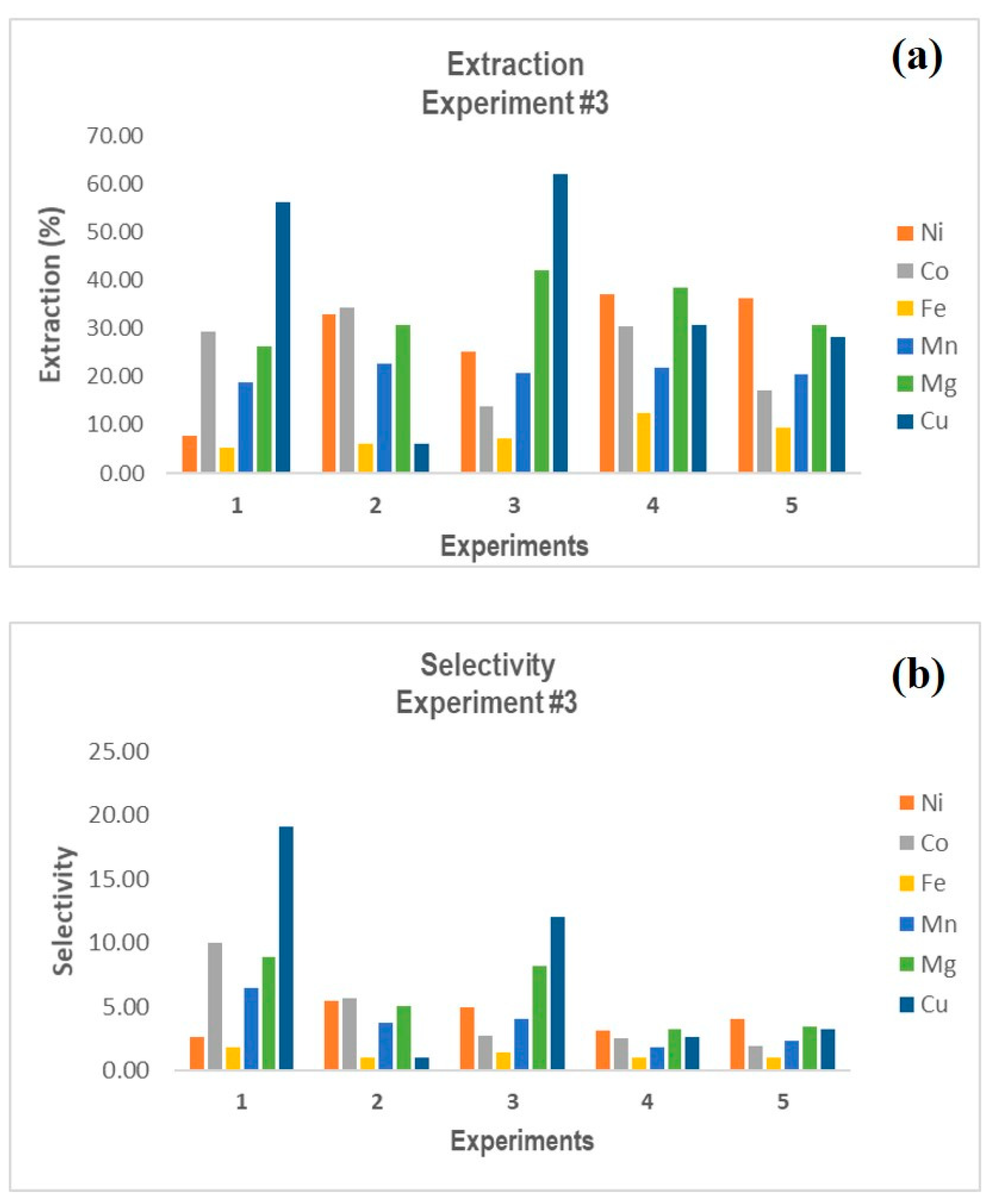
Figure 5.
XRD mineralogical phase analysis: (a) Integral sample of tailings from the acid leaching nickel extraction process. (b) Comparison of the diffractograms of the tailings before and after acid leaching.
Figure 5.
XRD mineralogical phase analysis: (a) Integral sample of tailings from the acid leaching nickel extraction process. (b) Comparison of the diffractograms of the tailings before and after acid leaching.
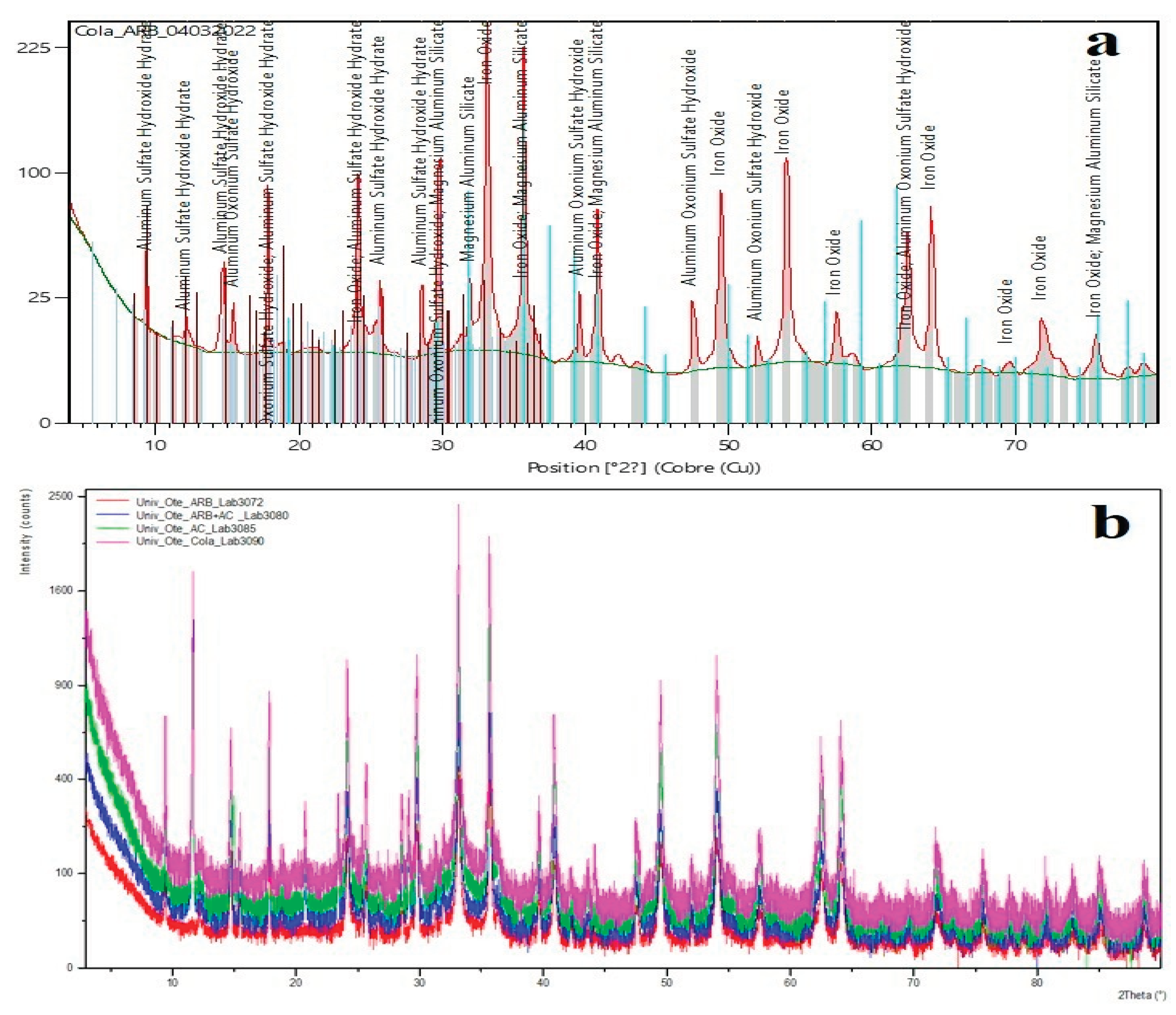

Table 1.
General design of bioextraction experiments on tailings. BRA: biological reducing agent; CA: citric acid. Size fraction used: –0.045 mm.
Table 1.
General design of bioextraction experiments on tailings. BRA: biological reducing agent; CA: citric acid. Size fraction used: –0.045 mm.
| Batch experimentsLeaching agents | |||||||||
|---|---|---|---|---|---|---|---|---|---|
| Biological reducing agent (BRA) |
Bioextraction with citric acid | ||||||||
| Experimental design R-1 (BRA) |
Experimental design R-2 (BRA +CA) |
Experimental design R-3 (Control Experiment) |
|||||||
| Exp. | T(ºC) | R(L/S) | Exp. | T(ºC) | R(L/S) | t (h) | Exp. | T(ºC) | Conct. CA (M) |
| 1 | 60 | 8 | 1 | 30 | 3 | 1 | 1 | 30 | 0,5 |
| 2 | 60 | 3 | 1 | 2 | 60 | 0,5 | |||
| 3 | 30 | 8 | 1 | 3 | 30 | 1 | |||
| 4 | 60 | 8 | 1 | 4 | 60 | 1 | |||
| 5 | 30 | 3 | 3 | 5 | 45 | 0,75 | |||
| 6 | 60 | 3 | 3 | ||||||
| 7 | 30 | 8 | 3 | ||||||
| 8 | 60 | 8 | 3 | ||||||
| 9 × 3 | 45 | 5 | 2 | ||||||
Table 2.
Initial chemical composition of filtered tailings (% in 100 g of sample).
| Chemical composition of residual tailings (%) | |||||
|---|---|---|---|---|---|
| Ni | Co | Fe | Mn | Mg | Cu |
| 0,080 | 0,011 | 43,68 | 0,079 | 0,133 | 0,014 |
Table 3.
Analysis of Variance for the response variables Nickel Extraction and Selectivity. Experimental design R-2. (95% confidence level).
Table 3.
Analysis of Variance for the response variables Nickel Extraction and Selectivity. Experimental design R-2. (95% confidence level).
| Item | A: Temp. | B:Relac. LS | C:time | AB | AC | BC | Total error | Total (corr.) | |
|---|---|---|---|---|---|---|---|---|---|
| Sum of squares | Extraction | 34.694 | 14.960 | 79.50 | 3.5 | 3.67 | 66.24 | 50.74 | 253.43 |
| Selectivity | 0.5196 | 0.0291 | 1.094 | 0.1 | 0.11 | 0.062 | 0.123 | 2.060 | |
| Gl | Extraction | 1 | 1 | 1 | 1 | 1 | 1 | 4 | 10 |
| Selectivity | 1 | 1 | 1 | 1 | 1 | 1 | 4 | 10 | |
| Mean square | Extraction | 34.694 | 14.960 | 79.50 | 3.5 | 3.67 | 66.24 | 25.05 | |
| Selectivity | 0.5196 | 0.0291 | 1.094 | 0.1 | 0.11 | 0.062 | 0.031 | ||
| F-Ratio | Extraction | 93.01 | 40.10 | 213.1 | 9.4 | 9.84 | 177.5 | ||
| Selectivity | 16.94 | 0.95 | 35.69 | 3.9 | 3.58 | 2.03 | |||
| Probable Value | Extraction | 0.0106 | 0.0240 | 0.0047 | 0.091 | 0.088 | 0.014 | ||
| Selectivity | 0.0147 | 0.3847 | 0.003 | 0.1 | 0.13 | 0.227 | |||
| Nickel Extraction | Nickel selectivity | ||||||||
| R2 = 96.485 % R2 (adjusted for l.g.) = 94.5677percent Std. error = 0.0884915 Durbin-Watson statistic = 1.66755 (P=0.3763) Residual autocorrelation of Lag 1 = -0.202252 |
R2= 94.0451 % R2 (adjusted by l.g.) = 85.1127 % Std. error of est. = 0.175128 Durbin-Watson statistic = 1.06713 (P=0.0026) Residual autocorrelation of Lag 1 = 0.5867 |
||||||||
Table 4.
Analysis of Variance for the response variables Cobalt Extraction and Selectivity. Experimental design R-2. (95% confidence level).
Table 4.
Analysis of Variance for the response variables Cobalt Extraction and Selectivity. Experimental design R-2. (95% confidence level).
| Item | A: Temp. | B:Relac. LS | C:time | AB | AC | BC | Total error | Total (corr.) | |
|---|---|---|---|---|---|---|---|---|---|
| Sum of squares | Extraction | 216.21 | 1.2090 | 222.9 | 71.2 | 56.44 | 31.72 | 19.59 | 619.32 |
| Selectivity | 0.0111 | 0.0276 | 0.187 | 0.003 | 0.011 | 0.021 | 0.171 | 0.4405 | |
| Gl | Extraction | 1 | 1 | 1 | 1 | 1 | 1 | 4 | 10 |
| Selectivity | 1 | 1 | 1 | 1 | 1 | 1 | 4 | 10 | |
| Mean square | Extraction | 216.21 | 1.2090 | 222.9 | 71.2 | 56.44 | 31.72 | 4.89 | |
| Selectivity | 0.0111 | 0.0276 | 0.187 | 0.003 | 0.011 | 0.021 | 0.085 | ||
| F-Ratio | Extraction | 44.15 | 0.25 | 45.52 | 14.5 | 11.5 | 6.48 | ||
| Selectivity | 3.14 | 7.80 | 53.07 | 0.9 | 3.14 | 6.17 | |||
| Probable Value | Extraction | 0.0027 | 0.6454 | 0.0025 | 0.019 | 0.0274 | 0.0636 | ||
| Selectivity | 0.2186 | 0.1079 | 0.0183 | 0.437 | 0.218 | 0.1310 | |||
| Cobalt Extraction | Cobalt Selectivity | ||||||||
| R2 = 96.8369 percent R2 (g.l. adjusted) = 92.09 percent Standard error of est. = 2.21303 Durbin-Watson statistic = 1.84866 (P=0.4549) Residual autocorrelation of Lag 1 = 0.00306817 |
R2 = 59.6513 percent R2 (g.l. adjusted) = 0.0 percent Std. error = 0.0595007 Durbin-Watson statistic = 0.408118 (P=0.0043) Residual autocorrelation of Lag 1 = 0.634658 |
||||||||
Table 5.
Mineralogical characteristics of the integral sample of the tailings from the acid process of nickel extraction.
Table 5.
Mineralogical characteristics of the integral sample of the tailings from the acid process of nickel extraction.
| Code Ref. | Compound Name | Chemical Formula | Mineral Name |
|---|---|---|---|
| 01-089-0596 | Iron oxide (III) | Fe2O3 | Hematite (synthetic) |
| 00-016-0409 | Aluminium oxonium hydroxyl sulphate | (H3O)Al3(SO4)2(OH)6 | Aluminium Jarosite (similar phase) |
| 00-024-0007 | Hydroxylated aluminium sulphate hydrate | Al4(SO4)(OH)10·5H2O | Basaluminite |
| 00-035-0964 | Magnesium aluminium hydroxide hydrate | Mg4Al2(OH)14·3H2O | Hydrotalcite (similar phase) |
Disclaimer/Publisher’s Note: The statements, opinions and data contained in all publications are solely those of the individual author(s) and contributor(s) and not of MDPI and/or the editor(s). MDPI and/or the editor(s) disclaim responsibility for any injury to people or property resulting from any ideas, methods, instructions or products referred to in the content. |
© 2025 by the authors. Licensee MDPI, Basel, Switzerland. This article is an open access article distributed under the terms and conditions of the Creative Commons Attribution (CC BY) license (http://creativecommons.org/licenses/by/4.0/).
Copyright: This open access article is published under a Creative Commons CC BY 4.0 license, which permit the free download, distribution, and reuse, provided that the author and preprint are cited in any reuse.


