
Submitted:
10 July 2025
Posted:
14 July 2025
You are already at the latest version
Abstract
While previous research has examined the role of team resources on team resilience from a resource-based perspective, the underlying mechanisms of team resilience emergence from a process perspective remain insufficiently discussed. Grounded in the context of VUCA era and team stress appraisal theory, we explore the mechanism through which team job insecurity influences team resilience and the contextual effects of team task characteristics. Through a three-wave questionnaire conducted with 464 employees from 96 teams, we found that team job insecurity was positively related to team challenge appraisal, which in turn positively related to team resilience. Meanwhile, team job insecurity was positively related to team hindrance appraisal, which in turn negatively related to team resilience. Furthermore, ream task interdependence reinforced the positive effect of team job insecurity on team resilience via challenge appraisal while weakened the negative effect of team job insecurity on team resilience via hindrance appraisal. Both theoretical and practical contributions were discussed.
Keywords:
team job insecurity
; team challenge appraisal
; team hindrance appraisal
; team resilience
; task interdependence
1. Introduction
With the increasing dynamics of the environment characterized by volatility, uncertainty, complexity, and ambiguity (VUCA, Millar, Groth, & Mahon, 2018), resilience has become more crucial for organizations (DesJardine et al., 2019; Dimitriadis, 2021; Sajko et al., 2021; Stoverink et al., 2020; Ortiz-de-Mandojana & Bansal, 2016). For example, Huawei—a renowned Chinese company—has developed a strategic reserve system, empowering young leaders to “lead the troops in battle”, which ensuring the organization remains passionate and dynamic. Amazon Web Service has implemented a DevOps culture, which enhances the team collaboration and ongoing improvement of team resilience. Organizational resilience refers to the adaptive capacity of organization to actively adjust to and manage pressure under the risky context (Weick et al., 1999), recover from crises or challenges, and even develop and transform in terms of organizational growth (Hillmann & Guenther, 2021). However, in the context of VUCA, organizations may confront significant challenges to their resilience due to the employees’ concerns about job insecurity, which reflects individuals’ perception of threats to their job continuity or concerns about the future stability of their job features such as salary and position (Klandermans & van Vuuren, 1999). Unfortunately, the mechanisms and boundary conditions of how team job insecurity affects team resilience remain under-investigated.
Specifically, first, previous research exploring antecedents has focused on organizational resilience but largely overlooked team resilience (e.g., Barasa et al., 2018). Empirical studies has examined the role of leadership, organizational culture, organizational support, and psychological capital in affecting organizational resilience. However, compared to organizations, teams have fewer resources and face more pronounced employee conflicts in the uncertainty (Costa, Passos, & Bakker, 2015; Hobfoll et al., 2018). Thus, conclusions drawn from research on organization resilience fail to adequately apply to explaining the formation of team resilience. Although the potential negative impact of uncertainty on team resilience has been suggested (Khuan, 2024), there is a lack of empirical evidence and in-depth theoretical discussion.
Second, researchers have predominantly focused on the resource-based perspective, leaving a limited understanding of the cognitive mechanisms through which job insecurity impacts team resilience. Based on resource conservation theory (Hobfoll, 1989), existing research has suggested that digital technologies provide teams with resources to manage uncertain events, which enhances team resilience (Miceli et al., 2021). However, in the era of VUCA, team members typically possess a high degree of job insecurity (Wilson, Lee, Fitzgerald, Oosterhoff, Sevi, & Shook, 2020; Wang, Le Blanc, Demerouti, Lu, & Jiang, 2019). In this context, on the one hand, team members may focus more on the potential growth and benefits in the challenge (Griffin, & Grote, 2020) and proactively confront environmental stress, which in turn strengthens team resilience. On the other hand, they may also pay more attention to the potential losses and harms with threats (Mitchell et al., 2019), which corresponds to hindrance appraisal, provoking negative emotion-driven responses that diminish team resilience. Despite these insights, there remains a significant gap in our understanding of the mechanism of job insecurity on team resilience from the perspective of stress appraisal.
Third, employees in teams with different task characteristics may adopt different coping strategies for job insecurity (Lazarus & Folkman, 1984), leading to differing levels of team resilience. Team task interdependence refers to the extent to which employees interact with or rely on other team members in terms of information, resources, and technologies to complete the tasks (Courtright et al., 2015; Parker, 2014). We propose that when the level of team task interdependent is high, team members are more likely to cooperate with others to cope with the challenges or threats, which enhances team resilience. However, research on the boundary conditions through which team job insecurity affects team resilience via stress appraisal from the perspective of team tasks characteristics remains to be expanded.
Taken together, drawing on team stress appraisal theory, this study examines the mechanisms and boundary conditions through which team job insecurity influences team resilience via team stress appraisal (See FIGURE 1). We make three key contributions to the research on team resilience. First, focusing on the VUCA context, we investigate the role of team job insecurity in shaping team resilience, thereby enriching the antecedent research of team resilience and validates the propositions of prior qualitative research (Lumpkin & Dess, 2001). Second, based on team stress appraisal theory, we explore the team challenge appraisal and hindrance appraisal as two key mediators, fulfilling the understanding of mechanisms through which job insecurity impacts team resilience. Third, by further introducing team task interdependence, we develop a moderated mediation model to illustrate the boundary conditions under which team job insecurity affects team resilience. The conclusions of our study offer valuable insights for team leaders to deal with job insecurity and enhance team resilience. The full model is as follows:
2. Hypotheses Development
2.1. Team Job Insecurity, Team Challenge Appraisal and Hinderance Appraisal
In the current society characterized by fierce competition and rapid change, individuals perceive heightened job insecurity with the heightened demands of knowledge and skills (Hellgren, & Sverke, 2003; Wang, Le Blanc, Demerouti, Lu, & Jiang, 2019; Wilson, Lee, Fitzgerald, Oosterhoff, Sevi, & Shook, 2020). Especially when team resources are more constrained than those at the organization level, individuals are more likely to worry about the stability and consistency of resources such as job opportunities, financial rewards, career development prospects, and social supports (Jiang & Lavaysse, 2018). However, the perception of resource losses can lead to the psychological stress responses with the desire to protect their resources (Hobfoll, 2011).
We expect that team job insecurity is positively associated with team challenge appraisal. Challenge appraisal is predominantly defined as individuals perceiving job stressors as favorable, believing they can overcome them and that they will benefit their career progression (Webster, Beehr, & Love, 2011). Job insecurity stimulates proactive individuals to interpret challenging task and uncertainty as the opportunities to promoting their abilities and career capital (Aryee, Chay, & Chew, 1996). Thus, these individuals devote more efforts to work and learn new skills to enhance their competitiveness. Previous studies have shown that complex and dynamic tasks create learning and growing opportunities for employees and invoke their curiosity, excited emotions, and job engagement (Griffin & Grote, 2020; Cullinane et al., 2013). Additionally, research has also indicated that when individuals believe they have the ability and resources to cope with the job threats and benefits from them, they are more likely to have challenge appraisal to the stressors and uncertainty (Jerusalem & Schwarzer, 1992; Lazarus & Folkman, 1984; Li et al., 2018) and proactively mobilizing their resources to take effective actions to manage the situation (Lazarus & Folkman, 1984). Therefore, we hypothesize:
H1a:
Team job insecurity is positively associated with team challenge appraisal.
We speculate that team job insecurity also be positively associated with team hindrance appraisal. Hindrance appraisal is described as individuals perceiving job stressors as unfavorable, believing they are difficult to overcome, which obstructs career progression (Ma, Peng, & Wu, 2021). The fear and anxiety induced by job insecurity may cause pessimistic individuals to view this stressor as a threat to career development. Specifically, such individuals may be concerned about failing to meet the teams’ requirements and expectations of their teams, which in turn increase their perception of heightened hindrance-related stress from work processes, task conflict, and organizational change (Sverke, Hellgren, & Näswall, 2002). Furthermore, the uncontrollability of environment leads these individuals to pay more attention to the difficulties and potential losses or failures (Mitchell et al., 2019). Especially when resources are insufficient to cope with job insecurity, they may experience negative emotions (Sverke et al., 2002; Wang, 2015) and work-life imbalance (Bell, Rajendran, & Theiler, 2012), thereby leading to team hindrance appraisal. The literature indicates that when individuals perceive a loss of control at work, they may experience anxiety and find it difficult to accurately assess the consumption of work resources and the corresponding returns (Liu, Li, Taris, & Peeters, 2022). This lead them to reduce their willingness to proactively take on extra tasks and become resistance to new job demands (Dane, 2018). Thus, we propose:
H1b:
Team job insecurity is positively associated with team hindrance appraisal.
2.2. Mediating Role of Team Challenge Appraisal and Hinderance Appraisal
We expect that team job insecurity will positively impact team challenge appraisal, which in turn enhances team resilience. When team members perceive a high level of job insecurity, proactive individuals may realize that both opportunities and challenges are present. This mindset will motivate them to actively embrace complex tasks (Tu et al., 2024;Piccoli, Reisel, & De Witte, 2021). Moreover, team members may harness energy and passion despite limited resources and time (Kavussanu, Dewar, & Boardley, 2014) to deal with challenges, enhance the team’s ability to handle diverse complex situations, and achieve team goals (Kaplan, LaPort, & Waller, 2013). These efforts collectively contribute to team resilience. Research has indicated that insecurity within the team work environment could cultivate empathy and a collaborative spirit, strengthening team cohesion (Hu et al., 2018). Additionally, the positive emotionality within the team boosts team resilience through team reciprocity and self-reflection (Hartmann et al., 2021; Meneghel et al., 2016). Thus, we further propose:
H2a:
Team challenge appraisal mediates the relationship between team job insecurity and team resilience.
Team job insecurity may also positively influence team hindrance appraisal, which in turn decreases team resilience. When confronted with job insecurity, competition for scarce resources within the team will intensify. Thus, team members may feel under pressure, a loss of control, and anxiety (Bao & Zhong, 2021; De Witte, 1999). These feelings undermine the harmonious team climate (Costa et al., 2015). In contrast, team members will focus on their individual survival and performance rather than team goals, decreasing team collaborative desire and team cohesion. Previous research has noted that team job insecurity can lead employees to adopt defensive and avoidance behaviors, such as limiting information sharing and cooperation (Hsu & Chang, 2014; Nifadkar & Bauer, 2016). Studies have also indicated that hindrance stressors can significantly influence negative emotions, such as anxiety and worry, as well as emotional exhaustion (Rodell & Judge, 2009; Charkhabi, 2019), diminish team members’ organizational identification, and promote counterproductive behaviors (Piccoli, Reisel, & De Witte, 2021; Jiang & Probst, 2016). Therefore, we hypothesize:
H2a:
Team hindrance appraisal mediates the relationship between team job insecurity and team resilience.
2.3. Moderating and Moderated Mediating Effects of Team Task Interdependence
We further expect that team task interdependence is an important contextual variable in the indirect relationship between team job insecurity and team resilience. When task interdependence is high, team members realize that they cannot complete the task solely by relying on the information and resources at their disposal. They must rely on each other’s expertise, information, and resources to collaborate in addressing challenging tasks and sharing team results (Courtright et al., 2015). Therefore, they will proactively engage in interactions and contacts among team members (e.g., Courtright et al., 2015), promoting team effectiveness (Van der Vegt & Van de Vliert, 2005) and team cohesion.
In the face of job insecurity, teams perceive their environment as offering opportunities to build competitive advantage, such as developing new core competencies and increasing market share, and thus have a high level of challenge pressure and tend to invest more effort in improving the team’s competitiveness (e.g., Wolf, Eys, Sadler, & Kleinert, 2015). when the level of team task interdependence is high, team members perceive the improvement of the team’s overall competence as the basis for the realization of their self-interests, and thus tend to take the initiative to work for the improvement of the team (e.g., Le Blanc, González-Romá, & Wang, 2021), in this case, organizations are more likely to gather resources and synchronize actions to confront stressors and emergencies, demonstrating a high level of resilience (Kahn et al., 2018). leading to the strengthening of team resilience. In support of our proposal, research has indicated that task interdependence increases the positive attitude towards team members (Ramamoorthy & Flood, 2004), stimulating citizenship behaviors and other interactive behaviors within the team (Bachrach et al., 2006). Thus, we propose:
H3a:
Team task interdependence moderates the relationship between team job insecurity and team challenge appraisal. Specifically, when the level of team task interdependence is high, this relationship will be stronger.
H3b:
Team task interdependence moderates the indirect effect of team job insecurity on team resilience via team challenge appraisal. Specifically, when the level of team task interdependence is high, this indirect effect will be stronger.
In the face of job insecurity, team members recognize the scarcity of resources and fear that they will not be able to achieve the team’s goals, resulting in a loss of interest among members, which generates negative emotions and thus higher ratings of obstructive stress. At this point, when team task interdependence is high, team members recognize that strengthening team communication and improving team performance are key ways to avoid negative outcomes, team members will alter their negative and avoidant attitudes, engage in collaboration with each other, and effectively reduce the burden of individual work pressure and the need to deal with difficult work issues (LePine et al., 2005). These actions further boost the team’s ability to handle difficulties and its overall resilience (Barton & Kahn, 2019; Varajão et al., 2021). Existing research has suggested that resilient team members are better able to handle stress (Varajão et al., 2021) and promote team performance (Van der Beek et al., 2015) when work problems are highly complex and likely to cause conflict (Varajão et al., 2021). Thus, we hypothesize:
H4a:
Team task interdependence moderates the relationship between team job insecurity and team hindrance appraisal. Specifically, when the level of team task interdependence is high, this relationship will be weaker.
H4b:
Team task interdependence moderates the indirect effect of team job insecurity on team resilience via team hindrance appraisal. Specifically, when the level of team task interdependence is high, this indirect effect will be weaker.
3. Method
3.1. Samples and Procedures
532 employees of the first-line 114 production team of a manufacturing group company in a province on the east coast of China participate in this study. The city’s manufacturing industry, which relies predominantly on foreign trade, has experienced significant challenges due to the deterioration of the trade situation. This has led to a notable decline in sales volume, causing widespread feelings of job insecurity among the production team working at the front line. Consequently, the sample of the study demonstrated a high degree of alignment with the research question. The data collection process of the present study can be divided into the following steps: firstly, the random selection of the study sample. We first obtained the support of the company to get the list of employees from the Human Resources Department and randomly selected the sample from them. Secondly, the purpose of the study was informed. The subjects were informed that the content of the questionnaire pertains to the survey team’s resilience, that its completion is intended to contribute to the development of a scientific research paper, and that the results of the questionnaire will be utilized exclusively for academic research. It was emphasized that the questionnaire is designed to provide an overall analysis and will not disclose any personal information or be associated with individual salaries or performance evaluations. The ultimate sample size is contingent upon the employees’ consent to participate in the study. Thirdly, a randomized questionnaire was conducted. In order to address any issues that might arise during the questionnaire process, two supervisors from human resources and two members of the research team collaborated on the entire questionnaire distribution and collection process.
In order to effectively avoid common method bias (Podsakoff, MacKenzie, Lee, & Podsakoff, 2003), this study conducted a three-wave time lagged data collection. Specifically, at the first time point, employees were asked to report their job insecurity, as well as their demographic variables. Two weeks later, at the second time point, employees were asked to report their challenging and hindrance appraisal, and task interdependence. Finally, two weeks later, at the third time point, employees were asked to report perceived team resilience. The present study was a team-level study and therefore the individual-level measures of perceived job insecurity, challenging and hindrance appraisal, perceived task interdependence and perceived team resilience were ultimately aggregated.
During the first round of data collection, we distributed a total of 532 questionnaires to 114 teams, and 511 questionnaires were returned (106 teams, response rate 96.05%). In the second round of data collection, we distributed 511 questionnaires (106 teams), and 486 questionnaires were returned (103 teams, response rate 95.10%). In the third round of data collection, we distributed 486 questionnaires (103 teams), and 464 questionnaires were returned (96 teams, response rate 95.47%). Due to the effective controlling in questionnaire process, the questionnaire recovery rate is relatively high, and the final valid questionnaires are 464 (96 team) after matched. In the sample of this study, the male employees are 199 (42.9%); the average age of the sample is 35.11 years (SD = 9.61). There were 330 employees with high school education and above (71.10%); the average tenure of the sample was 9.12 years (SD = 7.53).
3.2. Measures
In this study, all measures were administered in Chinese, following the translation/back-translation process to maintain their validity (Brislin, 1980). To avoid common method bias, the measurement of all variables items was conducted utilizing a 5-point Likert scale rating method (1 = strongly disagree, 5 = strongly agree), with the exception of job insecurity, and task interdependence item, which was evaluated through a 7-point Likert scale (1=strongly disagree, 7=strongly agree).
Job Insecurity. We used De Witte’s four-item Job Insecurity Scale (De Witte, 2000; Vander Elst, De Witte, & De Cuyper, 2014) to measure employees job insecurity. Sample question items such as “I feel insecure about the future of my job” (α =.75) and aggregation statistics supported aggregating to the team level: ICC1 = .15, ICC2 = .46; the mean of rwg (j) = .75 (James,Demaree, &Wolf, 1984).
Challenge and hindrance appraisals. We used Prem et al. (2017) six-item to measure employees challenge and hindrance appraisal. It has been demonstrated that the scale demonstrates excellent reliability (Lu, Kluemper, & Tu, 2023). Three of the items were used to measure challenging appraisal, with sample items such as “I view my tasks as challenging”(α =.74). The aggregation statistics supported aggregating to the team level: ICC1 = .16, ICC2 = .47; the mean of rwg (j) = .86. The other three items were used to measure hinderance appraisal, with sample items such as “my work hinders me from attaining personal goals”(α =.82), and the results of aggregation statistics supported aggregating to the team level: ICC1 = .34, ICC2 = .72; the mean of rwg (j) = .82.
Team resilience. We used three items developed by Kantur and Say (2015) to measure team resilience. Sample question items such as “we develop alternatives in order to benefit from negative circumstances” (α = .83), and the aggregation statistics supported aggregating to the team level: ICC1 = .32, ICC2 = .70; the mean of rwg (j) = .86.
Task interdependence. We used five-items scale developed by Van der Vegt and Janssen (2003) to measure task interdependence. Sample items such as “My colleagues need information and advice from me to perform their jobs well (α =.79), and the aggregation statistics supported aggregating to the team level: ICC1 = .48, ICC2 = .82; the mean of rwg (j) = .80.
3.3. Data Analysis Strategy
Due to team-level nature of this study, we firstly aggregated the individual-level variable measures into team level. Secondly, by using of the Mplus7.0 (Muthén & Muthén, 2017), we test the indirect effect of team job insecurity on team resilience via team challenge appraisal, and team hinderance appraisal, respectively. Third, we conducted a Monte Carlo sampling method to estimate the confidence intervals for these indirect effects (Preacher, Zyphur, & Zhang, 2010). Finally, we test the moderating effects of task interdependence, plot the simple slope of this moderation effect, and tested the moderated mediation effect of task interdependence, and conducted a Monte Carlo sampling method to estimate the confidence intervals for these moderated mediation effects.
4. Results
We conducted conformative factor analysis by using of Mplus 7.0 (Muthén & Muthén, 2012). The results of the 5-factor model fit well (χ2 = 266.96,df = 125,p < 0.00,CFI = 0.95,TLI=0.93,RMSEA = 0.05,SRMR = 0.04), and better than alternative model (four-fator model, collapsing challenge appraisal and hinderance appraisal, χ2 = 755.63,df = 129,p < 0.00,CFI = 0.76,TLI=0.72,RMSEA = 0.10,SRMR = 0.09; three-fator model, collapsing team challenge appraisal, team hinderance appraisal and team resilience, χ2 = 1035.22, df = 132,p < 0.00,CFI = 0.66,TLI=0.60,RMSEA = 0.12,SRMR = 0.11, which provides evidence that the variables in this research have good discriminant validity. The means, variances and correlations of the variables are displayed in Table 1. The findings indicated a positive correlation between team job insecurity and challenging appraisal (r = .30, p < .01) and team hinderance appraisal (r = .27, p < .01). Further, team challenge appraisal was positive with team resilience (r = .43, p < .01), and team hinderance appraisal was negative association with team resilience (r = –.38, p < .01), which basically support the hypotheses in this study.
4.1. Mediation Effects Test
Hypotheses 1a and 2a suggest that team job insecurity is positively associated with team challenge appraisal, and team challenge appraisal mediates the indirect effect of team job insecurity on team resilience. The results showed that team job insecurity was positive related to team challenge appraisal (β = .22, p < .01, See Table 2), and that the indirect effect of team job insecurity on team resilience via team challenge appraisal was significant (.13, 95% CI [.028, .227]). By using of Monte Carlo simulations method (Preacher, Zyphur, & Zhang, 2010), the results showed that the 95% confidence interval (20,000 repetitions) for this indirect effect did not contain zero (CI [.037, .237]), thus, Hypothesis 1a and Hypothesis 2a were supported.
Based on the same test procedure, the results indicated that team job insecurity was positive related to team hindrance appraisal (β = .31, p < .05, See Table 2), and that the indirect effect of team job insecurity on team resilience through team hindrance appraisal was significant (–.12, 95% CI [–.220, –.021]); therefore, Hypothesis 1b and Hypothesis 2b were supported.
4.2. Moderation Effect and Moderated Mediation Effect Test
Hypotheses 3a argues that task interdependence moderates the relationship between team insecurity and team challenge appraisal, and moderates the relationship between team insecurity and team hindrance appraisal. The results showed that the effect of team job insecurity on team challenge appraisal was positively significant (.80, SE = .17, 95% CI [.477, 1.124], see Table 3, Figure 2) for teams with high level of task interdependence (+1 SD), however, this effect was non-significant (.29, SE= .18, 95% CI [–.062, .644]) for team with low level of task interdependence (–1 SD), and there was a significant difference in the relationship between team job insecurity on team challenge appraisal when task interdependence were high versus low (.51, SE = .23, 95% CI [.052, .968]). The Monte Carlo simulations showed that the confidence interval for this indirect effect not contain zero (20,000 repetitions, 95% CI [–.233, –.031]), thus, Hypothesis 3a was supported.
The results indicated that the effect of team job insecurity on team hindrance appraisal was positively significant (–.54, SE = .10, 95% CI [–.728, –.349], see Table 3, Figure 3) for teams with low level of task interdependence (–1 SD), however, this effect was non-significant (–.20, SE = .11, 95% CI [–.423, .015]) for team with high level of task interdependence (+1 SD), and there was a significant difference in the effect of team job insecurity on team hindrance appraisal when task interdependence were high versus low (.34, SE = .14, 95% CI [.062, .609]), therefore, Hypothesis 4a was supported.
Hypotheses 3b and 4b propose that task interdependence enhance the indirect effect of team insecurity on team resilience through team challenge appraisal, and enhance the indirect effect of team insecurity on team resilience via team hindrance appraisal. The results indicated that the indirect effect of team insecurity on team resilience via team challenge appraisal was non-significant (γ = .11, SE = .06, 95% CI [–.012, .234]). Specifically, this indirect effect was significant for teams with a high level of task interdependence (+1 SD, γ = .18, SE = .07, 95% CI [.042, .307], see Table 3), however, this indirect effect was non-significant for teams with low level of task interdependence (–1 SD, γ = .06, SE = .04, 95% CI [–.024, .151]). However, the Monte Carlo simulations showed that the confidence interval for this moderated effect not contain zero (20,000 repetitions, 95% CI [.005, .193), supporting Hypotheses 3b.
Meanwhile, the indirect effect of team insecurity on team resilience via team hindrance appraisal was non-significant (γ = .11, SE = .06, 95% CI [–.009, .220], see Table 3), for teams with a low level of task interdependence (–1 SD, γ = –.17, SE = .07, 95% CI [–.304, –.034], see Table 3), however, this indirect effect was non-significant for teams with high level of task interdependence (+1 SD, γ = –.06, SE = .04, 95% CI [–.147, .019]). However, the Monte Carlo simulations showed that the confidence interval for this moderated effect not contain zero (20,000 repetitions, 95% CI [.008, .182), supporting Hypotheses 4b.
5. Discussion
Derived from a questionnaire survey conducted on 96 teams and 464 employees, we conclude that team job insecurity can increase team challenge appraisal, which in turn enhances team resilience. Meanwhile, team job insecurity can disrupt team resilience through team hindrance appraisal. Furthermore, team task interdependence strengthens the positive relationship between challenge appraisal and team resilience, while mitigating the negative correlation between hindrance appraisal and team resilience. These findings have several important theoretical contributions and practical implications.
5.1. Theoretical Contributions and Practical Implications
First, in the context of the VUCA era, this study examines the impact of team job insecurity on team resilience, thereby advancing research on the antecedents of team resilience. Previous studies have explored the antecedents of organizational resilience, such as team resources (Hartwig, Clarke, Johnson, & Willis, 2020) and team structure (Chapman, Lines, Crane, Ducker, Ntoumanis, Peeling, & Gucciardi, 2020). However, there has been limited focus on the antecedents of team resilience (Barasa et al., 2018). As global competition intensifies, market demands shift rapidly, and unexpected crises frequently impact organizations, team members are generally experiencing a high level of job insecurity. Therefore, within the context of the VUCA era, this study examines the relationship between team job insecurity and team resilience, enriching research on the antecedents of team resilience.
Second, focusing on team processes, we reveal the mechanism through which team job insecurity influences team resilience. We introduce team stress appraisal theory to examine the (Lazarus, DeLongis, Folkman, & Gruen, 1985) diverse effects of team job insecurity on team resilience, which deepens our understanding of the mechanisms through which team job insecurity affects team resilience. Specifically, our findings show that team job insecurity enhances team resilience via team challenge appraisal, while decreasing team resilience via team hindrance appraisal. This conclusion expands upon previous research based on motivation logic, with scholars suggesting that team job insecurity negatively affects employees’ organizational citizenship behavior (Callea, Urbini, & Chirumbolo, 2016) and reduces work engagement (Lee, Sim, & Tuckey, 2024), thereby diminishing team resilience. Therefore, our study contributes to exploring the “black box” of the process through which job insecurity affects team resilience.
Third, by showing the moderating effect of team task interdependence, we broaden the understanding of the boundary conditions that influence the effect of team stress appraisal on team resilience. Research focusing on leadership characteristics has shown that leaders with a performance goal orientation reduce the positive effect of team voice on team resilience (Fisher, LeNoble, & Vanhove, 2023). Additionally, studies examining team climate characteristics suggest that a diverse leadership environment can amplify the influence of inclusive leadership on team resilience (Hundschell, Backmann, Tian, & Hoegl, 2024). In contrast to these studies, we focus on team task characteristics, with findings showing that team task interdependence enhances the positive relationship between team job insecurity and team resilience via team challenge appraisal, while decreasing the negative relationship between team job insecurity and team resilience via team hindrance appraisal. Therefore, our study expands the explanatory power of team resilience and advances our knowledge of the contextual mechanisms through which team job insecurity affects team resilience.
The current research also provides important practical implications. First, our study finds that team challenge appraisal exerts a positive effect on team resilience, while team hindrance appraisal negatively impacts team resilience. Thus, team managers can highlight the demands for knowledge and skills from team members in job design and provide support through training to continuously improve the work skills of team members. These practices can heighten team members’ challenge appraisal while diminishing hindrance appraisal, which in turn enhances team resilience. Second, in the context of the VUCA era, managers should pay more attention to team members’ job insecurity, ensuring employees realize that the influence of job insecurity can be shaped by individual cognition. Managers can maximize the positive effect of team job insecurity by promoting team members’ efficacy and perception of support, such as involving them in decision-making processes, offering timely feedback on their work, and providing resources that continuously improve their willingness and ability to collaborate. Third, managers can enhance the positive impact of team job insecurity on team resilience by redesigning jobs to promote team task interdependence. For example, managers can encourage team collaboration by strengthening the connections between team tasks and setting team-based performance indicators.
5.2. Limitations and Future Directions
Several limitations to the present study should be noted. First, there may exist alternative mechanisms that explain the effect of team job insecurity on team resilience, such as resource conservation theory. Team job insecurity may depletes substantial cognitive resources from team members in their daily tasks. To preserve essential resources for dealing with unexpected events, employees may engage in knowledge hiding behaviors, which lower team innovation and, consequently, negatively impact team resilience. Therefore, future research can expand the mechanisms through which team job insecurity impacts team resilience based on resource conservation theory. Second, this study identifies the moderating role of team task interdependence from the perspective of task characteristics, while other boundary conditions remain to be explored. For example, leadership traits may be another important perspective. Transformational leadership has a role-model effect, and when employees observe their leaders engaging in job crafting, they are likely to imitate this behavior (Hetland, Hetland, Bakker, & Demerouti, 2018). Employee’s cognitive job crafting can change their cognition of their work stress, thereby influence the effect of job insecurity on diverse appraisal process. Future research is needed to exam these assumption. Despite these limitations, our study contributes to the initial exploration of the antecedents, mechanisms, and boundary conditions of team resilience.
6. Conclusion
Using a three-wave survey design, the current research demonstrates that team challenge appraisal mediates the positive effect of team job insecurity on team resilience, while team hindrance appraisal mediates the negative effect of team job insecurity on team resilience. Team task interdependence plays a positive role throughout the entire mechanism. Specifically, team task interdependence strengthens the positive indirect effect of team job insecurity on team resilience via team challenge appraisal, while weakening the negative indirect effect of team job insecurity on team resilience via team hindrance appraisal. These findings highlight the significance of managing team job insecurity in the VUCA environment and offer valuable managerial insights for fostering team resilience.
References
- Bachrach, D. G., Powell, B. C., Collins, B. J., & Richey, R. G. (2006). Effects of task interdependence on the relationship between helping behavior and group performance. Journal of Applied Psychology, 91(6), 1396–1405. [CrossRef]
- Bao, Y., & Zhong, W. (2021). Public service motivation matters: examining the differential effects of challenge and hindrance stressors on organizational identification and turnover intention. Public Management Review, 23(4), 545–566. [CrossRef]
- Barasa, E., Mbau, R., & Gilson, L. (2018). What is resilience and how can it be nurtured? A systematic review of empirical literature on organizational resilience. International Journal of Health Policy and Management, 7(6), 491–503. [CrossRef]
- Barton, M. A., & Kahn, W. A. (2019). Group resilience: The place and meaning of relational pauses. Organization Studies, 40(9), 1409–1429. [CrossRef]
- Bell, A. S., Rajendran, D., & Theiler, S. (2012). Job stress, wellbeing, work–life balance and work–life conflict among Australian academics. E-Journal of Applied Psychology, 8, 25–37. [CrossRef]
- Brislin, R. W. (1980). Translation and content analysis of oral and written material. In H. C. Triandis & J. W. Berry (Eds.), Handbook of Cross–cultural Psychology (Vol. 2, pp. 389– 444). Boston, MA: Allyn & Bacon.
- Chapman, M. T., Lines, R. L., Crane, M., Ducker, K. J., Ntoumanis, N., Peeling, P., ... & Gucciardi, D. F. (2020). Team resilience: A scoping review of conceptual and empirical work. Work & Stress, 34(1), 57–81. [CrossRef]
- Charkhabi, M. (2019). Quantitative job insecurity and well-being: Testing the mediating role of hindrance and challenge appraisals. Frontiers in Psychology, 9, 2776. [CrossRef]
- Costa, P. L., Passos, A. M., & Bakker, A. B. (2015). Direct and contextual influence of team conflict on team resources, team work engagement, and team performance. Negotiation and Conflict Management Research, 8(4), 211–227. [CrossRef]
- Cullinane, S. J., Bosak, J., Flood, P. C., & Demerouti, E. (2013). Job design under lean manufacturing and its impact on employee outcomes. Organizational Psychology Review, 3(1), 41–61. [CrossRef]
- De Witte, H. (1999). Job insecurity and psychological well-being: Review of the literature and exploration of some unresolved issues. European Journal of work and Organizational Psychology, 8(2), 155–177. [CrossRef]
- De Witte, H. (2000). Arbeidsethos en jobonzekerheid: Meting en gevolgen voor welzijn, tevredenheid en inzet op het werk [Work ethic and job insecurity: Measurement and consequences for well-being, satisfaction, and performance at work]. In R. Bouwen, K. De Witte, H. De Witte, & T. Taillieu (Eds.), Van groep naar gemeenschap (pp. 325–350). Leuven: Garant.
- DesJardine, M., Bansal, P., & Yang, Y. (2019). Bouncing back: Building resilience through social and environmental practices in the context of the 2008 global financial crisis. Journal of Management, 45(4), 1434–1460. [CrossRef]
- Dimitriadis, S. (2021). Social capital and entrepreneur resilience: Entrepreneur performance during violent protests in Togo. Strategic Management Journal, 42(11), 1993–2019. [CrossRef]
- Folkman, S., & Lazarus, R. S. (1985). If it changes it must be a process: study of emotion and college during three stages of a college examination. Journal of Personality and Social Psychology, 48(1), 150–170.
- Griffin, M. A., & Grote, G. (2020). When is more uncertainty better? A model of uncertainty regulation and effectiveness. Academy of Management Review, 45(4), 745–765. [CrossRef]
- Hartmann, S., Weiss, M., Hoegl, M., & Carmeli, A. (2021). How does an emotional culture of joy cultivate team resilience? A socicognitive perspective. Journal of Organizational Behavior, 42(3), 313–331. [CrossRef]
- Hartwig, A., Clarke, S., Johnson, S., & Willis, S. (2020). Workplace team resilience: A systematic review and conceptual development. Organizational Psychology Review, 10(3-4), 169–200. [CrossRef]
- Hellgren, J., & Sverke, M. (2003). Does job insecurity lead to impaired well-being or vice versa? Estimation of cross-lagged effects using latent variable modelling. Journal of Organizational Behavior: The International Journal of Industrial, Occupational and Organizational Psychology and Behavior, 24(2), 215–236. [CrossRef]
- Hetland, J., Hetland, H., Bakker, A. B., & Demerouti, E. (2018). Daily transformational leadership and employee job crafting: The role of promotion focus. European Management Journal, 36(6), 746–756. [CrossRef]
- Hillmann, J., & Guenther, E. (2021). Organizational resilience: a valuable construct for management research?. International Journal of Management Reviews, 23(1), 7–44. [CrossRef]
- Hobfoll, S. E. (1989). Conservation of resources: a new attempt at conceptualizing stress. American psychologist, 44(3), 513–524.
- Hsu, M. H., & Chang, C. M. (2014). Examining interpersonal trust as a facilitator and uncertainty as an inhibitor of intra-organisational knowledge sharing. Information Systems Journal, 24(2), 119–142. [CrossRef]
- Hu, J., Erdogan, B., Jiang, K., Bauer, T. N., & Liu, S. (2018). Leader humility and team creativity: The role of team information sharing, psychological safety, and power distance. Journal of Applied Psychology, 103(3), 313–323. [CrossRef]
- James, L. R., Demaree, R. G., & Wolf, G. 1984. Estimating within-group interrater reliability with and without response bias. The Journal of Applied Psychology, 69: 85–98.
- Jiang, L., & Lavaysse, L. M. (2018). When job insecurity is beneficial: The role of job insecurity climate in promoting safety voice. Journal of Applied Psychology, 103(1), 1–15.
- Jiang, L., & Probst, T. M. (2016). A multilevel examination of affective job insecurity climate on safety outcomes. Journal of Occupational Health Psychology, 21(3), 366–377. [CrossRef]
- Kahn, W. A., Barton, M. A., Fisher, C. M., Heaphy, E. D., Reid, E. M., & Rouse, E. D. (2018). The geography of strain: Organizational resilience as a function of intergroup relations. Academy of Management Review, 43(3), 509–529. [CrossRef]
- Kantur, D., & Say, A. I. (2015). Measuring organizational resilience: A scale development. Journal of Business Economics and Finance, 4(3), 456–472. [CrossRef]
- Kaplan, S., LaPort, K., & Waller, M. J. (2013). The role of positive affectivity in team effectiveness during crises. Journal of Organizational Behavior, 34(4), 473–491. [CrossRef]
- Kavussanu, M., Dewar, A. J., & Boardley, I. D. (2014). Achievement goals and emotions in athletes: The mediating role of challenge and threat appraisals. Motivation and Emotion, 38, 589–599. [CrossRef]
- Khuan, H. (2024). Building Organizational Resilience in the Era of Uncertainty: Strategies and Best Practices. Management Studies and Business Journal (PRODUCTIVITY), 1(2), 238–249. [CrossRef]
- Klandermans, B., & van Vuuren, T. (1999). Job insecurity. Special Issue of the European Journal of Work and Organizational Psychology, 8(2), 145–314.
- Lazarus, R. S., & Folkman, S. (1984). Stress, appraisal, and coping. New York, NY: Springer.
- Lazarus, R. S., DeLongis, A., Folkman, S., and Gruen, R. (1985). Stress and adaptational outcomes. The problem of confounded measures. American Psychologist, 40, 770–785.
- Le Blanc, P. M., González-Romá, V., & Wang, H. (2021). Charismatic leadership and work team innovative behavior: The role of team task interdependence and team potency. Journal of Business and Psychology, 36(2), 333–346. [CrossRef]
- LePine, J. A., Podsakoff, N. P., & LePine, M. A. (2005). A meta-analytic test of the challenge stressor-hindrance stressor framework. Academy of Management Journal, 48, 764–775. [CrossRef]
- Lumpkin, G. T., & Dess, G. G. (2001). Linking two dimensions of entrepreneurial orientation to firm performance: The moderating role of environment and industry life cycle. Journal of Business Venturing, 16(5), 429–451. [CrossRef]
- Lu, X., Kluemper, D., & Tu, Y. (2023). When does hindrance appraisal strengthen the effect of challenge appraisal? The role of goal orientation. Journal of Organizational Behavior, 44(9), 1464–1485. [CrossRef]
- Ma, J., Peng, Y., & Wu, B. (2021). Challenging or hindering? The roles of goal orientation and cognitive appraisal in stressor-performance relationships. Journal of Organizational Behavior, 42(3), 388–406. [CrossRef]
- Meneghel, I., Salanova, M., & Martínez, I. M. (2016). Feeling good makes us stronger: How team resilience mediates the effect of positive emotions on team performance. Journal of Happiness Studies, 17, 239–255. [CrossRef]
- Miceli, A., Hagen, B., Riccardi, M. P., Sotti, F., & Settembre-Blundo, D. (2021). Thriving, not just surviving in changing times: How sustainability, agility and digitalization intertwine with organizational resilience. Sustainability, 13(4), 2052. [CrossRef]
- Mitchell, M. S., Greenbaum, R. L., Vogel, R. M., Mawritz, M. B., & Keating, D. J. (2019). Can you handle the pressure? The effect of performance pressure on stress appraisals, self-regulation, and behavior. Academy of Management Journal, 62(2), 531–552. [CrossRef]
- Muthén, B., & Muthén, L. (2017). Mplus. In Handbook of item response theory (pp. 507-518). Chapman and Hall/CRC.
- Nifadkar, S. S., & Bauer, T. N. (2016). Breach of belongingness: Newcomer relationship conflict, information, and task-related outcomes during organizational socialization. Journal of Applied Psychology, 101(1), 1–13. [CrossRef]
- Parker, S. K. (2014). Beyond motivation: Job and work design for development, health, ambidexterity, and more. Annual Review of Psychology, 65(1), 661–691. [CrossRef]
- Piccoli, B., Reisel, W. D., & De Witte, H. (2021). Understanding the relationship between job insecurity and performance: hindrance or challenge effect?. Journal of Career Development, 48(2), 150–165. [CrossRef]
- Podsakoff, P. M., MacKenzie, S. B., Lee, J. Y., & Podsakoff, N. P. (2003). Common method biases in behavioral research: a critical review of the literature and recommended remedies. Journal of Applied Psychology, 88(5), 879–903. [CrossRef]
- Prem, R., Ohly, S., Kubicek, B., & Korunka, C. (2017). Thriving on challenge stressors? Exploring time pressure and learning demands as antecedents of thriving at work. Journal of Organizational Behavior, 38(1), 108–123. [CrossRef]
- Preacher, K. J., Zyphur, M. J., & Zhang, Z. (2010). A general multilevel SEM framework for assessing multilevel mediation. Psychological Methods, 15(3), 209–233. [CrossRef]
- Ramamoorthy, N., & Flood, P. C. (2004). Individualism/collectivism, perceived task interdependence and teamwork attitudes among Irish blue-collar employees: a test of the main and moderating effects?. Human Relations, 57(3), 347–366. [CrossRef]
- Rodell, J. B., & Judge, T. A. (2009). Can “good” stressors spark “bad” behaviors? The mediating role of emotions in links of challenge and hindrance stressors with citizenship and counterproductive behaviors. Journal of Applied Psychology, 94(6), 1438.
- Sajko, M., Boone, C., & Buyl, T. (2021). CEO greed, corporate social responsibility, and organizational resilience to systemic shocks. Journal of Management, 47(4), 957–992. [CrossRef]
- Stoverink, A. C., Kirkman, B. L., Mistry, S., & Rosen, B. (2020). Bouncing back together: Toward a theoretical model of work team resilience. Academy of Management Review, 45(2), 395–422. [CrossRef]
- Sverke, M., Hellgren, J., & Näswall, K. (2002). No security: a meta-analysis and review of job insecurity and its consequences. Journal of Occupational Health Psychology, 7(3), 242–264.
- Tu, Y., Wang, H. J., Jiang, L., De Witte, H., & Long, L. (2024). Tasks at hand or more challenges: The roles of regulatory focus and job insecurity in predicting work behaviours. Journal of Occupational and Organizational Psychology, 97(4), 1632–1658. [CrossRef]
- Van der Beek, D., & Schraagen, J. M. (2015). ADAPTER: Analysing and developing adaptability and performance in teams to enhance resilience. Reliability Engineering & System Safety, 141, 33–44. [CrossRef]
- Vander Elst, T., De Witte, H., & De Cuyper, N. (2014). The Job Insecurity Scale: A psychometric evaluation across five European countries. European Journal of Work and Organizational Psychology, 23(3), 364–380. [CrossRef]
- Van der Vegt, G. S., & Janssen, O. (2003). Joint impact of interdependence and group diversity on innovation. Journal of Management, 29(5), 729–751. [CrossRef]
- Van der Vegt, G. S., & Van de Vliert, E. (2005). Effects of perceived skill dissimilarity and task interdependence on helping in work teams. Journal of management, 31(1), 73–89. [CrossRef]
- Varajão, J., Fernandes, G., Amaral, A., & Gonçalves, A. M. (2021). Team resilience model: An empirical examination of information systems projects. Reliability Engineering & System Safety, 206, 107303. [CrossRef]
- Wang, H. J., Le Blanc, P., Demerouti, E., Lu, C. Q., & Jiang, L. (2019). A social identity perspective on the association between leader-member exchange and job insecurity. European Journal of Work and Organizational Psychology, 28(6), 800–809. [CrossRef]
- Webster, J. R., Beehr, T. A., & Love, K. (2011). Extending the challenge-hindrance model of occupational stress: The role of appraisal. Journal of Vocational Behavior, 79(2), 505–516. [CrossRef]
- Weick, K. E., Sutcliffe, K. M., & Obstfled, D. (1999). Organizing for high reliability: Processes of collective mindfulness” in Research in Organizational Behaviour, 21, R. Sutton, BM Staw, eds, Greenwich, CT: JAI Press.
- Wilson, J. M., Lee, J., Fitzgerald, H. N., Oosterhoff, B., Sevi, B., & Shook, N. J. (2020). Job insecurity and financial concern during the COVID-19 pandemic are associated with worse mental health. Journal of Occupational and Environmental Medicine, 62(9), 686–691. [CrossRef]
- Wolf, S. A., Eys, M. A., Sadler, P., & Kleinert, J. (2015). Appraisal in a team context: Perceptions of cohesion predict competition importance and prospects for coping. Journal of Sport and Exercise Psychology, 37(5), 489–499. [CrossRef]
Figure 1.
Hypothesized model.
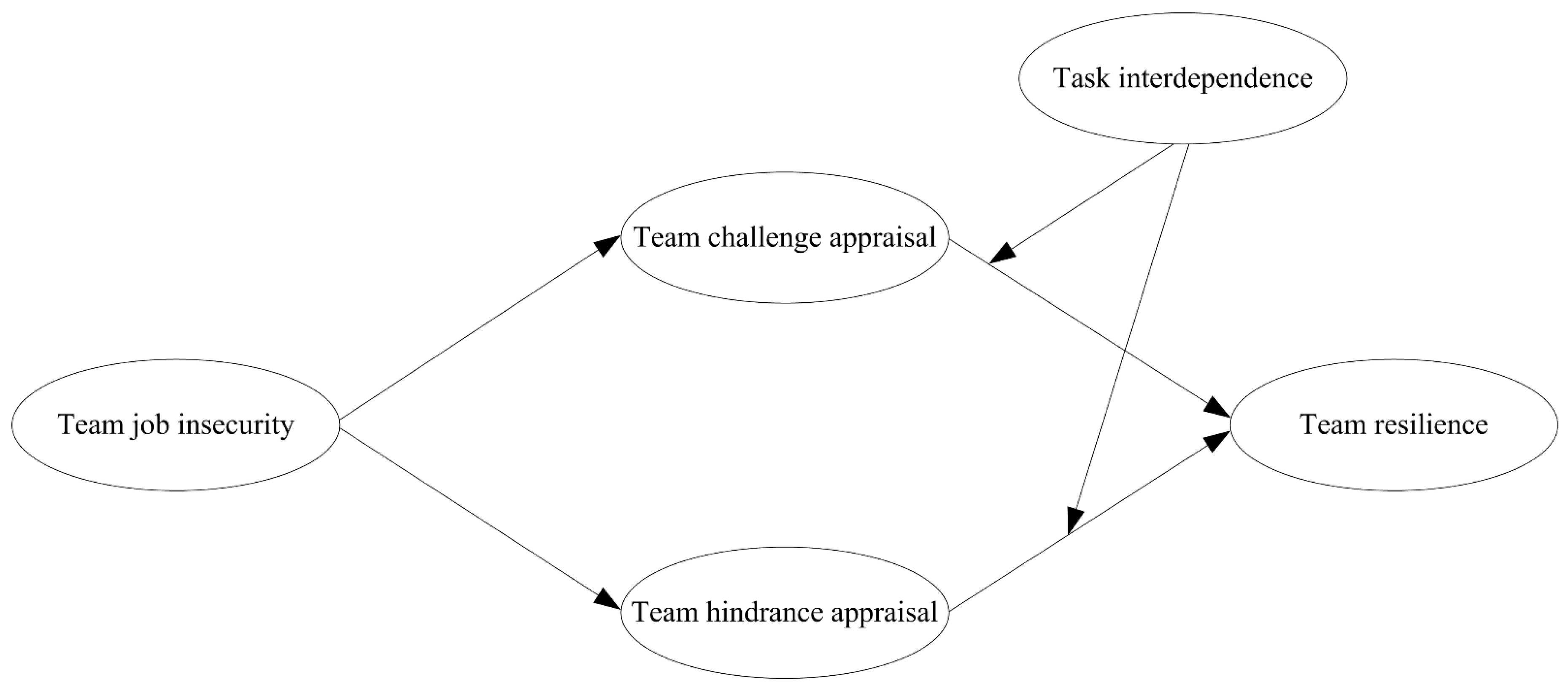
Figure 2.
Interactive effects of the team challenge appraisal and task interdependence on team resilience.
Figure 2.
Interactive effects of the team challenge appraisal and task interdependence on team resilience.
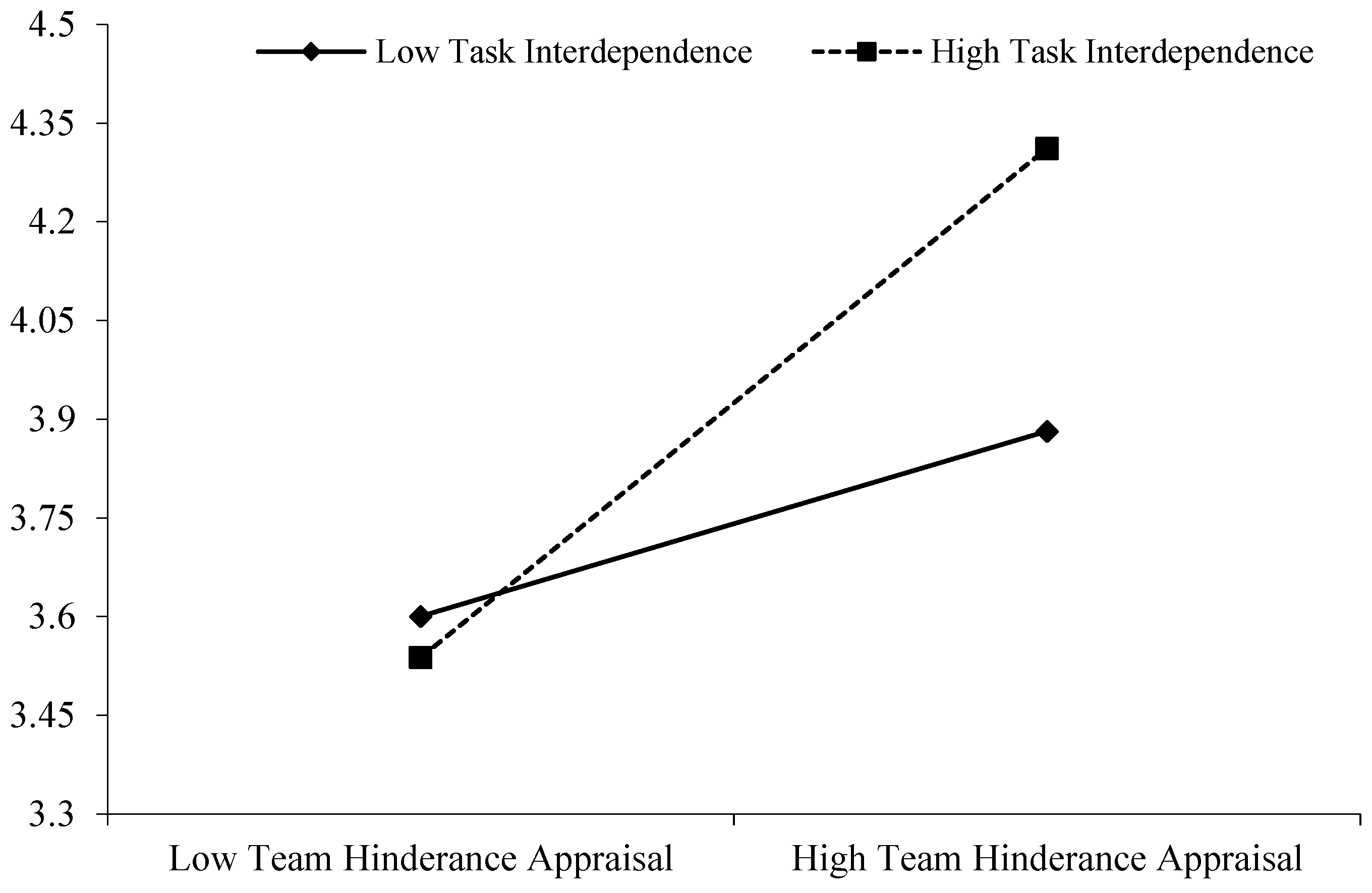
Figure 3.
Interactive effects of the team hinderance appraisal and task interdependence on team resilience.
Figure 3.
Interactive effects of the team hinderance appraisal and task interdependence on team resilience.
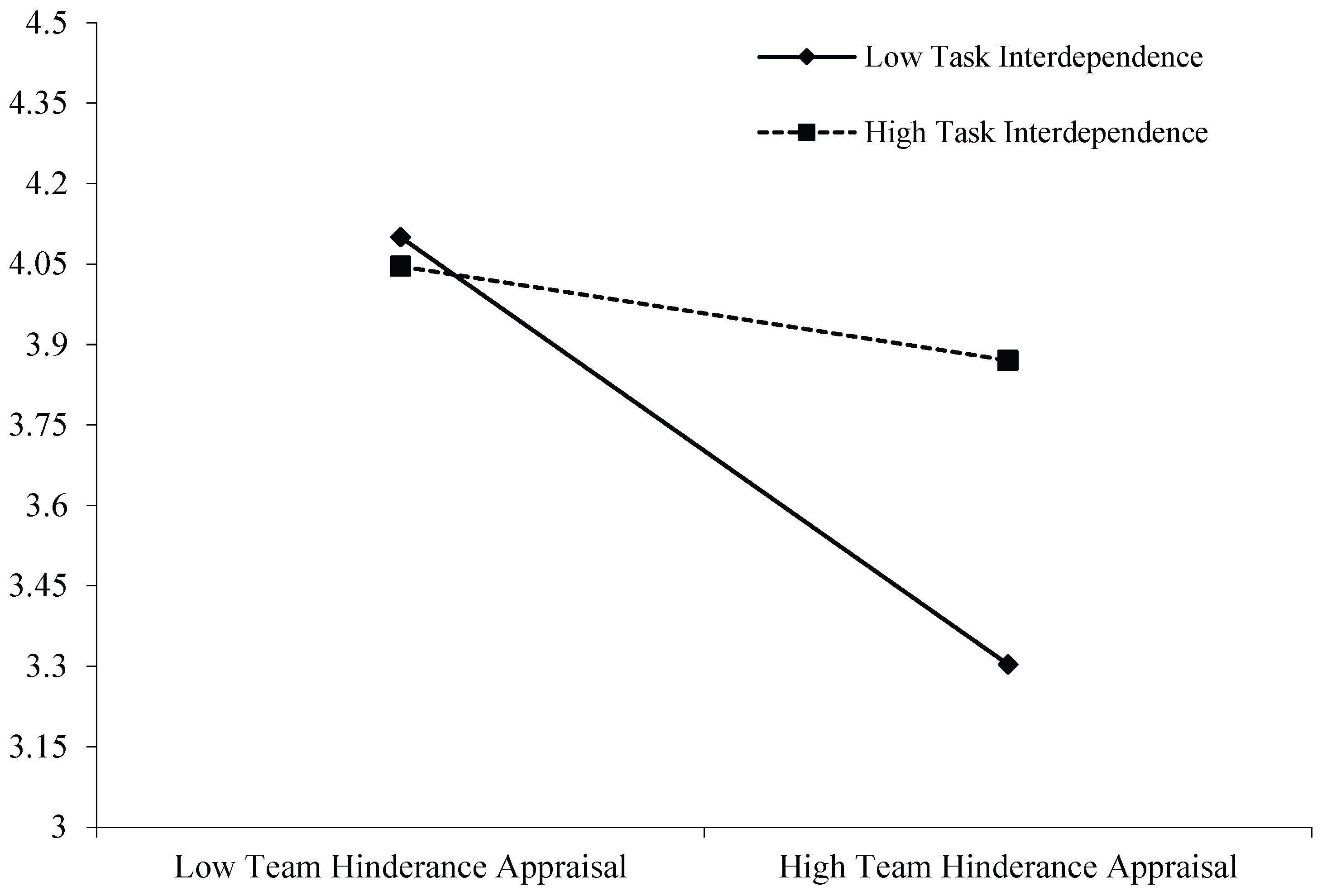

Table 1.
Means, standard deviations, and correlations.
| Variables | M | SD | 1 | 2 | 3 | 4 | 5 |
| 1. Team job insecurity | 4.50 | .66 | (.75) | ||||
| 2. Team challenge appraisal | 3.66 | .48 | .30** | (.74) | |||
| 3. Team hinderance appraisal | 3.07 | .77 | .27** | –.05 | (.82) | ||
| 4. Team resilience | 3.84 | .66 | .12 | .43** | –.38** | (.83) | |
| 5. Task interdependence | 4.27 | .93 | –.11 | .03 | .04 | .17 | (.79) |
Note:N = 464, n = 96. Cronbach’s alphas are in the parentheses on the diagonal. *p < .05, **p < .01, two–tailed.
Table 2.
Indirect effects analysis.
| Variables | Challenge appraisal | Hinderance appraisal | Team resilience | |
| Team job insecurity | .22** (.07) | .31** (.12) | −.01 (.10) | .24* (.10) |
| Challenge appraisal | .58** (.13) | |||
| Hinderance appraisal | −.38** (.08) | |||
| Indirect effect | Bootstrap, 95% CI | Monte Carlo, 95% CI, 20, 000 repetitions | ||
| Team job insecurity →Challenge appraisal → Team resilience | .13* [.028, .227] | [.037, .237] | ||
| Team job insecurity →Hinderance appraisal → Team resilience | −.12* [−.220, −.021] | [−.233, −.031] | ||
Note:N = 464, n = 96; * p < .05. ** p < .01; CI = confidence interval.
Table 3.
Moderation effects and moderated mediation effects analysis.
| Dependent variable | Moderator Task interdependence |
Effect 1 (PM1X) |
Effect 2 (PYM1) |
Effect (PM1X * PYM1) |
95% CI of Indirect effect, Bootstrap | 95% CI of Indirect effect, 20, 000 repetitions, Monte Carlo |
| Team resilience | Low (−1 SD) | .22** (.07) | .29 (.06) | .06 (.04) | [−.024, .151] | [.008, .178] |
| High (+1 SD) | .80** (.17) | .18* (.07) | [.042, .307] | [.051, .298] | ||
| Diff | .51* (.23) | .11 (.06) | [–.012, .234] | [.005, .193] | ||
| Dependent variable | Moderator Task interdependence |
Effect (PM2X) |
Effect 2 (PYM2) |
Effect (PM2X * PYM2) |
95% CI of Indirect effect, Bootstrap | 95% CI of Indirect effect, 20, 000 repetitions, Monte Carlo |
| Team resilience | Low (−1 SD) | .31** (.12) | .54** (.10) | –.17* (.07) | [–.304, –.034] | [–.299, –.040] |
| High (+1 SD) | –.20 (.11) | –.06 (.04) | [–.147, .019] | [–.172, –.010] | ||
| Diff | .34* (.14) | .11* (.06) | [–.009, .220] | [.008, .182] |
Note:N = 464, n = 96; * p < .05. ** p < .01; PM1X refers to the effect of team challenge appraisal on team job insecurity, PYM1 refers to the effect of team resilience on team challenge appraisal; PM1X * PYM1 refers to the indirect effect of team job insecurity on team resilience via team challenge appraisal. PM2X refers to the effect of team hinderance appraisal on team job insecurity, PYM2 refers to the effect of team resilience on team hinderance appraisal; PM2X * PYM2 refers to indirect effect of team job insecurity on team resilience via team hinderance appraisal. Diff refers to the indirect effect difference between a high level and a low level of task interdependence. CI = confidence interval.
Disclaimer/Publisher’s Note: The statements, opinions and data contained in all publications are solely those of the individual author(s) and contributor(s) and not of MDPI and/or the editor(s). MDPI and/or the editor(s) disclaim responsibility for any injury to people or property resulting from any ideas, methods, instructions or products referred to in the content. |
© 2025 by the authors. Licensee MDPI, Basel, Switzerland. This article is an open access article distributed under the terms and conditions of the Creative Commons Attribution (CC BY) license (http://creativecommons.org/licenses/by/4.0/).
Copyright: This open access article is published under a Creative Commons CC BY 4.0 license, which permit the free download, distribution, and reuse, provided that the author and preprint are cited in any reuse.


