

Submitted:
17 June 2025
Posted:
19 June 2025
You are already at the latest version
Abstract
We report the RAD@home citizen science discovery of two rare spiral-host radio galaxies (NGC 3898 & WISEA J221656.57-132042434.1 or “Thumbs up” galaxy), both exhibiting asymmetric radio lobes extending over 30 to 220 kiloparsec scales. We present a multi-wavelength image analysis of these two sources using radio, optical, and ultraviolet data. Both host galaxies are young, star-forming systems with asymmetric or distorted stellar disks. These disks show similarities to those in galaxies undergoing ram pressure stripping, and the radio morphologies resemble those of asymmetric or bent FR II and wide-angle-tailed radio galaxies. We suggest that non-uniform gas density in the environment surrounding the ram pressure-stripped disks may contribute to the observed asymmetry in the size, shape, and brightness of the bipolar radio lobes. Such environmental effects, when properly accounted for, could help explain many of the non-standard radio morphologies observed in Seyfert galaxies and in recently identified populations of galaxies with galaxy-scale radio jets, now being revealed through deep and sensitive radio surveys with uGMRT, MeerKAT, LOFAR, and, in the future, the SKAO. These findings also underscore the potential of citizen science to complement professional research and data-driven approaches involving machine learning and artificial intelligence in the analysis of complex radio sources.
Keywords:
galaxy evolution
; radio astronomy
; citizen science
; active galactic nuclei
; radio jet
1. Introduction
Ever since the discovery of double-lobed radio galaxies, in 1953, almost all of them have been found to be hosted by elliptical galaxies. Only recently, a sample has been grown in which episodic radio jets, as conclusive evidence, of Mpc-scales, have been found to be hosted by spiral/disk galaxies [1,2,3]. While many nearby Seyferts in spiral galaxies are known to host radio jets and lobes, although a few kpc-scale, [4,5,6,7], only recently, due to the advancement of sensitive low-frequency surveys, a sample of galaxy-scale radio-lobed galaxies has been discovered [8]. Hence, for a unified picture of radio jets in kpc-to-Mpc scale and in bulge-less spirals to giant ellipticals the study of jets at intermediate scales are important. Since these galaxy-scale jets in spiral hosts are naturally easier to observe for jet-interstellar Medium (jet-ISM) and jet-circum-galactic Medium (jet-CGM) interactions, their implications for understanding detailed physics of AGN-feedback in galaxy evolution are naturally high. Large, 200 kpc to Mpc-scale radio lobes are likely too large to show signs of interaction with the CGM. Small kpc-scale Seyfert jets are easy to show interacting with the ISM. In some cases of jet-ISM interactions, jet-driven shock ionisation is clearly observed [9,10]. As in the well-known case of Minkowski’s Object, jet-triggered young star formations have also been observed in many galaxies. Radio jets are always seen orthogonal to the small-scale or nuclear dust lanes in elliptical galaxies, irrespective of cases where the large-scale dust ellipse is aligned with the major axis of the optical galaxy [11]. Such orthogonal correlations naturally suggest gas/dust feeding of the accretion disks. However, jets in spiral galaxies do not show any such correlation with the rotation axis [12]. This can be attributed to intense jet-ISM interaction and short duty cycles of accretion and jet episodes. In some cases, instead of well-defined jets, radio emissions from spirals are seen in the shape of bipolar bubbles. In cases where bubbles are seen to be orthogonal to the stellar disk, bubbles are proposed to have been shaped by the galactic wind outflow [4]. In a representative sample of ten radio bubbles, the mandatory presence of AGNs has been observed[7]. The radio plasma in the bubble has probably been supplied by the AGN jet. The current study reports the finding of two galaxies where the intermediate scale (30-200 kpc) radio lobes from two spiral galaxies are seen asymmetrically located w.r.t. the host galaxies. Taking clues from the multi-wavelength observations, we bring an analogy with the ram pressure stripped galaxies [13,14] and propose a novel idea that these intermediate-scale radio lobes seen here, and possibly in other cases also, can be explained by the incorporation of ram pressure stripping by the intra-group or intra-cluster medium. Discovery and study of more such cases, added with deep H i and CO observations, will grow our understanding of radio-jet feedback-driven galaxy evolution [15,16].
2. RAD@home Citizen Science Discovery Method
The discovery and interpretation of the sources were made through the RAD@home citizen science research (CSR) Collaboratory [17,18]. Thousands of members, out of a total of 4700 plus members, were trained to understand galaxy images through a Facebook group via both online and offline modes of interactions. Undergraduate students of India are provided an opportunity to explore and understand the basics of Red-Green-Blue-Contour (RGB-C) images made out of UV, Optical, IR, and Radio image analysis in astronomy. Students are allowed to post their RGB-C image analysis on different galaxies on different days of the year, which are further understood and analysed through text/image comments and online e-classes. Image analysis was discussed by Google Meet screen share conducted during the weekends. A multi-wavelength RGB-C making web-tool (see Figure 1 for example) ensured a minimum and uniform training of galaxy image interpretations [19].
On the successful understanding of the basic RGB-C analysis, students are further trained and asked to work on the FITS image files of the TIFR GMRT Sky Survey(TGSS) obtained from the Giant Metrewave Radio Telescope (GMRT) at 150 MHz with 25″ resolution and rms noise of 5 mJy beam−1 [20]. The main aim of analysing the FITS files, using SAO ds9, is to identify faint, fuzzy and non-standard radio structures. These faint-fuzzy sources could be relics of past AGN jet-feedback[17]. Similarly, non-standard radio sources could suggest unusual interactions at the centre of the AGNs or distortions due to environmental effects, like the case of RAD12 [18] and the presently reported case. RAD12 is a rare case where a radio jet from one galaxy hits the companion galaxy and bounces back to form a mushroom bubble. Eventually, these sources could lead to a better understanding of the evolution of galaxies via star formation and AGN activities via jet-like outflows or feedback. These potential new-found sources are reported to the Collaboratory through an image submission Google form and then discussed with the professional astronomers and taken up for follow up observations with GMRT or direct publication. Here we report on two such galaxies that have non-standard and faint-fuzzy structures.
3. Results
3.1. NGC3898
An extremely asymmetric double-lobed radio source, hosted by a spiral galaxy, was identified in the TGSS and posted on 21 April 2024 in the RAD@home online discussion group. The RGB-contour image constructed using radio-optical-radio data (Figure 1) shows the eastern lobe to be located close to the nearly face-on host galaxy, while the western lobe is nearly three times farther away. Although the shorter eastern lobe is relatively bright, the western lobe appears faint and disconnected from the host. The host galaxy also exhibits faint radio emission in the NRAO VLA Sky Survey (NVSS; 1400 MHz, beam size = 45″) data [21]. A comparison with the Faint Images of the Radio Sky at Twenty Centimeters (FIRST; 1400 MHz, beam size = 5") survey [22] reveals a compact radio source coincident with the nucleus of the host galaxy, NGC 3898 (, km s−1, angular scale = 0.081 kpc arcsec−1).
NGC 3898 (UGC 06787) is a well-studied nearby galaxy, with observations spanning nearly all wavelengths. This SA(s)ab-type spiral galaxy, classified as a LINER–H ii composite, is a member of the “12-3” galaxy group [23]. Likely due to the presence of extremely asymmetric radio emission blobs seen in NVSS, the galaxy has been overlooked in earlier samples of nearby galaxies hosting radio jets. In this brief study, we focus on the asymmetric radio lobe morphology and complement the analysis with newly available data.
Imaging data from the Low-Frequency Array (LOFAR) are also available for this target from the LOFAR Two-metre Sky Survey [LoTSS; [24]. In Figure 2, we present both low and high-resolution 144 MHz images from LoTSS. The eastern lobe reveals a clearly resolved structure, with a hotspot and a backflow forming a standard edge-brightened FR II morphology resembling a “fish-head” or bow shock-like structure. The hotspot is located at the farthest end from the host galaxy. The angular separation between the hotspot and the radio core is 113", corresponding to 9 kpc. Faint radio emission from the backflow appears to reach the host galaxy. In contrast, the western lobe is well separated from the host and appears distorted. The western hotspot is offset to the north relative to the remaining diffuse emission of the lobe. Extended radio emission is observed farther from the host galaxy than the hotspot. The distance between the western hotspot and the radio core is 349″ (28 kpc). The resulting arm-length ratio, greater than 3, makes this an extreme example of lobe asymmetry. The total flux density of the radio core region is 10 mJy, with a peak flux of 5.73 mJy beam−1. The eastern lobe, including the radio core, has a flux density of 175 mJy, while the western lobe has 141 mJy. Since the eastern lobe extends into the host galaxy, the core flux must be subtracted when estimating the true flux density of the lobe. It remains uncertain whether ongoing star formation in the galactic disc contributes to the measured flux density of the eastern lobe. It may be noted that the compact radio source (R.A: 11:49:03.105 Dec. +56:06:33.049) has an offset of over 2″ with the galaxy in SDSS (R.A. 11:49:02.958 Dec. +56:06:31.398) and hence can be ruled out as the host galaxy of the larger double-lobed radio emission. This compact radio source has a flux density of 0.8 mJy at 144 MHz and is not detected in other radio surveys (e.g., FIRST and VLASS).
The low-resolution LOFAR image is shown in Figure 2, with optical image contours overlaid. No additional features are evident, except that the eastern lobe’s backflow is clearly seen crossing the nucleus of the host galaxy. The backflow also extends twice as far to the north of the optical nucleus compared to the south. This suggests that the eastern backflow is unlikely to be interacting directly with the host galaxy but appears to do so primarily due to projection effects. The origin of this pronounced asymmetry will be discussed in a subsequent section.
To investigate the regions where the radio lobe seems to touch the spiral-host galaxy for possible signs of jet-ISM interaction, we checked available images in GALEX (UV band) and deep optical images in Beijing-Arizona Sky Survey (BASS; [25]). Although we did not see any sign of jet-ISM interaction or signs of jet-triggered young star formation, we noticed that the western side of the galaxy shows extended young star-forming regions (Figure 3). These regions are also clearly seen, in BASS images, as arms/arcs in blue optical light. Note that they are still far from the western lobe to interact.
We also looked for signatures of asymmetry in the gaseous medium. The H i 21cm line observation data was available from the Westerbork Synthesis Radio Telescope (WSRT). The total intensity H i -emission contours are superposed on the optical image from SDSS (Figure 4 left panel). The nuclear region shows a dip, the surrounding region shows two peaks and regions surrounding them show clear east-west asymmetry. While the eastern region shows a truncated/shrunken H i the western emission is wider. We also looked for H line emission images to look for similar asymmetry. A false colour H image, of the central region of the galaxy, is presented in the right panel of the same figure. Ionised gas distribution is also seen as asymmetric with an extended gas tail seen to the west of the nuclear region. This ionised gas tail is similar to that seen in NGC4438, a ram pressure stripped galaxy in the Virgo cluster. In summary, the radio lobe asymmetry, asymmetry in the atomic and ionised gas distribution and asymmetry in the star-forming regions in the extended disk of the host galaxy may have some causal connections. We shall return to this discussion in later sections.
3.2. RAD-Thumbs up Galaxy
In December 2018, towards the end of a citizen science research training programme (a.k.a. RAD@home Discovery Camp), one participant spotted a radio source which seemed to be a radio lobe associated with a spiral/disturbed galaxy but peculiarly showing emission on only one side of the host. As seen in Figure 5 there is no radio emission seen on the eastern side of the central optical galaxy. The radio features, seen in the NVSS image, looked like a “Thumbs up” sign and thus were discussed as the “Thumbs up” galaxy (WISEA J221656.57-042434.1 0.095963 (scale =1.79 kpc/″). There are three radio peaks which can be seen in both the NVSS and TGSS images. The brightest peak is away from the host galaxy on the west side, the secondary peak roughly coincides (shifted slightly to the west) with the host galaxy, and the faintest peak, the "thumb" feature, is seen on the northwest of the host galaxy.
The FIRST survey data were available on the target. In Figure 6 we present the RAD@home composite contour image of the target where the optical image is superposed with the same NVSS (cyan), TGSS (magenta) and FIRST (yellow) radio contours. FIRST being a higher resolution (5″) image compared to NVSS (45″) it has resolved the compact peak at the host galaxy. However, the brightest NVSS/TGSS peak, the "fist" part, at the west of the host has been resolved out which is evidence that it is unlikely a background radio source but a diffuse/relic lobe from the host galaxy. Similarly, the north-western peak, the ‘Thumb’ part, has also been resolved out in the FIRST image. Note that the same structure of the radio source is observed in the archival images from Rapid ASKAP Continuum Survey images but not presented here in this short report.
Right panel of the same figure shows a zoomed-in view of the same multi-contour image. The resolved nuclear peak shows a “<” like structure. Its orientation and similarity with the larger-scale Thumbs-up structure is quite intriguing. The radio emission probably has a smaller bent double-lobed structure. The western peak is comparatively brighter than the north-western peak. This radio structure is similar in size to that of the host galaxy. Such sub-galaxy scale radio lobes/jets are typical of jetted Seyfert galaxies. From the centre to the western peak of the mini-“Thumbs up” the distance is 12″ (21.5 kpc) while that to the north-western peak is 10″ (17.9 kpc). In comparison, the nucleus to western radio peak of the large scale “Thumbs up”, or the fist, is 123" (220 kpc). Similarly, from the nucleus to the peak at the Thumb is 101″ (181 kpc). Hence, in projection, the large radio lobes are at least ten times larger than the small-scale radio lobes. Since the radio jet ejection has to happen in opposite directions from the nucleus and both the small and large radio lobes are on the western side of the nucleus, we are likely seeing the source whose jet axis is either parallel to the line of sight or in the plane of the sky. Thus, assuming an intermediate inclination, the real linear size of the radio source can be bigger than 400 kpc (224″).
Spectral index map of the entire “Thumbs up” radio source was available in the SPIDX database, which has generated the spectral index values from the NVSS and reprocessed TGSS (b=25″) by applying UV-tapering to the original UV data so as to match the coarser resolution(45″) of NVSS [26]. It is clear from Figure 7 that the host galaxy region is typical of synchrotron radiation (values around -0.75) and the diffuse region, farther away from the host is around -1.5, significantly steep. This suggests very little contribution of star formation for the mini-“Thumbs up” and the presence of a small unresolved jetted AGN. This pattern is also consistent with expectations from the composite contour map where NVSS peaks were resolved out in FIRST suggesting the relic or diffuse nature of the large-scale radio lobes.
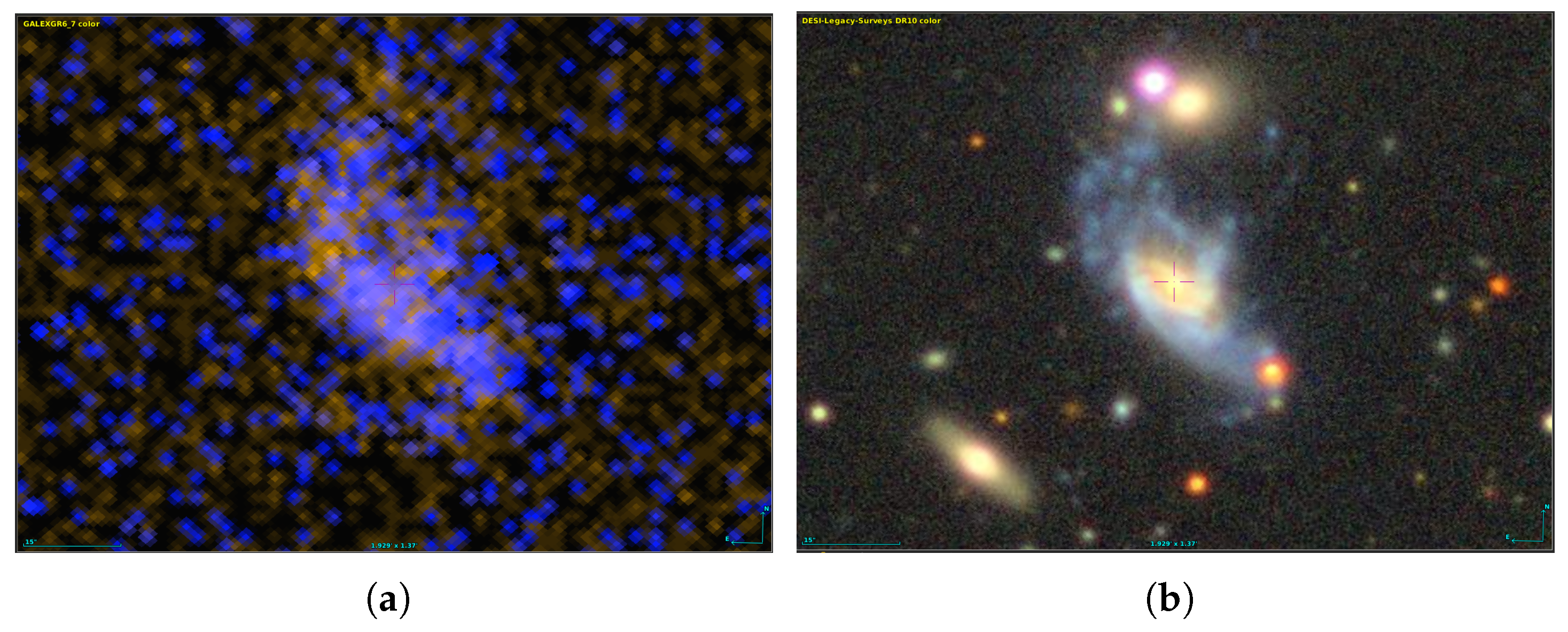
Ultraviolet images from GALEX and deeper optical images from the Legacy survey were available. Figure 8 (left panel) shows a combined near and far UV image of the host galaxy. The arc-shaped or bowl-shaped young star-forming region of the host galaxy naturally draws similarity with the ram-pressure-stripped galaxies in nearby clusters like Virgo and Coma. This UV image can be compared with GALEX images of Virgo cluster galaxies showing H evidence of ram pressure stripping like NGC 4522, NGC 4330 etc. [27].
Similarly, the Legacy optical image shows a disturbed spiral galaxy with bright blue star-forming clumps on its southern arm as well as disturbed regions on the north. The distribution of the star-forming regions of the galaxy has no correspondence with the sub-galactic mini-“Thumbs up” radio structure seen in the FIRST image. This, along with the spectral index value, are clear signs that the mini-“Thumbs up” radio emission is due to AGN activity and not from star formation. The overall optical structure is also similar to the Virgo cluster galaxy NGC 4438. Interestingly, NGC 4438 also has a mini-radio double along with diffuse radio emission to the west of the galaxy, on a large scale, which is attributed to ram pressure stripping. A multi-wavelength study of NGC 4438 can be referred to for further comparisons [28]. Although the arms are, the central region of the galaxy has not been disturbed. The host galaxy has a spectroscopic redshift or (v (heliocentric)=28769 ± 45 km s−1). The early-type galaxy seen to the north is WISEA J221656.42-042405.6 which has a heliocentric recession velocity of 20870 km s−1 (measurement uncertainty not available in NASA Extragalactic Database). Hence, these two galaxies, though they seem to be connected in projection, are widely separated in velocity space and are clearly not interacting. The late-type edge-on galaxy seen to the south-east of the host galaxy is undisturbed, and hence not part of any possible interaction. In summary, the UV-optical morphology as well as both the small- and large-scale “Thumbs up” radio morphology suggests ram pressure stripping acting from east to west.
4. Discussion
4.1. NGC3898: Not Bending But Stripping:
By analogy with WAT radio galaxies, if the observed arm-length asymmetry in NGC 3898 were attributed to bending, one would expect the shorter (9 kpc) eastern lobe to be aligned closer to the line of sight, and the longer (28 kpc) western lobe to lie closer to the plane of the sky. However, the observed morphology contradicts this interpretation: the hotspot of the eastern (shorter) lobe lies at the farthest extent from the host galaxy, while in the western (longer) lobe, the backflow or diffuse emission is located beyond the hotspot. These structural details indicate that bending alone cannot account for the asymmetry, suggesting the influence of another force, such as ram pressure stripping. In optical and UV images, the eastern half of the host galaxy appears relatively clear, while the western half exhibits multiple star-forming clumps and extends further from the galactic centre. This asymmetry in the stellar disc supports an east-to-west ram pressure stripping scenario. Additional supporting evidence includes the observed depletion of H i gas on the eastern side and the presence of an H tail extending westward, both consistent with ram pressure acting from east to west. The stripping of the eastern radio lobe may also enable the backflow to reach or overtake the host galaxy. Similarly on the western lobe, the ram pressure stripping can push the diffuse emission beyond the hotspot. Notably, evidence of ram pressure stripping affecting both H i and radio continuum emission has been reported in a group environment for Ho 124 [29], reinforcing the plausibility of such a mechanism in NGC 3898.
4.2. RAD-Thumbs Up Galaxy: Bent, Episodic, and Stripped:
The spectral index map and structure of the emission, compact vs diffuse emission, clearly suggest that the “Thumbs up” galaxy has two episodes of AGN-driven radio emission in the form of bent double lobes. One of the relic lobes is located on the west, 10 times away from the inner lobe, and extends up to 220 kpc from the center of the galaxy. As both of these lobes are on the same side of the host, the jet axis is expected to be inclined, in between parallel to the line of sight and in the plane of the sky. Hence, the real linear size of this episodic radio galaxy may be larger than 400 kpcs or larger than typical 200-300 kpc radio galaxies hosted in ellipticals. These lobes are unlike typical episodic FR II or double-double radio galaxies [30]. Spectral index map of typical FR II radio galaxies shows the backflow as a steep spectral index and the end of the lobe or hotspot regions as flat. If the lobe plasma was stripped away from the host, the plasma seen at the farthest point would be the oldest or steepest. This is what is seen in the present case, suggesting that ram pressure stripping has shaped the large-scale radio emission.
4.3. Unique Context:
The effects of ram pressure on WAT and HT radio galaxies are commonly observed, but these systems are almost always hosted by ellipticals, where direct evidence of ram pressure stripping is difficult to trace due to the lack of gas and dust. In contrast, spiral galaxies often show clear signs of ram pressure stripping, yet they rarely host double-lobed radio structures that extend beyond the optical size of the galaxy. A few known examples of ram pressure-stripped spiral galaxies with double radio lobes, though small in extent, include NGC 4438 and NGC 4388 [31], and NGC 4569 [32].
Unless the radio lobes extend significantly beyond the host, it is not possible to directly study the effect of ram pressure from the ambient thermal gas on the non-thermal plasma of AGN-driven lobes. The two sources reported in this study provide rare examples where such interactions may be examined, offering unique targets for future observations with upcoming mega-telescopes. The interaction between thermal gas and non-thermal outflows has direct implications for the modelling of AGN feedback [33], especially in understanding how the outflow energy couples with the surrounding gas in the ISM and CGM, a process that remains poorly constrained. Moreover, galaxies undergoing ram pressure stripping by intra-filament gas flows around clusters can also serve as useful tracers to constrain the properties of diffuse gas in the cosmic web.
Author Contributions
PA, AH and PD have contributed significantly to the manuscript writing. AH conceptualized the project. PA, DN and PKN are trained citizen scientists involved in object discovery. KSK and AP have contributed significantly towards the overall success of the project from inception to completion.
Funding
Results reported in this paper have been obtained from RAD@home citizen science research. RAD@home has not received any funding. However, the names of two institutions that have contributed by hosting RAD@home Discovery Camps, which have helped this particular paper, are the International Center for Theoretical Sciences of the Tata Institute of Fundamental Research (Code: ICTS/RADatICTS2018/05) and Nehru Planetarium, Prime Ministers Museum and Library, Ministry of Culture, Govt of India.
Institutional Review Board Statement
Not applicable.
Informed Consent Statement
Not applicable.
Data Availability Statement
All the data used in this research are publicly available and have been cited as per the common practice.
Acknowledgments
AH acknowledges the University Grants Commission (UGC, Ministry of Education, Government of India) for his monthly salary since June 2014. We express our profound gratitude to Late Dr. Nandivada Rathnasree who was quite instrumental in organizing multiple RAD@home Discovery Camps/workshops at Nehru Planetarium (Delhi). The long list of national and international organizations which have helped the establishment and growth of the first Indian astronomical citizen science research platform RAD@home are acknowledged in detail at https://radathomeindia.org/brochure .
Conflicts of Interest
The authors declare no conflicts of interest.
References
- Hota, A.; Sirothia, S.K.; Ohyama, Y.; et al. Discovery of a spiral-host episodic radio galaxy. MMRAS 2011, 417, L36–L40. [Google Scholar] [CrossRef]
- Bagchi, J.; Vivek, M.; Vikram, V.; et al. Megaparsec relativistic jets launched from an accreting supermassive black hole in an extreme spiral galaxy. ApJ 2014, 788, 174–191. [Google Scholar] [CrossRef]
- Sethi, S.; Kuźmicz, A.; Hunik, D.; Jamrozy, M. Serendipitous discovery of a spiral host in a 2 Mpc double-double lobed radio galaxy. A&A 2025, (in press). [Google Scholar]
- Baum, S. A.; O’Dea, C. P.; Dallacassa, D.; de Bruyn, A. G.; Pedlar, A. Kiloparsec-Scale Radio Emission in Seyfert Galaxies: Evidence for Starburst-driven Superwinds? ApJ 1993, 419, 553–572. [Google Scholar] [CrossRef]
- Colbert, E. J. M.; Baum, S. A.; Gallimore, J. F.; O’Dea, C. P.; Christensen, J. A. Large-Scale Outflows in Edge-on Seyfert Galaxies. II. Kiloparsec-Scale Radio Continuum Emission. ApJ 1996, 467, 551–578. [Google Scholar] [CrossRef]
- Gallimore, J. F.; Axon, D. J.; O’Dea, C. P.; Baum, S. A.; Pedlar, A. A Survey of Kiloparsec-Scale Radio Outflows in Radio-Quiet Active Galactic Nuclei. AJ 2006, 132, 546–569. [Google Scholar] [CrossRef]
- Hota, A.; Saikia, D.J. Radio bubbles in the composite AGN-starburst galaxy NGC 6764. MNRAS 2006, 371, 945–956. [Google Scholar] [CrossRef]
- Webster, B.; Croston, J.H.; Mingo, B.; et al. A population of galaxy-scale jets discovered using LOFAR. MNRAS 2021, 500, 4921–4936. [Google Scholar] [CrossRef]
- Cecil, G.; Greenhill, L.J.; DePree, C.G.; et al. The Active Jet in NGC 4258 and Its Associated Shocks. ApJ 2000, 536, 675–696. [Google Scholar] [CrossRef]
- Capetti, A.; Axon, D. J.; Macchetto, F. D.; Marconi, A.; Winge, C. The Origin of the Narrow-Line Region of Markarian 3: An Overpressured Jet Cocoon. ApJ 1999, 516, 187194. [Google Scholar] [CrossRef]
- Verdoes Kleijn, G.A.; de Zeeuw, P.T. A dichotomy in the orientation of dust and radio jets in nearby low-power radio galaxies. A&A 2005, 435, 43–64. [Google Scholar]
- Kinney, A. L.; Schmitt, H. R.; Clarke, C. J.; Pringle, J. E.; Ulvestad, J. S.; Antonucci, R. R. J. Jet Directions in Seyfert Galaxies. ApJ 2000, 537, 152–177. [Google Scholar] [CrossRef]
- Gunn, J. E.; Gott, J. R., III. On the Infall of Matter Into Clusters of Galaxies and Some Effects on Their Evolution. APJ 1972, 176, 1. [Google Scholar] [CrossRef]
- Abadi, M.G.; Moore, B.; Bower, R. G. Ram pressure stripping of spiral galaxies in clusters. MNRAS 1999, 308, 4–947. [Google Scholar] [CrossRef]
- Croton, D.; et al. MNRAS 2006, 365, 111.
- Hardcastle, M. J.; Croston, J. H. Radio galaxies and feedback from AGN jets. NewAR 2020, 88, 101539. [Google Scholar] [CrossRef]
- Hota, A.; Konar, C.; Stalin, C.S.; et al. Tracking Galaxy Evolution Through Low-Frequency Radio Continuum Observations using SKA and Citizen-Science Research using Multi-Wavelength Data. J Astrophys Astron 2016, 37, 41. [Google Scholar] [CrossRef]
- Hota, A.; Dabhade, P.; Vaddi, S.; Konar, C.; Pal, S.; Gulati, M.; Stalin, C.S.; Avinash, Ck.; Kumar, A.; Rajoria, M.; Purohit, A. RAD@home citizen science discovery of an active galactic nucleus spewing a large unipolar radio bubble on to its merging companion galaxy. MNRAS 2022, 517, L86–L91. [Google Scholar] [CrossRef]
- Kumar, A.; Avinash, C.; Purohit, A.; Hota, A. RAD@home RGB-maker web-tool for citizen science research in multi-wavelength study of AGNs with radio jets. Proceedings of the International Astronomical Union 2021, 17, 40–41. [Google Scholar] [CrossRef]
- Intema, H. T.; Jagannathan, P.; Mooley, K. P.; Frail, D. A. The GMRT 150 MHz all-sky radio survey. First alternative data release TGSS ADR1. A&A 2017, 598, A78. [Google Scholar]
- Condon, J. J.; Cotton, W. D.; Greisen, E. W.; Yin, Q. F.; Perley, R. A.; Taylor, G. B.; Broderick, J. J. The NRAO VLA Sky Survey. AJ 1998, 115, 1693–1716. [Google Scholar] [CrossRef]
- Becker, R.H.; White, R. L.; Helfand, D.J. The FIRST Survey: Faint Images of the Radio Sky at Twenty Centimeters. AJ 1995, 450, 559. [Google Scholar] [CrossRef]
- Trentham, N.; Tully, R. B.; Verheijen, M. A. W. The Ursa Major cluster of galaxies - III. Optical observations of dwarf galaxies and the luminosity function down to MR=-11. MNRAS 2001, 325, 385–404. [Google Scholar] [CrossRef]
- Shimwell, T. W.; Hardcastle, M. J.; Tasse, C.; Best, P. N.; Röttgering, H. J. A.; et al. The LOFAR Two-metre Sky Survey. V. Second data release. A&A 2022, 659, 27. [Google Scholar]
- Zou, H.; et al. Project Overview of the Beijing-Arizona Sky Survey. Publications of the Astronomical Society of the Pacific 2017, 129, 976–064101. [Google Scholar] [CrossRef]
- de Gasperin, F.; Intema, H. T.; Frail, D. A. A radio spectral index map and catalogue at 147-1400 MHz covering 80 per cent of the sky. MNRAS 2018, 474, 4–5008. [Google Scholar] [CrossRef]
- Boissier, S.; Boselli, A.; Duc, P.-A.; et al. The GALEX Ultraviolet Virgo Cluster Survey (GUViCS). II. Constraints on star formation in ram-pressure stripped gas. A&A 2012, 545, A142–16. [Google Scholar]
- Hota, A.; Saikia, D.J.; Irwin, J.A. NGC 4438 and its environment at radio wavelengths. MNRAS 2007, 380, 3–1009. [Google Scholar] [CrossRef]
- Kantharia, N. G.; Ananthakrishnan, S.; Nityananda, R.; Hota, A. GMRT observations of the group Holmberg 124: Evolution by tidal forces and ram pressure? A&A, 2005, 435, 2–483. [Google Scholar]
- Saikia, D.J.; Jamrozy, M. Recurrent activity in Active Galactic Nuclei. Bull. Astr. Soc. India 2009, 37, 63–89. [Google Scholar]
- Hummel, E.; Saikia, D. J. The anomalous radio features in NGC 4388 and NGC 4438. A&A 1991, 249, 43–56. [Google Scholar]
- Chyzy, K. T.; Soida, M.; Bomans, D. J.; Balkowski, C.; Beck, R.; Urbanik, M. Large-scale magnetized outflows from the Virgo Cluster spiral NGC4569. A&A 2006, 447, 465–47. [Google Scholar]
- Mukherjee, D.; Bicknell, G. V.; Wagner, A. Y.; Sutherland, R. S.; Silk, J. Relativistic jet feedback - III. Feedback on gas discs. MNRAS 2018, 479, 5544–5566. [Google Scholar] [CrossRef]
Figure 1.
A typical RAD@home citizen science research web-tool output showing radio-optical-radio overlay of the galaxy NGC3898. The Red, Green, and Blue channels present TGSS-ADR1, DSS-R and NVSS images, respectively. While the left panel shows NVSS in contour [0.0015, 0.0045, 0.0076, 0.0106 Jy beam−1] the right panel shows TGSS contours [0.015 0.023 0.03 0.038 Jy beam−1]. In both cases, the contours start with nearly 3 times the r.m.s. noise in each image. While NVSS beam is 45″ the TGSS beam is 25″.
Figure 1.
A typical RAD@home citizen science research web-tool output showing radio-optical-radio overlay of the galaxy NGC3898. The Red, Green, and Blue channels present TGSS-ADR1, DSS-R and NVSS images, respectively. While the left panel shows NVSS in contour [0.0015, 0.0045, 0.0076, 0.0106 Jy beam−1] the right panel shows TGSS contours [0.015 0.023 0.03 0.038 Jy beam−1]. In both cases, the contours start with nearly 3 times the r.m.s. noise in each image. While NVSS beam is 45″ the TGSS beam is 25″.
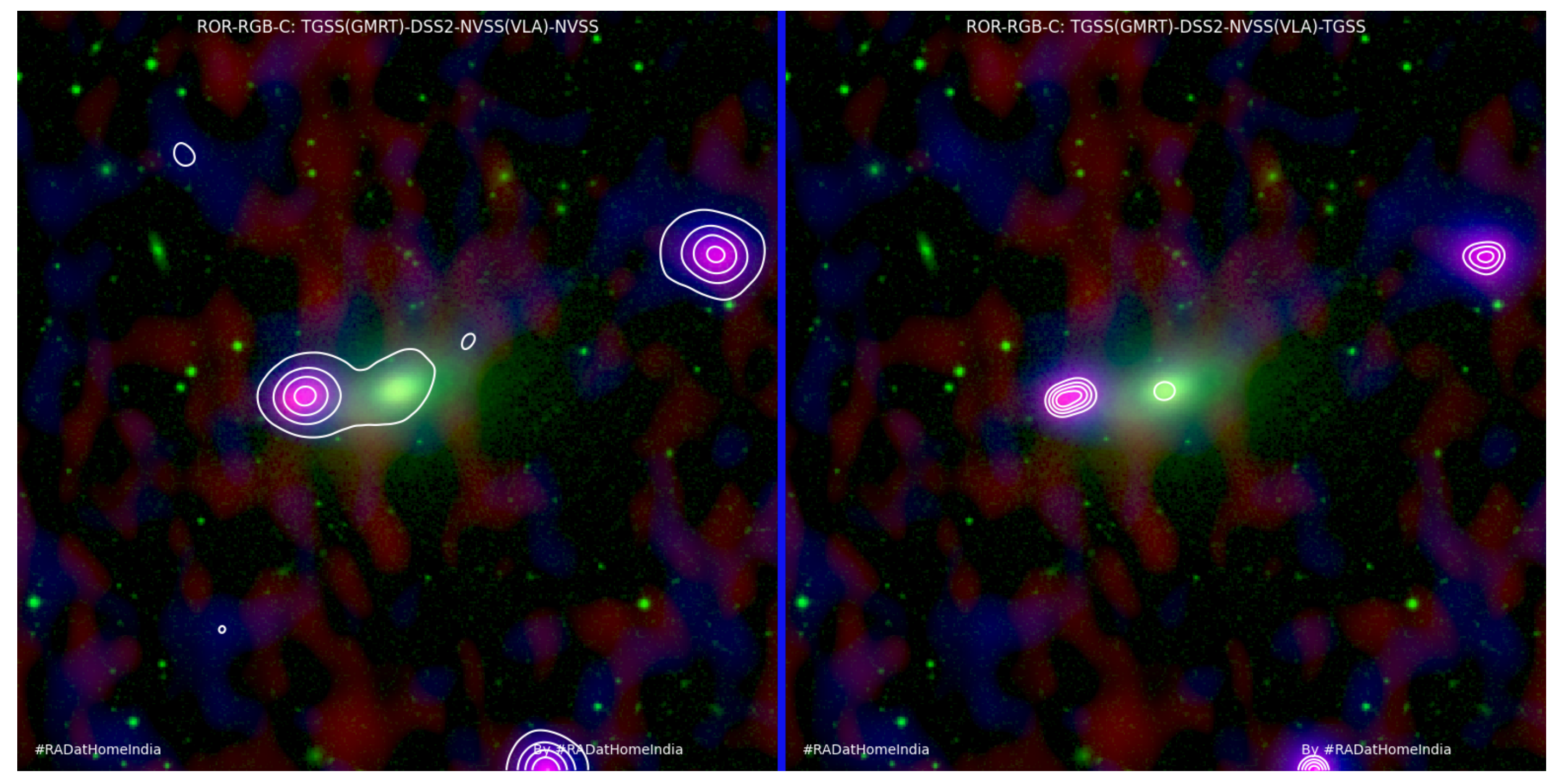
Figure 2.
NGC3898: Optical image (SDSS r-band) in thick yellow contour are plotted on the LoTSS (144 MHz beam=20″) low-resolution radio image from LOFAR (left panel). LoTSS high resolution (beam=6″) false colour image (right panel) is shown along with contour (white thin). The contour levels, in log scale, are 0.00024, 0.000251267, 0.000275542, 0.00032784, 0.000440513, 0.000683259, 0.00120624, 0.00233297, 0.00476043, 0.00999024 Jy beam−1.
Figure 2.
NGC3898: Optical image (SDSS r-band) in thick yellow contour are plotted on the LoTSS (144 MHz beam=20″) low-resolution radio image from LOFAR (left panel). LoTSS high resolution (beam=6″) false colour image (right panel) is shown along with contour (white thin). The contour levels, in log scale, are 0.00024, 0.000251267, 0.000275542, 0.00032784, 0.000440513, 0.000683259, 0.00120624, 0.00233297, 0.00476043, 0.00999024 Jy beam−1.
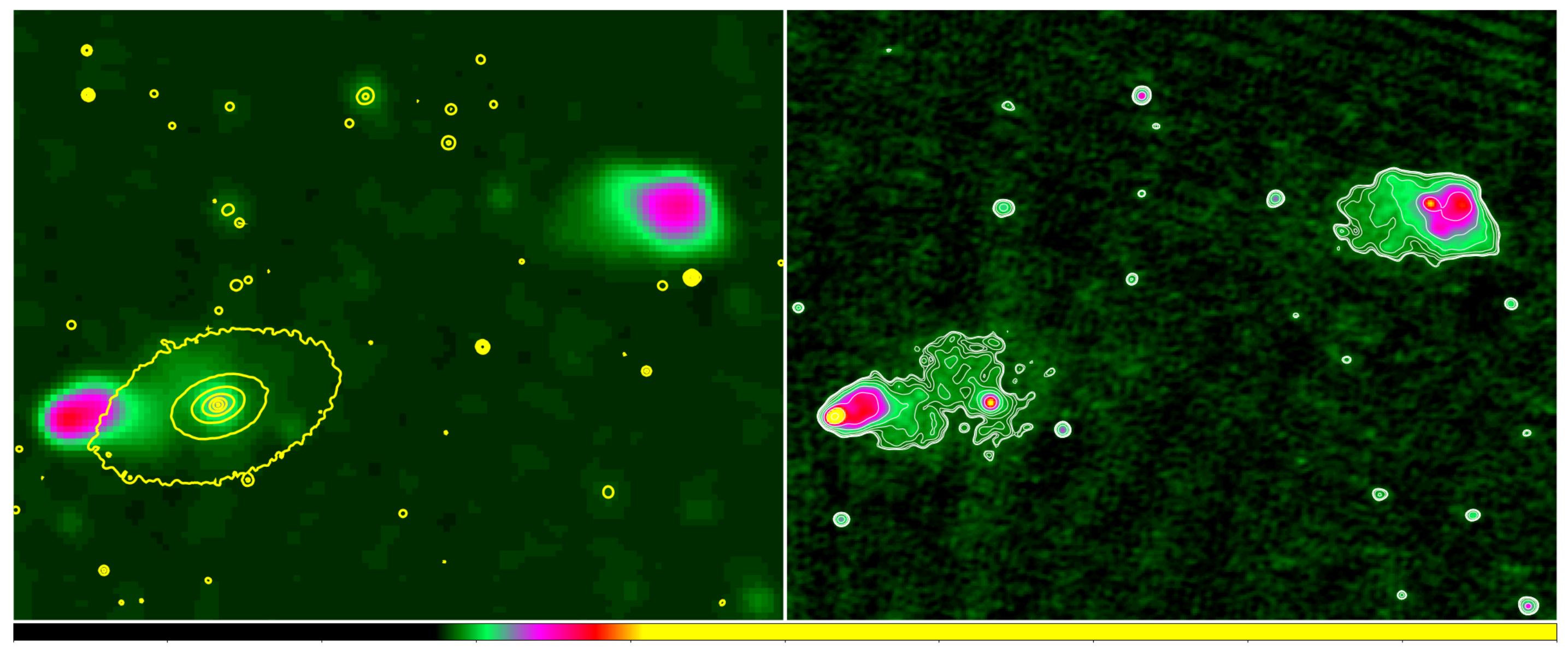
Figure 3.
NGC3898: A deep multi-band optical colour image from BASS has been presented in the left panel. On the right panel combined near and far UV images from GALEX have been presented.
Figure 3.
NGC3898: A deep multi-band optical colour image from BASS has been presented in the left panel. On the right panel combined near and far UV images from GALEX have been presented.
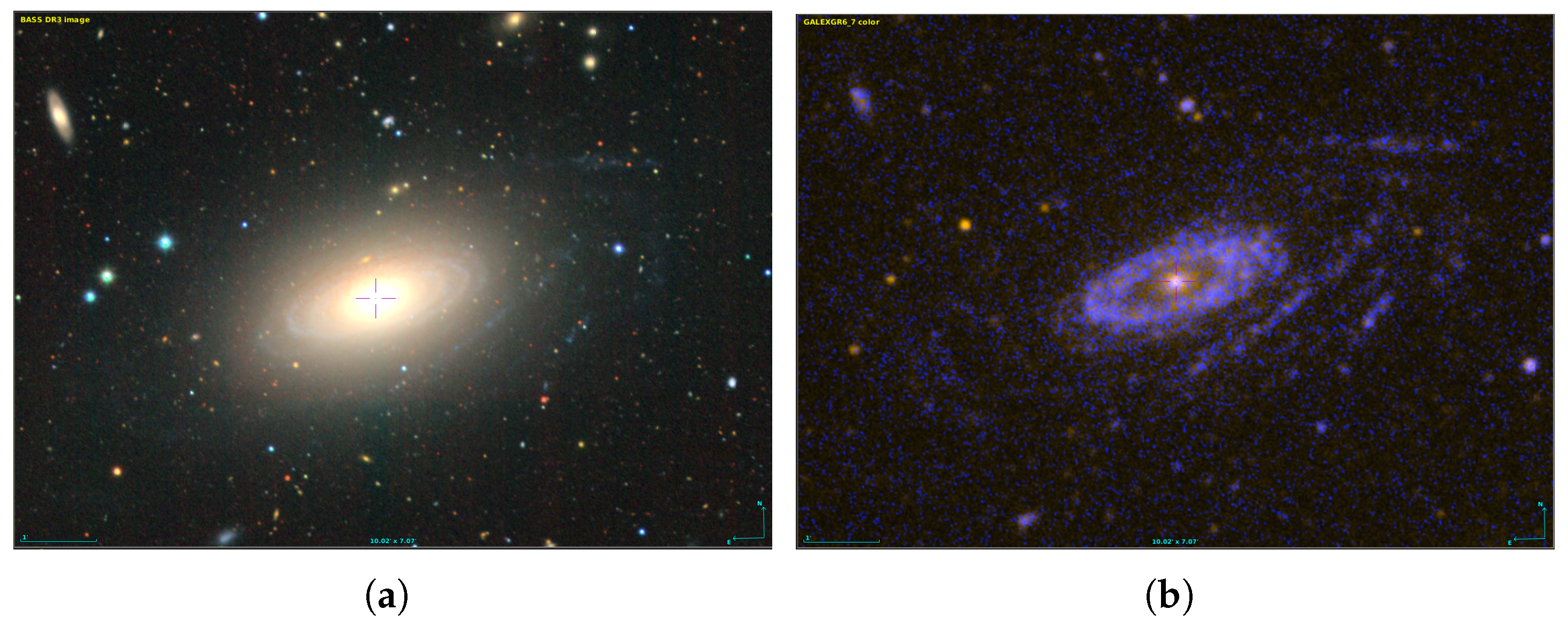
Figure 4.
NGC3898: Total intensity H i 21cm line emission contours have been superposed on an optical image of the galaxy from SDSS (left panel). H i contours from the central region are superposed on an H image (right panel). Both these H i and H are available via NASA Extragalactic Database(NED).
Figure 4.
NGC3898: Total intensity H i 21cm line emission contours have been superposed on an optical image of the galaxy from SDSS (left panel). H i contours from the central region are superposed on an H image (right panel). Both these H i and H are available via NASA Extragalactic Database(NED).
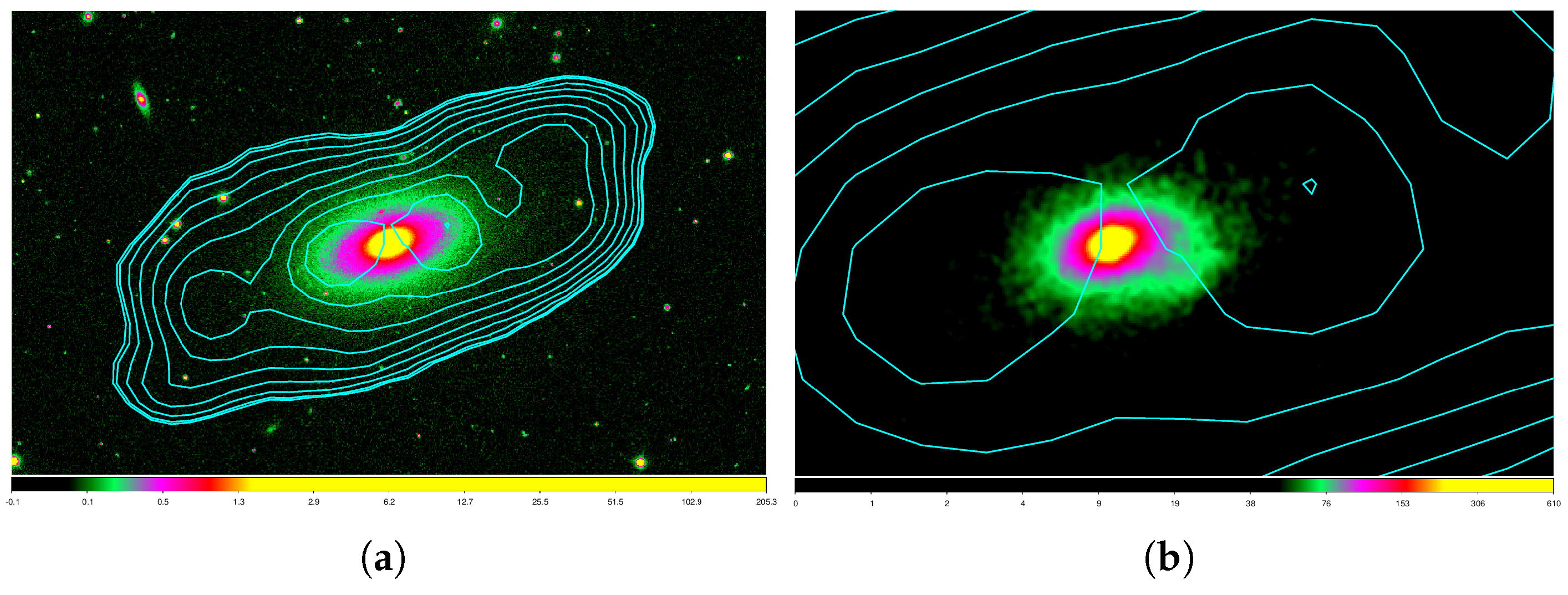
Figure 5.
RAD-“Thumbs up” galaxy: As in Figure 1, TGSS (red) DSS(green) and NVSS(blue) images of the target galaxy along with contours of NVSS on the left [0.0015 0.004 0.0065 0.009 Jy beam−1] and contours of TGSS on the right [0.015 0.027 0.038 0.05 Jy beam−1] are presented. The contours start with nearly 3 times the r.m.s. noise in the respective images. NVSS has a resolution of b=45″ and TGSS has 25″
Figure 5.
RAD-“Thumbs up” galaxy: As in Figure 1, TGSS (red) DSS(green) and NVSS(blue) images of the target galaxy along with contours of NVSS on the left [0.0015 0.004 0.0065 0.009 Jy beam−1] and contours of TGSS on the right [0.015 0.027 0.038 0.05 Jy beam−1] are presented. The contours start with nearly 3 times the r.m.s. noise in the respective images. NVSS has a resolution of b=45″ and TGSS has 25″
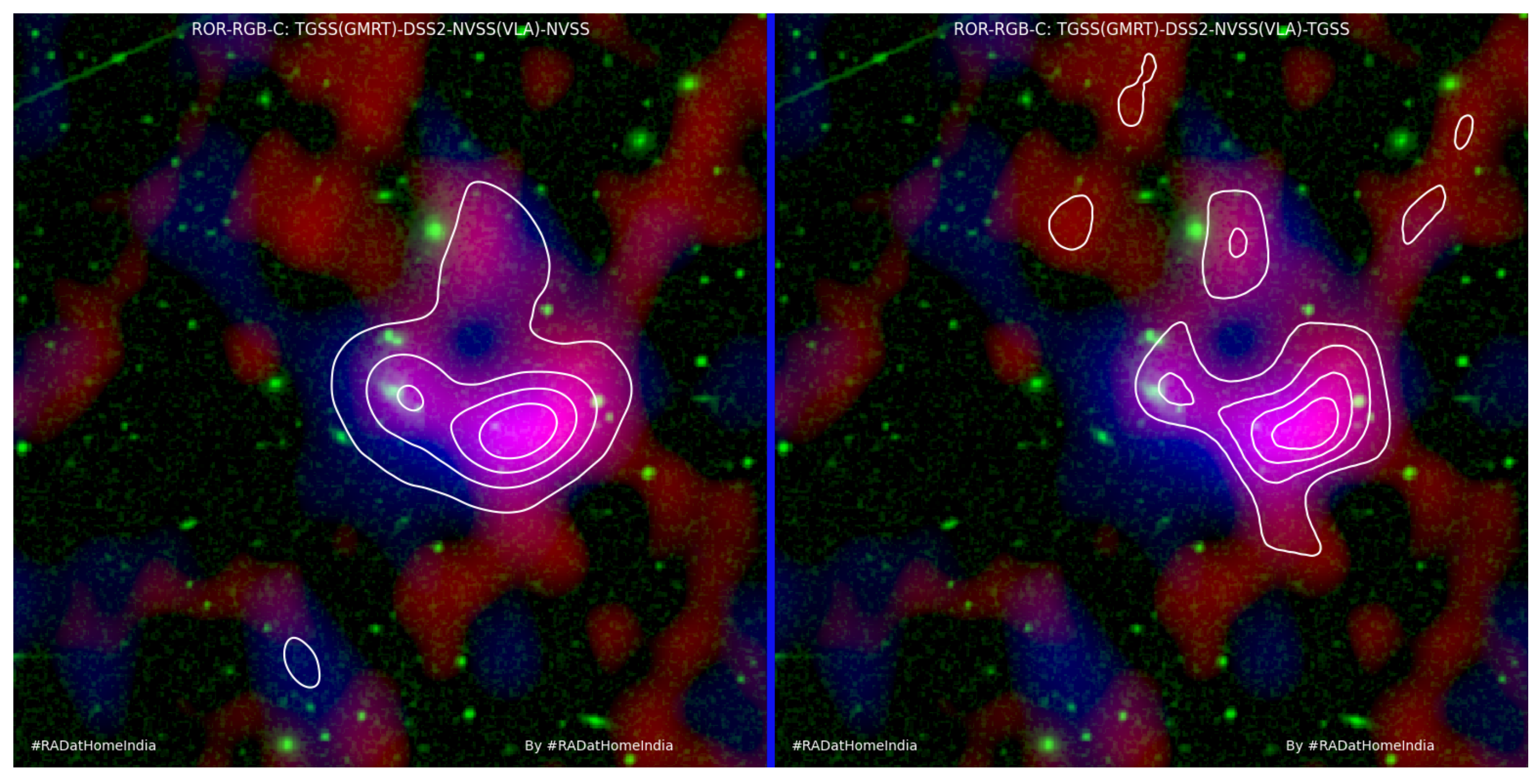
Figure 6.
RAD-Thumbs up galaxy: [Left Panel] A typical RAD@home citizen science research web-tool output showing three radio data in contours on an optical (DSS-R) greyscale image. The contour levels for NVSS (cyan) are [0.0015 0.004 0.0065 0.009 Jy beam−1], for TGSS (magenta) are [0.015 0.027 0.038 0.05 Jy beam−1] and for FIRST (yellow) are [0.0005 0.0007 0.0009 0.0011 Jy beam−1]. The resolution of the FIRST image is about 5". Notice that despite being at the same 1400 MHz frequency and better rms noise sensitivity, FIRST is missing out on the diffuse emission (thumb and fist of the “Thumbs up”). [Right panel] Contours and grey scale remain the same but the image is a zoomed-in fraction of the left panel to show features around the host galaxy.
Figure 6.
RAD-Thumbs up galaxy: [Left Panel] A typical RAD@home citizen science research web-tool output showing three radio data in contours on an optical (DSS-R) greyscale image. The contour levels for NVSS (cyan) are [0.0015 0.004 0.0065 0.009 Jy beam−1], for TGSS (magenta) are [0.015 0.027 0.038 0.05 Jy beam−1] and for FIRST (yellow) are [0.0005 0.0007 0.0009 0.0011 Jy beam−1]. The resolution of the FIRST image is about 5". Notice that despite being at the same 1400 MHz frequency and better rms noise sensitivity, FIRST is missing out on the diffuse emission (thumb and fist of the “Thumbs up”). [Right panel] Contours and grey scale remain the same but the image is a zoomed-in fraction of the left panel to show features around the host galaxy.
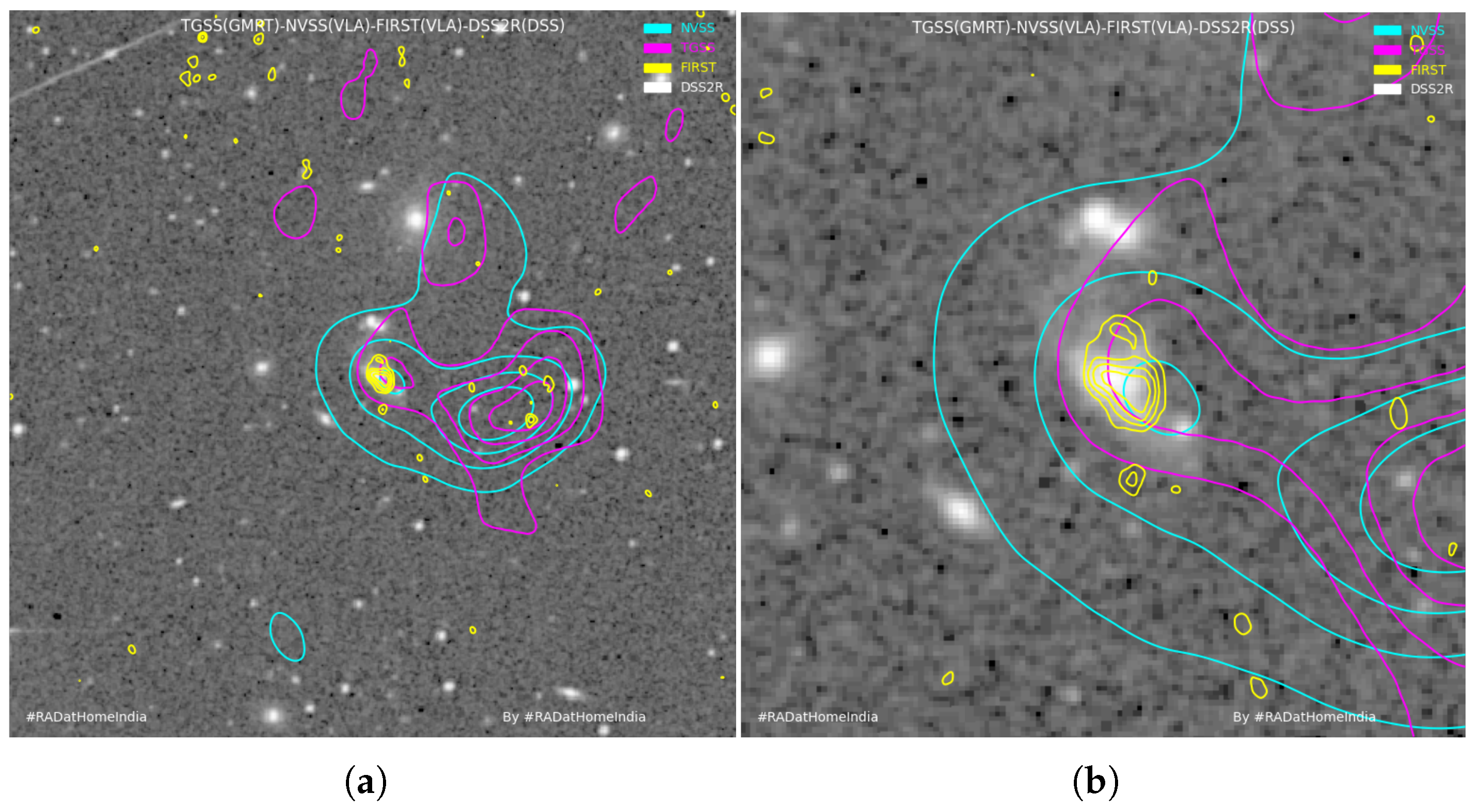
Figure 7.
Spectral index image of the RAD-“Thumbs up” galaxy from the SPIDX database. The colour bar represents the respective spectral index values. Centre of the optical galaxy is shown with a "+" mark.
Figure 7.
Spectral index image of the RAD-“Thumbs up” galaxy from the SPIDX database. The colour bar represents the respective spectral index values. Centre of the optical galaxy is shown with a "+" mark.
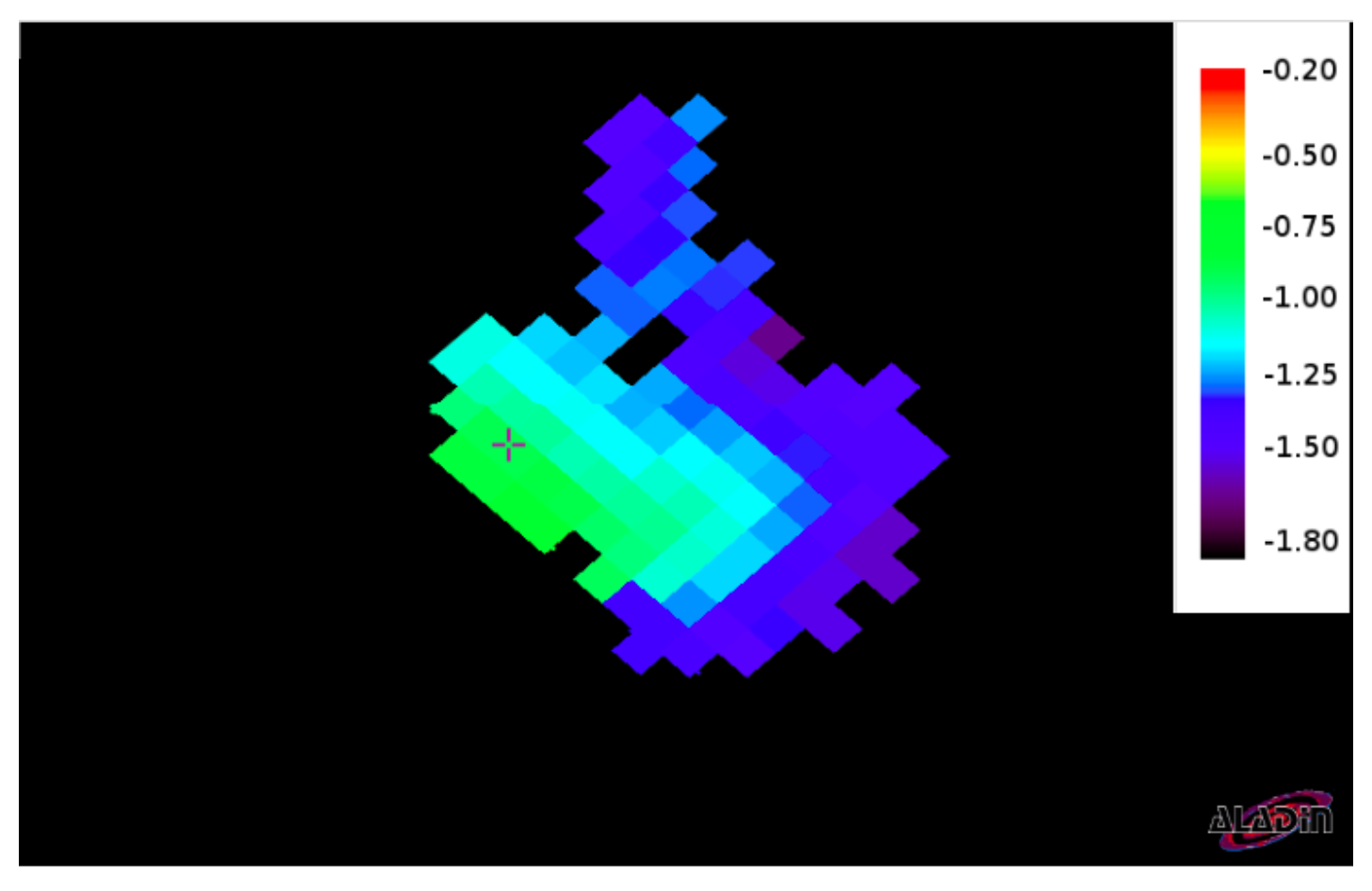
Figure 8.
A combined near and far UV image of the RAD-“Thumbs up” galaxy from GALEX (left panel). A deep optical colour image of the same galaxy from Legacy survey.
Figure 8.
A combined near and far UV image of the RAD-“Thumbs up” galaxy from GALEX (left panel). A deep optical colour image of the same galaxy from Legacy survey.
Disclaimer/Publisher’s Note: The statements, opinions and data contained in all publications are solely those of the individual author(s) and contributor(s) and not of MDPI and/or the editor(s). MDPI and/or the editor(s) disclaim responsibility for any injury to people or property resulting from any ideas, methods, instructions or products referred to in the content. |
© 2025 by the authors. Licensee MDPI, Basel, Switzerland. This article is an open access article distributed under the terms and conditions of the Creative Commons Attribution (CC BY) license (http://creativecommons.org/licenses/by/4.0/).
Copyright: This open access article is published under a Creative Commons CC BY 4.0 license, which permit the free download, distribution, and reuse, provided that the author and preprint are cited in any reuse.


