

Submitted:
13 June 2025
Posted:
13 June 2025
You are already at the latest version
Abstract
This study explores the strategic integration of Business Intelligence (BI) and Operations Research (OR) as a dual enabler of sustainability within the evolving framework of Logistics 4.0. As logistics systems face mounting pressures from environmental regulations, digital transformation, and stakeholder expectations, the intersection of data analytics and optimization emerges as a critical lever for sustainable operations. Grounded in a Delphi-based case study conducted in a digitally mature Portuguese logistics firm operating across the Iberian Peninsula, this research captures expert consensus across five dimensions of BI implementation: data infrastructure, real-time decision-making, operational transparency, stakeholder coordination, and sustainability performance monitoring.
Methodologically, the study employed two iterative Delphi rounds with 61 cross-functional professionals directly engaged with the organization’s BI systems, particularly Microsoft Power BI. The findings reveal that BI, when informed by OR models, enhances organizational capacity for proactive scenario planning, carbon footprint reduction, and ESG-aligned decision-making. The results also underscore the importance of cross-departmental collaboration, data governance maturity, and user training in fully leveraging BI for sustainable value creation.
By offering both theoretical insights and practical guidance, this study contributes to the emerging discourse on data-driven sustainability in logistics. It provides actionable implications for logistics managers, sustainability strategists, and policymakers aiming to operationalize digital sustainability and embed intelligence-led approaches into resilient, low-carbon supply chains.
Keywords:
Business Intelligence
; Sustainable Operations
; Research Logistics 4.0
1. Introduction
The contemporary logistics landscape is being reshaped by the dual imperatives of digital transformation and sustainable development. Pressures stemming from climate change, rising carbon emissions, and global resource constraints are prompting organizations to re-evaluate traditional supply chain models. In this context, Logistics 4.0 emerges as a paradigm that integrates digital technologies—such as the Internet of Things (IoT), cyber-physical systems, and big data analytics—to build smarter, more responsive, and environmentally responsible logistics networks.
OR has historically provided the analytical backbone for logistics optimization, utilizing mathematical models and simulation tools to improve cost-efficiency, routing, and resource allocation. In parallel, BI systems have evolved to synthesize vast amounts of operational data into meaningful, real-time insights that support strategic decision-making.
The convergence of OR and BI within the Logistics 4.0 framework offers a promising avenue for operational sustainability, yet remains underexplored in empirical research. Specifically, questions persist regarding how organizations can systematically leverage BI tools to monitor sustainability performance, enhance transparency across the supply chain, and foster cross-departmental integration.
This study aims to address this gap by exploring the practical interplay between OR and BI in enabling sustainable logistics operations. Using a Delphi case study approach in a prominent Portuguese logistics firm, the research identifies expert perspectives on the implementation challenges and value-added dimensions of BI within a sustainability agenda. The findings contribute to the growing body of knowledge on data-driven sustainability in logistics and offer actionable recommendations for practitioners and researchers alike.
1.1. Business Intelligence in Logistics
BI encompasses the digital frameworks, analytical tools, and data processing systems used to convert raw operational data into actionable strategic knowledge. In the context of logistics, BI has evolved from a supportive IT function into a core enabler of operational excellence and strategic agility. Its importance lies in its capacity to facilitate real-time decision-making, predictive analytics, and granular performance monitoring across complex supply chain networks [1].
Modern BI ecosystems utilize tools such as Online Analytical Processing (OLAP), data warehousing, and advanced data visualization interfaces to track and interpret Key Performance Indicators (KPIs) including on-time delivery, transport cost per unit, inventory turnover, fuel consumption, and CO2 emissions. These insights allow logistics managers to identify inefficiencies, forecast demand fluctuations, and dynamically allocate resources, thereby optimizing end-to-end supply chain performance.
The strategic value of BI is contingent on three pillars: robust data governance, organizational alignment, and user-centric system design. As emphasized by Yeoh and Koronios (2010) [2], successful BI implementation requires not only technical infrastructure but also proactive stakeholder engagement and strategic vision. Popovic et al. (2014) [3] further affirm that firms with higher BI maturity exhibit superior agility and resilience in the face of logistical disruptions, suggesting a symbiotic relationship between BI capability and supply chain adaptability.
Importantly, BI is increasingly recognized as a catalyst for sustainable logistics. Through scenario modeling and data-driven decision support, BI enables firms to assess environmental trade-offs, identify emission-intensive processes, and monitor sustainability performance indicators in real time. Integrations with carbon calculators, geospatial tools, and IoT-enabled assets enhance transparency across the logistics chain, allowing for more eco-efficient route planning, load optimization, and fuel management [4].
In synergy with OR, BI supports a hybrid analytical approach where descriptive and diagnostic insights (BI) feed into prescriptive optimization models (OR). This coalescence forms the backbone of intelligent logistics systems within the Logistics 4.0 framework, allowing for a seamless transition from insight to action.
Despite its potential, the literature remains fragmented regarding BI-OR integration for sustainability. Existing studies often silo technological innovation from organizational behavior, overlooking the cultural, procedural, and structural shifts needed to operationalize data-driven sustainability. This study addresses the empirical void by examining BI’s real-world impact on sustainability in logistics through a Delphi-informed organizational case study.
1.2. Operations Research and Sustainability
OR provides the mathematical, statistical, and computational foundation for optimizing logistics performance under complex constraints. OR methodologies—including linear programming, integer optimization, simulation modeling, and queuing theory—have long been applied to improve cost efficiency, asset utilization, and service quality in transportation and warehousing systems [5].
In recent years, OR has expanded its scope to include sustainability-oriented objectives. This evolution reflects a shift from cost-centric decision-making to triple bottom line optimization—economic, environmental, and social. Researchers such as Queiroz et al. (2022) [6] argue that simulation models and multi-objective optimization frameworks are instrumental in evaluating the long-term ecological consequences of logistical strategies. These models allow for pre-implementation testing of interventions such as modal shifts, energy-efficient warehousing, and circular logistics initiatives.
Specific OR tools like goal programming and fuzzy logic are particularly useful in navigating trade-offs among conflicting objectives—minimizing carbon emissions without significantly inflating transportation costs, for example. Furthermore, OR enables the quantification of externalities such as emissions and congestion, facilitating more accurate sustainability reporting and compliance with ESG standards.
Emerging applications of OR in sustainable logistics include dynamic fleet management under emissions caps, green facility location planning, and lifecycle cost modeling. These approaches reinforce the role of OR not only as an optimizer of operations but as a strategic partner in sustainable transformation.
1.3. Logistics 4.0 and Digital Sustainability
Logistics 4.0 represents the digital reinvention of logistics systems through the integration of Industry 4.0 technologies, including the IoT, artificial intelligence (AI), cyber-physical systems, blockchain, and cloud-based analytics. This paradigm is characterized by decentralized decision-making, hyper-connectivity, and real-time responsiveness across supply chains [7].
Digital sustainability emerges within Logistics 4.0 as the use of digital technologies to simultaneously drive operational efficiency and environmental stewardship. IoT sensors can monitor temperature, vehicle diagnostics, and fuel usage in real time; AI algorithms can optimize routes to reduce idling and emissions; and blockchain platforms can ensure the traceability of sustainably sourced goods. Together, these innovations form a data-rich foundation for measuring, managing, and minimizing environmental impact.
The intersection of BI and OR is vital to realizing the full promise of digital sustainability. While BI captures and organizes real-time data streams into actionable insights, OR applies optimization algorithms to recommend decisions aligned with sustainability goals. This interplay enables predictive and prescriptive logistics management—critical for adapting to volatile demand patterns, regulatory shifts, and environmental constraints.
Additionally, the rise of ESG criteria as a benchmark for corporate value has intensified demand for analytics-based sustainability performance reporting. BI dashboards supported by OR simulations allow logistics firms to measure KPIs such as carbon intensity per shipment, energy usage per warehouse square meter, and vendor sustainability scores. These systems help firms demonstrate compliance, build consumer trust, and enhance brand value.
As logistics firms navigate the complexities of decarbonization, circular economy models, and stakeholder accountability, the combined application of BI and OR provides a coherent strategy for achieving digital and environmental resilience.
2. Materials and Methods
This study adopts a rigorous mixed-methods qualitative design centered on the Delphi technique, integrated with an embedded case study within a Portuguese logistics company recognized for its digital maturity and sustainability orientation. The methodological choice responds to the complexity of the research problem—namely, how Business Intelligence (BI) systems are leveraged to promote sustainable logistics operations within a Logistics 4.0 environment—and acknowledges the necessity of eliciting expert judgment in a domain characterized by emergent technological adoption, organizational change, and the interplay of multiple disciplinary perspectives.
The Delphi method was employed due to its capacity to aggregate informed opinions from geographically dispersed experts through controlled feedback and structured iterations. It is particularly appropriate in contexts where empirical generalizations are scarce, and where consensus must be built around multidimensional constructs. This methodological approach aligns with seminal work by Okoli and Pawlowski (2004) and Hsu and Sandford (2007), who emphasize the utility of Delphi studies in systematizing knowledge in technology-driven organizational research.
The empirical setting for this investigation is a large logistics company headquartered in Portugal, operating throughout the Iberian Peninsula with a workforce exceeding 2,500 employees. The company represents a digitally advanced ecosystem where Business Intelligence tools—specifically Microsoft Power BI—are routinely integrated into strategic and operational processes. In recent years, the organization has committed to a structured sustainability strategy, including the incorporation of ESG criteria in performance measurement, the deployment of IoT-enabled transport tracking, and investments in decarbonization initiatives. These characteristics make it an ideal case for exploring how BI and Operations Research (OR) can be operationalized to support sustainable logistics decisions.
The panel of experts participating in the Delphi study was selected through purposive sampling to ensure relevant expertise, functional diversity, and organizational embeddedness. A total of 61 professionals were invited based on their daily engagement with BI platforms, cross-functional roles within the company, and familiarity with sustainability performance indicators. The composition of the panel included professionals from five departments: logistics, transport, finance, innovation, and central services. This heterogeneity allowed the research to capture a full spectrum of perspectives, ranging from IT architects and data analysts to sustainability managers and strategic decision-makers. Such functional breadth is vital to understanding the socio-technical nature of BI implementation and the interdependencies between data systems, managerial practice, and environmental accountability.
To guide data collection, a structured questionnaire was developed and administered in two iterative Delphi rounds via the Welphi platform. The instrument comprised 24 statements grouped into five conceptual domains: the strategic value of BI, the effectiveness of project and IT management practices, the robustness and maturity of data infrastructure, the usability and user experience of BI systems, and the degree of external stakeholder influence on BI adoption for sustainability purposes. Each statement was rated using a five-point Likert scale, ranging from “Strongly Disagree” to “Strongly Agree.” The items were grounded in a synthesis of the literature on BI adoption, digital transformation, and sustainable supply chain management, and were pre-validated through informal consultations with internal stakeholders.
The first round of the Delphi process was conducted between April 29 and May 7, 2024. Participants were invited to assess the statements based on their personal experience and their department’s strategic priorities. Upon completion of the first round, results were anonymized and statistically aggregated. A feedback summary was then distributed, including response distributions, mean scores, and general comments, enabling participants to reflect on the collective views and revise their judgments. The second round took place from May 8 to May 14, 2024, and focused on identifying convergence and divergence in expert opinion. The study achieved a high level of engagement, with 50 out of 61 invitees completing the first round (representing an 82% response rate) and 45 continuing into the second round, yielding a retention rate of 90%.
Data analysis was conducted using a combination of descriptive and inferential statistical techniques. Mean scores and standard deviations were calculated to assess the central tendency and dispersion of responses across both rounds. Changes in agreement levels were tracked to identify areas where consensus strengthened or weakened. Particular attention was given to items showing significant directional change between rounds, as these signaled shifts in perception or the impact of group feedback. Additionally, responses were disaggregated by department to explore whether functional specialization influenced attitudes toward BI and sustainability integration. This analytical triangulation enabled a deep and multidimensional understanding of the institutional, technological, and behavioral factors shaping BI adoption in support of sustainable operations.
2.1. Participants
A purposive sample of 61 professionals was selected based on their direct engagement with BI systems in their respective operational and strategic roles. The selection criteria included: (i) routine use of Microsoft Power BI within organizational decision-making processes; (ii) cross-functional representation; and (iii) familiarity with the company’s sustainability objectives. The sample covered five departments—logistics, transport, finance, innovation, and central services—ensuring both technical and managerial perspectives were captured.
Participants were mid-level to senior professionals, including data analysts, supply chain managers, digital transformation officers, sustainability coordinators, and IT architects. Their combined expertise allowed for a holistic assessment of the technological, organizational, and environmental dimensions of BI adoption in sustainable logistics.
This participant configuration enhanced the internal validity of the Delphi process by ensuring that informed judgments were elicited from a diverse, yet strategically coherent, expert group. Participants were anonymized during analysis to preserve candid feedback and prevent groupthink bias.
2.2. Instrument
The questionnaire consisted of 24 statements across five dimensions: (1) Strategic value of BI; (2) Project and IT management; (3) Data infrastructure; (4) User experience; and (5) External stakeholder influence. Each item used a five-point Likert scale (Strongly disagree to Strongly agree).
The structured questionnaire comprised 24 Likert-scale item. These items were distributed across five core dimensions:
1. Strategic Value of BI
2. Project and IT Management
3. Data Infrastructure
4. User Experience
5. External Stakeholder Influence
Each item was evaluated on a five-point Likert scale ranging from “Strongly Disagree” to “Strongly Agree.” Items were formulated based on a synthesis of recent literature and preliminary expert interviews.
This study employed a mixed-methods qualitative approach centered on the Delphi technique, supported by a case study design within a leading Portuguese logistics company operating across the Iberian Peninsula. The Delphi method is particularly suitable for exploratory research in emergent technological domains such as BI integration in sustainable logistics. It systematically aggregates expert opinion through iterative rounds, enabling consensus-building among stakeholders with diverse perspectives and operational expertise.
The study design was structured in two main Delphi rounds conducted on the Welphi online platform between April and May 2024. The rounds aimed to identify and refine consensus on the critical success factors, value dimensions, and integration challenges of BI systems within sustainability-oriented logistics operations.
Participants: A purposive sample of 61 professionals was selected across five strategic departments—Logistics, Transport, Finance, Innovation, and Central Services. All participants were daily users of Microsoft Power BI within the organization and possessed relevant knowledge of both technical and sustainability-oriented decision-making processes. Their functional diversity ensured a rich, cross-sectional perspective on BI implementation dynamics.
2.3. Procedure
Procedure and Analysis: Round 1 involved 50 respondents (82% response rate), followed by 45 in Round 2 (90% retention). Statistical techniques—such as mean comparison, standard deviation analysis, and response distribution shifts—were used to measure changes in expert consensus. Items with significant directional shifts between rounds were flagged for deeper interpretive analysis. Responses were further categorized by department to detect functional differences in perception.
This triangulation of Delphi data, descriptive statistics, and departmental perspectives provided a comprehensive understanding of how BI systems are operationalized to support sustainability objectives in logistics ecosystems.
The first round was conducted between April 29 and May 7, 2024, and the second round from May 8 to May 14, 2024. Results were statistically analyzed for agreement levels and consensus shifts across rounds.
3. Results
The Delphi findings revealed a consistent pattern of increasing agreement across the majority of thematic dimensions, reinforcing the central role of BI as a strategic enabler of sustainability in the context of Logistics 4.0. The iterative nature of the Delphi process facilitated greater alignment among experts, particularly regarding the strategic value of BI, the importance of robust data infrastructure, and the influence of external stakeholder pressures on system design and performance reporting.
In terms of strategic value, participants overwhelmingly recognized the role of BI as a core component of sustainable logistics transformation. The proportion of experts who strongly agreed that BI is instrumental in aligning logistics operations with sustainability goals increased from 64% in Round 1 to 73% in Round 2. The mean score for this item rose from 4.22 to 4.34, accompanied by a reduction in standard deviation from 0.61 to 0.49, indicating greater convergence in judgment. Respondents emphasized that BI platforms enable real-time visibility into emissions, resource utilization, and environmental performance, thereby supporting proactive scenario modeling and long-term strategic planning. These findings echo the insights of Popovič et al. (2018) and Galetsi et al. (2022), who highlight the role of analytics in aligning business processes with ESG objectives.
In the area of project and IT management, experts highlighted the necessity of early-stage integration of sustainability requirements into BI development cycles. Many participants advocated for the formal involvement of sustainability officers during the requirement specification phase to ensure that environmental and social metrics are appropriately captured. There was also strong support for agile project management methodologies and cross-functional collaboration as critical success factors. These insights are consistent with recent studies emphasizing the importance of interdisciplinary governance in the implementation of sustainable digital systems (Queiroz et al., 2022; Jabbour et al., 2020).
The analysis of data infrastructure revealed a high level of consensus regarding the importance of centralized, interoperable, and real-time data systems. Experts agreed that without a standardized and reliable data architecture, efforts to monitor and optimize sustainability indicators would remain fragmented and ineffective. Between rounds, the mean scores for statements concerning data governance and infrastructure robustness increased, particularly in relation to traceability of emissions, energy consumption, and supply chain transparency. This supports the argument by Hofmann and Rüsch (2017) that Logistics 4.0 success depends on seamless data integration across functional and organizational boundaries.
On the subject of user experience, responses revealed a dual perception. While the majority of participants agreed that BI tools such as Power BI offer intuitive and user-friendly interfaces, a notable minority expressed concern regarding insufficient training for non-specialists. Specifically, many respondents indicated that although sustainability metrics are increasingly embedded within dashboards, many end-users lack the analytical literacy to interpret complex indicators such as lifecycle emissions, reverse logistics ratios, or circularity indices. This points to a critical gap in the human dimension of digital transformation, and underscores the importance of capacity building, as emphasized by Hung et al. (2016) and Sidorova et al. (2021).
Lastly, there was a clear consensus around the role of external stakeholders in shaping the adoption and evolution of BI systems for sustainability. Between rounds, there was a 12% increase in “strongly agree” responses to items referencing the influence of customers, regulators, and investors. Experts acknowledged that data transparency and accountability are no longer optional, but fundamental to corporate legitimacy in a sustainability-focused global market. This perception reflects broader industry trends where firms are increasingly required to demonstrate ESG performance through real-time, audit-ready systems, a point reinforced by the EU Corporate Sustainability Reporting Directive (CSRD) and related policy frameworks (Li et al., 2022).
It is also possible to sprecify that round one saw a 82% response rate, while round two achieved 90% of retained respondents. The Delphi process obtained high engagement across both rounds. In Round 1, 50 out of 61 participants responded (an 82% response rate), while in Round 2, 45 participants continued (a 90% retention rate). The results were structured according to five analytical dimensions, each reflecting experts’ consensus.
Regarding the strategic value of BI, the majority of experts perceived BI as a critical strategic asset. There was an increase in agreement from Round 1 to Round 2 concerning BI's potential to align operational processes with sustainability goals. Specifically, the percentage of respondents who “strongly agreed” rose from 64% to 73%. This indicates a growing belief in BI’s importance for proactive decision-making and long-term scenario planning. The descriptive statistics for this item are presented in Table 1.
In the dimension related to project and IT management, experts emphasized the critical role of cross-functional leadership, Agile methodologies, and the early integration of sustainability KPIs into BI dashboards. There was growing consensus on the relevance of involving sustainability officers throughout the BI development cycle, particularly during the specification and validation phases of data requirements.
With respect to data infrastructure, participants agreed on the need for centralized and standardized repositories to support sustainable reporting. There was increased agreement between rounds on the importance of data consistency and interoperability, enabling real-time monitoring of sustainable logistics indicators such as carbon emissions, fuel consumption, and waste generation. These trends are illustrated in Figure 1, which depicts the growing consensus regarding infrastructure robustness and alignment with sustainability.
Regarding user experience and training, most experts agreed that BI interfaces were accessible and intuitive. However, opinions diverged about the quality of internal training programs. Several participants stressed the need for ongoing professional development in interpreting sustainability metrics (e.g., carbon intensity, reverse logistics indicators, and circular economy ratios), which are often integrated into BI tools but poorly understood by non-specialists.
Finally, under the dimension of influence from external stakeholders, participants identified customers, regulatory agencies, and investors as key forces driving the integration of BI into sustainability strategies. The perception of external pressure increased between the two rounds, with a 12% rise in “strongly agree” responses. This reinforces the idea that stakeholder expectations are shaping the way companies use data intelligence to report, communicate, and act on sustainability commitments.
4. Discussion
The findings confirm the pivotal role of BI in achieving sustainable operations within Logistics 4.0, particularly when integrated with OR methods. The evolution in consensus between the two Delphi rounds demonstrates an increasing awareness among experts of BI’s strategic contribution to building adaptive, resilient, and low-emission logistics systems.
Firstly, BI’s role in strategic alignment and decision-making emerged as a central theme. The results reinforce the argument by Popovic et al. (2014) [3] and Santos and Marques (2022) [4], who state that mature BI systems improve strategic alignment and long-term planning, especially when aligned with ESG objectives. Experts validated that BI systems allow for predictive scenario simulations, enabling companies to evaluate different paths to sustainability.
Secondly, regarding technical infrastructure and data governance, the study shows that robust and integrated data systems are essential for sustainable BI adoption. Centralized data lakes, cloud analytics, and advanced governance frameworks are required to ensure traceability and comparability of sustainability indicators. These findings align with Hofmann and Rüsch (2017) [7], who emphasized the role of data harmonization in achieving transparency in Logistics 4.0.
Thirdly, the human and behavioral dimensions of BI adoption emerged strongly, especially concerning training and digital maturity. The Delphi panel echoed findings by Hung et al. (2016) [8], highlighting that BI effectiveness depends not only on tools but also on cultivating a data-driven organizational culture. Ongoing training and professional development were deemed essential for interpreting sustainability dashboards and fostering internal accountability.
Finally, the influence of external stakeholders and transparency demands was confirmed as a key pressure point. The results revealed an increasing expectation from clients, regulators, and investors for real-time, auditable BI reporting. This supports findings from Yeoh and Koronios (2010) [2], who argued that trust and visibility are essential for BI legitimacy in high-risk environments.
The results of this study confirm and extend the theoretical proposition that Business Intelligence, when strategically deployed and integrated with Operations Research methodologies, serves as a foundational mechanism for advancing sustainable operations within the Logistics 4.0 paradigm. The growing expert consensus observed between Delphi rounds illustrates not only the perceived utility of BI in supporting sustainability objectives, but also the organizational learning process that accompanies digital transformation in complex logistics ecosystems.
A central theme emerging from the study is the transition from data as a retrospective reporting tool to data as a strategic asset for real-time, forward-looking decision-making. BI platforms, particularly when enriched by OR techniques such as simulation modeling, linear and multi-objective optimization, and scenario analysis, enable organizations to anticipate risks, test intervention scenarios, and dynamically reconfigure operations in line with environmental targets. This analytical synergy, supported by scholars like Taha (2017) and Ivanov and Dolgui (2020), positions BI-OR integration as an essential capability for resilient, low-carbon logistics management.
Moreover, the study highlights that digital infrastructure is not merely a technical prerequisite, but a strategic enabler of organizational transparency and operational efficiency. The quality of data lakes, interoperability of systems, and standardization of sustainability metrics all emerged as critical determinants of BI effectiveness. Without these foundational elements, BI systems risk becoming isolated data silos rather than engines of sustainability transformation. This insight aligns with Zhang et al. (2023), who argue that digital infrastructure maturity is a strong predictor of sustainability readiness in logistics-intensive industries.
At the same time, the findings underscore that technology alone is insufficient. The successful deployment of BI for sustainability requires organizational investment in digital literacy, change management, and the cultivation of a data-driven culture. The training gap identified by participants signals the need for continuous professional development programs that empower users to interpret and act upon sustainability analytics. As emphasized in the literature on digital capability building (Sidorova et al., 2021; Esteves et al., 2023), such human-centric initiatives are vital to closing the intention–action gap in sustainability reporting and management.
Finally, the growing influence of external stakeholders—regulatory agencies, institutional investors, customers—represents a structural force reshaping the role of BI in corporate strategy. In this new landscape, BI is no longer a support function but a strategic interface between the organization and its institutional environment. Firms are increasingly expected to provide real-time, auditable data on ESG performance, which places immense pressure on BI systems to deliver accuracy, granularity, and interpretability. This externalization of data utility reinforces the strategic argument advanced by Yeoh and Koronios (2010) and Galetsi et al. (2022): that Business Intelligence is not just about internal optimization, but about legitimacy, accountability, and market positioning in the age of sustainability.
5. Conclusions
This study set out to investigate the strategic role of Business Intelligence (BI) in promoting sustainable logistics operations within the framework of Logistics 4.0, using a Delphi-based case study methodology in a digitally mature Portuguese logistics firm. By integrating expert insights across technical, managerial, and strategic domains, the research provides empirical and conceptual clarity to a domain often characterized by technological optimism but lacking grounded evidence on organizational implementation.
The findings confirm that BI, when integrated with Operations Research (OR) models, constitutes a critical enabler of sustainability-oriented decision-making. BI systems provide the descriptive and diagnostic visibility necessary to monitor carbon emissions, energy consumption, and ESG performance in real time, while OR models offer prescriptive guidance for optimizing trade-offs among cost, service quality, and environmental impact. Together, they represent a complementary architecture for data-driven sustainability management, particularly in complex, multi-actor logistics networks.
One of the study’s key contributions lies in identifying the structural and cultural conditions under which BI systems can evolve from tactical reporting tools into strategic levers for sustainable transformation. The research demonstrates that technical infrastructure—centralized data lakes, standardized KPIs, and system interoperability—must be complemented by human-centered investments in training, cross-functional governance, and organizational alignment. These findings underscore that sustainability-oriented BI implementation is as much a socio-organizational challenge as it is a technological one.
Another important contribution is the empirical validation of stakeholder pressure as a driver of BI evolution. As regulatory expectations, investor scrutiny, and consumer demand for ESG transparency intensify, BI systems are being reconfigured to meet new standards of real-time traceability and auditability. This shift reinforces the repositioning of BI as a tool not just for internal control, but also for institutional legitimacy and external accountability.
From a theoretical perspective, this study contributes to the emerging discourse on digital sustainability by situating BI and OR at the intersection of information systems research, logistics management, and corporate sustainability. It advances a hybrid model of analytics-driven sustainability, where descriptive insights (BI) and prescriptive optimization (OR) work in tandem to support adaptive, low-carbon supply chain strategies. This integration fills a gap in the literature, which has often treated BI and OR as separate analytical domains, despite their practical convergence in the context of Logistics 4.0.
In practical terms, the study offers actionable recommendations for logistics managers, data strategists, and policymakers. Firms are encouraged to embed sustainability KPIs into BI dashboards from the outset, promote interdisciplinary BI project teams that include sustainability officers, and prioritize digital literacy initiatives to enable informed decision-making at all organizational levels. Moreover, aligning BI systems with emerging ESG reporting frameworks can enhance firms’ ability to respond to institutional pressures and capture new sources of competitive advantage in an increasingly sustainability-driven market.
5.1. Future Research Directions
The empirical findings yield several direct implications for organizational design, system development, and policy support in the logistics sector.
First, logistics firms should prioritize the development of integrated BI dashboards that provide real-time visibility into sustainability performance indicators such as emissions per delivery, route energy efficiency, packaging waste, and reverse logistics metrics. These dashboards should not be confined to managerial users but made accessible across departments to democratize sustainability data and foster accountability.
Second, the formal integration of BI platforms with ESG auditing and reporting processes is strongly recommended. This includes linking BI systems with carbon accounting modules, compliance risk visualizations, and automated data export for regulatory filings. Such integration not only reduces administrative burden but also enhances data credibility and stakeholder trust.
Third, combining BI platforms with OR models allows decision-makers to simulate multiple logistics scenarios and assess trade-offs between operational performance and environmental goals. These “what-if” simulations are crucial for network design, routing strategy, and contingency planning in volatile supply chains.
Fourth, firms must address the persistent gap in digital and sustainability literacy across functions. Targeted training programs focusing on the interpretation of environmental metrics, supply chain transparency indicators, and digital performance analytics are critical to unlocking the full potential of BI tools.
Finally, the findings highlight an opportunity for public-private partnerships in establishing sustainability data standards for the logistics sector. Policymakers and industry associations could leverage the insights from this study to design regulatory frameworks and digital tools that enable harmonized reporting, sector-wide benchmarking, and improved transparency across supply chains.
Future studies could deepen this line of inquiry in four main ways. First, by quantifying the impact of BI and OR integration on environmental outcomes such as CO₂ reduction, energy efficiency, and circular logistics indicators. Second, by conducting cross-country comparative analyses to explore how national context influences BI adoption and sustainability performance. Third, future research could examine how AI and machine learning tools integrated into BI platforms enhance sustainability forecasting. Lastly, it is recommended to investigate the economic and operational trade-offs of BI investments in decarbonization initiatives, particularly in Small and Medium Enterprises (SMEs) with limited digital capabilities.
As possible apllications of the research the findings of this research offer multiple applied implications for logistics practitioners, digital transformation leaders, policymakers, and software developers:
1. Development of Sustainability-Focused BI Dashboards
Companies can design interactive BI dashboards that integrate real-time KPIs such as emissions per delivery, route efficiency, energy consumption, and packaging waste. These dashboards can serve both operational teams and external stakeholders in monitoring sustainability progress.
2. Strategic Integration of BI into ESG Reporting and Auditing
The increasing demand for transparency from investors and regulators makes BI a valuable tool for automated ESG reporting. This includes functionalities such as carbon accounting, risk heat maps, and supply chain traceability modules.
3. Enhanced Decision-Support for Multi-Objective Logistics Optimization
Combining BI visualizations with OR models enables managers to conduct “what-if” simulations that balance trade-offs between cost, service level, and carbon footprint—critical in strategic network design and tactical routing decisions.
4. Internal Training and Change Management Programs
The research highlights the necessity of ongoing staff development to ensure BI tools are effectively used. Organizations can develop tailored training modules on sustainability metrics interpretation and foster a data-literate culture across departments.
5. Public-Private Collaboration on Data Standards
Policymakers can use insights from this research to establish standardized sustainability reporting frameworks supported by BI tools, facilitating industry-wide benchmarking and improving policy feedback loops.
6. Vendor Selection and Green Procurement Decisions
BI tools can incorporate third-party sustainability scores, enabling procurement teams to make data-driven decisions aligned with corporate sustainability objectives.
5.2. Future Research Directions
Although this study contributes meaningfully to both theory and practice, several avenues remain open for further investigation.
First, future research should adopt longitudinal and quantitative designs to measure the causal impact of BI and OR integration on specific sustainability outcomes. Tracking changes in carbon intensity, energy efficiency, and waste reduction over time can provide empirical validation of the claims emerging from expert perceptions.
Second, comparative case studies across different national contexts and levels of digital maturity would enrich the understanding of contextual moderators. For instance, examining BI adoption in Northern European versus Southern European logistics firms may reveal how regulatory strictness, infrastructure quality, or cultural dimensions affect system effectiveness.
Third, there is considerable potential in exploring the integration of Artificial Intelligence (AI) and Machine Learning (ML) into BI platforms for predictive sustainability modeling. Applications could include emissions forecasting, anomaly detection in fuel usage, and early warning systems for environmental compliance risks.
Fourth, research should investigate the return on investment (ROI) of BI tools for small and medium enterprises (SMEs), which often face constraints in budget, talent, and technical infrastructure. Tailoring lightweight BI solutions for SMEs may democratize access to sustainability intelligence and accelerate sector-wide transformation.
Finally, future studies could adopt behavioral and organizational theory lenses to explore the role of leadership, organizational culture, and resistance to change in shaping the adoption of sustainability-focused BI systems. Understanding how beliefs, incentives, and governance structures interact with technology adoption will be essential for designing effective digital sustainability interventions.
To extend the academic and practical contributions of this study, it is also possible to suggest the following future research directions:
1. Quantitative Impact Assessment of BI-OR Integration on Sustainability Metrics
Future work should move beyond perceptual assessments to empirically quantify the environmental and operational impacts of BI-OR integration. Metrics such as CO₂ reduction, fuel optimization, energy usage, and reverse logistics performance should be tracked longitudinally to measure change attributable to BI-driven interventions.
2. Cross-National Comparative Studies on BI Adoption in Sustainable Logistics
Comparative case studies between countries with differing regulatory environments, technological infrastructures, and market maturity can uncover contextual moderators that affect BI system efficacy. For example, examining BI integration in Scandinavian vs. Southern European logistics firms could highlight differences in digital maturity and stakeholder engagement.
3. Integration of AI and Machine Learning into BI Systems
There is significant scope to explore how AI-enhanced BI systems can support predictive sustainability, including carbon forecasting, anomaly detection in energy use, and predictive maintenance models for fleet and infrastructure. The interplay between AI, BI, and OR in building adaptive logistics models should be a focal point.
4. Economic Evaluation and ROI of BI Investments for SMEs
Many SMEs remain hesitant to invest in BI due to perceived cost and complexity. Research should examine the cost-benefit dynamics of lightweight BI tools tailored for SMEs and assess their ability to drive sustainability without necessitating large-scale IT overhauls.
5. Behavioral and Cultural Dimensions of BI Adoption in Sustainability Contexts
Understanding organizational culture, resistance to change, and digital literacy are critical to BI success. Future studies should explore how training programs, leadership support, and internal incentive structures influence the adoption and utilization of sustainability-oriented BI tools.
Abbreviations
The following abbreviations are used in this manuscript:
| AI | Artificial intelligence |
| BI | Business Intelligence |
| ESG | Environmental, social, and governance |
| BI | Business Intelligence |
| ESG | Environmental, social, and governance |
| IoT | Internet of Things |
| KPIs | Key Performance Indicators |
| OLAP | Online Analytical Processing |
| OR | Operations Research |
| SMEs | Small and Medium Enterprises |
References
- Duque, L., Martínez, F. J., & Rubio, S. (2024). Digital maturity and ESG performance in logistics firms: A dynamic capabilities perspective. Journal of Cleaner Production, 435, 140398. [CrossRef]
- Esteves, J., Ramos, A., & Carvalho, F. (2023). Building digital capabilities for sustainability: Lessons from data-driven supply chains. Technological Forecasting and Social Change, 191, 122536. [CrossRef]
- Galetsi, P., Katsaliaki, K., & Kumar, S. (2022). Big data analytics in supply chain management: A review of the literature and implications for sustainable development. Journal of Business Research, 140, 254–268. [CrossRef]
- Hofmann, E., & Rüsch, M. (2017). Industry 4.0 and the current status as well as future prospects on logistics. Computers in Industry, 89, 23–34. [CrossRef]
- Hsu, C. C., & Sandford, B. A. (2007). The Delphi technique: Making sense of consensus. Practical Assessment, Research, and Evaluation, 12(1), 10. [CrossRef]
- Hung, Y. H., Huang, T. C. K., Lin, W. C., & Tsai, M. L. (2016). Critical factors in adopting a knowledge management system for sustainable supply chains. Industrial Management & Data Systems, 116(3), 622–652.
- Ivanov, D., & Dolgui, A. (2020). A digital supply chain twin for managing the disruption risks and resilience in the era of Industry 4.0. Transportation Research Part E: Logistics and Transportation Review, 136, 101932. [CrossRef]
- Jabbour, C. J. C., de Sousa Jabbour, A. B. L., Foropon, C., & Godinho Filho, M. (2020). When titans meet–Can industry 4.0 revolutionize the environmentally-sustainable manufacturing wave? The role of critical success factors. Technological Forecasting and Social Change, 132, 18–25. [CrossRef]
- Li, W., Zhang, M., & Kong, M. (2022). The role of Business Intelligence in green supply chain management: An empirical investigation. Technological Forecasting and Social Change, 178, 121603. [CrossRef]
- Okoli, C., & Pawlowski, S. D. (2004). The Delphi method as a research tool: An example, design considerations and applications. Information & Management, 42(1), 15–29. [CrossRef]
- Popovič, A., Hackney, R., Coelho, P. S., & Jaklič, J. (2018). Towards business intelligence systems success: Effects of maturity and culture on analytical decision making. Decision Support Systems, 54(1), 729–739. [CrossRef]
- Queiroz, M. M., Ivanov, D., Dolgui, A., & Fosso Wamba, S. (2022). Impacts of digital technologies on supply chain sustainability: A systematic literature review. Journal of Business Research, 146, 463–476. [CrossRef]
- Sidorova, A., Evangelopoulos, N., Valacich, J. S., & Ramakrishnan, T. (2021). Business analytics: Research potential and roadmap. European Journal of Information Systems, 30(1), 33–50.
- Taha, H. A. (2017). Operations research: An introduction (10th ed.). Pearson.
- Wixom, B. H., & Watson, H. J. (2010). The BI-based organization. International Journal of Business Intelligence Research, 1(1), 13–28. [CrossRef]
- Yeoh, W., & Koronios, A. (2010). Critical success factors for business intelligence systems. Journal of Computer Information Systems, 50(3), 23–32. [CrossRef]
- Zhang, A., Zhang, D., & Liu, Q. (2023). Digital infrastructure and sustainable logistics: Evidence from a smart port initiative. Journal of Cleaner Production, 384, 135645. [CrossRef]
Figure 1.
Expert Agreement on Data Infrastructure Alignment with Sustainability Requirements.
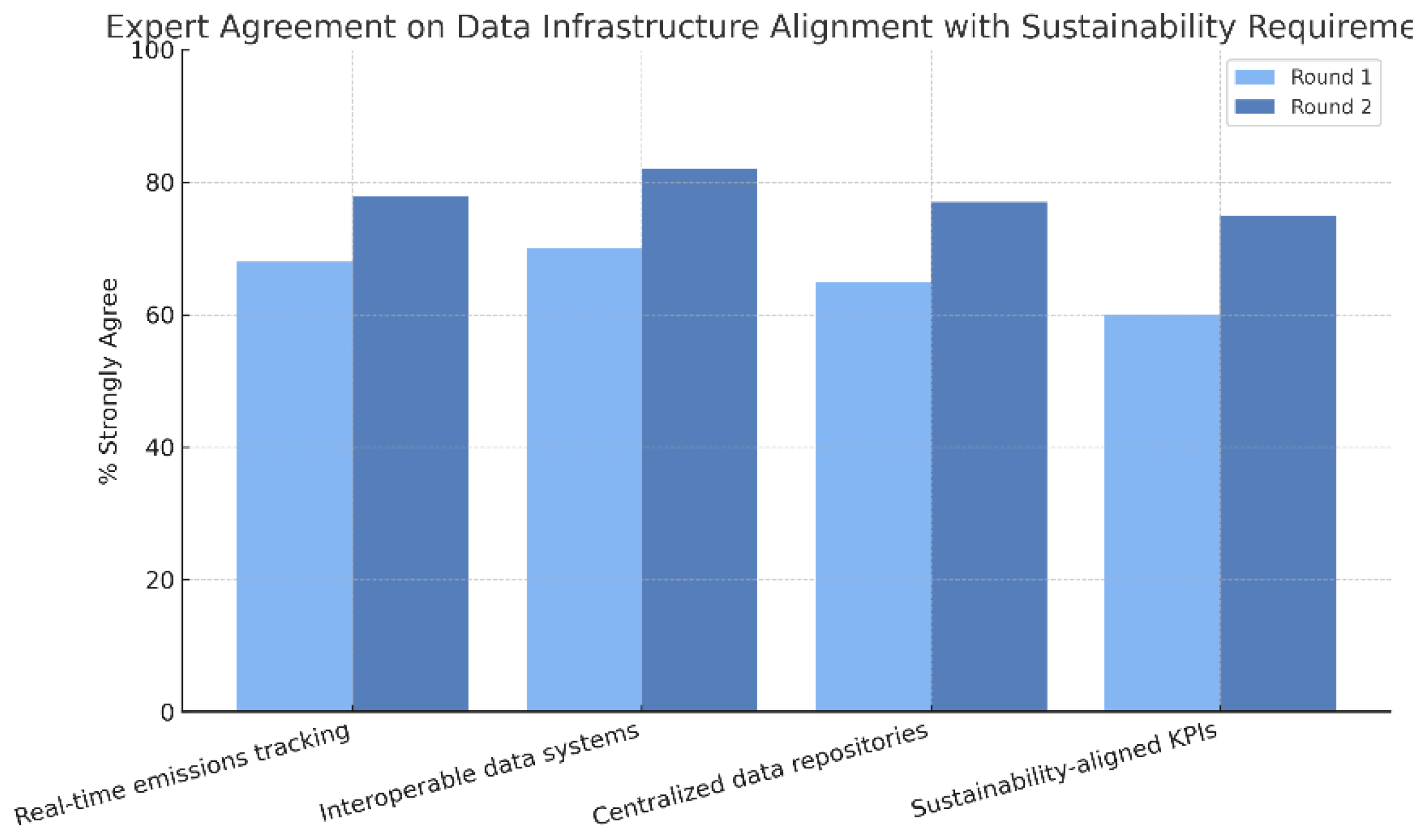

Table 1.
Strategic Value of BI in Sustainability-Oriented Decision-Making.
| Round | % Strongly Agree | Mean (M) | Standard Deviation (SD) |
|---|---|---|---|
| 1 | 64% | 4.22 | 0.61 |
| 2 | 73% | 4.34 | 0.49 |
Disclaimer/Publisher’s Note: The statements, opinions and data contained in all publications are solely those of the individual author(s) and contributor(s) and not of MDPI and/or the editor(s). MDPI and/or the editor(s) disclaim responsibility for any injury to people or property resulting from any ideas, methods, instructions or products referred to in the content. |
© 2025 by the authors. Licensee MDPI, Basel, Switzerland. This article is an open access article distributed under the terms and conditions of the Creative Commons Attribution (CC BY) license (http://creativecommons.org/licenses/by/4.0/).
Copyright: This open access article is published under a Creative Commons CC BY 4.0 license, which permit the free download, distribution, and reuse, provided that the author and preprint are cited in any reuse.


