

Submitted:
12 May 2025
Posted:
14 May 2025
You are already at the latest version
Abstract
In this paper we review Helmholtz-Boltzmann thermodynamics for mechanical systems
depending on parameters and we compute the Fisher information matrix for the associated probability
density. The divergence of Fisher information has been used as a signal for the existence of
phase transitions in finite systems even in the absence of a thermodynamic limit. We investigate
through examples if qualitative changes in the dynamic of mechanical systems described by
Helmholtz-Boltzmann thermodynamic formalism can be detected using Fisher information.
Keywords:
statistical models
; Fisher metric
; generalized exponential families
; ensemble equivalence
1. Introduction
The first part of the paper is devoted to an introduction of Helmholtz-Boltzmann (HB) thermodynamics for mechanical systems. In [1,2] Helmholtz proved that: 1) for a one-dimensional conservative mechanical system with potential energy – where is a parameter– a probability density can be defined on the region of configuration space corresponding to motions with energy e; moreover: 2) mechanical analogs of temperature T, pressure P and entropy S can be introduced such that the first principle of thermodynamics in the form holds for these systems. In the same years, Boltzmann [3] derived the analog of the probability density p for a mechanical system of n dimensions, and investigated the ergodic hypothesis for these systems. Interestingly, this picture of Statistical Mechanics based on a probability density defined in the configuration space preceded the Gibbs formulation of statistical mechanics [4] whose ensembles are defined on phase space. In recent times HB thermodynamics has been investigated in a series of papers [5,6,7,8].
In the second part of this paper we compute the Fisher Information matrix for mechanical systems described by HB thermodynamics. Fisher information (FI) matrix [9,10], a notion originally developed in statistical estimation theory, is nowadays at the crossroad between information theory [11,12], differential geometry [13], and Statistical Mechanics [14]. Recently, FI has been used to detect phase transitions in machine learning [15], neural networks [16], and in quantum systems even in the absence of a thermodynamic limit [17]. For finite systems, the existence of a phase transition is related to the divergence of one or more of the FI matrix elements, or more simply, it is located in correspondence to their maxima. Within this approach, which merges statistical mechanics and information theory, divergence of FI matrix are used to single out order parameters and reveal phase transitions, see [18].
However, for systems described by HB thermodynamics, all the information on the dynamics is encoded in the form of the potential energy where and so clearly we are dealing with a finite-dimensional system which is not composed of N interacting elementary units as in Statistical Mechanics. Moreover, there is no clear indication for the identification of one or more parameters as system’ volume, therefore, we cannot carry over for these systems the thermodynamic limit. We thus necessarily need to understand a possible notion of "phase transition" in a broader sense, as a qualitative change in some of the system’ features or patterns when one or more tunable parameters cross a threshold, as in the bifurcation theory for dynamical systems. Essentially, with HB thermodynamics, which is a statistical theory based on a probability density , we are between the statistical mechanics and bifurcation theory approaches, and this drives the interest for these systems and shapes the tools that we are going to use.
In Section 3, we state the conditions under which the probability density can define a statistical model and compute the related FI matrix. We examine the relationship between the elements of the FI matrix and the second-order derivatives of the free energy for the density which is not an exponential family and make a comparison with the corresponding notions for the canonical density (an exponential family) used in Statistical Mechanics. In Section 5 we show with paradigmatic examples that the divergence in the FI elements can detect qualitative changes in the form of probability density that describe the system (which can be interpreted as a signature of phase transition in finite systems) or it can locate the transition from negative to positive specific heat. We are aware that these results are not enough to shape a general theory, but we hope that this first step may help to renew interest for Helmholtz-Boltzmann approach to thermodynamics of mechanical systems.
2. Helmholtz-Boltzmann Thermodynamics of Mechanical Systems
In this Section we give a short exposition of Helmholtz-Boltzmann thermodynamics. Let us consider the unidimensional motion of a point of mass m under the action of a positional force where u is the potential energy. This mechanical system is conservative and the energy integral
defines a 1-dimensional orbit in phase plane which can be locally described as where is the kinetic energy. If the potential energy is convex, the motion corresponding to a fixed value e of the energy is confined in the convex interval
and it is periodic. Denoting with the time needed to travel a space interval , the semi-period of the motion is expressed by the generalized integral
We have that on the boundary of but the generalized integral is convergent if the orbit corresponding to the value of e it is not a separatrix. We can thus define a probability density on as (the value of m is not relevant)
As an example, if is the elastic potential energy and , we have and p is the arc-sine probability density defined in
We denote with the average of a function defined on with respect to the probability p in (3).
The aim of Helmholtz and Boltzmann (see [5] for an historical recognition of the theory) was to provide a mechanical analogy of the first principle of thermodynamic in Gibbs form
where S is the entropy, T is the temperature, P is the pressure and V is the volume.
This can be obtained by supposing that the potential energy depends on a parameter as and by defining the temperature and the pressure as the averages of (which is the kinetic energy) and of with respect to the probability density p in (3) –which now depends on –
The entropy S is defined as the logarithm of the area in phase space enclosed by the orbit of energy e which gives
One can check that the above defined thermodynamic analogs of for a mechanical system do satisfy the following relation, which is the mechanical equivalent of the first principle of thermodynamics
The proof is a straightforward application of the formula of derivation of a integral depending on a parameter, see [5,7].
2.1. The Multidimensional Probability Density
In [7] an extension of the above result to the case of , and is provided (see also [8] for a different approach). For the sake of completeness and to provide a basis for further development we give an account of it here. The first step is to generalize the entropy formula (5) and the probability density (3) to the d-dimensional case. To this aim we consider a system of n point masses of mass m moving in referred to coordinates and subject to potential energy . The total energy is and, analogously to what we have done before, we define
to be the portion of phase space where the energy is not greater than e. We define as in the microcanonical approach of Statistical Mechanics (see [5,8] for a justification of this definition) the entropy of the system as the logarithm of the measure of Q in phase space
If we set as before
then
where is the ball of radius r in . Let . Using Fubini theorem we can factorize the above entropy integral as
and the inner integral can be computed by "integrating on spheres" as
where is the measure of the unit ball in . Therefore, up to unessential constant term the entropy is
Setting
if we define the probability density on the subset of configuration space as –see (3)–
then the entropy integral (9) can be expressed in the same form of (5)
2.2. Multidimensional HB Thermodynamics
Our aim is to prove that for a mechanical system described by a potential energy with , a mechanical analog of the first principle of thermodynamics holds. In this section, we recall a number of results that will be used in the proof of the multidimensional HB thermodynamics result.
We start with recalling the Leibnitz integral rule, also called the Reynold transport theorem in continuum mechanics, which generalizes to the formula of derivation for the integral depending on parameters.
Proposition 1.
Let be a real function depending on one or more parameters α to be integrated on a domain . Then
where is the boundary of D, n is its outer normal unit vector and v is the speed of the boundary. If then and it holds that
Using the above Proposition 1, we want to compute the partial derivatives of the free entropy in (12) with respect to where denotes the parameters e or . If we assume that so that on , the boundary term in (15) is vanishing and we have (here and in the following we set )
If we introduce the log-likelihood function associated to the probability density in (13)
we get the result
and we can prove the following useful formula:
Proposition 2.
Let be a real function such that on . Then we have that
As a straightforward application of Proposition 2 for we can compute (here )
Now all the elements to prove the multidimensional version of HB thermodynamics have been introduced .
Proposition 3.
Let the entropy function for a mechanical system with potential energy be
and define the temperature and the type pressure as
Then it holds that
From the above result, temperature and pressure can be computed using the relations
2.3. Relation with Microcanonical Entropy
In HB thermodynamics, the entropy is the volume entropy defined as as in (6). If we choose to adopt the definition of the entropy of the microcanonical ensemble we introduce the so-called density of states and the microcanonical entropy
Since from (9)
we have
therefore, up to constant terms, the microcanonical entropy is
and we have from (14) the relation between HB and microcanonical entropy
For most thermodynamic systems the two definitions of entropy are equivalent in the limit of , where n is the number of particles of the system, see e.g. [19]. If we define the microcanonical temperature as we have, from (22) and (16)
which is different from the definition of temperature in HB thermodynamics, , see (20). So the two ensembles, for finite number of degree of freedom systems, are non-equivalent.
We now compute the specific heat in the HB and microcanonical cases. Note that since the temperature in HB thermodynamics is defined as the average value of the kinetic energy, is a dimensionless quantity. We define
and using again Proposition 2 we get
so the specific heat diverges when . Using the microcanonical temperature (23) we have
therefore
Note that, unlike what happens with the canonical ensemble, where the specific heat is necessarily positive (see (36) below), in the HB and microcanonical case the specific heat can be negative.
3. Statistical Models and Fisher Matrix
The notion of Fisher information matrix [9,10] is fundamental to describes the geometry of statistical models. We start by recalling the definition of a regular statistical model; see [12,13]. Let be a probability density defined on state space X depending on finitely many parameters . We introduce the set
Definition 1.
is a regular statistical model if the following conditions 1) and 2) hold:
- 1)
- (injectivity) the map , is one to one and
- 2)
-
(regularity) the d functions defined on Xare linearly independent as functions on X for every .
The inverse , of the map f, which exists by 1), defines a global coordinate system for . It is convenient to introduce the log-likelihood and the score basis . Note that since the function and are proportional, therefore, the regularity condition above holds if and only if the elements of the score basis are independent functions over X. The element of the Fisher matrix are defined as follows
The Fisher matrix is symmetric and positive definite; therefore, it defines a Riemannian metric on . (see [13], p.24). In fact we have (sum over repeated indices is understood)
since the score vectors are linearly independent over X. Note also that g is invariant with respect to change of coordinates in the state space X and covariant (as an order 2 tensor) with respect to change of coordinates in the parameter space [13].
3.1. Statistical Models in HB Thermodynamics
In this section we consider the HB-type probability density introduced in (13) and we compute the related Fisher matrix. We define the parameters where
and the probability density –see (13)–
defined on the set
Unlike the theory exposed above in Section 3, the probability densities in (29) are not defined in the same sample space X. To embed this case in the previously exposed theory we need to embed every probability density in the same space by setting
In the following we will spare the tilde symbol in . We suppose that conditions 1) and 2) do hold for . If we compute the score basis we have from (17) and (18)
and the elements of the Fisher matrix (26) are
Another useful expression for the elements of the Fisher matrix can be deduced from Proposition 2: we have from (16) that hence
therefore
Note that unlike what happens with exponential families, the Fisher matrix does not coincide with second-order derivatives of the free entropy function . However, the above formula coincides with the one obtained for Fisher matrix for generalized exponential families, [20,21]. Below we give detailed formulae for the elements of the Fisher matrix associated to HB thermodynamics. From (28) and (12) we have
so that
and
and
More in detail, the explicit expression of the Fisher matrix elements involves the computation of integrals of the type
where satisfies the condition on if .
4. Fisher Matrix for Canonical Ensemble
In this section we recall a well known relation between Fisher matrix and second order derivatives of the canonical free entropy function. In statistical mechanics a system of N microscopic units can be described by the Boltzmann-Gibbs (BG) or canonical probability density
where is the Hamiltonian and the integral (or sum) is extended over the set of system states x. The inverse temperature can be related to the system energy by inverting the equation so that . As a consequence
Second order phase transitions are characterized by discontinuities in the function . is an analytic function for finite systems but in the thermodynamic limit can develop discontinuities. If now we consider the log-likelihood of the canonical probability density in (35) we have
and the Fisher information of the canonical density (35) is
so from (36) and (37) we get the important result that for an exponential family density the Fisher matrix coincides with the second order derivatives of the free entropy and that the diagonal elements of the Fisher matrix diverge at the phase transition when tends to infinity.
If the system Hamiltonian is in the form the above relations are generalized as
In [18] the above argument is reversed and the claim is that the divergence of the diagonal elements of the Fisher matrix is a signature of a phase transition even if the underlying probability density is not the canonical one. The order parameter is defined by the relation and defines the generalized susceptibility. The same argument is developed in [15] in relation to the study of phase transitions using machine learning methods. To conclude, we recall that phase transitions have been defined for finite systems or for systems with long-range interactions using the non convexity of the entropy function or the non equivalence of canonical and microcanonical ensembles (see [22,23]).
5. Fisher Matrix in HB Thermodynamics. Examples
The HB thermodynamic formalism allows us to define a probability density see (10) which is related to the microcanonical one but it is "projected" on the configuration space. Instead of prescribing the interaction between the elementary units of the system, all the information about the system is encoded in its potential energy depending on multiple parameters and the energy . So we are using a formalism, which loosely speaking is in between statistical mechanics and catastrophe theory, and a probability density, which is not an exponential family. Nevertheless we still have, see (16) and (32) that for multidimensional HB thermodynamics –compare with (38)–
We want to investigate whether the divergence of elements of the Fisher matrix for particular values of parameters can detect qualitative changes in the dynamics in mechanical systems described by potential energy .
In the following, we consider some examples where the potential energy , is described by a radial function such that . This allows us to investigate our claim while keeping the computations at a tractable level. Note that, apart from the elastic chain, all the examples below define a statistical model, as it is easy to check using Definition 1.
5.1. Harmonic Potential Energy
Let us consider the simplest potential energy with no external parameters with . This energy represents d independent one-dimensional harmonic oscillators. Then and , the ball of radius in . Let us compute
so that
where is the Gamma function and the entropy function are
By direct computation we get the temperature
and the specific heat can be computed from
a result which holds also in Boltzmann Gibbs statistical mechanics (see [19]). The one dimensional Fisher matrix, also called Fisher information is, see (33)
where the probability density (29) is and
thereby obtaining (note that the average value exists for )
We see that diverges for , that is, when the system energy e tends to the minimum of the potential energy u.
Remark. This quadratic potential energy system is the prototype of the description of a mechanical system in the vicinity of a minimum of the potential energy. By a translation of the reference frame we can suppose that the minimum is in and that so that using a Taylor expansion we have
and
where and are the smallest and greatest (real) eigenvalues of the symmetric matrix . So we can conclude that the Fisher information diverges when the energy e approaches the minimum of the potential energy from above. This can be interpreted by recalling that the Fisher information measures the change in the "shape" of the probability distribution with respect to a change in the parameter e; when the energy becomes equal to the minimum of the potential energy, the probability density becomes a Dirac delta concentrated at the minimum . We can say that the divergence of the Fisher information at corresponds to the qualitative "phase transition" between a point orbit and a set of d closed orbits for the d oscillators when .
5.2. The Elastic Chain
The following example shows that for a n-dimensional mechanical systems with convex potential energy, HB thermodynamics gives a sound description of the system’s behavior (see also [7]).
Let us consider a chain of point particles of mass m linked by linearly elastic springs and constrained to move on the real axis. Suppose that particle 0 is fixed in the origin and that the coordinate of the n-th particle is so that the length of the chain is a controlled parameter corresponding to the equilibrium length of the n springs. Let the elongation of the spring be written as . The length constraint is
Due to the length constraint the chain potential energy of the resulting dimensional system can be written as
where . Therefore the region is
i.e.
where is the ball in of radius a,
and L is the dimensional hyperplane . We compute the entropy by setting
and (here )
By standard computation on radial function we get
Let us compute the temperature of this elongated chain using
which coincides with the kinetic energy per degree of freedom. Let us compute the pressure P corresponding to the controlled parameter which is the elongation on the elastic chain using . We have
which corresponds to our physical intuition of the reaction force exerted by the chain on its controlled end. The specific heat is
Remark. Note that the elastic chain model fails to define a statistical model because conditions 1) and 2) in Definition 1 are not met. Indeed concerning condition 2) we have
so the two score vectors and are not independent functions on . Therefore we can not compute the Fisher matrix for this mechanical system. If we consider only the energy parameter e, the system is similar to the previous example 1.
5.3. Two-Body System
In this example we consider an isolated system of two points of equal mass m subject to gravitational forces. If , , denote the positions of the two points, the potential energy is , where can be considered as a parameter. A system of points interacting via gravity requires a specific description in Statistical Mechanics due to the long-range nature of the force which prevents these systems to display the extensive character of the total energy. Also, it is known that gravitating systems exhibit the phenomenon of negative specific heat [24], a possibility which is excluded in the canonical description, see (36). Therefore, the correct statistical ensemble to adopt is the microcanonical one, see [25]. In [25] the above two body system is modified to construct a toy model which exhibits all the features of a many-body self-gravitating system. This is obtained by imposing a short range cutoff on the particles inter-distance , which behaves as hard spheres of radius , and a long range cutoff . This modified system display a phase transition between phases of positive and negative specific heat when the system energy is varied. We want to discuss this mechanical system using HB thermodynamics. See also [5] for a different analysis of a two body system with HB thermodynamics. Therefore we compute the probability density (10) and the Fisher information for this system and discuss its ability to describe phase transitions. Using (12) we have for ,
and from (10) with , ,
To compute the last integral it is useful to perform the change of variables where is the inter-particle vector. We have and where
therefore, by using the change of variable and Fubini theorem, we can write
The integral in is infinite unless we assume that the particle x is confined in a bounded region of volume V. Therefore we can write and, since we deal with a function radial in s we have that is finite and
The probability density (10) is thus factorized into the product of two densities
showing that the positions of the two particles are independent random variables. Therefore we can forget about the particle and perform all the computations in the s variable.
If we let the energy tend to zero, so that the inter-particle distance s can be arbitrarily large, we make Z in (40), hence the microcanonical entropy of the system , infinite. The HB or volume entropy is
and it is easy to see that is infinite if we let the inter-particle distance s go to zero, so the entropy S is infinite when stend to zero or to infinity, while is infinite only in the latter case.
Therefore, it is necessary to assume, as in [25], that there are two cutoffs , usually with , so that the two body system is confined in a bounded region of space. Moreover the system displays two energy scales
Also, it is stipulated in [25] that if the energy is in the range , the integration in the s variable is performed between extrema a and , while for the integration is between fixed extrema a and R. Due to the presence of the cutoff a, the system displays a negative specific heat phase (see again [25]).
We can now compute the temperature T, the microcanonical temperature and the pressure P using (21) for our system in the two energy ranges and then juxtapose the plots that have continuous junction at . See Appendix 1 for computations. We also compute the Fisher information from (33). See Figure 1 for the plot of T, and .
The temperature (blue curve of Figure 1) presents a gentle maximum for negative energy (point B) and a sharp minimum (point C) for a positive value of the energy. We see that for the temperature is zero as in the previous example 1. The temperature curve of this simple mechanical system displays the same features of more complex and realistic models of gravitating many particle systems: a phase (A to B) of positive specific heat followed by a phase (B to C) of negative specific heat and again a phase of positive specific heat (after C). The microcanonical temperature (orange curve) has a similar behavior of T. The points where the two temperature curves cross each other are the points where the specific heat diverges; see (24). See [25] for a physical interpretation of these phases.
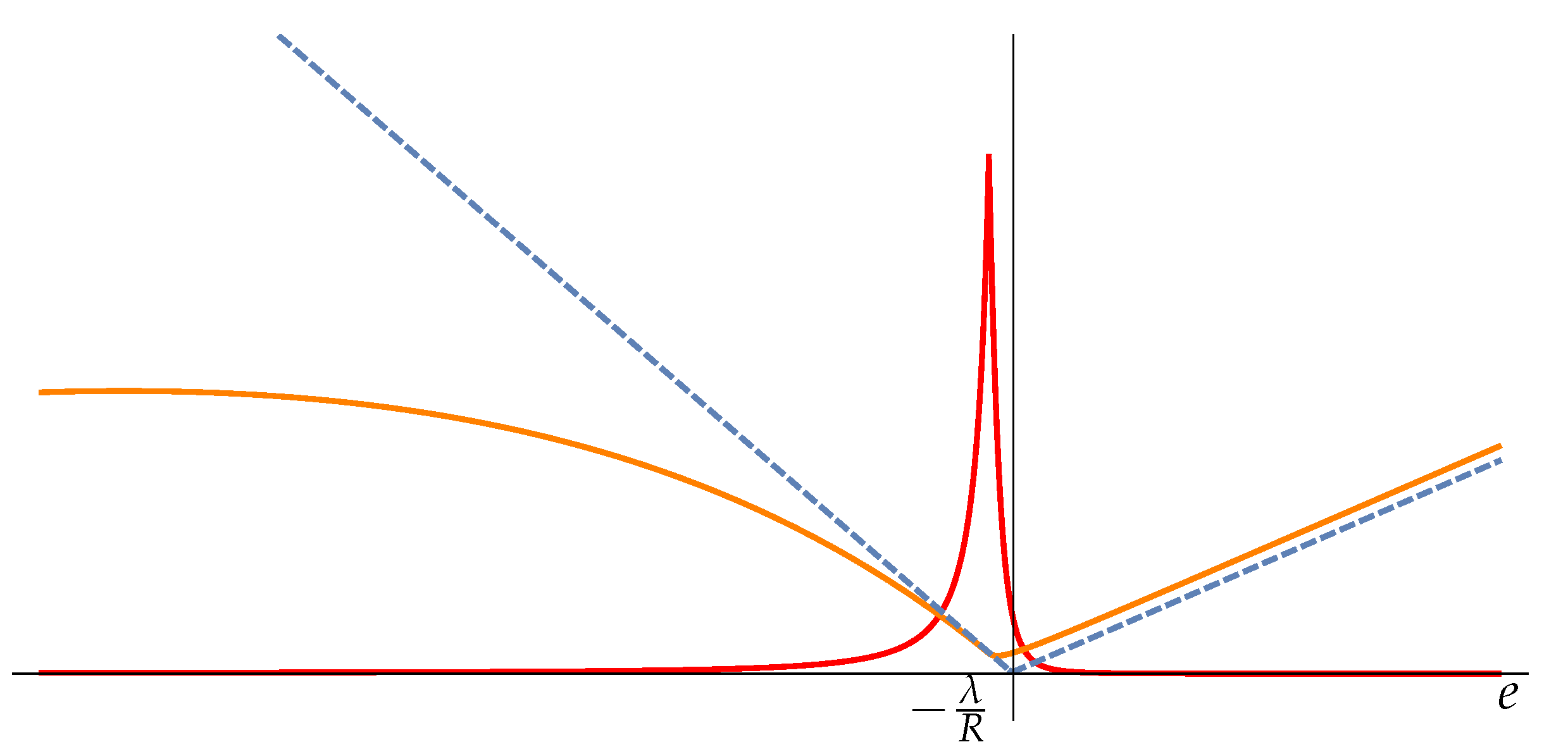
We see that the Fisher information (red curve of Figure 1) diverges for and has a peak for . The divergence in is located at the minimum of the potential energy (due to the cutoff at ) and it is similar to the one found in the previous example 1. Here we are concerned with the assessment of the ability of Fisher information to locate the phase transitions at B and C. It seems that the phase transition in B is not detected, and the one in C is not exactly located. This is due to the presence of the cutoffs (which are essential for the existence of the negative specific heat phase). As far as the phase transition in B is concerned, the shape of the curve of temperature T does not change with a and in the limit entropy S becomes infinite. On the other hand, the microcanonical entropy is defined for and the curve of the microcanonical temperature computed for (dashed line of Figure 2) does not show the phase A to B of positive specific heat. Therefore, for , the phase transition in B is removed in the microcanonical description of the system, while the remaining one is detected by the divergence of Fisher information.
We will show that if the bounds are removed, letting and the minimum C and the peak in Fisher information coincide at . In fact, the energy corresponding to point C can be determined using the condition . By computing at the leading order in we deduce that the minimum in C in Figure 1 is located at
The peak of Fisher information is located at and it height is
In the limit both and tends to 0. So we can say that the divergence of Fisher information correctly detects the phase transition from negative to positive specific heat located at .
6. Conclusions
The formulation of HB thermodynamics defines the analogs of temperature, pressure, and entropy for a mechanical system whose potential energy depends on a parameter . This scheme has been generalized to n degree-of-freedom systems with multiple parameters, but generalization to an infinite number of degrees of freedom (and hence the operation of thermodynamic limit) seems to be beyond the possibilities of the theory. It is thus interesting (and it is the aim of this work) to ask if the thermodynamic description of these mechanical systems is capable of displaying different patterns of organization (driven by qualitative changes in the underlying dynamics ) and if these patterns can be signaled by an order parameter. Given the probabilistic nature of the theory, it has been natural to investigate if the HB thermodynamic scheme can be read as a statistical model and to compute the associated Fisher matrix, which has previously been used in the literature to describe systems which are of more general nature than those considered in Statistical Mechanics. We have shown with some paradigmatic examples that there are cases in which the Fisher information computed from HB thermodynamics is capable of locating phase transitions in the generalized sense exposed above.
Funding
This research received no external funding.
Appendix
Concerning Section 5.3, all the computations are performed in the two separated energy ranges:
A) , and B) , where , , and .
In the A) case the integration in the s variable is in the interval while in the B) case the interval is . Note that the entropy is, see (9)
and it can be computed in the two energy ranges as:
Note that the entropy S is not defined for . Temperature T and pressure P can be computed from (21). Microcanonical entropy is
and it can be computed in the two energy ranges as:
Note that the entropy is defined also for . See plot of the entropies S and in Figure 3 below. Temperature and pressure can be computed by derivation using (21). See plot of T and in Figure 1 in the main text and plot of P and in Figure 4 below.
Note that is defined for . See plot of in Figure 1 in main text.
Figure 3.
Plot of entropy S (blue curve), microcanonical entropy (orange curve) and microcanonical entropy in the case (dashed curve) as a function of the energy e. The non convexity of the entropy function in the case (orange and blue solid curves) is a signature of a phase transition. See corresponding plot of temperatures in Figure 1, and in Figure 2 for the case .
Figure 3.
Plot of entropy S (blue curve), microcanonical entropy (orange curve) and microcanonical entropy in the case (dashed curve) as a function of the energy e. The non convexity of the entropy function in the case (orange and blue solid curves) is a signature of a phase transition. See corresponding plot of temperatures in Figure 1, and in Figure 2 for the case .
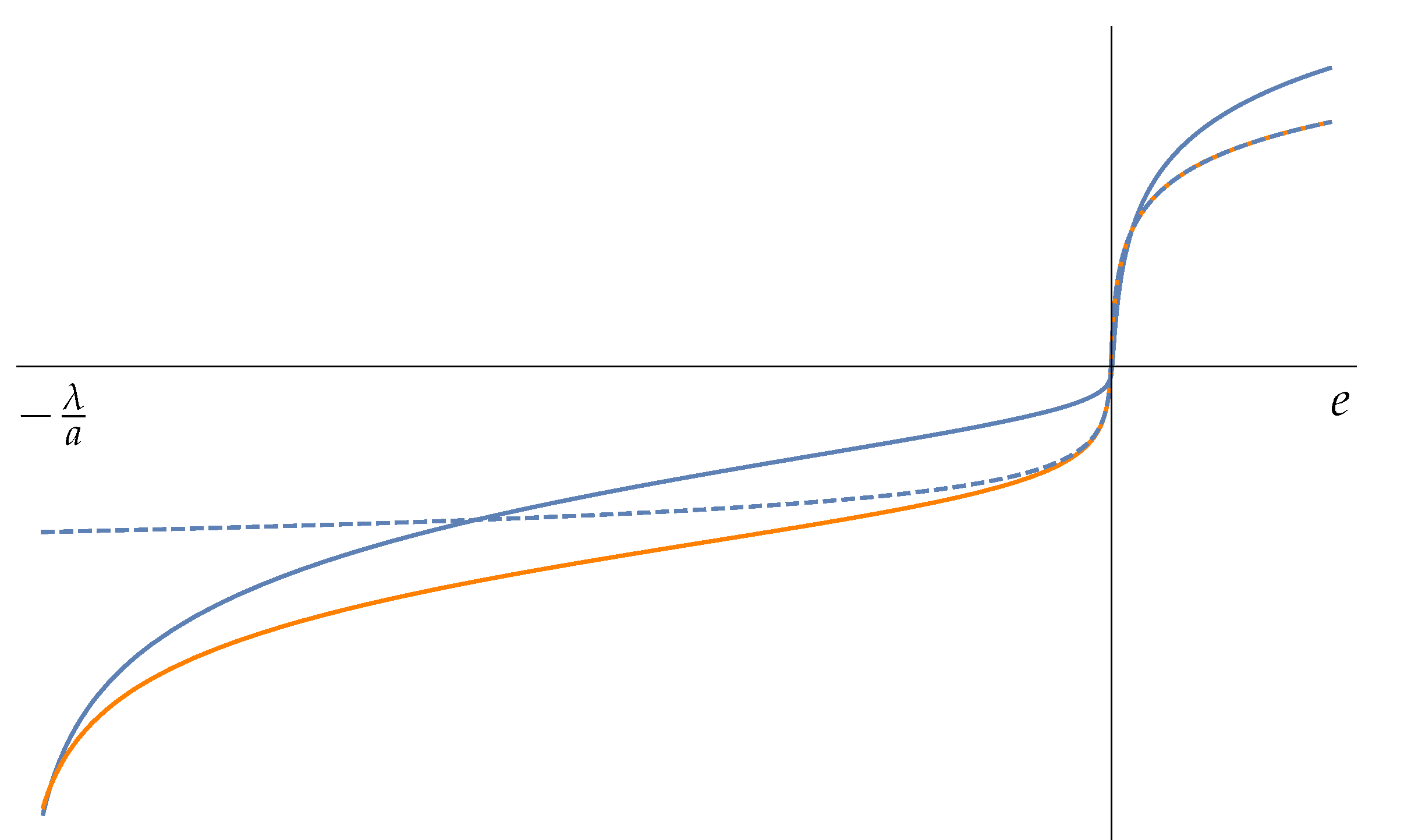
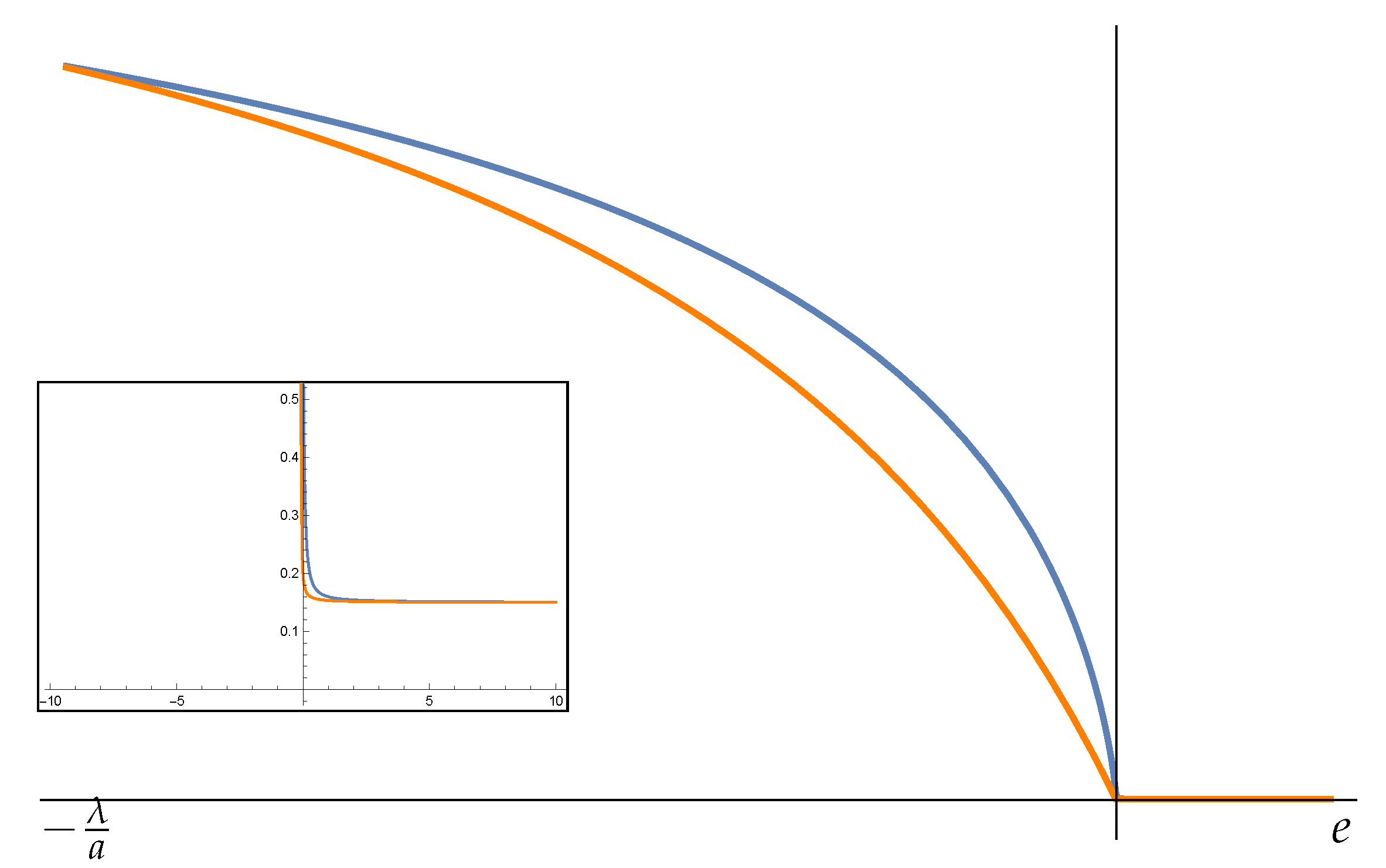
Figure 4.
Plot of pressure P (blue curve) and microcanonical pressure (orange curve) as a function of the energy e. Inlet: detail of the pressure plot for positive values of energy
Figure 4.
Plot of pressure P (blue curve) and microcanonical pressure (orange curve) as a function of the energy e. Inlet: detail of the pressure plot for positive values of energy
Acknowledgments
Conflicts of Interest
The author declares no conflicts of interest
References
- H. Helmholtz (1884) Principien der Statik monocyklischer Systeme, Crelle’s Journal 97 S. 111–140, reprinted in “Wissenschaftliche Abhandlungen", vol. III, p.142-162 and p.179-202, Leipzig, 1895.
- H. Helmholtz (1884) Studien zur Statik monocyklischer Systeme, Akademie der Wissenschaften zu Berlin, S. 159–177 , reprinted in “Wissenschaftliche Abhandlungen", vol. III, p.163-172 and p. 173-178, Leipzig, 1895.
- L. Boltzmann (1884) Über die Eigenschaften monozyklischer und anderer damit verwandter Systeme, Crelle’s Journal 98, S.68–94, reprinted in F. Hasenöhrl Wissenschaftliche Abhandlungen von Ludwig Boltzmann Band III, p.122 (1909), reprinted by Chelsea Publ. Company New York, N.Y. (1968).
- Gibbs, JW. Elementary principles in statistical mechanics: developed with especial reference to the rational foundations of thermodynamics. C. Scribner’s sons; 1902.
- G. Gallavotti (1999) Statistical Mechanics. A short treatise Texts and Monographs in Physics. Springer-Verlag, Berlin.
- Porporato, A., Rondoni, L. "Deterministic engines extending Helmholtz thermodynamics." Physica A: Statistical Mechanics and its Applications 640 (2024): 129700.
- Cardin F., Favretti M. On the Helmholtz-Boltzmann thermodynamics of mechanical systems. Continuum mechanics and thermodynamics. 2004 Feb;16(1):15-29. [CrossRef]
- Campisi, M. (2005). On the mechanical foundations of thermodynamics: The generalized Helmholtz theorem. Studies in History and Philosophy of Science Part B: Studies in History and Philosophy of Modern Physics, 36(2), 275-290.
- Fisher, R. A. On the mathematical foundations of theoretical statistics. Philosophical Transactions of the Royal Society of London. Series A, Containing Papers of a Mathematical or Physical Character 1922.
- Rao, C. R. Information and the accuracy attainable in the estimation of statistical parameters. In Breakthroughs in statistics Springer, New York, NY, 1992; pp. 235-247.
- Amari, S. Nagaoka, H. Methods of Information Geometry AMS and Oxford University Press, 2000.
- Amari, S. Information geometry and its applications Vol. 194. Springer, 2016.
- Calin, O., Udriste, C. Geometric modeling in probability and statistics Springer, Berlin, 2014.
- Crooks, G. E. Fisher information and statistical mechanics. Tech. Rep. 2011.
- Arnold J, Lörch N, Holtorf F, Schäfer F. Machine learning phase transitions: Connections to the Fisher information. arXiv preprint arXiv:2311.10710. 2023 Nov 17.
- Brunel, N., Nadal,JP. "Mutual information, Fisher information, and population coding." Neural computation 10, no. 7 (1998): 1731-1757.
- Petz, D. Quantum information theory and quantum statistics, Springer, Berlin, Heidelberg, 2008.
- Prokopenko, M., et al. Relating Fisher information to order parameters. Physical Review E 2011 84.4 041116. [CrossRef]
- Huang, K. (2008). Statistical mechanics. John Wiley & Sons.
- Favretti, M. Geometry and control of thermodynamic systems described by generalized exponential families. Journal of Geometry and Physics 176 (2022): 104497. [CrossRef]
- Favretti, M. (2022). Exponential Families with External Parameters. Entropy, 24(5), 698. [CrossRef]
- Dauxois, T., Ruffo,S., Arimondo,E. and Wilkens,M. Dynamics and thermodynamics of systems with long-range interactions: An introduction. Springer Berlin Heidelberg, 2002.
- Campa, A., Dauxois, T. and Ruffo, S., 2009. Statistical mechanics and dynamics of solvable models with long-range interactions. Physics Reports, 480(3-6), pp.57-159. [CrossRef]
- Thirring, W. (1970) Z. Phys. 235 p. 339.
- Padmanabhan, T., 1990. Statistical mechanics of gravitating systems. Physics Reports, 188(5), pp.285-362. [CrossRef]
Figure 1.
Plot of Fisher information (red curve), Temperature T (blue curve) and microcanonical temperature (orange curve) as a function of the energy e.
Figure 1.
Plot of Fisher information (red curve), Temperature T (blue curve) and microcanonical temperature (orange curve) as a function of the energy e.
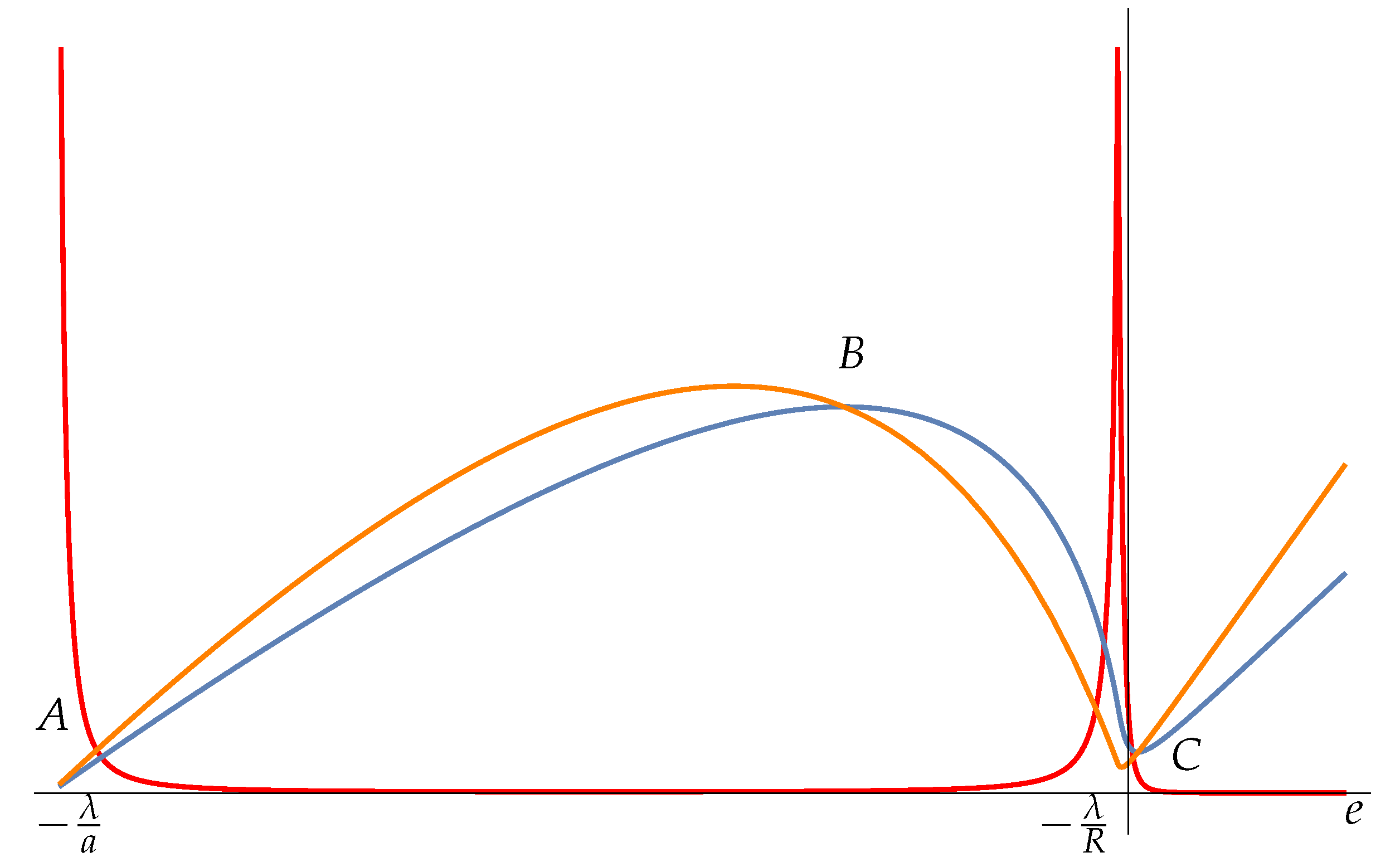
Figure 2.
Plot of Fisher information (red curve), microcanonical temperature (orange curve) and microcanonical temperature for (dashed curve) as a function of the energy e. In the case the phase of negative specific heat is not present and the remaining phase transition is located at . Note that for greater clarity the plot is not in the whole energy range .
Figure 2.
Plot of Fisher information (red curve), microcanonical temperature (orange curve) and microcanonical temperature for (dashed curve) as a function of the energy e. In the case the phase of negative specific heat is not present and the remaining phase transition is located at . Note that for greater clarity the plot is not in the whole energy range .
Disclaimer/Publisher’s Note: The statements, opinions and data contained in all publications are solely those of the individual author(s) and contributor(s) and not of MDPI and/or the editor(s). MDPI and/or the editor(s) disclaim responsibility for any injury to people or property resulting from any ideas, methods, instructions or products referred to in the content. |
© 2025 by the authors. Licensee MDPI, Basel, Switzerland. This article is an open access article distributed under the terms and conditions of the Creative Commons Attribution (CC BY) license (http://creativecommons.org/licenses/by/4.0/).
Copyright: This open access article is published under a Creative Commons CC BY 4.0 license, which permit the free download, distribution, and reuse, provided that the author and preprint are cited in any reuse.


