

Submitted:
25 April 2025
Posted:
28 April 2025
You are already at the latest version
Abstract
This study investigates AI technology's motivational factors that influence millennials and members of Generation Z in online transactions. These motivational factors shed light on which aspects of AI technology's ergonomics are acceptable to these consumer groups. This study adopted a quantitative research method in gathering and analyzing its data. A total of 116 respondents from Abuja Municipal Area Council (AMAC), Nigeria, took part in this study. 51 of the respondents were millennials, while 61 were members of Generation Z. Primary data was collected through a self-administered survey-questionnaire adopted from Gursoy et al’s AIDUA and Yang, Lou, and Lan’s modified AIDUA, which included anthropomorphic, hedonic, utilitarian, and interaction convenience motivational factors of AI technology acceptance. Additionally, this study utilized Statistical Package for Social Science (SPSS) version 26 in conducting the Mann-Whitney U-test for statistical analysis, while Gray and Kinnear's non-parametric effect size interpreted the practical significance of the results. The Mann-Whitney U-test result indicated that anthropomorphic and hedonic motivational factors of AI technology do not significantly influence millennials more than members of Generation Z in online transactions. Conversely, utilitarian and interaction convenience motivational factors of AI technology had significant influence on millennials compared to members of Generation Z in online transactions. Practically, the anthropomorphic and hedonic motivational factors of AI technology had medium effect sizes.
Keywords:
artificial intelligence
; millennials
; members of generation Z
; online transactions
1. Introduction
The motivational factors influencing the acceptance of artificial intelligence technology differ between millennials and members of Generation Z in online transactions. Online transactions involve the exchange of goods or financial payments between businesses and consumers over the Internet. This process includes activities such as buying and selling through e-commerce platforms, paying bills, and transferring funds. It encompasses three key phases within the value chain: pre-sale, purchase, and delivery. The pre-sale stage focuses on providing consumers with accurate information about a product or service. During the purchase stage, consumers choose their desired products or services and complete online payments. The value chain concludes with the delivery of the selected products or services to the consumers (Razorpay, 2024). With the integration of AI technology in online transactions, consumers increasingly perceive AI technology as capable of understanding human needs and emotions by emulating human-like qualities through relatable language and avatars (Lee, Tang, & Jiang, 2023; Kronemann, Kizgin, & Dwiveli, 2023).
Numerous studies have identified the motivational factors behind the acceptance of artificial intelligence among millennials and members of Generation Z (e.g., Yi et al., 2023; Hamairoh, Limakrisna, & Moeins, 2024; Arachicli & Samarasinghe, 2023; Guerra-Tamez et al., 2024). Z Yi et al. (2023) investigated the adoption of robot advisory among millennials and found that prior knowledge, perceived usability, and trust significantly influence millennials' acceptance of artificial intelligence robot advisory for financial management (pp. 11-13). In another study, Hamairoh, Limakrisna, and Moeins (2024) examined the impact of perceived usefulness and ease of use on millennials' continued intention to accept Chabots in the banking sector. This study noted that perceived usefulness and ease of use positively affect millennials' customer satisfaction and continued intention to accept Chabots in the banking sector (pp. 819-821).
Similarly, Arachcli and Samarasinghe (2023) studied the influence of embedded artificial intelligence-mobile smart speech recognition technology attributes, such as perceived ease of use, usefulness, and enjoyment, on consumers' purchase intention in the fashion retail sector. The study revealed that younger generational cohorts are more innovative in accepting artificial intelligence (p. 19). In the context of members of Generation Z's acceptance of artificial intelligence, Guerra-Tamez et al. (2024) examined the role of artificial intelligence in influencing members of Generation Z's consumer behaviour in the fashion, beauty, and educational sectors. Consequently, the study suggested that members of Generation Z, as digital natives, are more influenced by frequent interactions with artificial intelligence compared to other generational cohorts like millennials and Generation X (p. 11).
Unarguably, businesses have adopted and consumers have accepted artificial intelligence technology in online transactions. Global brands such as TikTok©, Meta©, and other businesses have integrated AI technology into their online products and services. Consequently, AI technology's psychological and social ergonomic features have influenced consumers' acceptance of AI technology in online transactions. Given the global adoption of artificial technology by businesses and acceptance of AI technology by consumers in online transactions, two gaps exist in which AI technology motivational factors—anthropomorphic features, hedonic features, utilitarian features, and interaction convenience—influence consumers' acceptance of AI technology in online transactions. First, based on cognitive appraisal theory, anthropomorphism, hedonic, and utilitarian motivation factors are individuals' primary responses to AI technology—i.e., these are individuals' perceptions mirrored the artificial intelligence embedded in technology during service delivery. However, the artificial intelligence motivational factors—anthropomorphism, hedonic, utilitarian, and interaction convenience—have been embedded in service delivery technology but were measured at a subliminal level (e.g., Gursoy et al., 2019). Second, the utilitarian and interaction convenience proposed by the modified AIDUA model at the primary appraisal of artificial intelligence technology in service delivery is yet to be tested alongside anthropomorphism and hedonic motivational factors of AI technology (e.g., Yang, Lou, & Lan, 2022). Also, no study has yet been conducted on the motivational factors of AI technology's differential influence among millennials and members of Generation Z in online transactions.
To address these gaps, this study conceptualizes anthropomorphic, hedonic, utilitarian, and interaction convenience motivational factors of AI technology among millennials and members of Generation Z. Furthermore, this study's concepts were divided into independent and dependent variables. Millennials and members of Generation Z are the independent variables, while anthropomorphic, hedonic, utilitarian, and interaction convenience motivational factors of AI technology are the dependent variables.
To establish the influential relationships between the independent variables and dependent variables identified, this study employs a positivist research philosophy, using a longitudinal research study and a quantitative research strategy. Furthermore, this study utilized convenience sampling technique to select respondents. Millennials and Generation Z members that participated in this study completed self-administered semi-structured questionnaires based on artificial intelligence device use acceptance and modified artificial intelligence device use acceptance, adapted from existing research and modified for this study. Eventually, this study employed the Mann-Whitney non-parametric test and Gray and Kinnear's effect size to analyze the statistical and practical significance of anthropomorphism motivation, hedonic motivation, utilitarian interaction convenience motivational factors of AI technology acceptance among millennials and members of Generation Z in online transactions.
1.2. Objectives of the Study
This study investigates if the motivational factors of AI technology differ among millennials and members of Generation Z in online transactions. Thus, the specific objectives of this study are:
- To examine whether the anthropomorphism motivational factors of AI technology significantly influence millennials more than members of Generation Z in online transactions.
- Investigate if the hedonic motivational factors of AI technology significantly influence millennials more than members of Generation Z in online transactions.
- To analyze whether the utilitarian motivational factors of AI technology significantly influence millennials more than members of Generation Z in online transactions.
- To examine whether the interaction convenience motivational factors of AI technology significantly influence millennials more than members of Generation Z in online transactions.
1.3. Research Questions and Hypotheses
1.3.1. Research Questions
The motivational factors of AI technology are results of the causal relationships between anthropomorphism motivational factors, hedonic motivational factors, utilitarian motivational factors, interaction convenience motivational factors, and generational cohort. Thus, this study is guided by the following research questions:
- Do the anthropomorphism motivational factors of AI technology significantly influence millennials more than members of Generation Z in online transactions?
- Do the hedonic motivational factors of AI technology significantly influence millennials more than members of Generation in online transactions?
- Do the utilitarian motivational factors of AI technology significantly influence millennials more than members of Generation Z in online transactions?
- Do the interaction convenience motivational factors of AI technology significantly influence millennials more than members of Generation Z in online transactions?
1.4. Significance of the Study
This study provides valuable insights for online marketers, marketing researchers, advertising specialists, and product managers by shedding light on the dynamics that impact AI technology acceptance among millennials and members of Generation Z consumers in online transactions. Given the significant purchasing power held by millennials and members of Generation Z globally, this study's findings and recommendations offer actionable information on their behaviour towards AI in online marketing in Nigeria. Importantly, this study paves the way for future research on the motivational factors influencing AI technology acceptance among millennials and Generation Z.
The remaining sections of this study are structured as follows: Section 2 provides a review of the literature. Section 3 outlines the methodology used in this study. Section 4 presents the results and discussion of findings. Finally, Sections 5 and 6 offer recommendations and the conclusion of this study, respectively.
2. Literature Review
This study aims to investigate if the motivational factors of AI technology differ among millennials and members of Generation Z in online transactions. Hence, the following subsections present the conceptual framework and the theoretical framework that guide the actualization of this study's objectives.
2.1. Conceptual Framework
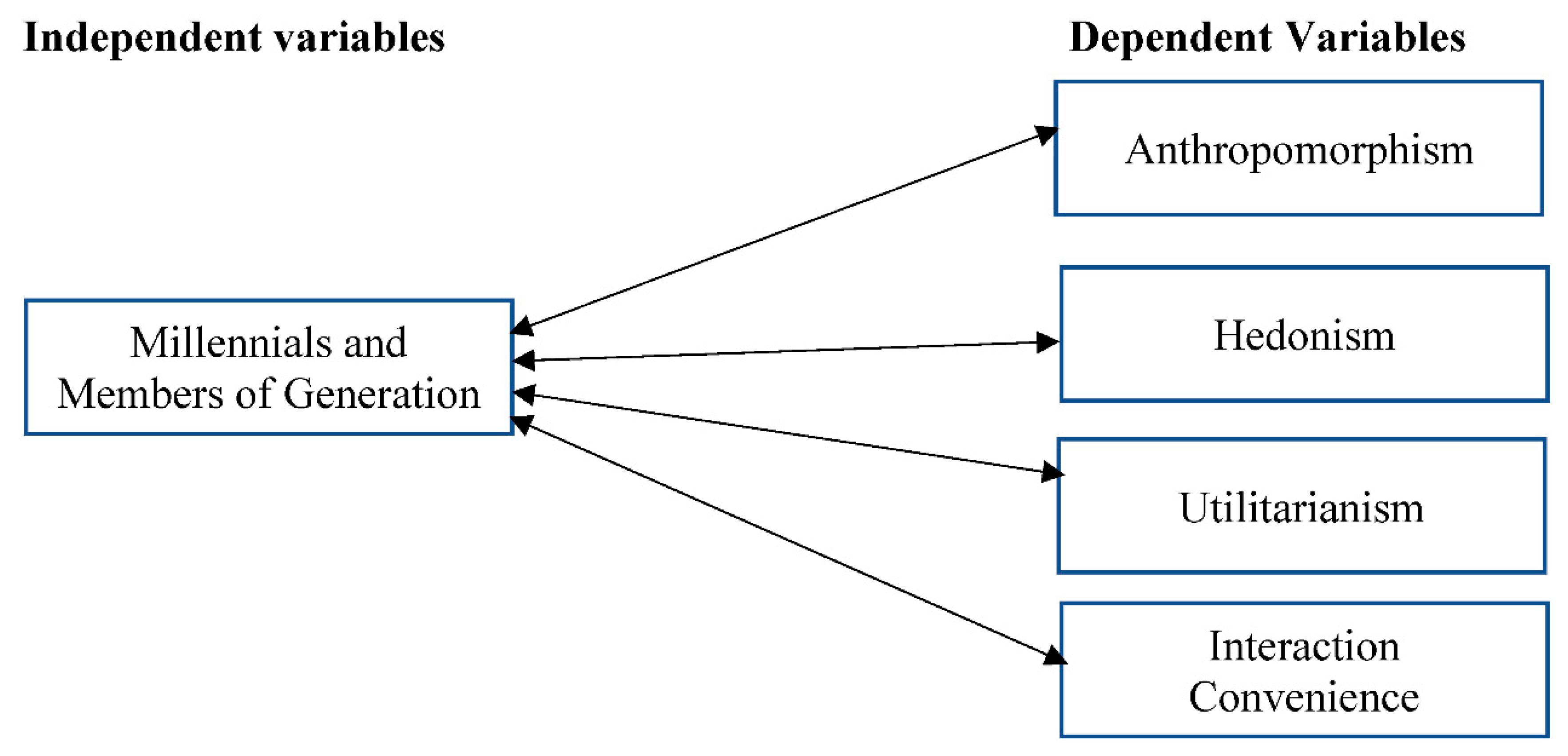
The conceptual framework of this study's model construct was based on the motivational factors of AI technology adopted from AIDUA and modified AIDUA. Thus, the model concepts identified were anthropomorphic, hedonic, utilitarian, interaction convenience motivational factors of AI technology, and millennials and members of Generation Z. Consequently, these concepts were divided into independent and dependent variables. Millennials and members of Generation Z are the independent variables; while anthropomorphic, hedonic, utilitarian, and interaction convenience motivational factors of AI technology are the dependent variables (See Figure 1).
Figure 1.
The model construct of this study.
2.1.1. Concept of Millennials and Members of Generation Z Generational Cohorts
Conceptually, generational cohort refers to subjective yardsticks for understanding social change and conflict, with two theoretical approaches to defining consumers' behaviour within the context of a defined generation. The social forces approach suggests that a generational cohort is the result of specific historical events that shape a shared set of understandings. On the other hand, Ryder (1965) proposed the 'cohort' approach, which identifies a generation as groups defined by age, experiencing significant events throughout their lifespan. As a result, a generational cohort is formed by individuals' interactive experiences with their environment, interpreting significant meanings to evaluate their surroundings and finding appropriate solutions or adaptations to perceived challenges. Therefore, individuals born into a pre-existing cohort are influenced by their interactions with the norms of the environment.
Similarly, millennials, born between 1981 and 1996, and members of Generation Z, born between 1997 and 2012, exhibit similarities and nuances in their consumer behaviour during online transactions. Millennials are accustomed to technological advancements from a young age and value a lifestyle free from complexity. Members of Generation Z, on the other hand, have grown up in a fully digitalized society, seamlessly navigating between the virtual and real worlds. Unlike millennials, members of Generation Z prioritize speed, practicality, and exploration of online activities, leading them to embrace social media as a source of information for products, services, and recommendations (Camphouse, 2025). According to Salesforce (2023), millennials are drawn to artificial intelligence technologies for leisure and entertainment purposes, while members of Generation Z are more inclined to use artificial intelligence for shopping and work-related activities.
2.1.2. Concept of Anthropomorphism Motivational Factors of AI Technology
Businesses anthropomorphize AI technology with human-like attributes or intellectual capabilities in online transactions to create interaction convenience with AI technology during human-machine interactions. Consumers respond positively to the anthropomorphized features of AI technology in online transactions when it exudes a high level of human appearance and intellectual capability.
2.1.3. Concept of Hedonic Motivational Factors of AI Technology
Hedonic motivational factors of AI technology represent consumers' desire for fun and emotional gratification when using AI technology. The hedonic motivational factors of AI technology that influence the acceptance of AI technology by consumers in online transactions involve making AI technology fun to interact with during online transactions.
According to Gursoy et al. (2019), consumers with hedonic motivation are likely to exude a favourable attitude toward AI technology before and after the use experience. As a result, the more hedonic motivational factors of AI technology exude interaction fun, entertaining interaction, and pleasant interaction process, the more hedonic motivational factors of AI technology influence differ among millennials and members of Generation Z in online transactions. On the other hand, the lesser the hedonic motivational factors of AI technology are, the less likely the hedonic motivational factors of AI technology influence will differ among millennials and members of Generation Z in online transactions.
2.1.4. Concept of Utilitarian Motivational Factors of AI Technology
Unlike hedonic motivational factors of AI technology, utilitarian motivational factors of AI technology involve a behavioural pattern driven by consistent expectations of success and efficiency from a task's outcome. According to Yang, Lou, and Lan (2022), consumers driven by utilitarian motivation expect task-oriented AI technology to give them accurate feedback. Similarly, the immediacy, accuracy, and comprehensiveness motivational factors of AI technology enhance consumers' acceptance of AI technology.
2.1.5. Concept of Interaction Convenience Motivational Factors of AI Technology
Yang, Luo, and Lan (2022) referred to interaction convenience motivational factors of AI technology as the simple-to-use approach and the concise interface features of AI technology that enhance consumers' AI technology acceptance. Unarguably, interaction convenience is the basic motivation behind consumers' acceptance of AI technology both in product and service industries based on consumers' exposure and performance expectancy.
Figure 1 illustrates the causal relationships between Millennials and members of Generation Z (independent variable) and the motivational factors influencing AI technology acceptance. Firstly, both generational cohorts' acceptance depends on the anthropomorphic features of AI technology, such as human-like consciousness and intellectual capabilities, perceived during online transactions. Secondly, the hedonic motivational factor of AI technology acceptance for both groups relies on the perception that AI technology's ergonomics include fun-filled features that enhance their online transaction experiences. Thirdly, the utilitarian motivation factor of AI technology is accepted by Millennials and Generation Z if they perceive that the technology's ergonomics meet their online transaction needs. Lastly, both generational cohorts will find the interaction convenience motivational factors of AI technology acceptable when the technology is easy to use and meets their online transaction needs, both stated and unstated.
2.2. Theoretical Framework
2.2.1. Anthropomorphism
Epley, Akalis, and Cacippo (2007) defined anthropomorphism as perceiving human-like attributes in real or imagined non-sentient beings. Essentially, humans attribute their personal and intellectual capabilities to non-sentient beings to better understand interactions. For example, during interactions with non-sentient agents, these agents take on human-like attributes. Anthropomorphism during human interaction with non-sentient agents serves as a form of communication. However, Epley, Akalis, and Cacioppo (2008) argued that anthropomorphism is not influenced by preconceived beliefs about the non-sentient agent. Instead, it stems from humans' social nature, seeking social connection with others. Simultaneously, the desire for predictability or control drives anthropomorphism.
Anthropomorphism motivation is driven by the need for social connection and control over non-sentient agents. Individuals lacking social connections may anthropomorphize non-sentient beings such as pets or digital devices (Epley, Akalis, & Cacioppo, 2008). White (1959) notes that humans' sense of competence is linked to predictability and control over their environment. Anthropomorphism feeds into this sense of control by providing a structure to understand novel non-sentient agents. Waytz, Epley, and Cacioppo (2014) suggested that the more unpredictable or uncontrollable a non-sentient agent is, the more likely it is to be anthropomorphized. Social connection triggers anthropomorphism when there is a sense of similarity, Therefore, anthropomorphism involves attributing uniquely human physical and mental qualities, such as consciousness or secondary emotions, to non-sentient agents (Waytz, Epley, & Cacioppo, 2014). Anthropomorphism can be applied to various objects, including physical items like cars and clothes, as well as natural entities, emotions, and technology.
In the context of AI technology, Cao, Zhao, and Hu (2014) suggest that visual, verbal, and psychological factors trigger anthropomorphism among consumers. These factors enhance human-AI technology interaction. The theories of anthropomorphism by Epley, Akalis, and Cacippo (2008), Waytz, Epley, and Cacioppo (2014), Cao, Zhao, and Hu (2014) are relevant to this study due to their focus on the physical and mental characteristics of AI technology. Combining these theories with the AIDUA model by Gursoy et al. (2019) allows for an exploration of how human-like qualities of AI technology differ among millennials and members of Generation Z in online transactions.
2.2.2. Hedonic Motivation
Gray (1981) defined hedonic motivation as an individual's willingness to engage in behaviours that enhance positive experiences or reduce negative experiences. It involves seeking pleasure or emotional satisfaction from an activity, regardless of its functional benefits. Gray (1981) suggested that there are two systems - behavioural inhibition and behavioural activation - that activate hedonic motivation. The behavioural inhibition system is sensitive to punishment, while the behavioural activation system is sensitive to reward. Kahneman (1999) emphasized that hedonism is about the positive or negative experiences individuals have. In the context of technology adoption, hedonic motivation extends to consumers seeking enjoyable experiences from their interactions with technology. Motivations behind hedonism can be categorized into affiliation, escapism, and novelty. For example, Quoidbach et al. (2015) noted that hedonic motivation occurs when individuals engage in repeated positive stimuli or activities that bring joy.
Bao and Lyubomirsky (2015) highlighted the fact that hedonic motives require strategies to enhance positive experiences and produce sustainable joy. Bolier et al. (2013) suggested strategies to increase the variety of positive stimuli or experiences to enhance hedonic motivation. In the context of AI technology, hedonic motivational factors such as fun, entertainment, and pleasant experiences influence consumer attitudes and acceptance. Consumers with hedonic motivations are likely to have positive attitudes towards AI technology in online transactions. Integrating definitions of motivation by Bolier et al. (2013) and Bao and Lyubomirsky (2015) with Gursoy et al.'s (2019) AIDUA model helps explain how hedonic motivational factors of AI technology influence differ among millennials and members of Generation Z.
2.2.3. Utilitarian Motivation
Utilitarian motivation, according to the organismic integration theory by Ryan & Deci (2017), involves extrinsic behaviour aimed at achieving instrumental values like external rewards or task completion. It serves as a means to an end, allowing consumers to efficiently complete tasks and achieve their goals. Fernandes, Semuel, and Adiwijaya (2020) suggested that utilitarian shopping value impacts consumers' online shopping behaviour, influencing their transition from shopping intention to purchase. In the context of AI technology, consumers cognitively evaluate AI technology based on specific features that stimulate motivation. Task-oriented attributes of AI technology, such as immediacy and accuracy, trigger consumers' perception of competence. Consumers with utilitarian motivation expect task-oriented AI technology to respond accurately and efficiently to their demands. Integrating Ryan and Deci's (2017) definition of utilitarian motivation with Yang, Lou, and Lan’s (2019) proposed factors helps understand how utilitarian motivation influences differ among millennials and members of Generation Z in online transactions.
2.2.4. Interaction Convenience
Srivastava and Kaul (2014) defined interaction convenience as the ease and efficiency with which customers engage with services or products, minimizing effort and maximizing accessibility. This includes simplicity in transactions and availability of information. Interaction convenience comprises perceived interaction control and convenience, with consumers able to specify details of interactions and facilitate transactions with minimal time and effort.
In the context of AI technology, interaction convenience refers to the level of ease consumers experience while using task-oriented AI devices. Yang, Luo, and Lan (2022) emphasize user-friendly interfaces and smart access to AI devices as key components of interaction convenience. Consumers' behavioural intention towards AI technology is influenced by the convenience of its use. Integrating different definitions and models of motivation and convenience helps explain how these factors that influence acceptance of AI technology differ among millennials and members of Generation Z in online transactions.
Based on the preceding theoretical framework, subsection 2.2 compiles the conceptual framework of themes—anthropomorphism, hedonic, utilitarian, and interaction motivational factors of AI technology—identified in this study.
2.3. Empirical Studies
To understand the motivational factors influencing the interaction convenience of AI technology acceptance among millennials and members of Generation Z, this section reviews relevant empirical studies aligned with the objectives of this study. To begin with, existing studies have been conducted on the motivational factors of AI technology and their influence on Millennials and members of Generation Z's acceptance of AI technology.
Based on existing studies, Primanto and Amin (2024) investigated the significant differences between millennials and members of Generation Z in their perceived anthropomorphism of a designed Chatbot and its effect on both generational cohorts’ intention to reuse it. This study utilized a scenario-based experiment and a survey with responses from 328 participants aged 17-39 years. Their study employed independent sample t-tests and regression for inferential analysis. This study revealed that virtual appearance, cognitive empathy, emotional empathy, moral virtue, and sociality anthropomorphic features of chatbots consistently rated higher among millennials compared to members of Generation Z. However, cognitive empathy anthropomorphic features of chatbots were less influential in shaping the reuse intentions of both generational cohorts in this study.
Furthermore, Bhatnagar and Rajesh (2024) investigated the impact of perceived animacy, perceived intelligence, and perceived anthropomorphism on the intentions of millennials and members of Generation Z. This study adopted the expectation confirmation theory. Consequently, this study used a qualitative research method to achieve the research aim. Furthermore, 495 samples were collected from 204 millennials and 291 members of Generation Z. The findings of this study indicate that millennials' satisfaction and acceptance of AI technology are based on the benefits derived from AI technology features, while members of Generation Z value the anthropomorphic factors of AI technology.
Meanwhile, Primanto and Amin's (2024) comparative analysis of agent bot anthropomorphic perceptions between millennials and members of Generation Z aimed to test the AI Device Use Acceptance (AIDUA) model that integrates cognitive and emotional factors to explore the acceptance of AI technology Chatbots, such as ChatGPT and Gemini, in the context of tourism and hospitality by members of Generation Z. This study recruited 100 members of Generation Z participants, and an online questionnaire was used to gather primary data. This study adopted Structural Equation Modeling– Partial Least Squares (SEM-PLS) for data analysis. The findings showed that emotional reaction, performance expectancy, anthropomorphism, and social influence significantly impacted millennials’ willingness to accept AI technology Chabot. However, hedonic motivation and effort expectancy did not have a significant effect on members of Generation Z's willingness to accept AI technology Chabot.
Ang (2024) examined members of Generation Z's consumer hedonic and utilitarian motivation and the Unified Theory of Acceptance and Use of Technology (UTAUT) during online purchases. This study utilized a quantitative approach with an online survey questionnaire. 156 participants were recruited, and their responses were analyzed using SmartPLS 4.0, employing Partial-Least Squares Structural Equation Modeling. The findings indicated that forty-four per cent of the respondents experienced online shopping for the first time due to the 2020 COVID-19 pandemic lockdown. Members of Generation Z were motivated by utilitarian and hedonic motivation during online shopping.
Mahemba and Dewi (2024) analyzed the effect of hedonic and utilitarian shopping motives on members of Generation Z's online repurchase intention. This study examined the interaction between consumers’ internal factors, such as shopping motives, and external stimuli, like product type, on online purchase intention. This study used exploratory research in a quantitative approach with 143 respondents from members of Generation Z in Indonesia. This study's multiple regression with mediating variables and independent sample t-test showed that hedonic and utilitarian shopping motives positively affect members of Generation Z's online repurchase intention. Additionally, attitudes towards online shopping partially mediated the influence of utilitarian and hedonic shopping motives on online repurchase intention. Hedonic shopping motives had a higher influence on online repurchase intention for hedonic products, while utilitarian shopping motives had a higher influence on utilitarian products among members of Generation Z.
Lastly, Barbul and Bojescu (2023) focused on the differences between millennials and members of Generation Z. This study adopted primary data analysis. The questionnaire contained 31 items to test consumer-AI technology interactions, including performance expectancy, effort expectancy, social influence, hedonic motivation, anthropomorphism, trust, anxiety, willingness to accept AI, and objection to the use of AI. This study showed average significant differences between millennials and members of Generation Z in their perception towards interaction with AI technology. Members of Generation Z gained emotional, fun, and experiential benefits from interaction with AI technology more significantly than millennials. Despite these hedonic gains, both generational cohorts considered the anthropomorphic attributes of AI technology not to have a mind of their own, free will, or emotions at all.
Given the global adoption of artificial technology by businesses and the incentive theory of motivation, there are two gaps on which artificial intelligence technology motivation factors--i.e., the anthropomorphic features, hedonic features, utilitarian features, and the interaction convenience--influence consumers' acceptance. First, based on cognitive appraisal theory, anthropomorphism, hedonic, and utilitarian motivational factors are individuals' primary responses to artificial intelligence technology—i.e., these are individuals' perceptions mirroring the artificial intelligence embedded in technology during service delivery. Hence, the artificial intelligence motivational factors--anthropomorphism, hedonic, and utilitarian--have been embedded in service delivery technology but were measured at a subliminal level. Second, the interaction convenience proposed by modified AIDUA at the primary appraisal of artificial intelligence technology in service delivery doesn't fit the primary appraisal narrative of cognitive appraisal theory. Rather, interaction convenience is the mother of the yardstick (expectancy) to which the primary motivational factors of artificial intelligence technology—ease of use, etc.—are evaluated. As such, this study proposes that:
HO1:
The anthropomorphism motivational factors of AI technology do not significantly influence millennials more than members of Generation Z in online transactions in AMAC.
HO2:
The hedonic motivational factors of AI technology do not significantly influence millennials more than members of Generation Z in online transactions in AMAC.
HO3:
The utilitarian motivational factors of AI technology do not significantly influence millennials more than members of Generation Z in online transactions in AMAC.
HO4:
The interaction convenience motivational factors of AI technology do not significantly influence millennials more than members of Generation Z in online transactions in AMAC.
3. Methodology
3.1. Research Design
Aligned with this study's objectives, quantitative research method was deemed most suitable to achieve its stated goals. In addition, quantitative research design emphasizes objectivity, control, and precise measurement through a top-down approach (Leavy, 2017; Fallon, 2016).
3.2. Sampling Technique & Sample Size
This study used convenience non-probability sampling technique to recruit 116 participants. This sample technique was chosen because it offered this study easy access, proximity to respondents due to the lack adequate funds and logistics for this study (Etikan, Musa, and Alkassin, 2015). Hence, the inclusion characteristics of respondents recruited in this study are millennials (born between 1981 and 1996) and members of Generation Z (born between 1997 and 2012) residing or working in the AMAC districts of Gwarimpa, Maitama, Wuse II, Wuse Zone 5, Wuse Zone 6, Garki, and Airport Road settlements in Abuja, FCT, Nigeria.
3.3. Source of Data Collection
A survey research method was utilized to gather data for analysis. This method is ideal for understanding the attitudes, beliefs, and opinions of millennials and members of Generation Z respondents on the subject matter (Fowler, 2014; Leavy, 2017). Primary data were collected through a self-administered structured survey questionnaire with five sections: A to E. Section A focused on demographic information, while Sections B and C included questions on anthropomorphism and hedonic motivational factors in AI technology, adapted from Gursoy et al. (2019). Sections D and E explored utilitarian and interaction convenience motivation factors, based on Yang, Lou, and Lan's (2022) modified AIDUA model. The survey questions covered various aspects, such as the perception of AI technology having human-like qualities, fun interactions, effectiveness in tasks, and convenience compared to human agents. The responses were measured on a 5-point Likert scale ranging from 1= Strongly Disagree to 5= Strongly Agree.
3.4. Reliability of the Instrument
To test the reliability of the survey research questionnaire adopted by this study, this study’s survey questionnaire was subjected to Cronbach's alpha reliability test (See Table 1).

Table 1.
Reliability test of construct for motivational factors of AI technology in online transactions.
Table 1.
Reliability test of construct for motivational factors of AI technology in online transactions.
| Construct/ Items | Cronbach’s Alpha |
|---|---|
| Anthropomorphic motivational factors of AI technology 1. AI has human-like consciousness 2. AI has human-like intellectual capabilities 3. AI indicates human-like emotions 4. AI has unique qualities similar to human agents |
.840 |
| Hedonic motivational factors of AI technology 1. AI is fun to interact with 2. AI is entertaining 3. AI interaction process is pleasant |
.810 |
| Utilitarian motivational factors of AI technology 1. AI is effective 2. AI gives immediate feedback 3. AI recommendations are accurate 4. AI provides comprehensive product and service recommendations |
.917 |
| Interaction convenience motivational factors of AI technology 1. AI has simpler to use approach 2. AI gives simpler access convenience |
.888 |
Source: SPSS version 26 computation.
Table 1 indicates that the survey questionnaire's reliability for the anthropomorphic construct was .84 for the four (4) items adopted from the AIDUA model. Hedonic motivational factors' Cronbach's alpha score was .81 for the three (3) items adopted from the AIDUA model. Hence, both Cronbach alpha scores were congruent within Gursoy et al's (2019) reliability threshold of .96 and .96 for anthropomorphic and hedonic motivational factors of AI technology, respectively. Likewise, the utilitarian and interaction convenience motivational factors of AI technology adopted from the modified AIDUA scored .91 for 4 items and .88 for 5 items, respectively. Thus, these adopted modified AIDUA (i.e., utilitarian and interaction convenience motivational factors) were congruent within Yang, Lou, and Lan's (2022) utilitarian and interaction convenience Cronbach alpha scores of .94 and .92, respectively. Consequently, the anthropomorphic, hedonic, utilitarian, and interaction convenience motivational factors of AI technology were .85. which was above the recommended Cronbach alpha benchmark .70 (Cronbach, 1951). Thus, the survey questionnaire adopted in this study is reliable to measure its intended statistical significance.
3.5. Method of Data Analysis
To analyze the statistical significance, this study utilized the services of Statistical Package for Social Science (SPSS) version 26 to conduct a Mann-Whitney U-test non-parametric test. Mann-Whitney U-test was adopted because the data of this study are congruent with the underlying assumptions of non-parametric tests (i.e., dependent variables are ordinal, the independent variable ate categorical), while the variables' observations have to be independent, and the data are not normally distributed (Field, 2013). As a result, this study used two-tailed test to test the significance of its significance at a p-value of .05 at a 95% confidence interval (CI). Comparatively, p-value < .05 retains the null hypothesis of this study, while p-value > .05 rejects the null hypothesis of this study.
To test the effect size, this study used Gray and Kinnear's (2012) non-parametric effect size estimator to estimate the strength of the difference the motivational factors of AI technology have among millennials and members of Generation Z in online transactions.
4. Results and Discussion
Section 4 presents the results and discussion that answer the research questions posed by this study.
4.1. Participant Demographic Characteristics
To address the research questions of this study, Table 2 shows the demographic characteristics of the millennials and members of Generation Z respondents of this study.
Table 2.
Demographic characteristics of millennials and members of Generation Z in AMAC.
| Millennials | Members of Generation Z |
Full sample | |
| n % | n % | n % | |
| Gender Female Male |
23 41.8 32 58.2 |
54 88.5 7 11.5 |
77 66.4 39 33.6 |
| Residential district Airport road Garki district Gwarimpa district Wuse district |
21 38.1 4 7.3 15 27.3 15 27.3 |
10 16.4 23 37.7 8 13.1 20 32.8 |
31 26.7 27 23.3 23 19.8 35 30.2 |
| Familiarity/use of AI in online transactions Yes No Not quite sure |
37 67.3 8 14.5 10 27.3 |
41 67.2 4 6.6 16 26.2 |
78 67.2 12 10.3 26 22.4 |
| Platform of AI exposure TikTok Company webpage Others |
22 40.0 7 12.7 4 7.3 14 25.5 8 14.5 |
7 11.5 11 18.0 21 34.4 17 27.9 5 8.2 |
29 25.0 18 15.5 25 21.6 31 26.7 13 11.2 |
| Social connection influence Strong Weak |
22 40.0 33 60.0 |
31 50.8 30 49.2 |
53 45.7 63 54.3 |
Source: Author’s computation.
Table 2 indicates that among the respondents surveyed in this study, 23 (41.8%) of millennial respondents were female, while 32 (58.2%) of the millennial respondents were male. Comparatively, 64 (88.5%) of the members of Generation Z respondents were females, and 7 (11.5%) were male.
Notably, in the context of respondents' exposure to AI (AI) technology in online transactions, 67.3% of millennial respondents were familiar with AI technology and had made use of AI technology. Conversely, 14.5% of millennial respondents were not familiar with AI technology and had never made use of AI technology, while 18.2% of millennial respondents were unsure of their familiarity with AI technology. Comparatively, 67.2% of members of Generation Z respondents were familiar with AI technology and had used AI technology, while 6.6% of the members of Generation Z respondents were not familiar with AI technology and had not used AI technology, while 26.2% of the members of Generation Z were unsure of their familiarity with AI technology in online transactions.
Lastly, in terms of the influence of social connection on respondents’ social activities, 40% of millennial respondents indicated social connection greatly influenced their social activities, while 60% of millennial respondents indicated social connection did not influence their social activities. Conversely, 50.8% of members of Generation Z respondents indicated social connection had a significant impact on their social activities, whereas 49.2% of the members of Generation Z respondents indicated social connection did not influence their social activities.
4.2. Answers to Research Questions
This study was guided by the motivational factors of AI technology adopted from AIDUA's anthropomorphic and hedonic motivational factors of AI technology; while the utilitarian and interaction motivational factors of AI technology were adopted from a modified AIDUA proposed by Tang, Lou, and Lan (2022). Therefore, the answers to questions regarding the influence of the motivational factors of AI technology among millennials and members of Generation Z were based their perceived elements of the motivational factors of AI technology in online transactions. Notably, millennials and members of Generation Z's responses were ranked on a 5-point Likert scale from 1 = Strongly Disagree to 5 = Strongly Agree.
4.2.1. Do Anthropomorphic Motivational Factors of AI Technology Influence Millennials More than Members of Generation Z?
In terms of anthropomorphic motivational factors of AI technology in online transactions, millennials disagreed AI technology had human-like consciousness (Mdn = 2, SD = 1.10), while members of Generation Z (Mdn = 4, SD = 1.08) agreed AI technology had human-like consciousness in online transactions. Similarly, millennials (Mdn = 3, SD = 1.13) were unsure AI technology possessed human-like intellectual capabilities in online transactions; while members of Generation Z agreed (Mdn = 4, SD = .58) AI technology possessed intellectual capabilities in online transactions. Furthermore, millennials disagreed (Mdn = 2.00, SD = 1.10) AI technology possesses human-like emotion in online transactions, while members of Generation Z were unsure (Mdn = 3.00, SD = 1.22) AI technology possesses human-like emotion in online transactions. However, both millennials (Mdn = 4, SD = 1.21) and members of Generation Z (Mdn = 4, SD = 1.00) agreed that AI technology possessed unique qualities similar to human agents in online transactions.
4.2.2. Do Hedonic Motivational Factors of AI Technology Influence Millennials More than Members of Generation Z in Online Transactions?
Regarding the hedonic motivational factors of AI technology in online transactions, both millennials (Mdn = 4, SD = .77) and members of Generation Z (Mdn = 4, SD = .79) agreed that AI technology was fun to interact with in online transactions. Additionally, both generational cohorts (millennials (Mdn = 4, SD = .63) and Generation Z (Mdn = 4, SD = .92)) agreed that AI technology was entertaining. Furthermore, millennials (Mdn = 4, SD = .63) and members of Generation Z (Mdn = 4, SD = .84) agreed that the AI technology interaction process was pleasant
4.2.3. Do Utilitarian Motivational Factors of AI Technology Influence Millennials More than Members of Generation Z in Online Transactions?
Regarding the influence of utilitarian motivational factors of AI technology in online transactions, both millennials (Mdn = 4, SD = 1.18) and members of Generation Z (Mdn = 4, SD = 1.05) agreed that AI technology was effective in online transactions. Similarly, both groups (millennials (Mdn = 4, SD = 1.05) and members of Generation Z (Mdn = 4, SD = 1.05)) agreed AI technology provided immediate feedback. Similarly, both millennials (Mdn = 4, SD = .71) and members of Generation Z (Mdn = 4, SD = 1.05) agreed AI technology provided accurate recommendations in online transactions. Furthermore, both millennials (Mdn = 4, SD = 1.07) and members of Generation Z (Mdn = 4, SD = .96) agree that AI technology provides comprehensive product and service recommendations.
4.2.4. Do Interaction Convenience Motivational Factors of AI Technology Influence Millennials More than Members of Generation Z in Online Transactions?
Considering the ease of use motivational factor of AI technology, millennials were unsure if AI technology possesses a simpler-to-use approach in online transactions (Mdn = 3, SD = .89), while members of Generation Z agreed that AI technology had a simpler-to-use approach (Mdn = 4, SD = 1.07). Additionally, both millennials (Mdn = 4, SD = .81) and members of Generation Z (Mdn = 4, SD = 1.06) agreed AI technology provided convenient access to online transactions.
4.3. Test of Hypotheses
This study focused on four motivational factors of AI technology: anthropomorphic, hedonic, utilitarian, and interaction convenience. Using inferential statistical analysis, this study analyzed how these motivational factors of AI technology differ among millennials and members of Generation Z in online transactions (See Table 3).
Table 3.
Test Statistics: Mann-Whitney Non-Parametric U-test.
| Millennials | Members of Generation Z | |||||
| Motivational Factors | Mean Rank | Mean Rank | U | Z- | p- | Effect size |
| score | value | |||||
| Anthropomorphic | 45.81 | 68.94 | 979 | .389 | .000 | -0.42 |
| Hedonic | 43.95 | 71.62 | 877 | -4.43 | .000 | -0.48 |
| Utilitarian | 62.42 | 54.97 | 1463 | -1.14 | .23 | 0.13 |
| Interaction convenience | 52.98 | 63.48 | 1374 | -1.68 | .09 | -0.18 |
Note: the test statistics were based on a two-tailed test, p > .05 rejects the null hypotheses. The effect size was calculated using Gray and Kinnear’s (2012) non-parametric effect size estimator: 2(M1-M2)/n1+n2. M1 is the mean rank of the first group, M2 is the mean rank of the second group, n1 is the sample size of the first group, and n2 is the sample size of the second group.
4.3.1. H01: The Anthropomorphic Motivational Factors of AI Technology Do Not Significantly Influence Millennials More than Members of Generation Z in Online Transactions
The Mann-Whitney U-test result indicated that anthropomorphic motivational factors of AI technology significantly influence members of Generation Z (M = 68.94) more than millennials (M = 45.81) in online transactions, U = 979, Z = .389, p = .000, r = -0.42.
4.3.2. H02: The Hedonic Motivational Factors of AI Technology Do Not Significantly Influence Millennials More than Members of Generation Z in Online Transactions
The Mann-Whitney U-test revealed that hedonic motivational factors of AI technology significantly influence members of Generation Z (M = 71.62) more than millennials (M = 43.95) in online transactions, U = .877, Z = -4.43, p = .000, r = -.48.
4.3.3. H03: The Utilitarian Motivational Factors of AI Technology Do Not Significantly Influence Millennials More than Members of Generation Z in Online Transactions
Based on the Mann-Whitney U-test, utilitarian motivational factors of AI technology significantly influence millennials (M = 62.42) more than members of Generation Z (M = 54.97) in online transactions, U = 1462, Z = -1.14, p = .23, r = 0.13.
4.3.4. H04: The Interaction Convenience Motivational Factors of AI Technology Do Not Significantly Influence Millennials More than Members of Generation Z in Online Transactions
The Mann-Whitney U-test indicated that interaction convenience motivational factors of AI technology have significantly influence on millennials (M = 53.51) more than members of Generation Z (M = 61.90) in online transactions, U = 1387, Z = -1.32, p = .187, r = -0.15.
4.4. Summary of the Findings
Based on the analysis of data, the following findings emerged:
- Anthropomorphic motivational factors of AI technology have significant influence on members of Generation Z more than millennials in online transactions.
- Hedonic motivational factors of AI technology have significant influence on members of Generation Z more than millennials in online transactions.
- Utilitarian motivational factors of AI technology have significant influence on millennials more than members of Generation Z in online transactions.
- Finally, interaction convenience motivational factors of AI technology have significant influence on millennials more than members of Generation Z in online transactions.
5. Discussion
This study focused on the motivational factors (adopted from AIDUA and modified AIDUA) that explain the impact of AI technology on millennials and members of Generation Z. Before delving into the findings, this study addressed the four motivational factors that guided the research on AI technology's varying influence on millennials and members of Generation Z in online transactions.
Anthropomorphic motivational factors of AI technology had a significant influence on members of Generation Z more than millennials in online transactions. First, the anthropomorphic features of AI technology (such as human-like appearance and visual factors) appealed more to members of Generation Z, who preferred the "psychological attributes" (i.e., the human-like consciousness, intellectual capabilities, and human-like emotion) of AI technology in online transactions. Secondly, members of Generation Z were influenced by the anthropomorphic features of AI technology because they have social connections that influence their social and online activities (Epley, Akalis, & Cacioppo, 2008). Conversely, this finding did not support Primanto and Amin's (2024) research on how virtual appearance and social features of AI technology chatbots affect millennials more than members of Generation Z. However, this finding supports the findings that members of Generation Z are motivated by the anthropomorphic features of AI technology (Bhatnagar & Rajesh, 2024).
Similarly, this study found that AI technology's hedonic features influence members of Generation Z more than millennials in online transactions. Members of Generation Z found the fun, entertaining, and pleasant aspects of AI technology more appealing than millennials in online transactions. This is in line with Ang's (2024) research, which showed that hedonic motivational factors of AI technology have a greater impact on members of Generation Z than on millennials. Members of Generation Z agreed that the hedonic features of AI technology influenced them, indicating that members of Generation Z have more hedonic motivations towards using AI technology in online transactions than millennials. These findings support Gray's (1981) theory that the more the hedonic motivations consumers have for a product, the more they accept its hedonic features.
In contrast to the hedonic motivational factor, AI technology's utilitarian features, such as immediate feedback and accurate product recommendations, significantly influence millennials more than Generation Z. This finding is consistent with Primanto and Amin's (2024) research on how utilitarian features of AI technology chatbots affect millennials more than members of Generation Z. Theoretically, this finding aligns with Ryan and Deci's (2017) assertion that consumers are motivated by external rewards and task completion in utilitarian. Therefore, millennials value the extrinsic rewards of AI technology's utilitarian features more than Generation Z in online transactions.
Importantly, the motivational factors for the interaction convenience of AI technology in online transactions are arguably determined by consumers' exposure and performance expectancy. This study revealed that a significant percentage of millennials (67.3%) and members of Generation Z (67.2%) respondents were familiar with and have utilized AI technology in online transactions. Furthermore, this study found that the interaction convenience features of AI technology aligned more closely with millennials' expectations of convenience performance than with those of members of Generation Z. This finding is consistent with Primanto and Amin's (2024) discovery that millennials' performance expectations were better met by AI technology than those of members of Generation Z in online transactions. However, millennials' perception of AI technology's ease of use was less certain compared to members of Generation Z's certainty regarding its simplicity in online transactions. Theoretically, this finding is supported by Yang, Luo, and Lan's (2022) emphasis on user-friendly interfaces and easy access to AI devices as crucial components of interaction convenience. Consumers' behavioural intention towards AI technology is influenced by the ease of its use.
Given these points, statistically, businesses' adoption of anthropomorphic and hedonic features of AI technology influence members of Generation Z more than millennials in online transactions. This indicates a shift from the assumption that millennials' leisure and entertainment approach to AI technology in online transactions were solely based on leisure and entertainment (hedonic motivation) to task-oriented performance expectancy (utilitarian motives). Nevertheless, millennials' behaviour towards AI technology in online transactions is guided by their desire to avoid complexity (Salesforce, 2023). Comparatively, members of Generation Z's perception of AI technology in online transactions are based on their traditional exposure and familiarity with the technological society in which AI technology now exists (Salesforce, 2023).
5.1. Implications of the Study
Ergonomically, businesses have adopted AI technology designs and features to create psychological and virtual convenience for consumers. Statistical inference of this study indicated the motivational factors of AI technology that influence millennials and members of Generation Z.
Subsequently, the effect size of this study indicated that the anthropomorphic motivational factors that influenced members of Generation Z more than millennials had a medium effect size (r= -0.42). Notably, the hedonic motivational factor of AI technology that influenced members of Generation Z over millennials had a medium effect size (-0.48), while utilitarian and interaction convenience motivational factors of AI technology that influenced millennials more than members of Generation Z in online transactions had a small effect size of 0.13 and -0.18, respectively.
By implication, the effect sizes indicated that anthropomorphic features of AI technology had a fading impact on millennials in online transactions. As an illustration, the more the human-like intellectual, human-like consciousness, and human-like emotional anthropomorphic features of AI technology are maintained, for every 1,000 millennials in online transaction, 420 (i.e., 1,000 * -0.42) millennials will not be influenced by the anthropomorphic motivational factors of AI technology. Likewise, for every 1,000 millennials, 480 (1000 * -0.48) millennials will not be influenced by the hedonic features of AI technology in online transactions. Likewise, 130 millennials and 180 in every 1,000 millennials in online transactions will be influenced by utilitarian and interaction convenience features of AI technology in online transactions.
Therefore, millennials are driven by utilitarian and interaction convenience motives in online transactions. This suggests that while both generational cohorts have utilitarian motives towards AI technology in online transactions, millennials are starting to adopt the practical benefits of AI technology in online transactions.
5.2. Limitations of the Study
Regardless, this study's findings are characterized by some limitations. First, the convenience sampling technique adopted in this study does not give a generalized representation of the total population of millennials and members of Generation Z's perception of the motivational factors of AI technology that influence their online transactions. Consequently, the sample size of this study is the susceptible to Type I error while interpreting null hypotheses (Faber and Fonseca, 2014). Unarguably, this study's small size does not guarantee significant detection of the difference in motivational factors of AI technology's influence among millennials and members of Generation Z in online transactions. Second, as observed by Gursoy et al. (2019), this study did not factor in the influence of national cultures to ascertain its effect on social connections behind the anthropomorphic motivation aspect of AI technology in online transactions. Third, the findings of this study are subject to recruited respondents' perceptions of the subject matter.
6. Recommendations
Taking into consideration the findings of this study, business organizations should concentrate on improving the hedonic factors of AI technology. This could assist in closing the significant hedonic motivation gap between millennials and members of Generation Z in online transactions.
Future studies should expand the sample size of their study to provide a more comprehensive representation of millennials and members of Generation Z’s perceptions on the motivational factors of AI technology in online transactions. Additionally, future studies should consider the influence of national culture to determine its impact on understanding the anthropomorphic motivational aspect of AI technology in relation to millennials and members of Generation Z in online transactions.
7. Conclusions
In essence, the motivational factors influencing the acceptance of AI technology in online transactions differ between millennials and members of Generation Z. AI technology involves computer programming that enables businesses to create virtual assistance and automated support services with human-like appearance and intellectual capabilities.
To comprehend the motivational factors of AI technology that influence millennials and members of Generation Z in online transactions, this study adopted and combined AIDUA's anthropomorphic, and hedonic motivational factors and modified AIDUA's utilitarian, interaction convenience motivational factors of AI technology. Arguably, this study indicates that anthropomorphic and hedonic motivational factors of AI technology influence members of Generation Z more than millennials in online transactions. Conversely, utilitarian and interaction convenience motivational factors of AI technology influences millennials more than members of Generation Z in online transactions. From the findings of this study, anthropomorphic factors—human-like appearance and visual factors—influence members of Generation Z more than millennials. This is based on the members of Generation Z’s strong social connections that influence their social and online activities. Regardless, millennials find the utilitarian (immediate feedback, accurate product recommendations) motivational factors of AI technology more appealing than members of Generation Z in online transactions.
Funding
This study was not funded.
Informed Consent Statement
Informed consent was obtained from all respondents that took part in this study.
Data Availability Statement
This study’s data are available at https://doi.org/10.5061/dryad.8cz8w9h3h.
Conflicts of Interest
The author declares no conflict of interest.
References
- Ang, Y. S. M. (2024). Understanding Gen Z’s online purchase behaviour through their hedonic and utilitarian motivation. Information Management and Business Review, 16(3sa), 461-474.
- APA (2020). Publication manual of the American psychology: The official guide to APA style (7th ed). Washington, DC.: American Psychology Association.
- Arachchi, H. A. D., & Samarasinghe, G. D. (2023). Impact of embedded AI mobile smart speech recognition on consumer attitudes toward AI and purchase intention across generation X and generation Y. European Journal of Management Studies,29(1). 3-29. [CrossRef]
- Barbul, M., & Bojescu, I. (2023). Generations’ Perception Towards the Interaction with AI. In: R. Pamfilie, V. Dinu, C. Vasiliu, D. Pleșea, L. Tăchiciu eds. 2023. 9th BASIQ International Conference on New Trends in Sustainable Business and Consumption. Constanța, Romania, 8-10 June 2023. Bucharest: ASE, pp. 539-546 https://www.doi.org/10.24818/BASIQ/2023/09/041.
- Bhatnagr, P., and Rajesh, C. (2024). Artificial intelligent factors and expectation confirmatory theory of digital banking apps: Gen Y and Z perspective. Management Decision.
- Bolier, L., Haoerman, M., Westerhof, G. J., Riper, A., Smit, F., & Bohemeijer, E. (2013). Positive psychology interventions: A met analysis of randomized controlled studies. BMC Public Health, 13, 119.
- Cao, C., Zhao, L., & Hu, Y. (2019). Anthropomorphic of intelligent personal assistant (IPAs): Antecedents and consequences. 23rd Pacific Asia Conference on Information System (PACIS) Yi’an, China: AIS.
- Camphouse. (2025). Gen Z trends: What markets need to know. https://camphouse.10/blog/gen-z- trends.
- Cronbach, L. J. (1951). Coefficient alpha and the internal structure of tests. Psychometrika, 16(3), 297–334. https://www.doi.org/10.1007/bf02310555.
- Deloitte. (26 September 2024). More hands on gen AI experience increases optimism and caution for millennials and gen Z. Deloitte Insights. https://www2.deloitte.com/us/en/insights/deloitte-insights-magazine/iss.
- Epley, N., Wartyz, A., & Cacioppo, J. T. (2007). On seeing human: A three-factor theory of anthropomorphism. Psychology Review, 114(4), 864.
- Epley, N., Akalis, S., & Cacioppo, J. T. (2008). When we need a human: Motivational determinants of anthropomorphic. Social Cognition, 26(2), 143-155. [CrossRef]
- Etikan, I., Musa, S. A., & Alkassim. (2015) Comparison of convenience sampling and purposive sampling. American Journal of Theoretical and Applied Statistics, 5(1), 1-4. [CrossRef]
- Fabar, J., & Fonseca, L. M. (2014). How sample size influences research outcomes. Dental Press J Orthod, 19(4), 27-29. https://dx.doi.org/10.1590/2176-9451.19.4.027-029.ebo.
- Fallon, M. (2016). Writing up quantitative research in the social and behavioural sciences. [CrossRef]
- Fernandes, E., Semuel, H., & Adiwijaya, M. (2020). The influence of social media advertising on purchase intention through utilitarian and hedonic shopping motivation: A study at beauty care and anti-aging clinic service in surabaya. Petra International Journal of Business Studies, 3 (1), 23-36.
- Field, A. (2013). Discovering statistics using IBM SPSS statistics (5TH ed). Los Angeles: SAGE.
- Fowler, F. J., Jr. (2014). Survey research methods (5th ed.). Thousand Oaks, CA: SAGE.
- Gray, J. A. (1981). A critique of eysenck's theory of personality. In. H., J. Eysenck (Ed.). A model of personality. Berlin: Springer.
- Gray, C. D., & Kinnear, P. R. (2012). IBM spss statistics made simple. New York: Psychology Press.
- Grous, A. (2022). Digitalization in the new normal: Empowering generation Z and millennials to deliver change. London School of Economics and Political Sciences, 4-67.
- Guerra-Tamez, C. R., Flores, K. R., Serna-Mendiburu, Robles, D. C., & Cortes, D. I. (2024). Decoding gen Z: AI’s influence on brand trust and purchasing behaviour. Frontier in Artificial Intelligence, 7. 3-14. [CrossRef]
- Gursory, D., Chi, O. H., Lu, L., & Nunkeo, R. (2019). Consumers acceptance of artificial intelligence (AI) device use in service delivery. International Journal of Information Management, 49, 157-169. https://www.doi.org/10.1016/j.ijinformgt.2019.03.608.
- Humairoh, A., Limakrisna, N., & Moeins, A. (2024). Intelligent banking chatbotss: Intention to continue through millennials’ customer satisfaction in Indonesia using TAM method. DINASTI International Journal of Economics, Financial, and Accounting (DIJEFA), 4 (6). 10-24. [CrossRef]
- Ka, C., & Chan, Y. (2023). A comprehensive AI policy education framework for university teaching and learning. International Journal of Educational Technology in Higher Education, 20 (38), 1-25. [CrossRef]
- Kahneman, D. Dienor, E., & Scwarrz, N. (1999). Well-being: The foundations of hedonic psychology. Russell Sage Foundation.
- Kaiger, P., & Rice, J. (1974). Little jiffy, more iv. Educational and Psychological Measurement, 34, 111-117. https://10.1177/001316447.403400115.
- Kronemann, B., Kizgin, H., Rana, N. P., & Dwivedi, Y. K. (2024). How AI encourages consumers to share their secrets? The role of anthropomorphic, personal, privacy concerns, and awareness for future research. Spanish Journal of Marketing (ESIC), 27(6221). https://www.doi.org/10.1108/SJME-10-20220213.
- Leavy, P. (2017). Research design: Quantitative, qualitative, mixed method, art based, and community based participatory research approach. London: The Guilford Press.
- Lee, J. C., Tang, Y., & Jiang, S. (2023). Understanding continuance intention of artificial intelligence (AI)-enabled mobile banking applications: an extension of AI characteristics to an expectation confirmation model. Humanit Soc Sci Commun, 10, 333. [CrossRef]
- Mahemba, U, S, A, K., & Dewi, I, J. (2024). Utilitarian and Hedonic Shopping Motives and Attitude towards Online Shopping of Generation Z in Indonesia. Ilomata International Journal of Management, 5(2), 542-558. [CrossRef]
- Primanto, A. B., &Amin, M. S. (2024). From human to robot: A comparative analysis of agent bot anthropomorphic perceptions between Gen Y and Gen Z. Jurnal Ekonomi Modernisasi, 20(1), 1–18. [CrossRef]
- Providence Wealth Advisory. (2024). Global spending power by generation. https://providencewalth.com/2024/12/17/global-spending-power-by-generation/.
- Razorpay (2024, June 14). What is online transaction? Meaning, steps, and examples of online transaction. https://razorpay.com/learn/what-is-online-transaction/.
- Ryan, R. M., & Deci, E. L. (2017). Self-determination theory: Basic psychological needs in motivation, development, and wellness. Guilford: Guilford Publications.
- Ryder, N. B. (1965). The generational cohort as a concept in the study of social change. American Sociological Review, 30, 843-861. https://ww.doi.org/10.2307/2090964.
- Sales, B.D., & Folkman, S. (2000). Ethics in research with human respondents. Washington, DC: American Psychological Association.
- Salesforce (2023). Top generative AI statistics for 2024. Retrieved from https://www.salesforce.com.
- Srivastava, M., & Kaul, D. (2014). Social interaction convenience and customer satisfaction: Mediating effect of customer exposure. Journal of Retailing and Consumer Services, 21, 1028-1037. https://dx.doi.org/10.1016/j.jretconser.2014.04.
- Standard (n.d). Which generation are you? Age range from Gen z to baby boomer explained https://www.standard.co.uk/news/uk/which-age-range-who-generation-z-millennial- boomer-zoomer-b1073540.html.
- Waytz, A., Epley, N., & Cacioppo, J. T. (2014). Social cognition unbound: Insights into anthropomorphic and dehumanization. Curr N Dir Ppsychol Sci, 19(1), 58-62. [CrossRef]
- Waytz, A., Heagner, J., & Epley, N. (2014). The mind of the machine: Anthropomorphic increases trust in autonomous vehicle. Journal of Experimental Society of Psychology, 52, 113-117.
- White, R. W. (1959). Motivation reconsidered: The concept of competence. Psychological Review, 66 (5), 297-333. [CrossRef]
- Williams, L. (21 March 2024). AI is disrupting everything: But Gen Z isn't too afraid. https://www.hercampus.com/life/how-gen-z-is-using-ai-2024-survey/.
- Yang, Y., Luo, J., & Lan, T. (2022). An empirical assessment of a modified artificial intelligent device use acceptance model: From the task-oriented perspective. Frontier in Psychology. 1-14. [CrossRef]
- Yi, T. Z., Rom, N. A. M, Hassan, N. M., Samsorijan, M. S., & Ebekozien, A. (2023). The adoption of robo-advisory among millennials in the 21st century: Trust, usability, and knowledge perception. Sustainability, 115, 1-16. [CrossRef]
Disclaimer/Publisher’s Note: The statements, opinions and data contained in all publications are solely those of the individual author(s) and contributor(s) and not of MDPI and/or the editor(s). MDPI and/or the editor(s) disclaim responsibility for any injury to people or property resulting from any ideas, methods, instructions or products referred to in the content. |
© 2025 by the author. Licensee MDPI, Basel, Switzerland. This article is an open access article distributed under the terms and conditions of the Creative Commons Attribution (CC BY) license (https://creativecommons.org/licenses/by/4.0/).
Copyright: This open access article is published under a Creative Commons CC BY 4.0 license, which permit the free download, distribution, and reuse, provided that the author and preprint are cited in any reuse.


