

Submitted:
16 July 2025
Posted:
16 July 2025
You are already at the latest version
Abstract
The accelerating universe’s mechanisms remain unresolved, prompting new cosmological frameworks beyond dark energy and static dark matter. This paper redefines E=mc2 as E/m = d2/t2 = c2, introducing Energy-Mass, and derives implications from a threshold-energy framework and the emergence of spacetime from sub-emergent cold-mass. A minimum threshold energy, Stringfellow Energy SE, is introduced, below which mass remains latent and unobservable. A feedback loop drives accelerating expansion as cold-mass (from an infinite source Gp), identified as Weakly Interacting Massive Particles (WIMPs; m2 ~ 1.78 x 10⁻²⁵ kg), absorbs CMB energy and transitions from the latent sub-emergent state (E < SE) to the threshold of emergence (E = SE), initiating spacetime formation. While WIMPs are used as a working example, the mechanism applies to all particles governed by E=mc2. These transitions are detectable as CMB anomalies—cold spots (∆ T ~ -70μK, m3 ~ 1039 kg) and hot spots (∆ T ~ +170 μK, m3 ~ 1036 kg). This framework links Energy-Mass and emergence thresholds to quantum properties, offering a testable alternative to prevailing cosmological models.

Keywords:
Energy-Mass
; WIMP
; CMB anomalies
; cosmic expansion
; feedback mechanism
; dark matter
; quantum cosmology
; emergence
; quantum tunneling
; cosmic thermodynamics
; Planck length
; quantum phase transition
1. Introduction
The standard cosmological model describes an accelerating universe [1,2], yet the mechanisms remain debated. This paper is based on a previously proposed framework [11], redefining as , and introducing Energy-Mass where spacetime and quantum physics emerge with . Unlike static WIMPs probed by XENON1T with null results ( [10]), this model posits dynamic injections detectable via cosmic microwave background (CMB) anomalies, bypassing underground constraints. A feedback loop accelerates expansion as cold-mass absorbs energy near an infinite state , detectable via CMB anomalies [4], offering alternatives to dark energy and dark matter. This framework integrates thermodynamics and quantum mechanics, extending prior concepts with new evidence and derivations.
2. Stringfellow Energy, Mass, and the Threshold of Emergence
I define the threshold at which probability, and therefore physical phenomena, can emerge from a state of zero energy as a fixed ratio between a minimum energy and mass. These are defined as:
- Stringfellow Energy () — the smallest nonzero energy at which emergent probability becomes meaningful.
- Stringfellow Mass () — the associated mass coupled to at the threshold of emergence.
I postulate that their ratio corresponds to the square of the Planck length () over the square of Planck time ():
This establishes the minimum energy-mass condition for the emergence of probabilistic behavior and spacetime. Since:
I recover:
matching the form of Einstein’s energy-mass equivalence, but reframed: not as a continuous identity, but as a **minimum emergent condition** for . In this view, and represent a discrete phase transition between a zero-energy background and the first probabilistic quantum fluctuation. This condition defines the critical threshold for the emergence of spacetime geometry from an otherwise latent energy-mass configuration. Below this threshold, neither space nor time exist in a measurable form.
This condition aligns with the Energy-Mass framework:
where must be at least for spacetime (and probability) to emerge.
To illustrate this framework, consider a Weakly Interacting Massive Particle (WIMP) with mass
corresponding to approximately 100 GeV. Applying the Stringfellow Energy relation,
I obtain:
which corresponds to the smallest non-zero energy necessary for that mass to transition from and initiate the emergence of spacetime. This threshold condition can be calculated for any particle, defining a simple yet powerful boundary between latent mass and that which manifests physicality within a spacetime framework.
3. Energy-Mass Framework
Einstein’s is reframed as:
defining Energy-Mass and Space-Time . When , ; when , spacetime exists, forming an expanding state.
4. The Infinite Universe
Since ( undefined) and is viable (, ), Energy-Mass is indestructible within the expanded universe, as derived from Noether’s theorem: time-translation symmetry in non-expanding spacetimes yields conserved energy, ensuring it cannot be created or destroyed, but only transformed between forms. By continuity, this extends to pre-emergent states, implying an infinite universe across latent and emergent configurations.
4.1. Implications of Conservation Laws for the Pre-Emergent Infinity
In State 3, the emergent regime with a spacetime metric, Noether’s theorem derives the indestructibility of Energy-Mass from symmetries such as time-translation invariance in non-expanding frames. The energy-momentum tensor satisfies , ensuring total energy E is conserved: it cannot be created or destroyed but only transformed between forms [6]. This local conservation extends to the Energy-Mass framework ratio , preserved across interactions.
By logical continuity, this indestructibility implies a pre-emergent origin that avoids ex nihilo paradoxes. If the finite energy-mass in State 3 emerged from a finite source, it would violate conservation; thus, State 1 must be an infinite latent reservoir () to supply transitions without net creation. Mathematically, consider the limit as mass polarizes from infinity:
preserving the zero specific energy while allowing finite extractions ( for finite m) that manifest in State 2 and 3 without diminishing the whole. This renders State 1’s infinity not merely postulated but required for consistency with observed conservation laws.
5. Pre-Expansion Infinity: The Golden Point
Hubble’s expansion and infinity before expansion implies an origin at , denoted the Golden Point , where and momentum is absent. Cold-mass transitions to , yet remains immutable:
6. System States and Definitions
Three states define the universe’s evolution:
6.1. State 1: Pre-Spacetime State
- Energy:
- Mass: (latent, pre-physical)
- Specific energy:
- Temperature:
- Spacetime: Absent (, no metric)
- Entropy: (single ordered state)
State 1, the Golden Point , exists pre-spacetime, with no volume or dynamics, rendering density () undefined; negates Pauli exclusion; Heisenberg uncertainty becomes undefined due to the absence of a spacetime manifold. While State 1 represents a timeless and spaceless configuration at the Golden Point () where and , the transition to State 2 occurs when energy becomes nonzero for some finite mass, but remains sub-emergent (). This transition breaks the perfect stasis of , yet remains outside spacetime. State 2 thus originates from State 1 as the first condition where finite mass carries nonzero energy, positioning State 2 just beneath the emergence threshold, and prior to the onset of probabilistic behavior, while preserving a pre-spacetime character.
6.2. State 2: Cold-Mass (Sub-Emergent Domain)
- Energy: (sub-emergent, latent)
- Mass: ( for single WIMP)
- Specific energy: (insufficient for full emergence)
- Temperature: (no thermal interaction)
- Spacetime: Absent (no metric formed; )
- Entropy: (pure state; no multiplicity)
State 2 represents cold-mass in a sub-emergent energy regime. Although , the energy is insufficient to meet the Stringfellow emergence threshold , preventing the formation of spacetime geometry or probabilistic evolution. This latent condition allows the mass to exist outside observable spacetime, conserved and real, but not yet manifest. Upon absorbing CMB energy or interacting near , a WIMP may transition to , entering State 3 and contributing to the expansion of spacetime.
6.3. State 3: Expanded CMB-like State
The universe evolves within an FLRW metric [3]:
- Energy: at emergence; may increase with cumulative interactions.
- Mass:
- Specific energy: at emergence; gradually decreases as the system evolves toward
- Temperature: [4]
- Volume: , expanding
- Entropy: (high, photon disorder)
6.4. Mathematical Use of Infinities in Describing the Emergent Universe (State 3)
In standard cosmology, infinities like are frequently employed as mathematical limits to describe the expanding universe, akin to State 3, without ascribing physical reality to them. For instance, in Friedmann-Lemaître-Robertson-Walker (FLRW) models, the Big Bang is modeled as a singularity where the scale factor as time , leading to infinite density () and curvature, while the specific energy approaches zero in the limit of infinite mass distribution [3]. This structure emerges in the Friedmann equation:
where for flat infinite universes, expansion extrapolates back to an initial state of infinite density, treated as a mathematical artifact rather than a real pre-emergent infinity [4]. Similar usages appear in pre-Big Bang scenarios and eternal inflation, where infinite pre-phases (e.g., contracting universes or multiverse foams) are invoked mathematically to avoid creation ex nihilo, but resolved via quantum effects without realizing a physical state [6]. In contrast, this Energy-Mass framework posits as the real Golden Point in State 1, from which finite mass polarizes, enabling emergent expansion without singularities—rendering these mathematical tools reflections of a deeper physical reality.
7. Thermodynamic Evolution and Feedback Loop
While traditionally interpreted as the temporal boundary of the observable universe, the CMB may also act as an emergence interface. From this perspective, lies not in the past but on the other side of the CMB "wall,” existing outside spacetime and still accessible through quantum processes. Energy () near triggers WIMP injections from State 2 into State 3:
-
The injection rate R represents the rate at which sub-emergent WIMPs interact with CMB photons to transition across the emergence threshold per unit volume per unit time. It is given bywhere is the CMB photon density, is a hypothetical cross-section () [9], and is the relative velocity (photons are relativistic).First, compute the product of the cross-section and relative velocity:Then, multiply by the photon density:WIMPs ( [9]), occupying a sub-emergent state () tunnel from the latent domain near and absorb CMB energy, transitioning into emergent spacetime (), at , based on CMB photon density (), absorbing CMB energy (, ) near , creating spacetime () and forming cold spots (Figure 1, , , WIMPs) detectable as CMB anomalies. This tunneling represents quantum barrier penetration across the emergence threshold , marking a transition from the latent sub-emergent domain into observable spacetime. While its detailed mechanics remain a topic for future study, the framework here provides a first-order thermodynamic interpretation.
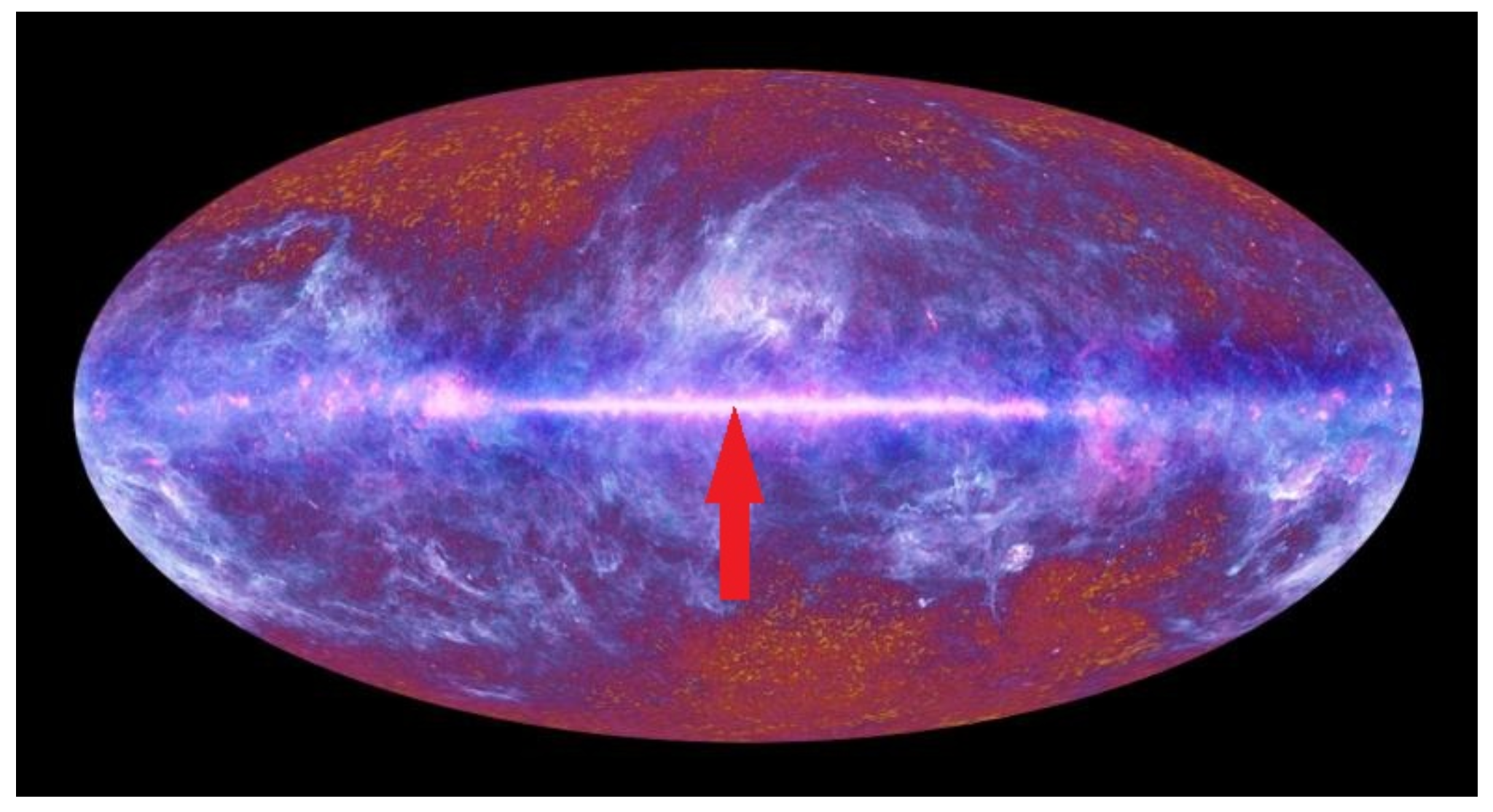
- WIMP annihilation releases energy near , forming hot spots (Figure 2, , , WIMPs), with CMB energy dominating over stellar contributions ().
- This increases , accelerating expansion over time.
-
To connect to CMB anomalies, consider the energy balance: the energy absorbed (cold spot) or released (hot spot) is , and the CMB temperature deviation implies an effective energy density change (where J is the radiation constant).For the cold spot (K): J ), leading to an effective volume m³ (linear scale ∼90 Mpc).For the hot spot (K): J ), leading to (linear scale ∼7 Mpc).
Equilibrium () looms as grows.
8. Results and Discussion
The feedback loop drives expansion via WIMP injections, detectable as CMB anomalies (cold spots, , of CMB sky [8], Figure 1; hot spots, , , Figure 2) or redshift trends [5]. CMB supports cold spot scale [4,7], while hot spots reflect annihilation energy near , contrasting static dark matter halos [9]. These scales align with WMAP’s anomalies across 41,253 [7]. Unlike traditional WIMPs forming halos post-recombination, these dynamically inject from , offering a testable alternative to dark energy [6].
9. Conclusions
Energy-Mass () drives expansion via a WIMP-based feedback loop, detectable via CMB anomalies, approaching equilibrium, contrasting dark matter theories. Future observations from JWST or Euclid could test these anomalies as dynamic injections rather than primordial.
Funding
This research received no external funding.
Data Availability Statement
The CMB data supporting this study’s figures (cold and hot spots) are openly available in the WMAP 5-year dataset [7] at NASA’s Lambda archive [https://lambda.gsfc.nasa.gov/product/map/dr3/skymaps_5yr.cfm]; the specific images are derived from [https://photojournal.jpl.nasa.gov/catalog/PIA13239]. Calculations (e.g., WIMP masses, injection rates) are detailed in the text.
Conflicts of Interest
The author declares no conflicts of interest.
Abbreviations
The following abbreviations are used in this manuscript:
| CMB | Cosmic Microwave Background |
| FLRW | Friedmann-Lemaître-Robertson-Walker |
| JPL | NASA’s Jet Propulsion Laboratory |
| JWST | James Webb Space Telescope |
| MDPI | Multidisciplinary Digital Publishing Institute |
| NASA | National Aeronautics and Space Administration |
| WIMP | Weakly Interacting Massive Particle |
| WMAP | NASA’s Wilkinson Microwave Anisotropy Probe |
References
- Riess, A. G.; et al. Astron. J. 1998, 116, 1009–1038.
- Perlmutter, S.; et al. Astrophys. J. 1999, 517, 565–586.
- Friedmann, A. Z. Phys. 1922, 10, 377–386.
- Planck Collaboration. Astron. Astrophys. 2018, 641, A6.
- Riess, A. G.; et al. Astrophys. J. 2019, 876, 85.
- Weinberg, S. Rev. Mod. Phys. 1989, 61, 1–23.
- Hinshaw, G.; et al. Astrophys. J. Suppl. Ser. 2009, 180, 225–245.
- Szapudi, I.; et al. Astrophys. J. Lett. 2014, 786, L2.
- Bertone, G.; Hooper, D.; Silk, J. Phys. Rep. 2005, 405, 279–390.
- XENON Collaboration. Phys. Rev. Lett. 2018, 121, 111302.
- Stringfellow, T. D. On Energy, Mass, Distance, Time, and the States of the Universe... Kindle Edition; Amazon Digital Services LLC, 2022; Available online: [https://www.amazon.com/dp/B09RVQNNDY] (accessed on 28 February 2025).
Figure 1.
CMB cold spot from WIMP injection (arrow), medium blue (, , size [8]) against . Credit: NASA/JPL-Caltech/WMAP Team.
Figure 1.
CMB cold spot from WIMP injection (arrow), medium blue (, , size [8]) against . Credit: NASA/JPL-Caltech/WMAP Team.
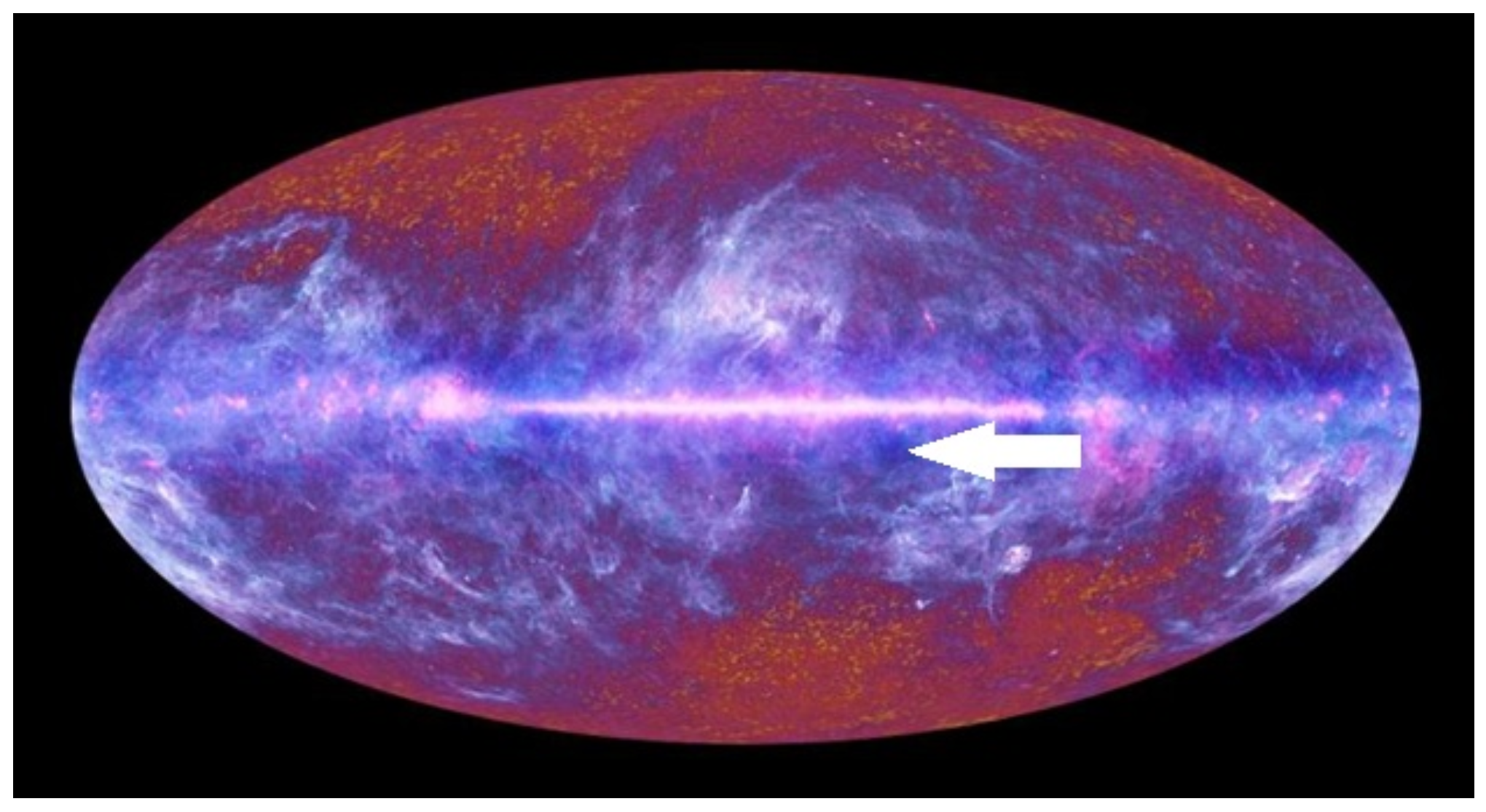
Figure 2.
CMB hot spot from WIMP annihilation (arrow), light purple (, , size ) against . Credit: NASA/JPL-Caltech/WMAP Team.
Figure 2.
CMB hot spot from WIMP annihilation (arrow), light purple (, , size ) against . Credit: NASA/JPL-Caltech/WMAP Team.
Disclaimer/Publisher’s Note: The statements, opinions and data contained in all publications are solely those of the individual author(s) and contributor(s) and not of MDPI and/or the editor(s). MDPI and/or the editor(s) disclaim responsibility for any injury to people or property resulting from any ideas, methods, instructions or products referred to in the content. |
© 2025 by the authors. Licensee MDPI, Basel, Switzerland. This article is an open access article distributed under the terms and conditions of the Creative Commons Attribution (CC BY) license (http://creativecommons.org/licenses/by/4.0/).
Copyright: This open access article is published under a Creative Commons CC BY 4.0 license, which permit the free download, distribution, and reuse, provided that the author and preprint are cited in any reuse.


