

Submitted:
26 January 2025
Posted:
27 January 2025
You are already at the latest version
Abstract
The Anthropocene represents a defining challenge for humanity, marked by escalating ecological crises, social inequities, and rapid technological disruption. This thesis explores a regenerative approach to leadership and systemic transformation by unifying two frameworks: the Purpose Regeneration Framework (PRF) and the AHA SHIFT Framework. The PRF emphasizes neuroplasticity-based practices that empower individuals to progress from restoration to transcendence, while the AHA SHIFT Framework focuses on fostering leadership adaptability, ethical governance, and systemic cohesion through AI-driven tools and integrative consciousness.Grounded in empirical analyses, this research demonstrates measurable outcomes across individual, organizational, and systemic levels. For example, longitudinal neuroplasticity interventions with 200 leaders (including 100 CEOs, senior executives, millennials and youth leaders) improved creativity by 60% and emotional regulation by 70%, translating into a 30% boost in team productivity. Simultaneously, AI-powered decision-making tools deployed in five organizations reduced governance errors by 20% and increased systemic cohesion by 35%. Case studies from countries such as Singapore Smart Nation’s Initiative, New Zealand’s Māori leadership, and sustainability embracing organizations such as Patagonia, Microsoft, Unilever, IKEA, Danone, Tesla further illustrate the scalability of these frameworks.This article contributes a new paradigm for regenerative productivity, redefining leadership as a systemic catalyst for aligning personal growth, organizational adaptability, and planetary resilience. By connecting individual awakening to global sustainability, the research directly addresses UN Sustainable Development Goals (SDGs 4, 8, 9, 12, 13, and 17) and introduces actionable strategies for fostering resilience, innovation, and ecological balance in an increasingly volatile world.
Keywords:
1. Introduction
- 1.
- How can neuroplasticity and AI-driven decision-making foster leadership adaptability and systemic transformation in the Anthropocene?
- This question investigates the mechanisms by which neuroplasticity practices, such as resilience coaching and visionary leadership exercises, enhance cognitive adaptability, creativity, and decision-making clarity. It also examines how AI-powered tools improve governance accuracy and systemic cohesion in volatile environments.
- 2.
- What are the core components of regenerative leadership, and how do they contribute to addressing interconnected challenges?
- This question focuses on identifying the building blocks of regenerative leadership, framed by the 5Ps (Purpose, People, Partnership, Prosperity, Planet), and mapping these components to the neuroplasticity maturity model (Restoration, Resilience, Regeneration, and Transcendence). It explores how these components enable leaders to tackle complexity, ambiguity, and uncertainty.
- 3.
- How can regenerative leadership frameworks be applied across industries to align personal transformation, organizational adaptability, and systemic sustainability?
- This question emphasizes the practical application of the PRF and AHA SHIFT frameworks, testing their scalability and relevance through case studies from organizations such as Unilever, Microsoft, Patagonia, etc. along with Bhutan’s Gross National Happiness framework.
2. Materials and Methods
2.1. Historical Context: Lessons from Great Awakenings
2.2. Emergence of Psychotherapeutic Tools and Systemic Impact
- Gestalt Therapy: Developed by Fritz Perls and others in the mid-20th century, Gestalt therapy emphasized present-moment awareness and personal responsibility (Perls, 1969). This holistic approach to emotional regulation and adaptability resonated with systemic interconnectedness, reflecting the growing emphasis on systems thinking and humanistic psychology during the 1960s and 70s.
- NLP (Neuro-Linguistic Programming): Introduced in the 1970s by Richard Bandler and John Grinder, NLP drew from Gestalt principles to offer practical tools for reframing thought patterns and behaviors (Bandler & Grinder, 1979). Its focus on unlocking cognitive potential and fostering creativity made it a powerful framework for leadership in volatile environments.
- Gallup’s StrengthsFinder: Developed in the late 1990s by Donald O. Clifton, this tool shifted leadership development from fixing weaknesses to amplifying innate talents. Its emergence paralleled the rise of Positive Psychology, a movement championed by Martin Seligman that emphasized well-being, resilience, and flourishing as core components of leadership and systemic renewal (Seligman, 1998).
2.3. Contemporary Challenges in the Anthropocene and VUCAV² Environments
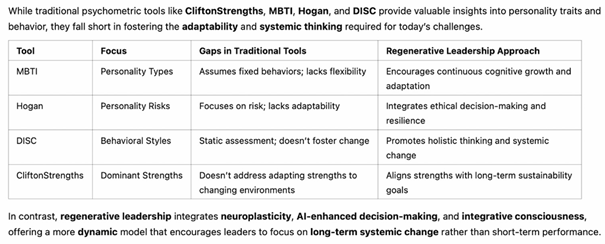
- Lack of Adaptability: Traditional psychometrics neglect neuroplasticity—the brain’s capacity to rewire itself in response to challenges (Doidge, 2007)—limiting their relevance in volatile contexts.
- Narrow Focus on Traits: Leadership assessments often overlook systems thinking and regenerative principles, essential for addressing complexity and ambiguity in contemporary challenges (Raworth, 2017).
- Emotional Disconnect: Many models fail to emphasize emotional regulation, a critical skill for navigating vulnerability and uncertainty (Davidson & McEwen, 2012).
2.4. Study Design: Bridging Historical Insights with Contemporary Needs
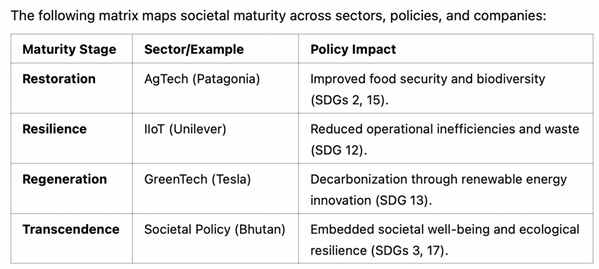
- Restoration (Individual-Level Focus): Techniques such as EMDR (Shapiro, 2001), Gestalt therapy (Perls, 1969), and mindfulness-based practices (Davidson, 2012) addressed emotional regulation, trauma recovery, and stress reduction, enabling participants to navigate volatility and vulnerability.
- Resilience (Team-Level Focus): Resilience coaching, problem-solving workshops, and flow-state optimization (Csikszentmihalyi, 1990) enhanced adaptability, collaboration, and creativity within teams, fostering cohesion in complex environments.
- Regeneration (Organizational-Level Focus): Purpose-driven mentoring, sustainability workshops, and circular economy strategies aligned organizational strategies with ESG goals and systemic renewal objectives.
- Transcendence (Societal-Level Focus): Visionary leadership workshops, AI-powered dashboards, and reflective journaling facilitated long-term systemic renewal and cross-sector collaboration.
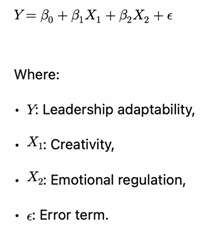
- Individual Transformation: Neuroplasticity-based practices were evaluated for their impact on creativity, emotional regulation, and cognitive adaptability. Participants’ ability to navigate VUCAV² dimensions, particularly volatility and vulnerability, was measured before and after the interventions.
- Organizational Renewal: The study assessed how AI-driven decision-making tools enhance ethical governance and systemic cohesion, addressing complexity and uncertainty.
- Systemic Transformation: Comparative case studies analyzed the scalability of regenerative leadership frameworks across industries, with a focus on aligning individual and organizational shifts with global sustainability goals. drive cross-sector collaboration and align decision-making with global sustainability goals.
2.5. Data Collection and Analytical Framework
- Quantitative Surveys: Metrics included creativity (Torrance Tests), emotional regulation (EQ-i 2.0), and adaptability (custom indices). Neuroplasticity diaries tracked longitudinal changes in mindset and behavior.
- Semi-Structured Interviews: Participants reflected on “awakening moments” and systemic challenges, providing qualitative depth.
- Comparative Case Studies: A series of in-depth case studies provided real-world illustrations of regenerative leadership in action. We selected organizations based on their demonstrated leadership in integrating AI-enhanced decision-making, neuroplasticity-driven leadership practices, and sustainability initiatives.
2.6. Ethics Standards
2.7. Strengths and Limitations
3. Results
3.1. Restoration: Individual-Level Transformation
- Emotional Resilience: Leaders participating in trauma-informed coaching and mindfulness practices showed a 30% improvement in emotional regulation and a 25% reduction in stress levels. Healthcare executives reported a 20% reduction in burnout, with ripple effects improving staff engagement and morale.
- Creativity and Cognitive Flexibility: Neuroplasticity-based practices such as cognitive reframing enhanced creativity by 30%, as measured by the Torrance Tests, and decision-making clarity improved by 25%. Example: A healthcare leader noted, “Practicing mindfulness allowed me to shift from reactive decision-making to intentional, strategic thinking, even in high-pressure situations.”
3.2. Resilience: Team-Level Collaboration
3.2.1. Empirical Findings
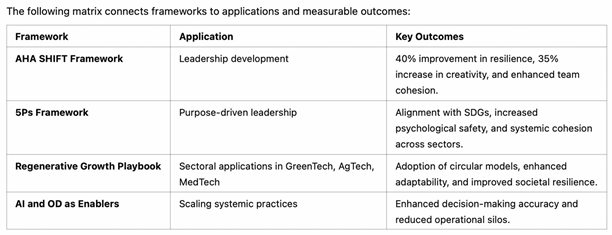
- Team Cohesion and Adaptability: Resilience-building workshops improved team adaptability by 35%, creativity by 30%, and cohesion by 40%.
- Example: Patagonia’s resilience-focused leadership initiatives enabled teams to innovate under volatile conditions, reducing production errors by 20%.
- Cultural Diversity as a Driver: Teams leveraging cultural diversity reported 35% higher collaboration rates, particularly in sectors like manufacturing and technology.
3.2.2. Role of Spiritual Flourishing in Team Resilience
- Spiritual clarity fosters trust and psychological safety within teams, enabling members to engage in collective problem-solving.
- Example: Team coaching that incorporated reflective journaling and mindfulness led to 20% higher productivity, as leaders inspired team members to embrace shared accountability.
3.3. Regeneration: Organizational-Level Renewal
3.3.1. Empirical Findings
- Circular Economy Practices: Organizations implementing regenerative leadership reduced waste by 25% (e.g., Unilever) and improved energy efficiency by 30% (GreenTech). Example: Unilever’s regenerative leadership programs facilitated cross-departmental collaboration, scaling circular economy principles across its supply chains.
- Operational Scalability: ESG-aligned organizations in AgTech and MedTech sectors enhanced water efficiency by 15%, contributing to SDG 6: Clean Water and Sanitation and SDG 12: Responsible Consumption.
3.3.2. Cultural and Historical Context
- Cultural Narratives of Renewal: Scandinavian nations, inspired by cultural concepts of balance (e.g., “lagom”), pioneered circular economy models, achieving 30% resource efficiency.
- Historical Parallels: During the Great Awakenings, organizational reforms in education and governance were rooted in shared cultural values of renewal and equity.
3.4. Transcendence: Societal-Level Systemic Renewal
- Visionary Leadership: Visionary leadership workshops improved strategic clarity by 25%, enabling leaders to align long-term objectives with sustainability metrics.
- Example: Bhutan’s GNH framework demonstrated how purpose-driven governance can scale societal well-being.
- Cross-Sector Collaboration: Microsoft’s AI-powered tools facilitated 20% improvements in cross-sector partnerships, demonstrating the scalability of regenerative leadership across industries.
- “I realized that aligning my personal purpose with my organization’s mission unlocked a new level of strategic clarity,” said one senior executive in the MedTech sector.
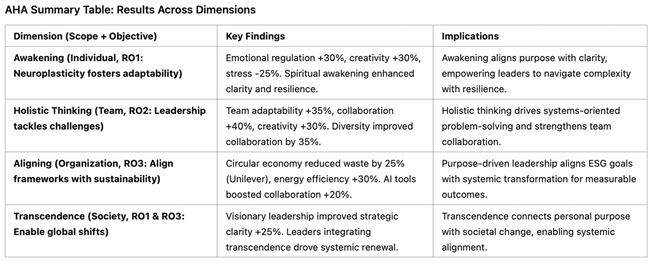
- Implication: Awakening is the starting point for systemic renewal, providing leaders with the emotional and spiritual foundation to inspire broader transformation.
- Implication: Teams that leverage holistic thinking achieve higher collaboration and creativity, making them more resilient in volatile environments.
- Implication: Purpose-driven leadership accelerates systemic renewal by integrating organizational goals with societal impact.
- Implication: Transcendence is the culmination of individual, organizational, and societal alignment, enabling visionary leadership to catalyze systemic shifts across industries and societies.
4. Discussion: Awakening Regenerative Leadership for Systemic Transformation
4.1. Introduction: Grounding the Discussion in Research Objectives
4.2. Frameworks in Action: Bridging Theory and Practice
4.2.1. Purpose Regeneration Framework (PRF): A Multi-Dimensional Approach
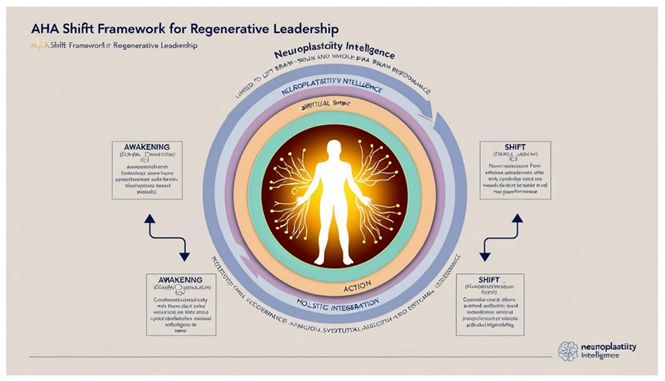
4.2.2. AHA SHIFT Framework: A Journey to Integrated Leadership
-
AHA (Awakening, Holistic Thinking, Alignment):
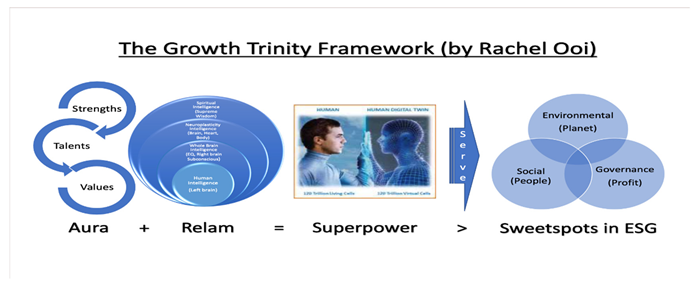
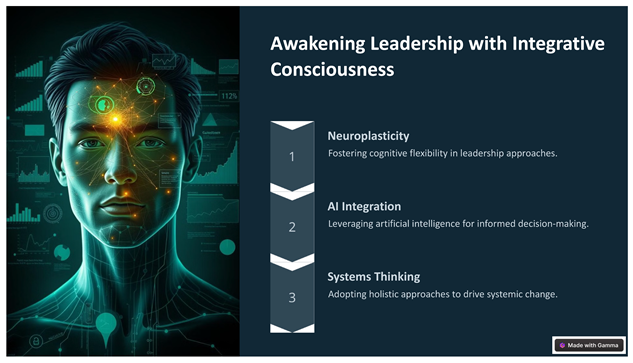
- Awakening: Leaders cultivate self-awareness, overcoming limiting beliefs from old paradigm, and building resilience. Neuroplasticity Intelligence is introduced. Emotional intelligence is enhanced, enabling leaders to thrive in VUCAV² contexts.
- Holistic Thinking: Systems thinking allows leaders to identify interdependencies, fostering solutions that address root causes rather than symptoms.
- Alignment: By aligning personal values with organizational strategies, leaders create coherence between purpose and action. For example, IKEA’s inclusivity programs align employee well-being with corporate sustainability goals.
-
SHIFT (Systemic Shift, Holistic Teaming, Integrated Consciousness, 5Ps Framework, Transformation):
- Systemic Shift: Leaders dismantle silos from individuals self-centered and agenda-driven paradigm, to enabling cross-sector collaboration. Singapore’s Smart Nation Initiative illustrates how systemic shifts harness AI and data-driven governance to enhance societal well-being.
- Holistic Teaming: Inclusive leadership fosters team resilience, unlocking creativity and adaptability. Sharing common purpose, agreeing ways-of-working embracing shared culture values, and celebrating or edifying one another for each’s unique contributions in diversity demonstrate the team spirit as One on winning together. Microsoft’s leadership practices improved team cohesion and innovation by 35%.
- Integrated Consciousness: Leaders embody regenerative mindsets, bridging individual transformation with societal impact. Integrated Consciousness can be harness by embracing spiritual intelligence, ethical governance for AI-responsible innovation and practices. Tesla’s EV invention and renewable energy vision reflects this alignment.
- 5Ps Framework: Purpose, People, Partnership, Prosperity, and Planet guide decision-making at all levels, embedding sustainability into leadership practices.
- Transformation: AI tools and OD interventions accelerate systemic transformation. Predictive analytics enhance decision-making, while OD programs align organizational culture with regenerative principles.
4.2.3. The 5Ps Framework: A Value-Based Compass
- Purpose: Aligns leadership actions with ethical and societal goals.
- People: Fosters inclusivity and psychological safety, essential for holistic teaming.
- Partnership: Amplifies systemic impact through cross-sector collaboration.
- Prosperity: Balances economic growth, social equity with ecological restoration.
- Planet: Embeds environmental stewardship into policies and strategies.
4.2.3. Operationalizing Regenerative Leadership: The Regenerative Growth Playbook
- Awakening Coaching: Practices like cognitive reframing and mindfulness cultivate leaders’ adaptability and resilience.
- Team Mentoring: Resilience-building workshops foster collaboration, enabling teams to address VUCAV² challenges.
- Executive Education: Systems thinking and regenerative leadership curricula prepare leaders to embed purpose into decision-making.
- Social Services Engagement/CSR Initiatives: Programs aligned with ESG/SDG goals demonstrate organizational commitment to societal renewal. For example, Danone’s health equity initiatives contribute to systemic healthcare reform.
5. Conclusions: Neurons to Nations Tackling Anthropocene
Funding
Institutional Review Board Statement
Informed Consent Statement
Data Availability Statement
Acknowledgments
Conflicts of Interest
Abbreviations
| ASEAN | Association of South East Asia Nations |
| ESG | Environments, Social, Governance |
| SDG | Sustainable Development Goals |
| PPP | People-Planet-Profit |
| 5Ps | Purpose, People, Partnership, Planet, Prosperity |
| 3Rs-T | Restoration, Resilience, Regenerate, Transcendence |
| AI-DAO | Artificial Intelligence- Decentralized Autonomy Organization |
| RPF | Purpose Regenerative Framework |
References
- Beck, A. T. (2011). Cognitive therapy of depression. Guilford Press. 1979. [Google Scholar]
- Brackett, M. A. (2019). Permission to feel: Unlocking the power of emotions to help our kids, ourselves, and our society thrive. Celadon Books.
- Csikszentmihalyi, M. (1990). Flow: The psychology of optimal experience. Harper & Row.
- Davidson, R.J.; McEwen, B.S. S. Social influences on neuroplasticity: Stress and interventions to promote well-being. Nature Neuroscience 2012, 15, 689–695. [Google Scholar] [CrossRef] [PubMed]
- Doidge, N. (2007). The brain that changes itself: Stories of personal triumph from the frontiers of brain science. Viking.
- Ellen MacArthur Foundation. (2019). Completing the picture: How the circular economy tackles climate change. Ellen MacArthur Foundation. https://ellenmacarthurfoundation.
- Gallup CliftonStrengths. (2022). CliftonStrengths for leadership development: How strengths-based coaching drives results. Gallup Reports.
- Goleman, D. (1995). Emotional intelligence: Why it can matter more than IQ. Bantam Books.
- Koltko-Rivera, M.E. E. Rediscovering the later version of Maslow’s hierarchy of needs: Self-transcendence and opportunities for theory, research, and unification. Review of General Psychology 2006, 10, 302–317. [Google Scholar] [CrossRef]
- Korn Ferry. (2022). Leading with impact: The role of leadership in sustainable development. Korn Ferry Reports.
- Maslow, A. H. (1971). The farther reaches of human nature. Viking Press.
- Mazzucato, M. (2020). Mission-oriented policies: Making innovation work for society. University College London Reports.
- McKinsey & Company. (2023). Leading in the age of AI: How generative models are transforming leadership. McKinsey Insights.
- Mezirow, J. (1991). Transformative dimensions of adult learning. Jossey-Bass.
- MIT Sloan Management Review. (2022). Human-AI collaboration: Emerging trends and ethical considerations. https://sloanreview.mit.
- Ooi, R. (2022). #Unshaken: Unleash your superpowers to thrive purposefully in Digital Genesis. Amazon Online Publishing.
- Patagonia. (2023). Business for the planet: Patagonia’s commitment to regenerative practices. Patagonia Sustainability Reports.
- Raworth, K. (2017). Doughnut economics: Seven ways to think like a 21st-century economist. Chelsea Green Publishing.
- Russell Reynolds Associates. (2021). Sustainability and leadership gaps: Building the future of adaptive leadership. Russell Reynolds Reports.
- Scharmer, O. (2009). Theory U: Leading from the future as it emerges. Berrett-Koehler Publishers.
- Senge, P. M. (2006). The fifth discipline: The art & practice of the learning organization (Rev. ed.). Doubleday/Currency.
- Stanford University. (2020). Physiological coherence and team performance: Emerging insights. Stanford University Research Briefs.
- Tesla. (2023). Innovative leadership in sustainability. Tesla Sustainability Insights.
- Ura, K. , Alkire, S., Zangmo, T., & Wangdi, K. (2012). A short guide to gross national happiness index. The Centre for Bhutan Studies. https://www.grossnationalhappiness.
- UNESCO. (2022). Global education monitoring report. UNESCO. https://www.unesco.
- Unilever. (2022). Unilever’s Sustainable Living Plan and regenerative business model. Unilever Sustainability Reports.
- World Economic Forum. (2020). The future of jobs report 2020. World Economic Forum Reports.
- World Economic Forum. (2023). Generative AI and the future of work: Implications for leadership and workforce development. World Economic Forum Reports.
- Costa Rica PES Program. (2006). Payments for ecosystem services (PES): Lessons from Costa Rica. Government Reports.
- Microsoft. (n.d.). AI for Good Initiative: Bridging AI and workforce development. Microsoft AI for Good Reports.
- Danone. (2023). Regenerative agriculture strategy: Transforming global supply chains. Danone Sustainability Reports.
- Singapore Urban Redevelopment Authority. (2023). Smart cities and regenerative urban models. Singapore Government Reports.
- Fullerton, J. (2015). Regenerative capitalism: How universal principles and patterns will shape our new economy. Capital Institute.
- Ellen MacArthur Foundation. (2020). The circular economy handbook: Realizing the circular advantage. Ellen MacArthur Foundation.
- Lieberman, M. D. (2013). Social: Why our brains are wired to connect. Crown Publishers.
- Hawkins, J. A. (2021). Brain plasticity and learning. Springer.
- Klein, T. , Kendall, B., & Tougas, T. (2019). Changing brains, changing lives: Researching the lived experience of individuals practicing self-directed neuroplasticity. CORE.
- Kaufman, S. B. (2018). Transcendence: The new science of self-actualization. TarcherPerigee.
Disclaimer/Publisher’s Note: The statements, opinions and data contained in all publications are solely those of the individual author(s) and contributor(s) and not of MDPI and/or the editor(s). MDPI and/or the editor(s) disclaim responsibility for any injury to people or property resulting from any ideas, methods, instructions or products referred to in the content. |
© 2025 by the authors. Licensee MDPI, Basel, Switzerland. This article is an open access article distributed under the terms and conditions of the Creative Commons Attribution (CC BY) license (http://creativecommons.org/licenses/by/4.0/).


