

Submitted:
02 January 2025
Posted:
03 January 2025
You are already at the latest version
Abstract
The Yang–Baxter equation emerged from a theoretical physics article written by the Nobel laureate C.N. Yang and from statistical mechanics work of R.J. Baxter. Attempts to unify the algebra structures and the coalgebra structures have eventually led to new solutions of the Yang-Baxter equation. But, in order to capture the information encapsulated in modules over algebras and comodules over coalgebras, we will need some kind of extensions of the Yang-Baxter equation, called Yang-Baxter systems. Also, the Tzitzeica-Johnson theorem is generalized in the curent paper.
Keywords:
Yang-Baxter equations
; Yang-Baxter systems
; associative algebras
; modules
MSC: 16T05; 16T25; 53C05; 51N20; 01A60; 00A05 (Primary); 17C05; 17C50 (Secondary)
1. Introduction
The Yang–Baxter equation emerged from a theoretical physics article written by the Nobel laureate C.N. Yang [1] and from statistical mechanics work of R.J. Baxter. [2,3]. In Knot Theory, invariants of links can be obtained from “enhanced” Yang-Baxter operators [5]. For example, the Jones polynomial [6], the Homflypt polynomial [16,33] and the Kauffman polynomial [19], are produced from “enhanced” Yang-Baxter operators.
Attempts to unify the algebra structures and the coalgebra structures have eventually led to new solutions of the Yang-Baxter equation. The only invariant which can be obtained from these Yang–Baxter operators is the Alexander polynomial of knots [23]. In order to capture the information encapsulated in modules over algebras and comodules over coalgebras, we will need some kind of extensions of the Yang-Baxter equation, called Yang-Baxter systems.
Also, the Tzitzeica-Johnson theorem is generalized in the curent paper. Several conclusions and evplanations are given at the end of the paper.
2. Yang-Baxter Equations and Yang-Baxter Systems
As usually, we work over a field k, and our tensor products are defined over k. Let be the identity map of the k-space V. For a k-linear map, let
Let be the linear map acting on the first and third component of .
Definition 2.1.
A Yang-Baxter operator is an invertible k-linear map , which satisfies the braid condition (the Yang-Baxter equation):
Remark 2.2.
The quantum Yang-Baxter equation is the following:
Remark 2.4.
Definition 2.5.
Let be k-spaces.
Let , and be k-maps. A Yang-Baxter commutator is a map , defined by
There are several types of Yang–Baxter systems, and in this section we consider the following example and its implications.
Definition 2.6.
For V and k–spaces, we consider the following maps
A WXZ-system verifies the following equations:
There are many applications of WXZ-systems. They can be used to construct dually-paired bialgebras of the FRT type, thus leading to quantum doubles.
Given a WXZ-system as in Definition 2.6 one can construct a Yang-Baxter operator on , provided the map X is invertible. This is a special case of a gluing procedure described in ([22] [Theorem 2.7]) (cf. [22] [Example 2.11]).
Entwining structures were introduced in order to recapture the symmetry structure of non-commutative (coalgebra) principal bundles or coalgebra-Galois extensions.
Theorem 2.7
([14]). Let A be an algebra and let C be a coalgebra. For any define linear maps
Let be a linear map such that and . Then is a Yang-Baxter system if and only if A is entwined with C by the map .
3. Unifications Using Yang-Baxter Systems
In this section we propose another kind of Yang-Baxter system.
We unify the following theorems:
(i) For an A–bimodule M, becomes an algebra.
(ii) For a C–bicomodule N, becomes a coalgebra.
Theorem 3.1.
Let V and be vector spaces, and
such that the following equations are satisified:
Then the linear map , given by , , , and , has the property .
Proof.
The proof is based on observations on the decomposition of into direct summands of tensor products. □
Remark 3.2.
If A is an associtive algebra, , M an A-bimodule, , and , then we have the conditions of the above theorem fulfilled.
Remark 3.3.
Let C be a coalgebra, , N a C-bicomodule, , and , then we have the conditions of the above theorem fulfilled.
4. On the Tzitzeica-Johnson Theorem
Let us start with the Tzitzeica-Johnson’s problem (see, for example, [24]).
We consider three circles of radius r, the intersection points of pairs of circles are denoted by A, B, C, and the common point of intersection of the three circles is denoted by O (see the Figure 1 below).
We now propose a new theorem. We now start with one circle of radius r (see the Figure 2).
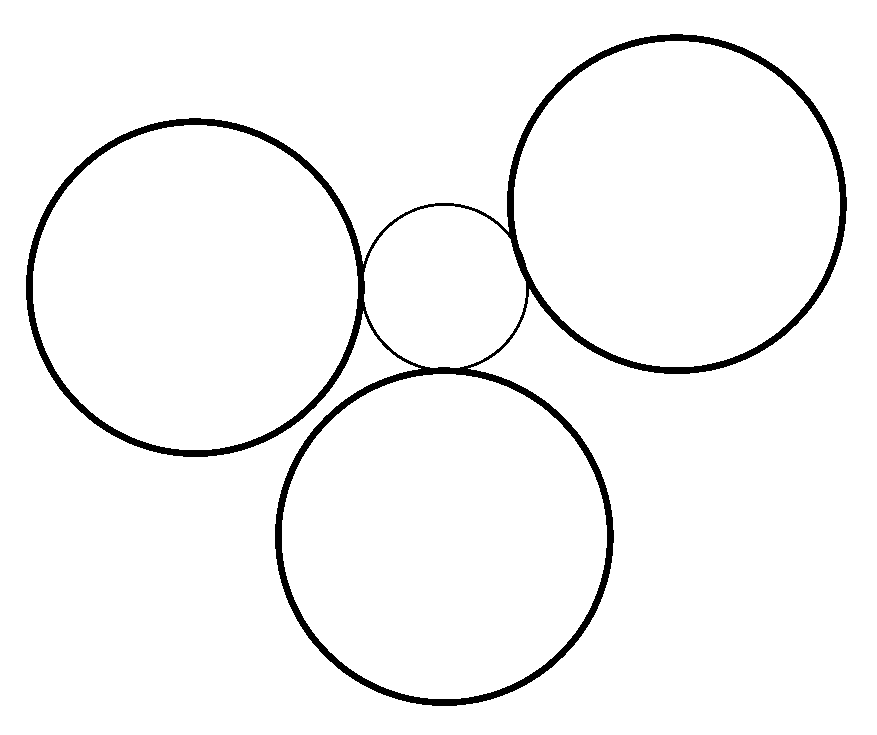
Related to our initial circle, we consider 3 tangent circles of radius R.
Figure 3.
Three circles of radius R, and a common tangent circle of radius r.
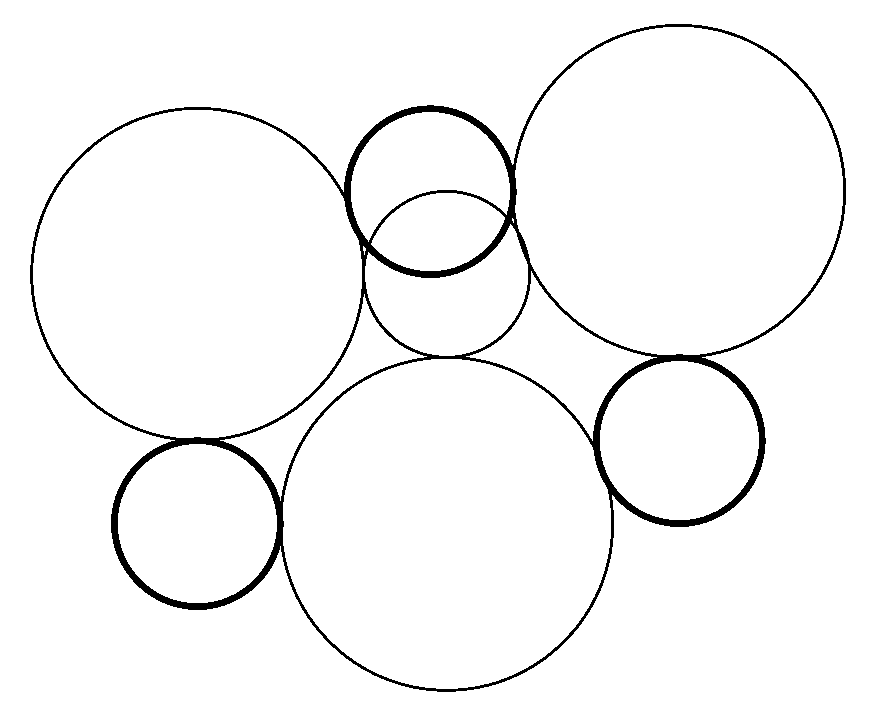
We now consider three circles tangent to the three circles of radius R:
Figure 4.
Three circles of radius R, and a other tangent circles of radius r.
At this moment, we can present our Theorem: under the above assumptions, there exists a circle of radius R, tangent to the three bold circles.
Figure 5.
Conclusion: There exists a fourth circle of radius R, which is tangent to the three exterior circles of radius r.
Figure 5.
Conclusion: There exists a fourth circle of radius R, which is tangent to the three exterior circles of radius r.
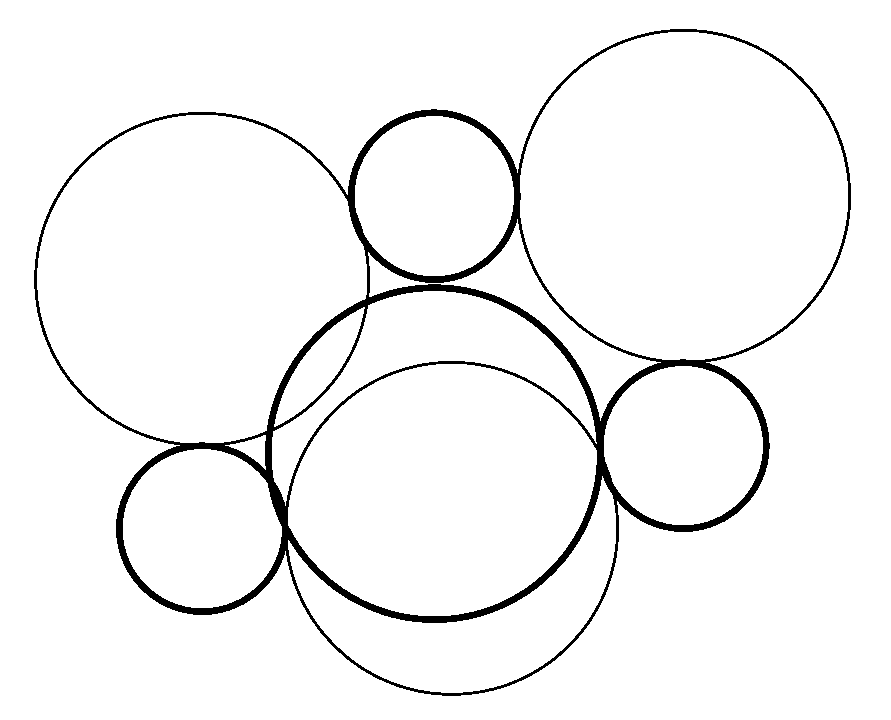
The proof of our theorem is based on reducing the above figure to the Tzitzeica-Johnson’s theorem for circles of radius .
5. Conclusions and Further Comments
Some of the results of this paper were presented at the 14-th International Workshop on Differential Geometry and Its Applications, hosted by the Petroleum Gas University from Ploiesti, between July 9-th and July 11-th, 2019. Several talks given on that ocasion were dedicated to the memory of St. Papadima (see [12,26,32,34]). It was during DGA 14, when we observed that some results from [32] can be extended for the virtual braid groups from [12].
References
- C. N. Yang, Some exact results for the many-body problem in one dimension with repulsive delta-function interaction, Phys. Rev. Lett. 19(1967), 1312-1315. [CrossRef]
- R.J. Baxter, Exactly Solved Models in Statistical Mechanics, Acad. Press, London,1982.
- R.J. Baxter, Partition function for the eight-vertex lattice model, Ann. Physics 70(1972), 193-228. [CrossRef]
- F.F. Nichita, Self-Inverse Yang-Baxter Operators from (Co)Algebra structures, Journal of Algebra, Volume 218, Number 2, 738-759(1999). [CrossRef]
- V. Turaev, The Yang-Baxter equation and invariants of links, Invent. Math. 1988 92 527-553.
- V. F. R. Jones, A polynomial invariant for knots via von Neumann algebras, Bull. Amer. Math. Soc. 12 (1985), 103–111. [CrossRef]
- Nichita, F.F.(Ed.): Hopf Algebras, Quantum Groups and Yang-Baxter Equations, MDPI, (2019), ISBN 978-3-03897-325-6 (PDF), ISBN 978-3-03897-324-9 (Pbk).
- Elisabeth Remm, On filiform Lie algebras. Geometric and algebraic studies, Revue Roumaine de Mathematiques Pures et Appliquees, Selected papers from the 13th International Workshop on Differential Geometry and its Applications (September, 2017) TOME LXIII, NO 2, 2018, 179-209. [CrossRef]
- Nichita, F.F., Yang–Baxter Equations, Computational Methods and Applications. Axioms 2015, 4, 423-435. [CrossRef]
- Nichita, F.F., On Jordan algebras and unification theories, Revue Roumaine de Mathematiques Pures et Appliquees 61(4), 2016, 305-316.
- N. Anghel, Heron Triangles with constant area and perimeter, talk, Differential Geometry and its Applications, UPG, 9 - 11 July, 2019, submitted to Revue Roumaine de Mathematiques Pures et Appliquees.
- Paolo Bellingeri, Virtual braid groups and permutations, talk, Differential Geometry and its Applications, UPG, 9 - 11 July, 2019.
- Tomasz Brzeziński, Towards semi-trusses Revue Roumaine de Mathematiques Pures et Appliquees, No. 2 (2018), pp. 75-89.
- T. Brzezinski, T.; Nichita, F.F. Yang-Baxter systems and entwined structures, Communications in Algebra 2005, vol. 33(4), pp. 1083–1093. [CrossRef]
- S. Dăscălescu and F. F. Nichita, Yang-Baxter operators arising from (co)algebra structures. Comm. Algebra 1999, 27, 5833–5845. [CrossRef]
- P. Freyd, D. Yetter, J. Hoste, W. B. R. Lickorish, K. Millett, A. Ocneanu, A new polynomial invariant of knots and links, Bull. Amer. Math. Soc. 12 (1985), 239–246. [CrossRef]
- L. Hlavaty and L. Snobl, Solution of the Yang-Baxter system for quantum doubles, Int. J. Mod. Phys. A14 (1999), 3029–3058. [CrossRef]
- M. Jimbo, Quantum R matrix for the generalized Toda system, Lett. Math. Phys. 11 (1986), 247–252.
- L. H. Kauffman, New invariants in the theory of knots, Astérisque 163-164 (1988), 137–219. [CrossRef]
- V. Lebed, Braided Systems: A Unified Treatment of Algebraic Structures with Several Operations, Homology, Homotopy and Applications, vol. 19(2), (2017), pp. 141-174. [CrossRef]
- V. Lebed, Homologies of algebraic structures via braidings and quantum shuffles, Journal of Algebra 391, 152-192 (2013). [CrossRef]
- Majid, S., Markl, M., Glueing operations for R-Matrices, quantum groups and link-invariants of Hecke type, Math. Proc. Cambridge Philos. Soc. 119 (1996), 139–166. [CrossRef]
- G. Massuyeau and F.F. Nichita, Yang-Baxter operators arising from algebra structures and the Alexander polynomial of knots, Comm. Algebra 2005, 33 (7) 2375-2385. [CrossRef]
- Moise, L.D.; Cristea, R Gheorghe Titeica - reverbertii si permanente ale geometriei in contemporaneitate, Proceedings, Conferinta Nationala de Invatamant Virtual, editia a XI-a, 2013, 150-156.
- J. Murakami, A state model for the multi–variable Alexander polynomial, Pacific J. Math. 157, 1 (1993), 109–135. [CrossRef]
- Florin Nichita, On Applications of UJLA Structures, talk, Differential Geometry and its Applications, UPG, 9 - 11 July, 2019.
- Nichita, F.F. Unification Theories: Examples and Applications. Axioms 2018, 7, 85. [CrossRef]
- Nichita, F.F. Unification Theories: New Results and Examples. Axioms 2019, 8, 60. [CrossRef]
- Nichita, F.F. Mathematics and Poetry • Unification, Unity, Union. Sci 2020, 2, 58.
- Nichita, F.F. (Ed.) Hopf Algebras, Quantum Groups and Yang-Baxter Equations, MDPI, 2019, ISBN 978-3-03897-324-9 (Pbk); ISBN 978-3-03897-325-6 (PDF).
- J. H.H. Perk and H. Au-Yang, Yang-Baxter Equations, Encyclopedia of Mathematical Physics, eds. J.-P. Françoise, G.L. Naber and Tsou S.T., Oxford: Elsevier, 2006 (ISBN 978-0-1251-2666-3), volume 5, pages 465-473.
- Radu Popescu, Resonance varieties. Definition and applications, talk, Differential Geometry and its Applications, UPG, 9 - 11 July, 2019.
- J. H. Przytycki, P. Traczyk, Invariants of links of Conway type, Kobe J. Math. 4, 2 (1987), 115–139. [CrossRef]
- Elisabeth Remm, Rigidity of Lie algebras, poster, Differential Geometry and its Applications, UPG, 9 - 11 July, 2019, submitted to Revue Roumaine de Mathematiques Pures et Appliquees.
Figure 1.
The Tzitzeica-Johnson’s theorem (Tzitzeica - 1908, Johnson - 1916). Under the above assumptions, there exists a circle with radius r, passing through the points A, B and C.
Figure 1.
The Tzitzeica-Johnson’s theorem (Tzitzeica - 1908, Johnson - 1916). Under the above assumptions, there exists a circle with radius r, passing through the points A, B and C.
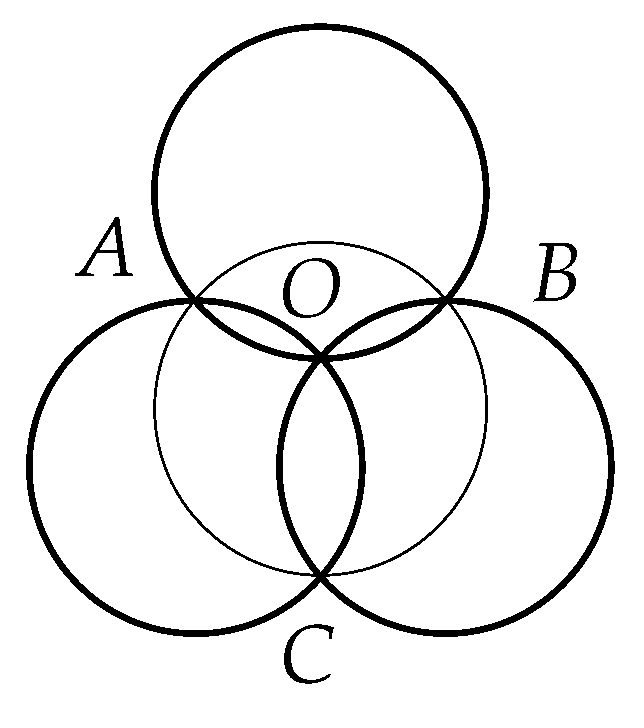
Figure 2.
We start with a circle of radius r.

Disclaimer/Publisher’s Note: The statements, opinions and data contained in all publications are solely those of the individual author(s) and contributor(s) and not of MDPI and/or the editor(s). MDPI and/or the editor(s) disclaim responsibility for any injury to people or property resulting from any ideas, methods, instructions or products referred to in the content. |
© 2025 by the authors. Licensee MDPI, Basel, Switzerland. This article is an open access article distributed under the terms and conditions of the Creative Commons Attribution (CC BY) license (http://creativecommons.org/licenses/by/4.0/).
Copyright: This open access article is published under a Creative Commons CC BY 4.0 license, which permit the free download, distribution, and reuse, provided that the author and preprint are cited in any reuse.


