1. Introduction
In the present paper, we only consider undirected, simple, and connected graphs unless otherwise stated. Let
(or shortly
) be a graph with vertex set
and edge set
. The adjacency matrix of
G is defined as
, where
equals the number of edges connecting vertices
and
when
and 0 when
. The rank of a graph
G, denoted by
, is defined to be the rank of its adjacency matrix
. The degree matrix
is defined as the diagonal matrix
, where
, and
equals the number of edges incident to vertex
. In the literature [
1], Cvetković et al. introduced a bivariate polynomial,
(abbreviated as
). Wang et al. [
2] referred to it as the generalized characteristic polynomial of
G. It is natural to define
in the variable
t as the generalized matrix of a graph
G, denoted by
. To be specific,it is easy to see
Consequently, the generalized characteristic polynomial of graph G is exactly the characteristic polynomial of the generalized matrix . That is, the polynomial is referred to as the generalized characteristic polynomial of G. Note that with encodes several well-known graph matrices, such as the adjacency matrix, the Laplacian matrix, and the normalized Laplacian matrix. It is evident that the generalized characteristic polynomial of a graph generalizes several well-known polynomial invariants of graphs, for example:
The characteristic polynomial of the adjacency matrix of a graph G is given by ;
-
The characteristic polynomial of the Laplacian matrix of G is
;
The characteristic polynomial of the unsigned Laplacian matrix of graph G is ;
The characteristic polynomial of the normalized Laplacian matrix is .
Following [
3], let
be an undirected graph, if
E is considered as a set of symmetric directed edges, meaning that if
, then
, where
is the reverse edge of
e, then
G can also be viewed as a directed graph. For
, let
denote the head of the directed edge
e and
the tail of
e. A closed walk in
G is defined as a sequence of edges
such that
for
. Here
is the length of
C and
is called the cyclic bump count of
C. The notation
is referred to as the equivalence class of the closed walk
C under edge permutation, meaning that
. If none of the representatives of
can be expressed as
(for
), then the cycle
C is said to be irreducible. The set of all irreducible cycles is denoted by
. The Bartholdi zeta function of a graph
G is defined as (see [
4] for details)
The function
is referred to as the (Ihara–Selberg) zeta function [
5], which was introduced by Ihara to study the zeta function of a regular graph and its reciprocal, and the reciprocal of the zeta function of a regular graph was generalized to the reciprocal of the Bartholdi zeta function for a general graph
G as below:
In particular, the reciprocal of the zeta function for a general graph
G is given by:
The zeta function encodes significant structural information about the graph, such as the number of vertices, edges, and loops. Moreover, the number of spanning trees (the complexity of the graph)
satisfies the equation [
6]:
For a comprehensive treatment of many aspects of Zeta function, refer to [
7].
Zeta functions of certain classes of graphs have received considerable attention, such as the line graph of semi-regular bipartite graphs [
8], the middle graph of semi-regular bipartite graphs [
9], the cone graph of regular graphs [
10], and various special join graphs of regular graphs [
11,
12]. It is not difficult to prove that
determines the reciprocal of the zeta function, and vice versa [
13]. Let
be a subgraph of the complete bipartite graph
. The
-complement of
G is defined as the graph obtained from
by deleting all edges of
G in
, i.e.,
. In this paper, we shall show a computational method for deriving the formula for the generalized characteristic polynomial of the
-complement of any bipartite graph
G, and further give an explicit formula for the generalized characteristic polynomials of the
-complement of a bipartite graph with rank less than or equal to 4.
2. Notations and Terminology
Let be a graph with the vertex set and the edge set . For two vertices , if and are adjacent, we denote this as . The neighborhood of a vertex in G is defined as , and the degree of vertex in G is denoted by . The complement of the graph is denoted as , where . If and with and , then is referred to as an induced subgraph of G.
A graph
is a bipartite graph if and only if there exists a bipartition of
V into
(namely
) such that no two vertices within
or
are adjacent. If the sizes of the bipartition sets are equal, i.e.,
, then
G is said to be a balanced bipartite. If
is a bipartite graph with a bipartition
, the bipartite complement of
G, denoted as
, has vertex set
and edge set
. For a bipartite graph
G, its adjacency matrix is given by
where
is the bipartite adjacency matrix of
G that defines the vertex adjacency relationship between the bipartite sets
and
. Specifically,
Lemma 1
Let G be a balanced bipartite graph. If G has a unique perfect matching, then the bipartite adjacency matrix has determinant 1 or .
Lemma 2
Let be an matrix, and let D be a diagonal matrix with diagonal entries , i.e., . Then
where θ is a subset of and is the complement of θ in , namely ; is the submatrix formed by the rows and columns of A indexed by θ. By convention, .
The following lemma immediately follows from Lemma 2.
Lemma 3 ([
15]).
If D is an invertible matrix, then the determinant of the matrix can be expressed as
Lemma 4 ([
16]).
Let A be an matrix. If there exists a zero submatrix in A such that , then
3. The generalized characteristic polynomial
For the sake of simplicity, the complete graph, cycle, and path on n vertices are denoted by , , and , respectively. Notationally, for , and ; and (or ) respectively denote the identity matrix and the (or ) matrix of all ones. For the rest of this paper, we will use to symbolize the complete bipartite graph with bipartite partition , where and , and to symbolize the set of all bipartite graphs with bipartite partition such that and . Note that a graph if and only if its bipartite complement . Let G be a subgraph of the complete bipartite graph . The -complement of a subgraph G in is defined as the graph obtained from by deleting all edges of G in , denoted by .
Theorem 1.
Let be a subgraph of with bipartite partition mentioned previously, and G has a bipartite partition such that (), (). Then, we have
where is the set of all induced balanced bipartite subgraphs in H such that the bipartite complement Q of has a nonsingular biadjacency matrix ; is the set of all nonempty induced balanced bipartite subgraphs Q in H (i.e., ) such that is nonsingular.
Proof. Let
. Note that
H has the same bipartite partition as
, that is,
, where
and
. Obviously,
. The generalized matrix
is given by
In other words,
where
and
,
.
Let
be the
column vector such that the
i-th element is 1 for
and 0 for
. Similarly, let
be the
vector where the
i-th element is 0 for
and 1 for
.
Let
and
. Then, we have
By Lemma 2, the following equality holds:
Now, we claim two facts:
Fact 1: The first-order principal submatrix of
is zero. The third-order principal submatrices of
are in the form:
and both of their determinants are zero. The fifth-order principal submatrices of
are in one of the following forms:
and each of their determinants equals zero. Analogously, the odd-order principal submatrices of
are in the form:
Note that or . According to Lemma 4, we conclude that , indicating that all odd-order principal submatrices of are singular.
Fact 2: By definition,
or equivalently
Suppose
is a subset of
such that
. Let
be an even-order principal submatrix of
. We denote by
the submatrix of
formed by the rows indexed by
and the columns indexed by
. Furthermore,
This reduces to
where
is the
submatrix obtained from
by deleting the rows that are not in
and the columns that are not in
. Similarly,
is the matrix resulting from
by the same deletion of rows and columns, and it is easy to see
.
Set , and let Q be a balanced bipartite induced subgraph of H with vertices, and the bipartite complement corresponding to Q is also a balanced bipartite induced subgraph of . Obviously, . Let denote the set of induced balanced bipartite subgraphs in H with vertices such that the bipartite complement Q of has a nonsingular biadjacency matrix , that is, the rank of is k (). Moreover, we denote by the set of all induced balanced bipartite subgraphs in H such that is nonsigular. We denote by the set of all nonempty induced balanced bipartite subgraphs Q in H (i.e., ) such that is nonsingular; that is to say, if Q is such a nonempty induced balanced bipartite subgraph in H on vertices, then the matrix satisfies the condition , and it’s worth noting that the induced subgraph Q may not necessarily be nonsingular.
Observe that (i)
, where
symbolizes the rank of the matrix
M; (ii)
. Then, by Lemma 2.3, we conclude that
This completes the proof. □
4. An application
Our main result in this section gives an application of Theorem 1. A permutation matrix is a square matrix obtained from the same size identity matrix by a permutation of rows. Two n by n matrices A and B are said to be permutationally equivalent if there exist n by n permutation matrices such that .
Theorem 2.
With notations mentioned in Theorem 1, if G has its rank , then
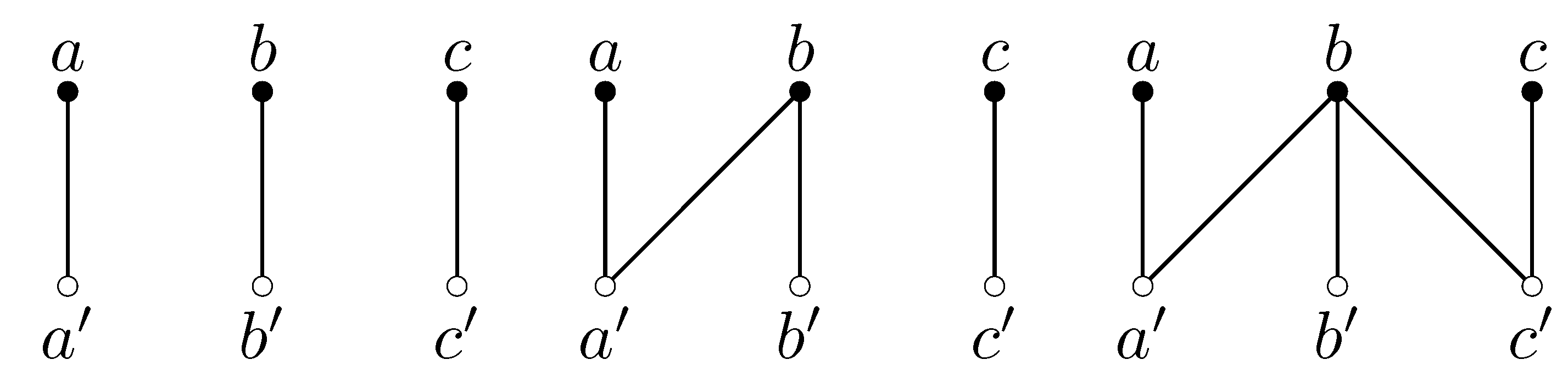
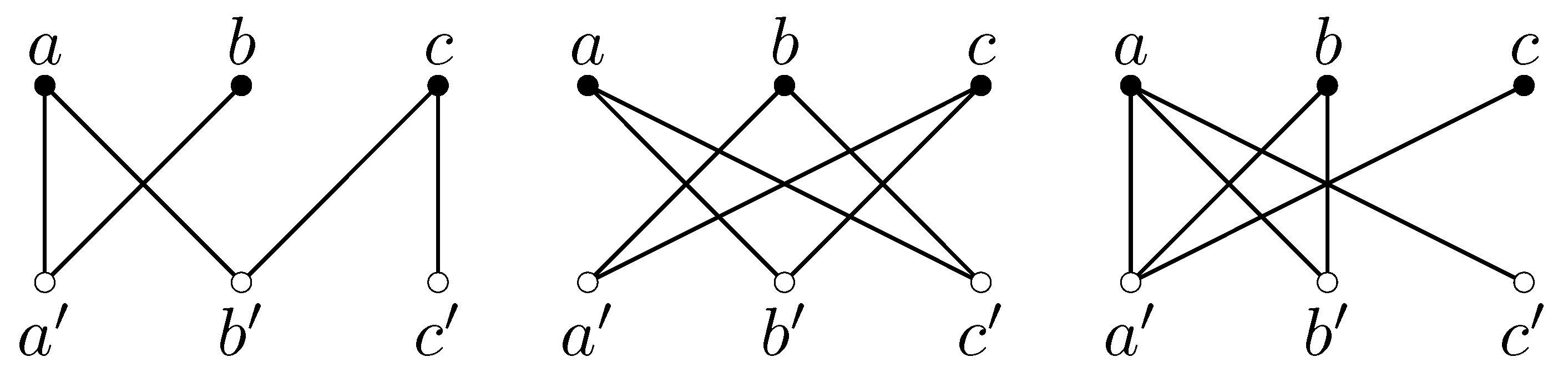
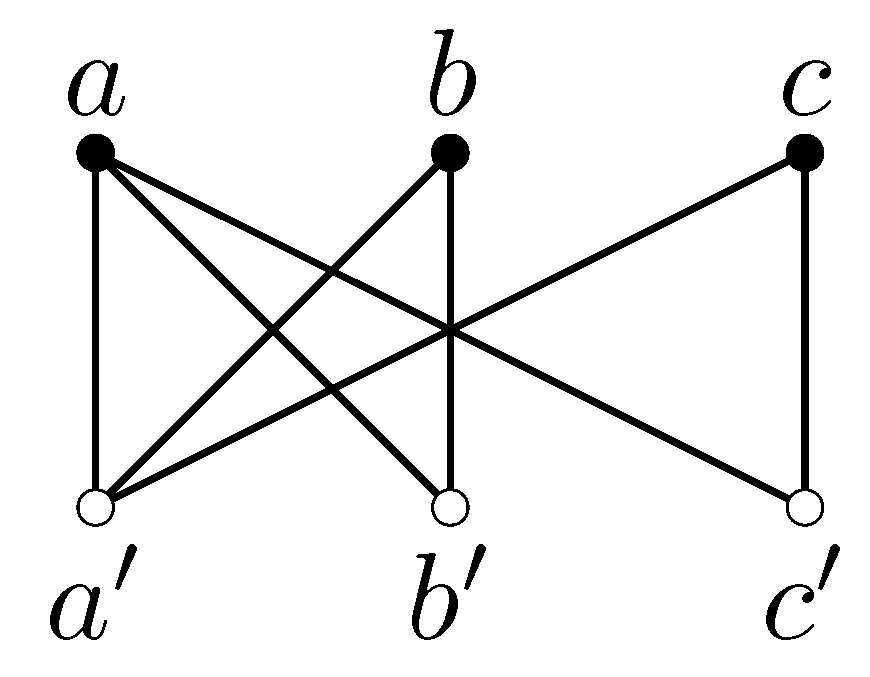
where is the set of all induced bipartite subgraphs of G that are isomorphic to the graph Q, and is the set of all induced bipartite subgraphs of G that are isomorphic to certain graph in the family . Here, where and are illustrated in Figure 1, Figure 2 and Figure 3.
Proof. From the proof of Theorem 1, we know that
where
,
, or
Hence we only need to study the summation
or equivalently
Observe that
. The following cases need to be discussed:
Case 1: If
, then
Case 2: If
, then
Consequently,
and
(the trivial graph on two vertices). The contribution of this case to the summation part of Eq. (
7) is given by
Case 3 If
, then
. Let
with
, where
and
. In this case, the matrix
is in the form
where
since
. This indicates that the induced subgraph
Q in
satisfies that
or
. The contribution of this case to the summation part of Eq. (
7) is given by
Case 4 If
, then
. Suppose
is the
principal submatrix of
in
such that
Moreover,
By exhaustive search, there exist 174 nonsingular 0–1 matrices of order 3, each of which is permutationally equivalent to one of the following seven matrices or their transposes:
In [
17], it is proved by the authors that
corresponds to the induced subgraph
in
, where
,
,
,
,
,
, or
(see
Figure 1,
Figure 2 and
Figure 3 ). By Lemma 1 or simple calculations, we know that
for
and
. Hence, the contribution of this case to Eq. (
7) is given by
The proof is completed. □
5. Conclusions
In this paper we studied the computation of the generalized characteristic polynomial or equivalently the zeta function of graphs, and derived a general formula for the generalized characteristic polynomial of the -complement of a bipartite graph. As a by-product, we obtained an explicit formula for the generalized characteristic polynomial of the - tite complement of a bipartite graph with rank no more than 4. In a sense, the formulas obtained in this paper are straightforward and only rely on the use of fundamental linear algebra about the biadjacency matrix of the bipartite graph.
Acknowledgments
This work is partially supported by National Natural Science Foundation of China (No. 12271489, No. 12371332). H.L. Gong is supported by Natural Science Foundation of Zhejiang Province (No. LY21A010006). W.L. Zhao is supported by the Project of the “14thFive-YearPlan” on the Reform of Higher Vocational Education in Zhejiang Province (No. jg20230215).
Conflicts of Interest
There are no conflicts of interests or competing interests.
References
- D. Cvetković, S. K. D. Cvetković, S. K. Simić, Towards a spectral theory of graphs based on the signless Laplacian. Publ. Inst. Math. 85 (2009) 19–33.
- W. Linear Algebra Appl. 434 (2011) 1378–1387.
- O. Kada, Characteristic polynomials and zeta functions of equitably partitioned graphs. Linear Algebra Appl. 588 (2020) 471–488.
- L. Bartholdi, Counting paths in graphs, Enseign.Math. 45 (1999) 83–131.
- Y. Ihara, On discrete subgroups of the two by two projective linear group over p-adic fields. J. Math. Soc. Japan 18 (1966) 219–235.
- S. Northshield, A note on the zeta function of a graph. J. Combin. Theory Ser. B 74 (1998) 408–410.
- A. Terras, Zeta Functions of Graphs: A Stroll Through the Garden. Cambridge University Press, Cambridge (2011).
- I. Sato, Zeta functions and complexities of a semiregular bipartite graph and its line graph. Discrete Math. 307 (2007) 237–245.
- I. Sato, Zeta functions and complexities of middle graphs of semiregular bipartite graphs. Discrete Math. 355 (2014) 92–99.
- P. Graphs Combin. 29 (2013) 1633–1646.
- A. Blanchard, E. A. Blanchard, E. Pakala, M. Somodi, Ihara zeta function and cospectrality of joins of regular graphs. Discrete Math. 333 (2014) 84–93.
- H.Y. Chen, Y. H.Y. Chen, Y. Chen, Bartholdi zeta functions of generalized join graphs. Graphs Combin. 34 (2018) 207–222.
- H.K. Kim, J. H.K. Kim, J. Lee, A generalized characteristic polynomial of graphs having a semifree action. Discrete Math. 308 (2008) 555–564.
- B. Khodakhast, On the determinant of bipartite graphs. Discrete Math. 313 (21) (2013) 2446–2450.
- J.C. Bruce, Characteristic polynomials by diagonal expansion. Am. Stat. 37 (1983) 233–235.
- R.B. Bapat, Graphs and Matrices. Hindustan Book Agency & Springer, New Delhi, India (2010).
- H.L. Gong, Y. H.L. Gong, Y. Gong, J. Ge, The number of spanning trees in Kn-complement of a bipartite graph. J. Algebr. Combin. 2024. [Google Scholar]
- H. Bass, The Ihara-Selberg zeta function of a tree lattice. Internat. J. Math. 3 (1992) 717–797.
- D. Graphs Combin. 35 (2019) 1503–1517.
|
Disclaimer/Publisher’s Note: The statements, opinions and data contained in all publications are solely those of the individual author(s) and contributor(s) and not of MDPI and/or the editor(s). MDPI and/or the editor(s) disclaim responsibility for any injury to people or property resulting from any ideas, methods, instructions or products referred to in the content. |
© 2024 by the authors. Licensee MDPI, Basel, Switzerland. This article is an open access article distributed under the terms and conditions of the Creative Commons Attribution (CC BY) license (http://creativecommons.org/licenses/by/4.0/).