

Submitted:
07 December 2024
Posted:
09 December 2024
You are already at the latest version
Abstract
This study explores the development of recurrence relations (RRs) for single moments (SMs) and product moments (PMs) based on progressive first-failure censored data (PFFCD) using the extended power Lindley distribution (EPLD). These RRs enable efficient computation of key statistical measures, such as means and variances, across varying sample sizes, reducing computational effort. The proposed approach extends existing methodologies and adapts to progressive type-II censoring schemes (PTIICS), broadening its applicability. This advancement enhances analytical frameworks and computational tools for statistical inference in models involving censored data.
Keywords:
Characterization
; Extended Power Lindley Distribution
; Progressive First-Failure Censored
MSC: 62E10; 62N99
1. Introduction
In industrial experiments and reliability testing, it is important to save costs and money when observing product downtime. Censoring is the most appropriate technique to achieve this goal by using lifetime experiments where we observe some lifetimes or failure times and not all lifetimes of the units under test. There are different methods of censoring. Progressively censored sampling has gained considerable attention in statistical research due to its flexibility and applicability across various fields. Numerous studies have explored this approach, including investigations by Balakrishnan et al. [1], Balakrishnan and Sandhu [2], and Davis and Feldstein [3]. Singh et al. [4] proposed both classical and Bayesian inference methods for the extended exponential distribution under PTIICS with binomial removals. Aggarwala and Balakrishnan [5] derived RRs for SMs and PMs under PTIICS. Recent advancements include the work of Athar et al. [6], who examined moments under PTIICS for the Lindley distribution, and Mohie El-Din et al. [7], who developed E-Bayesian estimation techniques for the Gompertz distribution with practical applications. Kotb et al. [8] extended these methods to the Kumaraswamy distribution under PFFCD, while Abu-Moussa et al. [9] estimated reliability functions for the extended Rayleigh distribution using the same framework. Further contributions by Sharawy [10] included RRs of PFFCD and characterization of right-truncated exponential distributions. Additionally, Alsadat et al. [11] conducted a comprehensive study of RRs and characterizations based on PFFCD.
The PFFCD scheme operates by dividing the total n groups, each containing b items, into segments based on observed failures. At the first , groups, along with the group containing the failed item, are removed. This process continues for subsequent failures , , and so on, until the failure , after which the remaining groups are removed. The resulting order statistics are termed PFFCD order statistics under the PTIICS scheme, where
Assuming the failure times of items follow a continuous distribution characterized by the cumulative distribution function (CDF) , survival function (SF) , and probability density function (PDF) and the joint PDF of the order statistics , is expressed as follows:
 where,

The EPLD is significant due to its flexibility in modeling various types of real-world data, particularly in reliability analysis and survival studies. Its ability to encompass multiple well-known distributions as special cases enhances its applicability across diverse statistical and probabilistic fields, see Alkarni [12]. The PDF and the CDF of EPLD are given, respectively, as follows.


It is worth noting that the relationship between PDF and SF can be derived using Equations (2) and (3) and is expressed as follows:

In Table 1 we present some distributions derived from the EPLD as special cases with different values of the parameters and .
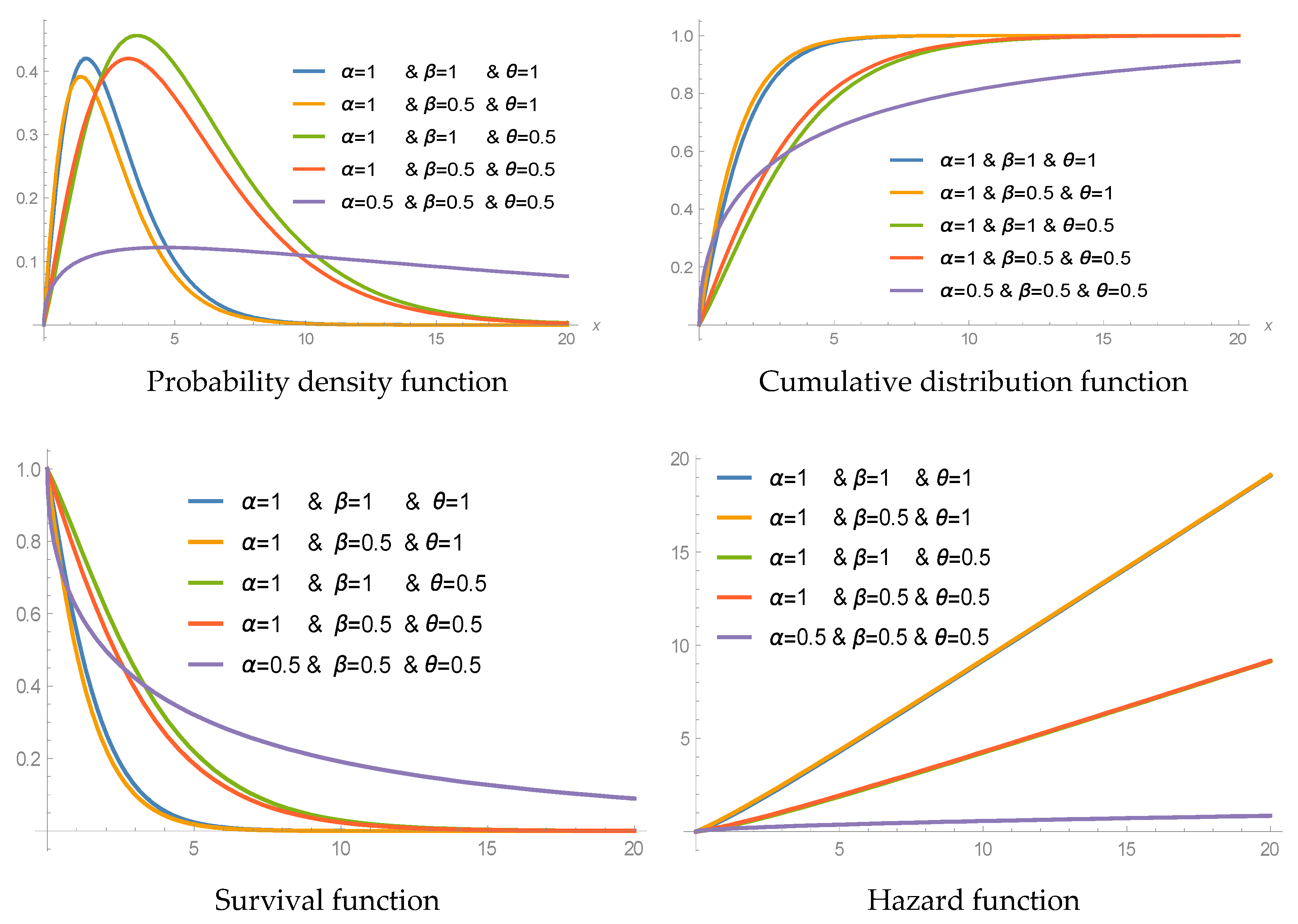
Figure 1.
graphs of the PDF, CDF, SF and Hazard functions of EPLD.
For any continuous distribution, the SMs of PFFCD can be represented, as outlined in Equation (1), as follows:
 while the and product moment for and based on the PFFCD is defined as follows,

2. Recurrence Relations for SMs and PMs
This section introduces RRs for SMs and PMs within the framework of PFFCD. These RRs simplify statistical computations by providing an iterative approach to determine expected values, variances, and higher-order moments as failures occur, significantly reducing computational effort. For product moments, the RRs facilitate the analysis of joint distributions and covariance structures under progressive censoring, making them particularly useful in areas such as reliability studies and clinical research. Employing these RRs offers valuable insights into system behavior under PFFCD, with practical applications in probabilistic modeling and risk evaluation [13]
The following theorem presents the RRs for SMs based on PFFCD.
Theorem 1.
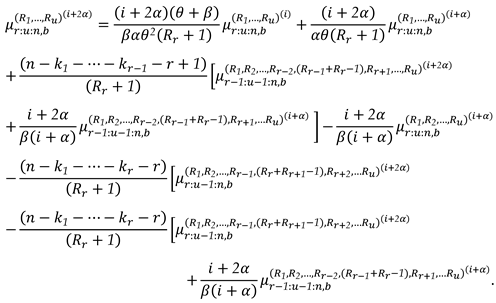
If X1:u:n:b ≤ X2:u:n:b ≤… ≤ Xn::u:n:b be the order statistics for a random sample of size drawn from EPLD, for then
Proof of Theorem 1.
Using Equations (1.4) and (1.5), we derive the following:
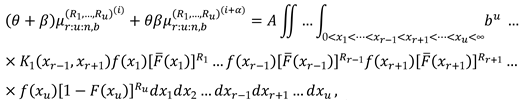 where
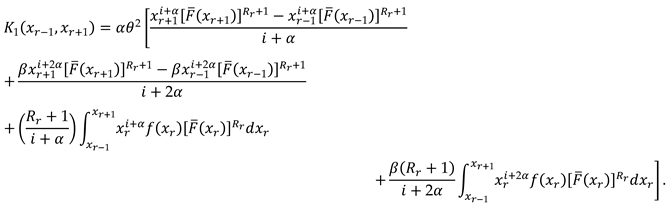
where
 By applying integration by parts, we arrive at the following result:
 Now substituting for the resultant expression of from Equation (10) in Equation (8), yields Equation (7), thus concluding the proof.
The following two theorems present RRs for PMs derived from PFFCD.
Theorem 2.
If X1:u:n:b ≤ X2:u:n:b ≤… ≤ Xn::u:n:b be the order statistics for a random sample of size drawn from EPLD, for then
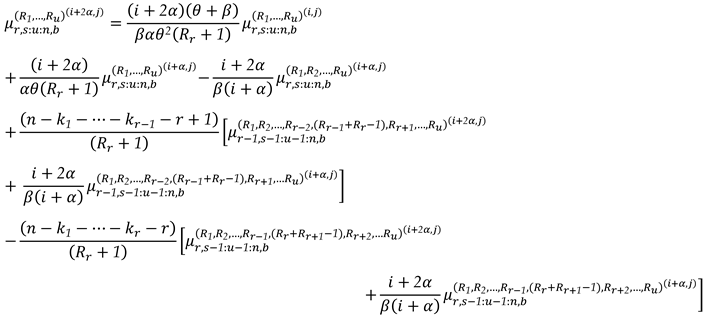
Proof of Theorem 2.
Using Equations (4) and (6), we derive the following:
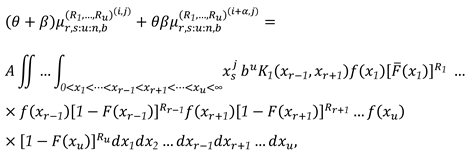 substituting the resultant expression of from Equation (10) in Equation (12), yields Equation (11), thus concluding the proof.
Theorem 3.
If X1:u:n:b ≤ X2:u:n:b ≤… ≤ Xn::u:n:b be the order statistics for a random sample of size drawn from EPLD, for then
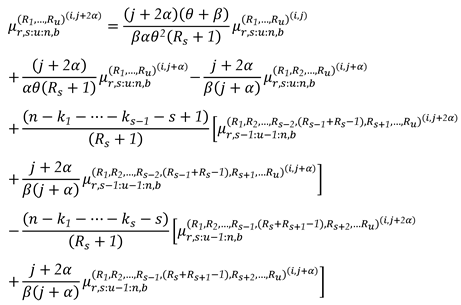
Proof of Theorem 3.
Using Equations (4) and (6), we derive the following:
 where
where
 Now, integrating by parts gives
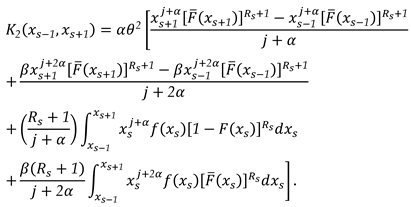 Now substituting for the resultant expression of from Equation (16) in Equation (14), yields Equation (13), thus concluding the proof.
3. The Characterizations
This section presents the characterizations of the EPLD by utilizing the relationship between its PDF and CDF, as well as through RRs for SMs and PMs under PFFCD.
3.1. Characterization via differential equation for the extended power Lindley distribution
The following theorem provides a characterization of the EPLD based on the connection between its PDF and SF.
Theorem 4.
Let be a random variable with PDF and SF . Then has EPLD iff

Proof of Theorem 4.
Necessity:
From Equations (2) and (3) we can easily obtain Equation (17).
Sufficiency:
Let be a random variable with pdf and SF . Assume that Equation (17) holds. Therefore, we have:
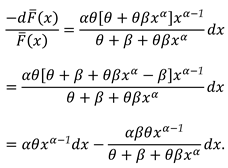 On integrating, we get
 where C is an arbitrary constant.
Since , substituting into this equation yields .
As a result,
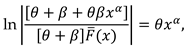 or,
or,
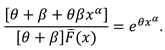 Hence,
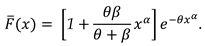 That is the SF of EPLD, thus concluding the proof.
3.2. Characterization via RRs for SMs
The upcoming theorem provides a characterization of the EPLD by utilizing RRs for SMs derived from PFFCD. These relations offer a systematic approach for analyzing statistical properties and simplify computations under censored data schemes. This characterization enhances the understanding of the EPLD’s behavior, making it valuable for applications in reliability analysis and survival studies, as outlined in the subsequent theorems.
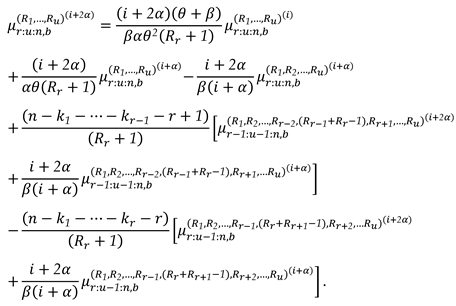
Theorem 5.
Let X1:u:n:b ≤ X2:u:n:b ≤… ≤ Xn::u:n:b be the order statistics for a random sample of size . Then has EPLD iff, for
Proof of Theorem 5.
Necessity:
Theorem 1 proved the necessary part of this theorem
Sufficiency:
Let be a random variable with PDF and SF . Assuming that equation (18) is valid, we then obtain:
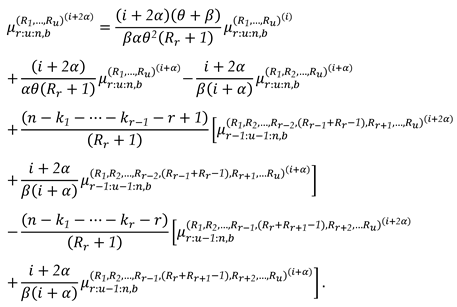 where,
 where,
 Now, integrating by parts gives
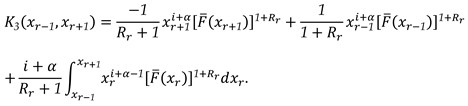 Now by substituting in Equation (20), we get
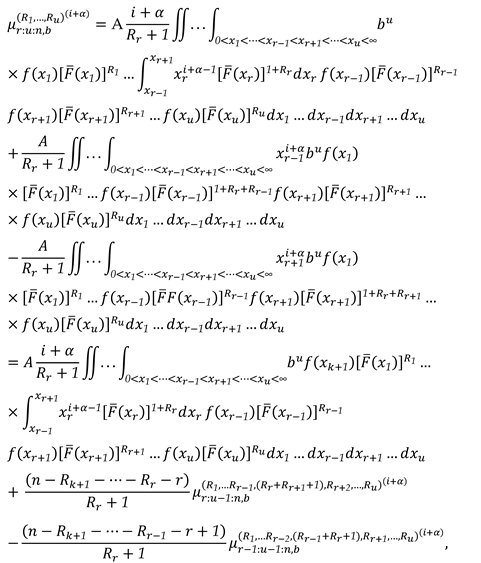 and
and
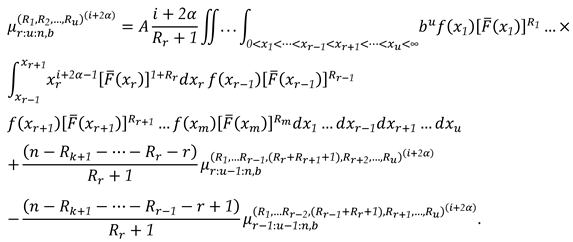 Now by substituting for by substituting Equations (23) and (24) into Equation (19), we obtain:
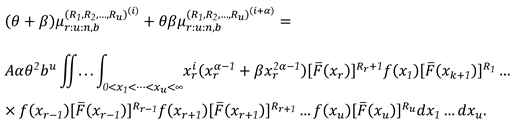 We get
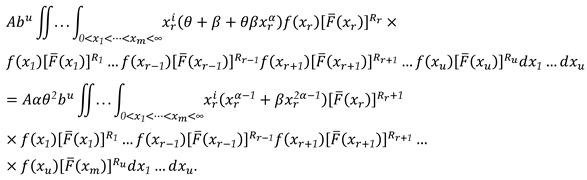 We get
 By applying the Muntz-Szasz theorem (see Hwang and Lin [14]), we obtain:
 Using theorem 4, we get the SF of EPLD.
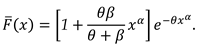 This completes the proof.
3.3. Characterization via RRs for PMs
In this subsection we characterize the EPLD using RRs for PMs based on PFFCD
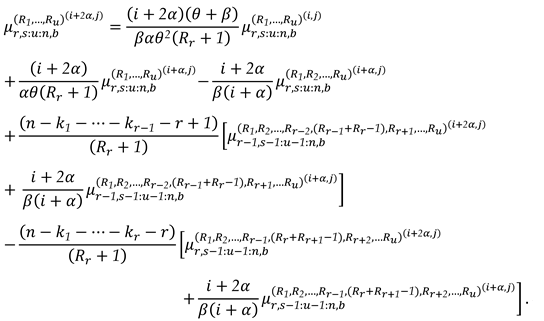
Theorem 6.
Let X1:u:n:b ≤ X2:u:n:b ≤… ≤ Xn::u:n:b be the order statistics for a random sample of size n Then has EPLD iff, for
Proof of Theorem 6.
Necessity:
The necessary condition of this theorem was established in theorem 2.
Sufficiency:
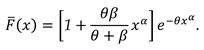
Following the proof in theorem 5, we derive the SF of the EPLD, given by:
 This concludes the proof.
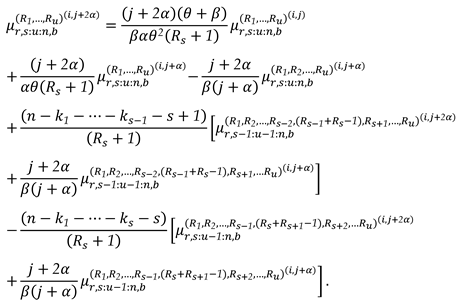
Theorem 7.
Let X1:u:n:b ≤ X2:u:n:b ≤… ≤ Xn::u:n:b be the order statistics for a random sample of size Then X has EPLD iff, for
Necessity:
theorem 7 proved the necessary part of this theorem the necessary condition of this theorem was established in theorem 3.
Sufficiency:
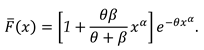
Following the proof in theorem 5, we derive the SF of the EPLD, given by:
 This concludes the proof.
Author contributions
Ali M. Sharawy: Methodology, validation, resources, writing original draft preparation, writing review and editing, analysis. All authors have read and approved the final version of the manuscript for publication.
Conflict of interest
The authors declare no conflicts of interest.
References
- Balakrishnan, N.; Cramer, E.; Kamps, U.; Schenk, N. Progressive type II censored order statistics from exponential distributions. Statistics: A Journal of Theoretical and Applied Statistics 2001, 35, 537–556. [Google Scholar] [CrossRef]
- Balakrishnan, N.; Sandhu, R.A. Best linear unbiased and maximum likelihood estimation for exponential distributions under general progressive type-II censored samples. Sankhyā: The Indian Journal of Statistics, Series B 1996, 1–9. https://www.jstor.org/stable/25052923.
- Davis, H.T.; Feldstein, M.L. The generalized Pareto law as a model for progressively censored survival data. Biometrika 1979, 66, 299–306. [Google Scholar] [CrossRef]
- Singh, S.K.; Singh, U.; Kumar, M.; Vishwakarma, P.K. Classical and Bayesian inference for an extension of the exponential distribution under progressive type-II censored data with binomial removals. Journal of Statistics Applications & Probability Letters 2014, 1, 75–86. [Google Scholar] [CrossRef]
- Aggarwala, R.; Balakrishnan, N. Recurrence relations for single and product moments of progressive Type-II right censored order statistics from exponential and truncated exponential distributions. Annals of the Institute of Statistical Mathematics 1996, 48, 757–771. [Google Scholar] [CrossRef]
- Athar, H.; Akhter, Z.; Saran, J. Moments of progressive Type-II right censored order statistics from Lindley distribution. Statistics Research Letters 2014, 3, 01–06. [Google Scholar]
- Mohie El-Din, M.M.; Sharawy, A.; Abu-Moussa, M.H. E-Bayesian estimation for the parameters and hazard function of Gompertz distribution based on progressively type-II right censoring with application. Quality and Reliability Engineering International 2023, 39, 1299–1317. [Google Scholar] [CrossRef]
- Kotb, M.S.; Sharawy, A.; El-Din, M.M.M. E-Bayesian Estimation for Kumaraswamy Distribution Using Progressive First Failure Censoring. Mathematical Modelling of Engineering Problems 2021, 8, 8.–content. [Google Scholar] [CrossRef]
- Abu-Moussa, M.H.; Alsadat, N.; Sharawy, A. On Estimation of Reliability Functions for the Extended Rayleigh Distribution under Progressive First-Failure Censoring Model. Axioms 2023, 12, 680. [Google Scholar] [CrossRef]
- Sharawy, A. Recurrence Relations for Moment Generating Function of Progressive First Failure Censoring and Characterizations of Right Truncated Exponential Distribution. ERU Research Journal 2024, 3, 781–790. [Google Scholar] [CrossRef]
- Alsadat, N.; Abu-Moussa, M.; Sharawy, A. On the study of the recurrence relations and characterizations based on progressive first-failure censoring. AIMS Mathematics 2024, 9, 481–494. [Google Scholar] [CrossRef]
- Alkarni, S.H. Extended power lindley distribution: A new statistical model for non-monotone survival data. European J. of Statist. and Probability 2015, 3, 19–34. [Google Scholar]
- El-Din, M.M.; Sadek, A.; El-Din MM, M.; Sharawy, A. Characterization for Gompertz distribution based on general progressively type-ii right censored orderstatistics. International Journal of Advanced Statistics and Probability 2017, 5, 52–56. [Google Scholar] [CrossRef]
- Hwang, J.S.; Lin, G.D. Extensions of Müntz-Szász theorem and applications. Analysis 1984, 4, 143–160. [Google Scholar] [CrossRef]

Table 1.
Special cases of the EPLD.
| Case | Parameters | Distribution |
| 1 | Power Lindley | |
| 2 | Lindley | |
| 3 | Weibull | |
| 4 | Rayleigh | |
| 5 | Exponential | |
| 6 | Modified Gamma | |
| 7 | Modified Rayleigh | |
| 8 | Extended Lindley |
Disclaimer/Publisher’s Note: The statements, opinions and data contained in all publications are solely those of the individual author(s) and contributor(s) and not of MDPI and/or the editor(s). MDPI and/or the editor(s) disclaim responsibility for any injury to people or property resulting from any ideas, methods, instructions or products referred to in the content. |
© 2024 by the authors. Licensee MDPI, Basel, Switzerland. This article is an open access article distributed under the terms and conditions of the Creative Commons Attribution (CC BY) license (http://creativecommons.org/licenses/by/4.0/).
Copyright: This open access article is published under a Creative Commons CC BY 4.0 license, which permit the free download, distribution, and reuse, provided that the author and preprint are cited in any reuse.


