

Submitted:
30 November 2024
Posted:
02 December 2024
You are already at the latest version
Abstract
At present, many researches have explored the modification of Bi₄O₅Br₂, but relatively few have focused on non-metallic doping. Particularly, the effect of S doping on its photocatalytic mechanism remains unclear. Hence, this study systematically investigates the modulation mechanism of the electronic structure and optical properties of Bi₄O₅Br₂ by doped S using density functional theory (DFT) calculations. The calculated results indicate that the Br4Br1 model, in which S replaces Br at sites 4 and 1, is the most thermodynamically stable configuration. Comparing the models before and after doping, it is found that S doping significantly alters the lattice parameters of Bi₄O₅Br₂, thus affecting its electronic structure. Furthermore, differential charge density calculations reveal that S doping improves charge transfer capability and enhances the separation efficiency of photogenerated electron-hole pairs in Bi₄O₅Br₂. Calculated absorption spectra demonstrate that S doping augments the light absorption of Bi₄O₅Br₂ in the low and medium energy regions. Moreover, the dielectric function calculations further validate the effect of S doping on the optical properties of Bi₄O₅Br₂. Specifically, there is an increase in polarization and energy loss in the low energy region, with an opposite trend in the middle and high energy regions. Overall, S doping elevated the light absorption capacity and charge transfer efficiency of Bi₄O₅Br₂ by altering its lattice parameter and electronic structure, which facilitated the enhancement of photocatalytic performance. This study provides new insights into the development of efficient photocatalytic materials and broadens the potential of Bi₄O₅Br₂ for photocatalytic applications.
Keywords:
S-doping
; Bi4O5Br2
; Density functional theory (DFT)
; Electronic structure
; Optical properties
1. Introduction
With the rapid development of the global economy and intensification of industrialization, the problems of energy shortage and environmental pollution are becoming increasingly serious [1]. Particularly, organic pollutants and bacteria in industrial wastewater seriously pollute the soil, air, and drinking water essential for human survival, and environmental pollution has become one of the common challenges faced by all countries worldwide [2,3,4]. Searching for environmentally friendly photocatalytic materials to replace non-renewable energy sources has become one of the effective strategies to solve current environmental pollution and energy crises. Photocatalytic technology is a high-efficiency, low-energy, low-cost, and non-secondary-pollution environmental treatment method and clean energy production technology. This technology utilizes semiconductor photocatalysts to generate active species under sunlight irradiation, which decompose pollutants into harmless water and carbon dioxide through redox reactions. Photocatalytic technology not only effectively addresses environmental problems, but also makes full use of the inexhaustible solar energy resources, which has become one of the hot spots in environmental remediation field [5,6].
Among many photocatalytic materials, bismuth-based semiconductors exhibit enormous application potential and advantages in photocatalysis due to their rich layered structure, tunable bandgap, excellent physicochemical stability, and high electron-hole mobility [7,8]. Especially, the special physical properties of bismuth oxide and the diversity of crystal morphology make it widely used in sensors, optoelectronic materials, microelectronic components, and various types of catalysts [9,10,11]. In the study of bismuth-rich halide oxide materials, Bi₄O₅Br₂ has attracted considerable attention owing to its unique crystal structure. Bi₄O₅Br₂ consists of alternating layers of [Bi₂O₂]²⁺ lamellae and double bromine atoms [4,10], which enables more efficient separation of photogenerated electron-hole pairs in the presence of a polarization-induced electric field. In addition, Bi₄O₅Br₂ is characterized by high chemical stability, large specific surface area, strong light absorption capacity, and short diffusion distance, which lead to its excellent performance in photocatalysis [12,13,14]. However, the application of Bi₄O₅Br₂ as a photocatalyst still faces several challenges. Firstly, Bi₄O₅Br₂ has a limited visible light absorption range (<450 nm), which restricts its photocatalytic activity in the visible region. Secondly, the wide optical band gap (2.54 eV) of Bi₄O₅Br₂ implies that only high-energy photons can excite electron-hole pairs, reducing the photocatalytic efficiency [15]. Meanwhile, Bi₄O₅Br₂ lacks carrier-enriched sites, which hinders the further improvement of its photocatalytic performance [16].
To overcome these limitations, researchers have explored a variety of modification methods, including the construction of heterostructures [17,18], surface modification [19], elemental doping [20,21], and the preparation of composite photocatalysts [22]. Pd doping of Bi₄O₅Br₂ has been proven to be an effective strategy to improve its catalytic performance [20]. The increase in catalytic activity is attributed to the formation of a Schottky barrier between Pd and Bi₄O₅Br₂, which broadens the absorption range of Bi₄O₅Br₂ in visible light and significantly improves the photocatalytic degradation of BPA. Zhang et al. [23] explored the photocatalytic activity of Bi₄O₅Br₂ by doping Mn. The results of experiments and theoretical calculations indicated that the introduction of Mn did not change the surface morphology or physical phase of Bi₄O₅Br₂. It was discovered that Mn doping reduces the band gap of Bi₄O₅Br₂, extends the visible light absorption range, and improves the separation efficiency of electrons and holes. By constructing TiO₂/Bi₄O₅Br₂ heterostructure, the light absorption ability of the catalyst was improved [24]. Meanwhile, the separation and migration of photogenerated carriers were facilitated, which significantly enhanced the photocatalytic performance. These research advances provide new ideas and methods for the application of modified Bi₄O₅Br₂ in photocatalysis. Notably, non-metallic doping has extraordinary potential to augment the photocatalytic performance of Bi-based semiconductor materials.
BiOBr photocatalysts with flower-like microsphere morphology have been successfully synthesized by N/S doping strategy, which exhibited excellent activity and stability in the degradation of organic pollutants such as rhodamine B (RhB) and phenol [25]. F doping could modify the lattice parameter and energy band structure of Bi₂MoO₆, leading to a decrease in the band gap and a negative conduction band potential, which improved the photocatalytic efficiency [26]. Weng et al. [27] prepared CQDs/S-Bi₄O₅Br₂ materials for the photocatalytic degradation of ciprofloxacin. The findings demonstrated that S-doped carbon quantum dots could augment the light absorption and photogenerated electron-hole pair separation efficiency of Bi₄O₅Br₂. Furthermore, the doping site and the doping concentration have a crucial influence on the photocatalytic performance of Bi-based materials [28,29,30]. Specifically, appropriate concentrations of non-metallic doping can optimize the energy band structure and surface chemistry of the material. Meanwhile, issues such as lattice distortion and increased recombination rate of photogenerated carriers that may result from high doping concentration can be avoided. Although previous studies have demonstrated the exciting potential of non-metallic doping for photocatalysis, the modification mechanism of Bi₄O₅Br₂ by S doping remains unclear.
In this study, the modification of Bi₄O₅Br₂ is realized by S doping. Based on DFT calculations, the effects of S doping on the energy band structure, density of states, differential charge, absorption spectra, and dielectric function of Bi₄O₅Br₂ are thoroughly investigated. The intrinsic mechanism of S doping in modulating the photocatalytic performance of Bi₄O₅Br₂ is revealed. This study provides theoretical evidence for the development of efficient photocatalytic materials.
2. Calculation Details
In this paper, all density functional theory (DFT) calculations are performed using Device Studio intergrated Projector Augmented-Wave (DS-PAW) method package rated in Device Studio program [31], and the cutoff energy for the plane-wave expansion is set to 450 eV. The convergence criteria for energy and force are set to 1 e-5 eV and 0.01 eV/Å, respectively. The first Brillouin zone is sampled using a 3 × 6 × 3 k-point grid. The exchange-correlation interactions are described using the Perdew-Burke-Ernzerhof (PBE) functional within the generalized gradient approximation (GGA) [32]. The calculation precision is set to “Accurate”. In this work, all computational models are constructed based on the primitive crystal structure of Bi₄O₅Br₂, as shown in Figure 1a, which contains 16 Bi atoms, 20 O atoms, and 8 Br atoms. Seven different S-doped Bi₄O₅Br₂ (S-BOB) models are constructed by replacing Br at different sites and their combinations, namely Br1 (Figure 1b), Br2 (Figure 1c), Br3 (Figure 1d), Br4 (Figure. 1e), Br4Br1 (Figure 1f), Br4Br2 (Figure 1g), and Br4Br3 (Figure 1h).
3. Results and Discussion
3.1. Structure Optimization
The base state energies of these seven models are obtained by structural optimization, and their formation energies are calculated by the following equation [33]:
where EX-BOB is the energy of S-BOB, EBOB is the energy of pure Bi4O5Br2, ES is the energy of S atoms, and EBr is the energy of Br atoms. As shown in Table 1, the Br4Br1 model has a minimum formation energy of 2.53 eV. Therefore, the Br4Br1 model is chosen for property calculations and analyses in subsequent research.
ΔES = EX-BOB − EBOB + n EBr − n ES
The lattice parameter a is increased from 10.89 Å to 10.92 Å after S doping compared to Bi₄O₅Br₂ (Table 2). This indicates that S doping can lead to lattice expansion. Furthermore, the lattice angles α increase from 90° to 90.64°, β from 97.72° to 97.97°, and γ from 90° to 91.44°, which implies that the lattice symmetry and the internal stress state also change slightly. This is mainly attributed to the difference in radius and electronegativity between the S atom (r = 105 pm) and the Br atom (r = 114 pm). S doping with smaller atomic radius and higher electronegativity leads to the tuning of the length and bond angles of the surrounding Bi-O bonds, thus causing lattice distortion. Accordingly, new or defect energy levels may be introduced to alter the energy band structure, which improves the separation and migration rate of photogenerated carriers [11,34]. Therefore, it is feasible to modulate the photocatalytic properties of Bi₄O₅Br₂ by S doping.
3.2. Energy Band Structure and Density of States
The energy band structure and density of states of Bi₄O₅Br₂ and S-BOB are calculated first. As shown in Figure 2a, the band gap of pure Bi₄O₅Br₂ is 2.56 eV, which is consistent with the experimental value of 2.54 eV [35], verifying that the theoretical calculations are reliable. Meanwhile, the valence band maxima and conduction band minima of Bi₄O₅Br₂ are located at different k-points in the Brillouin zone, indicating that Bi₄O₅Br₂ is an indirect bandgap semiconductor. The indirect bandgap helps to inhibit the recombination of photogenerated carriers, resulting in enhanced photocatalytic activity [36]. Encouragingly, the band gap of Bi₄O₅Br₂ is reduced to 2.43 eV (experimental data: 2.80 eV [37]) after S doping (Figure 2b). The reduced band gap allows S-BOB to absorb more visible light, which is essential for enhancing its photocatalytic performance. Moreover, the doping of S atoms introduces impurity energy levels in the band gap, and promotes the electron leap from the valence band to the conduction band, thereby enhancing the separation efficiency of photogenerated carriers [38]. Additionally, the impurity bands can elevate the migration rate of photogenerated carriers, which further enhances the photocatalytic activity [39]. These results suggest that the electronic structure modification after doping optimizes the light absorption ability of S-BOB.
The impact of S doping on the Bi₄O₅Br₂ electronic structure is further elucidated by the density of states. As depicted in Figure 2c, the valence band top of pure Bi₄O₅Br₂ consists mainly of hybridization of the Br 4p and O 2p orbitals, while the bottom of the conduction band is dominated by the Bi 6p and O 2s orbitals. This implies that Br and O play an important role in the distribution of electronic states. The density of states for S-BOB indicates that the S 3p state contributes remarkably to the top of the valence band apart from the Br 4p and O 2p states (Figure 2d). This involvement of S 3p state demonstrates that S doping effectively alters the electronic structure of Bi₄O₅Br₂. Moreover, the doped S 3p states provide additional electron transition pathways, facilitating electron transitions from the valence band to the conduction band. Furthermore, the local density of states variation introduced by S doping may also alter the surface activity of Bi₄O₅Br₂ and increase the photocatalytic reaction rate. Changes in the electronic structure of Bi₄O₅Br₂ cause a decrease in the band gap, which hinders the recombination probability of photogenerated electron-hole pairs. This is crucial for improving the photocatalytic performance of Bi₄O₅Br₂, as more efficient carrier separation can accelerate the photocatalytic reaction.
3.3. Differential Charge Density
To further analyze the electronic structure and electron transfer process of S-BOB, the differential charge densities of pristine Bi₄O₅Br₂ and S-BOB are calculated. As shown in Figure 3a, there is a clear charge accumulation around the O atoms in Bi₄O₅Br₂, while the Bi atoms exhibit a charge deficit. This suggests that the electrons in pure Bi₄O₅Br₂ are predominantly concentrated on the O atoms, while the Bi atoms tend to lose electrons due to their lower electronegativity. Furthermore, the absence of significant charge redistribution around the Br atoms demonstrates that there is relatively little charge involvement of the Br atoms in pure Bi₄O₅Br₂, which may be attributed to the stability of the Bi₄O₅Br₂ electronic structure.
Figure 3. b presents the differential charge density distribution of S-BOB. It is clearly observed a yellow area around the S atoms, which indicates a strong charge accumulation phenomenon. Meanwhile, the charge densities around the O and Bi atoms are reduced compared to pure Bi₄O₅Br₂, implying that S doping significantly affects the charge redistribution. The introduction of S atoms alters the localized electronic structure, enhancing electron-atom interactions and facilitating charge transfer and separation. This charge redistribution is related to the van der Waals interactions generated by S doping. In brief, S atoms attract more electrons through their higher electronegativity, which improves the charge transfer efficiency of Bi₄O₅Br₂. Furthermore, S doping improves the charge transfer path due to charge redistribution and also boosts the separation efficiency of electrons and holes. Meanwhile, the introduction of S atoms results in a significant electron accumulation on the surface of the system, which has a positive effect on the catalytic activity [40]. The redistribution of charge density optimizes the electronic structure of Bi₄O₅Br₂, confirming the positive role of S doping in enhancing the optoelectronic properties of Bi₄O₅Br₂.
3.4. Electron Localization Function
Figure 4 exhibits the two-dimensional distribution of the electron localization function (ELF) for Bi4O5Br2 and S-BOB. As shown in Figure 4a, the electron localization regions (red areas) in Bi4O5Br2 are relatively limited, with most ELF values concentrated in the higher range (green to blue areas). This indicates a low degree of electron localization in the intrinsic Bi4O5Br2, with electrons tending to delocalize. This results in a higher tendency for electron-hole pairs recombination, limiting the photocatalytic activity of Bi4O5Br2.
In comparison, S-BOB exhibits stronger electron localization, particularly in specific regions with prominent red highly localized areas, as illustrated in Figure 4b. This demonstrates that S doping introduces new electronic states or redistributes electrons, leading to increased localization in certain regions. The enhanced localization can suppress the recombination electron-hole pairs. Furthermore, the ELF in S-BOB is more uniformly distributed in high-value regions, highlighting the significant role of S atoms in modulating the electronic structure of Bi4O5Br2. This uniform electron localization may improve charge separation efficiency and carrier migration of S-BOB.
In summary, S doping significantly modulates the electronic localization properties of Bi4O5Br2. The enhanced electronic localization and optimized distribution may contribute to improve photocatalytic performance of S-BOB.
3.5. Absorption Spectrum
To investigate the influence of S doping on the light absorption properties of Bi₄O₅Br₂, the absorption spectra are calculated. As illustrated in Figure 5, the absorption intensity of S-BOB is slightly higher than that of pure Bi₄O₅Br₂ in the low energy region (< 4 eV). This result indicates that S doping improves the light absorption capacity of Bi₄O₅Br₂ in this energy range. This may be attributed to the introduction of a new electronic state in the S 3p orbital, inducing an increase in photon absorption [27,41]. Notably, the absorption of low energy photons contributes to the efficient utilization of Bi₄O₅Br₂ in the visible region.
In the middle energy region (6-9 eV), the absorption intensity of S-BOB is slightly higher than that of pure Bi₄O₅Br₂. Remarkably, a distinct characteristic absorption peak near 7 eV is observed. This absorption peak is attributed to the electron transition from the top of the valence band to the bottom of the conduction band involving the O 2p and Bi 6p orbitals. It can be concluded that S doping both tunes the electronic band structure and increases the probability of electron transitions, thus promoting the photogenerated carrier generation and separation efficiency.
In the high energy region (> 10 eV), the absorption intensity of S-BOB is lower than that of pure Bi₄O₅Br₂, suggesting a minor effect of S doping in this energy region. It may be due to the fact that in the high energy region, the electron transitions are mainly dependent on the intrinsic electronic structure of Bi₄O₅Br₂ rather than on S doping.
To conclude, by altering Bi₄O₅Br₂ electronic structure, S doping significantly improves its light absorption in the low and medium energy ranges. Moreover, S doping causes the absorption peaks to be blue-shifted and extended into the low energy region, with less effect on the high energy region. Furthermore, the new electronic states introduced by S doping augments the generation and separation efficiency of electron-hole pairs.
3.6. Dielectric Function
The dielectric function can reflect the electromagnetic response characteristics of catalysts at different energies. Therefore, the dielectric functions of Bi₄O₅Br₂ and S-BOB are implemented to examine the modulation mechanism of S doping on the optical properties of Bi₄O₅Br₂. The equations for the real and imaginary parts of the dielectric function are given below:
where ϵ1(ω) denotes the real part of the dielectric function, ϵ2(ω) denotes the imaginary part of the dielectric function, and ω is the frequency of light.
ϵ(ω) = ϵ1(ω) + iϵ2(ω)
The real part of the dielectric function is determined by the polarization response of catalysts, including electronic and ionic polarization. While, the imaginary part of the dielectric function is mainly related to the light absorption and energy loss of catalysts. As displayed in Figure 6a, the real parts of the Bi₄O₅Br₂ and S-BOB dielectric functions exhibit similar trends in the energy range from 0 to 8 eV. Nevertheless, the real part of the S-BOB dielectric function is slightly higher than that of Bi₄O₅Br₂ in the low energy interval (0 to 3.1 eV). This finding reveals that the polarizability of Bi₄O₅Br₂ in the low energy interval is enhanced by S doping. This may be attributed to the impurity energy levels introduced by S doping, which increases the electron density and electron-hole pair polarization of the S-BOB. Moreover, a distinct peak occurs in the energy range of 3.1 to 5 eV for Bi₄O₅Br₂, whereas the corresponding peak for S-BOB is slightly lower. This suggests that S doping weakens the response of Bi₄O₅Br₂ to polarization in this energy interval and reduces the opportunity for electron transitions.
As shown in Figure 6b, the imaginary part of the S-BOB dielectric function is slightly higher than that of Bi₄O₅Br₂ in the low energy interval (0 to 4 eV). This indicates that S doping aggravates the energy loss of Bi₄O₅Br₂ in this energy interval. It can be explained by the fact that S doping introduces additional absorption centers, promoting the absorption efficiency of Bi₄O₅Br₂. In the middle to high energy interval (4 to 6 eV), the imaginary part of the Bi₄O₅Br₂ dielectric function exhibits a pronounced peak, with a slightly lower corresponding peak for S-BOB. This observation implies that S doping moderates the energy loss of Bi₄O₅Br₂ in this energy interval, thus diminishing its absorption of photon energy. The above results show that S doping primarily optimizes the polarization response of Bi₄O₅Br₂ in the low energy region and accelerates its energy loss.
4. Conclusion
In this work, we systematically examine the modulation mechanism of S doping on the electronic structure and optical properties of Bi4O5Br2 photocatalysts. The Br4Br1 model has the lowest formation energy and the most stable thermodynamic properties according to density functional theory (DFT) calculations. Energy band and density of states calculations reveal that S doping reduces the band gap of Bi4O5Br2 (2.43 eV) and dramatically alters its electronic structure. The differential charge density analysis indicates that the charge around S atoms in S-BOB is clustered, while on the contrary the charge density of O and Bi atoms is reduced. This suggests that S doping has led to an improvement in the charge transfer efficiency and the separation rate of photogenerated electron-hole pairs. Absorption spectrum calculations illustrate that S doping significantly augments the light absorption of Bi4O5Br2 in the low and medium energy regions, especially exhibiting a characteristic absorption peak at around 7.0 eV. This is attributed to the new electronic states introduced by S doping and the enhanced electron-hole pair separation efficiency. The light absorption in the high energy region is less affected, indicating that S doping mainly improves the photocatalytic performance of Bi4O5Br2 in the visible region. Calculations of the dielectric function further verify the effect of S doping on the optical properties. Specifically, S doping enhances the polarization of Bi4O5Br2 in the low energy region, while attenuating its polarization response in the middle and high energy regions. Overall, S doping can significantly improve the optical absorption and charge transfer efficiency of Bi4O5Br2 by modifying its lattice parameters and electronic structure. This work offers new ideas for designing non-metal doped Bi4O5Br2 and expands the potential of Bi4O5Br2 for photocatalytic applications.
Author Contributions
Conceptualization, F.Z.; formal analysis, X.G.; methodology, G.L.; project administration, S.X.; resources, G.L. and X.C.; visualization, H.S. and N.D.; writing—original draft, G.L.; writing—review and editing, G.L. and F.Z. All authors have read and agreed to the published version of the manuscript.
Funding
This research was funded by the National Natural Science Foundation of China (No. 62264015) and Suqin Xue was partially supported by the postgraduate research opportunities program of HZWTECH (HZWTECH- PROP).
Institutional Review Board Statement
Not applicable.
Informed Consent Statement
Not applicable.
Data Availability Statement
Data are contained within this article.
Conflicts of Interest
The authors declare no conflicts of interest.
References
- Rashid, J.; Abbas, A.; Chang, L.C.; Iqbal, A.; Haq, I.U.; Rehman, A.; Awan, S.U.; Arshad, M.; Rafique, M.; Barakat, M.A. Butterfly cluster like lamellar BiOBr/TiO2 nanocomposite for enhanced sunlight photocatalytic mineralization of aqueous ciprofloxacin. Sci. Total Environ. 2019, 665, 668–677. [Google Scholar] [CrossRef] [PubMed]
- Ning, J.; Zhang, B.; Siqin, L.; Liu, G.; Wu, Q.; Xue, S.; Shao, T.; Zhang, F.; Zhang, W.; Liu, X. Designing advanced S-scheme CdS QDs/La-Bi2WO6 photocatalysts for efficient degradation of RhB. Exploration 2023, 3, 20230050. [Google Scholar] [CrossRef]
- Zhang, B.; Fang, C.; Ning, J.; Dai, R.; Liu, Y.; Wu, Q.; Zhang, F.; Zhang, W.; Dou, S.; Liu, X. Unusual aliovalent Cd doped γ-Bi2MoO6 nanomaterial for efficient photocatalytic degradation of sulfamethoxazole and rhodamine B under visible light irradiation. Carbon Neutralization 2023, 2, 646–660. [Google Scholar] [CrossRef]
- Ye, L.; Su, Y.; Jin, X.; Xie, H.; Zhang, C. Recent advances in BiOX (X = Cl, Br and I) photocatalysts: Synthesis, modification, facet effects and mechanisms. Environ. Sci-Nano 2014, 1, 90. [Google Scholar] [CrossRef]
- Li, T.; Li, Y.; Guo, C.; Hu, Y. Dual-defect semiconductor photocatalysts for solar-to-chemical conversion: Advances and challenges. Chem. Commun. 2024, 60, 2320–2348. [Google Scholar] [CrossRef]
- Luo, S.; Zeng, Z.; Zeng, G.; Liu, Z.; Xiao, R.; Xu, P.; Wang, H.; Huang, D.; Liu, Y.; Shao, B.; Liang, Q.; Wang, D.; He, Q.; Qin, L.; Fu, Y. Recent advances in conjugated microporous polymers for photocatalysis: Designs, applications, and prospects. J. Mater. Chem. A 2020, 8, 6434–6470. [Google Scholar] [CrossRef]
- Wei, X.; Akbar, M.U.; Raza, A.; Li, G. A review on bismuth oxyhalide based materials for photocatalysis. Nanoscale Adv. 2021, 3, 3353–3372. [Google Scholar] [CrossRef]
- Mao, D.; Lü, X.; Jiang, Z.; Xie, J.; Lu, X.; Wei, W.; Showkot Hossain, A.M. Ionic liquid-assisted hydrothermal synthesis of square BiOBr nanoplates with highly efficient photocatalytic activity. Mater. Lett. 2014, 118, 154–157. [Google Scholar] [CrossRef]
- Li, Y.; Jiang, H.; Wang, X.; Hong, X.; Liang, B. Recent advances in bismuth oxyhalide photocatalysts for degradation of organic pollutants in wastewater. RSC Adv. 2021, 11, 26855–26875. [Google Scholar] [CrossRef]
- Zhu, G.; Hojamberdiev, M.; Zhang, W.; Taj Ud Din, S.; Joong Kim, Y.; Lee, J.; Yang, W. Enhanced photocatalytic activity of Fe-doped Bi4O5Br2 nanosheets decorated with Au nanoparticles for pollutants removal. Appl. Surf. Sci. 2020, 526, 146760. [Google Scholar] [CrossRef]
- Sheng, H.; Zhang, X.; Xin, S.; Shi, H.; Liu, G.; Wu, Q.; Xue, S.; Wang, X.; Shao, T.; Liu, Y.; Zhang, F.; Liu, X. First-Principles Study of Electronic Structure and Optical Properties of Ni-Doped Bi4O5Br2. Coatings 2024, 14, 67. [Google Scholar] [CrossRef]
- Lu, S.; Li, J.; Duan, F.; Duan, L.; Du, M.; Chen, M. One-step preparation of Bi4O5BrxI2−x solid solution with superior photocatalytic performance for organic pollutants degradation under visible light. Appl. Surf. Sci. 2019, 475, 577–586. [Google Scholar] [CrossRef]
- Di, J.; Ji, M.; Xia, J.; Li, X.; Fan, W.; Zhang, Q.; Li, H. Bi4O5Br2 ultrasmall nanosheets in situ strong coupling to MWCNT and improved photocatalytic activity for tetracycline hydrochloride degradation. J. Mol. Catal. A-Chem. 2016, 424, 331–341. [Google Scholar] [CrossRef]
- Qian, X.; Ma, Y.; Xia, X.; Xia, J.; Ye, J.; He, G.; Chen, H. Recent progress on Bi4O5Br2-based photocatalysts for environmental remediation and energy conversion. Catal. Sci. Technol. 2024, 14, 1085–1104. [Google Scholar] [CrossRef]
- Li, Y.; Zhao, X.; Yang, J.; Liu, Q.; Huang, X.; Liu, Y.; Kuang, X. Solvothermal synthesis of Cu-Bi4O5Br2 photocatalyst enhanced visible light degradation of ciprofloxacin. Catal. Lett. 2024, 154, 5022–5034. [Google Scholar] [CrossRef]
- Chen, Y.; Zhao, C.; Ma, S.; Xing, P.; Hu, X.; Wu, Y.; He, Y. Fabrication of a Z-scheme AgBr/Bi4O5Br2 nanocomposite and its high efficiency in photocatalytic N2 fixation and dye degradation. Inorg. Chem. Fron. 2019, 6, 3083–3092. [Google Scholar] [CrossRef]
- Zhao, C.; Li, X.; Yue, L.; Ren, X.; Yuan, S.; Zeng, Z.; Hu, X.; Wu, Y.; He, Y. Bi4O5Br2 nanoflower and CdWO4 nanorod heterojunctions for photocatalytic synthesis of ammonia. ACS Appl. Nano Mater. 2023, 6, 15709–15720. [Google Scholar] [CrossRef]
- Yang, W.; Sun, K.; Wan, J.; Ma, Y.-A.; Liu, J.; Zhu, B.; Liu, L.; Fu, F. Boosting holes generation and O2 activation by bifunctional NiCoP modified Bi4O5Br2 for efficient photocatalytic aerobic oxidation. Appl. Catal. B:-Environ. Energy 2023, 320, 121978. [Google Scholar] [CrossRef]
- Dong, X. a.; Cui, Z.; Shi, X.; Yan, P.; Wang, Z.; Co, A.C.; Dong, F. Insights into dynamic surface bromide sites in Bi4O5Br2 for sustainable N2 photofixation. Angew. Chem. Int. Edit. 2022, 61, e202200937. [Google Scholar] [CrossRef] [PubMed]
- Li, N.; Zhu, G.; Hojamberdiev, M.; Zhu, R.; Chang, J.; Gao, J.; Guo, Q.; Liu, P. Pd nanoparticle-decorated Bi4O5Br2 nanosheets with enhanced visible-light photocatalytic activity for degradation of Bisphenol A. J. Photoch. and Photobio. A. 2018, 356, 440–450. [Google Scholar] [CrossRef]
- Cai, Z.; Huang, Y.; Ji, H.; Liu, W.; Fu, J.; Sun, X. Type-II surface heterojunction of bismuth-rich Bi4O5Br2 on nitrogen-rich g-C3N5 nanosheets for efficient photocatalytic degradation of antibiotics. Sep. Purif. Technol. 2022, 280, 119772. [Google Scholar] [CrossRef]
- Wang, C.; Sun, X.; Zhang, M.; Wang, Y.; Tan, Z.; Li, J.; Xi, B. Ultrasound-assisted room-temperature in situ precipitation synthesis of BC doped Bi4O5Br2 for enhanced photocatalytic activity in pollutants degradation under visible light. J. Alloy. Compd. 2021, 889, 161609. [Google Scholar] [CrossRef]
- Zhang, W.-B.; Xiao, X.; Wu, Q.-F.; Fan, Q.; Chen, S.; Yang, W.-X.; Zhang, F.-C. Facile synthesis of novel Mn-doped Bi4O5Br2 for enhanced photocatalytic NO removal activity. J. Alloy. Compd. 2020, 826, 154204. [Google Scholar] [CrossRef]
- Cao, W.; Jiang, C.; Chen, C.; Zhou, H.; Wang, Y. A novel Z-scheme CdS/Bi4O5Br2 heterostructure with mechanism analysis: Enhanced photocatalytic performance. J. Alloy. Compd. 2021, 861, 158554. [Google Scholar] [CrossRef]
- Li, X. Preparation and photocatalytic properties of Bi-based composite photocataltsts doped by non-metals. Professional Master ‘s Thesis, Zhejiang Sci-Tech University, 2014. (in Chinese).
- Zhang, Y.; Liu, S.; Guo, X.; Mikulčić, H.; Xiao, R.; Wang, X. F-doped Bi2MoO6 nanosheets for photoreduction of CO2 with H2O. J. Photoch. Photobio. A. 2024, 447, 115278. [Google Scholar] [CrossRef]
- Weng, P.; Cai, Q.; Wu, H.; Zhang, L.; Wu, K.; Guo, J. Facile synthesis of flower-like CQDs/S-Bi4O5Br2 composites as a highly efficient visible-light response photocatalyst for ciprofloxacin degradation. J. Mater. Sci. 2022, 57, 1977–1993. [Google Scholar] [CrossRef]
- Zhou, X.; Liu, C.; Zhang, Z.; Chen, P.; Yang, Y.; Yang, S. Construction of bismuth-deposited Bi4O5Br2 complex and exploration of its photocatalytic properties. J. Mate. Sci-Mater. El. 2023, 34, 558. [Google Scholar] [CrossRef]
- Lu, M.; Xiao, X.; Zhang, L.; Liu, F.; Nan, J. Photocatalytic degradation of methyl 2,4-dihydroxybenzoate with I-doped Bi4O5Br2 under visible light irradiation. Journal of South China Normal University (Natural Science Edition) 2018, 51, 22–27. (in Chinese). [Google Scholar]
- Zhang, W.; Zhu, G.; Yang, W.; Sun, Q.; Wu, Q.; Tian, Y.; Zhang, Z.; Zhang, S.; Cheng, S.; Zhang, C.; Chen, S.; Zhang, F. Fe-doped Bi4O5Br2 visible light photocatalyst: A first principles investigation. J. Theor. Compu. Chem. 2018, 17, 1850031. [Google Scholar] [CrossRef]
- Blochl, P.E. Projector augmented-wave method. Phys. Rev. B. 1994, 50, 17953–17979. [Google Scholar] [CrossRef]
- Grimme, S. Semiempirical GGA-type density functional constructed with a long-range dispersion correction. J. Comput. Chem. 2006, 27, 1787–1799. [Google Scholar] [CrossRef]
- Liu, G.; Dai, R.; Shi, H.; Dong, N.; Zhang, B.; Li, S.; Wang, W.; Liu, Y.; Shao, T.; Zhang, M.; Subramaniam, V.; Ramachandran, K.; Zhang, F.; Liu, X. Using Er/Cd-Co doped Bi4O5Br2 microspheres to enhance antibiotic degradation under visible illumination: A combined experimental and DFT investigation. J. Phys. Chem. B 2024, 128, 9373–9384. [Google Scholar] [CrossRef]
- Wang, M.; Han, J.; Guo, P.; Sun, M.; Zhang, Y.; Tong, Z.; You, M.; Lv, C. Hydrothermal synthesis of B-doped Bi2MoO6 and its high photocatalytic performance for the degradation of Rhodamine B. J. Phys. Chem. Solids 2018, 113, 86–93. [Google Scholar] [CrossRef]
- Yang, H. Study on the preparation and photocatalytic performance of modified Bi4O5Br2. Professional Master ‘s Thesis, Northwest University 2021. (in Chinese).
- Liu, Z.; Wu, B.; Zhao, Y.; Niu, J.; Zhu, Y. Solvothermal synthesis and photocatalytic activity of Al-doped BiOBr microspheres. Ceram. Int. 2014, 40, 5597–5603. [Google Scholar] [CrossRef]
- Huang, M.; Li, J.; Su, W.; Huang, X.; Li, B.; Fan, M.; Dong, L.; He, H. Oriented construction of S-doped, exposed {001} facet BiOBr nanosheets with abundant oxygen vacancies and promoted visible-light-driven photocatalytic performance. CrystEngComm 2020, 22, 7684–7692. [Google Scholar] [CrossRef]
- Wang, Y.; Yin, L.; Wu, J.; Li, N.; He, N.; Zhao, H.; Li, X.; Lai, X.; Wu, Q. Enhanced charge separation efficiency of sulfur-doped TiO2 nanorod arrays for an improved photoelectrochemical glucose sensing performance. J. Mater. Sci. 2022, 57, 1362–1372. [Google Scholar] [CrossRef]
- Sun, M., Li jieyuan, Dong, Fan. The research progress on the structural regulation methods of Bi-based photocatalytic materials and their applications in the field of environmental and energy. Journal of Huazhong Agricultural University 2020, 39, 17–25. (in Chinese). [Google Scholar]
- Jin, Y.; Li, F.; Li, T.; Xing, X.; Fan, W.; Zhang, L.; Hu, C. Enhanced internal electric field in S-doped BiOBr for intercalation, adsorption and degradation of ciprofloxacin by photoinitiation. App. Cata. B-Environ.Energy 2022, 302, 120824. [Google Scholar] [CrossRef]
- Wang, R.; Li, D.; Wang, H.; Liu, C.; Xu, L. Preparation, Characterization, and Performance Analysis of S-Doped Bi2MoO6 Nanosheets. Nanomaterials 2019, 9, 1341. [Google Scholar] [CrossRef] [PubMed]
Figure 1.
Models of Bi₄O₅Br₂ and seven S-BOB structures.
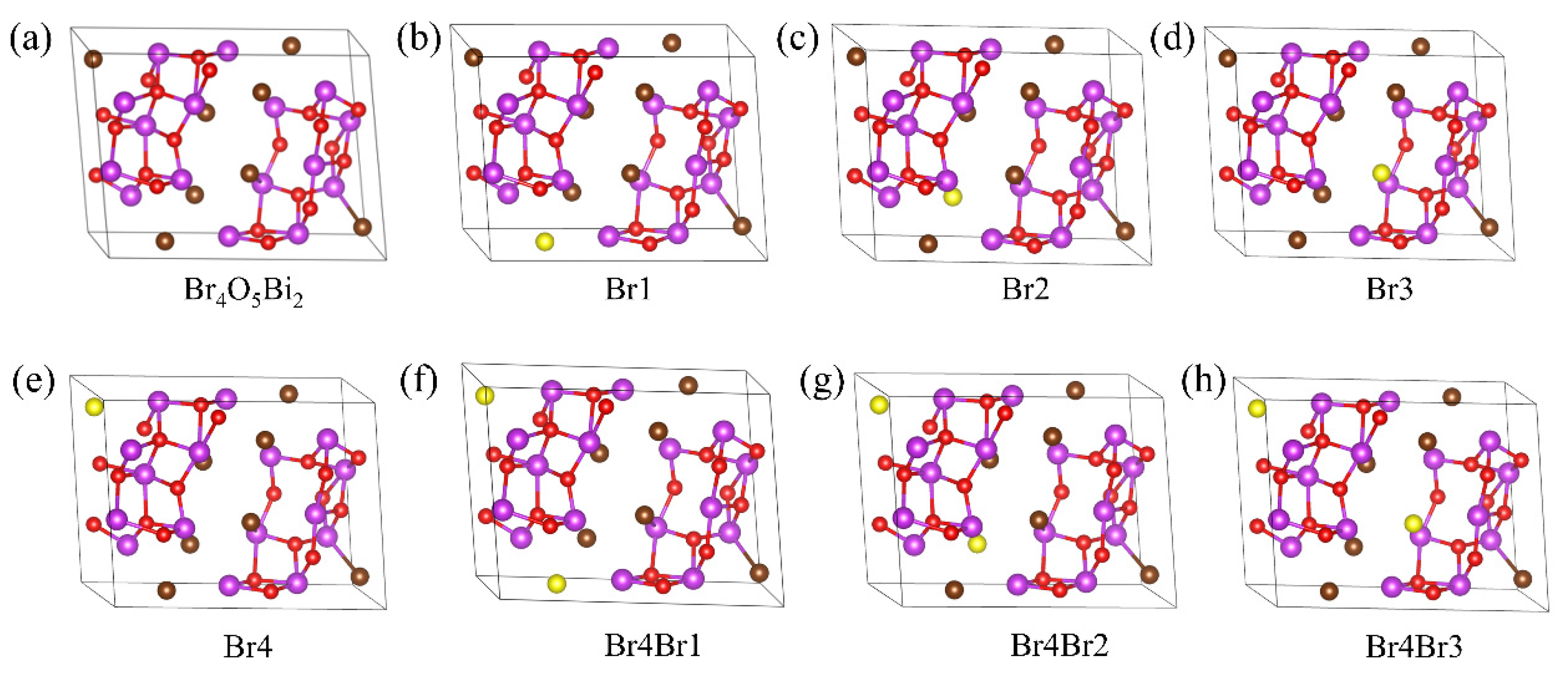
Figure 2.
Energy band structures of (a) Bi₄O₅Br₂ and (b) S-BOB; density of states of (c) Bi₄O₅Br₂ and (d) S-BOB. The Fermi energy level is set to 0.
Figure 2.
Energy band structures of (a) Bi₄O₅Br₂ and (b) S-BOB; density of states of (c) Bi₄O₅Br₂ and (d) S-BOB. The Fermi energy level is set to 0.
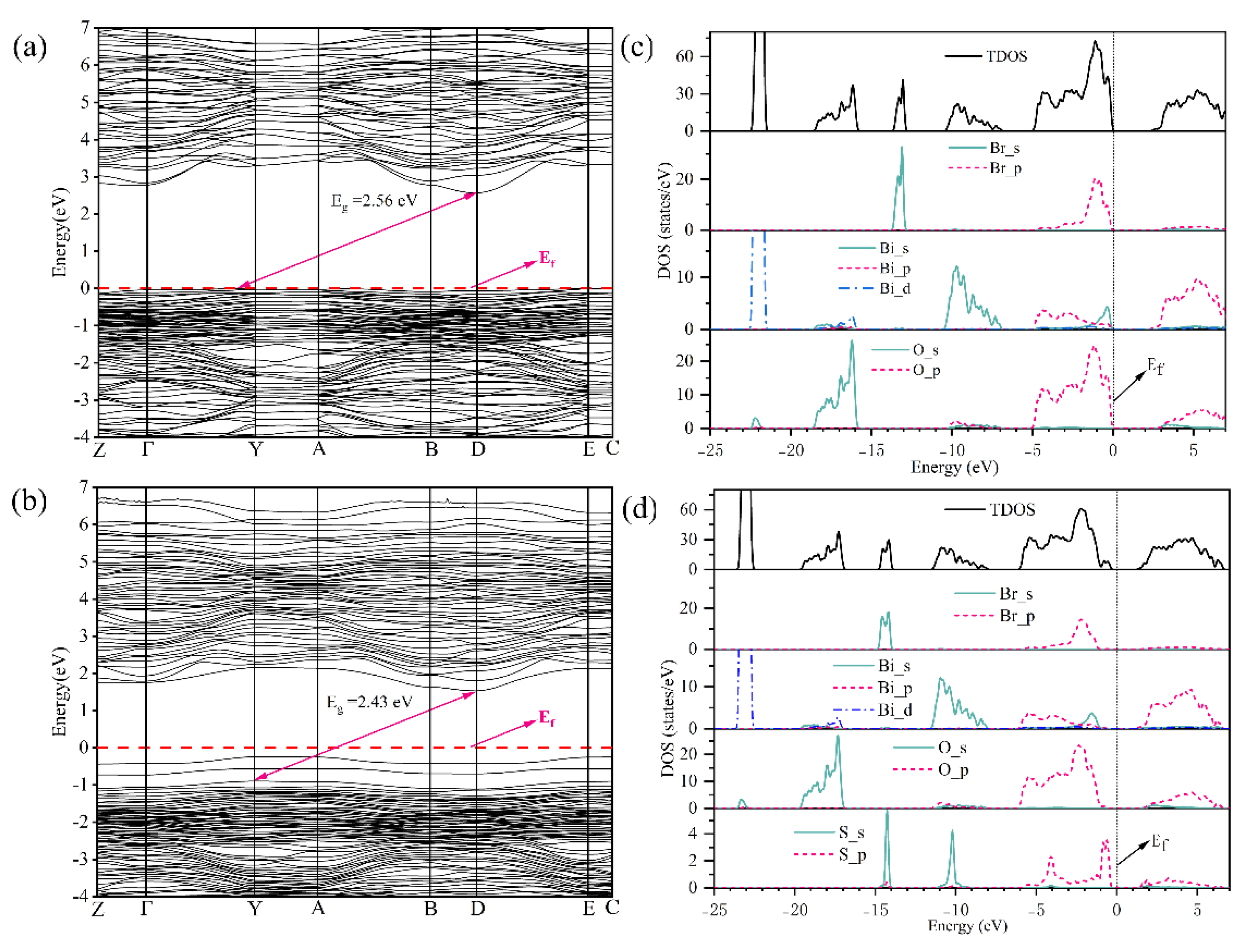
Figure 3.
Differential charge densities of (a) Bi₄O₅Br₂ and (b) S-BOB.
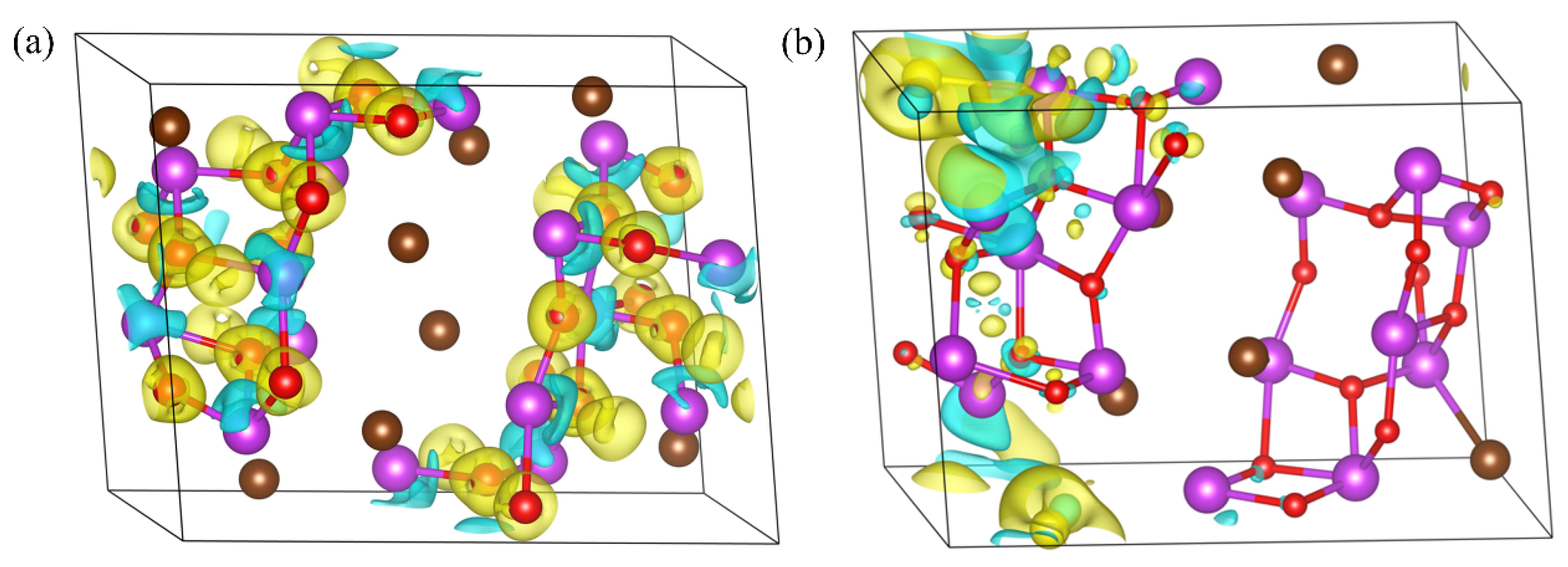
Figure 4.
Electron localization function of (a) Bi4O5Br2 and (b) S-BOB.
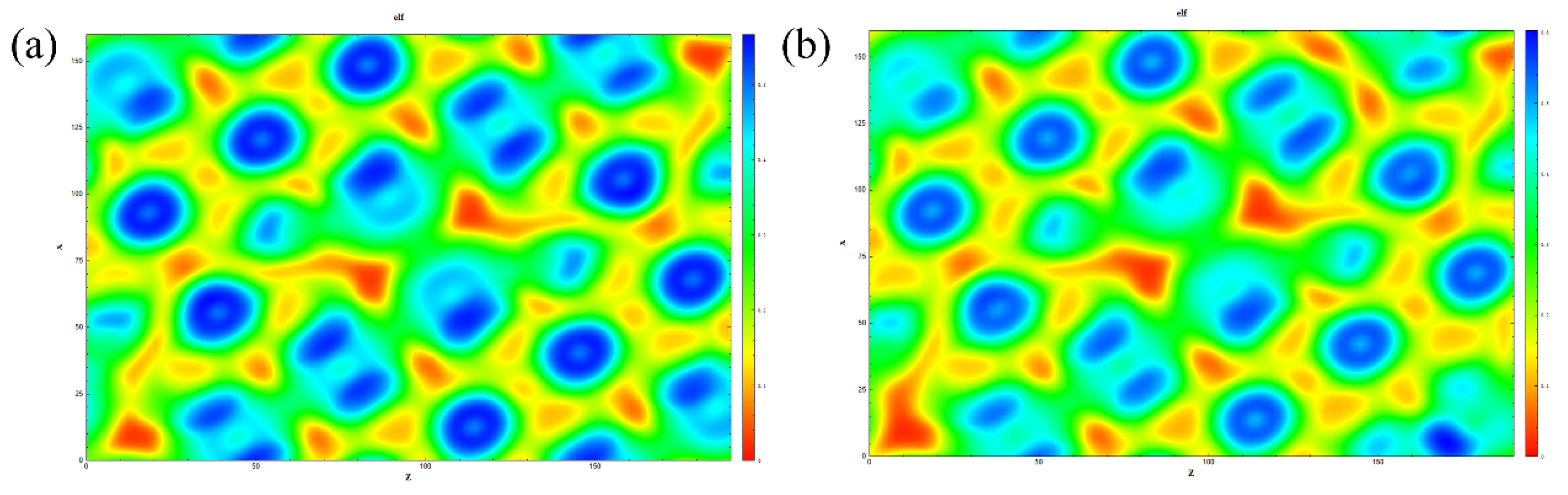
Figure 5.
Absorption spectra of Bi₄O₅Br₂ and S-BOB.
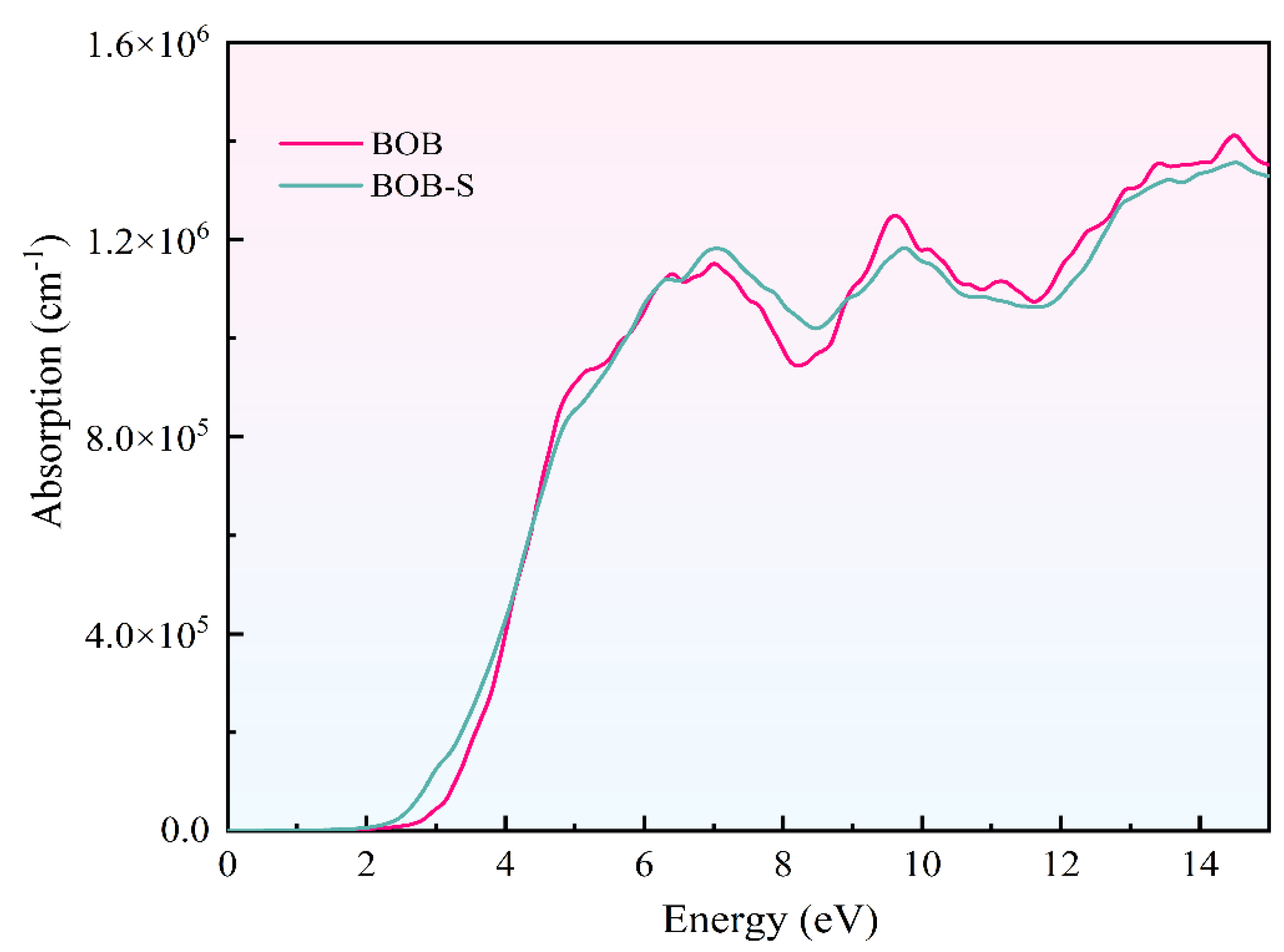
Figure 6.
Dielectric functions of Bi₄O₅Br₂ and S-BOB: (a) real parts and. (b) imaginary parts.
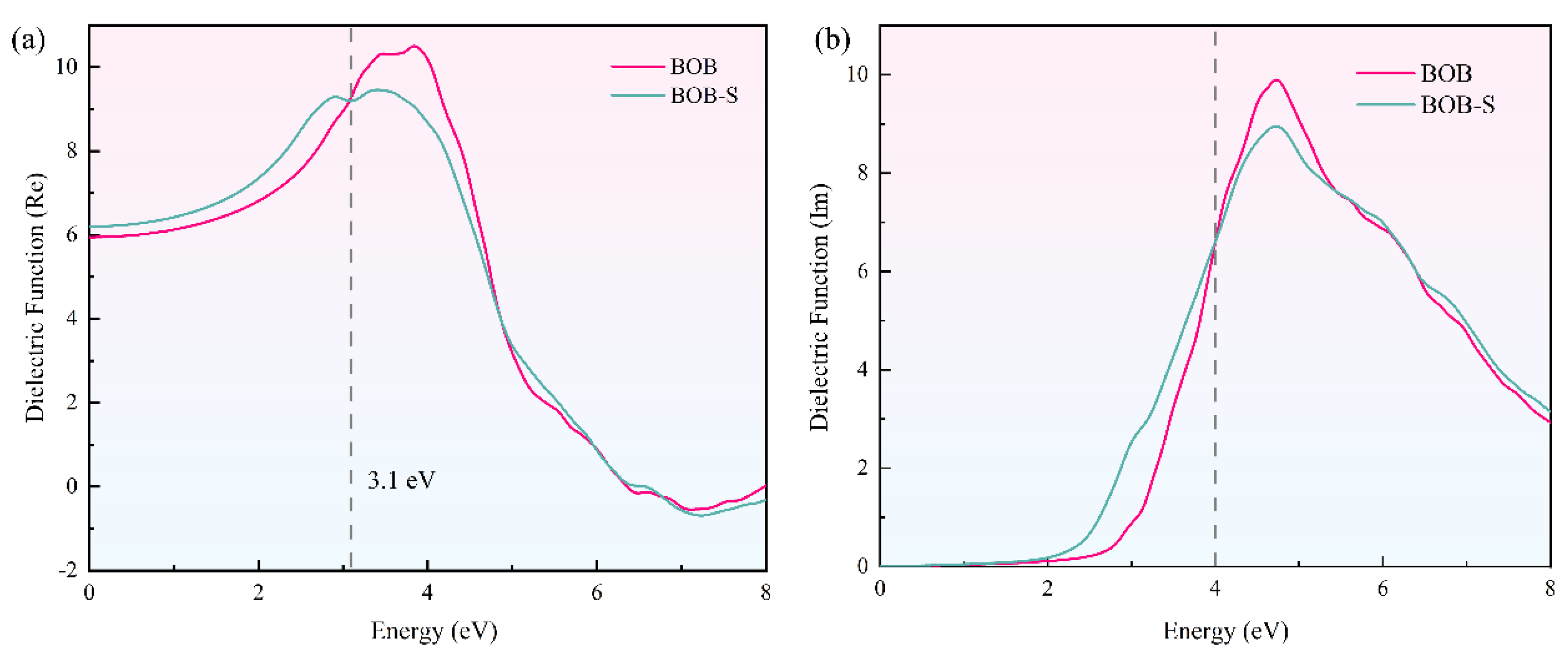

Table 1.
Formation energies of seven different S-BOB models.
| Configuration | Br1 | Br2 | Br3 | Br4 | Br4Br1 | Br4Br2 | Br4Br3 |
| Energy (eV) | 2.72 | 2.73 | 2.74 | 2.62 | 2.53 | 2.98 | 3.23 |
Table 2.
Lattice parameters of Bi₄O₅Br₂ and S-BOB.
| Species | a (Å) | b (Å) | c (Å) | α (°) | β (°) | γ (°) |
| Bi4O5Br2 | 10.89 | 5.67 | 14.60 | 90 | 97.72 | 90 |
| S-BOB | 10.92 | 5.67 | 14.58 | 90.64 | 97.97 | 91.44 |
Disclaimer/Publisher’s Note: The statements, opinions and data contained in all publications are solely those of the individual author(s) and contributor(s) and not of MDPI and/or the editor(s). MDPI and/or the editor(s) disclaim responsibility for any injury to people or property resulting from any ideas, methods, instructions or products referred to in the content. |
© 2024 by the authors. Licensee MDPI, Basel, Switzerland. This article is an open access article distributed under the terms and conditions of the Creative Commons Attribution (CC BY) license (http://creativecommons.org/licenses/by/4.0/).
Copyright: This open access article is published under a Creative Commons CC BY 4.0 license, which permit the free download, distribution, and reuse, provided that the author and preprint are cited in any reuse.


