

Submitted:
28 November 2024
Posted:
02 December 2024
You are already at the latest version
Abstract
This study explores the cultural symbols and design innovation of Taiwanese rice cake molds, known as “Guoyin,” which hold significant cultural and ceremonial value. While previous research has focused on these molds' historical and cultural dimensions, there needs to be more understanding of their contemporary reinterpretation and integration into modern design practices. Employing a qualitative approach, this study utilizes documentary analysis, in-depth interviews with artisans, and case studies to examine the embedded cultural symbols in rice cake molds, their evolution in response to societal changes, and their contemporary reinterpretation in sustainable modern design. The findings reveal that traditional motifs in rice cake molds embody Taiwanese cultural values related to festivals and life rituals, and artisans have adapted these motifs to appeal to modern consumers while maintaining cultural integrity. The study contributes to theories of cultural heritage preservation by demonstrating how traditional crafts can evolve dynamically through adaptation and innovation. It also highlights artisans' challenges in balancing cultural preservation with modern market demands, offering insights into strategies for sustaining this intangible cultural heritage in a contemporary context.
Keywords:
rice cake molds
; cultural symbols
; design innovation
; traditional crafts
; sustainability
1. Introduction
1.1 Historical Background
Taiwanese cultural heritage is deeply rooted in traditions brought by early settlers from Fujian Province during the late Ming and early Qing Dynasties. Among these customs, molds for rice cakes and pastries hold significant cultural and ceremonial value [1]. These molds, collectively known as “Guoyin,” encompass various forms, including rice cake, cake, pastry, and sugar molds (Figure 1). Traditionally used for treats such as red turtle-shaped rice cakes, mooncakes, and wedding cakes, these molds serve culinary purposes and carry cultural symbolism, reflecting societal values, beliefs, and aesthetics [2] (pp. 6–7). Wooden rice cake molds, prized for their durability and intricate designs, are integral to Taiwanese festivals such as the Lunar New Year and the Mid-Autumn Festival. Beyond their practical use, these molds symbolize blessings, prosperity, and longevity [3]. However, industrialization, changing consumer preferences, and an aging artisan population have placed the craft at risk of decline [4].
1.2 Research Context and Gaps
The craft of rice cake molds exemplifies intangible cultural heritage, yet it faces challenges adapting to modern societal, technological, and economic changes. Existing studies primarily focus on the molds’ historical and cultural dimensions [2, 5]. However, there needs to be more exploration of their contemporary reinterpretation, integration into modern design, and contribution to cultural sustainability. Addressing this gap is crucial for understanding how traditional motifs evolve to meet modern consumer preferences while retaining cultural significance. Additionally, exploring how traditional crafts can be leveraged for sustainable practices is necessary for their preservation in an environmentally conscious design context.
1.3 Research Questions and Aim
This study addresses gaps in understanding the cultural and symbolic significance of rice cake molds in Taiwanese society and their integration into sustainable modern design. By exploring these aspects, the research seeks to preserve an essential facet of Taiwanese intangible cultural heritage and examine the potential for traditional crafts to contribute to contemporary, sustainable design. The research questions guiding this study are:
- What cultural symbols are embedded in rice cake molds, and how do they reflect Taiwanese cultural values?
- How has the rice cake mold craft evolved in response to societal, technological, and economic changes, including sustainability considerations?
- In what ways are traditional rice cake mold motifs reinterpreted and incorporated into contemporary design to promote cultural sustainability?
1.4. Research Aim
This research explores Taiwanese rice cake molds’ cultural and symbolic significance, focusing on their historical roots, evolution, and contemporary reinterpretation within sustainable modern design contexts. By investigating how traditional motifs are integrated into current culinary and decorative practices, the study seeks to understand how these molds embody Taiwanese cultural values and how artisans adapt them to meet modern aesthetic, market, and sustainability needs. It also addresses artisans’ challenges, including balancing cultural preservation with innovation, sustaining craftsmanship amidst industrial pressures, and utilizing digital tools for promotion and environmental sustainability. Through documentary analysis, in-depth interviews with artisans, and case studies of contemporary adaptations, the research provides insights into the continued relevance of rice cake molds as a dynamic component of Taiwanese intangible cultural heritage, promoting cultural sustainability in a modern context.
2. Literature Review and Theoretical Framework
The existing literature on Taiwanese rice cake molds provides valuable insights into their cultural, economic, and artistic significance. However, a critical analysis reveals gaps concerning their contemporary reinterpretation and integration into modern design practices. This review synthesizes previous studies, identifies these gaps, and positions the current research to address them.
2.1. Cultural Significance and Cultural Heritage of Rice Cake Molds
Early foundational works, such as Chien [2], delve into the cultural origins and ceremonial importance of Taiwanese rice cake molds, highlighting their role in festivals and life rituals. Guo [5] and Zhang [6] extend this by exploring pastry molds’ artistic value and regional significance in Foshan and southern Fujian, respectively. These studies underscore the molds as carriers of cultural symbolism, reflecting societal values.
However, these works primarily provide descriptive accounts without critically examining how these cultural artifacts adapt to contemporary societal changes. There needs to be more analysis of how modernization and globalization impact the transmission of cultural values through these molds. Moreover, the role of artisans in preserving these traditions amidst evolving cultural landscapes requires further exploration.
2.2. Economic Impact and Sustainability of Rice Cake Molds
Lü [7] and Xie and Luo [4] highlight the economic potential of rice cake molds, emphasizing how branding and strategic communication can promote traditional craftsmanship. Tang [8] introduces the role of social media in preserving and expanding the reach of these crafts.
While recognizing economic benefits, these studies need a more critical assessment of the sustainability of such economic models in the face of industrialization and an aging artisan population [9]. The long-term viability of traditional mold-making in modern economies and strategies for artisans to adapt economically without compromising cultural integrity are underexplored.
2.3. Craftsmanship and Artistic Value of Rice Cake Molds
Li and Zhang [10] and Xie [11] emphasize the meticulous craftsmanship of mold carving, underscoring preservation efforts. Fu [12] and Zhang [6] highlight the unique regional craftsmanship, contributing to appreciating these molds as art forms.
Although these studies celebrate artistic value, they need a more critical examination of how traditional skills can be transmitted to younger generations in an era of declining interest in manual crafts. Strategies to sustain craftsmanship through education and adaptation to contemporary artistic expressions are necessary.
2.4. Symbolism and Design Elements of Rice Cake Molds
Analyses by Du [13] and Wei [14] explore the symbolism of mold patterns, revealing deep cultural meanings and aspirations. Yao [15] applies semiotic theories to understand the origins and significance of these symbols.
However, these studies remain theoretical and fail to connect symbolism to practical applications in sustainable modern design. The opportunity to reinterpret and adapt these traditional symbols to resonate with contemporary audiences still needs to be explored, particularly in the context of sustainable design innovation.
2.5. Regional Characteristics and Evolution of Rice Cake Molds
Zhou [16] and Xie [17, 18, 19] examine regional characteristics influencing mold evolution, highlighting how local cultures shape preservation efforts. Yao [20] discusses modernization strategies in specific regions.
These regional studies provide valuable context but lack a comparative analysis that could identify universal challenges and solutions applicable across different areas. A critical assessment of how regional practices can inform broader strategies for integrating traditional molds into modern design needs to be included.
2.6. Research Gaps in Existing Literature
The existing literature provides a solid foundation on the historical, cultural, and economic aspects of Taiwanese rice cake molds but reveals several gaps:
- Modern Reinterpretation: There is a need for more research on how traditional rice cake mold motifs are reinterpreted in contemporary design contexts. The connection between historical symbolism and modern consumer preferences must be explored.
- Artisan Challenges: Few studies address the practical challenges artisans face in balancing cultural preservation with innovation, particularly concerning technological advancements and market pressures.
- Integration into Modern Design: The potential for traditional motifs to inform and enhance modern design practices has yet to be fully realized, leaving a gap in practical applications and case studies demonstrating successful integration.
- Sustainable Practices and Digital Promotion: The role of sustainable materials and digital platforms in promoting and preserving rice cake mold craftsmanship needs further exploration [21].
2.7. Current Study Contributions
Exploring Cultural Symbols in Contemporary Contexts: Analyzing how the embedded cultural symbols in rice cake molds reflect Taiwanese values today and how they can be preserved amidst societal changes.
- Exploring Cultural Symbols in Contemporary Contexts: Analyzing how the embedded cultural symbols in rice cake molds reflect Taiwanese values today and how they can be preserved amidst societal changes.
- Examining Craft Evolution: Investigating how rice cake mold craftsmanship has evolved in response to technological, economic, and social factors, providing a critical analysis of the adaptation strategies employed by artisans.
- Reinterpreting Traditional Motifs in Modern Design: Presenting case studies where traditional motifs have been successfully incorporated into contemporary design, highlighting methods that maintain cultural integrity while appealing to modern consumers.
- Addressing Artisans’ Challenges: Identifying the practical challenges faced by artisans, such as the aging population and industrialization, and proposing solutions like collaboration, sustainable practices, and digital promotion to ensure the craft’s sustainability.
- Bridging Theory and Practice: Applying theoretical frameworks like semiotics to practical design innovation, demonstrating how traditional symbolism can inform modern design processes and contribute new perspectives to the field.
By addressing these areas, the study offers a comprehensive and critical examination of Taiwanese rice cake molds, contributing to cultural heritage preservation and contemporary design innovation. It provides valuable insights for artisans and cultural institutions seeking to navigate the complex interplay between tradition and modernity.
2.8. Integrated Theoretical Framework
The theoretical framework for this study builds upon semiotic theory, cultural heritage preservation, and design thinking. Semiotic theory provides a foundation for understanding the cultural symbols embedded in Taiwanese rice cake molds, examining how these symbols convey meaning and how their interpretations evolve [22]. Cultural heritage preservation theories emphasize safeguarding intangible cultural assets by adapting them to modern contexts, ensuring their relevance in contemporary society [23]. Design thinking is applied to explore how traditional motifs can be creatively reinterpreted to meet contemporary consumer demands while maintaining cultural integrity [24].
By integrating these theoretical perspectives, the study aims to comprehensively understand how traditional cultural symbols can be preserved and adapted in modern design practices. This approach lays the foundation for exploring the interplay between cultural heritage and contemporary design innovation, offering new perspectives on how traditional crafts can thrive in a rapidly changing world.
3. Materials and Methods
This study employs a qualitative approach to explore Taiwanese rice cake molds’ semiotics and design innovation, emphasizing their cultural significance, historical evolution, and contemporary reinterpretation. The methodology aims to capture the intricate cultural symbols embedded within these traditional crafts and to examine their transformation in the context of sustainable modern design practices. The research process consists of three main stages: documentary analysis, in-depth interviews, and case studies.
3.1. Materials
The materials for this study include historical texts, academic literature, cultural studies, visual representations, and physical artifacts related to Taiwanese rice cake molds. Historical archives, folklore studies, and images from media are analyzed to understand the traditional symbols, motifs, and meanings embedded in these molds. The collection also includes physical examples of molds to support a deeper understanding of their craftsmanship and artistic elements. The materials form the foundation for comprehensively understanding Taiwanese rice cake molds’ cultural and historical context.
3.2. Documentary Analysis
The first stage involves an in-depth analysis of historical texts, academic research, and folklore studies related to Taiwanese rice cake molds. This analysis identifies and categorizes the cultural symbols, motifs, and traditional meanings of these molds. Sources include historical archives, cultural studies, and Taiwanese folk art and crafts literature. The objective is to comprehensively understand rice cake molds’ cultural and historical context and trace their evolution. This stage also examines visual representations of molds in art and media to understand their historical portrayal and interpretation.
3.3. In-depth Interviews
The second stage involves in-depth interviews to gather insights into rice cake molds’ craftsmanship, cultural meanings, and modern applications. Participants are selected based on their expertise and active involvement in preserving and innovating this traditional craft. The interviews focus on conventional motifs’ artistic and symbolic significance, the challenges and opportunities in safeguarding this craft today, and the reinterpretation of these symbols in contemporary design. A semi-structured interview format allows open-ended responses while ensuring that crucial research questions are addressed.
3.4. Case Study Analysis
The final stage involves conducting case studies on the innovation of rice cake mold patterns and shapes in response to societal evolution, commercial applications, and customer demands. These case studies analyze specific examples in which traditional motifs and forms have been creatively adapted to meet contemporary needs while preserving cultural significance. The analysis considers how artisans have modified these conventional elements to reflect modern aesthetics, functionality, and market trends. By examining the processes of innovation and adaptation, this stage highlights successful instances of the evolution of traditional rice cake molds that retain their cultural essence. The insights gained provide valuable guidance for future design practices that balance tradition with innovation.
3.5. Data Collection and Sampling
Data for this study were gathered through documentary analysis, in-depth interviews, and case studies. Interview participants were purposively selected to provide diverse perspectives based on their expertise in preservation, innovation, and the cultural significance of Taiwanese rice cake molds. The sample included artisans with decades of experience, folk art researchers, cake and pastry producers, and artisan apprentices involved in learning and innovating traditional crafting techniques. This diverse group comprehensively understands traditional craftsmanship, cultural meanings, and modern design applications associated with rice cake molds. Case studies were selected based on their relevance to the research questions, focusing on examples demonstrating significant innovation in rice cake mold patterns and shapes. Documentary sources were chosen for their significance to rice cake molds’ cultural history and symbolism.
3.6. Ethical Considerations
Given the cultural sensitivity of the subject matter, ethical considerations were rigorously observed throughout the research process. Informed consent was obtained from all interview participants, ensuring they were fully aware of the research objectives and the intended use of their contributions. The study adhered to ethical guidelines for handling cultural artifacts and respected the intellectual property rights of artisans.
By employing these methods, the study offers a comprehensive and nuanced exploration of Taiwanese rice cake molds’ semiotics and design innovation. This research contributes valuable insights into preserving cultural heritage and informs contemporary design practices that balance tradition with innovation.
4. Results
This section presents the findings from the qualitative exploration of Taiwanese rice cake molds, focusing on the cultural symbols embedded in them, their representation of Taiwanese cultural values, and their adaptation across various cultural contexts.
4.1. Cultural Symbols in Rice Cake Molds
This subsection explores the primary symbols and their meanings embedded in Taiwanese rice cake molds, highlighting how these motifs reflect Taiwanese cultural values, particularly during festivals and life rituals.
4.1.1. Primary Symbols and Their Meanings
Artisans balance symbolic patterns with carving techniques, focusing on composition, harmony, and unity. They select motifs reflecting cultural themes and execute precise carvings highlighting creativity and unique layouts. The motifs on rice cake molds are vivid yet simple, balancing solid and empty spaces [25] (p. 12). These symbols can be categorized as follows:
- Natural themes: animals, plants, objects, celestial phenomena, etc.
- Life rituals: marriage, birthdays, civil service exams, religious ceremonies, etc.
- Social and literary references: customs, mythology, religious beliefs, puns, etc.
- Auspicious meanings: blessings, protection, moral guidance, humor, etc. [26] (pp. 11–12).
Examples of traditional motifs and their meanings are summarized in Table 1. Different molds are paired with specific patterns based on their themes, such as turtle and peach patterns for rice cake molds, fish for cake molds, and dragon and phoenix motifs for pastry molds. Modern molds have adopted cartoon and three-dimensional designs to appeal to contemporary consumers.
4.1.2. Reflection of Taiwanese Cultural Values
Major traditional festivals in Taiwan include the Lunar New Year, Lantern Festival, Tomb-Sweeping Day, Dragon Boat Festival, Ghost Festival, and Mid-Autumn Festival. Significant life rituals encompass weddings, childbirth, and longevity celebrations. The motifs on rice cake molds reflect the cultural values embedded in these festivals and life rituals, serving both decorative and symbolic purposes that embody wishes for blessings, wealth, and longevity. The cultural sentiments conveyed through specific motifs in traditional rice cakes during these occasions are summarized below (Figure 2).
4.1.2.1. Rice Cake Molds and Festival Celebrations
- Lunar New Year: From the first to the fifth day of the Lunar New Year, Taiwanese people worship gods and ancestors, praying for good fortune in the coming year. Traditional cakes include “gold and silver nuggets” and “ingot cakes.” “Gold and silver nuggets” are small cakes shaped like fragments of gold and silver, with white representing gold and red representing silver, symbolizing “abundant wealth.” Ingot cakes are stacked in layers, symbolizing gold and silver ingots and conveying wishes for continuous success year after year [27].
- Lantern Festival: Taiwanese people enjoy glutinous rice balls and lantern displays during the Lantern Festival, accompanied by various celebrations. Historically, releasing sky lanterns symbolized wishes for safety and offspring. Today, this remains a significant Lantern Festival activity in northern Taiwan, with cake and pastry producers offering cakes shaped like sky lanterns. In southern Taiwan, the folk activity “Begging for Turtles,” originally from Quanzhou, Fujian, involves praying for peace. Temples prepare turtle-shaped offerings, such as rice turtle cakes, for worshippers [28] (pp. 129-130).
- Tomb-Sweeping Day: Customs on Tomb-Sweeping Day, including tomb sweeping and ancestor worship, originate from the Cold Food Festival. Traditional foods include spring rolls, red turtle-shaped cakes, and cudweed rice cakes. “Green turtle-shaped cakes” are used for new tombs as a gesture of remembrance, while “red turtle-shaped cakes” are used to wish ancestors longevity and prosperity [29] (p. 21).
- Dragon Boat Festival: People eat mung bean cakes and zongzi during the Dragon Boat Festival, which falls between the Grain in Ear and the Summer Solstice [30] (p. 117). The word “cake” (Gao) is a homophone for “high,” in Chinese, symbolizing success. Cake and pastry producers shape mung bean cakes like zongzi, calling them “Bao Gao Zong,” a homophone for “guaranteeing exam success,” offering blessings to students.
- Ghost Festival: During the Ghost Festival, temples hold “Universal Salvation” rituals to pray for peace and eliminate disasters. Offerings include traditional “three sacrifices” of chicken, pork, fish, fruits, and snacks. For those who prefer a vegetarian lifestyle, the sacrifices are replaced with alternatives shaped from tofu, konjac, or cakes [31] (p. 81).
- Mid-Autumn Festival: The Mid-Autumn Festival features moon-gazing, barbecues, and enjoying mooncakes. Bakeries prepare molds for mooncake production, often using custom or large stock molds, such as those featuring rabbits and traditional mooncake designs [32] (p. 191).
The desire for a good life and pursuit of happiness is expressed through mold patterns, making rice cake molds a medium for human hopes and a bridge to the divine.
4.1.2.2. Rice Cake Molds and Life Rituals
- Marriage: A betrothal ceremony typically precedes traditional weddings, during which the groom’s family presents betrothal gifts to the bride’s family, including the wedding pastry. This pastry, often featuring dragon and phoenix motifs, symbolizes marital harmony [29] (p. 14). Modern variations may include Western wedding elements, such as portraits of the couple, reflecting the evolving cultural expressions of marriage.
- Childbirth: In early society, celebrating the birth of a son involved making a “newborn ban” and distributing it as a sign of celebration [33] (p. 760). With advancing gender equality, modern families celebrate daughters’ birth with a “red peach-shaped ban.” Both cakes are inscribed with auspicious characters wishing “fortune, prosperity, and longevity.”
- Longevity Celebrations: Birthdays for those over 50 are celebrated with traditional foods like red eggs, red turtle-shaped rice cakes, longevity peaches, and pork trotters with fine noodles [34] (p. 110), along with the “Fortune, Prosperity, and Longevity Cake,” which represents blessings for health and abundance.
4.2 Evolution of Rice Cake Mold Craft
This subsection explores the evolution of Taiwanese rice cake molds’ structural and design features, highlighting changes in craftsmanship and adaptations made in response to societal and cultural influences.
4.2.1. Development of Structural and Design Features
Taiwanese rice cake molds have evolved in various forms without adhering to fixed styles or combinations. Structurally, they may have handles or be handleless, with carvings on one or multiple sides. Their shapes include cup, barrel, square, rectangular, and other forms [2] (p. 11), [26] (pp. 71–77). Some molds feature a detachable cover, a unique characteristic of Taiwanese molds. These covers are used on single-sided or double-sided molds to shape thicker pastries and are often paired with handled rectangular molds [2] (p. 14). The shape of the cover window aligns with the motif; for example, turtle motifs often have an oval window, while peach motifs typically have a peach-shaped window [35] (p. 75).
Cake and pastry molds share structural similarities but differ in carving techniques, and they are often interchangeable in use. Variations include handled and handleless molds, with carvings featuring single or multiple recesses in the same or different designs. Some molds consist of two or three pieces and come in various shapes, such as cup, barrel, square, rectangular, and elongated rectangular (Figure 3) [26] (pp. 78–83), [35] (pp. 77–87). The elongated rectangular molds are narrower versions of rectangular molds, often featuring a single row of multiple recesses.
4.2.2. Modern Adaptations and Craftsmanship Techniques
4.2.2.1. Selection and Treatment of Materials for Rice Cake Molds
- Local Material Selection: Fruitwood is preferred for making rice cake molds [36] (pp. 19–20). Common types in Taiwan include camphor wood, ironwood, phoebe wood, small-leaf phoebe wood, and Taiwan red cypress, with camphor wood being the most commonly used [2] (p. 9). Artisans believe using locally sourced timber strengthens the connection to traditional craftsmanship and supports sustainable local resource use.
- Understanding Wood Characteristics: Cake and pastry molds must endure repeated tapping to facilitate easy cake removal, making durability a key factor in material selection. Camphor wood, known for its fine grain, is resilient, lightweight, and resistant to breaking or cracking. Ironwood and phoebe wood are also suitable, given their straight grain and strength, while camphor wood’s interwoven grain structure provides added durability.
- Air-Drying the Wood: After purchasing raw wood, it is cut into similarly sized pieces and stacked with small blocks between each piece to allow airflow, preventing decay. The wood is left to air-dry indoors for over a year to remove residual moisture, which prevents warping and ensures stability and durability, reducing the risk of future cracking.
4.2.2.2 Mold-Making Process
The process of making rice cake molds is summarized as follows:
- Sampling: Plan the mold’s weight, size, and thickness; trace the shape onto the wood using a template, and cut out the outer shape with a jigsaw.
- Sanding the Wood: Smooth the surface with a hand planer, then use an automatic planer to ensure a flat and even thickness for easier pastry-making.
- Carving the Mold: A machine will drill into the mold’s center, creating the desired depth and main design shape.
- Trimming and Drilling: Trim the mold’s edges and handle to add chamfers, enhancing aesthetics and grip. For pastry molds, drill a vent hole on the side to aid in mold release.
- Design Sampling: There are two types of sampling: “standard” and “custom.” Standard designs follow set specifications, making them easier to carve. Custom designs are based on sketches, with carving routes drawn before sculpting, making them more intricate and challenging.
- Decorative Carving: Sculpt the main pattern and refine fine lines using the intaglio carving technique, adding decorative patterns to enrich the design.
- Sanding and Polishing: Use fine sandpaper or a sanding wheel to polish the mold, creating a smooth surface for pastry-making.
4.2.2.3. Carving Techniques and Applications
Carving details must consider the baking and operational needs of cakes or pastries.
- Rice Cake Molds: Carvings on rice cake molds are generally shallower than pastry molds. The central design is typically carved deeper, with shallower surrounding patterns. The carvings are usually deeper if the mold has drilled holes or an added frame cover.
- Pastry Molds: Pastry molds are carved at a 90-degree angle, with deeper lines to prevent blurring during baking. A vent hole is drilled on the side for smaller Mid-Autumn Festival molds to facilitate mold release.
- Cake Molds: Cake molds are designed to be wider at the top and narrower at the bottom to facilitate easy removal during tapping. If the mold is narrower at the top, cakes may stick inside, making removal difficult.
- Pre-Treatment for Use: Rice cake molds are soaked in edible vegetable oil for seven days before initial use. The oil fills the wood’s pores, forming a protective layer that aids in long-term preservation and helps prevent sticking during cake-making.
4.2.3 Influences on Craft Evolution
Several factors have significantly influenced the evolution of Taiwanese rice cake molds, including changes in design and production processes. Based on interviews with artisans, folk art researchers, cake and pastry producers, and apprentices, the following factors have been identified as key drivers in the transformation and modernization of this traditional craft.
4.2.3.1. Technological Advancements
Artisans note that introducing modern carving tools, such as electric drills and laser cutters, has dramatically improved rice cake molds’ production speed and precision. Hand-carving once required extensive time and skill, but newer technologies allow artisans to create more efficient intricate designs. However, this shift raises concerns about the potential loss of traditional hand-carving techniques, a crucial aspect of cultural heritage. Therefore, some artisans advocate balancing modern tools with conventional methods to preserve the craft’s essence.
4.2.3.2. Economic Pressures and Market Demands
Cake and pastry producers frequently note the rising demand for customization and mass production driven by tourism and the culinary industries. Custom molds for events like weddings, festivals, and corporate branding have become popular, with clients seeking designs that reflect modern tastes. This trend has increased demand for molds featuring contemporary symbols, such as cartoon characters or logos, rather than traditional motifs. To meet this demand, artisans must adapt their designs while preserving traditional craftsmanship elements, creating challenges and opportunities for the craft’s evolution.
4.2.3.3. Cultural Preservation and Heritage Advocacy
Folk art researchers note an increased awareness of cultural preservation efforts in recent years. Government programs and non-profits have launched initiatives to protect intangible cultural heritage, including traditional Taiwanese crafts like rice cake mold carving. These programs provide financial support, organize exhibitions, and raise public awareness of rice cake molds’ historical and cultural significance. However, many artisans express concerns about the sustainability of these efforts as the aging artisan population declines, with few younger apprentices taking up the craft. This situation highlights the importance of education and outreach to preserve the craft for future generations.
4.2.3.4. Globalization and Design Innovation
Artisans highlight the influence of globalization in merging traditional Taiwanese designs with contemporary global aesthetics. International collaborations and exposure to global design trends have encouraged Taiwanese artisans to experiment with new motifs, materials, and shapes. For example, some artisans incorporate sustainable materials or combine various artistic traditions, such as Japanese or Western elements, into their rice cake molds. This blend of influences helps the craft stay relevant in a rapidly changing market and challenges artisans to maintain the cultural integrity of traditional designs.
4.2.3.5. Environmental and Material Concerns
The selection and availability of wood materials have also impacted the evolution of rice cake molds. Artisans note that environmental issues, such as deforestation and the sustainability of certain wood species, have led to a growing interest in using sustainable or reclaimed wood [37]. These materials offer environmentally friendly alternatives while maintaining the durability needed for rice cake molds. Some artisans are now exploring alternative materials, such as metal or synthetic composites, to meet modern manufacturing needs and reduce the environmental impact of traditional wood carving.
4.2.3.6. Educational and Apprenticeship Challenges
Apprenticeships are critical in passing down rice cake mold craftsmanship, but this tradition is under significant strain. Artisans observe that younger generations often prefer faster, technology-driven careers that require less long-term commitment than traditional apprenticeships. As a result, fewer young artisans are learning the intricate techniques essential to sustaining the craft. However, there is renewed interest in vocational training programs and workshops, particularly for hobbyists and cultural enthusiasts, which offer potential pathways to engage younger people in the craft.
In summary, technological, economic, cultural, and environmental factors influence the evolution of Taiwanese rice cake molds. Although modern advancements provide new opportunities for innovation, there remains a concern about preserving traditional techniques and cultural symbols. The future of rice cake mold craftsmanship will rely on balancing adopting modern tools and market demands with protecting the cultural and artistic heritage within the craft.
4.3. Contemporary Reinterpretation of Traditional Motifs
The contemporary reinterpretation of traditional rice cake mold motifs reflects a dynamic balance between cultural preservation and modern innovation. As Taiwanese society evolves, artisans find new ways to integrate these historic symbols into contemporary design practices. This section explores how traditional motifs are adapted in modern contexts, with case studies and examples of successful innovations that retain cultural integrity.
4.3.1. Collaborative Innovations in Contemporary Design
Blending traditional motifs with modern design principles has opened new opportunities for using rice cake mold patterns. Artisans collaborate with enterprises, brands, and restaurants to create products that preserve cultural heritage while appealing to modern consumers. These efforts include crafting molds that promote local agricultural and fishery products and express modern themes related to interests, emotions, and beliefs (Figure 4).
4.3.1.1. Brand Partnerships Integrating Traditional Symbols
- Collaborations with Culinary Brands for Signature Pastries
Artisans are partnering with culinary brands and corporations to create signature pastries that blend traditional mold-making techniques with modern branding. By incorporating corporate logos or brand imagery into conventional designs, these collaborations produce unique products that enhance brand recognition while honoring cultural heritage. This synergy between brands and artisans preserves traditional craftsmanship and presents it in a form that resonates with today’s consumers.
- 2.
- Promoting Modern Themes and Emotional Connections
Artisans design rice cake molds highlighting local agricultural and seafood products and personal interests and emotions to reflect contemporary societal themes and foster emotional resonance. Collaborations with local farming and fishery organizations lead to pastries featuring motifs of regional fruits, vegetables, and seafood specialties, raising awareness of Taiwan’s rich resources. Additionally, molds depicting pets or popular culture icons allow customers to celebrate their passions and personal connections. These designs maintain traditional carving techniques while appealing to modern consumers seeking deeper emotional engagement with their products.
4.3.1.2. Key Factors in Maintaining Cultural Integrity Through Innovation
The successful adaptation of traditional rice cake mold motifs in contemporary design relies on several key factors that help preserve cultural integrity while embracing innovation.
- Deep Understanding of Cultural Symbols
Artisans with a profound grasp of traditional motifs’ historical significance and symbolism can reinterpret them meaningfully. Respecting the original context ensures adaptations retain the essence of these cultural symbols.
- 2.
- Balancing Tradition and Modernity
Striking a balance between traditional craftsmanship and modern design is crucial. Simplifying or stylizing traditional patterns to align with contemporary aesthetics while preserving their symbolic meanings makes the motifs accessible to modern audiences without losing their cultural roots.
- 3.
- Collaborative Partnerships
Collaborations between artisans and commercial entities facilitate the exchange of ideas and resources, leading to culturally significant, visually appealing, and commercially viable products. Partnerships enable artisans to reach broader audiences and adapt their crafts to new contexts.
- 4.
- Focus on Quality and Craftsmanship
Maintaining high standards of quality in materials and craftsmanship honors the tradition of rice cake mold carving. Consumers value authenticity and are drawn to products showcasing genuine artisanal skills.
- 5.
- Responsiveness to Market Trends
Understanding and responding to current market trends helps artisans keep their work relevant. They connect traditional motifs with contemporary consumer interests by incorporating themes like sustainability, personalization, or wellness.
- 6.
- Educational and Cultural Storytelling
Providing context and storytelling around the motifs enhances consumer appreciation. Including explanations of cultural significance deepens the connection between consumers and the heritage embodied in the designs.
4.3.2 Integration into Modern Design Practices
Integrating traditional wood-carved motifs from Taiwanese rice cake molds into modern design practices bridges Taiwanese folk heritage with the evolving demands of contemporary society. This section explores how these symbolic elements are adapted to meet contemporary consumer needs and market trends in modern rice cake production, evaluating the challenges and opportunities that arise from these efforts.
4.3.2.1 Adaptation of Traditional Symbols to Modern Consumer Needs
Artisans are finding innovative ways to incorporate traditional motifs into modern rice cake products, balancing cultural heritage with contemporary aesthetics and consumer preferences.
- Preservation and Adaptation of Traditional Motifs
Traditional motifs such as the turtle (symbolizing longevity) and the peach (representing prosperity and health) play significant roles in festive rice cakes for events like the Lunar New Year and the Mid-Autumn Festival. By retaining these symbols, artisans maintain the cultural significance of rice cakes as offerings and tokens of goodwill.
To appeal to modern aesthetic preferences, artisans are also modifying these motifs. Intricate designs are sometimes simplified or stylized to create sleek, minimalist representations that resonate with younger audiences. For example, detailed dragon and phoenix motifs may be rendered more abstractly, focusing on essential lines and shapes while retaining their symbolic meaning. This approach allows the craft to evolve without losing its cultural depth, ensuring that traditional designs remain relevant in a modern context.
- 2.
- Market-Oriented Innovations
Artisans and bakeries are introducing innovative products that combine traditional motifs with contemporary trends, responding to market demands.
- Limited Edition and Thematic Products
Artisans and bakeries increasingly create limited-edition rice cakes featuring traditional motifs to commemorate cultural events or celebrations. By emphasizing each design’s uniqueness, they highlight the artistic value of their work, fostering exclusivity and attracting consumers eager to experience authentic cultural practices. For instance, sky lantern-shaped rice cakes are crafted during the Lantern Festival, blending traditional molds with modern calligraphy or additional festive motifs. These unique offerings provide a contemporary twist on cultural classics.
- Fusion of Traditional Patterns with Flavor Innovations
Incorporating traditional patterns into modern rice cake designs has been paired with flavor innovations, offering consumers fresh experiences. Bakeries explore new flavors like matcha, black sesame, and other trendy ingredients while retaining traditional patterns like linked coins or lotus flowers. Combining familiar visual symbolism with novel tastes appeals to younger generations seeking cultural continuity and novelty. By integrating cultural motifs with new flavors, artisans help maintain the relevance of traditional rice cakes in modern markets.
4.3.2.2. Challenges and Opportunities in Modern Integration
While adapting traditional motifs into modern design practices has been met with positive responses, several challenges and opportunities arise.
- Scalability and Preservation of Craftsmanship
A significant challenge is balancing the scalability required for modern production with preserving traditional craftsmanship. Handmade molds require considerable time and skill, limiting the ability to meet high consumer demand during peak seasons. Some bakeries have adopted machine-made molds to increase efficiency; however, these often need more delicate, intricate details of handcrafted versions. Finding ways to scale production without compromising artisanal quality remains a complex issue in the industry.
- 2.
- Effective Communication of Cultural Significance
Not all consumers know traditional motifs’ symbolic meanings and historical contexts. This gap can diminish the cultural impact of the products. To address this, artisans incorporate educational elements, such as informational cards or packaging, that explain each motif’s cultural and historical significance. This approach enhances consumer appreciation and strengthens the connection to Taiwanese cultural heritage, turning each purchase into an opportunity for cultural education.
- 3.
- Navigating Consumer Preferences
Preferences vary among consumers regarding the level of detail and abstraction in designs. While some favor simplified motifs that align with modern minimalist aesthetics, others feel that such simplifications may reduce the depth and character of the original carvings. Artisans must navigate these preferences to create designs that honor tradition while appealing to diverse consumer tastes.
- 4.
- Commercial Viability and Cultural Preservation
Integrating traditional motifs into modern products can promote cultural preservation and commercial success. Products that showcase authentic craftsmanship and cultural significance offer a competitive advantage over mass-produced alternatives, especially during cultural festivals when demand for such items is high. Consumers often pay a premium for products that embody genuine artisanal skills and cultural heritage. Artisans and businesses can leverage this willingness to support the sustainability of traditional crafts in the modern economy.
4.3.3. Challenges and Future Opportunities
Balancing cultural authenticity with innovation presents challenges and opportunities for artisans working with Taiwanese rice cake molds. Preserving the deep cultural meanings embedded in traditional motifs while adapting to contemporary tastes requires careful decision-making to maintain cultural integrity without compromising artistic evolution.
4.3.3.1 Navigating Tradition and Innovation
Artisans must thoughtfully adapt traditional designs to appeal to modern consumers without diminishing their symbolic significance. Simplifying intricate motifs can make them more accessible to younger audiences, but excessive simplification may result in losing meaningful details. The challenge lies in retaining essential elements of the original designs while introducing stylistic changes that resonate with contemporary aesthetics.
There is also the risk of over-commercialization, where increasing demand for culturally themed products might lead to commodifying traditional symbols. Artisans need to ensure that their work respects the cultural context of these motifs, using them to convey authentic cultural values rather than merely serving as marketing tools.
4.3.3.2 Future Directions in Design Practices
Despite these challenges, several promising avenues can help artisans sustain and evolve the craft:
- Collaboration with Cultural Institutions
Partnering with museums, heritage centers, and cultural organizations allows artisans to showcase their work in settings emphasizing education and preservation. Such collaborations can raise public awareness of rice cake molds’ historical and cultural significance, providing platforms for artisans to share their craft with wider audiences.
- 2.
- Educational Initiatives
Engaging in educational programs helps pass on the skills and knowledge of rice cake mold carving to future generations. Workshops and courses offered through schools and community centers can foster an appreciation for the craft and ensure its continuity.
- 3.
- Expanding Product Applications
Exploring new applications for traditional motifs can broaden the appeal of rice cake molds. Artisans might create molds for other traditional Taiwanese snacks or draw inspiration from the designs to produce decorative items and accessories. By extending these motifs, artisans introduce them to new contexts while maintaining their cultural significance.
- 4.
- Storytelling and Cultural Branding
Incorporating storytelling into branding and marketing enhances consumer engagement and appreciation. By conveying the cultural stories and historical contexts behind the motifs, artisans add value to their products and strengthen the connection between consumers and Taiwanese heritage. This approach differentiates artisanal products from mass-produced alternatives and appeals to consumers who value authenticity and craftsmanship.
- 5.
- Embracing Sustainability
Using sustainably sourced or reclaimed materials aligns the craft with environmental values and appeals to eco-conscious consumers. This practice reinforces the relationship between cultural heritage and the natural environment, highlighting the role of sustainability in preserving both cultural and natural resources [37].
- 6.
- Leveraging Digital Platforms
Utilizing digital platforms for promotion and sales can increase the visibility of rice cake mold artisans. An online presence allows artisans to reach wider audiences, share their stories, and connect with consumers interested in cultural heritage. Digital tools enhance the promotion of the craft and help attract new customers without compromising the traditional essence of the work.
In summary, while the balance between cultural authenticity and innovation presents challenges, it also opens up opportunities for growth and sustainability. By embracing collaboration, education, sustainability practices, and digital promotion, artisans can ensure that the traditional craft of rice cake mold carving continues to thrive, preserving its cultural significance while adapting to contemporary demands.
5. Discussion
The findings reveal Taiwanese rice cake molds’ cultural richness and evolving significance, underscoring their value as traditional culinary tools and cultural symbols. These motifs embody aspirations for health, prosperity, and familial harmony within Taiwanese society. This section further explores these themes by examining artisans’ cultural and economic challenges, the balance between tradition and innovation, and strategies for preserving this valued craft in a modern context.
5.1. Theoretical Contributions and Academic Significance
This study makes several significant theoretical contributions to cultural heritage preservation and modern design. By examining the adaptation of traditional Taiwanese rice cake molds within contemporary contexts, this research extends existing theories on cultural heritage and intangible cultural assets. Specifically, the findings contribute to understanding how traditional crafts can be preserved while adapting to modern consumer needs, offering a nuanced perspective on the relationship between cultural authenticity and innovation.
First, the study builds upon cultural heritage theories by demonstrating that preservation and innovation coexist harmoniously rather than mutually exclusive. The findings support the theoretical perspective that cultural preservation can occur dynamically through adaptation and reinterpretation rather than merely through conservation [38]. This challenges traditional views that regard preservation and innovation as opposing forces. It suggests sustainable heritage practices involve an ongoing dialogue between tradition and modernity.
Second, the research provides empirical evidence to support the application of design thinking within cultural heritage. It highlights how artisans leverage design principles to balance aesthetic qualities, cultural meaning, and functional requirements. This approach aligns with recent studies advocating for integrating design thinking into heritage preservation as a tool for innovation [39]. The empirical findings illustrate how artisans actively reinterpret cultural symbols, ensuring the craft’s continued relevance while maintaining artistic integrity.
Third, the findings extend theories of cultural semiotics by exploring how traditional symbols embedded in rice cake molds are recontextualized in a modern consumer landscape. Semiotic theory suggests that cultural symbols evolve as they are used in different contexts, and this research provides concrete examples of such evolution [40] (p. 87). This study demonstrates how artisans adapt motifs for new purposes, such as brand collaborations and social awareness campaigns. It shows how cultural symbols can maintain their significance even as their applications evolve.
Moreover, the study challenges existing literature that predominantly focuses on the economic commodification of traditional crafts, emphasizing the symbolic and cultural value these crafts bring to local and global audiences. This broader perspective aligns with recent critiques in cultural economics that argue for recognizing cultural products as more than economic commodities [41] (p. 175). The findings highlight that through cultural storytelling and the adaptation of motifs, artisans add layers of value that extend beyond mere market value, enhancing consumer engagement with cultural heritage.
5.2. Balancing Cultural Preservation and Modern Adaptation
A key theme emerging from this study is the challenge of balancing cultural preservation with modern adaptation. While traditional rice cake molds are deeply rooted in Taiwanese culture, there is a growing need to make them relevant to contemporary consumers. The study reveals that artisans increasingly integrate modern motifs, such as cartoon characters or personalized designs, to appeal to younger audiences and meet current market demands. However, such adaptations risk diluting the craft’s cultural authenticity and raise concerns about preserving its original significance.
To address this challenge, the role of artisans is crucial. They must navigate the fine line between preserving traditional symbolism and embracing new trends. This discussion highlights the importance of retaining cultural context and storytelling when modifying traditional motifs. By doing so, artisans can ensure that reinterpretations maintain their connection to the original cultural meanings. This approach can enhance consumer appreciation for the craft by emphasizing the stories and values embedded in the designs.
5.3. Economic Viability and Craftsmanship Sustainability
Ensuring the economic viability of rice cake molds is essential for the craft’s sustainability. Financial pressures have increased, primarily due to competition and the decline in traditional artisans. While customization and mass production driven by the tourism and culinary industries create economic opportunities, they also challenge traditional craftsmanship. The shift to modern tools may improve efficiency, but risks diminishing artisanal skills passed down through generations.
The discussion suggests that economic viability could be enhanced by positioning rice cake molds as premium cultural products that embody craftsmanship and cultural heritage. Collaborations with cultural institutions, culinary brands, and government initiatives can help sustain the craft by creating new economic opportunities for artisans. These collaborations support artisans in reaching broader audiences and gaining recognition for their skills, thereby ensuring the craft’s sustainability.
5.4. Innovation and Design Integration
Integrating traditional motifs into modern design applications is essential. The study shows that artisans have successfully adapted traditional symbols in contemporary culinary, decorative, and corporate branding contexts. This success relies on artisans’ deep understanding of cultural symbols, ability to balance tradition with modernity, and use of storytelling to connect with consumers.
The discussion emphasizes that collaboration between artisans and commercial entities has been instrumental in creating culturally significant and commercially viable products. The integration of storytelling and cultural branding enhances consumer engagement, allowing traditional motifs to resonate with contemporary audiences. However, challenges remain in maintaining the quality and authenticity of the craft while adapting to modern market demands. Addressing these challenges requires carefully considering how traditional elements are incorporated to ensure cultural heritage is respected while embracing innovation.
5.5. Future Directions and Opportunities
Future opportunities include collaborating with cultural institutions, launching educational initiatives, and expanding product lines to incorporate modern applications. Embracing sustainability, digital promotion, and storytelling will help ensure the craft’s relevance in a contemporary context, allowing artisans to preserve Taiwanese rice cake molds’ cultural and symbolic richness for future generations.
Furthermore, this discussion emphasizes the importance of sustainability in material selection and production processes. Using sustainable or reclaimed wood aligns with contemporary environmental values and helps preserve the craft in an ecologically responsible way. Digital technology also provides additional opportunities for promotion and outreach, enabling artisans to reach a global audience and share the cultural stories behind their work.
6. Conclusions
This study illuminates the intricate interplay between cultural heritage and modern design innovation in the context of Taiwanese rice cake molds. Analyzing the cultural symbols embedded in these molds reflects Taiwanese cultural values and societal aspirations, particularly during festivals and life rituals. The evolution of the rice cake mold craft demonstrates artisans’ responses to technological advancements, economic pressures, and changing consumer preferences, highlighting both challenges and opportunities in preserving this traditional craft. The contemporary reinterpretation of conventional motifs reveals a dynamic balance between maintaining cultural authenticity and embracing innovation, with artisans successfully integrating conventional symbols into modern design practices through collaborations and adaptation strategies.
Our findings contribute to the theoretical understanding of cultural heritage preservation by illustrating that preservation and innovation coexist, enabling traditional crafts to remain relevant in a rapidly changing world. The study underscores the importance of supporting artisans in balancing tradition and modernity, advocating for initiatives that promote education, sustainable practices, and digital engagement. Future efforts should focus on fostering collaborations between artisans, cultural institutions, and commercial entities to enhance the rice cake mold craft’s economic viability and cultural sustainability. By embracing the preservation of cultural symbols and innovation potential, Taiwanese rice cake molds can continue to thrive as a dynamic component of intangible cultural heritage.
Funding
This research received no external funding.
Institutional Review Board Statement
Not applicable.
Informed Consent Statement
Not applicable.
Data Availability Statement
The data supporting the findings of this study are not publicly available due to the confidentiality agreements with the interview participants. Access to the data may be granted upon reasonable request and with appropriate permissions from the participants.
Acknowledgments
The author gratefully acknowledges the “Yuanfeng Mold & Cultural Creative Workshop” for their support, consultation, and generosity in providing mold samples used as illustrations in this study.
Conflicts of Interest
The authors declare no conflicts of interest.
References
- Zhang, Y. , Mintai gaobing yinmo yu liangdi fengsu [Cake and pastry molds in Fujian and Taiwan and regional customs]. Root Exploration 2021, 1, 83–86. [Google Scholar]
- Chien, J.-T. , Taiwan guoyin yishu: Taiwan minjian guogao tangta yinmo wenhua yishu zhi yanjiu [The art of Taiwanese rice cake molds: A study of the cultural artistry in taiwanese folk rice cake and sugar pagoda molds]. Hanguang Culture: Taipei, 1999.
- Yao, T. , Chaoshan tao guoyin de minsu fuhao tezheng tanjiu [Exploring the folk symbolic characteristics of peach-shaped rice cake molds in Chaozhou-Shantou]. Zhuangshi 2018, 1, 90–92. [Google Scholar]
- Xie, L.; Luo, X. , Guangdong gaobing yinmo de chuancheng yu baohu: Yi “Zhangtian bingyin” wei li [The transmission and preservation of cake and pastry molds in Guangdong: A case study of Zhangtian pastry molds]. Cultural Heritage 2016, 6, 147–151. [Google Scholar]
- Guo, Y. , Binglei shiwu de shizhuang: Luelun Foshan bingyin [The fashion of pastry foods: A brief discussion on Foshan pastry molds]. Research of Chinese Fine Arts 2012, 4, 48–53. [Google Scholar]
- Zhang, M. , Minnan diqu mu guoyin shangxi [An appreciation of wooden rice cake molds in the southern Fujian region]. World of Antiquity 2013, 4. [Google Scholar]
- Lü, X. , Bingyin “yin” chu hao rizi [Molding a better life with pastry molds]. Identification and Appreciation to Cultural Relic 2003, 1, 20–21. [Google Scholar]
- Tang, Y. , Laozihao pinpai “Zhangtian bingyin” de shejiaohua chuanbo yanjiu [A study on the social media communication of the time-honored brand “Zhangtian pastry molds”]. Morden Business 2020, 18, 3–6. [Google Scholar]
- Xie, L.; Luo, X. , Yuebei Zhangtian bingyin de sheji meixue yanjiu [A study on the design aesthetics of Zhangtian pastry molds in northern Guangdong]. Arts Critism 2016, 6, 147–151. [Google Scholar]
- Li, Y.; Zhang, X. , Zhang Xuguang: Chuancheng bingyin diaoke yishu [Xuguang Zhang: Transmitting the art of pastry mold carving]. Shaoguan Daily April 23, 2008, p B01.
- Xie, L. , Yuebei Zhangtian cun minjian bingyin gongyi [The folk pastry mold craftsmanship of Zhangtian Village in northern Guangdong]. Zhuangshi 2010, 1, 106–107. [Google Scholar]
- Fu, Z. , Dehua yao guoyin wenhua qingshang [The appreciation of rice cake mold culture in Dehua kiln]. Identification and Appreciation to Cultural Relics 2012, 5, 34–38. [Google Scholar]
- Du, Y. , Chaoshan guoyin zhi wenyang yishu tanjiu [Exploring the pattern art of rice cake molds in Chaozhou-Shantou]. Hundred Schools in Arts 2012, 7, 211–213. [Google Scholar]
- Wei, X. , Minnan gui guoyin de jixiang biaozheng [Auspicious representations of tortoise-shaped rice cake molds in southern Fujian]. Zhuangshi 2014, 12, 112–114. [Google Scholar]
- Yao, T. , Chaoshan tao guoyin de wenhua yuanyuan he chouxing xingshi [The cultural origins and abstract forms of peach-shaped rice cake molds in Chaozhou-Shantou]. Art Panorama 2015, 6, 80–81. [Google Scholar]
- Zhou, Y. , Xinfeng Xian Zhangtian bingyin wenhua shengcheng dongyin tanxi [An analysis of the cultural formation factors of Zhangtian pastry molds in Xinfeng County]. Journal of Shaoguan University 2013, 7, 19–21. [Google Scholar]
- Xie, L. , Yuebei Zhangtian bingyin de zaoxing gongyi yu tuan: Yi Xinfeng Xian Bowuguan guancang bingyin wei li [The design craftsmanship and patterns of Zhangtian pastry molds in northern Guangdong: A case study of the pastry molds in the collection of Xinfeng County Museum]. Zhuangshi 2015, 4, 118–120. [Google Scholar]
- Xie, L. , Guangdong “Zhangtian bingyin” zhi yin yiren ji qi gongyi chuancheng diaocha [An Investigation of the Artisans and the Transmission of Craftsmanship in “Zhangtian pastry molds” in Guangdong]. Journal of Inner Mongolia Arts University 2015, 4, 19–25. [Google Scholar]
- Xie, L. , Yuebei Zhangtian bingyin de sheji meixue yanjiu [A study on the design aesthetics of Zhangtian pastry molds in northern Guangdong]. Arts Critism 2016, 147–151. [Google Scholar]
- Yao, T. , Chaoshan guoyin de zaoxing gongyi ji xiandaihua fazhan celue yanjiu [A study on the craftsmanship and modern development strategies of rice cake molds in Chaozhou-Shantou]. Dazhong Wenyi 2018, 10, 36–37. [Google Scholar]
- Paschalidou, E.; Fafet, C.; Milios, L. , A strong sustainability framework for digital preservation of cultural heritage: Introducing the eco-sufficiency perspective. Heritage 2022, 5, 1066–1088. [Google Scholar] [CrossRef]
- Dondero, M. G. , Visual semiotics and automatic analysis of images from the Cultural Analytics Lab: how can quantitative and qualitative analysis be combined? Semiotica 2019, 2019, 121–142. [Google Scholar] [CrossRef]
- Alivizatou-Barakou, M.; Kitsikidis, A.; Tsalakanidou, F.; Dimitropoulos, K.; Giannis, C.; Nikolopoulos, S.; Al Kork, S.; Denby, B.; Buchman, L.; Adda-Decker, M. , Intangible cultural heritage and new technologies: challenges and opportunities for cultural preservation and development. In Mixed reality and gamification for cultural heritage, 2017; pp 129-158.
- Li, J.; Yang, L.; Sun, T. , Design thinking driven digital cultural and creative design: Pattern construction and practice examples. Frontiers in Art Research 2023, 5, 9–19. [Google Scholar]
- Zhang, J.; Zhong, M. , Minjian gaomo [Folk cake molds]. China Light Industry Press: Beijing, 2009.
- Hua, C.-W. Taiwan chuantong wenhua tuxiang yanjiu: Yi muzhi gaobing yinmo weili [A study of traditional Taiwanese cultural imagery: The case of wooden cake and pastry molds]. National Yunlin University of Science and Technology, Yunlin, 2008.
- Chien, J.-T. , Guogaobing yishu fenghua [The artistic splendor of rice cakes, cakes, and pastries. Agricultural Training Magazine 2019, 348, 24–29. [Google Scholar]
- Cheng, Y.-T. , Taiwan guoyin yishu: Taiwan minjian guogao tangta yinmo wenhua yishu zhi yanjiu [The art of Taiwanese rice cake molds: A study of the cultural artistry in taiwanese folk rice cake and sugar pagoda molds]. Showwe Information: Taipei, 2010.
- Lin, C.-H.; Yang, C.-C.; Ho, C.-P. , Taiwan chuantong gaobing wenhua yu zhizuo [Traditional Taiwanese cake and pastry culture and production]. Vital Wellspring Group: New Taipei, 2014.
- Peng, C.-M.; Hung, C.-Y.; Li, H.-Y. , Lehuo Guomin Li [The LOHAS Almanac]. Yuan-Liou: Taipei, 2011.
- Li, W.-H.; Lin, Y.-C. , Tujie Taiwan minsu [Illustrated guide to Taiwanese folk customs]. Haodoo: Taichung, 2019.
- Tsao, C. , Zhuanye yuebing zhizuo daquan [Encyclopedia of professional mooncake making]. Cube Press: Taipei, 2014.
- Chiang, S.-Y. , Taiwan minsu wenwu cihui leibian [Lexicon of Taiwanese folk customs and cultural artifacts]. Taiwan Historica: Nantou, 2009.
- Li, H.-O. , Taiwan de shengming lisu: Hanren pian [Life rites and customs in Taiwan: The Han Chinese volume]. Folk Culture: Taipei, 2006.
- Chen, Y.-L. Taiwan mukegaobing yinmo zaoxing yu tuan zhi yanjiu [A study on the forms and patterns of Taiwanese wood-carved cake molds] Taipei University, Taipei, 2006.
- Yang, G. , Zhongguo chuantong yingaoban [Traditional Chinese cake molds]. People’s Fine Arts Publishing House: Beijing, 2008.
- Lin, Y.-S.; Lin, M.-H. , Exploring indigenous craft materials and sustainable design—A case study based on Taiwan Kavalan banana fibre. Sustainability 2022, 14, 7872. [Google Scholar] [CrossRef]
- Xiao, Y. In Adaptation and sustainability: The protection and renovation of historic districts and heritage buildings, World Congress of Architects, 2023; Springer: 2023; pp 63-85.
- Andreescu, D. , Cultural Heritage through Design Thinking. Scientific view on the modern problems of cultural heritage and arts in the context of social development: Collection of Scientific Articles. Klironomy Journal, 1 (1) 2021, 1, 22.
- Chandler, D. , Semiotics: the basics., 4th ed.; Routledge: London, 2022. [Google Scholar]
- Kompatsiaris, P.; Chrysagis, E. , Crafting values: economies, ethics and aesthetics of artistic valuation. Journal of Cultural Economy 2020, 13, 663–671. [Google Scholar] [CrossRef]
Figure 1.
Forms of rice cake molds. (a) Rice cake mold; (b) Cake mold; (c) Pastry mold; (d) Sugar molds.
Figure 1.
Forms of rice cake molds. (a) Rice cake mold; (b) Cake mold; (c) Pastry mold; (d) Sugar molds.
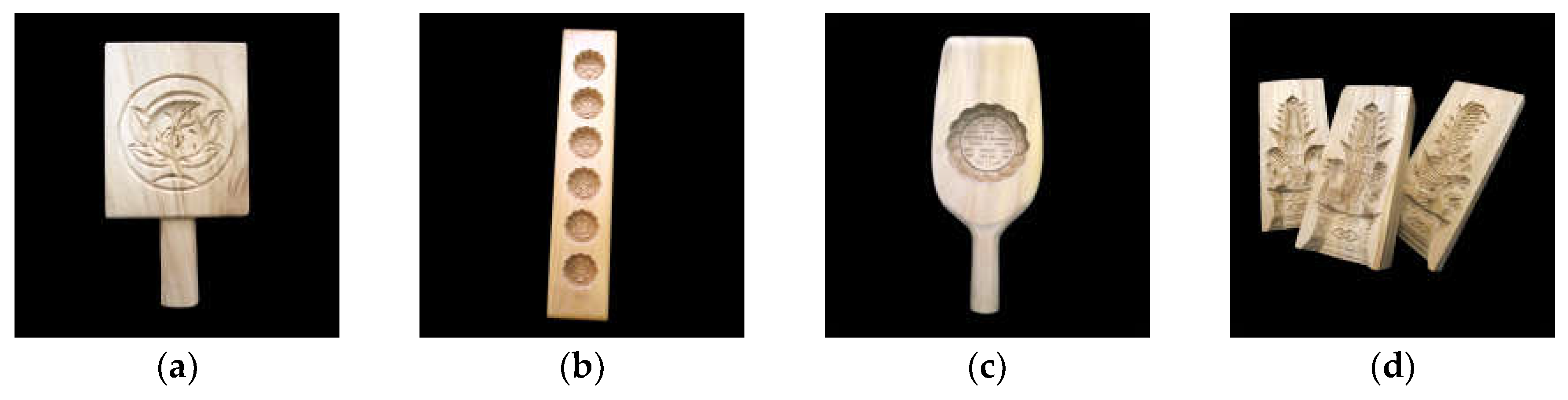
Figure 2.
Rice cake molds for festivals and rituals. (a) Ingot-shaped cake mold; (b) Sky lantern-shaped cake molds; (c) Rice turtle cake mold; (d) Turtle-shaped rice cake mold; I Cake-wrapped rice dumpling mold; (f) Three sacrifices-shaped pastry molds; (g) Mooncake mold; (h) Rabbit-shaped pastry molds; (i) Dragon and phoenix pastry mold; (j) Newlywed portrait pastry mold; (k) Newborn ban mold; (l) Red peach-shaped ban mold.
Figure 2.
Rice cake molds for festivals and rituals. (a) Ingot-shaped cake mold; (b) Sky lantern-shaped cake molds; (c) Rice turtle cake mold; (d) Turtle-shaped rice cake mold; I Cake-wrapped rice dumpling mold; (f) Three sacrifices-shaped pastry molds; (g) Mooncake mold; (h) Rabbit-shaped pastry molds; (i) Dragon and phoenix pastry mold; (j) Newlywed portrait pastry mold; (k) Newborn ban mold; (l) Red peach-shaped ban mold.
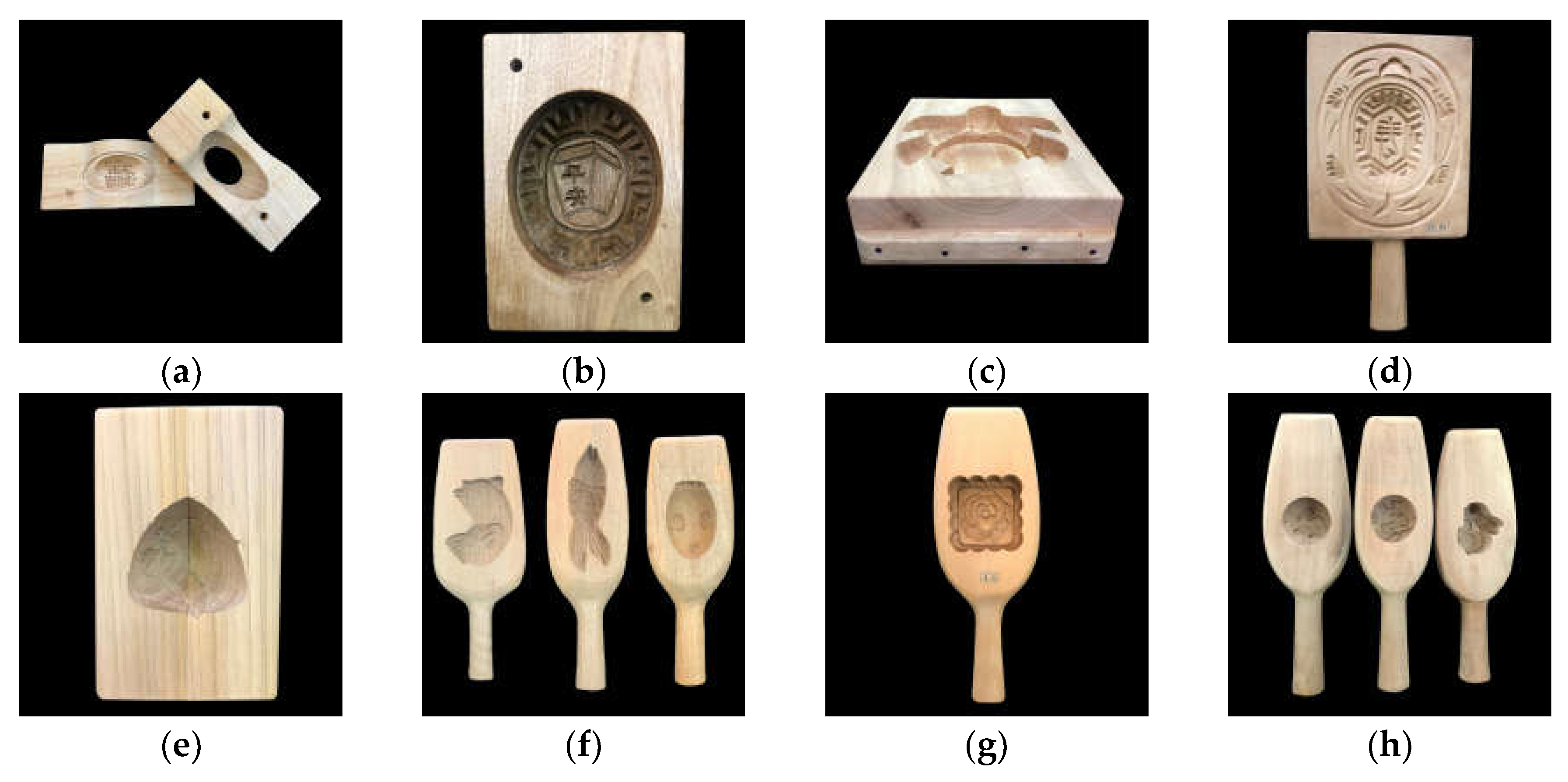
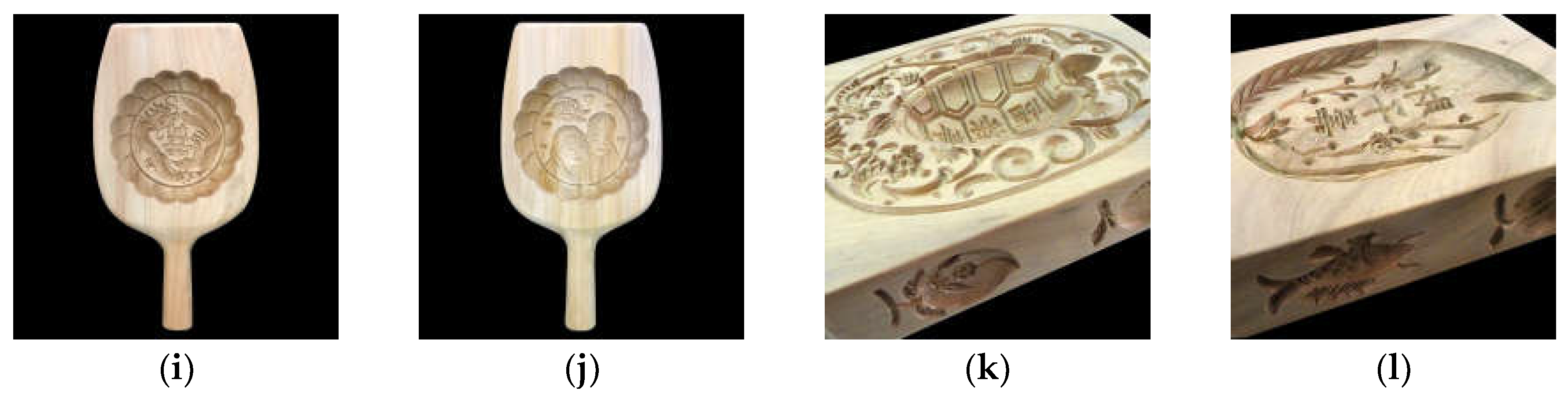
Figure 3.
Shapes of rice cake molds. (a) Handled cup-shaped; (b) Handled square; (c) Handled rectangular; (d) Handleless square; (e) Handleless rectangular; (f) Double-sided with detachable cover ; (g) Single-sided with detachable cover ; (h) Handled cup-shaped with a single recess; (i) Handled barrel-shaped with a single recess; (j) Handled square with a single recess; (k) Handled rectangular with a single recess; (l) Handled elongated with multiple recesses; (m) Handleless square with a single recess; (n) Handleless square with multiple recesses; (o) Handleless rectangular with a single recess; (p) Handleless rectangular with multiple recesses; (q) Rectangular two-piece assembly; (r) Handleless elongated with multiple recesses; (s) Elongated two-piece assembly; (t) Elongated three-piece assembly.
Figure 3.
Shapes of rice cake molds. (a) Handled cup-shaped; (b) Handled square; (c) Handled rectangular; (d) Handleless square; (e) Handleless rectangular; (f) Double-sided with detachable cover ; (g) Single-sided with detachable cover ; (h) Handled cup-shaped with a single recess; (i) Handled barrel-shaped with a single recess; (j) Handled square with a single recess; (k) Handled rectangular with a single recess; (l) Handled elongated with multiple recesses; (m) Handleless square with a single recess; (n) Handleless square with multiple recesses; (o) Handleless rectangular with a single recess; (p) Handleless rectangular with multiple recesses; (q) Rectangular two-piece assembly; (r) Handleless elongated with multiple recesses; (s) Elongated two-piece assembly; (t) Elongated three-piece assembly.
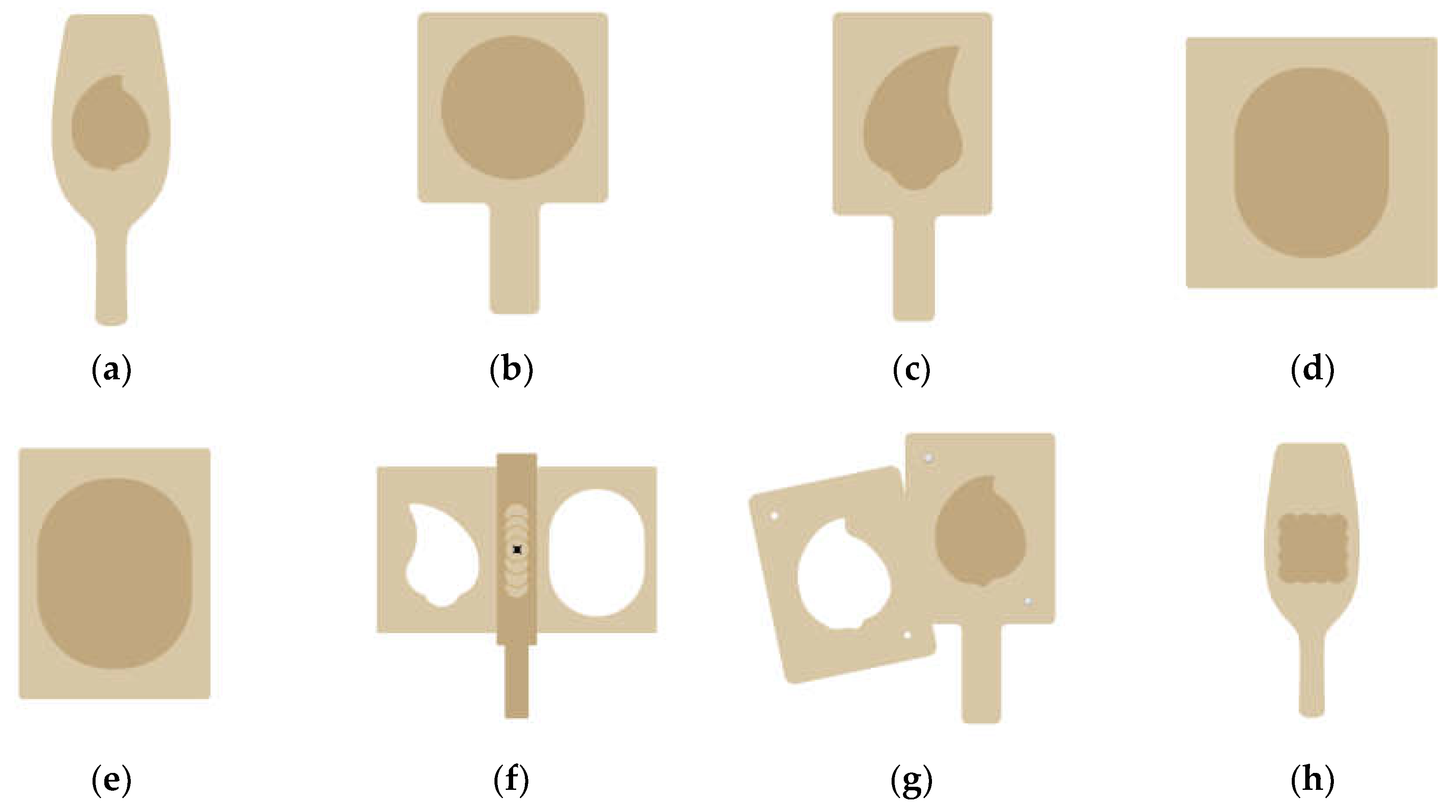
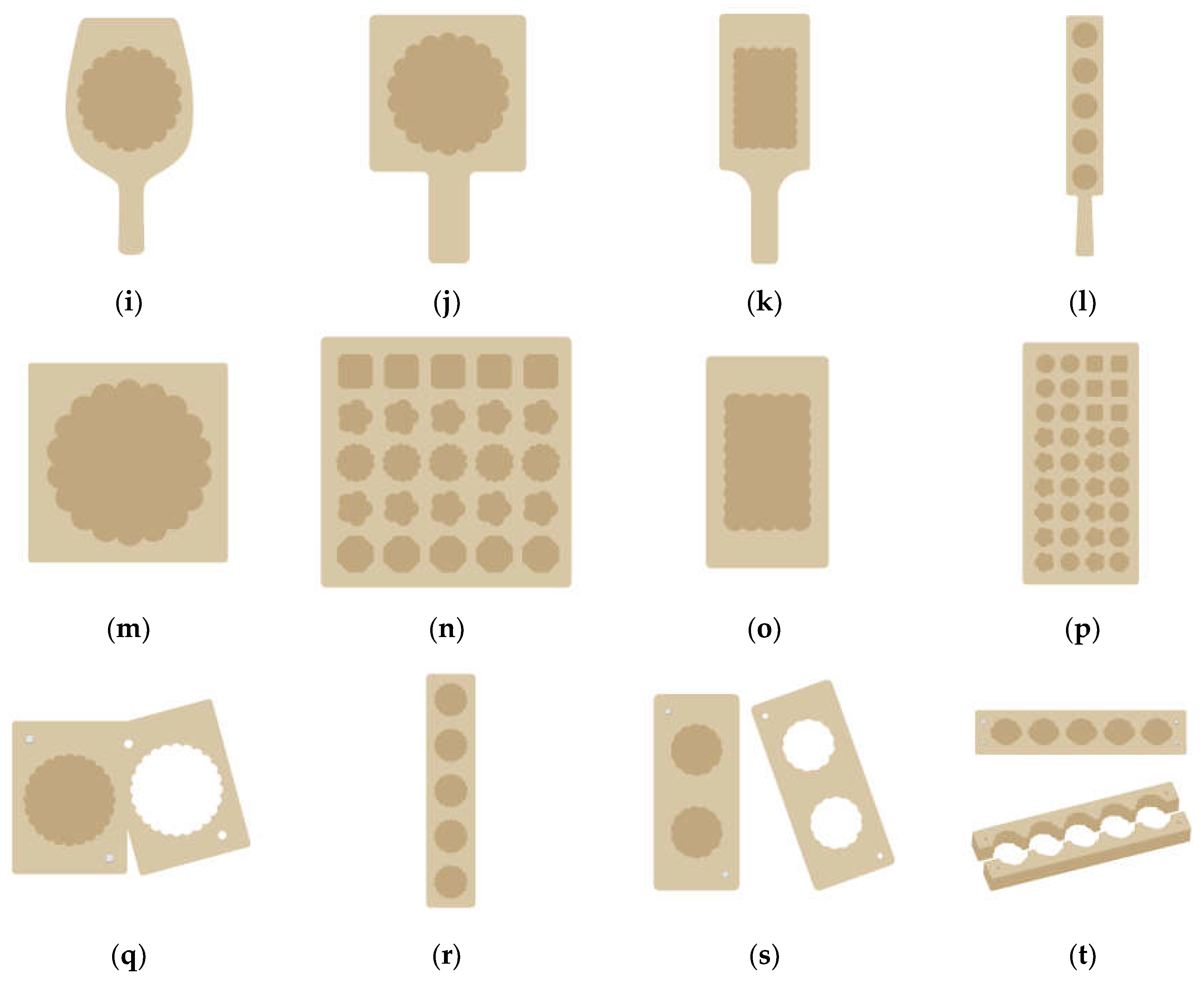
Figure 4.
Examples of contemporary rice pastry molds. (a) Pineapple-shaped pastry mold; (b) Bitter gourd-shaped pastry mold; (c) Seafood-shaped pastry molds; (d) Pet dog-shaped pastry mold.
Figure 4.
Examples of contemporary rice pastry molds. (a) Pineapple-shaped pastry mold; (b) Bitter gourd-shaped pastry mold; (c) Seafood-shaped pastry molds; (d) Pet dog-shaped pastry mold.
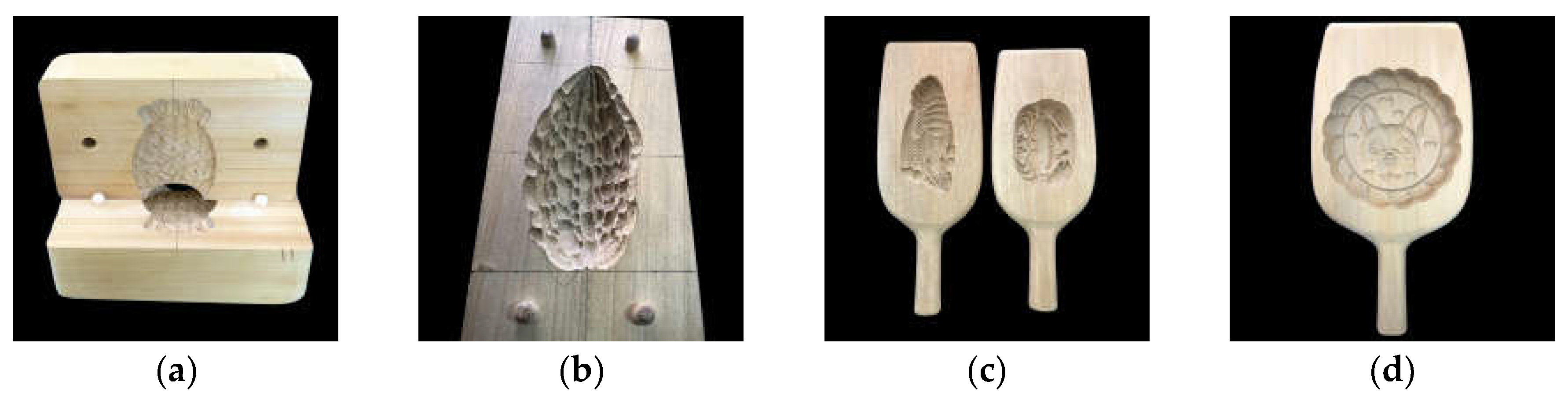

Table 1.
Symbolic meanings of rice cake mold patterns.
| Name | Pattern | Symbolism |
|---|---|---|
| Turtle |  |
Health and longevity, wealth, and good fortune. |
| Peach |  |
Health and longevity, mutual love and affection. |
| Linked Coins |  |
Continuous blessings, unending wealth. |
| Gourd |  |
Dual blessings of fortune and prosperity, harmony, and happiness. |
| Dragon and Phoenix |  |
Marital harmony, nobility, and good fortune. |
| Mandarin Ducks |  |
Conjugal love and harmony. |
| Double Carp |  |
Conveying love, abundance year after year. |
| Jade Rabbit |  |
Reunion and prosperity, bright future. |
| Lotus |  |
Beauty, purity, and sacredness. |
| Money Bag |  |
Prosperity for generations, wealth, and abundance. |
| Pineapple |  |
Good fortune, the arrival of good luck. |
| Peanut |  |
Longevity, unceasing vitality. |
Disclaimer/Publisher’s Note: The statements, opinions and data contained in all publications are solely those of the individual author(s) and contributor(s) and not of MDPI and/or the editor(s). MDPI and/or the editor(s) disclaim responsibility for any injury to people or property resulting from any ideas, methods, instructions or products referred to in the content. |
© 2024 by the author. Licensee MDPI, Basel, Switzerland. This article is an open access article distributed under the terms and conditions of the Creative Commons Attribution (CC BY) license (https://creativecommons.org/licenses/by/4.0/).
Copyright: This open access article is published under a Creative Commons CC BY 4.0 license, which permit the free download, distribution, and reuse, provided that the author and preprint are cited in any reuse.


