

Submitted:
06 November 2024
Posted:
08 November 2024
You are already at the latest version
Abstract
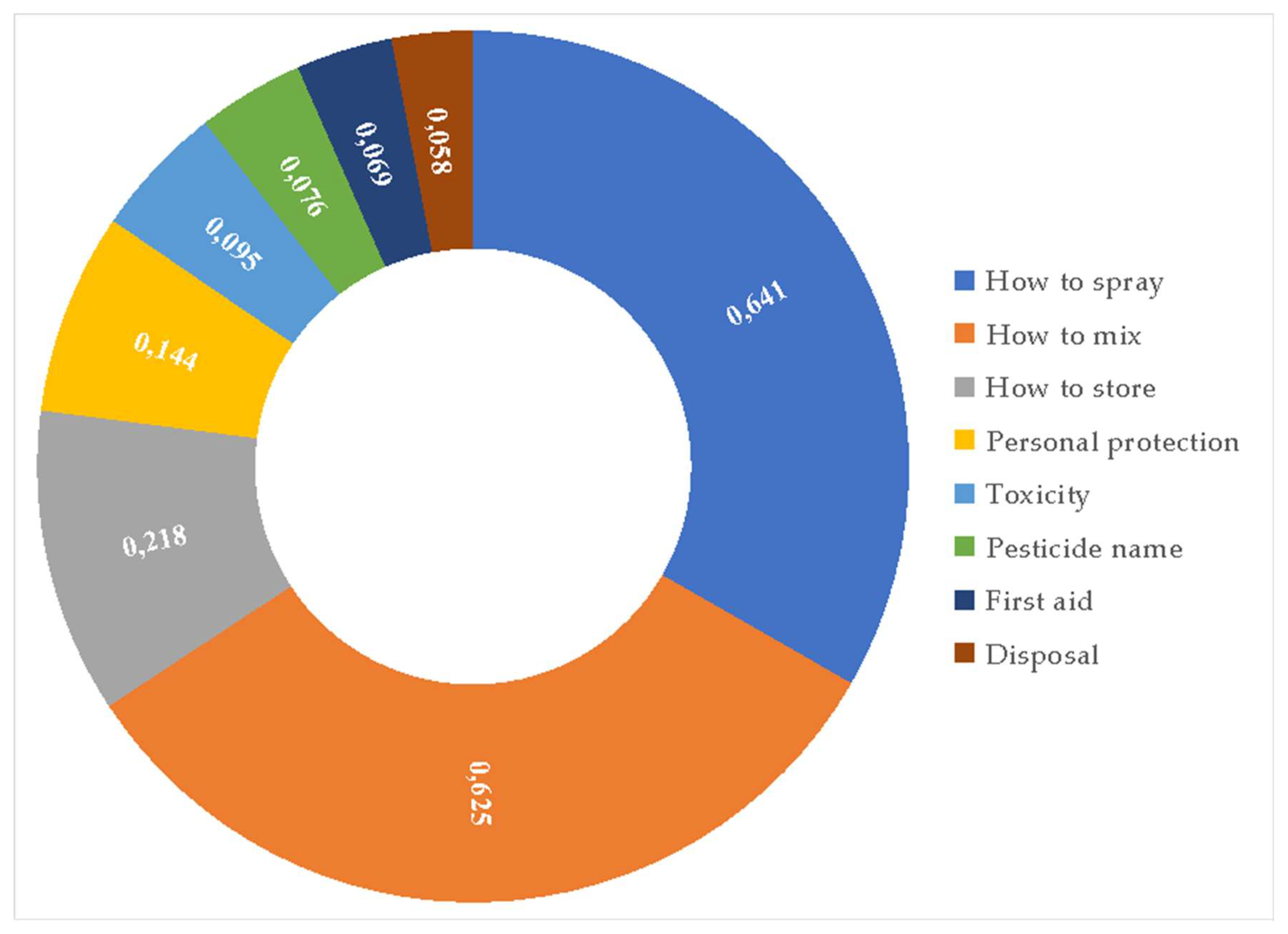
Women constitute most of the global horticulture workforce, where pesticide use is prevalent. Protecting their health, particularly during pregnancy, is essential. However, knowledge about practices among pregnant employees that cause exposure to pesticides is limited. This study aims to identify such practices and assess the impact of pesticide handling knowledge on exposure. A cross-sectional survey was conducted among 432 small-scale horticulture women in Tanzania from October 2022 to April 2023. The women were interviewed using a self-reported questionnaire, with descriptive statistics, Pearson’s chi-square, and T-tests used for data analysis. In total, 86% of participants worked in horticulture during pregnancy, with 47.5% continuing into the third trimester. Many engaged in weeding within 24 hours of spraying (57.2%) and washing pesticide-contaminated clothes (51.6%). Most women (93.1%) had limited knowledge of pesticide handling, though some understood mixing (62.5%) and spraying (64.1%) instructions on labels. This study suggests that women working in horticulture engage in activities that expose them to pesticides during pregnancy and have low knowledge of pesticide handling. Such practices expose pregnant women and their offspring to hazardous pesticides. There is a need for deliberate efforts towards protecting women in dangerous workplaces such as agriculture.
Keywords:
1. Introduction
2. Materials and Methods
2.1. Study design and population
2.2. Background information and exposure assessment
2.3. Knowledge assessment
2.4. Data analysis
3. Results
3.1. Participant Characteristics
3.2. Pesticide exposure during pregnancy
3.3. Knowledge of pesticide handling among horticulture women
4. Discussion
5. Conclusions
Author Contributions
Funding
Institutional Review Board Statement
Informed Consent Statement
Data Availability Statement
Acknowledgments
Conflicts of Interest
References
- International Labour Organization (ILO) Women at Work: Trends 2016. Int. Labour Organ. (PRODOC), Geneva. 2016.
- Palacios-Lopez, A.; Christiaensen, L.; Kilic, T. How Much of the Labor in African Agriculture Is Provided by Women? Food Policy 2017, 67, 52–63. [CrossRef]
- UNDP Tanzania Bridging the Gender Gap: Empowering Women in the Agriculture Sector Available online: https://www.undp.org/tanzania/news/bridging-gender-gap-empowering-women-agricultural-sector (accessed on 27 October 2023).
- Srivastava, S.K.; Sahu, A.; Das, L. Women in Growth of Horticulture - Contributions and Issues. Progress. Hortic. 2020, 52, 12–19. [CrossRef]
- Tripathi, P.C.; Babu, N.; Prustry, M. Analysis of Participation of Women in Horticultural Activities. J. Bus. Manag. Soc. Sci. Res. 2015, 4, 241–244.
- Horticulture Development Council of Tanzania (HODECT). The National Horticulture Development Strategy 2012-2021. Hortic. Dev. Counc. Tanzania 2010.
- Koussé, J.N.D.; Ilboudo, S.; Ouédraogo, J.C.R.P.; Hunsmann, M.; Ouédraogo, G.G.; Ouédraogo, M.; Kini, F.B.; Ouédraogo, S. Self-Reported Health Effects of Pesticides among Cotton Farmers from the Central-West Region in Burkina Faso. Toxicol. Reports 2023, 11, 273–282. [CrossRef]
- Ali, S.; Ullah, M.I.; Sajjad, A.; Shakeel, Q.; Hussain, A. Environmental and Health Effects of Pesticide Residues. In Sustainable Agriculture Reviews 48; Inamuddin, Ahamed, M.I., Lichtfouse, E., Eds.; Springer International Publishing: Cham, 2021; pp. 311–336 ISBN 978-3-030-54719-6.
- Sobańska, A.W. In Silico Assessment of Risks Associated with Pesticides Exposure during Pregnancy. Chemosphere 2023, 329, 138649. [CrossRef]
- Prahl, M.; Odorizzi, P.; Gingrich, D.; Muhindo, M.; McIntyre, T.; Budker, R.; Jagannathan, P.; Farrington, L.; Nalubega, M.; Nankya, F.; et al. Exposure to Pesticides in Utero Impacts the Fetal Immune System and Response to Vaccination in Infancy. Nat. Commun. 2021, 12, 132. [CrossRef]
- Addissie, Y.A.; Kruszka, P.; Troia, A.; Wong, Z.C.; Everson, J.L.; Kozel, B.A.; Lipinski, R.J.; Malecki, K.M.C.; Muenke, M. Prenatal Exposure to Pesticides and Risk for Holoprosencephaly: A Case-Control Study. Environ. Heal. 2020, 19, 65. [CrossRef]
- Wei, H.; Zhang, X.; Yang, X.; Yu, Q.; Deng, S.; Guan, Q.; Chen, D.; Zhang, M.; Gao, B.; Xu, S.; et al. Prenatal Exposure to Pesticides and Domain-Specific Neurodevelopment at Age 12 and 18 Months in Nanjing, China. Environ. Int. 2023, 173, 107814. [CrossRef]
- Jaacks, L.M.; Diao, N.; Calafat, A.M.; Ospina, M.; Mazumdar, M.; Ibne Hasan, M.O.S.; Wright, R.; Quamruzzaman, Q.; Christiani, D.C. Association of Prenatal Pesticide Exposures with Adverse Pregnancy Outcomes and Stunting in Rural Bangladesh. Environ. Int. 2019, 133, 105243. [CrossRef]
- Müller, M.H.B.; Polder, A.; Brynildsrud, O.B.; Grønnestad, R.; Karimi, M.; Lie, E.; Manyilizu, W.B.; Mdegela, R.H.; Mokiti, F.; Murtadha, M.; et al. Prenatal Exposure to Persistent Organic Pollutants in Northern Tanzania and Their Distribution between Breast Milk, Maternal Blood, Placenta and Cord Blood. Environ. Res. 2019, 170, 433–442. [CrossRef]
- Chilipweli, P.M.; Ngowi, A.V.; Manji, K. Maternal Pesticide Exposure and Child Neuro-Development among Smallholder Tomato Farmers in the Southern Corridor of Tanzania. BMC Public Health 2021, 21, 171. [CrossRef]
- United Nations (UN) Transforming Our World : The 2030 Agenda for Sustainable Development. UN Gen. Assem. 2015.
- Faul, F.; Erdfelder, E.; Lang, A.-G.; Buchner, A. G*Power 3: A Flexible Statistical Power Analysis Program for the Social, Behavioral, and Biomedical Sciences. Behav. Res. Methods 2007, 39, 175–191. [CrossRef]
- Maritano, S.; Moirano, G.; Popovic, M.; D’Errico, A.; Rusconi, F.; Maule, M.; Richiardi, L. Maternal Pesticides Exposure in Pregnancy and the Risk of Wheezing in Infancy: A Prospective Cohort Study. Environ. Int. 2022, 163, 107229. [CrossRef]
- Monger, A.; Mahat, K.; Dorjee; Om, N.; Mongar, P.; Dorji, T.; Jamtsho, S.; Wangdi, K.; Wangdi, C.; Jamtsho, T.; et al. Assessment of Exposure to Pesticides and the Knowledge, Attitude and Practice among Farmers of Western Bhutan. PLoS One 2023, 18, e0286348. [CrossRef]
- Friedman, D.; Parikh, N.S.; Giunta, N.; Fahs, M.C.; Gallo, W.T. The Influence of Neighborhood Factors on the Quality of Life of Older Adults Attending New York City Senior Centers: Results from the Health Indicators Project. Qual. life Res. an Int. J. Qual. life Asp. Treat. care Rehabil. 2012, 21, 123–131. [CrossRef]
- Zseleczky, L.; Christie, M.E.; Haleegoah, J. Embodied Livelihoods and Tomato Farmers’ Gendered Experience of Pesticides in Tuobodom, Ghana. Gend. Technol. Dev. 2014, 18, 249–274. [CrossRef]
- Ochago, R. Gender and Pest Management: Constraints to Integrated Pest Management Uptake among Smallholder Coffee Farmers in Uganda. Cogent Food Agric. 2018, 4. [CrossRef]
- Tsimbiri, P.F.; Moturi, W.N.; Sawe, J.; Henley, P.; Bend, J.R. Health Impact of Pesticides on Residents and Horticultural Workers in the Lake Naivasha Region, Kenya. Occup. Dis. Environ. Med. 2015, 03, 24–34. [CrossRef]
- Atinkut Asmare, B.; Freyer, B.; Bingen, J. Women in Agriculture: Pathways of Pesticide Exposure, Potential Health Risks and Vulnerability in Sub-Saharan Africa. Environ. Sci. Eur. 2022, 34. [CrossRef]
- Mrema, E.J.; Ngowi, A.V.; Kishinhi, S.S.; Mamuya, S.H. Pesticide Exposure and Health Problems Among Female Horticulture Workers in Tanzania. Environ. Health Insights 2017, 11, 1–13. [CrossRef]
- Negatu, B.; Kromhout, H.; Mekonnen, Y.; Vermeulen, R. Use of Chemical Pesticides in Ethiopia: A Cross-Sectional Comparative Study Onknowledge, Attitude and Practice of Farmers and Farm Workers in Three Farming Systems. Ann. Occup. Hyg. 2016, 60, 551–566. [CrossRef]
- Ntow, W.J.; Tagoe, L.M.; Drechsel, P.; Kelderman, P.; Nyarko, E.; Gijzen, H.J. Occupational Exposure to Pesticides: Blood Cholinesterase Activity in a Farming Community in Ghana. Arch. Environ. Contam. Toxicol. 2009, 56, 623–630. [CrossRef]
- International Labour Organization (ILO). Agriculture: A Hazardous Work Available online: https://www.ilo.org/safework/areasofwork/hazardous-work/WCMS_110188/lang--en/index.htm (accessed on 28 August 2023).
- Lorenz, A.N.; Prapamontol, T.; Narksen, W.; Srinual, N.; Barr, D.B.; Riederer, A.M. Pilot Study of Pesticide Knowledge, Attitudes, and Practices among Pregnant Women in Northern Thailand. Int. J. Environ. Res. Public Health 2012, 9, 3365–3383. [CrossRef]
- Mayhoub, F.; Berton, T.; Bach, V.; Tack, K.; Deguines, C.; Floch-Barneaud, A.; Desmots, S.; Stéphan-Blanchard, E.; Chardon, K. Self-Reported Parental Exposure to Pesticide during Pregnancy and Birth Outcomes: The MecoExpo Cohort Study. PLoS One 2014, 9, 1–14. [CrossRef]
- Shibazaki, T.; Motoki, N.; Misawa, Y.; Ohira, S.; Inaba, Y.; Kanai, M.; Kurita, H.; Nakazawa, Y.; Tsukahara, T.; Nomiyama, T.; et al. Association between Pesticide Usage during Pregnancy and Neonatal Hyperbilirubinemia Requiring Treatment: The Japan Environment and Children’s Study. Pediatr. Res. 2021, 89, 1565–1570. [CrossRef]
- Gunier, R.B.; Deardorff, J.; Rauch, S.; Bradshaw, P.T.; Kogut, K.; Sagiv, S.; Hyland, C.; Mora, A.M.; Eskenazi, B. Residential Proximity to Agricultural Pesticide Use and Risk-Taking Behaviors in Young Adults from the CHAMACOS Study. Environ. Res. 2022, 215, 114356. [CrossRef]
- Williams, M.K.; Rundle, A.; Holmes, D.; Reyes, M.; Hoepner, L.A.; Barr, D.B.; Camann, D.E.; Perera, F.P.; Whyatt, R.M. Changes in Pest Infestation Levels, Self-Reported Pesticide Use, and Permethrin Exposure during Pregnancy after the 2000-2001 U.S. Environmental Protection Agency Restriction of Organophosphates. Environ. Health Perspect. 2008, 116, 1681–1688. [CrossRef]
- Wang, W.; Jin, J.; He, R.; Gong, H. Gender Differences in Pesticide Use Knowledge, Risk Awareness and Practices in Chinese Farmers. Sci. Total Environ. 2017, 590–591, 22–28. [CrossRef]
- Galli, A.; Winkler, M.S.; Doanthu, T.; Fuhrimann, S.; Huynh, T.; Rahn, E.; Stamm, C.; Staudacher, P.; Van Huynh, T.; Loss, G. Assessment of Pesticide Safety Knowledge and Practices in Vietnam: A Cross-Sectional Study of Smallholder Farmers in the Mekong Delta. J. Occup. Environ. Hyg. 2022, 19, 509–523. [CrossRef]
- Idowu, A.A.; Sowe, A.; Bah, A.K.; Kuyateh, M.; Anthony, A. Knowledge, Attitudes and Practices Associated with Pesticide Use among Horticultural Farmers of Banjulinding and Lamin of the Gambia. African J. Chem. Educ. 2017, 7, 2–17.
- Pandiyan, A.; Lari, S.; Vanka, J.; Gavaravarapu, S.M.; Jee, B.; Jonnalagadda, P.R. Knowledge, Attitude and Practices Related to Pesticide Usage among Farmers: Findings from a Hospital Based Cross-Sectional Study. Work 2023, 76, 1061–1070. [CrossRef]
- Wang, W.; Jin, J.; He, R.; Gong, H. Gender Differences in Pesticide Use Knowledge, Risk Awareness and Practices in Chinese Farmers. Sci. Total Environ. 2017, 590–591, 22–28. [CrossRef]
- Tanzania National Bureau of Statistics. Tanzania National Panel Survey Report (NPS) - Wave 5, 2020 - 2021. Dodoma, Tanzania NBS 2022, 125.
- International Labour Organization (ILO) C184 - Safety and Health in Agriculture Convention (No. 184); 2001.
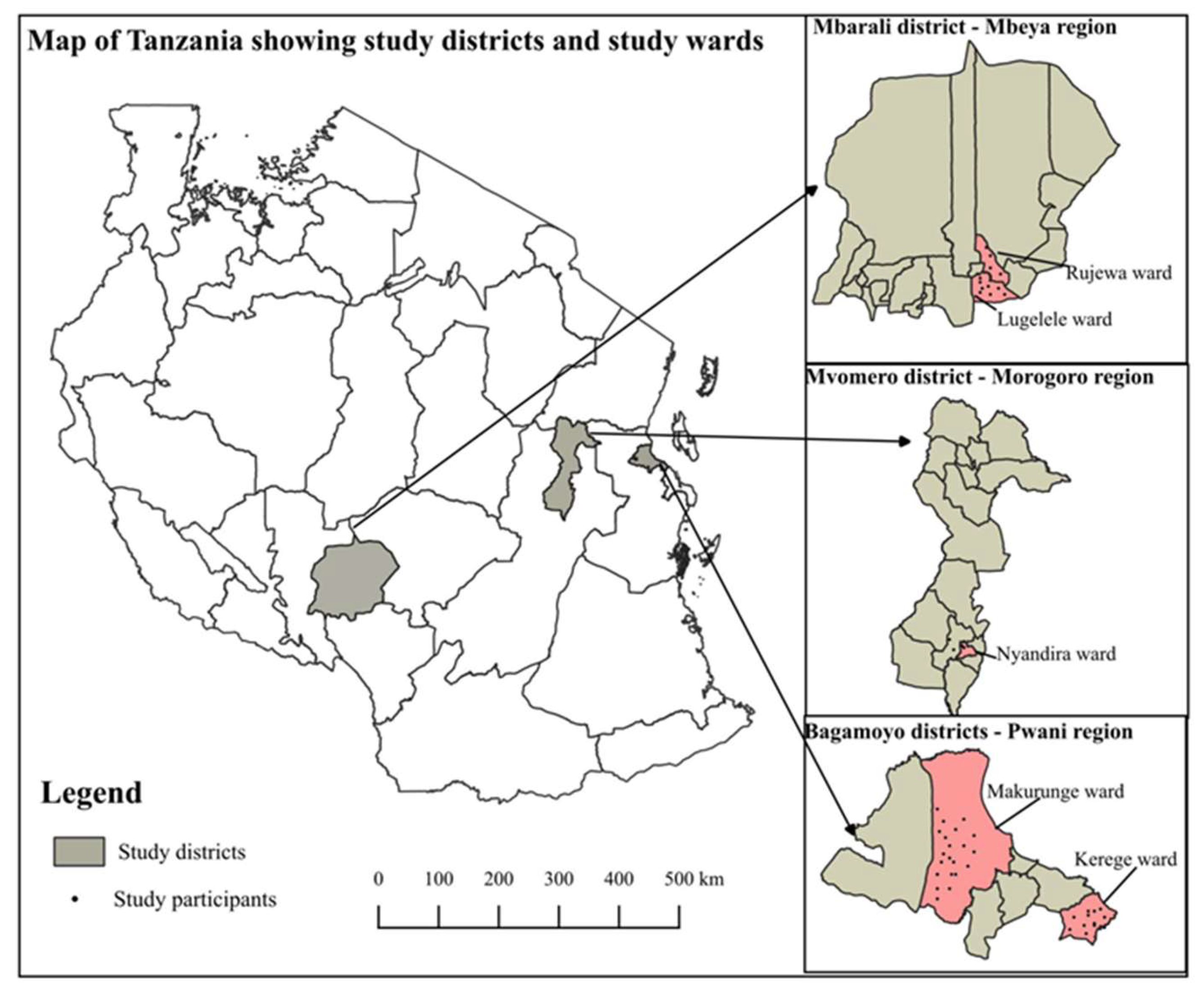

| Pesticides handling practice | Never | Sometimes | Often | Don’t remember |
|---|---|---|---|---|
| When working on the farm during pregnancy, were you mixing the pesticides or herbicides before spraying? | ☐ | ☐ | ☐ | ☐ |
| When working on the farm during pregnancy, were you involved in applying pesticides or herbicides by any method? | ☐ | ☐ | ☐ | ☐ |
| When working on the farm during pregnancy, were you involved in manual weeding within 24 hours after spray? | ☐ | ☐ | ☐ | ☐ |
| When working on the farm during pregnancy, were you involved in harvesting within 24 hours after spray? | ☐ | ☐ | ☐ | ☐ |
| When working on the farm during pregnancy, were you washing clothes used when applying pesticides? | ☐ | ☐ | ☐ | ☐ |
| When working on the farm during pregnancy, were you involved in cleaning equipment used for pesticides or herbicides mixing and spraying? | ☐ | ☐ | ☐ | ☐ |
| When working on the farm during pregnancy, were you involved in burning empty pesticide containers? | ☐ | ☐ | ☐ | ☐ |
| When working on the farm during pregnancy, were you involved in reusing empty pesticide containers? | ☐ | ☐ | ☐ | ☐ |
| When working on the farm during pregnancy, have you ever eaten vegetables sprayed with pesticides within 24 hours? | ☐ | ☐ | ☐ | ☐ |
| Frequency (%) | |||||
|---|---|---|---|---|---|
| Variable | All (n=432) |
Mvomero (n=258) | Bagamoyo (n=80) | Mbarali (n=94) | p-value (χ2 test) |
| Age | |||||
| ≤ 30 years | 141 (33) | 67 (26) | 28 (35) | 46 (49) | |
| 31 – 40 years | 238 (55) | 149 (58) | 47 (59) | 42 (45) | |
| Above 40 years | 53 (12) | 42 (16) | 5 (6) | 6 (6) | <0.001 |
| Years in horticulture: n (%) | |||||
| ≤ 5 years | 239 (55.3) | 135 (52.3) | 57 (71.3) | 47 (50.0) | |
| 6 – 10 years | 122 (28.2) | 86 (33.3) | 17 (21.3) | 19 (20.2) | |
| Above 10 years | 71 (16.4) | 37 (14.3) | 6 (7.5) | 28 (29.8) | <0.001 |
| Horticulture work during pregnancy: n (%) | 373 (86.3) | 228 (88.4) | 66 (82.5) | 79 (84.0) | 0.313 |
| Gestation age when decided to stop horticulture work (n=373) | |||||
| 1st Trimester | 46 (12.3) | 12 (5.3) | 19 (28.8) | 15 (19.0) | |
| 2nd Trimester | 150 (40.2) | 71 (31.1) | 31 (47.0) | 48 (60.8) | |
| 3rd Trimester | 177 (47.5) | 145 (63.6) | 16 (24.2) | 16 (20.3) | <0.001 |
| Frequency (%) | |||||
|---|---|---|---|---|---|
| Pesticide contact activity | Total | Mvomero | Bagamoyo | Mbarali | p value (χ2 test) |
| Mixing of pesticides before spray | |||||
| Practiced | 34 (7.9) | 11 (4.3) | 15 (18.8) | 8 (8.5) | |
| Did not practice | 398 (92.1) | 247 (95.7) | 65 (81.3) | 86 (91.5) | <0.001 |
| Spraying of pesticides | |||||
| Practiced | 163 (37.7) | 91 (35.3) | 36 (45.0) | 36 (38.3)) | |
| Did not practice | 269 (62.3) | 167 (64.7) | 44 (55.0) | 58 (61.7) | 0.290 |
| Weeding within 24 hours post-spray | |||||
| Practiced | 247 (57.2) | 124 (48.1) | 59 (73.8) | 64 (68.1) | |
| Did not practice | 185 (42.8) | 134 (51.9) | 21 (26.3) | 30 (31.9) | <0.001 |
| Harvest within 24 hours post-spray | |||||
| Practiced | 97 (22.5) | 19 (7.4) | 41 (51.2) | 37 (39.4) | |
| Did not practice | 335 (77.5) | 239 (92.6) | 39 (48.8) | 57 (60.6) | <0.001 |
| Washed clothes used in pesticide spraying | |||||
| Practiced | 223 (51.6) | 84 (32.6) | 60 (75.0) | 79 (84.0) | |
| Did not practice | 209 (48.4) | 174 (67.4) | 20 (25.0) | 15 (16.0) | <0.001 |
| Washed equipment used in spraying | |||||
| Practiced | 130 (30.1) | 11 (4.3) | 44 (55.0) | 75 (79.8) | |
| Did not practice | 302 (69.9) | 247 (95.7) | 36 (45.0) | 19 (20.2) | <0.001 |
| Burned pesticides container | |||||
| Practiced | 12 (2.8) | 0 (0.0) | 7 (8.8) | 5 (5.3) | |
| Did not practice | 420 (97.2) | 258 (100.0) | 73 (91.3) | 89 (94.7) | NA |
| Reused pesticides containers | |||||
| Practiced | 8 (1.9) | 0 (0.0) | 5 (6.3) | 3 (3.2) | |
| Did not practice | 424 (98.1) | 258 (100.0) | 75 (93.8) | 91 (96.8) | NA |
| Eat farm products within 24 hours postspray | |||||
| Practiced | 197 (45.6) | 65 (25.2) | 55 (68.8) | 77 (81.9) | |
| Did not practice | 235 (54.4) | 193 (74.8) | 25 (31.3) | 17 (18.1) | <0.001 |
| Gestation age when pesticide contact activity was practiced | Total | Frequency (%) | |||
|---|---|---|---|---|---|
| Mvomero | Bagamoyo | Mbarali | p value1 | ||
| Mixing of pesticides before spray | |||||
| 1st trimester | 9 (2.1) | 0 (0.0) | 5 (6.3) | 4 (4.3) | |
| 2nd trimester | 8 (1.9) | 2 (0.8) | 4 (5.0) | 2 (1.9) | |
| 3rd trimester | 3 (0.7) | 0 (0.0) | 3 (3.8) | 0 (0.0) | NA |
| Spraying of pesticides | |||||
| 1st trimester | 162 (37.5) | 89 (34.5) | 37 (46.3) | 36 (38.3) | |
| 2nd trimester | 159 (36.8) | 91 (35.3) | 33 (41.3) | 35 (37.2) | |
| 3rd trimester | 154 (35.6) | 89 (34.5) | 33 (41.3) | 32 (34.0) | 0.002 |
| Weeding within 24 hours post-spray | |||||
| 1st trimester | 220 (50.9) | 124 (48.1) | 48 (60.0) | 48 (51.1) | |
| 2nd trimester | 220 (50.9) | 124 (48.1) | 44 (55.0) | 52 (55.3) | |
| 3rd trimester | 34 (7.9) | 0 (0.0) | 21 (26.3) | 13 (13.8) | NA |
| Harvest within 24 hours post-spray | |||||
| 1st trimester | 46 (10.6) | 2 (0.8) | 25 (31.3) | 19 (20.2) | |
| 2nd trimester | 76 (17.6) | 17 (6.6) | 28 (35.0) | 31 (33.0) | |
| 3rd trimester | 60 (13.9) | 13 (5.0) | 33 (41.3) | 14 (14.9) | <0.001 |
| Washed clothes used in pesticide spraying | |||||
| 1st trimester | 200 (46.3) | 82 (31.8) | 50 (62.5) | 68 (72.3) | |
| 2nd trimester | 86 (19.9) | 3 (1.2) | 25 (31.3) | 58 (61.7) | |
| 3rd trimester | 79 (18.3) | 0 (0.0) | 29 (36.3) | 50 (53.2) | NA |
| Washed equipment used in spraying | |||||
| 1st trimester | 117 (27.1) | 11 (4.3) | 37 (46.3) | 69 (73.4) | |
| 2nd trimester | 116 (26.9) | 11 (4.3) | 36 (45.0) | 69 (73.4) | |
| 3rd trimester | 19 (4.4) | 0 (0.0) | 8 (10.0) | 11 (11.7) | NA |
| Burned pesticides container | |||||
| 1st trimester | 8 (1.9) | 0 (0.0) | 4 (5.0) | 4 (4.3) | |
| 2nd trimester | 10 (2.3) | 0 (0.0) | 5 (6.3) | 5 (5.3) | |
| 3rd trimester | 7 (1.6) | 0 (0.0) | 4 (5.0) | 3 (3.2) | NA |
| Variable | Frequency (%) | ||
|---|---|---|---|
| Low knowledge | High knowledge | p value | |
| Knowledge | 403 (93.3) | 29 (6.7) | |
| Study area | |||
| Mvomero | 254 (98.4) | 4 (1.6) | |
| Bagamoyo | 56 (70.0)) | 24 (30.0) | |
| Mbarali | 93 (98.9) | 1 (1.1) | <0.0011 |
| Years in horticulture | |||
| <5 years | 224 (93.7) | 15 (6.3) | |
| 6 – 10 years | 112 (91.8) | 10 (8.2) | |
| >10 years | 67 (94.4) | 4 (5.6) | 0.7281 |
| Gestation age when decided to stop horticulture work | |||
| 1st Trimester | 37 (80.4) | 9 (19.6) | |
| 2nd Trimester | 138 (92.0) | 12 (8.0) | |
| 3rd Trimester | 170 (96.0) | 7 (4.0) | 0.0012 |
Disclaimer/Publisher’s Note: The statements, opinions and data contained in all publications are solely those of the individual author(s) and contributor(s) and not of MDPI and/or the editor(s). MDPI and/or the editor(s) disclaim responsibility for any injury to people or property resulting from any ideas, methods, instructions or products referred to in the content. |
© 2024 by the authors. Licensee MDPI, Basel, Switzerland. This article is an open access article distributed under the terms and conditions of the Creative Commons Attribution (CC BY) license (http://creativecommons.org/licenses/by/4.0/).


