

Submitted:
02 September 2024
Posted:
03 September 2024
You are already at the latest version
Abstract
FER zeolites has a unique framework structure and acid distribution, and is widely studied as a catalyst for reactions such as n-butene skeletal isomerization and dimethyl ether carbonylation. The BAS located in the 10-MR of FER zeolites serves as the active site for the isomerization reaction of n-butene skeletal to produce isobutene. In contrast, the acid site found in the 8-MR is prone to side reactions, such as polymerization and cracking, which can adversely affect the selectivity of isobutene. This study prepared five types of FER zeolites using different method, inducing Na-form or H-form crystal seeds without organic structure directing agents (OSDAS), using pyridine alone as a template, and combining the seeds with pyridine. The differences in the structure and acid distribution of the five zeolites were investigated, as well as their catalytic performance for the the skeletal isomerization of n-Butene. Experiments and characterization results showed that under hydrothermal synthesis conditions, the FER-PY+SH zeolites synthesized by using both H-form zeolites seeds and pyridine exhibited the highest aluminum concentrations at T1 and T3 positions, along with the greatest BAS of 10-MR. This unique composition contributed to the highest selectivity of isobutene. The FER-PY+SH catalyst was continuously used for 720 hours at 350 ℃, 0.1 MPa, and n-butene mass space velocity of 2.0 h-1 for three recycles on 2160 h. During this period, the conversion of n-butene over 39%, while the selectivity of isobutene exceeded 95%.The catalyst exhibited excellent stability and activity.
Keywords:
FER zeolites
; seed
; Pyrrolidine
; Al distribution
; n-Butene
; Skeletal isomerization
1. Introduction
Isobutene is an important basic organic chemical raw material, which can be used to produce many high value-added products, including butyl rubber, polyisobutylene, methyl tert butyl ether (MTBE), methyl methacrylate, etc. One of the primary industrial production methods its production involves the skeletal isomerization of n-butene to generate isobutene [1,2,3]. In the past few decades, extensive research has focused on the production of isobutene through theskeleton isomerization of butene, utilizing various catalysts such as phosphoric acid, metal halides, aluminum oxide, phosphated and halogenated aluminum oxide, and zeolite molecular sieves [4,5]. The pore structure of FER zeolite includes two vertically intersecting two-dimensional pore systems: an 8-membered ring pore (0.35 × 0.48 nm) along the [010] direction, a 10 membered ring (10-MR) pore (0.43 × 0.55 nm) along the [001] direction, and a magnesium alkali zeolite cage with a diameter of approximately 0.6-0.7 nm formed by the intersection of 6 membered ring and 8-MR [6,7]. FER zeolite is currently highest-performance n-butene skeleton isomerization catalyst and was successfully applied in industrial applications in the 1990s [8].
Numerous studies have demonstrated that the B acid site (BAS) located on the 10-MR in FER zeolite as a selective active site for catalyzing the skeleton isomerization of n-butene to produce isobutene. In contrast, the L acid site (LAS) and BAS located on the 8-MR can exacerbate the occurrence of side reactions such as butene polymerization and cracking [9,10,11,12,13]. As is well known, molecular sieves are crystal compounds composed of TO4 (T atoms are generally Si or Al) tetrahedra according to certain rules. Their acidity mainly arises from the introduction of protons, which balance the negative charge of aluminum atoms in the molecular sieve framework. It can be seen that the catalytic performance of zeolites is closely linked to the strength and position of acid sites. The strength and position of these acid sites are directly influenced by the distribution of Al atoms within the zeolite framework [14,15,16,17]. According to relevant information from the International Zeolite Association (IZA), the framework T atom of FER molecular sieve exhibit four distinct positions, namely the T1/T2/T3 position,which can be connected to a 10 membered ring or FER cage, and the T4 position, which is solely connected connected through a FER cage (note: labels of T atoms have been unified according to the FER framework in the IZA). Xiong et al. [18,19,20] studied the skeletal aluminum atoms at four different T-positions of FER molecular sieves. The experimental characterization and theoretical calculation results were consistent. The 27 Al NMR isotropic chemical shifts of the aluminum atoms at T1/T2/T3/T4 positions of FER molecular sieves were 60.5, 51.5, 53.5, and 56.6 ppm, respectively.
In the synthesis process of zeolites, organic directing agents play a crucial role in balancing the negative charge introduced by the aluminum atoms in the framework. Consequently, these organic structural directing agents significantly influence the distribution of aluminum in molecular sieves. Pinar et al.[11,21,22] synthesized FER zeolites using a fluorinated system without the use of inorganic cations, using a combination of 1-benzoyl-1-methylpyrrolidinium (BMP), 2-hydroxymethyl-1-benzoyl-1-methylpyrrolidinium (bmprol) hydroxide, trimethylamine, pyridine, pyrrolidine, and several organic template agents. They investigated the synthesis of different organic structural directing agents. The distribution pattern of aluminum in the molecular sieve framework and its effect on the catalytic isomerization reaction of n-butene framework. Due to the different sizes of template molecules and their interactions with skeleton atoms, FER zeolites with different skeleton aluminum distributions can be obtained. When larger template molecule are used, a longer crystallisation time is required to increase the distribution probability of aluminium atoms in the 10-MR, enhance the BAS of the 10-MR, and improve the control of the activity and selectivity of n-butene skeleton isomerization reaction. Conversely, it tends to lead to side reactions such as olefin polymerization and cracking, and accelerate catalyst deactivation. In addition, the studies of Leshkov [23] and Chu [24] also indicate that when different sizes of cyclic or chain amines are used as organic structure directing agents, FER zeolites with different 10-MR and 8-MR aluminum distributions can also be obtained. Numerous studies have shown that the distribution of aluminum in the framework of zeolites is not only influenced by organic structural directing agents, but also by the synthesis conditions of zeolites [25], the silicon and aluminum sources used [26,27], solvents [28], inorganic cations [29,30,31], and post-treatment [32,33,34]. During the seed induced synthesis of molecular sieves, seed can play a role in reducing or avoiding the use of organic structure directing agents, shortening crystallization time, avoiding impurities, and regulating the crystal morphology of target zeolites [35,36,37]. Xiao et al. [38] believe that seed can be considered as the third type of structure directing agent. Zhang et al. [39] synthesized FER zeolite with good crystallinity, large surface area, uniform micropores, and abundant acidic sites using RUB-37 as the crystal seed. Studies by Ham et al. [40,41,42] showed a change in the distribution of framework aluminium atoms in seed-induced synthesized FER zeolites as compared to seed FER zeolites. The higher BAS content of the 8-MR than the 10-MR resulted in better dimethyl ether carbonylation activity and stability of the seed induced synthesised FER zeolites than seed. In addition, Nishitoba [26] found that when using trimethylamine as an organic structure directing agent to synthesize CHA molecular sieves, the addition of FAU molecular sieves as crystal seeds and aluminum sources can regulate the distribution of aluminum atoms in the framework of CHA molecular sieves. These studies indicate that the distribution of aluminium in the molecular sieve framework can be modulated using the seed induction methods.
In this work, the synthesis of FER zeolites under different conditions were investigated as fellow: organic structure directing agent synthesis, seed induced synthesis, and seed combining organic structure directing agent investigation. The distribution of aluminum atoms in the framework of FER zeolites synthesized by different methods and their catalytic performance for n-butene skeleton isomerization reaction were investigated. The obtained catalyst of FER-PY+SH exhibited unique distribution of skeletal aluminum,which enhanced the acidic strength in the 10-MR and significantly improved the catalytic activity and selectivity of FER zeolites for n-butene skeleton isomerization reaction. A new method for regulating the distribution of aluminum and acid in the framework of FER zeolites was proposed.
2. Results and Discussion
2.1. Structural and Textural Properties
As shown in Figure 1, XRD patterns of FER-PY, FER-SN, FER-SH, FER-PY+SN and FER-PY+SH exhibit typical diffraction peaks at 9.3o, 22.3o, 23.5o, 24.3o, 25.2o, 25.7o and 28.5o out of the (200), (321), (330), (112), (040), (202) and (312) crystal planes in FER topology (PDF #44-0104), respectively, indicating the successful formation of the FER zeolite without detectable impurities [19,20]. The relative crystallinity (R.C.s) was calculated by integrating the areas of diffraction peaks within 9.3-28.5°, and the sum of the areas of FER-PY was set as 100% for reference. As listed in Table 1, the calculated R.C.s values are comparable, measuring 101%, 99%, 100% and 101% for FER-SN, FER-SH, FER-PY+SN and SHFER-PY+SH, respectively. These results further demonstrate the excellent structure directing abilities of PY, SN, SH, PY+SN and PY+SH. The composition information is listed in Table 1, where the SiO2 to Al2O3 ratios (SARs) of the five samples are within 24.6 - 25.6. Additionally, the Na2O contents are all below 45 mg/g, suggesting that all FER-X samples have similar compositions and acidic densities. The calculated texture parameters are shown in Table 1, in line with the XRD observations, the specific surfaces and pore volumes remain relatively uniform, for instance, the values of SBET average around 430 m2/g, while Vtotal and Vmicro are all about 0.27 cm3/g and 0.14 cm3/g, respectively.
The SEM images (Figure 2) present the morphologies of the obtained FER-X zeolites. All samples are composed of hexagonal flake-like crystals with smooth surfaces; the average size of each flake is ~ 1 μm in length; ~ 500 nm in width and 20 ~ 50 nm in thickness. Combined XRD and TEM analyses indicate that their morphology and structure are identical.
2.2. Acidity Characterization
The acidic properties were characterized using NH3-TPD and Py-IR. As illustrated in Figure 3, two NH3 desorption peaks are observed at 195 oC and 450 oC (Figure 3a), corresponding tothe desorption of NH3 molecules that interact with the weak acids and strong acids, respectively. The positions of of these peaks provide insight into acid strength, indicating the weak and strong acid sites in FER-X samples exhibit similar acidic densities. Figure 3 (b)-(f) shows the Py-IR spectrum extracted at 150 oC, 250 oC and 350 oC. The IR adsorption peak at 1450 cm-1 corresponds to the C-N stretching of pyridine adsorbed on LAS, while the peak at 1490 cm-1 is attributed to the C-H vibration of pyridine on both BAS and LAS. The peak at 1540 cm-1 is due to the N-H stretching of pyridinium cations generated by protonation of pyridine on BAS. As shown in the Figure 3 (b)-(f), with the increase of desorption temperature, both BAS and LAS in the sample decrease. When the desorption temperature reaches 350 oC, LAS decreases to a very low level, indicating a scarcity of strong LAS in the FER-X samples. In contrast,, the decrease in BAS is considerably smaller, indicating a stronger acidity of the BAS present in the FER-X samples.
The quantitative analysis of NH3-TPD and Py-IR experiments is presented in Table 2. Notably, NH3-TPD provides an overall assessment of the acidity of the samples, as the kinetic diameter of NH3 (3.7 Å) is smaller than the 8-MR and 10-MR apertures in FER structure. In contrast, Py-IR could only detect the acid sites located in 10-MR due to its larger kinetic diameter (5.7 Å for pyridine vs. 4.8 Å for 8-MR). Consequently, the discrepancy between the total acid density acquired from NH3-TPD and Py-IR can be used to elucidate the distribution of acid sites in the zeolites (see the caption below Table 2 for more details). From the NH3-TPD, the overall acid distributions are similar,with acid densities approximately around 1.3 mmol/g for the five samples, consistent with their structural and compositional properties. However, more BAS can be identified over Py-IR for the FER-X samples (0.29 mmol/g for FER-PY and 0.28 ~ 0.34 mmol/g for others), especially for FER-PY+SH whose value is 0.34 mmol/g. In addition, the B10-350 (350 denotes to the desorption temperature as measured from Py-IR) are also shown in Table 2, this value is 0.20 mmol/g for FER-PY and increases monotonically to 0.32 for FER-PY+SH. The differing acid distribution may arise from the distinct nucleation and crystal growth processes of zeolites synthesized using seed crystals, or a combination of seed crystals and organic templates, compared to those formed solely with organic templates. The different B10-350 provides direct evidence that utilizing seeds or employing a combination of seeds and organic templates will alter the acid distribution in FER zeolite.
a) Acid sites on HFER and their amounts were measured by NH3-TPD analysis, and the amounts of weak and strong acid sites were calculated by using an integrated area at the maximum desorption temperatures of NH3 at 195 °C and 450 °C, respectively.
b) Amounts of BAS and LAS were measured by pyridine FT-IR (Py-IR) spectroscopy at a desorption temperature of 150 °C and 350 °C, and the number of acid sites was calculated by using the well-known formula of B sites = 1.88ABR2/W, L sites = 1.42ALR2/W, where AB and AL are the integrated absorbance peak areas of BAS and LAS located at 1550 and 1450 cm−1, respectively, and R represents the radius of a catalyst pellet of HFER with a catalyst weight W.
c) The number of BAS located in 10-MR at 350 °C was calculated by conducting PY-IR measurements at a desorption temperature of 350 °C.
2.3. 29Si and 27Al MAS NMR
The 29Si MAS NMR spectra show closely similar features (Figure 4), exhibiting four sub-peaks from the curve at approximately –100, –107, –112 and –116 ppm, respectively. The peaks at –100 and –107 ppm correspond to the Si atoms bonded to two Al atoms (Si(2Al)) and one Al atom (Si(1Al)), respectively. While the peak at –112 and –116 ppm can be attributed to the Si atoms that are not adjacent any Al atoms (Si(0Al)), silicon connecting to four Si tetrahedrons in the FER framework [18,43]. The weaker signal at –100 ppm of all samples indicates a lower prevalence of Al–O–Si–O–Al species on FER-X zeolites.
The 27Al MAS NMR spectrum of various FER-X zeolites are shown in Figure 5. As shown in Figure 5 (a), all of the FER-X samples exhibit a prominent resonance peak at 55 ppm corresponding to tetrahedrally coordinated Al species, while no signal peak appears at 0ppm. This indicates that the aluminum atoms in zeolites samples are located on the skeleton of FER zeolites, and there are no framework aluminum present [39,40,44]. Previous studies have shown that aluminum atoms exhibit different NMR chemical shifts depending on their positions within the FER framework [18,20,43]. The 27Al MAS NMR spectrum at 55 ppm is deconvolved into four peaks located at 61, 51, 53 and 58 ppm, respectively, as illustrated in Figure 5 (b)-(f). The Al population at T1-T4 sites in the FER-X samples was quantified from the corresponding 27Al NMR spectra (Figure 5 (b)-(f)) and Table 3. The FER-PY sample exhibited a minimal fraction of Al atoms on the T1+T3 sites (30%). In comparison, the distribution proportion of aluminum on the T1+T3 positions in FER-SN, FER-SH, and FER-PY+SN gradually increased to 41%, 44%, and 50% respectively, while the distribution proportion of aluminum at T1+T3 positions on the FER-PY+SN reached the highest value of 60%. Notably, both samples contained a small amount of Al on the T1 site (0 ~ 12%).
In summary,, compared to FER-PY synthesized with pyrrolidine, FER-X samples possess similar compositional and textural properties, with total acid densities are closely aligned. Nevertheless, the combined use of pyrrolidine and H-form FER seeds renders a distinctive acid distribution, with a greater number of strong acid sites located in the 10-MR. To elucidate the relationship between the Aluminum distribution and the acid distributions of FER-X zeolites, Figure 6 correlates the aluminum distribution data at T1+T3 positions of different samples with B10-350. A linear relationship can be observed between T1+T3 and B10-350, implying the acid distributions positively correlates with the quality of the aluminum distribution on the T1+T3. Several factors may contribute to this result. First, the use of seed crystals to facilitate FER zeolite synthesis accelerates the nucleation and crystallization processes, potentially leading to a higher distribution of aluminum within the 10-MR. Second, the lower sodium content in H-FER seeds allows for larger species to balance the framework charge, thereby increasing the likelihood of aluminum being positioned at T1+T3 sites in the 10-MR. Moreover, this effect is more pronounced in the presence of template agents alongside H-FER zeolite seeds.
2.4. Catalytic Performance
The catalytic performances of all FER-X samples in n-Butene isomerization are shown in Figure 7 using post-MTBE C4 as feed.
Figure 7(a) illustrates the relationship between n-butene conversion against time on stream. Both FER-PY and FER-SN showed the best initial activities, achieving n-butene conversions exceeding 65%, while the initial conversions of the other samples fall within the range of 60% to 65%. As reaction proceeded, all conversions dropped rapidly during the first 12 h and then stabilized, approximately 45% after 48 h running.
In contrast to conversion trends, the selectivity of isobutene showed a completely reversed trend, the initial isobutene selectivity over FER-PY, FER-SN and FER-SH were below 20%, while FER-PY+SN and FER-PY+SH recorded selectivity of 25% and 40%, respectively. Then isobutene selectivity over FER-PY gradually increased to ~ 55% after 48 h. For FER-SN and FER-SH presented a sharp increase in the first 12 h and then kept steady, isobutene selectivity reached ~ 63% at 24 h. The isobutene selectivity over FER-PY+SN also presented a sharp increase in the first 12 h, leveling off at about 78% after 48 h. In contrast, FER-PY+SH achieved an even higher selectivity of 90%. The experimental results in Figure 7 are mainly due to the different acid distributions of the catalysts. The skeleton isomerization of n-butene to produce isobutene is carried out through the joint action of the monomolecular mechanism and the bimolecular mechanism[44,45,46]. In monomolecular mechanism, n-butene is first adsorbed and protonated into a carbenium cation on the acid site, after which it undergoes skeleton isomerization and proton-feedback to afford isobutene. Bimolecular mechanism mainly involves the polymerization and isomerization to generate various long-chain carbocations, which subsequently crack to produce isobutene and by-products such as propylene. In the initial stage of this reaction, the strong acid sites of FER zeolite were well-retained, resulting in the predominance of the bimolecular mechanism, which was followed by cracking and the generation of by-products. After the initial stage, carbon deposition began to cover the strong acid sites, leading to a decrease in catalyst activity while suppressing undesired side reactions. Previous investigations have proved that the BAS in 10-MR of FER zeolites are accountable for the skeleton isomerization of n-butene, while BAS in the 8-MR and LAS can exacerbate side reactions such as polymerization and cracking, despite their higher activity [47,48]. Therefore, FER-PY+SH demonstrates improved selectivity and isobuten yields owing to its higher B10-350 concentration. As shown in Figure 8, the yield of isobutene increases with the increase of B10-350 and Al distribution on the T1+T3.
2.5. Catalyst Stability
Figure. 9 displays the long-term stability tests using FER-PY+SH as candidate catalysts. The catalytic results obtained with three recycles with regeneration (2160 h). The one-way life of the catalyst reaches 720 h, the conversion of n-butene is greater than 39%, the selectivity of isobutene is greater than 95%, and the yield of isobutene is greater than 37.5%. Interestingly, the activity and selectivity of FER-PY+SH in sketal isomerization of n-butene were fully recovered after each run. This finding substantiates that FER-PY+SH can be effectively reused, thereby extending its lifespan beyond most reported FER zeolites in the skeletal isomerization of n-butene. FER-PY+SH exhibits superior catalytic activity due to its unique distribution of skeletal aluminum and enhanced acidic strength in the 10-MR.
Figure 10.
Stability of FER-PY+SH for sketal isomerization of n-butene. Reaction conditions: T=350 ℃; p=0.1 MPa; WHSVn-Butene=2.0 h-1.
Figure 10.
Stability of FER-PY+SH for sketal isomerization of n-butene. Reaction conditions: T=350 ℃; p=0.1 MPa; WHSVn-Butene=2.0 h-1.
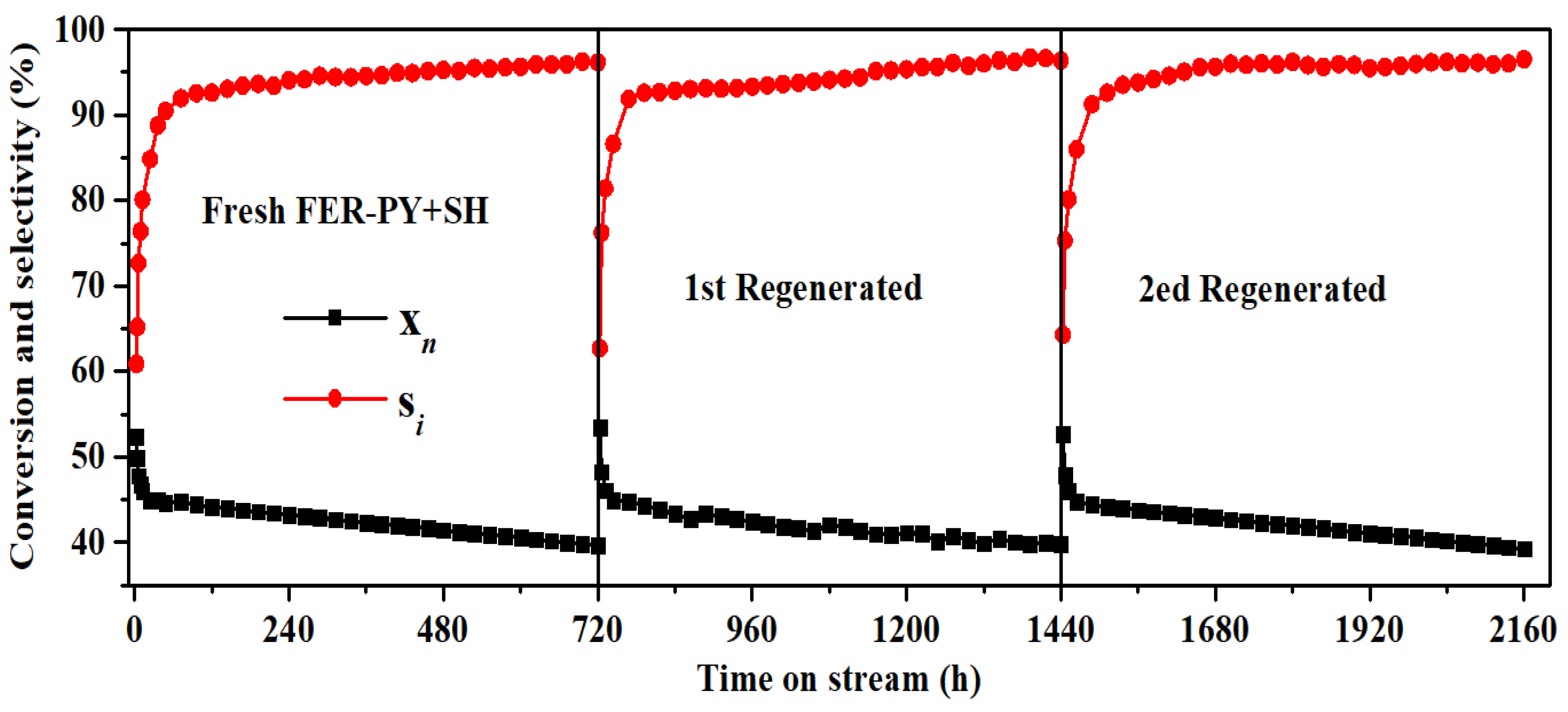
In conclusion, the preparation of FER-PY+SH zeolites using a combination of H-form seeds and pyrrolidine enriches the number of BAS in the 10-MR, effectively suppressing the bimolecular mechanism. The FER-PY+SH samples thus demonstrate excellent isomer selectivity and yields in the isomerization of n-butene.
3. Experimental
3.1. Materials
The reagents used for the synthesis of FER zeolite were silica sol (SS3015, 30% SiO2, 0.02%NaO2, Shandong Baite New Material Co., Ltd.), sodium metaaluminate (NaAlO2, 99.0%, Tianjin Kermel Chemical Reagent Co., Ltd.), sodium hydroxide (NaOH, 96.0%, Tianjin Kermel Chemical Reagent Co., Ltd.), pyrrolidine (PY) (C4H9N, 99%, Tianjin Kermel Chemical Reagent Co., Ltd.), ammonium chloride (NH4Cl, 99%, Tianjin Kermel Chemical Reagent Co., Ltd.), and deionized water.
3.2. Preparation of FER-X Zeolites
3.2.1. Preparation of Seeds
Typically, deionized water and NaOH aqueous solution were slowly added to silica sol (SiO2, 30 wt%), and stirred vigorously for 1 h. Then, NaAlO2 aqueous solution and pyrrolidine (PY) were added, followed by stirring for 2 h to form a homogeneous suspension with a molar composition of 0.1 Na2O:0.033 Al2O3:1 SiO2:25 H2O:0.22 PY. The suspension was transferred into a Teflon-lined stainless-steel autoclave and crystallized at 160 ℃ under a rotation of 200 rpm for 72 h. After the hydrothermal synthesis, the product was washed with distilled water until it reached a neutral pH. Then dried at 120 ℃ overnight and calcinated at 550 ℃ in air for 6 h to obtain Na-form FER. The Na-form FER zeolites were subsequently converted into into NH4-form via ion exchange with 1 mol/L NH4Cl solution at 80 ℃ for 2 h, this process was repeated twice. Then, the resulting white slurry was filtered and dried at 120 ℃ for 6 h. Finally, H-form FER zeolite catalysts were obtained by calcination of NH4-type FER zeolites in air at 500 ℃ for 4 h. These Na-form FER and H-form FER were used as the seeds.
3.2.2. Preparation of Seed-Derived FER-X zeolites
The seed-derived FER zeolites was prepared as fellows: organic structure directing agents were not used, while the remaining synthetic processes were kept identical to the procedures described above. Finally, the Na-form FER and H-form FER as seeds added to form homogeneous suspension with a molar composition of 0.1 Na2O:0.033 Al2O3:1 SiO2:25 H2O: 15% wt seeds. The prepared mother gel was transferred into a Teflon-lined stainless-steel autoclave and crystallized at 160 ℃ under a rotation of 200 rpm for 72 h, followed by centrifuging, rinsing, drying overnight at 120 ℃ to afford Na-form FER.
The method of synthesizing FER zeolites using both PY and Na-form FER or H-form FER as seeds simultaneously is similar to the synthesis methods of the two aforementioned FER zeolites. Finally, the homogeneous suspension with a molar composition of 0.1 Na2O:0.033 Al2O3:1. SiO2:25 H2O: 0.12PY:15% wt seeds was transferred into a Teflon-lined stainless-steel reactor, and then hydrothermal synthesis was conducted for 72 h at 160 °C with 200 rpm. The white gel obtained after several washing steps and dried at 120 ℃ for 6 h, and further calcined at 550 °C in air for 6 h to afford Na-form FER.
3.2.3. Preparation of H-form FER zeolites
All of the Na-form FER zeolites were transformed into NH4-form via ion exchange with 1 mol/L NH4Cl solution at 80 ℃ for 2 h. This process that was repeated twice. Then, the resulting white slurry was filtered and dried at 120 ℃ for 6 h. Finally, H-form FER zeolite catalysts were obtained by calcining of NH4-type FER zeolites in air at 500 ℃ for 4 h. The H-form FER zeolite prepared using PY was labeled as FER-PY, the H-form FER zeolite prepared by Na-form FER zeolites as seeds induction was denoted as FER-SN, the H-form FER zeolite prepared by H-form FER zeolites as seeds induction was denoted as FER-SH, and the H-form FER zeolite prepared PY and Na-form FER zeolites or H-form FER zeolites as seeds simultaneously was denoted as FER-PY+SN and FER-PY+SH respectively. Finally, the H-form FER zeolite was compressed and formed to obtain a catalyst for the skeletal isomerization of n-Butene.
3.3. Characterization of Catalysts
X-ray diffraction (XRD) was used to measure the crystallization and phase of the FER catalysts performed with a Rigaku D/max 2550 VB/PC diffractometer apparatus with Cu Ka radiation (λ = 0.15406 nm) at a voltage and current of 40 kV and 40 mA, respectively. The 2θ scanning range was from 5 to 40° with a scan rate of 4° / min and the step size of 0.02°. The R.C.s of the catalysts were obtained by calculating the sum of the peak intensity at 2θ = 9.3±0.1°, 22.3±0.1°, 23.5±0.1°, 24.3±0.1°, 25.2±0.1°, 25.7±0.1°, 28.5±0.1°, and the R.C.s of FER-PY was set as 100%.
The scanning electron microscopy (SEM) images of the samples were analyzed using a Nava Nano SEM 450 microscope to confirm the crystal morphology and size. The sodium content and SiO2/Al2O3 molar ratio of the samples were determined by X-ray fluorescence (XRF) analysis by using a ZSX Primus Ⅱ instrument operated at 60 kV and 150 mA. The textural characterization of the FER catalysts was performed by N2 adsorption–desorption at -196 ℃ with a US Micromeritics ASAP 2020 V3.00 H nitrogen adsorption analyzer. The FER catalysts were outgassed at 350℃ for 5 h under the vacuum of 10-3 Pa to remove moisture and volatile impurities before the adsorption measurement. The specific surface areas were obtained by the Brunauer-Emmett-Teller (BET) method and the pore volume was calculated by N2 adsorption at a relative pressure of 0.99.
The temperature-programmed desorption of ammonium (NH3-TPD) with Micromeritics chemisorb 2720 instrument equipped with a thermal conductivity detector was used to study the acid properties of the catalysts. Typically, 150 mg of the sample was first preheated under a He stream of 30 mL∙min-1 at 550℃ for 1 h, then purged in a 5% NH3-He flow (30 mL∙min-1) at 100℃ for 40 min. Subsequently, the sample was treated under a He flow of 30 mL∙min-1 at 100°C for 60 min to remove the physically-adsorbed NH3. Finally, the samples were heated from 100 to 550℃ using a temperature ramp of 10℃∙min-1, and the quantity of NH3 desorbed was measured by a TCD detector.
Pyridine adsorption Fourier transform infrared (Py-IR) was used to determine B acid and L acid concentrations using a Bruker Tensor 27 infrared spectrometer. Approximately, the sample powder (30 mg) was formed into self-supporting wafer (dimeter 20mm) and then placed inside the reaction tank. The sample was degassed under vacuum at 500℃ for 2h under high vacuum conditions of 10−3 Pa, and then the sample was saturated with the probe molecule pyridine at 40℃ for 30 min, and subsequently, the physisorbed molecules were removed at 150 ℃ for 30 min. IR spectra was recorded at 350 ℃. The adsorption peaks located at 1540 cm-1 and 1450 cm-1 were assigned to B acid and L acid, respectively. The concentration of acid sites was calculated from the IR results using the extinction coefficient and integrated intensity of the desorption peak and the sample weight reported by Emeis [49].
Magic-angle-spinning nuclear-magnetic-resonance (MAS NMR) spectra of 27Al and 29Si were collected on a Bruker Avance III 600 MHz Wide Bore spectrometer (Bruker, Rheinstetten, Germany). The single-pulse sequence was adopted with a 10° pulse and a delay time of 0.3 s. The chemical shifts for 27Al and 29Si were calibrated by referring to AlCl3 and tetramethylsilane, respectively. The 27Al MAS NMR \ spectra were deconvoluted by using the mixed Gaussian–Lorentzian equation.
3.4. Catalyst Evaluation
The skeletal isomerization of n-butene was was conducted under atmospheric pressure in a fixed bed stainless-steel reactor unit, the tubular reactor having 12 mm inner diameter and 800mm length. Firstly, 3 g of the HFER catalyst (20-40 mesh) was placed in the middle of reactor, and the catalyst was pretreated under a N2 flow at a heating rate of 10 ℃/ min, and the system was purged for 1 h. The feed stream of post-MTBE C4 was fed into the reactor by a mass flow controller to start the skeletal isomerization when heated to 350℃ at a weight hourly space velocity (WHSV) of n-butene was 2.0 h-1. The properties of the post-MTBE C4 are listed in Table 4.
The products were analyzed using an Agilent 7890B gas chromatograph equipped with a flame ionization detector and an Agilent-GS-Alumina capillary column (50 m × 0.532 mm). Since the equilibrium of 1-butene, trans-2-butene, and cis-2-butene was established rapidly through double-bond isomerization at the temperature of the reaction, and all the straight-chain butene isomers were transformed to isobutylene, all of the straight-chain butene was considered as the n-butene reactant.
The conversion of n-butene (xn) was defined as:
The selectivity of isobutene (si) was defined as:
where m0, m1, m2, and m3 are the weights of n-Butene in the feed, the weights of n-Butene in the reaction products, the weights of isobutylene in the reaction products, and the weights of isobutylene in the feed, respectively.
The production rate of isobutene (space time yield, STYiso-c4=) was defifined as the average moles of isobutene produced at the reaction duration of 24–48 h [mmol g-1 h-1].
4. Conclusions
FER type zeolites have been successfully prepared in pyrrolidine as organic template or without pyrrolidine systems utilizing Na-form or H-form as seed. The seed derived FER samples own similar topological and morphological properties compared to the pyrrolidine derived one, as well as close total acid densities. The choice of H-form seed and pyrrolidine induces more BAS in the 10-MR of FER structure. As the BAS in 8-MR and LAS is responsible for the bimolecular mechanism that tends to cause more carbon depositions and side-products in n-Butene skeleton isomerization, the FER-PY+SH samples exhibit better isobutene selectivity and higher stability than the counterparts synthesized by Na-form as normal seed. By optimizing the synthetic parameters, the FER-PY+SH could be continuously operated for 720 h at 350 ℃, 0.1 MPa for three recycles, and the n-butene mass space velocity of 2.0 h-1, during which the n-butene conversion keeps higher than 39%, the selectivity of isobtene is higher 95%, and the iso-butene yield is higher than 37.5%.
Author Contributions
F.J.: investigation, data curation, writing—original draft. Z.X.: methodology, conceptualization, supervision, writing—review and editing. Y.F.: methodology, writing—original draft. X.Y.: methodology formal analysis, project administration. C.L.: validation, formal analysis. All authors have read and agreed to the published version of the manuscript.
Data Availability Statement
Not applicable.
Acknowledgments
The authors gratefully acknowledge the funding of the project by CNPC (2018B-1907).
Conflicts of Interest
The authors declare no conflict of interest.
References
- Heriberto Díaz Velázquez, Likhanova N, Aljammal N,et al. New Insights into the Progress on the Isobutane/Butene Alkylation Reaction and Related Processes for High-Quality Fuel Production. A Critical Review[J]. Energy & Fuels 2020, 34, 15525–15556. [Google Scholar]
- Xu Q, Yang W, Chen Z; et al. Formation and regeneration of shape-selective ZSM-35 catalysts for n-Butene skeletal isomerization to isobutylene[J]. ACS Omega 2018, 3, 8202–8211. [Google Scholar] [CrossRef] [PubMed]
- Corma, A. Inorganic solid acids and their use in acid-catalyzed hydrocarbon reactions[J]. Chemical Reviews 1995, 95, 559–614. [Google Scholar] [CrossRef]
- Houzvicka J, Ponec V. Skeletal isomerization of n -Butenes[J]. Catalysis Reviews. Science and Engineering 1997, 39, 319–344. [Google Scholar] [CrossRef]
- Paul M, Naccache C. Skeletal isomerisation of n-butenes catalyzed by medium-pore zeolites and aluminophosphates[J]. Advances in Catalysis 2010, 31, 505–543. [Google Scholar]
- Vaughan P, A. The crystal structure of the zeolite ferrierite[J]. Acta Crystallographica, 1966, 21, 983–990. [Google Scholar] [CrossRef]
- Xu H, Zhu J, Zhu L, Zhou E, Shen C. Advances in the synthesis of ferrierite zeolite[J]. Molecules 2020, 25, 3722–3739. [Google Scholar] [CrossRef]
- Mooiweer H H, de Jong K P, Kraushaar-Czarnetzki B, Stork W H J, Krutzen B C H. Skeletal isomerisation of olefins with the zeolite ferrierite as catalyst[J]. Studies in Surface Science and Catalysis 1994, 84, 2327–2334. [Google Scholar]
- Wichterlová B, Ilkova N, Uvarova E; et al. Effect of Broensted and Lewis sites in ferrierites on skeletal isomerization of n-Butenes[J]. Applied Catalysis A General 1999, 182, 297–308. [Google Scholar] [CrossRef]
- Domokos L, Lefferts L, Seshan K; et al. The importance of acid site locations for n-Butene skeletal isomerization on ferrierite[J]. Journal of Molecular Catalysis A Chemical 2000, 162, 147–157. [Google Scholar] [CrossRef]
- Pinar A B, Márquez-álvarez C, Grande-Casas M; et al. Template-controlled acidity and catalytic activity of ferrierite crystals[J]. Journal of Catalysis 2009, 263, 258–265. [Google Scholar] [CrossRef]
- Seo G, Jeong H S, Hong S B; et al. Skeletal isomerization of 1-Butene over ferrierite and ZSM-5 zeolites: Influence of zeolite acidity[J]. Catalysis Letters 1996, 36, 249–253. [Google Scholar] [CrossRef]
- Donk S V, Bus E, Broersma A; et al. Probing the accessible sites for n-Butene skeletal isomerization over aged and selective H-Ferrierite with d3-acetonitrile[J]. Journal of Catalysis 2002, 212, 86–93. [Google Scholar] [CrossRef]
- Corma, A. From Microporous to Mesoporous Molecular Sieve Materials and Their Use in Catalysis[J]. Chem. ReV. 1997, 97, 2373–2420. [Google Scholar] [CrossRef]
- Li J, Gao M, Yan W; et al. Regulation of the Si/Al ratios and Al distributions of zeolites and their impact on properties[J]. Chem. Sci. 2023, 14, 1935–1959. [Google Scholar] [CrossRef] [PubMed]
- Mercedes,B; Corma A. What Is Measured When Measuring Acidity in Zeolites with Probe Molecules?[J]. ACS Catalysis 2019, 9, 1539–1548. [Google Scholar] [CrossRef] [PubMed]
- Palcic A V, V. Analysis and control of acid sites in zeolites[J]. Applied Catalysis, A. General: An International Journal Devoted to Catalytic Science and Its Applications 2020, 606, 117795. [Google Scholar] [CrossRef]
- Xiong Z P, Qi G D, Bai L Y; et al. Preferential population of Al atoms at the T4 site of ZSM-35 for the carbonylation of dimethylether[J]. Catal. Sci. Technol. 2022, 12, 4993–4997. [Google Scholar] [CrossRef]
- Bohinc R, Hoszowska J, Dousse J C; et al. Distribution of aluminum over different T-sites in ferrierite zeolites studied with aluminum valence to core X-ray emission spectroscopy[J]. Physical Chemistry Chemical Physics 2017, 19, 29271–29277. [Google Scholar] [CrossRef]
- Pinar A B, Verel R, Pariente P P; et al. Direct evidence of the effect of synthesis conditions on aluminum sitting in zeolite ferrierite: A 27Al MQ MAS NMR study[J]. Microporous and Mesoporous Materials 2014, 193, 1–17. [Google Scholar]
- Pinar A B, Hortiguela L G, McCusker L B; et al. Controlling the Aluminum Distribution in the Zeolite Ferrierite via the Organic Structure Directing Agent[J]. Chem. Mater. 2013, 25, 3654–3661. [Google Scholar] [CrossRef]
- Alvarez C M, Pinar A B, García R; et al. Influence of Al distribution and defects concentration of ferrierite catalysts synthesised from na-free gels in the skeletal isomerisation of n-Butene[J]. Top Catal 2009, 52, 1281–1291. [Google Scholar] [CrossRef]
- Leshkov Y R, Moliner M, Davis M E. Impact of Controlling the Site Distribution of Al Atoms on Catalytic Properties in Ferrierite-Type Zeolites[J]. J. Phys. Chem. C 2011, 115, 1096–1102. [Google Scholar] [CrossRef]
- Chu W F, Liu X N, Yang Z Q; et al. Constrained Al sites in FER-type zeolites[J]. Chinese Journal of Catalysis 2021, 42, 2078–2087. [Google Scholar] [CrossRef]
- Kim S, Park G, Woo M H; et al. Control of hierarchical structure and framework-Al distribution of ZSM-5 via adjusting crystallization temperature and their effects on methanol conversion[J]. ACS Catalysis 2019, 9, 2880–2892. [Google Scholar] [CrossRef]
- Gabova V, Dedecek J, Cejka. Control of Al distribution in ZSM-5 by conditions of zeolite synthesis[J]. J. Chem. Commun. 2003, 10, 1196–1197. [Google Scholar]
- Nishitoba T, Yoshida N, Kondo J N; et al. Control of Al distribution in the CHA-type aluminosilicate zeolites and its impact on the hydrothermal stability and catalytic properties[J]. Ind. Eng. Chem. Res 2018, 57, 3914–3922. [Google Scholar] [CrossRef]
- Heard C J, Luká G, Nachtigall P. The effect of water on the validity of Lwenstein’s rule[J]. Chemical Science 2019, 10, 5705–5711. [Google Scholar] [CrossRef] [PubMed]
- Iorio J R D, Gounder R. Controlling the isolation and pairing of aluminum in Chabazite zeolites using mixtures of organic and inorganic structure-directing agents[J]. Chem. Mater. 2016, 28, 2236–2247. [Google Scholar] [CrossRef]
- Iorio J R D, Li S, Jones C B; et al. Cooperative and competitive occlusion of organic and inorganic structure directing agents within Chabazite zeolites influences their aluminum arrangement[J]. Journal of the American Chemical Society 2020, 142, 4807–4819. [Google Scholar] [CrossRef]
- Fletcher R E, Ling S, Slater B. Violations of Löwensteins rule in zeolites[J]. Chem Sci 2017, 8, 7483–7491. [Google Scholar] [CrossRef] [PubMed]
- Inagaki S, Yamada N, Nishii M; et al. Control of framework Al distribution in ZSM-5 zeolite via post-synthetic TiCl4 treatment[J]. Microporous and Mesoporous Materials 2020, 302, 1102231–1102239. [Google Scholar]
- Vjunov A, Fulton J L, Huthwelker T; et al. Quantitatively Probing the Al Distribution in Zeolites[J]. Am. Chem. Soc. 2014, 136, 8296–8306. [Google Scholar] [CrossRef] [PubMed]
- Holzinger J, Beato P, Lundegaard, L F; et al. Distribution of Aluminum over the tetrahedral sites in ZSM-5 zeolites and their evolution after steam treatment[J]. The journal of physical chemistry, C, Nanomaterials and interfaces 2018, 122, 15595–15613. [Google Scholar] [CrossRef]
- Meng X J, Xiao F S. Green routes for synthesis of zeolites[J]. Chemical Reviews 2014, 114, 1521–1543. [Google Scholar] [CrossRef]
- Ye Z, Zhang H, Zhang Y; et al. Seed-induced synthesis of functional MFI zeolite materials:Method development, crystallization mechanisms, and catalytic properties[J]. Front. Chem. Sci. Eng. 2020, 14, 1–16. [Google Scholar]
- Zhang H, Zhao Y, Zhang H; et al. Tailoring zeolite ZSM-5 crystal morphology porosity through flexible utilization of Silicalite-1 seeds as templates: Unusual crystallization pathways in a heterogeneous system[J]. Chemistry-A European Journal 2016, 22, 7141–7151. [Google Scholar] [CrossRef]
- Ji Y, Wang Y, Xie B; et al. Zeolite Seeds: Third Type of Structure Directing Agents in the Synthesis of Zeolites[J]. Comments on Inorganic Chemistry 2016, 36, 1–16. [Google Scholar] [CrossRef]
- Zhang H, Guo Q, Ren L; et al. Organotemplate-free synthesis of high-silica ferrierite zeolite induced by CDO-structure zeolite building units[J]. Journal of Materials Chemistry 2011, 21, 9494–9497. [Google Scholar] [CrossRef]
- Ham H, Junga H S, Kim H S; et al. Gas-phase carbonylation of dimethyl ether on the stable seed derived Ferrierite[J]. ACS Catal 2020, 10, 5135–5146. [Google Scholar] [CrossRef]
- Kima J, Hama H, Junga H S; et al. Dimethyl ether carbonylation to methyl acetate over highly crystalline zeolite-seed derived Ferrierite[J]. Catalysis Science & Technology 2018, 8, 3060–3072. [Google Scholar]
- Kwak S J, Kim H S, Park N; et al. Recent progress on Al distribution over zeolite frameworks: Linking theories and experiments[J]. Korean J. Chem. Eng. 2021, 38, 1117–1128. [Google Scholar] [CrossRef]
- Guo Y X, Wang S, Geng R; et al. Enhancement of the dimethyl ether carbonylation activation via regulating acid sites distribution in FER zeolite framework[J]. iScience 2023, 26, 1–13. [Google Scholar]
- Xue T, Li S S, Wu H H. Surfactant-promoted synthesis of hierarchical zeolite ferrierite nano-sheets[J]. Microporous and Mesoporous Materials 2021, 312, 1107481–1107488. [Google Scholar]
- Xie S J, Peng J B, Xu L Y; et al. Synthesis of ZSM-35 zeolite using cyclohexylamine as organic template and its catalytic performance[J]. Chinese Journal of Catalysis 2003, 24, 531–534. [Google Scholar]
- Houzvicka J, Nienhuis J G, Ponec V. The role of the acid strength of the catalysts in the skeletal isomerisation of n-Butene[J]. Applied Catalysis A General 1998, 174, 207–212. [Google Scholar] [CrossRef]
- Xu W Q, Yin Y G, Suib S L; et al. Modification of non-template synthesized ferrierite/ZSM-35 for n-Butene skeletal isomerization to isobutylene[J]. Journal of Catalysis 1996, 163, 232–244. [Google Scholar] [CrossRef]
- Raúl, A. Comelli. Skeletal Isomerization of Linear Butenes on Boron Promoted Ferrierite: Effect of the Catalyst Preparation Technique[J]. Catalysis Letters 2008, 122, 302–309. [Google Scholar]
- Emeis C A. Determination of Integrated Molar Extinction Coefficients for Infrared Absorption Bands of Pyridine Adsorbed on Solid Acid Catalysts[J]. Journal of Catalysis 1993, 141, 347–354. [Google Scholar] [CrossRef]
Figure 1.
XRD patterns of of various FER-X zeolites.
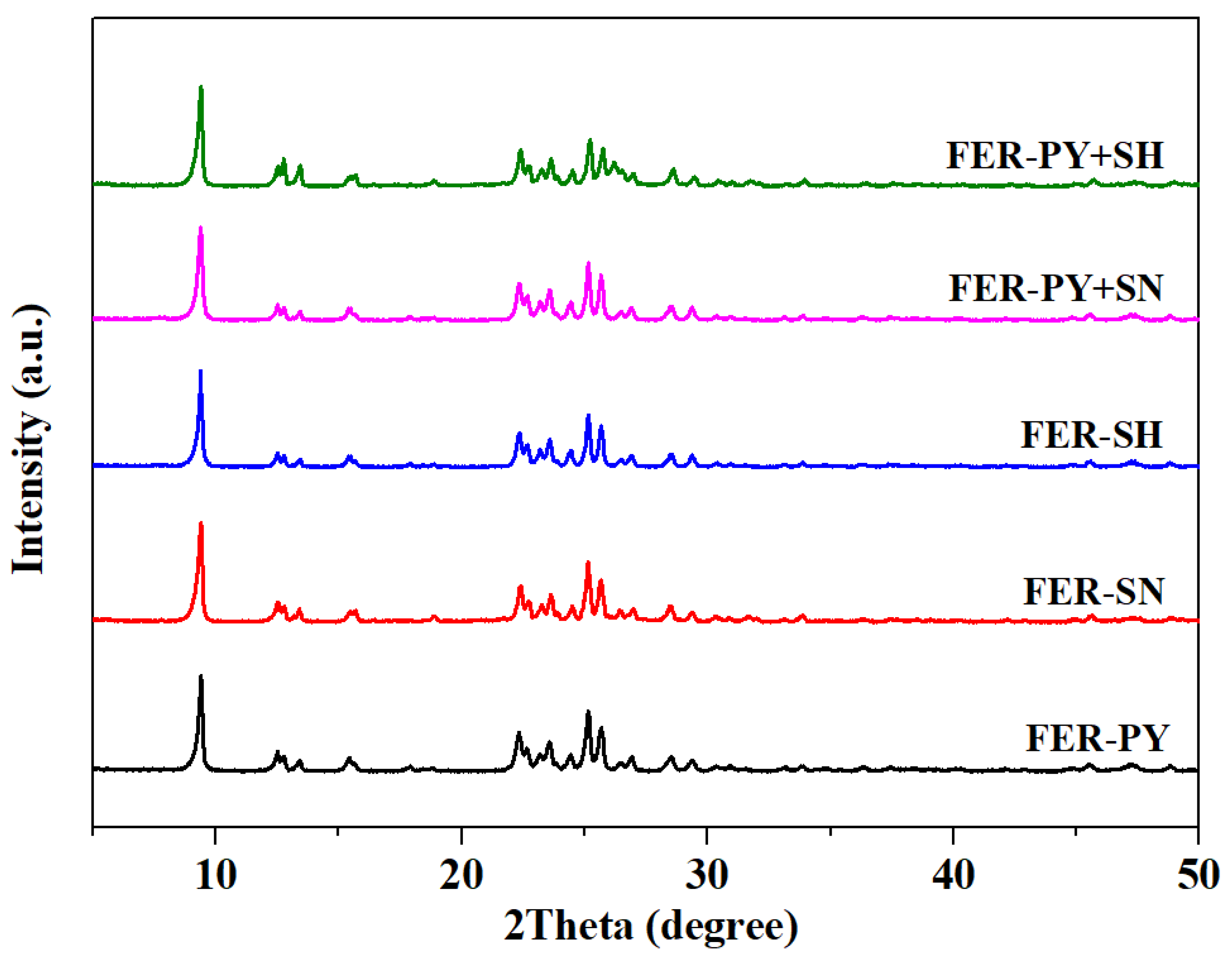
Figure 2.
SEM images of various FER-X zeolites.
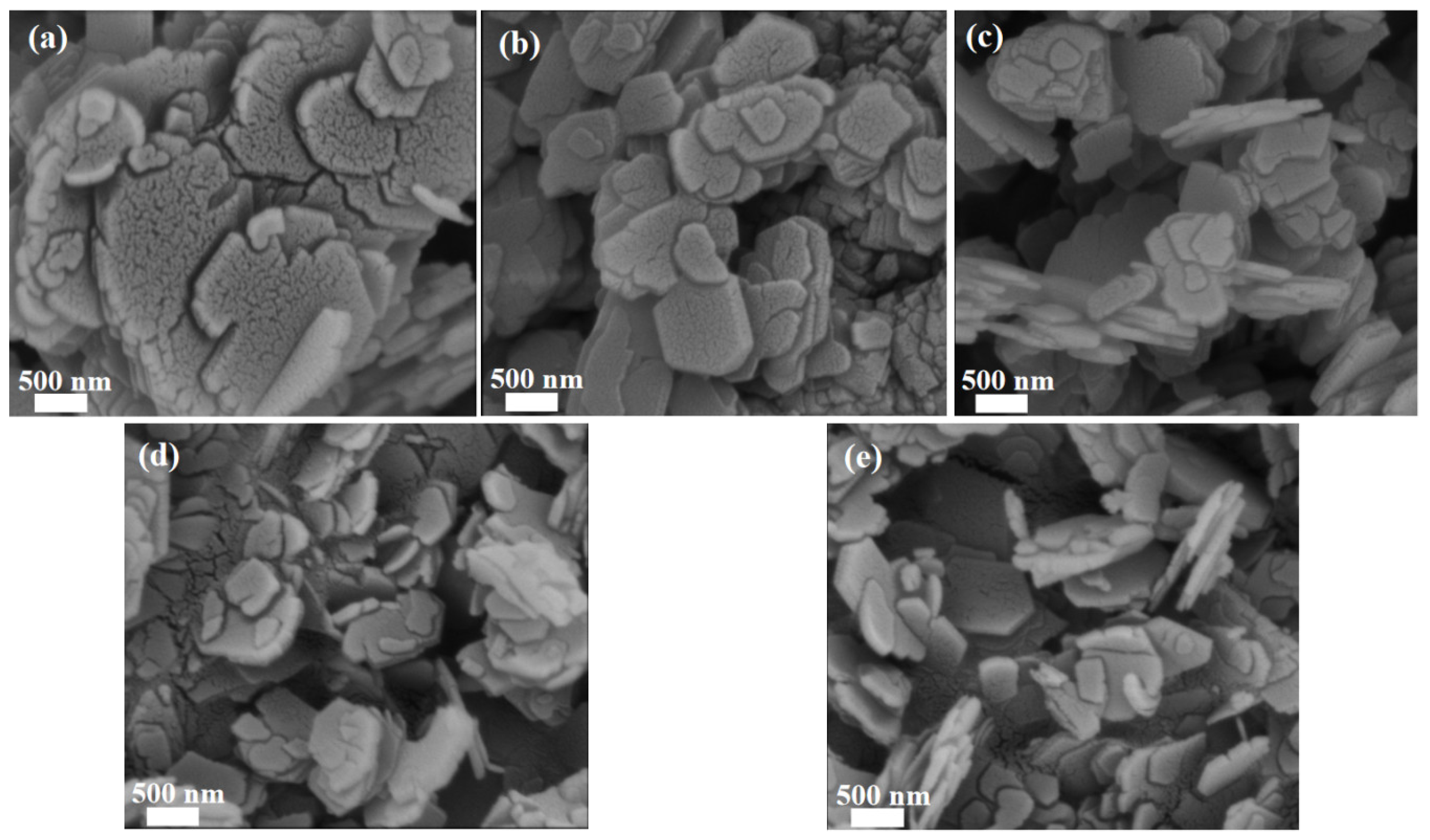
Figure 3.
NH3-TPD and Py--IR profiles of various FER-X zeolites.
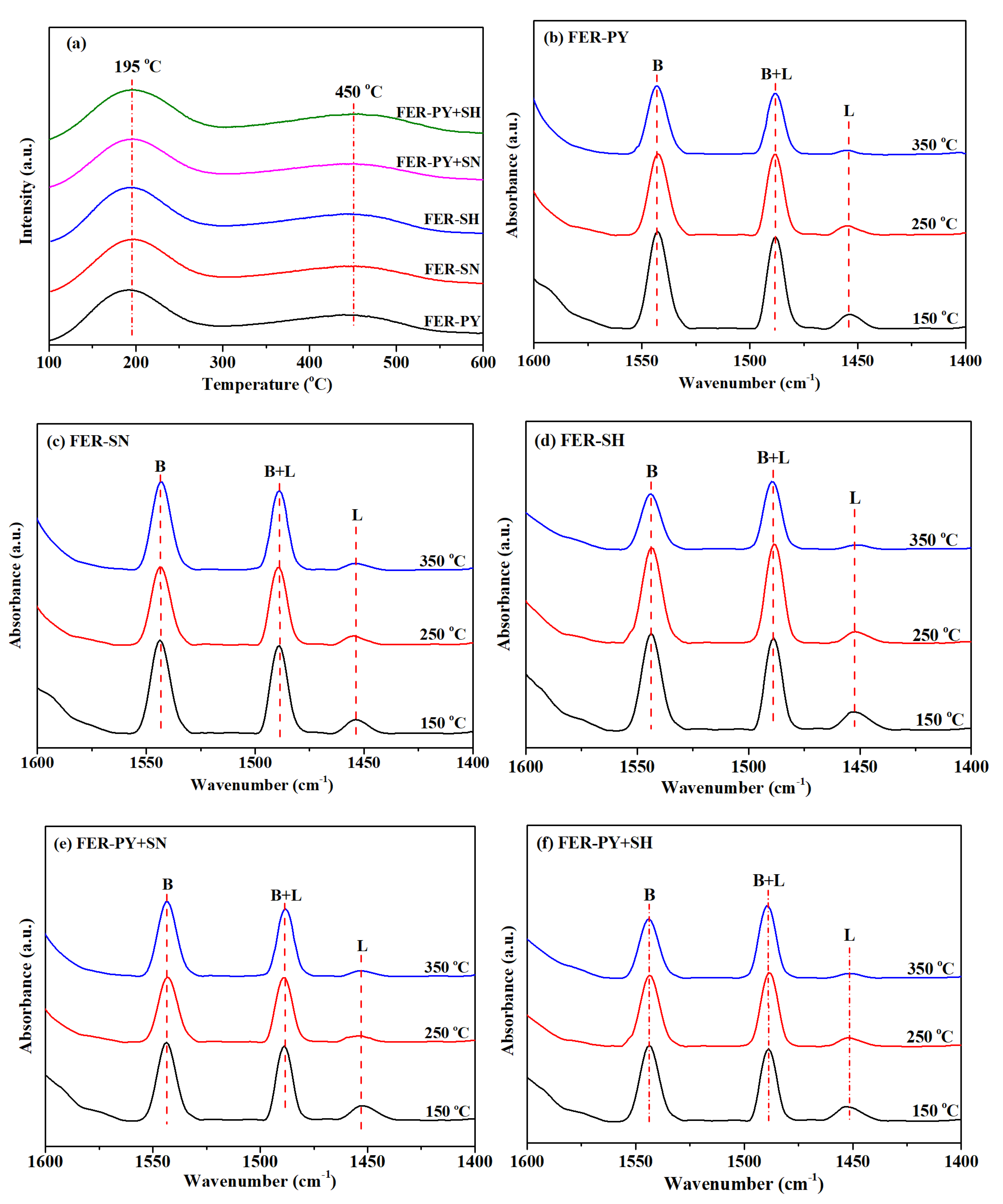
Figure 4.
29Si MAS NMR spectra of various FER-X zeolites.
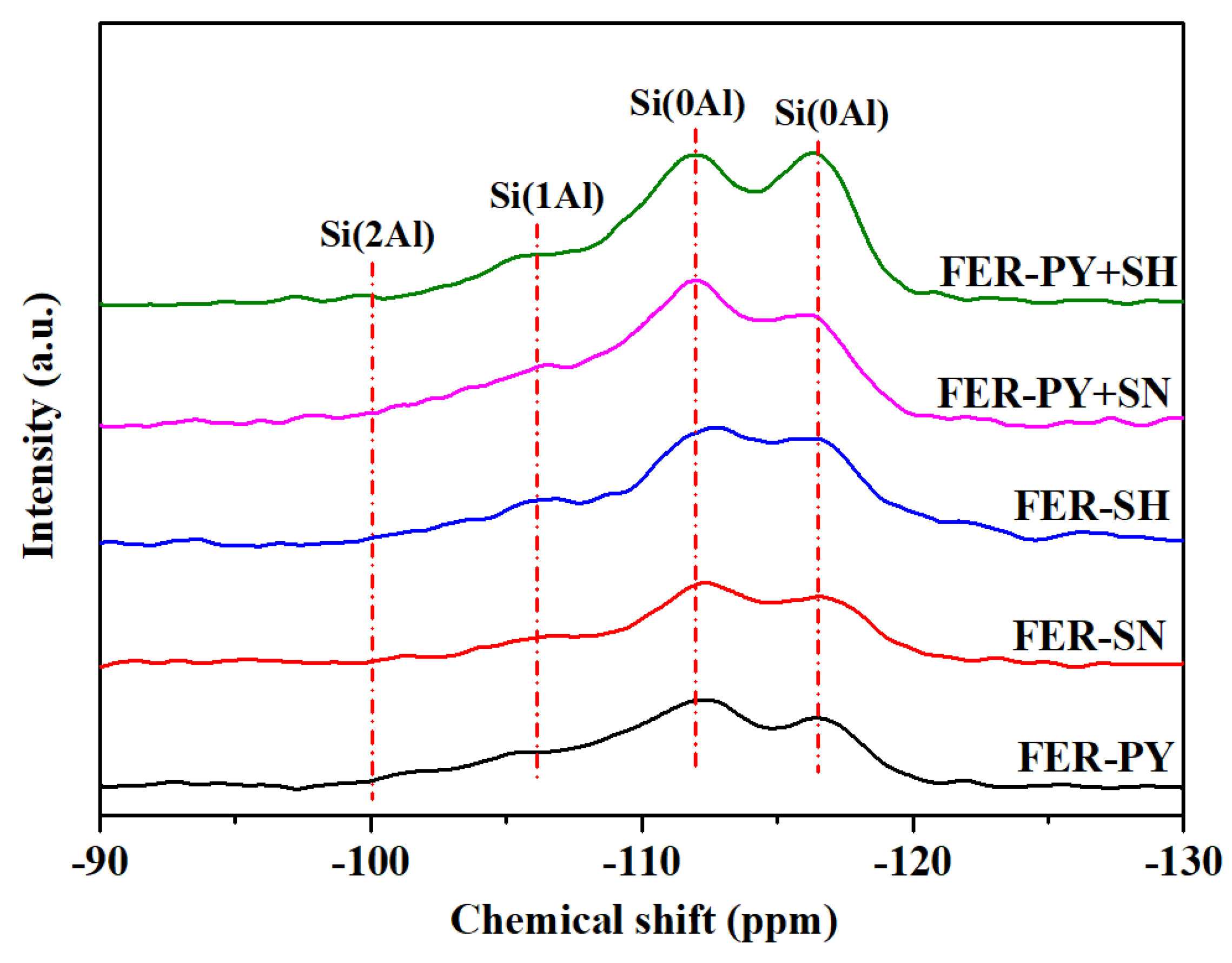
Figure 5.
27Al MAS NMR spectra of various FER-x zeolites.
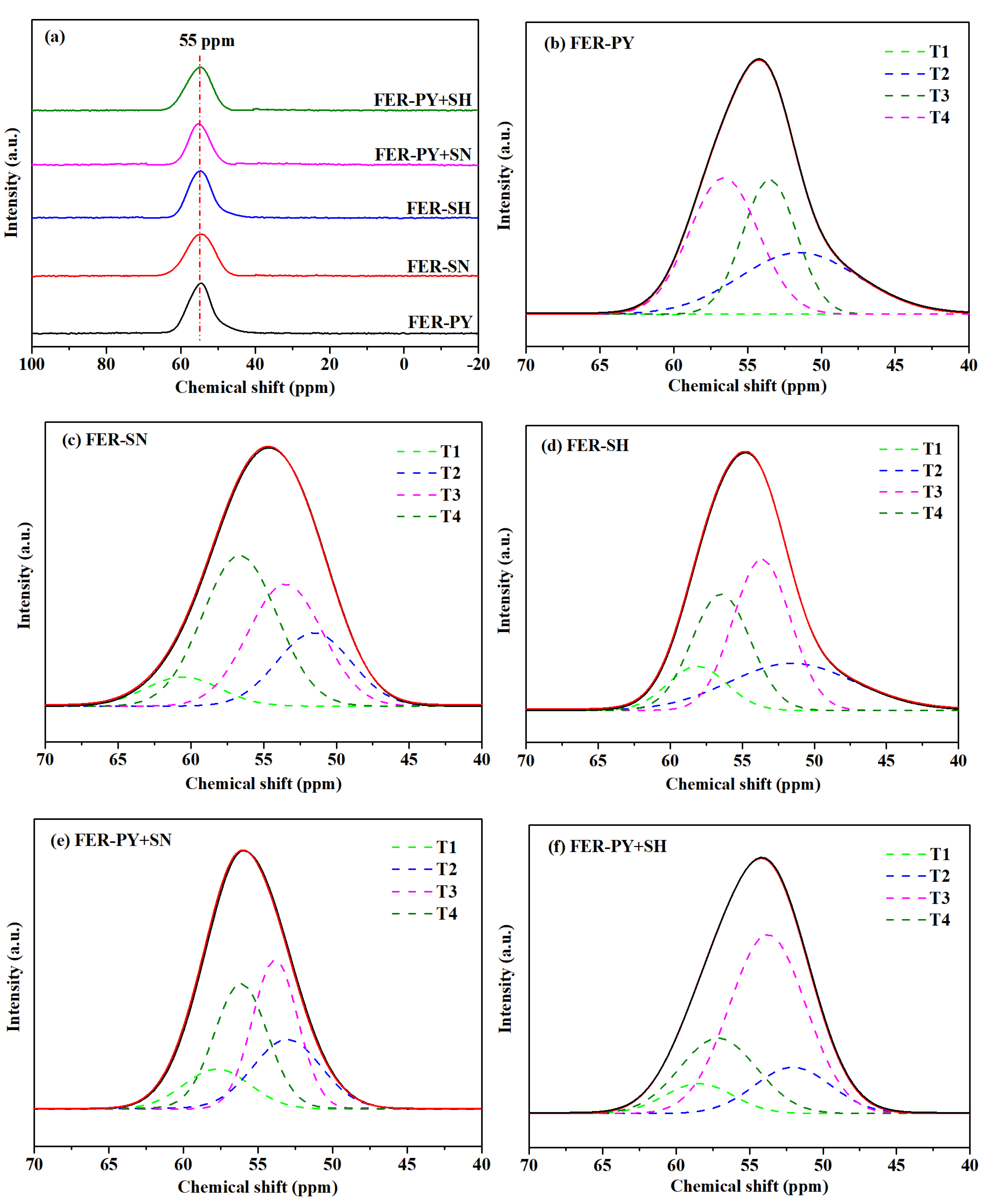
Figure 6.
The influence of the Al distribution on the acid distribution of various FER-X zeolites.
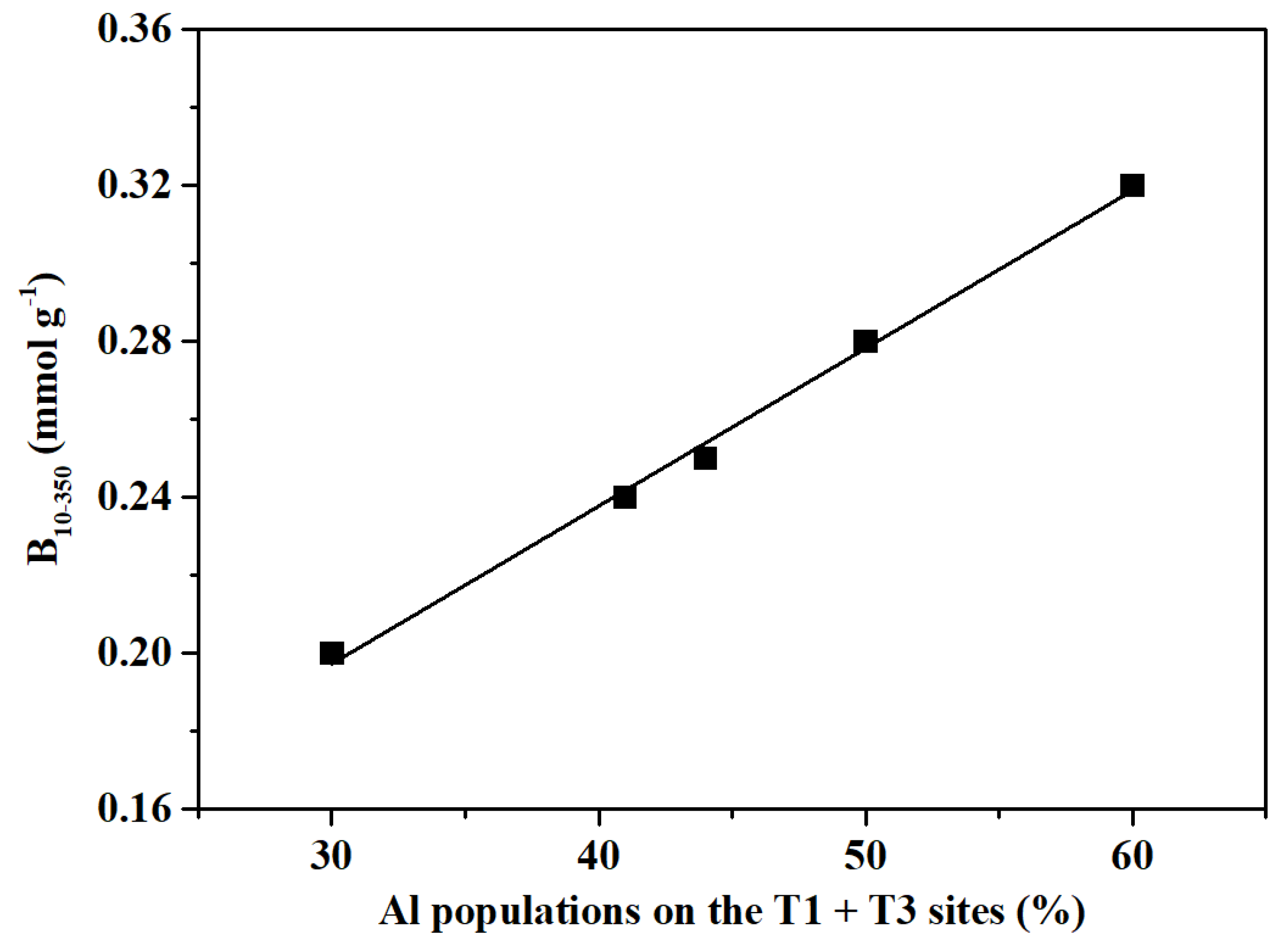
Figure 7.
Catalytic performance of various FER-X zeolites for sketal isomerization of n-Butene from post-MTBE C4.
Figure 7.
Catalytic performance of various FER-X zeolites for sketal isomerization of n-Butene from post-MTBE C4.
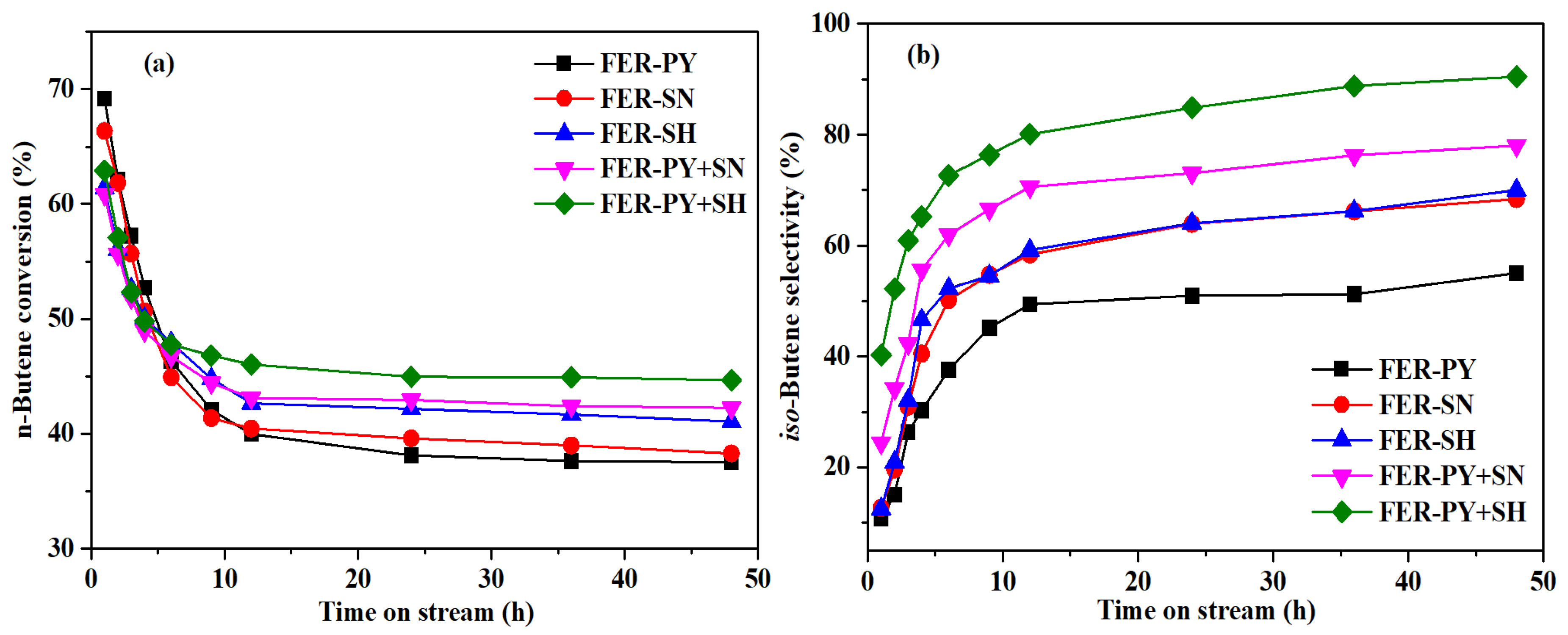
Figure 8.
Relationship between STYi-C4= and strong BAS content in 10-MR channels (a) or Al distribution on the T1+T3 (b).
Figure 8.
Relationship between STYi-C4= and strong BAS content in 10-MR channels (a) or Al distribution on the T1+T3 (b).
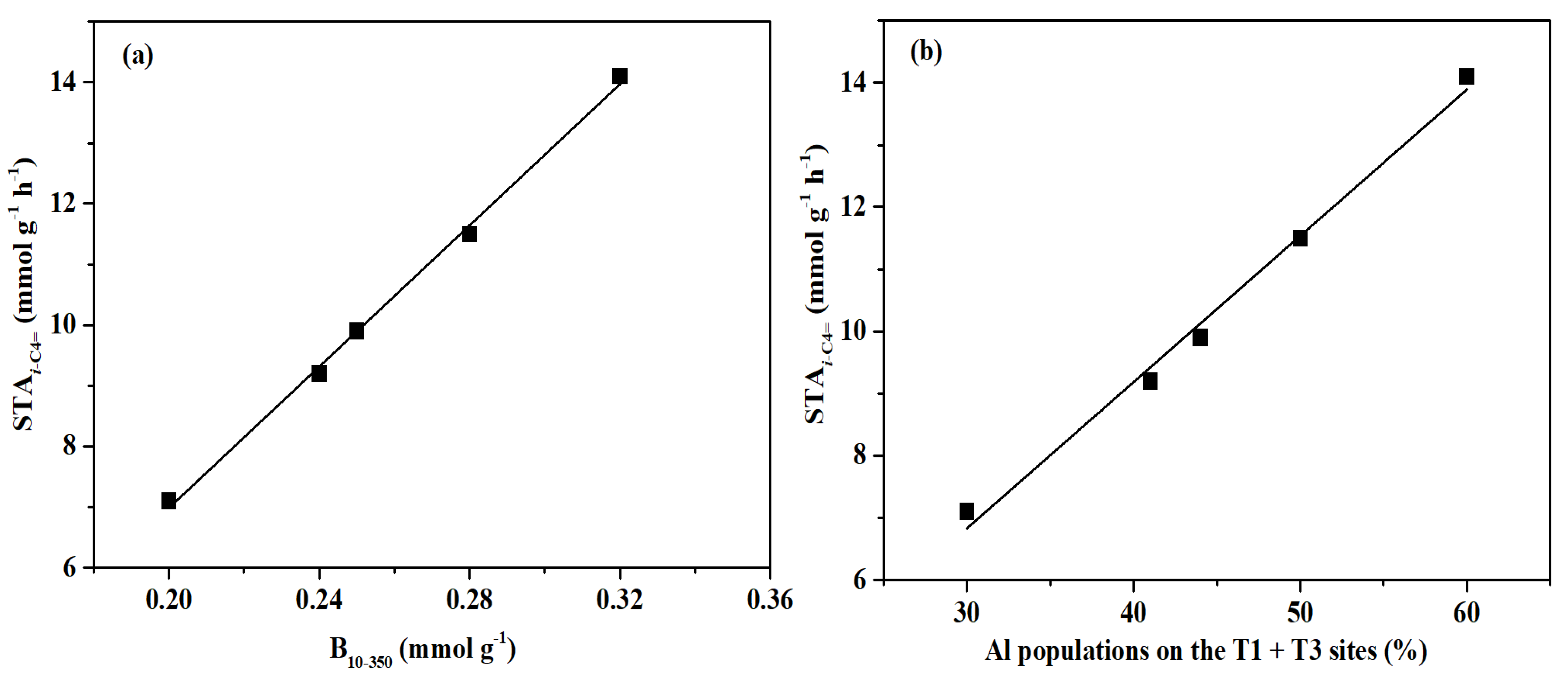

Table 1.
Textural properties of of various FER-X zeolites.
| Sample | Na2O(mg/g) | SARs | Crystallinity(%) | Surface Area (m2/g) | Pore Volume (cm3/g) | ||
|---|---|---|---|---|---|---|---|
| Total | Micro | Total | Micro | ||||
| FER-PY | 40 | 25.6 | 100 | 431 | 388 | 0.27 | 0.14 |
| FER-SN | 39 | 25.3 | 101 | 428 | 386 | 0.27 | 0.14 |
| FER-SH | 36 | 24.6 | 99 | 422 | 380 | 0.26 | 0.13 |
| FER-PY+SN | 42 | 25.3 | 100 | 430 | 378 | 0.28 | 0.14 |
| FER-PY+SH | 41 | 24.8 | 101 | 432 | 390 | 0.28 | 0.15 |
Table 2.
Amounts of Acid in the Various FER-X Samples.
| Sample | Acidity by NH3-TPDa(mmol/g) | Acidity by Py-IRb(mmol/g) | |||||
|---|---|---|---|---|---|---|---|
| Weak | Strong | Total | Brønsted | Lewis | Total | B10-350c | |
| FER-PY | 0.79 | 0.56 | 1.35 | 0.29 | 0.03 | 0.32 | 0.20 |
| FER-SN | 0.78 | 0.55 | 1.33 | 0.28 | 0.03 | 0.31 | 0.24 |
| FER-SH | 0.75 | 0.53 | 1.28 | 0.28 | 0.03 | 0.31 | 0.25 |
| FER-PY+SN | 0.76 | 0.52 | 1.28 | 0.30 | 0.03 | 0.33 | 0.28 |
| FER-PY+SH | 0.81 | 0.56 | 1.37 | 0.34 | 0.02 | 0.35 | 0.32 |
Table 3.
Aluminum distribution obtained from the curve fifitting of 27Al MAS NMR spectra of various FER-X zeolites.
Table 3.
Aluminum distribution obtained from the curve fifitting of 27Al MAS NMR spectra of various FER-X zeolites.
| Sample | Aluminum Distribution (%) | ||||
|---|---|---|---|---|---|
| T1 | T2 | T3 | T4 | T1+T3 | |
| FER-PY | 0 | 30 | 30 | 39 | 30 |
| FER-SN | 8 | 19 | 33 | 40 | 41 |
| FER-SH | 10 | 25 | 34 | 31 | 44 |
| FER-PY+SN | 12 | 21 | 38 | 29 | 50 |
| FER-PY+SH | 6 | 15 | 54 | 25 | 60 |
Table 4.
Composition of post-MTBE C4 from refinery.
| Composition | wt / % |
|---|---|
| Propane | 0.12 |
| Propylene | 0.15 |
| iso-Butane | 52.86 |
| Butane | 10.94 |
| trans-2-Butene | 13.76 |
| 1-Butene | 12.00 |
| isobutene | 0.26 |
| cis-2-Butene | 9.91 |
Disclaimer/Publisher’s Note: The statements, opinions and data contained in all publications are solely those of the individual author(s) and contributor(s) and not of MDPI and/or the editor(s). MDPI and/or the editor(s) disclaim responsibility for any injury to people or property resulting from any ideas, methods, instructions or products referred to in the content. |
© 2024 by the authors. Licensee MDPI, Basel, Switzerland. This article is an open access article distributed under the terms and conditions of the Creative Commons Attribution (CC BY) license (http://creativecommons.org/licenses/by/4.0/).
Copyright: This open access article is published under a Creative Commons CC BY 4.0 license, which permit the free download, distribution, and reuse, provided that the author and preprint are cited in any reuse.


